

Systematic review of reviews of intervention components associated with increased effectiveness in dietary and physical activity interventions
Open accessThe DOI matches its Crossref record; 79 of the 82 references it cites were found in a registry or an index.
Abstract
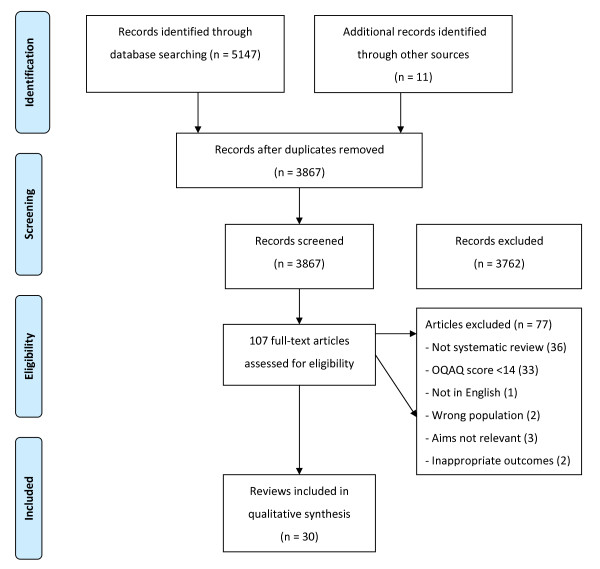
BACKGROUND: To develop more efficient programmes for promoting dietary and/or physical activity change (in order to prevent type 2 diabetes) it is critical to ensure that the intervention components and characteristics most strongly associated with effectiveness are included. The aim of this systematic review of reviews was to identify intervention components that are associated with increased change in diet and/or physical activity in individuals at risk of type 2 diabetes. METHODS: MEDLINE, EMBASE, CINAHL, PsycInfo, and the Cochrane Library were searched for systematic reviews of interventions targeting diet and/or physical activity in adults at risk of developing type 2 diabetes from 1998 to 2008. Two reviewers independently selected reviews and rated methodological quality. Individual analyses from reviews relating effectiveness to intervention components were extracted, graded for evidence quality and summarised. RESULTS: Of 3856 identified articles, 30 met the inclusion criteria and 129 analyses related intervention components to effectiveness. These included causal analyses (based on randomisation of participants to different intervention conditions) and associative analyses (e.g. meta-regression). Overall, interventions produced clinically meaningful weight loss (3-5 kg at 12 months; 2-3 kg at 36 months) and increased physical activity (30-60 mins/week of moderate activity at 12-18 months). Based on causal analyses, intervention effectiveness was increased by engaging social support, targeting both diet and physical activity, and using well-defined/established behaviour change techniques. Increased effectiveness was also associated with increased contact frequency and using a specific cluster of "self-regulatory" behaviour change techniques (e.g. goal-setting, self-monitoring). No clear relationships were found between effectiveness and intervention setting, delivery mode, study population or delivery provider. Evidence on long-term effectiveness suggested the need for greater consideration of behaviour maintenance strategies. CONCLUSIONS: This comprehensive review of reviews identifies specific components which are associated with increased effectiveness in interventions to promote change in diet and/or physical activity. To maximise the efficiency of programmes for diabetes prevention, practitioners and commissioning organisations should consider including these components.
Overview
The claims and statistics of this paper haven’t been checked yet.
Free: it reads the open-access text and checks the first 5 claims that cite a source we can check. Create a free account to check every claim.
Integrity signals
Registry
Cites
Statistics
Figures
Verification
Claims the paper makes
The claims and statistics of this paper haven’t been checked yet.
Free: it reads the open-access text and checks the first 5 claims that cite a source we can check. Create a free account to check every claim.
Claims other papers make about this one
Each is checked against this paper’s own text: does it say what the citing paper says it does?
The cited source says what the claim attributes to it.
In the citing paper
“The addition of behavioural interventions as a third component is believed to increase the effectiveness of dietary and physical interventions (Greaves et al., 2011;Teede et al., 2018).”
From Improvements in PCOS characteristics and phenotype severity during a randomized controlled lifestyle intervention (2021) · cites this paper as Greaves et al., 2011
In the citing paper
“Several studies have shown that targeting dietary self-monitoring, providing social support, and emphasizing both dietary changes and physical activity are key components to successful face-to-face behavioral weight-loss programs [43].”
From Tweets, Apps, and Pods: Results of the 6-Month Mobile Pounds Off Digitally (Mobile POD) Randomized Weight-Loss Intervention Among Adults (2011) · cites this paper as [43]
Self-check
Percentages, sums and reported differences re-computed from the paper’s own numbers.
The self-check needs the paper’s full text.
Citations
Cites
1 retracted
Psychological interventions for overweight or obesity
Shaw, K. A., O'Rourke, P., Del Mar, C., & Kenardy, J. (2005) · Cochrane Database of Systematic Reviews · doi:10.1002/14651858.cd003818.pub2 · Cited by 442 · cited 9×
“5 kg at a median 6 months of follow up[54].”
BackgroundMethodInfluentialRetractedThe theory of planned behavior
Ajzen, I. (1991) · Organizational Behavior and Human Decision Processes · doi:10.1016/0749-5978(91)90020-t · Cited by 134,657 · cited 2×
“Social Cognitive Theory,[60] Theory of Planned Behaviour[ 61 ]) were no more effective in producing changes in either weight or in combined dietary and physical activity outcomes than interventions with no stated theoretical basis[38].”
BackgroundMethodReduction in the incidence of type 2 diabetes with lifestyle intervention or metformin
(2002) · New England Journal of Medicine · doi:10.1056/nejmoa012512 · Cited by 19,011 · cited 5×
“Large randomised controlled trials (RCTs) have shown that relatively modest changes in lifestyle (increasing fibre (≥15 g/1000 kcal), reducing total fat (< 30% of energy consumed) and saturated fat (< 10% of energy consumed), engaging in moderate physical activity (≥30 mins/day), weight reduction (5%)) can reduce the…”
BackgroundMethodInfluentialTuomilehto, J., Lindström, J., Eriksson, J. G., Valle, T. T., Hämäläinen, H., Ilanne-Parikka, P., Keinänen-Kiukaanniemi, S., Laakso, M., Louheranta, A., Rastas, M., et al. (2001) · New England Journal of Medicine · doi:10.1056/nejm200105033441801 · Cited by 10,873 · cited 2×
“Our recommendations go considerably beyond the data on basic effectiveness presented in trials and systematic reviews of diabetes prevention programmes to date[3-8].”
Background‘Small Changes' to Diet and Physical Activity Behaviors for Weight Management
Hills, A. P., Byrne, N. M., Lindstrom, R., & Hill, J. O. (2013) · Obesity Facts · doi:10.1159/000345030 · Cited by 9,493
Motivational interviewing: preparing people for change.
Miller, W. R., & Rollnick, S. (2002) · Guilford Press eBooks · Cited by 7,915
The cochrane database of systematic reviews
Geddes, J. (1996) · Journal of Psychosomatic Research · doi:10.1016/s0022-3999(96)90063-x · Cited by 5,989
Cochrane Database of Systematic Reviews
(2008) · Encyclopedia of Public Health · doi:10.1007/978-1-4020-5614-7_436 · Cited by 4,527
Kirk, J., MacDonald, A., Lavender, P., Dean, J., & Rubin, G. (2017) · Biomedicine Hub · doi:10.1159/000480347 · Cited by 3,887
A taxonomy of behavior change techniques used in interventions
Abraham, C., & Michie, S. (2008) · Health Psychology · doi:10.1037/0278-6133.27.3.379 · Cited by 2,525
Self-citation
Research works printed but not linked: 5
- Scottish Intercollegiate Guidelines Network (SIGN) Management of Diabetes: A national clinical guideline. SIGN Publication Number 55 2001 Edinburgh: SIGN
- Dombrowski SU Sniehotta FF Avenell A Johnston M MacLennan G Araujo-Soares V Effects of specific behaviour change techniques on behaviour and weight change: A systematic review Health Psychology Review in press 20607139
- Bandura A Social foundations of thought and action: A social cognitive theory 1986 Englewood Cliffs, NJ: Prentice-Hall
- National Institute for Health and Clinical Excellence Obesity guidance on the prevention, identification, assessment and management of overweight and obesity in adults and children. London 2006 22497033
- Smith J Deno S Pronk N Reinhardt L Behavioural therapy programs for weight loss in adults: ICSI Technology Assessment Report 2005 Minnesota: Institute for Clinical Systems Improvement
Cited by
Items 901–1,000 of 1,000
Feyissa, T. R., Beks, H., Tolossa, T., Wood, S. M., Namara, K. M., Versace, V. L., Coffee, N. T., Schroers, R., Alsharrah, S. A., & Daniel, M. (2025) · BMC Medicine · doi:10.1186/s12916-025-04458-4 · Cited by 2
Ester, M., Gillespie, D., Zafar, S. N., Githumbi, R., Dhiman, K., Adhikari, K., & Barber, C. E. H. (2025) · BMC Rheumatology · doi:10.1186/s41927-025-00601-z · Cited by 2
Chang, W., Huang, Y., & Kim, D. (2026) · Humanities and Social Sciences Communications · doi:10.1057/s41599-026-06640-2 · Cited by 3
New Approach for Obesity Treatment Incorporating Individual Self- Management Education
Tanaka, K. (2013) · Journal of Obesity & Weight loss Therapy · doi:10.4172/2165-7904.1000164 · Cited by 4
“Although an increasing number of clinical researchers have been aggressively working to find optimal ways of preventing and treating obesity, including dieting, exercising, behavioral treatments, pharmacotherapy, and surgery [15-18], recent evidence suggests that Abstract”
BackgroundCalkins, N. D. (2017) · Strategies · doi:10.1080/08924562.2017.1345262 · Cited by 2
“Self-regulation is a component of social-cognitive theory, a behavior-change theory that has received empirical support demonstrating its effectiveness in increasing physical activity, improving nutritional habits, and enhancing athletic performance (Greaves et al., 2011).”
BackgroundBehaviour change techniques used in lifestyle support of adults with mild intellectual disabilities
Willems, M., de Jong, J., Overwijk, A., Hilgenkamp, T. I. M., van der Schans, C. P., & Waninge, A. (2022) · Journal of Applied Research in Intellectual Disabilities · doi:10.1111/jar.13021 · Cited by 2
Saxton, J., & Wilson, C. (2022) · Proceedings of The Nutrition Society · doi:10.1017/s0029665122002889 · Cited by 3
Sound, R. (2023) · Elsevier eBooks · doi:10.1016/b978-0-323-85615-7.00003-3 · Cited by 2
Yao, J., Steinberg, D., Turner, E. L., Cai, G. Y., Cameron, J. R., Hybels, C. F., Eagle, D. E., Milstein, G., Rash, J. A., & Proeschold‐Bell, R. J. (2023) · Journal of Religion and Health · doi:10.1007/s10943-023-01910-8 · Cited by 2
“The weight loss mechanisms that we observed are comparable to a systematic review, which found that weight loss intervention effectiveness related to self-monitoring and social support (Greaves et al., 2011).”
ResultHartman, Y., Kenkhuis, M., Stelten, S., Brouwer, C. G., van Lonkhuijzen, L. R. C. W., Kenter, G. G., van Driel, W. J., Winkels, R. M., Bekkers, R. L. M., Ottevanger, N. P. B., et al. (2024) · Gynecologic Oncology · doi:10.1016/j.ygyno.2024.03.007 · Cited by 4
Talay, L., & Vickers, M. (2024) · Obesities · doi:10.3390/obesities4040032 · Cited by 3
Collazo‐Castiñeira, P., Echegoyen, I., Schoufour, J. D., Díaz, N. Á., Botella, J., Janiszewska, K., Jiménez-Domínguez, C., Lavilla, V., López-Iglesias, A., Ramírez-Arellano, M. V. M., et al. (2025) · Health Psychology Review · doi:10.1080/17437199.2025.2492042 · Cited by 2
“Regarding whether the intervention was conducted individually or in groups, it did not appear to in fl uence e ff ectiveness, congruently with previous meta-analyses (Samdal et al., 2017) and reviews fi nding e ff ectiveness for both formats (Greaves et al., 2011).”
Sumarno, S., Ndayisenga, J., & Nohantiya, P. (2024) · Jurnal Pendidikan Jasmani Indonesia · doi:10.21831/jpji.v20i2.78134 · Cited by 3
Recent Graduates’ Perspectives on Undergraduate Kinesiology Programs in Canada
Cheng, Y.-Y. (., Klas, A., Ataman, R., Chou, S., & Pouresa, S. (2022) · Health & fitness journal of Canada · doi:10.14288/hfjc.v15i2.817 · Cited by 2
Effectiveness of a Faith-placed Cardiovascular Health Promotion Intervention for Rural Adults.
Zimmermann, K., Carnahan, L. R., Khare, M. M., Chakraborty, A., Risser, H. J., Molina, Y., & GELLER, S. E. (2018) · PubMed · Cited by 2
Intuitive Eating: Expanding the Research & Describing the State of Practice
Schaefer, J. T. (2015) · OhioLink ETD Center (Ohio Library and Information Network) · Cited by 4
Misperception among rural diabetic residents: a cross‐sectional descriptive study
Huang, T., Guo, S., Chang, C., Huang, J., Lin, M., Lee, C., & Chen, M. (2012) · Journal of Advanced Nursing · doi:10.1111/j.1365-2648.2012.06085.x · Cited by 2
Stages of Change for physical activity after a school-based intervention: a cross-sectional study
Ricardo, L. I. C., Rombaldi, A. J., Kopp, D., Ferreira, R. W., Hallal, P. C., & Azevedo, M. R. (2016) · Revista Brasileira de Atividade Física & Saúde · doi:10.12820/rbafs.v.20n6p569 · Cited by 2
Bougeons notre santé ! L’expérience de 40 ateliers de motivation à l’activité physique
Bouté, C., Cailliez, E., D’Hour, A., Goxe, D., Gusto, G., Copin, N., & Lantieri, O. (2016) · Santé Publique · doi:10.3917/spub.164.0451 · Cited by 2
“…dans leur vie quotidienne r é alis é es en groupe, par un travail sur les d é terminants individuels m é diateurs de changements (plaisir, confiance, motivation), qui utilisent une technique dechangementdecomportementsetimpliquentunsoutien social, figurent parmi les plus efficaces [8, 9, 12].”
Mete, R., Georgousopoulou, E. N., Mellor, D. D., Khoo, J. J. C., Cheong, M., Leeds, A., Allan, K., Avery, A., Hart, K., Muir, A., et al. (2017) · Wiley eBooks · doi:10.1002/9781118857991.ch4 · Cited by 2
Conley, C. C., Ryba, M. M., & Andersen, B. L. (2018) · Springer eBooks · doi:10.1007/978-3-319-93003-9_14 · Cited by 2
Ismail, S., Manaf, R. A., Mahmud, A., & Shamsuddin, K. (2018) · Universiti Putra Malaysia Institutional Repository (Universiti Putra Malaysia) · Cited by 5
Ritchie, N. D., Holtrop, J. S., Gritz, R. M., Sauder, K. A., Durfee, M. J., Dickinson, L. M., & Kaufmann, P. G. (2020) · JMIR Research Protocols · doi:10.2196/15499 · Cited by 2
“Multiple systematic reviews support the intended use of MI in a brief, group-based intervention to improve NDPP effectiveness [12-15].”
Behavior Change in Community Contexts
Trickett, E. J., & Paterson, S. E. (2020) · Cambridge University Press eBooks · doi:10.1017/9781108677318.028 · Cited by 2
Are Demographic Factors Associated with Diabetes Risk Perception and Preventive Behavior?
Calhoun, N., Vorderstrasse, A. A., & Chang, J. (2020) · PubMed · Cited by 2
Sustainability of natural movement activity
Metzgar, M. (2012) · Sustainability Science Practice and Policy · doi:10.1080/15487733.2012.11908096 · Cited by 2
“Another issue is social support, one of the keys to behavior change, particularly since people generally prefer exercising in a social setting (Nies & Motyka, 2006; Greaves et al. 2011).”
Move More, Sit Less: Applying the Physical Activity Guidelines for Americans to Extension Programs
Balis, L. E., Fuerniss, H. F., Brown, D. T., Marshall, C., & Harden, S. M. (2021) · Journal of Human Sciences and Extension · doi:10.54718/xcrs5142 · Cited by 2
Changing Lifestyle Behaviors to Improve the Prevention and Management of Cardiovascular Disease
Oldenburg, B. F., Baptista, S. N., Cocker, F., & O'Neil, A. E. (2015) · Springer eBooks · doi:10.1007/978-981-4560-53-5_54-1 · Cited by 4
Verhaltenstherapie der Adipositas
Benecke, A. (2022) · Springer eBooks · doi:10.1007/978-3-662-63544-5_75 · Cited by 2
Functional Imagery Training, a novel, theory-based motivational intervention for weight-loss
Solbrig, L. (2018) · PEARL (University of Plymouth) · doi:10.24382/848 · Cited by 4
van Dongen, E. J. I. (2019) · doi:10.18174/499122 · Cited by 3
An mHealth intervention for the dietary management of hemodialysis patients
Cosette, F. E. K. (2020) · Research Publications (Maastricht University) · doi:10.26481/dis.20200701cf · Cited by 1
“The effectiveness of dietary interventions has been supported in different fields, including chronic kidney disease [5, 7, 12], nephrolithiasis [8], obesity, and diabetes [6, 13], among other areas [4, 14, 15].”
BackgroundTaymoori, P., Khazaee-Pool, M., Pashaei, T., & Ponnet, K. S. (2020) · Research Square · doi:10.21203/rs.3.rs-30151/v1 · Cited by 2
“Social media amongst peer support is fundamental in improving healthy behavior (64).”
BackgroundPáez, A., Nunan, D., McCulloch, P. G., & Beard, D. J. (2024) · medRxiv · doi:10.1101/2024.08.29.24312797 · Cited by 2
Group-mediated exercise for chronic conditions: an urgent need for implementation and scale-up
Rees, T., Beauchamp, M. R., Stevens, M. R., Low, M., & Wainwright, T. W. (2025) · British Journal of Sports Medicine · doi:10.1136/bjsports-2024-109318 · Cited by 2
“8 But these efforts are not working, and with stretched budgets, long wait times and an increasing shortage of health professionals (eg, 15% of physio-therapy staff leave the NHS each year), even if individually focused strategies could be engineered to be successful, creating widespread impact…”
Eder, B. E. (2014) · Otago University Research Archive (University of Otago) · Cited by 3
Stapleton, J. N. (2014) · MacSphere (McMaster University) · doi:10.71548/19533 · Cited by 3
Cost-Effectiveness Evaluations of Behavior Change Interventions
Wang, T., Downes, M., Byrnes, J., & Scuffham, P. (2020) · Cambridge University Press eBooks · doi:10.1017/9781108677318.026 · Cited by 1
Colombo, A. I. M., Voglino, G., Moro, G. L., Taborelli, S., Bianchi, M. A., Gutierrez, L. M., Bert, F., Rosa, M. C. D., & Siliquini, R. (2021) · European Journal of Public Health · doi:10.1093/eurpub/ckab063 · Cited by 1
Cervantes-Ortega, M., Palma, A. M., Rook, K. S., Biegler, K. A., Davis, K. C., Janio, E. A., Kilgore, D. B., Dow, E., Ngo‐Metzger, Q., & Sorkin, D. H. (2023) · International Journal of Behavioral Medicine · doi:10.1007/s12529-022-10145-y · Cited by 2
“To develop more effective programs for individuals with type 2 diabetes, newer intervention models similar to Unidas por la Vida have begun to incorporate family members who share similar health risks [59].”
Background‘Super Rehab’: can we achieve coronary artery disease regression? A feasibility study protocol
Graby, J., Khavandi, A., Gillison, F., Smith, T. R., Murphy, D., Peacock, O., McLeod, H., Dastidar, A. G., Antoniades, C. A., Thompson, D., et al. (2023) · BMJ Open · doi:10.1136/bmjopen-2023-080735 · Cited by 2
“28 30 This will include frequent measurement of body metrics (blood pressure, heart-rate, BMI) to enable goal-setting and biofeedback to encourage adherence.”
BackgroundSaito, R., Sze, W. T., Waki, K., Enomoto, S., Yamauchi, T., Nangaku, M., & Ohe, K. (2024) · Studies in health technology and informatics · doi:10.3233/shti231025 · Cited by 3
Peña, H., & Dulas, H. M. (2024) · Evidence-Based Communication Assessment and Intervention · doi:10.1080/17489539.2024.2412860 · Cited by 1
“Based on standard quality assessment measures (Greaves et al., 2011; Kmet et al., 2004) of the studies meeting the initial inclusion criteria, the authors excluded one systematic/scoping review (Walton & Ingersoll, 2013) and one quantitative study (Robinson & Owens, 1995) for not meeting the…”
Miller, C. K., Young-Hyman, D. L., Wooldridge, J. S., Piatt, G., & Hawkins, J. (2025) · Clinical Diabetes · doi:10.2337/cd25-0020 · Cited by 1
Voorwinde, V., Steenhuis, I. H., Janssen, I. M. C., Monpellier, V. M., & van Stralen, M. M. (2025) · PEC Innovation · doi:10.1016/j.pecinn.2025.100404 · Cited by 2
“Interventions developed based on theory and scientific evidence, often yield superior results [36-38].”
Hohberg, V., Lichtenstein, E., Kreppke, J.-N., Kohl, J., Donath, M. Y., Streckmann, F., Gerber, M., Zahner, L., & Faude, O. (2025) · Journal of science and medicine in sport · doi:10.1016/j.jsams.2025.05.013 · Cited by 1
Mitri, R., & El-Ali, Z. (2025) · Journal of Nutritional Science · doi:10.1017/jns.2025.10014 · Cited by 2
Ester, M., Dhiman, K., Githumbi, R., Sipley, M., Dahal, K. A., & Barber, C. E. H. (2025) · The Journal of Rheumatology · doi:10.3899/jrheum.2025-0191 · Cited by 1
Godevithana, J., Wijesinghe, C. J., & Wijesinghe, M. S. D. (2025) · JMIR Research Protocols · doi:10.2196/70293 · Cited by 1
“The selection of appropriate BCTs is one of the key factors on which the effectiveness or the success of an intervention depends [18].”
Fairman, C. M., Kava, C. M., Beima‐Sofie, K., Sakhuja, M., Masud, M., Dias, E., Sheng, J., Gorzelitz, J., Morshed, A. B., Green, B. B., et al. (2025) · Lifestyle Medicine · doi:10.1002/lim2.70038 · Cited by 1
Lewis, E. C., Eldridge, G. D., Villarreal, D. L., Graham, M. L., Andrews-Trevino, J. Y., Folta, S. C., Maddock, J. E., Patterson, M. S., Andreyeva, E., & Seguin‐Fowler, R. A. (2025) · Social Sciences · doi:10.3390/socsci14110674 · Cited by 1
“…and strong social connections shown to play a crucial role in physical and mental health (Anderson et al. 2006; Anderson et al. 2007; Annesi 2011; Greaves et al. 2011; Jung and Brawley 2013; Schwarzer and Leppin 1991; Sheats et al. 2017; United States Institute of Peace n.d.; Wing et al. 2006).”
Mahboub, N., Slaybe, M. A., Mikhael, E., Tohme, P., Baltagi, T. K., de Vries, N. K., & Rizk, R. (2025) · Social Sciences & Humanities Open · doi:10.1016/j.ssaho.2025.102309 · Cited by 1
Ramamoorthy, S., Muhajarine, N., & Gauvin, L. I. (2025) · Journal of Public Health · doi:10.1093/pubmed/fdaf156 · Cited by 1
Kawaoka, T., Sakaguchi, Y., Oka, T., Doi, Y., Yamamoto, R., Matsui, I., Mizui, M., Kaimori, J.-Y., & Isaka, Y. (2026) · JMIR mhealth and uhealth · doi:10.2196/68447 · Cited by 1
“Greaves et al [45] reported that intervention intensity, such as the number of sessions and total contact time, was related to self-reported dietary changes.”
Diet and multiple sclerosis: Behaviour change techniques in the digital health application levidex
Krause, N., von Glasenapp, B., Heesen, C., Meyer, B., & Riemann-Lorenz, K. (2026) · Patient Education and Counseling · doi:10.1016/j.pec.2026.109613 · Cited by 1
Meywirth, S., Janson, A., & Söllner, M. (2026) · Behaviour and Information Technology · doi:10.1080/0144929x.2026.2676746 · Cited by 1
“While coaching interventions have proven effective in supporting behaviour change, access to such support is often limited (Greaves et al. 2011).”
Simi, T. A., Jagasia, K., Phillips, J., Malyan, H. H., Cooper, R., Bergstrom, J., Daly, R., Moore, A. A., Ancoli‐Israel, S., & Molina, A. J. A. (2026) · International Psychogeriatrics · doi:10.1016/j.inpsyc.2026.100225 · Cited by 1
Morris, A., Lycett, D., & Patel, R. (2026) · Journal of Human Nutrition and Dietetics · doi:10.1111/jhn.70295 · Cited by 1
“The Theoretical Domains Framework (v2) [17] is a validated integrative framework that consolidates constructs from multiple behaviour change theories into 14 domains relevant to implementation and intervention design [20, 21] (Supporting Information Table S1).”
Elalfy, A., Abdelnabi, M. H., Mohamed, A. E., VanDolah, H. B., Sayed, R. S., Kholeif, Z. M., Rashwan, R., Ibrahim, R., Perone, F., Thomas, R. J., et al. (2026) · European Journal of Preventive Cardiology · doi:10.1093/eurjpc/zwag375 · Cited by 1
Chow, E. J., Lee, E. D., Hershberger, M., Jenssen, K. M., Di, C., Doody, D. R., Hogue, B., Mendoza, J. A., Muller, T., Schenk, J. M., et al. (2026) · JMIR Research Protocols · doi:10.2196/104572 · Cited by 1
“…a 6-month lower-intensity maintenance phase where intervention participants had increased responsibility for self-monitoring, goal setting, and other strategies that have been shown to enhance adherence to lifestyle change while still receiving feedback and social support from the study [45].”
Quality Improvement Strategies to Enhance Physical Activity
Jaworski, C. A., & Ladewski, M. (2014) · Current Cardiovascular Risk Reports · doi:10.1007/s12170-014-0421-6 · Cited by 1
Editorial, A. (2015) · PULMONOLOGIYA · doi:10.18093/0869-0189-2015-25-3-277-290 · Cited by 2
Mahdavi, R., Ghannadiasl, F., & Jafarabadi, M. A. (2016) · Iranian Red Crescent Medical Journal · doi:10.5812/ircmj.24390 · Cited by 1
Modifying lifestyle behaviours to improve the prevention and management of cardiovascular disease
O'Neil, A. E., Oldenburg, B. F., Baptista, S. N., Cassimatis, M., & Cocker, F. (2017) · Minerva Access (University of Melbourne) · Cited by 1
Diet, Physical Activity, and Weight Control for Cancer Patients and Survivors
Demark‐Wahnefried, W., Rogers, L. Q., Alfano, C. M., Thomson, C. A., Courneya, K. S., Meyerhardt, J. A., Stout, N. L., Kvale, E. A., Ganzer, H., Gansler, T. S., et al. (2017) · Wiley eBooks · doi:10.1002/9781119468868.ch23 · Cited by 1
Perspektien digitaler Diabetesprävention: wo wollen wir hin?
Lantzsch, H., Harst, L., & Timpel, P. (2018) · Diabetes aktuell · doi:10.1055/a-0804-6239 · Cited by 1
“[77] Greaves CJ, Sheppard KE, Abraham C et al.”
BackgroundIncreasing physical activity in people with COPD
Armstrong, M. (2020) · Practice Nursing · doi:10.12968/pnur.2020.31.11.461 · Cited by 2
Prevention of Stroke by Modification of Additional Vascular and Lifestyle Risk Factors
Towfighi, A., & Saver, J. L. (2020) · Cambridge University Press eBooks · doi:10.1017/9781316286234.018 · Cited by 1
Porto, L. G. G., Molina, G. E., Martin, D. R. F. S., Soares, E. D. M. K. V. K., Barbosa, J. P. A., Barreto, K. A., da Cruz, C. J. G., & Nogueira, R. M. (2020) · Revista FLAMMAE · doi:10.17648/2359-4837/flammae.v6n16.p7-38 · Cited by 5
Naber, A. J., Willhite, L., & Molitor, W. L. (2021) · Work · doi:10.3233/wor-213443 · Cited by 2
“These findings are in line with a systematic review which reported personalized goal setting as an effective way to create behavior change in adults who are sedentary [39].”
Mustafa, A. S., Ali, N. B., & Dhillon, J. S. (2021) · Lecture notes on data engineering and communications technologies · doi:10.1007/978-3-030-70713-2_26 · Cited by 2
Eckert, T., Wunsch, K., Fiedler, J., & Wöll, A. (2021) · Prävention und Gesundheitsförderung · doi:10.1007/s11553-021-00873-6 · Cited by 1
“Setzen von Zielen) bei Erwachsenen als besonders wirksam [10].”
BackgroundDevelopment and evaluation of complex multicomponent interventions in public health
Campbell, R. M., & Bonell, C. P. (2021) · doi:10.1093/med/9780198816805.003.0048 · Cited by 1
Health Coaching for People With Disabilities: An Exploratory Mixed-Methods Study
Standley, K., Ravesloot, C., Sage, R. A., & Sondag, K. A. (2022) · American Journal of Health Promotion · doi:10.1177/08901171221109524 · Cited by 3
Schwartz, J., OH, P. I., Bredin, S. S. D., Rhodes, R. E., Perotto, M. B., Gaytán-González, A., & Warburton, D. E. R. (2022) · Journal of Clinical Medicine · doi:10.3390/jcm11195926 · Cited by 1
“better results and would likely have been welcomed by those engaged in the program since sharing day-to-day experiences and feelings can critically affect wellbeing [92,93].”
Importance of lifestyle modifications
Das, B., & Fatima, T. (2023) · Elsevier eBooks · doi:10.1016/b978-0-323-87932-3.00030-x · Cited by 1
Cummings, H. C., Merkas, J., Yaraskavitch, J., & Longmuir, P. E. (2023) · Children · doi:10.3390/children10081293 · Cited by 1
Women's empowerment: Current trends and the overlooked issue of physical activity participation
Tamanna, T., & Aarti, A. (2023) · International journal of applied research · doi:10.22271/allresearch.2023.v9.i9c.11329 · Cited by 2
Ghimire, K., Mishra, S. R., Neupane, D., Kallestrup, P., & McLachlan, C. S. (2024) · Nutrients · doi:10.3390/nu16121928 · Cited by 2
“Further, motivation-oriented activities should be incorporated into the interventions as behaviour-changing techniques [38].”
BackgroundReprint of: Blood Sugar Regulation for Cardiovascular Health Promotion and Disease Prevention
Schwarz, P. E. H., Timpel, P., Harst, L., Greaves, C. J., Ali, M. K., Lambert, J. D., Weber, M. B., Almedawar, M. M., & Morawietz, H. (2018) · Journal of the American College of Cardiology · doi:10.1016/j.jacc.2018.10.026 · Cited by 2
Self-citationBreukelman, G. J., Preez, C. J. D., Djarova, T. G., & Basson, A. K. (2018) · Journal of Applied Sports Sciences · doi:10.37393/jass.2018.01.9 · Cited by 2
Salemonsen, E. (2020) · University of Stavanger eBooks · doi:10.31265/usps.52 · Cited by 1
Effects of community-based interventions on physical activity levels: systematic review
Guerra, P. H., Ribeiro, E. H. C., de Lima, T. R., Andrade, D. R., & Loch, M. R. (2020) · Revista Brasileira de Atividade Física & Saúde · doi:10.12820/rbafs.25e0130 · Cited by 1
CARDIAC DYSFUNCTION IN THE ZDF RAT: POSSIBLE MECHANISMS AND BENEFITS OF EXERCISE
VanHoose, L. (2011) · KU ScholarWorks (The University of Kansas) · Cited by 1
Reichenpfader, U., Thaler, K. J., Richter, A., Thieda, P., & Gartlehner, G. (2012) · Wiener Medizinische Wochenschrift · doi:10.1007/s10354-012-0135-7 · Cited by 1
Price, C. (2015) · Murdoch University Research Portal · doi:10.13140/rg.2.2.29004.41600 · Cited by 1
Evaluation of an internet based weight loss intervention
Sherrington, A. M. (2015) · Cited by 1
Evaluating a Novel Device for Calorie Reduction: The Bite Counter Study
Mayette, G. (2016) · Digital Commons - URI (University of Rhode Island) · doi:10.23860/thesis-mayette-gregory-2016 · Cited by 1
The Meaning of Involvement in an Exercise and Health Promotion Program for People with Diabetes
Middleton, R. (2016) · Research Online (University of Wollongong) · Cited by 1
Western, M. J. (2016) · The University of Bath Online Publications Store (The University of Bath) · Cited by 1
Incorporating motivational interviewing into rheumatology care
Palmer, D., & Miedany, Y. M. E. (2018) · British Journal of Nursing · doi:10.12968/bjon.2018.27.7.370 · Cited by 1
Self-monitoring technologies to promote healthy behavior in the long term
Randriambelonoro, M. (2020) · Archive ouverte UNIGE (University of Geneva) · doi:10.13097/archive-ouverte/unige:136731 · Cited by 1
Sevild, C. H. (2021) · NVA (Nasjonalt vitenarkiv) · Cited by 2
Wood, C., Barton, J., & Smyth, N. (2020) · SportRxiv (OSF Preprints) · doi:10.31236/osf.io/qu73a · Cited by 2
Kapteyn, A., Kapteyn, A., & Darling, J. E. (2021) · Survey research methods · doi:10.18148/srm/2024.v18i3.8308 · Cited by 1
Organizing Care: U.S. Health Policy, Social Inequality, and the Work of Cancer Treatment
Armin, J. S. (2015) · UA Campus Repository (The University of Arizona) · Cited by 2
INCREASING LONG TERM WEIGHT LOSS SUCCESS: AN INDIVIDUALIZED, HOLISTIC, SELF-CARE MODEL
Lane, A. D. (2014) · CSUSB ScholarWorks (California State University, San Bernardino)
Spark, L. C. (2015) · The University of Queensland · doi:10.14264/uql.2015.641
An Eating Frequency Prescription for a Behavioral Weight Loss Intervention
Bachman, J. L. (2011)
Metadata
- Authors
- The IMAGE Study Group, Greaves, C. J., Sheppard, K. E., Abraham, C., Hardeman, W., Roden, M., Evans, P. H., & Schwarz, P.
- Affiliations
- University of Exeter (GB)
- University of Sussex (GB)
- University of Cambridge (GB)
- Deutsches Diabetes-Zentrum e.V. (DE)
- Technische Universität Dresden (DE)
- Corresponding author
- Greaves, Colin J
- Venue
- BMC Public Health
- Published
- 2011-02-18
- Volume
- 11
- Issue
- 1
- Pages
- 119-119
- ISSN
- 1471-2458 (ISSN-L)
- PMC
- PMC3048531
- OpenAlex
- W1986234805
- Semantic Scholar
- ae3ceecabd2574191054e1c9fad7edb78e2c791f
- Cited by
- 1,163
- References
- 82
- Citations by year
- 2026: 35 · 2025: 50 · 2024: 60 · 2023: 55 · 2022: 79 · 2021: 89 · 2020: 158 · 2019: 93 · 2018: 108 · 2017: 81 · 2016: 80 · 2015: 90 · 2014: 72 · 2013: 59 · 2012: 41
- FWCI
- 10.24
- Type
- journal article
- Language
- en
- Open access
- gold
- doi.org
- Licence
- cc-by
- creativecommons.org/licenses/by/2.0 (tdm)
- Locations
- BMC Public Health (publishedVersion, cc-by)
- PubMed Central (publishedVersion, cc-by)
- PubMed (publishedVersion)
- DOAJ (DOAJ: Directory of Open Access Journals) (submittedVersion)
- Figshare (submittedVersion, cc-by)
- Figshare (submittedVersion)
- Minerva Access (University of Melbourne) (submittedVersion, cc-by)
- Open Research Exeter (University of Exeter) (submittedVersion, cc-by)
- University of Birmingham Research Portal (University of Birmingham) (submittedVersion)
- UEA Digital Repository (University of East Anglia) (submittedVersion)
- Apollo (University of Cambridge) (submittedVersion, cc-by)
- Funders
- National Institute for Health and Care Research (PDA/02/06/031)
- European Commission
- Topics
- Social Sciences › Psychology › Applied Psychology › Behavioral Health and Interventions
- Health Sciences › Medicine › Public Health, Environmental and Occupational Health › Physical Activity and Health
- Health Sciences › Medicine › Endocrinology, Diabetes and Metabolism › Diabetes Management and Education
- Keywords
- type 2 diabetes prevention, dietary intervention, physical activity interventions, intervention components, behaviour change techniques, social support, weight loss, self-regulation, goal setting, self-monitoring, behavior maintenance, intervention effectiveness
- MeSH terms
- Diabetes Mellitus, Type 2, Diet, Health Promotion, Humans, Motivation, Exercise, Risk Reduction Behavior
About these checks
Registry, retraction, Cites and statistics results are computed, not judged, with one exception: a printed reference that no index lists is read once by a model before it counts as a citation error. Claims are extracted by a model and kept only when their quote appears verbatim in the text; each cited source is then checked, with a model’s help, for whether it says what the claim relies on. Those verdicts can be wrong — read the claim’s quote and the cited source before relying on one.
Statistics and arithmetic are recomputed, not judged.
Confidence bands are shown only for fields calibrated on our annotated test set. None is calibrated yet, so no band is shown.
What counts as a claim ›How we measure confidence ›How we check this ›
Are you an author, or do you see a problem with this page? Request a review
Data sources
Bibliographic data: Semantic Scholar, OpenAlex, Crossref.
Contains information from the Semantic Scholar Academic Graph Datasets, made available under the ODC Attribution License (ODC-BY 1.0).
Semantic Scholar’s data is described in: Kinney, R., et al. (2023). The Semantic Scholar Open Data Platform. arXiv:2301.10140.
