

The DOI matches its Crossref record; 74 of the 75 references it cites were found in a registry or an index; none of the 106 sources its claims cite is checked for support yet.
Is volunteering a public health intervention? A systematic review and meta-analysis of the health and survival of volunteers
Open accessAbstract
Background: Volunteering has been advocated by the United Nations, and American and European governments as a way to engage people in their local communities and improve social capital, with the potential for public health benefits such as improving wellbeing and decreasing health inequalities. Furthermore, the US Corporation for National and Community Service Strategic Plan for 2011–2015 focused on increasing the impact of national service on community needs, supporting volunteers’ wellbeing, and prioritising recruitment and engagement of underrepresented populations. The aims of this review were to examine the effect of formal volunteering on volunteers’ physical and mental health and survival, and to explore the influence of volunteering type and intensity on health outcomes. Methods: Experimental and cohort studies comparing the physical and mental health outcomes and mortality of a volunteering group to a non-volunteering group were identified from twelve electronic databases (Cochrane Library, Medline, Embase, PsychINFO, CINAHL, ERIC, HMIC, SSCI, ASSIA, Social Care Online, Social Policy and Practice) and citation tracking in January 2013. No language, country or date restrictions were applied. Data synthesis was based on vote counting and random effects meta-analysis of mortality risk ratios. Results: Forty papers were selected: five randomised controlled trials (RCTs, seven papers); four non-RCTs; and 17 cohort studies (29 papers). Cohort studies showed volunteering had favourable effects on depression, life satisfaction, wellbeing but not on physical health. These findings were not confirmed by experimental studies. Meta-analysis of five cohort studies found volunteers to be at lower risk of mortality (risk ratio: 0.78; 95% CI: 0.66, 0.90). There was insufficient evidence to demonstrate a consistent influence of volunteering type or intensity on outcomes. Conclusion: Observational evidence suggested that volunteering may benefit mental health and survival although the causal mechanisms remain unclear. Consequently, there was limited robustly designed research to guide the development of volunteering as a public health promotion intervention. Future studies should explicitly map intervention design to clear health outcomes as well as use pragmatic RCT methodology to test effects.
Overview
AI snapshot
Written from the paper’s full text.
TL;DR
This systematic review and meta-analysis found observational evidence that formal volunteering may improve mental health and reduce mortality, but experimental evidence did not confirm consistent health benefits. The authors conclude there is limited robust evidence to guide volunteering as a public health intervention.
Key findings
- Forty papers were included: 5 RCTs (7 papers), 4 non-RCTs, and 17 cohort studies (29 papers). Cohort studies showed favourable effects on depression, life satisfaction, and wellbeing, but not on physical health; these findings were not confirmed by experimental studies.
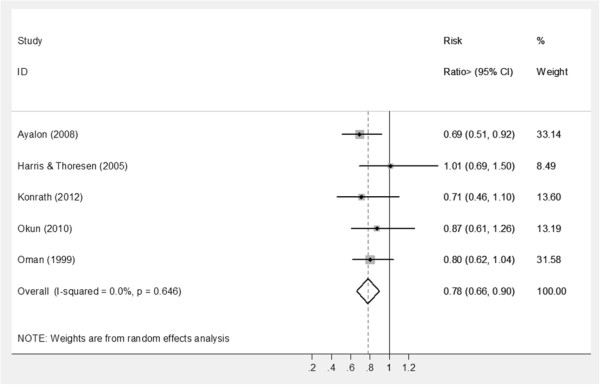
- Meta-analysis of five cohort studies found volunteers had a lower risk of mortality (risk ratio: 0.78; 95% CI: 0.66, 0.90; I² test: p = 0.65), corresponding to a 22% reduction (CI: 10% to 34%).
- Vote counting found no consistent significant health benefits in experimental studies; only single trials reported significant associations with increased physical activity, strength, walking speed, empowerment, wellbeing, and decreased stress.
- There was insufficient evidence to demonstrate a consistent influence of volunteering type or intensity on outcomes.
Methods
- Systematic review and meta-analysis following a pre-defined protocol and PRISMA; searches in January 2013 across twelve electronic databases plus citation tracking, with no language, country, or date restrictions.
- Included experimental and cohort studies comparing physical and/or mental health outcomes and mortality in volunteers versus non-volunteers, adults aged 16 years and above; formal volunteering had to be regular and long-term, defined as a minimum of one hour a month on at least two occasions.
- Data synthesis used vote counting for most outcomes and random-effects meta-analysis of mortality risk ratios; quality was appraised with the Cochrane risk of bias tool for RCTs and the Newcastle-Ottawa Scale for cohort/non-RCT studies.
Limitations
- The paper states that meta-analysis was possible only for survival data; other physical and mental health outcomes were restricted to vote counting due to heterogeneous interventions and study methods.
- The paper states that generalisability is limited because most studies were based in the USA, involved community-dwelling people aged 50 years or over, and many non-USA studies reported cross-sectional data that were excluded.
- The paper states that causal mechanisms remain unclear, selection effects and reverse causality cannot be conclusively ruled out, many cohort studies failed to fully describe volunteering status or measurement, and trial evidence was limited by small, likely underpowered samples and attrition.
Model-written summary. Check it against the paper before relying on it.
Integrity signals
Registry
Cites
Statistics
Figures
Verification
Claims the paper makes
38 Not checked yet · 16 Own result · 15 Own method · 14 Own interpretation · 4 No basis given
None of the sources cited for this claim have been checked yet.
In the paper
“As three RCT papers reported different outcomes collected at the same follow-up from the Experience Corps trial [30,35,58]; a total of five independent RCTs [33,37,54,62] were identified.”
§ Is volunteering a public health intervention? A systematic review and meta-analysis of the health and survival of volunteers > Results > Study characteristics
What the sources say
- Not checked yetcites [33] Cohen A: Welfare clients’ volunteering as a means of empowerment. Nonprofit Volunt Sec Q. 2009, 38: 522-534. 10.1177/0899764008320196. source
- Not checked yetcites [37] George DR, Singer ME: Intergenerational volunteering and quality of life for persons with mild to moderate dementia: results from a 5-month intervention study in the United States. Am J Geriatr Psychiatry. 2011, 19: 392-396. 10.1097/JGP.0b013e3181f17f20. source
- Not checked yetcites [54] Rook KS, Sorkin DH: Fostering social ties through a volunteer role: Implications for older-adults’ psychological health. Int J Aging Hum Dev. 2003, 57: 313-337. 10.2190/NBBN-EU3H-4Q1N-UXHR. source
- Not checked yetcites [62] Yuen HK, Huang P, Burik JK, Smith TG: Impact of participation in volunteer activities for residents living in long-term-care facilities. Am J Occup Ther. 2008, 62: 71-76. 10.5014/ajot.62.1.71. source
plainn = 4- Asserted: passes — The authors put it forward as true.
- Checkable: passes — It can be checked against evidence.
- Load-bearing: passes — The paper’s conclusions depend on it.
- Based: passes — The paper gives a reason why it holds.
A result the paper reports from its own data — it cites no other source for it, so there is none to check. The quote shows it is in the paper.
In the paper
“There was insufficient evidence to demonstrate a consistent influence of volunteering type or intensity on outcomes.”
§ Is volunteering a public health intervention? A systematic review and meta-analysis of the health and survival of volunteers > Abstract > Results
plain- Asserted: passes — The authors put it forward as true.
- Checkable: passes — It can be checked against evidence.
- Load-bearing: passes — The paper’s conclusions depend on it.
- Based: passes — The paper gives a reason why it holds.
A result the paper reports from its own data — it cites no other source for it, so there is none to check. The quote shows it is in the paper.
In the paper
“Cohort studies showed volunteering had favourable effects on depression, life satisfaction, wellbeing but not on physical health.”
§ Is volunteering a public health intervention? A systematic review and meta-analysis of the health and survival of volunteers > Abstract > Results
plaindirect- Asserted: passes — The authors put it forward as true.
- Checkable: passes — It can be checked against evidence.
- Load-bearing: passes — The paper’s conclusions depend on it.
- Based: passes — The paper gives a reason why it holds.
A result the paper reports from its own data — it cites no other source for it, so there is none to check. The quote shows it is in the paper.
In the paper
“Cohort studies showed volunteering had favourable effects on depression, life satisfaction, wellbeing but not on physical health.”
§ Is volunteering a public health intervention? A systematic review and meta-analysis of the health and survival of volunteers > Abstract > Results
plain- Asserted: passes — The authors put it forward as true.
- Checkable: passes — It can be checked against evidence.
- Load-bearing: passes — The paper’s conclusions depend on it.
- Based: passes — The paper gives a reason why it holds.
A result the paper reports from its own data — it cites no other source for it, so there is none to check. The quote shows it is in the paper.
In the paper
“Cohort studies showed volunteering had favourable effects on depression, life satisfaction, wellbeing but not on physical health.”
§ Is volunteering a public health intervention? A systematic review and meta-analysis of the health and survival of volunteers > Abstract > Results
plaindirect- Asserted: passes — The authors put it forward as true.
- Checkable: passes — It can be checked against evidence.
- Load-bearing: passes — The paper’s conclusions depend on it.
- Based: passes — The paper gives a reason why it holds.
None of the sources cited for this claim have been checked yet.
In the paper
“Three studies reported no association with volunteering [9,44,49].”
§ Is volunteering a public health intervention? A systematic review and meta-analysis of the health and survival of volunteers > Results > Impact of volunteering on health outcomes and survival
What the sources say
- Not checked yetcites [9] Konrath S, Fuhrel-Forbis A, Lou A, Brown S: Motives for volunteering are associated with mortality risk in older adults. Health Psychol. 2012, 31: 87-96. source
- Not checked yetcites [44] Menec VH: The relation between everyday activities and successful aging: a 6 year longitudinal study. J Gerontol B Psychol Sci Soc Sci. 2003, 58B: S74-S82. source
- Not checked yetcites [49] Okun MA, August KJ, Rook KS, Newsom JT: Does volunteering moderate the relation between functional limitations and mortality?. Soc Sci Med. 2010, 71: 1662-1668. 10.1016/j.socscimed.2010.07.034. source
plain- Asserted: passes — The authors put it forward as true.
- Checkable: passes — It can be checked against evidence.
- Load-bearing: unclear — It is unclear whether the paper’s conclusions depend on it.
- Based: passes — The paper gives a reason why it holds.
None of the sources cited for this claim have been checked yet.
In the paper
“Four [28,43,60,63] of the five cohorts [28,43,44,60,63] that assessed life satisfaction reported benefit (3–25 year follow-ups).”
§ Is volunteering a public health intervention? A systematic review and meta-analysis of the health and survival of volunteers > Results > Impact of volunteering on health outcomes and survival
What the sources say
- Not checked yetcites [28] Bowman N, Brandenberger J, Lapsley D, Hill P, Quaranto J: Serving in college, flourishing in adulthood: does community engagement during the college years predict adult well-being?. Appl Psychol Health Wellbeing. 2010, 2: 14-34. 10.1111/j.1758-0854.2009.01020.x. source
- Not checked yetcites [43] Meier S, Stutzer A: Is volunteering rewarding in itself?. Economica. 2008, 75: 39-59. source
- Not checked yetcites [60] Van Willigen M: Differential benefits of volunteering across the life course. J Gerontol B Psychol Sci Soc Sci. 2000, 55: S308-S318. 10.1093/geronb/55.5.S308. source
- Not checked yetcites [63] Nazroo J, Matthews K: The impact of volunteering on well-being in later life. A report to WRVS. 2012, Cardiff, UK: WRVS
- Not checked yetcites [44] Menec VH: The relation between everyday activities and successful aging: a 6 year longitudinal study. J Gerontol B Psychol Sci Soc Sci. 2003, 58B: S74-S82. source
plaincorrelational- Asserted: passes — The authors put it forward as true.
- Checkable: passes — It can be checked against evidence.
- Load-bearing: unclear — It is unclear whether the paper’s conclusions depend on it.
- Based: passes — The paper gives a reason why it holds.
None of the sources cited for this claim have been checked yet.
In the paper
“The remainder found statistically significant associations between at least one measure of volunteering status or intensity (e.g. frequency, hours spent, number of organisations supported) and mortality [26,38,47,50]. Interpretation was difficult, however, as studies reported statistically significant, but contradictory associations.”
§ Is volunteering a public health intervention? A systematic review and meta-analysis of the health and survival of volunteers > Results > Impact of volunteering on health outcomes and survival
What the sources say
- Not checked yetcites [26] Ayalon L: Volunteering as a predictor of all-cause mortality: what aspects of volunteering really matter?. Int Psychogeriatr. 2008, 20: 1000-1013.
- Not checked yetcites [38] Harris AHS, Thoresen CE: Volunteering is associated with delayed mortality in older people: analysis of the longitudinal study of aging. J Health Psychol. 2005, 10: 739-752. 10.1177/1359105305057310. source
- Not checked yetcites [47] Musick MA, Herzog A, House JS: Volunteering and mortality among older adults: findings from a national sample. J Gerontol B Psychol Sci Soc Sci. 1999, 54B: S173-S180. 10.1093/geronb/54B.3.S173. source
- Not checked yetcites [50] Oman D, Thoresen CE, McMahon K: Volunteerism and mortality among the community-dwelling elderly. J Health Psychol. 1999, 4: 301-316. source
plaincorrelational- Asserted: passes — The authors put it forward as true.
- Checkable: passes — It can be checked against evidence.
- Load-bearing: unclear — It is unclear whether the paper’s conclusions depend on it.
- Based: passes — The paper gives a reason why it holds.
A result the paper reports from its own data — it cites no other source for it, so there is none to check. The quote shows it is in the paper.
In the paper
“Four out of five RCTs were at moderate or high risk of bias due to the random sequence generation not being described, high attrition rates, and small sample sizes available for analysis”
§ Is volunteering a public health intervention? A systematic review and meta-analysis of the health and survival of volunteers > Results > Methodological quality
plain- Asserted: passes — The authors put it forward as true.
- Checkable: passes — It can be checked against evidence.
- Load-bearing: unclear — It is unclear whether the paper’s conclusions depend on it.
- Based: passes — The paper gives a reason why it holds.
A result the paper reports from its own data — it cites no other source for it, so there is none to check. The quote shows it is in the paper.
In the paper
“Cohort studies showed volunteering had favourable effects on depression, life satisfaction, wellbeing but not on physical health.”
§ Is volunteering a public health intervention? A systematic review and meta-analysis of the health and survival of volunteers > Abstract > Results
plaincorrelational- Asserted: passes — The authors put it forward as true.
- Checkable: passes — It can be checked against evidence.
- Load-bearing: passes — The paper’s conclusions depend on it.
- Based: passes — The paper gives a reason why it holds.
- Probably not a substantial claim. 30
- It may state two separate claims as one. 28
None of the sources cited for this claim have been checked yet.
In the paper
“Eleven papers reported RCTs (n = 7) [30,33,35,37,54,58,62] and non-RCTs (n = 4) [27,29,34,57].”
§ Is volunteering a public health intervention? A systematic review and meta-analysis of the health and survival of volunteers > Results > Study characteristics
What the sources say
- Not checked yetcites [27] Belgrave M: The effect of a music therapy intergenerational program on children and older adults’ intergenerational interactions, cross-age attitudes, and older adults’ psychosocial well-being. J Music Ther. 2011, 48: 486-508. source
- Not checked yetcites [29] Carlson MC, Erickson KI, Kramer AF, Voss MW, Bolea N, Mielke M, McGill S, Rebok GW, Seeman T, Fried LP: Evidence for neurocognitive plasticity in at-risk older adults: the experience corps program. J Gerontol A Biol Sci Med Sci. 2009, 64: 1275-1282. source
- Not checked yetcites [34] Dabelko-Schoeny H, Anderson KA, Spinks K: Civic engagement for older adults with functional limitations: piloting an intervention for adult day health participants. Gerontologist. 2010, 50: 694-701. 10.1093/geront/gnq019. source
- Not checked yetcites [57] Tan EJ, Rebok GW, Yu QL, Frangakis CE, Carlson MC, Wang T, Ricks M, Tanner EK, McGill S, Fried LP: The long-term relationship between high-intensity volunteering and physical activity in older African American women. J Gerontol B Psychol Sci Soc Sci. 2009, 64: 304-311. source
plainn = 4- Asserted: passes — The authors put it forward as true.
- Checkable: passes — It can be checked against evidence.
- Load-bearing: fails — The paper’s conclusions may not depend on it.
- Based: passes — The paper gives a reason why it holds.
Probably not a substantial claim. The paper’s conclusions may not depend on it.
In the paper
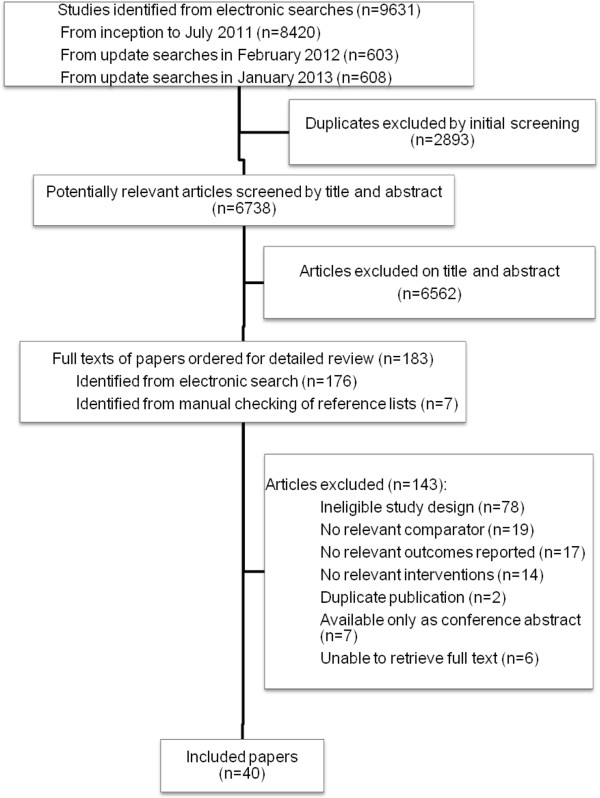
“Forty papers were selected: five randomised controlled trials (RCTs, seven papers); four non-RCTs; and 17 cohort studies (29 papers).”
- Also stated in: § Results · plain
“Forty papers were included in the review [9,25-63].”
§ Is volunteering a public health intervention? A systematic review and meta-analysis of the health and survival of volunteers > Abstract > Results
What the sources say
- Not checked yetcites [9,25-63]
plain- Asserted: passes — The authors put it forward as true.
- Checkable: passes — It can be checked against evidence.
- Load-bearing: fails — The paper’s conclusions may not depend on it.
- Based: passes — The paper gives a reason why it holds.
Probably not a substantial claim. The paper’s conclusions may not depend on it.
- Also stated in: § Results · plain
A result the paper reports from its own data — it cites no other source for it, so there is none to check. The quote shows it is in the paper.
In the paper
“Twenty-nine papers reported longitudinal analysis of cohort studies; 13 papers reported unique cohorts.”
§ Is volunteering a public health intervention? A systematic review and meta-analysis of the health and survival of volunteers > Results > Study characteristics
plain- Asserted: passes — The authors put it forward as true.
- Checkable: passes — It can be checked against evidence.
- Load-bearing: fails — The paper’s conclusions may not depend on it.
- Based: passes — The paper gives a reason why it holds.
Probably not a substantial claim. The paper’s conclusions may not depend on it. It may state two separate claims as one.
None of the sources cited for this claim have been checked yet.
In the paper
“Volunteering status was significantly associated with improved wellbeing in three cohorts [25,28,31,51,52] (10–29 year follow-ups) but findings regarding volunteering intensity were inconsistent.”
§ Is volunteering a public health intervention? A systematic review and meta-analysis of the health and survival of volunteers > Results > Impact of volunteering on health outcomes and survival
What the sources say
- Not checked yetcites [25] Son J, Wilson J: Volunteer work and hedonic, eudemonic, and social well-being. Sociological Forum. 2012, 27: 658-681. 10.1111/j.1573-7861.2012.01340.x. source
- Not checked yetcites [28] Bowman N, Brandenberger J, Lapsley D, Hill P, Quaranto J: Serving in college, flourishing in adulthood: does community engagement during the college years predict adult well-being?. Appl Psychol Health Wellbeing. 2010, 2: 14-34. 10.1111/j.1758-0854.2009.01020.x. source
- Not checked yetcites [31] Choi NG, Kim J: The effect of time volunteering and charitable donations in later life on psychological wellbeing. Ageing Soc. 2011, 31: 590-610. 10.1017/S0144686X10001224. source
- Not checked yetcites [51] Piliavin JA: Feeling good by doing good: health consequences of social service. Processes of community change and social action. 2005, Mahwah, New Jersey, USA: Lawrence Erlbaum Associates Publishers, 29-50.
- Not checked yetcites [52] Piliavin JA, Siegl E: Health benefits of volunteering in the Wisconsin longitudinal study. J Health Soc Behav. 2007, 48: 450-464. 10.1177/002214650704800408. source
plaincorrelational- Asserted: passes — The authors put it forward as true.
- Checkable: passes — It can be checked against evidence.
- Load-bearing: passes — The paper’s conclusions depend on it.
- Based: passes — The paper gives a reason why it holds.
It may state two separate claims as one.
None of the sources cited for this claim have been checked yet.
In the paper
“Irrespective of how it was measured, volunteering was associated with reduced levels of depression in four cohorts [32,40-42,46,48,51,63], with two cohorts reporting no benefits [36,53].”
§ Is volunteering a public health intervention? A systematic review and meta-analysis of the health and survival of volunteers > Results > Impact of volunteering on health outcomes and survival
What the sources say
- Not checked yetcites [32] Choi NG, Bohman TM: Predicting the changes in depressive symptomatology in later life: how much do changes in health status, marital and caregiving status, work and volunteering, and health-related behaviors contribute?. J Aging Health. 2007, 19: 152-177. 10.1177/0898264306297602. source
- Not checked yetcites [40] Kim J, Pai M: Volunteering and trajectories of depression. J Aging Health. 2010, 22: 84-105. 10.1177/0898264309351310. source
- Not checked yetcites [41] Li Y, Ferraro KF: Volunteering and depression in later life: social benefit or selection processes?. J Health Soc Behav. 2005, 46: 68-84. 10.1177/002214650504600106. source
- Not checked yetcites [42] Li Y, Ferraro KF: Volunteering in middle and later life: is health a benefit, barrier or both?. Soc Forces. 2006, 85: 497-519. 10.1353/sof.2006.0132. source
- Not checked yetcites [46] Morrow-Howell N, Hinterlong J, Rozario PA, Tang F: Effects of volunteering on the well-being of older adults. J Gerontol B Psychol Sci Soc Sci. 2003, 58: S137-S145. 10.1093/geronb/58.3.S137. source
- Not checked yetcites [48] Musick MA, Wilson J: Volunteering and depression: the role of psychological and social resources in different age groups. Soc Sci Med. 2003, 56: 259-269. 10.1016/S0277-9536(02)00025-4. source
- Not checked yetcites [51] Piliavin JA: Feeling good by doing good: health consequences of social service. Processes of community change and social action. 2005, Mahwah, New Jersey, USA: Lawrence Erlbaum Associates Publishers, 29-50.
- Not checked yetcites [63] Nazroo J, Matthews K: The impact of volunteering on well-being in later life. A report to WRVS. 2012, Cardiff, UK: WRVS
- Not checked yetcites [36] Fujiwara T, Kawachi I: A prospective study of individual-level social capital and major depression in the United States. J Epidemiol Community Health. 2008, 62: 627-633. 10.1136/jech.2007.064261. source
- Not checked yetcites [53] Pillemer K, Fuller-Rowell TE, Reid MC, Wells NM: Environmental volunteering and health outcomes over a 20-year period. Gerontologist. 2010, 50: 594-602. 10.1093/geront/gnq007. source
plaincorrelational- Asserted: passes — The authors put it forward as true.
- Checkable: passes — It can be checked against evidence.
- Load-bearing: passes — The paper’s conclusions depend on it.
- Based: passes — The paper gives a reason why it holds.
It may state two separate claims as one.
None of the sources cited for this claim have been checked yet.
In the paper
“Improved quality of life was associated with volunteering status in two cohorts [56,61,63] (2–5 year follow-ups) but only if the activity was reciprocal, i.e. the volunteer felt their actions to be appreciated [56,63].”
§ Is volunteering a public health intervention? A systematic review and meta-analysis of the health and survival of volunteers > Results > Impact of volunteering on health outcomes and survival
What the sources say
- Not checked yetcites [56] Siegrist J, Wahrendorf M: Participation in socially productive activities and quality of life in early old age: findings from SHARE. J Eur Soc Pol. 2009, 19: 317-326. 10.1177/1350506809341513. source
- Not checked yetcites [61] Wahrendorf M, Siegrist J: Are changes in productive activities of older people associated with changes in their well-being? Results of a longitudinal European study. Eur J Ageing. 2010, 7: 59-68. 10.1007/s10433-010-0154-4. source
- Not checked yetcites [63] Nazroo J, Matthews K: The impact of volunteering on well-being in later life. A report to WRVS. 2012, Cardiff, UK: WRVS
plaincorrelational- Asserted: passes — The authors put it forward as true.
- Checkable: passes — It can be checked against evidence.
- Load-bearing: unclear — It is unclear whether the paper’s conclusions depend on it.
- Based: passes — The paper gives a reason why it holds.
It may state two separate claims as one.
A result the paper reports from its own data — it cites no other source for it, so there is none to check. The quote shows it is in the paper.
In the paper
“In contrast, most papers reporting cohort studies (see Additional file 4: Table S4) were large and well designed (25/29 low risk, 4/29 moderate risk).”
§ Is volunteering a public health intervention? A systematic review and meta-analysis of the health and survival of volunteers > Results > Methodological quality
plain- Asserted: passes — The authors put it forward as true.
- Checkable: passes — It can be checked against evidence.
- Load-bearing: unclear — It is unclear whether the paper’s conclusions depend on it.
- Based: passes — The paper gives a reason why it holds.
It may state two separate claims as one.
A result the paper reports from its own data — it cites no other source for it, so there is none to check. The quote shows it is in the paper.
In the paper
“Quality appraisal of non-RCTs (see Additional file 4: Table S4) found three non-RCTs were at moderate risk of bias, and one non-RCT at low risk.”
§ Is volunteering a public health intervention? A systematic review and meta-analysis of the health and survival of volunteers > Results > Methodological quality
plain- Asserted: passes — The authors put it forward as true.
- Checkable: passes — It can be checked against evidence.
- Load-bearing: unclear — It is unclear whether the paper’s conclusions depend on it.
- Based: passes — The paper gives a reason why it holds.
It may state two separate claims as one.
None of the sources cited for this claim have been checked yet.
In the paper
“Volunteering was associated with improved self-efficacy for activities of daily living (one year follow-up) [55] but not with ‘happiness’ (25 year follow-up) [44].”
§ Is volunteering a public health intervention? A systematic review and meta-analysis of the health and survival of volunteers > Results > Impact of volunteering on health outcomes and survival
What the sources say
- Not checked yetcites [55] Shimanuki H, Honda H, Ito T, Kasai T, Takato J, Sakamoto Y, Inuzuka G, Ito Y, Arayama N, Ueki S, Haga H: Relationships between volunteerism and social-physical health and QOL with community-dwelling elderly participating in a long-term care prevention programme. [Japanese]. Nippon Koshu Eisei Zasshi. 2007, 54: 749-759.
- Not checked yetcites [44] Menec VH: The relation between everyday activities and successful aging: a 6 year longitudinal study. J Gerontol B Psychol Sci Soc Sci. 2003, 58B: S74-S82. source
plaincorrelational- Asserted: passes — The authors put it forward as true.
- Checkable: passes — It can be checked against evidence.
- Load-bearing: unclear — It is unclear whether the paper’s conclusions depend on it.
- Based: passes — The paper gives a reason why it holds.
It may state two separate claims as one.
None of the sources cited for this claim have been checked yet.
In the paper
“Heterogeneous findings were observed in the five trials [30,35,37,54,58,62] investigating the health effects of intergenerational volunteering among older adults, with benefits reported for some elements of physical activity and cognitive function.”
§ Is volunteering a public health intervention? A systematic review and meta-analysis of the health and survival of volunteers > Discussion > Interpreting study findings
What the sources say
- Not checked yetcites [30] Carlson MC, Saczynski JS, Rebok GW, Seeman T, Glass TA, McGill S, Tielsch J, Frick KD, Hill J, Fried LP: Exploring the effects of an “everyday” activity program on executive function and memory in older adults: experience corps. Gerontologist. 2008, 48: 793-801. 10.1093/geront/48.6.793. source
- Not checked yetcites [35] Fried LP, Carlson MC, Freedman M, Frick KD, Glass TA, Hill J, McGill S, Rebok GW, Seeman T, Tielsch J, Wasik BA, Zeger S: A social model for health promotion for an aging population: initial evidence on the experience corps model. J Urban Health Bull N Y Acad Med. 2004, 81: 64-78. source
- Not checked yetcites [37] George DR, Singer ME: Intergenerational volunteering and quality of life for persons with mild to moderate dementia: results from a 5-month intervention study in the United States. Am J Geriatr Psychiatry. 2011, 19: 392-396. 10.1097/JGP.0b013e3181f17f20. source
- Not checked yetcites [54] Rook KS, Sorkin DH: Fostering social ties through a volunteer role: Implications for older-adults’ psychological health. Int J Aging Hum Dev. 2003, 57: 313-337. 10.2190/NBBN-EU3H-4Q1N-UXHR. source
- Not checked yetcites [58] Tan EJ, Xue QL, Li T, Carlson MC, Fried LP: Volunteering: a physical activity intervention for older adults - the experience corps program in Baltimore. J Urban Health. 2006, 83: 954-969. 10.1007/s11524-006-9060-7. source
- Not checked yetcites [62] Yuen HK, Huang P, Burik JK, Smith TG: Impact of participation in volunteer activities for residents living in long-term-care facilities. Am J Occup Ther. 2008, 62: 71-76. 10.5014/ajot.62.1.71. source
plaincorrelational- Asserted: passes — The authors put it forward as true.
- Checkable: passes — It can be checked against evidence.
- Load-bearing: unclear — It is unclear whether the paper’s conclusions depend on it.
- Based: passes — The paper gives a reason why it holds.
It may state two separate claims as one.
A result the paper reports from its own data — it cites no other source for it, so there is none to check. The quote shows it is in the paper.
In the paper
“While such adjustments strongly mediated survival, a significant effect remained.”
§ Is volunteering a public health intervention? A systematic review and meta-analysis of the health and survival of volunteers > Discussion > Interpreting study findings
boostedcorrelational- Asserted: passes — The authors put it forward as true.
- Checkable: passes — It can be checked against evidence.
- Load-bearing: passes — The paper’s conclusions depend on it.
- Based: passes — The paper gives a reason why it holds.
It may state two separate claims as one.
A result the paper reports from its own data — it cites no other source for it, so there is none to check. The quote shows it is in the paper.
In the paper
“No significant effects were observed for depression, self-rated health or self-esteem.”
§ Is volunteering a public health intervention? A systematic review and meta-analysis of the health and survival of volunteers > Discussion > Interpreting study findings
plain- Asserted: passes — The authors put it forward as true.
- Checkable: passes — It can be checked against evidence.
- Load-bearing: unclear — It is unclear whether the paper’s conclusions depend on it.
- Based: passes — The paper gives a reason why it holds.
It may state two separate claims as one.
The paper states this without a source or data behind it here, so there is nothing to check it against. The quote shows it is in the paper.
In the paper
“For mental health, volunteering had a favourable effect on depression, life satisfaction and wellbeing.”
§ Is volunteering a public health intervention? A systematic review and meta-analysis of the health and survival of volunteers > Discussion > Interpreting study findings
plaindirect- Asserted: passes — The authors put it forward as true.
- Checkable: passes — It can be checked against evidence.
- Load-bearing: passes — The paper’s conclusions depend on it.
- Based: passes — The paper gives a reason why it holds.
It may state two separate claims as one.
A result the paper reports from its own data — it cites no other source for it, so there is none to check. The quote shows it is in the paper.
In the paper
“Vote counting failed to identify any consistent beneficial effects of volunteering on either physical functional ability or self-rated health.”
§ Is volunteering a public health intervention? A systematic review and meta-analysis of the health and survival of volunteers > Discussion > Interpreting study findings
plain- Asserted: passes — The authors put it forward as true.
- Checkable: passes — It can be checked against evidence.
- Load-bearing: passes — The paper’s conclusions depend on it.
- Based: passes — The paper gives a reason why it holds.
It may state two separate claims as one.
None of the sources cited for this claim have been checked yet.
In the paper
“The small number of observational studies that stratified analysis by age found that older people may be more likely to experience reduced functional dependency and fewer depressive symptoms through volunteering compared with their younger counterparts [40,42,48], although one study found no such benefit [45].”
§ Is volunteering a public health intervention? A systematic review and meta-analysis of the health and survival of volunteers > Discussion > Interpreting study findings
What the sources say
- Not checked yetcites [40] Kim J, Pai M: Volunteering and trajectories of depression. J Aging Health. 2010, 22: 84-105. 10.1177/0898264309351310. source
- Not checked yetcites [42] Li Y, Ferraro KF: Volunteering in middle and later life: is health a benefit, barrier or both?. Soc Forces. 2006, 85: 497-519. 10.1353/sof.2006.0132. source
- Not checked yetcites [48] Musick MA, Wilson J: Volunteering and depression: the role of psychological and social resources in different age groups. Soc Sci Med. 2003, 56: 259-269. 10.1016/S0277-9536(02)00025-4. source
- Not checked yetcites [45] Moen P, Dempstermcclain D, Williams RM: Successful aging - a life-course perspective on women’s multiple roles and health. Am J Sociol. 1992, 97: 1612-1638. 10.1086/229941. source
hedgedconditional- Asserted: passes — The authors put it forward as true.
- Checkable: passes — It can be checked against evidence.
- Load-bearing: unclear — It is unclear whether the paper’s conclusions depend on it.
- Based: passes — The paper gives a reason why it holds.
It may state two separate claims as one.
None of the sources cited for this claim have been checked yet.
In the paper
“Reassuringly, the estimates of the prevalence of volunteering from observational studies is consistent with other sources [3,5], which found the prevalence of volunteering is generally higher in the USA compared with European cohorts, and that older people may be less likely to volunteer than their younger counterparts [64].”
§ Is volunteering a public health intervention? A systematic review and meta-analysis of the health and survival of volunteers > Discussion > Interpreting study findings
What the sources say
- Not checked yetcites [3] Bureau of Labor Statistics - US Department of Labor: Volunteering in the United States - 2011. 2012, USA: Department of Labor
- Not checked yetcites [5] Mathou C: Volunteering in the European Union - final report. Educational, Audiovisual & Culture Executive Agency - Directorate General Education and Culture. 2010, London, UK: GHK
plain- Asserted: passes — The authors put it forward as true.
- Checkable: passes — It can be checked against evidence.
- Load-bearing: fails — The paper’s conclusions may not depend on it.
- Based: passes — The paper gives a reason why it holds.
Probably not a substantial claim. The paper’s conclusions may not depend on it.
The paper states this without a source or data behind it here, so there is nothing to check it against. The quote shows it is in the paper.
In the paper
“For example, it is unclear what type or dose of volunteering activity is associated with the greatest health improvement, for which outcomes and for whom.”
§ Is volunteering a public health intervention? A systematic review and meta-analysis of the health and survival of volunteers > Discussion > Implications for health inequalities, practice and research
plaincorrelational- Asserted: passes — The authors put it forward as true.
- Checkable: passes — It can be checked against evidence.
- Load-bearing: passes — The paper’s conclusions depend on it.
- Based: passes — The paper gives a reason why it holds.
Probably not a substantial claim.
What the paper did — it cites no source for this, so there is none to check. The quote shows it is in the paper.
In the paper
“No language, country or date restrictions were applied.”
- Also stated in: § Search strategy · plain
“Studies were identified without language, country or date restrictions, by searching electronic databases and scanning reference lists.”
§ Is volunteering a public health intervention? A systematic review and meta-analysis of the health and survival of volunteers > Abstract > Methods
plain- Asserted: passes — The authors put it forward as true.
- Checkable: passes — It can be checked against evidence.
- Load-bearing: fails — The paper’s conclusions may not depend on it.
- Based: passes — The paper gives a reason why it holds.
Probably not a substantial claim. The paper’s conclusions may not depend on it.
- Also stated in: § Search strategy · plain
A conclusion the paper draws from its own results — it cites no other source for it, so there is none to check. The quote shows it is in the paper.
In the paper
“Observational evidence suggested that volunteering may benefit mental health and survival although the causal mechanisms remain unclear.”
§ Is volunteering a public health intervention? A systematic review and meta-analysis of the health and survival of volunteers > Abstract > Conclusion
hedgedconditional- Asserted: passes — The authors put it forward as true.
- Checkable: passes — It can be checked against evidence.
- Load-bearing: passes — The paper’s conclusions depend on it.
- Based: passes — The paper gives a reason why it holds.
It may state two separate claims as one.
What the paper did — it cites no source for this, so there is none to check. The quote shows it is in the paper.
In the paper
“To avoid double counting, where multiple papers from the same population cohort reported the same outcome, only one vote per cohort was counted.”
§ Is volunteering a public health intervention? A systematic review and meta-analysis of the health and survival of volunteers > Methods > Evidence synthesis
plain- Asserted: passes — The authors put it forward as true.
- Checkable: passes — It can be checked against evidence.
- Load-bearing: passes — The paper’s conclusions depend on it.
- Based: passes — The paper gives a reason why it holds.
Probably not a substantial claim.
In the paper
“The Cochrane risk of bias tool [19] was used to assess the quality of RCTs. Non-representative samples and high loss to follow-up rates were considered major threats to the external validity of community-based studies. Thus, two domains, random sequence generation and incomplete outcome data, were prioritised out of a possible seven domains.”
§ Is volunteering a public health intervention? A systematic review and meta-analysis of the health and survival of volunteers > Methods > Screening, data extraction and quality appraisal
What the sources say
- Not checked yetcites [19] The Cochrane Collaboration: The Cochrane handbook for systematic reviews of interventions (version 5.1.0). Edited by: Higgins JPT, Green S. 2011, http://www.cochrane-handbook.org/,
plain- Asserted: passes — The authors put it forward as true.
- Checkable: passes — It can be checked against evidence.
- Load-bearing: fails — The paper’s conclusions may not depend on it.
- Based: passes — The paper gives a reason why it holds.
Probably not a substantial claim. The paper’s conclusions may not depend on it. It may state two separate claims as one.
What the paper did — it cites no source for this, so there is none to check. The quote shows it is in the paper.
In the paper
“One reviewer (CJ) screened all titles and abstracts for eligibility. Uncertainties were checked by a second reviewer (AD) with discrepancies resolved by discussion (CJ, AD and SR). The full text of potentially relevant articles was screened independently by two reviewers (CJ and SR or KJ); discrepancies were resolved by discussion with a third reviewer (SR or KJ).”
§ Is volunteering a public health intervention? A systematic review and meta-analysis of the health and survival of volunteers > Methods > Screening, data extraction and quality appraisal
plain- Asserted: passes — The authors put it forward as true.
- Checkable: passes — It can be checked against evidence.
- Load-bearing: fails — The paper’s conclusions may not depend on it.
- Based: passes — The paper gives a reason why it holds.
Probably not a substantial claim. The paper’s conclusions may not depend on it. It may state two separate claims as one.
None of the sources cited for this claim have been checked yet.
In the paper
“This review followed a pre-defined protocol (http://clahrc-peninsula.nihr.ac.uk/includes/site/files/files/EST%20Docs/PenCLAHRC%20volunteering%20protocol%20(21_02_12).pdf), in accordance with the general principles published by the NHS Centre for Reviews and Dissemination [17] and PRISMA (Preferred Reporting Items for Systematic reviews and Meta-Analyses) [18].”
§ Is volunteering a public health intervention? A systematic review and meta-analysis of the health and survival of volunteers > Methods
What the sources say
- Not checked yetcites [17] Centre for Reviews and Dissemination: Systematic reviews. CRD’s guidance for undertaking reviews in health care. 2009, UK: Centre for Reviews and Dissemination, Univeristy of York
- Not checked yetcites [18] Moher D, Liberati A, Tetzlaff J, Altman DG: Preferred reporting items for systematic reviews and meta-analyses: the PRISMA statement. Br Med J. 2009, 339: 332-336. source
plain- Asserted: passes — The authors put it forward as true.
- Checkable: passes — It can be checked against evidence.
- Load-bearing: fails — The paper’s conclusions may not depend on it.
- Based: passes — The paper gives a reason why it holds.
Probably not a substantial claim. The paper’s conclusions may not depend on it.
What the paper did — it cites no source for this, so there is none to check. The quote shows it is in the paper.
In the paper
“Data were extracted by one reviewer (CJ) and independently checked by a second (KJ or SR) using a standardised, piloted data extraction form.”
§ Is volunteering a public health intervention? A systematic review and meta-analysis of the health and survival of volunteers > Methods > Screening, data extraction and quality appraisal
plain- Asserted: passes — The authors put it forward as true.
- Checkable: passes — It can be checked against evidence.
- Load-bearing: fails — The paper’s conclusions may not depend on it.
- Based: passes — The paper gives a reason why it holds.
Probably not a substantial claim. The paper’s conclusions may not depend on it.
None of the sources cited for this claim have been checked yet.
In the paper
“Given the statistical and methodological heterogeneity of studies, meta-analyses of health outcomes were not possible. Consistent with other published reviews [21,22], a more qualitative ‘vote counting’ [23] approach was undertaken.”
§ Is volunteering a public health intervention? A systematic review and meta-analysis of the health and survival of volunteers > Methods > Evidence synthesis
What the sources say
- Not checked yetcites [21] Flodgren G, Eccles MP, Shepperd S, Scott A, Parmelli E, Beyer FR: An overview of reviews evaluating the effectiveness of financial incentives in changing healthcare professional behaviours and patient outcomes. Cochrane Database Syst Rev. 2011, 7: CD009255
- Not checked yetcites [22] Dickens AP, Richards SH, Greaves CJ, Campbell JL: Interventions targeting social isolation in older people: a systematic review. BMC Publ Health. 2011, 11: 647-10.1186/1471-2458-11-647. source
- Not checked yetcites [23] Bushman BJ: Vote-counting procedures in meta-analysis. The Handbook of Research Synthesis. Edited by: Cooper H, Hedges LV. 1984, New York, USA: Russell Sage, 193-213.
plain- Asserted: passes — The authors put it forward as true.
- Checkable: passes — It can be checked against evidence.
- Load-bearing: passes — The paper’s conclusions depend on it.
- Based: passes — The paper gives a reason why it holds.
It may state two separate claims as one.
What the paper did — it cites no source for this, so there is none to check. The quote shows it is in the paper.
In the paper
“The methodological quality of each paper was appraised to generate a risk of bias score. These numerical scores were used to aid interpretation only and not as a quality filter when synthesising results.”
§ Is volunteering a public health intervention? A systematic review and meta-analysis of the health and survival of volunteers > Methods > Screening, data extraction and quality appraisal
plain- Asserted: passes — The authors put it forward as true.
- Checkable: passes — It can be checked against evidence.
- Load-bearing: fails — The paper’s conclusions may not depend on it.
- Based: passes — The paper gives a reason why it holds.
Probably not a substantial claim. The paper’s conclusions may not depend on it. It may state two separate claims as one.
What the paper did — it cites no source for this, so there is none to check. The quote shows it is in the paper.
In the paper
“Experimental and cohort studies comparing the physical and mental health outcomes and mortality of a volunteering group to a non-volunteering group were identified from twelve electronic databases (Cochrane Library, Medline, Embase, PsychINFO, CINAHL, ERIC, HMIC, SSCI, ASSIA, Social Care Online, Social Policy and Practice) and citation tracking in January 2013.”
§ Is volunteering a public health intervention? A systematic review and meta-analysis of the health and survival of volunteers > Abstract > Methods
plain- Asserted: passes — The authors put it forward as true.
- Checkable: passes — It can be checked against evidence.
- Load-bearing: fails — The paper’s conclusions may not depend on it.
- Based: passes — The paper gives a reason why it holds.
Probably not a substantial claim. The paper’s conclusions may not depend on it.
In the paper
“The Newcastle-Ottawa Scale (NOS) for cohort studies [20] was used to assess the quality of non-RCTs and cohort studies.”
§ Is volunteering a public health intervention? A systematic review and meta-analysis of the health and survival of volunteers > Methods > Screening, data extraction and quality appraisal
What the sources say
- Not checked yetcites [20] Wells GA, Shea B, O’Connell D, Peterson J, Welch V, Losos M, Tugwell P: The Newcastle-Ottawa Scale (NOS) for assessing the quality of nonrandomised studies in meta-analyses. 2012, http://www.ohri.ca/programs/clinical_epidemiology/oxford.asp,
plain- Asserted: passes — The authors put it forward as true.
- Checkable: passes — It can be checked against evidence.
- Load-bearing: passes — The paper’s conclusions depend on it.
- Based: passes — The paper gives a reason why it holds.
Probably not a substantial claim.
What the paper did — it cites no source for this, so there is none to check. The quote shows it is in the paper.
In the paper
“Although interpreting evidence of effectiveness from longitudinal analysis of cohort studies may be problematic, they were included due to the limited evidence from experimental studies.”
§ Is volunteering a public health intervention? A systematic review and meta-analysis of the health and survival of volunteers > Methods > Search strategy
hedged- Asserted: passes — The authors put it forward as true.
- Checkable: passes — It can be checked against evidence.
- Load-bearing: passes — The paper’s conclusions depend on it.
- Based: passes — The paper gives a reason why it holds.
Probably not a substantial claim. It may state two separate claims as one.
What the paper did — it cites no source for this, so there is none to check. The quote shows it is in the paper.
In the paper
“Health outcomes which included mortality, and physical or mental health measures could be self-reported or extracted from routine records; no quality filtering was applied although the validity of each measure was noted.”
§ Is volunteering a public health intervention? A systematic review and meta-analysis of the health and survival of volunteers > Methods > Screening, data extraction and quality appraisal
hedged- Asserted: passes — The authors put it forward as true.
- Checkable: passes — It can be checked against evidence.
- Load-bearing: fails — The paper’s conclusions may not depend on it.
- Based: passes — The paper gives a reason why it holds.
Probably not a substantial claim. The paper’s conclusions may not depend on it. It may state two separate claims as one.
None of the sources cited for this claim have been checked yet.
In the paper
“Reassuringly, the estimates of the prevalence of volunteering from observational studies is consistent with other sources [3,5], which found the prevalence of volunteering is generally higher in the USA compared with European cohorts, and that older people may be less likely to volunteer than their younger counterparts [64].”
§ Is volunteering a public health intervention? A systematic review and meta-analysis of the health and survival of volunteers > Discussion > Interpreting study findings
What the sources say
- Not checked yetcites [3] Bureau of Labor Statistics - US Department of Labor: Volunteering in the United States - 2011. 2012, USA: Department of Labor
- Not checked yetcites [5] Mathou C: Volunteering in the European Union - final report. Educational, Audiovisual & Culture Executive Agency - Directorate General Education and Culture. 2010, London, UK: GHK
plaincorrelational- Asserted: passes — The authors put it forward as true.
- Checkable: passes — It can be checked against evidence.
- Load-bearing: fails — The paper’s conclusions may not depend on it.
- Based: passes — The paper gives a reason why it holds.
Probably not a substantial claim. The paper’s conclusions may not depend on it.
In the paper
“Although people tend to volunteer for altruistic reasons [9], if reciprocity is not experienced, then the positive impact of volunteering on quality of life is negated [56,63].”
§ Is volunteering a public health intervention? A systematic review and meta-analysis of the health and survival of volunteers > Discussion > Interpreting study findings
What the sources say
- Not checked yetcites [9] Konrath S, Fuhrel-Forbis A, Lou A, Brown S: Motives for volunteering are associated with mortality risk in older adults. Health Psychol. 2012, 31: 87-96. source
plain- Asserted: passes — The authors put it forward as true.
- Checkable: passes — It can be checked against evidence.
- Load-bearing: fails — The paper’s conclusions may not depend on it.
- Based: passes — The paper gives a reason why it holds.
Probably not a substantial claim. The paper’s conclusions may not depend on it.
In the paper
“Reassuringly, the estimates of the prevalence of volunteering from observational studies is consistent with other sources [3,5], which found the prevalence of volunteering is generally higher in the USA compared with European cohorts, and that older people may be less likely to volunteer than their younger counterparts [64].”
§ Is volunteering a public health intervention? A systematic review and meta-analysis of the health and survival of volunteers > Discussion > Interpreting study findings
What the sources say
- Not checked yetcites [64] Department for Communities and Local Government: Citizenship survey: 2009–10 (April 2009 - March 2010), England. 2010, London, UK: UK Government
hedgedcorrelational- Asserted: passes — The authors put it forward as true.
- Checkable: passes — It can be checked against evidence.
- Load-bearing: fails — The paper’s conclusions may not depend on it.
- Based: passes — The paper gives a reason why it holds.
Probably not a substantial claim. The paper’s conclusions may not depend on it.
In the paper
“The importance of reciprocity was highlighted in the cross sectional analysis of the English Longitudinal Study of Ageing (ELSA); retired people who engaged in either paid work or volunteering experienced greater levels of wellbeing compared to those retirees who engaged in caring [8].”
§ Is volunteering a public health intervention? A systematic review and meta-analysis of the health and survival of volunteers > Discussion > Interpreting study findings
What the sources say
- Not checked yetcites [8] McMunn A, Nazroo J, Wahrendorf M, Breeze E, Zaninotto P: Participation in socially-productive activities, reciprocity and wellbeing in later life: baseline results in England. Ageing Soc. 2009, 29: 765-782. 10.1017/S0144686X08008350. source
plaincorrelational- Asserted: passes — The authors put it forward as true.
- Checkable: passes — It can be checked against evidence.
- Load-bearing: fails — The paper’s conclusions may not depend on it.
- Based: passes — The paper gives a reason why it holds.
Probably not a substantial claim. The paper’s conclusions may not depend on it.
None of the sources cited for this claim have been checked yet.
In the paper
“The State of the World’s Volunteerism Report 2011 [14], the Policy Agenda for Volunteering in Europe (PAVE) [13], the CNCS Strategic Plan 2011–2015 [7] and the UK government policy [15] advocate the uptake of volunteering as a method of improving civic engagement, with the added potential of improving participants’ health and wellbeing [16].”
§ Is volunteering a public health intervention? A systematic review and meta-analysis of the health and survival of volunteers > Discussion > Implications for health inequalities, practice and research
What the sources say
- Not checked yetcites [14] United Nations Volunteers: State of the world’s volunteerism report 2011. Universal values for global well-being. 2011, Bonn, Germany: United Nations Volunteers source
- Not checked yetcites [13] European Year of Voluteering: Policy Agenda for Volunteering in Europe (PAVE). 2011, Brussels, Belgium: EYV 2011 Alliance Secretariat
- Not checked yetcites [7] Corporation for National and Community Service: The Corporation for National and Community Service Strategic Plan 2011–2015. 2011, http://www.nationalservice.gov/sites/default/files/documents/11_0203_cncs_strategic_plan.pdf,
hedgedconditional- Asserted: passes — The authors put it forward as true.
- Checkable: passes — It can be checked against evidence.
- Load-bearing: fails — The paper’s conclusions may not depend on it.
- Based: passes — The paper gives a reason why it holds.
Probably not a substantial claim. The paper’s conclusions may not depend on it. It may state two separate claims as one.
A conclusion the paper draws from its own results — it cites no other source for it, so there is none to check. The quote shows it is in the paper.
In the paper
“Taken together, this review suggests that bio-social and cultural factors may influence both a willingness to engage in volunteering, as well as the benefits that might accrue.”
§ Is volunteering a public health intervention? A systematic review and meta-analysis of the health and survival of volunteers > Discussion > Interpreting study findings
hedgedconditional- Asserted: passes — The authors put it forward as true.
- Checkable: passes — It can be checked against evidence.
- Load-bearing: fails — The paper’s conclusions may not depend on it.
- Based: passes — The paper gives a reason why it holds.
Probably not a substantial claim. The paper’s conclusions may not depend on it. It may state two separate claims as one.
In the paper
“A hierarchy of evidence approach [17] was applied; only experimental (randomised and non-randomised controlled trials) and cohort studies were included.”
§ Is volunteering a public health intervention? A systematic review and meta-analysis of the health and survival of volunteers > Methods > Search strategy
What the sources say
- Not checked yetcites [17] Centre for Reviews and Dissemination: Systematic reviews. CRD’s guidance for undertaking reviews in health care. 2009, UK: Centre for Reviews and Dissemination, Univeristy of York
plain- Asserted: passes — The authors put it forward as true.
- Checkable: passes — It can be checked against evidence.
- Load-bearing: passes — The paper’s conclusions depend on it.
- Based: passes — The paper gives a reason why it holds.
Probably not a substantial claim. It may state two separate claims as one.
In the paper
“Since people reporting stronger social relationships have a reduced risk of mortality [68], the social aspects of volunteering may contribute to the observed survival differences.”
§ Is volunteering a public health intervention? A systematic review and meta-analysis of the health and survival of volunteers > Discussion > Interpreting study findings
What the sources say
- Not checked yetcites [68] Holt-Lunstad J, Smith TB, Layton JB: Social relationships and mortality risk: a meta-analytic review. PLoS Med. 2010, 7: 10.1371/journal.pmed.1000316.
plaindirect- Asserted: passes — The authors put it forward as true.
- Checkable: passes — It can be checked against evidence.
- Load-bearing: passes — The paper’s conclusions depend on it.
- Based: passes — The paper gives a reason why it holds.
Probably not a substantial claim.
None of the sources cited for this claim have been checked yet.
In the paper
“Two recent systematic reviews reported narrative evidence of the potential health benefits from volunteering, but findings were restricted to older adults and evidence from only one trial [11,12].”
§ Is volunteering a public health intervention? A systematic review and meta-analysis of the health and survival of volunteers > Background
What the sources say
- Not checked yetcites [11] von Bonsdorff MB, Rantanen T: Benefits of formal voluntary work among older people. A review. Aging Clin Exp Res. 2011, 23: 162-169. source
- Not checked yetcites [12] Cattan M, Hogg E, Hardill I: Improving quality of life in ageing populations: what can volunteering do?. Maturitas. 2011, 70: 328-332. 10.1016/j.maturitas.2011.08.010. source
hedgedcorrelational- Asserted: passes — The authors put it forward as true.
- Checkable: passes — It can be checked against evidence.
- Load-bearing: passes — The paper’s conclusions depend on it.
- Based: passes — The paper gives a reason why it holds.
It may state two separate claims as one.
In the paper
“Alongside more traditional health promotion goals, such as reducing physical inactivity and excess weight in adults, the new Public Health Framework for England (2013–16) [69] includes self-reported wellbeing and improving health-related quality of life for older people as indicators.”
§ Is volunteering a public health intervention? A systematic review and meta-analysis of the health and survival of volunteers > Discussion > Implications for health inequalities, practice and research
What the sources say
- Not checked yetcites [69] Department of Health: Improving outcomes and supporting transparency. Part 1: a public health outcomes framework for England, 2013–2016. 2012, London, UK: Department of Health
plain- Asserted: passes — The authors put it forward as true.
- Checkable: passes — It can be checked against evidence.
- Load-bearing: fails — The paper’s conclusions may not depend on it.
- Based: passes — The paper gives a reason why it holds.
Probably not a substantial claim. The paper’s conclusions may not depend on it. It may state two separate claims as one.
A conclusion the paper draws from its own results — it cites no other source for it, so there is none to check. The quote shows it is in the paper.
In the paper
“The relevance of the current findings on a nation where health inequalities and volunteering are less prevalent may be questionable.”
§ Is volunteering a public health intervention? A systematic review and meta-analysis of the health and survival of volunteers > Discussion > Interpreting study findings
hedged- Asserted: passes — The authors put it forward as true.
- Checkable: fails — It may be too vague to check against evidence.
- Load-bearing: fails — The paper’s conclusions may not depend on it.
- Based: passes — The paper gives a reason why it holds.
Probably not a substantial claim. It may be too vague to check against evidence. The paper’s conclusions may not depend on it.
In the paper
“While meta-analysis of survival data was undertaken, analysis of the remaining physical and mental health outcomes was restricted to vote counting [23] due to heterogeneous trial interventions and study methods of both trial and observational studies.”
§ Is volunteering a public health intervention? A systematic review and meta-analysis of the health and survival of volunteers > Discussion > Interpreting study findings
What the sources say
- Not checked yetcites [23] Bushman BJ: Vote-counting procedures in meta-analysis. The Handbook of Research Synthesis. Edited by: Cooper H, Hedges LV. 1984, New York, USA: Russell Sage, 193-213.
plain- Asserted: passes — The authors put it forward as true.
- Checkable: passes — It can be checked against evidence.
- Load-bearing: passes — The paper’s conclusions depend on it.
- Based: passes — The paper gives a reason why it holds.
Probably not a substantial claim. It may state two separate claims as one.
A conclusion the paper draws from its own results — it cites no other source for it, so there is none to check. The quote shows it is in the paper.
In the paper
“Many uncertainties remain that preclude clear recommendations for practice.”
§ Is volunteering a public health intervention? A systematic review and meta-analysis of the health and survival of volunteers > Discussion > Implications for health inequalities, practice and research
plain- Asserted: passes — The authors put it forward as true.
- Checkable: passes — It can be checked against evidence.
- Load-bearing: passes — The paper’s conclusions depend on it.
- Based: passes — The paper gives a reason why it holds.
Probably not a substantial claim.
In the paper
“The emerging science of evaluating the impact of complex health behavioural change is giving new insights into intervention mapping and development [70].”
§ Is volunteering a public health intervention? A systematic review and meta-analysis of the health and survival of volunteers > Conclusions
What the sources say
- Not checked yetcites [70] Bartholomew LK, Parcel GS, Kok G, Gottlieb NH, Fernandez ME: Planning health promotion programs: an intervention mapping approach. 2011, San Francisco: Jossey-Bass, 3
plain- Asserted: passes — The authors put it forward as true.
- Checkable: fails — It may be too vague to check against evidence.
- Load-bearing: fails — The paper’s conclusions may not depend on it.
- Based: passes — The paper gives a reason why it holds.
Probably not a substantial claim. It may be too vague to check against evidence. The paper’s conclusions may not depend on it.
What the paper did — it cites no source for this, so there is none to check. The quote shows it is in the paper.
In the paper
“However, ‘volunteering’ (as assessed in cohort studies) is rarely described and heterogeneous in nature suggesting that future evaluations must seek to better describe the intervention ‘tested’.”
§ Is volunteering a public health intervention? A systematic review and meta-analysis of the health and survival of volunteers > Conclusions
plain- Asserted: passes — The authors put it forward as true.
- Checkable: passes — It can be checked against evidence.
- Load-bearing: passes — The paper’s conclusions depend on it.
- Based: passes — The paper gives a reason why it holds.
It may state two separate claims as one.
A conclusion the paper draws from its own results — it cites no other source for it, so there is none to check. The quote shows it is in the paper.
In the paper
“While the underlying causal mechanisms cannot be explained due to the potential for reverse causation and selection bias, synthesis of observational data suggests that people who choose to volunteer are at a lower risk of mortality, and may experience some benefits in terms of physical and mental health.”
§ Is volunteering a public health intervention? A systematic review and meta-analysis of the health and survival of volunteers > Discussion > Implications for health inequalities, practice and research
hedgedconditional- Asserted: passes — The authors put it forward as true.
- Checkable: passes — It can be checked against evidence.
- Load-bearing: passes — The paper’s conclusions depend on it.
- Based: passes — The paper gives a reason why it holds.
It may state two separate claims as one.
A conclusion the paper draws from its own results — it cites no other source for it, so there is none to check. The quote shows it is in the paper.
In the paper
“By adopting this approach, it may be more feasible over the long-term, to robustly design and adequately power, pragmatic RCTs.”
§ Is volunteering a public health intervention? A systematic review and meta-analysis of the health and survival of volunteers > Conclusions
hedgedconditional- Asserted: passes — The authors put it forward as true.
- Checkable: fails — It may be too vague to check against evidence.
- Load-bearing: fails — The paper’s conclusions may not depend on it.
- Based: passes — The paper gives a reason why it holds.
Probably not a substantial claim. It may be too vague to check against evidence. The paper’s conclusions may not depend on it.
The paper relies on this without support.
The adjusted estimates from the included cohort studies adequately control for important potential socio-demographic and health-related confounders.
“After adjusting for important potential socio-demographic and health-related confounders, volunteers had a significantly lower risk of mortality (risk ratio: 0.78; 95% CI: 0.66, 0.90; I2 test: p = 0.65) compared to non-volunteers”
Claims other papers make about this one
Each is checked against this paper’s own text: does it say what the citing paper says it does?
The source backs part of the claim, not all of it — or backs it for a different population, condition or comparison.
In the citing paper
“The cost of volunteering (D2) cannot be reduced to time investment alone; it emerges through the interaction of emotional demands, intensity, subjective meaning, and available coping resources, and it issues in a psychological consequence (D7) that organizational support and perceived recognition appear to buffer (21, 23, 33).”
From Volunteerism as a multidimensional form of human prosocial engagement (2026) · cites this paper as [23]
Experimental — accuracy not yet measuredThe source backs part of the claim, not all of it — or backs it for a different population, condition or comparison.
In the citing paper
“A growing body of research indicates that volunteering is associated with beneficial mental, social, and physical health outcomes, including higher wellbeing, lower distress, greater social connectedness, better functional health, and, in some longitudinal studies, lower mortality risk (21–24).”
From Volunteerism as a multidimensional form of human prosocial engagement (2026) · cites this paper as [23]
Experimental — accuracy not yet measuredThe cited source says what the claim attributes to it.
In the citing paper
“Evidence for a precise optimal level remains inconsistent, and this inconsistency is itself a finding the framework must accommodate rather than resolve by assertion (23).”
From Volunteerism as a multidimensional form of human prosocial engagement (2026) · cites this paper as [23]
In the citing paper
“However, much of this research has been correlationalshowing, for example, that people who spend more money on others are happier (Aknin, Barrington-Leigh, et al., 2013), or people who volunteer to help others are healthier (Jenkinson et al., 2013).”
From Happy to help? A systematic review and meta-analysis of the effects of performing acts of kindness on the well-being of the actor (2018) · cites this paper as Jenkinson et al., 2013
In the citing paper
“It was shown that less calories [469], good sleep [470], less stress [471], good relationships [472], no smoke and low alcohol drinking are environmental factors capable of delaying aging, while genetic factors play a role for in 25% to 30% of life expectancy [473].”
From The Role of Antioxidants in the Interplay between Oxidative Stress and Senescence (2022) · cites this paper as [472]
Self-check
Percentages, sums and reported differences re-computed from the paper’s own numbers.
Each contradiction between two passages listed here was confirmed by an independent check.
Rated minor: it would not touch a result — a value no result rests on, a p-value that stays on the same side of the significance level, or a conflict that is clerical, resolved elsewhere in the paper, or outside its own findings.
In the paper
§ Is volunteering a public health intervention? A systematic review and meta-analysis of the health and survival of volunteers > Discussion > Interpreting study findings
“Heterogeneous findings were observed in the five trials [30,35,37,54,58,62] investigating the health effects of intergenerational volunteering among older adults”
§ Is volunteering a public health intervention? A systematic review and meta-analysis of the health and survival of volunteers > Results > Study participants and interventions
“Four RCTs [30,35,37,54,58,62] and one non-RCT [27] investigated intergenerational volunteering interventions”
Rated minor: it would not touch a result — a value no result rests on, a p-value that stays on the same side of the significance level, or a conflict that is clerical, resolved elsewhere in the paper, or outside its own findings.
In the paper
§ Is volunteering a public health intervention? A systematic review and meta-analysis of the health and survival of volunteers > Results > Impact of volunteering on health outcomes and survival
“Only one RCT [29] found volunteering significantly improved cognitive function.”
§ Is volunteering a public health intervention? A systematic review and meta-analysis of the health and survival of volunteers > Results > Study characteristics
“Of the non-RCTs [27,29,34,57], one paper was drawn from a small sample (n = 18) of Experience Corps trial participants [29]”
Citations
Cites
Preferred Reporting Items for Systematic Reviews and Meta-Analyses: the PRISMA statement
Moher, D., Liberati, A., Tetzlaff, J., Altman, D. G., & for the PRISMA Group (2009) · BMJ · doi:10.1136/bmj.b2535 · Cited by 83,823
Preferred reporting items for systematic reviews and meta-analyses: the PRISMA Statement.
(2009) · PubMed Central · Cited by 44,859
Meta-analysis in clinical trials
DerSimonian, R., & Laird, N. (1986) · Controlled Clinical Trials · doi:10.1016/0197-2456(86)90046-2 · Cited by 39,552 · cited 1×
“Data were pooled using the STATA (version 12) ‘metan’ command, specifying a random effect meta-analysis model using the DerSimonian Laird method [24].”
MethodPreferred Reporting Items for Systematic Reviews and Meta-Analyses: The PRISMA Statement
Moher, D., Liberati, A., Tetzlaff, J., & Altman, D. G. (2009) · Journal of Clinical Epidemiology · doi:10.1016/j.jclinepi.2009.06.005 · Cited by 19,575
(2014) · Medical Entomology and Zoology · Cited by 17,633
Social Relationships and Mortality Risk: A Meta-analytic Review
Holt-Lunstad, J., Smith, T. B., & Layton, J. B. (2010) · PLoS Medicine · doi:10.1371/journal.pmed.1000316 · Cited by 7,272 · cited 1×
“Since people reporting stronger social relationships have a reduced risk of mortality [68], the social aspects of volunteering may contribute to the observed survival differences.”
BackgroundCochrane Handbook for Systematic Reviews of Interventions Version 5.0.1. The Cochrane Collaboration
Higgins, J., Green, S. R., & Higgins, J. (2008) · Cited by 5,544
The Handbook of Research Synthesis.
Howel, D., Cooper, H., & Hedges, L. V. (1995) · Biometrics · doi:10.2307/2533295 · Cited by 3,657
Systematic reviews: CRD's guidance for undertaking reviews in health care
Tacconelli, E. (2010) · The Lancet Infectious Diseases · doi:10.1016/s1473-3099(10)70065-7 · Cited by 3,270
Planning health promotion programs an intervention mapping approach
Bartholomew, L. K., Parcel, G. S., Kok, G., & Gottlieb, N. (2006) · Cited by 2,038
Research works printed but not linked: 5
- United Nations Volunteers Programme: Preparatory Committee for the Special Session of the General Assembly on the implementation of the outcome of the world summit for social development and further initiatives. Volunteering and social development. A/AC.253/16/Add.7. 2000, United Nations
- Mathou C: Volunteering in the European Union - final report. Educational, Audiovisual & Culture Executive Agency - Directorate General Education and Culture. 2010, London, UK: GHK
- European Year of Voluteering: Policy Agenda for Volunteering in Europe (PAVE). 2011, Brussels, Belgium: EYV 2011 Alliance Secretariat
- Department for Communities and Local Government: Citizenship survey: 2009–10 (April 2009 - March 2010), England. 2010, London, UK: UK Government
- Department of Health: Improving outcomes and supporting transparency. Part 1: a public health outcomes framework for England, 2013–2016. 2012, London, UK: Department of Health
Cited by
Sorted by citations
Global epidemiology of HIV among female sex workers: influence of structural determinants
Shannon, K., Strathdee, S. A., Goldenberg, S. M., Duff, P., Mwangi, P., Rusakova, M. M., Reza‐Paul, S., Lau, J. T. F., Deering, K., Pickles, M., et al. (2014) · The Lancet · doi:10.1016/s0140-6736(14)60931-4 · Cited by 891
Curry, O. S., Rowland, L. A., Van Lissa, C. J., Zlotowitz, S., McAlaney, J., & Whitehouse, H. (2018) · Journal of Experimental Social Psychology · doi:10.1016/j.jesp.2018.02.014 · Cited by 528
The contribution of health behaviors to socioeconomic inequalities in health: A systematic review
Petrović, D., de Mestral, C., Bochud, M., Bartley, M., Mika Kivimaki, B., Vineis, P., Mackenbach, J. P., & Stringhini, S. (2018) · Preventive Medicine · doi:10.1016/j.ypmed.2018.05.003 · Cited by 541
Does nutrition play a role in the prevention and management of sarcopenia?
Robinson, S. M., Reginster, J. Y., Rizzoli, R., Shaw, S. C., Kanis, J. A., Bautmans, I., Bischoff-Ferrari, H., Bruyère, O., Cesari, M., Dawson-Hughes, B., et al. (2018) · Clinical Nutrition · doi:10.1016/j.clnu.2017.08.016 · Cited by 491
Paradigm lost: Reinvigorating the study of organizational culture
Chatman, J. A., & O’Reilly, C. A. (2016) · Research in Organizational Behavior · doi:10.1016/j.riob.2016.11.004 · Cited by 488
Douglas, H., Georgiou, A., & Westbrook, J. (2017) · Australian Health Review · doi:10.1071/ah16038 · Cited by 401
Age-period-cohort analysis on the cancer mortality in rural China: 1990–2010
Wang, P., Xu, C., & Yu, C. (2014) · International Journal for Equity in Health · doi:10.1186/1475-9276-13-1 · Cited by 290
Memmott‐Elison, M. K., Holmgren, H. G., Padilla‐Walker, L. M., & Hawkins, A. J. (2020) · Journal of Adolescence · doi:10.1016/j.adolescence.2020.01.012 · Cited by 235
Bellucci, M., & Manetti, G. (2017) · Accounting Auditing & Accountability Journal · doi:10.1108/aaaj-07-2015-2122 · Cited by 221
Tabassum, F., Mohan, J., & Smith, P. W. F. (2016) · BMJ Open · doi:10.1136/bmjopen-2016-011327 · Cited by 233
Asante, K. O., Kugbey, N., Osafo, J., Quarshie, E. N., & Sarfo, J. O. (2017) · SSM - Population Health · doi:10.1016/j.ssmph.2017.05.005 · Cited by 202
Brown, S. L., & Brown, R. M. (2015) · Neuroscience & Biobehavioral Reviews · doi:10.1016/j.neubiorev.2015.04.004 · Cited by 212
Marx, W., Manger, S., Blencowe, M., Murray, G., Ho, F. Y., Lawn, S., Blumenthal, J. A., Schuch, F. B., Stubbs, B., Ruusunen, A. A., et al. (2022) · The World Journal of Biological Psychiatry · doi:10.1080/15622975.2022.2112074 · Cited by 200
“A systematic review of health benefits of volunteering found mixed evidence of positive impacts on MDD, though a greater number of the cohort studies reported reduced levels of MDD than those reporting no benefits (Jenkinson et al. 2013).”
BackgroundOdendaal, W., Goudge, J., Griffiths, F. E., Tomlinson, M., Leon, N., & Daniels, K. (2015) · Cochrane Database of Systematic Reviews · doi:10.1002/14651858.cd011942 · Cited by 176
Urbanos-Garrido, R. M., & López‐Valcárcel, B. G. (2014) · The European Journal of Health Economics · doi:10.1007/s10198-014-0563-y · Cited by 169
“At the same time, however, as the unemployed have a lower opportunity cost of their time, they may choose to invest in health through healthy lifestyles [26], or improve their mental health by doing volunteer work, although the psychological benefits of volunteering depend on factors such as reciprocity and the time d…”
BackgroundKim, E. S., Whillans, A. V., Lee, M. T., Chen, Y., & VanderWeele, T. J. (2020) · American Journal of Preventive Medicine · doi:10.1016/j.amepre.2020.03.004 · Cited by 165
“Owing to such discrepancies, some reports indicate that there is still insufficient evidence to demonstrate a consistent influence of volunteering on various outcomes and that more research is needed before volunteering can be considered a public health intervention.(37) These prior studies have contributed substantia…”
BackgroundNichol, B., Wilson, R., Rodrigues, A., & Haighton, C. (2023) · VOLUNTAS International Journal of Voluntary and Nonprofit Organizations · doi:10.1007/s11266-023-00573-z · Cited by 160
“…2017; Bons-dorff & Rantanen 2011; Cattan et al., 2011; Farrell & Bryant, 2009; Filges et al., 2020; Giraudeau & Bailly, 2019; Gualano et al., 2018; Jenkinson et al., 2013; Marco-Gardoqui et al., 2020; Milbourn et al., 2018; Okun et al., 2013; Onyx & Warburton, 2003; Owen et al., 2022; Wheeler et…”
InfluentialThe Role of Antioxidants in the Interplay between Oxidative Stress and Senescence
Varesi, A., Chirumbolo, S., Campagnoli, L. I. M., Pierella, E., Piccini, G. B., Carrara, A., Ricevuti, G., Scassellati, C., Bonvicini, C., & Pascale, A. (2022) · Antioxidants · doi:10.3390/antiox11071224 · Cited by 145
“It was shown that less calories [469], good sleep [470], less stress [471], good relationships [472], no smoke and low alcohol drinking are environmental factors capable of delaying aging, while genetic factors play a role for in 25% to 30% of life expectancy [473].”
BackgroundSerrat, R., Scharf, T., Villar, F., & Gómez, C. (2019) · The Gerontologist · doi:10.1093/geront/gnz021 · Cited by 145
“Existing systematic reviews have explored such aspects of older adults’ civic participation as motivations for and barriers to volunteering (Principi, Chiatti, Lamura, & Frerichs, 2012) or benefits of volunteering in terms of physical and mental health (Jenkinson et al., 2013).”
Niebuur, J., van Lente, L., Liefbroer, A. C., Steverink, N., & Smidt, N. (2018) · BMC Public Health · doi:10.1186/s12889-018-6077-2 · Cited by 146
Chen, A., Ge, S., Cho, S., Teng, A. K., Chu, F., Demiris, G., & Zaslavsky, O. (2020) · Geriatric Nursing · doi:10.1016/j.gerinurse.2020.08.001 · Cited by 132
Wray‐Lake, L., DeHaan, C. R., Shubert, J., & Ryan, R. M. (2017) · The Journal of Positive Psychology · doi:10.1080/17439760.2017.1388432 · Cited by 154
Frost, D. M., Fine, M., Torre, M. E., & Cabana, A. (2019) · American Journal of Community Psychology · doi:10.1002/ajcp.12326 · Cited by 129
“For example, this study suggests that participation in collective action and activist efforts might have a salutogenic role for youth similar to what is already known about well-being benefits associated with involvement in community in the form of volunteering (Jenkinson et al., 2013; Kumar, Calvo, Avendano, Sivarama…”
MethodThe Relationship Between Childhood Trauma and Poor Sleep Health in Adulthood
Brindle, R. C., Cribbet, M. R., Samuelsson, L. B., Gao, C., Frank, E., Krafty, R. T., Thayer, J. F., Buysse, D. J., & Hall, M. H. (2017) · Psychosomatic Medicine · doi:10.1097/psy.0000000000000542 · Cited by 134
Community group membership and multidimensional subjective well-being in older age
Fancourt, D. E., & Steptoe, A. (2018) · Journal of Epidemiology & Community Health · doi:10.1136/jech-2017-210260 · Cited by 125
Shift Work and Endocrine Disorders
Ulhôa, M. A., Marqueze, E. C., Burgos, L. G. A., & Moreno, C. R. D. C. (2015) · International Journal of Endocrinology · doi:10.1155/2015/826249 · Cited by 133
Gray, D., & Stevenson, C. (2019) · Journal of Community & Applied Social Psychology · doi:10.1002/casp.2448 · Cited by 145
“However it is notable that the area lacks direct evidence on the precise mechanisms by which individual volunteers accrue specific benefits (Jenkinson et al., 2013; Piliavin & Siegl, 2015).”
BackgroundInfluentialWhat have we learned about COVID-19 volunteering in the UK? A rapid review of the literature
Mao, G., Fernandes‐Jesus, M., Ntontis, E., & Drury, J. (2021) · BMC Public Health · doi:10.1186/s12889-021-11390-8 · Cited by 122
Does Becoming A Volunteer Attenuate Loneliness Among Recently Widowed Older Adults?
Carr, D. C., Kail, B. L., Matz-Costa, C. J., & Shavit, Y. Z. (2017) · The Journals of Gerontology Series B · doi:10.1093/geronb/gbx092 · Cited by 136
“A large body of evidence points to a range of health benefits associated with engagement in social and productive activities in later life, particularly volunteering (for reviews see Anderson et al., 2014; Carr, Fried, & Rowe, 2015; Heaven et al., 2013; Jenkinson et al., 2013).”
BackgroundQuinn, S., Bond, R., & Nugent, C. (2016) · Computers in Human Behavior · doi:10.1016/j.chb.2016.12.032 · Cited by 114
Bowe, M., Wakefield, J. R. H., Kellezi, B., Stevenson, C., McNamara, N., Jones, B. A., Sumich, A., & Heym, N. (2022) · Journal of Community & Applied Social Psychology · doi:10.1002/casp.2520 · Cited by 119
“Longitudinal and cross-cultural studies show volunteering results in increased happiness (Lawton, Gramatki, Watt, & Fujiwara, 2020), reduced depression and better well-being (Jenkinson et al., 2013; Thoits & Hewitt, 2001), as well as being valuable for vulnerable groups, such as refugees (Carlton, 2015).”
BackgroundTime use and mental health in UK adults during an 11-week COVID-19 lockdown: a panel analysis
Bu, F., Steptoe, A., Mak, H. W., & Fancourt, D. E. (2021) · The British Journal of Psychiatry · doi:10.1192/bjp.2021.44 · Cited by 117
Promoting active travel to school: a systematic review (2010–2016)
Pang, B., Kubacki, K., & Rundle-Thiele, S. R. (2017) · BMC Public Health · doi:10.1186/s12889-017-4648-2 · Cited by 125
The impact of teacher well-being and mental health on pupil progress in primary schools
Glazzard, J., & Rose, A. (2019) · Journal of Public Mental Health · doi:10.1108/jpmh-02-2019-0023 · Cited by 109
Facilitating Participation in Health-Enhancing Physical Activity: A Qualitative Study of parkrun
Stevinson, C. D., Wiltshire, G., & Hickson, M. (2014) · International Journal of Behavioral Medicine · doi:10.1007/s12529-014-9431-5 · Cited by 117
“In addition, volunteering added to many individuals’ enjoyment of participation, which is consistent with a body of research suggesting that volunteer activities are associated with well-being [30].”
BackgroundHelping and Happiness: A Review and Guide for Public Policy
Aknin, L. B., & Whillans, A. V. (2020) · Social Issues and Policy Review · doi:10.1111/sipr.12069 · Cited by 128
Brand-Miller, J. C., & Barclay, A. W. (2017) · American Journal of Clinical Nutrition · doi:10.3945/ajcn.116.145318 · Cited by 105
Gupta, V., Downs, S., Ghosh‐Jerath, S., Lock, K., & Singh, A. (2016) · Journal of Nutrition Education and Behavior · doi:10.1016/j.jneb.2015.11.006 · Cited by 109
Measurement invariance testing of the PHQ-9 in a multi-ethnic population in Europe: the HELIUS study
Galenkamp, H., Stronks, K., Snijder, M. B., & Derks, E. M. (2017) · BMC Psychiatry · doi:10.1186/s12888-017-1506-9 · Cited by 98
McGoey, T., Root, Z., Bruner, M. W., & Law, B. (2016) · Preventive Medicine · doi:10.1016/j.ypmed.2015.11.004 · Cited by 93
Volunteering and Cardiovascular Disease Risk: Does Helping Others Get “Under the Skin?”
Burr, J. A., Han, S. H., & Tavares, J. L. (2015) · The Gerontologist · doi:10.1093/geront/gnv032 · Cited by 98
Southby, K., South, J., & Bagnall, A. (2019) · VOLUNTAS International Journal of Voluntary and Nonprofit Organizations · doi:10.1007/s11266-019-00119-2 · Cited by 115
More Than a COVID-19 Response: Sustaining Mutual Aid Groups During and Beyond the Pandemic
Fernandes‐Jesus, M., Mao, G., Ntontis, E., Cocking, C., McTague, M., Schwarz, A. M., Semlyen, J. K., & Drury, J. (2021) · Frontiers in Psychology · doi:10.3389/fpsyg.2021.716202 · Cited by 97
“The literature on volunteering supports the need to look at the positive outcomes of participation, with a meta-analysis showing that volunteering has favorable effects on well-being, life satisfaction and depression (Jenkinson et al., 2013).”
BackgroundBowe, M., Gray, D., Stevenson, C., McNamara, N., Wakefield, J. R. H., Këllezi, B., Wilson, I., Cleveland, M., Mair, E., Halder, M., et al. (2020) · European Journal of Social Psychology · doi:10.1002/ejsp.2706 · Cited by 113
Dobrota, M., Bulajić, M., Bornmann, L., & Jeremić, V. (2015) · Journal of the Association for Information Science and Technology · doi:10.1002/asi.23355 · Cited by 94
Min, J., Ailshire, J., & Crimmins, E. M. (2016) · Age and Ageing · doi:10.1093/ageing/afw125 · Cited by 92
Optimal control and cost-effective analysis of malaria/visceral leishmaniasis co-infection
Agusto, F. B., & Elmojtaba, I. M. (2017) · PLoS ONE · doi:10.1371/journal.pone.0171102 · Cited by 92
Volunteering in the Community: Potential Benefits for Cognitive Aging
Guiney, H., & Machado, L. (2018) · The Journals of Gerontology: Series B · doi:10.1093/geronb/gbx134 · Cited by 100
Social engagement and physical frailty in later life: does marital status matter?
Wang, Y., Chen, Z., & Zhou, C. (2021) · BMC Geriatrics · doi:10.1186/s12877-021-02194-x · Cited by 89
“[45] suggests that volunteering benefits mental health and reduces mortality.”
BackgroundBreast Cancer Screening Barriers from the Womans Perspective: a Meta-synthesis
Aghdash, S. A., Ghojazadeh, M., Sheyklo, S. G., Daemi, A., Kolahdouzan, K., Mohseni, M., & Moosavi, A. (2015) · Asian Pacific Journal of Cancer Prevention · doi:10.7314/apjcp.2015.16.8.3463 · Cited by 88
Green space associations with mental health and cognitive function
Hystad, P., Payette, Y., Noisel, N., & Boileau, C. (2019) · Environmental Epidemiology · doi:10.1097/ee9.0000000000000040 · Cited by 87
Consumer acceptance and rejection of emerging agrifood technologies and their applications
Frewer, L. (2017) · European Review of Agricultural Economics · doi:10.1093/erae/jbx007 · Cited by 76
Crawshaw, J., Auyeung, V., Norton, S., & Weinman, J. (2016) · Journal of Psychosomatic Research · doi:10.1016/j.jpsychores.2016.09.003 · Cited by 97
Systemic inequalities in indoor air pollution exposure in London, UK
Ferguson, L., Taylor, J., Zhou, K., Shrubsole, C., Symonds, P., Davies, M., & Dimitroulopoulou, S. (2021) · Buildings and Cities · doi:10.5334/bc.100 · Cited by 95
Wang, Q., Xiao, X., Zhang, J., Jiang, D., Wilson, A. D., Qian, B., Song, P., & Yang, Q. (2023) · Frontiers in Psychiatry · doi:10.3389/fpsyt.2023.1173755 · Cited by 91
“It has been postulated that CGs of dementia patients benefit more from an atmosphere of RFP because prosocial behavior promotes physical health and buffers against stress (69, 70).”
BackgroundPsychometric Properties of Flourishing Scales From a Comprehensive Well-Being Assessment
Węziak‐Białowolska, D., Białowolski, P., Lee, M. T., Chen, Y., VanderWeele, T. J., & McNeely, E. (2021) · Frontiers in Psychology · doi:10.3389/fpsyg.2021.652209 · Cited by 86
“Additionally, they reported on spiritual practices, religious service attendance, and volunteering, which previous research showed to be relevant for well-being (Fisher, 2000; Jenkinson et al., 2013; VanderWeele et al., 2016; Pawlikowski et al., 2019).”
BackgroundVolunteering and Wellbeing Among Ageing Adults: A Longitudinal Analysis
Russell, A. R., Nyame-Mensah, A., de Wit, A., & Handy, F. (2018) · VOLUNTAS International Journal of Voluntary and Nonprofit Organizations · doi:10.1007/s11266-018-0041-8 · Cited by 94
Wray-Lake, L., Shubert, J., Lin, L., & Starr, L. R. (2019) · Applied Developmental Science · doi:10.1080/10888691.2017.1326825 · Cited by 81
“However, in reviewing literature on randomized control trials among older adults, Jenkinson et al. (2013) concluded there was no reliable effect of community service in reducing depression.”
BackgroundOptimal health literacy measurement for the clinical setting: A systematic review
Duell, P., Wright, D. J., Renzaho, A. M. N., & Bhattacharya, D. (2015) · Patient Education and Counseling · doi:10.1016/j.pec.2015.04.003 · Cited by 81
Enhancing Volunteer Engagement to Achieve Desirable Outcomes: What Can Non-profit Employers Do?
Alfes, K., Shantz, A. D., & Bailey, C. (2015) · VOLUNTAS International Journal of Voluntary and Nonprofit Organizations · doi:10.1007/s11266-015-9601-3 · Cited by 92
Wood, N., Charlwood, G., Zecchin, C., Hansen, V., Douglas, M., & Pit, S. W. (2019) · BMC Public Health · doi:10.1186/s12889-018-6328-2 · Cited by 80
“Additionally, despite there being evidence that volunteering improves elements of health [30, 31], and that there is desire in refugee populations for volunteering opportunities [21], there appears to be little research investigating the perceived impacts of volunteering on health and wellbeing in refugee populations.”
BackgroundDalziel, P. C., Saunders, C. M., & Saunders, J. (2018) · Springer eBooks · doi:10.1007/978-3-319-93194-4 · Cited by 86
Hansen, T., Aartsen, M., Slagsvold, B., & Deindl, C. (2018) · Social Sciences · doi:10.3390/socsci7050078 · Cited by 81
Strategies for Successful Aging: A Research Update
Harmell, A. L., Jeste, D. V., & Depp, C. A. (2014) · Current Psychiatry Reports · doi:10.1007/s11920-014-0476-6 · Cited by 79
Vandyk, A. D., Young, L., MacPhee, C., & Gillis, K. A. (2017) · Qualitative Health Research · doi:10.1177/1049732317746382 · Cited by 78
Fellows, M., Paye, V., Alencar, A. A. C., Nicácio, M., Castro, I. P. S., Coelho, M. E., Silva, C. V. J., Bandeira, M., Lourival, R., & Basta, P. C. (2021) · Frontiers in Psychiatry · doi:10.3389/fpsyt.2021.638359 · Cited by 74
Job stress and organizational commitment in hospitals
Saadeh, I., & Suifan, T. S. (2019) · International journal of organizational analysis · doi:10.1108/ijoa-11-2018-1597 · Cited by 89
Xie, B., & Ma, C. (2021) · Maturitas · doi:10.1016/j.maturitas.2021.06.015 · Cited by 71
Dolovich, L. R., Oliver, D., Lamarche, L., Thabane, L., Valaitis, R. K., Agarwal, G., Carr, T., Foster, G., Griffith, L. E., Javadi, D., et al. (2019) · Canadian Medical Association Journal · doi:10.1503/cmaj.181173 · Cited by 74
Sharma, P., Hajam, Y. A., Kumar, R., & Rai, S. (2021) · Phytomedicine Plus · doi:10.1016/j.phyplu.2021.100188 · Cited by 74
Productivity & Engagement in an Aging America: The Role of Volunteerism
Carr, D. C., Fried, L. P., & Rowe, J. W. (2015) · Daedalus · doi:10.1162/daed_a_00330 · Cited by 70
Sustainability performance and social media: an explorative analysis
Russo, S., Schimperna, F., Lombardi, R., & Ruggiero, P. (2021) · Meditari Accountancy Research · doi:10.1108/medar-03-2021-1227 · Cited by 75
Global variation in subjective well-being predicts seven forms of altruism
Rhoads, S. A., Gunter, D., Ryan, R. M., & Marsh, A. A. (2021) · Psychological Science · doi:10.1177/0956797621994767 · Cited by 66
Węziak‐Białowolska, D., Białowolski, P., VanderWeele, T. J., & McNeely, E. (2020) · American Journal of Health Promotion · doi:10.1177/0890117120964083 · Cited by 68
Adiyoso, W., & Wilopo, W. (2021) · BMC Public Health · doi:10.1186/s12889-021-11884-5 · Cited by 80
Roy, B., Riley, C. L., Sears, L. E., & Rula, E. Y. (2018) · American Journal of Health Promotion · doi:10.1177/0890117118791993 · Cited by 75
Avoiding negativity bias: Towards a positive psychology of human–wildlife relationships
Buijs, A. E., & Jacobs, M. H. (2020) · AMBIO · doi:10.1007/s13280-020-01394-w · Cited by 67
Schaufeli, W. (2017) · Journal of Well-Being Assessment · doi:10.1007/s41543-017-0001-x · Cited by 62
“In addition, another meta-analysis demonstrated that volunteering has favorable effects on depression, life satisfaction, and wellbeing (but not on physical health) of those who volunteered (Jenkinson et al. 2013).”
BackgroundMak, H. W., & Fancourt, D. E. (2021) · Perspectives in Public Health · doi:10.1177/1757913921994146 · Cited by 66
Rogers, H. L., Hernando, S. P., Núñez-Fernández, S., Sánchez, Á., Martos, C., Moreno, M., & Grandes, G. (2021) · Journal of Health Organization and Management · doi:10.1108/jhom-12-2020-0512 · Cited by 77
Kötter, T., Tautphäus, Y., Scherer, M., & Voltmer, E. (2014) · BMC Medical Education · doi:10.1186/1472-6920-14-134 · Cited by 65
“Each of these activities has been proposed as a health-promoting factor among students and the general population [37-43].”
BackgroundDoes Religion Stave Off the Grave? Religious Affiliation in One’s Obituary and Longevity
Wallace, L., Anthony, R. A., End, C. M., & Way, B. M. (2018) · Social Psychological and Personality Science · doi:10.1177/1948550618779820 · Cited by 67
“Volunteerism as a mediator is a more novel finding but is consistent with both religious affiliation increasing volunteerism (Wilson & Janoski, 1995) and volunteerism having salubrious effects (e.g., Jenkinson et al., 2013).”
MethodResultMultidimensional comparison of countries’ adaptation to societal aging
Chen, C., Goldman, D. P., Zissimopoulos, J., Rowe, J. W., Antonucci, T. C., Berkman, L. F., Borsch-Supan, A. H., Carstensen, L. L., Chen, C., Fried, L. P., et al. (2018) · Proceedings of the National Academy of Sciences · doi:10.1073/pnas.1806260115 · Cited by 65
Happiness and Prosocial Behavior: An Evaluation of the Evidence
Aknin, L. B., Whillans, A. V., Norton, M. I., & Dunn, E. W. (2019) · Cited by 62
Pinchas‐Mizrachi, R., Zalcman, B. G., & Shapiro, E. (2020) · Journal for the Scientific Study of Religion · doi:10.1111/jssr.12699 · Cited by 58
Simpson, S. A., McNamara, R. L., Shaw, C., Kelson, M. J., Moriarty, Y., Randell, E., Cohen, D. R., Alam, M. F., Copeland, L., Duncan, D., et al. (2015) · Health Technology Assessment · doi:10.3310/hta19500 · Cited by 64
Pillemer, K. A., Wells, N. M., Meador, R., Schultz, L., Henderson, C., & Cope, M. T. (2016) · The Gerontologist · doi:10.1093/geront/gnv693 · Cited by 58
Reliability and validity of self-efficacy scales assessing students’ information literacy skills
Mahmood, K. (2017) · The Electronic Library · doi:10.1108/el-03-2016-0056 · Cited by 60
The link between sacrifice and relational and personal well-being: A meta-analysis.
Righetti, F., Sakaluk, J. K., Faure, R., & Impett, E. A. (2020) · Psychological Bulletin · doi:10.1037/bul0000297 · Cited by 63
“In addition to prosocial spending, other forms of prosociality, such as helping and volunteering, have been linked to higher well-being (e.g., Chancellor, Margolis, Jacobs Bao, & Lyubomirsky, 2018; Jenkinson et al., 2013; Thoits & Hewitt, 2001; Weinstein & Ryan, 2010).”
BackgroundHu, T.-Y., Li, J., Jia, H., & Xie, X. (2016) · Frontiers in Psychology · doi:10.3389/fpsyg.2016.01349 · Cited by 61
Effects of Leisure Participation on Life Satisfaction in Older Korean Adults: A Panel Analysis
Yoon, H., Lee, W. S., Kim, K.-B., & Moon, J. (2020) · International Journal of Environmental Research and Public Health · doi:10.3390/ijerph17124402 · Cited by 61
“Promoting volunteering can be a great public health promotion intervention for older adults to increase physical and mental health outcomes [35].”
BackgroundVolunteering, Self-Perceptions of Aging, and Mental Health in Later Life
Huo, M. L., Miller, L. M., Kim, K., & Liu, S. (2020) · The Gerontologist · doi:10.1093/geront/gnaa164 · Cited by 61
Lau, Y., Fang, L., Cheng, L. J., & Kwong, H. K. D. (2018) · Educational Psychology · doi:10.1080/01443410.2018.1514102 · Cited by 57
Benefits of Older Volunteering on Wellbeing: An International Comparison
Gil‐Lacruz, M., Gil, M. I. S., & Gil‐Lacruz, A. I. (2019) · Frontiers in Psychology · doi:10.3389/fpsyg.2019.02647 · Cited by 59
Social Activities, Incident Cardiovascular Disease, and Mortality
Han, S. H., Tavares, J. L., Evans, M., Saczynski, J. S., & Burr, J. A. (2016) · Journal of Aging and Health · doi:10.1177/0898264316635565 · Cited by 55
“Given that these behaviors are modifiable, designing interventions that involve volunteering opportunities for older persons may yield public health benefits (Jenkinson et al., 2013).”
BackgroundMatthews, K., & Nazroo, J. Y. (2020) · The Journals of Gerontology Series B · doi:10.1093/geronb/gbaa146 · Cited by 53
Social connectedness and depression
Creaven, A., Healy, A. E., & Howard, S. (2017) · Journal of Social and Personal Relationships · doi:10.1177/0265407517716786 · Cited by 52
“Importantly, our null findings also align with experimental evidence that has failed confirm a mental health benefit for volunteering (Jenkinson et al., 2013).”
BackgroundResultInfluentialJiang, D., Warner, L. M., Chong, A. M. L., Li, T., Wolff, J. K., & Chou, K. (2020) · Aging & Mental Health · doi:10.1080/13607863.2020.1711862 · Cited by 69
Matz-Costa, C. J., Carr, D. C., Mcnamara, T. K., & James, J. B. (2015) · Research on Aging · doi:10.1177/0164027515606182 · Cited by 54
“Finally, findings support the idea that interventions aimed at increasing social roles among older adults should explicitly map intervention design to specific health outcomes (Heaven et al., 2013; Jenkinson et al., 2013).”
BackgroundMeasurement invariance of the SF-12 among different demographic groups: The HELIUS study
Galenkamp, H., Stronks, K., Mokkink, L. B., & Derks, E. M. (2018) · PLoS ONE · doi:10.1371/journal.pone.0203483 · Cited by 51
Metadata
- Authors
- Jenkinson, C. E., Dickens, A. P., Jones, K., Thompson-Coon, J., Taylor, R. S., Rogers, M., Bambra, C. L., Lang, I., & Richards, S. H.
- Affiliations
- University of Exeter (GB)
- University of Birmingham (GB)
- Durham University (GB)
- Corresponding author
- Richards, Suzanne H
- ORCID
- Venue
- BMC Public Health
- Published
- 2013-08-23
- Volume
- 13
- Issue
- 1
- Pages
- 773-773
- ISSN
- 1471-2458 (ISSN-L)
- PMC
- PMC3766013
- OpenAlex
- W2039460587
- Semantic Scholar
- 0b7ad1238f57b6d75f54dc36fd159f5234362831
- Cited by
- 730
- References
- 75
- Citations by year
- 2026: 49 · 2025: 48 · 2024: 44 · 2023: 51 · 2022: 53 · 2021: 104 · 2020: 86 · 2019: 66 · 2018: 55 · 2017: 59 · 2016: 48 · 2015: 42 · 2014: 23 · 2013: 1
- FWCI
- 19.81
- Type
- journal article
- Language
- en
- Open access
- gold
- doi.org
- Licence
- Locations
- BMC Public Health (publishedVersion, cc-by)
- Europe PMC (PubMed Central) (publishedVersion, cc-by)
- PubMed Central (publishedVersion, cc-by)
- PubMed (publishedVersion)
- White Rose Research Online (University of Leeds, The University of Sheffield, University of York) (acceptedVersion)
- Open Research Online - ORO (The Open University) (acceptedVersion)
- ENLIGHTEN (Jurnal Bimbingan dan Konseling Islam) (acceptedVersion)
- University of Birmingham Research Portal (University of Birmingham) (submittedVersion)
- Funders
- National Institute for Health and Care Research
- Topics
- Social Sciences › Sociology and Political Science › Nonprofit Sector and Volunteering
- Social Sciences › Business, Management and Accounting › Tourism, Leisure and Hospitality Management › Tourism, Volunteerism, and Development
- Social Sciences › Psychology › Social Psychology › Psychological Well-being and Life Satisfaction
- Keywords
- volunteering, public health interventions, volunteer health, mortality, mental health, depression, life satisfaction, well-being, physical health, social capital, health disparities
- MeSH terms
- Humans, Mental Health, Public Health, Volunteers, Randomized Controlled Trials as Topic, Social Capital
About these checks
Registry, retraction, Cites and statistics results are computed, not judged, with one exception: a printed reference that no index lists is read once by a model before it counts as a citation error. Claims are extracted by a model and kept only when their quote appears verbatim in the text; each cited source is then checked, with a model’s help, for whether it says what the claim relies on. Those verdicts can be wrong — read the claim’s quote and the cited source before relying on one.
A language model drew the claims from the paper on 2026-10-06, under version 3 of the claim definition (model deepseek-v4.1-flash, prompt extract-v3).
A second model labelled each claim on 2026-10-06 (model jev-1.13-20260917, definition revision gold-guideline-v0.2).
Statistics and arithmetic are recomputed, not judged.
Confidence bands are shown only for fields calibrated on our annotated test set. None is calibrated yet, so no band is shown.
What counts as a claim ›How we measure confidence ›How we check this ›
Are you an author, or do you see a problem with this page? Request a review
