

The Warwick-Edinburgh Mental Well-being Scale (WEMWBS): development and UK validation
Open accessThe DOI matches its Crossref record; 30 of the 36 references it cites were found in a registry or an index; none of the 2 sources its claims cite is checked for support yet.
Abstract
Background: There is increasing international interest in the concept of mental well-being and its contribution to all aspects of human life. Demand for instruments to monitor mental well-being at a population level and evaluate mental health promotion initiatives is growing. This article describes the development and validation of a new scale, comprised only of positively worded items relating to different aspects of positive mental health: the Warwick-Edinburgh Mental Well-Being Scale (WEMWBS). Methods: WEMWBS was developed by an expert panel drawing on current academic literature, qualitative research with focus groups, and psychometric testing of an existing scale. It was validated on a student and representative population sample. Content validity was assessed by reviewing the frequency of complete responses and the distribution of responses to each item. Confirmatory factor analysis was used to test the hypothesis that the scale measured a single construct. Internal consistency was assessed using Cronbach's alpha. Criterion validity was explored in terms of correlations between WEMWBS and other scales and by testing whether the scale discriminated between population groups in line with pre-specified hypotheses. Test-retest reliability was assessed at one week using intra-class correlation coefficients. Susceptibility to bias was measured using the Balanced Inventory of Desired Responding. Results: WEMWBS showed good content validity. Confirmatory factor analysis supported the single factor hypothesis. A Cronbach's alpha score of 0.89 (student sample) and 0.91 (population sample) suggests some item redundancy in the scale. WEMWBS showed high correlations with other mental health and well-being scales and lower correlations with scales measuring overall health. Its distribution was near normal and the scale did not show ceiling effects in a population sample. It discriminated between population groups in a way that is largely consistent with the results of other population surveys. Test-retest reliability at one week was high (0.83). Social desirability bias was lower or similar to that of other comparable scales. Conclusion: WEMWBS is a measure of mental well-being focusing entirely on positive aspects of mental health. As a short and psychometrically robust scale, with no ceiling effects in a population sample, it offers promise as a tool for monitoring mental well-being at a population level. Whilst WEMWBS should appeal to those evaluating mental health promotion initiatives, it is important that the scale's sensitivity to change is established before it is recommended in this context.
Overview
CoChat Summary
## TL;DR
WEMWBS is a new 14-item, all-positive mental well-being scale developed in the UK and validated in a student sample and two representative Scottish population datasets. It showed strong psychometric performance, including a single-factor structure, Cronbach’s alpha of 0.89–0.91, test-retest reliability of 0.83, and no ceiling effects in the population sample.
## Key findings
- The final WEMWBS had 14 items covering hedonic and eudaimonic well-being, including positive affect, relationships, and positive functioning.
- Confirmatory factor analysis supported a single-factor structure: in the population sample GFI = 0.91, AGFI = 0.87, RMSEA = 0.0502; in the student sample GFI = 0.93, AGFI = 0.89, RMSEA = 0.0551.
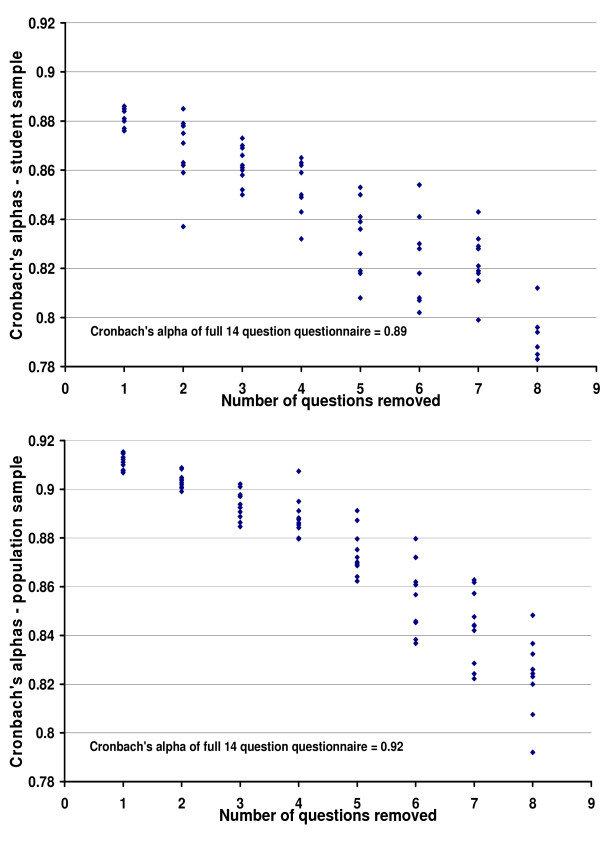
- Internal consistency was high: Cronbach’s alpha = 0.89 in the student sample and 0.91 in the population sample; test-retest reliability at one week was 0.83.
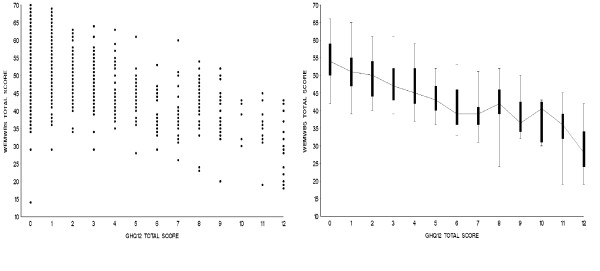
- Criterion validity was supported by correlations in the expected directions, including r = 0.77 with WHO-5, 0.74 with SPWB, 0.73 with SDHS and SWLS, 0.71 with PANAS-PA, -0.54 with PANAS-NA, and -0.53 with GHQ-12 in the population sample.
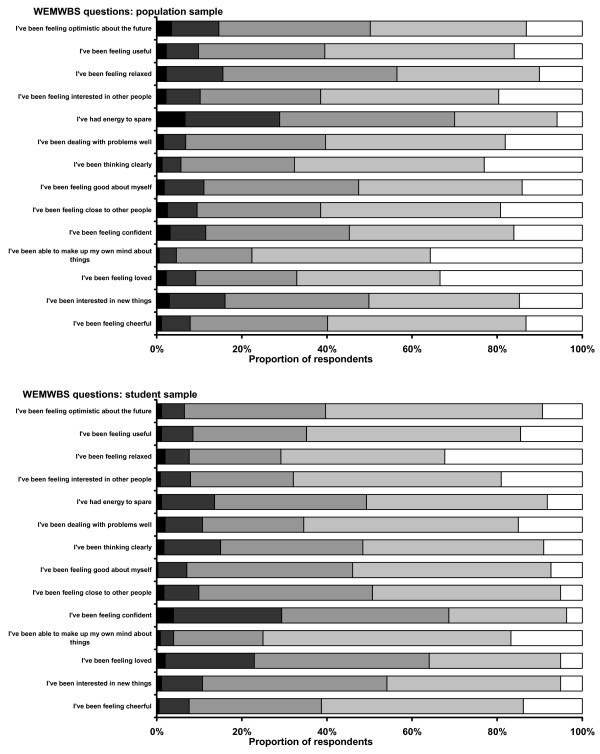
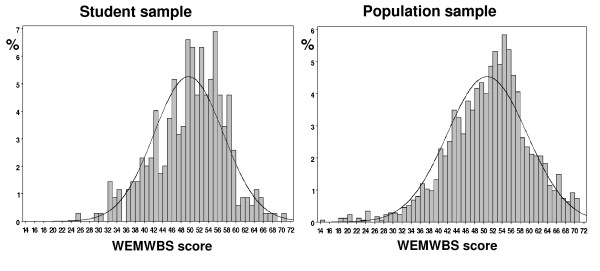
- The population sample showed no ceiling effects; median WEMWBS scores were 50 in the student sample and 51 in the population sample.
## Methods
- Scale development used an expert panel, nine focus groups (3 in England, 6 in Scotland; 56 participants total), and psychometric testing of the existing Affectometer 2.
- Validation used two samples: a student sample of 354 students from Warwick and Edinburgh universities, and a population sample combining 1749 respondents from two Scottish surveys.
- Analyses included content review, confirmatory factor analysis, Cronbach’s alpha, item-total correlations, Spearman correlations with other scales, Jonckheere/Wilcoxon/Kruskal-Wallis tests for group differences, test-retest ICCs, and assessment of social desirability bias with the BIDR.
## Limitations
- The paper states that sensitivity to change had not yet been established, and recommends further research before WEMWBS is used to evaluate mental health promotion interventions.
- The paper states that test-retest reliability was assessed only in the student sample and only over one week; it calls for replication in a population sample and over a longer interval.
- Evident from the text: the population sample could not test all eight validation scales used in the student sample because of space constraints, so some criterion-validity evidence is based only on the student sample.
Model-written summary. Check it against the paper before relying on it.
Integrity signals
Registry
Cites
Statistics
Figures
Verification
Claims the paper makes
0 Valid · 0 Not valid · 2 Not checked · 52 Own results and interpretations
A result the paper reports from its own data — it cites no other source for it, so there is none to check. The quote shows it is in the paper.
In the paper
“WEMWBS showed good content validity.”
- Also stated in: § Discussion · hedged
“The scale appears to have good content validity: response rates were high in both samples, although lower in the population sample than in the student sample.”
§ The Warwick-Edinburgh Mental Well-being Scale (WEMWBS): development and UK validation > Abstract > Results
hedged- Asserted: passes — The authors put it forward as true.
- Checkable: passes — It can be checked against evidence.
- Load-bearing: unclear — It is unclear whether the paper’s conclusions depend on it.
- Based: passes — The paper gives a reason why it holds.
- Also stated in: § Discussion · hedged
A result the paper reports from its own data — it cites no other source for it, so there is none to check. The quote shows it is in the paper.
In the paper
“A moderate negative correlation was observed between WEMWBS and the PANAS-NA (r = -0.54, p < 0.01) (Table 2).”
§ The Warwick-Edinburgh Mental Well-being Scale (WEMWBS): development and UK validation > Results > Criterion validity
plainstates an association- Asserted: passes — The authors put it forward as true.
- Checkable: passes — It can be checked against evidence.
- Load-bearing: passes — The paper’s conclusions depend on it.
- Based: passes — The paper gives a reason why it holds.
A result the paper reports from its own data — it cites no other source for it, so there is none to check. The quote shows it is in the paper.
In the paper
“In the student sample, overall health, as represented by the EQ-5D VAS, showed a low to moderate significant correlation (r = 0.43, p < 0.01), as hypothesised (Table 2).”
§ The Warwick-Edinburgh Mental Well-being Scale (WEMWBS): development and UK validation > Results > Criterion validity
plainstates an association- Asserted: passes — The authors put it forward as true.
- Checkable: passes — It can be checked against evidence.
- Load-bearing: unclear — It is unclear whether the paper’s conclusions depend on it.
- Based: passes — The paper gives a reason why it holds.
A result the paper reports from its own data — it cites no other source for it, so there is none to check. The quote shows it is in the paper.
In the paper
“Confirmatory factor analysis supported the single factor hypothesis.”
- Also stated in: § Construct validity · plain
“From these results, both samples showed verification of the pre-hypothesised one-factor scale structure.”
§ The Warwick-Edinburgh Mental Well-being Scale (WEMWBS): development and UK validation > Abstract > Results
plainstates an associationn = 1,749- Asserted: passes — The authors put it forward as true.
- Checkable: passes — It can be checked against evidence.
- Load-bearing: passes — The paper’s conclusions depend on it.
- Based: passes — The paper gives a reason why it holds.
- Also stated in: § Construct validity · plain
A result the paper reports from its own data — it cites no other source for it, so there is none to check. The quote shows it is in the paper.
In the paper
“The two life satisfaction scales showed higher than anticipated correlations with WEWMBS (SWLS r = 0.73, p < 0.01, GLS 0.53, p < 0.01) (Table 2).”
§ The Warwick-Edinburgh Mental Well-being Scale (WEMWBS): development and UK validation > Results > Criterion validity
plainstates an association- Asserted: passes — The authors put it forward as true.
- Checkable: passes — It can be checked against evidence.
- Load-bearing: unclear — It is unclear whether the paper’s conclusions depend on it.
- Based: passes — The paper gives a reason why it holds.
22 more claims
Create a free account to see all 54 claims and to verify the 2 references still open.
- It may state two separate claims as one. 21
- Probably not a substantial claim. 8
Claims other papers make about this one
Each is checked against this paper’s own text: does it say what the citing paper says it does?
The cited source doesn’t support the claim as written.
In the citing paper
“the Warwick-Edinburgh Mental Wellbeing Scale43,44 would be most useful to include as a main outcome, given that it showed greater sensitivity to change than the other measures examined.”
From Feasibility of RESTORE: An online Acceptance and Commitment Therapy intervention to improve palliative care staff wellbeing. (2023) · cites this paper as [44]
Checked by a reasoning model — may be wrong.
Experimental — accuracy not yet measuredThe source backs part of the claim, not all of it — or backs it for a different population, condition or comparison.
In the citing paper
“All participants filled out the European Quality of Life-5 Dimensions (EQ-5D-5L) (an online questionnaire on sociodemographic characteristics) and the Short-Warwick-Edinburgh Mental Well-being Scale (SWEMWBS) [20,21].”
From Long-term Weight Loss in a Primary Care-Anchored eHealth Lifestyle Coaching Program: Randomized Controlled Trial (2022) · cites this paper as [21]
Experimental — accuracy not yet measuredThe source backs part of the claim, not all of it — or backs it for a different population, condition or comparison.
In the citing paper
“They also found that over a quarter (27.4%) scored in the low wellbeing range on the Short Warwick–Edinburgh Mental Wellbeing Scale (SWEMWBS; Tennant et al., 2007).”
From Content Moderator Mental Health and Associations with Coping Styles: Replication and Extension of Previous Studies (2025) · cites this paper as Tennant et al., 2007
Experimental — accuracy not yet measuredThe source backs part of the claim, not all of it — or backs it for a different population, condition or comparison.
In the citing paper
“During baseline, the average Wellbeing scores of ~ 43 demonstrate that the level of wellbeing of this sample is somewhat below the average and median of 51 of the norm group (student population; Tennant et al., 2007).”
From Group cognitive behavioral therapy for reducing procrastination in college students: a randomized controlled trial (2026) · cites this paper as Tennant et al., 2007
Experimental — accuracy not yet measuredThe source backs part of the claim, not all of it — or backs it for a different population, condition or comparison.
In the citing paper
“Internal consistency was acceptable in the present study (α = .75).”
From An internet-delivered acceptance and commitment therapy program for anxious affect, depression, and wellbeing: A randomized, parallel, two-group, waitlist-controlled trial in a Middle Eastern sample of college students (2024) · cites this paper as [41]
Experimental — accuracy not yet measured
20 more claims about this paper
Create a free account to see every claim other papers make about this one.
Citations
Cites
Hu, L., & Bentler, P. M. (1999) · Structural Equation Modeling A Multidisciplinary Journal · doi:10.1080/10705519909540118 · Cited by 108,788 · cited 1×
“06 level [33], thus indicating only a small amount of unexplained variance or residual.”
BackgroundDevelopment and validation of brief measures of positive and negative affect: The PANAS scales.
Watson, D., Clark, L. A., & Tellegen, A. (1988) · Journal of Personality and Social Psychology · doi:10.1037/0022-3514.54.6.1063 · Cited by 32,433 · cited 1×
“The commonly-used twenty-item PANAS scale [14] describes affective-emotional aspects of well-being and is comprised of two dimensions: positive and negative affect (PANAS-PA and PANAS-NA) which are reported as distinct and independent concepts.”
MethodThe satisfaction with life scale
Diener, E., Emmons, R. A., Larsen, R. J., & Griffin, S. (1985) · Journal of Personality Assessment · doi:10.1207/s15327752jpa4901_13 · Cited by 31,768
Comparative fit indexes in structural models.
Bentler, P. M. (1990) · Psychological Bulletin · doi:10.1037/0033-2909.107.2.238 · Cited by 25,266 · cited 1×
“The goodness of fit index (GFI) and adjusted goodness of fit index (AGFI), based on a correction for degrees of freedom, were assessed with their desired levels being > 0.9 and > 0.8 respectively [ 31 ,32].”
MethodInfluentialSignificance tests and goodness of fit in the analysis of covariance structures.
Bentler, P. M., & Bonett, D. G. (1980) · Psychological Bulletin · doi:10.1037//0033-2909.88.3.588 · Cited by 19,023 · cited 1×
“05, indicates a significant amount of actual covariance between measures that was unexplained by the models [34].”
BackgroundOn Happiness and Human Potentials: A Review of Research on Hedonic and Eudaimonic Well-Being
Ryan, R. M., & Deci, E. L. (2001) · Annual Review of Psychology · doi:10.1146/annurev.psych.52.1.141 · Cited by 11,567 · cited 1×
“It is a complex construct, covering both affect and psychological functioning with two distinct perspectives:- the hedonic perspective, which focuses on the subjective experience of happiness and life satisfaction, and the eudaimonic perspective, focusing on psychological functioning and self realisation [3].”
BackgroundThe structure of psychological well-being revisited.
Ryff, C. D., & Keyes, C. L. M. (1995) · Journal of Personality and Social Psychology · doi:10.1037//0022-3514.69.4.719 · Cited by 10,285 · cited 8×
“Also as hypothesised, scales measuring components of affect or well-being all showed significant high correlations with WEMWBS: (PANAS-PA r = 0.71, p 0.01, SPWB r = 0.74, p 0.01, SDHS r = 0.73, p 0.01, WHO-5 0.77, p 0.01) (Table 2).”
ResultInfluential(1988) · NFER-Nelson eBooks · Cited by 5,560
Development and validation of a measure of emotional intelligence
Schutte, N. S., Malouff, J. M., Hall, L. E., Haggerty, D. J., Cooper, J. T., Golden, C. J., & Dornheim, L. (1998) · Personality and Individual Differences · doi:10.1016/s0191-8869(98)00001-4 · Cited by 3,856 · cited 5×
“As hypothesised, the EIS showed a low to moderate correlation with WEMWBS (r = 0.48, p 0.01) (Table 2).”
InfluentialThe Validity of Two Versions of the GHQ in the WHO Study of Mental Illness in General Health Care
GOLDBERG, D. P., GATER, R., SARTORIUS, N., USTUN, T. B., PICCINELLI, M., GUREJE, O., & RUTTER, C. (1997) · Psychological Medicine · doi:10.1017/s0033291796004242 · Cited by 3,657 · cited 1×
“01) using a Likert score, which persisted when a dichotomous scoring method, (with the four GHQ response categories being scored 0,0,1,1 [37]) was used (p < 0.”
Method
Research works printed but not linked: 8
- World Health Organisation: Strengthening mental health promotion. Geneva; World Health Organisation; 2001.
- Linley PA, Joseph S, (Eds.): Positive psychology in practice. Hoboken, NJ: Wiley; 2004.
- Bech P: Measuring the dimensions of psychological general well-being by the WHO-5. QoL Newsletter 2004, 32: 15–16.
- Stewart-Brown S: Measuring parts most measures do not reach: a necessity for evaluation in mental health promotion. J Mental Health Promotion 2002, 1: 4–9.
- Tennant R, Fishwick R, Platt S, Joseph S, Stewart-Brown S: Monitoring positive mental health in Scotland: validating the Affectometer 2 scale and developing the Warwick-Edinburgh Mental Well-being Scale for the UK. Edinburgh, NHS Health Scotland; 2006.
- Singleton HLG, (Ed): Better or worse: a longitudinal study of adults living in private households in Great Britain. London: The Stationery Office; 2003.
- Braunholtz S, Davidson S, Myant K, O'Connor R: Well? What do you think? (2006) The third national Scottish survey of public attitudes to mental health, mental wellbeing and mental health problems. Scottish Executive: Edinburgh; 2007.
- Nunnally JC: Psychometric Theory. 2nd edition. McGraw-Hill, London; 1978.
Cited by
Items 301–352 of 352
Serlachius, A., Schache, K., Boggiss, A., Lim, D., Wallace-Boyd, K., Brenton-Peters, J., Buttenshaw, E., Chadd, S., Cavadino, A., Cao, N., et al. (2020) · JMIR Research Protocols · doi:10.2196/23716 · Cited by 17
Maddock, A., McGuigan, K., & McCusker, P. (2024) · The British Journal of Social Work · doi:10.1093/bjsw/bcae011 · Cited by 17
Clustering in mental health payment by results: a critical summary for the clinician
Yeomans, D. (2014) · Advances in Psychiatric Treatment · doi:10.1192/apt.bp.113.011320 · Cited by 16
Sandhu, H., Bernstein, C. J., Davies, G., Tang, N. K. Y., Belhag, M., Tingle, A., Field, M., Foss, J., Lindahl, A., Underwood, M., et al. (2016) · BMJ Open · doi:10.1136/bmjopen-2016-011495 · Cited by 16
Taylor, R. W., Male, R., Economides, M., Bolton, H., & Cavanagh, K. (2023) · JMIR Formative Research · doi:10.2196/41590 · Cited by 15
“The Short Warwick-Edinburgh Mental Well-being Scale (SWEMWBS) [50], a short 7-item version of the original 14-item Warwick-Edinburgh Mental Well-being Scale, was designed to measure aspects of mental well-being primarily related to functioning [51].”
Hazell, C. M., Hayward, M., Cavanagh, K., Jones, A.-M., & Strauss, C. (2016) · Trials · doi:10.1186/s13063-016-1494-y · Cited by 15
Body image concerns in patients with persecutory delusions
Waite, F., Diamond, R., Collett, N., Bold, E., Chadwick, E., & Freeman, D. (2023) · Psychological Medicine · doi:10.1017/s0033291722000800 · Cited by 15
“Mean scores on the measures in the clinical group Variable n Mean S.D. Body esteem (BESAA) 115 30.18 16.2 Body esteem – appearance subscale 112 15.41 8.28 Body esteem – attribution subscale 107 5.50 3.87 Body esteem – weight subscale 112 9.67 6.71 Body mass index 112 30.23 6.94 Paranoia –ideas of reference (RGPTS- par…”
MethodInfluentialElhakeem, A., Hannam, K., Deere, K. C., Hartley, A., Clark, E. M., Moss, C., Edwards, M. H., Dennison, E., Gaysin, T., Kuh, D., et al. (2018) · The Journals of Gerontology: Series A · doi:10.1093/gerona/glx176 · Cited by 14
Gladwyn-Khan, M., & Morris, R. (2023) · Behavioural and Cognitive Psychotherapy · doi:10.1017/s135246582200042x · Cited by 13
Brown, A., Flint, S. W., Dicken, S. J., Kalea, A. Z., O'Kane, M., Williams, S., Wong, E., & Batterham, R. L. (2023) · Journal of Human Nutrition and Dietetics · doi:10.1111/jhn.13120 · Cited by 13
Miola, L., & Pazzaglia, F. (2025) · Frontiers in Psychology · doi:10.3389/fpsyg.2025.1522098 · Cited by 14
“The Warwick-Edinburgh Mental Wellbeing Scale (WEMWBS; Gremigni and Stewart-Brown, 2011; Tennant et al., 2007).”
Seon, Q., Mady, N., Yang, M., Karia, M., Lashley, M., Sescu, C., Lalonde, M., Puskas, S., Outerbridge, J., Parent-Racine, E., et al. (2023) · JMIR Research Protocols · doi:10.2196/40236 · Cited by 12
“…Measure (CORE-OM) and Clinical Outcome Routine Evaluation-10 item (CORE-10) [30,31]; Warwick-Edinburg Mental Well-being Scale (WEMWBS) [32,33]; Generalized Anxiety Disorder 7-item (GAD-7) [34]; Primary Care Screen for Posttraumatic Stress Disorder for Diagnostic and Statistical Manual…”
Civic engagement and mental health trajectories in Norwegian youth
Wiium, N., Kristensen, S. M., Årdal, E., Bøe, T., Gaspar de Matos, M., Karhina, K., Larsen, T. M. B., Urke, H. B., & Wold, B. (2023) · Frontiers in Public Health · doi:10.3389/fpubh.2023.1214141 · Cited by 12
Which aspects of mindfulness are important to include in adolescent interventions?
Johnson, C., & Wade, T. (2019) · Early Intervention in Psychiatry · doi:10.1111/eip.12490 · Cited by 11
Edwards, D. J., & Kemp, A. H. (2020) · BMJ Open · doi:10.1136/bmjopen-2020-041667 · Cited by 11
Hjort (2021) · doi:10.1136/bmjopen-2020-042728 · Cited by 11
Brophy, K., Emery, M., MacDonald, C., Côté, C. I., & Körner, A. (2024) · PLoS ONE · doi:10.1371/journal.pone.0305776 · Cited by 10
Moran, O., & McHugh, L. (2020) · Journal of Contextual Behavioral Science · doi:10.1016/j.jcbs.2020.01.010 · Cited by 10
Thwaites, O., Mizen, A., & Fry, R. (2024) · Landscape and Urban Planning · doi:10.1016/j.landurbplan.2023.104971 · Cited by 10
Theory driven psychological therapy for persecutory delusions: trajectories of patient outcomes
Jenner, L., Payne, M., Waite, F., Beckwith, H., Diamond, R., Isham, L., Collett, N., Emsley, R., & Freeman, D. (2024) · Psychological Medicine · doi:10.1017/s0033291724002113 · Cited by 10
Edwards, D. J., Rainey, E., Boukouvala, V., Wells, Y., Bennett, P., Tree, J., & Kemp, A. H. (2019) · BMJ Open · doi:10.1136/bmjopen-2019-029411 · Cited by 9
Graef-Calliess, I. T., Erdmann, L., Mohwinkel, V., Özkan, I., Finkelstein, D., Loos, K., Penteker, G., & Trilesnik, B. (2023) · International Review of Psychiatry · doi:10.1080/09540261.2022.2164181 · Cited by 9
The effect of online social evaluation on mood and cognition in young people
Grunewald, K., Deng, J., Wertz, J., & Schweizer, S. (2022) · Scientific Reports · doi:10.1038/s41598-022-24932-w · Cited by 9
Lantheaume, S., Shankland, R., Buchier, L., Facchin, A., & Kotsou, I. (2024) · European Review of Applied Psychology · doi:10.1016/j.erap.2023.100876 · Cited by 7
Knock, E., Siefried, K. J., Bedi, G., Albert, S., Day, R. O., Ezard, N., Ross, M., Liknaitzky, P., & Brett, J. (2025) · Addiction · doi:10.1111/add.70187 · Cited by 9
Brett, J., Knock, E., Watson, K., Albert, S., Siefried, K. J., & Guss, J. (2024) · Frontiers in Psychiatry · doi:10.3389/fpsyt.2024.1490907 · Cited by 7
“Participants were followed weekly for 1 month and then fi nally at 3 months following the psilocybin dose to measure safety and tolerability; change in methamphetamine use over the prior 28 days (17); MA cravings; depression, anxiety, and stress ratings (18); and quality of life (19).”
Foote, H., Bowen, A., Cotterill, S., Hill, G., Pieri, M., & Patchwood, E. (2023) · Clinical Rehabilitation · doi:10.1177/02692155221144554 · Cited by 7
Wagner, A. P., Galante, J., Dufour, G., Barton, G., Stochl, J., Vainre, M., & Jones, P. B. (2023) · BMJ Open · doi:10.1136/bmjopen-2023-071724 · Cited by 7
Dunn, A., Alvarez, J., Arbon, A., Bremner, S., Elsby-Pearson, C., Emsley, R., Jones, C., Lawrence, P., Lester, K. J., Majdandžić, M., et al. (2022) · JMIR Research Protocols · doi:10.2196/40707 · Cited by 7
Shepherd, K., Pritty, B., Tickle, A., & Moghaddam, N. (2023) · International Journal of Mental Health and Addiction · doi:10.1007/s11469-021-00729-2 · Cited by 6
Spence, R., & DeMarco, J. (2025) · Behavioral Sciences · doi:10.3390/bs15040487 · Cited by 6
“Short Warwick–Edinburgh Mental Wellbeing Scale (SWEMWBS; Tennant et al., 2007) The SWEMWS is a seven-item self-report measure that asks about thoughts and feelings over the previous two weeks.”
Perry, A., Gardener, C., Shieh, J., Hồ, Q. T., Doan, A., & Bhui, K. (2024) · Transcultural Psychiatry · doi:10.1177/13634615241228071 · Cited by 7
Vally, Z., Shah, H., Varga, S.-I., Hassan, W., Kashakesh, M., Albreiki, W., & Helmy, M. (2024) · PLoS ONE · doi:10.1371/journal.pone.0313243 · Cited by 5
Brophy, L., Fletcher, J., Dawadi, S., Reece, J., Edan, V., Enticott, J., Farhall, J., Fossey, E., Hamilton, B., Harvey, C., et al. (2024) · Australian & New Zealand Journal of Psychiatry · doi:10.1177/00048674241242943 · Cited by 5
Maddock, A. (2024) · The British Journal of Social Work · doi:10.1093/bjsw/bcae116 · Cited by 5
Is self-compassion linked to treatment adherence in schizophrenia?
Uzer-Kremers, L., Bralet, M.-C., Angerville, B., Jeanblanc, J., Pierrefiche, O., Martinetti, M. P., Naassila, M., & Dervaux, A. (2020) · Schizophrenia Research · doi:10.1016/j.schres.2020.05.058 · Cited by 5
Palmer, A., O'Connor, D. B., Janardhana, N., Khandeparkar, P., Bhola, P., Prabhu, S., A. L., K., Arelingaiah, M., K. P., J., Nag, R., et al. (2025) · Mental Health Science · doi:10.1002/mhs2.70019 · Cited by 5
“The Warwick ‐ Edinburgh Mental Wellbeing Scale (WEMWBS; Tennant et al. 2007) is a 14 ‐ item positively worded self ‐ report questionnaire of emotional wellbeing.”
Juszczyk-Kalina, A., Holas, P., & Farchione, T. J. (2023) · Trials · doi:10.1186/s13063-023-07744-9 · Cited by 4
Gordon, T. C., Kemp, A. H., & Edwards, D. J. (2024) · BMJ Open · doi:10.1136/bmjopen-2023-080972 · Cited by 4
Bennett, M. P., Knight, R. C., Dunning, D., Archer-Boyd, A., Blakemore, S.-J., Dalmaijer, E., Ford, T., Williams, J. M. G., Clegg, H., Kuyken, W., et al. (2022) · BMJ Open · doi:10.1136/bmjopen-2021-056864 · Cited by 4
Ribeyron, J., Shankland, R., Leys, C., & Duriez, N. (2025) · Canadian Journal of Behavioural Science/Revue canadienne des sciences du comportement · doi:10.1037/cbs0000430 · Cited by 4
Tran, K., Buchanan, J., Song, Y. J. C., Rosenberg, S., Occhipinti, J.-A., & Hickie, I. B. (2022) · International Journal of Mental Health Systems · doi:10.1186/s13033-022-00568-1 · Cited by 4
Tharwat, D., Trousselard, M., Fromage, D., Belrose, C., Balès, M., Sutter-Dallay, A.-L., Ezto, M.-L., Hurstel, F., Harvey, T., Martin, S., et al. (2022) · International Journal of Environmental Research and Public Health · doi:10.3390/ijerph19031545 · Cited by 3
Dominguez-Rodriguez, A., Herdoiza-Arroyo, P. E., González-Ramírez, L. P., Martínez-Arriaga, R. J., Villarreal-Zegarra, D., Santos da Silva, A. C., González-Cantero, J. O., Vargas Salinas, V. S., S. Mensorio, M., Cisneros Hernández, A. A., et al. (2024) · Frontiers in Psychology · doi:10.3389/fpsyg.2024.1279847 · Cited by 3
Gerami, A., Foster, C., & Murphy, J. (2022) · International Journal of Environmental Research and Public Health · doi:10.3390/ijerph192416732 · Cited by 3
de Haas, S. M. H., Blaesing, L., Oosterhoff, R., Rozental, A., & Scheres, A. P. J. (2026) · Cognitive Behaviour Therapy · doi:10.1080/16506073.2025.2543893 · Cited by 3
“Mental Wellbeing was measured using the Warwick Edinburgh Mental Well-being Scale (WEMWBS; Tennant et al., 2007), a 14-item self-report questionnaire rated on a 5-point Likert scale (1 = none of the time, 5 = all of the time), with higher scores indicating better wellbeing (range 14–70).”
A Practical Guide to Positive Functioning Assessment in Clinical Psychology
Joseph, S., & Patterson, T. G. (2016) · The Wiley Handbook of Positive Clinical Psychology · doi:10.1002/9781118468197.ch4 · Cited by 2
Self-citationFinucane, A., Hulbert-Williams, N. J., Swash, B., Spiller, J. A., Lydon, B., & Gillanders, D. (2022) · AMRC Open Research · doi:10.12688/amrcopenres.13035.2 · Cited by 2
Pavarini, G., Reardon, T., Hollowell, A., Bennett, V., Lawrance, E., Group, P. S. Y. P. A., Pinfold, V., & Singh, I. (2021) · doi:10.31234/osf.io/m7syr · Cited by 1
Miola, L., Rinaldi, E., Di Resta, S., & Pazzaglia, F. (2024) · Sustainability · doi:10.3390/su162411129 · Cited by 1
“One of its components is mental well-being consisting of a dynamic interaction between external circumstances and psychological states, which work together to meet individuals’ psychological needs, ultimately leading to positive emotions such as happiness and satisfaction [18,19].”
Kudrna, L., Yates, J., Alidu, L., Hemming, K., Quinn, L., Schmidtke, K. A., Jones, J., Al-Khudairy, L., Jolly, K., Bird, P., et al. (2025) · International Journal of Environmental Research and Public Health · doi:10.3390/ijerph22030398 · Cited by 1
Bowles, N., Burger, A., Davies, J. N., Simpson, J. A., Galante, J., Dennis, S., Stone, B., & Van Dam, N. T. (2025) · JMIR Research Protocols · doi:10.2196/72786
Metadata
- Authors
- Tennant, R., Hiller, L., Fishwick, R., Platt, S., Joseph, S., Weich, S., Parkinson, J., Secker, J., & Stewart-Brown, S.
- Affiliations
- University of Warwick (GB)
- University of Edinburgh (GB)
- University of Nottingham (GB)
- National Health Service Scotland (GB)
- Anglia Ruskin University (GB)
- Corresponding author
- Stewart-Brown, Sarah
- Venue
- Health and Quality of Life Outcomes
- Published
- 2007-11-27
- Volume
- 5
- Issue
- 1
- Pages
- 63-63
- ISSN
- 1477-7525 (ISSN-L)
- PMC
- PMC2222612
- OpenAlex
- W2123552131
- Cited by
- 5,031
- References
- 36
- Citations by year
- 2026: 489 · 2025: 663 · 2024: 612 · 2023: 522 · 2022: 574 · 2021: 525 · 2020: 365 · 2019: 282 · 2018: 222 · 2017: 187 · 2016: 159 · 2015: 136 · 2014: 85 · 2013: 82 · 2012: 58
- FWCI
- 17.46
- Type
- journal article
- Language
- en
- Open access
- gold
- doi.org
- Licence
- cc-by
- Locations
- Health and Quality of Life Outcomes (publishedVersion, cc-by)
- PubMed Central (publishedVersion, cc-by)
- PubMed (publishedVersion)
- White Rose Research Online (University of Leeds, The University of Sheffield, University of York) (acceptedVersion)
- Warwick Research Archive Portal (University of Warwick) (acceptedVersion)
- Anglia Ruskin Research Online (Anglia Ruskin University) (submittedVersion)
- Open Scholarship Institutional Repository (Washington University in St. Louis) (submittedVersion)
- DOAJ (DOAJ: Directory of Open Access Journals) (submittedVersion)
- Figshare (submittedVersion, cc-by)
- Edinburgh Research Explorer (University of Edinburgh) (submittedVersion, cc-by)
- Funders
- NHS Health Scotland
- University of Stirling
- Topics
- Social Sciences › Psychology › Social Psychology › Psychological Well-being and Life Satisfaction
- Social Sciences › Decision Sciences › Management Science and Operations Research › Psychometric Methodologies and Testing
- Health Sciences › Nursing › Research and Theory › Health Education and Validation
- Keywords
- Warwick-Edinburgh Mental Well-being Scale, psychological well-being, positive mental health, scale development, psychometric validation, content validity, test-retest reliability, social desirability bias, mental health promotion, student population
- MeSH terms
- Adult, Aged, Factor Analysis, Statistical, Female, United Kingdom, Health Status, Humans, Mental Health, Middle Aged, Personal Satisfaction, Psychometrics, Surveys and Questionnaires, Socioeconomic Factors, Students, Translations, Focus Groups
About these checks
Registry, retraction, Cites and statistics results are computed, not judged, with one exception: a printed reference that no index lists is read once by a model before it counts as a citation error. Claims are extracted by a model and kept only when their quote appears verbatim in the text; each cited source is then checked, with a model’s help, for whether it says what the claim relies on. Those verdicts can be wrong — read the claim’s quote and the cited source before relying on one.
A language model drew the claims from the paper on 2026-10-11, under version 3 of the claim definition (model deepseek-v4.1-flash, prompt extract-v3).
A second model labelled each claim on 2026-10-11 (model jev-1.13-20260917, definition revision gold-guideline-v0.2).
Statistics and arithmetic are recomputed, not judged.
Confidence bands are shown only for fields calibrated on our annotated test set. None is calibrated yet, so no band is shown.
What counts as a claim ›How we measure confidence ›How we check this ›
Are you an author, or do you see a problem with this page? Request a review
Data sources
Bibliographic data: Semantic Scholar, OpenAlex, Crossref.
Contains information from the Semantic Scholar Academic Graph Datasets, made available under the ODC Attribution License (ODC-BY 1.0).
Semantic Scholar’s data is described in: Kinney, R., et al. (2023). The Semantic Scholar Open Data Platform. arXiv:2301.10140.
