

The Warwick-Edinburgh Mental Well-being Scale (WEMWBS): development and UK validation
Open accessThe DOI matches its Crossref record; 30 of the 36 references it cites were found in a registry or an index; none of the 2 sources its claims cite is checked for support yet.
Abstract
Background: There is increasing international interest in the concept of mental well-being and its contribution to all aspects of human life. Demand for instruments to monitor mental well-being at a population level and evaluate mental health promotion initiatives is growing. This article describes the development and validation of a new scale, comprised only of positively worded items relating to different aspects of positive mental health: the Warwick-Edinburgh Mental Well-Being Scale (WEMWBS). Methods: WEMWBS was developed by an expert panel drawing on current academic literature, qualitative research with focus groups, and psychometric testing of an existing scale. It was validated on a student and representative population sample. Content validity was assessed by reviewing the frequency of complete responses and the distribution of responses to each item. Confirmatory factor analysis was used to test the hypothesis that the scale measured a single construct. Internal consistency was assessed using Cronbach's alpha. Criterion validity was explored in terms of correlations between WEMWBS and other scales and by testing whether the scale discriminated between population groups in line with pre-specified hypotheses. Test-retest reliability was assessed at one week using intra-class correlation coefficients. Susceptibility to bias was measured using the Balanced Inventory of Desired Responding. Results: WEMWBS showed good content validity. Confirmatory factor analysis supported the single factor hypothesis. A Cronbach's alpha score of 0.89 (student sample) and 0.91 (population sample) suggests some item redundancy in the scale. WEMWBS showed high correlations with other mental health and well-being scales and lower correlations with scales measuring overall health. Its distribution was near normal and the scale did not show ceiling effects in a population sample. It discriminated between population groups in a way that is largely consistent with the results of other population surveys. Test-retest reliability at one week was high (0.83). Social desirability bias was lower or similar to that of other comparable scales. Conclusion: WEMWBS is a measure of mental well-being focusing entirely on positive aspects of mental health. As a short and psychometrically robust scale, with no ceiling effects in a population sample, it offers promise as a tool for monitoring mental well-being at a population level. Whilst WEMWBS should appeal to those evaluating mental health promotion initiatives, it is important that the scale's sensitivity to change is established before it is recommended in this context.
Overview
CoChat Summary
## TL;DR
WEMWBS is a new 14-item, all-positive mental well-being scale developed in the UK and validated in a student sample and two representative Scottish population datasets. It showed strong psychometric performance, including a single-factor structure, Cronbach’s alpha of 0.89–0.91, test-retest reliability of 0.83, and no ceiling effects in the population sample.
## Key findings
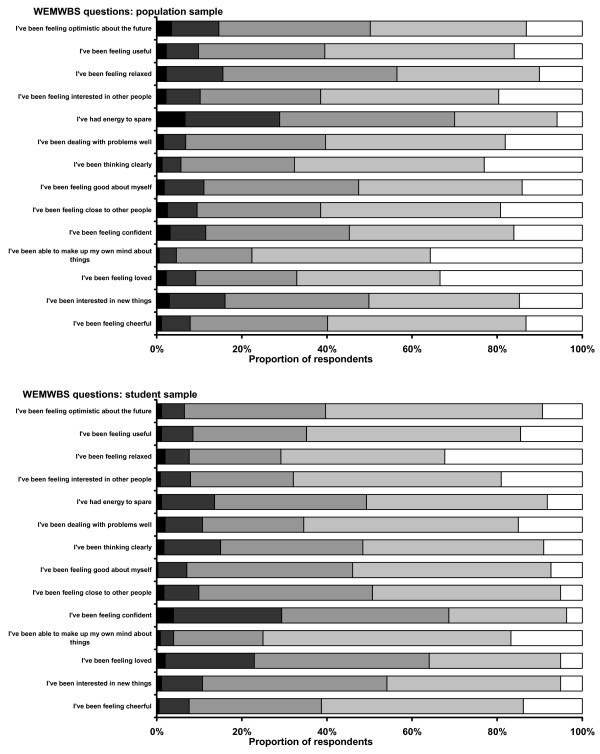
- The final WEMWBS had 14 items covering hedonic and eudaimonic well-being, including positive affect, relationships, and positive functioning.
- Confirmatory factor analysis supported a single-factor structure: in the population sample GFI = 0.91, AGFI = 0.87, RMSEA = 0.0502; in the student sample GFI = 0.93, AGFI = 0.89, RMSEA = 0.0551.
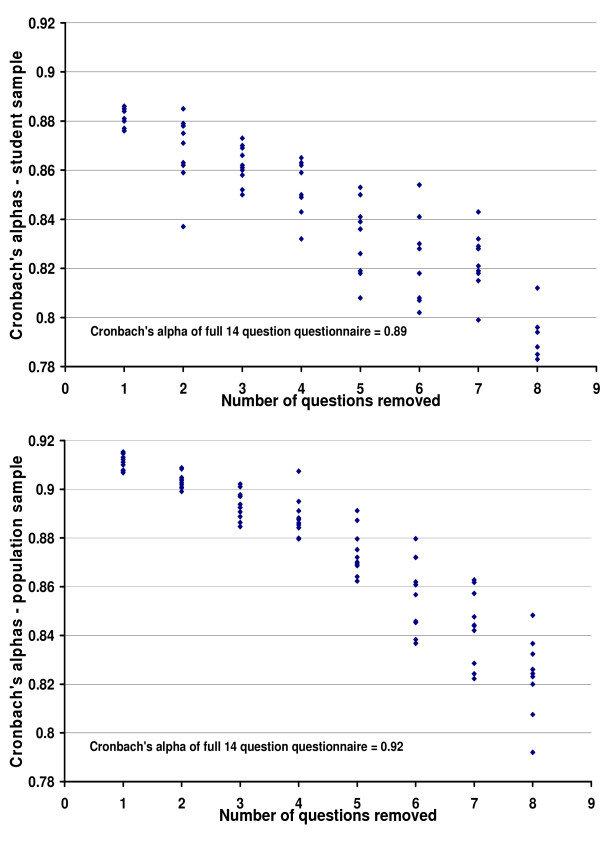
- Internal consistency was high: Cronbach’s alpha = 0.89 in the student sample and 0.91 in the population sample; test-retest reliability at one week was 0.83.
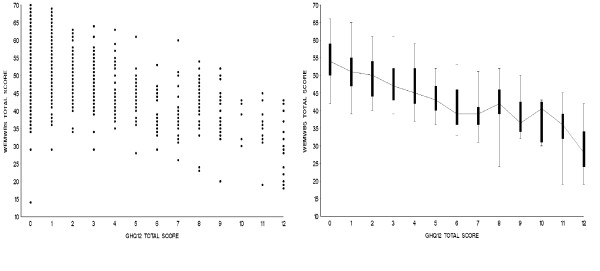
- Criterion validity was supported by correlations in the expected directions, including r = 0.77 with WHO-5, 0.74 with SPWB, 0.73 with SDHS and SWLS, 0.71 with PANAS-PA, -0.54 with PANAS-NA, and -0.53 with GHQ-12 in the population sample.
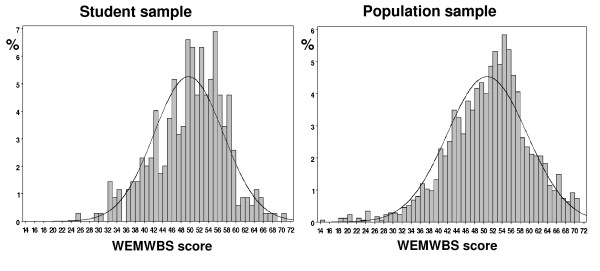
- The population sample showed no ceiling effects; median WEMWBS scores were 50 in the student sample and 51 in the population sample.
## Methods
- Scale development used an expert panel, nine focus groups (3 in England, 6 in Scotland; 56 participants total), and psychometric testing of the existing Affectometer 2.
- Validation used two samples: a student sample of 354 students from Warwick and Edinburgh universities, and a population sample combining 1749 respondents from two Scottish surveys.
- Analyses included content review, confirmatory factor analysis, Cronbach’s alpha, item-total correlations, Spearman correlations with other scales, Jonckheere/Wilcoxon/Kruskal-Wallis tests for group differences, test-retest ICCs, and assessment of social desirability bias with the BIDR.
## Limitations
- The paper states that sensitivity to change had not yet been established, and recommends further research before WEMWBS is used to evaluate mental health promotion interventions.
- The paper states that test-retest reliability was assessed only in the student sample and only over one week; it calls for replication in a population sample and over a longer interval.
- Evident from the text: the population sample could not test all eight validation scales used in the student sample because of space constraints, so some criterion-validity evidence is based only on the student sample.
Model-written summary. Check it against the paper before relying on it.
Integrity signals
Registry
Cites
Statistics
Figures
Verification
Claims the paper makes
0 Valid · 0 Not valid · 2 Not checked · 52 Own results and interpretations
A result the paper reports from its own data — it cites no other source for it, so there is none to check. The quote shows it is in the paper.
In the paper
“WEMWBS showed good content validity.”
- Also stated in: § Discussion · hedged
“The scale appears to have good content validity: response rates were high in both samples, although lower in the population sample than in the student sample.”
§ The Warwick-Edinburgh Mental Well-being Scale (WEMWBS): development and UK validation > Abstract > Results
hedged- Asserted: passes — The authors put it forward as true.
- Checkable: passes — It can be checked against evidence.
- Load-bearing: unclear — It is unclear whether the paper’s conclusions depend on it.
- Based: passes — The paper gives a reason why it holds.
- Also stated in: § Discussion · hedged
A result the paper reports from its own data — it cites no other source for it, so there is none to check. The quote shows it is in the paper.
In the paper
“A moderate negative correlation was observed between WEMWBS and the PANAS-NA (r = -0.54, p < 0.01) (Table 2).”
§ The Warwick-Edinburgh Mental Well-being Scale (WEMWBS): development and UK validation > Results > Criterion validity
plainstates an association- Asserted: passes — The authors put it forward as true.
- Checkable: passes — It can be checked against evidence.
- Load-bearing: passes — The paper’s conclusions depend on it.
- Based: passes — The paper gives a reason why it holds.
A result the paper reports from its own data — it cites no other source for it, so there is none to check. The quote shows it is in the paper.
In the paper
“In the student sample, overall health, as represented by the EQ-5D VAS, showed a low to moderate significant correlation (r = 0.43, p < 0.01), as hypothesised (Table 2).”
§ The Warwick-Edinburgh Mental Well-being Scale (WEMWBS): development and UK validation > Results > Criterion validity
plainstates an association- Asserted: passes — The authors put it forward as true.
- Checkable: passes — It can be checked against evidence.
- Load-bearing: unclear — It is unclear whether the paper’s conclusions depend on it.
- Based: passes — The paper gives a reason why it holds.
A result the paper reports from its own data — it cites no other source for it, so there is none to check. The quote shows it is in the paper.
In the paper
“Confirmatory factor analysis supported the single factor hypothesis.”
- Also stated in: § Construct validity · plain
“From these results, both samples showed verification of the pre-hypothesised one-factor scale structure.”
§ The Warwick-Edinburgh Mental Well-being Scale (WEMWBS): development and UK validation > Abstract > Results
plainstates an associationn = 1,749- Asserted: passes — The authors put it forward as true.
- Checkable: passes — It can be checked against evidence.
- Load-bearing: passes — The paper’s conclusions depend on it.
- Based: passes — The paper gives a reason why it holds.
- Also stated in: § Construct validity · plain
A result the paper reports from its own data — it cites no other source for it, so there is none to check. The quote shows it is in the paper.
In the paper
“The two life satisfaction scales showed higher than anticipated correlations with WEWMBS (SWLS r = 0.73, p < 0.01, GLS 0.53, p < 0.01) (Table 2).”
§ The Warwick-Edinburgh Mental Well-being Scale (WEMWBS): development and UK validation > Results > Criterion validity
plainstates an association- Asserted: passes — The authors put it forward as true.
- Checkable: passes — It can be checked against evidence.
- Load-bearing: unclear — It is unclear whether the paper’s conclusions depend on it.
- Based: passes — The paper gives a reason why it holds.
22 more claims
Create a free account to see all 54 claims and to verify the 2 references still open.
- It may state two separate claims as one. 21
- Probably not a substantial claim. 8
Claims other papers make about this one
Each is checked against this paper’s own text: does it say what the citing paper says it does?
The cited source doesn’t support the claim as written.
In the citing paper
“the Warwick-Edinburgh Mental Wellbeing Scale43,44 would be most useful to include as a main outcome, given that it showed greater sensitivity to change than the other measures examined.”
From Feasibility of RESTORE: An online Acceptance and Commitment Therapy intervention to improve palliative care staff wellbeing. (2023) · cites this paper as [44]
Checked by a reasoning model — may be wrong.
Experimental — accuracy not yet measuredThe source backs part of the claim, not all of it — or backs it for a different population, condition or comparison.
In the citing paper
“All participants filled out the European Quality of Life-5 Dimensions (EQ-5D-5L) (an online questionnaire on sociodemographic characteristics) and the Short-Warwick-Edinburgh Mental Well-being Scale (SWEMWBS) [20,21].”
From Long-term Weight Loss in a Primary Care-Anchored eHealth Lifestyle Coaching Program: Randomized Controlled Trial (2022) · cites this paper as [21]
Experimental — accuracy not yet measuredThe source backs part of the claim, not all of it — or backs it for a different population, condition or comparison.
In the citing paper
“They also found that over a quarter (27.4%) scored in the low wellbeing range on the Short Warwick–Edinburgh Mental Wellbeing Scale (SWEMWBS; Tennant et al., 2007).”
From Content Moderator Mental Health and Associations with Coping Styles: Replication and Extension of Previous Studies (2025) · cites this paper as Tennant et al., 2007
Experimental — accuracy not yet measuredThe source backs part of the claim, not all of it — or backs it for a different population, condition or comparison.
In the citing paper
“During baseline, the average Wellbeing scores of ~ 43 demonstrate that the level of wellbeing of this sample is somewhat below the average and median of 51 of the norm group (student population; Tennant et al., 2007).”
From Group cognitive behavioral therapy for reducing procrastination in college students: a randomized controlled trial (2026) · cites this paper as Tennant et al., 2007
Experimental — accuracy not yet measuredThe source backs part of the claim, not all of it — or backs it for a different population, condition or comparison.
In the citing paper
“Internal consistency was acceptable in the present study (α = .75).”
From An internet-delivered acceptance and commitment therapy program for anxious affect, depression, and wellbeing: A randomized, parallel, two-group, waitlist-controlled trial in a Middle Eastern sample of college students (2024) · cites this paper as [41]
Experimental — accuracy not yet measured
20 more claims about this paper
Create a free account to see every claim other papers make about this one.
Citations
Cites
Hu, L., & Bentler, P. M. (1999) · Structural Equation Modeling A Multidisciplinary Journal · doi:10.1080/10705519909540118 · Cited by 108,788 · cited 1×
“06 level [33], thus indicating only a small amount of unexplained variance or residual.”
BackgroundDevelopment and validation of brief measures of positive and negative affect: The PANAS scales.
Watson, D., Clark, L. A., & Tellegen, A. (1988) · Journal of Personality and Social Psychology · doi:10.1037/0022-3514.54.6.1063 · Cited by 32,433 · cited 1×
“The commonly-used twenty-item PANAS scale [14] describes affective-emotional aspects of well-being and is comprised of two dimensions: positive and negative affect (PANAS-PA and PANAS-NA) which are reported as distinct and independent concepts.”
MethodThe satisfaction with life scale
Diener, E., Emmons, R. A., Larsen, R. J., & Griffin, S. (1985) · Journal of Personality Assessment · doi:10.1207/s15327752jpa4901_13 · Cited by 31,768
Comparative fit indexes in structural models.
Bentler, P. M. (1990) · Psychological Bulletin · doi:10.1037/0033-2909.107.2.238 · Cited by 25,266 · cited 1×
“The goodness of fit index (GFI) and adjusted goodness of fit index (AGFI), based on a correction for degrees of freedom, were assessed with their desired levels being > 0.9 and > 0.8 respectively [ 31 ,32].”
MethodInfluentialSignificance tests and goodness of fit in the analysis of covariance structures.
Bentler, P. M., & Bonett, D. G. (1980) · Psychological Bulletin · doi:10.1037//0033-2909.88.3.588 · Cited by 19,023 · cited 1×
“05, indicates a significant amount of actual covariance between measures that was unexplained by the models [34].”
BackgroundOn Happiness and Human Potentials: A Review of Research on Hedonic and Eudaimonic Well-Being
Ryan, R. M., & Deci, E. L. (2001) · Annual Review of Psychology · doi:10.1146/annurev.psych.52.1.141 · Cited by 11,567 · cited 1×
“It is a complex construct, covering both affect and psychological functioning with two distinct perspectives:- the hedonic perspective, which focuses on the subjective experience of happiness and life satisfaction, and the eudaimonic perspective, focusing on psychological functioning and self realisation [3].”
BackgroundThe structure of psychological well-being revisited.
Ryff, C. D., & Keyes, C. L. M. (1995) · Journal of Personality and Social Psychology · doi:10.1037//0022-3514.69.4.719 · Cited by 10,285 · cited 8×
“Also as hypothesised, scales measuring components of affect or well-being all showed significant high correlations with WEMWBS: (PANAS-PA r = 0.71, p 0.01, SPWB r = 0.74, p 0.01, SDHS r = 0.73, p 0.01, WHO-5 0.77, p 0.01) (Table 2).”
ResultInfluential(1988) · NFER-Nelson eBooks · Cited by 5,560
Development and validation of a measure of emotional intelligence
Schutte, N. S., Malouff, J. M., Hall, L. E., Haggerty, D. J., Cooper, J. T., Golden, C. J., & Dornheim, L. (1998) · Personality and Individual Differences · doi:10.1016/s0191-8869(98)00001-4 · Cited by 3,856 · cited 5×
“As hypothesised, the EIS showed a low to moderate correlation with WEMWBS (r = 0.48, p 0.01) (Table 2).”
InfluentialThe Validity of Two Versions of the GHQ in the WHO Study of Mental Illness in General Health Care
GOLDBERG, D. P., GATER, R., SARTORIUS, N., USTUN, T. B., PICCINELLI, M., GUREJE, O., & RUTTER, C. (1997) · Psychological Medicine · doi:10.1017/s0033291796004242 · Cited by 3,657 · cited 1×
“01) using a Likert score, which persisted when a dichotomous scoring method, (with the four GHQ response categories being scored 0,0,1,1 [37]) was used (p < 0.”
Method
Research works printed but not linked: 8
- World Health Organisation: Strengthening mental health promotion. Geneva; World Health Organisation; 2001.
- Linley PA, Joseph S, (Eds.): Positive psychology in practice. Hoboken, NJ: Wiley; 2004.
- Bech P: Measuring the dimensions of psychological general well-being by the WHO-5. QoL Newsletter 2004, 32: 15–16.
- Stewart-Brown S: Measuring parts most measures do not reach: a necessity for evaluation in mental health promotion. J Mental Health Promotion 2002, 1: 4–9.
- Tennant R, Fishwick R, Platt S, Joseph S, Stewart-Brown S: Monitoring positive mental health in Scotland: validating the Affectometer 2 scale and developing the Warwick-Edinburgh Mental Well-being Scale for the UK. Edinburgh, NHS Health Scotland; 2006.
- Singleton HLG, (Ed): Better or worse: a longitudinal study of adults living in private households in Great Britain. London: The Stationery Office; 2003.
- Braunholtz S, Davidson S, Myant K, O'Connor R: Well? What do you think? (2006) The third national Scottish survey of public attitudes to mental health, mental wellbeing and mental health problems. Scottish Executive: Edinburgh; 2007.
- Nunnally JC: Psychometric Theory. 2nd edition. McGraw-Hill, London; 1978.
Cited by
Items 201–300 of 352
Cheng, V. W. S., Davenport, T. A., Johnson, D., Vella, K., Mitchell, J., & Hickie, I. B. (2018) · JMIR Mental Health · doi:10.2196/11068 · Cited by 62
Gale, C. R., Cooper, R., Craig, L., Elliott, J., Kuh, D., Richards, M., Starr, J. M., Whalley, L. J., & Deary, I. J. (2012) · PLoS ONE · doi:10.1371/journal.pone.0044860 · Cited by 60
“[17] This scale was Cognitive Ability and Mental Wellbeing”
BackgroundMethodInfluentialMarais, G. A. B., Lantheaume, S., Fiault, R., & Shankland, R. (2020) · European Journal of Investigation in Health, Psychology and Education · doi:10.3390/ejihpe10040073 · Cited by 58
“Well-being was measured using the Warwick–Edinburgh Mental Well-Being Scale (WEMWBS, [65]), which is a one-dimensional scale that measures subjective (i.e., positive emotions) and psychological well-being (i.e., self-acceptance, personal growth, meaning in life, etc.) dimensions.”
MethodInfluentialKrifa, I., Hallez, Q., van Zyl, L. E., Braham, A., Sahli, J., Ben Nasr, S., & Shankland, R. (2022) · Applied Psychology: Health and Well-Being · doi:10.1111/aphw.12332 · Cited by 58
Quinlan, D., Vella-Brodrick, D. A., Gray, A., & Swain, N. (2019) · Journal of Happiness Studies · doi:10.1007/s10902-018-0051-7 · Cited by 58
Stansfeld, S. A., Kerry, S., Chandola, T., Russell, J., Berney, L., Hounsome, N., Lanz, D., Costelloe, C., Smuk, M., & Bhui, K. (2015) · BMJ Open · doi:10.1136/bmjopen-2015-007981 · Cited by 53
Kuosmanen, T., Fleming, T. M., Newell, J., & Barry, M. M. (2017) · Internet Interventions · doi:10.1016/j.invent.2017.03.004 · Cited by 56
Santos, J. J. A. D., Costa, T. A. D., Guilherme, J. H., Silva, W. C. D., Abentroth, L. R. L., Krebs, J. A., & Sotoriva, P. (2015) · Revista da Associação Médica Brasileira · doi:10.1590/1806-9282.61.03.209 · Cited by 55
Bogosian, A., Hurt, C. S., Hindle, J. V., McCracken, L. M., Vasconcelos e Sa, D. A., Axell, S., Tapper, K., Stevens, J., Hirani, P. S., Salhab, M., et al. (2022) · Journal of Geriatric Psychiatry and Neurology · doi:10.1177/0891988720988901 · Cited by 55
Houghton, S., Hattie, J., Carroll, A., Wood, L., & Baffour, B. (2016) · Journal of Psychologists and Counsellors in Schools · doi:10.1017/jgc.2016.1 · Cited by 53
A null relationship between media multitasking and well-being
Shih, S.-I. (2013) · PLoS ONE · doi:10.1371/journal.pone.0064508 · Cited by 53
“Using.5 as the cut-off loading value, the wellbeing factor consisted of measures from the Ryff’s Scales of Psychological Well-being, Agreeableness Scale, Warwick-Edinburgh Mental Well-being Scale, and Attention Control Questionnaire; the sociability factor consisted of total word count, making distinctions, psychologi…”
MethodSmart-speaker technology and intellectual disabilities: agency and wellbeing
Smith, E., Sumner, P., Hedge, C., & Powell, G. (2023) · Disability and Rehabilitation: Assistive Technology · doi:10.1080/17483107.2020.1864670 · Cited by 53
Brown, J. S. L., Blackshaw, E., Stahl, D., Fennelly, L., McKeague, L., Sclare, I., & Michelson, D. (2019) · Journal of Adolescence · doi:10.1016/j.adolescence.2018.11.009 · Cited by 52
Borek, A. J., McDonald, B., Fredlund, M., Bjornstad, G., Logan, S., & Morris, C. (2018) · BMC Public Health · doi:10.1186/s12889-018-5168-4 · Cited by 52
Mothers' group participation: associations with social capital, social support and mental well-being
Strange, C., Bremner, A., Fisher, C., Howat, P., & Wood, L. (2016) · Journal of Advanced Nursing · doi:10.1111/jan.12809 · Cited by 52
Pavarini, G., Reardon, T., Hollowell, A., Bennett, V., Lawrance, E., Peer Support Young People’s Advisory Group, Brooks-Hall, E., Foster-Estwick, A., Juma, D. O., Lewis, P., et al. (2023) · European Child & Adolescent Psychiatry · doi:10.1007/s00787-021-01933-0 · Cited by 51
“The Warwick–Edinburgh Mental Wellbeing Scale [22] (WEMWS; 14 items; total score: 14–70), and the Strengths and Difficulties Questionnaire-Emotional symptoms subscale [23] (SDQ-E; 5 items, total score: 0–10) were used to assess mental wellbeing and emotional symptoms, respectively.”
MethodHoughton, S., Kyron, M., Lawrence, D., Hunter, S. C., Hattie, J., Carroll, A., Zadow, C., & Chen, W. (2022) · Journal of Child Psychology and Psychiatry · doi:10.1111/jcpp.13579 · Cited by 51
Montero-Marin, J., Taylor, L., Crane, C., Greenberg, M. T., Ford, T. J., Williams, J. M. G., García-Campayo, J., Sonley, A., Lord, L., Dalgleish, T., et al. (2021) · Journal of Educational Psychology · doi:10.1037/edu0000542 · Cited by 49
Alrashdi, D. H., Chen, K. K., Meyer, C., & Gould, R. L. (2023) · Journal of Technology in Behavioral Science · doi:10.1007/s41347-023-00321-6 · Cited by 50
Freeman, D., Bradley, J., Waite, F., Sheaves, B., DeWeever, N., Bourke, E., McInerney, J., Evans, N., Černis, E., Lister, R., et al. (2016) · Behavioural and Cognitive Psychotherapy · doi:10.1017/s1352465816000060 · Cited by 50
“At the first and last baseline assessments, and at all Targeting recovery in delusions 543 monthly assessments, overall levels of psychiatric symptoms were assessed with the Positive and Negative Syndrome Scale (PANSS) (Kay, 1991) and psychological well-being with the Warwick-Edinburgh Mental Well-Being Scale (WEMWBS)…”
MethodInfluentialBurgess, E. E., Selchen, S., Diplock, B. D., & Rector, N. A. (2021) · International Journal of Cognitive Therapy · doi:10.1007/s41811-021-00105-x · Cited by 50
Wu, J., Long, D., Hafez, N., Maloney, J., Lim, Y., & Samji, H. (2023) · International Journal of Mental Health Nursing · doi:10.1111/inm.13201 · Cited by 49
Mindfulness and Empathy: Differential Effects of Explicit and Implicit Buddhist Teachings
Bayot, M., Vermeulen, N., Kever, A., & Mikolajczak, M. (2020) · Mindfulness · doi:10.1007/s12671-018-0966-4 · Cited by 49
Patient-reported outcome measures for life engagement in mental health: a systematic review
McIntyre, R. S., Ismail, Z., Watling, C. P., Weiss, C., Meehan, S. R., Musingarimi, P., & Thase, M. E. (2022) · Journal of Patient-Reported Outcomes · doi:10.1186/s41687-022-00468-5 · Cited by 48
Fincham, G. W., Mavor, K., & Dritschel, B. (2023) · Mindfulness · doi:10.1007/s12671-023-02119-2 · Cited by 48
Edbrooke-Childs, J., Edridge, C., Averill, P., Delane, L., Hollis, C., Craven, M. P., Martin, K., Feltham, A., Jeremy, G., Deighton, J., et al. (2019) · JMIR mHealth and uHealth · doi:10.2196/11677 · Cited by 39
“…the Strengths and Difficulties Questionnaire [41] to assess young people’s mental health, (3) the Short Warwick-Edinburgh Mental Well-Being Scale [43] to assess young people’s well-being, and (4) the child-friendly version of the EuroQol five dimension quality of life measure [44] to assess…”
Intolerance of uncertainty and mental health in Brazil during the Covid-19 pandemic
Seco Ferreira, D. C., Lisboa Oliveira, W., Costa Delabrida, Z. N., Faro, A., Cerqueira-Santos, E., Universidade Federal de Sergipe, B., Universidade Federal de Sergipe, B., Universidade Federal de Sergipe, B., Universidade Federal de Sergipe, B., & Universidade Federal de Sergipe, B. (2020) · Suma Psicológica · doi:10.14349/sumapsi.2020.v27.n1.8 · Cited by 47
“Satici, Saricali, Satici and Griffiths (2020) have studied a large sample of Turkish nationals and established an inverse relation between IU and Mental Wellbeing, measured by the Warwick-Edinburgh Mental Well-Being Scale (WEMWBS; Tennant et al. 2007).”
MethodGammer, I., Hartley-Jones, C., & Jones, F. W. (2020) · Mindfulness · doi:10.1007/s12671-020-01306-9 · Cited by 47
Breslin, G., Haughey, T., O’Brien, W., Caulfield, L., Robertson, A., & Lawlor, M. (2018) · Journal of Clinical Sport Psychology · doi:10.1123/jcsp.2016-0039 · Cited by 47
“The Short Warwick Edinburgh Mental Well-being Scale (SWEMWBS; Tennant et al., 2007) is designed to monitor well-being in the general population.”
MethodExamining the Mental Well-Being of Australian Sport Coaches
Carson, F., Malakellis, M., Walsh, J., Main, L. C., & Kremer, P. (2019) · International Journal of Environmental Research and Public Health · doi:10.3390/ijerph16234601 · Cited by 47
“Mean mental well-being scores as measured by the WEMWBS for male coaches are 50.6 and 51.9 for female coaches, which compares favourably to the general Australian population (48.1) as measured by the Australian Psychological Society [10] national survey.”
MethodInfluentialTaskin, S., Yildirim Kurtulus, H., Satici, S. A., & Deniz, M. E. (2024) · Journal of Community Psychology · doi:10.1002/jcop.23111 · Cited by 44
Barley, E. A., Walters, P., Haddad, M., Phillips, R., Achilla, E., McCrone, P., Van Marwijk, H., Mann, A., & Tylee, A. (2014) · PLoS ONE · doi:10.1371/journal.pone.0098704 · Cited by 44
(2022) · doi:10.1002/jcv2.12071 · Cited by 44
Effects of self-paced interval and continuous training on health markers in women
Connolly, L. J., Bailey, S. J., Krustrup, P., Fulford, J., Smietanka, C., & Jones, A. M. (2017) · European Journal of Applied Physiology · doi:10.1007/s00421-017-3715-9 · Cited by 44
Spotlight on eudaimonia and depression. A systematic review of the literature over the past 5 years
Ruini, C., & Cesetti, G. (2019) · Psychology Research and Behavior Management · doi:10.2147/prbm.s178255 · Cited by 43
Espie, C. A., Luik, A. I., Cape, J., Drake, C. L., Siriwardena, A. N., Ong, J. C., Gordon, C., Bostock, S., Hames, P., Nisbet, M., et al. (2016) · Trials · doi:10.1186/s13063-016-1364-7 · Cited by 41
Communication Apprehension and Psychological Well-Being of Students in Online Learning
Agrawal, S., & Krishna, S. M. (2021) · Behavioral Sciences · doi:10.3390/bs11110145 · Cited by 41
“The construct of psychological well-being was inspired from the Warwick–Edinburgh mental well-being scale to monitor and improve mental well-being in individuals [91].”
MethodFreeman, D., Lister, R., Waite, F., Galal, U., Yu, L.-M., Lambe, S., Beckley, A., Bold, E., Jenner, L., Diamond, R., et al. (2023) · The Lancet Psychiatry · doi:10.1016/s2215-0366(23)00257-2 · Cited by 40
“There were two post hoc analyses to aid in interpretation of the results.”
The impact of exercise projects to promote mental wellbeing
Malcolm, E., Evans-Lacko, S., Little, K., Henderson, C., & Thornicroft, G. (2013) · Journal of Mental Health · doi:10.3109/09638237.2013.841874 · Cited by 40
Miller, C. B., Gu, J., Henry, A. L., Davis, M. L., Espie, C. A., Stott, R., Heinz, A. J., Bentley, K. H., Goodwin, G. M., Gorman, B. S., et al. (2021) · Journal of Behavior Therapy and Experimental Psychiatry · doi:10.1016/j.jbtep.2020.101609 · Cited by 40
Effects of yoga on functional capacity and well being
Akhtar, P., Yardi, S., & Akhtar, M. (2013) · International Journal of Yoga · doi:10.4103/0973-6131.105952 · Cited by 39
“It is a robust tool for monitoring mental well‐being at a population level.[13] The improvement in the sense of well being can be explained on the basis of various interrelated factors.”
MethodHenshall, C., Davey, Z., Srikesavan, C., Hart, L., Butcher, D., & Cipriani, A. (2023) · Journal of Medical Internet Research · doi:10.2196/43771 · Cited by 38
“(3) Resilience and Psychological Well-being : the validated Brief Resilience Scale [40] and Warwick-Edinburgh Mental Wellbeing Scale [41] were used to measure changes in resilience, psychological health, and well-being over time between the REsOluTioN program and the waitlist control arms at 6…”
O'Gara, G., Murray, L., Georgopoulou, S., Anstiss, T., Macquarrie, A., Wheatstone, P., Bellman, B., Gilbert, P., Steed, A., & Wiseman, T. (2022) · BMJ Open · doi:10.1136/bmjopen-2020-047626 · Cited by 38
Grégoire, S., Beaulieu, F., Lachance, L., Bouffard, T., Vezeau, C., & Perreault, M. (2024) · Journal of American College Health · doi:10.1080/07448481.2022.2099224 · Cited by 41
Chang, T. F. H., Ley, B. L., Ramburn, T. T., Srinivasan, S., Hariri, S., Purandare, P., & Subramaniam, B. (2022) · Applied Psychology: Health and Well-Being · doi:10.1111/aphw.12341 · Cited by 38
Grégoire, S., Doucerain, M., Morin, L., & Finkelstein-Fox, L. (2021) · Journal of Contextual Behavioral Science · doi:10.1016/j.jcbs.2021.03.006 · Cited by 38
Kladnitski, N., Smith, J., Allen, A., Andrews, G., & Newby, J. M. (2018) · Internet Interventions · doi:10.1016/j.invent.2018.06.003 · Cited by 37
“Warwick-Edinburgh Mental Wellbeing Scale (WEMWBS; Tennant et al., 2007) is a 14-item scale measuring subjective well-being and positive psychological functioning.”
MethodLara-Cabrera, M. L., Mundal, I. P., & De Las Cuevas, C. (2020) · Psychiatry Research · doi:10.1016/j.psychres.2020.113268 · Cited by 37
A transdiagnostic approach to neurodiversity in a representative population sample: The N+ 4 model
Apperly, I. A., Lee, R., van der Kleij, S. W., & Devine, R. T. (2024) · JCPP Advances · doi:10.1002/jcv2.12219 · Cited by 37
The current and retrospective intentional nature exposure scales: development and factorial validity
Wood, C., Barron, D., & Smyth, N. (2019) · International Journal of Environmental Research and Public Health · doi:10.3390/ijerph16224443 · Cited by 36
Pilot study of a well-being app to support New Zealand young people during the COVID-19 pandemic
Serlachius, A., Boggiss, A., Lim, D., Schache, K., Wallace-Boyd, K., Brenton-Peters, J., Buttenshaw, E., Chadd, S., Cavadino, A., Cao, N., et al. (2021) · Internet Interventions · doi:10.1016/j.invent.2021.100464 · Cited by 35
“Mental well-being was measured by the Short Warwick-Edinburgh Mental Well-being Scale (SWEMWBS) (Fat et al., 2017; Tennant et al., 2007).”
Werner‐Seidler, A., Maston, K., Calear, A. L., Batterham, P. J., Larsen, M. E., Torok, M., O’Dea, B., Huckvale, K., Beames, J. R., Brown, L., et al. (2023) · International Journal of Methods in Psychiatric Research · doi:10.1002/mpr.1954 · Cited by 37
Freeman, D., Sheaves, B., Goodwin, G. M., Yu, L.-M., Harrison, P. J., Emsley, R., Bostock, S., Foster, R. G., Wadekar, V., Hinds, C., et al. (2015) · Trials · doi:10.1186/s13063-015-0756-4 · Cited by 35
Wolfe, I., Forman, J., Cecil, E., Newham, J., Hu, N., Satherley, R., Soley-Bori, M., Fox-Rushby, J., Cousens, S., & Lingam, R. (2023) · The Lancet Child & Adolescent Health · doi:10.1016/s2352-4642(23)00216-x · Cited by 34
Sathananthan, N., Dimech-Betancourt, B., Morris, E., Vicendese, D., Knox, L., Gillanders, D., Das Nair, R., & Wong, D. (2022) · Neuropsychological Rehabilitation · doi:10.1080/09602011.2021.1971094 · Cited by 31
“The WEMWBS and SWLS were analysed by determining a clinical cut-off using criteria C from Jacobson and Truax (1991) which utilized psychometric information from a healthy comparison sample (SWLS; Diener et al., 1985; WEMWBS; Tennant et al., 2007).”
MethodThe role of dispositional mindfulness in employee readiness for change during the COVID-19 pandemic
Roemer, A., Sutton, A., & Medvedev, O. N. (2021) · Journal of Organizational Change Management · doi:10.1108/jocm-10-2020-0323 · Cited by 33
Martin, F., Wright, H., Moody, L., Whiteman, B., McGillion, M., Clyne, W., Pearce, G., & Turner, A. (2020) · Journal of Medical Internet Research · doi:10.2196/17824 · Cited by 33
Dunning, D., Ahmed, S., Foulkes, L., Griffin, C., Griffiths, K., Leung, J. T., Parker, J., Piera Pi-Sunyer, B., Sakhardande, A., Bennett, M., et al. (2022) · Evidence Based Mental Health · doi:10.1136/ebmental-2022-300460 · Cited by 31
Hesseldal, L., Christensen, J. R., Olesen, T. B., Olsen, M. H., Jakobsen, P. R., Laursen, D. H., Lauridsen, J. T., Nielsen, J. B., Søndergaard, J., & Brandt, C. J. (2022) · Journal of Medical Internet Research · doi:10.2196/39741 · Cited by 31
“All participants filled out the European Quality of Life-5 Dimensions (EQ-5D-5L) (an online questionnaire on sociodemographic characteristics) and the Short-Warwick-Edinburgh Mental Well-being Scale (SWEMWBS) [20,21].”
Shepherd, K., Golijani-Moghaddam, N., & Dawson, D. L. (2022) · Journal of Contextual Behavioral Science · doi:10.1016/j.jcbs.2021.12.003 · Cited by 31
Johnson, R., Jenkinson, D., Stinton, C., Taylor-Phillips, S., Madan, J., Stewart-Brown, S., & Clarke, A. (2016) · Health and Quality of Life Outcomes · doi:10.1186/s12955-016-0532-5 · Cited by 31
“Originally validated in English and Scottish populations of people aged 16 and older [15], the scale has now been translated into many different languages and validated in many different cultures [18].”
BackgroundMethodSelf-citationBest, P., Taylor, B., & Manktelow, R. (2015) · Journal of Public Mental Health · doi:10.1108/jpmh-05-2014-0022 · Cited by 30
The Sources of Strength Australia Project: study protocol for a cluster randomised controlled trial
Calear, A. L., Brewer, J. L., Batterham, P. J., Mackinnon, A., Wyman, P. A., LoMurray, M., Shand, F., Kazan, D., & Christensen, H. (2016) · Trials · doi:10.1186/s13063-016-1475-1 · Cited by 30
Skripkauskaite, S., Fazel, M., & the OxWell Study Team (2022) · JMIR Pediatrics and Parenting · doi:10.2196/41480 · Cited by 29
“WEMWBSbGASaPhone gamingComputer gamingVariable Computer gaming 0.120.37–0.031r <.001<.001.04—cP value Phone gaming –0.090.171–0.03r <.001<.001—.04P value GAS –0.2910.170.37r <.001—<.001<.001P value WEMWBS 1–0.29–0.090.12r —<.001<.001<.001P value aGAS: Game Addiction Scale. bWEMWBS: Warwick-Edinburgh Mental Well-being…”
MethodInfluentialHudimova, A., Popovych, I., Baidyk, V., Buriak, O., & Kechyk, O. (2021) · Revista Amazonia Investiga · doi:10.34069/ai/2021.39.03.5 · Cited by 28
“The WarwickEdinburgh psychological well-being scale was used to study the psychological and individual spheres (α-Cronbach’s coefficient was α = .85) (Tennant et al., 2007); The loneliness experience questionnaire (α-Cronbach’s ratio was α = .77) (Korchagina, 2008) and the Social Media Disorder…”
MethodHjetland, G. J., Finserås, T. R., Sivertsen, B., Colman, I., Hella, R. T., Andersen, A. I. O., & Skogen, J. C. (2024) · BMC Public Health · doi:10.1186/s12889-024-20052-4 · Cited by 28
“The Warwick-Edinburgh Mental Well-Being Scale (WEMWBS) was used to assess the participants’ level of mental well-being [29].”
Method(2023) · doi:10.21203/rs.3.rs-3642834/v1 · Cited by 28
A randomised trial of Mindfulness-based Social Work and Self-Care with social workers
Maddock, A., McGuigan, K., & McCusker, P. (2023) · Current Psychology · doi:10.1007/s12144-023-04410-w · Cited by 27
“In their work to develop and validate the WEMWBS, Tennant et al. (2007) confirmed the scale displayed good content validity and a high test–retest reliability of 0.83.”
BackgroundMethodInfluentialGnanapragasam, S. N., Tinch-Taylor, R., Scott, H. R., Hegarty, S., Souliou, E., Bhundia, R., Lamb, D., Weston, D., Greenberg, N., Madan, I., et al. (2023) · The British Journal of Psychiatry · doi:10.1192/bjp.2022.103 · Cited by 27
Prudenzi, A., Graham, C. D., Rogerson, O., & O’Connor, D. B. (2023) · Psychology & Health · doi:10.1080/08870446.2021.2020272 · Cited by 27
“A brief seven-item self-report inventory scale, The Warwick-Edinburgh Mental Wellbeing scale (Tennant et al., 2007), was used to assess wellbeing in the general population (e.g. ‘Over the past two weeks have you been feeling optimistic about the future?’).”
MethodInfluentialJolley, S., Johns, L. C., O’Donoghue, E., Oliver, J., Khondoker, M., Byrne, M., Butler, L., De Rosa, C., Leal, D., McGovern, J., et al. (2020) · British Journal of Clinical Psychology · doi:10.1111/bjc.12265 · Cited by 26
Bowman, A. W., & Turner, M. J. (2022) · Psychology of Sport and Exercise · doi:10.1016/j.psychsport.2022.102167 · Cited by 28
Tanni, T. I., Akter, M., Anderson, J., Amon, M. J., & Wisniewski, P. J. (2024) · Proceedings of the CHI Conference on Human Factors in Computing Systems · doi:10.1145/3613904.3642509 · Cited by 27
Chung, J., Mundy, M. E., Hunt, I., Coxon, A., Dyer, K. R., & McKenzie, S. (2021) · Frontiers in Psychology · doi:10.3389/fpsyg.2021.752060 · Cited by 26
Wright, H., Turner, A., Ennis, S., Percy, C., Loftus, G., Clyne, W., Matouskova, G., & Martin, F. (2022) · JMIR Formative Research · doi:10.2196/41410 · Cited by 26
Counselling in the workplace: How time‐limited counselling can effect change in well‐being
Collins, J., Gibson, A., Parkin, S., Parkinson, R., Shave, D., & Dyer, C. (2012) · Counselling and Psychotherapy Research · doi:10.1080/14733145.2011.638080 · Cited by 26
A Longitudinal Examination of Stress and Mental Ill-/Well-Being in Elite Football Coaches
Baldock, L., Cropley, B., Mellalieu, S. D., & Neil, R. (2022) · The Sport Psychologist · doi:10.1123/tsp.2021-0184 · Cited by 25
Vekas, E. J., & Wade, T. D. (2017) · British Journal of Clinical Psychology · doi:10.1111/bjc.12152 · Cited by 25
Casu, G., Hlebec, V., Boccaletti, L., Bolko, I., Manattini, A., & Hanson, E. (2021) · International Journal of Environmental Research and Public Health · doi:10.3390/ijerph18042045 · Cited by 24
“The original WEMWBS was developed in the United Kingdom and showed sound psychometric proprieties including internal consistency and evidence of validity based on content, internal structure and relations with other mental health and well-being scales [90].”
MethodInfluentialDatta, A., Aditya, C., Chakraborty, A., Das, P., & Mukhopadhyay, A. (2016) · Journal of Cancer Education · doi:10.1007/s13187-015-0935-8 · Cited by 24
Fazia, T., Bubbico, F., Berzuini, G., Tezza, L. D., Cortellini, C., Bruno, S., & Bernardinelli, L. (2021) · Work · doi:10.3233/wor-210510 · Cited by 25
“WEMWBS (Warwick-Edinburgh Mental Wellbeing Scale) [44] is a scale of mental wellbeing including subjective wellbeing and psychological functioning, in which all items are worded positively and address aspects of positive mental health.”
Zhang, Y., & Carciofo, R. (2021) · BMC Psychology · doi:10.1186/s40359-021-00569-8 · Cited by 24
Trottier, C. F., Lieffers, J. R. L., Johnson, S. T., Mota, J. F., Gill, R. K., & Prado, C. M. (2021) · JMIR Research Protocols · doi:10.2196/24534 · Cited by 24
Positive mental health and wellbeing in adults with cystic fibrosis: a cross sectional study
Cronly, J., Duff, A., Riekert, K., Horgan, A., Lehane, E., Perry, I., Fitzgerald, A., Howe, B., Chroinin, M. N., & Savage, E. (2019) · Journal of Psychosomatic Research · doi:10.1016/j.jpsychores.2018.11.016 · Cited by 24
Constructing a definition: Adolescent wellbeing from the perspective of the child and expert
Gennings, E. K., Brown, H. J., & Hewlett, D. (2021) · International Journal of Wellbeing · doi:10.5502/ijw.v11i1.1461 · Cited by 23
“In addition, both Clarke et al (2011) and Tennant et al (2007) only included positively worded items in their measure of wellbeing showing that adolescents must also perceive wellbeing as a positive construct.”
MethodContent Moderator Mental Health, Secondary Trauma, and Well-being: A Cross-Sectional Study
Spence, R., Bifulco, A., Bradbury, P., Martellozzo, E., & DeMarco, J. (2024) · Cyberpsychology, Behavior, and Social Networking · doi:10.1089/cyber.2023.0298 · Cited by 29
Johnson, C., & Wade, T. (2021) · Mindfulness · doi:10.1007/s12671-021-01716-3 · Cited by 22
Xu, W., Shen, W., & Wang, S. (2021) · Children and Youth Services Review · doi:10.1016/j.childyouth.2021.105960 · Cited by 22
“(2) W-E Well-being Scale (Tennant et al. 2007), also known as Warwick-Edinburgh Mental Well-being Scale (WEMWBS), was developed by Tennant et al.”
MethodInfluentialFinucane, A. M., Hulbert-Williams, N. J., Swash, B., Spiller, J. A., Wright, B., Milton, L., & Gillanders, D. (2023) · Palliative Medicine · doi:10.1177/02692163221143817 · Cited by 21
Brown, J., James, K., Lisk, S., Shearer, J., Byford, S., Stallard, P., Deighton, J., Saunders, D., Yarrum, J., Fonagy, P., et al. (2024) · The Lancet Psychiatry · doi:10.1016/s2215-0366(24)00101-9 · Cited by 21
Elnazer, H. Y., Sampson, A. P., & Baldwin, D. S. (2021) · International Clinical Psychopharmacology · doi:10.1097/yic.0000000000000356 · Cited by 21
“Mean plasma cytokine concentrations (and HCC) were found to be within normal concentration ranges apart from a low mean concentration of IL-12p70 (0.11 pg/mL, SEM 0.04: normal range 0.26–0.38 pg/mL) and an elevated mean CBT, cognitive behavioural therapy; CGI-S, clinical global impression of illness severity; GAD, gen…”
BackgroundInfluentialSierk, A., Travers, E., Economides, M., Loe, B. S., Sun, L., & Bolton, H. (2022) · JMIR Mental Health · doi:10.2196/34103 · Cited by 21
Waller, H., Landau, S., Fornells-Ambrojo, M., Jolley, S., McCrone, P., Halkoree, R., Basit, N., Iredale, C., Tunnard, C., Zala, D., et al. (2018) · Journal of Behavior Therapy and Experimental Psychiatry · doi:10.1016/j.jbtep.2017.12.004 · Cited by 21
“Participants identified five key avoided areas from 26 situations listed in the MI, rated according to how often they are avoided, alone or accompanied; the Positive and Negative Syndromes Scale (PANSS) (Kay, Fiszbein, & Opler, 1987) and the Psychotic Symptoms Rating Scales (PSYRATS) (Haddock, McCarron, Tarrier, & Far…”
InfluentialMindfulness-Based Interventions in Recurrent Ovarian Cancer: A Mixed-Methods Feasibility Study
Arden-Close, E., Mitchell, F., Davies, G., Bell, L., Fogg, C., Tarrant, R., Gibbs, R., & Yeoh, C. C. (2020) · Integrative Cancer Therapies · doi:10.1177/1534735420908341 · Cited by 20
Kawadler, J. M., Hemmings, N. R., Ponzo, S., Morelli, D., Bird, G., & Plans, D. (2020) · JMIR Formative Research · doi:10.2196/18067 · Cited by 20
McKay, M. T., Andretta, J. R., Cole, J. C., & Clarke, M. (2020) · Psychiatry Research · doi:10.1016/j.psychres.2019.112728 · Cited by 20
Hemmings, N. R., Kawadler, J. M., Whatmough, R., Ponzo, S., Rossi, A., Morelli, D., Bird, G., & Plans, D. (2021) · JMIR Formative Research · doi:10.2196/21737 · Cited by 19
Maloney, S., Montero-Marin, J., & Kuyken, W. (2024) · Psychotherapy Research · doi:10.1080/10503307.2023.2269299 · Cited by 18
Han, J., McGillivray, L., Wong, Q. J., Werner-Seidler, A., Wong, I., Calear, A., Christensen, H., & Torok, M. (2020) · JMIR Research Protocols · doi:10.2196/23655 · Cited by 17
Simm, R., Iddon, J., & Barker, C. (2014) · British Journal of Pain · doi:10.1177/2049463713507910 · Cited by 17
Metadata
- Authors
- Tennant, R., Hiller, L., Fishwick, R., Platt, S., Joseph, S., Weich, S., Parkinson, J., Secker, J., & Stewart-Brown, S.
- Affiliations
- University of Warwick (GB)
- University of Edinburgh (GB)
- University of Nottingham (GB)
- National Health Service Scotland (GB)
- Anglia Ruskin University (GB)
- Corresponding author
- Stewart-Brown, Sarah
- Venue
- Health and Quality of Life Outcomes
- Published
- 2007-11-27
- Volume
- 5
- Issue
- 1
- Pages
- 63-63
- ISSN
- 1477-7525 (ISSN-L)
- PMC
- PMC2222612
- OpenAlex
- W2123552131
- Cited by
- 5,031
- References
- 36
- Citations by year
- 2026: 489 · 2025: 663 · 2024: 612 · 2023: 522 · 2022: 574 · 2021: 525 · 2020: 365 · 2019: 282 · 2018: 222 · 2017: 187 · 2016: 159 · 2015: 136 · 2014: 85 · 2013: 82 · 2012: 58
- FWCI
- 17.46
- Type
- journal article
- Language
- en
- Open access
- gold
- doi.org
- Licence
- cc-by
- Locations
- Health and Quality of Life Outcomes (publishedVersion, cc-by)
- PubMed Central (publishedVersion, cc-by)
- PubMed (publishedVersion)
- White Rose Research Online (University of Leeds, The University of Sheffield, University of York) (acceptedVersion)
- Warwick Research Archive Portal (University of Warwick) (acceptedVersion)
- Anglia Ruskin Research Online (Anglia Ruskin University) (submittedVersion)
- Open Scholarship Institutional Repository (Washington University in St. Louis) (submittedVersion)
- DOAJ (DOAJ: Directory of Open Access Journals) (submittedVersion)
- Figshare (submittedVersion, cc-by)
- Edinburgh Research Explorer (University of Edinburgh) (submittedVersion, cc-by)
- Funders
- NHS Health Scotland
- University of Stirling
- Topics
- Social Sciences › Psychology › Social Psychology › Psychological Well-being and Life Satisfaction
- Social Sciences › Decision Sciences › Management Science and Operations Research › Psychometric Methodologies and Testing
- Health Sciences › Nursing › Research and Theory › Health Education and Validation
- Keywords
- Warwick-Edinburgh Mental Well-being Scale, psychological well-being, positive mental health, scale development, psychometric validation, content validity, test-retest reliability, social desirability bias, mental health promotion, student population
- MeSH terms
- Adult, Aged, Factor Analysis, Statistical, Female, United Kingdom, Health Status, Humans, Mental Health, Middle Aged, Personal Satisfaction, Psychometrics, Surveys and Questionnaires, Socioeconomic Factors, Students, Translations, Focus Groups
About these checks
Registry, retraction, Cites and statistics results are computed, not judged, with one exception: a printed reference that no index lists is read once by a model before it counts as a citation error. Claims are extracted by a model and kept only when their quote appears verbatim in the text; each cited source is then checked, with a model’s help, for whether it says what the claim relies on. Those verdicts can be wrong — read the claim’s quote and the cited source before relying on one.
A language model drew the claims from the paper on 2026-10-11, under version 3 of the claim definition (model deepseek-v4.1-flash, prompt extract-v3).
A second model labelled each claim on 2026-10-11 (model jev-1.13-20260917, definition revision gold-guideline-v0.2).
Statistics and arithmetic are recomputed, not judged.
Confidence bands are shown only for fields calibrated on our annotated test set. None is calibrated yet, so no band is shown.
What counts as a claim ›How we measure confidence ›How we check this ›
Are you an author, or do you see a problem with this page? Request a review
Data sources
Bibliographic data: Semantic Scholar, OpenAlex, Crossref.
Contains information from the Semantic Scholar Academic Graph Datasets, made available under the ODC Attribution License (ODC-BY 1.0).
Semantic Scholar’s data is described in: Kinney, R., et al. (2023). The Semantic Scholar Open Data Platform. arXiv:2301.10140.
