

Meat consumption and mortality--results from the European Prospective Investigation into Cancer and Nutrition
Open accessThe DOI matches its Crossref record; 43 of the 43 references it cites were found in a registry or an index.
Abstract
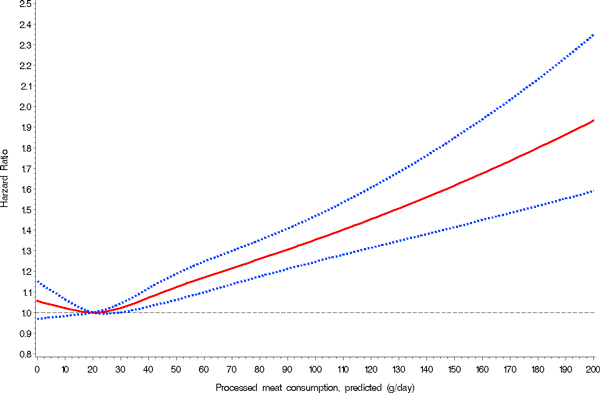
BACKGROUND: Recently, some US cohorts have shown a moderate association between red and processed meat consumption and mortality supporting the results of previous studies among vegetarians. The aim of this study was to examine the association of red meat, processed meat, and poultry consumption with the risk of early death in the European Prospective Investigation into Cancer and Nutrition (EPIC). METHODS: Included in the analysis were 448,568 men and women without prevalent cancer, stroke, or myocardial infarction, and with complete information on diet, smoking, physical activity and body mass index, who were between 35 and 69 years old at baseline. Cox proportional hazards regression was used to examine the association of meat consumption with all-cause and cause-specific mortality. RESULTS: As of June 2009, 26,344 deaths were observed. After multivariate adjustment, a high consumption of red meat was related to higher all-cause mortality (hazard ratio (HR) = 1.14, 95% confidence interval (CI) 1.01 to 1.28, 160+ versus 10 to 19.9 g/day), and the association was stronger for processed meat (HR = 1.44, 95% CI 1.24 to 1.66, 160+ versus 10 to 19.9 g/day). After correction for measurement error, higher all-cause mortality remained significant only for processed meat (HR = 1.18, 95% CI 1.11 to 1.25, per 50 g/d). We estimated that 3.3% (95% CI 1.5% to 5.0%) of deaths could be prevented if all participants had a processed meat consumption of less than 20 g/day. Significant associations with processed meat intake were observed for cardiovascular diseases, cancer, and 'other causes of death'. The consumption of poultry was not related to all-cause mortality. CONCLUSIONS: The results of our analysis support a moderate positive association between processed meat consumption and mortality, in particular due to cardiovascular diseases, but also to cancer.
Overview
The claims and statistics of this paper haven’t been checked yet.
Free: it reads the open-access text and checks the first 5 claims that cite a source we can check. Create a free account to check every claim.
Integrity signals
Registry
Cites
Statistics
Figures
Verification
Claims the paper makes
The claims and statistics of this paper haven’t been checked yet.
Free: it reads the open-access text and checks the first 5 claims that cite a source we can check. Create a free account to check every claim.
Claims other papers make about this one
Each is checked against this paper’s own text: does it say what the citing paper says it does?
The source backs part of the claim, not all of it — or backs it for a different population, condition or comparison.
In the citing paper
“numerous large scale epidemiological studies have noted a relationship between a Western diet, which is enriched in known nutrient TMAO precursors (e.g. choline, phosphatidylcholine and carnitine), and enhanced risk for myocardial infarction, stroke and death”
From Gut Microbial Metabolite TMAO Enhances Platelet Hyperreactivity and Thrombosis Risk (2016) · cites this paper as Rohrmann et al., 2013
Experimental — accuracy not yet measuredIn the citing paper
“There was a positive correlation between processed meat and mortality due to CVD observed in a study from the EPIC group (n > 400,000 people), but this association was specific to processed meat and was not seen with unprocessed meat, which has high L-carnitine and choline content (95).”
From Trimethylamine N -Oxide, the Microbiome, and Heart and Kidney Disease (2017) · cites this paper as [95]
In the citing paper
“In more recent analyses, red meats, particularly processed red meats, were associated with increased CVD, CHD, stroke, and cancer mortality, while poultry was not (170–172).”
From Food Consumption and its Impact on Cardiovascular Disease: Importance of Solutions Focused on the Globalized Food System (2015) · cites this paper as [170]
Self-check
Percentages, sums and reported differences re-computed from the paper’s own numbers.
The self-check needs the paper’s full text.
Citations
Cites
Food, nutrition, physical activity, and the prevention of cancer: a global perspective
(2008) · Choice Reviews Online · doi:10.5860/choice.45-5024 · Cited by 5,350
Riboli, E., Hunt, K., Slimani, N., Ferrari, P., Norat, T., Fahey, M., Charrondière, U., Hémon, B., Casagrande, C., Vignat, J., et al. (2002) · Public Health Nutrition · doi:10.1079/phn2002394 · Cited by 1,866 · cited 4×
“At recruitment, men were 40 to 70 and women 35 to 70 years old [18].”
InfluentialSelf-citationLazcano-Ponce, E. C. (2009) · Salud Pública de México · Cited by 1,669
Mozaffarian, D., Micha, R., & Wallace, S. (2010) · PLoS Medicine · doi:10.1371/journal.pmed.1000252 · Cited by 1,215 · cited 2×
“Both high saturated fat and cholesterol intake have been found to be related to the risk of coronary heart disease [2].”
BackgroundNorat, T., Bingham, S., Ferrari, P., Slimani, N., Jenab, M., Mazuir, M., Overvad, K., Olsen, A., Tjønneland, A., Clavel, F., et al. (2005) · JNCI: Journal of the National Cancer Institute · doi:10.1093/jnci/dji164 · Cited by 862 · cited 1×
“colorectal [29] and gastric [30] cancer with high meat, in particular processed meat, consumption.”
BackgroundSelf-citationWareham, N. J., Jakes, R. W., Rennie, K. L., Schuit, J., Mitchell, J., Hennings, S., & Day, N. E. (2003) · Public Health Nutrition · doi:10.1079/phn2002439 · Cited by 850 · cited 1×
“continuous), physical activity index (active, moderately active, moderately inactive, inactive, missing) [23], and education (none or primary school completed; technical/professional school; secondary school; university degree; missing).”
BackgroundSelf-citationRed Meat Consumption and Mortality: Results From 2 Prospective Cohort Studies
Sun, Q. (2012) · Archives of Internal Medicine · doi:10.1001/archinternmed.2011.2287 · Cited by 763
Meat Intake and Mortality: A Prospective Study of Over Half a Million People
Sinha, R., Cross, A. J., Graubard, B. I., Leitzmann, M. F., & Schatzkin, A. (2009) · Archives of Internal Medicine · doi:10.1001/archinternmed.2009.6 · Cited by 543 · cited 5×
“6 g/1,000 kcal/ day (the authors did not state the preventable fraction for men [8]).”
InfluentialFraser, G. E. (1999) · The American Journal of Clinical Nutrition · doi:10.1093/ajcn/70.3.532s · Cited by 489 · cited 2×
“Some prospective studies have evaluated the association between meat intake and mortality [6-17], but several of them were studies comparing meat consumers with vegetarians [9, 11,”
BackgroundResultAccuracy of Death Certificates for Coding Coronary Heart Disease as the Cause of Death
Lloyd-Jones, D. M., Martin, D. O., Larson, M. G., & Levy, D. (1998) · Annals of Internal Medicine · doi:10.7326/0003-4819-129-12-199812150-00005 · Cited by 480
Anatomy of health effects of Mediterranean diet: Greek EPIC prospective cohort study
Trichopoulou, A., Bamia, C., & Trichopoulos, D. (2009) · BMJ · doi:10.1136/bmj.b2337 · Cited by 436 · cited 2×
“Some prospective studies have evaluated the association between meat intake and mortality [6-17], but several of them were studies comparing meat consumers with vegetarians [9, 11,”
ResultSelf-citationDay, N. (2001) · International Journal of Epidemiology · doi:10.1093/ije/30.2.309 · Cited by 412 · cited 5×
“Abbreviations AARP: American Association of Retired Persons; CI: confidence interval; EPIC: European Prospective Investigation into Cancer and Nutrition; FFQ: food frequency questionnaire; HPFS: Health Professionals Follow-up Study; HR: hazard rate; ICD-10: 10th Revision of the International Classification of Diseases…”
MethodInfluentialSlimani, N., Kaaks, R., Ferrari, P., Casagrande, C., Clavel-Chapelon, F., Lotze, G., Kroke, A., Trichopoulos, D., Trichopoulou, A., Lauria, C., et al. (2002) · Public Health Nutrition · doi:10.1079/phn2002395 · Cited by 385 · cited 1×
“In order to improve the comparability of dietary data across the participating centers, dietary intakes from the questionnaires were calibrated using a standardized 24-hour dietary recall [24, 25], thus, partly correcting for over- and underestimation of dietary intakes [26].”
MethodSelf-citationSlimani, N., Ferrari, P., Ocké, M., Welch, A., Boeing, H., van Liere, M., Pala, V, Amiano, P., Lagiou, A., Mattisson, I., et al. (2000) · European Journal of Clinical Nutrition · doi:10.1038/sj.ejcn.1601107 · Cited by 361 · cited 1×
“In order to improve the comparability of dietary data across the participating centers, dietary intakes from the questionnaires were calibrated using a standardized 24-hour dietary recall [24, 25], thus, partly correcting for over- and underestimation of dietary intakes [26].”
MethodSelf-citationGonzález, C. A., Jakszyn, P., Pera, G., Agudo, A., Bingham, S., Palli, D., Ferrari, P., Boeing, H., del Giudice, G., Plebani, M., et al. (2006) · JNCI: Journal of the National Cancer Institute · doi:10.1093/jnci/djj071 · Cited by 345 · cited 1×
“colorectal [29] and gastric [30] cancer with high meat, in particular processed meat, consumption.”
BackgroundSelf-citationProblems With Proper Completion and Accuracy of the Cause-of-Death Statement
Sehdev, A. E. S., & Hutchins, G. M. (2001) · Archives of Internal Medicine · doi:10.1001/archinte.161.2.277 · Cited by 342 · cited 1×
“Deaths due to cancer are most correctly diagnosed, whereas deaths due to coronary heart disease tend to be overrepresented and respiratory diseases might be underrepresented [37-39].”
BackgroundSpiegelman, D., Hertzmark, E., & Wand, H. C. (2007) · Cancer Causes & Control · doi:10.1007/s10552-006-0090-y · Cited by 298 · cited 1×
“The population attributable risk (PAR), which describes the proportion of cases that would be prevented if everyone in the study population had the reference level of the exposure, was estimated based on the formula [28]:”
MethodGaining more flexibility in Cox proportional hazards regression models with cubic spline functions
Heinzl, H., & Kaider, A. (1997) · Computer Methods and Programs in Biomedicine · doi:10.1016/s0169-2607(97)00043-6 · Cited by 283
Empirical Evidence of Correlated Biases in Dietary Assessment Instruments and Its Implications
Kipnis, V., Midthune, D., Freedman, L. S., Bingham, S., Schatzkin, A., Subar, A., & Carroll, R. J. (2001) · American Journal of Epidemiology · doi:10.1093/aje/153.4.394 · Cited by 280 · cited 3×
“Results of the 24-hour recalls (mean, standard error of the mean) were also used to describe the FFQ-based intake categories of red meat, processed meat, and poultry.”
Haftenberger, M., Lahmann, P., Panico, S., Gonzalez, C., Seidell, J., Boeing, H., Giurdanella, M., Krogh, V, Bueno-de-Mesquita, H., Peeters, P., et al. (2002) · Public Health Nutrition · doi:10.1079/phn2002396 · Cited by 275 · cited 1×
“In Oxford, self-reports were improved by using prediction equations [19].”
Self-citationBingham, S. A., Hughes, R., & Cross, A. J. (2002) · The Journal of Nutrition · doi:10.1093/jn/132.11.3522s · Cited by 273 · cited 1×
“Although iron is essential for prevention of anemia, a high intake, especially of heme iron, is related to the endogenous formation of N-nitroso compounds in the gastro-intestinal tract [3, 4] and, thus, may be a risk factor for some cancer entities, for example, colon cancer [5].”
BackgroundKey, T. J., Appleby, P. N., Spencer, E. A., Travis, R. C., Roddam, A. W., & Allen, N. E. (2009) · The American Journal of Clinical Nutrition · doi:10.3945/ajcn.2009.26736l · Cited by 257 · cited 2×
“Some prospective studies have evaluated the association between meat intake and mortality [6-17], but several of them were studies comparing meat consumers with vegetarians [9,11,13,16].”
Self-citationKaaks, R. (1997) · International Journal of Epidemiology · doi:10.1093/ije/26.suppl_1.s15 · Cited by 220
Self-citationKelemen, L. E. (2005) · American Journal of Epidemiology · doi:10.1093/aje/kwi038 · Cited by 214 · cited 1×
“Some prospective studies have evaluated the association between meat intake and mortality [6-17], but several of them were studies comparing meat consumers with vegetarians [9, 11,”
ResultKaaks, R. (1997) · International Journal of Epidemiology · doi:10.1093/ije/26.suppl_1.s26 · Cited by 198
Self-citationLinseisen, J., Kesse, E., Slimani, N., Bueno-de-Mesquita, H., Ocké, M., Skeie, G., Kumle, M., Iraeta, M. D., Gómez, P. M., Janzon, L., et al. (2002) · Public Health Nutrition · doi:10.1079/phn2002402 · Cited by 161 · cited 1×
“A further methodological strength of the EPIC cohort is the inclusion of individuals from 10 European countries with distinctly diverging meat consumption habits [36].”
Self-citationA Practical Guide to Dose-Response Analyses and Risk Assessment in Occupational Epidemiology
Steenland, K., & Deddens, J. A. (2004) · Epidemiology · doi:10.1097/01.ede.0000100287.45004.e7 · Cited by 154 · cited 1×
“To explore the shape of the risk function, we fitted a Cox proportional hazards model with restricted cubic splines for red and processed meat and poultry intake treated as continuous variables [20, 21].”
Effect of processed and red meat on endogenous nitrosation and DNA damage
Joosen, A. M. C. P., Kuhnle, G. G. C., Aspinall, S. M., Barrow, T. M., Lecommandeur, E., Azqueta, A., Collins, A. R., & Bingham, S. A. (2009) · Carcinogenesis · doi:10.1093/carcin/bgp130 · Cited by 149 · cited 1×
“Although iron is essential for prevention of anemia, a high intake, especially of heme iron, is related to the endogenous formation of N-nitroso compounds in the gastro-intestinal tract [3, 4] and, thus, may be a risk factor for some cancer entities, for example, colon cancer [5].”
BackgroundASSOCIATION BETWEEN REPORTED DIET AND ALL-CAUSE MORTALITY
KAHN, H. A., PHILLIPS, R. L., SNOWDON, D. A., & CHOI, W. (1984) · American Journal of Epidemiology · doi:10.1093/oxfordjournals.aje.a113798 · Cited by 139 · cited 2×
“Some prospective studies have evaluated the association between meat intake and mortality [6-17], but several of them were studies comparing meat consumers with vegetarians [9, 11,”
ResultModelmog, D., Rahlenbeck, S. I., & Trichopoulos, D. (1992) · Cancer Causes & Control · doi:10.1007/bf00052751 · Cited by 133 · cited 1×
“Deaths due to cancer are most correctly diagnosed, whereas deaths due to coronary heart disease tend to be overrepresented and respiratory diseases might be underrepresented [37-39].”
BackgroundSelf-citationKaaks, R., & Ríboli, E. (1997) · International Journal of Epidemiology · Cited by 133
Self-citationLinseisen, J., Rohrmann, S., Miller, A. B., Bueno‐de‐Mesquita, H. B., Büchner, F. L., Vineis, P., Agudo, A., Gram, I. T., Janson, L., Krogh, V., et al. (2007) · International Journal of Cancer · doi:10.1002/ijc.22807 · Cited by 123 · cited 1×
“We separately adjusted for the amount of smoking and the duration of smoking instead of using pack-years of smoking to differentiate better between, for example, heavy smokers of a short duration and light smokers for a long duration [22].”
Self-citationFerrari, P., Day, N. E., Boshuizen, H. C., Roddam, A., Hoffmann, K., Thiébaut, A., Pera, G., Overvad, K., Lund, E., Trichopoulou, A., et al. (2008) · International Journal of Epidemiology · doi:10.1093/ije/dym242 · Cited by 116 · cited 1×
“In order to improve the comparability of dietary data across the participating centers, dietary intakes from the questionnaires were calibrated using a standardized 24-hour dietary recall [24, 25], thus, partly correcting for over- and underestimation of dietary intakes [26].”
MethodSelf-citationRosthøj, S., Andersen, P. K., & Abildstrom, S. Z. (2003) · Computer Methods and Programs in Biomedicine · doi:10.1016/s0169-2607(03)00069-5 · Cited by 107
Kaaks, R., Slimani, N., & Ríboli, E. (1997) · International Journal of Epidemiology · Cited by 97
Self-citationChang-Claude, J., Hermann, S., Eilber, U., & Steindorf, K. (2005) · Cancer Epidemiology, Biomarkers & Prevention · doi:10.1158/1055-9965.epi-04-0696 · Cited by 95 · cited 2×
“Some prospective studies have evaluated the association between meat intake and mortality [6-17], but several of them were studies comparing meat consumers with vegetarians [9, 11,”
BackgroundResultDiet and Overall Survival in a Cohort of Very Elderly People
Fortes, C., Forastiere, F., Farchi, S., Rapiti, E., Pastori, G., & Perucci, C. A. (2000) · Epidemiology · doi:10.1097/00001648-200007000-00013 · Cited by 92 · cited 2×
“Some prospective studies have evaluated the association between meat intake and mortality [6-17], but several of them were studies comparing meat consumers with vegetarians [9,11,13,16].”
Meat consumption in relation to mortality from cardiovascular disease among Japanese men and women
Nagao, M., Iso, H., Yamagishi, K., Date, C., Tamakoshi, A., & for the JACC Study Group (2012) · European Journal of Clinical Nutrition · doi:10.1038/ejcn.2012.6 · Cited by 76 · cited 2×
“Some prospective studies have evaluated the association between meat intake and mortality [6-17], but several of them were studies comparing meat consumers with vegetarians [9, 11,”
BackgroundResultFerrari, P. (2004) · American Journal of Epidemiology · doi:10.1093/aje/kwh280 · Cited by 75
Self-citationAdditional Ways to Diminish the Deleterious Effects of Red Meat—Reply
Pan, A., Willett, W. C., & Hu, F. B. (2012) · Archives of Internal Medicine · doi:10.1001/archinternmed.2012.4111 · Cited by 65
Mortality in British vegetarians
Appleby, P. N., Key, T. J., Thorogood, M., Burr, M. L., & Mann, J. (2002) · Public Health Nutrition · doi:10.1079/phn2001248 · Cited by 61 · cited 1×
“Some prospective studies have evaluated the association between meat intake and mortality [6-17], but several of them were studies comparing meat consumers with vegetarians [9,11,13,16].”
Self-citationDietary questions as determinants of mortality: the OXCHECK experience
Whiteman, D., Muir, J., Jones, L., Murphy, M., & Key, T. (1999) · Public Health Nutrition · doi:10.1017/s136898009900066x · Cited by 54 · cited 2×
“Some prospective studies have evaluated the association between meat intake and mortality [6-17], but several of them were studies comparing meat consumers with vegetarians [9,11,13,16].”
Self-citationHebels, D. G. A. J., Sveje, K. M., de Kok, M. C., van Herwijnen, M. H. M., Kuhnle, G., Engels, L. G. J. B., Vleugels-Simon, C. B. E. M., Mares, W. G. N., Pierik, M. J., Masclee, A., et al. (2011) · Cancer Letters · doi:10.1016/j.canlet.2011.05.007 · Cited by 35
Cited by
Meat consumption, health, and the environment
Godfray, H. C. J., Aveyard, P., Garnett, T., Hall, J. W., Key, T. J., Lorimer, J., Pierrehumbert, R. T., Scarborough, P., Springmann, M., & Jebb, S. A. (2018) · Science · doi:10.1126/science.aam5324 · Cited by 2,077
Self-citationGut Microbial Metabolite TMAO Enhances Platelet Hyperreactivity and Thrombosis Risk
Zhu, W., Gregory, J. C., Org, E., Buffa, J. A., Gupta, N., Wang, Z., Li, L., Fu, X., Wu, Y., Mehrabian, M., et al. (2016) · Cell · doi:10.1016/j.cell.2016.02.011 · Cited by 1,968
“…large scale epidemiological studies have noted a relationship between a Western diet, which is enriched in known nutrient TMAO precursors (e.g. choline, phosphatidylcholine and carnitine), and enhanced risk for myocardial infarction, stroke and death (Iqbal et al., 2008; Rohrmann et al., 2013).”
de Souza, R. J., Mente, A., Maroleanu, A., Cozma, A. I., Ha, V., Kishibe, T., Uleryk, E., Budylowski, P., Schünemann, H., Beyene, J., et al. (2015) · BMJ · doi:10.1136/bmj.h3978 · Cited by 1,424
Position of the Academy of Nutrition and Dietetics: Vegetarian Diets
Melina, V., Craig, W., & Levin, S. (2016) · Journal of the Academy of Nutrition and Dietetics · doi:10.1016/j.jand.2016.09.025 · Cited by 1,360
Reactive Oxygen Species: A Key Constituent in Cancer Survival
Kumari, S., Badana, A. K., G, M. M., G, S., & Malla, R. (2018) · Biomarker Insights · doi:10.1177/1177271918755391 · Cited by 777
Metadata
- Authors
- Rohrmann, S., Overvad, K., Bueno-de-Mesquita, H. B., Jakobsen, M. U., Egeberg, R., Tjønneland, A., Nailler, L., Boutron-Ruault, M.-C., Clavel-Chapelon, F., Krogh, V., Palli, D., Panico, S., Tumino, R., Ricceri, F., Bergmann, M. M., Boeing, H., Li, K., Kaaks, R., Khaw, K.-T., Wareham, N. J., Crowe, F. L., Key, T. J., Naska, A., Trichopoulou, A., Trichopoulos, D., Leenders, M., Peeters, P. H., Engeset, D., Parr, C. L., Skeie, G., Jakszyn, P., Sánchez, M.-J., Huerta, J. M., Redondo, M. L., Barricarte, A., Amiano, P., Drake, I., Sonestedt, E., Hallmans, G., Johansson, I., Fedirko, V., Romieux, I., Ferrari, P., Norat, T., Vergnaud, A. C., Riboli, E., & Linseisen, J.
- Affiliations
- University of Zurich (CH)
- Aarhus University (DK)
- University Medical Center Utrecht (NL)
- Danish Cancer Society (DK)
- Inserm (FR)
- Fondazione IRCCS Istituto Nazionale dei Tumori (IT)
- Federico II University Hospital (IT)
- Italian institute for Genomic Medicine (IT)
- German Institute of Human Nutrition (DE)
- German Cancer Research Center (DE)
- University of Cambridge (GB)
- MRC Epidemiology Unit (GB)
- University of Oxford (GB)
- National and Kapodistrian University of Athens (GR)
- Harvard University (US)
- UiT The Arctic University of Norway (NO)
- University of Oslo (NO)
- Institut Català d'Oncologia (ES)
- Centro de Investigación Biomédica en Red de Epidemiología y Salud Pública (ES)
- Andalusian School of Public Health (ES)
- Gobierno del Principado de Asturias (ES)
- Instituto de Salud Pública de Navarra (ES)
- Basque Government (ES)
- Lund University (SE)
- Umeå University (SE)
- Centre international de recherche sur le cancer (FR)
- Imperial College London (GB)
- Corresponding author
- Rohrmann, Sabine
- ORCID
- Rohrmann, Sabine
- Overvad, Kim
- Jakobsen, Marianne U
- Tjønneland, Anne
- Krogh, Vittorio
- Palli, Domenico
- Panico, Salvatore
- Tumino, Rosario
- Ricceri, Fulvio
- Bergmann, Manuela M
- Boeing, Heiner
- Li, Kuanrong
- Kaaks, Rudolf
- Khaw, Kay-Tee
- Wareham, Nicholas J
- Crowe, Francesca L
- Key, Timothy J
- Naska, Androniki
- Trichopoulou, Antonia
- Peeters, Petra HM
- Engeset, Dagrun
- Parr, Christine L
- Skeie, Guri
- Jakszyn, Paula
- Sánchez, María-José
- Huerta, José M
- Barricarte, Aurelio
- Amiano, Pilar
- Drake, Isabel
- Sonestedt, Emily
- Johansson, Ingegerd
- Fedirko, Veronika
- Ferrari, Pietro
- Linseisen, Jakob
- Venue
- BMC Medicine
- Published
- 2013-03-07
- Volume
- 11
- Issue
- 1
- Pages
- 63-63
- ISSN
- 1741-7015 (ISSN-L)
- PMC
- PMC3599112
- OpenAlex
- W2168476314
- Cited by
- 454
- References
- 43
- Citations by year
- 2026: 15 · 2025: 23 · 2024: 42 · 2023: 21 · 2022: 44 · 2021: 40 · 2020: 31 · 2019: 38 · 2018: 30 · 2017: 38 · 2016: 37 · 2015: 43 · 2014: 31 · 2013: 21
- FWCI
- 44.88
- Type
- journal article
- Language
- en
- Open access
- gold
- doi.org
- Licence
- Locations
- BMC Medicine (publishedVersion, cc-by)
- Europe PMC (PubMed Central) (publishedVersion, cc-by)
- PubMed Central (publishedVersion, cc-by)
- PubMed (publishedVersion)
- Zurich Open Repository and Archive (University of Zurich) (acceptedVersion, cc-by)
- HAL (submittedVersion, other-oa)
- KTH Publication Database DiVA (KTH Royal Institute of Technology) (submittedVersion, other-oa)
- Institutional Research Information System University of Turin (University of Turin) (submittedVersion)
- Lund University Publications (Lund University) (submittedVersion, other-oa)
- NORA - Norwegian Open Research Archives (submittedVersion, other-oa)
- Site cant be reached (submittedVersion, cc-by)
- OPUS (Augsburg University) (submittedVersion, cc-by)
- NORA - Norwegian Open Research Archives (submittedVersion, cc-by)
- RISalud Institutional Health Repository of Andalucía (submittedVersion, other-oa)
- Apollo (University of Cambridge) (submittedVersion, cc-by)
- Zurich Open Repository and Archive (University of Zurich) (submittedVersion, cc-by)
- Zurich Open Repository and Archive (University of Zurich)
- Funders
- Deutsches Krebsforschungszentrum
- Kreftforeningen
- Wellcome Trust
- Cancer Research UK (14136)
- National Institute for Health and Care Research
- British Heart Foundation
- European Commission
- Institut National de la Santé et de la Recherche Médicale
- Bundesministerium für Bildung und Forschung
- Cancerfonden
- Ligue Contre le Cancer
- Stavros Niarchos Foundation
- NordForsk
- Associazione Italiana per la Ricerca sul Cancro
- Deutsche Krebshilfe
- Institut Gustave-Roussy
- Mutuelle Générale de l'Education Nationale
- Hellenic Health Foundation
- Medical Research Council
- World Cancer Research Fund
- Instituto de Salud Carlos III (C03/09)
- Topics
- Health Sciences › Medicine › Public Health, Environmental and Occupational Health › Nutritional Studies and Diet
- Physical Sciences › Environmental Science › Ecology › Agriculture Sustainability and Environmental Impact
- Life Sciences › Agricultural and Biological Sciences › Animal Science and Zoology › Meat and Animal Product Quality
- Keywords
- meat consumption, red meat, processed meat, poultry, mortality, all-cause mortality, cardiovascular mortality, cancer mortality, dietary risk factors, EPIC cohort
- MeSH terms
- Adult, Aged, Cardiovascular Diseases, Diet, Feeding Behavior, Female, Humans, Male, Meat, Middle Aged, Neoplasms, Nutrition Surveys, Prospective Studies, United States, Cohort Studies, Survival Analysis
About these checks
Registry, retraction, Cites and statistics results are computed, not judged, with one exception: a printed reference that no index lists is read once by a model before it counts as a citation error. Claims are extracted by a model and kept only when their quote appears verbatim in the text; each cited source is then checked, with a model’s help, for whether it says what the claim relies on. Those verdicts can be wrong — read the claim’s quote and the cited source before relying on one.
Statistics and arithmetic are recomputed, not judged.
Confidence bands are shown only for fields calibrated on our annotated test set. None is calibrated yet, so no band is shown.
What counts as a claim ›How we measure confidence ›How we check this ›
Are you an author, or do you see a problem with this page? Request a review
Data sources
Bibliographic data: Semantic Scholar, OpenAlex, Crossref.
Contains information from the Semantic Scholar Academic Graph Datasets, made available under the ODC Attribution License (ODC-BY 1.0).
Semantic Scholar’s data is described in: Kinney, R., et al. (2023). The Semantic Scholar Open Data Platform. arXiv:2301.10140.
