

The DOI matches its Crossref record; 107 of the 107 references it cites were found in a registry or an index.
Dysfunction of the intestinal microbiome in inflammatory bowel disease and treatment
Open accessAbstract
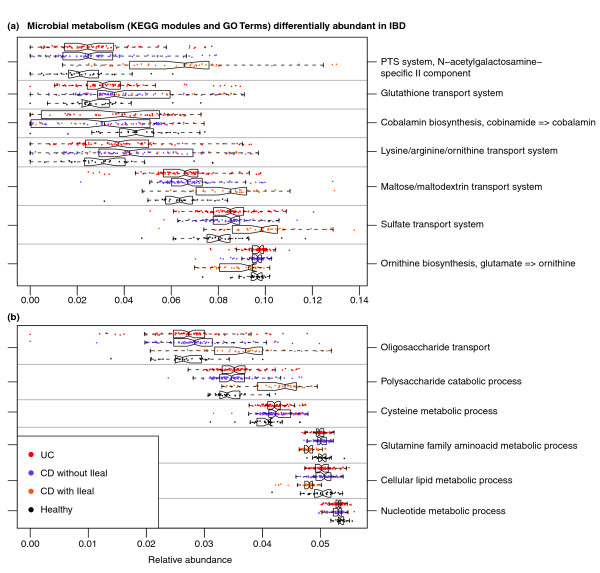
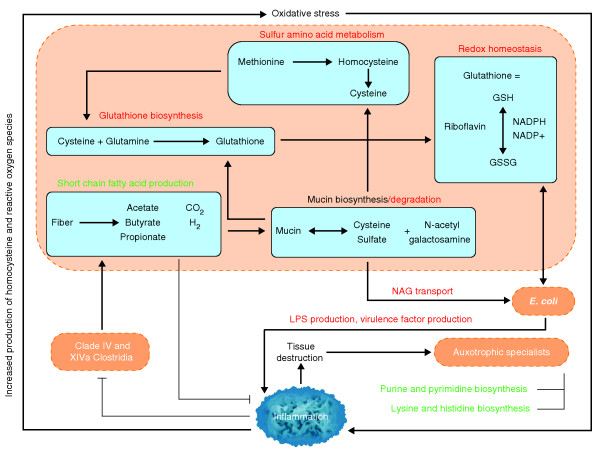
Background: The inflammatory bowel diseases (IBD) Crohn's disease and ulcerative colitis result from alterations in intestinal microbes and the immune system. However, the precise dysfunctions of microbial metabolism in the gastrointestinal microbiome during IBD remain unclear. We analyzed the microbiota of intestinal biopsies and stool samples from 231 IBD and healthy subjects by 16S gene pyrosequencing and followed up a subset using shotgun metagenomics. Gene and pathway composition were assessed, based on 16S data from phylogenetically-related reference genomes, and associated using sparse multivariate linear modeling with medications, environmental factors, and IBD status. Results: Firmicutes and Enterobacteriaceae abundances were associated with disease status as expected, but also with treatment and subject characteristics. Microbial function, though, was more consistently perturbed than composition, with 12% of analyzed pathways changed compared with 2% of genera. We identified major shifts in oxidative stress pathways, as well as decreased carbohydrate metabolism and amino acid biosynthesis in favor of nutrient transport and uptake. The microbiome of ileal Crohn's disease was notable for increases in virulence and secretion pathways. Conclusions: This inferred functional metagenomic information provides the first insights into community-wide microbial processes and pathways that underpin IBD pathogenesis.
Overview
The claims and statistics of this paper haven’t been checked yet.
Run the check — free, no account needed. It reads the open-access text and checks the sources it cites.
Integrity signals
Registry
Cites
Statistics
Figures
Verification
Claims the paper makes
The claims and statistics of this paper haven’t been checked yet.
Run the check — free, no account needed. It reads the open-access text and checks the sources it cites.
Claims other papers make about this one
Each is checked against this paper’s own text: does it say what the citing paper says it does?
In the citing paper
“This study identified enrichment in microbial pathways for oxidative stress tolerance, immune evasion and host metabolite uptake, with corresponding depletions in SCFA biosynthesis and typical gut carbohydrate metabolism and amino acid biosynthetic processes.”
From The gut microbiota and host health: a new clinical frontier (2016) · cites this paper as [70]
In the citing paper
“Changes in the proportions of specific taxa of gut microbiota have been observed in various disease states, including obesity68,69, inflammatory bowel disease70, type 1 and type 2 diabetes mellitus71,72, biliary disease73, and intestinal cancers74,75 among many others.”
From Dietary metabolism, the gut microbiome, and heart failure (2019) · cites this paper as [70]
In the citing paper
“no comprehensive model of specific microbial, molecular, and immune interactions yet exists to explain the disease’s onset and dynamic progression.”
From The Integrative Human Microbiome Project (2019) · cites this paper as [71]
In the citing paper
“Indeed, these dynamic changes were of much greater magnitude than were cross-sectional differences among clinical phenotypes, which have been emphasized by previous studies67,71,78,79.”
From The Integrative Human Microbiome Project (2019) · cites this paper as [71]
Self-check
Percentages, sums and reported differences re-computed from the paper’s own numbers.
The self-check needs the paper’s full text.
Citations
Cites
Controlling the False Discovery Rate: A Practical and Powerful Approach to Multiple Testing
Benjamini, Y., & Hochberg, Y. (1995) · Journal of the Royal Statistical Society Series B: Statistical Methodology · doi:10.1111/j.2517-6161.1995.tb02031.x · Cited by 109,482
The Elements of Statistical Learning
Hastie, T., Tibshirani, R., & Friedman, J. (2009) · Springer Series in Statistics · doi:10.1007/978-0-387-84858-7 · Cited by 25,970
The Elements of Statistical Learning
Hastie, T., Friedman, J., & Tibshirani, R. (2001) · Springer Series in Statistics · doi:10.1007/978-0-387-21606-5 · Cited by 24,162
Metagenomic biomarker discovery and explanation
Segata, N., Izard, J., Waldron, L., Gevers, D., Miropolsky, L., Garrett, W. S., & Huttenhower, C. (2011) · Genome Biology · doi:10.1186/gb-2011-12-6-r60 · Cited by 16,192
Self-citationFastTree 2 – Approximately Maximum-Likelihood Trees for Large Alignments
Price, M. N., Dehal, P. S., & Arkin, A. P. (2010) · PLoS ONE · doi:10.1371/journal.pone.0009490 · Cited by 14,894
Simpson, E. (1949) · Nature · doi:10.1038/163688a0 · Cited by 14,809
An obesity-associated gut microbiome with increased capacity for energy harvest
Turnbaugh, P. J., Ley, R. E., Mahowald, M. A., Magrini, V., Mardis, E. R., & Gordon, J. I. (2006) · Nature · doi:10.1038/nature05414 · Cited by 12,444
FactoMineR : An R Package for Multivariate Analysis
Lê, S., Josse, J., & Husson, F. (2008) · Journal of Statistical Software · doi:10.18637/jss.v025.i01 · Cited by 12,422
Structure, function and diversity of the healthy human microbiome
The Human Microbiome Project Consortium (2012) · Nature · doi:10.1038/nature11234 · Cited by 11,726
A human gut microbial gene catalogue established by metagenomic sequencing
MetaHIT Consortium, Qin, J., Li, R., Raes, J., Arumugam, M., Burgdorf, K. S., Manichanh, C., Nielsen, T., Pons, N., Levenez, F., et al. (2010) · Nature · doi:10.1038/nature08821 · Cited by 11,624
Research works printed but not linked: 1
- Sokol H, Pigneur B, Watterlot L, Lakhdari O, Bermudez-Humaran LG, Gratadoux JJ, Blugeon S, Bridonneau C, Furet JP, Corthier G, et al: Faecalibacterium prausnitzii is an anti-inflammatory commensal bacterium identified by gut microbiota analysis of Crohn disease patients. Proc Natl Acad Sci USA. 2008, 105: 16731-16736. 10.1073/pnas.0804812105. · DOI · Paper page
Cited by
Sorted by citations
Items 101–151 of 151
Probiotic approach to prevent antibiotic resistance
Ouwehand, A. C., Forssten, S., Hibberd, A. A., Lyra, A., & Stahl, B. (2016) · Annals of Medicine · doi:10.3109/07853890.2016.1161232 · Cited by 216
Kurokawa, S., Kishimoto, T., Mizuno, S., Masaoka, T., Naganuma, M., Liang, K.-C., Kitazawa, M., Nakashima, M., Shindo, C., Suda, W., et al. (2018) · Journal of Affective Disorders · doi:10.1016/j.jad.2018.04.038 · Cited by 205
Russo, E., Giudici, F., Fiorindi, C., Ficari, F., Scaringi, S., & Amedei, A. (2019) · Frontiers in Immunology · doi:10.3389/fimmu.2019.02754 · Cited by 204
Siderophore-mediated iron acquisition and modulation of host-bacterial interactions
Ellermann, M., & Arthur, J. C. (2017) · Free Radical Biology and Medicine · doi:10.1016/j.freeradbiomed.2016.10.489 · Cited by 186
The intestinal microbiota in inflammatory bowel disease
Becker, C., Neurath, M. F., & Wirtz, S. (2015) · ILAR Journal · doi:10.1093/ilar/ilv030 · Cited by 185
Nlrp6- and ASC-Dependent Inflammasomes Do Not Shape the Commensal Gut Microbiota Composition
Mamantopoulos, M., Ronchi, F., Van Hauwermeiren, F., Vieira-Silva, S., Yilmaz, B., Martens, L., Saeys, Y., Drexler, S. K., Yazdi, A. S., Raes, J., et al. (2017) · Immunity · doi:10.1016/j.immuni.2017.07.011 · Cited by 181
Gao, C., Major, A., Rendon, D., Lugo, M., Jackson, V., Shi, Z., Mori-Akiyama, Y., & Versalovic, J. (2015) · mBio · doi:10.1128/mbio.01358-15 · Cited by 176
The Milieu Intérieur Consortium, Scepanovic, P., Hodel, F., Mondot, S., Partula, V., Byrd, A., Hammer, C., Alanio, C., Bergstedt, J., Patin, E., et al. (2019) · Microbiome · doi:10.1186/s40168-019-0747-x · Cited by 171
The "Gut Feeling": Breaking Down the Role of Gut Microbiome in Multiple Sclerosis
Freedman, S. N., Shahi, S. K., & Mangalam, A. K. (2018) · Neurotherapeutics · doi:10.1007/s13311-017-0588-x · Cited by 168
Role of gut microbiota in intestinal wound healing and barrier function
Alam, A., & Neish, A. (2018) · Tissue Barriers · doi:10.1080/21688370.2018.1539595 · Cited by 166
Leonard, M. M., Valitutti, F., Karathia, H., Pujolassos, M., Kenyon, V., Fanelli, B., Troisi, J., Subramanian, P., Camhi, S., Colucci, A., et al. (2021) · Proceedings of the National Academy of Sciences · doi:10.1073/pnas.2020322118 · Cited by 162
Ma, S., Shungin, D., Mallick, H., Schirmer, M., Nguyen, L. H., Kolde, R., Franzosa, E., Vlamakis, H., Xavier, R., & Huttenhower, C. (2022) · Genome biology · doi:10.1186/s13059-022-02753-4 · Cited by 164
Self-citationGut microbiota and short‐chain fatty acid alterations in cachectic cancer patients
Ubachs, J., Ziemons, J., Soons, Z., Aarnoutse, R., van Dijk, D. P. J., Penders, J., van Helvoort, A., Smidt, M. L., Kruitwagen, R. F. P. M., Baade‐Corpelijn, L., et al. (2021) · Journal of Cachexia, Sarcopenia and Muscle · doi:10.1002/jcsm.12804 · Cited by 161
Constante, M., Fragoso, G., Calvé, A., Samba-Mondonga, M., & Santos, M. M. (2017) · Frontiers in Microbiology · doi:10.3389/fmicb.2017.01809 · Cited by 161
Can probiotics benefit children with autism spectrum disorders?
Navarro, F., Liu, Y., & Rhoads, J. M. (2016) · World Journal of Gastroenterology · doi:10.3748/wjg.v22.i46.10093 · Cited by 154
Recipient factors in faecal microbiota transplantation: one stool does not fit all
Danne, C., Rolhion, N., & Sokol, H. (2021) · Nature Reviews Gastroenterology & Hepatology · doi:10.1038/s41575-021-00441-5 · Cited by 154
Self-citationThe features of mucosa‐associated microbiota in primary sclerosing cholangitis
Torres, J., Bao, X., Goel, A., Colombel, J. ‐., Pekow, J., Jabri, B., Williams, K. M., Castillo, A., Odin, J. A., Meckel, K., et al. (2016) · Alimentary Pharmacology & Therapeutics · doi:10.1111/apt.13552 · Cited by 149
Alderete, T. L., Jones, R. B., Chen, Z., Kim, J. S., Habre, R., Lurmann, F., Gilliland, F. D., & Goran, M. I. (2018) · Environmental Research · doi:10.1016/j.envres.2017.11.046 · Cited by 139
Mechanism and Intervention Measures of Iron Side Effects on the Intestine
Qi, X., Zhang, Y., Guo, H., Hai, Y., Luo, Y., & Yue, T. (2020) · Critical Reviews in Food Science and Nutrition · doi:10.1080/10408398.2019.1630599 · Cited by 142
Carcinogenesis and therapeutics: the microbiota perspective
Tsilimigras, M. C. B., Fodor, A., & Jobin, C. (2017) · Nature Microbiology · doi:10.1038/nmicrobiol.2017.8 · Cited by 144
Factors influencing the gut microbiome in children: from infancy to childhood
Kumbhare, S. V., Patangia, D. V., Patil, R. H., Shouche, Y. S., & Patil, N. P. (2019) · Journal of Biosciences · doi:10.1007/s12038-019-9860-z · Cited by 143
Fecal microbiota transplantation reverses antibiotic and chemotherapy-induced gut dysbiosis in mice
Le Bastard, Q., Ward, T., Sidiropoulos, D., Hillmann, B. M., Chun, C. L., Sadowsky, M. J., Knights, D., & Montassier, E. (2018) · Scientific Reports · doi:10.1038/s41598-018-24342-x · Cited by 134
Baars, A., Oosting, A., Knol, J., Garssen, J., & Van Bergenhenegouwen, J. (2015) · Microorganisms · doi:10.3390/microorganisms3040641 · Cited by 135
Chen, Y.-R., Zheng, H.-M., Zhang, G.-X., Chen, F.-L., Chen, L.-D., & Yang, Z.-C. (2020) · Scientific Reports · doi:10.1038/s41598-020-66369-z · Cited by 127
Sung, C. M., Lin, Y.-F., Chen, K.-F., Ke, H.-M., Huang, H.-Y., Gong, Y.-N., Tsai, W.-S., You, J.-F., Lu, M. J., Cheng, H.-T., et al. (2019) · Cellular and Molecular Gastroenterology and Hepatology · doi:10.1016/j.jcmgh.2019.04.008 · Cited by 127
Klimenko, N. S., Tyakht, A. V., Popenko, A. S., Vasiliev, A. S., Altukhov, I. A., Ischenko, D. S., Shashkova, T. I., Efimova, D. A., Nikogosov, D. A., Osipenko, D. A., et al. (2018) · Nutrients · doi:10.3390/nu10050576 · Cited by 123
Mezö, C., Dokalis, N., Mossad, O., Staszewski, O., Neuber, J., Yilmaz, B., Schnepf, D., de Agüero, M. G., Ganal-Vonarburg, S. C., Macpherson, A. J., et al. (2020) · Acta Neuropathologica Communications · doi:10.1186/s40478-020-00988-5 · Cited by 120
GLP-1 and GLP-2 Orchestrate Intestine Integrity, Gut Microbiota, and Immune System Crosstalk
Abdalqadir, N., & Adeli, K. (2022) · Microorganisms · doi:10.3390/microorganisms10102061 · Cited by 119
Singh, V., Yeoh, B. S., Chassaing, B., Zhang, B., Saha, P., Xiao, X., Awasthi, D., Shashidharamurthy, R., Dikshit, M., Gewirtz, A., et al. (2016) · Cellular and Molecular Gastroenterology and Hepatology · doi:10.1016/j.jcmgh.2016.03.007 · Cited by 117
Deciphering the tête-à-tête between the microbiota and the immune system
Surana, N. K., & Kasper, D. L. (2014) · Journal of Clinical Investigation · doi:10.1172/jci72332 · Cited by 120
Shankar, V., Hamilton, M. J., Khoruts, A., Kilburn, A., Unno, T., Paliy, O., & Sadowsky, M. J. (2014) · Microbiome · doi:10.1186/2049-2618-2-13 · Cited by 106
“In addition to the tolerance against molecular oxygen and its effects, these oxidative stress response genes also provide protection against ROS generated by neutrophils and macrophages and released into the gut during inflammation [34].”
No distinct microbiome signature of irritable bowel syndrome found in a Swedish random population
Hugerth, L. W., Andreasson, A., Talley, N. J., Forsberg, A. M., Kjellström, L., Schmidt, P. T., Agreus, L., & Engstrand, L. (2020) · Gut · doi:10.1136/gutjnl-2019-318717 · Cited by 102
Preventing adolescent stress-induced cognitive and microbiome changes by diet
Provensi, G., Schmidt, S. D., Boehme, M., Bastiaanssen, T. F. S., Rani, B., Costa, A., Busca, K., Fouhy, F., Strain, C., Stanton, C., et al. (2019) · Proceedings of the National Academy of Sciences · doi:10.1073/pnas.1820832116 · Cited by 110
Healthy hosts rule within: ecological forces shaping the gut microbiota
Byndloss, M. X., Pernitzsch, S. R., & Bäumler, A. J. (2018) · Mucosal Immunology · doi:10.1038/s41385-018-0010-y · Cited by 109
Wang, Y., Wang, S., Wu, C., Chen, X., Duan, Z., Xu, Q., Jiang, W., Xu, L., Wang, T., Su, L., et al. (2019) · mSystems · doi:10.1128/msystems.00450-19 · Cited by 105
Haran, J. P., Bucci, V., Dutta, P., Ward, D., & McCormick, B. (2018) · Journal of Medical Microbiology · doi:10.1099/jmm.0.000640 · Cited by 97
Self-citationFrom the Bottom-Up: Chemotherapy and Gut-Brain Axis Dysregulation
Bajic, J. E., Johnston, I. N., Howarth, G. S., & Hutchinson, M. R. (2018) · Frontiers in Behavioral Neuroscience · doi:10.3389/fnbeh.2018.00104 · Cited by 100
Zysset-Burri, D. C., Keller, I., Berger, L. E., Largiadèr, C. R., Wittwer, M., Wolf, S., & Zinkernagel, M. S. (2020) · npj Genomic Medicine · doi:10.1038/s41525-020-00141-0 · Cited by 94
Pärnänen, K. M., Hultman, J., Markkanen, M., Satokari, R., Rautava, S., Lamendella, R., Wright, J., McLimans, C. J., Kelleher, S. L., & Virta, M. P. (2022) · The American Journal of Clinical Nutrition · doi:10.1093/ajcn/nqab353 · Cited by 99
Analysis of the association between host genetics, smoking, and sputum microbiota in healthy humans
Lim, M. Y., Yoon, H. S., Rho, M., Sung, J., Song, Y.-M., Lee, K., & Ko, G. (2016) · Scientific Reports · doi:10.1038/srep23745 · Cited by 89
Lloréns-Rico, V., Vieira-Silva, S., Gonçalves, P. J., Falony, G., & Raes, J. (2021) · Nature Communications · doi:10.1038/s41467-021-23821-6 · Cited by 73
Touch, S., Godefroy, E., Rolhion, N., Danne, C., Oeuvray, C., Straube, M., Galbert, C., Brot, L., Alonso Salgueiro, I., Chadi, S., et al. (2022) · JCI Insight · doi:10.1172/jci.insight.154722 · Cited by 80
Self-citationMiMeNet: Exploring microbiome-metabolome relationships using neural networks
Reiman, D., Layden, B. T., & Dai, Y. (2021) · PLOS Computational Biology · doi:10.1371/journal.pcbi.1009021 · Cited by 80
Estradiol and high fat diet associate with changes in gut microbiota in female ob/ob mice
Acharya, K. D., Gao, X., Bless, E. P., Chen, J., & Tetel, M. J. (2019) · Scientific Reports · doi:10.1038/s41598-019-56723-1 · Cited by 74
Kong, L., Lloyd-Price, J., Vatanen, T., Seksik, P., Beaugerie, L., Simon, T., Vlamakis, H., Sokol, H., & Xavier, R. J. (2020) · Gastroenterology · doi:10.1053/j.gastro.2020.08.045 · Cited by 69
Self-citationThe microbiota: An underestimated actor in radiation-induced lesions?
Sokol, H., & Adolph, T. E. (2018) · Gut · doi:10.1136/gutjnl-2017-314279 · Cited by 52
Self-citationEngelstad, H. J., Barron, L., Moen, J., Wylie, T. N., Wylie, K., Rubin, D. C., Davidson, N., Cade, T. W., Warner, B. B., & Warner, B. W. (2018) · Journal of the American College of Surgeons · doi:10.1016/j.jamcollsurg.2018.07.657 · Cited by 49
Gut microbiota and inflammatory bowel disease: the role of antibiotics in disease management
Kerman, D. H., & Deshpande, A. R. (2014) · Postgraduate Medicine · doi:10.3810/pgm.2014.07.2779 · Cited by 47
Selective serotonin reuptake inhibitors and inflammatory bowel disease; Beneficial or malpractice
Hatamnejad, M. R., Baradaran Ghavami, S., Shirvani, M., Asghari Ahmadabad, M., Shahrokh, S., Farmani, M., Sherkat, G., Asadzadeh Aghdaei, H., & Zali, M. R. (2022) · Frontiers in Immunology · doi:10.3389/fimmu.2022.980189 · Cited by 28
Drobny, A., Ngo, P. A., Neurath, M. F., Zunke, F., & López-Posadas, R. (2021) · Frontiers in Medicine · doi:10.3389/fmed.2021.655123 · Cited by 24
Does fluoride exposure impact on the human microbiome?
Moran, G. P., Zgaga, L., Daly, B., Harding, M., & Montgomery, T. (2023) · Toxicology Letters · doi:10.1016/j.toxlet.2023.03.001 · Cited by 18
Metadata
- Authors
- Morgan, X. C., Tickle, T. L., Sokol, H., Gevers, D., Devaney, K. L., Ward, D. V., Reyes, J. A., Shah, S. A., LeLeiko, N., Snapper, S. B., Bousvaros, A., Korzenik, J., Sands, B. E., Xavier, R. J., & Huttenhower, C.
- Affiliations
- Harvard University (US)
- Broad Institute (US)
- Brown University (US)
- Brigham and Women's Hospital (US)
- Icahn School of Medicine at Mount Sinai (US)
- Corresponding author
- Huttenhower, Curtis
- ORCID
- Venue
- Genome Biology
- Published
- 2012-09-26
- Volume
- 13
- Issue
- 9
- Pages
- R79-R79
- ISSN
- 1465-6906 (ISSN-L)
- 1474-760X
- PMC
- PMC3506950
- OpenAlex
- W2143777796
- Cited by
- 2,713
- References
- 107
- Citations by year
- 2026: 84 · 2025: 165 · 2024: 198 · 2023: 237 · 2022: 257 · 2021: 302 · 2020: 297 · 2019: 272 · 2018: 229 · 2017: 182 · 2016: 168 · 2015: 136 · 2014: 120 · 2013: 64 · 2012: 1
- FWCI
- 41.24
- Type
- journal article
- Language
- en
- Open access
- gold
- doi.org
- Locations
- Genome biology (publishedVersion, cc-by)
- PubMed Central (publishedVersion, cc-by)
- PubMed (publishedVersion)
- Digital Access to Scholarship at Harvard (DASH) (Harvard University) (submittedVersion, cc-by)
- HAL (submittedVersion)
- Funders
- National Science Foundation (1053486)
- Crohn's and Colitis Foundation of America
- Brigham and Women's Hospital
- Massachusetts General Hospital
- Brown University
- Massachusetts Institute of Technology
- Harvard University
- Crohn's and Colitis Foundation (DP000340)
- Broad Institute
- Philippe Foundation
- Fondation Bettencourt Schueller
- National Institutes of Health (ARO W911NF-11-1-0473, DBI-1053486)
- Centers for Disease Control and Prevention (DP000340)
- National Human Genome Research Institute (U54HG004969, R01HG005969)
- National Institute of General Medical Sciences (T32GM080177)
- National Institute of Diabetes and Digestive and Kidney Diseases (R01DK092405, P30DK043351)
- Division of Biological Infrastructure (DBI-1053486)
- Eunice Kennedy Shriver National Institute of Child Health and Human Development (R21HD058828)
- Army Research Office (W911NF-11-1-0473, W911NF-11-1-0429, W911NF, W911NF-11)
- Topics
- Life Sciences › Biochemistry, Genetics and Molecular Biology › Molecular Biology › Gut microbiota and health
- Health Sciences › Medicine › Gastroenterology › Inflammatory Bowel Disease
- Health Sciences › Dentistry › Periodontics › Oral microbiology and periodontitis research
- Keywords
- inflammatory bowel disease, Crohn's disease, ulcerative colitis, gut microbiota, microbial metabolism, functional metagenomics, oxidative stress pathways, carbohydrate metabolism, amino acid biosynthesis, nutrient transport, Firmicutes, Enterobacteriaceae, IBD treatment, ileal Crohn's disease, gut microbiota composition
- MeSH terms
- Amino Acids, Bacteria, Biological Transport, Humans, Intestines, Phylogeny, RNA, Ribosomal, 16S, Inflammatory Bowel Diseases, Multivariate Analysis, Linear Models, Case-Control Studies, Sequence Analysis, DNA, Oxidative Stress, Genes, rRNA, Carbohydrate Metabolism, Metagenome, Metagenomics
About these checks
Registry, retraction, Cites and statistics results are computed, not judged, with one exception: a printed reference that no index lists is read once by a model before it counts as a citation error. Claims are extracted by a model and kept only when their quote appears verbatim in the text; each cited source is then checked, with a model’s help, for whether it says what the claim relies on. Those verdicts can be wrong — read the claim’s quote and the cited source before relying on one.
Statistics and arithmetic are recomputed, not judged.
Confidence bands are shown only for fields calibrated on our annotated test set. None is calibrated yet, so no band is shown.
What counts as a claim ›How we measure confidence ›How we check this ›
Are you an author, or do you see a problem with this page? Request a review
