

ADHD-related sex differences in fronto-subcortical intrinsic functional connectivity and associations with delay discounting
Open accessThe DOI matches its Crossref record; 89 of the 89 references it cites were found in a registry or an index.
Abstract
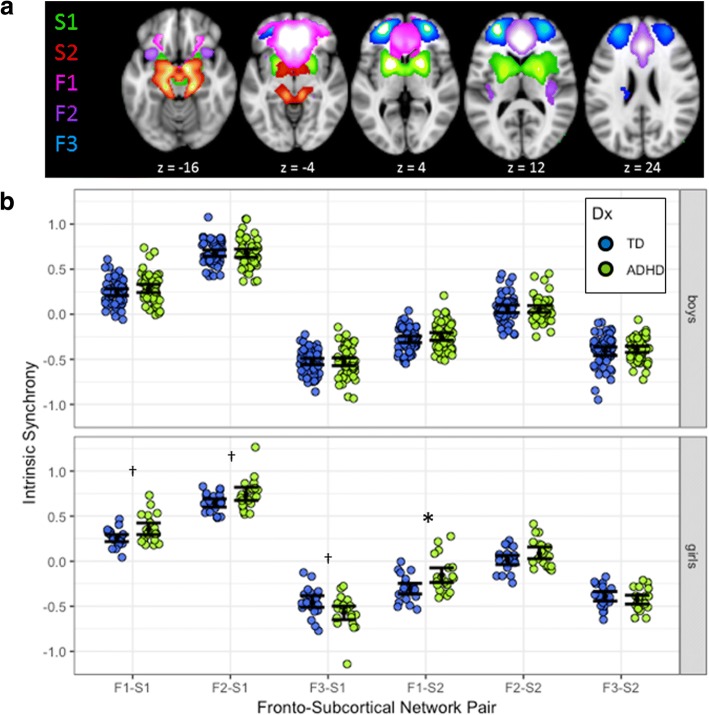
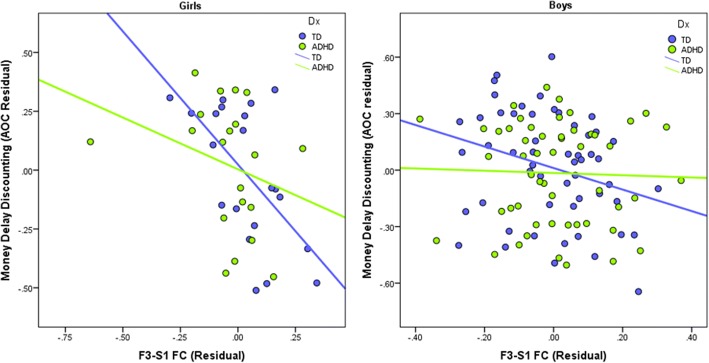
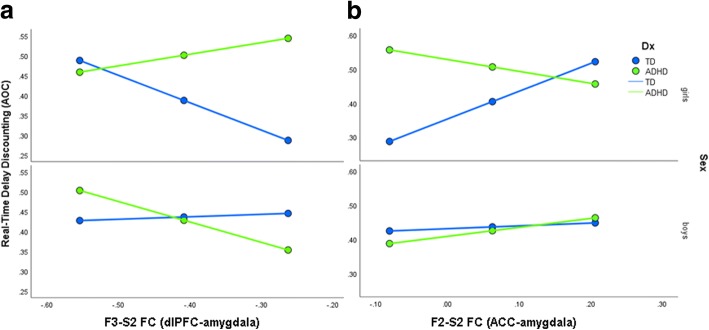
BACKGROUND: Attention-deficit/hyperactivity disorder (ADHD) is associated with atypical fronto-subcortical neural circuitry and heightened delay discounting, or a stronger preference for smaller, immediate rewards over larger, delayed rewards. Recent evidence of ADHD-related sex differences in brain structure and function suggests anomalies in fronto-subcortical circuitry may differ among girls and boys with ADHD. The current study examined whether the functional connectivity (FC) within fronto-subcortical neural circuitry differs among girls and boys with ADHD compared to same-sex typically developing (TD) controls and relates to delay discounting. METHODS: Participants include 8-12-year-old children with ADHD (n = 72, 20 girls) and TD controls (n = 75, 21 girls). Fronto-subcortical regions of interest were functionally defined by applying independent component analysis to resting-state fMRI data. Intrinsic FC between subcortical components, including the striatum and amygdala, and prefrontal components, including ventromedial prefrontal cortex (vmPFC), anterior cingulate cortex (ACC), and anterior dorsolateral prefrontal cortex (dlPFC), was compared across diagnostic groups overall and within sex. Correlations between intrinsic FC of the six fronto-subcortical pairs and delay discounting were also examined. RESULTS: Both girls and boys with ADHD show atypical FC between vmPFC and subcortical regions including the striatum (stronger positive FC in ADHD) and amygdala (weaker negative FC in ADHD), with the greatest diagnostic effects among girls. In addition, girls with ADHD show atypical intrinsic FC between the striatum and dlPFC components, including stronger positive FC with ACC and stronger negative FC with dlPFC. Further, girls but not boys, with ADHD, show heightened real-time delay discounting. Brain-behavior correlations suggest (1) stronger negative FC between the striatal and dlPFC components correlated with greater money delay discounting across all participants and (2) stronger FC between the amygdala with both the dlPFC and ACC components was differentially related to heightened real-time discounting among girls and boys with and without ADHD. CONCLUSIONS: Our findings suggest fronto-subcortical functional networks are affected in children with ADHD, particularly girls, and relate to delay discounting. These results also provide preliminary evidence of greater disruptions in fronto-subcortical FC among girls with ADHD that is not due to elevated inattention symptom severity, intellectual reasoning ability, age, or head motion.
Overview
The claims and statistics of this paper haven’t been checked yet.
Free: it reads the open-access text and checks the first 5 claims that cite a source we can check. Create a free account to check every claim.
Integrity signals
Registry
Cites
Statistics
Figures
Verification
Claims the paper makes
The claims and statistics of this paper haven’t been checked yet.
Free: it reads the open-access text and checks the first 5 claims that cite a source we can check. Create a free account to check every claim.
Claims other papers make about this one
Each is checked against this paper’s own text: does it say what the citing paper says it does?
The cited source doesn’t support the claim as written.
In the citing paper
“Functional imaging similarly points to sex-differentiated profiles: men typically exhibit reduced activation in executive networks, whereas women often display activation closer to neurotypical controls—potentially reflecting compensatory neural recruitment [135].”
From ADHD in Adulthood: Clinical Presentation, Comorbidities, and Treatment Perspectives (2025) · cites this paper as [135]
Checked by a reasoning model — may be wrong.
Experimental — accuracy not yet measuredIn the citing paper
“Functional connectivity between these regions also correlated with increased delay discounting of monetary rewards, a proxy for altered reward functioning and impulsivity, that was elevated in ADHD females only.”
From Sex and gender in neurodevelopmental conditions (2023) · cites this paper as [207]
In the citing paper
“Evidence from one study suggests that, compared with neurotypical peers, school-aged ADHD females display more alterations in resting-state functional connectivity between striatal and prefrontal regions than males207.”
From Sex and gender in neurodevelopmental conditions (2023) · cites this paper as [207]
Self-check
Percentages, sums and reported differences re-computed from the paper’s own numbers.
The self-check needs the paper’s full text.
Citations
Cites
Controlling the False Discovery Rate: A Practical and Powerful Approach to Multiple Testing
Benjamini, Y., & Hochberg, Y. (1995) · Journal of the Royal Statistical Society Series B: Statistical Methodology · doi:10.1111/j.2517-6161.1995.tb02031.x · Cited by 109,482 · cited 1×
“05 [77] was applied to each family of tests (i.”
MethodAn Information-Maximization Approach to Blind Separation and Blind Deconvolution
Bell, A. J., & Sejnowski, T. J. (1995) · Neural Computation · doi:10.1162/neco.1995.7.6.1129 · Cited by 8,986
Parallel organization of functionally segregated circuits linking basal ganglia and cortex
Alexander, G. E., DeLong, M. R., & Strick, P. L. (1986) · Annual Review of Neuroscience · doi:10.1146/annurev.ne.09.030186.002041 · Cited by 8,527
Power, J. D., Barnes, K. A., Snyder, A. Z., Schlaggar, B. L., & Petersen, S. E. (2012) · NeuroImage · doi:10.1016/j.neuroimage.2011.10.018 · Cited by 7,429
Maldjian, J. A., Laurienti, P. J., Kraft, R. A., & Burdette, J. H. (2003) · NeuroImage · doi:10.1016/s1053-8119(03)00169-1 · Cited by 5,085
Functional architecture of basal ganglia circuits: neural substrates of parallel processing
Alexander, G. E., & Crutcher, M. D. (1990) · Trends in Neurosciences · doi:10.1016/0166-2236(90)90107-l · Cited by 4,131
A method for making group inferences from functional MRI data using independent component analysis
Calhoun, V. D., Adali, T., Pearlson, G. D., & Pekar, J. J. (2001) · Human Brain Mapping · doi:10.1002/hbm.1048 · Cited by 2,994
Tracking whole-brain connectivity dynamics in the resting state
Allen, E. A., Damaraju, E., Plis, S. M., Erhardt, E. B., Eichele, T., & Calhoun, V. D. (2014) · Cerebral Cortex · doi:10.1093/cercor/bhs352 · Cited by 2,992
Functional brain networks develop from a local to distributed organization
Fair, D. A., Cohen, A. L., Power, J. D., Dosenbach, N. U. F., Church, J. A., Miezin, F. M., Schlaggar, B. L., & Petersen, S. E. (2009) · PLoS Computational Biology · doi:10.1371/journal.pcbi.1000381 · Cited by 1,530
AREA UNDER THE CURVE AS A MEASURE OF DISCOUNTING
Myerson, J., Green, L., & Warusawitharana, M. (2001) · Journal of the Experimental Analysis of Behavior · doi:10.1901/jeab.2001.76-235 · Cited by 1,505
Reward representations and reward-related learning in the human brain: Insights from neuroimaging
O’Doherty, J. P. (2004) · Current Opinion in Neurobiology · doi:10.1016/j.conb.2004.10.016 · Cited by 1,426
Wechsler Individual Achievement Test
SMITH, D. R. (2001) · Handbook of Psychoeducational Assessment · doi:10.1016/b978-012058570-0/50008-2 · Cited by 1,414
Hot and Cool Executive Function in Childhood and Adolescence: Development and Plasticity
Zelazo, P. D., & Carlson, S. M. (2012) · Child Development Perspectives · doi:10.1111/j.1750-8606.2012.00246.x · Cited by 1,403 · cited 1×
“Executive function (EF) refers to the deliberate, top–down control of thoughts, actions, and emotions in the service of goal-directed behavior [3] and is generally purported to rely on discrete”
BackgroundValidating the independent components of neuroimaging time series via clustering and visualization
Himberg, J., Hyvärinen, A., & Esposito, F. (2004) · NeuroImage · doi:10.1016/j.neuroimage.2004.03.027 · Cited by 1,244
Development of distinct control networks through segregation and integration
Fair, D. A., Dosenbach, N. U. F., Church, J. A., Cohen, A. L., Brahmbhatt, S., Miezin, F. M., Barch, D. M., Raichle, M. E., Petersen, S. E., & Schlaggar, B. L. (2007) · Proceedings of the National Academy of Sciences · doi:10.1073/pnas.0705843104 · Cited by 1,244
Limbic connections of the orbital and medial prefrontal cortex in macaque monkeys
Carmichael, S. T., & Price, J. L. (1995) · Journal of Comparative Neurology · doi:10.1002/cne.903630408 · Cited by 1,197
sagvolden, T., johansen, E. B., aase, H., & russell, V. A. (2005) · Behavioral and Brain Sciences · doi:10.1017/s0140525x05000075 · Cited by 1,035
Jafri, M. J., Pearlson, G. D., Stevens, M., & Calhoun, V. D. (2008) · NeuroImage · doi:10.1016/j.neuroimage.2007.11.001 · Cited by 974
Estimating the number of independent components for functional magnetic resonance imaging data
Li, Y., Adalı, T., & Calhoun, V. D. (2007) · Human Brain Mapping · doi:10.1002/hbm.20359 · Cited by 912
(2008) · Cited by 889
Comparison of multi‐subject ICA methods for analysis of fMRI data
Erhardt, E. B., Rachakonda, S., Bedrick, E. J., Allen, E. A., Adali, T., & Calhoun, V. D. (2011) · Human Brain Mapping · doi:10.1002/hbm.21170 · Cited by 712
The neural mechanisms of inter-temporal decision-making: understanding variability
Peters, J., & Büchel, C. (2011) · Trends in Cognitive Sciences · doi:10.1016/j.tics.2011.03.002 · Cited by 693
Solanto, M. V., Abikoff, H., Sonuga-Barke, E., Schachar, R., Logan, G. D., Wigal, T., Hechtman, L., Hinshaw, S., & Turkel, E. (2001) · Journal of Abnormal Child Psychology · doi:10.1023/a:1010329714819 · Cited by 639
Barkley, R. A., Edwards, G., Laneri, M., Fletcher, K., & Metevia, L. (2001) · Journal of Abnormal Child Psychology · doi:10.1023/a:1012233310098 · Cited by 638
Amlung, M., Vedelago, L., Acker, J., Balodis, I., & MacKillop, J. (2017) · Addiction · doi:10.1111/add.13535 · Cited by 626
Corners' Rating Scales-Revised
Kollins, S. H., Epstein, J. N., & Conners, C. K. (2014) · The Use of Psychological Testing for Treatment Planning and Outcomes Assessment · doi:10.4324/9781410610621-8 · Cited by 626 · cited 1×
“Parents and teachers (when available) also completed the Conners Parent and Teacher Rating Scales-Revised Long Version or the Conners-3 (CPRS and CTRS; [54, 55] and the ADHD Rating Scale-IV, home and school versions (ADHD-RS; [56]).”
MethodNIGG, J. T., & CASEY, B. J. (2005) · Development and Psychopathology · doi:10.1017/s0954579405050376 · Cited by 593
Gender Differences in Attention-Deficit/Hyperactivity Disorder
Rucklidge, J. J. (2010) · Psychiatric Clinics of North America · doi:10.1016/j.psc.2010.01.006 · Cited by 571
Ramtekkar, U. P., Reiersen, A. M., Todorov, A. A., & Todd, R. D. (2010) · Journal of the American Academy of Child & Adolescent Psychiatry · doi:10.1097/00004583-201003000-00005 · Cited by 511
Sonuga-Barke, E., Bitsakou, P., & Thompson, M. (2010) · Journal of the American Academy of Child & Adolescent Psychiatry · doi:10.1016/j.jaac.2009.12.018 · Cited by 504 · cited 1×
“Delay aversion may also work in concert with an impulsive drive for immediate reward to exacerbate impulsive choice [1, 22].”
BackgroundMcFarland, N. R., & Haber, S. N. (2002) · The Journal of Neuroscience · doi:10.1523/jneurosci.22-18-08117.2002 · Cited by 504
Ramtekkar, U. P., Reiersen, A. M., Todorov, A. A., & Todd, R. D. (2010) · Journal of the American Academy of Child & Adolescent Psychiatry · doi:10.1016/j.jaac.2009.11.011 · Cited by 480 · cited 1×
“There is a surprising lack of research comparing girls and boys with ADHD to same-sex TD children despite reports that the proportion of males to females diagnosed with the disorder has fallen to approximately 2:1 [36].”
BackgroundOkon-Singer, H., Hendler, T., Pessoa, L., & Shackman, A. J. (2015) · Frontiers in Human Neuroscience · doi:10.3389/fnhum.2015.00058 · Cited by 371
Tripp, G., & Wickens, J. R. (2008) · Journal of Child Psychology and Psychiatry · doi:10.1111/j.1469-7610.2007.01851.x · Cited by 368
Abnormal Functional Connectivity in Children with Attention-Deficit/Hyperactivity Disorder
Tomasi, D., & Volkow, N. D. (2012) · Biological Psychiatry · doi:10.1016/j.biopsych.2011.11.003 · Cited by 363
Luman, M., Tripp, G., & Scheres, A. (2010) · Neuroscience & Biobehavioral Reviews · doi:10.1016/j.neubiorev.2009.11.021 · Cited by 335
Scheres, A., Dijkstra, M., Ainslie, E., Balkan, J., Reynolds, B., Sonuga-Barke, E., & Castellanos, F. X. (2006) · Neuropsychologia · doi:10.1016/j.neuropsychologia.2005.10.012 · Cited by 327
The impact of T1 versus EPI spatial normalization templates for fMRI data analyses
Calhoun, V. D., Wager, T. D., Krishnan, A., Rosch, K. S., Seymour, K. E., Nebel, M. B., Mostofsky, S. H., Nyalakanai, P., & Kiehl, K. (2017) · Human Brain Mapping · doi:10.1002/hbm.23737 · Cited by 320
Self-citationDe Martino, F., Gentile, F., Esposito, F., Balsi, M., Di Salle, F., Goebel, R., & Formisano, E. (2007) · NeuroImage · doi:10.1016/j.neuroimage.2006.08.041 · Cited by 274
Plichta, M. M., Vasic, N., Wolf, R. C., Lesch, K.-P., Brummer, D., Jacob, C., Fallgatter, A. J., & Grön, G. (2009) · Biological Psychiatry · doi:10.1016/j.biopsych.2008.07.008 · Cited by 272
Posner, J., Park, C., & Wang, Z. (2014) · Neuropsychology Review · doi:10.1007/s11065-014-9251-z · Cited by 257
Basal Ganglia Volume and Shape in Children With Attention Deficit Hyperactivity Disorder
Qiu, A., Crocetti, D., Adler, M., Mahone, E. M., Denckla, M. B., Miller, M. I., & Mostofsky, S. H. (2009) · American Journal of Psychiatry · doi:10.1176/appi.ajp.2008.08030426 · Cited by 253
Self-citationPatros, C. H. G., Alderson, R. M., Kasper, L. J., Tarle, S. J., Lea, S. E., & Hudec, K. L. (2016) · Clinical Psychology Review · doi:10.1016/j.cpr.2015.11.001 · Cited by 241
The Diagnostic Interview for Children and Adolescents
Batts, K. R., & Reich, W. (2002) · Cited by 222
Delay and reward choice in ADHD: An experimental test of the role of delay aversion.
Marco, R., Miranda, A., Schlotz, W., Melia, A., Mulligan, A., Müller, U., Andreou, P., Butler, L., Christiansen, H., Gabriels, I., et al. (2009) · Neuropsychology · doi:10.1037/a0014914 · Cited by 214
On the relationship between seed‐based and ICA‐based measures of functional connectivity
Joel, S. E., Caffo, B. S., van Zijl, P. C. M., & Pekar, J. J. (2011) · Magnetic Resonance in Medicine · doi:10.1002/mrm.22818 · Cited by 205
Koch, W., Teipel, S., Mueller, S., Buerger, K., Bokde, A. L. W., Hampel, H., Coates, U., Reiser, M., & Meindl, T. (2010) · NeuroImage · doi:10.1016/j.neuroimage.2009.12.008 · Cited by 204
Conners' Rating Scales - Revised
Conners, C. K. (2012) · PsycTESTS Dataset · doi:10.1037/t04967-000 · Cited by 201
Cao, X., Cao, Q., Long, X., Sun, L., Sui, M., Zhu, C., Zuo, X., Zang, Y., & Wang, Y. (2009) · Brain Research · doi:10.1016/j.brainres.2009.08.029 · Cited by 200
Costa Dias, T. G., Wilson, V. B., Bathula, D. R., Iyer, S. P., Mills, K. L., Thurlow, B. L., Stevens, C. A., Musser, E. D., Carpenter, S. D., Grayson, D. S., et al. (2013) · European Neuropsychopharmacology · doi:10.1016/j.euroneuro.2012.10.015 · Cited by 180
Gender Differences Among Children With ADHD on Continuous Performance Tests: A Meta-Analytic Review
Hasson, R., & Fine, J. G. (2012) · Journal of Attention Disorders · doi:10.1177/1087054711427398 · Cited by 175
Reynolds, B. A., & Schiffbauer, R. (2005) · The Psychological Record · doi:10.1007/bf03395520 · Cited by 161
Delay discounting of reward in ADHD: application in young children
Wilson, V. B., Mitchell, S. H., Musser, E. D., Schmitt, C. F., & Nigg, J. T. (2011) · Journal of Child Psychology and Psychiatry · doi:10.1111/j.1469-7610.2010.02347.x · Cited by 158
(2016) · doi:10.1037/t05638-000 · Cited by 142
Is the statistic value all we should care about in neuroimaging?
Chen, G., Taylor, P. A., & Cox, R. W. (2017) · NeuroImage · doi:10.1016/j.neuroimage.2016.09.066 · Cited by 139
Hulvershorn, L. A., Mennes, M., Castellanos, F. X., Di Martino, A., Milham, M. P., Hummer, T. A., & Roy, A. K. (2014) · Journal of the American Academy of Child & Adolescent Psychiatry · doi:10.1016/j.jaac.2013.11.012 · Cited by 138
Posner, J., Nagel, B. J., Maia, T. V., Mechling, A., Oh, M., Wang, Z., & Peterson, B. S. (2011) · Journal of the American Academy of Child & Adolescent Psychiatry · doi:10.1016/j.jaac.2011.05.010 · Cited by 137
Bitsakou, P., Psychogiou, L., Thompson, M., & Sonuga-Barke, E. J. S. (2009) · Neuropsychologia · doi:10.1016/j.neuropsychologia.2008.09.015 · Cited by 134
Characterizing heterogeneity in children with and without ADHD based on reward system connectivity
Costa Dias, T. G., Iyer, S. P., Carpenter, S. D., Cary, R. P., Wilson, V. B., Mitchell, S. H., Nigg, J. T., & Fair, D. A. (2015) · Developmental Cognitive Neuroscience · doi:10.1016/j.dcn.2014.12.005 · Cited by 130
Age-related changes in motor subtle signs among girls and boys with ADHD
Cole, W. R., Mostofsky, S. H., Larson, J. C. G., Denckla, M. B., & Mahone, E. M. (2008) · Neurology · doi:10.1212/01.wnl.0000334275.57734.5f · Cited by 130
Self-citationAnnotation: On Dysfunction and Function in Psychological Theories of Childhood Disorder
Sonuga-Barke, E. J. S. (1994) · Journal of Child Psychology and Psychiatry · doi:10.1111/j.1469-7610.1994.tb02296.x · Cited by 112
Wechsler Individual Achievement Test-Second edition (WIAT-II)
Stavrou, E. (2002) · PsycEXTRA Dataset · doi:10.1037/e537372009-008 · Cited by 112
Individual Differences in Impulsivity Predict Head Motion during Magnetic Resonance Imaging
Kong, X.-Z., Zhen, Z., Li, X., Lu, H.-H., Wang, R., Liu, L., He, Y., Zang, Y., & Liu, J. (2014) · PLoS ONE · doi:10.1371/journal.pone.0104989 · Cited by 109
McClelland, J., Dalton, B., Kekic, M., Bartholdy, S., Campbell, I. C., & Schmidt, U. (2016) · Neuroscience & Biobehavioral Reviews · doi:10.1016/j.neubiorev.2016.09.024 · Cited by 104
Diagnostic Interview for Children and Adolescents-IV
Reich, W., Welner, Z., & Herjanic, B. M. (2012) · PsycTESTS Dataset · doi:10.1037/t04974-000 · Cited by 98
The role of lateral orbitofrontal cortex in the inhibitory control of emotion
Hooker, C. I., & Knight, R. T. (2006) · The Orbitofrontal Cortex · doi:10.1093/acprof:oso/9780198565741.003.0012 · Cited by 97
Posner, J., Rauh, V., Gruber, A., Gat, I., Wang, Z., & Peterson, B. S. (2013) · Psychiatry Research: Neuroimaging · doi:10.1016/j.pscychresns.2013.01.004 · Cited by 94
Distinct frontal lobe morphology in girls and boys with ADHD
Dirlikov, B., Shiels Rosch, K., Crocetti, D., Denckla, M. B., Mahone, E. M., & Mostofsky, S. H. (2015) · NeuroImage: Clinical · doi:10.1016/j.nicl.2014.12.010 · Cited by 93
Self-citationCouvy-Duchesne, B., Ebejer, J. L., Gillespie, N. A., Duffy, D. L., Hickie, I. B., Thompson, P. M., Martin, N. G., de Zubicaray, G. I., McMahon, K. L., Medland, S. E., et al. (2016) · PLOS ONE · doi:10.1371/journal.pone.0146271 · Cited by 77
Antonini, T. N., Becker, S. P., Tamm, L., & Epstein, J. N. (2015) · Journal of the International Neuropsychological Society · doi:10.1017/s1355617715000752 · Cited by 72
Hong, S.-B., Harrison, B. J., Fornito, A., Sohn, C.-H., Song, I.-C., & Kim, J.-W. (2015) · Journal of Psychiatry and Neuroscience · doi:10.1503/jpn.130290 · Cited by 72 · cited 2×
“In contrast, studies of striatal-dlPFC FC have reported weaker FC with the VS [34], dorsal caudate [33], and putamen [35] in children and adolescents with ADHD.”
ResultNeural and psychophysiological markers of delay aversion in attention-deficit hyperactivity disorder
Wilbertz, G., Trueg, A., Sonuga-Barke, E. J. S., Blechert, J., Philipsen, A., & Tebartz van Elst, L. (2013) · Journal of Abnormal Psychology · doi:10.1037/a0031924 · Cited by 69
Zhu, Y., Jiang, X., & Ji, W. (2018) · Neuroscience Bulletin · doi:10.1007/s12264-018-0214-x · Cited by 65
Attention-Deficit/Hyperactivity Disorder Symptoms Coincide With Altered Striatal Connectivity
Oldehinkel, M., Beckmann, C. F., Pruim, R. H. R., van Oort, E. S. B., Franke, B., Hartman, C. A., Hoekstra, P. J., Oosterlaan, J., Heslenfeld, D., Buitelaar, J. K., et al. (2016) · Biological Psychiatry: Cognitive Neuroscience and Neuroimaging · doi:10.1016/j.bpsc.2016.03.008 · Cited by 58
A TUTORIAL ON THE USE OF EXCEL 2010 AND EXCEL FOR MAC 2011 FOR CONDUCTING DELAY‐DISCOUNTING ANALYSES
Reed, D. D., Kaplan, B. A., & Brewer, A. T. (2012) · Journal of Applied Behavior Analysis · doi:10.1901/jaba.2012.45-375 · Cited by 57
Increased Delay Discounting on a Novel Real-Time Task among Girls, but not Boys, with ADHD
Rosch, K. S., & Mostofsky, S. H. (2015) · Journal of the International Neuropsychological Society · doi:10.1017/s1355617715001071 · Cited by 55
Self-citationMahone, E. M., Ranta, M. E., Crocetti, D., O'Brien, J., Kaufmann, W. E., Denckla, M. B., & Mostofsky, S. H. (2011) · Journal of the International Neuropsychological Society · doi:10.1017/s1355617711001056 · Cited by 51
Self-citationCognitive Load Differentially Impacts Response Control in Girls and Boys with ADHD
Seymour, K. E., Mostofsky, S. H., & Rosch, K. S. (2016) · Journal of Abnormal Child Psychology · doi:10.1007/s10802-015-9976-z · Cited by 50
Self-citationSeymour, K. E., Tang, X., Crocetti, D., Mostofsky, S. H., Miller, M. I., & Rosch, K. S. (2017) · Psychiatry Research: Neuroimaging · doi:10.1016/j.pscychresns.2017.01.002 · Cited by 47
Self-citationJacobson, L. A., Peterson, D. J., Rosch, K. S., Crocetti, D., Mori, S., & Mostofsky, S. H. (2015) · Journal of the American Academy of Child & Adolescent Psychiatry · doi:10.1016/j.jaac.2015.08.014 · Cited by 44
Self-citationSonuga‐Barke, E. J. S., Houwer, J. D., Ruiter, K. D., Ajzenstzen, M., & Holland, S. (2004) · Journal of Child Psychology and Psychiatry · doi:10.1111/j.1469-7610.2004.00219.x · Cited by 41
Yu, X., Liu, L., Chen, W., Cao, Q., Zepf, F. D., Ji, G., Wu, Z., An, L., Wang, P., Qian, Q., et al. (2020) · Journal of Attention Disorders · doi:10.1177/1087054716661419 · Cited by 41 · cited 1×
“Fewer studies have examined connectivity of the amygdala among children with ADHD, with evidence of greater PFC-amygdala FC in adolescents with ADHD during an emotional task [82] and in relation to emotional lability [83], whereas reduced negative FC of an amygdala subregion with the dlPFC has been reported among boys…”
BackgroundAberrant local striatal functional connectivity in attention‐deficit/hyperactivity disorder
von Rhein, D. T., Oldehinkel, M., Beckmann, C. F., Oosterlaan, J., Heslenfeld, D. J., Hartman, C. A., Hoekstra, P. J., Franke, B., Cools, R., Buitelaar, J. K., et al. (2016) · Journal of Child Psychology and Psychiatry · doi:10.1111/jcpp.12529 · Cited by 38
Resting state FMRI research in child psychiatric disorders
Oldehinkel, M., Francx, W., Beckmann, C. F., Buitelaar, J. K., & Mennes, M. (2013) · European Child & Adolescent Psychiatry · doi:10.1007/s00787-013-0480-0 · Cited by 37
Oldehinkel, M., Beckmann, C. F., Franke, B., Hartman, C. A., Hoekstra, P. J., Oosterlaan, J., Heslenfeld, D. J., Buitelaar, J. K., & Mennes, M. (2016) · NeuroImage Clinical · doi:10.1016/j.nicl.2016.10.006 · Cited by 37
Greater delay discounting among girls, but not boys, with ADHD correlates with cognitive control
Patros, C. H. G., Sweeney, K. L., Mahone, E. M., Mostofsky, S. H., & Rosch, K. S. (2017) · Child Neuropsychology · doi:10.1080/09297049.2017.1359525 · Cited by 34
Self-citationAutomated MRI parcellation of the frontal lobe
Ranta, M. E., Chen, M., Crocetti, D., Prince, J. L., Subramaniam, K., Fischl, B., Kaufmann, W. E., & Mostofsky, S. H. (2014) · Human Brain Mapping · doi:10.1002/hbm.22309 · Cited by 28
Self-citationFunctional neuroimaging of reward and motivational pathways in ADHD
Kelly, C. A. M., Scheres, A., Sonuga-Barke, E. J. S., & Castellanos, F. X. (2007) · Cited by 16
Rosch, K. S., Dirlikov, B., & Mostofsky, S. H. (2015) · Biological Psychology · doi:10.1016/j.biopsycho.2015.06.010 · Cited by 14
Self-citation
Research works printed but not linked: 7
- Wechsler DL Wechsler intelligence scale for children - fourth edition (WISC-IV) 2003 San Antonio, TX The Psychological Corporation
- Wechsler DL Wechsler intelligence scale for children - fifth edition (WISC-V): the psychological corporation 2014
- Kaufman J Birmaher B Axelson D Perepletchikova F Brent D Ryan N Kiddie schedule for affective disorders and schizophrenia for school-aged children – lifetime version (Kiddie-SADS-PL 2013 Working Draft) 2013 Pittsburgh Pennsylvania Western Psychiatric Institute and Clinic and Yale University
- Conners CK Conners 3 2008 North Tonawanda, NY Multi-Health Systems, Inc.
- DuPaul GJ Power TJ Anastopoulos AD Reid R ADHD rating scale—IV 1998 New York, NY Guilford Press
- Patros CH, Sweeney K, Mahone EM, Mostofsky SH, Rosch KS. Greater delay discounting among girls, but not boys, with ADHD correlates with cognitive control. Child Neuropsychology. In press. PMC5796876 28768457
- Cohen D Statistical power analyses for the behavioral sciences 1988 2 Lawrence Earlbaum Associates Hillsdale, NJ
Cited by
Sex and gender in neurodevelopmental conditions
Bölte, S., Neufeld, J., Marschik, P. B., Williams, Z. J., Gallagher, L., & Lai, M.-C. (2023) · Nature Reviews Neurology · doi:10.1038/s41582-023-00774-6 · Cited by 249
Santos, S., Ferreira, H., Martins, J., Gonçalves, J., & Castelo-Branco, M. (2022) · Neuroscience & Biobehavioral Reviews · doi:10.1016/j.neubiorev.2022.104577 · Cited by 142
“However, sex dimorphisms were found in front-subcortical functional networks in children with ADHD, in which girls showed larger differences than boys (Rosch et al., 2018).”
BackgroundSaad, J. F., Griffiths, K. R., & Korgaonkar, M. S. (2020) · Frontiers in Integrative Neuroscience · doi:10.3389/fnint.2020.00031 · Cited by 89
The role of hedonics in the Human Affectome
Becker, S., Bräscher, A., Bannister, S., Bensafi, M., Calma‐Birling, D., Chan, R. C. K., Eerola, T., Ellingsen, D., Ferdenzi, C., Hanson, J. L., et al. (2019) · Neuroscience & Biobehavioral Reviews · doi:10.1016/j.neubiorev.2019.05.003 · Cited by 103
Lawrence, K. E., Hernandez, L. M., Bowman, H. C., Padgaonkar, N. T., Fuster, E., Jack, A., Aylward, E., Gaab, N., Van Horn, J. D., Bernier, R. A., et al. (2020) · Cerebral Cortex · doi:10.1093/cercor/bhaa105 · Cited by 93
“order (ADHD) found that girls with ADHD significantly differed from their same-sex TD counterparts in functional connectivity, but boys with ADHD did not significantly differ from TD boys (Rosch et al. 2018).”
Background
Metadata
- Authors
- Rosch, K. S., Mostofsky, S. H., & Nebel, M. B.
- Affiliations
- Kennedy Krieger Institute (US)
- Corresponding author
- Rosch, Keri S.
- Venue
- Journal of Neurodevelopmental Disorders
- Published
- 2018-12
- Volume
- 10
- Issue
- 1
- Pages
- 34-34
- ISSN
- 1866-1947 (ISSN-L)
- 1866-1955
- PMC
- PMC6292003
- OpenAlex
- W2903229881
- Cited by
- 69
- References
- 88
- Citations by year
- 2026: 5 · 2025: 11 · 2024: 6 · 2023: 13 · 2022: 12 · 2021: 7 · 2020: 9 · 2019: 5 · 2018: 1
- FWCI
- 4.30
- Type
- journal article
- Language
- en
- Open access
- gold
- doi.org
- Licence
- cc-by
- creativecommons.org/licenses/by/4.0/ (tdm)
- creativecommons.org/licenses/by/4.0/ (vor, 12 d)
- Locations
- Journal of Neurodevelopmental Disorders (publishedVersion, cc-by)
- Europe PMC (PubMed Central) (publishedVersion, other-oa)
- PubMed Central (publishedVersion, cc-by)
- PubMed (publishedVersion)
- DOAJ (DOAJ: Directory of Open Access Journals) (submittedVersion, cc-by-sa)
- Funders
- National Institute of Mental Health (R01 MH078160, R01 MH085328, K23 MH101322, K01 MH109766)
- National Institute of Child Health and Human Development (U54 HD079123)
- Topics
- Health Sciences › Medicine › Psychiatry and Mental health › Attention Deficit Hyperactivity Disorder
- Life Sciences › Neuroscience › Cognitive Neuroscience › Functional Brain Connectivity Studies
- Life Sciences › Neuroscience › Cognitive Neuroscience › Neural and Behavioral Psychology Studies
- Keywords
- attention deficit hyperactivity disorder, sex differences, delay discounting, intrinsic functional connectivity, striatum, amygdala, ventromedial prefrontal cortex, anterior cingulate cortex, dorsolateral prefrontal cortex, children, reward processing, brain-behavior relationship, independent component analysis, resting-state fMRI, impulsivity
- MeSH terms
- Amygdala, Attention Deficit Disorder with Hyperactivity, Brain, Brain Mapping, Child, Corpus Striatum, Female, Gyrus Cinguli, Humans, Magnetic Resonance Imaging, Male, Neural Pathways, Sex Characteristics, Prefrontal Cortex, Delay Discounting
About these checks
Registry, retraction, Cites and statistics results are computed, not judged, with one exception: a printed reference that no index lists is read once by a model before it counts as a citation error. Claims are extracted by a model and kept only when their quote appears verbatim in the text; each cited source is then checked, with a model’s help, for whether it says what the claim relies on. Those verdicts can be wrong — read the claim’s quote and the cited source before relying on one.
Statistics and arithmetic are recomputed, not judged.
Confidence bands are shown only for fields calibrated on our annotated test set. None is calibrated yet, so no band is shown.
What counts as a claim ›How we measure confidence ›How we check this ›
Are you an author, or do you see a problem with this page? Request a review
Data sources
Bibliographic data: Semantic Scholar, OpenAlex, Crossref.
Contains information from the Semantic Scholar Academic Graph Datasets, made available under the ODC Attribution License (ODC-BY 1.0).
Semantic Scholar’s data is described in: Kinney, R., et al. (2023). The Semantic Scholar Open Data Platform. arXiv:2301.10140.
