

The effectiveness of mindfulness yoga on patients with major depressive disorder: a systematic review and meta-analysis of randomized controlled trials
Open accessThe DOI matches its Crossref record; 58 of the 60 references it cites were found in a registry or an index; 56 of the 106 sources its claims cite were checked for support.
Abstract
Background: Mindfulness yoga is a type of exercise that emphasizes the integration of mindfulness or meditation into yoga. The aim of this study was to determine the effectiveness of mindfulness yoga intervention on major depressive disorder (MDD) patients. Methods: A systematic review and meta-analysis of randomized controlled trials (RCTs) was conducted by searching nine databases, including PubMed, EMBASE, Web of Science, The Cochrane Library, MEDLINE, China National Knowledge Infrastructure (CNKI), Wanfang Data knowledge service platform, Chinese Biomedical Literature Database (CBM), and China Science and Technology Journal Database (VIP) from inception to April 2023. Primary outcomes included the severity of depression. Secondary outcomes included anxiety and rumination. Results: Nine RCTs met our inclusion criteria (n = 581). The meta-analysis showed that mindfulness yoga significantly has a significant effect on depression (SMD = -0.53; 95%CI = -0.96 to -0.11; P < 0.05) among MDD patients. The only two RCTs involved also showed that mindfulness yoga could alleviate the anxiety level of MDD patients after intervention (SMD = -1.08; 95%CI = -1.64 to -0.52; P < 0.05). Meta-analysis did not reveal positive effects of the mindfulness yoga groups on rumination after intervention based on three RCTs (SMD = -0.33; 95%CI = -0.89 to 0.23; P > 0.05), but found a significant difference in the follow-up period based on two RCTs (MD = -7.42; 95%CI = -11.27 to -3.56; P < 0.05), compared with the control groups. Conclusion: Although we were unable to provide conclusive evidence to support the effectiveness of mindfulness yoga in improving symptoms in MDD patients, we found the literature included in this study indicated that mindfulness yoga might have a potential benefit for MDD patients and should be a feasible, acceptable, and promising intervention. © 2023, BioMed Central Ltd., part of Springer Nature.
Overview
CoChat Summary
TL;DR
This systematic review and meta-analysis of 9 RCTs (n = 581) found that mindfulness yoga was associated with a modest reduction in depressive symptoms in patients with major depressive disorder, but the evidence quality was low. Effects on anxiety and rumination were mixed: anxiety improved in 2 RCTs, rumination was not improved immediately after intervention in 3 RCTs, and follow-up rumination favored mindfulness yoga in 2 RCTs.
Key findings
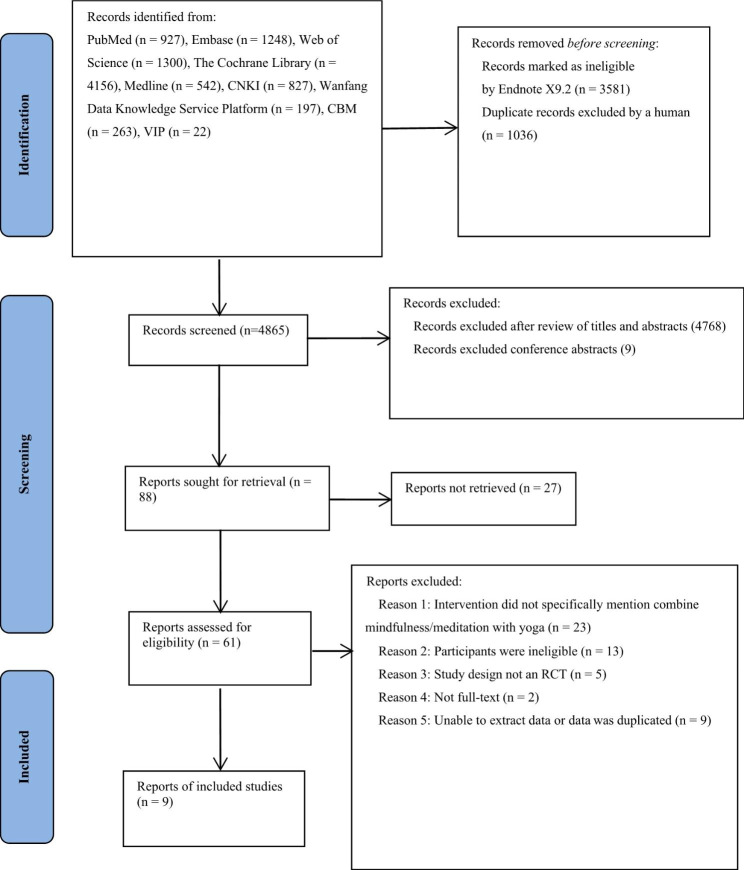
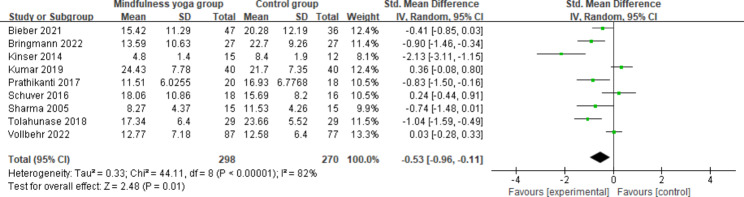
- Nine RCTs met inclusion criteria, with 581 participants at baseline; the meta-analysis found a significant improvement in depression with mindfulness yoga versus control (SMD = -0.53; 95% CI -0.96 to -0.11; P < 0.05).
- Anxiety data from 2 RCTs showed a significant reduction after intervention (SMD = -1.08; 95% CI -1.64 to -0.52; P = 0.0002), but the paper notes this was based on limited literature.
- Rumination was not significantly improved immediately after intervention in 3 RCTs (SMD = -0.33; 95% CI -0.89 to 0.23; P = 0.25), but follow-up data from 2 RCTs showed a significant difference favoring mindfulness yoga (MD = -7.42; 95% CI -11.27 to -3.56; P = 0.0002).
- For other outcomes, 2 studies found no significant effect on stress after intervention (MD = -4.20; 95% CI -9.35 to 0.95; P = 0.11), and 2 studies on quality of life reported no clear between-group difference overall.
Methods
- Systematic review and meta-analysis of randomized controlled trials, reported according to PRISMA and registered in PROSPERO (CRD42022315329).
- Searched 9 databases from inception to April 12, 2023: PubMed, EMBASE, Web of Science, Cochrane Library, MEDLINE, CNKI, Wanfang, CBM, and VIP; only RCTs were included.
- Main analyses used RevMan 5.3 with random-effects or fixed-effects models depending on heterogeneity; effect sizes were summarized as SMDs or MDs with 95% CIs, with subgroup, sensitivity, GRADE, and risk-of-bias assessments.
Limitations
- The paper states that the evidence base was small, and results should be treated with caution; only 9 studies were included, and evidence quality for depression, anxiety, and rumination was rated low.
- The authors state there was heterogeneity from different measuring tools and potential bias, plus heterogeneity from mixing yoga interventions that incorporated mindfulness/meditation; this weakened the ability of meta-analysis to show clear and consistent effects.
- The text makes evident that outcome data were sparse for several endpoints: anxiety was analyzable in only 2 RCTs, rumination follow-up in 2 RCTs, and some studies could not be used because data were not extractable or were presented only in graphs (evidence from the paper’s descriptions).
Model-written summary. Check it against the paper before relying on it.
Integrity signals
Registry
Cites
Statistics
Figures




Verification
Claims the paper makes
38 Valid · 2 Not valid · 28 Not checked · 91 Own results and interpretations
Every source the paper cites for this claim was checked and supports it.
In the paper
“A meta-analysis based on 39 studies totaling 1140 participants suggests that mindfulness-based therapy is a promising intervention for treating anxiety and mood problems in the clinical population [16].”
§ The effectiveness of mindfulness yoga on patients with major depressive disorder: a systematic review and meta-analysis of randomized controlled trials > Background
What the sources say
- Supportedcites [16] Hofmann SG Sawyer AT Witt AA Oh D The effect of mindfulness-based therapy on anxiety and depression: a meta-analytic review J Consult Clin Psychol 2010 78 2 169 83 10.1037/a0018555 20350028 PMC2848393 source
The Review Methods section identifies 39 studies totaling 1,140 participants. The Conclusion says the results suggest mindfulness-based therapy is a promising intervention for anxiety and mood problems in clinical populations. (LLM, conf=0.95)
hedgedstates a possible causen = 1,140- Asserted: passes — The authors put it forward as true.
- Checkable: passes — It can be checked against evidence.
- Load-bearing: passes — The paper’s conclusions depend on it.
- Based: passes — The paper gives a reason why it holds.
- Supported
The cited sources support only part of this claim — read each source’s verdict below.
In the paper
“And as the third wave of CBT, mindfulness-based interventions (MBIs) provide a promising psychotherapeutic strategy for MDD [10].”
- Also stated in: § Background · plain
“Therefore, MBIs are a promising psychotherapeutic strategy for MDD.”
§ The effectiveness of mindfulness yoga on patients with major depressive disorder: a systematic review and meta-analysis of randomized controlled trials > Background
What the sources say
- Partly supportedcites [10] Hayes SC Hofmann SG The third wave of cognitive behavioral therapy and the rise of process-based care World Psychiatry 2017 16 3 245 6 10.1002/wps.20442 28941087 PMC5608815 sourceExperimental — accuracy not yet measured
The Abstract identifies mindfulness-based cognitive therapy as a third-wave CBT approach and says evidence suggests mindfulness methods are helpful. It does not address their use specifically for major depressive disorder, so it does not establish the MDD-specific part of the claim. (LLM, conf=0.87)
plainstates a possible cause- Asserted: passes — The authors put it forward as true.
- Checkable: passes — It can be checked against evidence.
- Load-bearing: passes — The paper’s conclusions depend on it.
- Based: passes — The paper gives a reason why it holds.
- Also stated in: § Background · plain
The cited sources support only part of this claim — read each source’s verdict below.
In the paper
“Furthermore, there is evidence to support the use of a combination of mindfulness and yoga in those with depression [22–27].”
§ The effectiveness of mindfulness yoga on patients with major depressive disorder: a systematic review and meta-analysis of randomized controlled trials > Background
What the sources say
- Not checked — no full text of the sourcecites [22] Lee KC Tang WK Bressington D The experience of mindful yoga for older adults with depression J Psychiatr Ment Health Nurs 2019 26 3–4 87 100 10.1111/jpm.12517 30873714 source
- Not checked — no full text of the sourcecites [23] Cramer H Anheyer D Lauche R Dobos G A systematic review of yoga for major depressive disorder J Affect Disord 2017 213 70 7 10.1016/j.jad.2017.02.006 28192737 source
- Not checked — no full text of the sourcecites [24] Slomski A Online mindfulness therapy improves residual Depression JAMA 2020 323 12 1124 10.1001/jama.2020.2446 32207792 source
- Partly supportedcites [25] Johannsen M Nissen ER Lundorff M O’Toole MS Mediators of acceptance and mindfulness-based therapies for anxiety and depression: a systematic review and meta-analysis Clin Psychol Rev 2022 94 102156 10.1016/j.cpr.2022.102156 35483275 sourceExperimental — accuracy not yet measured
The Abstract says acceptance- and mindfulness-based therapies have shown efficacy for depression. The paper does not establish that combining mindfulness with yoga is effective; its Strengths and limitations section describes the therapies studied without identifying yoga as a component. Thus it supports the mindfulness-and-depression part, but not the specific combination. (LLM, conf=0.86)
- Partly supportedcites [26] Brinsley J Schuch F Lederman O Girard D Smout M Immink MA Stubbs B Firth J Davison K Rosenbaum S Effects of yoga on depressive symptoms in people with mental disorders: a systematic review and meta-analysis Br J Sports Med 2021 55 17 992 1000 10.1136/bjsports-2019-101242 32423912 sourceExperimental — accuracy not yet measured
The Introduction describes yoga as a practice that often includes mindfulness, and the Diagnostic category results report reduced depressive symptoms in people with depressive disorders. The review evaluated physically active yoga, however, not a separately specified combination of mindfulness and yoga, so it does not establish the benefit of that combination as such. Page numbers are unavailable in our copy. (LLM, conf=0.84)
- Not checked — no full text of the sourcecites [27] Saeed SA Cunningham K Bloch RM Depression and anxiety Disorders: benefits of Exercise, yoga, and Meditation Am Fam Physician 2019 99 10 620 7 31083878
plainstates a possible cause- Asserted: passes — The authors put it forward as true.
- Checkable: passes — It can be checked against evidence.
- Load-bearing: passes — The paper’s conclusions depend on it.
- Based: passes — The paper gives a reason why it holds.
Every source the paper cites for this claim was checked and supports it.
In the paper
“In three of our studies, blinding of participants and personnel was judged high risk [54, 57, 60]”
§ The effectiveness of mindfulness yoga on patients with major depressive disorder: a systematic review and meta-analysis of randomized controlled trials > Results > Risk-of-bias of randomized controlled trials
What the sources say
- Supportedcites [54] Kinser PA Elswick RK Kornstein S Potential long-term effects of a mind-body intervention for women with major depressive disorder: sustained mental health improvements with a pilot yoga intervention Arch Psychiatr Nurs 2014 28 6 377 83 10.1016/j.apnu.2014.08.014 25457687 PMC4254446 source
The Methods (Study Design and Intervention; page unavailable) identify this as a randomized study comparing yoga classes and home practice with nurse-led health-education sessions. The citing authors’ high-risk rating is their own assessment; this citation identifies one of the studies they assessed, rather than attributing all three ratings to this paper. (LLM, conf=0.84)
- Supportedcites [57] Bieber M Görgülü E Schmidt D Zabel K Etyemez S Friedrichs B Prvulovic D Reif A Oertel V Effects of body-oriented yoga: a RCT study for patients with major depressive disorder Eur Arch Psychiatry Clin Neurosci 2021 271 7 1217 29 10.1007/s00406-021-01277-5 34245349 PMC8429165 source
This citation identifies one of the three studies assessed by the citing authors; the high-risk judgment is theirs, not a rating attributed to this paper. In Materials and methods (Overview, study design and sample; page unavailable), the paper says participants were told their assignment after allocation. It separately reports that outcome assessors were blinded, which does not establish blinding of participants or personnel. (LLM, conf=0.87)
- Supportedcites [60] Kumar S Subramaniam E Bhavanani AB Sarkar S Balasundaram S Effect of adjunct yoga therapy in depressive disorders: findings from a randomized controlled study Indian J Psychiatry 2019 61 6 592 7 10.4103/psychiatry.IndianJPsychiatry_173_19 31896865 PMC6862972 source
The Materials and Methods (Data collection) state that participants in both groups were assessed by the principal investigator and that blinding was not done. This supports treating this trial as one of the studies judged high risk for blinding; the count of three and the risk judgment belong to the citing review. (LLM, conf=0.90)
plain- Asserted: passes — The authors put it forward as true.
- Checkable: passes — It can be checked against evidence.
- Load-bearing: unclear — It is unclear whether the paper’s conclusions depend on it.
- Based: passes — The paper gives a reason why it holds.
- Supported
The sources with a verdict support this claim; the rest weren’t checked yet, have no full text we could read, or their verdicts aren’t rated yet.
In the paper
“The results showed that mindfulness yoga might help MDD sufferers minimize their depressed symptoms”
- Also stated in: § Summary of evidence · hedged
“We discovered that mindfulness yoga might influence depressive symptoms, consistent with previous similar research findings [23, 26, 45].”
§ The effectiveness of mindfulness yoga on patients with major depressive disorder: a systematic review and meta-analysis of randomized controlled trials > Results > Overall
What the sources say
- Not checked — no full text of the sourcecites [23] Cramer H Anheyer D Lauche R Dobos G A systematic review of yoga for major depressive disorder J Affect Disord 2017 213 70 7 10.1016/j.jad.2017.02.006 28192737 source
- Supportedcites [26] Brinsley J Schuch F Lederman O Girard D Smout M Immink MA Stubbs B Firth J Davison K Rosenbaum S Effects of yoga on depressive symptoms in people with mental disorders: a systematic review and meta-analysis Br J Sports Med 2021 55 17 992 1000 10.1136/bjsports-2019-101242 32423912 source
The Diagnostic category section reports a reduction in depressive symptoms for people with depressive disorders, and the Characteristics of included trials section says three trials enrolled people with major depressive disorder. The Introduction describes yoga as incorporating mindfulness, so the hedged claim that yoga might help people with MDD is supported. Page numbers were not available in our copy. (LLM, conf=0.87)
- Supportedcites [45] Wu Y, Yan D, Yang J. Effectiveness of yoga for major depressive disorder: a systematic review and meta-analysis. Front Psychiatry. 2023;14. 10.3389/fpsyt.2023.1138205. PMC10077871 37032928 source
The Discussion (page unavailable) says the review found evidence that yoga improves depressive symptoms in patients with MDD. The Introduction describes mindfulness as a component of yoga, so the claim’s cautious wording is consistent with the paper. (LLM, conf=0.88)
hedgedstates a possible cause- Asserted: passes — The authors put it forward as true.
- Checkable: passes — It can be checked against evidence.
- Load-bearing: passes — The paper’s conclusions depend on it.
- Based: passes — The paper gives a reason why it holds.
- Also stated in: § Summary of evidence · hedged
66 more claims · 7 with their cited sources checked
Create a free account to see all 159 claims and to verify the 5 references still open.
- Probably not a substantial claim. 79
- It may state two separate claims as one. 19
Citations
Cites
The PRISMA 2020 statement: An updated guideline for reporting systematic reviews
Page, M. J., McKenzie, J. E., Bossuyt, P. M., Boutron, I., Hoffmann, T. C., Mulrow, C. D., Shamseer, L., Tetzlaff, J. M., Akl, E. A., Brennan, S. E., et al. (2021) · BMJ · doi:10.1136/bmj.n71 · Cited by 108,283
GRADE: an emerging consensus on rating quality of evidence and strength of recommendations
Guyatt, G. H., Oxman, A. D., Vist, G. E., Kunz, R., Falck-Ytter, Y., Alonso-Coello, P., & Schünemann, H. J. (2008) · BMJ · doi:10.1136/bmj.39489.470347.ad · Cited by 23,305
Cohen, J. (1992) · Psychological Bulletin · doi:10.1037//0033-2909.112.1.155 · Cited by 8,771
Mindfulness-based interventions in context: Past, present, and future
Kabat-Zinn, J. (2003) · Clinical Psychology: Science and Practice · doi:10.1093/clipsy.bpg016 · Cited by 8,615 · cited 3×
“Mindfulness is a technique that requires individuals to accept the pres-ent moment with non-judgment, tune out distractions, and focus exclusively on their breathing [11, 12].”
BackgroundMethodMalhi, G. S., & Mann, J. J. (2018) · The Lancet · doi:10.1016/s0140-6736(18)31948-2 · Cited by 4,099
The effect of mindfulness based therapy on anxiety and depression: A meta analytic review
Hofmann, S. G., Sawyer, A. T., Witt, A. A., & Oh, D. (2010) · Journal of Consulting and Clinical Psychology · doi:10.1037/a0018555 · Cited by 3,846 · cited 1×
“A meta-analysis based on 39 studies totaling 1140 participants suggests that mindfulness-based therapy is a promising intervention for treating anxiety and mood problems in the clinical population [16].”
MethodCreswell, J. D. (2017) · Annual Review of Psychology · doi:10.1146/annurev-psych-042716-051139 · Cited by 1,702 · cited 1×
“Although neurobiological effects remain unclear, yoga and meditation have been demonstrated to improve neuroplasticity in the brain of yoga practitioners with neuropsychiatric conditions [21, 32].”
BackgroundMindfulness-based interventions for psychiatric disorders: A systematic review and meta-analysis
Goldberg, S. B., Tucker, R. P., Greene, P. A., Davidson, R. J., Wampold, B. E., Kearney, D. J., & Simpson, T. L. (2018) · Clinical Psychology Review · doi:10.1016/j.cpr.2017.10.011 · Cited by 1,145 · cited 1×
“Another meta-analysis suggests that mindfulness-based interventions were superior to the comparison group and equivalent to evidence-based treatments for depression [17].”
BackgroundThe Economic Burden of Adults with Major Depressive Disorder in the United States (2010 and 2018)
Greenberg, P. E., Fournier, A.-A., Sisitsky, T., Simes, M., Berman, R., Koenigsberg, S. H., & Kessler, R. C. (2021) · PharmacoEconomics · doi:10.1007/s40273-021-01019-4 · Cited by 838 · cited 2×
“From 2010 to 2018, the number of adults with MDD in the United States increased from 15.5 to 17.5 million, while the proportion of adults aged 18 to 34 with MDD rose from 34.6–47.5% [3].”
BackgroundInfluentialPiet, J., & Hougaard, E. (2011) · Clinical Psychology Review · doi:10.1016/j.cpr.2011.05.002 · Cited by 807 · cited 1×
“A previous research found that mindfulness-based therapy can prevent the recurrence of major depression [14].”
MethodThe third wave of cognitive behavioral therapy and the rise of process-based care
Hayes, S. C., & Hofmann, S. G. (2017) · World Psychiatry · doi:10.1002/wps.20442 · Cited by 613 · cited 1×
“And as the third wave of CBT, mindful-ness-based interventions (MBIs) provide a promising psychotherapeutic strategy for MDD [10].”
BackgroundYoga, mindfulness-based stress reduction and stress-related physiological measures: A meta-analysis.
Pascoe, M. C., Thompson, D. R., & Ski, C. F. (2017) · Psychoneuroendocrinology · doi:10.1016/j.psyneuen.2017.08.008 · Cited by 570 · cited 2×
“Although neurobiological effects remain unclear, yoga and meditation have been demonstrated to improve neuroplasticity in the brain of yoga practitioners with neuropsychiatric conditions [21, 32].”
BackgroundExercise and the Prevention of Depression: Results of the HUNT Cohort Study
Harvey, S. B., Øverland, S., Hatch, S. L., Wessely, S., Mykletun, A., & Hotopf, M. (2018) · American Journal of Psychiatry · doi:10.1176/appi.ajp.2017.16111223 · Cited by 493 · cited 1×
“In addition to pharmaco-therapy, psychological therapy, and exercise have become increasingly more widely accepted because they can possibly produce the same effect for alleviating depressive symptoms without the risk of unpleasant side effects [7, 8].”
BackgroundMindfulness Meditation and Psychopathology
Wielgosz, J., Goldberg, S. B., Kral, T. R. A., Dunne, J. D., & Davidson, R. J. (2019) · Annual Review of Clinical Psychology · doi:10.1146/annurev-clinpsy-021815-093423 · Cited by 435 · cited 1×
“Mindfulness is a technique that requires individuals to accept the pres-ent moment with non-judgment, tune out distractions, and focus exclusively on their breathing [11, 12].”
BackgroundKwok, J. Y. Y., Kwan, J. C. Y., Auyeung, M., Mok, V. C. T., Lau, C. K. Y., Choi, K. C., & Chan, H. Y. L. (2019) · JAMA Neurology · doi:10.1001/jamaneurol.2019.0534 · Cited by 379
(2019) · PubMed · Cited by 300
Exercise, brain plasticity, and depression
Zhao, J., Jiang, W., Wang, X., Cai, Z., Liu, Z., & Liu, G. (2020) · CNS Neuroscience & Therapeutics · doi:10.1111/cns.13385 · Cited by 241 · cited 1×
“Yoga, an exercise with cost-effective and manageable characteristics, has also been suggested as a positive way to improve the overall well-being of MDD patients [18, 19].”
BackgroundImpact of a Yoga and Meditation Intervention on Students' Stress and Anxiety Levels
Lemay, V., Hoolahan, J., & Buchanan, A. (2019) · American Journal of Pharmaceutical Education · doi:10.5688/ajpe7001 · Cited by 208 · cited 1×
“Besides, researchers are presently exploring the effects of various intervention durations on individuals, such as six weeks [52], eight weeks [53], and 12 weeks [11].”
BackgroundA systematic review of yoga for major depressive disorder
Cramer, H., Anheyer, D., Lauche, R., & Dobos, G. (2017) · Journal of Affective Disorders · doi:10.1016/j.jad.2017.02.006 · Cited by 192 · cited 5×
“These conclusions are consistent with Cramer et al. findings [23].”
BackgroundResultInfluentialBrinsley, J., Schuch, F., Lederman, O., Girard, D., Smout, M., Immink, M. A., Stubbs, B., Firth, J., Davison, K., & Rosenbaum, S. (2021) · British Journal of Sports Medicine · doi:10.1136/bjsports-2019-101242 · Cited by 184 · cited 3×
“We conclude that more practice would appear more efficacious [26].”
BackgroundResultWang, W.-L., Chen, K.-H., Pan, Y.-C., Yang, S.-N., & Chan, Y.-Y. (2020) · BMC Psychiatry · doi:10.1186/s12888-020-02566-4 · Cited by 176 · cited 1×
“We also computed standardized mean differences (SMDs) because different scales were used to measure the same outcomes [49, 50].”
MethodLiu, W., Liu, J., Ma, L., & Chen, J. (2022) · Journal of Cancer Research and Clinical Oncology · doi:10.1007/s00432-022-04167-y · Cited by 171
Tolahunase, M. R., Sagar, R., Faiq, M., & Dada, R. (2018) · Restorative Neurology and Neuroscience · doi:10.3233/rnn-170810 · Cited by 167 · cited 7×
“Incomplete outcome data were rated as uncertain in one study [31] and as high risk in two others [57, 60], with selective reporting of depression noted in one study [31].”
BackgroundResultInfluentialHaugmark, T., Hagen, K. B., Smedslund, G., & Zangi, H. A. (2019) · PLoS ONE · doi:10.1371/journal.pone.0221897 · Cited by 161 · cited 1×
“We also computed standardized mean differences (SMDs) because different scales were used to measure the same outcomes [49, 50].”
MethodTreating major depression with yoga: A prospective, randomized, controlled pilot trial
Prathikanti, S., Rivera, R., Cochran, A., Tungol, J. G., Fayazmanesh, N., & Weinmann, E. (2017) · PLOS ONE · doi:10.1371/journal.pone.0173869 · Cited by 157 · cited 6×
“The main reason for the target population declining to participate in the studies were as follows: individuals said that they were engaged in current yoga practice [56] or not yoga naïve (n = 2 [57]).”
BackgroundResultInfluentialShi, Z., & MacBeth, A. (2017) · Mindfulness · doi:10.1007/s12671-016-0673-y · Cited by 148 · cited 1×
“Systematic reviews have shown that mindfulness yoga may be a determinant of improving the physical health of women [43, 44].”
BackgroundMuzik, M., Hamilton, S. E., Lisa Rosenblum, K., Waxler, E., & Hadi, Z. (2012) · Complementary Therapies in Clinical Practice · doi:10.1016/j.ctcp.2012.06.006 · Cited by 123 · cited 1×
“Mindfulness yoga focuses on the connection between consciousness and body, as well as noticing and accepting the present moment in the physical and mental experience [34].”
BackgroundJohannsen, M., Nissen, E. R., Lundorff, M., & O'Toole, M. S. (2022) · Clinical Psychology Review · doi:10.1016/j.cpr.2022.102156 · Cited by 116
Mindfulness and yoga for psychological trauma: systematic review and meta-analysis
Taylor, J., McLean, L., Korner, A., Stratton, E., & Glozier, N. (2020) · Journal of Trauma & Dissociation · doi:10.1080/15299732.2020.1760167 · Cited by 110 · cited 1×
“Several systematic reviews have evaluated the effect of yoga, highlighting its significant impact on reducing depression [26, 41, 42].”
BackgroundGonzalez, M., Pascoe, M. C., Yang, G., de Manincor, M., Grant, S., Lacey, J., Firth, J., & Sarris, J. (2021) · Psycho-Oncology · doi:10.1002/pon.5671 · Cited by 102 · cited 1×
“Several systematic reviews have evaluated the effect of yoga, highlighting its significant impact on reducing depression [26, 41, 42].”
BackgroundEffect of Sahaj Yoga on depressive disorders.
(2005) · PubMed · Cited by 102
Patel, V., Menezes, H., Menezes, C., Bouwer, S., Bostick-Smith, C. A., & Speelman, D. L. (2020) · Journal of Osteopathic Medicine · doi:10.7556/jaoa.2020.050 · Cited by 81 · cited 1×
“Current research on mindfulness yoga often adds elements of mindfulness-based therapy that have included body scans, standing or sitting posture training, and mindful walking [36–38].”
BackgroundMindfulness-based yoga intervention for women with depression
Schuver, K. J., & Lewis, B. A. (2016) · Complementary Therapies in Medicine · doi:10.1016/j.ctim.2016.03.003 · Cited by 77 · cited 8×
“Mindfulness of body, mind, thoughts, emotions and even eating were also involved within studies [55].”
BackgroundMethodResultInfluentialKinser, P. A., Elswick, R. K., & Kornstein, S. (2014) · Archives of Psychiatric Nursing · doi:10.1016/j.apnu.2014.08.014 · Cited by 76 · cited 11×
“Sample size in included studies ranged from 27 [54] to 88 [59] .”
BackgroundMethodResultInfluentialThe effect of the yoga course on mindfulness and self‐compassion among nursing students
Erkin, Ö., & Aykar, F. Ş. (2020) · Perspectives In Psychiatric Care · doi:10.1111/ppc.12630 · Cited by 74 · cited 1×
“Systematic reviews have shown that mindfulness yoga may be a determinant of improving the physical health of women [43, 44].”
BackgroundYogic Breathing and Mindfulness as Stress Coping Mediate Positive Health Outcomes of Yoga
Tellhed, U., Daukantaitė, D., Maddux, R. E., Svensson, T., & Melander, O. (2019) · Mindfulness · doi:10.1007/s12671-019-01225-4 · Cited by 63 · cited 1×
“Some researchers found that combining yoga with elements of mindfulness is more likely to draw positive outcomes than conventional treat-ment approaches [29, 30].”
BackgroundKappelmann, N., Rein, M., Fietz, J., Mayberg, H. S., Craighead, W. E., Dunlop, B. W., Nemeroff, C. B., Keller, M. B., Klein, D. N., Arnow, B. A., et al. (2020) · BMC Medicine · doi:10.1186/s12916-020-01623-9 · Cited by 57 · cited 1×
“In addition to pharmacotherapy, psychological therapy, and exercise have become increasingly more widely accepted because they can possibly produce the same effect for alleviating depressive symptoms without the risk of unpleasant side effects [7, 8].”
BackgroundEffectiveness of yoga for major depressive disorder: A systematic review and meta-analysis
Wu, Y., Yan, D., & Yang, J. (2023) · Frontiers in Psychiatry · doi:10.3389/fpsyt.2023.1138205 · Cited by 54 · cited 3×
“They included 34 literatures, focusing on indicators of depression and anxiety, and found that yoga improved depression symptoms and anxiety levels in MDD patients in the short term [45].”
BackgroundResultOfei-Dodoo, S., Cleland-Leighton, A., Nilsen, K., Cloward, J. L., & Casey, E. (2020) · Journal of Occupational & Environmental Medicine · doi:10.1097/jom.0000000000001892 · Cited by 53 · cited 1×
“For now, there is no internationally accepted definition of mindfulness yoga, also regarded by scholars as mindfulness-based yoga or mindful yoga [29, 40].”
BackgroundKwok, J. Y. Y., Choi, E. P. H., Lee, J. J., Lok, K. Y. W., Kwan, J. C. Y., Mok, V. C. T., & Auyeung, M. (2022) · Annals of Behavioral Medicine · doi:10.1093/abm/kaac005 · Cited by 37 · cited 1×
“Mindfulness yoga, a form of physical and mental activity used to manage emotions, is regarded to potentially impact the treatment of depressive and anxious symptoms [28].”
BackgroundMindful Yoga for women with metastatic breast cancer: design of a randomized controlled trial
Carson, J. W., Carson, K. M., Olsen, M. K., Sanders, L., & Porter, L. S. (2017) · BMC Complementary and Alternative Medicine · doi:10.1186/s12906-017-1672-9 · Cited by 36 · cited 2×
“The whole process is usually under the guidance of one or several professional teachers [38, 39].”
BackgroundMeditation‐based lifestyle modification in mild to moderate depression—A randomized controlled trial
Bringmann, H. C., Michalsen, A., Jeitler, M., Kessler, C. S., Brinkhaus, B., Brunnhuber, S., & Sedlmeier, P. (2022) · Depression and Anxiety · doi:10.1002/da.23249 · Cited by 34 · cited 7×
“Three studies were from the USA [54–56], two was from Germany [57, 58], one was from Netherlands [59], and the other three from India [20, 31, 60].”
BackgroundMethodResultInfluentialVignaud, P., Donde, C., Sadki, T., Poulet, E., & Brunelin, J. (2018) · Neuroscience & Biobehavioral Reviews · doi:10.1016/j.neubiorev.2018.03.004 · Cited by 33 · cited 1×
“Evidence also suggests that mindfulness-based therapy can help MDD patients’ self-awareness, control attention and regulate emotion by regulating the prefrontal cortex, cingulate cortex, and basal ganglia [15].”
BackgroundThe experience of mindful yoga for older adults with depression
Lee, K. C., Tang, W. K., & Bressington, D. (2019) · Journal of Psychiatric and Mental Health Nursing · doi:10.1111/jpm.12517 · Cited by 30 · cited 1×
“Furthermore, there is evidence to support the use of a combination of mindfulness and yoga in those with depression [22–27].”
BackgroundGrahn Kronhed, A.-C., Enthoven, P., Spångeus, A., & Willerton, C. (2020) · The Journal of Alternative and Complementary Medicine · doi:10.1089/acm.2019.0450 · Cited by 27
Shah, D., Allen, L., Zheng, W., Madhavan, S., Wei, W., LeMasters, T. J., & Sambamoorthi, U. (2021) · PharmacoEconomics · doi:10.1007/s40273-021-01029-2 · Cited by 27 · cited 1×
“Depression affects patients’ quality of life and causes an enormous burden for society and families regarding health care costs and long-term treatment [6].”
BackgroundEffects of body-oriented yoga: a RCT study for patients with major depressive disorder
Bieber, M., Görgülü, E., Schmidt, D., Zabel, K., Etyemez, S., Friedrichs, B., Prvulovic, D., Reif, A., & Oertel, V. (2021) · European Archives of Psychiatry and Clinical Neuroscience · doi:10.1007/s00406-021-01277-5 · Cited by 27 · cited 5×
“The main reason for the target population declining to participate in the studies were as follows: individuals said that they were engaged in current yoga practice [56] or not yoga naïve (n = 2 [57]).”
BackgroundResultInfluentialMindfulness meditation and physical activity: Evidence from 2012 National Health Interview Survey.
Strowger, M., Kiken, L. G., & Ramcharran, K. (2018) · Health Psychology · doi:10.1037/hea0000656 · Cited by 26 · cited 1×
“Additionally, research has shown that mindfulness meditation may improve aerobic physical activity because of its self-regulatory capacities [13].”
BackgroundVollbehr, N. K., Hoenders, H. J. R., Bartels-Velthuis, A. A., Nauta, M. H., Castelein, S., Schroevers, M. J., Stant, A. D., Albers, C. J., de Jong, P. J., & Ostafin, B. D. (2022) · Journal of Consulting and Clinical Psychology · doi:10.1037/ccp0000777 · Cited by 26 · cited 7×
“Vollbehr et al. (2022) utilized a bar graph to depict the quality of life of both the mindfulness yoga group and control group.”
BackgroundMethodInfluentialUebelacker, L. A., Weinstock, L. M., Battle, C. L., Abrantes, A. M., & Miller, I. W. (2018) · Journal of Affective Disorders · doi:10.1016/j.jad.2018.05.009 · Cited by 25 · cited 1×
“For example, Uebelacker (2018) presents study data with a line graph rather than exact numbers, and we find it hard to abstract it [61]; others, like Vollbehr’s, only provide baseline data [29].”
BackgroundKinser, P. A., Thacker, L. R., Rider, A., Moyer, S. W., Amstadter, A. B., Mazzeo, S. E., Bodnar-Deren, S. M., & Starkweather, A. R. (2020) · Nursing Research · doi:10.1097/nnr.0000000000000485 · Cited by 24 · cited 1×
“It places a focus on posture adjustment and mind-body awareness, involving basic yoga techniques like controlled breathing, medi-tative or mindfulness techniques, and simple physical postures [35–37].”
BackgroundReadmission Risk Factors and Heart Failure With Preserved Ejection Fraction
Harmon, D., Rathousky, J., Choudhry, F., Grover, H. K., Patel, I., Jacobson, T., Boura, J., Crawford, J., & Arnautovic, J. Z. (2020) · Journal of Osteopathic Medicine · doi:10.7556/jaoa.2020.154 · Cited by 18
Vollbehr, N. K., Hoenders, H. J. R., Bartels‐Velthuis, A. A., Nauta, M. H., Castelein, S., Schroevers, M. J., Stant, A. D., de Jong, P. J., & Ostafin, B. D. (2020) · International Journal of Methods in Psychiatric Research · doi:10.1002/mpr.1820 · Cited by 16 · cited 3×
“For example, Uebelacker (2018) presents study data with a line graph rather than exact numbers, and we find it hard to abstract it [61]; others, like Vollbehr’s, only provide baseline data [29].”
BackgroundEffect of adjunct yoga therapy in depressive disorders: Findings from a randomized controlled study
Sarkar, S., Kumar, S., Subramaniam, E., Bhavanani, A., & Balasundaram, S. (2019) · Indian Journal of Psychiatry · doi:10.4103/psychiatry.indianjpsychiatry_173_19 · Cited by 16 · cited 6×
“Incomplete outcome data were rated as uncertain in one study [31] and as high risk in two others [57, 60], with selective reporting of depression noted in one study [31].”
BackgroundResultInfluentialYoga v Health Education for Attentional Processes Relevant to Major Depressive Disorder
West, J. L., Tremont, G., Miller, I. W., & Uebelacker, L. A. (2021) · Mindfulness · doi:10.1007/s12671-020-01519-y · Cited by 14 · cited 1×
“One study also reported slight effectiveness of mindfulness yoga during a 2.5-month period, which is similar to the conclusion we reached [62].”
ResultInfluentialOnline Mindfulness Therapy Improves Residual Depression
Slomski, A. (2020) · JAMA · doi:10.1001/jama.2020.2446 · Cited by 8
Kabat‐Zinn, J. (2017) · Mindfulness · doi:10.1007/s12671-017-0695-0 · Cited by 7
Despite Law, Most Clinical Trial Results Still Not Posted
Slomski, A. (2020) · JAMA · doi:10.1001/jama.2020.2814 · Cited by 3
Research works printed but not linked: 1
- Gartlehner G Gaynes BN Amick HR Asher G Morgan LC Coker-Schwimmer E Forneris C Boland E Lux LJ Gaylord S Bann C Pierl CB Lohr KN Nonpharmacological Versus pharmacological treatments for adult patients with Major Depressive disorder [Internet] 2015 Rockville (MD) Agency for Healthcare Research and Quality (US) 26764438
Cited by
Yang, Y., Cao, D., Lyu, T., & Gao, W. (2023) · Frontiers in Psychology · doi:10.3389/fpsyg.2023.1283172 · Cited by 29
García-Pérez, L., Atencia-Rodríguez, M. E., González, M. D. M. C., & Ruz, R. P. (2025) · Journal of American College Health · doi:10.1080/07448481.2025.2492174 · Cited by 17
“24 Unlike interventions based solely on PA or mindfulness, MBT seeks a harmonious balance between physical exercise and mind-body connection, fostering the unity of these components and amplifying their positive effects on psychological health.”
Su, K. (2024) · Current Opinion in Psychiatry · doi:10.1097/yco.0000000000000986 · Cited by 9
What can the psychoneuroimmunology of yoga teach us about depression's psychopathology?
Chiarpenello, C., & Brodmann, K. (2024) · Brain Behavior & Immunity - Health · doi:10.1016/j.bbih.2024.100877 · Cited by 8
“Results have been mixed, although most showed that yoga significantly improved self-reported depressive symptoms (Miao et al., 2023; Bieber et al., 2021; Bringmann et al., 2022; Kinser et al., 2014).”
ResultLu, F., Deng, Z., Ji, X., Li, T., Yang, W., Li, G., & Li, X. (2025) · Complementary Therapies in Clinical Practice · doi:10.1016/j.ctcp.2025.101962 · Cited by 8
Self-citation
Metadata
- Authors
- Miao, C., Gao, Y., Li, X., Zhou, Y., Chung, J. W.-Y., & Smith, G. D.
- Affiliations
- Guangzhou Medical University (CN)
- Hong Kong Shue Yan University (CN)
- Saint Francis University (HK)
- Corresponding author
- Zhou, Ying
- Chung, Joanne Wai-yee
- Venue
- BMC Complementary Medicine and Therapies
- Published
- 2023-09-08
- Volume
- 23
- Issue
- 1
- Pages
- 313-313
- ISSN
- 2662-7671 (ISSN-L)
- PMC
- PMC10492419
- OpenAlex
- W4386542586
- Semantic Scholar
- 6ef51008fa7d31a1f528b1079d673f214e16c5d2
- Cited by
- 34
- References
- 60
- Citations by year
- 2026: 13 · 2025: 13 · 2024: 5 · 2023: 3
- FWCI
- 1.34
- Type
- journal article
- Language
- en
- Open access
- gold
- doi.org
- Licence
- cc-by
- creativecommons.org/licenses/by/4.0 (tdm)
- creativecommons.org/licenses/by/4.0 (vor)
- Locations
- BMC Complementary Medicine and Therapies (publishedVersion, cc-by)
- PubMed Central (publishedVersion, cc-by)
- PubMed (publishedVersion)
- DOAJ (DOAJ: Directory of Open Access Journals) (submittedVersion, cc-by-sa)
- Funders
- Key Discipline Project of Guangzhou City, Nursing Discipline
- Topics
- Social Sciences › Psychology › Clinical Psychology › Mindfulness and Compassion Interventions
- Health Sciences › Medicine › Pharmacology (medical) › Treatment of Major Depression
- Social Sciences › Psychology › Clinical Psychology › Psychotherapy Techniques and Applications
- Keywords
- mindfulness yoga, major depressive disorder, depression severity, anxiety, rumination, exercise intervention, complementary therapy
- MeSH terms
- Major Depressive Disorder, Humans, Yoga, Randomized Controlled Trials as Topic, Meditation, Mindfulness
About these checks
Registry, retraction, Cites and statistics results are computed, not judged, with one exception: a printed reference that no index lists is read once by a model before it counts as a citation error. Claims are extracted by a model and kept only when their quote appears verbatim in the text; each cited source is then checked, with a model’s help, for whether it says what the claim relies on. Those verdicts can be wrong — read the claim’s quote and the cited source before relying on one.
The claim verdicts this report counts are experimental: their accuracy is not yet measured.
A language model drew the claims from the paper on 2026-10-11, under version 3 of the claim definition (model deepseek-v4.1-flash, prompt extract-v3).
A second model labelled each claim on 2026-10-11 (model jev-1.13-20260917, definition revision gold-guideline-v0.2).
Cited sources are checked with a language model’s help (gpt-6-sol).
Statistics and arithmetic are recomputed, not judged.
Confidence bands are shown only for fields calibrated on our annotated test set. None is calibrated yet, so no band is shown.
What counts as a claim ›How we measure confidence ›How we check this ›
Are you an author, or do you see a problem with this page? Request a review
Data sources
Bibliographic data: Semantic Scholar, OpenAlex, Crossref.
Contains information from the Semantic Scholar Academic Graph Datasets, made available under the ODC Attribution License (ODC-BY 1.0).
Semantic Scholar’s data is described in: Kinney, R., et al. (2023). The Semantic Scholar Open Data Platform. arXiv:2301.10140.
