

The DOI matches its Crossref record; 69 of the 69 references it cites were found in a registry or an index; 1 of the 34 sources its claims cite were checked for support.
Psychiatric symptoms, risk, and protective factors among university students in quarantine during the COVID-19 pandemic in China
Open accessPublished version of a preprint
Abstract
Background: The COVID-19 pandemic has made unprecedented impact on the psychological health of university students, a population vulnerable to distress and mental health disorders. This study investigated psychiatric symptoms (anxiety, depression, and traumatic stress) during state-enforced quarantine among university students in China ( N = 1912) through a cross-sectional survey during March and April 2020. Results: Psychiatric symptoms were alarmingly prevalent: 67.05% reported traumatic stress, 46.55% had depressive symptoms, and 34.73% reported anxiety symptoms. Further, 19.56% endorsed suicidal ideation. We explored risk and protective factors of psychological health, including demographic variables, two known protective factors for mental health (mindfulness, perceived social support), four COVID-specific factors (COVID-19 related efficacy, perceived COVID-19 threat, perceived COVID-19 societal stigma, COVID-19 prosocial behavior) and screen media usage. Across symptom domains, mindfulness was associated with lower symptom severity, while COVID-19 related financial stress, perceived COVID-19 societal stigma, and perceived COVID-19 threat were associated with higher symptom severity. COVID-19 threat and COVID-19 stigma showed main and interactive effects in predicting all mental health outcomes, with their combination associated with highest symptom severity. Screen media device usage was positively associated with depression. Female gender and COVID-19 prosocial behavior were associated with higher anxiety, while COVID-19 self-efficacy associated with lower anxiety symptoms. Conclusions: Findings suggest high need for psychological health promotion among university students during the COVID-19 pandemic and inform an ecological perspective on the detrimental role of stigma during an emerging infectious disease outbreak. Interventions targeting multi-level factors, such as promoting mindfulness and social support at individual and interpersonal levels while reducing public stigma about COVID-19, may be particularly promising. Attending to the needs of disadvantaged groups including those financially impacted by COVID-19 is needed.
Overview
AI snapshot
Written from the paper’s full text.
TL;DR
In a cross-sectional online survey of 1,912 Chinese university students during state-enforced COVID-19 quarantine, psychiatric symptoms were highly prevalent, with 67.05% reporting traumatic stress, 46.55% depressive symptoms, 34.73% anxiety symptoms, and 19.56% suicidal ideation. Mindfulness and social support were protective, while COVID-related financial stress, perceived COVID-19 threat, and perceived societal stigma were consistent risk factors, with threat and stigma interacting to predict all three symptom domains.
Key findings
- Clinically elevated symptoms were common: 67.05% for COVID-19-related traumatic stress (mild or higher), 46.55% for depression, and 34.73% for anxiety; 19.56% reported some suicidal ideation in the past 2 weeks. Moderate-or-higher elevations were 17.67% for traumatic stress, 15.58% for depression, and 9.62% for anxiety.
- Across anxiety, depression, and traumatic stress, mindfulness was associated with lower symptom severity, while COVID-19-related financial stress, perceived COVID-19 societal stigma, and perceived COVID-19 threat were associated with higher symptom severity. Perceived social support was negatively associated with anxiety and depression.
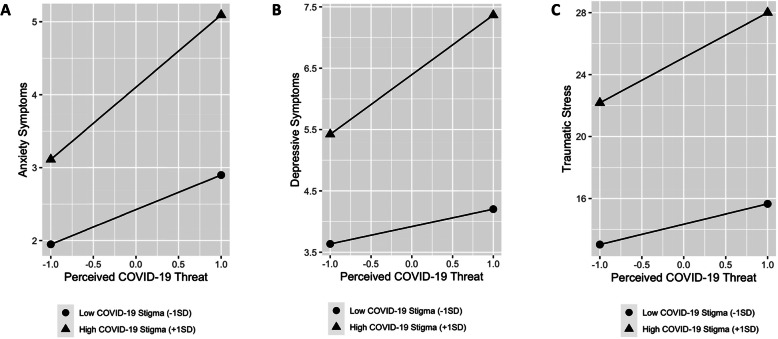
- Perceived COVID-19 threat and perceived COVID-19 societal stigma showed significant main and interactive effects for all outcomes; their combination was associated with the highest symptom severity. Screen media usage was positively associated with depression; female gender and COVID-19 prosocial behavior were associated with higher anxiety, while COVID-19 self-efficacy was associated with lower anxiety.
Methods
- Cross-sectional online survey conducted March 20–April 10, 2020, during state-enforced quarantine; participants were recruited via websites and WeChat-based platforms, including advertisements distributed through academic advisors at 19 Chinese universities, with snowball sharing encouraged.
- Inclusion criteria: at least 18 years old, currently enrolled as an undergraduate or graduate student in a Chinese college/university, and fluent in Chinese; final sample was 1,912 students (mean age 20.28, SD = 2.10; 69.77% female; 91.84% undergraduate).
- Measures included GAD-7 for anxiety, PHQ-9 for depression, IES for COVID-19-related traumatic stress, MAAS for mindfulness, adapted MSPSS for perceived social support, and adapted COVID-19-specific measures of prosocial behavior, self-efficacy, societal stigma, and perceived threat. Analyses used bivariate tests, multiple regression models, interaction terms for threat × stigma, simple slopes, and model comparison.
Limitations
- The paper states that open internet recruitment may have attracted those highly impacted by COVID-19, potentially upwardly biasing symptom severity estimates; the sample was disproportionately female (69.77%), which may skew anxiety estimates and limit representativeness.
- The cross-sectional design precludes causal inference; the IES measured only intrusion and avoidance clusters of PTSD symptoms, missing other symptom clusters; and self-report measures may be subject to biases such as social desirability, with clinician-rated measures preferable for prevalence.
- The text also notes that the newly adapted COVID-19 prosocial behavior scale had not been validated, although exploratory and confirmatory factor analyses indicated a one-factor structure.
Model-written summary. Check it against the paper before relying on it.
Integrity signals
Registry
Cites
Statistics
Figures
Verification
Claims the paper makes
70 Own result · 21 Not checked yet · 20 Own method · 9 Own interpretation · 1 Supported so far
A result the paper reports from its own data — it cites no other source for it, so there is none to check. The quote shows it is in the paper.
In the paper
“Symptom severity across psychiatric domains did not differ based on region of residence (Hubei, the hotspot of COVID-19 or non-Hubei).”
§ Psychiatric symptoms, risk, and protective factors among university students in quarantine during the COVID-19 pandemic in China > Results > Descriptive and bivariate statistics
plain- Asserted: passes — The authors put it forward as true.
- Checkable: passes — It can be checked against evidence.
- Load-bearing: unclear — It is unclear whether the paper’s conclusions depend on it.
- Based: passes — The paper gives a reason why it holds.
A result the paper reports from its own data — it cites no other source for it, so there is none to check. The quote shows it is in the paper.
In the paper
“Across symptom domains, mindfulness was associated with lower symptom severity, while COVID-19 related financial stress, perceived COVID-19 societal stigma, and perceived COVID-19 threat were associated with higher symptom severity.”
§ Psychiatric symptoms, risk, and protective factors among university students in quarantine during the COVID-19 pandemic in China > Abstract > Results
plaincorrelational- Asserted: passes — The authors put it forward as true.
- Checkable: passes — It can be checked against evidence.
- Load-bearing: passes — The paper’s conclusions depend on it.
- Based: passes — The paper gives a reason why it holds.
A result the paper reports from its own data — it cites no other source for it, so there is none to check. The quote shows it is in the paper.
In the paper
“COVID-19 threat and COVID-19 stigma showed main and interactive effects in predicting all mental health outcomes, with their combination associated with highest symptom severity.”
§ Psychiatric symptoms, risk, and protective factors among university students in quarantine during the COVID-19 pandemic in China > Abstract > Results
plaincorrelational- Asserted: passes — The authors put it forward as true.
- Checkable: passes — It can be checked against evidence.
- Load-bearing: passes — The paper’s conclusions depend on it.
- Based: passes — The paper gives a reason why it holds.
A result the paper reports from its own data — it cites no other source for it, so there is none to check. The quote shows it is in the paper.
In the paper
“Across symptom domains, mindfulness was associated with lower symptom severity, while COVID-19 related financial stress, perceived COVID-19 societal stigma, and perceived COVID-19 threat were associated with higher symptom severity.”
§ Psychiatric symptoms, risk, and protective factors among university students in quarantine during the COVID-19 pandemic in China > Abstract > Results
plaincorrelational- Asserted: passes — The authors put it forward as true.
- Checkable: passes — It can be checked against evidence.
- Load-bearing: passes — The paper’s conclusions depend on it.
- Based: passes — The paper gives a reason why it holds.
A result the paper reports from its own data — it cites no other source for it, so there is none to check. The quote shows it is in the paper.
In the paper
“Screen media device usage was positively associated with depression.”
§ Psychiatric symptoms, risk, and protective factors among university students in quarantine during the COVID-19 pandemic in China > Abstract > Results
plaincorrelational- Asserted: passes — The authors put it forward as true.
- Checkable: passes — It can be checked against evidence.
- Load-bearing: passes — The paper’s conclusions depend on it.
- Based: passes — The paper gives a reason why it holds.
A result the paper reports from its own data — it cites no other source for it, so there is none to check. The quote shows it is in the paper.
In the paper
“Female gender and COVID-19 prosocial behavior were associated with higher anxiety, while COVID-19 self-efficacy associated with lower anxiety symptoms.”
- Also stated in: § Descriptive and bivariate statistics · plain
“Anxiety symptoms were higher for female participants (t [1017] = − 2.10, p = .036, mean [M] for male = 3.27, M for female = 3.74).”
§ Psychiatric symptoms, risk, and protective factors among university students in quarantine during the COVID-19 pandemic in China > Abstract > Results
plaincorrelational- Asserted: passes — The authors put it forward as true.
- Checkable: passes — It can be checked against evidence.
- Load-bearing: passes — The paper’s conclusions depend on it.
- Based: passes — The paper gives a reason why it holds.
- Also stated in: § Descriptive and bivariate statistics · plain
A result the paper reports from its own data — it cites no other source for it, so there is none to check. The quote shows it is in the paper.
In the paper
“Female gender and COVID-19 prosocial behavior were associated with higher anxiety, while COVID-19 self-efficacy associated with lower anxiety symptoms.”
§ Psychiatric symptoms, risk, and protective factors among university students in quarantine during the COVID-19 pandemic in China > Abstract > Results
plaincorrelational- Asserted: passes — The authors put it forward as true.
- Checkable: passes — It can be checked against evidence.
- Load-bearing: passes — The paper’s conclusions depend on it.
- Based: passes — The paper gives a reason why it holds.
A result the paper reports from its own data — it cites no other source for it, so there is none to check. The quote shows it is in the paper.
In the paper
“Proportion with moderate or higher clinical elevations were 17.67% for traumatic stress, 15.58% for depression, and 9.62% for anxiety.”
§ Psychiatric symptoms, risk, and protective factors among university students in quarantine during the COVID-19 pandemic in China > Results > Descriptive and bivariate statistics
plain- Asserted: passes — The authors put it forward as true.
- Checkable: passes — It can be checked against evidence.
- Load-bearing: unclear — It is unclear whether the paper’s conclusions depend on it.
- Based: passes — The paper gives a reason why it holds.
A result the paper reports from its own data — it cites no other source for it, so there is none to check. The quote shows it is in the paper.
In the paper
“46.55% had depressive symptoms”
- Also stated in: § Descriptive and bivariate statistics · plain
“Anxiety symptoms were clinical elevated among 34.73% participants and 46.55% for depression.”
§ Psychiatric symptoms, risk, and protective factors among university students in quarantine during the COVID-19 pandemic in China > Abstract > Results
plain- Asserted: passes — The authors put it forward as true.
- Checkable: passes — It can be checked against evidence.
- Load-bearing: passes — The paper’s conclusions depend on it.
- Based: passes — The paper gives a reason why it holds.
- Also stated in: § Descriptive and bivariate statistics · plain
- Probably not a substantial claim. 31
- It may state two separate claims as one. 9
The sources with a verdict support this claim; the rest weren’t checked yet, have no full text we could read, or their verdicts aren’t rated yet.
In the paper
“past economic recessions have witnessed increased rates of common mental disorders and suicidal behavior in other global regions [44, 50].”
§ Psychiatric symptoms, risk, and protective factors among university students in quarantine during the COVID-19 pandemic in China > Discussion
What the sources say
- Not checked yetcites [44] Nordt C, Warnke I, Seifritz E, Kawohl W. Modelling suicide and unemployment: a longitudinal analysis covering 63 countries, 2000-11. Lancet Psychiatry. 2015;2:239–45. https://doi.org/10.1016/S2215-0366(14)00118-7. source
- Supportedcites [50] Reeves A, Stuckler D, McKee M, Gunnell D, Chang SS, Basu S. Increase in state suicide rates in the USA during economic recession. Lancet. 2012;380:1813–4. https://doi.org/10.1016/S0140-6736(12)61910-2. source
The paper’s opening passage reports increased suicides during the recession in European countries, including the UK and Greece. Its discussion also describes depression and anxiety disorders seen in Spain and Greece and notes a similar pattern of suicides in Italy. Together, these passages support the broad claim about mental disorders and suicidal behavior in other regions. (LLM, conf=0.87)
plaincorrelational- Asserted: passes — The authors put it forward as true.
- Checkable: passes — It can be checked against evidence.
- Load-bearing: fails — The paper’s conclusions may not depend on it.
- Based: passes — The paper gives a reason why it holds.
Probably not a substantial claim. The paper’s conclusions may not depend on it. It may state two separate claims as one.
A result the paper reports from its own data — it cites no other source for it, so there is none to check. The quote shows it is in the paper.
In the paper
“Model 3 was superior to model 2, F = 8.70, p = .003, and accounted for 3% additional variance.”
§ Psychiatric symptoms, risk, and protective factors among university students in quarantine during the COVID-19 pandemic in China > Results > Predicting traumatic stress
plaincorrelational- Asserted: passes — The authors put it forward as true.
- Checkable: passes — It can be checked against evidence.
- Load-bearing: passes — The paper’s conclusions depend on it.
- Based: passes — The paper gives a reason why it holds.
It may state two separate claims as one.
A result the paper reports from its own data — it cites no other source for it, so there is none to check. The quote shows it is in the paper.
In the paper
“In addition to financial stress, being older and female were also identified as risk factors of anxiety symptoms.”
§ Psychiatric symptoms, risk, and protective factors among university students in quarantine during the COVID-19 pandemic in China > Discussion
plaincorrelational- Asserted: passes — The authors put it forward as true.
- Checkable: passes — It can be checked against evidence.
- Load-bearing: passes — The paper’s conclusions depend on it.
- Based: passes — The paper gives a reason why it holds.
It may state two separate claims as one.
A result the paper reports from its own data — it cites no other source for it, so there is none to check. The quote shows it is in the paper.
In the paper
“For instance, COVID-19 prosocial behavior was associated with heightened anxiety”
§ Psychiatric symptoms, risk, and protective factors among university students in quarantine during the COVID-19 pandemic in China > Discussion > Study limitations and strengths
plaincorrelational- Asserted: passes — The authors put it forward as true.
- Checkable: passes — It can be checked against evidence.
- Load-bearing: fails — The paper’s conclusions may not depend on it.
- Based: passes — The paper gives a reason why it holds.
Probably not a substantial claim. The paper’s conclusions may not depend on it.
A result the paper reports from its own data — it cites no other source for it, so there is none to check. The quote shows it is in the paper.
In the paper
“Conducted in March and April 2020 during massive, state-enforced quarantine, the current study found high rates of psychiatric symptoms in a sample of internet-recruited university students in China.”
§ Psychiatric symptoms, risk, and protective factors among university students in quarantine during the COVID-19 pandemic in China > Conclusions
plain- Asserted: passes — The authors put it forward as true.
- Checkable: passes — It can be checked against evidence.
- Load-bearing: passes — The paper’s conclusions depend on it.
- Based: passes — The paper gives a reason why it holds.
It may state two separate claims as one.
None of the sources cited for this claim have been checked yet.
In the paper
“Altruistic and prosocial social behavior appears to promote well-being for the helpers [18, 39].”
§ Psychiatric symptoms, risk, and protective factors among university students in quarantine during the COVID-19 pandemic in China > Introduction
What the sources say
- Not checked yetcites [18] Curry OS, Rowland LA, Van Lissa CJ, Zlotowitz S, McAlaney J, Whitehouse H. Happy to help? A systematic review and meta-analysis of the effects of performing acts of kindness on the well-being of the actor. J Exp Soc Psychol. 2018;76:320–9. https://doi.org/10.1016/j.jesp.2018.02.014. source
- Not checked yetcites [39] Martela F, Ryan RM. Prosocial behavior increases well-being and vitality even without contact with the beneficiary: causal and behavioral evidence. Motiv Emot. 2016;40:351–7. https://doi.org/10.1007/s11031-016-9552-z. source
hedgedconditional- Asserted: passes — The authors put it forward as true.
- Checkable: passes — It can be checked against evidence.
- Load-bearing: passes — The paper’s conclusions depend on it.
- Based: passes — The paper gives a reason why it holds.
Probably not a substantial claim.
What the paper did — it cites no source for this, so there is none to check. The quote shows it is in the paper.
In the paper
“Cronbach’s α was 0.91.”
§ Psychiatric symptoms, risk, and protective factors among university students in quarantine during the COVID-19 pandemic in China > Methods > Instruments
plain- Asserted: passes — The authors put it forward as true.
- Checkable: passes — It can be checked against evidence.
- Load-bearing: fails — The paper’s conclusions may not depend on it.
- Based: passes — The paper gives a reason why it holds.
Probably not a substantial claim. The paper’s conclusions may not depend on it.
In the paper
“COVID-19 self-efficacy was explored as a predictor of mental health, as belief in one’s capacity to prevent COVID-19 and take necessary steps for treatment may facilitate an increased sense of control in an evolving outbreak [48].”
§ Psychiatric symptoms, risk, and protective factors among university students in quarantine during the COVID-19 pandemic in China > Introduction
What the sources say
- Not checked yetcites [48] Person B, Sy F, Holton K, Govert B, Liang A, the NCID/SARS Community Outreach Team. Fear and stigma: the epidemic within the SARS outbreak. Emerg Infect Dis. 2004;10:358–63. source
hedgedconditional- Asserted: passes — The authors put it forward as true.
- Checkable: passes — It can be checked against evidence.
- Load-bearing: passes — The paper’s conclusions depend on it.
- Based: passes — The paper gives a reason why it holds.
Probably not a substantial claim.
In the paper
“The scale has demonstrated good reliability and validity in outpatient settings in China [65].”
§ Psychiatric symptoms, risk, and protective factors among university students in quarantine during the COVID-19 pandemic in China > Methods > Instruments
What the sources say
- Not checked yetcites [65] Zeng Q-Z, He Y-L, Liu H, Miao J-M, Chen J-X, Xu H-N, Wang J-Y. Reliability and validity of Chinese version of the generalized anxiety disorder 7-item (GAD-7) scale in screening anxiety disorders in outpatients from traditional Chinese internal department. Chinese Ment Heal J. 2013;27:163–8.
boosted- Asserted: passes — The authors put it forward as true.
- Checkable: passes — It can be checked against evidence.
- Load-bearing: fails — The paper’s conclusions may not depend on it.
- Based: passes — The paper gives a reason why it holds.
Probably not a substantial claim. The paper’s conclusions may not depend on it.
What the paper did — it cites no source for this, so there is none to check. The quote shows it is in the paper.
In the paper
“Cronbach’s α was 0.93.”
§ Psychiatric symptoms, risk, and protective factors among university students in quarantine during the COVID-19 pandemic in China > Methods > Instruments
plain- Asserted: fails — The authors may not put it forward as true.
- Checkable: passes — It can be checked against evidence.
- Load-bearing: fails — The paper’s conclusions may not depend on it.
- Based: fails — The paper may give no reason why it holds.
Probably not a substantial claim. The authors may not put it forward as true. The paper’s conclusions may not depend on it. The paper may give no reason why it holds.
What the paper did — it cites no source for this, so there is none to check. The quote shows it is in the paper.
In the paper
“Cronbach’s α was 0.96.”
§ Psychiatric symptoms, risk, and protective factors among university students in quarantine during the COVID-19 pandemic in China > Methods > Instruments
plain- Asserted: passes — The authors put it forward as true.
- Checkable: passes — It can be checked against evidence.
- Load-bearing: fails — The paper’s conclusions may not depend on it.
- Based: passes — The paper gives a reason why it holds.
Probably not a substantial claim. The paper’s conclusions may not depend on it.
What the paper did — it cites no source for this, so there is none to check. The quote shows it is in the paper.
In the paper
“Cronbach’s α was 0.90.”
§ Psychiatric symptoms, risk, and protective factors among university students in quarantine during the COVID-19 pandemic in China > Methods > Instruments
plain- Asserted: passes — The authors put it forward as true.
- Checkable: passes — It can be checked against evidence.
- Load-bearing: fails — The paper’s conclusions may not depend on it.
- Based: passes — The paper gives a reason why it holds.
Probably not a substantial claim. The paper’s conclusions may not depend on it.
In the paper
“A recent study found 90% of respondents in China exhibited discriminatory attitudes toward people and regions associated with the COVID-19 outbreak [27].”
§ Psychiatric symptoms, risk, and protective factors among university students in quarantine during the COVID-19 pandemic in China > Introduction
What the sources say
- Not checked yetcites [27] He J, He L, Zhou W, Nie X, He M. Discrimination and social exclusion in the outbreak of COVID-19. Int J Environ Res Public Health. 2020;17:2933. https://doi.org/10.3390/ijerph17082933. source
plain- Asserted: passes — The authors put it forward as true.
- Checkable: passes — It can be checked against evidence.
- Load-bearing: fails — The paper’s conclusions may not depend on it.
- Based: passes — The paper gives a reason why it holds.
Probably not a substantial claim. The paper’s conclusions may not depend on it.
What the paper did — it cites no source for this, so there is none to check. The quote shows it is in the paper.
In the paper
“The study was approved by the Institutional Review Board at Beijing Normal University.”
§ Psychiatric symptoms, risk, and protective factors among university students in quarantine during the COVID-19 pandemic in China > Methods > Ethical consideration and approval
plain- Asserted: passes — The authors put it forward as true.
- Checkable: passes — It can be checked against evidence.
- Load-bearing: fails — The paper’s conclusions may not depend on it.
- Based: passes — The paper gives a reason why it holds.
Probably not a substantial claim. The paper’s conclusions may not depend on it.
What the paper did — it cites no source for this, so there is none to check. The quote shows it is in the paper.
In the paper
“Data were collected via an anonymous online survey.”
§ Psychiatric symptoms, risk, and protective factors among university students in quarantine during the COVID-19 pandemic in China > Methods > Ethical consideration and approval
plain- Asserted: passes — The authors put it forward as true.
- Checkable: passes — It can be checked against evidence.
- Load-bearing: fails — The paper’s conclusions may not depend on it.
- Based: passes — The paper gives a reason why it holds.
Probably not a substantial claim. The paper’s conclusions may not depend on it.
None of the sources cited for this claim have been checked yet.
In the paper
“This was informed by the ecological model (person X context) [9, 17].”
§ Psychiatric symptoms, risk, and protective factors among university students in quarantine during the COVID-19 pandemic in China > Introduction
What the sources say
- Not checked yetcites [9] Bronfenbrenner U. Toward an experimental ecology of human development. Am Psychol. 1977;32:513–31. https://doi.org/10.1037/0003-066X.32.7.513. source
- Not checked yetcites [17] Cook JE, Purdie-Vaughns V, Meyer IH, Busch JTA. Intervening within and across levels: a multilevel approach to stigma and public health. Soc Sci Med. 2014;103:101–9. https://doi.org/10.1016/j.socscimed.2013.09.023. source
plainconditional- Asserted: passes — The authors put it forward as true.
- Checkable: passes — It can be checked against evidence.
- Load-bearing: passes — The paper’s conclusions depend on it.
- Based: passes — The paper gives a reason why it holds.
Probably not a substantial claim.
What the paper did — it cites no source for this, so there is none to check. The quote shows it is in the paper.
In the paper
“Cronbach’s α was 0.94.”
§ Psychiatric symptoms, risk, and protective factors among university students in quarantine during the COVID-19 pandemic in China > Methods > Instruments
plain- Asserted: passes — The authors put it forward as true.
- Checkable: passes — It can be checked against evidence.
- Load-bearing: fails — The paper’s conclusions may not depend on it.
- Based: passes — The paper gives a reason why it holds.
Probably not a substantial claim. The paper’s conclusions may not depend on it.
What the paper did — it cites no source for this, so there is none to check. The quote shows it is in the paper.
In the paper
“All regression analyses complied with assumptions regarding variable distribution and there was no evidence for collinearity (VIF values ranged from 1.02 to 1.50).”
§ Psychiatric symptoms, risk, and protective factors among university students in quarantine during the COVID-19 pandemic in China > Methods > Data Analysis
plain- Asserted: passes — The authors put it forward as true.
- Checkable: passes — It can be checked against evidence.
- Load-bearing: passes — The paper’s conclusions depend on it.
- Based: passes — The paper gives a reason why it holds.
It may state two separate claims as one.
What the paper did — it cites no source for this, so there is none to check. The quote shows it is in the paper.
In the paper
“Cronbach’s α was 0.93.”
§ Psychiatric symptoms, risk, and protective factors among university students in quarantine during the COVID-19 pandemic in China > Methods > Instruments
plain- Asserted: fails — The authors may not put it forward as true.
- Checkable: passes — It can be checked against evidence.
- Load-bearing: fails — The paper’s conclusions may not depend on it.
- Based: fails — The paper may give no reason why it holds.
Probably not a substantial claim. The authors may not put it forward as true. The paper’s conclusions may not depend on it. The paper may give no reason why it holds.
In the paper
“Consistent with prior work showing perceived SARS threat predicted emotional exhaustion among frontline nurses during the SARS outbreak [23], we examined perceived COVID-19 threat (i.e., perception of one’s likelihood of contracting COVID-19) as a risk factor.”
§ Psychiatric symptoms, risk, and protective factors among university students in quarantine during the COVID-19 pandemic in China > Introduction
What the sources say
- Not checked yetcites [23] Fiksenbaum L, Marjanovic Z, Greenglass ER, Coffey S. Emotional exhaustion and state anger in nurses who worked during the SARS outbreak: the role of perceived threat and organizational support. Can J Community Ment Heal. 2006;25:89–103. https://doi.org/10.7870/cjcmh-2006-0015. source
plaindirect- Asserted: passes — The authors put it forward as true.
- Checkable: passes — It can be checked against evidence.
- Load-bearing: passes — The paper’s conclusions depend on it.
- Based: passes — The paper gives a reason why it holds.
Probably not a substantial claim.
What the paper did — it cites no source for this, so there is none to check. The quote shows it is in the paper.
In the paper
“This newly adapted scale has not been validated.”
§ Psychiatric symptoms, risk, and protective factors among university students in quarantine during the COVID-19 pandemic in China > Methods > Instruments
plain- Asserted: passes — The authors put it forward as true.
- Checkable: passes — It can be checked against evidence.
- Load-bearing: fails — The paper’s conclusions may not depend on it.
- Based: passes — The paper gives a reason why it holds.
Probably not a substantial claim. The paper’s conclusions may not depend on it.
A conclusion the paper draws from its own results — it cites no other source for it, so there is none to check. The quote shows it is in the paper.
In the paper
“Findings suggest high need for psychological health promotion among university students during the COVID-19 pandemic and inform an ecological perspective on the detrimental role of stigma during an emerging infectious disease outbreak.”
§ Psychiatric symptoms, risk, and protective factors among university students in quarantine during the COVID-19 pandemic in China > Abstract > Conclusions
hedged- Asserted: passes — The authors put it forward as true.
- Checkable: passes — It can be checked against evidence.
- Load-bearing: passes — The paper’s conclusions depend on it.
- Based: passes — The paper gives a reason why it holds.
Probably not a substantial claim.
- Rests on an assumption: The sample of 1912 Chinese university students recruited online is representative of Chinese university students during state-enforced quarantine.
What the paper did — it cites no source for this, so there is none to check. The quote shows it is in the paper.
In the paper
“Exploratory factor analysis (EFA) and confirmatory factor analysis (CFA) indicated a one-factor structure, with all items having sufficient loadings (≥ .40, all items had a standardized loading > .70).”
§ Psychiatric symptoms, risk, and protective factors among university students in quarantine during the COVID-19 pandemic in China > Methods > Instruments
hedged- Asserted: passes — The authors put it forward as true.
- Checkable: passes — It can be checked against evidence.
- Load-bearing: passes — The paper’s conclusions depend on it.
- Based: passes — The paper gives a reason why it holds.
It may state two separate claims as one.
What the paper did — it cites no source for this, so there is none to check. The quote shows it is in the paper.
In the paper
“Cronbach’s α was 0.72.”
§ Psychiatric symptoms, risk, and protective factors among university students in quarantine during the COVID-19 pandemic in China > Methods > Instruments
plain- Asserted: passes — The authors put it forward as true.
- Checkable: passes — It can be checked against evidence.
- Load-bearing: fails — The paper’s conclusions may not depend on it.
- Based: passes — The paper gives a reason why it holds.
Probably not a substantial claim. The paper’s conclusions may not depend on it.
What the paper did — it cites no source for this, so there is none to check. The quote shows it is in the paper.
In the paper
“Cronbach’s α was 0.95.”
§ Psychiatric symptoms, risk, and protective factors among university students in quarantine during the COVID-19 pandemic in China > Methods > Instruments
plain- Asserted: passes — The authors put it forward as true.
- Checkable: passes — It can be checked against evidence.
- Load-bearing: fails — The paper’s conclusions may not depend on it.
- Based: passes — The paper gives a reason why it holds.
Probably not a substantial claim. The paper’s conclusions may not depend on it.
In the paper
“Most mental health systems in LMIC context, including in China, are often overburdened by high demand yet inadequately funded [63].”
§ Psychiatric symptoms, risk, and protective factors among university students in quarantine during the COVID-19 pandemic in China > Discussion > Implications for research and clinical interventions
What the sources say
- Not checked yetcites [63] World Health Organization. Mental health atlas 2017: World Health Organization; 2017. https://apps.who.int/iris/bitstream/handle/10665/272735/9789241514019-eng.pdf?ua=1.
plain- Asserted: passes — The authors put it forward as true.
- Checkable: passes — It can be checked against evidence.
- Load-bearing: fails — The paper’s conclusions may not depend on it.
- Based: passes — The paper gives a reason why it holds.
Probably not a substantial claim. The paper’s conclusions may not depend on it.
A conclusion the paper draws from its own results — it cites no other source for it, so there is none to check. The quote shows it is in the paper.
In the paper
“Findings highlight the high need for psychological health promotion in this population.”
§ Psychiatric symptoms, risk, and protective factors among university students in quarantine during the COVID-19 pandemic in China > Conclusions
plain- Asserted: passes — The authors put it forward as true.
- Checkable: fails — It may be too vague to check against evidence.
- Load-bearing: passes — The paper’s conclusions depend on it.
- Based: passes — The paper gives a reason why it holds.
Probably not a substantial claim. It may be too vague to check against evidence.
In the paper
“which is consistent with existing evidence that women report greater anxiety and more likely to develop anxiety disorders than men [40].”
§ Psychiatric symptoms, risk, and protective factors among university students in quarantine during the COVID-19 pandemic in China > Discussion
What the sources say
- Not checked yetcites [40] McLean CP, Anderson ER. Brave men and timid women? A review of the gender differences in fear and anxiety. Clin Psychol Rev. 2009;29:496–505. https://doi.org/10.1016/j.cpr.2009.05.003. source
plaincorrelational- Asserted: passes — The authors put it forward as true.
- Checkable: passes — It can be checked against evidence.
- Load-bearing: fails — The paper’s conclusions may not depend on it.
- Based: passes — The paper gives a reason why it holds.
Probably not a substantial claim. The paper’s conclusions may not depend on it. It may state two separate claims as one.
None of the sources cited for this claim have been checked yet.
In the paper
“As the economic consequences of COVID-19 have continued to unfold, it has become clear that individuals from lower socioeconomic background have been disproportionately burdened across the globe [1, 12].”
§ Psychiatric symptoms, risk, and protective factors among university students in quarantine during the COVID-19 pandemic in China > Discussion
What the sources say
- Not checked yetcites [1] Ahmed F, Ahmed N, Pissarides C, Stiglitz J. Why inequality could spread COVID-19. Lancet Public Health. 2020;5:e240. https://doi.org/10.1016/S2468-2667(20)30085-2. source
- Not checked yetcites [12] Buheji M, da Costa Cunha K, Beka G, Mavrić B, Leandro do Carmo de Souza Y, Souza da Costa Silva S, Hanafi M, Chetia Yein T. The extent of COVID-19 pandemic socio-economic impact on global poverty: a global integrative multidisciplinary review. Am J Econ. 2020;2020:213–24. https://doi.org/10.5923/j.economics.20201004.02. source
boostedcorrelational- Asserted: passes — The authors put it forward as true.
- Checkable: passes — It can be checked against evidence.
- Load-bearing: fails — The paper’s conclusions may not depend on it.
- Based: passes — The paper gives a reason why it holds.
Probably not a substantial claim. The paper’s conclusions may not depend on it.
In the paper
“This is supported by evidence suggesting decreased rumination may be one of the key mechanisms underlying the efficacy of mindfulness-based interventions [26].”
§ Psychiatric symptoms, risk, and protective factors among university students in quarantine during the COVID-19 pandemic in China > Discussion
What the sources say
- Not checked yetcites [26] Gu J, Strauss C, Bond R, Cavanagh K. How do mindfulness-based cognitive therapy and mindfulness-based stress reduction improve mental health and wellbeing? A systematic review and meta-analysis of mediation studies. Clin Psychol Rev. 2015;37:1–12. https://doi.org/10.1016/j.cpr.2015.01.006. source
hedgedconditional- Asserted: passes — The authors put it forward as true.
- Checkable: passes — It can be checked against evidence.
- Load-bearing: fails — The paper’s conclusions may not depend on it.
- Based: passes — The paper gives a reason why it holds.
Probably not a substantial claim. The paper’s conclusions may not depend on it.
What the paper did — it cites no source for this, so there is none to check. The quote shows it is in the paper.
In the paper
“The higher proportion of women could have skewed the estimates in anxiety, given the higher prevalence of anxiety in female students.”
§ Psychiatric symptoms, risk, and protective factors among university students in quarantine during the COVID-19 pandemic in China > Discussion > Study limitations and strengths
hedgedconditional- Asserted: passes — The authors put it forward as true.
- Checkable: passes — It can be checked against evidence.
- Load-bearing: fails — The paper’s conclusions may not depend on it.
- Based: passes — The paper gives a reason why it holds.
Probably not a substantial claim. The paper’s conclusions may not depend on it.
What the paper did — it cites no source for this, so there is none to check. The quote shows it is in the paper.
In the paper
“We collected a large, geographically diverse sample during the early phase of the COVID-19 pandemic and included a variety of psychiatric symptoms.”
§ Psychiatric symptoms, risk, and protective factors among university students in quarantine during the COVID-19 pandemic in China > Discussion > Study limitations and strengths
plain- Asserted: passes — The authors put it forward as true.
- Checkable: passes — It can be checked against evidence.
- Load-bearing: fails — The paper’s conclusions may not depend on it.
- Based: passes — The paper gives a reason why it holds.
Probably not a substantial claim. The paper’s conclusions may not depend on it. It may state two separate claims as one.
A conclusion the paper draws from its own results — it cites no other source for it, so there is none to check. The quote shows it is in the paper.
In the paper
“Additionally, the gender makeup and recruitment method may lead to findings not being representative of the larger Chinese university student population.”
§ Psychiatric symptoms, risk, and protective factors among university students in quarantine during the COVID-19 pandemic in China > Discussion > Study limitations and strengths
hedgedconditional- Asserted: passes — The authors put it forward as true.
- Checkable: passes — It can be checked against evidence.
- Load-bearing: unclear — It is unclear whether the paper’s conclusions depend on it.
- Based: passes — The paper gives a reason why it holds.
It may state two separate claims as one.
A conclusion the paper draws from its own results — it cites no other source for it, so there is none to check. The quote shows it is in the paper.
In the paper
“In addition to informing current and future pandemic responses, this research can also clarify the psychological consequences, risk, and protective factors of acute stress more generally.”
§ Psychiatric symptoms, risk, and protective factors among university students in quarantine during the COVID-19 pandemic in China > Conclusions
plain- Asserted: passes — The authors put it forward as true.
- Checkable: fails — It may be too vague to check against evidence.
- Load-bearing: passes — The paper’s conclusions depend on it.
- Based: passes — The paper gives a reason why it holds.
Probably not a substantial claim. It may be too vague to check against evidence.
None of the sources cited for this claim have been checked yet.
In the paper
“Excessive screen time has been linked to a variety of health concerns including obesity, sleep disturbance, and mental health issues [7, 22].”
§ Psychiatric symptoms, risk, and protective factors among university students in quarantine during the COVID-19 pandemic in China > Discussion
What the sources say
- Not checked yetcites [7] Boone JE, Gordon-Larsen P, Adair LS, Popkin BM. Screen time and physical activity during adolescence: longitudinal effects on obesity in young adulthood. Int J Behav Nutr Phys Act. 2007;4:61–71. https://doi.org/10.1186/1479-Received. source
- Not checked yetcites [22] Feng Q, Le Zhang Q, Du Y, Ye YL, He QQ. Associations of physical activity, screen time with depression, anxiety and sleep quality among Chinese college freshmen. PLoS One. 2014;9:1–5. https://doi.org/10.1371/journal.pone.0100914. source
plaincorrelational- Asserted: passes — The authors put it forward as true.
- Checkable: passes — It can be checked against evidence.
- Load-bearing: fails — The paper’s conclusions may not depend on it.
- Based: passes — The paper gives a reason why it holds.
Probably not a substantial claim. The paper’s conclusions may not depend on it.
What the paper did — it cites no source for this, so there is none to check. The quote shows it is in the paper.
In the paper
“Similarly, given the self-report method, all variables are at risk to known biases (e.g., social desirability).”
§ Psychiatric symptoms, risk, and protective factors among university students in quarantine during the COVID-19 pandemic in China > Discussion > Study limitations and strengths
plain- Asserted: passes — The authors put it forward as true.
- Checkable: passes — It can be checked against evidence.
- Load-bearing: fails — The paper’s conclusions may not depend on it.
- Based: passes — The paper gives a reason why it holds.
Probably not a substantial claim. The paper’s conclusions may not depend on it.
In the paper
“As noted by Allport [3], stigma is derived from the separation of human groups (“us” vs. “them”) and stereotypes associated with group membership [3].”
§ Psychiatric symptoms, risk, and protective factors among university students in quarantine during the COVID-19 pandemic in China > Discussion > Implications for research and clinical interventions
What the sources say
- Not checked yetcites [3] Allport GW. The nature of prejudice. Reading, MA: Addison-Wesley; 1954.
plaindirect- Asserted: passes — The authors put it forward as true.
- Checkable: passes — It can be checked against evidence.
- Load-bearing: fails — The paper’s conclusions may not depend on it.
- Based: passes — The paper gives a reason why it holds.
Probably not a substantial claim. The paper’s conclusions may not depend on it.
The paper relies on this without support.
The sample of 1912 Chinese university students recruited online is representative of Chinese university students during state-enforced quarantine.
“Recruitment took place online through advertisements on websites and WeChat-based platforms targeting Chinese university students.”
“The sample included 1912 Chinese university students.”
The paper relies on this without support.
The observed associations between predictors and psychiatric symptoms reflect causal risk or protective effects rather than reverse causation or unmeasured confounding.
“We explored risk and protective factors of psychological health, including demographic variables, two known protective factors for mental health (mindfulness, perceived social support), four COVID-specific factors (COVID-19 related efficacy, perceived COVID-19 threat, perceived COVID-19 societal stigma, COVID-19 prosocial behavior) and screen media usage.”
“Risk factors (i.e., positive correlates) for depressive symptoms included financial stress due to COVID-19 (β = 0.119), two COVID-specific risk factors (perceived COVID-19 threat: β = 0.109; perceived COVID-19 societal stigma: β = 0.238), and screen media device usage (β = 0.058).”
The paper relies on this without support.
No meta-analyses or nationally representative survey data are available estimating rates of clinically elevated anxiety or traumatic stress symptoms among Chinese university students.
“To our knowledge, no meta-analyses or nationally representative survey data are available estimating rates of clinically elevated anxiety or traumatic stress symptoms among Chinese university students.”
The paper relies on this without support.
Stigma research has focused on victimized groups.
“Thus far, stigma research has focused on victimized groups.”
Claims other papers make about this one
Each is checked against this paper’s own text: does it say what the citing paper says it does?
The cited source says what the claim attributes to it.
In the citing paper
“Of the 16 studies remaining, 15 were cross sectional studies and one was a cohort study [16, 19–33].”
From Mental Health Impact of COVID-19 among Children and College Students: A Systematic Review (2023) · cites this paper as [25]
In the citing paper
“our findings of five studies on children and 16 studies on college students”
From Mental Health Impact of COVID-19 among Children and College Students: A Systematic Review (2023) · cites this paper as [25]
Self-check
Percentages, sums and reported differences re-computed from the paper’s own numbers.
Each contradiction between two passages listed here was confirmed by an independent check.
Rated minor: it would not touch a result — a value no result rests on, a p-value that stays on the same side of the significance level, or a conflict that is clerical, resolved elsewhere in the paper, or outside its own findings.
In the paper
“| Perceived COVID-19 threat | 2.011 | [1.377, 2.645] | 0.323 | 0.136 | < .001*** | | |”
§ Psychiatric symptoms, risk, and protective factors among university students in quarantine during the COVID-19 pandemic in China > Results > Predicting traumatic stress
Reported 2.011 · recomputed 2.17328
Rated minor: it would not touch a result — a value no result rests on, a p-value that stays on the same side of the significance level, or a conflict that is clerical, resolved elsewhere in the paper, or outside its own findings.
In the paper
“Model comparison indicated superiority of Model 3 to Model 2, F = 15.38, p < .001, and the interaction term accounted for 6% additional variance.”
§ Psychiatric symptoms, risk, and protective factors among university students in quarantine during the COVID-19 pandemic in China > Results > Predicting depressive symptoms
Reported 0.06 · recomputed 0.006
Rated minor: it would not touch a result — a value no result rests on, a p-value that stays on the same side of the significance level, or a conflict that is clerical, resolved elsewhere in the paper, or outside its own findings.
In the paper
§ Psychiatric symptoms, risk, and protective factors among university students in quarantine during the COVID-19 pandemic in China > Results > Descriptive and bivariate statistics
“Average age was 20.28 (SD = 2.10, Median = 20, Range = [18, 49]).”
§ Psychiatric symptoms, risk, and protective factors among university students in quarantine during the COVID-19 pandemic in China > Results > Descriptive and bivariate statistics
“| M | 5.20 | 3.59 | 19.83 | 20.38 |”
Citations
Cites
The PHQ-9: Validity of a brief depression severity measure
Kroenke, K., Spitzer, R. L., & Williams, J. B. W. (2001) · Journal of General Internal Medicine · doi:10.1046/j.1525-1497.2001.016009606.x · Cited by 44,910
A Brief Measure for Assessing Generalized Anxiety Disorder: The GAD-7
Spitzer, R. L., Kroenke, K., Williams, J. B. W., & Löwe, B. (2006) · Archives of Internal Medicine · doi:10.1001/archinte.166.10.1092 · Cited by 31,765
The Psychological Impact of Quarantine and How to Reduce It: Rapid Review of the Evidence
Brooks, S. K., Webster, R. K., Smith, L. E., Woodland, L., Wessely, S., Greenberg, N., & Rubin, G. J. (2020) · doi:10.2139/ssrn.3532534 · Cited by 16,394
The psychological impact of quarantine and how to reduce it: Rapid review of the evidence
Brooks, S. K., Webster, R. K., Smith, L. E., Woodland, L., Wessely, S., Greenberg, N., & Rubin, G. J. (2020) · The Lancet · doi:10.1016/s0140-6736(20)30460-8 · Cited by 16,378
(1954) · Cited by 15,935
The benefits of being present: Mindfulness and its role in psychological well-being
Brown, K. W., & Ryan, R. M. (2003) · Journal of Personality and Social Psychology · doi:10.1037/0022-3514.84.4.822 · Cited by 13,448
The Multidimensional Scale of Perceived Social Support
Zimet, G. D., Dahlem, N. W., Zimet, S. G., & Farley, G. K. (1988) · Journal of Personality Assessment · doi:10.1207/s15327752jpa5201_2 · Cited by 13,339
Toward an experimental ecology of human development.
Bronfenbrenner, U. (1977) · American Psychologist · doi:10.1037/0003-066x.32.7.513 · Cited by 10,853
Diagnostic and Statistical Manual of Mental Disorders (DSM-IV)
Hu, R. J. (2003) · Elsevier eBooks · doi:10.1016/b0-12-226870-9/01070-4 · Cited by 9,168
Impact of Event Scale: A Measure of Subjective Stress
Horowitz, M., Wilner, N., & Alvarez, W. (1979) · Psychosomatic Medicine · doi:10.1097/00006842-197905000-00004 · Cited by 7,813
The psychological impact of the COVID-19 epidemic on college students in China
Cao, W., Fang, Z., Hou, G., Han, M., Xu, X., Dong, J., & Zheng, J. (2020) · Psychiatry Research · doi:10.1016/j.psychres.2020.112934 · Cited by 5,843
Holmes, E. A., O'Connor, R. C., Perry, V. H., Tracey, I., Wessely, S., Arseneault, L., Ballard, C., Christensen, H., Cohen Silver, R., Everall, I., et al. (2020) · The Lancet Psychiatry · doi:10.1016/s2215-0366(20)30168-1 · Cited by 5,715
Psychometric Characteristics of the Multidimensional Scale of Perceived Social Support
Zimet, G. D., Powell, S. S., Farley, G. K., Werkman, S., & Berkoff, K. A. (1990) · Journal of Personality Assessment · doi:10.1080/00223891.1990.9674095 · Cited by 4,855
Mental health and the COVID-19 pandemic
Pfefferbaum, B., & North, C. S. (2020) · New England Journal of Medicine · doi:10.1056/nejmp2008017 · Cited by 4,378
(2005) · Medical Entomology and Zoology · Cited by 3,197
Mental health of young people: A global public-health challenge
Patel, V., Flisher, A. J., Hetrick, S., & McGorry, P. (2007) · The Lancet · doi:10.1016/s0140-6736(07)60368-7 · Cited by 3,126
Wherever you go, there you are: Mindfulness meditation in everyday life
Kwee, M. G. T. (1995) · Behaviour Research and Therapy · doi:10.1016/0005-7967(95)90133-7 · Cited by 2,912
Effects of mindfulness on psychological health: A review of empirical studies
Keng, S.-L., Smoski, M. J., & Robins, C. J. (2011) · Clinical Psychology Review · doi:10.1016/j.cpr.2011.04.006 · Cited by 2,687
The New Life Stage of Emerging Adulthood at Ages 18–29 Years: Implications for Mental Health
Arnett, J. J., Žukauskienė, R., & Sugimura, K. (2014) · The Lancet Psychiatry · doi:10.1016/s2215-0366(14)00080-7 · Cited by 1,896
Gu, J., Strauss, C., Bond, R., & Cavanagh, K. (2015) · Clinical Psychology Review · doi:10.1016/j.cpr.2015.01.006 · Cited by 1,712
Measuring stigma in people with HIV: Psychometric assessment of the HIV stigma scale¶
Berger, B. E., Ferrans, C. E., & Lashley, F. R. (2001) · Research in Nursing & Health · doi:10.1002/nur.10011 · Cited by 1,601
Wang, W., Bian, Q., Zhao, Y., Li, X., Wang, W., Du, J., Zhang, G., Zhou, Q., & Zhao, M. (2014) · General Hospital Psychiatry · doi:10.1016/j.genhosppsych.2014.05.021 · Cited by 1,480
Schmider, E., Ziegler, M. D., Danay, E., Beyer, L. M., & Bühner, M. (2010) · Methodology · doi:10.1027/1614-2241/a000016 · Cited by 1,300
Garfin, D. R., Silver, R. C., & Holman, E. A. (2020) · Health Psychology · doi:10.1037/hea0000875 · Cited by 1,270
Feitosa, M. F., Kraja, A. T., Chasman, D. I., Sung, Y. J., Winkler, T. W., Ντάλλα, Ι., Guo, X., Franceschini, N., Cheng, C., Sim, X., et al. (2018) · PLoS ONE · doi:10.1371/journal.pone.0198166 · Cited by 1,169
Brave men and timid women? A review of the gender differences in fear and anxiety
McLean, C. P., & Anderson, E. R. (2009) · Clinical Psychology Review · doi:10.1016/j.cpr.2009.05.003 · Cited by 1,149
Mindfulness-based interventions for psychiatric disorders: A systematic review and meta-analysis
Goldberg, S. B., Tucker, R. P., Greene, P. A., Davidson, R. J., Wampold, B. E., Kearney, D. J., & Simpson, T. L. (2018) · Clinical Psychology Review · doi:10.1016/j.cpr.2017.10.011 · Cited by 1,145
Self-citation(2020) · Cited by 1,012
Psychological Treatments for the World: Lessons from Low- and Middle-Income Countries
Singla, D. R., Kohrt, B. A., Murray, L. K., Anand, A., Chorpita, B. F., & Patel, V. (2017) · Annual Review of Clinical Psychology · doi:10.1146/annurev-clinpsy-032816-045217 · Cited by 913
Linardon, J., Cuijpers, P., Carlbring, P., Messer, M., & Fuller‐Tyszkiewicz, M. (2019) · World Psychiatry · doi:10.1002/wps.20673 · Cited by 860
Social support and mental health among college students.
Hefner, J., & Eisenberg, D. (2009) · American Journal of Orthopsychiatry · doi:10.1037/a0016918 · Cited by 810
Fear and Stigma: The Epidemic within the SARS Outbreak
Person, B., Sy, F., Holton, K., Govert, B., Liang, A., the, N. C. I. D., SARS Community Outreach Team (listed in alphabetical order), Garza, B., Gould, D., Hickson, M., et al. (2004) · Emerging Infectious Diseases · doi:10.3201/eid1002.030750 · Cited by 790
Why inequality could spread COVID-19
Ahmed, F., Ahmed, N., Pissarides, C., & Stiglitz, J. (2020) · The Lancet Public Health · doi:10.1016/s2468-2667(20)30085-2 · Cited by 788
Tang, W., Hu, T., Hu, B., Jin, C., Wang, G., Xie, C., Chen, S., & Xu, J. (2020) · Journal of Affective Disorders · doi:10.1016/j.jad.2020.05.009 · Cited by 787
Stangl, A. L., Lloyd, J. K., Brady, L. M., Holland, C. E., & Baral, S. (2013) · Journal of the International AIDS Society · doi:10.7448/ias.16.3.18734 · Cited by 698
RAD51B in Familial Breast Cancer
Pelttari, L. M., Khan, S., Vuorela, M., Kiiski, J. I., Vilske, S., Nevanlinna, V., Ranta, S., Schleutker, J., Winqvist, R., Kallioniemi, A. H., et al. (2016) · PLoS ONE · doi:10.1371/journal.pone.0153788 · Cited by 672
The Impact of COVID-19 on Anxiety in Chinese University Students
Wang, C., & Zhao, H. (2020) · Frontiers in Psychology · doi:10.3389/fpsyg.2020.01168 · Cited by 621
A New Scale for Measuring Adults' Prosocialness
Caprara, G. V., Steca, P., Zelli, A., & Capanna, C. (2005) · European Journal of Psychological Assessment · doi:10.1027/1015-5759.21.2.77 · Cited by 600
Curry, O. S., Rowland, L. A., Van Lissa, C. J., Zlotowitz, S., McAlaney, J., & Whitehouse, H. (2018) · Journal of Experimental Social Psychology · doi:10.1016/j.jesp.2018.02.014 · Cited by 528
Buheji, M., da Costa Cunha, K., Beka, G., Mavrić, B., Leandro do Carmo de Souza, Y., Souza da Costa Silva, S., Hanafi, M., & Chetia Yein, T. (2020) · American Journal of Economics · doi:10.5923/j.economics.20201004.02 · Cited by 474
Intervening within and across levels: A multilevel approach to stigma and public health
Cook, J. E., Purdie-Vaughns, V., Meyer, I. H., & Busch, J. T. A. (2014) · Social Science & Medicine · doi:10.1016/j.socscimed.2013.09.023 · Cited by 438
The dynamics of travel avoidance: The case of Ebola in the U.S.
Cahyanto, I., Wiblishauser, M. J., Pennington-Gray, L. A., & Schroeder, A. (2016) · Tourism Management Perspectives · doi:10.1016/j.tmp.2016.09.004 · Cited by 403
Guilt, fear, submission, and empathy in depression
O’Connor, L. E., Berry, J. W., Weiss, J., & Gilbert, P. (2002) · Journal of Affective Disorders · doi:10.1016/s0165-0327(01)00408-6 · Cited by 349
Increase in state suicide rates in the USA during economic recession
Reeves, A., Stuckler, D., McKee, M., Gunnell, D., Chang, S.-S., & Basu, S. (2012) · The Lancet · doi:10.1016/s0140-6736(12)61910-2 · Cited by 347
The Evolution of Altruism in Humans
Kurzban, R., Burton-Chellew, M. N., & West, S. A. (2014) · Annual Review of Psychology · doi:10.1146/annurev-psych-010814-015355 · Cited by 334
Modelling suicide and unemployment: a longitudinal analysis covering 63 countries, 2000–11
Nordt, C., Warnke, I., Seifritz, E., & Kawohl, W. (2015) · The Lancet Psychiatry · doi:10.1016/s2215-0366(14)00118-7 · Cited by 322
Bovier, P. A., Chamot, E., & Perneger, T. V. (2004) · Quality of Life Research · doi:10.1023/b:qure.0000015288.43768.e4 · Cited by 311
Prevalence of Depression among Chinese University Students: A Meta-Analysis
Lei, X.-Y., Xiao, L.-M., Liu, Y.-N., & Li, Y.-M. (2016) · PLOS ONE · doi:10.1371/journal.pone.0153454 · Cited by 300
Boone, J. E., Gordon‐Larsen, P., Adair, L. S., & Popkin, B. M. (2007) · International Journal of Behavioral Nutrition and Physical Activity · doi:10.1186/1479-5868-4-26 · Cited by 288
Feng, Q., Zhang, Q.-L., Du, Y., Ye, Y.-L., & He, Q.-Q. (2014) · PLoS ONE · doi:10.1371/journal.pone.0100914 · Cited by 285
Psychometric Properties of the Chinese Translation of the Mindful Attention Awareness Scale (MAAS)
Deng, Y.-Q., Li, S., Tang, Y.-Y., Zhu, L.-H., Ryan, R., & Brown, K. (2012) · Mindfulness · doi:10.1007/s12671-011-0074-1 · Cited by 266
Martela, F., & Ryan, R. M. (2016) · Motivation and Emotion · doi:10.1007/s11031-016-9552-z · Cited by 253
Discrimination and Social Exclusion in the Outbreak of COVID-19
He, J., He, L., Zhou, W., Nie, X., & He, M. (2020) · International Journal of Environmental Research and Public Health · doi:10.3390/ijerph17082933 · Cited by 208
Ortega, F. B., Ruiz, J. R., & Sjöstróm, M. (2007) · International Journal of Behavioral Nutrition and Physical Activity · doi:10.1186/1479-5868-4-61 · Cited by 203
Successful containment of COVID-19: the WHO-Report on the COVID-19 outbreak in China
Salzberger, B., Glück, T., & Ehrenstein, B. P. (2020) · Infection · doi:10.1007/s15010-020-01409-4 · Cited by 165
Stigmatization of Newly Emerging Infectious Diseases: AIDS and SARS
Des Jarlais, D. C., Galea, S., Tracy, M., Tross, S., & Vlahov, D. (2006) · American Journal of Public Health · doi:10.2105/ajph.2004.054742 · Cited by 140
Xiang, Y.-T., Jin, Y., & Cheung, T. (2020) · JAMA Psychiatry · doi:10.1001/jamapsychiatry.2020.1057 · Cited by 136
Linardon, J. (2020) · Behavior Therapy · doi:10.1016/j.beth.2019.10.002 · Cited by 133
Eaton, L. A., & Kalichman, S. C. (2020) · Journal of Behavioral Medicine · doi:10.1007/s10865-020-00157-y · Cited by 129
Franse, R. K., van Schijndel, T. J. P., & Raijmakers, M. E. J. (2020) · Frontiers in Psychology · doi:10.3389/fpsyg.2020.01047 · Cited by 111
Lee‐Baggley, D., DeLongis, A., Voorhoeave, P., & Greenglass, E. (2004) · Asian Journal Of Social Psychology · doi:10.1111/j.1467-839x.2004.00131.x · Cited by 99
Stigma and Ebola survivorship in Liberia: Results from a longitudinal cohort study
Overholt, L., Wohl, D. A., Fischer, W. A., Westreich, D. J., Tozay, S., Reeves, E., Pewu, K., Adjasoo, D., Hoover, D., Merenbloom, C., et al. (2018) · PLoS ONE · doi:10.1371/journal.pone.0206595 · Cited by 85
Choi, J. (2020) · Asian Communication Research · doi:10.20879/acr.2020.17.2.98 · Cited by 84
Fiksenbaum, L., Marjanovic, Z., Greenglass, E. R., & Coffey, S. (2006) · Canadian Journal of Community Mental Health · doi:10.7870/cjcmh-2006-0015 · Cited by 79
(2013) · Zhongguo xinli weisheng zazhi · Cited by 74
Koven, S. J. (2020) · New England Journal of Medicine · doi:10.1056/nejmp2009027 · Cited by 56
Sun, S., Lin, D., & Operario, D. (2020) · Psychological Trauma Theory Research Practice and Policy · doi:10.1037/tra0000618 · Cited by 37
Self-citationWang, L., Zhang, J., Shi, Z., Zhou, M., Huang, D., & Liu, P. (2010) · Journal of Anxiety Disorders · doi:10.1016/j.janxdis.2010.10.011 · Cited by 36
Bradley, J. M., Koker, P., Deng, Q., Moroni-Zentgraf, P., Ratjen, F. A., Geller, D. E., Elborn, J. S., & on behalf of the Tiotropium Cystic Fibrosis Study Group (2014) · PLoS ONE · doi:10.1371/journal.pone.0106195 · Cited by 29
Research works printed but not linked: 3
- Aiken LS, West SG. Multiple regression: Testin and interpreting interactions. Sage: Newbury Park; 1991.
- Cohen J, Cohen P, West SG, Aiken LS. Data-analytic strategies using multiple regression/correlation, in: applied multiple regression/correlation analysis for the behavioral sciences; 2003. p. 151–92.
- Zhao C, Wang X, Chang L. Reliability and validity of the impact of event scale in Chinese traumatic event suffers. Chinese Ment Heal J. 2003;17:679–81.
Cited by
Sorted by citations
Nochaiwong, S., Ruengorn, C., Thavorn, K., Hutton, B., Awiphan, R., Phosuya, C., Ruanta, Y., Wongpakaran, N., & Wongpakaran, T. (2021) · Scientific Reports · doi:10.1038/s41598-021-89700-8 · Cited by 743
Yuan, K., Gong, Y.-M., Liu, L., Sun, Y., Tian, S.-S., Wang, Y.-J., Zhong, Y., Zhang, A.-Y., Su, S.-Z., Liu, X.-X., et al. (2021) · Molecular Psychiatry · doi:10.1038/s41380-021-01036-x · Cited by 336
Mental Health Impact of COVID-19 among Children and College Students: A Systematic Review
Elharake, J. A., Akbar, F., Malik, A. A., Gilliam, W., & Omer, S. B. (2023) · Child Psychiatry & Human Development · doi:10.1007/s10578-021-01297-1 · Cited by 279
Luo, W. P., Zhong, B., & Chiu, H. F. K. (2021) · Epidemiology and Psychiatric Sciences · doi:10.1017/s2045796021000202 · Cited by 210
Prevalence of Anxiety in University Students during the COVID-19 Pandemic: A Systematic Review
Liyanage, S., Saqib, K., Khan, A. F., Thobani, T. R., Tang, W., Chiarot, C. B., AlShurman, B. A., & Butt, Z. A. (2021) · International Journal of Environmental Research and Public Health · doi:10.3390/ijerph19010062 · Cited by 186
Metadata
- Authors
- Sun, S., Goldberg, S. B., Lin, D., Qiao, S., & Operario, D.
- Affiliations
- Brown University (US)
- University of Wisconsin–Madison (US)
- Beijing Normal University (CN)
- University of South Carolina (US)
- Corresponding author
- Lin, Danhua
- Venue
- Globalization and Health
- Published
- 2021-01-25
- Volume
- 17
- Issue
- 1
- Pages
- 15-15
- ISSN
- 1744-8603 (ISSN-L)
- PMC
- PMC7829620
- OpenAlex
- W3126110330
- Semantic Scholar
- 56344abdbb723e92ee5d28d38f6bd87d37f35f0e
- Cited by
- 221
- References
- 69
- Citations by year
- 2026: 4 · 2025: 14 · 2024: 38 · 2023: 49 · 2022: 56 · 2021: 60
- FWCI
- 34.77
- Type
- journal article
- Language
- en
- Update notices
- correction (2021-04-26)
- Open access
- gold
- doi.org
- Locations
- Globalization and Health (publishedVersion, cc-by)
- PubMed Central (publishedVersion, cc-by)
- PubMed (publishedVersion)
- DOAJ (DOAJ: Directory of Open Access Journals) (submittedVersion, cc-by-sa)
- Funders
- Beijing Normal University (Fighting COVID Research Award)
- National Institute of Mental Health (T32MH078788)
- National Center for Complementary and Integrative Health (K23AT011173, K23AT010879-01)
- Topics
- Social Sciences › Psychology › Clinical Psychology › COVID-19 and Mental Health
- Social Sciences › Psychology › Developmental and Educational Psychology › Student Stress and Coping
- Health Sciences › Medicine › Public Health, Environmental and Occupational Health › Maternal Mental Health During Pregnancy and Postpartum
- Keywords
- COVID-19 pandemic, university students, quarantine, psychiatric symptoms, anxiety, depression, traumatic stress, suicidal ideation, COVID-19 stigma, threat perception, financial stress, mindfulness, social support, screen media use, prosocial behavior, self-efficacy, risk and protective factors
- MeSH terms
- COVID-19, Adolescent, Adult, Anxiety, Mental Disorders, China, Cross-Sectional Studies, Depression, Female, Humans, Male, Middle Aged, Quarantine, Risk Factors, Students, Universities, Stress Disorders, Traumatic, Young Adult, Pandemics, Protective Factors
About these checks
Registry, retraction, Cites and statistics results are computed, not judged, with one exception: a printed reference that no index lists is read once by a model before it counts as a citation error. Claims are extracted by a model and kept only when their quote appears verbatim in the text; each cited source is then checked, with a model’s help, for whether it says what the claim relies on. Those verdicts can be wrong — read the claim’s quote and the cited source before relying on one.
A language model drew the claims from the paper on 2026-10-06, under version 3 of the claim definition (model deepseek-v4.1-flash, prompt extract-v3).
A second model labelled each claim on 2026-10-06 (model jev-1.13-20260917, definition revision gold-guideline-v0.2).
Cited sources are checked with a language model’s help (gpt-6-sol).
Statistics and arithmetic are recomputed, not judged.
Confidence bands are shown only for fields calibrated on our annotated test set. None is calibrated yet, so no band is shown.
What counts as a claim ›How we measure confidence ›How we check this ›
Are you an author, or do you see a problem with this page? Request a review
