

Distant delivery of a mindfulness-based intervention for people with Parkinson's disease: The study protocol of a randomised pilot trial
Open accessThe DOI matches its Crossref record; 69 of the 71 references it cites were found in a registry or an index, and 1 are not checked yet; 18 of the 72 sources its claims cite were checked for support.
Abstract
Background: Psychological difficulties, especially depression and anxiety, are the most prevalent non-motor symptoms in Parkinson's disease. Pharmacological treatments for these conditions appear relatively ineffective in Parkinson's disease. Mindfulness courses are increasingly popular and recognised as effective for managing emotional states, and there is growing evidence for the effectiveness of mindfulness courses for people with long-term medical conditions. With this exploratory pilot trial, we want to assess the feasibility of the procedures and processes, including recruitment, most appropriate outcome measure(s), acceptability of type and number of measures, potential nocebo effects, and potential effectiveness and cost-effectiveness of a specially adapted distance-delivered mindfulness-based intervention in people affected by Parkinson's disease. Methods/Design: This is a pilot two-arm randomised parallel group controlled trial. Sixty participants who meet eligibility criteria will be randomly assigned either to an 8-week mindfulness-based intervention group or a wait-list control group. The mindfulness intervention will include 1-h weekly sessions delivered by a health psychologist trained to facilitate mindfulness courses. Participants in both groups will complete standardised questionnaires assessing anxiety, depression, pain, insomnia, fatigue, and daily activities at four time points (baseline, 4, 8, and 20 weeks). The analysis will also consider potential mechanisms of change, such as acceptance, self-compassion, and tolerance of uncertainty, as well as health economic outcomes. Participants' experiences of the mindfulness interventions will be explored via in-depth interviews. Discussion: A mindfulness-based intervention for people with Parkinson's delivered remotely, through Skype group videoconferences, may represent a viable, more accessible, intervention for people with mobility limitations and people who live in rural areas. The trial will provide important information about the feasibility, potential efficacy and cost-effectiveness, and acceptability of the intervention as well as mechanisms of psychosocial adjustment. The results of this pilot trial will help us design a phase III trial to assess efficacy of an online mindfulness-based intervention in Parkinson's disease and evaluate significance. © 2017 The Author(s).
Verified 2026-11-22 · 1 reference not checked yet
Overview
CoChat Summary
## TL;DR
This is a study protocol for a two-arm randomised pilot trial testing whether an 8-week mindfulness-based intervention delivered by Skype is feasible, acceptable, and potentially beneficial for people with Parkinson’s disease (PD). The trial will compare 60 participants assigned 1:1 to mindfulness or wait-list control and will assess symptoms, mechanisms, and health economics across four time points.
## Key findings
- Not stated in the paper.
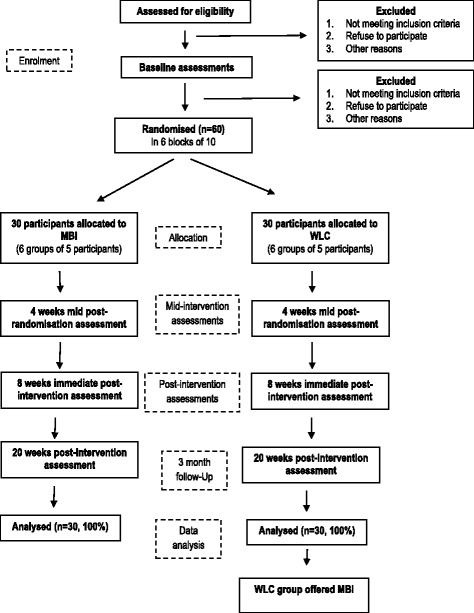
- The planned sample is 60 participants with PD, randomized 1:1 to 30 in the mindfulness-based intervention (MBI) and 30 in the wait-list control (WLC) group.
- The intervention is an 8-week program with 8 sessions, delivered via Skype in groups of five people, with 1-h weekly sessions and 20 min home mindfulness practice.
- Feasibility will be judged against a target recruitment rate of 10 participants per month and by retention, refusal, adherence, missing data, and questionnaire burden.
## Methods
- Pilot two-arm randomised parallel group controlled trial; participants with PD are assigned to MBI or WLC using computer-generated blocked randomisation with six blocks of 10.
- Participants must have PD (UK PD Brain Bank Criteria), internet/computer access, fluent English, and stable PD/psychiatric medication if applicable; exclusions include severe cognitive impairment (TICS-M < 20), serious psychiatric conditions, severe hearing impairment, current psychological therapy, or prior mindfulness practice.
- Outcomes are collected at baseline, 4, 8, and 20 weeks using standardized questionnaires; the analysis includes intention-to-treat quantitative comparisons, plus inductive thematic analysis of post-intervention interviews.
- Measures include anxiety/depression (HADS), pain (BPI), fatigue (FSS), insomnia (ISI), daily activities (PADLS), mechanisms such as acceptance/self-compassion/decentering/tolerance of uncertainty, and health economics measures.
## Limitations
- The paper states the sample will not be large enough to account for the heterogeneity in non-motor challenges in PD, so subgroup comparisons by different non-motor challenges will not be possible.
- The authors note the wait-list control group can induce nocebo effects, potentially inflating the apparent effectiveness of the intervention.
- The authors state the total HADS score may not be the most appropriate tool to detect caseness of depression and anxiety, though it was chosen for other reasons.
- Evident from the protocol: this is a pilot protocol without results, so effectiveness, acceptability, and cost-effectiveness are only planned to be explored, not yet demonstrated.
Model-written summary. Check it against the paper before relying on it.
Integrity signals
Registry
Cites
Statistics
Figures
Verification
Claims the paper makes
12 Valid · 5 Not valid · 34 Not checked · 35 Own results and interpretations
The cited sources support only part of this claim — read each source’s verdict below.
In the paper
“there is growing evidence for the effectiveness of mindfulness courses for people with long-term medical conditions.”
§ Distant delivery of a mindfulness-based intervention for people with Parkinson’s disease: the study protocol of a randomised pilot trial > Abstract > Background
What the sources say
- Not checked — no full text of the sourcecites [14] Grossman P Mindfulness-based stress reduction and health benefits. A meta-analysis J Psychosom Res 2004 57 1 35 43 10.1016/S0022-3999(03)00573-7 15256293 source
- Not checked — no full text of the sourcecites [20] Ljotsson B Long-term follow-up of internet-delivered exposure and mindfulness based treatment for irritable bowel syndrome Behav Res Ther 2011 49 1 58 61 10.1016/j.brat.2010.10.006 21092934 source
- Partly supportedcites [21] Hawkes AL CanPrevent: a telephone-delivered intervention to reduce multiple behavioural risk factors for colorectal cancer BMC Cancer 2012 12 1 560 10.1186/1471-2407-12-560 23181756 PMC3529678 sourceExperimental — accuracy not yet measured
The Background (page unavailable) says that Acceptance and Commitment Therapy (ACT), which uses mindfulness strategies, has been used successfully for several health conditions. It does not establish the effectiveness of mindfulness courses specifically; the Methods > Intervention section describes telephone health coaching using ACT strategies, not a mindfulness course. (LLM, conf=0.84)
- Not checked — no full text of the sourcecites [22] Thompson NJ Distance delivery of mindfulness-based cognitive therapy for depression: project UPLIFT Epilepsy Behav 2010 19 3 247 54 10.1016/j.yebeh.2010.07.031 20851055 source
- Not checked — no full text of the sourcecites [23] Browne RH On the use of a pilot sample for sample size determination Stat Med 1995 14 17 1933 1940 10.1002/sim.4780141709 8532986 source
plainstates a cause- Asserted: passes — The authors put it forward as true.
- Checkable: passes — It can be checked against evidence.
- Load-bearing: passes — The paper’s conclusions depend on it.
- Based: passes — The paper gives a reason why it holds.
The cited sources support only part of this claim — read each source’s verdict below.
In the paper
“Pharmacological treatments for these conditions appear relatively ineffective in Parkinson’s disease.”
- Also stated in: § Background · plain
“However, people with PD benefit less from antidepressant treatment than do patients without PD [5].”
§ Distant delivery of a mindfulness-based intervention for people with Parkinson’s disease: the study protocol of a randomised pilot trial > Abstract > Background
What the sources say
- Partly supportedcites [5] Weintraub D Antidepressant studies in Parkinson’s disease: a review and meta-analysis Mov Disord 2005 20 9 1161 9 10.1002/mds.20555 15954137 PMC1989731 sourceExperimental — accuracy not yet measured
The Discussion (page not available in our copy) reports a large improvement with antidepressants for depression in Parkinson’s disease, but no advantage over placebo, supporting the claim only in the sense of limited medication-specific benefit. The paper does not assess pharmacological treatment for anxiety, so that part of the claim is unsupported. (LLM, conf=0.88)
- Not matchedcites [6] Frisina PG Depression in Parkinson’s disease: health risks, etiology, and treatment options Neuropsychiatr Dis Treat 2008 4 1 81 91 18728814 PMC2515908
Its entry has no title and year that we can search by.
- Not checked — no full text of the sourcecites [8] Weintraub D Atomoxetine for depression and other neuropsychiatric symptoms in Parkinson disease Neurology 2010 75 5 448 55 10.1212/WNL.0b013e3181ebdd79 20679638 PMC2918470 source
plain- Asserted: passes — The authors put it forward as true.
- Checkable: passes — It can be checked against evidence.
- Load-bearing: passes — The paper’s conclusions depend on it.
- Based: passes — The paper gives a reason why it holds.
- Also stated in: § Background · plain
The cited sources support only part of this claim — read each source’s verdict below.
In the paper
“In fact, shortened class time has been used successfully before, for example in people with multiple sclerosis [23], multiple sclerosis and peripheral neuropathy [28], and PD [17].”
§ Distant delivery of a mindfulness-based intervention for people with Parkinson’s disease: the study protocol of a randomised pilot trial > Methods/Design > Mindfulness-based intervention for PD
What the sources say
- Not checked — no full text of the sourcecites [23] Browne RH On the use of a pilot sample for sample size determination Stat Med 1995 14 17 1933 1940 10.1002/sim.4780141709 8532986 source
- Partly supportedcites [28] Tavee J Effects of meditation on pain and quality of life in multiple sclerosis and peripheral neuropathy: a pilot study Int J MS Care 2011 13 4 163 8 10.7224/1537-2073-13.4.163 24453721 PMC3882962 sourceExperimental — accuracy not yet measured
The Methods describe weekly 90-minute meditation classes for participants with multiple sclerosis and peripheral neuropathy, and the Results report improvements in several pain and quality-of-life measures. The paper does not describe the classes as shortened or compare their duration with a longer standard; it also reports a four-hour introductory session. (LLM, conf=0.82)
- Not checked — no full text of the sourcecites [17] Cash TV, et al. Pilot study of a mindfulness-based group intervention for individuals with Parkinson’s disease and their caregivers. Mindfulness. 2016;7(2):361–71. source
plainstates a cause- Asserted: passes — The authors put it forward as true.
- Checkable: passes — It can be checked against evidence.
- Load-bearing: passes — The paper’s conclusions depend on it.
- Based: passes — The paper gives a reason why it holds.
The cited sources support only part of this claim — read each source’s verdict below.
In the paper
“Further, there is evidence that distance-delivered mindfulness interventions can also be effective in people with chronic medical conditions [20–23].”
§ Distant delivery of a mindfulness-based intervention for people with Parkinson’s disease: the study protocol of a randomised pilot trial > Background
What the sources say
- Not checked — no full text of the sourcecites [20] Ljotsson B Long-term follow-up of internet-delivered exposure and mindfulness based treatment for irritable bowel syndrome Behav Res Ther 2011 49 1 58 61 10.1016/j.brat.2010.10.006 21092934 source
- Partly supportedcites [21] Hawkes AL CanPrevent: a telephone-delivered intervention to reduce multiple behavioural risk factors for colorectal cancer BMC Cancer 2012 12 1 560 10.1186/1471-2407-12-560 23181756 PMC3529678 sourceExperimental — accuracy not yet measured
The Methods > Intervention section describes telephone-delivered coaching using ACT strategies that include mindfulness, and the Discussion reports short-term improvements. But the participants were first-degree relatives of colorectal cancer survivors, not people selected for a chronic medical condition; the study also lacked a control group. The Background discusses ACT in chronic conditions, but does not establish that those interventions were distance-delivered. (LLM, conf=0.87)
- Not checked — no full text of the sourcecites [22] Thompson NJ Distance delivery of mindfulness-based cognitive therapy for depression: project UPLIFT Epilepsy Behav 2010 19 3 247 54 10.1016/j.yebeh.2010.07.031 20851055 source
- Not checked — no full text of the sourcecites [23] Browne RH On the use of a pilot sample for sample size determination Stat Med 1995 14 17 1933 1940 10.1002/sim.4780141709 8532986 source
plainstates a cause- Asserted: passes — The authors put it forward as true.
- Checkable: passes — It can be checked against evidence.
- Load-bearing: passes — The paper’s conclusions depend on it.
- Based: passes — The paper gives a reason why it holds.
Every source the paper cites for this claim was checked and supports it.
In the paper
“The non-motor symptoms of Parkinson’s disease (PD) can be as disabling for an individual as their motor symptoms, if not more so [1].”
§ Distant delivery of a mindfulness-based intervention for people with Parkinson’s disease: the study protocol of a randomised pilot trial > Background
What the sources say
- Supportedcites [1] Hinnell C Nonmotor versus motor symptoms: how much do they matter to health status in Parkinson’s disease? Mov Disord 2012 27 2 236 241 10.1002/mds.23961 21954027 source
The Abstract (p. 3) reports that depression, a non-motor symptom, had more than twice the impact of motor signs on health status in Parkinson’s disease. The Discussion (p. 12) reiterates that finding and says anxiety and other non-motor symptoms also influence health status. This supports the citing sentence’s qualified claim, though the paper measures health status rather than disability directly. (LLM, conf=0.90)
plain- Asserted: passes — The authors put it forward as true.
- Checkable: passes — It can be checked against evidence.
- Load-bearing: passes — The paper’s conclusions depend on it.
- Based: passes — The paper gives a reason why it holds.
- Supported
27 more claims · 5 with their cited sources checked
Create a free account to see all 86 claims and to verify the 4 references still open.
- It may state two separate claims as one. 22
- Probably not a substantial claim. 44
Citations
Cites
Using thematic analysis in psychology
Braun, V., & Clarke, V. (2006) · Qualitative Research in Psychology · doi:10.1191/1478088706qp063oa · Cited by 194,414
The Hospital Anxiety and Depression Scale
Zigmond, A. S., & Snaith, R. P. (1983) · Acta Psychiatrica Scandinavica · doi:10.1111/j.1600-0447.1983.tb09716.x · Cited by 47,139
The Discovery of Grounded Theory: Strategies for Qualitative Research.
Wagner, H. R., Glaser, B. G., & Strauss, A. L. (1968) · Social Forces · doi:10.2307/2575405 · Cited by 46,361
The Discovery of Grounded Theory; Strategies for Qualitative Research
Glaser, B. G., Strauss, A. L., & Strutzel, E. (1968) · Nursing Research · doi:10.1097/00006199-196807000-00014 · Cited by 39,449
The Discovery of Grounded Theory: Strategies for Qualitative Research
Glaser, B. G., & Strauss, A. L. (2017) · Aldine (Routledge reprint) · doi:10.4324/9780203793206 · Cited by 25,789
(1990) · Cited by 24,217
Qualitative evaluation and research methods
Ellis, D. (1990) · International Journal of Information Management · doi:10.1016/0268-4012(90)90041-p · Cited by 17,943
EuroQol: a new facility for the measurement of health-related quality of life
(1990) · Health Policy · doi:10.1016/0168-8510(90)90421-9 · Cited by 15,736
Depression and quality of life in older persons: A review
Sivertsen, H., Bjørkløf, G. H., Engedal, K., Selbæk, G., & Helvik, A.-S. (2015) · Dementia and Geriatric Cognitive Disorders · doi:10.1159/000437299 · Cited by 14,152
Validation of the Insomnia Severity Index as an outcome measure for insomnia research
Bastien, C. (2001) · Sleep Medicine · doi:10.1016/s1389-9457(00)00065-4 · Cited by 8,067
Acceptance and commitment therapy: model, processes and outcomes
Hayes, S. C., Luoma, J. B., Bond, F. W., Masuda, A., & Lillis, J. (2006) · Behaviour Research and Therapy · doi:10.1016/j.brat.2005.06.006 · Cited by 6,587
Krupp, L. B. (1989) · Archives of Neurology · doi:10.1001/archneur.1989.00520460115022 · Cited by 6,172
EuroQol: the current state of play
Brooks, R. (1996) · Health Policy · doi:10.1016/0168-8510(96)00822-6 · Cited by 5,815
Qualitative data analysis for applied policy research
(2002) · Analyzing Qualitative Data · doi:10.4324/9780203413081-14 · Cited by 4,964
Qualitative data analysis for applied policy research
Ritchie, J., & Spencer, L. (2010) · Analyzing qualitative data · doi:10.4324/9780203413081_chapter_9 · Cited by 4,800
Mindfulness-based stress reduction and health benefits
Grossman, P., Niemann, L., Schmidt, S., & Walach, H. (2004) · Journal of Psychosomatic Research · doi:10.1016/s0022-3999(03)00573-7 · Cited by 3,958
Bond, F. W., Hayes, S. C., Baer, R. A., Carpenter, K. M., Guenole, N., Orcutt, H. K., Waltz, T., & Zettle, R. D. (2011) · Behavior Therapy · doi:10.1016/j.beth.2011.03.007 · Cited by 3,950
(2001) · Cited by 3,666
The relevance of the Lewy body to the pathogenesis of idiopathic Parkinson's disease.
Gibb, W. R., & Lees, A. J. (1988) · Journal of Neurology, Neurosurgery & Psychiatry · doi:10.1136/jnnp.51.6.745 · Cited by 3,481 · cited 2×
“Be diagnosed with PD according to UK PD Brain Bank Criteria [25, 26] by a neurologist or geriatrician Have a computer and internet access at home”
MethodA tutorial on pilot studies: the what, why and how
Thabane, L., Ma, J., Chu, R., Cheng, J., Ismaila, A., Rios, L. P., Robson, R., Thabane, M., Giangregorio, L., & Goldsmith, C. H. (2010) · BMC Medical Research Methodology · doi:10.1186/1471-2288-10-1 · Cited by 3,384
Construction and factorial validation of a short form of the Self-Compassion Scale
Raes, F., Pommier, E., Neff, K. D., & Van Gucht, D. (2011) · Clinical Psychology & Psychotherapy · doi:10.1002/cpp.702 · Cited by 2,997
Herrmann, C. (1997) · Journal of Psychosomatic Research · doi:10.1016/s0022-3999(96)00216-4 · Cited by 2,885
Non-motor symptoms of Parkinson's disease: diagnosis and management
Chaudhuri, K. R., Healy, D. G., & Schapira, A. H. (2006) · The Lancet Neurology · doi:10.1016/s1474-4422(06)70373-8 · Cited by 2,807
Boutron, I., Moher, D., Altman, D. G., Schulz, K. F., Ravaud, P., & for the CONSORT Group* (2008) · Annals of Internal Medicine · doi:10.7326/0003-4819-148-4-200802190-00008 · Cited by 2,292
Fearing the unknown: A short version of the Intolerance of Uncertainty Scale
Carleton, R. N., Norton, M. A. P. J., & Asmundson, G. J. G. (2007) · Journal of Anxiety Disorders · doi:10.1016/j.janxdis.2006.03.014 · Cited by 2,288
Mindfulness-Based Cognitive Therapy for Depression: A New Approach to Preventing Relapse
HODO, D. W. (2002) · American Journal of Psychiatry · doi:10.1176/appi.ajp.159.7.1257 · Cited by 1,401
Mindfulness-based stress reduction and health benefits: A meta-analysis
Grossman, P., Niemann, L., Schmidt, S., & Walach, H. (2003) · Focus on Alternative and Complementary Therapies · doi:10.1111/j.2042-7166.2003.tb04008.x · Cited by 1,394 · cited 3×
“Mindfulness approaches are non-invasive and have been previously used successfully in chronic illness populations [14].”
BackgroundInfluentialHughes, A. J., Ben-Shlomo, Y., Daniel, S. E., & Lees, A. J. (1992) · Neurology · doi:10.1212/wnl.42.6.1142 · Cited by 1,313
Price, D. D., Bush, F. M., Long, S., & Harkins, S. W. (1994) · Pain · doi:10.1016/0304-3959(94)90097-3 · Cited by 1,174
On the use of a pilot sample for sample size determination
Browne, R. H. (1995) · Statistics in Medicine · doi:10.1002/sim.4780141709 · Cited by 1,007 · cited 14×
“Assessing time and resource problems, for example whether it is feasible for patients to answer all the questionnaires and the time taken to do so, the flow of participants entering the study, the use of equipment to set up Skype, and other resources needed 3.”
BackgroundInfluentialThe Assessment of Present-Moment Awareness and Acceptance: The Philadelphia Mindfulness Scale
Cardaciotto, L., Herbert, J. D., Forman, E. M., Moitra, E., & Farrow, V. (2008) · Assessment · doi:10.1177/1073191107311467 · Cited by 940
A validation study of the hospital anxiety and depression scale (HADS) in a Spanish population
Herrero, M. J., Blanch, J., Peri, J. M., De Pablo, J., Pintor, L., & Bulbena, A. (2003) · General Hospital Psychiatry · doi:10.1016/s0163-8343(03)00043-4 · Cited by 892
Fresco, D. M., Moore, M. T., van Dulmen, M. H. M., Segal, Z. V., Ma, S. H., Teasdale, J. D., & Williams, J. M. G. (2007) · Behavior Therapy · doi:10.1016/j.beth.2006.08.003 · Cited by 810
Development of a self-report measure of capability wellbeing for adults: the ICECAP-A
Al-Janabi, H., N Flynn, T., & Coast, J. (2012) · Quality of Life Research · doi:10.1007/s11136-011-9927-2 · Cited by 666
Carmody, J., & Baer, R. A. (2009) · Journal of Clinical Psychology · doi:10.1002/jclp.20555 · Cited by 568
Furukawa, T. A., Noma, H., Caldwell, D. M., Honyashiki, M., Shinohara, K., Imai, H., Chen, P., Hunot, V., & Churchill, R. (2014) · Acta Psychiatrica Scandinavica · doi:10.1111/acps.12275 · Cited by 521
The role of self-compassion in development: a healthier way to relate to oneself
Neff, K. D. (2009) · Human Development · doi:10.1159/000215071 · Cited by 419
Hospital Anxiety and Depression Scale (HADS): validation in a Greek general hospital sample
Michopoulos, I., Douzenis, A., Kalkavoura, C., Christodoulou, C., Michalopoulou, P., Kalemi, G., Fineti, K., Patapis, P., Protopapas, K., & Lykouras, L. (2008) · Annals of General Psychiatry · doi:10.1186/1744-859x-7-4 · Cited by 389
Construct validation of the hospital anxiety and depression scale with clinical populations
Johnston, M., Pollard, B., & Hennessey, P. (2000) · Journal of Psychosomatic Research · doi:10.1016/s0022-3999(00)00102-1 · Cited by 383
Cognitive-Behavioral Therapy for Depression in Parkinson's Disease: A Randomized, Controlled Trial
Dobkin, R. D., Menza, M., Allen, L. A., Gara, M. A., Mark, M. H., Tiu, J., Bienfait, K. L., & Friedman, J. (2011) · American Journal of Psychiatry · doi:10.1176/appi.ajp.2011.10111669 · Cited by 310
Measuring subjective well-being for public policy
Dolan, P. J., Layard, R., & Metcalfe, R. (2011) · London School of Economics and Political Science Research Online (London School of Economics and Political Science) · Cited by 304
Delara, M., Ghofranipour, F., Azadfallah, P., Tavafian, S. S., Kazemnejad, A., & Montazeri, A. (2012) · Health and Quality of Life Outcomes · doi:10.1186/1477-7525-10-1 · Cited by 304
Atomoxetine for depression and other neuropsychiatric symptoms in Parkinson disease
Weintraub, D., Mavandadi, S., Mamikonyan, E., Siderowf, A. D., Duda, J. E., Hurtig, H. I., Colcher, A., Horn, S. S., Nazem, S., Ten Have, T. R., et al. (2010) · Neurology · doi:10.1212/wnl.0b013e3181ebdd79 · Cited by 255 · cited 1×
“Atomoxetine, an effective drug treatment for anxiety in non-PD patients, was not found to be efficacious for anxiety in PD [8].”
BackgroundBurn, D. J. (2002) · Movement Disorders · doi:10.1002/mds.10114 · Cited by 223 · cited 1×
“Depending on the criteria used, depression affects up to 50% of people affected by PD [3] and up to 31% of people with PD report some level of anxiety [4].”
Antidepressant studies in Parkinson's disease: A review and meta‐analysis
Weintraub, D., Morales, K. H., Moberg, P. J., Bilker, W. B., Balderston, C., Duda, J. E., Katz, I. R., & Stern, M. B. (2005) · Movement Disorders · doi:10.1002/mds.20555 · Cited by 191 · cited 1×
“However, people with PD benefit less from antidepressant treatment than do patients without PD [5].”
BackgroundDistance delivery of mindfulness-based cognitive therapy for depression: Project UPLIFT
Thompson, N. J., Walker, E. R., Obolensky, N., Winning, A., Barmon, C., DiIorio, C., & Compton, M. T. (2010) · Epilepsy & Behavior · doi:10.1016/j.yebeh.2010.07.031 · Cited by 185
Depression and anxiety related subtypes in Parkinson's disease
Brown, R. G., Landau, S., Hindle, J. V., Playfer, J., Samuel, M., Wilson, K. C., Hurt, C. S., Anderson, R. J., Carnell, J., Dickinson, L., et al. (2011) · Journal of Neurology, Neurosurgery & Psychiatry · doi:10.1136/jnnp.2010.213652 · Cited by 183 · cited 1×
“Depending on the criteria used, depression affects up to 50% of people affected by PD [3] and up to 31% of people with PD report some level of anxiety [4].”
Self-citationMindfulness based intervention in Parkinson's disease leads to structural brain changes on MRI
Pickut, B. A., Van Hecke, W., Kerckhofs, E., Mariën, P., Vanneste, S., Cras, P., & Parizel, P. M. (2013) · Clinical Neurology and Neurosurgery · doi:10.1016/j.clineuro.2013.10.002 · Cited by 174
Malley, J. N., Towers, A.-M., Netten, A. P., Brazier, J. E., Forder, J. E., & Flynn, T. (2012) · Health and Quality of Life Outcomes · doi:10.1186/1477-7525-10-21 · Cited by 152
Nonmotor versus motor symptoms: How much do they matter to health status in Parkinson's disease?
Hinnell, C., Hurt, C. S., Landau, S., Brown, R. G., Samuel, M., & on behalf of the PROMS‐PD Study Group (2012) · Movement Disorders · doi:10.1002/mds.23961 · Cited by 142
Self-citationA qualitative analysis of mindfulness‐based cognitive therapy (MBCT) in Parkinson's disease
Fitzpatrick, L., Simpson, J., & Smith, A. (2010) · Psychology and Psychotherapy: Theory, Research and Practice · doi:10.1348/147608309x471514 · Cited by 136 · cited 1×
“qualitative study evaluating the acceptability and feasibility of this approach in a group of patients with PD [18] has found that this form of intervention is well accepted by patients with PD.”
BackgroundDistress improves after mindfulness training for progressive MS: a pilot randomised trial
Bogosian, A., Chadwick, P., Windgassen, S., Norton, S., McCrone, P., Mosweu, I., Silber, E., & Moss-Morris, R. (2015) · Multiple Sclerosis Journal · doi:10.1177/1352458515576261 · Cited by 135
Self-citationHereditary Influences on Cognitive Functioning in Older Men: A Study of 4000 Twin Pairs
Brandt, J. (1993) · Archives of Neurology · doi:10.1001/archneur.1993.00540060039014 · Cited by 131 · cited 3×
“Telephone Interview for Cognitive Status Instrument modified version (TICS-M, [26]).”
MethodTurner, A., Hambridge, J., White, J., Carter, G., Clover, K., Nelson, L., & Hackett, M. (2012) · Stroke · doi:10.1161/strokeaha.111.643296 · Cited by 114
Ljótsson, B., Hedman, E., Lindfors, P., Hursti, T., Lindefors, N., Andersson, G., & Rück, C. (2011) · Behaviour Research and Therapy · doi:10.1016/j.brat.2010.10.006 · Cited by 113
Hobson, J. P., Edwards, N. I., & Meara, R. J. (2001) · Clinical Rehabilitation · doi:10.1191/026921501666767060 · Cited by 93
Cash, T. V., Ekouevi, V. S., Kilbourn, C., & Lageman, S. K. (2016) · Mindfulness · doi:10.1007/s12671-015-0452-1 · Cited by 86 · cited 3×
“In fact, shortened class time has been used successfully before, for example in people with multiple sclerosis [23], multiple sclerosis and peripheral neuropathy [28], and PD [17].”
BackgroundEffects of Meditation on Pain and Quality of Life in Multiple Sclerosis and Peripheral Neuropathy
Tavee, J., Rensel, M., Planchon, S. M., Butler, R. S., & Stone, L. (2011) · International Journal of MS Care · doi:10.7224/1537-2073-13.4.163 · Cited by 85
Depression in Parkinson’s disease: Health risks, etiology, and treatment options
Borod, J. (2008) · Neuropsychiatric Disease and Treatment · doi:10.2147/ndt.s1453 · Cited by 82 · cited 1×
“Also, there is a high risk of negative side effects and adverse interactions between antidepressants and antiparkinsonian medications [6].”
BackgroundMindfulness Training among Individuals with Parkinson’s Disease: Neurobehavioral Effects
Pickut, B., Vanneste, S., Hirsch, M. A., Van Hecke, W., Kerckhofs, E., Mariën, P., Parizel, P. M., Crosiers, D., & Cras, P. (2015) · Parkinson's Disease · doi:10.1155/2015/816404 · Cited by 80
Mindfulness for Motor and Nonmotor Dysfunctions in Parkinson’s Disease
Dissanayaka, N. N. W., Idu Jion, F., Pachana, N. A., O’Sullivan, J. D., Marsh, R., Byrne, G. J., & Harnett, P. (2016) · Parkinson's Disease · doi:10.1155/2016/7109052 · Cited by 79 · cited 1×
“reported motor symptoms [15, 16] and symptoms of depression [16, 17] and anxiety [16] for people with PD.”
BackgroundBogosian, A., Hughes, A., Norton, S., Silber, E., & Moss‐Morris, R. (2016) · British Journal of Health Psychology · doi:10.1111/bjhp.12201 · Cited by 75
Self-citationPoole, N. A., & Morgan, J. F. (2006) · General Hospital Psychiatry · doi:10.1016/j.genhosppsych.2005.08.004 · Cited by 72
Cole, K., & Vaughan, F. L. (2005) · Parkinsonism & Related Disorders · doi:10.1016/j.parkreldis.2005.03.002 · Cited by 49
Feeney, F., Egan, S., & Gasson, N. (2005) · Clinical Psychologist · doi:10.1080/13284200500048240 · Cited by 43
Hawkes, A. L., Patrao, T. A., Green, A., & Aitken, J. F. (2012) · BMC Cancer · doi:10.1186/1471-2407-12-560 · Cited by 27
Treatment of behavioural symptoms and dementia in Parkinson's disease
Hanagasi, H. A., & Emre, M. (2005) · Fundamental & Clinical Pharmacology · doi:10.1111/j.1472-8206.2005.00317.x · Cited by 24 · cited 1×
“Benzodiazepines, commonly used for anxiety disorder treatment, are not recommended for PD patients due to adverse effects including cognitive and psychomotor impairment [9].”
BackgroundDrug treatments for the neuropsychiatric complications of Parkinson’s disease
Connolly, B. S., & Fox, S. H. (2012) · Expert Review of Neurotherapeutics · doi:10.1586/ern.12.142 · Cited by 24 · cited 1×
“Anxiety is managed pharmacologically largely also by antidepressants [7].”
BackgroundPHQ-9: sensitivity to change over time
Cameron, I. M., Reid, I. C., & Lawton, K. (2010) · British Journal of General Practice · doi:10.3399/bjgp10x514909 · Cited by 11
Measuring Well-Being for Public Policy: Preferences or Experiences?
Dolan, P., & Peasgood, T. (2010) · Law and Happiness · doi:10.7208/chicago/9780226676029.003.0002
Research works printed but not linked: 1
- Kabat-Zinn J Full catastrophe living, revised edition: how to cope with stress, pain and illness using mindfulness meditation 2013 London Piatkus
Cited by
Zarotti, N., Eccles, F. J. R., Foley, J. A., Paget, A., Gunn, S., Leroi, I., & Simpson, J. (2021) · Psychology and Psychotherapy Theory Research and Practice · doi:10.1111/papt.12321 · Cited by 73
Bogosian, A., Hurt, C. S., Hindle, J. V., McCracken, L. M., Vasconcelos e Sa, D. A., Axell, S., Tapper, K., Stevens, J., Hirani, P. S., Salhab, M., et al. (2022) · Journal of Geriatric Psychiatry and Neurology · doi:10.1177/0891988720988901 · Cited by 55
“More details on the protocol of the study have previously been published.(28) All participants completed written informed consent.”
MethodSelf-citationFurther explorations of illness uncertainty: carers’ experiences of Parkinson’s disease
Hurt, C. S., Cleanthous, S., & Newman, S. P. (2017) · Psychology and Health · doi:10.1080/08870446.2017.1283041 · Cited by 40
Self-citationA Systematic Review of Psychotherapy Approaches for Anxiety in Parkinson's Disease.
Roper, A., Pacas Fronza, G., Dobkin, R. D., Beaudreau, S. A., Mitchell, L. K., Pachana, N. A., Thangavelu, K., & Dissanayaka, N. N. (2024) · Clinical Gerontologist · doi:10.1080/07317115.2022.2074814 · Cited by 19
“While excluded from the final synthesis, the search also identified 3 published protocols of controlled trials on psychotherapy approaches to be utilized in PD (Bogosian et al., 2017; Ghielen et al., 2015; Mulders et al., 2018).”
BackgroundBogosian, A., Rixon, L., & Hurt, C. S. (2020) · Research Involvement and Engagement · doi:10.1186/s40900-020-00212-7 · Cited by 15
Self-citation
Metadata
- Authors
- Bogosian, A., Hurt, C. S., Vasconcelos e Sa, D., Hindle, J. V., McCracken, L., & Cubi-Molla, P.
- Affiliations
- City, University of London (GB)
- Bangor University (GB)
- King's College London (GB)
- Corresponding author
- Bogosian, A.
- Venue
- Pilot and Feasibility Studies
- Published
- 2017-01-16
- Volume
- 3
- Issue
- 1
- Pages
- 4-4
- ISSN
- 2055-5784 (ISSN-L)
- PMC
- PMC5244573
- OpenAlex
- W2579371014
- Cited by
- 12
- References
- 71
- Citations by year
- 2024: 3 · 2023: 2 · 2022: 1 · 2021: 2 · 2020: 3 · 2017: 1
- FWCI
- 1.35
- Type
- journal article
- Language
- en
- Open access
- gold
- doi.org
- Licence
- cc-by
- Locations
- Pilot and Feasibility Studies (publishedVersion, cc-by)
- PubMed Central (publishedVersion, cc-by)
- PubMed (publishedVersion)
- Research Portal (King's College London) (publishedVersion, cc-by)
- City Research Online (City University London) (acceptedVersion)
- Funders
- Parkinson's UK (K-1409)
- Topics
- Social Sciences › Psychology › Clinical Psychology › Mindfulness and Compassion Interventions
- Health Sciences › Medicine › Clinical Neurology › Parkinson's Disease Mechanisms and Treatments
- Health Sciences › Medicine › Oncology › Cancer survivorship and care
- Keywords
- Parkinson's disease, mindfulness-based interventions, depression, anxiety, non-motor symptoms, feasibility, acceptability, cost-effectiveness, self-compassion, uncertainty tolerance, mechanisms of change, psychosocial adjustment, rural population, mobility limitations
About these checks
Registry, retraction, Cites and statistics results are computed, not judged, with one exception: a printed reference that no index lists is read once by a model before it counts as a citation error. Claims are extracted by a model and kept only when their quote appears verbatim in the text; each cited source is then checked, with a model’s help, for whether it says what the claim relies on. Those verdicts can be wrong — read the claim’s quote and the cited source before relying on one.
The claim verdicts this report counts are experimental: their accuracy is not yet measured.
A language model drew the claims from the paper on 2026-10-11, under version 3 of the claim definition (model deepseek-v4.1-flash, prompt extract-v3).
A second model labelled each claim on 2026-10-11 (model jev-1.13-20260917, definition revision gold-guideline-v0.2).
Cited sources are checked with a language model’s help (gpt-6-sol).
Statistics and arithmetic are recomputed, not judged.
Confidence bands are shown only for fields calibrated on our annotated test set. None is calibrated yet, so no band is shown.
What counts as a claim ›How we measure confidence ›How we check this ›
Are you an author, or do you see a problem with this page? Request a review
Data sources
Bibliographic data: Semantic Scholar, OpenAlex, Crossref.
Contains information from the Semantic Scholar Academic Graph Datasets, made available under the ODC Attribution License (ODC-BY 1.0).
Semantic Scholar’s data is described in: Kinney, R., et al. (2023). The Semantic Scholar Open Data Platform. arXiv:2301.10140.
