

Why Most Published Research Findings Are False
Open accessThe DOI matches its Crossref record; 40 of the 40 references it cites were found in a registry or an index.
Abstract
There is increasing concern that most current published research findings are false. The probability that a research claim is true may depend on study power and bias, the number of other studies on the same question, and, importantly, the ratio of true to no relationships among the relationships probed in each scientific field. In this framework, a research finding is less likely to be true when the studies conducted in a field are smaller; when effect sizes are smaller; when there is a greater number and lesser preselection of tested relationships; where there is greater flexibility in designs, definitions, outcomes, and analytical modes; when there is greater financial and other interest and prejudice; and when more teams are involved in a scientific field in chase of statistical significance. Simulations show that for most study designs and settings, it is more likely for a research claim to be false than true. Moreover, for many current scientific fields, claimed research findings may often be simply accurate measures of the prevailing bias. In this essay, I discuss the implications of these problems for the conduct and interpretation of research.
Overview
The claims and statistics of this paper haven’t been checked yet.
Free: it reads the open-access text and checks the first 5 claims that cite a source we can check. Create a free account to check every claim.
Integrity signals
Registry
Cites
Statistics
Figures
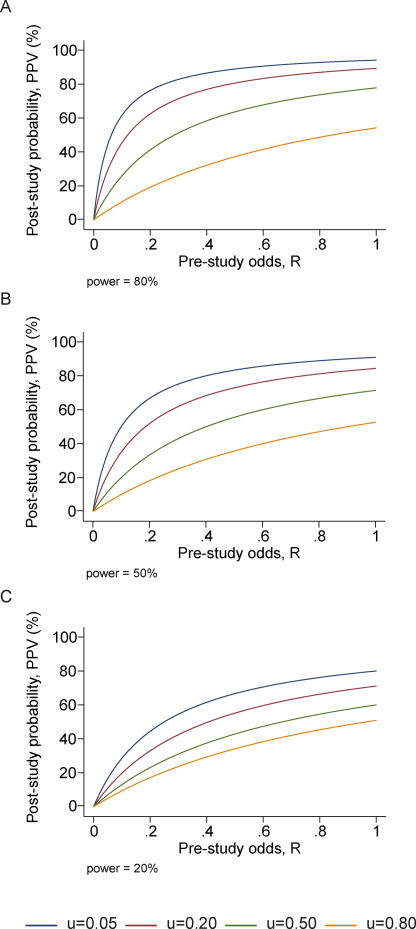
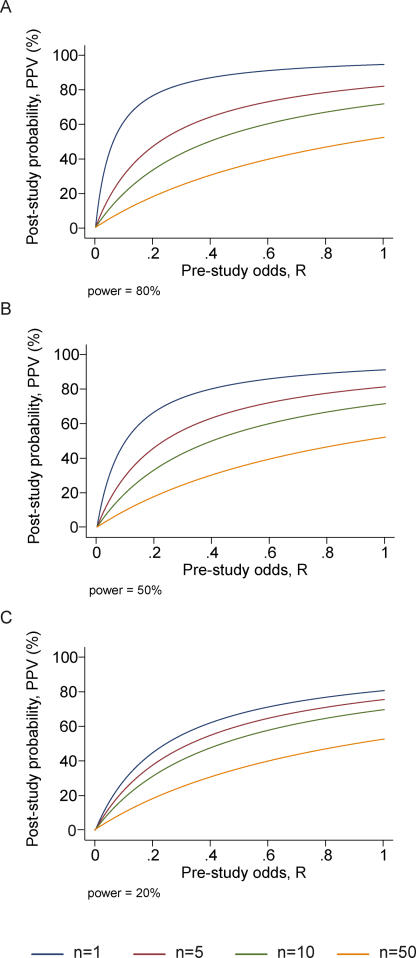
Verification
Claims the paper makes
The claims and statistics of this paper haven’t been checked yet.
Free: it reads the open-access text and checks the first 5 claims that cite a source we can check. Create a free account to check every claim.
Claims other papers make about this one
Each is checked against this paper’s own text: does it say what the citing paper says it does?
The source backs part of the claim, not all of it — or backs it for a different population, condition or comparison.
In the citing paper
“As noted, the pooled effect of risks and interventions trends towards the null result over time;189,190 the implication being that risks for which only a few studies have been done might have their effect overestimated compared with risks for which a large body of evidence exists.”
From A comparative risk assessment of burden of disease and injury attributable to 67 risk factors and risk factor clusters in 21 regions, 1990–2010: a systematic analysis for the Global Burden of Disease Study 2010 (2012) · cites this paper as [189]
Experimental — accuracy not yet measuredThe source backs part of the claim, not all of it — or backs it for a different population, condition or comparison.
In the citing paper
“Less clear, perhaps, is that low power can also increase the false discovery rate and the likelihood that reported effect sizes are inflated, due to their reduced ability to mute stochastic noise [13,63,64].”
From The natural selection of bad science (2016) · cites this paper as [13]
Experimental — accuracy not yet measuredThe source backs part of the claim, not all of it — or backs it for a different population, condition or comparison.
In the citing paper
“scholars have demonstrated that a large proportion of published articles contains flaws (Ioannidis 2005)”
From The ability of different peer review procedures to flag problematic publications (2019) · cites this paper as Ioannidis 2005
Experimental — accuracy not yet measuredThe source backs part of the claim, not all of it — or backs it for a different population, condition or comparison.
In the citing paper
“Furthermore, the publishing landscape in contemporary science rewards novel, positive findings over replications or negative results (Ioannidis 2005; Romero 2017).”
From The myth of the Bayesian brain (2025) · cites this paper as Ioannidis 2005
Experimental — accuracy not yet measuredThe source backs part of the claim, not all of it — or backs it for a different population, condition or comparison.
In the citing paper
“given the demonstrated association between small numbers and bias (Ioannidis 2005; Moore 2010; Nuesch 2009).”
From Psychological therapies for the management of chronic pain (excluding headache) in adults (2012) · cites this paper as Ioannidis 2005
Experimental — accuracy not yet measured
42 more claims about this paper
Create a free account to see every claim other papers make about this one.
Self-check
Percentages, sums and reported differences re-computed from the paper’s own numbers.
The self-check needs the paper’s full text.
Citations
Cites
Dermyshi, E., Wang, Y., Yan, C., Hong, W., Qiu, G., Gong, X., & Zhang, T. (2017) · Neonatology · doi:10.1159/000454668 · Cited by 24,451
Meta-analysis of Observational Studies in Epidemiology<SUBTITLE>A Proposal for Reporting</SUBTITLE>
Stroup, D. F. (2000) · JAMA · doi:10.1001/jama.283.15.2008 · Cited by 20,623
Golub, T. R., Slonim, D. K., Tamayo, P., Huard, C., Gaasenbeek, M., Mesirov, J. P., Coller, H., Loh, M. L., Downing, J. R., Caligiuri, M. A., et al. (1999) · Science · doi:10.1126/science.286.5439.531 · Cited by 11,516
Moher, D., Schulz, K. F., & Altman, D. G. (2001) · The Lancet · doi:10.1016/s0140-6736(00)04337-3 · Cited by 5,373
Moher, D., Cook, D. J., Eastwood, S., Olkin, I., Rennie, D., & Stroup, D. F. (1999) · The Lancet · doi:10.1016/s0140-6736(99)04149-5 · Cited by 4,826
Moher, D., Schulz, K. F., & Altman, D. G. (2001) · BMC Medical Research Methodology · doi:10.1186/1471-2288-1-2 · Cited by 2,755
Chan, A.-W., Hróbjartsson, A., Haahr, M. T., Gøtzsche, P. C., & Altman, D. G. (2004) · JAMA · doi:10.1001/jama.291.20.2457 · Cited by 1,845
Searching for genetic determinants in the new millennium
Risch, N. J. (2000) · Nature · doi:10.1038/35015718 · Cited by 1,839
Replication validity of genetic association studies
Ioannidis, J. P. A., Ntzani, E. E., Trikalinos, T. A., & Contopoulos-Ioannidis, D. G. (2001) · Nature Genetics · doi:10.1038/ng749 · Cited by 1,832
Self-citationWacholder, S., Chanock, S., Garcia-Closas, M., El ghormli, L., & Rothman, N. (2004) · JNCI: Journal of the National Cancer Institute · doi:10.1093/jnci/djh075 · Cited by 1,754
Cited by
Items 201–300 of 1,227
(2015) · OECD Science, Technology and Industry Policy Papers · doi:10.1787/5jrs2f963zs1-en · Cited by 419
Hakulinen, C., Elovainio, M., Pulkki-Råback, L., Virtanen, M., Kivimäki, M., & Jokela, M. (2015) · Depression and Anxiety · doi:10.1002/da.22376 · Cited by 418
Fairchild, G., Hawes, D. J., Frick, P. J., Copeland, W. E., Odgers, C. L., Franke, B., Freitag, C. M., & De Brito, S. A. (2019) · Nature Reviews Disease Primers · doi:10.1038/s41572-019-0095-y · Cited by 387
Heinrich, M., Jalil, B., Abdel-Tawab, M., Echeverria, J., Kulić, Ž., McGaw, L. J., Pezzuto, J. M., Potterat, O., & Wang, J.-B. (2022) · Frontiers in Pharmacology · doi:10.3389/fphar.2022.953205 · Cited by 393
A Genomic Pathway Approach to a Complex Disease: Axon Guidance and Parkinson Disease
Lesnick, T. G., Papapetropoulos, S., Mash, D. C., Ffrench-Mullen, J., Shehadeh, L., de Andrade, M., Henley, J. R., Rocca, W. A., Ahlskog, J. E., & Maraganore, D. M. (2007) · PLoS Genetics · doi:10.1371/journal.pgen.0030098 · Cited by 411
Performing high‐powered studies efficiently with sequential analyses
Lakens, D. (2014) · European Journal of Social Psychology · doi:10.1002/ejsp.2023 · Cited by 414
Does stereotype threat influence performance of girls in stereotyped domains? A meta-analysis
Flore, P. C., & Wicherts, J. M. (2015) · Journal of School Psychology · doi:10.1016/j.jsp.2014.10.002 · Cited by 410
Fraley, R. C., & Vazire, S. (2014) · PLoS ONE · doi:10.1371/journal.pone.0109019 · Cited by 409
The genetics of bipolar disorder
Barnett, J. H., & Smoller, J. W. (2009) · Neuroscience · doi:10.1016/j.neuroscience.2009.03.080 · Cited by 407
How Bayes factors change scientific practice
Dienes, Z. (2016) · Journal of Mathematical Psychology · doi:10.1016/j.jmp.2015.10.003 · Cited by 401
Yong, E. (2012) · Nature · doi:10.1038/485298a · Cited by 405
Anderson, S. F., Kelley, K., & Maxwell, S. E. (2017) · Psychological Science · doi:10.1177/0956797617723724 · Cited by 406
Epidemiology of endemic systemic fungal infections in Latin America
Colombo, A. L., Tobón, A., Restrepo, A., Queiroz-Telles, F., & Nucci, M. (2011) · Medical Mycology · doi:10.3109/13693786.2011.577821 · Cited by 400
Kühberger, A., Fritz, A., & Scherndl, T. (2014) · PLoS ONE · doi:10.1371/journal.pone.0105825 · Cited by 399
Contextual sensitivity in scientific reproducibility
Van Bavel, J. J., Mende-Siedlecki, P., Brady, W. J., & Reinero, D. A. (2016) · Proceedings of the National Academy of Sciences · doi:10.1073/pnas.1521897113 · Cited by 398
Statistical learning and selective inference
Taylor, J., & Tibshirani, R. J. (2015) · Proceedings of the National Academy of Sciences · doi:10.1073/pnas.1507583112 · Cited by 398
Swedberg, R. (2020) · The Production of Knowledge · doi:10.1017/9781108762519.002 · Cited by 293
Neuroimaging of the periaqueductal gray: State of the field
Linnman, C., Moulton, E. A., Barmettler, G., Becerra, L., & Borsook, D. (2012) · NeuroImage · doi:10.1016/j.neuroimage.2011.11.095 · Cited by 393
Universal school-based prevention programs for alcohol misuse in young people
Foxcroft, D. R., & Tsertsvadze, A. (2011) · Cochrane Database of Systematic Reviews · doi:10.1002/14651858.cd009113 · Cited by 389
A Systematic Review of Medical Costs Associated with Heart Failure in the USA (2014–2020)
Urbich, M., Globe, G., Pantiri, K., Heisen, M., Bennison, C., Wirtz, H. S., & Di Tanna, G. L. (2020) · PharmacoEconomics · doi:10.1007/s40273-020-00952-0 · Cited by 393
Investigating the replicability of preclinical cancer biology
Errington, T. M., Mathur, M., Soderberg, C. K., Denis, A., Perfito, N., Iorns, E., & Nosek, B. A. (2021) · eLife · doi:10.7554/elife.71601 · Cited by 462
Cuijpers, P., Smit, F., Bohlmeijer, E., Hollon, S. D., & Andersson, G. (2010) · British Journal of Psychiatry · doi:10.1192/bjp.bp.109.066001 · Cited by 391
Understanding GRADE: an introduction
Goldet, G., & Howick, J. (2013) · Journal of Evidence-Based Medicine · doi:10.1111/jebm.12018 · Cited by 391
Identification of and correction for publication bias
Andrews, I., & Kasy, M. (2019) · American Economic Review · doi:10.1257/aer.20180310 · Cited by 388
Model Selection Techniques: An Overview
Ding, J., Tarokh, V., & Yang, Y. (2018) · IEEE Signal Processing Magazine · doi:10.1109/msp.2018.2867638 · Cited by 383
Parameter tuning or default values? An empirical investigation in search-based software engineering
Arcuri, A., & Fraser, G. (2013) · Empirical Software Engineering · doi:10.1007/s10664-013-9249-9 · Cited by 384
Hydrogen Bonds: Simple after All?
Herschlag, D., & Pinney, M. M. (2018) · Biochemistry · doi:10.1021/acs.biochem.8b00217 · Cited by 382
Evolution of Reporting P Values in the Biomedical Literature, 1990-2015
Chavalarias, D., Wallach, J. D., Li, A. H. T., & Ioannidis, J. P. A. (2016) · JAMA · doi:10.1001/jama.2016.1952 · Cited by 370
Self-citationPublication bias: What are the challenges and can they be overcome?
Joober, R., Schmitz, N., Annable, L., & Boksa, P. (2012) · Journal of Psychiatry and Neuroscience · doi:10.1503/jpn.120065 · Cited by 382
Why rankings of biomedical image analysis competitions should be interpreted with care
Maier-Hein, L., Eisenmann, M., Reinke, A., Onogur, S., Stankovic, M., Scholz, P., Arbel, T., Bogunovic, H., Bradley, A. P., Carass, A., et al. (2018) · Nature Communications · doi:10.1038/s41467-018-07619-7 · Cited by 380
A Decade of Reversal: An Analysis of 146 Contradicted Medical Practices
Prasad, V., Vandross, A., Toomey, C., Cheung, M., Rho, J., Quinn, S., Chacko, S. J., Borkar, D., Gall, V., Selvaraj, S., et al. (2013) · Mayo Clinic Proceedings · doi:10.1016/j.mayocp.2013.05.012 · Cited by 381
The problem of pseudoreplication in neuroscientific studies: is it affecting your analysis?
Lazic, S. E. (2010) · BMC Neuroscience · doi:10.1186/1471-2202-11-5 · Cited by 381
On the Plurality of (Methodological) Worlds: Estimating the Analytic Flexibility of fMRI Experiments
Carp, J. (2012) · Frontiers in Neuroscience · doi:10.3389/fnins.2012.00149 · Cited by 381
Weingarten, E., Chen, Q., McAdams, M., Yi, J., Hepler, J., & Albarracín, D. (2016) · Psychological Bulletin · doi:10.1037/bul0000030 · Cited by 380
Say no to DMSO: dimethylsulfoxide inactivates cisplatin, carboplatin, and other platinum complexes
Hall, M. D., Telma, K. A., Chang, K.-E., Lee, T. D., Madigan, J. P., Lloyd, J. R., Goldlust, I. S., Hoeschele, J. D., & Gottesman, M. M. (2014) · Cancer Research · doi:10.1158/0008-5472.can-14-0247 · Cited by 377
Moshontz, H., Campbell, L., Ebersole, C. R., IJzerman, H., Urry, H. L., Forscher, P. S., Grahe, J. E., McCarthy, R. J., Musser, E. D., Antfolk, J., et al. (2018) · Advances in Methods and Practices in Psychological Science · doi:10.1177/2515245918797607 · Cited by 377
Statistical Inference as Severe Testing: How to Get Beyond the Statistics Wars
Mayo, D. G. (2018) · doi:10.1017/9781107286184 · Cited by 376
Multiple hypothesis testing in genomics
Goeman, J. J., & Solari, A. (2014) · Statistics in Medicine · doi:10.1002/sim.6082 · Cited by 375
Why the need for qPCR publication guidelines?—The case for MIQE
Bustin, S. A. (2010) · Methods · doi:10.1016/j.ymeth.2009.12.006 · Cited by 375
Zhang, L., Rana, I., Shaffer, R. M., Taioli, E., & Sheppard, L. (2019) · Mutation Research/Reviews in Mutation Research · doi:10.1016/j.mrrev.2019.02.001 · Cited by 374
Mirowski, P. (2018) · Social Studies of Science · doi:10.1177/0306312718772086 · Cited by 372
Integrating explanation and prediction in computational social science
Hofman, J. M., Watts, D. J., Athey, S., Garip, F., Griffiths, T. L., Kleinberg, J., Margetts, H., Mullainathan, S., Salganik, M. J., Vazire, S., et al. (2021) · Nature · doi:10.1038/s41586-021-03659-0 · Cited by 371
Howrigan, D. P., Simonson, M. A., & Keller, M. C. (2011) · BMC Genomics · doi:10.1186/1471-2164-12-460 · Cited by 371
“Evidence” in chronic pain–establishing best practice in the reporting of systematic reviews
Moore, A. R., Eccleston, C., Derry, S., Wiffen, P., Bell, R. F., Straube, S., & McQuay, H. (2010) · Pain · doi:10.1016/j.pain.2010.05.011 · Cited by 370
Blockchain technology for improving clinical research quality
Benchoufi, M., & Ravaud, P. (2017) · Trials · doi:10.1186/s13063-017-2035-z · Cited by 367
Scientific Utopia: I. Opening Scientific Communication
Nosek, B. A., & Bar-Anan, Y. (2012) · Psychological Inquiry · doi:10.1080/1047840x.2012.692215 · Cited by 368
Challenges to the Reproducibility of Machine Learning Models in Health Care
Beam, A. L., Manrai, A. K., & Ghassemi, M. (2020) · JAMA · doi:10.1001/jama.2019.20866 · Cited by 366
The Science of Visual Data Communication: What Works
Franconeri, S. L., Padilla, L. M., Shah, P., Zacks, J. M., & Hullman, J. (2021) · Psychological Science in the Public Interest · doi:10.1177/15291006211051956 · Cited by 360
Kyzas, P. A., Evangelou, E., Denaxa-Kyza, D., & Ioannidis, J. P. A. (2008) · JNCI: Journal of the National Cancer Institute · doi:10.1093/jnci/djn125 · Cited by 364
Self-citationKell, D. B. (2010) · Archives of Toxicology · doi:10.1007/s00204-010-0577-x · Cited by 361
Candidate Gene–Environment Interaction Research: Reflections and Recommendations
Dick, D. M., Agrawal, A., Keller, M. C., Adkins, A., Aliev, F., Monroe, S., Hewitt, J. K., Kendler, K. S., & Sher, K. J. (2015) · Perspectives on Psychological Science · doi:10.1177/1745691614556682 · Cited by 361
Kers, J. G., & Saccenti, E. (2022) · Frontiers in Microbiology · doi:10.3389/fmicb.2021.796025 · Cited by 359
The need to approximate the use-case in clinical machine learning
Saeb, S., Lonini, L., Jayaraman, A., Mohr, D. C., & Kording, K. P. (2017) · GigaScience · doi:10.1093/gigascience/gix019 · Cited by 367
On doing relevant and rigorous experiments: Review and recommendations
Lonati, S., Quiroga, B. F., Zehnder, C., & Antonakis, J. (2018) · Journal of Operations Management · doi:10.1016/j.jom.2018.10.003 · Cited by 354
Four reasons to prefer Bayesian analyses over significance testing
Dienes, Z., & Mclatchie, N. (2018) · Psychonomic Bulletin & Review · doi:10.3758/s13423-017-1266-z · Cited by 354
Ten ironic rules for non-statistical reviewers
Friston, K. (2012) · NeuroImage · doi:10.1016/j.neuroimage.2012.04.018 · Cited by 351
Madigan, S., Cyr, C., Eirich, R., Fearon, R. M. P., Ly, A., Rash, C., Poole, J. C., & Alink, L. R. A. (2019) · Development and Psychopathology · doi:10.1017/s0954579418001700 · Cited by 352
The relation between statistical power and inference in fMRI
Cremers, H. R., Wager, T. D., & Yarkoni, T. (2017) · PLOS ONE · doi:10.1371/journal.pone.0184923 · Cited by 349
Meta-analysis of emotion recognition deficits in major depressive disorder
Dalili, M. N., Penton-Voak, I. S., Harmer, C. J., & Munafò, M. R. (2015) · Psychological Medicine · doi:10.1017/s0033291714002591 · Cited by 349
Bench to Bedside: The Quest for Quality in Experimental Stroke Research
Dirnagl, U. (2006) · Journal of Cerebral Blood Flow & Metabolism · doi:10.1038/sj.jcbfm.9600298 · Cited by 349
Avoiding False Positive Conclusions in Molecular Simulation: The Importance of Replicas
Knapp, B., Ospina, L., & Deane, C. M. (2018) · Journal of Chemical Theory and Computation · doi:10.1021/acs.jctc.8b00391 · Cited by 344
50 Years of object recognition: Directions forward
Andreopoulos, A., & Tsotsos, J. K. (2013) · Computer Vision and Image Understanding · doi:10.1016/j.cviu.2013.04.005 · Cited by 347
On the scientific superiority of conceptual replications for scientific progress
Crandall, C. S., & Sherman, J. W. (2016) · Journal of Experimental Social Psychology · doi:10.1016/j.jesp.2015.10.002 · Cited by 344
Questionable research practices in ecology and evolution
Fraser, H., Parker, T., Nakagawa, S., Barnett, A., & Fidler, F. (2018) · PLOS ONE · doi:10.1371/journal.pone.0200303 · Cited by 346
Berger, M. L., Sox, H., Willke, R. J., Brixner, D. L., Eichler, H., Goettsch, W., Madigan, D., Makady, A., Schneeweiss, S., Tarricone, R., et al. (2017) · Pharmacoepidemiology and Drug Safety · doi:10.1002/pds.4297 · Cited by 344
Statistical and Methodological Considerations for the Interpretation of Intranasal Oxytocin Studies
Walum, H., Waldman, I. D., & Young, L. J. (2016) · Biological Psychiatry · doi:10.1016/j.biopsych.2015.06.016 · Cited by 347
False Discovery Rates in PET and CT Studies with Texture Features: A Systematic Review
Chalkidou, A., O’Doherty, M. J., & Marsden, P. K. (2015) · PLOS ONE · doi:10.1371/journal.pone.0124165 · Cited by 344
Digital medicine and the curse of dimensionality
Berisha, V., Krantsevich, C., Hahn, P. R., Hahn, S., Dasarathy, G., Turaga, P., & Liss, J. (2021) · npj Digital Medicine · doi:10.1038/s41746-021-00521-5 · Cited by 344
Most published research findings are false-but a little replication goes a long way.
Moonesinghe, R., Khoury, M. J., & Janssens, A. C. J. W. (2007) · PLoS Medicine · doi:10.1371/journal.pmed.0040028 · Cited by 341
Chen, X., Lu, B., & Yan, C. (2018) · Human Brain Mapping · doi:10.1002/hbm.23843 · Cited by 340
Measuring the effectiveness of scientific gatekeeping
Siler, K., Lee, K., & Bero, L. (2015) · Proceedings of the National Academy of Sciences · doi:10.1073/pnas.1418218112 · Cited by 333
Fair Statistical Communication in HCI
Dragicevic, P. (2016) · Human–Computer Interaction Series · doi:10.1007/978-3-319-26633-6_13 · Cited by 325
Frank, M. C., Bergelson, E., Bergmann, C., Cristia, A., Floccia, C., Gervain, J., Hamlin, J. K., Hannon, E. E., Kline, M., Levelt, C., et al. (2017) · Infancy · doi:10.1111/infa.12182 · Cited by 335
Sullivan, P. F. (2007) · Biological Psychiatry · doi:10.1016/j.biopsych.2006.11.010 · Cited by 335
Recommendations for Biomarker Identification and Qualification in Clinical Proteomics
Mischak, H., Allmaier, G., Apweiler, R., Attwood, T., Baumann, M., Benigni, A., Bennett, S. E., Bischoff, R., Bongcam-Rudloff, E., Capasso, G., et al. (2010) · Science Translational Medicine · doi:10.1126/scitranslmed.3001249 · Cited by 334
Self-citationMachine Translation: Mining Text for Social Theory
Evans, J. A., & Aceves, P. (2016) · Annual Review of Sociology · doi:10.1146/annurev-soc-081715-074206 · Cited by 333
Methods Matter: p-Hacking and Publication Bias in Causal Analysis in Economics
Brodeur, A., Cook, N., & Heyes, A. (2020) · American Economic Review · doi:10.1257/aer.20190687 · Cited by 333
Outcome Reporting Among Drug Trials Registered in ClinicalTrials.gov
Bourgeois, F. T., Murthy, S., & Mandl, K. D. (2010) · Annals of Internal Medicine · doi:10.7326/0003-4819-153-3-201008030-00006 · Cited by 332
The epidemiology of triple-negative breast cancer, including race
Trivers, K. F., Lund, M. J., Porter, P. L., Liff, J. M., Flagg, E. W., Coates, R. J., & Eley, J. W. (2009) · Cancer Causes & Control · doi:10.1007/s10552-009-9331-1 · Cited by 332
Using prediction markets to estimate the reproducibility of scientific research
Dreber, A., Pfeiffer, T., Almenberg, J., Isaksson, S., Wilson, B., Chen, Y., Nosek, B. A., & Johannesson, M. (2015) · Proceedings of the National Academy of Sciences · doi:10.1073/pnas.1516179112 · Cited by 331
A Guideline to Univariate Statistical Analysis for LC/MS-Based Untargeted Metabolomics-Derived Data
Vinaixa, M., Samino, S., Saez, I., Duran, J., Guinovart, J. J., & Yanes, O. (2012) · Metabolites · doi:10.3390/metabo2040775 · Cited by 329
FSH blockade improves cognition in mice with Alzheimer’s disease
Xiong, J., Kang, S. S., Wang, Z., Liu, X., Kuo, T.-C., Korkmaz, F., Padilla, A., Miyashita, S., Chan, P., Zhang, Z., et al. (2022) · Nature · doi:10.1038/s41586-022-04463-0 · Cited by 329
Bjordal, J. M., Johnson, M. I., Lopes-Martins, R. A., Bogen, B., Chow, R., & Ljunggren, A. E. (2007) · BMC Musculoskeletal Disorders · doi:10.1186/1471-2474-8-51 · Cited by 329
Rising, K., Bacchetti, P., & Bero, L. (2008) · PLoS Medicine · doi:10.1371/journal.pmed.0050217 · Cited by 328
A Bayesian Perspective on the Reproducibility Project: Psychology
Etz, A., & Vandekerckhove, J. (2016) · PLOS ONE · doi:10.1371/journal.pone.0149794 · Cited by 295
Illusions in regression analysis
Armstrong, J. S. (2012) · International Journal of Forecasting · doi:10.1016/j.ijforecast.2012.02.001 · Cited by 322
The slow death of the concept of schizophrenia and the painful birth of the psychosis spectrum
Guloksuz, S., & van Os, J. (2018) · Psychological Medicine · doi:10.1017/s0033291717001775 · Cited by 325
Some Theoretical Underpinnings of Knowledge Translation
Graham, I. D., Tetroe, J., & KT Theories Research Group (2007) · Academic Emergency Medicine · doi:10.1111/j.1553-2712.2007.tb02369.x · Cited by 323
The Taboo Against Explicit Causal Inference in Nonexperimental Psychology
Grosz, M. P., Rohrer, J. M., & Thoemmes, F. (2020) · Perspectives on Psychological Science · doi:10.1177/1745691620921521 · Cited by 322
Work-Related Psychosocial Factors and the Development of Ischemic Heart Disease: A Systematic Review
Eller, N. H., Netterstrøm, B., Gyntelberg, F., Kristensen, T. S., Nielsen, F., Steptoe, A., & Theorell, T. (2009) · Cardiology in Review · doi:10.1097/crd.0b013e318198c8e9 · Cited by 323
The False-positive to False-negative Ratio in Epidemiologic Studies
Ioannidis, J. P. A., Tarone, R., & McLaughlin, J. K. (2011) · Epidemiology · doi:10.1097/ede.0b013e31821b506e · Cited by 321
Self-citationPriming, Replication, and the Hardest Science
Cesario, J. (2014) · Perspectives on Psychological Science · doi:10.1177/1745691613513470 · Cited by 320
What’s in a p? Reassessing best practices for conducting and reporting hypothesis-testing research
Meyer, K. E., van Witteloostuijn, A., & Beugelsdijk, S. (2017) · Journal of International Business Studies · doi:10.1057/s41267-017-0078-8 · Cited by 318
Helbing, D. (2012) · Understanding Complex Systems · doi:10.1007/978-3-642-24004-1_2 · Cited by 298
Biomedical Applications of Recombinant Silk‐Based Materials
Aigner, T. B., DeSimone, E., & Scheibel, T. (2018) · Advanced Materials · doi:10.1002/adma.201704636 · Cited by 318
Carnivore conservation needs evidence-based livestock protection
van Eeden, L. M., Eklund, A., Miller, J. R. B., López-Bao, J. V., Chapron, G., Cejtin, M. R., Crowther, M. S., Dickman, C. R., Frank, J., Krofel, M., et al. (2018) · PLOS Biology · doi:10.1371/journal.pbio.2005577 · Cited by 316
Designing deep learning studies in cancer diagnostics
Kleppe, A., Skrede, O.-J., De Raedt, S., Liestøl, K., Kerr, D. J., & Danielsen, H. E. (2021) · Nature Reviews Cancer · doi:10.1038/s41568-020-00327-9 · Cited by 316
When and how can real world data analyses substitute for randomized controlled trials?
Franklin, J. M., & Schneeweiss, S. (2017) · Clinical Pharmacology & Therapeutics · doi:10.1002/cpt.857 · Cited by 316
BCPT policy for experimental and clinical studies
Tveden‐Nyborg, P., Bergmann, T. K., Jessen, N., Simonsen, U., & Lykkesfeldt, J. (2021) · Basic & Clinical Pharmacology & Toxicology · doi:10.1111/bcpt.13492 · Cited by 316
Implementing Reproducible Research
Stodden, V. (2014) · doi:10.1201/b16868 · Cited by 314
Metadata
- Authors
- Ioannidis, J. P. A.
- Affiliations
- University of Ioannina (GR)
- Corresponding author
- Ioannidis, John P. A.
- Venue
- PLoS Medicine
- Publisher
- Public Library of Science (PLoS)
- Published
- 2005-08-30
- Volume
- 2
- Issue
- 8
- Pages
- e124
- ISSN
- 1549-1277 (ISSN-L)
- 1549-1676
- PMC
- PMC1182327
- OpenAlex
- W2144981148
- Cited by
- 10,505
- References
- 40
- Citations by year
- 2026: 628 · 2025: 666 · 2024: 649 · 2023: 706 · 2022: 783 · 2021: 834 · 2020: 836 · 2019: 897 · 2018: 778 · 2017: 759 · 2016: 716 · 2015: 542 · 2014: 427 · 2013: 344 · 2012: 227
- FWCI
- 97.37
- Type
- journal article
- Language
- en
- Update notices
- correction (2022-08-25)
- Open access
- gold
- doi.org
- Locations
- PLoS Medicine (publishedVersion, cc-by)
- Europe PMC (PubMed Central) (publishedVersion, cc-by)
- PubMed Central (publishedVersion, cc-by)
- PubMed (publishedVersion)
- RePEc: Research Papers in Economics (submittedVersion, cc-by)
- DOAJ (DOAJ: Directory of Open Access Journals) (submittedVersion, cc-by-sa)
- Topics
- Social Sciences › Decision Sciences › Statistics, Probability and Uncertainty › Meta-analysis and systematic reviews
- Social Sciences › Library and Information Sciences › Academic Publishing and Open Access
- Social Sciences › Education › Academic integrity and plagiarism
- Keywords
- replication crisis, false positives, research credibility, statistical power, research bias, p-hacking, effect size, multiple comparisons, financial conflicts of interest, research misconduct, significance testing
- MeSH terms
- Data Interpretation, Statistical, Publishing, Research Design, Meta-Analysis as Topic, Reproducibility of Results, Bias, Likelihood Functions, Odds Ratio, Sample Size
About these checks
Registry, retraction, Cites and statistics results are computed, not judged, with one exception: a printed reference that no index lists is read once by a model before it counts as a citation error. Claims are extracted by a model and kept only when their quote appears verbatim in the text; each cited source is then checked, with a model’s help, for whether it says what the claim relies on. Those verdicts can be wrong — read the claim’s quote and the cited source before relying on one.
Statistics and arithmetic are recomputed, not judged.
Confidence bands are shown only for fields calibrated on our annotated test set. None is calibrated yet, so no band is shown.
What counts as a claim ›How we measure confidence ›How we check this ›
Are you an author, or do you see a problem with this page? Request a review
Data sources
Bibliographic data: Semantic Scholar, OpenAlex, Crossref.
Contains information from the Semantic Scholar Academic Graph Datasets, made available under the ODC Attribution License (ODC-BY 1.0).
Semantic Scholar’s data is described in: Kinney, R., et al. (2023). The Semantic Scholar Open Data Platform. arXiv:2301.10140.
