

The DOI matches its Crossref record; 67 of the 67 references it cites were found in a registry or an index; none of the 95 sources its claims cite is checked for support yet.
The Other in Me: Interpersonal Multisensory Stimulation Changes the Mental Representation of the Self
Open accessAbstract
BACKGROUND: Recent studies have shown that the well-known effect of multisensory stimulation on body-awareness can be extended to self-recognition. Seeing someone else's face being touched at the same time as one's own face elicits changes in the mental representation of the self-face. We sought to further elucidate the underlying mechanisms and the effects of interpersonal multisensory stimulation (IMS) on the mental representation of the self and others. METHODOLOGY/PRINCIPAL FINDINGS: Participants saw an unfamiliar face being touched synchronously or asynchronously with their own face, as if they were looking in the mirror. Following synchronous, but not asynchronous, IMS, participants assimilated features of the other's face in the mental representation of their own face as evidenced by the change in the point of subjective equality for morphed pictures of the two faces. Interestingly, synchronous IMS resulted in a unidirectional change in the self-other distinction, affecting recognition of one's own face, but not recognition of the other's face. The participants' autonomic responses to objects approaching the other's face were higher following synchronous than asynchronous IMS, but this increase was not specific to the pattern of IMS in interaction with the viewed object. Finally, synchronous, as compared to asynchronous, IMS resulted in significant differences in participants' ratings of their experience, but unlike other bodily illusions, positive changes in subjective experience were related to the perceived physical similarity between the two faces, and not to identification. CONCLUSIONS/SIGNIFICANCE: Synchronous IMS produces quantifiable changes in the mental representations of one's face, as measured behaviorally. Changes in autonomic responses and in the subjective experience of self-identification were broadly consistent with patterns observed in other bodily illusions, but less robust. Overall, shared multisensory experiences between self and other can change the mental representation of one's identity, and the perceived similarity of others relative to one's self.
Overview
AI snapshot
Written from the paper’s full text.
TL;DR
Synchronous interpersonal multisensory stimulation (IMS) between one’s own face and an unfamiliar other’s face produced a measurable, unidirectional shift in self-face recognition, with the other’s face assimilated into the mental representation of the self. Autonomic and subjective changes were broadly consistent with other bodily illusions but less robust.
Key findings
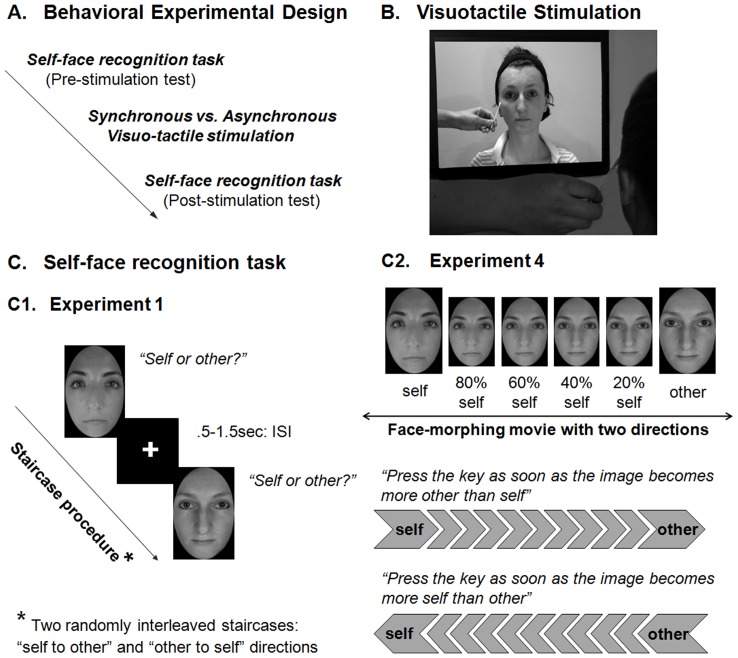
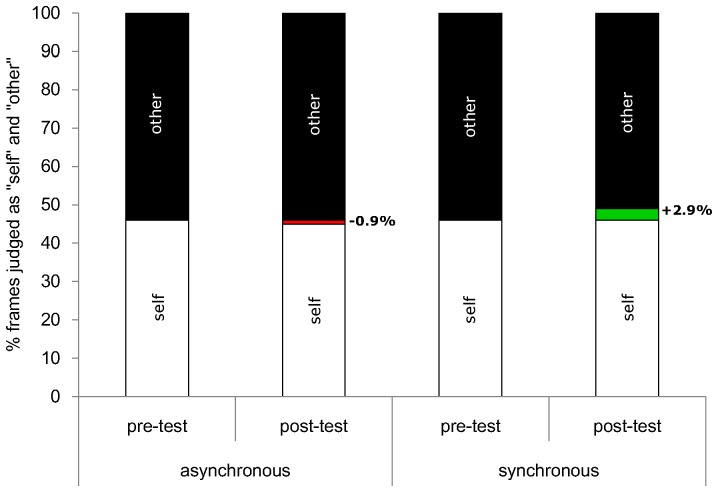
- In Experiment 1, synchronous IMS shifted the point of subjective equality toward the other’s face: mean PSE rose from 45.91±1.55 pre-test to 48.81±1.71 post-test, whereas asynchronous IMS changed from 46.22±1.43 to 45.36±1.67; the stimulation × timing interaction was significant, F(1,38)=4.38, p=.043, and the synchronous pre–post comparison was significant, t(38)=2.69, p=.011, corresponding to about a 3% shift.
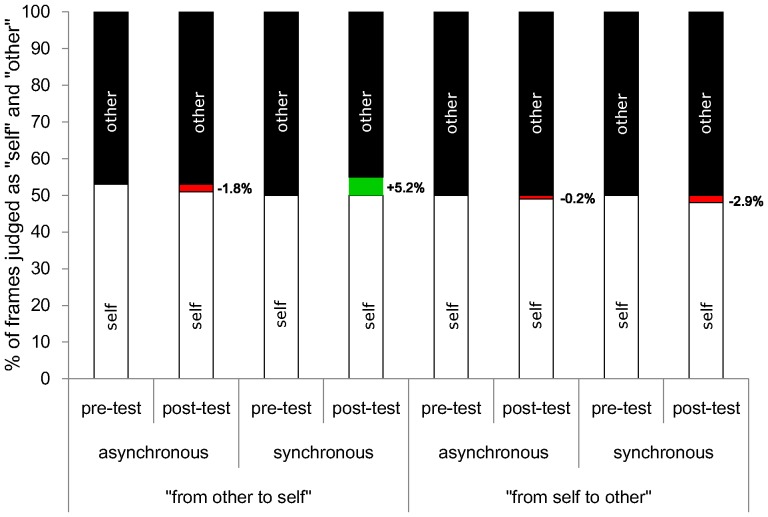
- Experiment 4 showed an asymmetric effect: for the “other to self” morph direction, synchronous IMS increased the percentage of other-face accepted as self from 50.1±3.25 to 55.33±3.0, while asynchronous changed from 52.83±3.31 to 51.0±3.24; the three-way interaction was significant, F(1,29)=4.3, p=.047, and the synchronous-vs-asynchronous difference was significant only for “other to self,” t(29)=2.18, p=.037, by approximately 5% morphing. The “self to other” direction did not reach significance, t(29)=.9, p=.375.
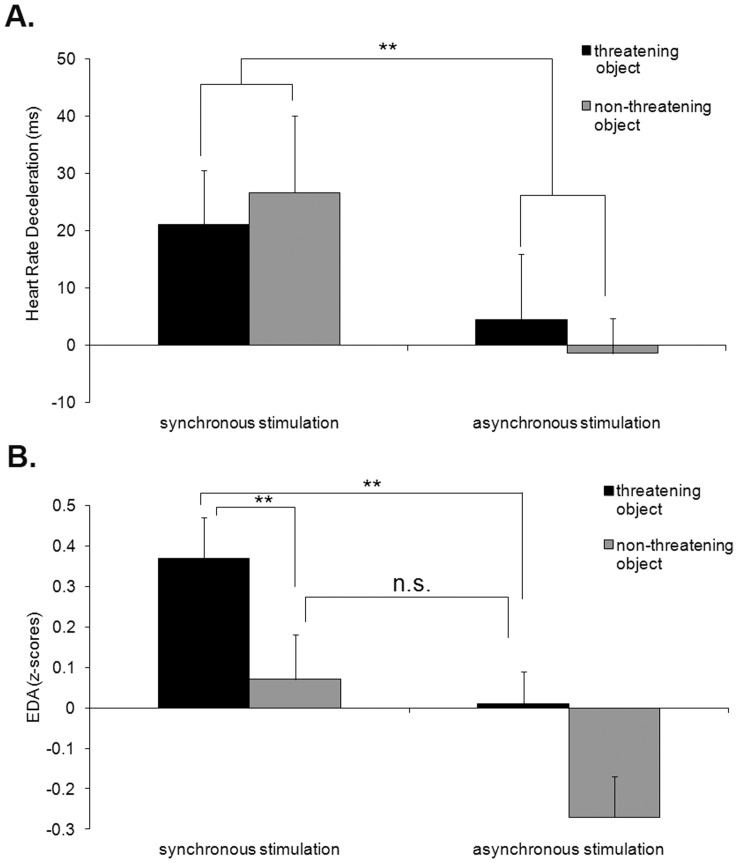
- In Experiment 2, synchronous IMS increased autonomic responses to objects approaching the other’s face: heart rate deceleration showed a significant main effect of stimulation, F(1,38)=4.5, p=.04; electrodermal activity showed significant main effects of object, F(1,38)=7.6, p=.009, and stimulation, F(1,38)=6.4, p=.016, but no significant interaction, p=.9. Planned comparisons found greater EDA for the threatening-object/synchronous condition than for threatening-object/asynchronous, t(38)=2.03, p=.049, and non-threatening-object/synchronous, t(38)=2.24, p=.031.
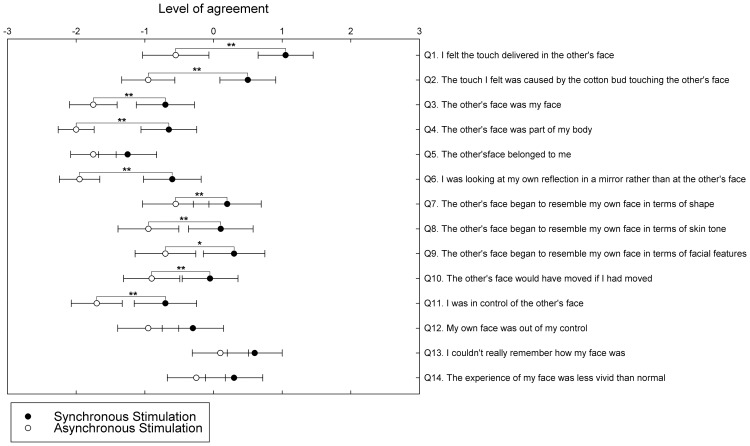
- In Experiment 3, synchronous versus asynchronous IMS produced significant differences in subjective ratings for touch referral (Q1, Q2), identification/ownership of the other’s face (Q3, Q4, Q6), perceived physical similarity between own and other face (Q7–Q9), and movement/control over the other’s face (Q10, Q11). However, ownership and identification items did not receive affirmative ratings; positive changes were related to perceived physical similarity, not identification.
Methods
- Four experiments used interpersonal multisensory stimulation: participants viewed an unfamiliar, gender-matched face being touched while their own face was touched at the specularly congruent location, either synchronously or asynchronously by 1 s. Experiment 1 (39 participants; 23 female; Mage±SD=24±6) used a staircase-based self-recognition task before and after IMS; Experiment 2 used the same group in a different session and measured electrodermal activity and heart rate while a knife or spoon approached the other’s face; Experiment 3 (20 participants; 17 female; Mage±SD=21±4) used a 14-item subjective questionnaire; Experiment 4 (30 participants; 15 female; Mage±SD=21±4) used face-morphing movies in “other to self” and “self to other” directions.
- Main analyses used within-subjects ANOVAs and planned paired t-tests, with alpha set at .05, 2-tailed unless otherwise specified. Experiment 3 used non-parametric Wilcoxon Signed Ranks tests because data did not pass normality testing.
Limitations
- The paper states that Experiment 2’s lack of a significant interaction cannot support the hypothesis that enfacement specifically modulated arousal to threatening stimuli, rather than a purely attentional modulation; it identifies the need for an additional control condition with synchronous IMS but without changes in face representation, and notes that the exact time-onset of the enfacement illusion remains unknown.
- The paper states that Experiment 1’s post-hoc directional pattern should be interpreted with caution because the two staircases were interleaved and the task was not designed to be sensitive to morphing direction.
- Evident from the text: sample sizes were modest and several experiments had predominantly female participants (Experiment 1: 23/39 female; Experiment 3: 17/20 female; Experiment 4: 15/30 female), which may limit generalizability, though the paper does not state this as a limitation.
Model-written summary. Check it against the paper before relying on it.
Integrity signals
Registry
Cites
Statistics
Figures
Verification
Claims the paper makes
68 Not checked yet · 53 Own result · 41 Own interpretation · 9 Own method · 1 No basis given
A result the paper reports from its own data — it cites no other source for it, so there is none to check. The quote shows it is in the paper.
In the paper
“Following synchronous, but not asynchronous, IMS, participants assimilated features of the other’s face in the mental representation of their own face as evidenced by the change in the point of subjective equality for morphed pictures of the two faces.”
- Also stated in: § Results and Discussion · plain
“Planned paired t-test comparisons between pre- and post-tests showed that following synchronous (t(38) = 2.69, p = .011), but not asynchronous (p = .5), visuo-tactile stimulation, the PSE for self-recognition judgments significantly shifted towards the other’s face”
§ The Other in Me: Interpersonal Multisensory Stimulation Changes the Mental Representation of the Self > Abstract > Methodology/Principal Findings
plaindirect- Asserted: passes — The authors put it forward as true.
- Checkable: passes — It can be checked against evidence.
- Load-bearing: passes — The paper’s conclusions depend on it.
- Based: passes — The paper gives a reason why it holds.
- Also stated in: § Results and Discussion · plain
A result the paper reports from its own data — it cites no other source for it, so there is none to check. The quote shows it is in the paper.
In the paper
“Q1. It seemed as if the knife/spoon was approaching my own face | −.18 (1.3) | −.99 (1.6) | 3.69** | .001”
§ The Other in Me: Interpersonal Multisensory Stimulation Changes the Mental Representation of the Self > Experiment 2 > Materials and Methods
plaindirect- Asserted: passes — The authors put it forward as true.
- Checkable: passes — It can be checked against evidence.
- Load-bearing: passes — The paper’s conclusions depend on it.
- Based: passes — The paper gives a reason why it holds.
- Rests on an assumption: The knife is a threatening stimulus and the spoon is a non-threatening stimulus.
A result the paper reports from its own data — it cites no other source for it, so there is none to check. The quote shows it is in the paper.
In the paper
“In other words, after synchronous stimulation pictures that contained a higher percentage of the other’s face (approximately 3%) were judged as self-images, as compared to the pre-test judgments.”
§ The Other in Me: Interpersonal Multisensory Stimulation Changes the Mental Representation of the Self > Experiment 1 > Results and Discussion
plaindirect- Asserted: passes — The authors put it forward as true.
- Checkable: passes — It can be checked against evidence.
- Load-bearing: passes — The paper’s conclusions depend on it.
- Based: passes — The paper gives a reason why it holds.
A result the paper reports from its own data — it cites no other source for it, so there is none to check. The quote shows it is in the paper.
In the paper
“The two-way interaction between visuo-tactile stimulation and timing of the test was significant (F(1, 38) = 4.38, p = .043), while the main effects failed to reach significance (all p>.2).”
§ The Other in Me: Interpersonal Multisensory Stimulation Changes the Mental Representation of the Self > Experiment 1 > Results and Discussion
plaincorrelational- Asserted: passes — The authors put it forward as true.
- Checkable: passes — It can be checked against evidence.
- Load-bearing: passes — The paper’s conclusions depend on it.
- Based: passes — The paper gives a reason why it holds.
The paper states this without a source or data behind it here, so there is nothing to check it against. The quote shows it is in the paper.
In the paper
“Therefore, on average participants accepted as self-stimulus a morphed picture that contained 55% of the other face.”
§ The Other in Me: Interpersonal Multisensory Stimulation Changes the Mental Representation of the Self > Experiment 4 > Results and Discussion
plain- Asserted: passes — The authors put it forward as true.
- Checkable: passes — It can be checked against evidence.
- Load-bearing: passes — The paper’s conclusions depend on it.
- Based: passes — The paper gives a reason why it holds.
A result the paper reports from its own data — it cites no other source for it, so there is none to check. The quote shows it is in the paper.
In the paper
“Differences from pre- to post-test in the percentage of frames judged as “more self than other” between synchronous and asynchronous stimulation conditions were significant only when participants judged the stimuli in the morphing direction “other to self” (t(29) = 2.18, p = .037, 2-tailed)”
§ The Other in Me: Interpersonal Multisensory Stimulation Changes the Mental Representation of the Self > Experiment 4 > Results and Discussion
plain- Asserted: passes — The authors put it forward as true.
- Checkable: passes — It can be checked against evidence.
- Load-bearing: passes — The paper’s conclusions depend on it.
- Based: passes — The paper gives a reason why it holds.
A result the paper reports from its own data — it cites no other source for it, so there is none to check. The quote shows it is in the paper.
In the paper
“Q2. It seemed as if the knife/spoon was touchingmy own face | −.59 (1.4) | −1.21 (1.4) | 3.12** | .003”
§ The Other in Me: Interpersonal Multisensory Stimulation Changes the Mental Representation of the Self > Experiment 2 > Materials and Methods
plaindirect- Asserted: passes — The authors put it forward as true.
- Checkable: passes — It can be checked against evidence.
- Load-bearing: passes — The paper’s conclusions depend on it.
- Based: passes — The paper gives a reason why it holds.
- Rests on an assumption: The knife is a threatening stimulus and the spoon is a non-threatening stimulus.
A result the paper reports from its own data — it cites no other source for it, so there is none to check. The quote shows it is in the paper.
In the paper
“In addition, no difference was found across the different duration, 40 s and 80 s, conditions (p = .48), therefore we averaged the data from those conditions.”
§ The Other in Me: Interpersonal Multisensory Stimulation Changes the Mental Representation of the Self > Experiment 2 > Results and Discussion
plain- Asserted: passes — The authors put it forward as true.
- Checkable: passes — It can be checked against evidence.
- Load-bearing: passes — The paper’s conclusions depend on it.
- Based: passes — The paper gives a reason why it holds.
A result the paper reports from its own data — it cites no other source for it, so there is none to check. The quote shows it is in the paper.
In the paper
“revealing that after synchronous, as compared to asynchronous, stimulation participants had a greater feeling that the object was approaching (Q1), touching (Q2) and causing pain on (Q3) their own face.”
§ The Other in Me: Interpersonal Multisensory Stimulation Changes the Mental Representation of the Self > Experiment 2 > Results and Discussion
plaindirect- Asserted: passes — The authors put it forward as true.
- Checkable: passes — It can be checked against evidence.
- Load-bearing: passes — The paper’s conclusions depend on it.
- Based: passes — The paper gives a reason why it holds.
A result the paper reports from its own data — it cites no other source for it, so there is none to check. The quote shows it is in the paper.
In the paper
“Q3. It felt as if I experienced pain on myface when the knife/spoon touched the face | −.78 (1.5) | −1.34 (1.4) | 2.86** | .007”
§ The Other in Me: Interpersonal Multisensory Stimulation Changes the Mental Representation of the Self > Experiment 2 > Materials and Methods
plaindirect- Asserted: passes — The authors put it forward as true.
- Checkable: passes — It can be checked against evidence.
- Load-bearing: passes — The paper’s conclusions depend on it.
- Based: passes — The paper gives a reason why it holds.
- Rests on an assumption: The knife is a threatening stimulus and the spoon is a non-threatening stimulus.
- It may state two separate claims as one. 54
- Probably not a substantial claim. 33
A result the paper reports from its own data — it cites no other source for it, so there is none to check. The quote shows it is in the paper.
In the paper
“Interestingly, synchronous IMS resulted in a unidirectional change in the self-other distinction, affecting recognition of one’s own face, but not recognition of the other’s face.”
§ The Other in Me: Interpersonal Multisensory Stimulation Changes the Mental Representation of the Self > Abstract > Methodology/Principal Findings
plaindirect- Asserted: passes — The authors put it forward as true.
- Checkable: passes — It can be checked against evidence.
- Load-bearing: passes — The paper’s conclusions depend on it.
- Based: passes — The paper gives a reason why it holds.
It may state two separate claims as one.
A result the paper reports from its own data — it cites no other source for it, so there is none to check. The quote shows it is in the paper.
In the paper
“The participants’ autonomic responses to objects approaching the other’s face were higher following synchronous than asynchronous IMS, but this increase was not specific to the pattern of IMS in interaction with the viewed object.”
§ The Other in Me: Interpersonal Multisensory Stimulation Changes the Mental Representation of the Self > Abstract > Methodology/Principal Findings
plaindirect- Asserted: passes — The authors put it forward as true.
- Checkable: passes — It can be checked against evidence.
- Load-bearing: unclear — It is unclear whether the paper’s conclusions depend on it.
- Based: passes — The paper gives a reason why it holds.
It may state two separate claims as one.
A result the paper reports from its own data — it cites no other source for it, so there is none to check. The quote shows it is in the paper.
In the paper
“Finally, synchronous, as compared to asynchronous, IMS resulted in significant differences in participants’ ratings of their experience, but unlike other bodily illusions, positive changes in subjective experience were related to the perceived physical similarity between the two faces, and not to identification.”
§ The Other in Me: Interpersonal Multisensory Stimulation Changes the Mental Representation of the Self > Abstract > Methodology/Principal Findings
plaincorrelational- Asserted: passes — The authors put it forward as true.
- Checkable: passes — It can be checked against evidence.
- Load-bearing: passes — The paper’s conclusions depend on it.
- Based: passes — The paper gives a reason why it holds.
It may state two separate claims as one.
A result the paper reports from its own data — it cites no other source for it, so there is none to check. The quote shows it is in the paper.
In the paper
“The mean PSE values ± SE were, for the synchronous condition 45.91±1.55 (pre-test) and 48.81±1.71 (post-test), and for the asynchronous condition 46.22±1.43 (pre-test) and 45.36±1.67 (post-test).”
§ The Other in Me: Interpersonal Multisensory Stimulation Changes the Mental Representation of the Self > Experiment 1 > Results and Discussion
plain- Asserted: passes — The authors put it forward as true.
- Checkable: passes — It can be checked against evidence.
- Load-bearing: passes — The paper’s conclusions depend on it.
- Based: passes — The paper gives a reason why it holds.
It may state two separate claims as one.
A result the paper reports from its own data — it cites no other source for it, so there is none to check. The quote shows it is in the paper.
In the paper
“certain items did not result in affirmative ratings (Q3–6, Q10–12), while other items resulted in low yet affirmative values (Q1, Q2, Q7–9) following synchronous IMS.”
§ The Other in Me: Interpersonal Multisensory Stimulation Changes the Mental Representation of the Self > Experiment 3 > Results and Discussion
plain- Asserted: passes — The authors put it forward as true.
- Checkable: passes — It can be checked against evidence.
- Load-bearing: unclear — It is unclear whether the paper’s conclusions depend on it.
- Based: passes — The paper gives a reason why it holds.
It may state two separate claims as one.
A result the paper reports from its own data — it cites no other source for it, so there is none to check. The quote shows it is in the paper.
In the paper
“Arousal | 5.40 (2.0) | 5.04 (2.0) | 1.36 | .18”
§ The Other in Me: Interpersonal Multisensory Stimulation Changes the Mental Representation of the Self > Experiment 2 > Materials and Methods
plain- Asserted: passes — The authors put it forward as true.
- Checkable: passes — It can be checked against evidence.
- Load-bearing: fails — The paper’s conclusions may not depend on it.
- Based: passes — The paper gives a reason why it holds.
Probably not a substantial claim. The paper’s conclusions may not depend on it.
- Rests on an assumption: The knife is a threatening stimulus and the spoon is a non-threatening stimulus.
None of the sources cited for this claim have been checked yet.
In the paper
“but it should be noted that in our study the mean value for the critical statement Q3 (“I felt as if the other’s face was my face”) is numerically higher than the ones reported in previous studies [33], [34].”
§ The Other in Me: Interpersonal Multisensory Stimulation Changes the Mental Representation of the Self > Experiment 4 > Changes in Subjective Experience
What the sources say
plain- Asserted: passes — The authors put it forward as true.
- Checkable: passes — It can be checked against evidence.
- Load-bearing: fails — The paper’s conclusions may not depend on it.
- Based: passes — The paper gives a reason why it holds.
Probably not a substantial claim. The paper’s conclusions may not depend on it.
A result the paper reports from its own data — it cites no other source for it, so there is none to check. The quote shows it is in the paper.
In the paper
“In relation to changes in the subjective experience (Experiment 3), we observed a significant difference between the synchronous and asynchronous IMS, in line with other bodily illusions, but unlike other bodily illusions, only few statements resulted in positive affirmative ratings.”
§ The Other in Me: Interpersonal Multisensory Stimulation Changes the Mental Representation of the Self > Experiment 4 > General Discussion
plaincorrelational- Asserted: passes — The authors put it forward as true.
- Checkable: passes — It can be checked against evidence.
- Load-bearing: passes — The paper’s conclusions depend on it.
- Based: passes — The paper gives a reason why it holds.
It may state two separate claims as one.
A result the paper reports from its own data — it cites no other source for it, so there is none to check. The quote shows it is in the paper.
In the paper
“Synchronous, as compared to asynchronous, IMS resulted in significant differences in participants’ ratings of their experience, but unlike other bodily illusions, the evidence for strong and positive changes in subjective experience was limited to a change in “touch referral” and the perceived physical similarity between the two faces.”
§ The Other in Me: Interpersonal Multisensory Stimulation Changes the Mental Representation of the Self > Experiment 4 > Changes in Subjective Experience
plaindirect- Asserted: passes — The authors put it forward as true.
- Checkable: passes — It can be checked against evidence.
- Load-bearing: passes — The paper’s conclusions depend on it.
- Based: passes — The paper gives a reason why it holds.
It may state two separate claims as one.
A result the paper reports from its own data — it cites no other source for it, so there is none to check. The quote shows it is in the paper.
In the paper
“In addition, while certain statements resulted in negative ratings following both synchronous and asynchronous IMS (Q3, Q4 and Q6), the ratings between the synchronous and asynchronous conditions were significantly different, suggesting that participants showed less negation following synchronous IMS for these statements”
§ The Other in Me: Interpersonal Multisensory Stimulation Changes the Mental Representation of the Self > Experiment 4 > Changes in Subjective Experience
hedgeddirect- Asserted: passes — The authors put it forward as true.
- Checkable: passes — It can be checked against evidence.
- Load-bearing: passes — The paper’s conclusions depend on it.
- Based: passes — The paper gives a reason why it holds.
It may state two separate claims as one.
A result the paper reports from its own data — it cites no other source for it, so there is none to check. The quote shows it is in the paper.
In the paper
“Following synchronous IMS, participants accepted statements referring to the source of tactile sensation (Q1, Q2) and the change in resemblance between the other’s face and their own face (Q7, Q8, Q9), while they denied the same statements following asynchronous IMS.”
§ The Other in Me: Interpersonal Multisensory Stimulation Changes the Mental Representation of the Self > Experiment 4 > Changes in Subjective Experience
plaindirect- Asserted: passes — The authors put it forward as true.
- Checkable: passes — It can be checked against evidence.
- Load-bearing: passes — The paper’s conclusions depend on it.
- Based: passes — The paper gives a reason why it holds.
It may state two separate claims as one.
None of the sources cited for this claim have been checked yet.
In the paper
“This asymmetric effect for the two directions of morphing could also be observed in Experiment 1, but was not found in previous studies where the other’s face was a familiar one [32], [33].”
§ The Other in Me: Interpersonal Multisensory Stimulation Changes the Mental Representation of the Self > Experiment 4 > Behavioral Changes in Self-recognition
What the sources say
hedged- Asserted: passes — The authors put it forward as true.
- Checkable: passes — It can be checked against evidence.
- Load-bearing: unclear — It is unclear whether the paper’s conclusions depend on it.
- Based: passes — The paper gives a reason why it holds.
It may state two separate claims as one.
A result the paper reports from its own data — it cites no other source for it, so there is none to check. The quote shows it is in the paper.
In the paper
“Synchronous IMS specifically affected recognition of the self-face, as statistically significant changes were observed only for the direction of morphing that presented a transition from other to self.”
§ The Other in Me: Interpersonal Multisensory Stimulation Changes the Mental Representation of the Self > Experiment 4 > Behavioral Changes in Self-recognition
plaindirect- Asserted: passes — The authors put it forward as true.
- Checkable: passes — It can be checked against evidence.
- Load-bearing: passes — The paper’s conclusions depend on it.
- Based: passes — The paper gives a reason why it holds.
It may state two separate claims as one.
A result the paper reports from its own data — it cites no other source for it, so there is none to check. The quote shows it is in the paper.
In the paper
“Consistent with this pattern, our results show that morphed instances of the other’s face are perceived as self-stimuli, whereas morphed instances of the self-face are not perceived as other-stimuli.”
§ The Other in Me: Interpersonal Multisensory Stimulation Changes the Mental Representation of the Self > Experiment 4 > Behavioral Changes in Self-recognition
plain- Asserted: passes — The authors put it forward as true.
- Checkable: passes — It can be checked against evidence.
- Load-bearing: passes — The paper’s conclusions depend on it.
- Based: passes — The paper gives a reason why it holds.
It may state two separate claims as one.
None of the sources cited for this claim have been checked yet.
In the paper
“The ability to recognize oneself in a mirror is taken as evidence of a basic form of self-awareness in non-human primates [1], [3] and human infants [4].”
§ The Other in Me: Interpersonal Multisensory Stimulation Changes the Mental Representation of the Self > Introduction
What the sources say
- Not checked yetcites [1] GGJ Gallup, 1970, Chimpanzees: Self-Recognition., Science source
- Not checked yetcites [3] FB de Waal, 2005, The monkey in the mirror: Hardly a stranger., Proceedings of the National Academy of Sciences of the United States of America source
- Not checked yetcites [4] BI Bertenthal, 1978, Development of self-recognition in the infant., Child Development
plaincorrelational- Asserted: passes — The authors put it forward as true.
- Checkable: passes — It can be checked against evidence.
- Load-bearing: fails — The paper’s conclusions may not depend on it.
- Based: passes — The paper gives a reason why it holds.
Probably not a substantial claim. The paper’s conclusions may not depend on it.
A conclusion the paper draws from its own results — it cites no other source for it, so there is none to check. The quote shows it is in the paper.
In the paper
“Changes in autonomic responses and in the subjective experience of self-identification were broadly consistent with patterns observed in other bodily illusions, but less robust.”
§ The Other in Me: Interpersonal Multisensory Stimulation Changes the Mental Representation of the Self > Abstract > Conclusions/Significance
plaincorrelational- Asserted: passes — The authors put it forward as true.
- Checkable: passes — It can be checked against evidence.
- Load-bearing: passes — The paper’s conclusions depend on it.
- Based: passes — The paper gives a reason why it holds.
It may state two separate claims as one.
In the paper
“For example, Uddin et al. [11] reported activations in the right inferior parietal lobule, inferior frontal gyrus and inferior occipital gyrus.”
§ The Other in Me: Interpersonal Multisensory Stimulation Changes the Mental Representation of the Self > Introduction
What the sources say
- Not checked yetcites [11] LQ Uddin, 2004, Self-face recognition activates a frontoparietal “mirror” network in the right hemisphere: an event-related fMRI study., NeuroImage
plaincorrelational- Asserted: passes — The authors put it forward as true.
- Checkable: passes — It can be checked against evidence.
- Load-bearing: fails — The paper’s conclusions may not depend on it.
- Based: passes — The paper gives a reason why it holds.
Probably not a substantial claim. The paper’s conclusions may not depend on it.
None of the sources cited for this claim have been checked yet.
In the paper
“This ability for self-face recognition is also claimed to be fundamental to the awareness of being a self among others like us [5], upon which more complex forms of self-identity are built, such as a diachronic sense of self [6], and the expression of social emotions (e.g., embarrassment, pride and guilt [7]).”
§ The Other in Me: Interpersonal Multisensory Stimulation Changes the Mental Representation of the Self > Introduction
What the sources say
- Not checked yetcites [5] D Zahavi, 2011, Faces and ascriptions: mapping measures of the self., Conscious & Cognition source
- Not checked yetcites [6] DJ Povinelli, 1998, Young children's understanding of briefly versus extremely delayed images of self: Emergence of the autobiographical stance., Developmental Psychology source
- Not checked yetcites [7] M Lewis, 2006, The emergence of consciousness and its role in human development., Annals of the New York Academy of Sciences source
hedgeddirect- Asserted: passes — The authors put it forward as true.
- Checkable: passes — It can be checked against evidence.
- Load-bearing: fails — The paper’s conclusions may not depend on it.
- Based: passes — The paper gives a reason why it holds.
Probably not a substantial claim. The paper’s conclusions may not depend on it. It may state two separate claims as one.
In the paper
“Accumulating evidence favors a right hemispheric specificity in frontoparietal areas responsible for self-face recognition [8].”
§ The Other in Me: Interpersonal Multisensory Stimulation Changes the Mental Representation of the Self > Introduction
What the sources say
- Not checked yetcites [8] SJ Gillihan, 2005, Is self special? A critical review of evidence from experimental psychology and cognitive neuroscience., Psychological Bulletin source
hedgedcorrelational- Asserted: passes — The authors put it forward as true.
- Checkable: passes — It can be checked against evidence.
- Load-bearing: fails — The paper’s conclusions may not depend on it.
- Based: passes — The paper gives a reason why it holds.
Probably not a substantial claim. The paper’s conclusions may not depend on it.
A conclusion the paper draws from its own results — it cites no other source for it, so there is none to check. The quote shows it is in the paper.
In the paper
“Overall, shared multisensory experiences between self and other can change the mental representation of one’s identity, and the perceived similarity of others relative to one’s self.”
§ The Other in Me: Interpersonal Multisensory Stimulation Changes the Mental Representation of the Self > Abstract > Conclusions/Significance
plaindirect- Asserted: passes — The authors put it forward as true.
- Checkable: passes — It can be checked against evidence.
- Load-bearing: passes — The paper’s conclusions depend on it.
- Based: passes — The paper gives a reason why it holds.
It may state two separate claims as one.
None of the sources cited for this claim have been checked yet.
In the paper
“Mirror self-recognition is a key feature of self-awareness and identity [1], [2].”
§ The Other in Me: Interpersonal Multisensory Stimulation Changes the Mental Representation of the Self > Introduction
What the sources say
plaincorrelational- Asserted: passes — The authors put it forward as true.
- Checkable: passes — It can be checked against evidence.
- Load-bearing: passes — The paper’s conclusions depend on it.
- Based: passes — The paper gives a reason why it holds.
Probably not a substantial claim.
In the paper
“In the rubber hand illusion (RHI), synchronous visuo-tactile stimulation between a rubber hand and one’s own unseen hand generates the feeling that the rubber hand is part of one’s body [25].”
§ The Other in Me: Interpersonal Multisensory Stimulation Changes the Mental Representation of the Self > Introduction
What the sources say
- Not checked yetcites [25] M Botvinick, 1998, Rubber hands ‘feel’ touch that eyes see., Nature source
plaindirect- Asserted: passes — The authors put it forward as true.
- Checkable: passes — It can be checked against evidence.
- Load-bearing: passes — The paper’s conclusions depend on it.
- Based: passes — The paper gives a reason why it holds.
Probably not a substantial claim.
In the paper
“This task, in which participants were required to give judgments for single pictures, without being aware of the direction of change from one picture to the other, avoids potential errors of habituation and/or anticipation due to cognitive expectations [36].”
§ The Other in Me: Interpersonal Multisensory Stimulation Changes the Mental Representation of the Self > Experiment 1 > Materials and Methods
What the sources say
- Not checked yetcites [36] TS Meese, 1995, Using the standard staircase to measure the point of subjective equality: A guide based on computer simulations., Perception & Psychophysics source
plaindirect- Asserted: passes — The authors put it forward as true.
- Checkable: passes — It can be checked against evidence.
- Load-bearing: passes — The paper’s conclusions depend on it.
- Based: passes — The paper gives a reason why it holds.
Probably not a substantial claim.
None of the sources cited for this claim have been checked yet.
In the paper
“These findings are compatible with the behavioral results of Tsakiris [32] and Sforza et al. [33], but importantly, they show, for the first time, that IMS between one’s own face and a completely unknown face can affect the mental representation of one’s own face.”
§ The Other in Me: Interpersonal Multisensory Stimulation Changes the Mental Representation of the Self > Experiment 1 > Results and Discussion
What the sources say
plaindirect- Asserted: passes — The authors put it forward as true.
- Checkable: passes — It can be checked against evidence.
- Load-bearing: passes — The paper’s conclusions depend on it.
- Based: passes — The paper gives a reason why it holds.
It may state two separate claims as one.
In the paper
“Behavioral research emphasizes the role of mnemonic representations of one’s face [17]–[21], suggesting that I recognize myself in the mirror because I know the person I see looks like me.”
§ The Other in Me: Interpersonal Multisensory Stimulation Changes the Mental Representation of the Self > Introduction
What the sources say
- Not checked yetcites [17]–[21]
hedgeddirect- Asserted: passes — The authors put it forward as true.
- Checkable: passes — It can be checked against evidence.
- Load-bearing: fails — The paper’s conclusions may not depend on it.
- Based: passes — The paper gives a reason why it holds.
Probably not a substantial claim. The paper’s conclusions may not depend on it. It may state two separate claims as one.
In the paper
“Similar effects were reported in the description of the “enfacement illusion” by Sforza et al. [33], who used exposure to visuo-tactile stimulation delivered to the participant’s face and, unlike Tsakiris [32], the familiar face of a friend or colleague who was physically present.”
§ The Other in Me: Interpersonal Multisensory Stimulation Changes the Mental Representation of the Self > Introduction
What the sources say
- Not checked yetcites [33] A Sforza, 2010, My face in yours: Visuo-tactile facial stimulation influences sense of identity., Social Neuroscience source
plain- Asserted: passes — The authors put it forward as true.
- Checkable: passes — It can be checked against evidence.
- Load-bearing: fails — The paper’s conclusions may not depend on it.
- Based: passes — The paper gives a reason why it holds.
Probably not a substantial claim. The paper’s conclusions may not depend on it.
In the paper
“Sforza et al. [33] used a familiar face during visuo-tactile stimulation and lacked a baseline self-recognition task prior to stimulation;”
§ The Other in Me: Interpersonal Multisensory Stimulation Changes the Mental Representation of the Self > Introduction
What the sources say
- Not checked yetcites [33] A Sforza, 2010, My face in yours: Visuo-tactile facial stimulation influences sense of identity., Social Neuroscience source
plain- Asserted: passes — The authors put it forward as true.
- Checkable: passes — It can be checked against evidence.
- Load-bearing: unclear — It is unclear whether the paper’s conclusions depend on it.
- Based: passes — The paper gives a reason why it holds.
It may state two separate claims as one.
In the paper
“rTMS over the right TPJ, but not over the left TPJ, biased self-other discrimination but only in the “other to self” direction of morphing, without any effect on the “self to other” direction of morphing.”
§ The Other in Me: Interpersonal Multisensory Stimulation Changes the Mental Representation of the Self > Introduction
What the sources say
- Not checked yetcites [16] C Heinisch, 2010, An rTMS study into self-face recognition using video-morphing technique., Social Cognitive and Affective Neuroscience
plaindirect- Asserted: passes — The authors put it forward as true.
- Checkable: passes — It can be checked against evidence.
- Load-bearing: fails — The paper’s conclusions may not depend on it.
- Based: passes — The paper gives a reason why it holds.
Probably not a substantial claim. The paper’s conclusions may not depend on it. It may state two separate claims as one.
None of the sources cited for this claim have been checked yet.
In the paper
“Comparable findings have been shown after multisensory stimulation of whole bodies [26]–[29] and in the body-swap illusion [30].”
§ The Other in Me: Interpersonal Multisensory Stimulation Changes the Mental Representation of the Self > Introduction
What the sources say
- Not checked yetcites [26]–[29]
- Not checked yetcites [30] VI Petkova, 2008, If I were you: Perceptual illusion of body swapping., PLoS ONE source
plaincorrelational- Asserted: passes — The authors put it forward as true.
- Checkable: passes — It can be checked against evidence.
- Load-bearing: unclear — It is unclear whether the paper’s conclusions depend on it.
- Based: passes — The paper gives a reason why it holds.
It may state two separate claims as one.
In the paper
“EDA is a sensitive and valid indicator for the low arousal range, reflecting small variations in response to arousing stimuli [40], while heart rate deceleration (HRD) is a valid real-time measure for the higher arousal range and attention.”
§ The Other in Me: Interpersonal Multisensory Stimulation Changes the Mental Representation of the Self > Experiment 2 > Materials and Methods
What the sources say
- Not checked yetcites [40] W Boucsein, 1992, Electrodermal activity. source
plaincorrelational- Asserted: passes — The authors put it forward as true.
- Checkable: passes — It can be checked against evidence.
- Load-bearing: passes — The paper’s conclusions depend on it.
- Based: passes — The paper gives a reason why it holds.
It may state two separate claims as one.
In the paper
“When people experience ownership over a foreign body, as a result of multisensory stimulation, they also exhibit increased physiological responses to threatening stimuli approaching the body that is attributed to the self [30].”
§ The Other in Me: Interpersonal Multisensory Stimulation Changes the Mental Representation of the Self > Experiment 1 > Results and Discussion
What the sources say
- Not checked yetcites [30] VI Petkova, 2008, If I were you: Perceptual illusion of body swapping., PLoS ONE source
plaindirect- Asserted: passes — The authors put it forward as true.
- Checkable: passes — It can be checked against evidence.
- Load-bearing: passes — The paper’s conclusions depend on it.
- Based: passes — The paper gives a reason why it holds.
Probably not a substantial claim.
In the paper
“To further investigate the causal role of these areas in self-other discrimination, Uddin et al. [15] used repetitive transcranial magnetic stimulation (rTMS) over the right inferior parietal lobe (rIPL), which selectively disrupted performance on a self-other discrimination task, whereas rTMS to the left IPL had no effect.”
§ The Other in Me: Interpersonal Multisensory Stimulation Changes the Mental Representation of the Self > Introduction
What the sources say
- Not checked yetcites [15] LQ Uddin, 2006, rTMS to the right inferior parietal lobule disrupts self-other discrimination., Social Cognitive and Affective Neuroscience source
plaindirect- Asserted: passes — The authors put it forward as true.
- Checkable: passes — It can be checked against evidence.
- Load-bearing: unclear — It is unclear whether the paper’s conclusions depend on it.
- Based: passes — The paper gives a reason why it holds.
It may state two separate claims as one.
None of the sources cited for this claim have been checked yet.
In the paper
“Devue et al. [12] reported that visual self-recognition of both faces and bodies activated the right inferior frontal gyrus and the right insula (see also [13], [14]).”
§ The Other in Me: Interpersonal Multisensory Stimulation Changes the Mental Representation of the Self > Introduction
What the sources say
- Not checked yetcites [12] C Devue, 2007, Here I am: The cortical correlates of visual self- recognition., Brain Research source
- Not checked yetcites [13] TTJ Kircher, 2001, Recognizing one’s own face., Cognition source
- Not checked yetcites [14] LQ Uddin, 2005, Split-brain reveals separate but equal self-recognition in the two cerebral hemispheres., Consciousness & Cognition source
plaincorrelational- Asserted: passes — The authors put it forward as true.
- Checkable: passes — It can be checked against evidence.
- Load-bearing: fails — The paper’s conclusions may not depend on it.
- Based: passes — The paper gives a reason why it holds.
Probably not a substantial claim. The paper’s conclusions may not depend on it.
In the paper
“Extending the behavioral results of Tsakiris [32] and Sforza et al. [33], Paladino et al. [34] exposed participants to visuo-tactile stimulation delivered to their face and another unfamiliar face, and showed that synchronous multisensory stimulation might also influence social cognition processes of inference and conformity, and the perceived physical resemblance between one’s own and the other’s”
§ The Other in Me: Interpersonal Multisensory Stimulation Changes the Mental Representation of the Self > Introduction
What the sources say
- Not checked yetcites [34] M-P Paladino, 2010, Synchronous multisensory stimulation blurs self-other boundaries., Psychological Science source
hedgedconditional- Asserted: passes — The authors put it forward as true.
- Checkable: passes — It can be checked against evidence.
- Load-bearing: passes — The paper’s conclusions depend on it.
- Based: passes — The paper gives a reason why it holds.
It may state two separate claims as one.
In the paper
“Previous research from similar bodily illusions (RHI) suggests that on average the illusion onset takes place approximately after 12 s of stimulation [39].”
§ The Other in Me: Interpersonal Multisensory Stimulation Changes the Mental Representation of the Self > Experiment 2 > Materials and Methods
What the sources say
- Not checked yetcites [39] HH Ehrsson, 2004, That's my hand! Activity in premotor cortex reflects feeling of ownership of a limb., Science source
hedgeddirect- Asserted: passes — The authors put it forward as true.
- Checkable: passes — It can be checked against evidence.
- Load-bearing: fails — The paper’s conclusions may not depend on it.
- Based: passes — The paper gives a reason why it holds.
Probably not a substantial claim. The paper’s conclusions may not depend on it.
In the paper
“and Paladino et al. [34] lacked a behavioral self-recognition task and did not control for the gender of the viewed model.”
§ The Other in Me: Interpersonal Multisensory Stimulation Changes the Mental Representation of the Self > Introduction
What the sources say
- Not checked yetcites [34] M-P Paladino, 2010, Synchronous multisensory stimulation blurs self-other boundaries., Psychological Science source
plain- Asserted: passes — The authors put it forward as true.
- Checkable: passes — It can be checked against evidence.
- Load-bearing: passes — The paper’s conclusions depend on it.
- Based: passes — The paper gives a reason why it holds.
It may state two separate claims as one.
What the paper did — it cites no source for this, so there is none to check. The quote shows it is in the paper.
In the paper
“The first psychophysical task (Experiment 1) was designed to minimize the effect of cognitive expectations on the performance of the self-recognition task.”
§ The Other in Me: Interpersonal Multisensory Stimulation Changes the Mental Representation of the Self > Introduction
plaindirect- Asserted: passes — The authors put it forward as true.
- Checkable: passes — It can be checked against evidence.
- Load-bearing: passes — The paper’s conclusions depend on it.
- Based: fails — The paper may give no reason why it holds.
Probably not a substantial claim. The paper may give no reason why it holds.
In the paper
“changes in EDA are not as immediate as those in heart response, but they normally occur between 1 and 2 s after stimulus onset, although the response can be delayed up to 5 s [45].”
§ The Other in Me: Interpersonal Multisensory Stimulation Changes the Mental Representation of the Self > Experiment 2 > Results and Discussion
What the sources say
- Not checked yetcites [45] R Edelberg, 1967, Electrical properties of the skin.
plain- Asserted: passes — The authors put it forward as true.
- Checkable: passes — It can be checked against evidence.
- Load-bearing: passes — The paper’s conclusions depend on it.
- Based: passes — The paper gives a reason why it holds.
It may state two separate claims as one.
A conclusion the paper draws from its own results — it cites no other source for it, so there is none to check. The quote shows it is in the paper.
In the paper
“Experiment 4 shows that synchronous visuo-tactile stimulation altered self-face representations, by producing changes in the recognition of the self-face, while recognition of the other’s face was not affected.”
§ The Other in Me: Interpersonal Multisensory Stimulation Changes the Mental Representation of the Self > Experiment 4 > Results and Discussion
boosteddirect- Asserted: passes — The authors put it forward as true.
- Checkable: passes — It can be checked against evidence.
- Load-bearing: passes — The paper’s conclusions depend on it.
- Based: passes — The paper gives a reason why it holds.
It may state two separate claims as one.
None of the sources cited for this claim have been checked yet.
In the paper
“This issue was investigated by Tsakiris [32] and Sforza et al. [33], who failed to find significant differences between self-recognition changes for the “self to other” and “other to self” directions [32] and between the judgments given under different instruction conditions (e.g., to evaluate the amount of “self” or to evaluate the amount of “other” contained in the morphs) [33].”
§ The Other in Me: Interpersonal Multisensory Stimulation Changes the Mental Representation of the Self > Experiment 3 > Results and Discussion
What the sources say
plain- Asserted: passes — The authors put it forward as true.
- Checkable: passes — It can be checked against evidence.
- Load-bearing: passes — The paper’s conclusions depend on it.
- Based: passes — The paper gives a reason why it holds.
It may state two separate claims as one.
A conclusion the paper draws from its own results — it cites no other source for it, so there is none to check. The quote shows it is in the paper.
In the paper
“These results might also indicate a specific change in the perceived similarity of the other face relative to self, but not the reverse, as discussed below.”
§ The Other in Me: Interpersonal Multisensory Stimulation Changes the Mental Representation of the Self > Experiment 4 > Results and Discussion
hedgedconditional- Asserted: passes — The authors put it forward as true.
- Checkable: passes — It can be checked against evidence.
- Load-bearing: passes — The paper’s conclusions depend on it.
- Based: passes — The paper gives a reason why it holds.
It may state two separate claims as one.
In the paper
“the experience of seeing a knife is generally significantly more arousing than the experience of seeing a spoon (e.g., [47])”
§ The Other in Me: Interpersonal Multisensory Stimulation Changes the Mental Representation of the Self > Experiment 2 > Results and Discussion
What the sources say
- Not checked yetcites [47] PJ Lang, 2008, International affective picture system (IAPS): Affective ratings of pictures and instruction manual. Technical Report A-8.
plaincorrelational- Asserted: passes — The authors put it forward as true.
- Checkable: passes — It can be checked against evidence.
- Load-bearing: fails — The paper’s conclusions may not depend on it.
- Based: passes — The paper gives a reason why it holds.
Probably not a substantial claim. The paper’s conclusions may not depend on it.
A conclusion the paper draws from its own results — it cites no other source for it, so there is none to check. The quote shows it is in the paper.
In the paper
“The observed changes in HRD might reflect the general modulation of attention of visuo-tactile stimulation, independent of the kind of object that appeared, with synchronous IMS resulting in greater HRD.”
§ The Other in Me: Interpersonal Multisensory Stimulation Changes the Mental Representation of the Self > Experiment 2 > Results and Discussion
hedgedconditional- Asserted: passes — The authors put it forward as true.
- Checkable: passes — It can be checked against evidence.
- Load-bearing: passes — The paper’s conclusions depend on it.
- Based: passes — The paper gives a reason why it holds.
It may state two separate claims as one.
What the paper did — it cites no source for this, so there is none to check. The quote shows it is in the paper.
In the paper
“None of the factors passed the normality test, therefore we used non-parametrical statistical tests to analyze the data (Wilcoxon Signed Ranks Test).”
§ The Other in Me: Interpersonal Multisensory Stimulation Changes the Mental Representation of the Self > Experiment 3 > Results and Discussion
plain- Asserted: passes — The authors put it forward as true.
- Checkable: passes — It can be checked against evidence.
- Load-bearing: passes — The paper’s conclusions depend on it.
- Based: passes — The paper gives a reason why it holds.
Probably not a substantial claim. It may state two separate claims as one.
None of the sources cited for this claim have been checked yet.
In the paper
“Previous studies on the RHI have reported changes in the perceived similarity between felt and seen bodies whereby the rubber hand is perceived to become more similar to one’s own hand [24], [49].”
§ The Other in Me: Interpersonal Multisensory Stimulation Changes the Mental Representation of the Self > Experiment 3 > Results and Discussion
What the sources say
plaindirect- Asserted: passes — The authors put it forward as true.
- Checkable: passes — It can be checked against evidence.
- Load-bearing: fails — The paper’s conclusions may not depend on it.
- Based: passes — The paper gives a reason why it holds.
Probably not a substantial claim. The paper’s conclusions may not depend on it.
None of the sources cited for this claim have been checked yet.
In the paper
“This change was similar but subjectively not as strong as those changes observed in other body-illusions that use multisensory stimulation to manipulate body-awareness [24], [49].”
§ The Other in Me: Interpersonal Multisensory Stimulation Changes the Mental Representation of the Self > Experiment 4 > General Discussion
What the sources say
plain- Asserted: passes — The authors put it forward as true.
- Checkable: passes — It can be checked against evidence.
- Load-bearing: unclear — It is unclear whether the paper’s conclusions depend on it.
- Based: passes — The paper gives a reason why it holds.
It may state two separate claims as one.
In the paper
“although it seems that other bodily illusions (e.g., RHI) produce stronger phenomenological effects, as reported by participants.”
§ The Other in Me: Interpersonal Multisensory Stimulation Changes the Mental Representation of the Self > Experiment 4 > Changes in Subjective Experience
What the sources say
- Not checked yetcites [49] MR Longo, 2008, What is embodiment? A psychometric approach., Cognition source
hedgedcorrelational- Asserted: passes — The authors put it forward as true.
- Checkable: passes — It can be checked against evidence.
- Load-bearing: fails — The paper’s conclusions may not depend on it.
- Based: passes — The paper gives a reason why it holds.
Probably not a substantial claim. The paper’s conclusions may not depend on it.
None of the sources cited for this claim have been checked yet.
In the paper
“Experiment 1 was designed to control for potential confounds reported in previous studies, such as the use of a familiar face [32], [33] and the lack of a pre-test baseline self-recognition performance [33].”
§ The Other in Me: Interpersonal Multisensory Stimulation Changes the Mental Representation of the Self > Experiment 4 > Behavioral Changes in Self-recognition
What the sources say
plain- Asserted: passes — The authors put it forward as true.
- Checkable: passes — It can be checked against evidence.
- Load-bearing: passes — The paper’s conclusions depend on it.
- Based: passes — The paper gives a reason why it holds.
Probably not a substantial claim.
In the paper
“The observed larger HRD during synchronous, as compared to asynchronous, IMS, might reflect an increase in attention [41] towards the other’s face.”
§ The Other in Me: Interpersonal Multisensory Stimulation Changes the Mental Representation of the Self > Experiment 4 > Changes in Autonomic Arousal
What the sources say
- Not checked yetcites [41] PJ Lang, 1990, Emotion attention and the startle reflex., Psychological Review source
hedgedconditional- Asserted: passes — The authors put it forward as true.
- Checkable: passes — It can be checked against evidence.
- Load-bearing: fails — The paper’s conclusions may not depend on it.
- Based: passes — The paper gives a reason why it holds.
Probably not a substantial claim. The paper’s conclusions may not depend on it.
A conclusion the paper draws from its own results — it cites no other source for it, so there is none to check. The quote shows it is in the paper.
In the paper
“In addition, the overall affirmative ratings in questions relating to the perceived similarity of the other’s face (see Q7–9) following synchronous IMS point to a key change in subjective experience and are consistent with the behavioral pattern as discussed below.”
§ The Other in Me: Interpersonal Multisensory Stimulation Changes the Mental Representation of the Self > Experiment 4 > Changes in Subjective Experience
hedgedcorrelational- Asserted: passes — The authors put it forward as true.
- Checkable: passes — It can be checked against evidence.
- Load-bearing: passes — The paper’s conclusions depend on it.
- Based: passes — The paper gives a reason why it holds.
It may state two separate claims as one.
In the paper
“These items are important as they reflect the subjective experience of a key process of “touch referral” that has been implicated in the inducement of similar bodily illusions [53].”
§ The Other in Me: Interpersonal Multisensory Stimulation Changes the Mental Representation of the Self > Experiment 4 > Changes in Subjective Experience
What the sources say
- Not checked yetcites [53] TR Makin, 2008, On the other hand: Dummy hands and peripersonal space., Behavioural Brain Research source
plaincorrelational- Asserted: passes — The authors put it forward as true.
- Checkable: passes — It can be checked against evidence.
- Load-bearing: fails — The paper’s conclusions may not depend on it.
- Based: passes — The paper gives a reason why it holds.
Probably not a substantial claim. The paper’s conclusions may not depend on it.
A conclusion the paper draws from its own results — it cites no other source for it, so there is none to check. The quote shows it is in the paper.
In the paper
“which shows that the increase in arousal is threat-related and not only due to the general effect of seeing an object approaching the face after synchronous IMS.”
§ The Other in Me: Interpersonal Multisensory Stimulation Changes the Mental Representation of the Self > Experiment 4 > Changes in Autonomic Arousal
plaindirect- Asserted: passes — The authors put it forward as true.
- Checkable: passes — It can be checked against evidence.
- Load-bearing: passes — The paper’s conclusions depend on it.
- Based: passes — The paper gives a reason why it holds.
It may state two separate claims as one.
None of the sources cited for this claim have been checked yet.
In the paper
“Overall, this pattern is consistent with the reported changes in subjective experience in other studies reporting the influence of multisensory stimulation in face recognition [33], [34]”
§ The Other in Me: Interpersonal Multisensory Stimulation Changes the Mental Representation of the Self > Experiment 4 > Changes in Subjective Experience
What the sources say
plaincorrelational- Asserted: passes — The authors put it forward as true.
- Checkable: passes — It can be checked against evidence.
- Load-bearing: fails — The paper’s conclusions may not depend on it.
- Based: passes — The paper gives a reason why it holds.
Probably not a substantial claim. The paper’s conclusions may not depend on it.
What the paper did — it cites no source for this, so there is none to check. The quote shows it is in the paper.
In the paper
“This concern identifies a potential confound that requires an additional control condition with synchronous IMS but without changes in face representation.”
§ The Other in Me: Interpersonal Multisensory Stimulation Changes the Mental Representation of the Self > Experiment 4 > Changes in Autonomic Arousal
plain- Asserted: passes — The authors put it forward as true.
- Checkable: fails — It may be too vague to check against evidence.
- Load-bearing: passes — The paper’s conclusions depend on it.
- Based: passes — The paper gives a reason why it holds.
Probably not a substantial claim. It may be too vague to check against evidence.
In the paper
“That would be analogous to the one used in the rubber hand illusion where, for example, synchronous multisensory stimulation is applied to a rubber hand that is placed in an incongruent posture with respect to the participant’s hand, a condition that does not elicit ownership [52].”
§ The Other in Me: Interpersonal Multisensory Stimulation Changes the Mental Representation of the Self > Experiment 4 > Changes in Autonomic Arousal
What the sources say
- Not checked yetcites [52] A Guterstam, 2011, The illusion of owning a third arm., PLoS ONE source
plain- Asserted: passes — The authors put it forward as true.
- Checkable: passes — It can be checked against evidence.
- Load-bearing: fails — The paper’s conclusions may not depend on it.
- Based: passes — The paper gives a reason why it holds.
Probably not a substantial claim. The paper’s conclusions may not depend on it.
A conclusion the paper draws from its own results — it cites no other source for it, so there is none to check. The quote shows it is in the paper.
In the paper
“These were the ones that focused mainly on the perceived physical similarity between self and other, corroborating thus the behavioral findings.”
§ The Other in Me: Interpersonal Multisensory Stimulation Changes the Mental Representation of the Self > Experiment 4 > General Discussion
plaincorrelational- Asserted: passes — The authors put it forward as true.
- Checkable: passes — It can be checked against evidence.
- Load-bearing: unclear — It is unclear whether the paper’s conclusions depend on it.
- Based: passes — The paper gives a reason why it holds.
It may state two separate claims as one.
In the paper
“It should be noted that a previous study which measured HRD in response to a person being threatened, observed from first- and third-person-perspective, did not find a significant difference in HRD to the threat occurring after synchronous as compared to the asynchronous touch condition, but they only found differences in HRD between the conditions when the person threatened was observed from first”
§ The Other in Me: Interpersonal Multisensory Stimulation Changes the Mental Representation of the Self > Experiment 4 > Changes in Autonomic Arousal
What the sources say
- Not checked yetcites [51] M Slater, 2010, First person experience of body transfer in virtual reality., PLoS ONE source
plain- Asserted: passes — The authors put it forward as true.
- Checkable: passes — It can be checked against evidence.
- Load-bearing: unclear — It is unclear whether the paper’s conclusions depend on it.
- Based: passes — The paper gives a reason why it holds.
It may state two separate claims as one.
A conclusion the paper draws from its own results — it cites no other source for it, so there is none to check. The quote shows it is in the paper.
In the paper
“Therefore, despite the lack of a significant interaction, these planned contrasts provide some tentative support for an effect of synchronous IMS on autonomic reactivity related to stimuli, and perhaps more so for threatening stimuli, approaching the other’s face.”
§ The Other in Me: Interpersonal Multisensory Stimulation Changes the Mental Representation of the Self > Experiment 4 > Changes in Autonomic Arousal
hedgedconditional- Asserted: passes — The authors put it forward as true.
- Checkable: passes — It can be checked against evidence.
- Load-bearing: passes — The paper’s conclusions depend on it.
- Based: passes — The paper gives a reason why it holds.
It may state two separate claims as one.
- Rests on an assumption: The lack of a significant interaction in EDA does not invalidate the planned contrasts as tentative support for an effect of synchronous IMS on autonomic reactivity.
A conclusion the paper draws from its own results — it cites no other source for it, so there is none to check. The quote shows it is in the paper.
In the paper
“For example, during synchronous IMS, a strong binding between one’s own tactile experiences and the visual impact on the other face results in increased attention to the other face, which can in turn explain the higher EDA responses as confirmed by the significant main effect of stimulation.”
§ The Other in Me: Interpersonal Multisensory Stimulation Changes the Mental Representation of the Self > Experiment 4 > Changes in Autonomic Arousal
plaindirect- Asserted: passes — The authors put it forward as true.
- Checkable: passes — It can be checked against evidence.
- Load-bearing: fails — The paper’s conclusions may not depend on it.
- Based: passes — The paper gives a reason why it holds.
Probably not a substantial claim. The paper’s conclusions may not depend on it. It may state two separate claims as one.
None of the sources cited for this claim have been checked yet.
In the paper
“For example, it has been found that when the two end-points of a continuum are the self-face and an unknown face, the categorical boundaries are dependent on the perceived face similarity between self and other but not on the direction of morphing [13], [54]–[56].”
§ The Other in Me: Interpersonal Multisensory Stimulation Changes the Mental Representation of the Self > Experiment 4 > Behavioral Changes in Self-recognition
What the sources say
- Not checked yetcites [13] TTJ Kircher, 2001, Recognizing one’s own face., Cognition source
- Not checked yetcites [54]–[56]
plaincorrelational- Asserted: passes — The authors put it forward as true.
- Checkable: passes — It can be checked against evidence.
- Load-bearing: passes — The paper’s conclusions depend on it.
- Based: passes — The paper gives a reason why it holds.
Probably not a substantial claim. It may state two separate claims as one.
None of the sources cited for this claim have been checked yet.
In the paper
“Previous studies failed to find significant differences between self-recognition changes for the “self to other” and “other to self” directions in a video morphing from one face to the other [32], a task identical to the one used in our Experiment 4, and between the judgments of morphed images under different instruction conditions (either to evaluate the amount of “self” or to evaluate the amount”
§ The Other in Me: Interpersonal Multisensory Stimulation Changes the Mental Representation of the Self > Experiment 4 > Behavioral Changes in Self-recognition
What the sources say
plain- Asserted: passes — The authors put it forward as true.
- Checkable: passes — It can be checked against evidence.
- Load-bearing: passes — The paper’s conclusions depend on it.
- Based: passes — The paper gives a reason why it holds.
It may state two separate claims as one.
In the paper
“Heinisch et al. [16] argued that disrupting neural processing in rTPJ makes self-recognition performance less conservative (i.e., increasing the likelihood of accepting other faces as one’s own face), while other-face recognition is unaffected (i.e., the likelihood of judging one’s own face as that of someone else is not changing).”
§ The Other in Me: Interpersonal Multisensory Stimulation Changes the Mental Representation of the Self > Experiment 4 > Behavioral Changes in Self-recognition
What the sources say
- Not checked yetcites [16] C Heinisch, 2010, An rTMS study into self-face recognition using video-morphing technique., Social Cognitive and Affective Neuroscience
plaindirect- Asserted: passes — The authors put it forward as true.
- Checkable: passes — It can be checked against evidence.
- Load-bearing: passes — The paper’s conclusions depend on it.
- Based: passes — The paper gives a reason why it holds.
Probably not a substantial claim. It may state two separate claims as one.
In the paper
“Aside from the rTMS study over the rTPJ that showed an asymmetric effect on categorical boundaries depending also on the direction of morphing [16], we show that synchronous IMS can also elicit an asymmetric effect, such that the other’s face is perceived as self-face, while the reverse did not occur.”
§ The Other in Me: Interpersonal Multisensory Stimulation Changes the Mental Representation of the Self > Experiment 4 > Behavioral Changes in Self-recognition
What the sources say
- Not checked yetcites [16] C Heinisch, 2010, An rTMS study into self-face recognition using video-morphing technique., Social Cognitive and Affective Neuroscience
plaindirect- Asserted: passes — The authors put it forward as true.
- Checkable: passes — It can be checked against evidence.
- Load-bearing: passes — The paper’s conclusions depend on it.
- Based: passes — The paper gives a reason why it holds.
It may state two separate claims as one.
In the paper
“It has been suggested that the perceived similarity of other people to one’s self is the starting point for inferring that others have similar psychological processes, including perceptions and emotions, as one’s self (see the “like me” process [57]).”
§ The Other in Me: Interpersonal Multisensory Stimulation Changes the Mental Representation of the Self > Experiment 4 > Behavioral Changes in Self-recognition
What the sources say
- Not checked yetcites [57] AN Meltzoff, 2007, 'Like me': A foundation for social cognition., Developmental Science source
hedgeddirect- Asserted: passes — The authors put it forward as true.
- Checkable: passes — It can be checked against evidence.
- Load-bearing: passes — The paper’s conclusions depend on it.
- Based: passes — The paper gives a reason why it holds.
Probably not a substantial claim.
A conclusion the paper draws from its own results — it cites no other source for it, so there is none to check. The quote shows it is in the paper.
In the paper
“Our results provide further support to these theories because following synchronous IMS, the “other” is perceived to be more “like me”.”
§ The Other in Me: Interpersonal Multisensory Stimulation Changes the Mental Representation of the Self > Experiment 4 > Behavioral Changes in Self-recognition
plaindirect- Asserted: passes — The authors put it forward as true.
- Checkable: passes — It can be checked against evidence.
- Load-bearing: passes — The paper’s conclusions depend on it.
- Based: passes — The paper gives a reason why it holds.
It may state two separate claims as one.
A conclusion the paper draws from its own results — it cites no other source for it, so there is none to check. The quote shows it is in the paper.
In the paper
“Here, we used an unfamiliar face, and synchronous IMS seems to reverse this pattern by shifting categorical boundaries towards the unfamiliar face, suggesting that a higher percentage of the other face is assimilated in the mental representation of the self-face.”
§ The Other in Me: Interpersonal Multisensory Stimulation Changes the Mental Representation of the Self > Experiment 4 > Behavioral Changes in Self-recognition
hedgeddirect- Asserted: passes — The authors put it forward as true.
- Checkable: passes — It can be checked against evidence.
- Load-bearing: passes — The paper’s conclusions depend on it.
- Based: passes — The paper gives a reason why it holds.
It may state two separate claims as one.
A conclusion the paper draws from its own results — it cites no other source for it, so there is none to check. The quote shows it is in the paper.
In the paper
“Moreover, this change depends on the interaction of the pattern of stimulation and the direction of morphing (Experiment 4), that makes the other’s face to be perceived as self-face.”
§ The Other in Me: Interpersonal Multisensory Stimulation Changes the Mental Representation of the Self > Experiment 4 > Behavioral Changes in Self-recognition
plaindirect- Asserted: passes — The authors put it forward as true.
- Checkable: passes — It can be checked against evidence.
- Load-bearing: passes — The paper’s conclusions depend on it.
- Based: passes — The paper gives a reason why it holds.
It may state two separate claims as one.
None of the sources cited for this claim have been checked yet.
In the paper
“Insula activations in the right hemisphere have been reported during bodily illusions of body-ownership caused by multisensory integration [61], as well as during self-face recognition [12], and the mapping of observed bodily states on one’s own body [62].”
§ The Other in Me: Interpersonal Multisensory Stimulation Changes the Mental Representation of the Self > Experiment 4 > A Multisensory Perspective on Self-representations
What the sources say
- Not checked yetcites [61] M Tsakiris, 2007, Neural signatures of body ownership: a sensory network for bodily self-consciousness., Cerebral Cortex source
- Not checked yetcites [12] C Devue, 2007, Here I am: The cortical correlates of visual self- recognition., Brain Research source
- Not checked yetcites [62] T Singer, 2004, Empathy for pain involves the affective but not sensory components of pain., Science source
plaincorrelational- Asserted: passes — The authors put it forward as true.
- Checkable: passes — It can be checked against evidence.
- Load-bearing: unclear — It is unclear whether the paper’s conclusions depend on it.
- Based: passes — The paper gives a reason why it holds.
It may state two separate claims as one.
In the paper
“Uddin et al. [59] suggest that there are at least two neural networks involved in representing self and others.”
§ The Other in Me: Interpersonal Multisensory Stimulation Changes the Mental Representation of the Self > Experiment 4 > A Multisensory Perspective on Self-representations
What the sources say
- Not checked yetcites [59] LQ Uddin, 2007, The self and social cognition: the role cortical midline structures and mirror neurons., Trends in Cognitive Sciences source
hedged- Asserted: passes — The authors put it forward as true.
- Checkable: passes — It can be checked against evidence.
- Load-bearing: fails — The paper’s conclusions may not depend on it.
- Based: passes — The paper gives a reason why it holds.
Probably not a substantial claim. The paper’s conclusions may not depend on it.
In the paper
“This mapping may also depend on the perceived physical similarity between self and other [65].”
§ The Other in Me: Interpersonal Multisensory Stimulation Changes the Mental Representation of the Self > Experiment 4 > A Multisensory Perspective on Self-representations
What the sources say
- Not checked yetcites [65] A Avenanti, 2010, Racial bias reduces empathic sensorimotor resonance with other-race pain., Current Biology source
hedgedconditional- Asserted: passes — The authors put it forward as true.
- Checkable: passes — It can be checked against evidence.
- Load-bearing: fails — The paper’s conclusions may not depend on it.
- Based: passes — The paper gives a reason why it holds.
Probably not a substantial claim. The paper’s conclusions may not depend on it.
In the paper
“For example, Paladino et al. [34], using an experimental paradigm similar to ours, showed that IMS altered the social perception of participants towards the other person: following synchronous vs. asynchronous IMS, participants reported a higher self-other merging measured in terms of inner states, closeness and physical attraction, and they tended to conform more with the other.”
§ The Other in Me: Interpersonal Multisensory Stimulation Changes the Mental Representation of the Self > Experiment 4 > Behavioral Changes in Self-recognition
What the sources say
- Not checked yetcites [34] M-P Paladino, 2010, Synchronous multisensory stimulation blurs self-other boundaries., Psychological Science source
plaindirect- Asserted: passes — The authors put it forward as true.
- Checkable: passes — It can be checked against evidence.
- Load-bearing: passes — The paper’s conclusions depend on it.
- Based: passes — The paper gives a reason why it holds.
It may state two separate claims as one.
A conclusion the paper draws from its own results — it cites no other source for it, so there is none to check. The quote shows it is in the paper.
In the paper
“This model provides a functional explanation of how the “I” comes to be identified with “me”, allowing this “me” to be represented as an object for the others, but also for one’s own self.”
§ The Other in Me: Interpersonal Multisensory Stimulation Changes the Mental Representation of the Self > Experiment 4 > A Multisensory Perspective on Self-representations
plaindirect- Asserted: passes — The authors put it forward as true.
- Checkable: unclear — It is unclear whether it could be checked against evidence.
- Load-bearing: passes — The paper’s conclusions depend on it.
- Based: passes — The paper gives a reason why it holds.
It may state two separate claims as one.
A conclusion the paper draws from its own results — it cites no other source for it, so there is none to check. The quote shows it is in the paper.
In the paper
“Evidence for changes in autonomic responses and in the subjective experience of self-identification were broadly consistent with patterns observed in other bodily illusions, but they were not as potent.”
§ The Other in Me: Interpersonal Multisensory Stimulation Changes the Mental Representation of the Self > Experiment 4 > A Multisensory Perspective on Self-representations
plaincorrelational- Asserted: passes — The authors put it forward as true.
- Checkable: passes — It can be checked against evidence.
- Load-bearing: passes — The paper’s conclusions depend on it.
- Based: passes — The paper gives a reason why it holds.
It may state two separate claims as one.
In the paper
“The frontoparietal mirror neuron system (MNS), which is involved in processing the physical self [11], and a network composed of the cortical midline structures (CMS) including the medial prefrontal cortex, the anterior cingulate cortex and the precuneus which is involved in the more abstract, evaluative processing of self and others.”
§ The Other in Me: Interpersonal Multisensory Stimulation Changes the Mental Representation of the Self > Experiment 4 > A Multisensory Perspective on Self-representations
What the sources say
- Not checked yetcites [11] LQ Uddin, 2004, Self-face recognition activates a frontoparietal “mirror” network in the right hemisphere: an event-related fMRI study., NeuroImage
plaincorrelational- Asserted: passes — The authors put it forward as true.
- Checkable: passes — It can be checked against evidence.
- Load-bearing: passes — The paper’s conclusions depend on it.
- Based: passes — The paper gives a reason why it holds.
It may state two separate claims as one.
None of the sources cited for this claim have been checked yet.
In the paper
“Finally, the right TPJ has been shown to engage in the filtering of multisensory percepts that may be assigned to one’s own body or not [63] and in the maintenance of a 1st person perspective [64].”
§ The Other in Me: Interpersonal Multisensory Stimulation Changes the Mental Representation of the Self > Experiment 4 > A Multisensory Perspective on Self-representations
What the sources say
- Not checked yetcites [63] M Tsakiris, 2008, The role of the right temporo-parietal junction in maintaining a coherent sense of one's body., Neuropsychologia source
- Not checked yetcites [64] S Ionta, 2011, Multisensory mechanisms in temporo-parietal cortex support self-location and first-person perspective., Neuron source
plaincorrelational- Asserted: passes — The authors put it forward as true.
- Checkable: passes — It can be checked against evidence.
- Load-bearing: passes — The paper’s conclusions depend on it.
- Based: passes — The paper gives a reason why it holds.
It may state two separate claims as one.
A conclusion the paper draws from its own results — it cites no other source for it, so there is none to check. The quote shows it is in the paper.
In the paper
“These results suggest that self-other distinction and recognition of the physical self might be based upon specific processes of multisensory perception.”
§ The Other in Me: Interpersonal Multisensory Stimulation Changes the Mental Representation of the Self > Experiment 4 > A Multisensory Perspective on Self-representations
hedgedcorrelational- Asserted: passes — The authors put it forward as true.
- Checkable: passes — It can be checked against evidence.
- Load-bearing: passes — The paper’s conclusions depend on it.
- Based: passes — The paper gives a reason why it holds.
It may state two separate claims as one.
In the paper
“For example, Ishida et al. [60] showed that visuo-tactile neurons in the parietal cortex display mirroring properties and can be used to link self and other body representations.”
§ The Other in Me: Interpersonal Multisensory Stimulation Changes the Mental Representation of the Self > Experiment 4 > A Multisensory Perspective on Self-representations
What the sources say
- Not checked yetcites [60] H Ishida, 2010, Shared mapping of own and others' bodies in visuotactile bimodal area of monkey parietal cortex., Journal of Cognitive Neuroscience source
plaincorrelational- Asserted: passes — The authors put it forward as true.
- Checkable: passes — It can be checked against evidence.
- Load-bearing: fails — The paper’s conclusions may not depend on it.
- Based: passes — The paper gives a reason why it holds.
Probably not a substantial claim. The paper’s conclusions may not depend on it. It may state two separate claims as one.
In the paper
“This change in perceived similarity is caused by the synchrony of multisensory stimuli, which in the context of body-awareness has been shown to determine whether external stimuli can be experienced as part of the self or not [25].”
§ The Other in Me: Interpersonal Multisensory Stimulation Changes the Mental Representation of the Self > Experiment 4 > A Multisensory Perspective on Self-representations
What the sources say
- Not checked yetcites [25] M Botvinick, 1998, Rubber hands ‘feel’ touch that eyes see., Nature source
plaindirect- Asserted: passes — The authors put it forward as true.
- Checkable: passes — It can be checked against evidence.
- Load-bearing: passes — The paper’s conclusions depend on it.
- Based: passes — The paper gives a reason why it holds.
It may state two separate claims as one.
A conclusion the paper draws from its own results — it cites no other source for it, so there is none to check. The quote shows it is in the paper.
In the paper
“Multisensory integration provides a plausible mechanism for constructing a self-representation, and for the subsequent assimilation of changes and updating of self-representations.”
§ The Other in Me: Interpersonal Multisensory Stimulation Changes the Mental Representation of the Self > Experiment 4 > A Multisensory Perspective on Self-representations
hedgedconditional- Asserted: passes — The authors put it forward as true.
- Checkable: passes — It can be checked against evidence.
- Load-bearing: passes — The paper’s conclusions depend on it.
- Based: passes — The paper gives a reason why it holds.
It may state two separate claims as one.
- Rests on an assumption: Representations of self-identity must possess sufficient plasticity to ensure both the assimilation of changes and a sense of continuity over time.
The paper relies on this without support.
The knife is a threatening stimulus and the spoon is a non-threatening stimulus.
“a knife appeared from the left side of the screen, moving towards the model’s face and being slightly inserted into the right corner of the model’s mouth.”
“a non-threatening object (a spoon) approached, and made contact with, the other’s face at the same rate and through the same trajectory as the threatening object.”
The paper relies on this without support.
The experimental situation resembles the experience of looking at oneself in a mirror.
“We developed an experimental situation that resembles the experience of looking at oneself into the mirror, albeit we replaced the “mirror reflection” of one’s face with another, unfamiliar, person’s face.”
The paper relies on this without support.
The other’s face used in the study is unknown and unfamiliar to participants.
“our paradigm is novel in that the “other’s” face is unknown and unfamiliar.”
The paper relies on this without support.
The knife is a threatening object and the spoon is a non-threatening object.
“The mean HRD change scores ± SE in response to the different conditions relative to baseline were, following synchronous IMS 21.05±9.5 (threatening object) and 26.65±11.53 (non-threatening)”
The paper relies on this without support.
Representations of self-identity must possess sufficient plasticity to ensure both the assimilation of changes and a sense of continuity over time.
“Representations of self-identity must possess sufficient plasticity to ensure both the assimilation of changes and a sense of continuity over time.”
The paper relies on this without support.
The lack of a significant interaction in EDA does not invalidate the planned contrasts as tentative support for an effect of synchronous IMS on autonomic reactivity.
“Therefore, despite the lack of a significant interaction, these planned contrasts provide some tentative support for an effect of synchronous IMS on autonomic reactivity related to stimuli, and perhaps more so for threatening stimuli, approaching the other’s face.”
Claims other papers make about this one
Each is checked against this paper’s own text: does it say what the citing paper says it does?
In the citing paper
“The first relevant finding to support our argument is that experimentally induced modulations of body ownership enhance perceived physical similarity between self and other.”
From Changing bodies changes minds: Owning another body affects social cognition (2015) · cites this paper as [36]
In the citing paper
“In a more objective quantification of a comparable effect, participants accepted morphed photos of faces with a higher percentage of the other as depicting themselves after experiencing an enfacement illusion, suggesting that the participants' stored representations of their own faces were altered to incorporate aspects of the other person [26,35,36].”
From Changing bodies changes minds: Owning another body affects social cognition (2015) · cites this paper as [36]
In the citing paper
“produces a measurable bias in self-face recognition, whereby participants perceive the other's face as looking more like their own [26,35,36].”
From Changing bodies changes minds: Owning another body affects social cognition (2015) · cites this paper as [36]
In the citing paper
“self-report measures indicate changes in the phenomenological experience of one’s own and the other’s face, such that the face is experienced as more like “me” than before”
From The free-energy self: a predictive coding account of self-recognition (2014) · cites this paper as Tajadura-Jimenez et al., 2012
Statistics recomputed
Every reported test result, recomputed from its test statistic and degrees of freedom. A result shows as not adding up only once an independent check has confirmed it.
- ConsistentF(1, 38) = 4.38reported p = .043 · recomputed p = .043
“F(1, 38) = 4.38, p = .043”
- Consistentt(38) = 2.69reported p = .011 · recomputed p = .011
“t(38) = 2.69, p = .011”
- ConsistentF(1, 38) = 4.5reported p = .04 · recomputed p = .040
“F(1,38) = 4.5, p = .04”
- ConsistentF(1, 38) = 7.6reported p = .009 · recomputed p = .009
“F(1,38) = 7.6, p = .009”
- ConsistentF(1, 38) = 6.4reported p = .016 · recomputed p = .016
“F(1,38) = 6.4, p = .016”
- Consistentt(38) = 2.03reported p = .049 · recomputed p = .049
“t(38) = 2.03, p = .049”
- Consistentt(38) = 2.24reported p = .031 · recomputed p = .031
“t(38) = 2.24, p = .031”
- Consistentt(38) = 0.3reported p = .76 · recomputed p = .766
“t(38) = .30, p = .76”
- ConsistentF(3, 36) = 3.17reported p = .036 · recomputed p = .036
“F(3,36) = 3.17, p = .036”
- ConsistentF(3, 36) = 3.52reported p = .025 · recomputed p = .025
“F(3,36) = 3.52, p = .025”
- ConsistentF(1, 38) = 6.46reported p = .015 · recomputed p = .015
“F(1, 38) = 6.46, p = .015”
- ConsistentF(2, 37) = 14.5reported p < .001 · recomputed p < .001
“F(2,37) = 14.5, p < .001”
- ConsistentF(1, 38) = 4.4reported p = .043 · recomputed p = .043
“F(1,38) = 4.4, p = .043”
- ConsistentF(1, 29) = 4.3reported p = .047 · recomputed p = .047
“F(1,29) = 4.3, p = .047”
- Consistentt(29) = 2.18reported p = .037 · recomputed p = .038
“t(29) = 2.18, p = .037”
- Consistentt(29) = 0.9reported p = .375 · recomputed p = .376
“t(29) = .9, p = .375”
- Consistentt(38) = 2.17reported p = .036 · recomputed p = .036
“t(38) = 2.17, p = .036”
- Consistentt(38) = 1reported p = .3 · recomputed p = .324
“t(38) = 1.0, p = .3”
Self-check
Percentages, sums and reported differences re-computed from the paper’s own numbers.
Rated minor: it would not touch a result — a value no result rests on, a p-value that stays on the same side of the significance level, or a conflict that is clerical, resolved elsewhere in the paper, or outside its own findings.
In the paper
“The 3-way interaction between type of stimulation, timing of test and direction of morphing was significant (F(1,29) = 4.3, p = .047)”
§ The Other in Me: Interpersonal Multisensory Stimulation Changes the Mental Representation of the Self > Experiment 4 > Results and Discussion
Reported 29 · recomputed 28
Citations
Cites
James, W. (1891) · Personality Culture Society · doi:10.1037/11059-000 · Cited by 25,876
(2005) · CTIT technical reports series · Cited by 5,307
Rubber hands ‘feel’ touch that eyes see
Botvinick, M., & Cohen, J. (1998) · Nature · doi:10.1038/35784 · Cited by 4,410
Empathy for Pain Involves the Affective but not Sensory Components of Pain
Singer, T., Seymour, B., O'Doherty, J., Kaube, H., Dolan, R. J., & Frith, C. D. (2004) · Science · doi:10.1126/science.1093535 · Cited by 3,929
Emotion, attention, and the startle reflex
Lang, P. J., Bradley, M. M., & Cuthbert, B. N. (1990) · Psychological Review · doi:10.1037/0033-295x.97.3.377 · Cited by 2,205
Gallup, G. G. (1970) · Science · doi:10.1126/science.167.3914.86 · Cited by 1,794
That's my hand! Activity in premotor cortex reflects feeling of ownership of a limb
Ehrsson, H. H., Spence, C., & Passingham, R. E. (2004) · Science · doi:10.1126/science.1097011 · Cited by 1,348
Video ergo sum: manipulating bodily self-consciousness
Lenggenhager, B., Tadi, T., Metzinger, T., & Blanke, O. (2007) · Science · doi:10.1126/science.1143439 · Cited by 1,265
First person experience of body transfer in virtual reality
Slater, M., Spanlang, B., Sanchez-Vives, M. V., & Blanke, O. (2010) · PLoS ONE · doi:10.1371/journal.pone.0010564 · Cited by 1,090
My body in the brain: A neurocognitive model of body-ownership.
Tsakiris, M. (2010) · Neuropsychologia · doi:10.1016/j.neuropsychologia.2009.09.034 · Cited by 1,069
Cited by
Sorted by citations
The building blocks of the full body ownership illusion
Maselli, A., & Slater, M. (2013) · Frontiers in Human Neuroscience · doi:10.3389/fnhum.2013.00083 · Cited by 655
The free-energy self: a predictive coding account of self-recognition
Apps, M. A. J., & Tsakiris, M. (2014) · Neuroscience & Biobehavioral Reviews · doi:10.1016/j.neubiorev.2013.01.029 · Cited by 514
Mentalizing homeostasis: the social origins of interoceptive inference
Fotopoulou, A., & Tsakiris, M. (2017) · Neuropsychoanalysis · doi:10.1080/15294145.2017.1294031 · Cited by 428
The multisensory basis of the self: From body to identity to others
Manos Tsakiris, A. (2016) · Quarterly Journal of Experimental Psychology · doi:10.1080/17470218.2016.1181768 · Cited by 443
Changing bodies changes minds: Owning another body affects social cognition
Maister, L., Slater, M., Sanchez-Vives, M. V., & Tsakiris, M. (2015) · Trends in Cognitive Sciences · doi:10.1016/j.tics.2014.11.001 · Cited by 384
McKay, R., & Whitehouse, H. (2015) · Psychological Bulletin · doi:10.1037/a0038455 · Cited by 353
Drumming in Immersive Virtual Reality: The Body Shapes the Way We Play
Kilteni, K., Bergstrom, I., & Slater, M. (2013) · IEEE Transactions on Visualization and Computer Graphics · doi:10.1109/tvcg.2013.29 · Cited by 326
Prosocial Consequences of Interpersonal Synchrony
Rennung, M., & Göritz, A. S. (2016) · Zeitschrift für Psychologie · doi:10.1027/2151-2604/a000252 · Cited by 331
Filippetti, M. L., Johnson, M. H., Lloyd‐Fox, S., Dragovic, D., & Farroni, T. (2013) · Current Biology · doi:10.1016/j.cub.2013.10.017 · Cited by 249
The neuroscience of body memory: From the self through the space to the others
Riva, G. (2017) · Cortex · doi:10.1016/j.cortex.2017.07.013 · Cited by 252
Tajadura-Jiménez, A., & Tsakiris, M. (2014) · Journal of Experimental Psychology: General · doi:10.1037/a0033171 · Cited by 167
Self-citationGraffigna, G., Barello, S., & Bonanomi, A. G. (2017) · PLoS ONE · doi:10.1371/journal.pone.0179865 · Cited by 156
Tajadura-Jiménez, A., Longo, M. R., Coleman, R., & Tsakiris, M. (2012) · Consciousness and Cognition · doi:10.1016/j.concog.2012.10.004 · Cited by 150
Self-citationTajadura‐Jiménez, A., Banakou, D., Bianchi‐Berthouze, N., & Slater, M. (2017) · Scientific Reports · doi:10.1038/s41598-017-09497-3 · Cited by 156
Self-citationThe spatial self in schizophrenia and autism spectrum disorder
Noel, J.-P., Cascio, C. J., Wallace, M. T., & Park, S. (2017) · Schizophrenia Research · doi:10.1016/j.schres.2016.09.021 · Cited by 120
Fribourg, R., Ogawa, N., Hoyet, L., Argelaguet, F., Narumi, T., Hirose, M., & Lécuyer, A. (2020) · IEEE Transactions on Visualization and Computer Graphics · doi:10.1109/tvcg.2020.2999197 · Cited by 114
Sel, A., Azevedo, R. T., & Tsakiris, M. (2016) · Cerebral Cortex · doi:10.1093/cercor/bhw296 · Cited by 111
Out of my real body: cognitive neuroscience meets eating disorders
Riva, G. (2014) · Frontiers in Human Neuroscience · doi:10.3389/fnhum.2014.00236 · Cited by 110
Embodied Medicine: Mens Sana in Corpore Virtuale Sano
Riva, G., Serino, S., Lernia, D. D., Pavone, E. F., & Dakanalis, A. (2017) · Frontiers in Human Neuroscience · doi:10.3389/fnhum.2017.00120 · Cited by 109
The ‘Enfacement’ illusion: A window on the plasticity of the self
Porciello, G., Bufalari, I., Minio-Paluello, I., Pace, E. D., & Aglioti, S. M. (2018) · Cortex · doi:10.1016/j.cortex.2018.01.007 · Cited by 109
Neural Mechanisms of Body Awareness in Infants
Filippetti, M. L., Lloyd‐Fox, S., Longo, M. R., Farroni, T., & Johnson, M. H. (2014) · Cerebral Cortex · doi:10.1093/cercor/bhu261 · Cited by 94
Your place or mine: Shared sensory experiences elicit a remapping of peripersonal space
Maister, L., Cardini, F., Zamariola, G., Serino, A., & Tsakiris, M. (2015) · Neuropsychologia · doi:10.1016/j.neuropsychologia.2014.10.027 · Cited by 93
Apps, M. A. J., Tajadura‐Jiménez, A., Sereno, M. I., Blanke, O., & Manos Tsakiris, A. (2013) · Cerebral Cortex · doi:10.1093/cercor/bht199 · Cited by 79
Self-citationFilippetti, M. L., & Manos Tsakiris, A. (2016) · Cognition · doi:10.1016/j.cognition.2016.11.002 · Cited by 74
Fluidity of gender identity induced by illusory body-sex change
Tacikowski, P., Fust, J., & Ehrsson, H. H. (2020) · Scientific Reports · doi:10.1038/s41598-020-71467-z · Cited by 79
Mirror-touch synaesthesia changes representations of self-identity
Maister, L., Banissy, M. J., & Tsakiris, M. (2013) · Neuropsychologia · doi:10.1016/j.neuropsychologia.2013.01.020 · Cited by 68
The Effect of Gender Body-Swap Illusions on Working Memory and Stereotype Threat
Peck, T. C., Doan, M., Bourne, K. A., & Good, J. J. (2018) · IEEE Transactions on Visualization and Computer Graphics · doi:10.1109/tvcg.2018.2793598 · Cited by 68
Self-face advantage over familiar and unfamiliar faces: A three-level meta-analytic approach
Bortolon, C., & Raffard, S. (2018) · Psychonomic Bulletin & Review · doi:10.3758/s13423-018-1487-9 · Cited by 68
Fini, C., Cardini, F., Tajadura-Jiménez, A., Serino, A., & Tsakiris, M. (2013) · Frontiers in Behavioral Neuroscience · doi:10.3389/fnbeh.2013.00165 · Cited by 59
Self-citationPerception of Our Own Body Influences Self-Concept and Self-Incoherence Impairs Episodic Memory
Tacikowski, P., Weijs, M. L., & Ehrsson, H. H. (2020) · iScience · doi:10.1016/j.isci.2020.101429 · Cited by 62
Farmer, H., McKay, R., & Manos Tsakiris, A. (2013) · Psychological Science · doi:10.1177/0956797613494852 · Cited by 62
Drift and ownership toward a distant virtual body
Pomés, A., & Slater, M. (2013) · Frontiers in Human Neuroscience · doi:10.3389/fnhum.2013.00908 · Cited by 59
Mood migration: How enfacing a smile makes you happier
Ma, K., Sellaro, R., Lippelt, D. P., & Hommel, B. (2016) · Cognition · doi:10.1016/j.cognition.2016.02.018 · Cited by 56
Payne, S., & Manos Tsakiris, A. (2016) · Cognitive Affective & Behavioral Neuroscience · doi:10.3758/s13415-016-0461-0 · Cited by 51
A neurobiological perspective on social influence: Serotonin and social adaptation
Duerler, P., Vollenweider, F. X., & Preller, K. H. (2022) · Journal of Neurochemistry · doi:10.1111/jnc.15607 · Cited by 52
Cardini, F., Tajadura‐Jiménez, A., Serino, A., & Manos Tsakiris, A. (2012) · Journal of Experimental Psychology Human Perception & Performance · doi:10.1037/a0031049 · Cited by 49
Self-citationEmbodiment into a robot increases its acceptability
Ventre‐Dominey, J., Gibert, G., Bosse-Platiere, M., Farnè, A., Dominey, P. F., & Pavani, F. (2019) · Scientific Reports · doi:10.1038/s41598-019-46528-7 · Cited by 47
I feel your fear: shared touch between faces facilitates recognition of fearful facial expressions
Maister, L., Tsiakkas, E., & Tsakiris, M. (2013) · Emotion · doi:10.1037/a0030884 · Cited by 46
Altered self-recognition in patients with schizophrenia
Sandsten, K. E., Nordgaard, J., Kjaer, T. W., Gallese, V., Ardizzi, M., Ferroni, F., Petersen, J., & Parnas, J. (2020) · Schizophrenia Research · doi:10.1016/j.schres.2020.01.022 · Cited by 44
Enfacing others but only if they are nice to you
Bufalari, I., Lenggenhager, B., Porciello, G., Holmes, B. S., & Aglioti, S. M. (2014) · Frontiers in Behavioral Neuroscience · doi:10.3389/fnbeh.2014.00102 · Cited by 49
Banissy, M. J., & Ward, J. (2013) · Frontiers in Human Neuroscience · doi:10.3389/fnhum.2013.00112 · Cited by 42
Pozeg, P., Galli, G., & Blanke, O. (2015) · Frontiers in Psychology · doi:10.3389/fpsyg.2015.01749 · Cited by 41
What can mirror-touch synaesthesia tell us about the sense of agency?
Cioffi, M. C., Moore, J. W., & Banissy, M. J. (2014) · Frontiers in Human Neuroscience · doi:10.3389/fnhum.2014.00256 · Cited by 36
Interoception and Autonomic Correlates during Social Interactions. Implications for Anorexia
Ambrosecchia, M., Ardizzi, M., Russo, E. C., Ditaranto, F., Speciale, M., Vinai, P., Todisco, P., Maestro, S., & Gallese, V. (2017) · Frontiers in Human Neuroscience · doi:10.3389/fnhum.2017.00219 · Cited by 43
Self-Concept Clarity and the Bodily Self: Malleability Across Modalities
Krol, S. A., Thériault, R., Olson, J. A., Raz, A., & Bartz, J. A. (2019) · Personality and Social Psychology Bulletin · doi:10.1177/0146167219879126 · Cited by 41
Coster, L. D., Verschuère, B., Goubert, L., Manos Tsakiris, A., & Braß, M. (2013) · Cognitive Affective & Behavioral Neuroscience · doi:10.3758/s13415-013-0168-4 · Cited by 35
Active and passive-touch during interpersonal multisensory stimulation change self–other boundaries
Tajadura‐Jiménez, A., Lorusso, L., & Manos Tsakiris, A. (2013) · Consciousness and Cognition · doi:10.1016/j.concog.2013.09.002 · Cited by 32
Self-citationPayne, S., Manos Tsakiris, A., & Maister, L. (2016) · Quarterly Journal of Experimental Psychology · doi:10.1080/17470218.2015.1137329 · Cited by 31
Full-Body Ownership Illusion Can Change Our Emotion
Jun, J., Jung, M., Kim, S.-Y., & Kim, K. K. (2018) · CHI Conference on Human Factors in Computing Systems · doi:10.1145/3173574.3174175 · Cited by 32
Shared multisensory experience affects Others’ boundary: the enfacement illusion in schizophrenia
Ferroni, F., Ardizzi, M., Sestito, M., Lucarini, V., Daniel, B. D., Paraboschi, F., Tonna, M., Marchesi, C., & Gallese, V. (2019) · Schizophrenia Research · doi:10.1016/j.schres.2018.11.018 · Cited by 31
Lavenne-Collot, N., Tersiguel, M., Dissaux, N., Degrez, C., Bronsard, G., Botbol, M., & Berthoz, A. (2023) · PLoS ONE · doi:10.1371/journal.pone.0275018 · Cited by 31
Body-Borne Computers as Extensions of Self
Leigh, S.-W., Sareen, H. S., Kao, H.-L., Liu, X., & Maes, P. (2017) · Computers · doi:10.3390/computers6010012 · Cited by 29
Porciello, G., Holmes, B. S., Liuzza, M. T., Crostella, F., Aglioti, S. M., & Bufalari, I. (2014) · Scientific Reports · doi:10.1038/srep06669 · Cited by 27
Meulemeester, C. D., Lowyck, B., Panagiotopoulou, E., Fotopoulou, A., & Luyten, P. (2020) · Personality Disorders Theory Research and Treatment · doi:10.1037/per0000415 · Cited by 23
Can Gaze-Contingent Mirror-Feedback from Unfamiliar Faces alter Self-Recognition?
Estudillo, A. J., & Bindemann, M. (2016) · Quarterly Journal of Experimental Psychology · doi:10.1080/17470218.2016.1166253 · Cited by 25
Bortolon, C., Capdevielle, D., Altman, R. A. E., Macgregor, A., Attal, J., & Raffard, S. (2017) · Psychiatry Research · doi:10.1016/j.psychres.2017.03.055 · Cited by 25
Interpersonal Motor Interactions Shape Multisensory Representations of the Peripersonal Space
Fanghella, M., Era, V., & Candidi, M. (2021) · Brain Sciences · doi:10.3390/brainsci11020255 · Cited by 22
Mindfulness meditation weakens attachment to self: Evidence from a self vs other binding task
Chiarella, S. G., Makwana, M., Simione, L., Hartkamp, M., Calabrese, L., Raffone, A., & Srinivasan, N. (2020) · Mindfulness · doi:10.1007/s12671-020-01457-9 · Cited by 23
Vidal, L. T., Tajadura‐Jiménez, A., Vega-Cebrián, J. M., Ley-Flores, J., Diaz-Durán, J. R., & Segura, E. M. (2024) · International Conference on Tangible, Embedded, and Embodied Interaction (TEI) · doi:10.1145/3623509.3633373 · Cited by 30
Self-citationThirioux, B., Wehrmann, M., Langbour, N., Jaafari, N., & Berthoz, A. (2016) · Frontiers in Psychology · doi:10.3389/fpsyg.2016.01283 · Cited by 22
Challenges for the understanding of the dynamics of social coordination
Lagarde, J. (2013) · Frontiers in Neurorobotics · doi:10.3389/fnbot.2013.0001 · Cited by 23
Filippetti, M. L., & Manos Tsakiris, A. (2018) · Infancy · doi:10.1111/infa.12236 · Cited by 19
I Am There … but Not Quite: An Unfaithful Mirror That Reduces Feelings of Ownership and Agency
O’Sullivan, N., de Bézenac, C. E., Piovesan, A., Cutler, H., Corcoran, R., Fenyvesi, D., & Bertamini, M. (2017) · Perception · doi:10.1177/0301006617743392 · Cited by 16
Lavenne-Collot, N., Maubant, E., Déroulez, S., Bronsard, G., Botbol, M., & Berthoz, A. (2022) · Research Square · doi:10.21203/rs.3.rs-1943634/v1 · Cited by 17
Not That Heart-Stopping After All: Visuo-Cardiac Synchrony Does Not Boost Self-Face Attribution
Porciello, G., Daum, M. M., Menghini, C., Brugger, P., & Lenggenhager, B. (2016) · PLoS ONE · doi:10.1371/journal.pone.0160498 · Cited by 20
Lavenne-Collot, N., Maubant, E., Déroulez, S., Bronsard, G., Wehrmann, M., Botbol, M., & Berthoz, A. (2022) · Research Square · doi:10.21203/rs.3.rs-1943634/v2 · Cited by 16
Malleability of the self: electrophysiological correlates of the enfacement illusion
Bufalari, I., Sforza, A. L., Russo, F. D., Mannetti, L., & Aglioti, S. M. (2019) · Scientific Reports · doi:10.1038/s41598-018-38213-y · Cited by 16
Ma, K., Sellaro, R., & Hommel, B. (2018) · Psychological Research · doi:10.1007/s00426-018-1048-x · Cited by 15
Multisensory stimulation with other-race faces and the reduction of racial prejudice
Estudillo, A. J., & Bindemann, M. (2016) · Consciousness and Cognition · doi:10.1016/j.concog.2016.04.006 · Cited by 12
Skyt, I., Dagsdóttir, L. K., Vase, L., Baad‐Hansen, L., Castrillón, E., Roepstorff, A., Jensen, T. S., & Svensson, P. J. (2015) · Journal of Pain · doi:10.1016/j.jpain.2015.01.006 · Cited by 13
Shimizu, K., Naruse, S., Nishida, J., & Kasahara, S. (2023) · CHI Conference on Human Factors in Computing Systems · doi:10.1145/3544548.3580853 · Cited by 12
The Origins and Emergence of Self-Representation
Southgate, V. (2024) · Annual Review of Developmental Psychology · doi:10.1146/annurev-devpsych-120621-025747 · Cited by 16
Embodied perspective-taking enhances interpersonal synchronization: A body-swap study
Rosso, M., Kerrebroeck, B. V., Maes, P., & Leman, M. (2023) · iScience · doi:10.1016/j.isci.2023.108099 · Cited by 11
You, me, and us: Maintaining self-other distinction enhances coordination, agency, and affect
Fairhurst, M. T., Tajadura‐Jiménez, A., Keller, P. E., & Deroy, O. D. (2023) · iScience · doi:10.1016/j.isci.2023.108253 · Cited by 12
Self-citationCopying You Copying Me: Interpersonal Motor Co-Ordination Influences Automatic Imitation
Shaw, D. J., Czekóová, K., Chromec, J., Mareček, R., & Brázdil, M. (2013) · PLoS ONE · doi:10.1371/journal.pone.0084820 · Cited by 10
Deltort, N., Swendsen, J. D., Bouvard, M. P., Cazalets, J., & Amestoy, A. (2022) · Frontiers in Psychiatry · doi:10.3389/fpsyt.2022.946066 · Cited by 9
Matamala-Gomez, M., Donegan, T., & Świdrak, J. (2023) · Current topics in behavioral neurosciences · doi:10.1007/7854_2022_402 · Cited by 8
Five‐Month‐old Infants' Discrimination of Visual–Tactile Synchronous Facial Stimulation
Filippetti, M. L., Farroni, T., & Johnson, M. H. (2016) · Infant and Child Development · doi:10.1002/icd.1977 · Cited by 9
Self-face perception in 12-month-old infants: A study using the morphing technique
Nitta, H., & Hashiya, K. (2020) · Infant Behavior and Development · doi:10.1016/j.infbeh.2020.101479 · Cited by 9
Look at me now! Enfacement illusion over computer-generated faces
Rocca, S. L., Gobbo, S., Tosi, G., Fiora, E., & Daini, R. (2023) · Frontiers in Human Neuroscience · doi:10.3389/fnhum.2023.1026196 · Cited by 8
Botan, V., Salisbury, A., Critchley, H., & Ward, J. (2021) · Quarterly Journal of Experimental Psychology · doi:10.1177/17470218211024822 · Cited by 7
Happiness connects: The impact of mood on self-other integration
Zhang, J., & Hommel, B. (2022) · Frontiers in Psychology · doi:10.3389/fpsyg.2022.986965 · Cited by 7
Toscano, H., & Schubert, T. W. (2015) · PLoS ONE · doi:10.1371/journal.pone.0145664 · Cited by 7
Embodying an invisible face shrinks the cone of gaze.
D’Angelo, M., Maister, L., Tucciarelli, R., Frassinetti, F., & Longo, M. R. (2020) · Journal of Experimental Psychology General · doi:10.1037/xge0000953 · Cited by 8
Individual Differences in Bodily Self-Consciousness and Its Neural Basis
Wu, H., Huang, Y., Qin, P., & Wu, H. (2024) · Brain Sciences · doi:10.3390/brainsci14080795 · Cited by 6
The Open Virtual Mirror Framework for enfacement illusions
Grewe, C. M., Liu, T., Hildebrandt, A., & Stefan Zachow, A. (2022) · Behavior Research Methods · doi:10.3758/s13428-021-01761-9 · Cited by 6
Merging second-person and first-person neuroscience
Longo, M. R., & Manos Tsakiris, A. (2013) · Behavioral and Brain Sciences · doi:10.1017/s0140525x12001975 · Cited by 6
Estudillo, A. J., Kaufmann, J. M., Bindemann, M., & Schweinberger, S. R. (2018) · European Journal of Neuroscience · doi:10.1111/ejn.14112 · Cited by 6
Examining the relationship between subclinical levels of social anxiety and the rubber hand illusion
Macpherson, M. C., Bîrlădeanu, A., & Miles, L. K. (2020) · Acta Psychologica · doi:10.1016/j.actpsy.2020.103209 · Cited by 6
Commentary: Attentional control and the self: The Self Attention Network (SAN)
Porciello, G., Minio-Paluello, I., & Bufalari, I. (2016) · Frontiers in Psychology · doi:10.3389/fpsyg.2016.01701 · Cited by 6
Sound effects on body perception vary with the social support network of individuals
D'Adamo, A., Sánchez, Á., Coster, L. D., & Tajadura‐Jiménez, A. (2025) · iScience · doi:10.1016/j.isci.2025.113091 · Cited by 6
Self-citationBelcheva, A., & Shindova, M. (2022) · BMJ Open · doi:10.1136/bmjopen-2021-054523 · Cited by 5
Portingale, J., Butler, D. L., & Krug, I. (2024) · Journal of Eating Disorders · doi:10.1186/s40337-024-01026-8 · Cited by 6
Quintard, V., Jouffre, S., Paladino, M. P., & Bouquet, C. A. (2019) · Consciousness and Cognition · doi:10.1016/j.concog.2019.102849 · Cited by 5
Volpara, G., Nani, A., & Cauda, F. (2022) · Topoi · doi:10.1007/s11245-022-09815-z · Cited by 5
Self-Identification With Another’s Body Alters Self-Other Face Distinction
Dobricki, M., & Mohler, B. J. (2015) · Perception · doi:10.1177/0301006615594697 · Cited by 6
Cultural group perception enhances sense of agency in a multicultural society
Li, M., Li, L. M. W., Zhao, K., & Gao, D. (2019) · Scandinavian Journal of Psychology · doi:10.1111/sjop.12552 · Cited by 5
Pratviel, Y., Bouni, A., Deschodt‐Arsac, V., Larrue, F., & Arsac, L. M. (2022) · Frontiers in Virtual Reality · doi:10.3389/frvir.2022.954808 · Cited by 10
Beyond substantiality and illusion: the problem of the self in Buddhist constructivism
Jing, Z., Ping, X., Chen, W., & Dong, D. (2024) · Humanities and Social Sciences Communications · doi:10.1057/s41599-024-02746-7 · Cited by 4
Yin, W., & Lee, Y. (2024) · Cognitive Processing · doi:10.1007/s10339-024-01179-z · Cited by 4
Metadata
- Authors
- Tajadura-Jiménez, A., Grehl, S., & Tsakiris, M.
- Affiliations
- The University of Western Australia (AU)
- Venue
- PLoS ONE
- Publisher
- Public Library of Science (PLoS)
- Published
- 2012-07-13
- Volume
- 7
- Issue
- 7
- Pages
- e40682
- ISSN
- 1932-6203 (ISSN-L)
- PMC
- PMC3404924
- OpenAlex
- W2009991525
- Semantic Scholar
- 97d512b1e22dc256c1398cbcf65a0c4c4b0e517e
- Cited by
- 147
- References
- 67
- Citations by year
- 2026: 4 · 2025: 8 · 2024: 12 · 2023: 9 · 2022: 10 · 2021: 5 · 2020: 10 · 2019: 11 · 2018: 11 · 2017: 11 · 2016: 18 · 2015: 6 · 2014: 10 · 2013: 19 · 2012: 2
- FWCI
- 6.07
- Type
- journal article
- Language
- en
- Open access
- gold
- doi.org
- Locations
- PLoS ONE (publishedVersion, cc-by)
- Europe PMC (PubMed Central) (publishedVersion, cc-by)
- PubMed Central (publishedVersion, cc-by)
- PubMed (publishedVersion)
- UWA Profiles and Research Repository (UWA) (submittedVersion, other-oa)
- UWA Profiles and Research Repository (University of Western Australia) (submittedVersion, other-oa)
- RePEc: Research Papers in Economics (submittedVersion)
- DOAJ (DOAJ: Directory of Open Access Journals) (submittedVersion, cc-by-sa)
- UCL Discovery (University College London) (submittedVersion)
- Royal Holloway Digital Repository (Royal Holloway University of London) (submittedVersion)
- Funders
- Volkswagen Foundation
- Economic and Social Research Council (ES/G000719/1, RES‐061‐25‐0233)
- FP7 Ideas: European Research Council (262853)
- Topics
- Life Sciences › Neuroscience › Cognitive Neuroscience › Face Recognition and Perception
- Social Sciences › Psychology › Experimental and Cognitive Psychology › Multisensory perception and integration
- Physical Sciences › Computer Science › Human-Computer Interaction › Virtual Reality Applications and Impacts
- Keywords
- self-other distinction, face recognition (cognition), body awareness, bodily illusions, point of subjective equality, autonomic responses, self-identification, perceived similarity
- MeSH terms
- Adult, Face, Female, Humans, Male, Pattern Recognition, Visual, Self Concept, Recognition, Psychology, Young Adult
About these checks
Registry, retraction, Cites and statistics results are computed, not judged, with one exception: a printed reference that no index lists is read once by a model before it counts as a citation error. Claims are extracted by a model and kept only when their quote appears verbatim in the text; each cited source is then checked, with a model’s help, for whether it says what the claim relies on. Those verdicts can be wrong — read the claim’s quote and the cited source before relying on one.
A language model drew the claims from the paper on 2026-10-09, under version 3 of the claim definition (model deepseek-v4.1-flash, prompt extract-v3).
A second model labelled each claim on 2026-10-09 (model jev-1.13-20260917, definition revision gold-guideline-v0.2).
Statistics and arithmetic are recomputed, not judged.
Confidence bands are shown only for fields calibrated on our annotated test set. None is calibrated yet, so no band is shown.
What counts as a claim ›How we measure confidence ›How we check this ›
Are you an author, or do you see a problem with this page? Request a review
