

The DOI matches its Crossref record; 72 of the 72 references it cites were found in a registry or an index.
Amygdalar Inactivation Blocks Stress-Induced Impairments in Hippocampal Long-Term Potentiation and Spatial Memory
Open accessAbstract
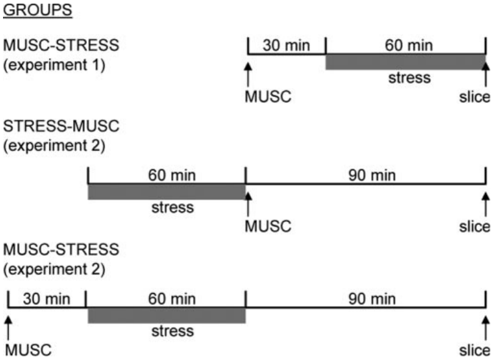
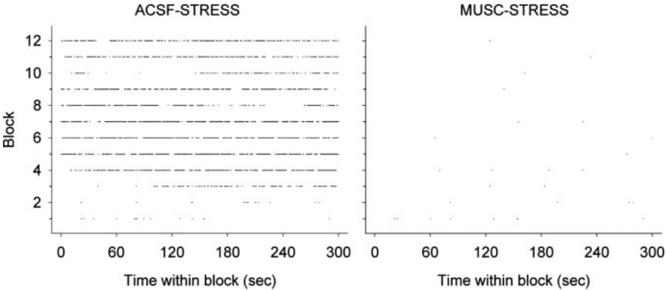
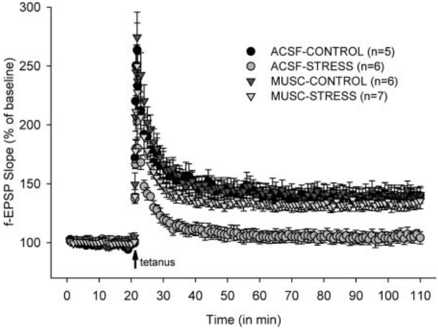
Electrolytic lesions to the amygdala, a limbic structure implicated in stress-related behaviors and memory modulation, have been shown to prevent stress-induced impairments of hippocampal long-term potentiation (LTP) and spatial memory in rats. The present study investigated the role of intrinsic amygdalar neurons in mediating stress effects on the hippocampus by microinfusing the GABA(A) receptor agonist muscimol into the amygdala and examining stress effects on Schaffer collateral/commissural-CA1 LTP and spatial memory. The critical period of the amygdalar contribution to stress effects on hippocampal functions was determined by applying muscimol either before stress or immediately after stress. Our results indicate that intra-amygdalar muscimol infusions before uncontrollable restraint-tailshock stress effectively blocked stress-induced physiological and behavioral effects. Specifically, hippocampal slices prepared from vehicle-infused stressed animals exhibited markedly impaired LTP, whereas slices obtained from muscimol-infused stressed animals demonstrated robust LTP comparable with that of unstressed animals. Correspondingly, vehicle-infused stressed animals displayed impaired spatial memory (on a hidden platform version of the Morris water maze task), whereas muscimol-infused stressed animals revealed unimpaired spatial memory. In contrast to prestress muscimol effects, however, immediate poststress infusions of muscimol into the amygdala failed to interfere with stress impairments of LTP and spatial memory. Together, these results suggest that the amygdalar neuronal activity during stress, but not shortly after stress, is essential for the emergence of stress-induced alterations in hippocampal LTP and memory.
Overview
The claims and statistics of this paper haven’t been checked yet.
Run the check — free, no account needed. It reads the open-access text and checks the sources it cites.
Integrity signals
Registry
Cites
Statistics
Figures
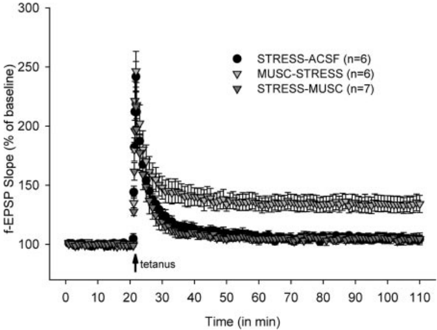
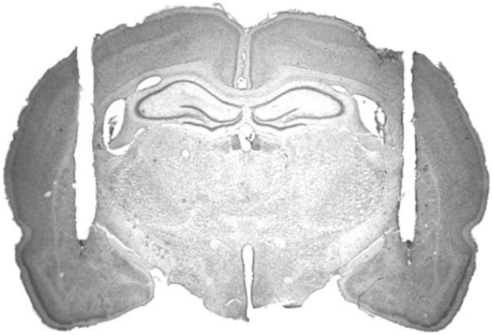
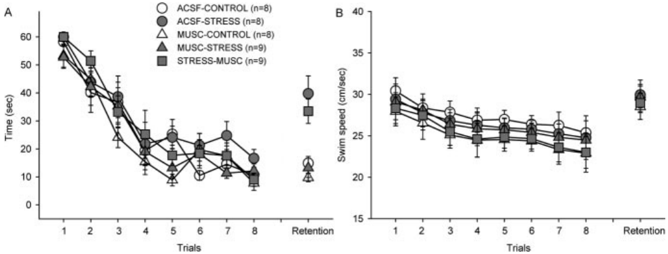
Verification
Claims the paper makes
The claims and statistics of this paper haven’t been checked yet.
Run the check — free, no account needed. It reads the open-access text and checks the sources it cites.
Claims other papers make about this one
Each is checked against this paper’s own text: does it say what the citing paper says it does?
In the citing paper
“damage to, or inactivation of, the amygdala blocks stress effects on hippocampal LTP and spatial memory (Almaguer-Melian et al. [214]; Kim et al. [154]; Korz and Frey [215]; Kim and Jung [21]).”
From The Temporal Dynamics Model of Emotional Memory Processing: A Synthesis on the Neurobiological Basis of Stress-Induced Amnesia, Flashbulb and Traumatic Memories, and the Yerkes-Dodson Law (2007) · cites this paper as Kim et al. [154]
In the citing paper
“Overall, these findings, in conjunction with related work by Kim et al. [154] support our hypothesis that a strong stressor generates a powerful inhibitory influence on hippocampal memory processing for events occurring 30–60 minutes after the onset of a stressful experience.”
From The Temporal Dynamics Model of Emotional Memory Processing: A Synthesis on the Neurobiological Basis of Stress-Induced Amnesia, Flashbulb and Traumatic Memories, and the Yerkes-Dodson Law (2007) · cites this paper as Kim et al. [154]
Self-check
Percentages, sums and reported differences re-computed from the paper’s own numbers.
The self-check needs the paper’s full text.
Citations
Cites
Bliss, T. V. P., & Gardner-Medwin, A. R. (1973) · The Journal of Physiology · doi:10.1113/jphysiol.1973.sp010274 · Cited by 7,424
LOSS OF RECENT MEMORY AFTER BILATERAL HIPPOCAMPAL LESIONS
Scoville, W. B., & Milner, B. (1957) · Journal of Neurology, Neurosurgery & Psychiatry · doi:10.1136/jnnp.20.1.11 · Cited by 7,322
The Organization of Behavior; A Neuropsychological Theory.
Attneave, F., B., M., & Hebb, D. O. (1950) · The American Journal of Psychology · doi:10.2307/1418888 · Cited by 5,146
Memory - A century of consolidation
McGaugh, J. L. (2000) · Science · doi:10.1126/science.287.5451.248 · Cited by 4,250
Morris, R. G. M., Anderson, E., Lynch, G. S., & Baudry, M. (1986) · Nature · doi:10.1038/319774a0 · Cited by 3,640
Long-Term Potentiation--A Decade of Progress?
Malenka, R. C., & Nicoll, A. R. A. (1999) · Science · doi:10.1126/science.285.5435.1870 · Cited by 2,729
Two receptor systems for corticosterone in rat brain: Microdistribution and differential occupation
REUL, J. M. H. M., & KLOET, E. R. D. (1985) · Endocrinology · doi:10.1210/endo-117-6-2505 · Cited by 2,580
Learned helplessness: Theory and evidence
Maier, S. F., & Seligman, M. E. (1976) · Journal of Experimental Psychology: General · doi:10.1037/0096-3445.105.1.3 · Cited by 2,494
Failure to escape traumatic shock.
Seligman, M. E., & Maier, S. F. (1967) · Journal of Experimental Psychology · doi:10.1037/h0024514 · Cited by 1,981
McEwen, B. S., & Sapolsky, R. M. (1995) · Current Opinion in Neurobiology · doi:10.1016/0959-4388(95)80028-x · Cited by 1,889
Mechanisms of emotional arousal and lasting declarative memory.
Cahill, L., & McGaugh, J. L. (1998) · Trends in Neurosciences · doi:10.1016/s0166-2236(97)01214-9 · Cited by 1,575
The stressed hippocampus, synaptic plasticity and lost memories
Kim, J. J., & Diamond, D. M. (2002) · Nature Reviews Neuroscience · doi:10.1038/nrn849 · Cited by 1,543
Self-citationStructure and function of declarative and nondeclarative memory systems
Squire, L. R., & Zola, S. M. (1996) · Proceedings of the National Academy of Sciences · doi:10.1073/pnas.93.24.13515 · Cited by 1,327
Stress and glucocorticoids impair retrieval of long-term spatial memory
de Quervain, D. J.-F., Roozendaal, B., & McGaugh, J. L. (1998) · Nature · doi:10.1038/29542 · Cited by 1,182
The hippocampus—what does it do?
Eichenbaum, H., Otto, T., & Cohen, N. J. (1992) · Behavioral and Neural Biology · doi:10.1016/0163-1047(92)90724-i · Cited by 867
(1992) · Cited by 777
Diamond, D. M., Bennett, M. C., Fleshner, M., & Rose, G. M. (1992) · Hippocampus · doi:10.1002/hipo.450020409 · Cited by 688
Effects of adverse experiences for brain structure and function
McEwen, B. S. (2000) · Biological Psychiatry · doi:10.1016/s0006-3223(00)00964-1 · Cited by 639
Amygdala modulation of hippocampal-dependent and caudate nucleus-dependent memory processes
Packard, M. G., Cahill, L., & McGaugh, J. L. (1994) · Proceedings of the National Academy of Sciences · doi:10.1073/pnas.91.18.8477 · Cited by 544
Kim, J. J., Lee, H. J., Han, J.-S., & Packard, M. G. (2001) · The Journal of Neuroscience · doi:10.1523/jneurosci.21-14-05222.2001 · Cited by 537
Self-citationKrettek, J. E., & Price, J. L. (1977) · The Journal of Comparative Neurology · doi:10.1002/cne.901720409 · Cited by 535
Bodnoff, S., Humphreys, A., Lehman, J., Diamond, D. M., Rose, G., & Meaney, M. (1995) · Journal of Neuroscience · doi:10.1523/jneurosci.15-01-00061.1995 · Cited by 529
Behavioural stress facilitates the induction of long-term depression in the hippocampus
Xu, L., Anwyl, R., & Rowan, M. J. (1997) · Nature · doi:10.1038/387497a0 · Cited by 521
Localization of a Memory Trace in the Mammalian Brain
Krupa, D. J., Thompson, J. K., & Thompson, R. F. (1993) · Science · doi:10.1126/science.8493536 · Cited by 515
Blanchard, R. J., Blanchard, D. C., Agullana, R., & Weiss, S. M. (1991) · Physiology & Behavior · doi:10.1016/0031-9384(91)90423-l · Cited by 461
Inescapable versus escapable shock modulates long-term potentiation in the rat hippocampus
Shors, T. J., Seib, T. B., Levine, S., & Thompson, R. F. (1989) · Science · doi:10.1126/science.2704997 · Cited by 458
Principles of Neuropsychopharmacology
Feldman, R. S., Meyer, J. S., & Quenzer, L. F. (1997) · Cited by 444
Behavioral stress impairs long-term potentiation in rodent hippocampus
Foy, M. R., Stanton, M. E., Levine, S., & Thompson, R. F. (1987) · Behavioral and Neural Biology · doi:10.1016/s0163-1047(87)90664-9 · Cited by 436
Behavioral stress modifies hippocampal plasticity through N-methyl-D-aspartate receptor activation.
Kim, J. J., Foy, M. R., & Thompson, R. F. (1996) · Proceedings of the National Academy of Sciences · doi:10.1073/pnas.93.10.4750 · Cited by 435
Self-citationStress: metaplastic effects in the hippocampus
Kim, J. J., & Yoon, K. S. (1998) · Trends in Neurosciences · doi:10.1016/s0166-2236(98)01322-8 · Cited by 403
Self-citationMuller, J., Corodimas, K. P., Fridel, Z., & LeDoux, J. E. (1997) · Behavioral Neuroscience · doi:10.1037//0735-7044.111.4.683 · Cited by 401
Mind and body; The theories of their relation.
Bain, A. (1877) · D. Appleton and company eBooks · doi:10.1037/12850-000 · Cited by 391
Goldstein, L. E., Rasmusson, A. M., Bunney, B. S., & Roth, R. H. (1996) · The Journal of Neuroscience · doi:10.1523/jneurosci.16-15-04787.1996 · Cited by 387
Muller, J., Corodimas, K. P., Fridel, Z., & LeDoux, J. E. (1997) · Behavioral Neuroscience · doi:10.1037/0735-7044.111.4.683 · Cited by 382
Effects of glucocorticoids and norepinephrine on the excitability in the hippocampus
Joëls, M., & de Kloet, E. R. (1989) · Science · doi:10.1126/science.2781292 · Cited by 375
Jin, C., & Reed, J. C. (2002) · Nature Reviews Molecular Cell Biology · doi:10.1038/nrm832 · Cited by 340
Roozendaal, B., Griffith, Q. K., Buranday, J., de Quervain, D. J.-F., & McGaugh, J. L. (2003) · Proceedings of the National Academy of Sciences · doi:10.1073/pnas.0337480100 · Cited by 291
Exposing Rats to a Predator Blocks Primed Burst Potentiation in the Hippocampus In Vitro
Mesches, M. H., Fleshner, M., Heman, K. L., Rose, G. M., & Diamond, D. M. (1999) · The Journal of Neuroscience · doi:10.1523/jneurosci.19-14-j0004.1999 · Cited by 276
Corticosteroid Modulation of Hippocampal Potentials: Increased Effect with Aging
Kerr, D. S., Campbell, L. W., Hao, S.-Y., & Landfield, P. W. (1989) · Science · doi:10.1126/science.2781293 · Cited by 271
Helmstetter, F. J., & Bellgowan, P. S. F. (1994) · Behavioral Neuroscience · doi:10.1037//0735-7044.108.5.1005 · Cited by 265
Akirav, I., & Richter-Levin, G. (1999) · The Journal of Neuroscience · doi:10.1523/jneurosci.19-23-10530.1999 · Cited by 250
Long-term potentiation and memory
Morris, R. G. M. (2003) · Philosophical Transactions of the Royal Society of London. Series B: Biological Sciences · doi:10.1098/rstb.2002.1230 · Cited by 232
Wilensky, A. E., Schafe, G. E., & LeDoux, J. E. (1999) · Journal of Neuroscience · doi:10.1523/jneurosci.19-24-j0006.1999 · Cited by 223
The amygdala is essential for the expression of conditional hypoalgesia.
Helmstetter, F. J. (1992) · Behavioral Neuroscience · doi:10.1037//0735-7044.106.3.518 · Cited by 203
Amygdalar NMDA Receptors Are Critical for the Expression of Multiple Conditioned Fear Responses
Lee, H. J., Choi, J.-S., Brown, T. H., & Kim, J. J. (2001) · Journal of Neuroscience · doi:10.1523/jneurosci.21-11-04116.2001 · Cited by 197
Self-citationStress Impairs LTP and Hippocampal‐Dependent Memorya
Diamond, D. M., & ROSE, G. M. (1994) · Annals of the New York Academy of Sciences · doi:10.1111/j.1749-6632.1994.tb39271.x · Cited by 196
Vazdarjanova, A., & McGaugh, J. D. (1999) · Journal of Neuroscience · doi:10.1523/jneurosci.19-15-06615.1999 · Cited by 194
Brain slice preparation: Hippocampus
Teyler, T. J. (1980) · Brain Research Bulletin · doi:10.1016/s0361-9230(80)80009-8 · Cited by 192
Maren, S., Yap, S. A., & Goosens, K. A. (2001) · Journal of Neuroscience · doi:10.1523/jneurosci.21-06-j0001.2001 · Cited by 189
In search of general mechanisms for long-lasting plasticity: Aplysia and the hippocampus
Pittenger, C., & Kandel, E. R. (2003) · Philosophical Transactions of the Royal Society B Biological Sciences · doi:10.1098/rstb.2002.1247 · Cited by 180
Behavioural responses of laboratory rats to playback of 22 kHz ultrasonic calls
Brudzyński, S. M., & Chiu, E. M. C. (1995) · Physiology & Behavior · doi:10.1016/0031-9384(95)00003-2 · Cited by 159
A description of the amygdalo-hippocampal interconnections in the macaque monkey
Aggleton, J. P. (1986) · Experimental Brain Research · doi:10.1007/bf00340489 · Cited by 155
Attenuated hippocampal long-term potentiation in basolateral amygdala-lesioned rats
Ikegaya, Y., Saitō, H., & Abe, K. (1994) · Brain Research · doi:10.1016/0006-8993(94)91377-3 · Cited by 142
Adamec, R. E., Burton, P., Shallow, T., & Budgell, J. (1998) · Physiology & Behavior · doi:10.1016/s0031-9384(98)00225-x · Cited by 137
The Production of Ultrasonic Sounds by Laboratory Rats and Other Mammals
Anderson, J. W. (1954) · Science · doi:10.1126/science.119.3101.808 · Cited by 118
Shors, T. J., & Dryver, E. T. (1994) · Brain Research · doi:10.1016/0006-8993(94)90777-3 · Cited by 118
van der Poel, A. M., & Miczek, K. A. (1991) · Behaviour · doi:10.1163/156853991x00409 · Cited by 112
Abe, K. (2001) · The Japanese Journal of Pharmacology · doi:10.1254/jjp.86.18 · Cited by 106
Ikegaya, Y., Saitō, H., & Abe, K. (1996) · European Journal of Neuroscience · doi:10.1111/j.1460-9568.1996.tb01327.x · Cited by 105
Arikan, R., Blake, N. M. J., Erinjeri, J. P., Woolsey, T. A., Giraud, L., & Highstein, S. M. (2002) · Journal of Neuroscience Methods · doi:10.1016/s0165-0270(02)00143-7 · Cited by 99
Startle-inducing acoustic stimuli evoke ultrasonic vocalization in the rat
Kaltwasser, M.-T. (1990) · Physiology & Behavior · doi:10.1016/0031-9384(90)90253-z · Cited by 97
Effect of Adrenalectomy and Demedullation on the Stress-Induced Impairment of Long-Term Potentiation
Shors, T. J., Levine, S., & Thompson, R. F. (2008) · Neuroendocrinology · doi:10.1159/000125318 · Cited by 87
Time-dependent blockade of STP and LTP in hippocampal slices following acute stress in mice
Garcia, R., Musleh, W., Tocco, G., Thompson, R. F., & Baudry, M. (1997) · Neuroscience Letters · doi:10.1016/s0304-3940(97)00621-6 · Cited by 83
Brudzyński, S. M. (1994) · Behavioural Brain Research · doi:10.1016/0166-4328(94)90084-1 · Cited by 77
Roozendaal, B., Sapolsky, R. M., & McGaugh, J. L. (1998) · Neuroscience · doi:10.1016/s0306-4522(97)00538-1 · Cited by 55
Packard, M. G., & McGaugh, J. L. (1994) · Psychobiology · doi:10.3758/bf03327080 · Cited by 51
Grijalva, C. V., Taché, Y., Gunion, M. W., Walsht, J. H., & Geiselman, P. J. (1986) · Brain Research Bulletin · doi:10.1016/0361-9230(86)90012-2 · Cited by 36
Wilkes, A. L., & Wade, N. J. (1997) · Brain and Cognition · doi:10.1006/brcg.1997.0869 · Cited by 35
Attenuation of shock-induced ulcers after lesions in the medial amygdala☆
Henke, P. G. (1981) · Physiology & Behavior · doi:10.1016/0031-9384(81)90311-5 · Cited by 34
Ikegaya, Y., Saitō, H., & Abe, K. (1995) · Neuroscience Letters · doi:10.1016/0304-3940(95)11643-b · Cited by 29
Merchenthaler (1999) · doi:10.1002/(sici)1096-9861(19990111)403:2
Research works printed but not linked: 6
- 1999, Physiol Behav, 65, 739
- 1973, J Physiol (Lond), 232, 331, 10.1113/jphysiol.1973.sp010273 · DOI · Paper page
- 1990, Psychol Sci, 3, 201
- 10.1037/0735-7044.106.3.518 · DOI
- 10.1037/0735-7044.108.5.1005 · DOI
- 10.1037//0096-3445.105.1.3 · DOI · Paper page
Cited by
Sorted by citations
Physiology and neurobiology of stress and adaptation: central role of the brain
McEwen, B. S. (2007) · Physiological Reviews · doi:10.1152/physrev.00041.2006 · Cited by 5,429
Stress, memory and the amygdala
Roozendaal, B., McEwen, B. S., & Chattarji, S. (2009) · Nature Reviews Neuroscience · doi:10.1038/nrn2651 · Cited by 1,760
The Brain on Stress: Vulnerability and Plasticity of the Prefrontal Cortex over the Life Course
McEwen, B. S., & Morrison, J. H. (2013) · Neuron · doi:10.1016/j.neuron.2013.06.028 · Cited by 1,079
Diamond, D. M., Campbell, A. M., Park, C. R., Halonen, J., & Zoladz, P. R. (2007) · Neural Plasticity · doi:10.1155/2007/60803 · Cited by 762
Stress effects on memory: An update and integration
Schwabe, L., Joëls, M., Roozendaal, B., Wolf, O. T., & Oitzl, M. S. (2012) · Neuroscience & Biobehavioral Reviews · doi:10.1016/j.neubiorev.2011.07.002 · Cited by 714
Metadata
- Authors
- Kim, J. J., Koo, J. W., Lee, H. J., & Han, J.-S.
- Affiliations
- University of Washington (US)
- Yale University (US)
- Johns Hopkins University (US)
- Venue
- The Journal of Neuroscience
- Publisher
- Society for Neuroscience
- Published
- 2005-02-09
- Volume
- 25
- Issue
- 6
- Pages
- 1532-1539
- ISSN
- 0270-6474 (ISSN-L)
- 1529-2401
- PMC
- PMC6725997
- OpenAlex
- W2053502537
- Cited by
- 184
- References
- 71
- Citations by year
- 2026: 2 · 2025: 2 · 2024: 1 · 2023: 2 · 2022: 4 · 2021: 8 · 2020: 3 · 2019: 4 · 2018: 6 · 2017: 6 · 2016: 12 · 2015: 6 · 2014: 14 · 2013: 19 · 2012: 16
- FWCI
- 7.12
- Type
- journal article
- Language
- en
- Open access
- hybrid
- doi.org
- Licence
- Locations
- Journal of Neuroscience (publishedVersion, cc-by-nc-sa)
- Europe PMC (PubMed Central) (publishedVersion)
- PubMed Central (publishedVersion)
- PubMed (publishedVersion)
- Funders
- Whitehall Foundation
- National Institute of Mental Health (MH64457, R01MH064457, 1R01 MH64457)
- Topics
- Life Sciences › Neuroscience › Cognitive Neuroscience › Memory and Neural Mechanisms
- Life Sciences › Neuroscience › Behavioral Neuroscience › Stress Responses and Cortisol
- Life Sciences › Neuroscience › Cellular and Molecular Neuroscience › Neuroscience and Neuropharmacology Research
- Keywords
- amygdala, stress, hippocampal long-term potentiation, spatial memory, muscimol, GABAA receptor, stress-induced memory impairment, limbic system
- MeSH terms
- Amygdala, Animals, Corticosterone, Drug Administration Schedule, Electroshock, Hippocampus, Male, Memory Disorders, Muscimol, Stress, Physiological, Vocalization, Animal, Rats, Sprague-Dawley, Long-Term Potentiation, GABA Agonists, Maze Learning, Rats, GABA-A Receptor Agonists
About these checks
Registry, retraction, Cites and statistics results are computed, not judged, with one exception: a printed reference that no index lists is read once by a model before it counts as a citation error. Claims are extracted by a model and kept only when their quote appears verbatim in the text; each cited source is then checked, with a model’s help, for whether it says what the claim relies on. Those verdicts can be wrong — read the claim’s quote and the cited source before relying on one.
Statistics and arithmetic are recomputed, not judged.
Confidence bands are shown only for fields calibrated on our annotated test set. None is calibrated yet, so no band is shown.
What counts as a claim ›How we measure confidence ›How we check this ›
Are you an author, or do you see a problem with this page? Request a review
