

Efficient Low-rank Multimodal Fusion With Modality-Specific Factors
Open accessThe DOI matches its Crossref record; 33 of the 33 references it cites were found in a registry or an index.
Abstract
Zhun Liu, Ying Shen, Varun Bharadhwaj Lakshminarasimhan, Paul Pu Liang, AmirAli Bagher Zadeh, Louis-Philippe Morency. Proceedings of the 56th Annual Meeting of the Association for Computational Linguistics (Volume 1: Long Papers). 2018.
Overview
The claims and statistics of this paper haven’t been checked yet.
Free: it reads the open-access text and checks the first 5 claims that cite a source we can check. Create a free account to check every claim.
Integrity signals
Registry
Cites
Statistics
Figures
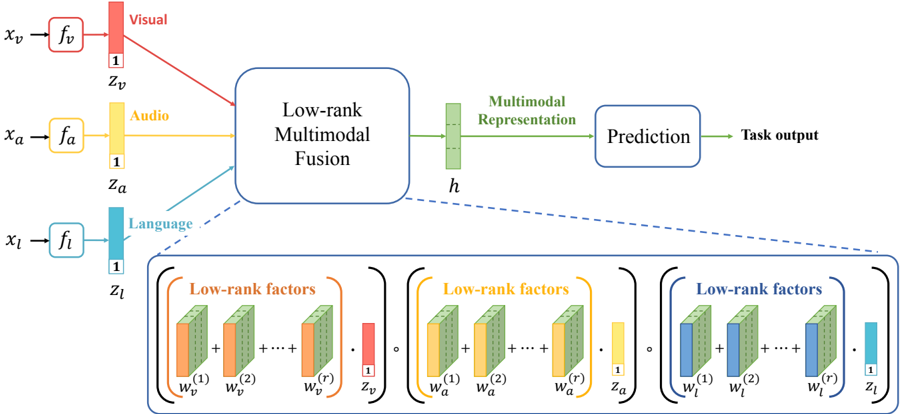
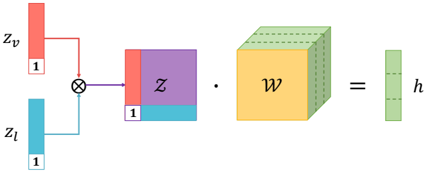
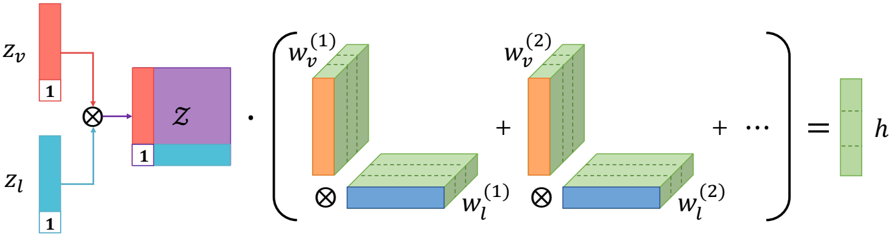
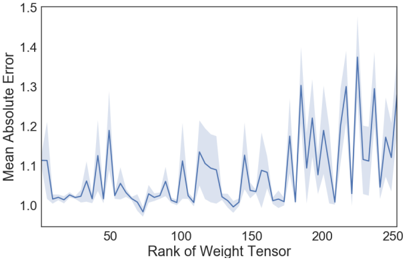
Verification
Claims the paper makes
The claims and statistics of this paper haven’t been checked yet.
Free: it reads the open-access text and checks the first 5 claims that cite a source we can check. Create a free account to check every claim.
Claims other papers make about this one
Each is checked against this paper’s own text: does it say what the citing paper says it does?
The cited source says what the claim attributes to it.
In the citing paper
“The experiment confirmed that the LMF effectively improves the training and testing efficiency compared to TFN.”
From A Survey of Deep Learning-Based Multimodal Emotion Recognition: Speech, Text, and Face (2023) · cites this paper as [100]
The cited source says what the claim attributes to it.
In the citing paper
“Several efficient variants have been proposed to approximate expensive full tensor products with cheaper variants while maintaining performance [71, 101, 106].”
From MultiBench: Multiscale Benchmarks for Multimodal Representation Learning (2021) · cites this paper as [106]
In the citing paper
“we compared vector concatenation and a low-rank implementation of Kronecker Product Fusion, which similarly outperform unimodal approaches (Table S3) (Liu et al., 2018).”
From Pan-cancer integrative histology-genomic analysis via multimodal deep learning (2022) · cites this paper as Liu et al., 2018
Self-check
Percentages, sums and reported differences re-computed from the paper’s own numbers.
The self-check needs the paper’s full text.
Citations
Cites
Hochreiter, S., & Schmidhuber, J. (1997) · Neural Computation · doi:10.1162/neco.1997.9.8.1735 · Cited by 102,318 · cited 4×
“Multi-View LSTM Multi-View LSTM (MV-LSTM) (Rajagopalan et al., 2016) aims to capture both modality-specific and cross-modality interactions from multiple modalities by partitioning the memory cell and the gates corresponding to multiple modalities.”
MethodInfluentialCortes, C., & Vapnik, V. (1995) · Machine Learning · doi:10.1007/bf00994018 · Cited by 59,421
Glove: Global Vectors for Word Representation
Pennington, J., Socher, R., & Manning, C. (2014) · Proceedings of the 2014 Conference on Empirical Methods in Natural Language Processing (EMNLP) · doi:10.3115/v1/d14-1162 · Cited by 34,071 · cited 1×
“Language We use pre-trained 300-dimensional Glove word embeddings (Pennington et al., 2014) to encode a sequence of transcribed words into a sequence of word vectors.”
MethodIEMOCAP: Interactive emotional dyadic motion capture database
Busso, C., Bulut, M., Lee, C.-C., Kazemzadeh, A., Mower, E., Kim, S., Chang, J. N., Lee, S., & Narayanan, S. S. (2008) · Language Resources and Evaluation · doi:10.1007/s10579-008-9076-6 · Cited by 3,869 · cited 4×
“We perform our experiments on the following multi-modal datasets, CMU-MOSI (Zadeh et al., 2016a POM (Park et al., 2014b), and IEMOCAP (Busso et al., 2008) for sentiment analysis, speaker traits recognition, and emotion recognition task, where the goal is to identify speakers emotions based on the speakers’ verbal and…”
BackgroundMethodInfluentialTensor Fusion Network for Multimodal Sentiment Analysis
Zadeh, A., Chen, M., Poria, S., Cambria, E., & Morency, L.-P. (2017) · Proceedings of the 2017 Conference on Empirical Methods in Natural Language Processing · doi:10.18653/v1/d17-1115 · Cited by 2,102 · cited 12×
“In addition, in order to be able to model the interactions between any subset of modalities using one tensor, Zadeh et al. (2017) proposed a simple extension to append 1 s to the unimodal representations before taking the outer product.”
BackgroundMethodInfluentialSelf-citationMultimodal Compact Bilinear Pooling for Visual Question Answering and Visual Grounding
Fukui, A., Park, D. H., Yang, D., Rohrbach, A., Darrell, T., & Rohrbach, M. (2016) · Proceedings of the 2016 Conference on Empirical Methods in Natural Language Processing · doi:10.18653/v1/d16-1044 · Cited by 1,582 · cited 6×
“, 2017), (Fukui et al., 2016) performs contextdependent fusion of multimodal data.”
BackgroundMethodResultInfluentialFast Human Detection Using a Cascade of Histograms of Oriented Gradients
Zhu, Q., Yeh, M.-C., Cheng, K.-T., & Avidan, S. (2006) · 2006 IEEE Computer Society Conference on Computer Vision and Pattern Recognition - Volume 2 (CVPR'06) · doi:10.1109/cvpr.2006.119 · Cited by 1,399 · cited 2×
“Visual The library Facet1 is used to extract a set of visual features for each frame (sampled at 30Hz) including 20 facial action units, 68 facial landmarks, head pose, gaze tracking and HOG features (Zhu et al., 2006).”
MethodMemory Fusion Network for Multi-view Sequential Learning
Zadeh, A., Liang, P. P., Mazumder, N., Poria, S., Cambria, E., & Morency, L.-P. (2018) · Proceedings of the AAAI Conference on Artificial Intelligence · doi:10.1609/aaai.v32i1.12021 · Cited by 855
Self-citationMultimodal Sentiment Intensity Analysis in Videos: Facial Gestures and Verbal Messages
Zadeh, A., Zellers, R., Pincus, E., & Morency, L.-P. (2016) · IEEE Intelligent Systems · doi:10.1109/mis.2016.94 · Cited by 852 · cited 6×
“We perform our experiments on the following multi-modal datasets, CMU-MOSI (Zadeh et al., 2016a POM (Park et al., 2014b), and IEMOCAP (Busso et al., 2008) for sentiment analysis, speaker traits recognition, and emotion recognition task, where the goal is to identify speakers emotions based on the…”
MethodInfluentialSelf-citationCOVAREP — A collaborative voice analysis repository for speech technologies
Degottex, G., Kane, J., Drugman, T., Raitio, T., & Scherer, S. (2014) · 2014 IEEE International Conference on Acoustics, Speech and Signal Processing (ICASSP) · doi:10.1109/icassp.2014.6853739 · Cited by 695 · cited 1×
“Acoustic We use COVAREP acoustic analysis framework (Degottex et al., 2014) to extract a set of low-level acoustic features, including 12 Mel frequency cepstral coefficients (MFCCs), pitch, voiced/unvoiced segmentation, glottal source, peak slope, and maxima dispersion quotient features.”
Method
Research works printed but not linked: 5
- [6]6. Gilles Degottex, John Kane, Thomas Drugman, Tuomo Raitio, and Stefan Scherer. 2014. Covarepa collabo- rative voice analysis repository for speech technolo- gies. In Acoustics, Speech and Signal Processing (ICASSP), 2014 IEEE International Conference on. IEEE, pages 960-964.
- [10]10. Othmar Koch and Christian Lubich. 2010. Dynami- cal tensor approximation. SIAM Journal on Matrix Analysis and Applications 31(5):2360-2375.
- [14]14. Sunghyun Park, Han Suk Shim, Moitreya Chatterjee, Kenji Sagae, and Louis-Philippe Morency. 2014a. Computational analysis of persuasiveness in social multimedia: A novel dataset and multimodal predic- tion approach. In Proceedings of the 16th Interna- tional Conference on Multimodal Interaction. ACM, pages 50-57.
- [22]22. Hongcheng Wang and Narendra Ahuja. 2008. A ten- sor approximation approach to dimensionality re- duction. International Journal of Computer Vision 76(3):217-229.
- [24]24. Torsten Wortwein and Stefan Scherer. 2017. What really mattersan information gain analysis of ques- tions and reactions in automated ptsd screenings. In 2017 Seventh International Conference on Affective Computing and Intelligent Interaction (ACII). IEEE, pages 15-20.
Cited by
Items 101–200 of 1,001
Tellamekala, M. K., Amiriparian, S., Schuller, B. W., André, E., Giesbrecht, T., & Valstar, M. (2024) · IEEE Transactions on Pattern Analysis and Machine Intelligence · doi:10.1109/tpami.2023.3325770 · Cited by 66
Disentanglement Translation Network for multimodal sentiment analysis
Zeng, Y., Yan, W., Mai, S., & Hu, H. (2023) · Information Fusion · doi:10.1016/j.inffus.2023.102031 · Cited by 105
A Generative Random Modality Dropout Framework for Robust Multimodal Emotion Recognition
Zhang, Y., Chen, H., Rida, I., & Zhu, X. (2025) · IEEE Intelligent Systems · doi:10.1109/mis.2025.3597120 · Cited by 105
Learning Behavior-oriented Knowledge Tracing
Xu, B., Huang, Z., Liu, J., Shen, S., Liu, Q., Chen, E., Wu, J., & Wang, S. (2023) · ACM SIGKDD Conference on Knowledge Discovery and Data Mining (KDD) · doi:10.1145/3580305.3599407 · Cited by 100
“In order to save the memory and computation overhead, we follow LMF [30] to decompose𝑾3.”
MethodFan, C., Zhu, K., Tao, J., Yi, G., Xue, J., & Lv, Z. (2024) · IEEE Transactions on Affective Computing · doi:10.1109/taffc.2024.3423671 · Cited by 102
Multimodal Routing: Improving Local and Global Interpretability of Multimodal Language Analysis
Tsai, Y.-H. H., Ma, M., Yang, M., Salakhutdinov, R., & Morency, L.-P. (2020) · Proceedings of the 2020 Conference on Empirical Methods in Natural Language Processing (EMNLP) · doi:10.18653/v1/2020.emnlp-main.143 · Cited by 98
“Recent work (Liu et al., 2018; Williams et al., 2018; Ortega et al., 2019) proposed methods to fuse information across modalities and”
MethodSelf-citationBAFN: Bi-Direction Attention Based Fusion Network for Multimodal Sentiment Analysis
Tang, J., Liu, D., Jin, X., Peng, Y. K., Zhao, Q., Ding, Y., & Kong, W. (2022) · IEEE Transactions on Circuits and Systems for Video Technology · doi:10.1109/tcsvt.2022.3218018 · Cited by 98
“Non-attention based: Bi-directional LSTM (BC-LSTM) [32], RNN-based multistage fusion network (RMFN) [33], Multi-view LSTM (MV-LSTM) [34], Self-Supervised Multi-task Multimodal model (Self-MM) [35], Multimodal Factorization Model (MFM) [36], Interaction Canonical Correlation Network (ICCN) [37], Tensor Fusion Network (…”
MethodInfluentialTeFNA: Text-centered fusion network with crossmodal attention for multimodal sentiment analysis
Huang, C., Zhang, J., Wu, X., Wang, Y., Li, M., & Huang, X. (2023) · Knowledge-Based Systems · doi:10.1016/j.knosys.2023.110502 · Cited by 99
Multi-Modality Sensing and Data Fusion for Multi-Vehicle Detection
Roy, D., Li, Y., Jian, T., Tian, P., Chowdhury, K. R., & Ioannidis, S. (2022) · IEEE Transactions on Multimedia · doi:10.1109/tmm.2022.3145663 · Cited by 97
“4) Low Rank Multimodal Fusion: The idea of low rank multimodal fusion is to decompose the weight tensor into M sets of modality-specific factors [57].”
BackgroundMethodInfluentialCounterfactual Reasoning for Out-of-distribution Multimodal Sentiment Analysis
Sun, T. F., Wang, W., Jing, L., Cui, Y., Song, X., & Nie, L. (2022) · ACM International Conference on Multimedia (ACM MM) · doi:10.1145/3503161.3548211 · Cited by 97
“Low-rankMultimodal Fusion [16] performsmultimodal fusion using modality-specific low-rank tensors, which decreases the computational complexity and improves the model’s efficiency.”
BackgroundMethodInfluentialMulti-Modal Attention for Speech Emotion Recognition
Pan, Z., Luo, Z., Yang, J., & Li, H. (2020) · Interspeech 2020 · doi:10.21437/interspeech.2020-1653 · Cited by 95
Learning Representations from Imperfect Time Series Data via Tensor Rank Regularization
Liang, P. P., Liu, Z., Tsai, Y.-H. H., Zhao, Q., Salakhutdinov, R., & Morency, L.-P. (2019) · Proceedings of the 57th Annual Meeting of the Association for Computational Linguistics · doi:10.18653/v1/p19-1152 · Cited by 95
“Similar to prior work which found tensor representations to capture higher-order interactions from multimodal data (Liu et al., 2018; Zadeh et al., 2017; Fukui et al., 2016), we form tensors via outer products of the individual representations through time (as shown in Figure 2): where we append a…”
InfluentialSelf-citationAdapted Dynamic Memory Network for Emotion Recognition in Conversation
Xing, S., Mai, S., & Hu, H. (2020) · IEEE Transactions on Affective Computing · doi:10.1109/taffc.2020.3005660 · Cited by 96
Multi-Task Momentum Distillation for Multimodal Sentiment Analysis
Lin, R., & Hu, H. (2023) · IEEE Transactions on Affective Computing · doi:10.1109/taffc.2023.3282410 · Cited by 95
PS-Mixer: A Polar-Vector and Strength-Vector Mixer Model for Multimodal Sentiment Analysis
Lin, H., Zhang, P., Ling, J., Yang, Z., Lee, L., & Liu, W. (2022) · Information Processing & Management · doi:10.1016/j.ipm.2022.103229 · Cited by 94
EMOE: Modality-Specific Enhanced Dynamic Emotion Experts
Fang, Y., Huang, W., Wan, G., Su, K., & Ye, M. (2025) · IEEE Computer Society Conference on Computer Vision and Pattern Recognition/Proceedings - IEEE Computer Society Conference on Computer Vision and Pattern Recognition/Proceedings · doi:10.1109/cvpr52734.2025.01335 · Cited by 97
Tensor Networks Meet Neural Networks: A Survey and Future PerspectivesPreprint
Wang, M., Pan, Y., Xu, Z., Li, G., Yang, X., Mandic, D. P., & Cichocki, A. (2023) · arXiv (Cornell University) · doi:10.48550/arxiv.2302.09019 · Cited by 96
“The structure of the MLB method is a special case of LMF (see Sec.”
InfluentialMultimodal Phased Transformer for Sentiment Analysis
Cheng, J., Fostiropoulos, I., BOEHM, B. W., & Soleymani, M. (2021) · Conference on Empirical Methods in Natural Language Processing (EMNLP) · doi:10.18653/v1/2021.emnlp-main.189 · Cited by 93
“Liu et al. (2018) propose to decompose the weight from the fusion layers into low-rank factors to reduce the large number of parameters in TFN .”
BackgroundShou, Y., Meng, T., Ai, W., Zhang, F., Yin, N., & Li, K. (2024) · Information Fusion · doi:10.1016/j.inffus.2024.102590 · Cited by 92
“…can obtain the user’s current emotional state according to the data analysis of the human–computer dialogue, and then generate words that fit the Low-rank Fusion Network (LFN) [7] utilizes low-rank decomposition operations to combine highly correlated feature vectors and fuse three modal features.”
BackgroundRevisiting Multimodal Emotion Recognition in Conversation from the Perspective of Graph Spectrum
Ai, W., Zhang, F., Shou, Y., Meng, T., Chen, H., & Li, K. (2025) · Proceedings of the AAAI Conference on Artificial Intelligence · doi:10.1609/aaai.v39i11.33242 · Cited by 91
Quantum-inspired Neural Network for Conversational Emotion Recognition
Li, Q., Gkoumas, D., Sordoni, A., Nie, J., & Melucci, M. (2021) · Proceedings of the AAAI Conference on Artificial Intelligence · doi:10.1609/aaai.v35i15.17567 · Cited by 90
Adaptive Graph Learning for Multimodal Conversational Emotion Detection
Tu, G., Xie, T., Liang, B., Wang, H., & Xu, R. (2024) · Proceedings of the AAAI Conference on Artificial Intelligence · doi:10.1609/aaai.v38i17.29876 · Cited by 90
“Existing multimodal ERC meth-ods mainly focus on aggregation-based fusion by concatenation (Tu et al. 2022b), tensor product (Mai, Hu, and Xing 2019; Liu et al. 2018), attention network (Rahman et al. 2020; Wang et al. 2019) or heterogeneous graph (Yang et al. 2021; Hu et al. 2022), etc.”
BackgroundMai, S., Xing, S., & Hu, H. (2020) · IEEE Transactions on Multimedia · doi:10.1109/tmm.2019.2925966 · Cited by 89
“Low-rank Multimodal Fusion (LMF) [52] seeks to perform multimodal fusion by decomposing weights of”
BackgroundMethodInfluentialMai, S., Xing, S., & Hu, H. (2021) · IEEE/ACM Transactions on Audio, Speech, and Language Processing · doi:10.1109/taslp.2021.3068598 · Cited by 89
“Recently, more researchers [5], [6], [24] tend to adopt COVAREP [40] to extract acoustic features.”
BackgroundInfluentialDeep Emotional Arousal Network for Multimodal Sentiment Analysis and Emotion Recognition
Zhang, F., Li, X., Lim, C. P., Hua, Q., Dong, C.-R., & Zhai, J. (2022) · Information Fusion · doi:10.1016/j.inffus.2022.07.006 · Cited by 89
AtCAF: Attention-based causality-aware fusion network for multimodal sentiment analysis
Huang, C., Chen, J., Huang, Q., Wang, S., Tu, Y., & Huang, X. (2024) · Information Fusion · doi:10.1016/j.inffus.2024.102725 · Cited by 91
Multi-Modal Fusion Technology Based on Vehicle Information: A Survey
Zhang, X., Gong, Y., Lu, J., Wu, J., Li, Z., Jin, D., & Li, J. (2023) · IEEE Transactions on Intelligent Vehicles · doi:10.1109/tiv.2023.3268051 · Cited by 88
“strategy similar to the article [68] to solve the problem of high computational cost, but also realizes local feature fusion through the added sliding window mechanism.”
MultiBench: Multiscale Benchmarks for Multimodal Representation Learning
Liang, P. P., Lyu, Y., Fan, X., Wu, Z., Cheng, Y., Wu, J., Chen, L., Wu, P., Lee, M. A., Zhu, Y., et al. (2021) · arXiv · doi:10.48550/arxiv.2107.07502 · Cited by 85
“MULTIZOO includes Tensor Fusion (TF) [179] as well as the approximate Low-rank Tensor Fusion (LRTF) [106].”
BackgroundSelf-citationFusing pairwise modalities for emotion recognition in conversations
Fan, C., Lin, J., Mao, R., & Cambria, E. (2024) · Information Fusion · doi:10.1016/j.inffus.2024.102306 · Cited by 86
Yang, Y., Dong, X., & Qiang, Y. (2024) · Findings of the Association for Computational Linguistics: NAACL · doi:10.18653/v1/2024.findings-naacl.135 · Cited by 85
Learning to Balance the Learning Rates Between Various Modalities via Adaptive Tracking Factor
Ya, S., Mai, S., & Hu, H. (2021) · IEEE Signal Processing Letters · doi:10.1109/lsp.2021.3101421 · Cited by 86
Hyper-node Relational Graph Attention Network for Multi-modal Knowledge Graph Completion
Liang, S., Zhu, A., Zhang, J., & Shao, J. (2023) · ACM Transactions on Multimedia Computing Communications and Applications · doi:10.1145/3545573 · Cited by 86
“The space complexity will also increase exponentially, so we use the low-rank multi-modal fusion [25] instead of tensor fusion.”
MethodHuan, R., Zhong, G., Chen, P., & Liang, R. (2023) · IEEE Transactions on Multimedia · doi:10.1109/tmm.2023.3338769 · Cited by 83
Che, W., Wang, Z., Jiang, C., & Abedin, M. Z. (2024) · Information Processing & Management · doi:10.1016/j.ipm.2024.103703 · Cited by 84
MERBench: A Unified Evaluation Benchmark for Multimodal Emotion Recognition
Lian, Z., Sun, L.-C., Ren, Y., Gu, H., Sun, H.-Y., Chen, L., Liu, B., & Tao, J.-H. (2024) · IEEE Transactions on Pattern Analysis and Machine Intelligence · doi:10.1109/tpami.2026.3653457 · Cited by 52
“The above experiments primarily utilize pre-trained models as feature extractors and then use shallow classifiers for emotion recognition.”
Multi-modal information analysis for fault diagnosis with time-series data from power transformer
Xing, Z., & He, Y. (2022) · International Journal of Electrical Power & Energy Systems · doi:10.1016/j.ijepes.2022.108567 · Cited by 81
Zeng, Y., Li, Z., Tang, Z., Chen, Z., & Ma, H. (2022) · Expert Systems with Applications · doi:10.1016/j.eswa.2022.119240 · Cited by 81
Zhang, X., & Li, Y. (2023) · Proceedings of the conference - Association for Computational Linguistics. Meeting · doi:10.18653/v1/2023.acl-long.732 · Cited by 81
“…on the utterance-level explicit alignment learning both intra-modality and inter-modality interactions via the Cartesian product was firstly created (Zadeh et al., 2017), then a low-rank multimodal fusion network to improve efficiency and reduce trainable parameters was designed (Liu et al., 2018).”
BackgroundConKI: Contrastive Knowledge Injection for Multimodal Sentiment Analysis
Yu, Y., Zhao, M. M., Qi, S.-A., Sun, F., Wang, B., Guo, W., Wang, X. L., Yang, L., & Niu, D. (2023) · Findings of the Association for Computational Linguistics: ACL (Findings of ACL) · doi:10.18653/v1/2023.findings-acl.860 · Cited by 82
Trustworthy Multimodal Fusion for Sentiment Analysis in Ordinal Sentiment Space
Xie, Z., Yang, Y. Z., Wang, J., Liu, X., & Li, X. (2024) · IEEE Transactions on Circuits and Systems for Video Technology · doi:10.1109/tcsvt.2024.3376564 · Cited by 83
“In addition, there are some multimodal fusion methods, such as graph-based fusion meth-ods [23], [24], [25], [26], tensor-based fusion methods [1], [27], and attention-based fusion methods [2], [28], [29].”
BackgroundMethodToken-Level Contrastive Learning with Modality-Aware Prompting for Multimodal Intent Recognition
Zhou, Q., Xu, H., Li, H., Zhang, H., Zhang, X., Wang, Y., & Gao, K. (2024) · Proceedings of the AAAI Conference on Artificial Intelligence · doi:10.1609/aaai.v38i15.29656 · Cited by 82
A Novel Multimodal Approach for Hybrid Brain–Computer Interface
Sun, Z., Huang, Z., Duan, F., & Liu, Y. (2020) · IEEE Access · doi:10.1109/access.2020.2994226 · Cited by 80
“In addition, some tensor-based methods have been proposed to solve multimodal fusion problems such as Visual Question Answering: for example, [35] proposed a Deep Attention Neural Tensor Network which can discover the joint correlations over images, questions and answers with tensor-based representations; [36] propose…”
MethodTechnology and Data Fusion Methods to Enhance Site-Specific Crop Monitoring
Ahmad, U., Nasirahmadi, A., Hensel, O., & Marino, S. (2022) · Agronomy · doi:10.3390/agronomy12030555 · Cited by 79
Zhu, C., Xiao, F., & Cao, Z. (2022) · Information Sciences · doi:10.1016/j.ins.2022.05.012 · Cited by 79
Lu, Q., Sun, X., Gao, Z., Long, Y., Feng, J., & Zhang, H. (2023) · Information Processing & Management · doi:10.1016/j.ipm.2023.103538 · Cited by 80
Robust Multimodal Learning with Missing Modalities via Parameter-Efficient Adaptation
Reza, M. K., Prater-Bennette, A., & Asif, M. S. (2025) · IEEE Transactions on Pattern Analysis and Machine Intelligence · doi:10.1109/tpami.2024.3476487 · Cited by 78
Multimodal Speech Emotion Recognition and Ambiguity ResolutionPreprint
Sahu, G. (2019) · arXiv (Cornell University) · doi:10.48550/arxiv.1904.06022 · Cited by 78
“Recently, methods have also been proposed to efficiently combine features from multiple domains, such as, Tensor Fusion Networks [10] and Low-Rank Matrix Multiplication [11], instead of trivial concatenation.”
MethodMmlatch: Bottom-Up Top-Down Fusion For Multimodal Sentiment Analysis
Paraskevopoulos, G., Georgiou, E., & Potamianos, A. (2022) · IEEE International Conference on Acoustics Speech and Signal Processing · doi:10.1109/icassp43922.2022.9746418 · Cited by 77
Adaptive Fusion Techniques for Multimodal Data
Sahu, G., & Vechtomova, O. (2021) · Conference of the European Chapter of the Association for Computational Linguistics · doi:10.18653/v1/2021.eacl-main.275 · Cited by 75
“Liu et al. (2018) proposed a low-rank multimodal fusion technique (LMF) to address the previous problem.”
BackgroundMethodInfluentialCheng, H., Yang, Z., Zhang, X., & Yang, Y. (2023) · IEEE Transactions on Affective Computing · doi:10.1109/taffc.2023.3265653 · Cited by 76
Contrastive-Based Removal of Negative Information in Multimodal Emotion Analysis
Wang, R., Wang, Y., Cambria, E., Fan, X., Yu, X., Huang, Y., Xiaosong, E., & Zhu, X. (2025) · Cognitive Computation · doi:10.1007/s12559-025-10463-9 · Cited by 75
MEDT: Using Multimodal Encoding-Decoding Network as in Transformer for Multimodal Sentiment Analysis
Qi, Q., Lin, L., Zhang, R., & Xue, C. (2022) · IEEE Access · doi:10.1109/access.2022.3157712 · Cited by 74
“LMF : Low-rank Multimodal Fusion [25] is an improvement of the TFN that uses a low-rank tensor to perform multimodal fusion to improve efficiency.”
BackgroundLin, R., & Hu, H. (2023) · IEEE Transactions on Multimedia · doi:10.1109/tmm.2023.3303711 · Cited by 74
MEmoR: A Dataset for Multimodal Emotion Reasoning in Videos
Shen, G., Wang, X. Y., Duan, X., Li, H., & Zhu, W. (2020) · ACM International Conference on Multimedia (ACM MM) · doi:10.1145/3394171.3413909 · Cited by 73
Multimodal sentiment analysis with unimodal label generation and modality decomposition
Zhu, L., Zhao, H., Zhu, Z., Zhang, C., & Kong, X. (2024) · Information Fusion · doi:10.1016/j.inffus.2024.102787 · Cited by 73
Zheng, J., Zhang, S., Wang, Z., Wang, X., & Zeng, Z. (2022) · IEEE Transactions on Multimedia · doi:10.1109/tmm.2022.3144885 · Cited by 74
“Furthermore, low rank multi-modal fusion technique (LMF) [11] based on TFN is proposed to realize cross-modal information interaction while reducing the computational cost.”
MethodMulti-Fusion Residual Memory Network for Multimodal Human Sentiment Comprehension
Mai, S., Hu, H., Xu, J., & Xing, S. (2022) · IEEE Transactions on Affective Computing · doi:10.1109/taffc.2020.3000510 · Cited by 68
Chen, Q., Huang, G., & Wang, Y. (2022) · IEEE/ACM Transactions on Audio Speech and Language Processing · doi:10.1109/taslp.2022.3192728 · Cited by 71
“TCM-LSTM [14]: The Temporal Convolutional Multimodal LSTM (TCM-LSTM) extracted the high-level features of each modality through learning both the temporal and the channel-wise co-dependency.”
MethodTEDT: Transformer-Based Encoding–Decoding Translation Network for Multimodal Sentiment Analysis
Wang, F., Tian, S., Yu, L., Liu, J., Wang, J., Li, K., & Wang, Y. (2022) · Cognitive Computation · doi:10.1007/s12559-022-10073-9 · Cited by 72
“Low-rank multimodal fusion (LMF) [17] adopts the same approach as TFN to model the multimodal representation.”
MethodDFMKE: A dual fusion multi-modal knowledge graph embedding framework for entity alignment
Zhu, J., Huang, C., & Meo, P. D. (2022) · Information Fusion · doi:10.1016/j.inffus.2022.09.012 · Cited by 72
I2MoE: Interpretable Multimodal Interaction-aware Mixture-of-Experts
Xin, J., Yun, S., Peng, J., Choi, I., Ballard, J. L., Chen, T., & Long, Q. (2025) · PubMed · doi:10.48550/arxiv.2505.19190 · Cited by 73
“Existing methods often rely on concatenating input modalities using off-the-shelf architectures (Liu et al., 2018; Tsai et al., 2019; Xue & Mar-culescu, 2023; Shazeer et al., 2017; Fedus et al., 2022).”
Modality-invariant temporal representation learning for multimodal sentiment classification
Sun, H., Liu, J., Chen, Y., & Lin, L. (2022) · Information Fusion · doi:10.1016/j.inffus.2022.10.031 · Cited by 70
Multi-grained fusion network with self-distillation for aspect-based multimodal sentiment analysis
Yang, J., Xiao, Y., & Du, X. (2024) · Knowledge-Based Systems · doi:10.1016/j.knosys.2024.111724 · Cited by 69
Multimodal Graph for Unaligned Multimodal Sequence Analysis via Graph Convolution and Graph Pooling
Mai, S., Xing, S., He, J., Zeng, Y., & Hu, H. (2023) · ACM Transactions on Multimedia Computing Communications and Applications · doi:10.1145/3542927 · Cited by 68
“Tensor ) [64] and Low-rank Modality Fusion [29] adopt outer product to learn joint representation of three modalities.”
BackgroundExcavating multimodal correlation for representation learning
Mai, S., Ya, S., Zeng, Y., & Hu, H. (2022) · Information Fusion · doi:10.1016/j.inffus.2022.11.003 · Cited by 68
MCRN: A Multi-source Cross-modal Retrieval Network for remote sensing
Yuan, Z., Zhang, W., Tian, C., Mao, Y., Zhou, R., Wang, H., Fu, K., & Sun, X. (2022) · International Journal of Applied Earth Observation and Geoinformation · doi:10.1016/j.jag.2022.103071 · Cited by 68
Learning to Learn Better Unimodal Representations via Adaptive Multimodal Meta-Learning
Ya, S., Mai, S., & Hu, H. (2022) · IEEE Transactions on Affective Computing · doi:10.1109/taffc.2022.3178231 · Cited by 69
“4) Tensor Fusion: Tensor fusion [57] is a widely-used fusion algorithm that draws significant attention recently [17], [58], [60].”
BackgroundMethodInfluentialLearning fine-grained representation with token-level alignment for multimodal sentiment analysis
Li, X., Zhang, H., Dong, Z., Cheng, X., Liu, Y., & Zhang, X. (2024) · Expert Systems with Applications · doi:10.1016/j.eswa.2024.126274 · Cited by 67
Wu, X., Zou, B., Lu, C., Wang, L., Zhang, Y., & Wang, H. (2025) · IEEE Journal on Selected Areas in Communications · doi:10.1109/jsac.2025.3560036 · Cited by 65
Liu, R., Huang, Z.-A., Hu, Y. F., Zhu, Z., Wong, K., & Tan, K. C. (2022) · IEEE Transactions on Neural Networks and Learning Systems · doi:10.1109/tnnls.2022.3219551 · Cited by 66
LD-MAN: Layout-Driven Multimodal Attention Network for Online News Sentiment Recognition
Guo, W., Zhang, Y., Cai, X., Meng, L., Yang, J., & Yuan, X. (2020) · IEEE Transactions on Multimedia · doi:10.1109/tmm.2020.3003648 · Cited by 65
“Multimodal methods: We report the performance of the effective multimodal fusion method GMU [49] and the typical senti-mentanalysismethodforvideossuchasTFN[47]andLMF[81].”
MethodMake Acoustic and Visual Cues Matter: CH-SIMS v2.0 Dataset and AV-Mixup Consistent Module
Liu, Y., Yuan, Z., Mao, H., Liang, Z., Yang, W., Qiu, Y., Cheng, T., Li, X., Xu, H., & Gao, K. (2022) · Proceedings of the 2022 International Conference on Multimodal Interaction · doi:10.1145/3536221.3556630 · Cited by 64
“The traditional MSA models which are supervised with the unified multimodal annotations include the Late Fusion Deep Neural Network (LF_DNN) [36], the Tensor Fusion Network (TFN) [43], the Low-rank Multimodal Fusion (LMF) [17], the Memory Fusion Network (MFN) [44], the Graph Memory Fusion Network (Graph_MFN) [46], the…”
MethodSWAFN: Sentimental Words Aware Fusion Network for Multimodal Sentiment Analysis
Chen, M., & Li, X. (2020) · International Conference on Computational Linguistics · doi:10.18653/v1/2020.coling-main.93 · Cited by 65
“, 2018), LMF (Liu et al., 2018), MFN (Zadeh et al.”
BackgroundMethodResultInfluentialMMoE: Enhancing Multimodal Models with Mixtures of Multimodal Interaction Experts
Yu, H., Qi, Z., Jang, L., Salakhutdinov, R. R., Morency, L., & Liang, P. P. (2024) · Conference on Empirical Methods in Natural Language Processing (EMNLP) · doi:10.18653/v1/2024.emnlp-main.558 · Cited by 63
Self-citationYang, D., Liu, Y., Huang, C., Li, M., Zhao, X., Wang, Y., Yang, K., Wang, Y., Zhai, P., & Zhang, L. (2023) · Knowledge-Based Systems · doi:10.1016/j.knosys.2023.110370 · Cited by 62
Incongruity-aware multimodal physiology signals fusion for emotion recognition
Li, J., Chen, N., Zhu, H., Li, G., Xu, Z., & Chen, D. (2023) · Information Fusion · doi:10.1016/j.inffus.2023.102220 · Cited by 62
A multimodal fusion method for sarcasm detection based on late fusion
Ding, N., Tian, S., & Yu, L. (2022) · Multimedia Tools and Applications · doi:10.1007/s11042-022-12122-9 · Cited by 62
“In order to verify the comparison results between the deep learning models, we have added the experimental results of several models, they are: EF-LSTM [38], MFN [47], LMF [22], TFN [44] and MULT [36].”
ResultXing, Z., He, Y., & Zhang, W. (2022) · IEEE Transactions on Industrial Electronics · doi:10.1109/tie.2022.3222663 · Cited by 62
“LMF is a tensor fusion method that uses low-rank factorization factors for tensor fusion and avoids the high-dimensional problems caused by direct tensor multiplication for fusion [23].”
MethodMALN: Multimodal Adversarial Learning Network for Conversational Emotion Recognition
Ren, M., Huang, X., Liu, J., Liu, M., Li, X., & Liu, A.-A. (2023) · IEEE Transactions on Circuits and Systems for Video Technology · doi:10.1109/tcsvt.2023.3273577 · Cited by 61
“Reference [32] introduces low-rank tensors for multimodal information fusion to improve efficiency of tensor-based methods.”
BackgroundXiao, L., Wu, X., Wu, W., Yang, J., & He, L. (2022) · IEEE International Conference on Acoustics Speech and Signal Processing · doi:10.1109/icassp43922.2022.9747542 · Cited by 63
Multimodal PEAR Chain-of-Thought Reasoning for Multimodal Sentiment Analysis
Li, Y., Lan, X., Chen, H., Lü, K., & Jiang, D. (2024) · ACM Transactions on Multimedia Computing Communications and Applications · doi:10.1145/3672398 · Cited by 61
“To evaluate the performance of our models, we adopt the following metrics based on previous works: binary accuracy (Acc 2 ), binary F1 score (F1), 7-class accuracy (Acc 7 ), Mean Absolute Error (MAE) , and the correlation between model predictions and human annotations (Corr).”
Factorized Multimodal Transformer for Multimodal Sequential LearningPreprint
Zadeh, A., Mao, C., Shi, K., Zhang, Y., Liang, P. P., Poria, S., & Morency, L. (2019) · arXiv (Cornell University) · doi:10.48550/arxiv.1911.09826 · Cited by 60
“, 2017) and its approximate variants (Liang et al.; Liu et al., 2018), as well as Compact Bilinear Pooling (Gao et al.”
BackgroundMethodSelf-citationDeep Multimodal Emotion Recognition on Human Speech: A Review
Koromilas, P., & Giannakopoulos, T. (2021) · Applied Sciences · doi:10.3390/app11177962 · Cited by 58
“LMF [52] [52] NTA {A, T, V} Train-Val-Test 3-1-1 Sessions 87.”
BackgroundInfluentialCAMR: cross-aligned multimodal representation learning for cancer survival prediction
Wu, X., Shi, Y., Wang, M., & Li, A. (2023) · Bioinformatics · doi:10.1093/bioinformatics/btad025 · Cited by 49
A fine-grained modal label-based multi-stage network for multimodal sentiment analysis
Peng, J., Wu, T., Zhang, W., Cheng, F., Tan, S., Yi, F., & Huang, Y. (2023) · Expert Systems with Applications · doi:10.1016/j.eswa.2023.119721 · Cited by 60
Li, Z., Guo, Q., Pan, Y., Ding, W., Yu, J., Zhang, Y., Liu, W., Chen, H., Wang, H., & Xie, Y. (2023) · Information Fusion · doi:10.1016/j.inffus.2023.101891 · Cited by 58
A Novel Digital Twin Framework for Aeroengine Performance Diagnosis
Wang, Z., Wang, Y., Wang, X., Yang, K., & Zhao, Y. (2023) · Aerospace · doi:10.3390/aerospace10090789 · Cited by 58
Xiang, J., Zhu, X., & Cambria, E. (2025) · Information Fusion · doi:10.1016/j.inffus.2025.103809 · Cited by 58
Cross-Modal Hybrid Feature Fusion for Image-Sentence Matching
Xu, X., Wang, Y., He, Y., Yang, Y., Hanjalić, A., & Shen, H. T. (2021) · ACM Transactions on Multimedia Computing Communications and Applications · doi:10.1145/3458281 · Cited by 58
“Other tensor-based fusion methods externalize multimodal fusion as a compact tensor—for example, a low-rank method [34] proposed to improve the efficiency of multimodal fusion and release the memory observably.”
MethodLei, Y., Yang, D., Li, M., Wang, S., Chen, J., & Zhang, L. (2024) · Lecture notes in computer science · doi:10.1007/978-981-99-9119-8_18 · Cited by 57
Multimodal fusion techniques: Review, data representation, information fusion, and application areas
Hangloo, S., & Arora, B. (2025) · Neurocomputing · doi:10.1016/j.neucom.2025.130827 · Cited by 60
Video multimodal emotion recognition based on Bi-GRU and attention fusion
Huan, R., Shu, J., Bao, S.-L., Liang, R., Chen, P., & Chi, K. (2020) · Multimedia Tools and Applications · doi:10.1007/s11042-020-10030-4 · Cited by 57
“…learning (SAL) Zadeh et al. [44] 2018 multimodal multi-attention recurrent network (MARN) Zadeh et al. [43] 2018 multimodal memory fusion network (MFN) Liu Z et al. [20] 2018 multimodal low-rank multimodal fusion Ma L et al. [21] 2019 multimodal cross-modal fusion with edge network data incentive”
BackgroundMethodEvolutionary Deep Fusion Method and its Application in Chemical Structure Recognition
Liang, X., Guo, Q. J., Qian, Y., Ding, W., & Zhang, Q. (2021) · IEEE Transactions on Evolutionary Computation · doi:10.1109/tevc.2021.3064943 · Cited by 58
“fusion methods, namely, bilinear-based fusion [4], [9] and tensor-based fusion [10], [37], have been proposed.”
MethodDeep Vision Multimodal Learning: Methodology, Benchmark, and Trend
Chai, W., & Wang, G. (2022) · Applied Sciences · doi:10.3390/app12136588 · Cited by 56
Learning from the global view: Supervised contrastive learning of multimodal representation
Mai, S., Zeng, Y., & Hu, H. (2023) · Information Fusion · doi:10.1016/j.inffus.2023.101920 · Cited by 57
Layer-wise Fusion with Modality Independence Modeling for Multi-modal Emotion Recognition
Sun, J., Han, S., Ruan, Y.-P., Zhang, X., Zheng, S., Liu, Y., Huang, Y., & Li, T. (2023) · Proceedings of the conference - Association for Computational Linguistics. Meeting · doi:10.18653/v1/2023.acl-long.39 · Cited by 56
“We compare LFMIM with MLF-DNN, MLMF and MTFN, of which the results are from the reference (Yu et al., 2020), as shown in Table 3.”
BackgroundMethodInfluentialAdaptive Modality Distillation for Separable Multimodal Sentiment Analysis
Peng, W., Hong, X., & Zhao, G. (2021) · IEEE Intelligent Systems · doi:10.1109/mis.2021.3057757 · Cited by 56
“TFN [9] and LMF [13] are two tensor-based methods, which are most related to our work.”
BackgroundMethodInfluentialZhang, Q., Shi, L., Liu, P., Zhu, Z., & Xu, L. (2022) · Applied Intelligence · doi:10.1007/s10489-022-03343-4 · Cited by 55
“Low-rank Multimodal Fusion Network [4] is proposed to reduce the rank of the high-dimensional fusion tensor.”
BackgroundMethodInfluentialRetractedShared-Private Memory Networks For Multimodal Sentiment Analysis
Zhao, X., Chen, Y., Liu, S., & Tang, B. (2022) · IEEE Transactions on Affective Computing · doi:10.1109/taffc.2022.3222023 · Cited by 55
Hybrid cross-modal interaction learning for multimodal sentiment analysis
Fu, Y., Zhang, Z., Yang, R., & Yao, C. (2023) · Neurocomputing · doi:10.1016/j.neucom.2023.127201 · Cited by 56
Metadata
- Authors
- Liu, Z., Shen, Y., Lakshminarasimhan, V. B., Liang, P. P., Bagher Zadeh, A., & Morency, L.-P.
- Affiliations
- Carnegie Mellon University (US)
- Venue
- Proceedings of the 56th Annual Meeting of the Association for Computational Linguistics (Volume 1: Long Papers)
- Published
- 2018
- Pages
- 2247-2256
- ISSN
- 0736-587X (ISSN-L)
- OpenAlex
- W2964346351
- Cited by
- 1,170
- References
- 31
- Citations by year
- 2026: 213 · 2025: 262 · 2024: 255 · 2023: 176 · 2022: 126 · 2021: 85 · 2020: 39 · 2019: 12 · 2018: 2
- FWCI
- 10.40
- Type
- conference paper
- Language
- en
- Open access
- hybrid
- doi.org
- Licence
- cc-by
- Locations
- Proceedings of the conference - Association for Computational Linguistics. Meeting (publishedVersion, cc-by)
- Funders
- National Science Foundation
- Topics
- Physical Sciences › Computer Science › Computer Vision and Pattern Recognition › Multimodal Machine Learning Applications
- Physical Sciences › Engineering › Media Technology › Advanced Image Fusion Techniques
- Physical Sciences › Computer Science › Artificial Intelligence › Topic Modeling
- Keywords
- multimodal fusion, cross-modal representation learning
About these checks
Registry, retraction, Cites and statistics results are computed, not judged, with one exception: a printed reference that no index lists is read once by a model before it counts as a citation error. Claims are extracted by a model and kept only when their quote appears verbatim in the text; each cited source is then checked, with a model’s help, for whether it says what the claim relies on. Those verdicts can be wrong — read the claim’s quote and the cited source before relying on one.
Statistics and arithmetic are recomputed, not judged.
Confidence bands are shown only for fields calibrated on our annotated test set. None is calibrated yet, so no band is shown.
What counts as a claim ›How we measure confidence ›How we check this ›
Are you an author, or do you see a problem with this page? Request a review
Data sources
Bibliographic data: Semantic Scholar, OpenAlex, Crossref.
Contains information from the Semantic Scholar Academic Graph Datasets, made available under the ODC Attribution License (ODC-BY 1.0).
Semantic Scholar’s data is described in: Kinney, R., et al. (2023). The Semantic Scholar Open Data Platform. arXiv:2301.10140.
