

Simulation-Based Learning in Higher Education: A Meta-Analysis
Open accessThe DOI matches its Crossref record; 172 of the 173 references it cites were found in a registry or an index; 3 of the 59 sources its claims cite were checked for support.
Abstract
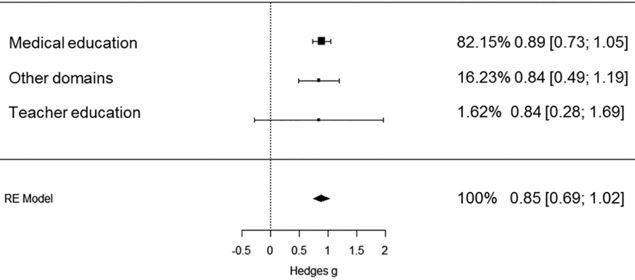
Simulation-based learning offers a wide range of opportunities to practice complex skills in higher education and to implement different types of scaffolding to facilitate effective learning. This meta-analysis includes 145 empirical studies and investigates the effectiveness of different scaffolding types and technology in simulation-based learning environments to facilitate complex skills. The simulations had a large positive overall effect: g = 0.85, SE = 0.08; CIs [0.69, 1.02]. Technology use and scaffolding had positive effects on learning. Learners with high prior knowledge benefited more from reflection phases; learners with low prior knowledge learned better when supported by examples. Findings were robust across different higher education domains (e.g., medical and teacher education, management). We conclude that (1) simulations are among the most effective means to facilitate learning of complex skills across domains and (2) different scaffolding types can facilitate simulation-based learning during different phases of the development of knowledge and skills.
Overview
CoChat Summary
TL;DR
This meta-analysis of 145 studies (10,532 participants) finds that simulation-based learning in higher education has a large positive overall effect on complex skills (g = 0.85, 95% CI [0.69, 1.02]). Effects vary by simulation features and prior knowledge, with examples/prompts helping lower-prior-knowledge learners and reflection phases helping higher-prior-knowledge learners.
Key findings
- Overall effect: g = 0.85, SE = 0.08, 95% CI [0.69, 1.02], N = 145 studies, 10,532 participants; heterogeneity was high: Q(409) = 4213.93, p < .0001, τ² = 1.2, I² = 95.86%.
- By complex skill: technical performance g = 1.06 (SE = 0.15), general problem solving g = 0.88 (SE = 0.11), diagnosing g = 0.82 (SE = 0.21), management g = 0.72 (SE = 0.30), teamwork g = 0.50 (SE = 0.08), communication g = 0.44 (SE = 0.15).
- Simulation features: live model g = 2.27 (N = 3), mixed g = 1.56, mannequin g = 0.96, virtual object g = 0.75, role play g = 0.63, document g = 0.31; technology: simulator g = 1.07, virtual reality g = 0.85, screen-based g = 0.68, no technology g = 0.74; high authenticity g = 0.86 vs low g = 0.58; duration: <1 hr g = 0.65, hours g = 0.81, days g = 0.80, >1 month g = 1.31 (N = 4).
- Scaffolding × prior knowledge: examples helped low-education learners (g = 1.15 vs high-education g = 0.56); prompts helped unfamiliar contexts (g = 0.85 vs no prompts g = 0.63) but not familiar contexts (g = 0.33 vs no prompts g = 0.96); reflection phases helped postgraduate learners (g = 1.10 vs no reflection g = 0.86) but not graduate/undergraduate learners (g = 0.52 vs no reflection g = 0.81).
Methods
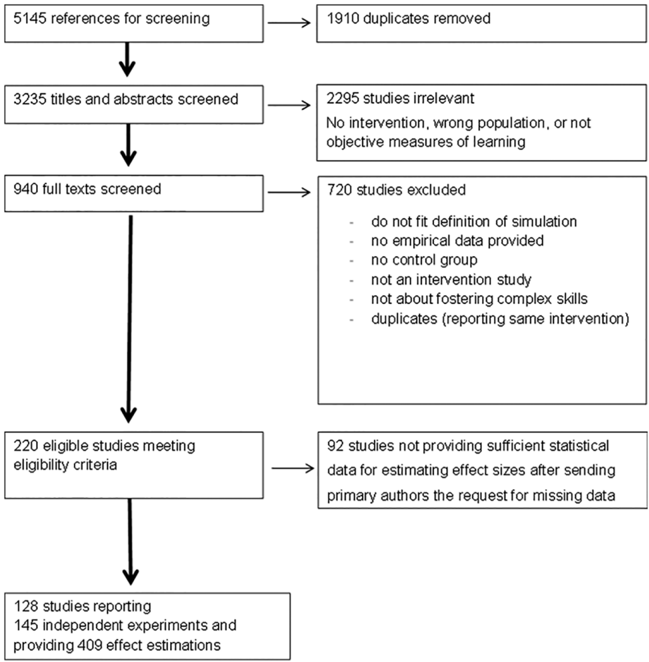
- Meta-analysis of 145 empirical studies (from 128 articles, 1979–2018) yielding 409 effect estimates and 10,532 participants; searched PsycINFO, PsycARTICLES, ERIC, and MEDLINE through April 2018; included experimental/quasi-experimental or within-subject pre-post studies with a control condition and objective measures of complex skills.
- Coded moderators included simulation type, technology use, duration, authenticity, scaffolding (examples, prompts, reflection phases), knowledge convey, prior knowledge (familiarity of context, level of education), complex skill type, domain, study design, and publication type.
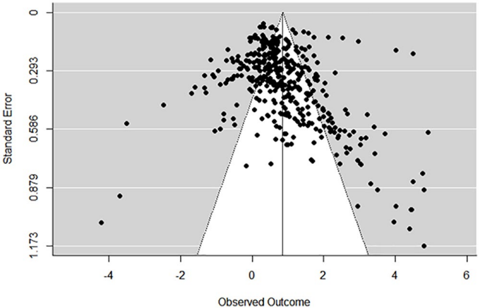
- Used Hedges’ g, random-effects models, robust variance estimation for correlated effects, pretest adjustment when available, heterogeneity Q/I², and publication-bias checks (Egger’s test, trim and fill); metaregression on control variables.
Limitations
- Stated: the focus is on complex skills involving interaction with people, so findings do not straightforwardly generalize to STEM domains such as science, mathematics, engineering, or informatics; a large proportion of findings come from medical education, so caution is needed for other domains, especially regarding technology, simulation type, outcome measures, and moderators.
- Stated: many primary studies gave little treatment description, insufficient for coding some moderators or finer distinctions; many implemented multiple instructional support measures, making specific effects hard to determine; the scaffolding framework may omit other supports such as feedback or fading/adding instruction; combinations could only be partially investigated; prior knowledge operationalization had drawbacks and explained only 4% of heterogeneity; implementation quality was assumed similar; large unexplained heterogeneity requires caution.
- Evident from the text: heterogeneity was very high (I² = 95.86%, τ² = 1.2), and several moderator estimates rest on very small numbers (e.g., live model N = 3, all scaffolding types N = 2, duration >1 month N = 4), so subgroup effects are unstable; presence/absence comparisons for examples, prompts, and reflections often did not reach significance.
Model-written summary. Check it against the paper before relying on it.
Integrity signals
Registry
Cites
Statistics
Figures

Verification
Claims the paper makes
1 Valid · 3 Not valid · 48 Not checked · 181 Own results and interpretations
At least one cited source doesn’t support this claim or points to a different paper, and none confirmed it — see the verdicts below.
In the paper
“However, they only focused on comparing simulations with a duration of more than 1 day with simulations of less than 1 day.”
§ Simulation-Based Learning in Higher Education: A Meta-Analysis > Simulations in Educational Contexts
What the sources say
- Disputedcites Cook et al., 2013 matched to “Technology-Enhanced Simulation to Assess Health Professionals: A Systematic Review of Validity Evidence, Research Methods, and Reporting Quality” (2013) sourceExperimental — accuracy not yet measured
Our copy of Cook et al. (2013) contains no duration contrast whatsoever: searches for 'simulation duration more than one day versus less than one day' and related phrasings returned only the study-coding tables. Those tables (sections 'List of all included studies, sorted by year of publication, with validity evidence and QUADAS-2 ratings (N=417 except for QUADAS-2)', pp. 17, 21, 23, 27, 32-35, and the parallel full-citation list, pp. 4-14) show the review's actual focus: charting validity evidence (content/response/process, internal structure, relations to other variables, consequences, reliability), methodological quality (MERSQI, selection/flow indices, RoB indices, QUADAS-2) and reporting across 417 technology-enhanced simulation assessment studies spanning many topics and instruments. That is contrary to the claim that the review 'only focused on comparing simulations with a duration of more than 1 day with simulations of less than 1 day'. Our copy is truncated at the end, but the retrieved structure of the review already contradicts the characterization; no alternative source for the duration comparison is named in our copy. (LLM, conf=0.72)
Checked by a reasoning model — may be wrong.
plain- Asserted: passes — The authors put it forward as true.
- Checkable: passes — It can be checked against evidence.
- Load-bearing: passes — The paper’s conclusions depend on it.
- Based: passes — The paper gives a reason why it holds.
- Disputed
The cited sources that could be checked couldn’t confirm or dispute this claim.
In the paper
“In their meta-analysis, Cook et al. (2013) provided supportive evidence of the effectiveness of distributed and repetitive practice (effects above .60)in the acquisition of complex skills in medical education.”
§ Simulation-Based Learning in Higher Education: A Meta-Analysis > Simulations in Educational Contexts
What the sources say
- Could not verifycites Cook et al., 2013 matched to “Technology-Enhanced Simulation to Assess Health Professionals: A Systematic Review of Validity Evidence, Research Methods, and Reporting Quality” (2013) sourceExperimental — accuracy not yet measured
Our copy of Cook et al. (2013) contains only the appendix material — the 'List of all included studies, sorted by year of publication, with full journal citation' (pp. 2-16) and the parallel table 'with validity evidence and QUADAS-2 ratings (N=417)' (pp. 20-35), which catalogue simulation-based ASSESSMENT validation studies with MERSQI scores, not pooled effects. Searches for 'distributed and repetitive practice', 'meta-analysis', 'effect size / Hedges g / random-effects', 'learning principles / repetition', and the paper's objective returned no narrative text at all, so nothing in our copy reports an effectiveness meta-analysis or effect magnitudes above .60. The copy is also flagged truncated, so the results/discussion where such a finding would appear may be missing; absence here is not evidence of a contrary statement, and no alternative source is named in the passages we hold. (LLM, conf=0.68)
plainstates a cause- Asserted: passes — The authors put it forward as true.
- Checkable: passes — It can be checked against evidence.
- Load-bearing: unclear — It is unclear whether the paper’s conclusions depend on it.
- Based: passes — The paper gives a reason why it holds.
- Could not verify
The cited sources support only part of this claim — read each source’s verdict below.
In the paper
“All these scaffolding measures were found to be beneficial for developing diagnostic competences (Chernikova et al., 2019).”
§ Simulation-Based Learning in Higher Education: A Meta-Analysis > Added Value of Instructional Support
What the sources say
- Partly supportedcites Chernikova et al., 2019 matched to “Facilitating Diagnostic Competences in Higher Education—a Meta-Analysis in Medical and Teacher Education” (2020) sourceExperimental — accuracy not yet measured
The meta-analysis does state broadly that all scaffolding types help ('as long as learners are able to practice problem-solving, all of the different types of scaffolding are beneficial', Theoretical Significance; echoed in Summary and Conclusion: roles, prompts and reflection phases 'have clear positive effects', with 'no indication for different effect sizes of different types of scaffolding'). But the claim drops the source's binding condition — the benefit holds only where learners' own problem-solving is preserved — and the source's results are not uniformly significant: in Effect of Scaffolding, settings with vs. without examples 'did not reach statistical significance' (Q(1,35)=2.85, p=.06), and Limitations warns that 'conclusions about the effectiveness of each scaffolding type should be made with caution'. So the flat 'all these scaffolding measures were found to be beneficial' overstates an explicitly conditional and hedged finding. (LLM, conf=0.72)
plainstates a cause- Asserted: passes — The authors put it forward as true.
- Checkable: passes — It can be checked against evidence.
- Load-bearing: passes — The paper’s conclusions depend on it.
- Based: passes — The paper gives a reason why it holds.
- Partly supported
A result the paper reports from its own data — it cites no other source for it, so there is none to check. The quote shows it is in the paper.
In the paper
“The 145 eligible studies (from 128 articles published in the period 1979-2018) provided 409 effect estimations (Figure 1).”
§ Simulation-Based Learning in Higher Education: A Meta-Analysis > Results of Literature Search
plainn = 10,532- Asserted: passes — The authors put it forward as true.
- Checkable: passes — It can be checked against evidence.
- Load-bearing: passes — The paper’s conclusions depend on it.
- Based: passes — The paper gives a reason why it holds.
A result the paper reports from its own data — it cites no other source for it, so there is none to check. The quote shows it is in the paper.
In the paper
“The most frequent combinations of instructional support measures were knowledge convey together with examples (82 effects), knowledge convey with reflection phases (62 effects), and examples with reflection phases (43 effects).”
§ Simulation-Based Learning in Higher Education: A Meta-Analysis > Results of Literature Search
plain- Asserted: passes — The authors put it forward as true.
- Checkable: passes — It can be checked against evidence.
- Load-bearing: unclear — It is unclear whether the paper’s conclusions depend on it.
- Based: passes — The paper gives a reason why it holds.
120 more claims
Create a free account to see all 233 claims and to verify the 44 references still open.
- It may state two separate claims as one. 61
- Probably not a substantial claim. 61
Claims other papers make about this one
Each is checked against this paper’s own text: does it say what the citing paper says it does?
In the citing paper
“Chernikova and colleagues have demonstrated in a meta-analysis that simulations of professional situations, such as interactions in a classroom for teachers, can be a beneficial tool during teacher training as they expose teachers to authentic problems in their fields51.”
From On opportunities and challenges of large multimodal foundation models in education (2025) · cites this paper as [51]
In the citing paper
“Meta-analytic findings indicate that simulations are among the most effective means to facilitate the learning of complex skills across domains, with technology-based and scaffolded simulations showing robust positive effects on learning outcomes [11].”
In the citing paper
“While several earlier reviews have examined the general benefits of simulation in nursing education [17], few have focused specifically on its role in bridging the theory–practice gap.”
From The impact of clinical simulation on bridging the theory–practice gap in nursing education: a systematic review (2025) · cites this paper as [17]
In the citing paper
“High-fidelity simulations were particularly associated with enhanced clinical judgment and decision-making accuracy [17, 29, 30].”
From The impact of clinical simulation on bridging the theory–practice gap in nursing education: a systematic review (2025) · cites this paper as [17]
In the citing paper
“These findings are supported by meta-analytic evidence from Chernikova et al., who concluded that simulation-based learning substantially improves decision-making and problem-solving skills in higher education, especially when paired with active learning strategies and structured debriefing [17].”
From The impact of clinical simulation on bridging the theory–practice gap in nursing education: a systematic review (2025) · cites this paper as [17]
Statistics recomputed
Every reported test result, recomputed from its test statistic and degrees of freedom. A result shows as not adding up only once an independent check has confirmed it.
- ConsistentQ(409) = 4213.93reported p < .0001 · recomputed p < .001
“Q (409) = 4213.93,p < .0001”
Self-check
Percentages, sums and reported differences re-computed from the paper’s own numbers.
Each contradiction between two passages listed here was confirmed by an independent check.
Rated major: it would touch a result — a value a result rests on, reported and recomputed p-values on opposite sides of the significance level, two passages that conflict with no sign which is right, or a cited work retracted before this paper was published.
In the paper
§ Simulation-Based Learning in Higher Education: A Meta-Analysis > Discussion
“However, the effects are greater if learners are unfamiliar with the context and the task.”
§ Simulation-Based Learning in Higher Education: A Meta-Analysis > Prior Professional Knowledge
“learners showed a lower increase of complex skills in an unfamiliar context (g = 0.67, SE = 0.10) than in a familiar context (g = 0.83, SE = 0.13)”
Rated minor: it would not touch a result — a value no result rests on, a p-value that stays on the same side of the significance level, or a conflict that is clerical, resolved elsewhere in the paper, or outside its own findings.
In the paper
§ Simulation-Based Learning in Higher Education: A Meta-Analysis > Results of Literature Search
“Most studies focused on general problem solving (51) or the technical performance of a particular complex procedure (56); the other outcomes were communication skills (24), diagnosing (18), managing critical situations (18), and collaboration and teamwork (5).”
§ Simulation-Based Learning in Higher Education: A Meta-Analysis > Conclusion
“2,493 (27) 0.46 91.03% | 911 (18) 0.76 92.02% | 6,010 (58) 0.47 91.23% | 2,543 (21) 1.04 97.15% | 810 (5) 0.03 66.07% | 2,933 (63) 1.25 91.10%”
Rated minor: it would not touch a result — a value no result rests on, a p-value that stays on the same side of the significance level, or a conflict that is clerical, resolved elsewhere in the paper, or outside its own findings.
In the paper
“(2) prompts as the only scaffolding method (N = 11)”
§ Simulation-Based Learning in Higher Education: A Meta-Analysis > Level of Education as an Indicator of Prior Knowledge and Experience
Reported 11 · recomputed 12
Rated minor: it would not touch a result — a value no result rests on, a p-value that stays on the same side of the significance level, or a conflict that is clerical, resolved elsewhere in the paper, or outside its own findings.
In the paper
§ Simulation-Based Learning in Higher Education: A Meta-Analysis > Discussion
“Despite these differences, simulations had effects that can be categorized as large positive effects for all but one type of skill.The exception is teamwork, where the meta-analysis found a medium positive effect only.”
§ Simulation-Based Learning in Higher Education: A Meta-Analysis > Overall Effect of Simulation-Based Learning on Complex Skills (Research Question 1)
“Communication and collaboration skills (teamwork) are only moderately facilitated by simulation-based learning (g = 0.44, SE = 0.15, and g = 0.50, SE = 0.08, respectively)”
Rated minor: it would not touch a result — a value no result rests on, a p-value that stays on the same side of the significance level, or a conflict that is clerical, resolved elsewhere in the paper, or outside its own findings.
In the paper
§ Simulation-Based Learning in Higher Education: A Meta-Analysis > Level of Education as an Indicator of Prior Knowledge and Experience
“however, introducing prompts was related to higher learning outcomes in the high-level group.”
§ Simulation-Based Learning in Higher Education: A Meta-Analysis > Level of Education as an Indicator of Prior Knowledge and Experience
“Similarly, introducing prompts for a high (postgraduate learners and practitioners) level (g = 0.50, SE = 0.36) was not beneficial for learning compared with simulations without prompts (g = 0.91, SE = 0.11).”
Citations
Cites
Measuring inconsistency in meta-analyses
Higgins, J. P. T., Thompson, S. G., Deeks, J. J., & Altman, D. G. (2003) · BMJ · doi:10.1136/bmj.327.7414.557 · Cited by 63,139 · cited 1×
“The thresholds suggested by Higgins et al. (2003) were used to interpret the I 2 (25% for low heterogeneity, 50% for medium, 75% for high heterogeneity).”
MethodBorenstein, M., Hedges, L. V., Higgins, J. P. T., & Rothstein, H. R. (2009) · doi:10.1002/9780470743386 · Cited by 14,225
Hattie, J., & Timperley, H. (2007) · Review of Educational Research · doi:10.3102/003465430298487 · Cited by 12,905
THE ROLE OF TUTORING IN PROBLEM SOLVING *
Wood, D., Bruner, J. S., & Ross, G. (1976) · Journal of Child Psychology and Psychiatry · doi:10.1111/j.1469-7610.1976.tb00381.x · Cited by 8,851 · cited 1×
“Scaffolding enables a learner to solve problems through modifying tasks and reducing possible pathways, and through hints helping the learner to coordinate the steps in problem solving or interaction (Quintana et al., 2004), by taking over some elements of learning material (Wood et al., 1976).”
BackgroundKirschner, P. A., Sweller, J., & Clark, R. E. (2006) · Educational Psychologist · doi:10.1207/s15326985ep4102_1 · Cited by 7,776 · cited 2×
“…suggesting that including simulations in a later phase of a higher education program after students already know theoretical concepts is promising in order to not overwhelm learners and block too much of their cognitive capacity for solving a problem in a simulation (e.g., Kirschner et al., 2006).”
BackgroundFunnel plots for detecting bias in meta-analysis
Sterne, J. A. C., & Egger, M. (2001) · Journal of Clinical Epidemiology · doi:10.1016/s0895-4356(01)00377-8 · Cited by 3,779 · cited 1×
“We have a relatively small sample of empirical studies and apply a range of techniques to identify possible biases (Egger’s test, trim and fill) and improve the generalizability of the results (Sterne & Egger, 2001).”
MethodEducational Psychology: A Cognitive View
Gagné, R. M., Ausubel, D. P., & Gagné, R. M. (1969) · American Educational Research Journal · doi:10.3102/00028312006002287 · Cited by 3,302
Educational Psychology: A Cognitive View
Gagné, R. M., Ausubel, D. P., & Gagne, R. M. (1969) · American Educational Research Journal · doi:10.2307/1161899 · Cited by 3,278
HMELO-SILVER, C. E., DUNCAN, R. G., & CHINN, C. A. (2007) · Educational Psychologist · doi:10.1080/00461520701263368 · Cited by 2,641 · cited 1×
“…problems, especially in early stages of expertise development, should be accompanied by scaffolding to maximize learning and avoid cognitive overload, distraction, or focusing on superficial features of a situation (see the discussions of Hmelo-Silver et al., 2007; Kirschner et al., 2006).”
BackgroundReflection and reflective practice in health professions education: a systematic review
Mann, K., Gordon, J., & MacLeod, A. (2009) · Advances in Health Sciences Education · doi:10.1007/s10459-007-9090-2 · Cited by 2,175 · cited 1×
“Reflection phases, on the other hand, allow learners to think about goals, analyze their own performance, and plan further steps (e.g., Mann et al., 2009), but they do not provide much guidance during the problem solving.”
Background
Research works printed but not linked: 4
- Funke, J. (Ed.). (2006). Denken und Problemlösen (pp. 375-446).
- Henninger, M., & Mandl, H. (2000). Vom Wissen zum Handeln-ein Ansatz zur Förderung kommunikativen Handelns [From knowledge to action-An approach for fostering communicative behavior]. In H. Mandl & J. Gerstenmaier (Eds.), Die Kluft zwischen Wissen und Handeln (pp. 197-219).
- Raven, J. (2000). Psychometrics, cognitive ability, and occupational performance. Review of Psychology, 7(1-2), 51-74.
- Veritas Health Innovation. (2019). Covidence systematic review software (online ver- sion) [Computer software]. https://www.covidence.org
Cited by
Items 1,101–1,200 of 1,412
Présentation du projet ARC Sim'Pro et des travaux de recherche en cours
Duvivier, V., Dave, M., Kinart, A., & Rocca, F. (2023) · ORBi UMONS
Kamışlı, S. (2026) · Nigerian Journal of Clinical Practice · doi:10.4103/njcp.njcp_518_25
Torres, F. J., Martínez-Ramírez, I., García, A. D. J. B., & Robles, E. H. (2026) · AppliedMath · doi:10.3390/appliedmath6030041
Zhang, L., Fang, X., Cheng, Y., & Yang, M. (2025) · International Conference on Educational Technology Management (ICETM) · doi:10.1109/icetm67477.2025.11413499
“Importantly, research suggests that the effectiveness of simulation-based learning can be enhanced when supported by scaffolding strategies such as learning-related feedback and guided reflection [22].”
Wono, A. L., Bell, A., & Bourne, E. (2026) · International Journal of Language & Communication Disorders · doi:10.1111/1460-6984.70221
“Simulated placements provide curated practice experiences that allow students to develop clinical competencies through practically applying knowledge and enacting practice specific skills (Chernikova et al. 2020 ; Ker and Bradley 2014 ).”
SEFI 53rd Annual Conference. European Society for Engineering Education (SEFI)
Marttila, M. P., Äijälä, M., Tedeschi, M., Shaw, M., & Levänen, J. (2026) · UTUPub (University of Turku)
Hubungan IPK dan Nilai Pretest Terhadap Hasil OSCE Mahasiswa pada Mata Kuliah Praktikum Farmakologi
A’laTarigan, A., Chaizuran, M., Siti Maria Ladia, P. S., & Zulkarnaini, Z. (2025) · Jurnal Pustaka Keperawatan (Pusat Akses kajian Keperawatan) · doi:10.55382/jurnalpustakakeperawatan.v4i2.1403
“Misalnya, penerapan simulasi, role-play, dan evaluasi formatif dapat membantu mahasiswa menghubungkan pengetahuan teoretis dengan keterampilan klinik yang diperlukan pada OSCE [16], [17].”
Rogers, S., Wedgbury, K., Wilson, S., Read, A., & Mairs, H. (2026) · Teaching and learning in nursing · doi:10.1016/j.teln.2026.02.022
Forest machine operator students’ experiences of simulation-based learning
Manu, M., Silvennoinen, M., Näykki, P., & Vesisenaho, M. (2026) · Nordic Journal of Vocational Education and Training · doi:10.3384/njvet.2242-458x.261636
“SBL is particularly beneficial in terms of its flexibility as learning environments can be adapted to learners’ needs (Chernikova et al., 2020), and skills to be practised can be either technical or non-technical such as teamwork, communication, and decision-making (Østergaard et al., 2011).”
Adaptive guidance in simulation-based inquiry: effects on inquiry performance and learning outcomes
Jain, M. (n.d.) · Summit (Simon Fraser University)
Arnaudova, R., Salvá-García, P., Hewawasam, S., Pahadee, B., Buafi, B., Akinbami, O., Onoyima, T., & Fandi, W. A. (2026) · Procedia Computer Science · doi:10.1016/j.procs.2026.03.149
Khan, B. J., & Nyaiteera, V. (2026) · Research Square · doi:10.21203/rs.3.rs-9110539/v1
Robles, A., & Dotger, B. H. (2026) · Journal of First-generation Student Success · doi:10.1080/26906015.2026.2627304
Stone, L., McGurgan, P., Petrohilos, R., Fisher, R., Fleming, S. S., & Senior, T. (2026) · Cambridge University Press eBooks · doi:10.1017/9781009673037.009
Mahdi, L. K., Denyer, G. S., & Costabile, M. (2026) · Journal of Microbiology and Biology Education · doi:10.1128/jmbe.00052-26
“It allows students to engage with complex technologies and procedures in a risk-free setting, enabling repeated practice with immediate feedback (3, 4).”
The Health Insurance Game – A Simulation Game and a Simulation of a Health Economic Experiment
Alf, T., Wasem, J., & Buchner, F. (2026) · Lecture notes in computer science · doi:10.1007/978-3-032-20129-4_10
LEGO® SERIOUS PLAY® and Simulation Games: A Meaningful Combination or a Distracting Influence?
Freese, M., Gründler, H.-C., Hövelborn, P., Kriz, W. C., Meidert, N., Wittenzellner, H., Zeiner-Fink, S., Zumhasch, S., & Zürn, B. (2026) · Lecture notes in computer science · doi:10.1007/978-3-032-20129-4_4
AI for Simulation Operations: A Framework for Administrative and Logistical Excellence
Herrington, A., & Rutherford-Hemming, T. (2026) · Simulation in Healthcare The Journal of the Society for Simulation in Healthcare · doi:10.1097/sih.0000000000000932
Pedagogical Foundations for Designing Digital Educational Tools in Engineering Education
Tulebekova, A., & Kulisz, M. (2026) · Trudy Universiteta · doi:10.52209/1609-1825_2026_1_282
Carlino, F., & Searight, H. R. (2026) · International and cultural psychology/International and cultural psychology series · doi:10.1007/978-3-032-09977-8_13
Kidayi, P., Mtuya, C. C., Risa, C. F., & Rogathi, J. J. (2026) · Healthcare · doi:10.3390/healthcare14080994
“This has been reported to facilitate the acquisition of targeted skills [6,8].”
Saeteros, J. M., Mendoza, E., Ramírez, J. B. R., Fajardo-Pruna, M., Buele, J., Yumbla, F., & Saldarriaga, C. X. (2026) · Frontiers in Education · doi:10.3389/feduc.2026.1808715
Implementation of VisualizeIT: An Interactive Simulation Platform for Engineering Education
Shankhapal, K., Suryawanshi, Y., Sonawane, S. S., Palde, S., -, P. N., & Birari, D. A. (2026) · International Journal of Science Strategic Management and Technology · doi:10.55041/ijsmt.v2i4.177
Handoko, W., & Halim, E. (2026) · Lecture notes in networks and systems · doi:10.1007/978-3-032-14750-9_9
Liu, H., Tuerxun, N., & Chen, J. (2026) · Research Square · doi:10.21203/rs.3.rs-9368123/v1
Hanifah, S., Suryani, E., Santika, G., & Astuti, T. N. (2026) · Dalton Jurnal Pendidikan Kimia dan Ilmu Kimia · doi:10.31602/dl.v9i1.22113
“Hal ini sejalan dengan pendapat Chernikova et al. (2020) yang menyatakan bahwa pembelajaran berbasis simulasi menawarkan berbagai peluang bagi mahasiswa untuk melatih keterampilan kompleks dan dipandang sebagai pendekatan yang efektif dalam memfasilitasi pembelajaran lintas disiplin.”
SimuNEX: A 3-D Simulation Framework for Teaching Control Systems
Bissessar, L., Ramlal, C. J., & Singh, A. (2026) · IEEE Transactions on Learning Technologies · doi:10.1109/tlt.2026.3684021
Axt, C. (2026) · International Journal of Speech-Language Pathology · doi:10.1080/17549507.2026.2652490
Sobada, A., Meyer, J., Cameron, E., & Carolus, G. (2026) · Panorama of emergency medicine. · doi:10.26738/poem.v4i1.3
“The immersive nature of these MRS promotes situated cognition, where learning is deeply embedded in the context of practice [8] .”
Whitney, K. (2026) · ThinkIR: The University of Louisville's Institutional Repository (University of Louisville)
Ahn, S., Kim, S., & Valdes, J. (2026) · Springer international handbooks of education · doi:10.1007/978-3-031-88898-4_24-1
Carbajal, M. E. R. (2024) · LA Referencia (Red Federada de Repositorios Institucionales de Publicaciones Científicas)
Jung, H., & Shin, S. (2026) · Interactive Learning Environments · doi:10.1080/10494820.2026.2662457
“Technical and applied fields, such as engineering and computer science, benefit from interactive tasks such as simulations and hands-on problem-solving (Chernikova et al., 2020).”
Sanja, R. P. K. (2025) · Darshan - The International Journal of Commerce and Management (DIJCM) · doi:10.56360/dijcm/5.ii.2025.2513
Primero, G. A. A., Nebrida, J. M., Yaos, J. A. B., Balawid, R. J. C., Carino, C. D. P., & Jimena, M. A. M. (2026) · Journal of Rural Tourism · doi:10.70310/jrt.2026.030212114 · Cited by 1
Richters, C., Stadler, M. J., Braun, L., Fischer, M. R., & Heitzmann, N. (2026) · Journal of Computer Assisted Learning · doi:10.1002/jcal.70251
Self-citationDesigning Gaze-Adaptive Immersive Learning Support
Liu, S. (2026) · Repository KITopen (Karlsruhe Institute of Technology) · doi:10.5445/ir/1000192592
Criminology meets nursing simulated technology: Taking blended learning in new directions.
Lee, N., & Salje, J. (2026) · Journal of Perspectives in Applied Academic Practice · doi:10.56433/qmv93m13
“SBE can also offer wide ranging opportunities for students to implement practical, complex skills and use them to support various types of scaffolding to develop effective learning opportunities and environments (Chernikova et al., 2020).”
InfluentialAdvancing Robotics Programming Education With AI: Virtual Simulation and LLM-Assisted Learning
Wang, H., Zong, J., Qin, Y., Han, J., Gao, Z., Liu, J. T., & Xu, L. (2026) · IEEE Transactions on Education · doi:10.1109/te.2026.3684007
“Chernikova et al. [23] emphasize the importance of sca ff olding and instructional design in maximizing the e ffi cacy of simulation-based learning.”
Cuesta, M. H. B., Gómez, C. A., González, P. S. M., García, M. Á. F., & Aguado, M. P. Q. (2026) · Revista Española de Educación Médica · doi:10.6018/edumed.709741
Gamification in Public Sector Training: Evidence from Ireland
Udeh, S. O. U. (2026) · Indonesian Journal of Pedagogy and Teacher Education · doi:10.58723/ijopate.v4i1.675
“Simulation-based environments enhance adaptive expertise and resilience by enabling safe experimentation (Chernikova et al., 2020).”
InfluentialHarsami, T., Usman, N., Niswanto, N., & Afaidi, M. I. (2026) · Al-Madrasah Jurnal Pendidikan Madrasah Ibtidaiyah · doi:10.35931/am.v10i2.5766
The Panther Dig: A Vibrant, Interdisciplinary Teaching Model Using a Simulated Archaeological Dig
Litteral, D. J. (2026) · IGI Global eBooks · doi:10.4018/979-8-3373-6603-6.ch010
Cyr, E. R., Kuszajewski, M. L., Pitman, J. S., & Simmons, V. C. (2026) · Air Medical Journal · doi:10.1016/j.amj.2026.04.005
Tang, S., & Malaluan, L. A. (2025) · Journal of Chemical Learning Innovation. · doi:10.37251/jocli.v2i2.2966
Kerangka konseptual untuk mengembangkan kembali bimbingan karier dalam pendidikan kejuruan
Rama, A., & Lofandri, W. (2025) · Education and Social Sciences Review · doi:10.29210/07essr680100
“Misalnya, simulasi skenario volatil dalam pelatihan dapat membantu siswa mengembangkan kemampuan beradaptasi di lingkungan kerja yang tidak dapat diprediksi (Chernikova et al., 2020).”
Sadad, I. A., Joko, J. B. P., & Hartono, H. (2026) · Physics Communication · doi:10.15294/pc.v10i1.31500
Coulon, T., Barondeau, R., Bourdeau, S., & Hémond, Y. (2026) · The International Journal of Management Education · doi:10.1016/j.ijme.2026.101444
The EduAI Project: AI Tools Across the Teaching Cycle
Çetin, G., Şahin, M. A., Çifçi, H., Viana, C. L., da Silva-Pina, A. J., Roque, M., & Edison, A. (2026) · Springer texts in education · doi:10.1007/978-3-032-18806-9_14
Ahmed, M. H., Srivastava, U., Das, R., & Goyal, S. (2026) · Journal of Computational and Nonlinear Dynamics · doi:10.1115/1.4071926
Students’ knowledge and perceptions of Indigenous peoples and cultures
Varis, D. D., Samaranayake, R., & Miller, T. (2026) · Diaspora Indigenous and Minority Education · doi:10.1080/15595692.2026.2669085
Regidor, M. G., & Faller, E. (2026) · International Journal of Education, Research, and Innovation Perspectives · doi:10.5281/zenodo.20260291
Mat, S. T. B., Kızıl, H., Baştarcan, Ç., Karaca, E., & Sabandüzen, H. (2026) · Higher Education Skills and Work-based Learning · doi:10.1108/heswbl-01-2026-0014
Oommen, S., Jeena Vijayan, P. V., & Banbakode, P. (2026) · Asian Journal of Nursing Education and Research · doi:10.52711/2349-2996.2026.00023
Gow, P., Laurie, T., & Stevenson, S. (2026) · The UWS Academic Portal (University of the West of Scotland)
Applying Minecraft Education as a Simulation Tool for Teaching Construction Management
Lozano, M., Brioso, X., Herrera, R. F., & Morillo, T. (2026) · International Journal of Construction Education and Research · doi:10.1080/15578771.2026.2673923
Waskita, G. S., Nurani, Hidayati, A., Sutantri, & Ashari, D. R. W. (2026) · Penamas Journal of Community Service · doi:10.53088/penamas.v6i2.3128
“…aligns with contemporary vocational education literature emphasizing the importance of contextualized learning environments, sectoral awareness-building, and experiential pedagogy in strengthening vocational competency development (Chernikova et al., 2020; Howell, 2021; Fania et al., 2025).”
Mouatarif, F. A. E., jalil, Z. A., Rim, K., Bennour, Z., & Ihsane, B. (2026) · European Journal of Education and Pedagogy · doi:10.24018/ejedu.2026.7.1.70058
“Immersive simulation represents an innovative teaching approach, offering numerous benefits, including the acquisition of complex skills and enhancing students’ problem-solving and decision-making abilities (Chernikova et al ., 2020; D’Angelo et al ., 2014).”
Sarango, M. V. P., Parra, E. G. B., Chavez, K. V. C., Niza, E. F. N., Carrión, J. C. A., & Andrade, J. V. M. (2026) · South Florida Journal of Development · doi:10.46932/sfjdv7n5-027
Soliman, M. W., Rashwan, M. N., & Kamel, T. M. (2022) · Evolutionary Studies in Imaginative Culture · doi:10.70082/esiculture.vi.3122
Vainionpää, M., Kaila, S., & Melto, S. (2026) · Theseus (Ammattikorkeakoulujen)
ВИКОРИСТАННЯ ІНТЕРАКТИВНИХ МЕТОДІВ НАВЧАННЯ У ФОРМУВАННІ БЕЗПЕКОВИХ НАВИЧОК СТУДЕНТІВ
Kamenchuk, T. O. (2026) · Наука і техніка сьогодні · doi:10.52058/2786-6025-2026-4(58)-1459-1469
Fatimah, S., Ahman, A., Suherman, U., & Ilfiandra, I. (2026) · Counsenesia Indonesian Journal Of Guidance and Counseling · doi:10.36728/cijgc.v7i1.6460
Constructing Reality: Comparing Simulation Modalities in Initial Teacher Education
Fossey, R., Counihan, C., Nichol, D., Luke, C., Cole, M., Meller, S., Davies, J., Barker, L., Anderson, A., Hudson, K., et al. (2026) · Education Sciences · doi:10.3390/educsci16060891 · Cited by 1
MALABANAN, A. A. (2026) · European Modern Studies Journal · doi:10.59573/emsj.10(2).2026.17
Development and Effectiveness of Electrical Trainer in Basic Electrical Connection
JORE, M. C. (2026) · IARJSET · doi:10.17148/iarjset.2026.13610
Designing a Layered Learning Infrastructure with a Digital Twin Component
Aksovaara, S., Haapala, H., & Silvennoinen, M. (2026) · Bled eConference · doi:10.18690/um.fov.4.2026.5
Rodríguez-Rivera, P., León, A. M., & Rodríguez-Ferrer, J. M. (2026) · Advances in computational intelligence and robotics book series · doi:10.4018/979-8-3373-7472-7.ch005
Gómez-Pérez, L. S., Ordaz, A., Barradas, J. S. A., & Martínez, C. R. (2026) · IEEE World Engineering Education Conference (EDUNINE) · doi:10.1109/edunine62390.2026.11546720
“In this context, simulation-based learning emerges as a complementary strategy that enhances conceptual understanding while mitigating resource limitations [5].”
Toktarbekova, K., Kalykbayeva, A., Stelmakh, S. A., Autayeva, A., Paylozyan, Z., & Tyulyupergeneva, R. Z. (2026) · Frontiers in Education · doi:10.3389/feduc.2026.1807445
Wang, Y., Li, C., Li, J., Vajravelu, A., & Kakade, K. (2026) · IEEE International Conference on Quantum Photonics, Artificial Intelligence & Networking (QPAIN) · doi:10.1109/qpain69676.2026.11545529
“…research focused on simulation-based learning (SBL) within higher learning settings, meta-analytical studies demonstrate that more fundamental and quantitative studies are needed to determine the impact that features of simulation design and pedagogical influences have on learning outcomes [7] [8].”
Ugur, V., & Villemson, S. (2026) · DSpace repository (University of Tartu)
Fang, Y., An, R., & Fang, C. (2026) · Springer eBooks · doi:10.1007/978-3-032-18443-6_20
Tigabu, L., Sidhu, A., Hayashi, R., Person, E. C., & Donnelly-Hermosillo, D. F. (2026) · Journal of Science Education and Technology · doi:10.1007/s10956-026-10335-3
Cheng, F., & Sangsawang, T. (2026) · Educational Gerontology · doi:10.1080/03601277.2026.2682500
Plachynda, T., & Dovga, T. (2026) · Education in the 21st Century · doi:10.46991/educ-21st-century.v8.i1.044
“Furthermore, empirical studies indicate that simulations allow learners to connect theoretical knowledge with professional practice and develop higher-order cognitive skills such as problem-solving and decision-making (Chernikova et al., 2020; Saputra et al., 2022).”
Черненко, О. (2026) · Педагогічні науки теорія історія інноваційні технології · doi:10.24139/2312-5993/2026.01(2)/143-153
Taga, J. R. A., Gelacio, J., & Cabiling, H. J. (2026) · International Journal of Technology in Education · doi:10.46328/ijte.6201
Jirasophin, L. (2026) · World Journal of Education · doi:10.5430/wje.v16n2p17
Lenk-Ostendorf, B., Thaller, A., Brudermann, T., & Krusche, S. (2026) · Environmental Research Communications · doi:10.1088/2515-7620/ae7fdd
“This result partially aligns with prior meta-analyses showing small to medium effects of simulations and serious games on learning outcomes (Sitzmann 2011, Lamb et al 2018, Chernikova et al 2020).”
Sotsiaalteaduslik simulatsioon organisatsioonilise küberturbe mõõtmisel
Oruaas, H. (2026) · DSpace repository (University of Tartu)
Simulated practice-based learning: Creating the opportunity for the profession to learn
Grant, T., Turner, S., & Hay, C. (2026) · British Journal of Occupational Therapy · doi:10.1177/03080226261461175
Angelini, M. L., & Pop, R. (2026) · Springer international handbooks of education · doi:10.1007/978-3-032-10711-4_118-1
Samala, A. D., Howard, N.-J., Ferdian, F., Maral, M., Fiandra, Y. A., & Daineko, Y. A. (2026) · Social Sciences & Humanities Open · doi:10.1016/j.ssaho.2026.103154
Clement, S., Seethalakshmi, A., Al-Maskari, M. A., Arulappan, J., & Ramakrishnan, R. (2026) · Nursing Forum · doi:10.1155/nuf/3292180
Enhancing Student Teachers’ Ability to teach Controversial Issues through Simulation Training
Samuelsson, M., Hansson, P.-O., & Höög, M.-L. (2026) · Nordidactica · doi:10.62902/nordidactica.v16i2026:2.27681
Joe, Y., Lee, H., Choi, H., & Ryu, J. (2026) · International Conference of the Immersive Learning Research Network (iLRN) · doi:10.56198/00m5y980
Multimodal Analytics of Cybersecurity Crisis Preparation Exercises: What Predicts Success?
Borchers, C., Švábenský, V., Kafle, S. K., Tang, K. K., & Vykopal, J. (2026) · Lecture notes in computer science · doi:10.1007/978-3-032-29760-0_47
“Prior meta-analyses of scenario-based learning similarly show that scaffolds improve outcomes by aligning what learners actually do with the targeted cognitive demands, not by merely increasing task difficulty [16,15].”
Fitriani, R., Ayshar, R., Asrial, A., & Syaiful, S. (2026) · Indonesian Journal of Education Research (IJoER) · doi:10.37251/ijoer.v7i3.3482
“…simulation-based and AI-enhanced science learning environments indicate that interactive representations, modelling tools, and adaptive scaffolding can facilitate conceptual understanding by enabling students to explore scientific phenomena, test explanations, and revise misconceptions [28].”
InfluentialStructural Barriers to Vocational Certification in Nonformal Maritime TVET in Remote IndonesiaPreprint
Novian, D., Rafiq, A. A., Triyono, M. B., Pratama, G. N. I. P., Ferdian, F., Sakti, B., & Wardani, R. (2026) · Research Square · doi:10.21203/rs.3.rs-9635579/v1
Madsong, C., Tongtham, A., & Dhippayom, T. (2026) · BMC Medical Education · doi:10.1186/s12909-026-09792-6
Design Considerations for Adaptive Training in Scenario-Based Learning Environments
Bell, B., & Berman, T. (2026) · Lecture notes in computer science · doi:10.1007/978-3-032-30015-7_18
Shchegolyeva, T. (2026) · Academic Visions · doi:10.66556/2786-586x.52.shchegolyeva-t
Steinberg, E., Yanagida, T., Marsch, S., Dörrenbächer‐Ulrich, L., Schwarz, L., Auer, U., Pfeiffer, C., Bührle, P., Smith, A. E., & Perels, F. (2026) · Journal of Veterinary Medical Education · doi:10.3138/jvme-2025-0023
Ercan, F., & Özkan, Y. (2026) · Journal of Social and Educational Research · doi:10.66028/jser.51202684
Evaluating a pilot session for nursing students with schoolchildren as simulated patients
Reddy, H., Holliday, L., Clarke, L., Whittaker, C., Wilson, V., & Jackson, J. E. (2026) · Nursing Children and Young People · doi:10.7748/ncyp.2026.e1585
Metadata
- Authors
- Chernikova, O., Heitzmann, N., Stadler, M., Holzberger, D., Seidel, T., & Fischer, F.
- Affiliations
- Ludwig-Maximilians-Universität München (DE)
- Technical University of Munich (DE)
- Venue
- Review of Educational Research
- Published
- 2020-06-15
- Volume
- 90
- Issue
- 4
- Pages
- 499-541
- ISSN
- 0034-6543 (ISSN-L)
- 1935-1046
- OpenAlex
- W3039587732
- Semantic Scholar
- af60f6e1157bbec85ef6f0012608e01e0a6bd6a9
- Cited by
- 1,072
- References
- 171
- Citations by year
- 2026: 206 · 2025: 267 · 2024: 214 · 2023: 174 · 2022: 129 · 2021: 69 · 2020: 10
- FWCI
- 32.44
- Type
- journal article
- Language
- en
- Open access
- hybrid
- doi.org
- Locations
- Review of Educational Research (publishedVersion, cc-by)
- Open access LMU (Ludwid Maxmilian's Universitat Munchen) (submittedVersion, cc-by)
- mediaTUM – the media and publications repository of the Technical University Munich (Technical University Munich) (submittedVersion, other-oa)
- mediaTUM – the media and publications repository of the Technical University Munich (Technical University Munich) (submittedVersion)
- Funders
- Deutsche Forschungsgemeinschaft (DFG 2385)
- Topics
- Social Sciences › Education › Innovative Teaching Methodologies in Social Sciences
- Social Sciences › Education › Simulation-Based Education in Healthcare
- Social Sciences › Psychology › Developmental and Educational Psychology › Innovative Teaching and Learning Methods
- Keywords
- simulation-based training, scaffolding, complex skills, higher education, prior knowledge, reflection, examples, educational technology, medical education, teacher professional development, management education
About these checks
Registry, retraction, Cites and statistics results are computed, not judged, with one exception: a printed reference that no index lists is read once by a model before it counts as a citation error. Claims are extracted by a model and kept only when their quote appears verbatim in the text; each cited source is then checked, with a model’s help, for whether it says what the claim relies on. Those verdicts can be wrong — read the claim’s quote and the cited source before relying on one.
The claim verdicts this report counts are experimental: their accuracy is not yet measured.
A language model drew the claims from the paper on 2026-11-16, under version 3 of the claim definition (model deepseek-v4.1-flash, prompt extract-v3).
A second model labelled each claim on 2026-11-16 (model jev-1.13-20260917, definition revision gold-guideline-v0.2).
Cited sources are checked with a language model’s help (qwen3.8-omni-flash).
Statistics and arithmetic are recomputed, not judged.
Confidence bands are shown only for fields calibrated on our annotated test set. None is calibrated yet, so no band is shown.
What counts as a claim ›How we measure confidence ›How we check this ›
Are you an author, or do you see a problem with this page? Request a review
Data sources
Bibliographic data: Semantic Scholar, OpenAlex, Crossref.
Contains information from the Semantic Scholar Academic Graph Datasets, made available under the ODC Attribution License (ODC-BY 1.0).
Semantic Scholar’s data is described in: Kinney, R., et al. (2023). The Semantic Scholar Open Data Platform. arXiv:2301.10140.
