

Simulation-Based Learning in Higher Education: A Meta-Analysis
Open accessThe DOI matches its Crossref record; 172 of the 173 references it cites were found in a registry or an index; 3 of the 59 sources its claims cite were checked for support.
Abstract
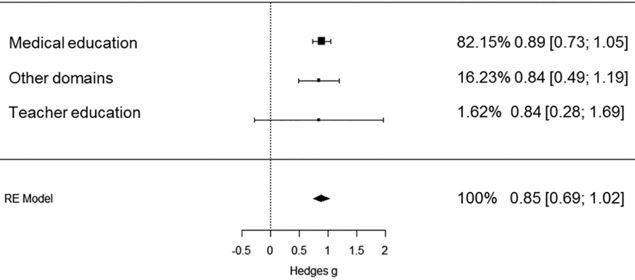
Simulation-based learning offers a wide range of opportunities to practice complex skills in higher education and to implement different types of scaffolding to facilitate effective learning. This meta-analysis includes 145 empirical studies and investigates the effectiveness of different scaffolding types and technology in simulation-based learning environments to facilitate complex skills. The simulations had a large positive overall effect: g = 0.85, SE = 0.08; CIs [0.69, 1.02]. Technology use and scaffolding had positive effects on learning. Learners with high prior knowledge benefited more from reflection phases; learners with low prior knowledge learned better when supported by examples. Findings were robust across different higher education domains (e.g., medical and teacher education, management). We conclude that (1) simulations are among the most effective means to facilitate learning of complex skills across domains and (2) different scaffolding types can facilitate simulation-based learning during different phases of the development of knowledge and skills.
Overview
CoChat Summary
TL;DR
This meta-analysis of 145 studies (10,532 participants) finds that simulation-based learning in higher education has a large positive overall effect on complex skills (g = 0.85, 95% CI [0.69, 1.02]). Effects vary by simulation features and prior knowledge, with examples/prompts helping lower-prior-knowledge learners and reflection phases helping higher-prior-knowledge learners.
Key findings
- Overall effect: g = 0.85, SE = 0.08, 95% CI [0.69, 1.02], N = 145 studies, 10,532 participants; heterogeneity was high: Q(409) = 4213.93, p < .0001, τ² = 1.2, I² = 95.86%.
- By complex skill: technical performance g = 1.06 (SE = 0.15), general problem solving g = 0.88 (SE = 0.11), diagnosing g = 0.82 (SE = 0.21), management g = 0.72 (SE = 0.30), teamwork g = 0.50 (SE = 0.08), communication g = 0.44 (SE = 0.15).
- Simulation features: live model g = 2.27 (N = 3), mixed g = 1.56, mannequin g = 0.96, virtual object g = 0.75, role play g = 0.63, document g = 0.31; technology: simulator g = 1.07, virtual reality g = 0.85, screen-based g = 0.68, no technology g = 0.74; high authenticity g = 0.86 vs low g = 0.58; duration: <1 hr g = 0.65, hours g = 0.81, days g = 0.80, >1 month g = 1.31 (N = 4).
- Scaffolding × prior knowledge: examples helped low-education learners (g = 1.15 vs high-education g = 0.56); prompts helped unfamiliar contexts (g = 0.85 vs no prompts g = 0.63) but not familiar contexts (g = 0.33 vs no prompts g = 0.96); reflection phases helped postgraduate learners (g = 1.10 vs no reflection g = 0.86) but not graduate/undergraduate learners (g = 0.52 vs no reflection g = 0.81).
Methods
- Meta-analysis of 145 empirical studies (from 128 articles, 1979–2018) yielding 409 effect estimates and 10,532 participants; searched PsycINFO, PsycARTICLES, ERIC, and MEDLINE through April 2018; included experimental/quasi-experimental or within-subject pre-post studies with a control condition and objective measures of complex skills.
- Coded moderators included simulation type, technology use, duration, authenticity, scaffolding (examples, prompts, reflection phases), knowledge convey, prior knowledge (familiarity of context, level of education), complex skill type, domain, study design, and publication type.
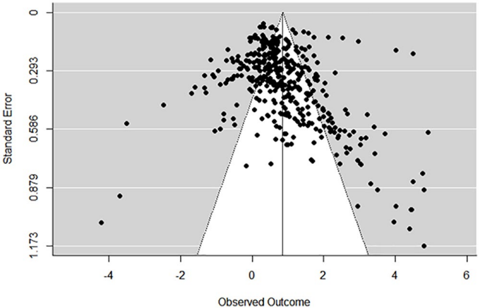
- Used Hedges’ g, random-effects models, robust variance estimation for correlated effects, pretest adjustment when available, heterogeneity Q/I², and publication-bias checks (Egger’s test, trim and fill); metaregression on control variables.
Limitations
- Stated: the focus is on complex skills involving interaction with people, so findings do not straightforwardly generalize to STEM domains such as science, mathematics, engineering, or informatics; a large proportion of findings come from medical education, so caution is needed for other domains, especially regarding technology, simulation type, outcome measures, and moderators.
- Stated: many primary studies gave little treatment description, insufficient for coding some moderators or finer distinctions; many implemented multiple instructional support measures, making specific effects hard to determine; the scaffolding framework may omit other supports such as feedback or fading/adding instruction; combinations could only be partially investigated; prior knowledge operationalization had drawbacks and explained only 4% of heterogeneity; implementation quality was assumed similar; large unexplained heterogeneity requires caution.
- Evident from the text: heterogeneity was very high (I² = 95.86%, τ² = 1.2), and several moderator estimates rest on very small numbers (e.g., live model N = 3, all scaffolding types N = 2, duration >1 month N = 4), so subgroup effects are unstable; presence/absence comparisons for examples, prompts, and reflections often did not reach significance.
Model-written summary. Check it against the paper before relying on it.
Integrity signals
Registry
Cites
Statistics
Figures

Verification
Claims the paper makes
1 Valid · 3 Not valid · 48 Not checked · 181 Own results and interpretations
At least one cited source doesn’t support this claim or points to a different paper, and none confirmed it — see the verdicts below.
In the paper
“However, they only focused on comparing simulations with a duration of more than 1 day with simulations of less than 1 day.”
§ Simulation-Based Learning in Higher Education: A Meta-Analysis > Simulations in Educational Contexts
What the sources say
- Disputedcites Cook et al., 2013 matched to “Technology-Enhanced Simulation to Assess Health Professionals: A Systematic Review of Validity Evidence, Research Methods, and Reporting Quality” (2013) sourceExperimental — accuracy not yet measured
Our copy of Cook et al. (2013) contains no duration contrast whatsoever: searches for 'simulation duration more than one day versus less than one day' and related phrasings returned only the study-coding tables. Those tables (sections 'List of all included studies, sorted by year of publication, with validity evidence and QUADAS-2 ratings (N=417 except for QUADAS-2)', pp. 17, 21, 23, 27, 32-35, and the parallel full-citation list, pp. 4-14) show the review's actual focus: charting validity evidence (content/response/process, internal structure, relations to other variables, consequences, reliability), methodological quality (MERSQI, selection/flow indices, RoB indices, QUADAS-2) and reporting across 417 technology-enhanced simulation assessment studies spanning many topics and instruments. That is contrary to the claim that the review 'only focused on comparing simulations with a duration of more than 1 day with simulations of less than 1 day'. Our copy is truncated at the end, but the retrieved structure of the review already contradicts the characterization; no alternative source for the duration comparison is named in our copy. (LLM, conf=0.72)
Checked by a reasoning model — may be wrong.
plain- Asserted: passes — The authors put it forward as true.
- Checkable: passes — It can be checked against evidence.
- Load-bearing: passes — The paper’s conclusions depend on it.
- Based: passes — The paper gives a reason why it holds.
- Disputed
The cited sources that could be checked couldn’t confirm or dispute this claim.
In the paper
“In their meta-analysis, Cook et al. (2013) provided supportive evidence of the effectiveness of distributed and repetitive practice (effects above .60)in the acquisition of complex skills in medical education.”
§ Simulation-Based Learning in Higher Education: A Meta-Analysis > Simulations in Educational Contexts
What the sources say
- Could not verifycites Cook et al., 2013 matched to “Technology-Enhanced Simulation to Assess Health Professionals: A Systematic Review of Validity Evidence, Research Methods, and Reporting Quality” (2013) sourceExperimental — accuracy not yet measured
Our copy of Cook et al. (2013) contains only the appendix material — the 'List of all included studies, sorted by year of publication, with full journal citation' (pp. 2-16) and the parallel table 'with validity evidence and QUADAS-2 ratings (N=417)' (pp. 20-35), which catalogue simulation-based ASSESSMENT validation studies with MERSQI scores, not pooled effects. Searches for 'distributed and repetitive practice', 'meta-analysis', 'effect size / Hedges g / random-effects', 'learning principles / repetition', and the paper's objective returned no narrative text at all, so nothing in our copy reports an effectiveness meta-analysis or effect magnitudes above .60. The copy is also flagged truncated, so the results/discussion where such a finding would appear may be missing; absence here is not evidence of a contrary statement, and no alternative source is named in the passages we hold. (LLM, conf=0.68)
plainstates a cause- Asserted: passes — The authors put it forward as true.
- Checkable: passes — It can be checked against evidence.
- Load-bearing: unclear — It is unclear whether the paper’s conclusions depend on it.
- Based: passes — The paper gives a reason why it holds.
- Could not verify
The cited sources support only part of this claim — read each source’s verdict below.
In the paper
“All these scaffolding measures were found to be beneficial for developing diagnostic competences (Chernikova et al., 2019).”
§ Simulation-Based Learning in Higher Education: A Meta-Analysis > Added Value of Instructional Support
What the sources say
- Partly supportedcites Chernikova et al., 2019 matched to “Facilitating Diagnostic Competences in Higher Education—a Meta-Analysis in Medical and Teacher Education” (2020) sourceExperimental — accuracy not yet measured
The meta-analysis does state broadly that all scaffolding types help ('as long as learners are able to practice problem-solving, all of the different types of scaffolding are beneficial', Theoretical Significance; echoed in Summary and Conclusion: roles, prompts and reflection phases 'have clear positive effects', with 'no indication for different effect sizes of different types of scaffolding'). But the claim drops the source's binding condition — the benefit holds only where learners' own problem-solving is preserved — and the source's results are not uniformly significant: in Effect of Scaffolding, settings with vs. without examples 'did not reach statistical significance' (Q(1,35)=2.85, p=.06), and Limitations warns that 'conclusions about the effectiveness of each scaffolding type should be made with caution'. So the flat 'all these scaffolding measures were found to be beneficial' overstates an explicitly conditional and hedged finding. (LLM, conf=0.72)
plainstates a cause- Asserted: passes — The authors put it forward as true.
- Checkable: passes — It can be checked against evidence.
- Load-bearing: passes — The paper’s conclusions depend on it.
- Based: passes — The paper gives a reason why it holds.
- Partly supported
A result the paper reports from its own data — it cites no other source for it, so there is none to check. The quote shows it is in the paper.
In the paper
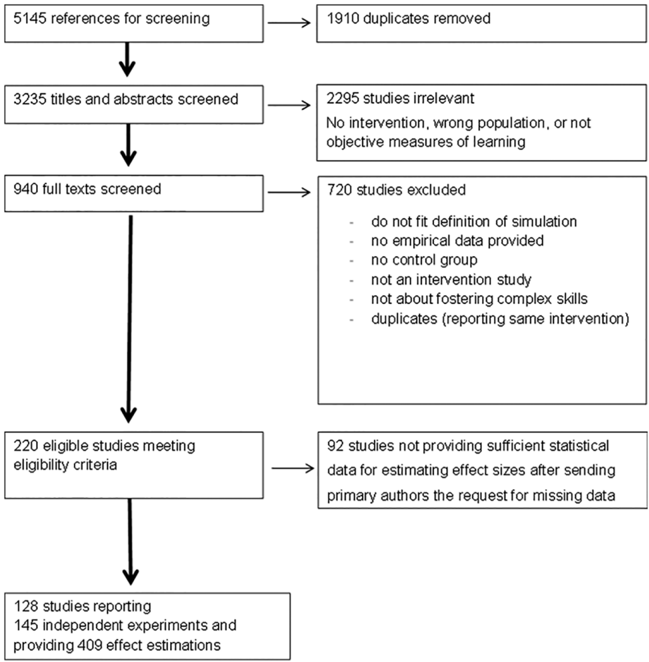
“The 145 eligible studies (from 128 articles published in the period 1979-2018) provided 409 effect estimations (Figure 1).”
§ Simulation-Based Learning in Higher Education: A Meta-Analysis > Results of Literature Search
plainn = 10,532- Asserted: passes — The authors put it forward as true.
- Checkable: passes — It can be checked against evidence.
- Load-bearing: passes — The paper’s conclusions depend on it.
- Based: passes — The paper gives a reason why it holds.
A result the paper reports from its own data — it cites no other source for it, so there is none to check. The quote shows it is in the paper.
In the paper
“The most frequent combinations of instructional support measures were knowledge convey together with examples (82 effects), knowledge convey with reflection phases (62 effects), and examples with reflection phases (43 effects).”
§ Simulation-Based Learning in Higher Education: A Meta-Analysis > Results of Literature Search
plain- Asserted: passes — The authors put it forward as true.
- Checkable: passes — It can be checked against evidence.
- Load-bearing: unclear — It is unclear whether the paper’s conclusions depend on it.
- Based: passes — The paper gives a reason why it holds.
120 more claims
Create a free account to see all 233 claims and to verify the 44 references still open.
- It may state two separate claims as one. 61
- Probably not a substantial claim. 61
Claims other papers make about this one
Each is checked against this paper’s own text: does it say what the citing paper says it does?
In the citing paper
“Chernikova and colleagues have demonstrated in a meta-analysis that simulations of professional situations, such as interactions in a classroom for teachers, can be a beneficial tool during teacher training as they expose teachers to authentic problems in their fields51.”
From On opportunities and challenges of large multimodal foundation models in education (2025) · cites this paper as [51]
In the citing paper
“Meta-analytic findings indicate that simulations are among the most effective means to facilitate the learning of complex skills across domains, with technology-based and scaffolded simulations showing robust positive effects on learning outcomes [11].”
In the citing paper
“While several earlier reviews have examined the general benefits of simulation in nursing education [17], few have focused specifically on its role in bridging the theory–practice gap.”
From The impact of clinical simulation on bridging the theory–practice gap in nursing education: a systematic review (2025) · cites this paper as [17]
In the citing paper
“High-fidelity simulations were particularly associated with enhanced clinical judgment and decision-making accuracy [17, 29, 30].”
From The impact of clinical simulation on bridging the theory–practice gap in nursing education: a systematic review (2025) · cites this paper as [17]
In the citing paper
“These findings are supported by meta-analytic evidence from Chernikova et al., who concluded that simulation-based learning substantially improves decision-making and problem-solving skills in higher education, especially when paired with active learning strategies and structured debriefing [17].”
From The impact of clinical simulation on bridging the theory–practice gap in nursing education: a systematic review (2025) · cites this paper as [17]
Statistics recomputed
Every reported test result, recomputed from its test statistic and degrees of freedom. A result shows as not adding up only once an independent check has confirmed it.
- ConsistentQ(409) = 4213.93reported p < .0001 · recomputed p < .001
“Q (409) = 4213.93,p < .0001”
Self-check
Percentages, sums and reported differences re-computed from the paper’s own numbers.
Each contradiction between two passages listed here was confirmed by an independent check.
Rated major: it would touch a result — a value a result rests on, reported and recomputed p-values on opposite sides of the significance level, two passages that conflict with no sign which is right, or a cited work retracted before this paper was published.
In the paper
§ Simulation-Based Learning in Higher Education: A Meta-Analysis > Discussion
“However, the effects are greater if learners are unfamiliar with the context and the task.”
§ Simulation-Based Learning in Higher Education: A Meta-Analysis > Prior Professional Knowledge
“learners showed a lower increase of complex skills in an unfamiliar context (g = 0.67, SE = 0.10) than in a familiar context (g = 0.83, SE = 0.13)”
Rated minor: it would not touch a result — a value no result rests on, a p-value that stays on the same side of the significance level, or a conflict that is clerical, resolved elsewhere in the paper, or outside its own findings.
In the paper
§ Simulation-Based Learning in Higher Education: A Meta-Analysis > Results of Literature Search
“Most studies focused on general problem solving (51) or the technical performance of a particular complex procedure (56); the other outcomes were communication skills (24), diagnosing (18), managing critical situations (18), and collaboration and teamwork (5).”
§ Simulation-Based Learning in Higher Education: A Meta-Analysis > Conclusion
“2,493 (27) 0.46 91.03% | 911 (18) 0.76 92.02% | 6,010 (58) 0.47 91.23% | 2,543 (21) 1.04 97.15% | 810 (5) 0.03 66.07% | 2,933 (63) 1.25 91.10%”
Rated minor: it would not touch a result — a value no result rests on, a p-value that stays on the same side of the significance level, or a conflict that is clerical, resolved elsewhere in the paper, or outside its own findings.
In the paper
“(2) prompts as the only scaffolding method (N = 11)”
§ Simulation-Based Learning in Higher Education: A Meta-Analysis > Level of Education as an Indicator of Prior Knowledge and Experience
Reported 11 · recomputed 12
Rated minor: it would not touch a result — a value no result rests on, a p-value that stays on the same side of the significance level, or a conflict that is clerical, resolved elsewhere in the paper, or outside its own findings.
In the paper
§ Simulation-Based Learning in Higher Education: A Meta-Analysis > Discussion
“Despite these differences, simulations had effects that can be categorized as large positive effects for all but one type of skill.The exception is teamwork, where the meta-analysis found a medium positive effect only.”
§ Simulation-Based Learning in Higher Education: A Meta-Analysis > Overall Effect of Simulation-Based Learning on Complex Skills (Research Question 1)
“Communication and collaboration skills (teamwork) are only moderately facilitated by simulation-based learning (g = 0.44, SE = 0.15, and g = 0.50, SE = 0.08, respectively)”
Rated minor: it would not touch a result — a value no result rests on, a p-value that stays on the same side of the significance level, or a conflict that is clerical, resolved elsewhere in the paper, or outside its own findings.
In the paper
§ Simulation-Based Learning in Higher Education: A Meta-Analysis > Level of Education as an Indicator of Prior Knowledge and Experience
“however, introducing prompts was related to higher learning outcomes in the high-level group.”
§ Simulation-Based Learning in Higher Education: A Meta-Analysis > Level of Education as an Indicator of Prior Knowledge and Experience
“Similarly, introducing prompts for a high (postgraduate learners and practitioners) level (g = 0.50, SE = 0.36) was not beneficial for learning compared with simulations without prompts (g = 0.91, SE = 0.11).”
Citations
Cites
Measuring inconsistency in meta-analyses
Higgins, J. P. T., Thompson, S. G., Deeks, J. J., & Altman, D. G. (2003) · BMJ · doi:10.1136/bmj.327.7414.557 · Cited by 63,139 · cited 1×
“The thresholds suggested by Higgins et al. (2003) were used to interpret the I 2 (25% for low heterogeneity, 50% for medium, 75% for high heterogeneity).”
MethodBorenstein, M., Hedges, L. V., Higgins, J. P. T., & Rothstein, H. R. (2009) · doi:10.1002/9780470743386 · Cited by 14,225
Hattie, J., & Timperley, H. (2007) · Review of Educational Research · doi:10.3102/003465430298487 · Cited by 12,905
THE ROLE OF TUTORING IN PROBLEM SOLVING *
Wood, D., Bruner, J. S., & Ross, G. (1976) · Journal of Child Psychology and Psychiatry · doi:10.1111/j.1469-7610.1976.tb00381.x · Cited by 8,851 · cited 1×
“Scaffolding enables a learner to solve problems through modifying tasks and reducing possible pathways, and through hints helping the learner to coordinate the steps in problem solving or interaction (Quintana et al., 2004), by taking over some elements of learning material (Wood et al., 1976).”
BackgroundKirschner, P. A., Sweller, J., & Clark, R. E. (2006) · Educational Psychologist · doi:10.1207/s15326985ep4102_1 · Cited by 7,776 · cited 2×
“…suggesting that including simulations in a later phase of a higher education program after students already know theoretical concepts is promising in order to not overwhelm learners and block too much of their cognitive capacity for solving a problem in a simulation (e.g., Kirschner et al., 2006).”
BackgroundFunnel plots for detecting bias in meta-analysis
Sterne, J. A. C., & Egger, M. (2001) · Journal of Clinical Epidemiology · doi:10.1016/s0895-4356(01)00377-8 · Cited by 3,779 · cited 1×
“We have a relatively small sample of empirical studies and apply a range of techniques to identify possible biases (Egger’s test, trim and fill) and improve the generalizability of the results (Sterne & Egger, 2001).”
MethodEducational Psychology: A Cognitive View
Gagné, R. M., Ausubel, D. P., & Gagné, R. M. (1969) · American Educational Research Journal · doi:10.3102/00028312006002287 · Cited by 3,302
Educational Psychology: A Cognitive View
Gagné, R. M., Ausubel, D. P., & Gagne, R. M. (1969) · American Educational Research Journal · doi:10.2307/1161899 · Cited by 3,278
HMELO-SILVER, C. E., DUNCAN, R. G., & CHINN, C. A. (2007) · Educational Psychologist · doi:10.1080/00461520701263368 · Cited by 2,641 · cited 1×
“…problems, especially in early stages of expertise development, should be accompanied by scaffolding to maximize learning and avoid cognitive overload, distraction, or focusing on superficial features of a situation (see the discussions of Hmelo-Silver et al., 2007; Kirschner et al., 2006).”
BackgroundReflection and reflective practice in health professions education: a systematic review
Mann, K., Gordon, J., & MacLeod, A. (2009) · Advances in Health Sciences Education · doi:10.1007/s10459-007-9090-2 · Cited by 2,175 · cited 1×
“Reflection phases, on the other hand, allow learners to think about goals, analyze their own performance, and plan further steps (e.g., Mann et al., 2009), but they do not provide much guidance during the problem solving.”
Background
Research works printed but not linked: 4
- Funke, J. (Ed.). (2006). Denken und Problemlösen (pp. 375-446).
- Henninger, M., & Mandl, H. (2000). Vom Wissen zum Handeln-ein Ansatz zur Förderung kommunikativen Handelns [From knowledge to action-An approach for fostering communicative behavior]. In H. Mandl & J. Gerstenmaier (Eds.), Die Kluft zwischen Wissen und Handeln (pp. 197-219).
- Raven, J. (2000). Psychometrics, cognitive ability, and occupational performance. Review of Psychology, 7(1-2), 51-74.
- Veritas Health Innovation. (2019). Covidence systematic review software (online ver- sion) [Computer software]. https://www.covidence.org
Cited by
Items 1,201–1,300 of 1,412
Aljabar, D. R., Suparmanto, G., & Azizah, A. N. (2026) · Genius Journal of Nursing · doi:10.66763/gjn.v2i1.32
“Previous evidence suggests that simulation creates equivalent learning opportunities across heterogeneous learner groups by emphasizing active participation and contextual learning experiences (Chernikova et al., 2020; Cant & Cooper, 2017).”
Virtual simulation as a catalyst for equitable and authentic interprofessional learning
Molabe, M., Rasesemola, R. M., Matlala, S., & Matshaka, L. (2026) · BMC Medical Education · doi:10.1186/s12909-026-09773-9
“Furthermore, inclusive access strategies such as loaner devices, bandwidth support, and asynchronous participation options may be important considerations to prevent digital inequities that could undermine the accessibility and equity advantages of virtual simulation [34].”
Conceptions of human factors in simulation-based education: a phenomenographic study
Kitt, A., & Kainth, R. (2026) · Advances in Simulation · doi:10.1186/s41077-026-00462-7
“While simulation is widely endorsed as an effective modality for HF education [1–5, 19 ], Ultimately, recognising and addressing conceptual variation among SBE facilitators is essential to achieving coherence between educational intent and patient-safety outcomes.”
Sellán, K. M. C., & Álvarez Alvarado, M. S. (2025) · Maestría en Control de Operaciones y Gestión Logística (Escuela Superior Politécnica del Litoral)
Rizali, I., Johari, M., & Susanti (2026) · caXra Jurnal Pendidikan Sekolah Dasar · doi:10.31980/caxra.v6i2.3058
Braunstein, A., & Deutscher, V. K. (2026) · Technology Knowledge and Learning · doi:10.1007/s10758-026-10010-x
“This makes them valuable tools in higher education and vocational education and training (VET) when authentic, practice-oriented learning, particularly that reflecting real-world conditions, is required (Chernikova et al., 2020 ).”
The Effect of Direct Feedback on Manuscript Development and Public Speaking Performance
Adys, H. P. (2025) · Celebes Journal of Language Studies · doi:10.51629/cjls.v5i2.262
Szimuláció és kihívás, mint tanulási keret a közszolgálati képzésben
Botos, A., & Biró, É. (2025) · Közösségi Kapcsolódások - tanulmányok kultúráról és oktatásról · doi:10.14232/kapocs.2025.1-2.97-110
Radke, T., Reinsdorf, N., & Ehlert, A. (2026) · Trends in Higher Education · doi:10.3390/higheredu5030066
“Complementarily, Chernikova et al. (2020) showed in their meta-analysis that the type of scaffolding required for effective learning shifts systematically as a function of learners’ prior knowledge base [12].”
InfluentialLin, T. T., & Zahedi, H. (2026) · The Open Journal of Occupational Therapy · doi:10.15453/2168-6408.2548
Artificial Intelligence in Education: A Brief Narrative Review
Ladghem-Chikouche, M. W., & Cynthia, E. P. (2026) · International Journal of Education and Vocational Studies · doi:10.62712/ijevs.v1i1.3
Assessment in Team Problem-Solving Exercises in Computing EducationPreprint
Švábenský, V., Vykopal, J., Leelaluk, S., Čeleda, P., Okubo, F., & Shimada, A. (2026) · arXiv (Cornell University) · doi:10.48550/arxiv.2607.19209
“From an educational-theory perspective, TTXs connect to the broader landscape of simulation-based learning [5].”
Non-animal models in undergraduate education: opportunities, applications, and future directions
Teakel, S. L., Connolly, J. H., Vanniasinkam, T., & Costabile, M. (2026) · ImmunoHorizons · doi:10.1093/immhor/vlag032
Hermann, B., Truchot, J., Cariou, A., & Benghanem, S. (2026) · Medical Education Online · doi:10.1080/10872981.2026.2694932
“Similarly, respondents with a university position reported greater preparedness (5 [4–7] vs. 4 [2–6], p 0.001) and lower perceived difficulty compared to respondents without a university position (3 [2–5] vs. 5 [3–7], p = 0.004) (Figure 5B).”
InfluentialShevchuk, L., Hryhorenko, A. O., & Shevchuk, O. (2026) · Scientia et societus · doi:10.69587/ss/1.2026.20
“The works of (Chernikova, et al ., 2020; Sakun et al ., 2020; Chernenko et al ., 2021) were reviewed to establish the conceptual framework of the study.”
AVANCES DE INVESTIGACION 2026/Nro.2
Saeteros, E. Z. D., Cachinell, B. M. L., & Álvarez, Y. M. M. (2026) · ACVENISPROH Académico · doi:10.47606/acven/aclib0115
Datenbasierte diagnostische Entscheidungen im inklusiven Klassenzimmer
Zellner, J. (2025) · Electronic Theses of LMU Munich (Ludwig-Maximilians-Universität München) · doi:10.5282/edoc.36905
Pimentel, L. Y. G., Urbina, P. G., & Pérez, F. M. (2026) · Company games & business simulation academic journal. · doi:10.54988/cg.2026.1.1827
Jerez, K. E. G., & Mora, M. E. R. (2026) · Ciencia y Educación
Camejo, I. M., Sailema, G. L. A., Verdecia, J. A. M., & Carrillo, K. M. G. (2026) · Revista Cognosis · doi:10.33936/cognosis.v11i1.8598
Karatoprak, U., Altundağ, C. K., & Yücel, A. S. (2026) · IGI Global eBooks · doi:10.4018/979-8-3373-7675-2.ch008
Technology-Enhanced Tabletop Exercises for Cybersecurity Education: Lessons LearnedPreprint
Vykopal, J., Čeleda, P., Horák, M., & Švábenský, V. (2026) · arXiv (Cornell University) · doi:10.48550/arxiv.2607.28179
“A tabletop exercise is an experiential and active learning method, specifically, a form of simulation-based learning [14], [15] in small teams.”
Nurdiansyah, L., & Suryadi, A. (2026) · Indonesian Journal of Innovation Multidisipliner Research · doi:10.69693/ijim.v4i3.1850
“…juga terbukti memberikan hasil belajar yang lebih baik dibandingkan penyajian materi secara terus-menerus (Fiorella & Mayer, 2018), sementara simulation-based learning terbukti efektif dalam meningkatkan keterampilan kompleks melalui praktik langsung yang disimulasikan (Chernikova et al., 2020).”
An Electronic Wave Laboratory Worksheet Integrating Virtual Simulation and Performance Assessment
Latifah, S., Diani, R., Yuberti, Y., & Rifa’i, M. (2026) · Jurnal Ilmiah Pendidikan Fisika Al-Biruni · doi:10.24042/jipfalbiruni.v15i1.27227
Kuasit, K., Limpinan, P., & Jantakoon, T. (2026) · Higher Education Studies · doi:10.5539/hes.v16n3p594
“This finding is consistent with Chernikova et al. (2020), who reported that simulation-based learning environments significantly improve problem-solving performance by enabling iterative experimentation.”
Yıldız, G., Capineri, C., & Sanna, V. S. (2026) · World sustainability series · doi:10.1007/978-3-032-22076-9_11
Sidek, M. N. A. M., Mohamed, Z., Khan, M. R. B., Zalli, M. M. M., Abdullah, Z., & Chamaratana, T. (2026) · International Journal of Research and Innovation in Social Science · doi:10.47772/ijriss.2026.100700427
Mascher, U., Fernes, D., Tillmann, A., Haas, S., Buschmann, C., Meßner, M. T., & Adl-Amini, K. (2026) · MedienPädagogik Zeitschrift für Theorie und Praxis der Medienbildung · doi:10.21240/mpaed/71/2026.08.03.x
Envisioning Scenarios. A Simulator to Develop Systemic Thinking in Higher Education Students
Alvarez-Icaza, I., & Martínez-Briones, B. J. (2026) · LACCEI International Multi-Conference for Engineering, Education and Technology (LACCEI) · doi:10.18687/laccei2026.1.1.2122
Coleman, J.-C., Witti, M. J., Zulina, N. A., Aumiller, M., Rühm, A., Sroka, R. C., Büttner, T., Mothes, B., & Stadler, M. J. (2026) · JMIR Research Protocols · doi:10.2196/94628
“Overall, SBL has been shown to be very effective and a valuable addition to traditional training (“see one, do one, teach one”) [8].”
Self-citationINTERACTIVE AIRPLANE CONTROLLER SIMULATOR WITH DIFFERENT CONTROL ALGORITHMS
Beisenbayev, T., Omirzak, B., & Zhangeldi, D. (2025) · Nazarbayev University Repository (Nazarbayev University)
Інтегроване стратегічне управління, управління портфелями, програмами, проєктами
(2024) · eNTUKhPIIR Repository (Kharkiv Polytechnic Institute)
Elashvili, T., & ელაშვილი, Ტ. (2026) · Iverieli (National Parliamentary Library of Georgia)
Davies, A. J., & Burnes, L. (2026) · Simulation & Gaming · doi:10.1177/10468781261440792
Lemke, N., & Siemon, J. (2026) · Applied Studies in Innovative Learning and Teaching · doi:10.1016/j.asilt.2026.100011
Sidek, M. N. A. M., Mohamed, Z., Khan, M. R. B., Jamil, M. R. M., Abdullah, Z., & Chamaratana, T. (2026) · International Journal For Multidisciplinary Research · doi:10.36948/ijfmr.2026.v08i04.85548
“Meta-analytic and systematic-review evidence indicates that simulation and immersive environments can support learning when tasks, scaffolding, feedback, and reflection are well designed [12, 13, 14, 15].”
InfluentialDomann, M., Phillips, F., Fischer, M. R., Stadler, M. J., Kolb, N., & Witti, M. J. (2026) · doi:10.2196/preprints.109276
Self-citationLevin, O., Ophir, L., Shahwan-Dalal, S., & Hagshoury, T. (2026) · Professional Development in Education · doi:10.1080/19415257.2026.2716059
Leite, R. D. P. T., Figueiredo, A. K. S., Cordeiro, M. A. N., & Fagundes, M. V. C. (2026) · Revista Inclusiones · doi:10.58210/rie3962
Building Self-Confidence in Elementary School Civic Education Learning
Noviasafitri, L. G., & Sutama, S. (2026) · Proceeding ISETH (International Summit on Science Technology and Humanity) · doi:10.23917/iseth.7509
“The integration of Pancasila values as a moral framework helps students make rational and ethical decisions, strengthening their cognitive and social abilities (Chernikova et al. 2020); (Gustari A & Juliardi B, 2025).”
Lütolf, S. (2026) · Logos Verlag Berlin eBooks · doi:10.30819/6006
Effects of Virtual Technologies Enabled Simulation-Based Learning: A Meta-Analysis
Zheng, X., Lu, X., & Sun, K. (2026) · International Conference on Computer Science and Technologies in Education (CSTE) · doi:10.1109/cste69562.2026.11649666
“Although Chernikova et al. [12] conducted a comprehensive meta-analysis of SBL in higher education, their study did not systematically examine the role of virtual technologies as moderating factors.”
Lehman, E., Healy, G. N., Forbes, R., Barker, M. S., Giguere, D., Cotugno, J., Munro, J., & Gomersall, S. R. (2026) · Health Education · doi:10.1108/he-01-2026-0006
Chau, A. D., Kleimola, A., Wang, L., Marchiori, R. S., Reinhart, D., Thomas, S., Sanchez, R., & Chandupatla, S. B. R. (2026) · ASEE Annual Conference & Exposition · doi:10.18260/1-2--59987
Innovative Online Delivery of Nuclear Engineering Technology Courses Using Simulation-Based Learning
Cole, R., & Koneru, A. (2026) · ASEE Annual Conference & Exposition · doi:10.18260/1-2--60005
Simulations to facilitate AI literacy for teachers and school leaders
Sinha, T., Lim, S., Seow, P., & Hung, D. W. L. (2026) · Proceedings. · doi:10.22318/icls2026.634461
Zwane, N. C. M., Skhosana, R. M., & Leburu, G. E. (2026) · Discover Education · doi:10.1007/s44217-026-02037-0
“This process deepens conceptual understanding, supports the development of professional judgment, and enhances transferable skills [7].”
Pedagogical Lessons from Teaching a Wargaming Module for Strategic Foresight in Management EducationPreprint
Carleton, T., & Cockayne, W. R. (2026) · SSRN Electronic Journal · doi:10.2139/ssrn.7345140
Nadine, E. J., Junus, K. M., Santoso, H. B., Michael, J., & Mannix, I. A. (2026) · Journal of Learning Analytics · doi:10.18608/jla.2026.9303
Bielikowicz, A., Pawlukowska, W., Brzosko, M., Grochans, E., Machaliński, B., & Baumert, B. (2026) · Frontiers in Medicine · doi:10.3389/fmed.2026.1913838
“A meta-analysis of 145 studies across multiple healthcare domains concluded that simulation represents one of the most effective pedagogical approaches for facilitating complex clinical skills acquisition (5).”
Bridging microbiology and public health through simulation-based learning
Krupinsky, K. C., & Kirschner, D. E. (2026) · Journal of Microbiology and Biology Education · doi:10.1128/jmbe.00281-26
Bazaliński, D., Przybek-Mita, J. Z., Mesarosova, J., Skórka, M., Pavelová, Ľ., & Więch, P. (2026) · doi:10.15584/978-83-8277-356-9_1
Shachrai, M., Nir, B., Haber, Y., & Elyoseph, Z. (2026) · SSRN Electronic Journal · doi:10.2139/ssrn.7360008
YABO, B. I., Shagari, B. A., JONAH, M. A., & Olaoluwa, T. T. (2026) · Journal of Human Social and Political Science Research · doi:10.70382/sjhspsr.v13i6.0115
LRBTeacher: A Generative AI Co-teaching System for Cultivating “Internet Sense” in Content Creators
Hou, S., & Chai, C. (2025) · International Symposium on Computational Intelligence and Design · doi:10.1109/iscid68789.2025.00020
“The system uses an LLM to simulate an experienced, successful blogger and constructs a series of realistic operational scenarios (e.g., responding to negative comments) [16].”
Large Language Models and Prompt Engineering: A Comprehensive Guide with Practical Applications
Kuhail, M. A., Tubishat, M., Kohail, S., & Hadid, M. (2026) · Chapman & Hall/CRC eBooks · doi:10.1201/9781003626909
Андреевна, Д. К. (2026) · Russian Journal of Education and Psychology · doi:10.12731/2658-4034-2026-17-3-1199
THE EXPERIENCE OF PRACTICAL NURSING STUDENTS LEARNING IN A DETERIORATING PATIENT SIMULATION
Sherrer, M. (2025) · AUSpace (Athabasca University)
Cardona, J. P. (2026) · Formación universitaria · doi:10.4067/s0718-50062026000400161
Slack, J. N. (2025) · Lu Zone Ul (Laurentian University)
Shu-Fei, W., & Yu-Cheng, L. (2026) · IIAI Letters on Informatics and Interdisciplinary Research · doi:10.52731/liir.v007.617
Vermittlung von Vermittlungskompetenz
Simeone, C. M. (2026) · Electronic Theses of LMU Munich (Ludwig-Maximilians-Universität München) · doi:10.5282/edoc.37587
SPIELräume. Gestaltungsfelder der Erwachsenenbildung zwischen Freiheit und Restriktion
Dinkelaker, J., Hoffmann, N., Rosenberg, H., Rott, K. J., Stimm, M., & Budrich, V. B. (2026) · Verlag Barbara Budrich eBooks · doi:10.3224/84743461
Witti, M. J., Coleman, J.-C., Richters, C., Schönberger, J., de Ruijter, M.-A., Stortz, A., Bauer, M. J., Kiriakidou, R., & Stadler, M. J. (2026) · JMIR Medical Education · doi:10.2196/97489
“Well-designed simulations lead to effective learning by allowing deliberate practice with feedback, and technology-enhanced simulation training has positive effects on learning outcomes in health professions education [2], including improved skill performance and knowledge retention [3,4].”
Self-citationJahrbuch der berufs- und wirtschaftspädagogischen Forschung 2026
(2026) · Verlag Barbara Budrich eBooks · doi:10.3224/84743177
Kruse, A., Ertl, B., Manhart, S., & Deutschland (2026)
PROJECT MANAGEMENT FROM NEED TO VALUE – AN INTEGRATED GUIDE TO DECISION-READY PROJECT PROPOSALS
(2026) · Pesci Egyetemi Archivum (University of Pécs) · doi:10.15170/pmnvig-ktk-2026
Simulation in Occupational Therapy Graduate Programs
Walls, D., Thomas, L., Underwood, M., & Davis, K. (2026) · Journal of Occupational Therapy Education · doi:10.26681/jote.2026.100206
Arief, U. M., Sukamta, S., Andrasto, T., Tumangger, M. H., Daffa, M. H. A., Susilawati, A., & Ghazali, A. S. (2026) · Frontiers in Education · doi:10.3389/feduc.2026.1878824
Dios, H. W. D. (2026) · Pantao (International Journal of the Humanities and Social Sciences) · doi:10.69651/pijhss05031475
Connor, E., & Ai, J. (2026) · Compass Journal of Learning and Teaching · doi:10.21100/compass.v19i1.1700
Beyond Traditional Sales Training: An AI Driven Experiential Learning Framework
Singh, P. P., Saran, A., Khan, I., & Kalliny, M. (2026) · Marketing Education Review · doi:10.1080/10528008.2026.2729466
Deliani, M. K. (2026) · Jurnal Bahasa Indonesia Prima (BIP) · doi:10.34012/bip.v8i1.8051
“…interaction has been shown to significantly enhance analytical reasoning and active learning processes in higher education contexts (Olga Chernikova, 2020) The presenter consequently defends arguments using effective Indonesian language structures and accurate KPNK technical terminology.”
InfluentialYang, L., Liu, H., Li, S., Jia, R., Xiao, Y., Chen, G., & Lu, L. (2026) · arXiv (Cornell University) · doi:10.48550/arxiv.2609.10939
Kim, S., & Byeon, J.-H. (2026) · Journal of Baltic Science Education · doi:10.33225/jbse/26.25.650
Sikorová, L., & Knytl, M. (2026) · ORBIS SCHOLAE · doi:10.14712/23363177.2026.4
Using Simulations, Games, and Apps to Support the Mental Health of First Responders
Englert, D. R., Sachau, D. A., & Lassiter, A. (2026) · Springer eBooks · doi:10.1007/978-3-032-27978-1_16
Pacheco, M. A. D. L. P., Charris, L. D. B., & Manotas, E. N. (2026) · Journal of Teaching in International Business · doi:10.1080/08975930.2026.2726744
“…evidence in higher education also indicates that simulation-based learning can support the development of complex skills, particularly when simulations include appropriate scaffolding, authentic tasks, and opportunities to apply knowledge in realistic situations (Chernikova et al. 2020).”
(2026) · Education and New Developments 2022 – Volume I · doi:10.36315/2026v2end025
Ackaradejruangsri, P., & Samarathunga, H. P. N. C. (2026) · SSRN Electronic Journal · doi:10.2139/ssrn.7478776
Angelini, M. L. (2026) · Reflective Practice · doi:10.1080/14623943.2026.2735378
Hauk, D., Menter, F., & Schorling, J. (2026) · British Journal of Educational Technology · doi:10.1111/bjet.70087
Hamid, M. S. A., Marjuni, A., Nasruddin, M. A., & Abdullah, M. S. (2026) · ANP Journal Of Social Sciences And Humanities · doi:10.53797/anp.jssh.v7i1.7.2026
“Chernikova et al. (2020), melalui meta-analisis 145 kajian pembelajaran berasaskan simulasi, mendapati bahawa pelajar berpengetahuan awal rendah memperoleh manfaat terbesar daripada sokongan berasaskan contoh dan panduan berstruktur, manakala pelajar berpengetahuan awal tinggi lebih mendapat…”
Before the Breadboard: Using AI to Scaffold Arduino Algorithm Design in Secondary Schools
Vassallo, D., & Govus, G. (2026) · OAR@UM (University of Malta) · doi:10.5281/zenodo.22248700
Project-Based Conversion Versus Prototype-Based Instruction in Automotive Teacher Education
Ramdhani, R., Sriyono, S., Munawar, W., Maulana, R. R., & Bahrudin, A. (2026) · Jurnal Pendidikan Teori Penelitian dan Pengembangan · doi:10.17977/2502-471x.2975
The impact of shared feedback visualization on student reflection during simulation debriefing
Popov, V., & van Leeuwen, A. (2026) · Computer-supported collaborative learning/The Computer-Supported Collaborative Learning Conference · doi:10.22318/cscl2026.699729
Tang, Y., Puad, M. H. M., & Pyng, H. S. (2026) · Pertanika Journal of Vocational Science and Technology Education · doi:10.47836/pjvste.2.2.09
Huang, Y., Klausner-Thimm, N., Richter, E., Scheiter, K., & Richter, D. (2026) · Proceedings. · doi:10.22318/icls2026.614625
Living the impossible: Designing Life Happens, an AI-supported budget and justice simulation
Walton, D., Bae, H., Park, J., Zhao, Y., Weiss, R., & Tashjian, S. (2026) · Proceedings. · doi:10.22318/icls2026.510813
Miole, G. D., Pungtilan, C. J. P., Graniada, J. –. J. P., Rabago, J. K. M., & Rabago, J. A. (2026) · Asian Journal of Advanced Research and Reports · doi:10.9734/ajarr/2026/v20i101469
AI-Powered Simulator Design Principles for Skill Transfer: A Theory Synthesis
Rodionova, A. (2026) · International Journal of AI in Pedagogy Innovation and Learning Futures · doi:10.46787/ijaipil.v1i2.7737 · Cited by 1
Сапрікін, С. М. (2026) · Academic Visions · doi:10.66556/2786-586x.59.saprikin-s
Ghanbari, S., Hosseini, S., & Zamiran, S. (2026) · Advances in Medical Education and Practice · doi:10.2147/amep.s637881
Practical E-Module Using Flipbook Maker as A Solution For Visual Learner Type Students
Kharisma, M. (2026) · FWU Journal of Social Sciences · doi:10.51709/19951272/september2026/3
Shao, Y., Xu, Y., Zhang, Y., Zhang, X., & Ye, Z. (2026) · Systems · doi:10.3390/systems14101210
Recamara, R. (2026) · Pantao (International Journal of the Humanities and Social Sciences) · doi:10.69651/pijhss05041524
Market Forces: Playing with Risk in Business Planning for Games
Risley, K., Wanick, V., Buckingham, C., Procter, A., O’Brien, M. P., & Daniels, M. H. (2026) · European Conference on Games Based Learning · doi:10.34190/ecgbl.20.2.5134
“More recent work supports position while showing that simulation-based learning depends heavily on design and scaffolding, with educational value shaped by the forms of reasoning an activity elicits rather than by activity or immersion alone (Chernikova et al. , 2020; Faisal et al. , 2022).”
Metadata
- Authors
- Chernikova, O., Heitzmann, N., Stadler, M., Holzberger, D., Seidel, T., & Fischer, F.
- Affiliations
- Ludwig-Maximilians-Universität München (DE)
- Technical University of Munich (DE)
- Venue
- Review of Educational Research
- Published
- 2020-06-15
- Volume
- 90
- Issue
- 4
- Pages
- 499-541
- ISSN
- 0034-6543 (ISSN-L)
- 1935-1046
- OpenAlex
- W3039587732
- Semantic Scholar
- af60f6e1157bbec85ef6f0012608e01e0a6bd6a9
- Cited by
- 1,072
- References
- 171
- Citations by year
- 2026: 206 · 2025: 267 · 2024: 214 · 2023: 174 · 2022: 129 · 2021: 69 · 2020: 10
- FWCI
- 32.44
- Type
- journal article
- Language
- en
- Open access
- hybrid
- doi.org
- Locations
- Review of Educational Research (publishedVersion, cc-by)
- Open access LMU (Ludwid Maxmilian's Universitat Munchen) (submittedVersion, cc-by)
- mediaTUM – the media and publications repository of the Technical University Munich (Technical University Munich) (submittedVersion, other-oa)
- mediaTUM – the media and publications repository of the Technical University Munich (Technical University Munich) (submittedVersion)
- Funders
- Deutsche Forschungsgemeinschaft (DFG 2385)
- Topics
- Social Sciences › Education › Innovative Teaching Methodologies in Social Sciences
- Social Sciences › Education › Simulation-Based Education in Healthcare
- Social Sciences › Psychology › Developmental and Educational Psychology › Innovative Teaching and Learning Methods
- Keywords
- simulation-based training, scaffolding, complex skills, higher education, prior knowledge, reflection, examples, educational technology, medical education, teacher professional development, management education
About these checks
Registry, retraction, Cites and statistics results are computed, not judged, with one exception: a printed reference that no index lists is read once by a model before it counts as a citation error. Claims are extracted by a model and kept only when their quote appears verbatim in the text; each cited source is then checked, with a model’s help, for whether it says what the claim relies on. Those verdicts can be wrong — read the claim’s quote and the cited source before relying on one.
The claim verdicts this report counts are experimental: their accuracy is not yet measured.
A language model drew the claims from the paper on 2026-11-16, under version 3 of the claim definition (model deepseek-v4.1-flash, prompt extract-v3).
A second model labelled each claim on 2026-11-16 (model jev-1.13-20260917, definition revision gold-guideline-v0.2).
Cited sources are checked with a language model’s help (qwen3.8-omni-flash).
Statistics and arithmetic are recomputed, not judged.
Confidence bands are shown only for fields calibrated on our annotated test set. None is calibrated yet, so no band is shown.
What counts as a claim ›How we measure confidence ›How we check this ›
Are you an author, or do you see a problem with this page? Request a review
Data sources
Bibliographic data: Semantic Scholar, OpenAlex, Crossref.
Contains information from the Semantic Scholar Academic Graph Datasets, made available under the ODC Attribution License (ODC-BY 1.0).
Semantic Scholar’s data is described in: Kinney, R., et al. (2023). The Semantic Scholar Open Data Platform. arXiv:2301.10140.
