

Simulation-Based Learning in Higher Education: A Meta-Analysis
Open accessThe DOI matches its Crossref record; 172 of the 173 references it cites were found in a registry or an index; 3 of the 59 sources its claims cite were checked for support.
Abstract
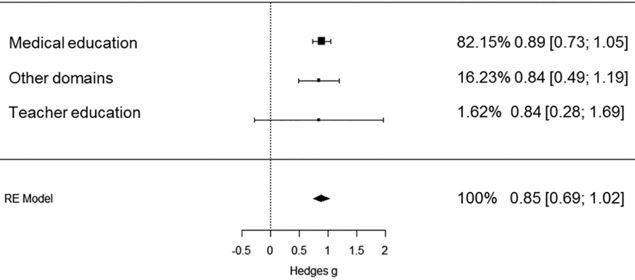
Simulation-based learning offers a wide range of opportunities to practice complex skills in higher education and to implement different types of scaffolding to facilitate effective learning. This meta-analysis includes 145 empirical studies and investigates the effectiveness of different scaffolding types and technology in simulation-based learning environments to facilitate complex skills. The simulations had a large positive overall effect: g = 0.85, SE = 0.08; CIs [0.69, 1.02]. Technology use and scaffolding had positive effects on learning. Learners with high prior knowledge benefited more from reflection phases; learners with low prior knowledge learned better when supported by examples. Findings were robust across different higher education domains (e.g., medical and teacher education, management). We conclude that (1) simulations are among the most effective means to facilitate learning of complex skills across domains and (2) different scaffolding types can facilitate simulation-based learning during different phases of the development of knowledge and skills.
Overview
CoChat Summary
TL;DR
This meta-analysis of 145 studies (10,532 participants) finds that simulation-based learning in higher education has a large positive overall effect on complex skills (g = 0.85, 95% CI [0.69, 1.02]). Effects vary by simulation features and prior knowledge, with examples/prompts helping lower-prior-knowledge learners and reflection phases helping higher-prior-knowledge learners.
Key findings
- Overall effect: g = 0.85, SE = 0.08, 95% CI [0.69, 1.02], N = 145 studies, 10,532 participants; heterogeneity was high: Q(409) = 4213.93, p < .0001, τ² = 1.2, I² = 95.86%.
- By complex skill: technical performance g = 1.06 (SE = 0.15), general problem solving g = 0.88 (SE = 0.11), diagnosing g = 0.82 (SE = 0.21), management g = 0.72 (SE = 0.30), teamwork g = 0.50 (SE = 0.08), communication g = 0.44 (SE = 0.15).
- Simulation features: live model g = 2.27 (N = 3), mixed g = 1.56, mannequin g = 0.96, virtual object g = 0.75, role play g = 0.63, document g = 0.31; technology: simulator g = 1.07, virtual reality g = 0.85, screen-based g = 0.68, no technology g = 0.74; high authenticity g = 0.86 vs low g = 0.58; duration: <1 hr g = 0.65, hours g = 0.81, days g = 0.80, >1 month g = 1.31 (N = 4).
- Scaffolding × prior knowledge: examples helped low-education learners (g = 1.15 vs high-education g = 0.56); prompts helped unfamiliar contexts (g = 0.85 vs no prompts g = 0.63) but not familiar contexts (g = 0.33 vs no prompts g = 0.96); reflection phases helped postgraduate learners (g = 1.10 vs no reflection g = 0.86) but not graduate/undergraduate learners (g = 0.52 vs no reflection g = 0.81).
Methods
- Meta-analysis of 145 empirical studies (from 128 articles, 1979–2018) yielding 409 effect estimates and 10,532 participants; searched PsycINFO, PsycARTICLES, ERIC, and MEDLINE through April 2018; included experimental/quasi-experimental or within-subject pre-post studies with a control condition and objective measures of complex skills.
- Coded moderators included simulation type, technology use, duration, authenticity, scaffolding (examples, prompts, reflection phases), knowledge convey, prior knowledge (familiarity of context, level of education), complex skill type, domain, study design, and publication type.
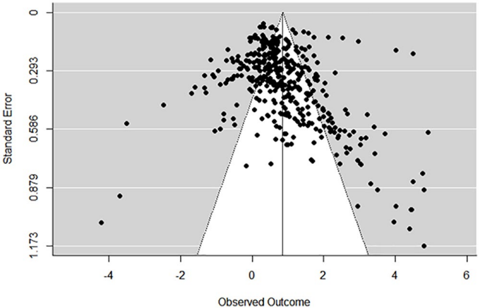
- Used Hedges’ g, random-effects models, robust variance estimation for correlated effects, pretest adjustment when available, heterogeneity Q/I², and publication-bias checks (Egger’s test, trim and fill); metaregression on control variables.
Limitations
- Stated: the focus is on complex skills involving interaction with people, so findings do not straightforwardly generalize to STEM domains such as science, mathematics, engineering, or informatics; a large proportion of findings come from medical education, so caution is needed for other domains, especially regarding technology, simulation type, outcome measures, and moderators.
- Stated: many primary studies gave little treatment description, insufficient for coding some moderators or finer distinctions; many implemented multiple instructional support measures, making specific effects hard to determine; the scaffolding framework may omit other supports such as feedback or fading/adding instruction; combinations could only be partially investigated; prior knowledge operationalization had drawbacks and explained only 4% of heterogeneity; implementation quality was assumed similar; large unexplained heterogeneity requires caution.
- Evident from the text: heterogeneity was very high (I² = 95.86%, τ² = 1.2), and several moderator estimates rest on very small numbers (e.g., live model N = 3, all scaffolding types N = 2, duration >1 month N = 4), so subgroup effects are unstable; presence/absence comparisons for examples, prompts, and reflections often did not reach significance.
Model-written summary. Check it against the paper before relying on it.
Integrity signals
Registry
Cites
Statistics
Figures

Verification
Claims the paper makes
1 Valid · 3 Not valid · 48 Not checked · 181 Own results and interpretations
At least one cited source doesn’t support this claim or points to a different paper, and none confirmed it — see the verdicts below.
In the paper
“However, they only focused on comparing simulations with a duration of more than 1 day with simulations of less than 1 day.”
§ Simulation-Based Learning in Higher Education: A Meta-Analysis > Simulations in Educational Contexts
What the sources say
- Disputedcites Cook et al., 2013 matched to “Technology-Enhanced Simulation to Assess Health Professionals: A Systematic Review of Validity Evidence, Research Methods, and Reporting Quality” (2013) sourceExperimental — accuracy not yet measured
Our copy of Cook et al. (2013) contains no duration contrast whatsoever: searches for 'simulation duration more than one day versus less than one day' and related phrasings returned only the study-coding tables. Those tables (sections 'List of all included studies, sorted by year of publication, with validity evidence and QUADAS-2 ratings (N=417 except for QUADAS-2)', pp. 17, 21, 23, 27, 32-35, and the parallel full-citation list, pp. 4-14) show the review's actual focus: charting validity evidence (content/response/process, internal structure, relations to other variables, consequences, reliability), methodological quality (MERSQI, selection/flow indices, RoB indices, QUADAS-2) and reporting across 417 technology-enhanced simulation assessment studies spanning many topics and instruments. That is contrary to the claim that the review 'only focused on comparing simulations with a duration of more than 1 day with simulations of less than 1 day'. Our copy is truncated at the end, but the retrieved structure of the review already contradicts the characterization; no alternative source for the duration comparison is named in our copy. (LLM, conf=0.72)
Checked by a reasoning model — may be wrong.
plain- Asserted: passes — The authors put it forward as true.
- Checkable: passes — It can be checked against evidence.
- Load-bearing: passes — The paper’s conclusions depend on it.
- Based: passes — The paper gives a reason why it holds.
- Disputed
The cited sources that could be checked couldn’t confirm or dispute this claim.
In the paper
“In their meta-analysis, Cook et al. (2013) provided supportive evidence of the effectiveness of distributed and repetitive practice (effects above .60)in the acquisition of complex skills in medical education.”
§ Simulation-Based Learning in Higher Education: A Meta-Analysis > Simulations in Educational Contexts
What the sources say
- Could not verifycites Cook et al., 2013 matched to “Technology-Enhanced Simulation to Assess Health Professionals: A Systematic Review of Validity Evidence, Research Methods, and Reporting Quality” (2013) sourceExperimental — accuracy not yet measured
Our copy of Cook et al. (2013) contains only the appendix material — the 'List of all included studies, sorted by year of publication, with full journal citation' (pp. 2-16) and the parallel table 'with validity evidence and QUADAS-2 ratings (N=417)' (pp. 20-35), which catalogue simulation-based ASSESSMENT validation studies with MERSQI scores, not pooled effects. Searches for 'distributed and repetitive practice', 'meta-analysis', 'effect size / Hedges g / random-effects', 'learning principles / repetition', and the paper's objective returned no narrative text at all, so nothing in our copy reports an effectiveness meta-analysis or effect magnitudes above .60. The copy is also flagged truncated, so the results/discussion where such a finding would appear may be missing; absence here is not evidence of a contrary statement, and no alternative source is named in the passages we hold. (LLM, conf=0.68)
plainstates a cause- Asserted: passes — The authors put it forward as true.
- Checkable: passes — It can be checked against evidence.
- Load-bearing: unclear — It is unclear whether the paper’s conclusions depend on it.
- Based: passes — The paper gives a reason why it holds.
- Could not verify
The cited sources support only part of this claim — read each source’s verdict below.
In the paper
“All these scaffolding measures were found to be beneficial for developing diagnostic competences (Chernikova et al., 2019).”
§ Simulation-Based Learning in Higher Education: A Meta-Analysis > Added Value of Instructional Support
What the sources say
- Partly supportedcites Chernikova et al., 2019 matched to “Facilitating Diagnostic Competences in Higher Education—a Meta-Analysis in Medical and Teacher Education” (2020) sourceExperimental — accuracy not yet measured
The meta-analysis does state broadly that all scaffolding types help ('as long as learners are able to practice problem-solving, all of the different types of scaffolding are beneficial', Theoretical Significance; echoed in Summary and Conclusion: roles, prompts and reflection phases 'have clear positive effects', with 'no indication for different effect sizes of different types of scaffolding'). But the claim drops the source's binding condition — the benefit holds only where learners' own problem-solving is preserved — and the source's results are not uniformly significant: in Effect of Scaffolding, settings with vs. without examples 'did not reach statistical significance' (Q(1,35)=2.85, p=.06), and Limitations warns that 'conclusions about the effectiveness of each scaffolding type should be made with caution'. So the flat 'all these scaffolding measures were found to be beneficial' overstates an explicitly conditional and hedged finding. (LLM, conf=0.72)
plainstates a cause- Asserted: passes — The authors put it forward as true.
- Checkable: passes — It can be checked against evidence.
- Load-bearing: passes — The paper’s conclusions depend on it.
- Based: passes — The paper gives a reason why it holds.
- Partly supported
A result the paper reports from its own data — it cites no other source for it, so there is none to check. The quote shows it is in the paper.
In the paper
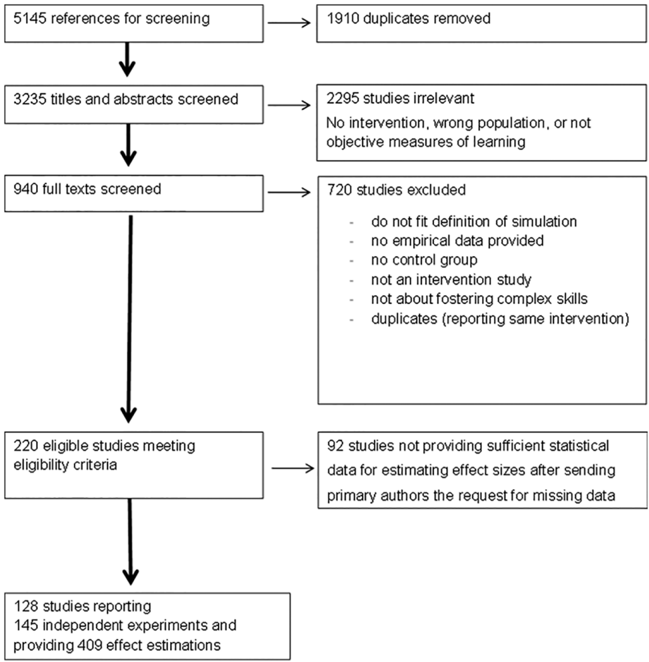
“The 145 eligible studies (from 128 articles published in the period 1979-2018) provided 409 effect estimations (Figure 1).”
§ Simulation-Based Learning in Higher Education: A Meta-Analysis > Results of Literature Search
plainn = 10,532- Asserted: passes — The authors put it forward as true.
- Checkable: passes — It can be checked against evidence.
- Load-bearing: passes — The paper’s conclusions depend on it.
- Based: passes — The paper gives a reason why it holds.
A result the paper reports from its own data — it cites no other source for it, so there is none to check. The quote shows it is in the paper.
In the paper
“The most frequent combinations of instructional support measures were knowledge convey together with examples (82 effects), knowledge convey with reflection phases (62 effects), and examples with reflection phases (43 effects).”
§ Simulation-Based Learning in Higher Education: A Meta-Analysis > Results of Literature Search
plain- Asserted: passes — The authors put it forward as true.
- Checkable: passes — It can be checked against evidence.
- Load-bearing: unclear — It is unclear whether the paper’s conclusions depend on it.
- Based: passes — The paper gives a reason why it holds.
120 more claims
Create a free account to see all 233 claims and to verify the 44 references still open.
- It may state two separate claims as one. 61
- Probably not a substantial claim. 61
Claims other papers make about this one
Each is checked against this paper’s own text: does it say what the citing paper says it does?
In the citing paper
“Chernikova and colleagues have demonstrated in a meta-analysis that simulations of professional situations, such as interactions in a classroom for teachers, can be a beneficial tool during teacher training as they expose teachers to authentic problems in their fields51.”
From On opportunities and challenges of large multimodal foundation models in education (2025) · cites this paper as [51]
In the citing paper
“Meta-analytic findings indicate that simulations are among the most effective means to facilitate the learning of complex skills across domains, with technology-based and scaffolded simulations showing robust positive effects on learning outcomes [11].”
In the citing paper
“While several earlier reviews have examined the general benefits of simulation in nursing education [17], few have focused specifically on its role in bridging the theory–practice gap.”
From The impact of clinical simulation on bridging the theory–practice gap in nursing education: a systematic review (2025) · cites this paper as [17]
In the citing paper
“High-fidelity simulations were particularly associated with enhanced clinical judgment and decision-making accuracy [17, 29, 30].”
From The impact of clinical simulation on bridging the theory–practice gap in nursing education: a systematic review (2025) · cites this paper as [17]
In the citing paper
“These findings are supported by meta-analytic evidence from Chernikova et al., who concluded that simulation-based learning substantially improves decision-making and problem-solving skills in higher education, especially when paired with active learning strategies and structured debriefing [17].”
From The impact of clinical simulation on bridging the theory–practice gap in nursing education: a systematic review (2025) · cites this paper as [17]
Statistics recomputed
Every reported test result, recomputed from its test statistic and degrees of freedom. A result shows as not adding up only once an independent check has confirmed it.
- ConsistentQ(409) = 4213.93reported p < .0001 · recomputed p < .001
“Q (409) = 4213.93,p < .0001”
Self-check
Percentages, sums and reported differences re-computed from the paper’s own numbers.
Each contradiction between two passages listed here was confirmed by an independent check.
Rated major: it would touch a result — a value a result rests on, reported and recomputed p-values on opposite sides of the significance level, two passages that conflict with no sign which is right, or a cited work retracted before this paper was published.
In the paper
§ Simulation-Based Learning in Higher Education: A Meta-Analysis > Discussion
“However, the effects are greater if learners are unfamiliar with the context and the task.”
§ Simulation-Based Learning in Higher Education: A Meta-Analysis > Prior Professional Knowledge
“learners showed a lower increase of complex skills in an unfamiliar context (g = 0.67, SE = 0.10) than in a familiar context (g = 0.83, SE = 0.13)”
Rated minor: it would not touch a result — a value no result rests on, a p-value that stays on the same side of the significance level, or a conflict that is clerical, resolved elsewhere in the paper, or outside its own findings.
In the paper
§ Simulation-Based Learning in Higher Education: A Meta-Analysis > Results of Literature Search
“Most studies focused on general problem solving (51) or the technical performance of a particular complex procedure (56); the other outcomes were communication skills (24), diagnosing (18), managing critical situations (18), and collaboration and teamwork (5).”
§ Simulation-Based Learning in Higher Education: A Meta-Analysis > Conclusion
“2,493 (27) 0.46 91.03% | 911 (18) 0.76 92.02% | 6,010 (58) 0.47 91.23% | 2,543 (21) 1.04 97.15% | 810 (5) 0.03 66.07% | 2,933 (63) 1.25 91.10%”
Rated minor: it would not touch a result — a value no result rests on, a p-value that stays on the same side of the significance level, or a conflict that is clerical, resolved elsewhere in the paper, or outside its own findings.
In the paper
“(2) prompts as the only scaffolding method (N = 11)”
§ Simulation-Based Learning in Higher Education: A Meta-Analysis > Level of Education as an Indicator of Prior Knowledge and Experience
Reported 11 · recomputed 12
Rated minor: it would not touch a result — a value no result rests on, a p-value that stays on the same side of the significance level, or a conflict that is clerical, resolved elsewhere in the paper, or outside its own findings.
In the paper
§ Simulation-Based Learning in Higher Education: A Meta-Analysis > Discussion
“Despite these differences, simulations had effects that can be categorized as large positive effects for all but one type of skill.The exception is teamwork, where the meta-analysis found a medium positive effect only.”
§ Simulation-Based Learning in Higher Education: A Meta-Analysis > Overall Effect of Simulation-Based Learning on Complex Skills (Research Question 1)
“Communication and collaboration skills (teamwork) are only moderately facilitated by simulation-based learning (g = 0.44, SE = 0.15, and g = 0.50, SE = 0.08, respectively)”
Rated minor: it would not touch a result — a value no result rests on, a p-value that stays on the same side of the significance level, or a conflict that is clerical, resolved elsewhere in the paper, or outside its own findings.
In the paper
§ Simulation-Based Learning in Higher Education: A Meta-Analysis > Level of Education as an Indicator of Prior Knowledge and Experience
“however, introducing prompts was related to higher learning outcomes in the high-level group.”
§ Simulation-Based Learning in Higher Education: A Meta-Analysis > Level of Education as an Indicator of Prior Knowledge and Experience
“Similarly, introducing prompts for a high (postgraduate learners and practitioners) level (g = 0.50, SE = 0.36) was not beneficial for learning compared with simulations without prompts (g = 0.91, SE = 0.11).”
Citations
Cites
Measuring inconsistency in meta-analyses
Higgins, J. P. T., Thompson, S. G., Deeks, J. J., & Altman, D. G. (2003) · BMJ · doi:10.1136/bmj.327.7414.557 · Cited by 63,139 · cited 1×
“The thresholds suggested by Higgins et al. (2003) were used to interpret the I 2 (25% for low heterogeneity, 50% for medium, 75% for high heterogeneity).”
MethodBorenstein, M., Hedges, L. V., Higgins, J. P. T., & Rothstein, H. R. (2009) · doi:10.1002/9780470743386 · Cited by 14,225
Hattie, J., & Timperley, H. (2007) · Review of Educational Research · doi:10.3102/003465430298487 · Cited by 12,905
THE ROLE OF TUTORING IN PROBLEM SOLVING *
Wood, D., Bruner, J. S., & Ross, G. (1976) · Journal of Child Psychology and Psychiatry · doi:10.1111/j.1469-7610.1976.tb00381.x · Cited by 8,851 · cited 1×
“Scaffolding enables a learner to solve problems through modifying tasks and reducing possible pathways, and through hints helping the learner to coordinate the steps in problem solving or interaction (Quintana et al., 2004), by taking over some elements of learning material (Wood et al., 1976).”
BackgroundKirschner, P. A., Sweller, J., & Clark, R. E. (2006) · Educational Psychologist · doi:10.1207/s15326985ep4102_1 · Cited by 7,776 · cited 2×
“…suggesting that including simulations in a later phase of a higher education program after students already know theoretical concepts is promising in order to not overwhelm learners and block too much of their cognitive capacity for solving a problem in a simulation (e.g., Kirschner et al., 2006).”
BackgroundFunnel plots for detecting bias in meta-analysis
Sterne, J. A. C., & Egger, M. (2001) · Journal of Clinical Epidemiology · doi:10.1016/s0895-4356(01)00377-8 · Cited by 3,779 · cited 1×
“We have a relatively small sample of empirical studies and apply a range of techniques to identify possible biases (Egger’s test, trim and fill) and improve the generalizability of the results (Sterne & Egger, 2001).”
MethodEducational Psychology: A Cognitive View
Gagné, R. M., Ausubel, D. P., & Gagné, R. M. (1969) · American Educational Research Journal · doi:10.3102/00028312006002287 · Cited by 3,302
Educational Psychology: A Cognitive View
Gagné, R. M., Ausubel, D. P., & Gagne, R. M. (1969) · American Educational Research Journal · doi:10.2307/1161899 · Cited by 3,278
HMELO-SILVER, C. E., DUNCAN, R. G., & CHINN, C. A. (2007) · Educational Psychologist · doi:10.1080/00461520701263368 · Cited by 2,641 · cited 1×
“…problems, especially in early stages of expertise development, should be accompanied by scaffolding to maximize learning and avoid cognitive overload, distraction, or focusing on superficial features of a situation (see the discussions of Hmelo-Silver et al., 2007; Kirschner et al., 2006).”
BackgroundReflection and reflective practice in health professions education: a systematic review
Mann, K., Gordon, J., & MacLeod, A. (2009) · Advances in Health Sciences Education · doi:10.1007/s10459-007-9090-2 · Cited by 2,175 · cited 1×
“Reflection phases, on the other hand, allow learners to think about goals, analyze their own performance, and plan further steps (e.g., Mann et al., 2009), but they do not provide much guidance during the problem solving.”
Background
Research works printed but not linked: 4
- Funke, J. (Ed.). (2006). Denken und Problemlösen (pp. 375-446).
- Henninger, M., & Mandl, H. (2000). Vom Wissen zum Handeln-ein Ansatz zur Förderung kommunikativen Handelns [From knowledge to action-An approach for fostering communicative behavior]. In H. Mandl & J. Gerstenmaier (Eds.), Die Kluft zwischen Wissen und Handeln (pp. 197-219).
- Raven, J. (2000). Psychometrics, cognitive ability, and occupational performance. Review of Psychology, 7(1-2), 51-74.
- Veritas Health Innovation. (2019). Covidence systematic review software (online ver- sion) [Computer software]. https://www.covidence.org
Cited by
Items 1,301–1,400 of 1,412
AI-Supported Feedback, Team Dynamics and Coaching in Hospitality Management Simulation
Calisto, M. D. L., & Afonso, V. A. (2026) · European Conference on Games Based Learning · doi:10.34190/ecgbl.20.1.5505
“This is consistent with evidence suggesting that serious games and simulations can increase motivation, involvement, knowledge retention and the development of complex competencies in higher education (Chernikova et al. , 2020; Vlachopoulos and Makri, 2017).”
Bernache‐Assollant, I., & Lacroix, J. (2026) · Adapted Physical Activity Quarterly · doi:10.1123/apaq.2025-0184
AI-Driven Curriculum Reform for Intelligent Connected Vehicle Education
Wang, Y., Li, C., Li, J., Vajravelu, A., & Kakade, K. S. (2026) · Technology and Innovation Conference (TIC) · doi:10.1109/tic68483.2026.11702853
“The analysis tool applies the Python code-based high-level machine-learning models to provide a predictive approach to the analysis of the outcomes and determine the major factors that have the greatest influence on the curriculum efficiency and industry-collaboration effectiveness [9] [10] [11].”
Seralieva, A. M., & Baimagambetova, Z. (2026) · Frontiers in Education · doi:10.3389/feduc.2026.1967393
Ю.Н., С., Chuyanov, K., Мамаtov, F., Шодмонович, Ч. Д., Ilkhomov, K., Shomirzaev, M., Kurbanovna, S. D., Батиров, З. Л., Sharipov, E., & Egamov, M. X. (2026) · Computer Applications in Engineering Education · doi:10.1002/cae.70279
Perikli, M., Charalambous, C. Y., & Sergiou, S. C. (2026) · Asian Journal for Mathematics Education · doi:10.1177/27527263261492057
Gamified situated learning for crime scene investigation: an empirical study at Dubai Police Academy
Alsuwaidi, A., bin Fahad, A., Alawlaqi, N., & Balbahaith, Z. (2026) · Policing A Journal of Policy and Practice · doi:10.1093/police/paag003
Andhika, M., Hadi, S., Jaedun, ., Metianing, D., Sista, T. R., Akbarini, N. R., Sari, M. W., Gunadi, G., & Prasastiawati, D. (2026) · International Journal of Learning Teaching and Educational Research · doi:10.26803/ijlter.25.9.9
Psychological Interventions to Overcome Public Speaking Anxiety
Sonata, B. R., & Tetelepta, M. M. (2024) · Borneo International Journal
Developing Simulation-Based Learning for Forensic Social Work
Lattas, D., Jefferies, G., Ross, R. M., & Adams, B. (2025) · Advances in Social Work and Welfare Education · Cited by 5
The Impact Of Simulation-Based Training On Nurses’ Clinical Decision-Making Skills
Abdualaziz Eid Aealhamazani, A. S. A.-R., & Haya Mutni Muqbil Alanazi, N. G. G. A. (2024) · The Review of Diabetic Studies · doi:10.70082/z8647w30
Nursing Students' Perceptions Of Simulation-Based Learning In Santa Elena, Ecuador
Potosí-Chuquín, V. G., Espinoza, C. O. L., Andrade, C. E., & Holguín, S. A. S. (2025) · The Review of Diabetic Studies · doi:10.1900/26se2y63
Phetprasit, N., Laimek, S., & Thiangchanya, P. (2022) · Nursing Journal CMU
Effects of Technology on Student Learning Outcomes in Higher Education
Amit Channa, A. S. (2023) · European Economic Letters (EEL)
Penguatan Kompetensi Guru PAUD sebagai Terapis melalui Stimulasi Sensori
Sari, A. P., Sugiarti, S., Kumalasari, A. I., & Fitriati, S. (2026) · ABDISOSHUM Jurnal Pengabdian Masyarakat Bidang Sosial dan Humaniora · doi:10.55123/abdisoshum.v5i1.7644
Keeratavanithsathian, S., & Nualyong, A. (2025) · Thai journal of nursing
Abdurakhmonova, D. (2025) · Mental Enlightenment Scientific-Methodological Journal
Vázquez, A. G., Ríos, R. M., & Carrera, P. (2025) · Repositorio Institucional de la Universidad de Burgos (University of Burgos) · Cited by 1
The Impact of Simulation-Based Learning on Nursing Education and Clinical Practice
Asiri, A. S. M. (2024) · Review of Contemporary Philosophy
Seeputsuk, D., Thepraksa, N., & Noppasee, K. (2026) · Journal of MCU Social Development
Xudoyberdiyevna, U. S. (2025) · Intent Research Scientific Journal
Ferman, R. J. E., Arroyo, N. A., Jr., Badillo, M. S. A., de Leon, E. V., del Rosario, D. C. S., Mago, R. R. V., Puentenegra, J. R., Agustin, D. A. S., & -, M. S. G. D. R. (2024) · International Journal of Progressive Research in Science and Engineering
Chiablam, P., & Leetheera, T. (2024) · Journal of Health Research and Innovation
Gamified learning for sustainability
Kramar, U., & Knez, M. (2025) · University of Maribor digital library (University of Maribor)
Thiptheerasawet, P., & Sarika, T. (2026) · Journal of Social Science and Cultural
Barakaevich, Q. S. (2026) · Modern American Journal of Linguistics, Education, and Pedagogy
Hou, H. (2026) · Frontiers in Psychology · doi:10.3389/fpsyg.2026.1950695
Convincing Conrad and Cora: Enhancing Microlearning Through Chatbot-Based Dialogues
Frosch, K., & Lindauer, F. (2026) · Lecture notes in computer science · doi:10.1007/978-3-032-37982-5_47
Suryanto, S., Gendroyono, G., & Pratolo, B. W. (2026) · Proceeding International Conference of Community Service
Bibi, R., Khalid, N., & Shehzad, F. (2025) · Pakistan Journal of Medical & Cardiological Review · Cited by 3
Ogunbanwo, A. S., Owoade, A. A., & uwakala, G. C. (2025) · Journal of Science and Information Technology
Limbu, B. H., Chen, Y., Haußmann, Y., & Chounta, I. (2026) · Lecture notes in computer science · doi:10.1007/978-3-032-37979-5_27
Who Understands Whom? Mutual Theory of Mind as a Unified Framework for Teacher-Facing AI
Baig, D., Nurbakova, D., Calabretto, S., & Mbaye, B. (2026) · Lecture notes in computer science · doi:10.1007/978-3-032-37979-5_6
ADHERENCE TO STANDARD OPERATING PROCEDURES BY NURSING STUDENTS IN CLINICAL PRACTICE
MCLEAN, C. (2023) · Nelson Mandela University Research Repository
Reimagining Inquiry Through AI: Emerging Technologies for Scalable Complex Problem-Solving
Tawfik, A. A., Kuhlmann, S. L., Vann, S. W., & Czupryk, J. (2026) · Technology Knowledge and Learning · doi:10.1007/s10758-026-10034-3
Du, R.-Q., Chen, Z., Shi, Y., Wang, C., Zhao, H., & Wang, Z. (2026) · Journal of Educational Computing Research · doi:10.1177/07356331261494349
Hayibaka, M., Adulyasas, L., & Anantanukulwong, R. (2026) · International Journal of Science Education · doi:10.1080/09500693.2026.2717399
Orozco, J. H., Sandoval, J. C. M., Esquivel, H. A. C., Vega, F. G. P., & Vázquez, L. G. G. (2026) · Investigación y Ciencia Aplicada a la Ingeniería
Methodology for developing a website to solve force moment exercises in three dimensions
Moreno, H. C., Maldonado, N. N. M., Aguilera, L. L., García, R. Z., Vázquez, L. G. G., & Hernández, T. C. (2026) · Investigación y Ciencia Aplicada a la Ingeniería
Yim, P. Y., & Young, J. (2026) · doi:10.2196/preprints.106772
Coronel, J. M. M., Rodriguez, L. A. F., Sánchez, R. E. Z., Wong, E. R. C., Pazos, G. L. P., Rosas, A. A. J., Miranda, M. F., de Chang, M. D. P. C., & Valdiviezo, J. H. C. (2026) · Encyclopedia · doi:10.3390/encyclopedia6100223
Wang, J., & Tian, L. (2026) · Journal of Education and Educational Research · doi:10.54097/yz6kv776
“In education, gamified teaching is increasingly used to promote positive learning, enhance learners' willingness to take challenges, and expand students' capabilities through enriched learning[6] [7].”
Uystka Hikmatul Kamiliyah, N. H., & Aditia, V. (2026) · JURNAL PAJAR (Pendidikan dan Pengajaran) · doi:10.33578/pjr.v10i4.1600
“Using these strategies can help build teamwork and conflict-resolution skills, while also making task distribution fairer during simulations (Chernikova et al., 2020).”
Silva, A. S. (2026) · SSRN Electronic Journal · doi:10.2139/ssrn.7597675
Orola, J. (2026) · International Journal of Education, Research, and Innovation Perspectives · doi:10.5281/zenodo.23298606
Schreder, S. A. (2026) · University of Regensburg Publication Server (University of Regensburg) · doi:10.5283/epub.80917
Segovia, J., Quiroz, A., Villalón, F., Marican, V., Maldonado, M., Moreno, I., Torres, R., Peralta, C., & Puchi, I. (2026) · Internet Journal of Allied Health Sciences and Practice · doi:10.46743/1540-580x.2793
“Further details of the survey methodology are provided in Supplementary Material 1.”
InfluentialBöhnke, A., Kilbury, M., & Thiel, F. (2026) · Applied Studies in Innovative Learning and Teaching · doi:10.1016/j.asilt.2026.100017 · Cited by 1
Нові погляди на фармакотерапію ожиріння
П., М. І., & Butuzova, L. (2026) · doi:10.70286/eoss-12.10.2026
Montoto, J. I. G., Herrera, M., Carrasco, C. A. D., Marinkovic, B., Beltrán, C. I. R., & Vilches, R. T. (2026) · International Journal of Online and Biomedical Engineering (iJOE) · doi:10.3991/ijoe.v22i10.62228
Barrio, M. (2026) · Psychology and Education A Multidisciplinary Journal · doi:10.70838/pemj.640303
Integrating Situational Awareness Into Higher Education Curricula
Shroff, N. M., & Prasad, S. (2026) · International Journal of Educational Reform · doi:10.1177/10567879261498899
Implementing a Portable, Simulation-Based Trauma Curriculum for Rural Hospitals: Planning Pilot Year
Moore, G., Aldaher, Z., Harp, C., Wilcox, J., Dunn, K., Via, K., Gunji, S., Skadan, S., Jones, C., Zevallos, E., et al. (2026) · Journal of Surgical Research · doi:10.1016/j.jss.2026.09.016
MELIYEVA, M. (2025) · Eurasian Journal of Academic Research · doi:10.70413/ejar-v05-i09-ps-068
Castro-Moyano, G. E. (2026) · CIENCIAMATRIA · doi:10.35381/cm.v12i2.2711
ПАРНЫЕ ДИНАМИЧЕСКИЕ КЕЙСЫ КАК СРЕДСТВО РАЗЛИЧЕНИЯ ДОКАЗАТЕЛЬНОЙ АДАПТАЦИИ И СИТУАТИВНОЙ
Дилхумор, Э. М. (2026) · MAKTABGACHA VA MAKTAB TA’LIMI JURNALI · doi:10.5281/zenodo.23473209
Rana, A., Iqbal, M. S., & Siddiqa, A. (2026) · Medical Science Educator · doi:10.1007/s40670-026-02917-y
Мухамедова, М., & Xudoyberdiyev, O. I. (2026) · MAKTABGACHA VA MAKTAB TA’LIMI JURNALI · doi:10.5281/zenodo.23538856
Мирзабдуллаева, Д. (2026) · Academic Journal of Science, Technology and Education
Мирзабдуллаева, Д. (2026) · Academic Journal of Science, Technology and Education
Pop, R., & Marc, A. (2026) · Frontiers in Education · doi:10.3389/feduc.2026.1967197
Formar quem investiga: o seminário doutoral em Direito e em Criminologia
Junqueira, R. (2026) · PhilPapers (PhilPapers Foundation) · doi:10.5281/zenodo.23810845
Cartagena, T., Rodrigues, R. A., & Duarte, M. (2026) · Anais do ... Simpósio Brasileiro de Informática na Educação/Anais do Simpósio Brasileiro de Informática na Educação · doi:10.5753/sbie.2026.28144
“…educacionais podem ser recursos promissores para promover consciˆencia sobre riscos, pois permitem que estudan-tes vivenciem situac¸ ˜ oes controladas, observem consequ ˆ encias de suas decis ˜ oes e reflitam sobre elas com a mediac¸ ˜ ao do professor [Chernikova et al. 2020, Nicholson 2013].”
Nazirova, O. (2026) · Digitalization of Inclusive Education for Students with Disabilities: Modern Assistive Technologies · doi:10.61587/mmit.tiue.uz.v1i1.336
TROYA, E. F. G., Ripalda, M. G. O., & Arias, A. L. V. (2026) · Research Club Scientia · doi:10.65415/7dxjev41
Reuben, A. I. (2026) · International journal of research and scientific innovation · doi:10.51244/ijrsi.2026.1309000274
Thornton, M. E., & Dexter, S. L. (2026) · Journal of Research on Leadership Education · doi:10.1177/19427751261495579
Chellappa, V., & Alotaibi, A. (2026) · Journal of Information Technology Education Research · doi:10.28945/5889
Mansor, A. A., Shobri, N. D. M., Mat, A., Rahim, N. N. A., Hassan, L. F. A., & Asnawi, N. H. (2026) · Information Management and Business Review · doi:10.22610/imbr.v18i4(i).4931
Interactive Stratigraphic Forward Simulation: An Open-Source Toolkit for Marine Geoscience Education
Qiu, S., Dai, Y., Liu, Y., & 李景哲 (2026) · Applied Sciences · doi:10.3390/app162110608
Álvarez-Rubio, M. N. (2026) · Frontiers in Education · doi:10.3389/feduc.2026.1961346
Fang, Y., Chenjia, G., Deng, X., & Yu, C. (2026) · International Conference on Intelligent Education and Computer Technology (IECT) · doi:10.1145/3845354.3845455
“Simulation-based learning supports professional skill development when scenarios match learning objectives and include feed-back [13].”
Sætertrø, O., & Lysfjord, E. M. (2026) · Teaching and learning in nursing · doi:10.1016/j.teln.2026.09.018
Theelen, H., Angelini, M. L., Levin, O., Hemi, M. E., Kasperski, R., Dieker, L., Ledger, S., Siker, J., Dotger, B. H., Chernikova, O., et al. (2026) · Education Sciences · doi:10.3390/educsci16111813
Self-citationLa herida autoinfligida y la cancelación de un futuro de innovación pedagógica
Silva-Rodríguez, A., & Guarneros-Reyes, E. (2026) · doi:10.22402/ed.leed.978.970.96343.3.4.c07
Una herida en el corazón pedagógico de la carrera: La pérdida de los laboratorios de enseñanza
Silva-Rodríguez, A., & Guarneros-Reyes, E. (2026) · doi:10.22402/ed.leed.978.970.96343.3.4.c06
Metodología mixta para evaluar estrategias didácticas con simuladores en circuitos eléctricos
Espinosa, J. A. G., Villegas, B., & Cabrera, A. Á. (2026) · Ediciones Comunicación Científica eBooks · doi:10.52501/cc.472.05
KURSANTLARDA KASBIY MULOQOT MADANIYATINI SHAKLLANTIRISHNING PSIXOLOGIK-PEDAGOGIK SHART-SHAROITLARI
Ruziyev, N. I. (2026) · Science and Technology in the Modern World · doi:10.70413/zdift-v05-i31-a9212
Investigación sobre educación en ingeniería: Ejemplos de validación de instrumentos
Cubero, A. T., Muñoz, F. B., & Aguilar, N. Á. (2026) · Ediciones Comunicación Científica eBooks · doi:10.52501/cc.472
Yang, G. (2026) · International Journal of Web-Based Learning and Teaching Technologies · doi:10.4018/ijwltt.426375
Hybrid Risk-Based and User-Centric Testing Framework
Sa'adah, L. M. A., Hikmawati, E., Azimi, I., & Nugroho, H. (2026) · Electrical Power, Electronics, Communications, Controls and Informatics Seminar (EECCIS) · doi:10.1109/eeccis68982.2026.11750581
“Existing academic platforms like Moodle, Canvas, Google Classroom, and SIAKAD support administrative tasks but are not set up to manage systematic RPL processes [7], [16].”
Жиздюк, Г. (2026) · Innovate Pedagogy · doi:10.32782/ip/100.32
An Interactive and Integrated Simulation Tool for Operating Systems Education
Orak, B. K., & ÇAKIRGÖZ, O. (2026) · Bilişim Teknolojileri Dergisi · doi:10.17671/gazibtd.1814912
Рустамовна, Е. З. (2026) · CyberLeninK (CyberLeninka) · doi:10.24412/2949-1487-2026-9-141-144
Bugueño, H. E., Sánchez, A. C., Rojas, P. M., & Araya, A. A. (2026) · Formación universitaria · doi:10.4067/s0718-50062026000500125
Savina, I. (2026) · Scientific Bulletin of Uzhhorod University Series «Pedagogy Social Work» · doi:10.24144/2524-0609.2026.59.235-241
Alnazawi, A. (2026) · Clinical Simulation in Nursing · doi:10.1016/j.ecns.2026.102106
Yuliandi, A., Anwar, M., Irfan, D., & Karudin, A. (2026) · JRTI (Jurnal Riset Tindakan Indonesia) · doi:10.29210/30037037000
Ikromjonovich, S. A. (2026) · QO‘QON UNIVERSITETI XABARNOMASI · doi:10.54613/vge5jw46
qizi, B. М. O. (2026) · MAKTABGACHA VA MAKTAB TA’LIMI JURNALI · doi:10.5281/zenodo.24030543
Natural disaster literacy in education: A thematic literature analysis
Yılmaz, E., Taş, E., & YEŞİLTAŞ, H. M. (2026) · Pedagogical Perspective · doi:10.29329/pedper.2026.176
Shambare, B., Jita, T., & Jita, L. C. (2026) · Computers and Education Open · doi:10.1016/j.caeo.2026.100432
Мирзабдуллаева, Д. (2026) · CyberLeninK (CyberLeninka)
Erkinovna, M. D. (2026) · CyberLeninK (CyberLeninka)
Adaptive Support for Collaborative Learning: A Meta-Analysis
Gao, L., Fischer, F., Stadler, M. J., & Chernikova, O. (2026) · Review of Educational Research · doi:10.3102/00346543261488039
Self-citationFrei-Landau, R., Muchnik-Rozanov, Y., Shalev, R., Ablin, E., Heaysman, O., Tanami-Dor, S., & Zvieli, A. (2026) · SAGE Open · doi:10.1177/21582440261494813
Metadata
- Authors
- Chernikova, O., Heitzmann, N., Stadler, M., Holzberger, D., Seidel, T., & Fischer, F.
- Affiliations
- Ludwig-Maximilians-Universität München (DE)
- Technical University of Munich (DE)
- Venue
- Review of Educational Research
- Published
- 2020-06-15
- Volume
- 90
- Issue
- 4
- Pages
- 499-541
- ISSN
- 0034-6543 (ISSN-L)
- 1935-1046
- OpenAlex
- W3039587732
- Semantic Scholar
- af60f6e1157bbec85ef6f0012608e01e0a6bd6a9
- Cited by
- 1,072
- References
- 171
- Citations by year
- 2026: 206 · 2025: 267 · 2024: 214 · 2023: 174 · 2022: 129 · 2021: 69 · 2020: 10
- FWCI
- 32.44
- Type
- journal article
- Language
- en
- Open access
- hybrid
- doi.org
- Locations
- Review of Educational Research (publishedVersion, cc-by)
- Open access LMU (Ludwid Maxmilian's Universitat Munchen) (submittedVersion, cc-by)
- mediaTUM – the media and publications repository of the Technical University Munich (Technical University Munich) (submittedVersion, other-oa)
- mediaTUM – the media and publications repository of the Technical University Munich (Technical University Munich) (submittedVersion)
- Funders
- Deutsche Forschungsgemeinschaft (DFG 2385)
- Topics
- Social Sciences › Education › Innovative Teaching Methodologies in Social Sciences
- Social Sciences › Education › Simulation-Based Education in Healthcare
- Social Sciences › Psychology › Developmental and Educational Psychology › Innovative Teaching and Learning Methods
- Keywords
- simulation-based training, scaffolding, complex skills, higher education, prior knowledge, reflection, examples, educational technology, medical education, teacher professional development, management education
About these checks
Registry, retraction, Cites and statistics results are computed, not judged, with one exception: a printed reference that no index lists is read once by a model before it counts as a citation error. Claims are extracted by a model and kept only when their quote appears verbatim in the text; each cited source is then checked, with a model’s help, for whether it says what the claim relies on. Those verdicts can be wrong — read the claim’s quote and the cited source before relying on one.
The claim verdicts this report counts are experimental: their accuracy is not yet measured.
A language model drew the claims from the paper on 2026-11-16, under version 3 of the claim definition (model deepseek-v4.1-flash, prompt extract-v3).
A second model labelled each claim on 2026-11-16 (model jev-1.13-20260917, definition revision gold-guideline-v0.2).
Cited sources are checked with a language model’s help (qwen3.8-omni-flash).
Statistics and arithmetic are recomputed, not judged.
Confidence bands are shown only for fields calibrated on our annotated test set. None is calibrated yet, so no band is shown.
What counts as a claim ›How we measure confidence ›How we check this ›
Are you an author, or do you see a problem with this page? Request a review
Data sources
Bibliographic data: Semantic Scholar, OpenAlex, Crossref.
Contains information from the Semantic Scholar Academic Graph Datasets, made available under the ODC Attribution License (ODC-BY 1.0).
Semantic Scholar’s data is described in: Kinney, R., et al. (2023). The Semantic Scholar Open Data Platform. arXiv:2301.10140.
