

The DOI matches its Crossref record; 191 of the 192 references it cites were found in a registry or an index; none of the 129 sources its claims cite is checked for support yet.
The impact of microglial activation on blood-brain barrier in brain diseases
Open accessAbstract
The blood-brain barrier (BBB), constituted by an extensive network of endothelial cells (ECs) together with neurons and glial cells, including microglia, forms the neurovascular unit (NVU). The crosstalk between these cells guarantees a proper environment for brain function. In this context, changes in the endothelium-microglia interactions are associated with a variety of inflammation-related diseases in brain, where BBB permeability is compromised. Increasing evidences indicate that activated microglia modulate expression of tight junctions, which are essential for BBB integrity and function. On the other hand, the endothelium can regulate the state of microglial activation. Here, we review recent advances that provide insights into interactions between the microglia and the vascular system in brain diseases such as infectious/inflammatory diseases, epilepsy, ischemic stroke and neurodegenerative disorders.
Overview
AI snapshot
Written from the paper’s full text.
TL;DR
This narrative review synthesizes evidence that activated microglia impair blood-brain barrier (BBB) function through release of inflammatory mediators (ROS, TNF-α, IL-1β, IL-6, MMPs, chemokines), while the endothelium can in turn regulate microglial activation. It argues that microglia–endothelium crosstalk within the neurovascular unit is a central, and potentially targetable, mechanism in epilepsy, ischemic stroke, infectious/inflammatory disease, Alzheimer's disease and multiple sclerosis.
Key findings
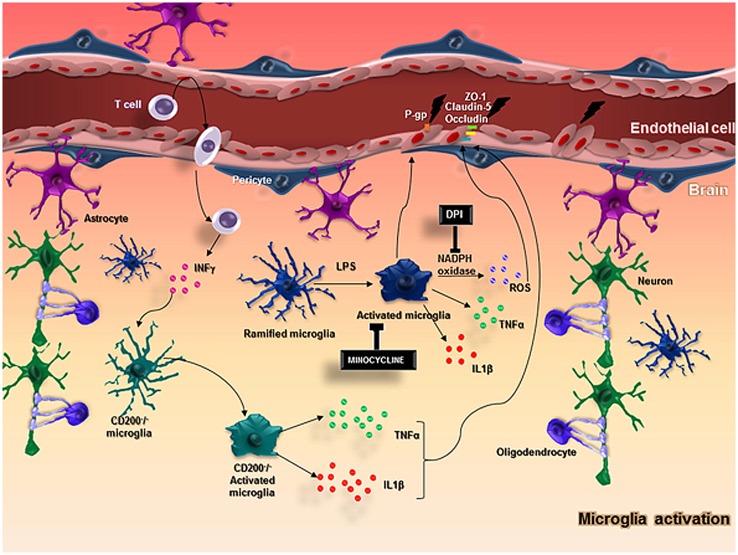
- In rat brain microvascular endothelial cell (RBEC)/microglia co-culture, abluminal LPS did not change transendothelial electrical resistance (TEER) in RBEC monolayers alone, but decreased TEER and increased sodium-fluorescein permeability in co-culture, in a manner dependent on microglial cell number; the disrupted ZO-1, claudin-5 and occludin staining was restored by the NADPH oxidase inhibitor DPI (Sumi et al., 2010).
- In mouse brain capillary endothelial (MBEC4)/microglia co-culture, LPS-activated microglia increased Na-F permeability, an effect blocked by a neutralizing antibody against TNF-α (Nishioku et al., 2010).
- In CD200-deficient mice, increased BBB permeability was associated with T cell/macrophage entry, elevated IFNγ, and increased TNF-α, promoting classical microglial activation (Denieffe et al., 2013).
- In rat hippocampus, Aβ1–42 injection caused time-dependent increases in fibrinogen and microgliosis and significantly increased IgG immunoreactivity; anti-Mac-1 reduced IgG, consistent with reduced microglial reactivity and greater BBB preservation (Ryu and McLarnon, 2009).
- In stroke, BBB disruption is described as biphasic: an early opening (12–48 h) driven mainly by ROS activating latent MMP-2, and a delayed secondary opening (48–72 h) driven by sustained inflammation and microglial MMP-2/3/9 production; activated microglia were reported up to 16 weeks after 2-hour MCAO in rats (Ekdahl et al., 2009), while neutrophil infiltration was more prominent only with longer MCAO periods and few exogenous macrophages infiltrated over the first 72 h (Denes et al., 2007).
- Minocycline, a microglial inhibitor, preserved BBB constituents in vitro and reduced BBB disruption and hemorrhage in vivo (Yenari et al., 2006), and in two clinical trials in ischemic stroke patients improved neurological functional outcome, alone and combined with fibrinolysis (Fagan et al., 2011).
Methods
- Design: narrative literature review of "recent advances" on microglia–vascular interactions in brain disease; no systematic search strategy, inclusion criteria, or quantitative synthesis is reported.
- Scope: developmental microglia–endothelium interaction, mechanisms of microglial activation and BBB impairment, and disease-specific sections on epilepsy, stroke, Alzheimer's disease and multiple sclerosis.
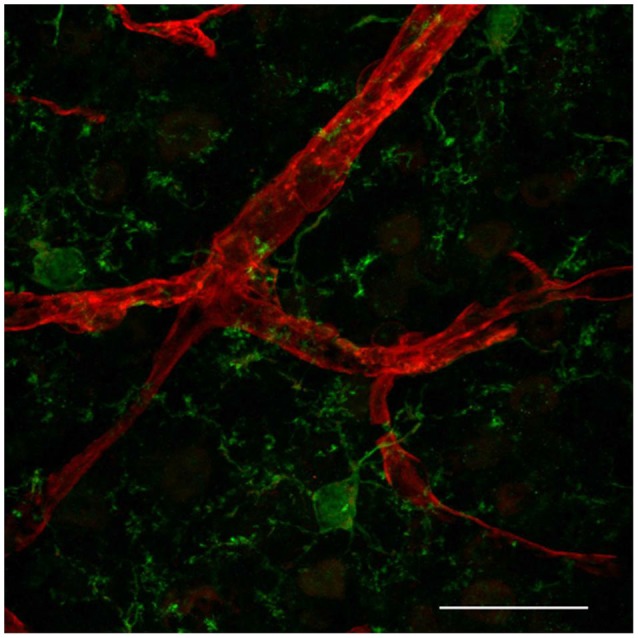
- Evidence base: cited in vitro co-culture systems (RBEC/microglia, MBEC4/microglia), rodent models (PU.1-deficient mice, clodronate liposome depletion, choroidal neovascularization, Aβ1–42 intra-hippocampal injection, tMCAO, EAE, TMEV-IDD, CD200-deficient mice), human AD and MS tissue, and clinical trial reports; the review also presents one original confocal image (Figure 1) of IBA1-positive microglia and IsolectinB4-positive endothelium in a 1-month-old mouse cortex.
Limitations
- The paper states no explicit limitations section; it acknowledges that "the mechanisms involved in the multifaceted interactions between the constituents of the NVU are not yet fully uncovered," particularly how microglial activation drives BBB disruption.
- Evident from the text: as a narrative review it relies on heterogeneous cited studies (in vitro co-cultures, animal models, human tissue, clinical trials) without systematic appraisal, and several mechanistic claims are hedged by the authors as hypotheses or suggestions (e.g., "we can hypothesize," "we suggest") rather than demonstrated findings.
- Evident from the text: much of the mechanistic evidence is preclinical (rodent and cell-culture), and the authors note uncertainty about the relative contribution of resident microglia versus infiltrating bone-marrow-derived myeloid cells in inflammatory conditions.
Model-written summary. Check it against the paper before relying on it.
Integrity signals
Registry
Cites
Statistics
Figures
Verification
Claims the paper makes
70 Not checked yet · 12 Own interpretation · 4 No basis given · 1 Sources not found · 1 Own result
A result the paper reports from its own data — it cites no other source for it, so there is none to check. The quote shows it is in the paper.
In the paper
“Representative confocal image revealing close interaction between microglia (IBA1, green) and endothelial cells (IsolectinB4, red) in a 50 micron-cryopreserved cross-section of a 1 month-old mouse cortex.”
§ The impact of microglial activation on blood-brain barrier in brain diseases > Microglia-endothelium interaction during development
plaincorrelationalSingle case- Asserted: passes — The authors put it forward as true.
- Checkable: passes — It can be checked against evidence.
- Load-bearing: passes — The paper’s conclusions depend on it.
- Based: passes — The paper gives a reason why it holds.
None of the sources cited for this claim have been checked yet.
In the paper
“but undoubtedly microglia certainly play an important role in these pathologies (Perry et al., 2010; Graeber et al., 2011).”
§ The impact of microglial activation on blood-brain barrier in brain diseases > Microglial activation and the impact on BBB
What the sources say
boosteddirect- Asserted: passes — The authors put it forward as true.
- Checkable: passes — It can be checked against evidence.
- Load-bearing: passes — The paper’s conclusions depend on it.
- Based: passes — The paper gives a reason why it holds.
None of the sources cited for this claim have been checked yet.
In the paper
“Considering all the studies mentioned above, microglial activation impairs BBB function by the release of various molecules leading to a hyperpermeability condition associated with inflammation that is similar to what occurs in certain neurodegenerative disorders, including AD and Multiple Sclerosis (MS).”
§ The impact of microglial activation on blood-brain barrier in brain diseases > Microglial activation and the impact on BBB
What the sources say
plaindirect- Asserted: passes — The authors put it forward as true.
- Checkable: passes — It can be checked against evidence.
- Load-bearing: passes — The paper’s conclusions depend on it.
- Based: passes — The paper gives a reason why it holds.
- Rests on an assumption: The findings from animal models and in vitro co-culture systems about microglia-endothelium interactions are representative of human brain diseases.
In the paper
“indicating that TNF-α contributes to BBB dysfunction (Nishioku et al., 2010).”
§ The impact of microglial activation on blood-brain barrier in brain diseases > Microglial activation and the impact on BBB
What the sources say
- Not checked yetcites Nishioku et al., 2010 source
hedgeddirect- Asserted: passes — The authors put it forward as true.
- Checkable: passes — It can be checked against evidence.
- Load-bearing: passes — The paper’s conclusions depend on it.
- Based: passes — The paper gives a reason why it holds.
In the paper
“These current findings show the increasing importance of the inflammatory pathways activated by microglial cells in inducing BBB dysfunction, which contributes to epileptogenesis.”
§ The impact of microglial activation on blood-brain barrier in brain diseases > Microglial activation and the impact on BBB > Epilepsy
What the sources say
- Not checked yetcites Vezzani et al., 2011 source
plaindirect- Asserted: passes — The authors put it forward as true.
- Checkable: passes — It can be checked against evidence.
- Load-bearing: passes — The paper’s conclusions depend on it.
- Based: passes — The paper gives a reason why it holds.
In the paper
“Taking all the recent data into consideration, we can suggest that the cells of the NVU, specially glial cells, have an overwhelming importance in epileptogenesis.”
§ The impact of microglial activation on blood-brain barrier in brain diseases > Microglial activation and the impact on BBB > Epilepsy
What the sources say
- Not checked yetcites Vezzani et al., 2011 source
boosteddirect- Asserted: passes — The authors put it forward as true.
- Checkable: passes — It can be checked against evidence.
- Load-bearing: passes — The paper’s conclusions depend on it.
- Based: passes — The paper gives a reason why it holds.
- Rests on an assumption: Microglial activation is a common and comparable process across the different brain diseases discussed (infectious/inflammatory diseases, epilepsy, ischemic stroke and neurodegenerative disorders).
None of the sources cited for this claim have been checked yet.
In the paper
“impairments of the BBB have been observed in this context (Dickstein et al., 2006; Zipser et al., 2007; Lassman et al., 2012; Figure 2).”
§ The impact of microglial activation on blood-brain barrier in brain diseases > Microglial activation and the impact on BBB
What the sources say
plaincorrelational- Asserted: passes — The authors put it forward as true.
- Checkable: passes — It can be checked against evidence.
- Load-bearing: unclear — It is unclear whether the paper’s conclusions depend on it.
- Based: passes — The paper gives a reason why it holds.
The paper states this without a source or data behind it here, so there is nothing to check it against. The quote shows it is in the paper.
In the paper
“Increasing evidences indicate that activated microglia modulate expression of tight junctions, which are essential for BBB integrity and function.”
§ The impact of microglial activation on blood-brain barrier in brain diseases > Abstract
hedgeddirect- Asserted: passes — The authors put it forward as true.
- Checkable: passes — It can be checked against evidence.
- Load-bearing: passes — The paper’s conclusions depend on it.
- Based: unclear — It is unclear why the paper says it holds.
None of the sources cited for this claim have been checked yet.
In the paper
“microglia associate with endothelial tip cells, as demonstrated during embryonic brain and postnatal retinal angiogenesis”
§ The impact of microglial activation on blood-brain barrier in brain diseases > Microglia-endothelium interaction during development
What the sources say
boostedcorrelational- Asserted: passes — The authors put it forward as true.
- Checkable: passes — It can be checked against evidence.
- Load-bearing: unclear — It is unclear whether the paper’s conclusions depend on it.
- Based: passes — The paper gives a reason why it holds.
In the paper
“Recent studies suggest that microglial activation may be related to BBB disruption.”
§ The impact of microglial activation on blood-brain barrier in brain diseases > Microglial activation and the impact on BBB
What the sources say
- Not checked yetcites Sumi et al., 2010 source
hedgedcorrelational- Asserted: passes — The authors put it forward as true.
- Checkable: passes — It can be checked against evidence.
- Load-bearing: passes — The paper’s conclusions depend on it.
- Based: passes — The paper gives a reason why it holds.
- Probably not a substantial claim. 4
- It may state two separate claims as one. 37
The paper states this without a source or data behind it here, so there is nothing to check it against. The quote shows it is in the paper.
In the paper
“On the other hand, the endothelium can regulate the state of microglial activation.”
§ The impact of microglial activation on blood-brain barrier in brain diseases > Abstract
plaindirect- Asserted: passes — The authors put it forward as true.
- Checkable: passes — It can be checked against evidence.
- Load-bearing: fails — The paper’s conclusions may not depend on it.
- Based: fails — The paper may give no reason why it holds.
Probably not a substantial claim. The paper’s conclusions may not depend on it. The paper may give no reason why it holds.
None of the sources cited for this claim have been checked yet.
In the paper
“One of the key components of the cell death cascades in stroke is neuroinflammation, where the main players are microglial cells and the peripheral leukocytes, especially neutrophils and monocytes/macrophages.”
§ The impact of microglial activation on blood-brain barrier in brain diseases > Microglial activation and the impact on BBB > Stroke
What the sources say
plaindirect- Asserted: passes — The authors put it forward as true.
- Checkable: passes — It can be checked against evidence.
- Load-bearing: passes — The paper’s conclusions depend on it.
- Based: passes — The paper gives a reason why it holds.
It may state two separate claims as one.
None of the sources cited for this claim have been checked yet.
In the paper
“Microglial and astrocytic IL-1β act directly on the endothelium, altering BBB permeability and contributing to epileptogenesis.”
§ The impact of microglial activation on blood-brain barrier in brain diseases > Microglial activation and the impact on BBB > Epilepsy
What the sources say
plaindirect- Asserted: passes — The authors put it forward as true.
- Checkable: passes — It can be checked against evidence.
- Load-bearing: passes — The paper’s conclusions depend on it.
- Based: passes — The paper gives a reason why it holds.
It may state two separate claims as one.
In the paper
“the authors suggest that microglia play a role in CNS angiogenesis by serving as a bridge to promote tip cell fusion, vascular plexus growth following sprouting induction and tip cell migration by VEGF (Fantin et al., 2010).”
§ The impact of microglial activation on blood-brain barrier in brain diseases > Microglia-endothelium interaction during development
What the sources say
- Not checked yetcites Fantin et al., 2010 source
hedgeddirect- Asserted: passes — The authors put it forward as true.
- Checkable: passes — It can be checked against evidence.
- Load-bearing: fails — The paper’s conclusions may not depend on it.
- Based: passes — The paper gives a reason why it holds.
Probably not a substantial claim. The paper’s conclusions may not depend on it.
None of the sources cited for this claim have been checked yet.
In the paper
“The fact that microglia are present in the embryonic CNS territory prior to endothelial invasion and that they participate in cerebrovasculature growth place the interactions between microglia and CNS endothelium as a possible key mechanism in BBB formation and regulation.”
§ The impact of microglial activation on blood-brain barrier in brain diseases > Microglia-endothelium interaction during development
What the sources say
hedgedconditional- Asserted: passes — The authors put it forward as true.
- Checkable: passes — It can be checked against evidence.
- Load-bearing: passes — The paper’s conclusions depend on it.
- Based: passes — The paper gives a reason why it holds.
It may state two separate claims as one.
None of the sources cited for this claim have been checked yet.
In the paper
“Microglia become activated under brain injury and immunological stimuli (Kreutzberg, 1996) and undergo several alterations from a “resting state” to an active state (Hanisch and Kettenmann, 2007; Kettenmann et al., 2011).”
§ The impact of microglial activation on blood-brain barrier in brain diseases > Microglial activation and the impact on BBB
What the sources say
plaindirect- Asserted: passes — The authors put it forward as true.
- Checkable: passes — It can be checked against evidence.
- Load-bearing: passes — The paper’s conclusions depend on it.
- Based: passes — The paper gives a reason why it holds.
It may state two separate claims as one.
None of the sources cited for this claim have been checked yet.
In the paper
“In this phase, MMPs are important mediators: microglial ROS, especially superoxide radical O2−, increase vascular permeability also by stimulating MMP-2/MMP-3/MMP-9 production by microglia, astrocytes and ECs (Gottschall and Deb, 1996; Asahi et al., 2001; Rosenberg et al., 2001), contributing to hemorrhagic transformation and vasogenic edema.”
§ The impact of microglial activation on blood-brain barrier in brain diseases > Microglial activation and the impact on BBB > Stroke
What the sources say
plaindirect- Asserted: passes — The authors put it forward as true.
- Checkable: passes — It can be checked against evidence.
- Load-bearing: passes — The paper’s conclusions depend on it.
- Based: passes — The paper gives a reason why it holds.
It may state two separate claims as one.
None of the sources cited for this claim have been checked yet.
In the paper
“After the ischemic insult, the recruitment of immune cells occurs in a biphasic dynamics. In the acute phase (within minutes), microglial cells are rapidly recruited to the injury site, due to the immediate release of cytokines and chemokines.”
§ The impact of microglial activation on blood-brain barrier in brain diseases > Microglial activation and the impact on BBB > Stroke
What the sources say
plaindirect- Asserted: passes — The authors put it forward as true.
- Checkable: passes — It can be checked against evidence.
- Load-bearing: unclear — It is unclear whether the paper’s conclusions depend on it.
- Based: passes — The paper gives a reason why it holds.
It may state two separate claims as one.
None of the sources cited for this claim have been checked yet.
In the paper
“Blood-derived macrophages and microglia appear to have many functions in the dynamic process of CNS injury and repair, affecting BBB permeabilization, which in turn can aggravate stroke (Hallenbeck, 2002; Sandoval and Witt, 2008; Jiao et al., 2011).”
§ The impact of microglial activation on blood-brain barrier in brain diseases > Microglial activation and the impact on BBB > Stroke
What the sources say
hedgeddirect- Asserted: passes — The authors put it forward as true.
- Checkable: passes — It can be checked against evidence.
- Load-bearing: passes — The paper’s conclusions depend on it.
- Based: passes — The paper gives a reason why it holds.
It may state two separate claims as one.
None of the sources cited for this claim have been checked yet.
In the paper
“Some in vitro and in vivo studies have shown the role of IGF-1 in promoting neuroprotection and neuroregeneration (Li et al., 2010; Selvamani et al., 2012; Sohrabji and Williams, 2013; Bake et al., 2014).”
§ The impact of microglial activation on blood-brain barrier in brain diseases > Microglial activation and the impact on BBB > Stroke
What the sources say
- Not checked yetcites Li et al., 2010
- Not checked yetcites Selvamani et al., 2012 source
- Not checked yetcites Sohrabji and Williams, 2013
hedgeddirect- Asserted: passes — The authors put it forward as true.
- Checkable: passes — It can be checked against evidence.
- Load-bearing: fails — The paper’s conclusions may not depend on it.
- Based: passes — The paper gives a reason why it holds.
Probably not a substantial claim. The paper’s conclusions may not depend on it. It may state two separate claims as one.
None of the sources cited for this claim have been checked yet.
In the paper
“In addition, ROS and NO can also reorganize the cytoskeleton of ECs and modulate tight junction proteins claudin-5 and occludin (Yamagata et al., 2004; Schreibelt et al., 2007) activate microglial cells; and up-regulate inflammatory mediators in the first 48 h.”
§ The impact of microglial activation on blood-brain barrier in brain diseases > Microglial activation and the impact on BBB > Stroke
What the sources say
plaindirect- Asserted: passes — The authors put it forward as true.
- Checkable: passes — It can be checked against evidence.
- Load-bearing: passes — The paper’s conclusions depend on it.
- Based: passes — The paper gives a reason why it holds.
It may state two separate claims as one.
In the paper
“These actions not only help enhancing the influx of peripheral leukocytes, but also contribute to the formation of vasogenic edema by allowing the diffusion of sodium and water (Sandoval and Witt, 2008).”
§ The impact of microglial activation on blood-brain barrier in brain diseases > Microglial activation and the impact on BBB > Stroke
What the sources say
- Not checked yetcites Sandoval and Witt, 2008
plaindirect- Asserted: passes — The authors put it forward as true.
- Checkable: passes — It can be checked against evidence.
- Load-bearing: passes — The paper’s conclusions depend on it.
- Based: passes — The paper gives a reason why it holds.
It may state two separate claims as one.
None of the sources cited for this claim have been checked yet.
In the paper
“Recently, the neuroinflammatory state was shown to activate the c-Jun N-terminal kinase (JNK) pathway not only in microglia but also in ECs, leading to microglial and endothelial activation with direct and microglial-induced BBB disruption, further cytokine production and perpetuation of the neuroinflammatory process (Tu et al., 2011; Wang et al., 2012).”
§ The impact of microglial activation on blood-brain barrier in brain diseases > Microglial activation and the impact on BBB > Stroke
What the sources say
- Not checked yetcites Tu et al., 2011
- Not checked yetcites Wang et al., 2012 source
plaindirect- Asserted: passes — The authors put it forward as true.
- Checkable: passes — It can be checked against evidence.
- Load-bearing: passes — The paper’s conclusions depend on it.
- Based: passes — The paper gives a reason why it holds.
It may state two separate claims as one.
None of the sources cited for this claim have been checked yet.
In the paper
“They activate the latent MMP-2 min after the ischemic insult, and are produced by microglia and astrocytes through the HIF-1α pathway (Yang and Rosenberg, 2011; Obermeier et al., 2013).”
§ The impact of microglial activation on blood-brain barrier in brain diseases > Microglial activation and the impact on BBB > Stroke
What the sources say
- Not checked yetcites Yang and Rosenberg, 2011
- Not checked yetcites Obermeier et al., 2013 source
plaindirect- Asserted: passes — The authors put it forward as true.
- Checkable: passes — It can be checked against evidence.
- Load-bearing: passes — The paper’s conclusions depend on it.
- Based: passes — The paper gives a reason why it holds.
It may state two separate claims as one.
None of the sources cited for this claim have been checked yet.
In the paper
“minocycline, a member of the tetracycline antibiotic family, inhibits activation of microglia and brain infiltrating blood-derived macrophages and protects cultured neurons from excitotoxic insults by preventing microglial generation of glutamate, IL-1β and NO (Yrjänheikki et al., 1998, 1999; Tikka et al., 2001).”
§ The impact of microglial activation on blood-brain barrier in brain diseases > Microglial activation and the impact on BBB > Stroke
What the sources say
- Not matchedcites Yrjänheikki et al., 1998, 1999
Couldn’t be matched to a paper in Crossref, so it can’t be checked.
- Not checked yetcites Tikka et al., 2001 source
plaindirect- Asserted: passes — The authors put it forward as true.
- Checkable: passes — It can be checked against evidence.
- Load-bearing: passes — The paper’s conclusions depend on it.
- Based: passes — The paper gives a reason why it holds.
It may state two separate claims as one.
- Not matched
None of the sources cited for this claim have been checked yet.
In the paper
“Inhibiting microglial activation may limit BBB disruption and reduce vasogenic edema in the context of ischemic stroke, reducing the volume of ischemic tissue and neuronal deficits, as well as preventing hemorrhagic transformation (Tikka et al., 2001; Yenari et al., 2006).”
§ The impact of microglial activation on blood-brain barrier in brain diseases > Microglial activation and the impact on BBB > Stroke
What the sources say
hedgedconditional- Asserted: passes — The authors put it forward as true.
- Checkable: passes — It can be checked against evidence.
- Load-bearing: passes — The paper’s conclusions depend on it.
- Based: passes — The paper gives a reason why it holds.
It may state two separate claims as one.
A conclusion the paper draws from its own results — it cites no other source for it, so there is none to check. The quote shows it is in the paper.
In the paper
“These mediators also indirectly lead to BBB damage, by acting not on ECs, but on different components of the NVU: activating MMPs and acting on astrocytes and pericytes through ROS, NO and cytokines.”
§ The impact of microglial activation on blood-brain barrier in brain diseases > Microglial activation and the impact on BBB > Stroke
plaindirect- Asserted: passes — The authors put it forward as true.
- Checkable: passes — It can be checked against evidence.
- Load-bearing: unclear — It is unclear whether the paper’s conclusions depend on it.
- Based: passes — The paper gives a reason why it holds.
It may state two separate claims as one.
None of the sources cited for this claim have been checked yet.
In the paper
“In addition, ROS and NO can also reorganize the cytoskeleton of ECs and modulate tight junction proteins claudin-5 and occludin (Yamagata et al., 2004; Schreibelt et al., 2007) activate microglial cells; and up-regulate inflammatory mediators in the first 48 h.”
§ The impact of microglial activation on blood-brain barrier in brain diseases > Microglial activation and the impact on BBB > Stroke
What the sources say
plaindirect- Asserted: passes — The authors put it forward as true.
- Checkable: passes — It can be checked against evidence.
- Load-bearing: unclear — It is unclear whether the paper’s conclusions depend on it.
- Based: passes — The paper gives a reason why it holds.
It may state two separate claims as one.
None of the sources cited for this claim have been checked yet.
In the paper
“These cells are activated, enhancing the release of ROS (through NADPH oxidase and MPO), cytokines (i.e., IL-1β, IL-6 and TNF-α) and chemokines (MCP-1, CXCL-1 and MIP-1α).”
§ The impact of microglial activation on blood-brain barrier in brain diseases > Microglial activation and the impact on BBB > Stroke
What the sources say
plaindirect- Asserted: passes — The authors put it forward as true.
- Checkable: passes — It can be checked against evidence.
- Load-bearing: passes — The paper’s conclusions depend on it.
- Based: passes — The paper gives a reason why it holds.
It may state two separate claims as one.
In the paper
“Also, very few infiltrating exogenous macrophages were observed over the first 72 h period and, instead, a profound increase in proliferating resident microglia cells was observed (Denes et al., 2007).”
§ The impact of microglial activation on blood-brain barrier in brain diseases > Microglial activation and the impact on BBB > Stroke
What the sources say
- Not checked yetcites Denes et al., 2007 source
plain- Asserted: passes — The authors put it forward as true.
- Checkable: passes — It can be checked against evidence.
- Load-bearing: passes — The paper’s conclusions depend on it.
- Based: passes — The paper gives a reason why it holds.
It may state two separate claims as one.
A conclusion the paper draws from its own results — it cites no other source for it, so there is none to check. The quote shows it is in the paper.
In the paper
“All these data suggest that microglia has a role in the EC damage and BBB disruption in stroke, making these cells a possible target to minimize the ischemic damage in stroke patients.”
§ The impact of microglial activation on blood-brain barrier in brain diseases > Microglial activation and the impact on BBB > Stroke
hedgedconditional- Asserted: passes — The authors put it forward as true.
- Checkable: passes — It can be checked against evidence.
- Load-bearing: passes — The paper’s conclusions depend on it.
- Based: passes — The paper gives a reason why it holds.
It may state two separate claims as one.
None of the sources cited for this claim have been checked yet.
In the paper
“Apart from the effects of MMPs, microglial-induced late-phase BBB disruption is due to direct effects on ECs: IL-1β and TNF-α downregulate tight junction proteins expression in ECs (Yamagata et al., 2004; Jiao et al., 2011) and, together with IL-6, modulate the expression of adhesion molecules (ICAM-1 and VCAM; Hallenbeck, 2002).”
§ The impact of microglial activation on blood-brain barrier in brain diseases > Microglial activation and the impact on BBB > Stroke
What the sources say
plaindirect- Asserted: passes — The authors put it forward as true.
- Checkable: passes — It can be checked against evidence.
- Load-bearing: passes — The paper’s conclusions depend on it.
- Based: passes — The paper gives a reason why it holds.
It may state two separate claims as one.
None of the sources cited for this claim have been checked yet.
In the paper
“MMPs are further stimulated by NK-κB and HIF-1α and disrupt TJ proteins (as ZO-1, claudin-5 and occludin), rendering the BBB leaky, downstream effects which were shown to be reverted by blocking NOS (Yang and Rosenberg, 2011; Gu et al., 2012; Obermeier et al., 2013).”
§ The impact of microglial activation on blood-brain barrier in brain diseases > Microglial activation and the impact on BBB > Stroke
What the sources say
- Not checked yetcites Yang and Rosenberg, 2011
- Not checked yetcites Gu et al., 2012
- Not checked yetcites Obermeier et al., 2013 source
plaindirect- Asserted: passes — The authors put it forward as true.
- Checkable: passes — It can be checked against evidence.
- Load-bearing: unclear — It is unclear whether the paper’s conclusions depend on it.
- Based: passes — The paper gives a reason why it holds.
It may state two separate claims as one.
In the paper
“In AD, these cells can promote the clearance of Aβ, however, if they are not able to do that, there is an accumulation of Aβ deposits leading to neuronal death (Rogers et al., 2002).”
§ The impact of microglial activation on blood-brain barrier in brain diseases > Microglial activation and the impact on BBB > Alzheimer’s disease
What the sources say
- Not checked yetcites Rogers et al., 2002 source
plaindirect- Asserted: passes — The authors put it forward as true.
- Checkable: passes — It can be checked against evidence.
- Load-bearing: unclear — It is unclear whether the paper’s conclusions depend on it.
- Based: passes — The paper gives a reason why it holds.
It may state two separate claims as one.
A conclusion the paper draws from its own results — it cites no other source for it, so there is none to check. The quote shows it is in the paper.
In the paper
“When activated, microglia impair BBB function through the release of several inflammatory modulators leading to a hyperpermeability condition, which is associated with several brain disorders.”
§ The impact of microglial activation on blood-brain barrier in brain diseases > Concluding remarks
plaindirect- Asserted: passes — The authors put it forward as true.
- Checkable: passes — It can be checked against evidence.
- Load-bearing: passes — The paper’s conclusions depend on it.
- Based: passes — The paper gives a reason why it holds.
It may state two separate claims as one.
In the paper
“Multiple sclerosis is a chronic, progressive and neuroinflammatory demyelinating disease of the CNS, which involves an energy deficit, tissue remodeling, microglial activation and loss of BBB integrity (Lassmann et al., 2012).”
§ The impact of microglial activation on blood-brain barrier in brain diseases > Microglial activation and the impact on BBB > Multiple sclerosis
What the sources say
- Not checked yetcites Lassmann et al., 2012 source
plaincorrelational- Asserted: passes — The authors put it forward as true.
- Checkable: passes — It can be checked against evidence.
- Load-bearing: unclear — It is unclear whether the paper’s conclusions depend on it.
- Based: passes — The paper gives a reason why it holds.
It may state two separate claims as one.
None of the sources cited for this claim have been checked yet.
In the paper
“it was observed in AD brains the presence of activated microglia and astrocytes around Aβ plaques, with the release of inflammatory cytokines, such as IL-1 and IL-6, TNF-α and transforming growth factor-β (TNF-β; Wyss-Coray, 2006; Zhou et al., 2012).”
§ The impact of microglial activation on blood-brain barrier in brain diseases > Microglial activation and the impact on BBB > Alzheimer’s disease
What the sources say
plaincorrelational- Asserted: passes — The authors put it forward as true.
- Checkable: passes — It can be checked against evidence.
- Load-bearing: passes — The paper’s conclusions depend on it.
- Based: passes — The paper gives a reason why it holds.
It may state two separate claims as one.
None of the sources cited for this claim have been checked yet.
In the paper
“Previous studies showed that systemic inflammation contributes to the disease progression and the activation of immune cells allows the infiltration of T and B cells into the CNS, promoting the release of chemokines that in turn stimulate the migration of more immune cells, leading to BBB disruption (Holman et al., 2011; Kooij et al., 2011; Larochelle et al., 2011; Willis, 2011).”
§ The impact of microglial activation on blood-brain barrier in brain diseases > Microglial activation and the impact on BBB > Multiple sclerosis
What the sources say
plaindirect- Asserted: passes — The authors put it forward as true.
- Checkable: passes — It can be checked against evidence.
- Load-bearing: passes — The paper’s conclusions depend on it.
- Based: passes — The paper gives a reason why it holds.
It may state two separate claims as one.
In the paper
“Moreover, high levels of Aβ are correlated with production of CCL2 by microglia, which leads to BBB impairment (Roberts et al., 2012).”
§ The impact of microglial activation on blood-brain barrier in brain diseases > Microglial activation and the impact on BBB > Alzheimer’s disease
What the sources say
- Not checked yetcites Roberts et al., 2012 source
plaindirect- Asserted: passes — The authors put it forward as true.
- Checkable: passes — It can be checked against evidence.
- Load-bearing: unclear — It is unclear whether the paper’s conclusions depend on it.
- Based: passes — The paper gives a reason why it holds.
It may state two separate claims as one.
In the paper
“Hereupon, there are two different types of inflammation in MS. The first consists in the initial response to the disease, involving the infiltration of CD4+ and CD8+ T-cells and robust microglial activation; the second occurs due to the myelin destruction, stimulating the secondary recruitment of T cells, B cells and macrophages (Lassmann et al., 2012).”
§ The impact of microglial activation on blood-brain barrier in brain diseases > Microglial activation and the impact on BBB > Multiple sclerosis
What the sources say
- Not checked yetcites Lassmann et al., 2012 source
plaindirect- Asserted: passes — The authors put it forward as true.
- Checkable: passes — It can be checked against evidence.
- Load-bearing: unclear — It is unclear whether the paper’s conclusions depend on it.
- Based: passes — The paper gives a reason why it holds.
It may state two separate claims as one.
None of the sources cited for this claim have been checked yet.
In the paper
“Furthermore, it was shown that intracranial injection of thrombin activates microglia, leading to the production of NO and TNFα via JAK2-STAT3 signaling pathway, which induce BBB disruption.”
§ The impact of microglial activation on blood-brain barrier in brain diseases > Microglial activation and the impact on BBB > Alzheimer’s disease
What the sources say
plaindirect- Asserted: passes — The authors put it forward as true.
- Checkable: passes — It can be checked against evidence.
- Load-bearing: passes — The paper’s conclusions depend on it.
- Based: passes — The paper gives a reason why it holds.
It may state two separate claims as one.
In the paper
“It has already been shown that the elimination of Aβ from the brain and the consequent impairment of microglial activation decrease ROS, nitrogen compounds and also inflammatory cytokines produced by microglial cells, which are correlated with the activation of ECs (Dickstein et al., 2006).”
§ The impact of microglial activation on blood-brain barrier in brain diseases > Microglial activation and the impact on BBB > Alzheimer’s disease
What the sources say
- Not checked yetcites Dickstein et al., 2006 source
boosteddirect- Asserted: passes — The authors put it forward as true.
- Checkable: passes — It can be checked against evidence.
- Load-bearing: passes — The paper’s conclusions depend on it.
- Based: passes — The paper gives a reason why it holds.
It may state two separate claims as one.
In the paper
“Moreover, during inflammation and demyelination in MS, the activation of microglial cells lead to the release of cytotoxic factors, such as NO and ROS, provoking myelin damage, release of proinflammatory cytokines (IFNγ, TNF-α and IL-1β), as well as chemokines (MCP-1), ultimately inducing BBB disruption (Mahad and Ransohoff, 2003).”
§ The impact of microglial activation on blood-brain barrier in brain diseases > Microglial activation and the impact on BBB > Multiple sclerosis
What the sources say
- Not checked yetcites Mahad and Ransohoff, 2003
plaindirect- Asserted: passes — The authors put it forward as true.
- Checkable: passes — It can be checked against evidence.
- Load-bearing: passes — The paper’s conclusions depend on it.
- Based: passes — The paper gives a reason why it holds.
It may state two separate claims as one.
A conclusion the paper draws from its own results — it cites no other source for it, so there is none to check. The quote shows it is in the paper.
In the paper
“Thus, regarding all evidences described above, we can hypothesize that microglia activation plays an important role during BBB disruption, which substantiates the need to study other factors correlated with inflammatory pathways, as potential targets of new strategies to reduce microglial-dependent inflammation in the brain of AD patients.”
§ The impact of microglial activation on blood-brain barrier in brain diseases > Microglial activation and the impact on BBB > Alzheimer’s disease
hedgeddirect- Asserted: passes — The authors put it forward as true.
- Checkable: passes — It can be checked against evidence.
- Load-bearing: passes — The paper’s conclusions depend on it.
- Based: passes — The paper gives a reason why it holds.
Probably not a substantial claim.
None of the sources cited for this claim have been checked yet.
In the paper
“The inhibition of microglial activation by minocycline favors the differentiation of oligodendrocyte precursors and immature oligodendrocytes. These cells are responsible for remyelination of neurons, an important event for improvement of MS condition (Li et al., 2005; Yenari et al., 2006; Defaux et al., 2011; Miron et al., 2013).”
§ The impact of microglial activation on blood-brain barrier in brain diseases > Microglial activation and the impact on BBB > Multiple sclerosis
What the sources say
plaindirect- Asserted: passes — The authors put it forward as true.
- Checkable: passes — It can be checked against evidence.
- Load-bearing: passes — The paper’s conclusions depend on it.
- Based: passes — The paper gives a reason why it holds.
It may state two separate claims as one.
In the paper
“Recently published data demonstrated that dipyridamole attenuates the expression of Toll-like receptor stimulation-dependent cytokines and chemokines in human microglia, reduces microglial activity in EAE mice, and consequently decreases IL-1β, TNF-α and IL-6 expression, which are responsible for increased BBB permeability (Sloka et al., 2013).”
§ The impact of microglial activation on blood-brain barrier in brain diseases > Microglial activation and the impact on BBB > Multiple sclerosis
What the sources say
- Not checked yetcites Sloka et al., 2013 source
boosteddirect- Asserted: passes — The authors put it forward as true.
- Checkable: passes — It can be checked against evidence.
- Load-bearing: passes — The paper’s conclusions depend on it.
- Based: passes — The paper gives a reason why it holds.
It may state two separate claims as one.
In the paper
“experimental autoimmune encephalomyelitis (EAE), where activation of microglia precedes infiltration of peripheral macrophages and occurs before the onset of the disease (Sriram and Steiner, 2005).”
§ The impact of microglial activation on blood-brain barrier in brain diseases > Microglial activation and the impact on BBB > Multiple sclerosis
What the sources say
- Not checked yetcites Sriram and Steiner, 2005
plaincorrelational- Asserted: passes — The authors put it forward as true.
- Checkable: passes — It can be checked against evidence.
- Load-bearing: unclear — It is unclear whether the paper’s conclusions depend on it.
- Based: passes — The paper gives a reason why it holds.
It may state two separate claims as one.
None of the sources cited for this claim have been checked yet.
In the paper
“Activated microglia are known to express ROS-generating enzymes, such as NADPH oxidase, which are responsible for degeneration of oligodendrocytes and increased BBB permeability by downregulating the expression of VE-cadherin, occludin and claudin-5 proteins in microvascular ECs (Fischer et al., 2012; Rochfort et al., 2014).”
§ The impact of microglial activation on blood-brain barrier in brain diseases > Microglial activation and the impact on BBB > Multiple sclerosis
What the sources say
boosteddirect- Asserted: passes — The authors put it forward as true.
- Checkable: passes — It can be checked against evidence.
- Load-bearing: passes — The paper’s conclusions depend on it.
- Based: passes — The paper gives a reason why it holds.
It may state two separate claims as one.
In the paper
“In this event, fibrinogen induces the activation of microglia and consequently the release of ROS, inducing axonal damage (Davalos et al., 2012).”
§ The impact of microglial activation on blood-brain barrier in brain diseases > Microglial activation and the impact on BBB > Multiple sclerosis
What the sources say
- Not checked yetcites Davalos et al., 2012 source
plaindirect- Asserted: passes — The authors put it forward as true.
- Checkable: passes — It can be checked against evidence.
- Load-bearing: passes — The paper’s conclusions depend on it.
- Based: passes — The paper gives a reason why it holds.
It may state two separate claims as one.
None of the sources cited for this claim have been checked yet.
In the paper
“On the other hand, it has been shown that LPS induces the production of TNF-α in the brain by microglial cells, which promotes BBB dysfunction and also causes neuronal cell death by phagocytosis (Tanaka et al., 2006; Nishioku et al., 2010; Smith et al., 2012; Neniskyte et al., 2014).”
§ The impact of microglial activation on blood-brain barrier in brain diseases > Microglial activation and the impact on BBB > Alzheimer’s disease
What the sources say
boosteddirect- Asserted: passes — The authors put it forward as true.
- Checkable: passes — It can be checked against evidence.
- Load-bearing: passes — The paper’s conclusions depend on it.
- Based: passes — The paper gives a reason why it holds.
It may state two separate claims as one.
The paper relies on this without support.
The findings from animal models and in vitro co-culture systems about microglia-endothelium interactions are representative of human brain diseases.
“Considering all the studies mentioned above, microglial activation impairs BBB function by the release of various molecules leading to a hyperpermeability condition associated with inflammation that is similar to what occurs in certain neurodegenerative disorders, including AD and Multiple Sclerosis (MS).”
The paper relies on this without support.
Microglial activation is a common and comparable process across the different brain diseases discussed (infectious/inflammatory diseases, epilepsy, ischemic stroke and neurodegenerative disorders).
“Taking all the recent data into consideration, we can suggest that the cells of the NVU, specially glial cells, have an overwhelming importance in epileptogenesis.”
The paper relies on this without support.
BBB disruption worsens the clinical picture of stroke patients by causing intracerebral vasogenic edema and hemorrhagic transformation.
“BBB disruption is another key event in the pathogenesis of stroke, as it can worsen the clinical picture of the patients by the formation of intracerebral vasogenic edema and hemorrhagic transformation.”
The paper relies on this without support.
Findings from animal models of ischemic stroke, AD, and MS can be generalized to human patients.
“In vivo models helped clarifying the kinetics of the immune cells in ischemic stroke”
“Several studies using animal models have further contributed with in vivo evidences of the importance of microglia during AD progression.”
The paper relies on this without support.
Pharmacological modulation of microglial activation will produce net clinical benefit in AD and MS despite microglia's beneficial roles.
“Taking into account the literature reviewed about AD and MS, we suggest that pharmacological modulation of microglial activation may control the impairment of BBB in these diseases.”
Claims other papers make about this one
Each is checked against this paper’s own text: does it say what the citing paper says it does?
In the citing paper
“Microglia and astrocytes are the main innate immune effector cells in the CNS (da Fonseca et al., 2014).”
From The role of microglia in retinal neurodegeneration: Alzheimer’s disease, parkinson, and glaucoma. (2017) · cites this paper as da Fonseca et al., 2014
Self-check
Percentages, sums and reported differences re-computed from the paper’s own numbers.
Each contradiction between two passages listed here was confirmed by an independent check.
Rated major: it would touch a result — a value a result rests on, reported and recomputed p-values on opposite sides of the significance level, two passages that conflict with no sign which is right, or a cited work retracted before this paper was published.
In the paper
§ The impact of microglial activation on blood-brain barrier in brain diseases > Microglial activation and the impact on BBB > Multiple sclerosis
“The inhibition of microglial activation by minocycline favors the differentiation of oligodendrocyte precursors and immature oligodendrocytes. These cells are responsible for remyelination of neurons, an important event for improvement of MS condition (Li et al., 2005; Yenari et al., 2006; Defaux et al., 2011; Miron et al., 2013).”
§ The impact of microglial activation on blood-brain barrier in brain diseases > References
“Minocycline-mediated inhibition of microglia activation impairs oligodendrocyte progenitor cell responses and remyelination in a non-immune model of demyelination.”
Rated minor: it would not touch a result — a value no result rests on, a p-value that stays on the same side of the significance level, or a conflict that is clerical, resolved elsewhere in the paper, or outside its own findings.
In the paper
§ The impact of microglial activation on blood-brain barrier in brain diseases > Microglial activation and the impact on BBB > Alzheimer’s disease
“transforming growth factor-β (TNF-β; Wyss-Coray, 2006; Zhou et al., 2012)”
§ The impact of microglial activation on blood-brain barrier in brain diseases > Microglial activation and the impact on BBB > Epilepsy
“such as TGF-β, ATP, HMGB1”
Rated minor: it would not touch a result — a value no result rests on, a p-value that stays on the same side of the significance level, or a conflict that is clerical, resolved elsewhere in the paper, or outside its own findings.
In the paper
§ The impact of microglial activation on blood-brain barrier in brain diseases > Microglial activation and the impact on BBB > Alzheimer’s disease
“they observed a regression in the disease (El Khoury et al., 2007; Kiyota et al., 2013).”
§ The impact of microglial activation on blood-brain barrier in brain diseases > References
“Ccr2 deficiency impairs microglial accumulation and accelerates progression of Alzheimer-like disease.”
Citations
Cites
1 retracted
Briones, T. L., Rogozinska, M., & Woods, J. (2011) · Journal of Neurotrauma · doi:10.1089/neu.2011.1842 · Cited by 30
RetractedPolazzi, E., Mengoni, I., Caprini, M., Peña‐Altamira, E., Kurtys, E., & Monti, B. (2012) · Neurosignals · doi:10.1159/000337115 · Cited by 9,023
Fate Mapping Analysis Reveals That Adult Microglia Derive from Primitive Macrophages
Ginhoux, F., Greter, M., Leboeuf, M., Nandi, S., See, P., Gokhan, S., Mehler, M. F., Conway, S. J., Ng, L. G., Stanley, E. R., et al. (2010) · Science · doi:10.1126/science.1194637 · Cited by 5,175
Microglia: a sensor for pathological events in the CNS
Kreutzberg, G. W. (1996) · Trends in Neurosciences · doi:10.1016/0166-2236(96)10049-7 · Cited by 4,396
Calamita, E., Schmid, M., Kunz, M., Ndebele-Murisa, M. R., Magadza, C. H. D., Nyambe, I., & Wehrli, B. (2019) · Figshare · doi:10.26181/6153922fe919c · Cited by 4,239
Fisher, R. S., Boas, W. V. E., Blume, W. T., Elger, C. E., Genton, P., Lee, P., & Engel, J. (2005) · Epilepsia · doi:10.1111/j.0013-9580.2005.66104.x · Cited by 3,678
Microglia: Active sensor and versatile effector cells in the normal and pathologic brain
Hanisch, U.-K., & Kettenmann, H. (2007) · Nature Neuroscience · doi:10.1038/nn1997 · Cited by 3,676
Kettenmann, H., Hanisch, U.-K., Noda, M., & Verkhratsky, A. (2011) · Physiological Reviews · doi:10.1152/physrev.00011.2010 · Cited by 3,547
The Blood-Brain Barrier in Health and Chronic Neurodegenerative Disorders
Zlokovic, B. V. (2008) · Neuron · doi:10.1016/j.neuron.2008.01.003 · Cited by 3,280
Neurovascular pathways to neurodegeneration in Alzheimer’s disease and other disorders
Zlokovic, B. V. (2011) · Nature Reviews Neuroscience · doi:10.1038/nrn3114 · Cited by 2,969
Cited by
Sorted by citations
The Microenvironmental Landscape of Brain Tumors
Quail, D. F., & Joyce, J. A. (2017) · Cancer Cell · doi:10.1016/j.ccell.2017.02.009 · Cited by 1,924
Saraiva, C., Praça, C., Ferreira, R., Santos, T., Ferreira, L., & Bernardino, L. (2016) · Journal of Controlled Release · doi:10.1016/j.jconrel.2016.05.044 · Cited by 1,609
Blood-brain barrier dysfunction and recovery after ischemic stroke
Jiang, X., Andjelkovic, A. V., Zhu, L., Yang, T., Bennett, M. V. L., Chen, J., Keep, R. F., & Shi, Y. (2017) · Progress in Neurobiology · doi:10.1016/j.pneurobio.2017.10.001 · Cited by 965
Dual microglia effects on blood brain barrier permeability induced by systemic inflammation
Haruwaka, K., Ikegami, A., Tachibana, Y., Ohno, N., Konishi, H., Hashimoto, A., Matsumoto, M., Kato, D., Ono, R., Kiyama, H., et al. (2019) · Nature Communications · doi:10.1038/s41467-019-13812-z · Cited by 923
The blood-brain barrier in Alzheimer’s disease
Zenaro, E., Piacentino, G., & Constantin, G. (2017) · Neurobiology of Disease · doi:10.1016/j.nbd.2016.07.007 · Cited by 767
Metadata
- Authors
- da Fonseca, A. C. C., Matias, D., Garcia, C., Amaral, R., Geraldo, L. H., Freitas, C., & Lima, F. R. S.
- Affiliations
- Universidade Federal do Rio de Janeiro (BR)
- Venue
- Frontiers in Cellular Neuroscience
- Publisher
- Frontiers Media SA
- Published
- 2014-11-03
- Volume
- 8
- Pages
- 362-362
- ISSN
- 1662-5102 (ISSN-L)
- PMC
- PMC4217497
- OpenAlex
- W2051140555
- Semantic Scholar
- c5be3f0efc87bc47ecc037aeddfe23499572e499
- Cited by
- 572
- References
- 192
- Citations by year
- 2026: 37 · 2025: 49 · 2024: 51 · 2023: 50 · 2022: 61 · 2021: 52 · 2020: 71 · 2019: 43 · 2018: 59 · 2017: 43 · 2016: 36 · 2015: 19 · 2014: 1
- FWCI
- 2.67
- Type
- journal article
- Language
- en
- Open access
- gold
- doi.org
- Licence
- cc-by
- Locations
- Frontiers in Cellular Neuroscience (publishedVersion, cc-by)
- Europe PMC (PubMed Central) (publishedVersion, cc-by)
- PubMed Central (publishedVersion, cc-by)
- PubMed (publishedVersion)
- DOAJ (DOAJ: Directory of Open Access Journals) (submittedVersion, cc-by-sa)
- Topics
- Life Sciences › Neuroscience › Neurology › Barrier Structure and Function Studies
- Life Sciences › Neuroscience › Neurology › Neuroinflammation and Neurodegeneration Mechanisms
- Life Sciences › Biochemistry, Genetics and Molecular Biology › Molecular Biology › Extracellular vesicles in disease
- Keywords
- microglial activation, blood-brain barrier, neurovascular unit, endothelial cells, tight junctions, blood-brain barrier permeability, neuroinflammation, epilepsy, ischemic stroke, neurodegenerative diseases
About these checks
Registry, retraction, Cites and statistics results are computed, not judged, with one exception: a printed reference that no index lists is read once by a model before it counts as a citation error. Claims are extracted by a model and kept only when their quote appears verbatim in the text; each cited source is then checked, with a model’s help, for whether it says what the claim relies on. Those verdicts can be wrong — read the claim’s quote and the cited source before relying on one.
A language model drew the claims from the paper on 2026-10-09, under version 3 of the claim definition (model deepseek-v4.1-flash, prompt extract-v3).
A second model labelled each claim on 2026-10-09 (model jev-1.13-20260917, definition revision gold-guideline-v0.2).
Statistics and arithmetic are recomputed, not judged.
Confidence bands are shown only for fields calibrated on our annotated test set. None is calibrated yet, so no band is shown.
What counts as a claim ›How we measure confidence ›How we check this ›
Are you an author, or do you see a problem with this page? Request a review
