

The DOI matches its Crossref record; 63 of the 63 references it cites were found in a registry or an index; 21 of the 45 sources its claims cite were checked for support.
The Sixth Edition of the WHO Manual for Human Semen Analysis: A Critical Review and SWOT Analysis
Open accessAbstract
Semen analysis is the cornerstone of male fertility evaluation with WHO guidelines providing the basis for procedural standardization and reference values worldwide. The first WHO manual was published in 1980, and five editions have been subsequently released over the last four decades. The 6th Edition was published in July 2021. In this review, we identify the key changes of this 6th Edition. Additionally, we evaluate the utility of this 6th Edition in clinical practice using SWOT (strengths, weaknesses, opportunities, and threats) analysis. This new Edition has made the analysis of basic semen parameters more robust, taking into account the criticisms and grey areas of the previous editions. The tests assessing sperm DNA fragmentation and seminal oxidative stress are well-described. The main novelty is that this latest edition abandons the notion of reference thresholds, suggesting instead to replace them with “decision limits”. While this seems attractive, no decision limits are proposed for either basic semen parameters, or for extended or advanced parameters. This critical review of the 6th Edition of the WHO laboratory manual combined with a SWOT analysis summarizes the changes and novelties present in this new Edition and provides an in-depth analysis that could help its global use in the coming years.
Overview
AI snapshot
Written from the paper’s full text.
TL;DR
This critical review summarizes key changes in the 6th Edition of the WHO Manual for Human Semen Analysis and evaluates its clinical utility using SWOT analysis. It finds the 6th Edition improves basic semen analysis and adds SDF/oxidative stress testing, but abandons reference thresholds without providing replacement decision limits.
Key findings
- The 6th Edition, published July 2021, abandons reference thresholds and suggests replacing them with “decision limits,” yet no decision limits are proposed for basic, extended, or advanced semen parameters.
- Its reference data combine the 5th Edition and new data from 2010–2020, totaling 3589 fertile men (1800 from the 5th Edition and 1789 new subjects); the 5th centiles are not significantly different from the 2010 WHO 5th Edition.
- SDF and seminal oxidative stress tests are well-described, but SDF has no thresholds and each laboratory is recommended to develop its own reference range; clinical indications and utility are not discussed.
- Basic semen analysis changes include re-adopting grade a/b progressive motility, recommending vitality assessment when total sperm motility is below 40%, requiring 200 spermatozoa per replicate, and more precise assessment of concentrations <2 × 10^6/mL.
Methods
- Design: narrative critical review of the WHO 6th Edition combined with SWOT (strengths, weaknesses, opportunities, threats) analysis.
- Data/sample: comparison of the 5th and 6th Editions, including the 6th Edition’s combined semen data from 3589 fertile men and discussion of extended/advanced tests, sperm preparation, and cryopreservation.
- Main analysis: qualitative evaluation of methodological changes, clinical utility, and external/internal factors affecting global use.
Limitations
- The paper states that some geographical areas, such as South America and Sub-Saharan Africa, remain under-represented in the 6th Edition.
- The paper states that the 6th Edition lacks decision limits, SDF thresholds, clinical guidance for SDF/genetic tests, and accepted cut-off values for seminal oxidative stress.
- Evident from the text: this is a narrative critical review and SWOT analysis without a stated systematic search strategy or primary data collection; the SWOT assessment is qualitative.
Model-written summary. Check it against the paper before relying on it.
Integrity signals
Registry
Cites
Statistics
Figures
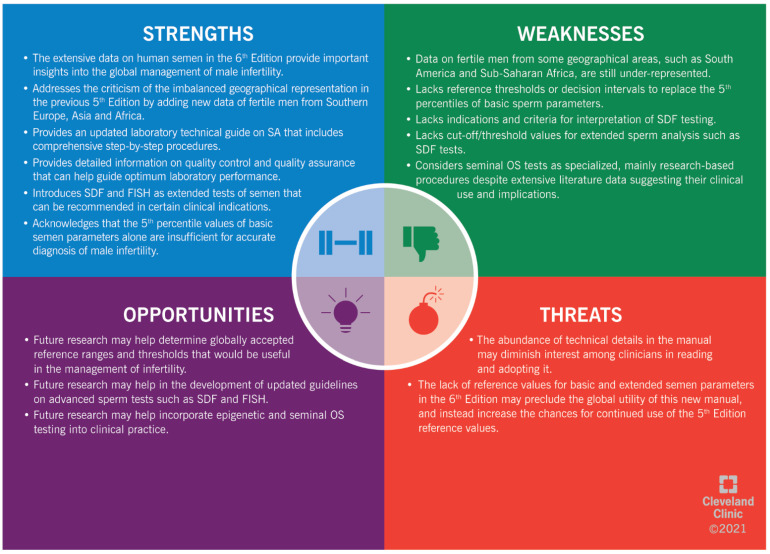
Verification
Claims the paper makes
38 No basis given · 19 Own interpretation · 12 Not checked yet · 7 Partly supported · 3 Supported · 3 No full text of the sources · 2 Supported so far · 2 Sources not found · accuracy not yet measured
The cited sources support only part of this claim — read each source’s verdict below.
In the paper
“To justify this choice, the WHO manual cites older papers stating that rapid motility (grade a) has clinical value [21,22,23,24,25,26,27,28,29,30].”
§ The Sixth Edition of the WHO Manual for Human Semen Analysis: A Critical Review and SWOT Analysis > 2. Critical Review of the 6th Edition > 2.2. Basic Examination of Semen
What the sources say
- Partly supportedcites [21] Aitken, 1985, Relationship between the movement characteristics of human spermatozoa and their ability to penetrate cervical mucus and zona-free hamster oocytes, Reproduction sourceExperimental — accuracy not yet measured
The Discussion (page unavailable) identifies linear velocity of progression as one factor associated with cervical-mucus penetration, giving some support to the clinical relevance of sperm movement. The paper does not identify rapid motility as WHO grade a or establish the clinical value of that grade; its Discussion also says sperm movement had no consistent, clinically useful relationship with fertilizing potential in normospermic males. The claim about what the WHO manual cites cannot be established from this paper. (LLM, conf=0.85)
- Partly supportedcites [22] Mortimer, 1986, Relationship between human sperm motility characteristics and sperm penetration into human cervical mucus in vitro, Reproduction sourceExperimental — accuracy not yet measured
The Discussion (page unavailable) says that detailed evaluation of sperm motility may contribute to infertility diagnosis, and the discriminant-analysis section links movement velocity and progressively motile sperm concentration to cervical-mucus penetration test results. The paper does not identify these measures as WHO grade-a rapid motility or establish that the WHO manual cites it. (LLM, conf=0.83)
- Not checked — no full text of the sourcecites [23] Barratt, 1992, Prognostic value of two putative sperm function tests: Hypo-osmotic swelling and bovine sperm mucus penetration test (Penetrak), Hum. Reprod. source
plain- Asserted: passes — The authors put it forward as true.
- Checkable: passes — It can be checked against evidence.
- Load-bearing: passes — The paper’s conclusions depend on it.
- Based: passes — The paper gives a reason why it holds.
- Partly supported
The sources with a verdict support this claim; the rest weren’t checked yet, have no full text we could read, or their verdicts aren’t rated yet.
In the paper
“Due to the production of excessive amounts of ROS in numerous medical conditions, including varicocele [43], leukocytospermia [44], diabetes mellitus [45], and obesity [46], seminal OS develops.”
§ The Sixth Edition of the WHO Manual for Human Semen Analysis: A Critical Review and SWOT Analysis > 2. Critical Review of the 6th Edition > 2.4. Advanced Examination of Semen
What the sources say
- Supportedcites [43] Agarwal, 2006, Relationship between oxidative stress, varicocele and infertility: A meta-analysis, Reprod. Biomed. Online source
Citation [43] is attached to varicocele, not to the other listed conditions. The Introduction states that ROS production is enhanced in varicocele patients and that the resulting imbalance with antioxidant capacity causes oxidative stress; the Discussion likewise reports increased oxidative stress in infertile patients with varicocele. (LLM, conf=0.92)
- Supportedcites [44] Saleh, 2002, Leukocytospermia is associated with increased reactive oxygen species production by human spermatozoa, Fertil. Steril. source
Citation [44] is attached specifically to leukocytospermia, not to the other listed conditions. The Abstract reports significantly higher ROS production in samples from men with leukocytospermia, and the paper explains that excessive ROS can overwhelm antioxidant defenses and cause oxidative stress. (LLM, conf=0.92)
- Not checked — no full text of the sourcecites [45] Amaral, 2008, Diabetes and the Impairment of Reproductive Function: Possible Role of Mitochondria and Reactive Oxygen Species, Curr. Diabetes Rev. source
plaindirect- Asserted: passes — The authors put it forward as true.
- Checkable: passes — It can be checked against evidence.
- Load-bearing: unclear — It is unclear whether the paper’s conclusions depend on it.
- Based: passes — The paper gives a reason why it holds.
- Supported
The cited sources support only part of this claim — read each source’s verdict below.
In the paper
“Sperm DNA integrity is a pre-requisite for proper embryo development, implantation, and pregnancy [31]”
§ The Sixth Edition of the WHO Manual for Human Semen Analysis: A Critical Review and SWOT Analysis > 2. Critical Review of the 6th Edition > 2.3. Extended Examination of Semen
What the sources say
- Partly supportedcites [31] Ward, 2009, Function of sperm chromatin structural elements in fertilization and development, Mol. Hum. Reprod. sourceExperimental — accuracy not yet measured
The Implications section (page unavailable) says sperm chromatin structures are probably required for proper embryonic development and recommends preserving paternal DNA integrity in assisted reproduction. The Introduction also says DNA integrity affects ART outcomes. The paper does not establish DNA integrity as a prerequisite for implantation or pregnancy, and its developmental conclusion is qualified rather than absolute. (LLM, conf=0.86)
plaindirect- Asserted: passes — The authors put it forward as true.
- Checkable: passes — It can be checked against evidence.
- Load-bearing: unclear — It is unclear whether the paper’s conclusions depend on it.
- Based: passes — The paper gives a reason why it holds.
- Partly supported
The sources with a verdict support this claim; the rest weren’t checked yet, have no full text we could read, or their verdicts aren’t rated yet.
In the paper
“For the latter, recent progress has been made in terms of the identification of relevant patients [60,66,67].”
§ The Sixth Edition of the WHO Manual for Human Semen Analysis: A Critical Review and SWOT Analysis > 2. Critical Review of the 6th Edition > 2.4. Advanced Examination of Semen
What the sources say
- Supportedcites [60] Nakamura, 2018, Prediction of pregnancy after frozen-thawed embryo transfer via in vivo intrauterine oxidation-reduction potential measurements: A pilot study, Reprod. Med. Biol. source
The Results section reports that intrauterine ORP distinguished pregnant from non-pregnant patients undergoing frozen-thawed embryo transfer and had an area under the ROC curve of 0.80 for predicting non-conception. This supports the cited sentence’s broad point about progress in identifying relevant patients, specifically in this treatment setting. (LLM, conf=0.87)
- Supportedcites [66] Agarwal, 2017, Determination of seminal oxidation-reduction potential (ORP) as an easy and cost-effective clinical marker of male infertility, Andrology source
The Introduction says ORP measures redox imbalance and can identify oxidative stress as a possible factor in male infertility. The Discussion adds that ORP testing can identify oxidative stress in men at risk of infertility who might otherwise go undetected by routine semen analysis. These passages support the attributed progress in identifying relevant patients; the copy provides section labels but no page numbers. (LLM, conf=0.89)
- Not checked — no full text of the sourcecites [67] Tanaka, 2020, Seminal oxidation–reduction potential and sperm DNA fragmentation index increase among infertile men with varicocele, Hum. Fertil. source
plain- Asserted: passes — The authors put it forward as true.
- Checkable: passes — It can be checked against evidence.
- Load-bearing: unclear — It is unclear whether the paper’s conclusions depend on it.
- Based: passes — The paper gives a reason why it holds.
- Supported
Every source the paper cites for this claim was checked and supports it.
In the paper
“Similarly, the luminometric determination of seminal OS resulted in a significant prediction of good embryo cleavage and blastocyst quality after intracytoplasmic sperm injection (ICSI) in the low OS group [61].”
§ The Sixth Edition of the WHO Manual for Human Semen Analysis: A Critical Review and SWOT Analysis > 2. Critical Review of the 6th Edition > 2.4. Advanced Examination of Semen
What the sources say
- Supportedcites [61] Kuroda, 2020, Early and late paternal effects of reactive oxygen species in semen on embryo development after intracytoplasmic sperm injection, Syst. Biol. Reprod. Med. source
The ROS assessment section says seminal ROS was measured with a luminometer and that ROC cutoffs were calculated to predict good-cleavage embryos and good-quality blastocysts. The Results report significantly higher rates of both outcomes in the low-ROS groups after ICSI. The paper reports significant differences between groups, rather than a separate statistical test of predictive performance. (LLM, conf=0.91)
plaincorrelational- Asserted: passes — The authors put it forward as true.
- Checkable: passes — It can be checked against evidence.
- Load-bearing: unclear — It is unclear whether the paper’s conclusions depend on it.
- Based: passes — The paper gives a reason why it holds.
- Supported
The cited sources support only part of this claim — read each source’s verdict below.
In the paper
“In addition, criticism of using OS as a parameter to predict the male fertilizing potential, particularly for the direct determination of either ROS with luminometric methods or ORP using the MiOXSYS System, is also pointing at the pH sensitivity of the measurement, especially at alkaline pH values [48].”
§ The Sixth Edition of the WHO Manual for Human Semen Analysis: A Critical Review and SWOT Analysis > 2. Critical Review of the 6th Edition > 2.4. Advanced Examination of Semen
What the sources say
- Partly supportedcites [48] Garcia-Segura, S., Ribas-Maynou, J., Lara-Cerrillo, S., Garcia-Peiró, A., Castel, A., Benet, J., and Oliver-Bonet, M. (2020). Relationship of Seminal Oxidation-Reduction Potential with Sperm DNA Integrity and pH in Idiopathic Infertile Patients. Biology, 9. sourceExperimental — accuracy not yet measured
Split into 2 atoms — 0 confirmed, 2 partially supported, 0 disputed, 0 misattributed, 0 unverifiable. Expand the claim to see per-atom verdicts.
plaincorrelational- Asserted: passes — The authors put it forward as true.
- Checkable: passes — It can be checked against evidence.
- Load-bearing: unclear — It is unclear whether the paper’s conclusions depend on it.
- Based: passes — The paper gives a reason why it holds.
- Partly supported
The cited sources support only part of this claim — read each source’s verdict below.
In the paper
“Unfortunately, this 6th Edition of the WHO manual is lacking recently published evidence indicating the predictive power of seminal OS as determined by means of the ORP [48,57,58,59,60].”
§ The Sixth Edition of the WHO Manual for Human Semen Analysis: A Critical Review and SWOT Analysis > 2. Critical Review of the 6th Edition > 2.4. Advanced Examination of Semen
What the sources say
- Partly supportedcites [48] Garcia-Segura, S., Ribas-Maynou, J., Lara-Cerrillo, S., Garcia-Peiró, A., Castel, A., Benet, J., and Oliver-Bonet, M. (2020). Relationship of Seminal Oxidation-Reduction Potential with Sperm DNA Integrity and pH in Idiopathic Infertile Patients. Biology, 9. sourceExperimental — accuracy not yet measured
The Introduction describes ORP measurement as a proposed diagnostic tool, and the Results (section 3.2) report associations between ORP and sperm motility and chromatin compaction. The paper does not establish predictive power; its Conclusions describe possible clinical applications and call for further work on measurement reliability. It does not assess what the WHO manual’s sixth edition includes. (LLM, conf=0.82)
- Supportedcites [57] Agarwal, 2017, A multicenter study to evaluate oxidative stress by oxidation-reduction potential, a reliable and reproducible method, Andrology source
The Results (pp. 939–945) report that seminal ORP differentiated infertile patients from fertile controls, with a combined-dataset positive predictive value of 93.3%. The Discussion describes ORP as a possible diagnostic tool for assessing infertility. The statement about what the WHO manual omits is the citing authors’ framing, not a finding attributed to this study. (LLM, conf=0.91)
- Supportedcites [58] Agarwal, 2017, Diagnostic application of oxidation-reduction potential assay for measurement of oxidative stress: Clinical utility in male factor infertility, Reprod. Biomed. Online source
The Results (under “Background information on the study population is presented in Table 1”) report that seminal ORP predicted normal versus abnormal semen quality, with an AUC of 0.770 and a positive predictive value of 85.3% at the proposed cut-off. The Discussion describes the cut-off’s clinical utility for identifying oxidative stress in men at risk for infertility. The statement about what the WHO manual omits is the citing authors’ framing, not a finding attributed to this 2017 paper. (LLM, conf=0.89)
plain- Asserted: passes — The authors put it forward as true.
- Checkable: passes — It can be checked against evidence.
- Load-bearing: passes — The paper’s conclusions depend on it.
- Based: passes — The paper gives a reason why it holds.
- Partly supported
The paper states this without a source or data behind it here, so there is nothing to check it against. The quote shows it is in the paper.
In the paper
“However, some geographical areas, such as South America and Sub-Saharan Africa, remain under-represented in the current 6th Edition.”
§ The Sixth Edition of the WHO Manual for Human Semen Analysis: A Critical Review and SWOT Analysis > 2. Critical Review of the 6th Edition > 2.1. Methodological Considerations in the New 6th Edition
plain- Asserted: passes — The authors put it forward as true.
- Checkable: passes — It can be checked against evidence.
- Load-bearing: unclear — It is unclear whether the paper’s conclusions depend on it.
- Based: passes — The paper gives a reason why it holds.
The paper states this without a source or data behind it here, so there is nothing to check it against. The quote shows it is in the paper.
In the paper
“An important deviation from the previous 5th version is the abandonment of the reference values.”
§ The Sixth Edition of the WHO Manual for Human Semen Analysis: A Critical Review and SWOT Analysis > 2. Critical Review of the 6th Edition > 2.1. Methodological Considerations in the New 6th Edition
plain- Asserted: passes — The authors put it forward as true.
- Checkable: passes — It can be checked against evidence.
- Load-bearing: passes — The paper’s conclusions depend on it.
- Based: passes — The paper gives a reason why it holds.
The paper states this without a source or data behind it here, so there is nothing to check it against. The quote shows it is in the paper.
In the paper
“Thus, the 6th Edition contains results of semen samples of 3589 fertile men (1800 subjects from the 5th Edition and 1789 new subjects).”
§ The Sixth Edition of the WHO Manual for Human Semen Analysis: A Critical Review and SWOT Analysis > 2. Critical Review of the 6th Edition > 2.1. Methodological Considerations in the New 6th Edition
plainn = 3,589- Asserted: passes — The authors put it forward as true.
- Checkable: passes — It can be checked against evidence.
- Load-bearing: unclear — It is unclear whether the paper’s conclusions depend on it.
- Based: passes — The paper gives a reason why it holds.
- Probably not a substantial claim. 59
- It may state two separate claims as one. 28
None of the sources cited for this claim have been checked yet.
In the paper
“These assays may have a use in the evaluation of male infertility, however, their adoption by a large number of fertility laboratories will require robust research and clinical trials proving their value in diagnostic andrology [11,38].”
§ The Sixth Edition of the WHO Manual for Human Semen Analysis: A Critical Review and SWOT Analysis > 2. Critical Review of the 6th Edition > 2.4. Advanced Examination of Semen
What the sources say
- Not checked yetcites [11] World Health Organization (2021). WHO Laboratory Manual for the Examination and Processing of Human Semen, WHO Press. [6th ed.]. Available online: https://www.who.int/publications/i/item/9789240030787.
- Could not verifycites [38] Donkin, 2018, Sperm epigenetics and influence of environmental factors, Mol. Metab. sourceExperimental — accuracy not yet measured
The Introduction discusses sperm epigenetics as a possible mechanism of inheritance, and the Concluding remarks discuss confounders in that research. Neither section addresses adoption of epigenetic assays by fertility laboratories or a need for clinical trials to establish their diagnostic value in andrology. Searches for clinical validation, infertility diagnostics, and laboratory adoption found no passage making that point. (LLM, conf=0.72)
hedgedconditional- Asserted: passes — The authors put it forward as true.
- Checkable: passes — It can be checked against evidence.
- Load-bearing: passes — The paper’s conclusions depend on it.
- Based: passes — The paper gives a reason why it holds.
Probably not a substantial claim.
The cited sources support only part of this claim — read each source’s verdict below.
In the paper
“Unselected infertile men, as well as men with SDF, Robertsonian and reciprocal translocation, and those with a history of recurrent pregnancy loss are at increased risk of producing aneuploid sperm [33,34].”
§ The Sixth Edition of the WHO Manual for Human Semen Analysis: A Critical Review and SWOT Analysis > 2. Critical Review of the 6th Edition > 2.3. Extended Examination of Semen
What the sources say
- Partly supportedcites [33] Godo, 2015, Altered segregation pattern and numerical chromosome abnormalities interrelate in spermatozoa from Robertsonian translocation carriers, Reprod. Biomed. Online sourceExperimental — accuracy not yet measured
The Introduction reports that more than half of Robertsonian translocation carriers produce significantly increased percentages of sperm with numerical chromosome abnormalities. The Biological samples section says this study included only carriers already known to have elevated aneuploid or diploid sperm rates, and the Conclusions limit its findings to that group. The paper does not establish the same increased risk for unselected infertile men, men with sperm DNA fragmentation, or men with recurrent pregnancy loss; its comparison with reciprocal translocation carriers does not establish that risk for them either. No page numbers were available in our copy. (LLM, conf=0.88)
- Partly supportedcites [34] Wang, 2017, Analysis of meiotic segregation patterns and interchromosomal effects in sperm from 13 robertsonian translocations, Balk. J. Med. Genet. sourceExperimental — accuracy not yet measured
The Results report increased aneuploidy in many Robertsonian translocation carriers and more unbalanced sperm in heterozygous carriers than in controls; the homozygous carrier did not show this increase. The Patients and Results sections do not establish increased risk for unselected infertile men, men with sperm DNA fragmentation or reciprocal translocations, or men with recurrent pregnancy loss as a separate group. Page numbers are unavailable in our copy. (LLM, conf=0.90)
plaincorrelational- Asserted: passes — The authors put it forward as true.
- Checkable: passes — It can be checked against evidence.
- Load-bearing: fails — The paper’s conclusions may not depend on it.
- Based: passes — The paper gives a reason why it holds.
Probably not a substantial claim. The paper’s conclusions may not depend on it. It may state two separate claims as one.
- Partly supported
Every source the paper cites for this claim was checked and supports it.
In the paper
“Additionally, FISH is used in the assessment of the male partner’s chromosomal abnormalities in cases of recurrent pregnancy loss or ART failure [37].”
§ The Sixth Edition of the WHO Manual for Human Semen Analysis: A Critical Review and SWOT Analysis > 2. Critical Review of the 6th Edition > 2.3. Extended Examination of Semen
What the sources say
- Supportedcites [37] Kohn, 2016, Genetic counseling for men with recurrent pregnancy loss or recurrent implantation failure due to abnormal sperm chromosomal aneuploidy, J. Assist. Reprod Genet. source
The Introduction says sperm FISH analysis is recommended for men whose partners have experienced recurrent pregnancy loss or IVF failures, to assess sperm aneuploidy. The Sperm aneuploidy section explains that FISH detects abnormal chromosome numbers in sperm. (LLM, conf=0.94)
plain- Asserted: passes — The authors put it forward as true.
- Checkable: passes — It can be checked against evidence.
- Load-bearing: fails — The paper’s conclusions may not depend on it.
- Based: passes — The paper gives a reason why it holds.
Probably not a substantial claim. The paper’s conclusions may not depend on it.
- Supported
The cited sources support only part of this claim — read each source’s verdict below.
In the paper
“Consequently, OS negatively affects all sperm functions, including sperm DNA integrity [47,48], and thereby the fertilization process and reproductive outcomes [49,50,51,52,53,54,55].”
§ The Sixth Edition of the WHO Manual for Human Semen Analysis: A Critical Review and SWOT Analysis > 2. Critical Review of the 6th Edition > 2.4. Advanced Examination of Semen
What the sources say
- Partly supportedcites [47] Cicek, 2021, The association of seminal oxidation reduction potential with sperm parameters in patients with unexplained and male factor infertility, Int. Braz. J. Urol. sourceExperimental — accuracy not yet measured
The Introduction says excessive ROS can cause sperm DNA damage and dysfunction, supporting the claim's general point. But the Results report no correlation between oxidative-stress measure sORP and total motility or immotility, so the source does not support the unqualified assertion that oxidative stress negatively affects *all* sperm functions. The later clause about fertilization and reproductive outcomes is attached to different citations in the citing sentence. (LLM, conf=0.86)
- Partly supportedcites [48] Garcia-Segura, S., Ribas-Maynou, J., Lara-Cerrillo, S., Garcia-Peiró, A., Castel, A., Benet, J., and Oliver-Bonet, M. (2020). Relationship of Seminal Oxidation-Reduction Potential with Sperm DNA Integrity and pH in Idiopathic Infertile Patients. Biology, 9. sourceExperimental — accuracy not yet measured
The Introduction reports that redox dysregulation alters sperm motility and can cause sperm DNA fragmentation. It does not establish that oxidative stress negatively affects *all* sperm functions. The fertilization and reproductive-outcome clause is attached to other citations, not this source. (LLM, conf=0.86)
- Not checked — no full text of the sourcecites [49] Aitken, 2010, On the possible origins of DNA damage in human spermatozoa, Mol. Hum. Reprod. source
plaindirect- Asserted: passes — The authors put it forward as true.
- Checkable: passes — It can be checked against evidence.
- Load-bearing: unclear — It is unclear whether the paper’s conclusions depend on it.
- Based: passes — The paper gives a reason why it holds.
It may state two separate claims as one.
- Partly supported
The cited sources support only part of this claim — read each source’s verdict below.
In the paper
“Semen analysis (SA) represents the most basic evaluation of male infertility. The evaluation of semen parameters is currently based on the standards defined in the laboratory manual for the examination and processing of human semen created by the World Health Organization (WHO) [8,9,10].”
§ The Sixth Edition of the WHO Manual for Human Semen Analysis: A Critical Review and SWOT Analysis > 1. Introduction
What the sources say
- Supportedcites [8] Barratt, 2017, The diagnosis of male infertility: An analysis of the evidence to support the development of global WHO guidance—Challenges and future research opportunities, Hum. Reprod. Update source
In the section on the prevalence of male infertility, the paper includes semen analysis in the initial evaluation of men with infertility. That section also describes WHO methods and procedures as the recommended standards for semen analysis; the References identify the 2010 WHO laboratory manual. The paper notes that some laboratories do not follow those standards, but that does not contradict the claim. (LLM, conf=0.88)
- Not checked — no full text of the sourcecites [9] Guzick, 2001, Sperm Morphology, Motility, and Concentration in Fertile and Infertile Men, N. Engl. J. Med. source
- Partly supportedcites [10] Schlegel, 2021, Diagnosis and treatment of infertility in men: AUA/ASRM guideline part I, Fertil. Steril. sourceExperimental — accuracy not yet measured
The guideline’s section on initial infertility evaluation recommends one or more semen analyses and calls semen analysis an important component of the initial male evaluation. That supports its role as a basic evaluation, but the passages from our copy do not say that semen parameters are evaluated according to standards in the WHO laboratory manual. (LLM, conf=0.85)
plain- Asserted: passes — The authors put it forward as true.
- Checkable: passes — It can be checked against evidence.
- Load-bearing: passes — The paper’s conclusions depend on it.
- Based: passes — The paper gives a reason why it holds.
Probably not a substantial claim. It may state two separate claims as one.
- Supported
Every source the paper cites for this claim was checked and supports it.
In the paper
“FISH is commonly used in the assessment of chromosomal aneuploidy involving chromosomes 13, 18, 21, X, and Y, which usually result in viable but defective births [36].”
§ The Sixth Edition of the WHO Manual for Human Semen Analysis: A Critical Review and SWOT Analysis > 2. Critical Review of the 6th Edition > 2.3. Extended Examination of Semen
What the sources say
- Supportedcites [36] Hwang, 2010, The use of fluorescent in situ hybridization in male infertility, Ther. Adv. Urol. source
The History of FISH section states that sperm FISH routinely measures aneuploidy in chromosomes X, Y, 13, 18, and 21. It explains that these chromosomes are selected because their aneuploidies can be consistent with viable offspring affected by the listed syndromes. (LLM, conf=0.91)
plaindirect- Asserted: passes — The authors put it forward as true.
- Checkable: passes — It can be checked against evidence.
- Load-bearing: fails — The paper’s conclusions may not depend on it.
- Based: passes — The paper gives a reason why it holds.
Probably not a substantial claim. The paper’s conclusions may not depend on it. It may state two separate claims as one.
- Supported
The paper states this without a source or data behind it here, so there is nothing to check it against. The quote shows it is in the paper.
In the paper
“Concerning the epigenetic mechanisms of chromatin condensation, for example, the aniline blue and chromomycin A3 assays have been described.”
§ The Sixth Edition of the WHO Manual for Human Semen Analysis: A Critical Review and SWOT Analysis > 2. Critical Review of the 6th Edition > 2.4. Advanced Examination of Semen
plain- Asserted: passes — The authors put it forward as true.
- Checkable: passes — It can be checked against evidence.
- Load-bearing: fails — The paper’s conclusions may not depend on it.
- Based: passes — The paper gives a reason why it holds.
Probably not a substantial claim. The paper’s conclusions may not depend on it.
None of the sources cited for this claim have been checked yet.
In the paper
“The importance of SDF and genetic evaluation in the context of male infertility has been expanded in the 6th Edition, unlike its previous counterpart, the 5th Edition, which merely described sperm genetics and chromatin evaluation under the research procedures section [11,14].”
§ The Sixth Edition of the WHO Manual for Human Semen Analysis: A Critical Review and SWOT Analysis > 2. Critical Review of the 6th Edition > 2.3. Extended Examination of Semen
What the sources say
- Not checked yetcites [11] World Health Organization (2021). WHO Laboratory Manual for the Examination and Processing of Human Semen, WHO Press. [6th ed.]. Available online: https://www.who.int/publications/i/item/9789240030787.
- Not checked yetcites [14] World Health Organization (2010). WHO Laboratory Manual for the Examination and Processing of Human Semen, WHO Press. [5th ed.].
plain- Asserted: passes — The authors put it forward as true.
- Checkable: passes — It can be checked against evidence.
- Load-bearing: passes — The paper’s conclusions depend on it.
- Based: passes — The paper gives a reason why it holds.
Probably not a substantial claim. It may state two separate claims as one.
The paper states this without a source or data behind it here, so there is nothing to check it against. The quote shows it is in the paper.
In the paper
“Although the authors list some correlates between abnormal genetic tests and clinical parameters, they do not adequately address the indications for sperm genetic testing.”
§ The Sixth Edition of the WHO Manual for Human Semen Analysis: A Critical Review and SWOT Analysis > 2. Critical Review of the 6th Edition > 2.3. Extended Examination of Semen
plain- Asserted: passes — The authors put it forward as true.
- Checkable: passes — It can be checked against evidence.
- Load-bearing: passes — The paper’s conclusions depend on it.
- Based: passes — The paper gives a reason why it holds.
Probably not a substantial claim. It may state two separate claims as one.
The paper states this without a source or data behind it here, so there is nothing to check it against. The quote shows it is in the paper.
In the paper
“Since this assessment was abandoned in the 2010 5th Edition, the distinction of progressive motility in two categories was not evaluated like the other parameters (by comparing the data obtained from men with time to pregnancy ≤12 months with men that remain childless).”
§ The Sixth Edition of the WHO Manual for Human Semen Analysis: A Critical Review and SWOT Analysis > 2. Critical Review of the 6th Edition > 2.2. Basic Examination of Semen
plaindirect- Asserted: passes — The authors put it forward as true.
- Checkable: passes — It can be checked against evidence.
- Load-bearing: passes — The paper’s conclusions depend on it.
- Based: passes — The paper gives a reason why it holds.
It may state two separate claims as one.
None of the sources cited for this claim have been checked yet.
In the paper
“Concerning sperm motility, the 6th Edition re-adopted the distinction of progressive motility in two categories (grade a and b).”
§ The Sixth Edition of the WHO Manual for Human Semen Analysis: A Critical Review and SWOT Analysis > 2. Critical Review of the 6th Edition > 2.2. Basic Examination of Semen
plain- Asserted: passes — The authors put it forward as true.
- Checkable: passes — It can be checked against evidence.
- Load-bearing: passes — The paper’s conclusions depend on it.
- Based: passes — The paper gives a reason why it holds.
Probably not a substantial claim.
The paper states this without a source or data behind it here, so there is nothing to check it against. The quote shows it is in the paper.
In the paper
“However, a discussion on the indications and how to apply the results of these tests in clinical practice is missing.”
§ The Sixth Edition of the WHO Manual for Human Semen Analysis: A Critical Review and SWOT Analysis > 2. Critical Review of the 6th Edition > 2.3. Extended Examination of Semen
plain- Asserted: passes — The authors put it forward as true.
- Checkable: passes — It can be checked against evidence.
- Load-bearing: passes — The paper’s conclusions depend on it.
- Based: passes — The paper gives a reason why it holds.
Probably not a substantial claim.
The paper states this without a source or data behind it here, so there is nothing to check it against. The quote shows it is in the paper.
In the paper
“Finally, the 6th Edition acknowledges the scarcity of tools available in the general andrology laboratory and that most tests require an advanced genetic testing facility.”
§ The Sixth Edition of the WHO Manual for Human Semen Analysis: A Critical Review and SWOT Analysis > 2. Critical Review of the 6th Edition > 2.3. Extended Examination of Semen
plain- Asserted: passes — The authors put it forward as true.
- Checkable: passes — It can be checked against evidence.
- Load-bearing: fails — The paper’s conclusions may not depend on it.
- Based: passes — The paper gives a reason why it holds.
Probably not a substantial claim. The paper’s conclusions may not depend on it. It may state two separate claims as one.
None of the sources cited for this claim have been checked yet.
In the paper
“In addition, the 6th Edition provides a detailed outline on the technical aspects of these tests and some guidance on the interpretation of the test results.”
§ The Sixth Edition of the WHO Manual for Human Semen Analysis: A Critical Review and SWOT Analysis > 2. Critical Review of the 6th Edition > 2.3. Extended Examination of Semen
plain- Asserted: passes — The authors put it forward as true.
- Checkable: passes — It can be checked against evidence.
- Load-bearing: passes — The paper’s conclusions depend on it.
- Based: passes — The paper gives a reason why it holds.
Probably not a substantial claim. It may state two separate claims as one.
The paper states this without a source or data behind it here, so there is nothing to check it against. The quote shows it is in the paper.
In the paper
“Notably, throughout the 280 pages of the current Edition, the terms “normozoospermia” “asthenozoospermia”, “necrozoospermia”, “teratozoospermia” are not used at all.”
§ The Sixth Edition of the WHO Manual for Human Semen Analysis: A Critical Review and SWOT Analysis > 2. Critical Review of the 6th Edition > 2.2. Basic Examination of Semen
plain- Asserted: passes — The authors put it forward as true.
- Checkable: passes — It can be checked against evidence.
- Load-bearing: passes — The paper’s conclusions depend on it.
- Based: passes — The paper gives a reason why it holds.
Probably not a substantial claim.
The paper states this without a source or data behind it here, so there is nothing to check it against. The quote shows it is in the paper.
In the paper
“The 6th Edition describes and elaborates on different methods of SDF testing, including the TUNEL assay, sperm chromatin dispersion assay, Comet assay and acridine orange flow cytometry assay.”
§ The Sixth Edition of the WHO Manual for Human Semen Analysis: A Critical Review and SWOT Analysis > 2. Critical Review of the 6th Edition > 2.3. Extended Examination of Semen
plain- Asserted: passes — The authors put it forward as true.
- Checkable: passes — It can be checked against evidence.
- Load-bearing: passes — The paper’s conclusions depend on it.
- Based: passes — The paper gives a reason why it holds.
Probably not a substantial claim.
The paper states this without a source or data behind it here, so there is nothing to check it against. The quote shows it is in the paper.
In the paper
“However, the actual epigenetic assays, which assess, for example, post-translational histone modifications, the degree of sperm DNA methylation, or small RNA are not described.”
§ The Sixth Edition of the WHO Manual for Human Semen Analysis: A Critical Review and SWOT Analysis > 2. Critical Review of the 6th Edition > 2.4. Advanced Examination of Semen
plain- Asserted: passes — The authors put it forward as true.
- Checkable: passes — It can be checked against evidence.
- Load-bearing: passes — The paper’s conclusions depend on it.
- Based: passes — The paper gives a reason why it holds.
Probably not a substantial claim.
The paper states this without a source or data behind it here, so there is nothing to check it against. The quote shows it is in the paper.
In the paper
“Except for the Comet assay, these tests are deemed useful for clinical testing.”
§ The Sixth Edition of the WHO Manual for Human Semen Analysis: A Critical Review and SWOT Analysis > 2. Critical Review of the 6th Edition > 2.3. Extended Examination of Semen
plain- Asserted: passes — The authors put it forward as true.
- Checkable: passes — It can be checked against evidence.
- Load-bearing: passes — The paper’s conclusions depend on it.
- Based: passes — The paper gives a reason why it holds.
Probably not a substantial claim.
None of the sources cited for this claim have been checked yet.
In the paper
“Regarding the indications for sperm vitality assessment, the 6th Edition has addressed an inconsistency surrounding the assessment of sperm vitality that exists in the previous 5th Edition [11,14].”
§ The Sixth Edition of the WHO Manual for Human Semen Analysis: A Critical Review and SWOT Analysis > 2. Critical Review of the 6th Edition > 2.2. Basic Examination of Semen
What the sources say
- Not checked yetcites [11] World Health Organization (2021). WHO Laboratory Manual for the Examination and Processing of Human Semen, WHO Press. [6th ed.]. Available online: https://www.who.int/publications/i/item/9789240030787.
- Not checked yetcites [14] World Health Organization (2010). WHO Laboratory Manual for the Examination and Processing of Human Semen, WHO Press. [5th ed.].
plaindirect- Asserted: passes — The authors put it forward as true.
- Checkable: passes — It can be checked against evidence.
- Load-bearing: fails — The paper’s conclusions may not depend on it.
- Based: passes — The paper gives a reason why it holds.
Probably not a substantial claim. The paper’s conclusions may not depend on it.
The paper states this without a source or data behind it here, so there is nothing to check it against. The quote shows it is in the paper.
In the paper
“In the 6th Edition, the assessment of sperm vitality is recommended when total sperm motility is below 40%.”
§ The Sixth Edition of the WHO Manual for Human Semen Analysis: A Critical Review and SWOT Analysis > 2. Critical Review of the 6th Edition > 2.2. Basic Examination of Semen
plainconditional- Asserted: passes — The authors put it forward as true.
- Checkable: passes — It can be checked against evidence.
- Load-bearing: passes — The paper’s conclusions depend on it.
- Based: passes — The paper gives a reason why it holds.
Probably not a substantial claim.
The paper states this without a source or data behind it here, so there is nothing to check it against. The quote shows it is in the paper.
In the paper
“However, the 6th Edition provides no thresholds and recommends that each laboratory develop its own reference range based on appropriate controls.”
§ The Sixth Edition of the WHO Manual for Human Semen Analysis: A Critical Review and SWOT Analysis > 2. Critical Review of the 6th Edition > 2.3. Extended Examination of Semen
plain- Asserted: passes — The authors put it forward as true.
- Checkable: passes — It can be checked against evidence.
- Load-bearing: passes — The paper’s conclusions depend on it.
- Based: passes — The paper gives a reason why it holds.
Probably not a substantial claim. It may state two separate claims as one.
The paper states this without a source or data behind it here, so there is nothing to check it against. The quote shows it is in the paper.
In the paper
“In this 6th Edition, it is clearly specified that the 5th centile values are only one way to interpret the results of SA, and the use of the 5th centile alone is not sufficient to diagnose male infertility.”
§ The Sixth Edition of the WHO Manual for Human Semen Analysis: A Critical Review and SWOT Analysis > 2. Critical Review of the 6th Edition > 2.1. Methodological Considerations in the New 6th Edition
boosted- Asserted: passes — The authors put it forward as true.
- Checkable: passes — It can be checked against evidence.
- Load-bearing: passes — The paper’s conclusions depend on it.
- Based: passes — The paper gives a reason why it holds.
Probably not a substantial claim. It may state two separate claims as one.
The paper states this without a source or data behind it here, so there is nothing to check it against. The quote shows it is in the paper.
In the paper
“It is probably also for this reason that the mitochondrial membrane potential assessment tests are not described in this 6th Edition.”
§ The Sixth Edition of the WHO Manual for Human Semen Analysis: A Critical Review and SWOT Analysis > 2. Critical Review of the 6th Edition > 2.4. Advanced Examination of Semen
hedged- Asserted: passes — The authors put it forward as true.
- Checkable: passes — It can be checked against evidence.
- Load-bearing: passes — The paper’s conclusions depend on it.
- Based: passes — The paper gives a reason why it holds.
Probably not a substantial claim.
The paper states this without a source or data behind it here, so there is nothing to check it against. The quote shows it is in the paper.
In the paper
“The tests assessing sperm DNA fragmentation and seminal oxidative stress are well-described.”
§ The Sixth Edition of the WHO Manual for Human Semen Analysis: A Critical Review and SWOT Analysis > Abstract
boosted- Asserted: passes — The authors put it forward as true.
- Checkable: passes — It can be checked against evidence.
- Load-bearing: fails — The paper’s conclusions may not depend on it.
- Based: fails — The paper may give no reason why it holds.
Probably not a substantial claim. The paper’s conclusions may not depend on it. The paper may give no reason why it holds.
The paper states this without a source or data behind it here, so there is nothing to check it against. The quote shows it is in the paper.
In the paper
“The evaluation of semen odor has been added”
§ The Sixth Edition of the WHO Manual for Human Semen Analysis: A Critical Review and SWOT Analysis > 2. Critical Review of the 6th Edition > 2.2. Basic Examination of Semen
plain- Asserted: passes — The authors put it forward as true.
- Checkable: passes — It can be checked against evidence.
- Load-bearing: passes — The paper’s conclusions depend on it.
- Based: passes — The paper gives a reason why it holds.
Probably not a substantial claim.
The paper states this without a source or data behind it here, so there is nothing to check it against. The quote shows it is in the paper.
In the paper
“In the new 6th Edition, seminal OS is described together with ROS in a separate subsection under “Advanced examinations of semen”.”
§ The Sixth Edition of the WHO Manual for Human Semen Analysis: A Critical Review and SWOT Analysis > 2. Critical Review of the 6th Edition > 2.4. Advanced Examination of Semen
plain- Asserted: passes — The authors put it forward as true.
- Checkable: passes — It can be checked against evidence.
- Load-bearing: fails — The paper’s conclusions may not depend on it.
- Based: passes — The paper gives a reason why it holds.
Probably not a substantial claim. The paper’s conclusions may not depend on it.
The paper states this without a source or data behind it here, so there is nothing to check it against. The quote shows it is in the paper.
In the paper
“The main novelty is that this latest edition abandons the notion of reference thresholds, suggesting instead to replace them with “decision limits”.”
§ The Sixth Edition of the WHO Manual for Human Semen Analysis: A Critical Review and SWOT Analysis > Abstract
plain- Asserted: passes — The authors put it forward as true.
- Checkable: passes — It can be checked against evidence.
- Load-bearing: passes — The paper’s conclusions depend on it.
- Based: passes — The paper gives a reason why it holds.
Probably not a substantial claim.
The paper states this without a source or data behind it here, so there is nothing to check it against. The quote shows it is in the paper.
In the paper
“While this seems attractive, no decision limits are proposed for either basic semen parameters, or for extended or advanced parameters.”
§ The Sixth Edition of the WHO Manual for Human Semen Analysis: A Critical Review and SWOT Analysis > Abstract
plain- Asserted: passes — The authors put it forward as true.
- Checkable: passes — It can be checked against evidence.
- Load-bearing: passes — The paper’s conclusions depend on it.
- Based: passes — The paper gives a reason why it holds.
It may state two separate claims as one.
The paper states this without a source or data behind it here, so there is nothing to check it against. The quote shows it is in the paper.
In the paper
“Henceforth, the evaluation of low sperm concentrations (<2 × 10⁶/mL) must be assessed more precisely, by noting that the errors associated with counting a small number of spermatozoa may be very high.”
§ The Sixth Edition of the WHO Manual for Human Semen Analysis: A Critical Review and SWOT Analysis > 2. Critical Review of the 6th Edition > 2.2. Basic Examination of Semen
hedgedconditional- Asserted: passes — The authors put it forward as true.
- Checkable: passes — It can be checked against evidence.
- Load-bearing: passes — The paper’s conclusions depend on it.
- Based: passes — The paper gives a reason why it holds.
Probably not a substantial claim. It may state two separate claims as one.
The paper states this without a source or data behind it here, so there is nothing to check it against. The quote shows it is in the paper.
In the paper
“Sperm morphology assessment using a systematic approach is described in the new 6th Edition with multiple and better-quality micrographs of spermatozoa from unprocessed semen samples that are considered normal, borderline, or abnormal.”
§ The Sixth Edition of the WHO Manual for Human Semen Analysis: A Critical Review and SWOT Analysis > 2. Critical Review of the 6th Edition > 2.2. Basic Examination of Semen
plain- Asserted: passes — The authors put it forward as true.
- Checkable: passes — It can be checked against evidence.
- Load-bearing: fails — The paper’s conclusions may not depend on it.
- Based: passes — The paper gives a reason why it holds.
Probably not a substantial claim. The paper’s conclusions may not depend on it.
The paper states this without a source or data behind it here, so there is nothing to check it against. The quote shows it is in the paper.
In the paper
“Some tests concerning the evaluation of seminal OS, sperm acrosome reaction, functional analysis of transmembrane ion flux, and transport in sperm or methods for the evaluation of chromatin condensation have been described in the 6th Edition.”
§ The Sixth Edition of the WHO Manual for Human Semen Analysis: A Critical Review and SWOT Analysis > 2. Critical Review of the 6th Edition > 2.4. Advanced Examination of Semen
plain- Asserted: passes — The authors put it forward as true.
- Checkable: passes — It can be checked against evidence.
- Load-bearing: fails — The paper’s conclusions may not depend on it.
- Based: passes — The paper gives a reason why it holds.
Probably not a substantial claim. The paper’s conclusions may not depend on it.
The paper states this without a source or data behind it here, so there is nothing to check it against. The quote shows it is in the paper.
In the paper
“The newly added data originate from two countries in Southern Europe, which were under-represented in the previous 5th Edition, along with two countries from Asia and one country from Africa that lacked representation in the previous release.”
§ The Sixth Edition of the WHO Manual for Human Semen Analysis: A Critical Review and SWOT Analysis > 2. Critical Review of the 6th Edition > 2.1. Methodological Considerations in the New 6th Edition
plainn = 1,789- Asserted: passes — The authors put it forward as true.
- Checkable: passes — It can be checked against evidence.
- Load-bearing: unclear — It is unclear whether the paper’s conclusions depend on it.
- Based: passes — The paper gives a reason why it holds.
It may state two separate claims as one.
None of the sources cited for this claim have been checked yet.
In the paper
“In the 5th Edition of the WHO manual, seminal OS has been mentioned under “Research procedures” [14,20].”
§ The Sixth Edition of the WHO Manual for Human Semen Analysis: A Critical Review and SWOT Analysis > 2. Critical Review of the 6th Edition > 2.4. Advanced Examination of Semen
What the sources say
- Not checked yetcites [14] World Health Organization (2010). WHO Laboratory Manual for the Examination and Processing of Human Semen, WHO Press. [5th ed.].
- Not checked yetcites [20] World Health Organization (1999). WHO Laboratory Manual for the Examination of Human Semen and Sperm-Cervical Mucus Interaction, Cambridge University Press. [4th ed.].
plain- Asserted: passes — The authors put it forward as true.
- Checkable: passes — It can be checked against evidence.
- Load-bearing: fails — The paper’s conclusions may not depend on it.
- Based: passes — The paper gives a reason why it holds.
Probably not a substantial claim. The paper’s conclusions may not depend on it.
The paper states this without a source or data behind it here, so there is nothing to check it against. The quote shows it is in the paper.
In the paper
“For the evaluation of sperm count, semen dilutions have been simplified, but 200 spermatozoa per replicate should be counted.”
§ The Sixth Edition of the WHO Manual for Human Semen Analysis: A Critical Review and SWOT Analysis > 2. Critical Review of the 6th Edition > 2.2. Basic Examination of Semen
plain- Asserted: passes — The authors put it forward as true.
- Checkable: passes — It can be checked against evidence.
- Load-bearing: fails — The paper’s conclusions may not depend on it.
- Based: passes — The paper gives a reason why it holds.
Probably not a substantial claim. The paper’s conclusions may not depend on it. It may state two separate claims as one.
The paper states this without a source or data behind it here, so there is nothing to check it against. The quote shows it is in the paper.
In the paper
“The 6th Edition introduces the reader to sperm genetic tests and how they relate to male reproductive biology and associated fertility disorders, yet it fails to provide guidelines on the indications and utility of these tests.”
§ The Sixth Edition of the WHO Manual for Human Semen Analysis: A Critical Review and SWOT Analysis > 2. Critical Review of the 6th Edition > 2.3. Extended Examination of Semen
plaindirect- Asserted: passes — The authors put it forward as true.
- Checkable: passes — It can be checked against evidence.
- Load-bearing: passes — The paper’s conclusions depend on it.
- Based: passes — The paper gives a reason why it holds.
Probably not a substantial claim. It may state two separate claims as one.
The paper states this without a source or data behind it here, so there is nothing to check it against. The quote shows it is in the paper.
In the paper
“The 6th Edition was published in July 2021.”
- Also stated in: § 2.1. Methodological Considerations in the New 6th Edition · plain
“The new 6th Edition, released in July 2021, commended the importance of SA as a tool to:”
§ The Sixth Edition of the WHO Manual for Human Semen Analysis: A Critical Review and SWOT Analysis > Abstract
plain- Asserted: passes — The authors put it forward as true.
- Checkable: passes — It can be checked against evidence.
- Load-bearing: fails — The paper’s conclusions may not depend on it.
- Based: passes — The paper gives a reason why it holds.
Probably not a substantial claim. The paper’s conclusions may not depend on it.
- Also stated in: § 2.1. Methodological Considerations in the New 6th Edition · plain
The paper states this without a source or data behind it here, so there is nothing to check it against. The quote shows it is in the paper.
In the paper
“Additionally, the determination of oxidation–reduction potential (ORP) using the male infertility oxidative system (MiOXSYS), and total antioxidant capacity are mentioned with a brief description of procedures and issues.”
§ The Sixth Edition of the WHO Manual for Human Semen Analysis: A Critical Review and SWOT Analysis > 2. Critical Review of the 6th Edition > 2.4. Advanced Examination of Semen
plain- Asserted: passes — The authors put it forward as true.
- Checkable: passes — It can be checked against evidence.
- Load-bearing: fails — The paper’s conclusions may not depend on it.
- Based: passes — The paper gives a reason why it holds.
Probably not a substantial claim. The paper’s conclusions may not depend on it.
A conclusion the paper draws from its own results — it cites no other source for it, so there is none to check. The quote shows it is in the paper.
In the paper
“Moreover, without some guidance as to the utility of these assays, it is unclear how the tests will be used to guide the management of infertile couples.”
§ The Sixth Edition of the WHO Manual for Human Semen Analysis: A Critical Review and SWOT Analysis > 2. Critical Review of the 6th Edition > 2.3. Extended Examination of Semen
plainconditional- Asserted: passes — The authors put it forward as true.
- Checkable: fails — It may be too vague to check against evidence.
- Load-bearing: passes — The paper’s conclusions depend on it.
- Based: passes — The paper gives a reason why it holds.
Probably not a substantial claim. It may be too vague to check against evidence.
A conclusion the paper draws from its own results — it cites no other source for it, so there is none to check. The quote shows it is in the paper.
In the paper
“To rely on other reference values, clinicians will need to look for other sources in the literature. This can be time-consuming and difficult.”
§ The Sixth Edition of the WHO Manual for Human Semen Analysis: A Critical Review and SWOT Analysis > 2. Critical Review of the 6th Edition > 2.2. Basic Examination of Semen
plaindirect- Asserted: passes — The authors put it forward as true.
- Checkable: fails — It may be too vague to check against evidence.
- Load-bearing: passes — The paper’s conclusions depend on it.
- Based: fails — The paper may give no reason why it holds.
Probably not a substantial claim. It may be too vague to check against evidence. The paper may give no reason why it holds. It may state two separate claims as one.
- Rests on an assumption: Clinicians and laboratories rely on WHO reference values in clinical practice.
A conclusion the paper draws from its own results — it cites no other source for it, so there is none to check. The quote shows it is in the paper.
In the paper
“These terms have been voluntarily removed as the editors of the manual explain, quite rightly, that the reference thresholds alone are meaningless and that multiple criteria must be applied to establish a diagnosis of male infertility.”
§ The Sixth Edition of the WHO Manual for Human Semen Analysis: A Critical Review and SWOT Analysis > 2. Critical Review of the 6th Edition > 2.2. Basic Examination of Semen
plaindirect- Asserted: passes — The authors put it forward as true.
- Checkable: passes — It can be checked against evidence.
- Load-bearing: passes — The paper’s conclusions depend on it.
- Based: passes — The paper gives a reason why it holds.
Probably not a substantial claim. It may state two separate claims as one.
A conclusion the paper draws from its own results — it cites no other source for it, so there is none to check. The quote shows it is in the paper.
In the paper
“Furthermore, the addition of this parameter is at odds with recommendations for the safety of laboratory personnel.”
§ The Sixth Edition of the WHO Manual for Human Semen Analysis: A Critical Review and SWOT Analysis > 2. Critical Review of the 6th Edition > 2.2. Basic Examination of Semen
plaincorrelational- Asserted: passes — The authors put it forward as true.
- Checkable: passes — It can be checked against evidence.
- Load-bearing: passes — The paper’s conclusions depend on it.
- Based: fails — The paper may give no reason why it holds.
Probably not a substantial claim. The paper may give no reason why it holds.
A conclusion the paper draws from its own results — it cites no other source for it, so there is none to check. The quote shows it is in the paper.
In the paper
“This important omission can lead to inappropriate use of these tests in clinical practice.”
§ The Sixth Edition of the WHO Manual for Human Semen Analysis: A Critical Review and SWOT Analysis > 2. Critical Review of the 6th Edition > 2.3. Extended Examination of Semen
plaindirect- Asserted: passes — The authors put it forward as true.
- Checkable: passes — It can be checked against evidence.
- Load-bearing: passes — The paper’s conclusions depend on it.
- Based: passes — The paper gives a reason why it holds.
Probably not a substantial claim.
A conclusion the paper draws from its own results — it cites no other source for it, so there is none to check. The quote shows it is in the paper.
In the paper
“These are accompanied by explanations for the classification of each assessment, rendering this a helpful guide.”
§ The Sixth Edition of the WHO Manual for Human Semen Analysis: A Critical Review and SWOT Analysis > 2. Critical Review of the 6th Edition > 2.2. Basic Examination of Semen
plaindirect- Asserted: passes — The authors put it forward as true.
- Checkable: passes — It can be checked against evidence.
- Load-bearing: fails — The paper’s conclusions may not depend on it.
- Based: passes — The paper gives a reason why it holds.
Probably not a substantial claim. The paper’s conclusions may not depend on it. It may state two separate claims as one.
A conclusion the paper draws from its own results — it cites no other source for it, so there is none to check. The quote shows it is in the paper.
In the paper
“It is unclear why they have chosen to discuss and describe sperm chromatin tests in the chapter on “Advanced examinations of semen” when these tests are closely related to, and certainly no more advanced than tests of SDF.”
§ The Sixth Edition of the WHO Manual for Human Semen Analysis: A Critical Review and SWOT Analysis > 2. Critical Review of the 6th Edition > 2.3. Extended Examination of Semen
plain- Asserted: passes — The authors put it forward as true.
- Checkable: passes — It can be checked against evidence.
- Load-bearing: fails — The paper’s conclusions may not depend on it.
- Based: fails — The paper may give no reason why it holds.
Probably not a substantial claim. The paper’s conclusions may not depend on it. The paper may give no reason why it holds.
None of the sources cited for this claim have been checked yet.
In the paper
“The incorporation of additional areas and continents and, importantly, the addition of more participants and samples in the final analysis provide greater statistical power to the reference ranges reported, even though the 5th centiles are not significantly different from the 2010 WHO 5th Edition [11,14] (Table 2).”
§ The Sixth Edition of the WHO Manual for Human Semen Analysis: A Critical Review and SWOT Analysis > 2. Critical Review of the 6th Edition > 2.2. Basic Examination of Semen
What the sources say
- Not checked yetcites [11] World Health Organization (2021). WHO Laboratory Manual for the Examination and Processing of Human Semen, WHO Press. [6th ed.]. Available online: https://www.who.int/publications/i/item/9789240030787.
- Not checked yetcites [14] World Health Organization (2010). WHO Laboratory Manual for the Examination and Processing of Human Semen, WHO Press. [5th ed.].
plaindirect- Asserted: passes — The authors put it forward as true.
- Checkable: passes — It can be checked against evidence.
- Load-bearing: unclear — It is unclear whether the paper’s conclusions depend on it.
- Based: passes — The paper gives a reason why it holds.
It may state two separate claims as one.
A conclusion the paper draws from its own results — it cites no other source for it, so there is none to check. The quote shows it is in the paper.
In the paper
“Additionally, the clinical utility of SDF testing is not discussed, so the reader is uncertain as to how to use the results in a clinically meaningful way.”
§ The Sixth Edition of the WHO Manual for Human Semen Analysis: A Critical Review and SWOT Analysis > 2. Critical Review of the 6th Edition > 2.3. Extended Examination of Semen
plaindirect- Asserted: passes — The authors put it forward as true.
- Checkable: passes — It can be checked against evidence.
- Load-bearing: passes — The paper’s conclusions depend on it.
- Based: passes — The paper gives a reason why it holds.
Probably not a substantial claim. It may state two separate claims as one.
None of the sources cited for this claim have been checked yet.
In the paper
“It should be noted that the evaluation of semen odor is subjective [11,19], which makes the standardization of this parameter very complicated.”
§ The Sixth Edition of the WHO Manual for Human Semen Analysis: A Critical Review and SWOT Analysis > 2. Critical Review of the 6th Edition > 2.2. Basic Examination of Semen
What the sources say
- Not checked yetcites [11] World Health Organization (2021). WHO Laboratory Manual for the Examination and Processing of Human Semen, WHO Press. [6th ed.]. Available online: https://www.who.int/publications/i/item/9789240030787.
- Not checked — no full text of the sourcecites [19] Mortimer, D. (1994). Practical Laboratory Andrology, Oxford University Press. source
plaindirect- Asserted: passes — The authors put it forward as true.
- Checkable: passes — It can be checked against evidence.
- Load-bearing: passes — The paper’s conclusions depend on it.
- Based: passes — The paper gives a reason why it holds.
It may state two separate claims as one.
A conclusion the paper draws from its own results — it cites no other source for it, so there is none to check. The quote shows it is in the paper.
In the paper
“This new Edition has made the analysis of basic semen parameters more robust, taking into account the criticisms and grey areas of the previous editions.”
§ The Sixth Edition of the WHO Manual for Human Semen Analysis: A Critical Review and SWOT Analysis > Abstract
plaindirect- Asserted: passes — The authors put it forward as true.
- Checkable: fails — It may be too vague to check against evidence.
- Load-bearing: passes — The paper’s conclusions depend on it.
- Based: fails — The paper may give no reason why it holds.
Probably not a substantial claim. It may be too vague to check against evidence. The paper may give no reason why it holds.
A conclusion the paper draws from its own results — it cites no other source for it, so there is none to check. The quote shows it is in the paper.
In the paper
“Therefore, a possibility remains that clinicians will continue to use the 5th centile values, which were designed in the 5th Edition to compare fertile and infertile men with the criterion of time to pregnancy ≤12 months.”
§ The Sixth Edition of the WHO Manual for Human Semen Analysis: A Critical Review and SWOT Analysis > 2. Critical Review of the 6th Edition > 2.2. Basic Examination of Semen
hedged- Asserted: passes — The authors put it forward as true.
- Checkable: fails — It may be too vague to check against evidence.
- Load-bearing: passes — The paper’s conclusions depend on it.
- Based: passes — The paper gives a reason why it holds.
Probably not a substantial claim. It may be too vague to check against evidence.
- Rests on an assumption: Clinicians and laboratories rely on WHO reference values in clinical practice.
A conclusion the paper draws from its own results — it cites no other source for it, so there is none to check. The quote shows it is in the paper.
In the paper
“The latter statement is correct, but in actual practice, it is highly likely that clinicians may encounter some degree of confusion with the absence of reference values.”
§ The Sixth Edition of the WHO Manual for Human Semen Analysis: A Critical Review and SWOT Analysis > 2. Critical Review of the 6th Edition > 2.2. Basic Examination of Semen
hedgedconditional- Asserted: passes — The authors put it forward as true.
- Checkable: fails — It may be too vague to check against evidence.
- Load-bearing: passes — The paper’s conclusions depend on it.
- Based: passes — The paper gives a reason why it holds.
Probably not a substantial claim. It may be too vague to check against evidence.
- Rests on an assumption: Clinicians and laboratories rely on WHO reference values in clinical practice.
A conclusion the paper draws from its own results — it cites no other source for it, so there is none to check. The quote shows it is in the paper.
In the paper
“Till then, the current threshold issue will remain a problem for laboratories and clinicians.”
§ The Sixth Edition of the WHO Manual for Human Semen Analysis: A Critical Review and SWOT Analysis > 2. Critical Review of the 6th Edition > 2.2. Basic Examination of Semen
plaindirect- Asserted: passes — The authors put it forward as true.
- Checkable: fails — It may be too vague to check against evidence.
- Load-bearing: passes — The paper’s conclusions depend on it.
- Based: passes — The paper gives a reason why it holds.
Probably not a substantial claim. It may be too vague to check against evidence.
- Rests on an assumption: Clinicians and laboratories rely on WHO reference values in clinical practice.
The paper states this without a source or data behind it here, so there is nothing to check it against. The quote shows it is in the paper.
In the paper
“The new 6th Edition presents revised reference values of basic semen parameters based on the combined data of fertile men from the previous 5th Edition, released in 2010, and 5 additional studies published between 2010 and 2020,”
§ The Sixth Edition of the WHO Manual for Human Semen Analysis: A Critical Review and SWOT Analysis > 3. Conclusions
plaindirect- Asserted: passes — The authors put it forward as true.
- Checkable: passes — It can be checked against evidence.
- Load-bearing: passes — The paper’s conclusions depend on it.
- Based: fails — The paper may give no reason why it holds.
Probably not a substantial claim. The paper may give no reason why it holds.
The paper states this without a source or data behind it here, so there is nothing to check it against. The quote shows it is in the paper.
In the paper
“Open and closed systems are detailed.”
§ The Sixth Edition of the WHO Manual for Human Semen Analysis: A Critical Review and SWOT Analysis > 2. Critical Review of the 6th Edition > 2.5. Sperm Preparation and Sperm Cryopreservation
plain- Asserted: passes — The authors put it forward as true.
- Checkable: passes — It can be checked against evidence.
- Load-bearing: fails — The paper’s conclusions may not depend on it.
- Based: passes — The paper gives a reason why it holds.
Probably not a substantial claim. The paper’s conclusions may not depend on it.
In the paper
“this technique is not described as clinically valuable because the WHO states that a Cochrane review has not shown its effectiveness in increasing live birth rates [68].”
§ The Sixth Edition of the WHO Manual for Human Semen Analysis: A Critical Review and SWOT Analysis > 2. Critical Review of the 6th Edition > 2.5. Sperm Preparation and Sperm Cryopreservation
What the sources say
- Not matchedcites [68] McDowell, 2014, Advanced sperm selection techniques for assisted reproduction, Cochrane Database Syst. Rev.
Couldn’t be matched to a paper in Crossref, so it can’t be checked.
plain- Asserted: passes — The authors put it forward as true.
- Checkable: passes — It can be checked against evidence.
- Load-bearing: passes — The paper’s conclusions depend on it.
- Based: passes — The paper gives a reason why it holds.
Probably not a substantial claim.
- Not matched
A conclusion the paper draws from its own results — it cites no other source for it, so there is none to check. The quote shows it is in the paper.
In the paper
“although the manual neither provides guidance as to the indication for testing nor addresses the variability of test results with different currently available SDF assays.”
§ The Sixth Edition of the WHO Manual for Human Semen Analysis: A Critical Review and SWOT Analysis > 3. Conclusions
plain- Asserted: passes — The authors put it forward as true.
- Checkable: passes — It can be checked against evidence.
- Load-bearing: passes — The paper’s conclusions depend on it.
- Based: passes — The paper gives a reason why it holds.
Probably not a substantial claim. It may state two separate claims as one.
None of the sources cited for this claim have been checked yet.
In the paper
“In the chapter “Sperm preparation techniques”, this 6th Edition briefly describes the MACS technique as a technique for selecting sperm with potentially undamaged DNA (i.e., with intact DNA).”
§ The Sixth Edition of the WHO Manual for Human Semen Analysis: A Critical Review and SWOT Analysis > 2. Critical Review of the 6th Edition > 2.5. Sperm Preparation and Sperm Cryopreservation
plain- Asserted: passes — The authors put it forward as true.
- Checkable: passes — It can be checked against evidence.
- Load-bearing: fails — The paper’s conclusions may not depend on it.
- Based: passes — The paper gives a reason why it holds.
Probably not a substantial claim. The paper’s conclusions may not depend on it.
The paper states this without a source or data behind it here, so there is nothing to check it against. The quote shows it is in the paper.
In the paper
“While sperm cryopreservation and sperm preparation techniques are described in a single chapter in the 5th Edition, they are discussed in two separate chapters in the 6th Edition.”
§ The Sixth Edition of the WHO Manual for Human Semen Analysis: A Critical Review and SWOT Analysis > 2. Critical Review of the 6th Edition > 2.5. Sperm Preparation and Sperm Cryopreservation
plain- Asserted: passes — The authors put it forward as true.
- Checkable: passes — It can be checked against evidence.
- Load-bearing: fails — The paper’s conclusions may not depend on it.
- Based: passes — The paper gives a reason why it holds.
Probably not a substantial claim. The paper’s conclusions may not depend on it. It may state two separate claims as one.
The paper states this without a source or data behind it here, so there is nothing to check it against. The quote shows it is in the paper.
In the paper
“In the chapter on “Cryopreservation of spermatozoa”, the vitrification technique makes its appearance.”
§ The Sixth Edition of the WHO Manual for Human Semen Analysis: A Critical Review and SWOT Analysis > 2. Critical Review of the 6th Edition > 2.5. Sperm Preparation and Sperm Cryopreservation
plain- Asserted: passes — The authors put it forward as true.
- Checkable: passes — It can be checked against evidence.
- Load-bearing: fails — The paper’s conclusions may not depend on it.
- Based: passes — The paper gives a reason why it holds.
Probably not a substantial claim. The paper’s conclusions may not depend on it.
In the paper
“However, the manual states that these techniques have not been proven to be superior to conventional freezing techniques and should be considered experimental [11].”
§ The Sixth Edition of the WHO Manual for Human Semen Analysis: A Critical Review and SWOT Analysis > 2. Critical Review of the 6th Edition > 2.5. Sperm Preparation and Sperm Cryopreservation
What the sources say
- Not checked yetcites [11] World Health Organization (2021). WHO Laboratory Manual for the Examination and Processing of Human Semen, WHO Press. [6th ed.]. Available online: https://www.who.int/publications/i/item/9789240030787.
plain- Asserted: passes — The authors put it forward as true.
- Checkable: passes — It can be checked against evidence.
- Load-bearing: fails — The paper’s conclusions may not depend on it.
- Based: passes — The paper gives a reason why it holds.
Probably not a substantial claim. The paper’s conclusions may not depend on it. It may state two separate claims as one.
The paper states this without a source or data behind it here, so there is nothing to check it against. The quote shows it is in the paper.
In the paper
“An example is the introduction of the SDF assay as an extended assessment of semen that can be requested in certain clinical scenarios,”
§ The Sixth Edition of the WHO Manual for Human Semen Analysis: A Critical Review and SWOT Analysis > 3. Conclusions
plain- Asserted: passes — The authors put it forward as true.
- Checkable: passes — It can be checked against evidence.
- Load-bearing: fails — The paper’s conclusions may not depend on it.
- Based: passes — The paper gives a reason why it holds.
Probably not a substantial claim. The paper’s conclusions may not depend on it.
In the paper
“Earlier, it was shown that the seminal radical buffering capacity is the best predictor of fertilization [62].”
§ The Sixth Edition of the WHO Manual for Human Semen Analysis: A Critical Review and SWOT Analysis > 2. Critical Review of the 6th Edition > 2.4. Advanced Examination of Semen
What the sources say
- Not checked — no full text of the sourcecites [62] Rhemrev, 2001, The acrosome index, radical buffer capacity and number of isolated progressively motile spermatozoa predict IVF results, Hum. Reprod. source
plaincorrelational- Asserted: passes — The authors put it forward as true.
- Checkable: passes — It can be checked against evidence.
- Load-bearing: fails — The paper’s conclusions may not depend on it.
- Based: passes — The paper gives a reason why it holds.
Probably not a substantial claim. The paper’s conclusions may not depend on it.
The paper states this without a source or data behind it here, so there is nothing to check it against. The quote shows it is in the paper.
In the paper
“In addition, the 6th Edition incorporates advances in laboratory techniques of semen examination.”
§ The Sixth Edition of the WHO Manual for Human Semen Analysis: A Critical Review and SWOT Analysis > 3. Conclusions
plaindirect- Asserted: passes — The authors put it forward as true.
- Checkable: passes — It can be checked against evidence.
- Load-bearing: passes — The paper’s conclusions depend on it.
- Based: passes — The paper gives a reason why it holds.
Probably not a substantial claim.
A conclusion the paper draws from its own results — it cites no other source for it, so there is none to check. The quote shows it is in the paper.
In the paper
“Most importantly, however, currently there are insufficient well-designed studies evaluating the impact of seminal OS on the reproductive outcome and providing normal values in order to identify men with abnormal seminal OS levels.”
§ The Sixth Edition of the WHO Manual for Human Semen Analysis: A Critical Review and SWOT Analysis > 2. Critical Review of the 6th Edition > 2.4. Advanced Examination of Semen
plain- Asserted: passes — The authors put it forward as true.
- Checkable: passes — It can be checked against evidence.
- Load-bearing: passes — The paper’s conclusions depend on it.
- Based: passes — The paper gives a reason why it holds.
It may state two separate claims as one.
The paper states this without a source or data behind it here, so there is nothing to check it against. The quote shows it is in the paper.
In the paper
“Additionally, the 6th Edition highlights the recent developments of the techniques of sperm preparation and cryopreservation and recommends that the laboratories adhere to optimum quality control and quality assurance measures.”
§ The Sixth Edition of the WHO Manual for Human Semen Analysis: A Critical Review and SWOT Analysis > 3. Conclusions
plain- Asserted: passes — The authors put it forward as true.
- Checkable: passes — It can be checked against evidence.
- Load-bearing: fails — The paper’s conclusions may not depend on it.
- Based: passes — The paper gives a reason why it holds.
Probably not a substantial claim. The paper’s conclusions may not depend on it. It may state two separate claims as one.
The paper states this without a source or data behind it here, so there is nothing to check it against. The quote shows it is in the paper.
In the paper
“But while the addition of this test represents a novelty, compared to the 5th Edition,”
§ The Sixth Edition of the WHO Manual for Human Semen Analysis: A Critical Review and SWOT Analysis > 2. Critical Review of the 6th Edition > 2.5. Sperm Preparation and Sperm Cryopreservation
plain- Asserted: passes — The authors put it forward as true.
- Checkable: passes — It can be checked against evidence.
- Load-bearing: fails — The paper’s conclusions may not depend on it.
- Based: passes — The paper gives a reason why it holds.
Probably not a substantial claim. The paper’s conclusions may not depend on it.
In the paper
“Concerning sperm preparation techniques, the two main novelties of this 6th Edition are the description of the magnetic-Activated cell sorting (MACS) technique and the sperm vitrification technique [11].”
§ The Sixth Edition of the WHO Manual for Human Semen Analysis: A Critical Review and SWOT Analysis > 2. Critical Review of the 6th Edition > 2.5. Sperm Preparation and Sperm Cryopreservation
What the sources say
- Not checked yetcites [11] World Health Organization (2021). WHO Laboratory Manual for the Examination and Processing of Human Semen, WHO Press. [6th ed.]. Available online: https://www.who.int/publications/i/item/9789240030787.
plain- Asserted: passes — The authors put it forward as true.
- Checkable: passes — It can be checked against evidence.
- Load-bearing: fails — The paper’s conclusions may not depend on it.
- Based: passes — The paper gives a reason why it holds.
Probably not a substantial claim. The paper’s conclusions may not depend on it. It may state two separate claims as one.
The paper relies on this without support.
Clinicians and laboratories rely on WHO reference values in clinical practice.
“To rely on other reference values, clinicians will need to look for other sources in the literature.”
“Therefore, a possibility remains that clinicians will continue to use the 5th centile values, which were designed in the 5th Edition to compare fertile and infertile men with the criterion of time to pregnancy ≤12 months.”
The paper relies on this without support.
Professional societies have not yet fully endorsed oxidative stress (OS) as a diagnostic tool.
“Despite more evidence being published recently [55], professional societies have not yet fully endorsed OS as a diagnostic tool.”
The paper relies on this without support.
There are a number of different methodologies for the determination of seminal OS with different results described.
“However, as there are a number of different methodologies for the determination of seminal OS with different results described,”
The paper relies on this without support.
Seminal plasma is regarded as the human body fluid with the highest amount of antioxidants.
“which is regarded as the human body fluid with the highest amount of antioxidants.”
The paper relies on this without support.
The MACS technique is not approved for human in vivo use in the United States due to the lack of safety studies on paramagnetic beads in the animal model.
“Furthermore, the MACS technique is not approved for human in vivo use in the United States (and maybe in some other advanced countries as well) due to the lack of safety studies on paramagnetic beads (used in MACS columns to trap sperm with high SDF) in the animal model.”
Citations
Cites
Free Radicals in Biology and Medicine
Halliwell, B., & Gutteridge, J. M. C. (2015) · doi:10.1093/acprof:oso/9780198717478.001.0001 · Cited by 8,990
World Health Organization reference values for human semen characteristics*‡
Cooper, T. G., Noonan, E., von Eckardstein, S., Auger, J., Baker, H. W. G., Behre, H. M., Haugen, T. B., Kruger, T., Wang, C., Mbizvo, M. T., et al. (2010) · Human Reproduction Update · doi:10.1093/humupd/dmp048 · Cited by 2,827
A unique view on male infertility around the globe
Agarwal, A. K., Mulgund, A. A., Hamada, A., & Chyatte, M. R. (2015) · Reproductive Biology and Endocrinology · doi:10.1186/s12958-015-0032-1 · Cited by 2,615 · cited 1×
“Hence, a male factor could be present as a primary or contributing cause in approximately 50% of couples [5,6].”
BackgroundSelf-citationBoivin, J., Bunting, L., Collins, J. A., & Nygren, K. G. (2007) · Human Reproduction · doi:10.1093/humrep/dem046 · Cited by 2,437 · cited 1×
“48 million couples and 186 million individuals globally [2,3].”
Agarwal, A. K., Baskaran, S., Parekh, N. V., Cho, C., Henkel, R., Vij, S. C., Arafa, M. M., Selvam, M. K. P., & Shah, R. S. (2020) · The Lancet · doi:10.1016/s0140-6736(20)32667-2 · Cited by 1,497
Self-citationTemporal trends in sperm count: a systematic review and meta-regression analysis
Levine, H., Jørgensen, N., Martino-Andrade, A., Mendiola, J., Weksler-Derri, D., Mindlis, I., Pinotti, R., & Swan, S. H. (2017) · Human Reproduction Update · doi:10.1093/humupd/dmx022 · Cited by 1,374 · cited 1×
“In recent years, there has been growing concern about the declining sperm concentrations around the world, which could be attributed to various lifestyle factors such as obesity and exposure to environmental chemicals/radiations [7].”
BackgroundSperm Morphology, Motility, and Concentration in Fertile and Infertile Men
Guzick, D. S., Overstreet, J. W., Factor-Litvak, P., Brazil, C. K., Nakajima, S. T., Coutifaris, C., Carson, S. A., Cisneros, P., Steinkampf, M. P., Hill, J. A., et al. (2001) · New England Journal of Medicine · doi:10.1056/nejmoa003005 · Cited by 1,336
Biochemistry of Oxidative Stress
Sies, H. (1986) · Angewandte Chemie International Edition in English · doi:10.1002/anie.198610581 · Cited by 1,316
Koppers, A. J., Iuliis, G. N. D., Finnie, J. M., McLaughlin, E. A., & Aitken, R. J. (2008) · The Journal of Clinical Endocrinology & Metabolism · doi:10.1210/jc.2007-2616 · Cited by 699
On the possible origins of DNA damage in human spermatozoa
Aitken, R. J., & De Iuliis, G. N. (2010) · Molecular Human Reproduction · doi:10.1093/molehr/gap059 · Cited by 606
Research works printed but not linked: 3
- World Health Organization (2010). WHO Laboratory Manual for the Examination and Processing of Human Semen, WHO Press. [5th ed.].
- World Health Organization (1999). WHO Laboratory Manual for the Examination of Human Semen and Sperm-Cervical Mucus Interaction, Cambridge University Press. [4th ed.].
- Morris, 2019, Prediction of successful ICSI cycles by Oxidation-reduction potential (ORP) and sperm DNA fragmentation (SDF) analysis. A Prospective study, Hum. Reprod., 34, i8
Cited by
Sorted by citations
Items 201–271 of 271
Ulhe, S., Shrivastava, J., Khemani, S., et al. (2024) · F1000Research · doi:10.12688/f1000research.147461.1
Handzhiyska, M., Ganeva, R., Parvanov, D. A., Ruseva, M., Eftimov, P., Georgieva, V., Velikova, D. V., & Stamenov, G. (2024) · Reproduction and Fertility · doi:10.1530/raf-23-0052 · Cited by 1
In Celebration of Women in Molecular and Cellular Reproduction
(2024) · Frontiers research topics · doi:10.3389/978-2-8325-4893-6
ASSESSMENT OF SPERM DNA DAMAGE IN MEN WITH ASTHENOZOOSPERMIA
Nasr-Esfahani, A., Pashaei, K., Behdarvandiyan, P., et al. (2024) · Studies in Medical Sciences · doi:10.61186/umj.34.11.4
Correlation between Lifestyle Factors and Sperm DNA Fragmentation in Infertile Men
Arora, G. K., Shankar, K., Asokan, Y., et al. (2023) · International Journal of Science and Research (IJSR) · doi:10.21275/sr231128104009
Male infection: cross-contamination risk management and impact on sperm parameters
Zacà, C., Calesini, C., Borini, E., et al. (2024) · Research Innovation Views Embryology Reproduction. · doi:10.57582/river.240101.041
“In a study published by the same group in 2021 [43] , the authors tested the possibility of using hyaluronidase as an innovative method for removing HPV virions bound to sperm cells before proceeding with ART [44] .”
BackgroundMethodPermatasari, S., Christin, S. N., Rahmatina, H., & Adnyana, I. G. H. E. (2024) · Pharmacy Education · doi:10.46542/pe.2024.246.1520
Kamber, H. M., Al-Jawdah, K., Shahid, S. M., & Al-Attar, Z. I. (2023) · AFMN Biomedicine · doi:10.5937/afmnai41-42819
Role of Semen Examination in the Couple’s Fertility Assessment
Rambhatla, A., & Boitrelle, F. (2024) · Springer eBooks · doi:10.1007/978-3-031-55337-0_2
Self-citationHistorical View: From First to the Sixth WHO Manual
Chung, E., & Park, H. J. (2024) · Springer eBooks · doi:10.1007/978-3-031-55337-0_1
Self-citationEvgeni, E., & Kothari, P. (2024) · Springer eBooks · doi:10.1007/978-3-031-55337-0_5
Shah, R. S., Saleh, R. A., Boitrelle, F., & Agarwal, A. K. (2024) · Springer eBooks · doi:10.1007/978-3-031-55337-0_19
Self-citationKosgi, R. G., Sr., & Gül, M. (2024) · Springer eBooks · doi:10.1007/978-3-031-55337-0_3
Faniev, M. V., Prokopiev, Y. V., Faustova, K. V., Kadyrov, Z. A., Vodolazhsky, D. I., Markelova, M., Khusnutdinova, D. R., Grigoryeva, T. V., & Черепнев, Г. В. (2024) · Andrology and Genital Surgery · doi:10.62968/2070-9781-2024-25-2-120-126
Effects of Tanacetum parthenium on Chromatin Quality, Sperm Parameters and Oxidative Stress in Mice
Mohammadi, S., Beheshti, F., & Mohammadipour, A. (2024) · Pharmaceutical and Biomedical Research · doi:10.32598/pbr.10.2.562.4
“Then, using a Neu-bauer hemocytometer, the sperm count and morphology were evaluated [18, 19] .”
Clinical Implications of the WHO 6th Edition on Human Semen Analysis
Boitrelle, F., & Çeker, G. (2024) · Springer eBooks · doi:10.1007/978-3-031-62648-7_1
Self-citationEin Blick auf das Spermiogramm
Hunziker, M., Lautenbach, N., & Eberli, D. (2024) · Urologie in der Praxis · doi:10.1007/s41973-024-00265-1
Nawale, N., More, A., Choudhary, N., et al. (2024) · Cureus · doi:10.7759/cureus.70495
Aschauer, J., Ott, J., Selzer, C., Ghobrial, S., Fitz, V. W., & Hager, M. (2024) · Archives of Gynecology and Obstetrics · doi:10.1007/s00404-024-07760-3 · Cited by 1
“…these laboratory procedures described for assessing basic the semen parameters of sperm count, morphology and motility have undergone only minimal adjustments in the updated manual compared to its predecessor [24], making absolute values of the results comparable for further interpretation.”
Social Media Integration in Public Transportation: A Case Study of Sweden
Sarkheyli, A., & Sarkheyli, E. (2024) · IEEE International Conference on Internet of Things (iThings) and IEEE Green Computing and Communications (GreenCom) and IEEE Cyber, Physical and Social Computing (CPSCom) and IEEE Smart Data (SmartData) · doi:10.1109/ithings-greencom-cpscom-smartdata-cybermatics62450.2024.00109
“Analyzing these factors allows organizations to develop strategies to capitalize on strengths, address weaknesses, leverage opportunities, and mitigate threats, thus improving their overall strategic position [17], [18].”
BackgroundHashim, H. T., Varney, J., Qais, Z., et al. (2024) · American Journal of Men s Health · doi:10.1177/15579883241296881
“The first WHO manual was published in 1980, and five editions have been subsequently released over the last four decades (Boitrelle et al., 2021).”
InfluentialRetractedAnatomy and Physiology of the Male Reproductive System and Potential Targets of Toxicants
Ing, N. H., Curley, K. O., Welsh, T. H., Johnson, L. W., Luense, L. J., Clement, T. M., & Staub, C. (2024) · Elsevier eBooks · doi:10.1016/b978-0-323-95488-4.00208-4
Effect of Male Age on Semen Quality
Dukureh, A., Koroma, S. F., Marah, B., Wu, P., Yuan, Y., Yan, Y., Wu, F. C., Liu, Q., Li, Y., Ma, J., et al. (2025) · IntechOpen eBooks · doi:10.5772/intechopen.1010041
A Neuromorphic Camera for Tracking Passive and Active Matter with Lower Data Throughput
Monteiro, G. B., Lim, M., Tan, T. C. Y., Upadhya, A., Liang, Z., Agnew, B., Hu, T., Eggleton, B. J., Perrella, C., Dunning, K. R., et al. (2025) · Laser & Photonics Review · doi:10.1002/lpor.202500106
“In fertility clinics, semen analysis is a fundamental aspect of male fertility assessment and sperm motility evaluation is an important feature of this analysis [36].”
Yenigürbüz, S., Ediz, C., Tavukçu, H. H., et al. (2025) · Basic and Clinical Andrology · doi:10.1186/s12610-025-00270-5
“…testosterone level, semen volume, and count, the ratio of progressive motility, non-progressive motility, immotile sperms, and sperms morphology, and histopathological reports of undescended testicles were collected. who manuel for human semen analysis was used to evaluate semen samples [9].”
Zolfagharizadeh, A., Ghaleno, L. R., Esmaeili, V., et al. (2025) · Biopreservation and Biobanking · doi:10.1089/bio.2024.0133
“16”
Poulitsidou, M., Kuster, S. P., & Hungerbühler, V. (2025) · Bulletin of the National Research Centre/Bulletin of the National Research Center · doi:10.1186/s42269-025-01333-3
“…(ART), such as in vitro fertilization (IVF) and intrauterine insemination (IUI), are vital for addressing infertility, and male sperm quality is a key determinant of ART success, as outlined in the sixth edition of the WHO manual for human semen analysis (Boitrelle et al. 2021; Ata 2022).”
Diallo, T. A., Diop, A., Faye, B., Ndiaye, B., Sy, M., Niang, L., Misrahi, M., Derwiche, R., Mahou, C., Gaitch, N., et al. (2025) · Egyptian Journal of Medical Human Genetics · doi:10.1186/s43042-025-00749-w
“Assessment of the male is essential in etiological and therapeutic approach to infertile couple [1].”
Al-Sultan, S. A. S., Eid, W., Abdulhameed, I. A., et al. (2025) · Regulatory Mechanisms in Biosystems · doi:10.15421/0225081
Protective effect of exosomes derived from platelet-rich plasma during human sperm cryopreservation
Karimi, F., Kafami, M., Khakestar, F. G., Madahali, M. H., Nazemi, S., & Karimi, S. (2025) · Molecular and Cellular Biochemistry · doi:10.1007/s11010-025-05371-3 · Cited by 1
“[16] were randomly divided into 5 groups: first group: Control: semen samples were frozen and thawed one week later, second group: EXO/Before: semen samples were incubated for 1 h with 1 mg/ml exosome derived from PRP and then frozen and thawed one week later [17], third group: EXO/After: semen…”
Oxidative Stress Factors is Effective on Reproductive Functions: A Review
Gözüyukarı, H., & Kılıç, S. H. (2025) · Anatolian journal of obstetrics and gynecology research. · doi:10.4274/anajog.galenos.2025.83997
Assessing Sperm Motility Through a Multi-Modal Correlation
Trinh, V. D., Nguyen-Huynh, N.-Y., Bui-Quang, P., et al. (2025) · IEEE Symposium on Computers & Informatics (ISCI) · doi:10.1109/isci65687.2025.11167457
Cassuto, N. G., Boitrelle, F., Ruoso, L., et al. (2025) · Genes · doi:10.3390/genes16111314
“This analysis assesses key parameters, such as sperm concentration, motility and morphology [13].”
Self-citationJaffar, F. H. F., Azhar, N. A., Maluin, S. M., Osman, K., & Ibrahim, S. F. (2025) · Foods · doi:10.3390/foods14213759
Safa, A., Medawar, N., Tayeh, G. A., et al. (2025) · Urologia Journal · doi:10.1177/03915603251395513
Costanzi, F., Greco, E., Fusco, S., et al. (2025) · Cureus · doi:10.7759/cureus.98505
“The male partner, aged 40 years, had semen analysis showing normal parameters according to the WHO 2021 criteria [10]: a volume of 1 mL, concentration of 56 million/mL, motility with type A at 3%, type B at 30%, type C at 17%, normal morphology at 4%, and pathological forms at 96%.”
Goulai, B. Y. E. B., Bouatinin, M. O. A., AGOSSOU, I. P., et al. (2025) · Advances in Reproductive Sciences · doi:10.4236/arsci.2025.134021
Dehpahni, M. F., Hoolari, B. B., & Amidi, F. (2026) · Scientific Reports · doi:10.1038/s41598-026-39963-w
“Our meta-analysis focused on semen characteristics, including volume, motility, count, and morphology, for clinical and animal studies 12,13 .”
Dakowicz, A. L., Milewska, A. J., Nowakowski, D., Zańko, A., Pawłowski, M., Skórka, J., Warpechowski, M., Skowrońska, M., & Milewski, R. J. (2026) · Scientific Reports · doi:10.1038/s41598-026-45648-1
Characterization of CCDC146 protein function in spermiogenesis and male fertility
Muroňová, J. (2023) · theses.fr (ABES) · doi:10.70675/de8575cdz09fbz4e1dz9eb5z08887a7410a6
Salvio, G., Zohdy, W., & Singh, K. (2026) · Cambridge University Press eBooks · doi:10.1017/9781009476072.005
Huijben, M., Prinsen, A., de Kort, L. M. O., & van Breda, J. (2026) · Andrology · doi:10.1111/andr.70226
“However, in this review, the majority of men do not reach normozoospermic levels according to WHO criteria, and only 25% of patients exceeded a threshold of > 15 million/mL [ 80 ].”
InfluentialSome pathophysiological mechanisms of spermatogenesis disorders in patients with varicocele. Part 1
Kadyrov, Z. A., Stepanov, V. S., Faniev, M. V., et al. (2026) · Andrology and Genital Surgery · doi:10.63769/2070-9781-2025-25-4-84-92
Dirican, E. K. (2026) · Reproductive BioMedicine Online · doi:10.1016/j.rbmo.2026.105797
Epidemiological Aspects of Male Infertility in the City of Ngaoundere, Cameroon
Yemele, D. M., Moguem, J., Gakou, A., et al. (2026) · Central African Journal of Public Health · doi:10.11648/j.cajph.20261203.17
Yiğit, M. H., Yiğit, E., Atak, M., & Uzun, H. (2026) · Biomolecules · doi:10.3390/biom16060820
“…sperm concentration, and motility were evaluated as part of the routine laboratory workflow, and sperm motility was classified as rapid progressive, slow progressive, non-progressive, and immotile, consistent with the four-category motility system adopted in the WHO 6th edition [2,18].”
Al-Zori, I. K. S., Abbood, M. S., & Mossa, H. A. L. (2026) · European Journal of Clinical and Experimental Medicine · doi:10.15584/ejcem.2026.2.9
Greco, P., Greco, E., Varricchio, M. T., et al. (2026) · Frontiers in Oncology · doi:10.3389/fonc.2026.1897240
“Notably, even among patients who would otherwise be candidates for primary surgical treatment, a meaningful proportion who pursue FST ultimately achieve live birth, underscoring the clinical value of conservative management in carefully selected cases (23, 28).”
Chaudhari, D. B. S. D. D. R. R., & Holkar, D. S. S. (2026) · International Journal of Advanced Research in Science Communication and Technology · doi:10.48175/ijarsct-37853
Molecular factors shaping small RNA content in mouse spermPreprint
Perillo, G., Allen, G. E., Shehzada, S., Shibata, K., Ueberheide, B. M., Conzelmann-Prin, S., Darques, M. V., Sharma, P., & Wu, P. (2026) · bioRxiv (Cold Spring Harbor Laboratory) · doi:10.64898/2026.07.27.740910
Nasr, A. M., Zamlout, A., Alghzawi, H. M., et al. (2026) · Journal of Pediatric Surgery · doi:10.1016/j.jpedsurg.2026.163348
Russo, L. M., Pilsner, J. R., Canty, T. P., et al. (2026) · Paediatric and Perinatal Epidemiology · doi:10.1111/ppe.70185
“We additionally evaluated effect modification by male partner fertility status, including baseline self-report of prior male-factor infertility diagnosis and baseline semen quality parameters (sperm count, morphology, and motility) falling below the 5th percentile of WHO standards [32].”
Roychoudhury, S., Paul, S., Choudhury, B. P., et al. (2026) · Frontiers in Reproductive Health · doi:10.3389/frph.2026.1908391
“Conventionally, semen analysis remains the first line laboratory investigation for assessing male fertility potential (7).”
Improving ARTs: Microfluidics as a Tool for Sperm Selection
Pérez-Gómez, A., Urries, A., Pablo, J. L. D., Serrano‐Ramón, L., Sanchez, S., Herrer, R., Morrell, J. M., & Malo, C. (2026) · Andrology · doi:10.1111/andr.70314
MEELF: Morphology Evidence and Expert Learning Framework for Sperm ClassificationPreprint
Wei, F., Liang, Z., Honglan, H., et al. (2026) · SSRN Electronic Journal · doi:10.2139/ssrn.7324360
Savira, M., Avidor‐Reiss, T., Chung, E., & Çayan, S. (2026) · Springer eBooks · doi:10.1007/978-3-032-29112-7_1
Self-citationRole of AI in Male Infertility
Böcü, K., Jindal, S. K., & Park, H. J. (2026) · Springer eBooks · doi:10.1007/978-3-032-29112-7_14
Kouchackzadeh, K., Arjmand, S., Ghaemimanesh, F., et al. (2026) · Reproductive Biology · doi:10.1016/j.repbio.2026.101272
Sperm-driven microrobots for impaired sperm motility: a scoping review of preclinical evidence
Hennayake, A., Hettiarachchige Done, A. S., Alwis, M. S. N., Panagoda, O., Anthony, R., Perera, O., Rodrigo, N., Logenthiran, P., & Wijesekara, K. B. (2026) · Middle East Fertility Society Journal · doi:10.1186/s43043-026-00361-x
“The WHO classification distinguishes fast progressive, slow progressive, non-progressive, and immotile sperm [1].”
Elfouly, S. A., Hamed, N. S., Asker, M. S., et al. (2026) · Applied Biochemistry and Biotechnology · doi:10.1007/s12010-026-05902-8
Abugilah, M., Alhlafi, M., Milad, A., amhareb, A., & Shuaib, H. (2026) · Reproduction and Fertility · doi:10.1530/raf-26-0113
“…edition has highlighted both the rationale for and the practical consequences of these and other revisions, including the reintroduction of a rapid/slow progressive-motility distinction and a formal move away from treating the fifth percentile as a fixed clinical threshold (Boitrelle et al. 2021).”
InfluentialMatamoros, K., Sevilla, F., Araya‐Zúñiga, I., Corcini, C. D., Junior, A. S. V., Salamanca-Carreño, A., & Valverde, A. (2026) · Animal - Open Space · doi:10.1016/j.anopes.2026.100159
Henkel, R., Arafa, M. M., Majzoub, A. A., Elbardisi, H., & Das, M. (2026) · Frontiers in Urology · doi:10.3389/fruro.2026.1926391
Self-citationShirazi, M. T., Hashem-Dabaghian, F., Sohrabvand, F., et al. (2026) · Journal of Medicinal Plants · doi:10.66224/jmp.25.98.30
Kyrgiafini, M.-A., Vetsika, G., Πάτσαλη, Γ. Θ., Kaltsas, A., Stamatellos, G., & Mamuris, Z. (2026) · Genes · doi:10.3390/genes17101187
Association of MHC‐ and TCR‐Like Immunoreactivity With Sperm Parameters in Human Semen
Xystra, P., Morfoniou, T., Antonopoulou, T., et al. (2026) · American Journal of Reproductive Immunology · doi:10.1111/aji.70327
Esposito, C., Chiarenza, S. F., Mento, C. D., et al. (2026) · La Pediatria Medica e Chirurgica · doi:10.4081/pmc.2026.384
Mohamud, I., & Abdalla, M. (2026) · Cureus · doi:10.7759/cureus.117329
Izah, S. C., Dunga, K. E., Aseibai, E. R., Etim, N. G., Ogwu, M. C., Promise, V. I., Alum, E. U., & Ohanusi, I. N. (2026) · Frontiers in Endocrinology · doi:10.3389/fendo.2026.1922443
“Repeated semen analysis after a modi fi able insult is usually more informative than treating one sample as a permanent verdict (4, 50).”
InfluentialTwo-Stage Probabilistic Classification of Sperm Identity and Morphology
Zayman, E., & İnceoğlu, F. (2026) · Diagnostics · doi:10.3390/diagnostics16203390
Yang, J., Chen, Q., Ren, H., et al. (2026) · Andrology · doi:10.1111/andr.70395
Metadata
- Authors
- Boitrelle, F., Shah, R., Saleh, R., Henkel, R., Kandil, H., Chung, E., Vogiatzi, P., Zini, A., Arafa, M., & Agarwal, A.
- Affiliations
- Université de Versailles Saint-Quentin-en-Yvelines (FR)
- Lilavati Hospital & Research Centre (IN)
- Sohag University (EG)
- Cleveland Clinic (US)
- Fakih IVF Fertility Center, Abu Dhabi 31452, United Arab Emirates
- The University of Queensland (AU)
- Andromed Health & Reproduction, Fertility Diagnostics Laboratory, Maroussi, 15126 Athens, Greece
- McGill University (CA)
- Corresponding author
- Agarwal, Ashok
- ORCID
- Venue
- Life
- Publisher
- MDPI AG
- Published
- 2021-12-09
- Volume
- 11
- Issue
- 12
- Pages
- 1368
- ISSN
- 2075-1729 (ISSN-L)
- PMC
- PMC8706130
- OpenAlex
- W4200457040
- Semantic Scholar
- e4691510fb9cccf4c0d68533be7fa8d52c795fe8
- Cited by
- 271
- References
- 63
- Citations by year
- 2026: 40 · 2025: 53 · 2024: 96 · 2023: 59 · 2022: 23
- FWCI
- 31.25
- Type
- journal article
- Language
- en
- Open access
- gold
- doi.org
- Licence
- Locations
- Life (publishedVersion, cc-by)
- PubMed (publishedVersion)
- PubMed Central (submittedVersion, cc-by)
- HAL (submittedVersion, other-oa)
- DOAJ (DOAJ: Directory of Open Access Journals) (submittedVersion, cc-by-sa)
- UWC Research Repository (University of the Western Cape) (submittedVersion)
- Spiral (Imperial College London) (submittedVersion, cc-by)
- Topics
- Health Sciences › Medicine › Reproductive Medicine › Sperm and Testicular Function
- Health Sciences › Medicine › Urology › Male Reproductive Health Studies
- Health Sciences › Medicine › Reproductive Medicine › Reproductive Health and Technologies
- Keywords
- semen analysis, male fertility, semen parameters, reference thresholds, decision limits, sperm DNA fragmentation, seminal oxidative stress, semen quality assessment, clinical practice
About these checks
Registry, retraction, Cites and statistics results are computed, not judged, with one exception: a printed reference that no index lists is read once by a model before it counts as a citation error. Claims are extracted by a model and kept only when their quote appears verbatim in the text; each cited source is then checked, with a model’s help, for whether it says what the claim relies on. Those verdicts can be wrong — read the claim’s quote and the cited source before relying on one.
A language model drew the claims from the paper on 2026-10-26, under version 3 of the claim definition (model deepseek-v4.1-flash, prompt extract-v3).
A second model labelled each claim on 2026-10-26 (model jev-1.13-20260917, definition revision gold-guideline-v0.2).
Cited sources are checked with a language model’s help (gpt-6-sol).
Statistics and arithmetic are recomputed, not judged.
Confidence bands are shown only for fields calibrated on our annotated test set. None is calibrated yet, so no band is shown.
What counts as a claim ›How we measure confidence ›How we check this ›
Are you an author, or do you see a problem with this page? Request a review
