

The DOI matches its Crossref record; 93 of the 93 references it cites were found in a registry or an index; 70 of the 136 sources its claims cite were checked for support.
Detailed Dissection and Critical Evaluation of the Pfizer/BioNTech and Moderna mRNA Vaccines
Open accessAbstract
The design of Pfizer/BioNTech and Moderna mRNA vaccines involves many different types of optimizations. Proper optimization of vaccine mRNA can reduce dosage required for each injection leading to more efficient immunization programs. The mRNA components of the vaccine need to have a 5′-UTR to load ribosomes efficiently onto the mRNA for translation initiation, optimized codon usage for efficient translation elongation, and optimal stop codon for efficient translation termination. Both 5′-UTR and the downstream 3′-UTR should be optimized for mRNA stability. The replacement of uridine by N1-methylpseudourinine (Ψ) complicates some of these optimization processes because Ψ is more versatile in wobbling than U. Different optimizations can conflict with each other, and compromises would need to be made. I highlight the similarities and differences between Pfizer/BioNTech and Moderna mRNA vaccines and discuss the advantage and disadvantage of each to facilitate future vaccine improvement. In particular, I point out a few optimizations in the design of the two mRNA vaccines that have not been performed properly.
Overview
AI snapshot
Written from the paper’s full text.
TL;DR
Xia dissects the design of Pfizer/BioNTech BNT-162b2 and Moderna mRNA-1273, comparing 5′-UTRs, codon optimization, translation initiation, termination signals, and 3′-UTRs. He argues several optimizations are suboptimal—especially Moderna’s CGG codon choice and both vaccines’ UGA-containing stop signals—while noting some interpretations remain uncertain.
Key findings
- Both vaccines increased CGN Arg codons and reduced AGR codons: BNT-162b2 reduced AGR by 8 and mRNA-1273 by 28; highly expressed ribosomal protein genes encode 64.2% of Arg by CGN. However, the paper argues CGG is not the optimal CGN codon: highly expressed skeletal muscle genes prefer CGC over CGG (paired t-test, t = 3.075, DF = 25, p = 0.0034), and mRNA-1273 overused CGG.
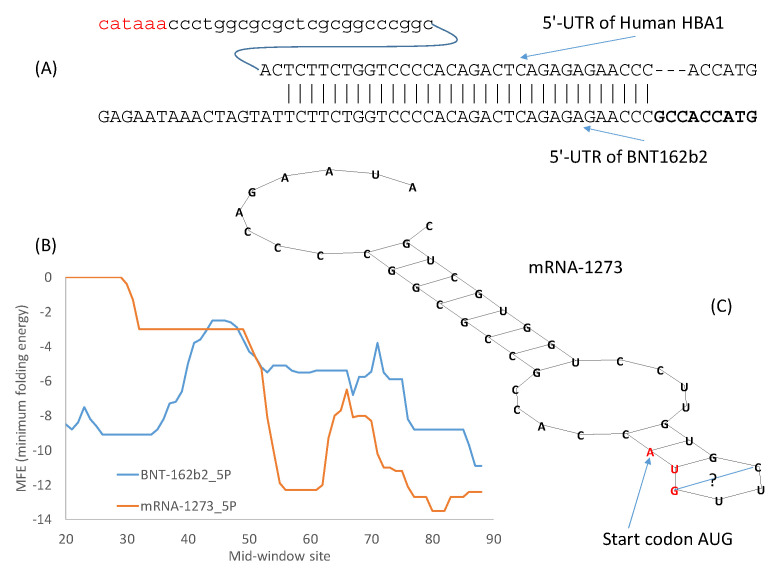
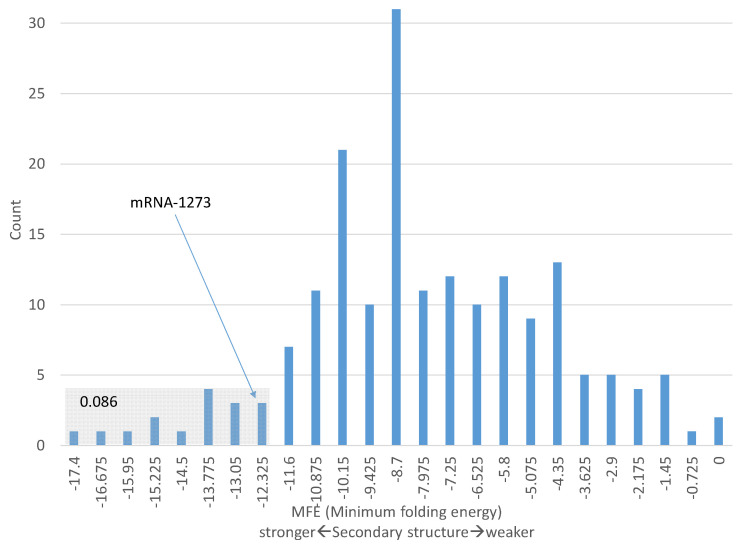
- BNT162b2 uses the human α-globin 5′-UTR with Kozak GCCACCAUG and little secondary structure flanking the start codon; mRNA-1273 has a GC-rich element and secondary structure with MFE −12.3 for the 40-nt window around the start codon, versus −11.1 for α-globin. The paper says BNT162b2’s 5′-UTR appears superior but cautions that 8.6% of ribosomal protein genes have MFE equal to or smaller than −12.3.
- BNT162b2 ends with UGAUGA and mRNA-1273 with UGAUAAUAG; the paper argues the optimal stop signal should be UAAA, because UGA is leakiest and highly expressed RP genes favor +4R (likelihood ratio chi-square = 931.0514, DF = 17, p < 0.000001). Ψ substitution may further increase stop-codon misreading and +1 frameshifting.
- Given 100 μg mRNA-1273 versus 30 μg BNT-162b2 and equivalent efficacy, the paper infers Pfizer/BioNTech mRNA may produce about 3.3 times as many proteins per mRNA. CAI values are 0.94925 for BNT-162b2 and 0.97939 for mRNA-1273, but higher CAI is not necessarily better because Moderna used a “fundamentalist” and Pfizer/BioNTech a “liberal” codon strategy.
Methods
- Sequence data included 33 RPS and 50 RPL ubiquitously expressed ribosomal protein genes, 11,327 annotated CDSs from human chromosome 1, intron nucleotide frequencies from chromosomes 18–22, SARS-CoV/SARS-CoV-2 and related coronavirus genomes, and vaccine mRNA sequences (BNT-162b2 public; mRNA-1273 putative from Jeong et al., with UTRs matching Moderna patents).
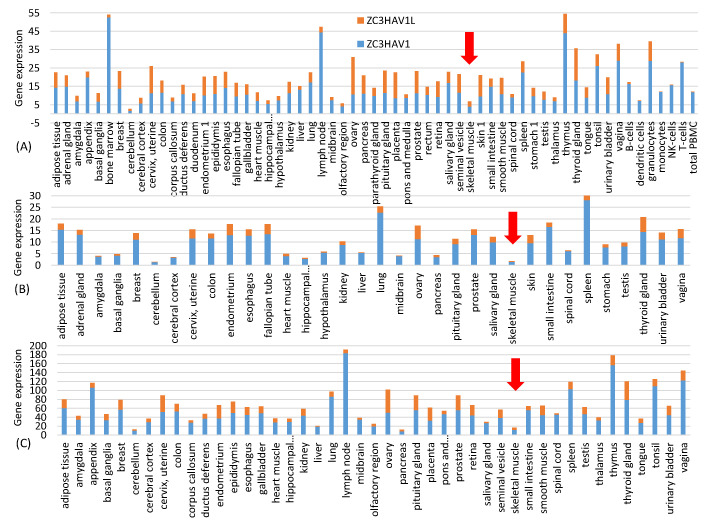
- Tissue expression used Human Protein Atlas data from 62 tissues; top 50 skeletal-muscle highly expressed genes were selected, with 26 having CDSs ≥300 codons for Table 2; ZAP expression was extracted from three HPA files.
- Analyses used DAMBE for CDS extraction, codon frequencies, CAI, ITE, PWM, and MFE (Vienna RNA fold); SARS-CoV-2 transcriptomic SRA SRR11886744 was analyzed for subgenomic spike mRNA; statistical tests included paired t-test and likelihood ratio test.
Limitations
- Stated: the mRNA-1273 sequence is putative and “should be considered putative,” though its UTRs match Moderna patents; there is no systematic evaluation of the fundamentalist versus liberal codon optimization strategies in translation efficiency; the 5′-UTR secondary-structure interpretation is cautioned because some highly expressed genes have comparable MFE; and Ψ replacement complicates stop-codon reasoning.
- Evident: the study is computational/in silico and reports no new wet-lab translation or immunogenicity experiments; inferences about dosage, protein output, and translation efficiency are indirect.
- Evident: the paper itself notes that tRNA gene copy number is problematic as a proxy for tRNA abundance because nearly half of human tRNA genes are not expressed.
Model-written summary. Check it against the paper before relying on it.
Integrity signals
Registry
Cites
Statistics
Figures
Verification
Claims the paper makes
47 Own interpretation · 39 No basis given · 28 Partly supported · 20 Own result · 13 No full text of the sources · 8 Supported · 7 Not checked yet · 5 Supported so far · 2 Mixed support · 2 Couldn’t confirm · 1 Not supported · 1 Own method · accuracy not yet measured
At least one cited source doesn’t support this claim or points to a different paper, and none confirmed it — see the verdicts below.
In the paper
“First, while the -3R (site 4 in the first column of Table 5) has been demonstrated repeatedly to enhance translation initiation, the effect of +4G (site 10 in Table 5), as well as nucleotides downstream, on translation initiation has been inconclusive [46,49,50,51].”
§ Detailed Dissection and Critical Evaluation of the Pfizer/BioNTech and Moderna mRNA Vaccines > 3. Results and Discussion > 3.3. Translation Initiation Signal
What the sources say
- Not checked — no full text of the sourcecites [46] Kozak, 1999, Initiation of translation in prokaryotes and eukaryotes, Gene source
- Not checked — no full text of the sourcecites [49] Kozak, 2001, A progress report on translational control in eukaryotes, Sci. STKE source
- Disputedcites [50] Kozak, 2003, Not every polymorphism close to the AUG codon can be explained by invoking context effects on initiation of translation, Blood sourceExperimental — accuracy not yet measured
In the letter “Not every polymorphism close to the AUG codon can be explained by invoking context effects on initiation of translation,” Kozak says mutagenesis experiments found that +4G makes one of the strongest contributions to translation initiation. That is contrary to describing the effect of +4G as inconclusive. The References section also identifies a study reporting that +4G augments initiation, while nucleotides at +5 and +6 generally do not affect it. (LLM, conf=0.88)
Checked by a reasoning model — may be wrong.
- Disputedcites [51] Kozak, 1997, Recognition of AUG and alternative initiator codons is augmented by G in position +4 but is not generally affected by the nucleotides in positions +5 and +6, Embo J. sourceExperimental — accuracy not yet measured
The paper does not leave the effect of +4G inconclusive: the Discussion says its positive effect is generalizable, while the results report no significant effect from changes at +5 or +6 in the tests described. It notes a sequence-specific exception to the usual +4G effect, but presents that as an exception rather than an inconclusive overall finding (Discussion; Figures 4–6, page not provided in our copy). (LLM, conf=0.88)
Checked by a reasoning model — may be wrong.
plain- Asserted: passes — The authors put it forward as true.
- Checkable: passes — It can be checked against evidence.
- Load-bearing: passes — The paper’s conclusions depend on it.
- Based: passes — The paper gives a reason why it holds.
Some cited sources support this claim and some don’t — read each source’s verdict below.
In the paper
“There is little evidence that +4G and downstream nucleotides contribute to translation initiation.”
§ Detailed Dissection and Critical Evaluation of the Pfizer/BioNTech and Moderna mRNA Vaccines > 3. Results and Discussion > 3.3. Translation Initiation Signal
What the sources say
- Not checked — no full text of the sourcecites [46] Kozak, 1999, Initiation of translation in prokaryotes and eukaryotes, Gene source
- Not checked — no full text of the sourcecites [49] Kozak, 2001, A progress report on translational control in eukaryotes, Sci. STKE source
- Disputedcites [50] Kozak, 2003, Not every polymorphism close to the AUG codon can be explained by invoking context effects on initiation of translation, Blood sourceExperimental — accuracy not yet measured
In the letter “Not every polymorphism close to the AUG codon can be explained by invoking context effects on initiation of translation” (page not supplied), Kozak says that G at +4 makes one of the strongest contributions to start-codon recognition. The paper also says downstream secondary structure can compensate for a suboptimal initiation context. Its caution about a particular −1 polymorphism does not support the broad claim that there is little evidence for a contribution from +4G. (LLM, conf=0.90)
Checked by a reasoning model — may be wrong.
- Partly supportedcites [51] Kozak, 1997, Recognition of AUG and alternative initiator codons is augmented by G in position +4 but is not generally affected by the nucleotides in positions +5 and +6, Embo J. sourceExperimental — accuracy not yet measured
The Discussion reports little or no effect from varying nucleotides at +5 and +6, supporting that part of the claim. But it also reports a strong, generalizable contribution of G at +4 to initiator-codon recognition, contrary to the claim about +4G. (LLM, conf=0.90)
plain- Asserted: passes — The authors put it forward as true.
- Checkable: passes — It can be checked against evidence.
- Load-bearing: passes — The paper’s conclusions depend on it.
- Based: passes — The paper gives a reason why it holds.
Some cited sources support this claim and some don’t — read each source’s verdict below.
In the paper
“Optimum codon usage without efficient translation initiation does not increase protein production [10,11] because translation initiation is often the rate-limiting step.”
§ Detailed Dissection and Critical Evaluation of the Pfizer/BioNTech and Moderna mRNA Vaccines > 3. Results and Discussion > 3.3. Translation Initiation Signal
What the sources say
- Disputedcites [10] Tuller, 2010, Translation efficiency is determined by both codon bias and folding energy, Proc. Natl. Acad. Sci. USA sourceExperimental — accuracy not yet measured
The Discussion and Conclusions (page unavailable) say that, for individual genes in the E. coli and S. cerevisiae transcriptomes studied, codon bias—not folding energy at the start of a gene—is the rate-limiting factor. The paper discusses effects on initiation, but its own conclusion does not support the citing sentence’s claim that initiation is often rate-limiting. (LLM, conf=0.83)
Checked by a reasoning model — may be wrong.
- Partly supportedcites [11] Xia, 2015, A Major Controversy in Codon-Anticodon Adaptation Resolved by a New Codon Usage Index, Genetics sourceExperimental — accuracy not yet measured
The Conceptual Framework says that inefficient initiation can limit the benefit of improved codon adaptation. But the Discussion concludes that both initiation and elongation limit translation efficiency, and notes that the low-initiation group studied is not representative of most genes. The paper therefore does not establish that initiation is often the rate-limiting step. (LLM, conf=0.83)
hedged- Asserted: passes — The authors put it forward as true.
- Checkable: passes — It can be checked against evidence.
- Load-bearing: passes — The paper’s conclusions depend on it.
- Based: passes — The paper gives a reason why it holds.
- Disputed
The cited sources support only part of this claim — read each source’s verdict below.
In the paper
“When nucleotide U in stop codons was replaced by Ψ, the rate of misreading of a stop codon by a near-cognate tRNAs increased [17].”
§ Detailed Dissection and Critical Evaluation of the Pfizer/BioNTech and Moderna mRNA Vaccines > 1. Introduction
What the sources say
- Partly supportedcites [17] Adachi, 2019, Post-transcriptional pseudouridylation in mRNA as well as in some major types of noncoding RNAs, Biochim. Et Biophys. Acta. Gene Regul. Mech. sourceExperimental — accuracy not yet measured
In “Targeted pseudouridylation promotes stop codon read-through” (page unavailable), the review reports that replacing U with Ψ promotes stop-codon read-through and describes tRNA anticodon pairing during decoding. It does not report a measured increase in the rate of misreading by near-cognate tRNAs specifically. (LLM, conf=0.82)
plaindirect- Asserted: passes — The authors put it forward as true.
- Checkable: passes — It can be checked against evidence.
- Load-bearing: passes — The paper’s conclusions depend on it.
- Based: passes — The paper gives a reason why it holds.
- Partly supported
The cited sources support only part of this claim — read each source’s verdict below.
In the paper
“Both mRNA encodes the same S-2P protein [5,6] which differ from the spike protein in the reference SARS-CoV-2 genome (NC_045512) by two amino acids, i.e., amino acids KV at sites 986 and 987 were replaced by PP to stabilize the resulting spike protein in the prefusion state to train the host immune system to recognize the virus before its entry into the host cell [7,8].”
§ Detailed Dissection and Critical Evaluation of the Pfizer/BioNTech and Moderna mRNA Vaccines > 1. Introduction
What the sources say
- Partly supportedcites [5] Anderson, E.J., Rouphael, N.G., Widge, A.T., Jackson, L.A., Roberts, P.C., Makhene, M., Chappell, J.D., Denison, M.R., Stevens, L.J., and Pruijssers, A.J. (2020). Safety and Immunogenicity of SARS-CoV-2 mRNA-1273 Vaccine in Older Adults. N. Engl. J. Med. sourceExperimental — accuracy not yet measured
The Methods section (“mRNA-1273 Vaccine”) states that mRNA-1273 encodes S-2P, a stabilized spike protein with two proline substitutions. The cited paper does not establish that the other mRNA referred to in the sentence encodes the same protein. (LLM, conf=0.86)
- Partly supportedcites [6] Jackson, 2020, An mRNA Vaccine against SARS-CoV-2-Preliminary Report, N. Engl. J. Med. sourceExperimental — accuracy not yet measured
The Methods > Vaccine passage states that mRNA-1273 encodes the S-2P antigen. The paper does not establish that both mRNA vaccines encode the same protein, so it supports only the mRNA-1273 part of the claim. (LLM, conf=0.87)
plain- Asserted: passes — The authors put it forward as true.
- Checkable: passes — It can be checked against evidence.
- Load-bearing: unclear — It is unclear whether the paper’s conclusions depend on it.
- Based: passes — The paper gives a reason why it holds.
- Partly supported
The cited sources support only part of this claim — read each source’s verdict below.
In the paper
“Both mRNA encodes the same S-2P protein [5,6] which differ from the spike protein in the reference SARS-CoV-2 genome (NC_045512) by two amino acids, i.e., amino acids KV at sites 986 and 987 were replaced by PP to stabilize the resulting spike protein in the prefusion state to train the host immune system to recognize the virus before its entry into the host cell [7,8].”
§ Detailed Dissection and Critical Evaluation of the Pfizer/BioNTech and Moderna mRNA Vaccines > 1. Introduction
What the sources say
- Partly supportedcites [5] Anderson, E.J., Rouphael, N.G., Widge, A.T., Jackson, L.A., Roberts, P.C., Makhene, M., Chappell, J.D., Denison, M.R., Stevens, L.J., and Pruijssers, A.J. (2020). Safety and Immunogenicity of SARS-CoV-2 mRNA-1273 Vaccine in Older Adults. N. Engl. J. Med. sourceExperimental — accuracy not yet measured
The Methods section (‘mRNA-1273 Vaccine’; page not provided) says S-2P contains two proline substitutions, and the Discussion describes them as prefusion-stabilizing mutations. Our copy does not identify the original residues as KV, give positions 986 and 987, or specify the reference genome accession NC_045512. (LLM, conf=0.87)
- Partly supportedcites [6] Jackson, 2020, An mRNA Vaccine against SARS-CoV-2-Preliminary Report, N. Engl. J. Med. sourceExperimental — accuracy not yet measured
The Methods (Vaccine; page not provided) state that S-2P has two proline substitutions at positions 986 and 987, stabilizing the spike protein in its prefusion conformation. Our copy does not identify the original amino acids as KV or specify the reference genome accession NC_045512. (LLM, conf=0.84)
- Partly supportedcites [7] Hsieh, 2020, Structure-based design of prefusion-stabilized SARS-CoV-2 spikes, Science sourceExperimental — accuracy not yet measured
The supplied passage describing S-2P (section labeled Abstract; page unavailable) says it contains two consecutive proline substitutions in the S2 subunit that stabilize the prefusion spike. Our copy does not identify the original residues as KV, give positions 986 and 987, or compare the construct with reference genome NC_045512, so those specifics are not verified. (LLM, conf=0.85)
- Supportedcites [8] Xia, X. (2021). Domains and Functions of Spike Protein in SARS-COV-2 in the Context of Vaccine Design. Viruses, 13. source
Section 6, “The Spike Protein in Vaccine Development,” identifies S-2P as SARS-CoV-2 spike with the two proline substitutions K986P and V987P. It also says these substitutions stabilize the spike protein in its prefusion state. (LLM, conf=0.91)
plain- Asserted: passes — The authors put it forward as true.
- Checkable: passes — It can be checked against evidence.
- Load-bearing: unclear — It is unclear whether the paper’s conclusions depend on it.
- Based: passes — The paper gives a reason why it holds.
- Partly supported
The cited sources support only part of this claim — read each source’s verdict below.
In the paper
“The codon optimization applied to BNT-162b2 and mRNA-1273 leads to a much increased codon adaptation index (CAI) [21,22] and index of translation efficiency (ITE) [11,36] for the two vaccine mRNAs.”
§ Detailed Dissection and Critical Evaluation of the Pfizer/BioNTech and Moderna mRNA Vaccines > 3. Results and Discussion > 3.1. Codon Optimization for Translation Elongation Efficiency
What the sources say
- Partly supportedcites [21] Sharp, 1987, The codon Adaptation Index--a measure of directional synonymous codon usage bias, and its potential applications, Nucleic Acids Res. sourceExperimental — accuracy not yet measured
The 'Comparison of CAI with other indices' section defines CAI as a measure of synonymous codon usage bias, and 'Predicting levels of heterologous gene expression' discusses using it to assess whether a gene might benefit from more appropriate codons. The paper does not report CAI values for BNT-162b2 or mRNA-1273, so it cannot substantiate the claimed increase in those vaccine mRNAs. The ITE claim has separate citations and is not attributed to this source. (LLM, conf=0.88)
- Not checked — no full text of the sourcecites [22] Xia, 2007, An Improved Implementation of Codon Adaptation Index, Evol. Bioinform. source
- Supportedcites [11] Xia, 2015, A Major Controversy in Codon-Anticodon Adaptation Resolved by a New Codon Usage Index, Genetics source
The citation is attached to the index of translation efficiency (ITE), rather than to the vaccine-specific increase. In “Necessity of a New Translation Elongation Index,” the paper defines ITE and explains how it is calculated. (LLM, conf=0.90)
- Not checked — no full text of the sourcecites [36] Xia, X. (2018). Bioinformatics and Translation Elongation. Bioinformatics and the Cell: Modern Computational Approaches in Genomics, Proteomics and Transcriptomics, Springer. source
plaindirect- Asserted: passes — The authors put it forward as true.
- Checkable: passes — It can be checked against evidence.
- Load-bearing: passes — The paper’s conclusions depend on it.
- Based: passes — The paper gives a reason why it holds.
- Partly supported
Every source the paper cites for this claim was checked and supports it.
In the paper
“Both mRNA encodes the same S-2P protein [5,6] which differ from the spike protein in the reference SARS-CoV-2 genome (NC_045512) by two amino acids, i.e., amino acids KV at sites 986 and 987 were replaced by PP to stabilize the resulting spike protein in the prefusion state to train the host immune system to recognize the virus before its entry into the host cell [7,8].”
§ Detailed Dissection and Critical Evaluation of the Pfizer/BioNTech and Moderna mRNA Vaccines > 1. Introduction
What the sources say
- Supportedcites [7] Hsieh, 2020, Structure-based design of prefusion-stabilized SARS-CoV-2 spikes, Science source
The paper describes S-2P as a spike with two proline substitutions designed to stabilize the prefusion conformation. It also states that prefusion-stabilized glycoproteins are superior immunogens and that spike is a critical vaccine antigen and target of neutralizing antibodies because it mediates viral entry. Together, these passages support the stated vaccine rationale; the paper does not report a direct test of immune training by S-2P. (LLM, conf=0.86)
- Supportedcites [8] Xia, X. (2021). Domains and Functions of Spike Protein in SARS-COV-2 in the Context of Vaccine Design. Viruses, 13. source
Section 6 states that the K986P and V987P substitutions stabilize the spike protein in its prefusion state. It also explains that presenting prefusion spike trains the immune system to act against the virus before the postfusion stage, when the virus is gaining entry into a cell. (LLM, conf=0.94)
plaindirect- Asserted: passes — The authors put it forward as true.
- Checkable: passes — It can be checked against evidence.
- Load-bearing: unclear — It is unclear whether the paper’s conclusions depend on it.
- Based: passes — The paper gives a reason why it holds.
- Supported
The cited sources that could be checked couldn’t confirm or dispute this claim.
In the paper
“First, GC-rich mRNAs tend to be more stable than AU-rich mRNAs [32].”
§ Detailed Dissection and Critical Evaluation of the Pfizer/BioNTech and Moderna mRNA Vaccines > 3. Results and Discussion > 3.1. Codon Optimization for Translation Elongation Efficiency
What the sources say
- Could not verifycites [32] Courel, M., Clément, Y., Bossevain, C., Foretek, D., Vidal Cruchez, O., Yi, Z., Bénard, M., Benassy, M.N., Kress, M., and Vindry, C. (2019). GC content shapes mRNA storage and decay in human cells. eLife, 8. sourceExperimental — accuracy not yet measured
The Results (Figure 4) report that silencing XRN1 stabilizes GC-rich mRNAs, while silencing PAT1B stabilizes AU-rich mRNAs. The Discussion describes distinct decay and storage pathways, but neither passage compares the groups’ overall stability. Searches for relative stability and half-life found no such comparison in our copy. (LLM, conf=0.74)
hedgedcorrelational- Asserted: passes — The authors put it forward as true.
- Checkable: passes — It can be checked against evidence.
- Load-bearing: passes — The paper’s conclusions depend on it.
- Based: passes — The paper gives a reason why it holds.
- Could not verify
The sources with a verdict support this claim; the rest weren’t checked yet, have no full text we could read, or their verdicts aren’t rated yet.
In the paper
“As mammalian host cells attack unmodified exogeneous RNA [12,13], all U nucleotides were replaced by N1-methylpseudouridine (Ψ) [14,15].”
§ Detailed Dissection and Critical Evaluation of the Pfizer/BioNTech and Moderna mRNA Vaccines > 1. Introduction
What the sources say
- Supportedcites [12] Muramatsu, 2008, Incorporation of pseudouridine into mRNA yields superior nonimmunogenic vector with increased translational capacity and biological stability, Mol. Ther. J. Am. Soc. Gene Ther. source
The Introduction says unmodified RNA activates innate immune cells, while modified transcripts greatly diminish that response. The Results section reports that unmodified RNA induced inflammatory responses in human dendritic cells and mice; this supports the citing sentence’s informal description of host cells ‘attacking’ it. (LLM, conf=0.90)
- Not checked — no full text of the sourcecites [13] Weissman, 2015, mRNA transcript therapy, Expert Rev. Vaccines source
plaindirect- Asserted: passes — The authors put it forward as true.
- Checkable: passes — It can be checked against evidence.
- Load-bearing: passes — The paper’s conclusions depend on it.
- Based: passes — The paper gives a reason why it holds.
- Supported
- It may state two separate claims as one. 41
- Probably not a substantial claim. 16
- The quote only partly states this claim. 1
Every source the paper cites for this claim was checked and supports it.
In the paper
“However, Ψ wobbles more in base-pairing than U and can pair not only with A and G, but also, to a lesser extent, with C and U [16].”
§ Detailed Dissection and Critical Evaluation of the Pfizer/BioNTech and Moderna mRNA Vaccines > 1. Introduction
What the sources say
- Supportedcites [16] Kierzek, 2014, The contribution of pseudouridine to stabilities and structure of RNAs, Nucleic Acids Res. source
The Introduction says Ψ has greater potential for hydrogen bonding than U, and the Discussion reports Ψ-A, Ψ-G, Ψ-U and Ψ-C pairs, with Ψ-C duplexes the least stable. The Results clarify an important limit to the paraphrase: NMR supports hydrogen bonding for Ψ paired with A, G or U, but not with C; Ψ and C instead stack within the duplex. (LLM, conf=0.86)
plaincorrelational- Asserted: passes — The authors put it forward as true.
- Checkable: passes — It can be checked against evidence.
- Load-bearing: passes — The paper’s conclusions depend on it.
- Based: passes — The paper gives a reason why it holds.
It may state two separate claims as one.
- Supported
The cited sources support only part of this claim — read each source’s verdict below.
In the paper
“This highlights one advantage of mRNA vaccines because it has many different but convenient routes for vaccine administration, including subcutaneous, intramuscular, intradermal, intratracheal, intravenous and intraperitoneal routes [31].”
§ Detailed Dissection and Critical Evaluation of the Pfizer/BioNTech and Moderna mRNA Vaccines > 3. Results and Discussion > 3.1. Codon Optimization for Translation Elongation Efficiency
What the sources say
- Partly supportedcites [31] Pardi, 2015, Expression kinetics of nucleoside-modified mRNA delivered in lipid nanoparticles to mice by various routes, J. Control. Release sourceExperimental — accuracy not yet measured
The Discussion lists all six routes used to deliver nucleoside-modified mRNA-LNPs, and the Abstract reports protein expression after administration to mice. The study tested luciferase expression, not vaccine administration or whether these routes are convenient for vaccination. (LLM, conf=0.88)
plain- Asserted: passes — The authors put it forward as true.
- Checkable: passes — It can be checked against evidence.
- Load-bearing: fails — The paper’s conclusions may not depend on it.
- Based: passes — The paper gives a reason why it holds.
Probably not a substantial claim. The paper’s conclusions may not depend on it.
- Partly supported
The cited sources support only part of this claim — read each source’s verdict below.
In the paper
“Translation initiation is typically the limiting step in translation, and its efficiency depends heavily on how rapidly the 5′-UTR can load ribosome onto the mRNA [9].”
§ Detailed Dissection and Critical Evaluation of the Pfizer/BioNTech and Moderna mRNA Vaccines > 1. Introduction
What the sources say
- Partly supportedcites [9] Xia, 2011, Translation Initiation: A Regulatory Role for Poly(A) Tracts in Front of the AUG Codon in Saccharomyces cerevisiae, Genetics sourceExperimental — accuracy not yet measured
The Abstract (page not provided) calls the 5′-UTR a ribosome-loading dock during initiation and a key site of translation regulation. The Results section on protein synthesis rate and ribosomal density (page not provided) uses ribosomal density as a measure of translation efficiency. Neither passage establishes that initiation is typically the limiting step or that efficiency depends specifically on the speed of ribosome loading. (LLM, conf=0.84)
plaindirect- Asserted: passes — The authors put it forward as true.
- Checkable: passes — It can be checked against evidence.
- Load-bearing: passes — The paper’s conclusions depend on it.
- Based: passes — The paper gives a reason why it holds.
It may state two separate claims as one.
- Partly supported
The cited sources support only part of this claim — read each source’s verdict below.
In the paper
“However, all U nucleotides in the mRNA vaccines have been modified to N1-methyl-pseudouridine (Ψ) [14] to reduce immune reaction towards mRNA and to increase protein production [2,13,58].”
§ Detailed Dissection and Critical Evaluation of the Pfizer/BioNTech and Moderna mRNA Vaccines > 3. Results and Discussion > 3.3. Translation Initiation Signal
What the sources say
- Not checked yetcites [14] European Medicines Agency (2021). Assessment report on Comirnaty (Common Name: COVID-19 mRNA Vaccine) (Nucleoside-Modified) Procedure No. EMEA/H/C/005735/0000, European Medicines Agency.
- Partly supportedcites [2] Corbett, 2020, SARS-CoV-2 mRNA vaccine design enabled by prototype pathogen preparedness, Nature sourceExperimental — accuracy not yet measured
The Methods section (“Pre-clinical mRNA-1273 mRNA and LNP Production Process”) states that uridine was completely replaced by N1m-pseudouridine in mRNA-1273. That supports the modification attributed to this source, but this paper does not establish that all mRNA vaccines use it. The sentence cites other sources for the stated reasons for the modification. (LLM, conf=0.86)
- Not checked — no full text of the sourcecites [13] Weissman, 2015, mRNA transcript therapy, Expert Rev. Vaccines source
- Partly supportedcites [58] Muramatsu, 2012, Increased erythropoiesis in mice injected with submicrogram quantities of pseudouridine-containing mRNA encoding erythropoietin, Mol. Ther. J. Am. Soc. Gene Ther. sourceExperimental — accuracy not yet measured
The Introduction and Results (pages not available in our copy) report that pseudouridine-containing mRNA reduced immune activation and increased protein production relative to uridine-containing mRNA. The paper studies erythropoietin-encoding mRNA, not mRNA vaccines, and identifies the modification as pseudouridine (Ψ), not N1-methyl-pseudouridine. It therefore does not establish the claim about all U nucleotides in mRNA vaccines. (LLM, conf=0.88)
plaindirect- Asserted: passes — The authors put it forward as true.
- Checkable: passes — It can be checked against evidence.
- Load-bearing: passes — The paper’s conclusions depend on it.
- Based: passes — The paper gives a reason why it holds.
It may state two separate claims as one.
The cited sources support only part of this claim — read each source’s verdict below.
In the paper
“As Ψ is more promiscuous in base-pairing than U and can pair with both A and G and, to a less extent, with C and U [16], stop codons become more prone to misreading by tRNAs [17].”
§ Detailed Dissection and Critical Evaluation of the Pfizer/BioNTech and Moderna mRNA Vaccines > 3. Results and Discussion > 3.4. Translation Termination Signal
What the sources say
- Partly supportedcites [16] Kierzek, 2014, The contribution of pseudouridine to stabilities and structure of RNAs, Nucleic Acids Res. sourceExperimental — accuracy not yet measured
The Discussion reports Ψ-A, Ψ-G and Ψ-U hydrogen bonding and generally greater stability when Ψ replaces U in mispairs. But it says Ψ and U hydrogen-bond to those bases in similar ways, and finds no NMR evidence of hydrogen bonding in Ψ-C, so the claimed greater breadth of base-pairing is not established. The stop-codon clause is attached to a different citation and is not judged here. (LLM, conf=0.86)
- Partly supportedcites [17] Adachi, 2019, Post-transcriptional pseudouridylation in mRNA as well as in some major types of noncoding RNAs, Biochim. Et Biophys. Acta. Gene Regul. Mech. sourceExperimental — accuracy not yet measured
The Introduction (page unavailable) says Ψ has an additional hydrogen-bond donor and chemical properties distinct from U, but does not specify that Ψ pairs with A and G or, less readily, C and U. The stop-codon read-through section reports decoding of pseudouridylated stop codons, but the citing sentence attaches a separate citation to that consequence. (LLM, conf=0.80)
plaindirect- Asserted: passes — The authors put it forward as true.
- Checkable: passes — It can be checked against evidence.
- Load-bearing: passes — The paper’s conclusions depend on it.
- Based: passes — The paper gives a reason why it holds.
It may state two separate claims as one.
- Partly supported
The cited sources support only part of this claim — read each source’s verdict below.
In the paper
“Similar predictions can also be made with respect to +5 or +6 sites which, however, have their effect far less consistent than the +4 site on translation termination [65].”
§ Detailed Dissection and Critical Evaluation of the Pfizer/BioNTech and Moderna mRNA Vaccines > 3. Results and Discussion > 3.4. Translation Termination Signal
What the sources say
- Partly supportedcites [65] McCaughan, 1995, Translational termination efficiency in mammals is influenced by the base following the stop codon, Proc. Natl. Acad. Sci. USA sourceExperimental — accuracy not yet measured
The Results report that the fifth base has little effect on a strong UGAA termination signal but affects a weak UGAC signal, supporting a context-dependent effect compared with the experimentally established fourth-base effect. The paper notes a statistical bias at the sixth position and cites possible importance in Sindbis virus RNA, but does not establish that sixth-base effects on translation termination are less consistent than fourth-base effects. Page numbers are unavailable in our copy. (LLM, conf=0.85)
plaincorrelational- Asserted: passes — The authors put it forward as true.
- Checkable: passes — It can be checked against evidence.
- Load-bearing: unclear — It is unclear whether the paper’s conclusions depend on it.
- Based: passes — The paper gives a reason why it holds.
It may state two separate claims as one.
- Partly supported
The cited sources support only part of this claim — read each source’s verdict below.
In the paper
“First, the binding affinity to eRF1 is in the order of UAA > UGA and UAG [63,64], suggesting that UAA is a more efficient stop codon than the other two.”
§ Detailed Dissection and Critical Evaluation of the Pfizer/BioNTech and Moderna mRNA Vaccines > 3. Results and Discussion > 3.4. Translation Termination Signal
What the sources say
- Not checked — no full text of the sourcecites [63] Konecki, 1977, Characterization of reticulocyte release factor, J. Biol. Chem. source
- Partly supportedcites [64] Tate, 1973, Influence of Guanine Nucleotides and Elongation Factors on Interaction of Release Factors with the Ribosome, Proc. Natl. Acad. Sci. USA sourceExperimental — accuracy not yet measured
The Results (Fig. 3; page not specified) show that tetranucleotides containing all three stop codons competed in a reticulocyte release-factor binding assay, and that UAGA required a higher concentration for complete competition. The paper does not establish the claimed UAA > UGA affinity ordering or show that UAA is a more efficient stop codon; it also notes contamination affecting the UAGA result. (LLM, conf=0.82)
hedgedcorrelational- Asserted: passes — The authors put it forward as true.
- Checkable: passes — It can be checked against evidence.
- Load-bearing: passes — The paper’s conclusions depend on it.
- Based: passes — The paper gives a reason why it holds.
It may state two separate claims as one.
The sources with a verdict support this claim; the rest weren’t checked yet, have no full text we could read, or their verdicts aren’t rated yet.
In the paper
“It has long been recognized that the translation termination signal is more than a stop codon [86,87], leading to an early proposal of tetranucleotide stop signal including the downstream +4 site [63,65,87,88].”
§ Detailed Dissection and Critical Evaluation of the Pfizer/BioNTech and Moderna mRNA Vaccines > 3. Results and Discussion > 3.4. Translation Termination Signal
What the sources say
- Not checked — no full text of the sourcecites [86] Tate, 1992, Translational termination: “stop” for protein synthesis or “pause” for regulation of gene expression, Biochemistry source
- Not checked — no full text of the sourcecites [87] Tate, 1996, Three, four or more: The translational stop signal at length, Mol. Microbiol. source
- Not checked — no full text of the sourcecites [63] Konecki, 1977, Characterization of reticulocyte release factor, J. Biol. Chem. source
- Supportedcites [65] McCaughan, 1995, Translational termination efficiency in mammals is influenced by the base following the stop codon, Proc. Natl. Acad. Sci. USA source
The Results section explicitly says the authors had proposed a four-base stop signal comprising the termination codon and the following base. The Discussion also reports that this following base can influence mammalian termination, supporting the claim that the signal extends beyond the stop codon. (LLM, conf=0.95)
- Not checked — no full text of the sourcecites [88] Brown, 1990, Sequence analysis suggests that tetra-nucleotides signal the termination of protein synthesis in eukaryotes, Nucleic Acids Res. source
boosted- Asserted: passes — The authors put it forward as true.
- Checkable: passes — It can be checked against evidence.
- Load-bearing: unclear — It is unclear whether the paper’s conclusions depend on it.
- Based: passes — The paper gives a reason why it holds.
It may state two separate claims as one.
Every source the paper cites for this claim was checked and supports it.
In the paper
“Both UGAC and UGAU lead to frequent selenocysteine incorporation [65], suggesting poor decoding of UGA as a stop codon with +4Y.”
§ Detailed Dissection and Critical Evaluation of the Pfizer/BioNTech and Moderna mRNA Vaccines > 3. Results and Discussion > 3.4. Translation Termination Signal
What the sources say
- Supportedcites [65] McCaughan, 1995, Translational termination efficiency in mammals is influenced by the base following the stop codon, Proc. Natl. Acad. Sci. USA source
The Results report that UGAC and UGAU allowed termination in approximately one of four ribosomal passages, leaving selenocysteine incorporation at most passages. The Discussion describes the same fourth-base pyrimidine pattern: termination is favored with a purine, whereas selenocysteyl-tRNA selection is favored with a pyrimidine. The authors caution that the in vivo result measures the net competition between those processes, not release-factor selection alone. (LLM, conf=0.94)
hedgeddirect- Asserted: passes — The authors put it forward as true.
- Checkable: passes — It can be checked against evidence.
- Load-bearing: passes — The paper’s conclusions depend on it.
- Based: passes — The paper gives a reason why it holds.
It may state two separate claims as one.
- Supported
The cited sources support only part of this claim — read each source’s verdict below.
In the paper
“Such frameshifting also occurs in eukaryotes, such as the mammalian AZ1 gene with a stop codon context UGAU [85], where UGA is the stop codon followed by a U at the +4 site. The first U in the stop codon in translating AZ1 mRNA is often skipped when the concentration of polyamines is high, resulting in the ribosome reading GAU as the next codon [85].”
§ Detailed Dissection and Critical Evaluation of the Pfizer/BioNTech and Moderna mRNA Vaccines > 3. Results and Discussion > 3.4. Translation Termination Signal
What the sources say
- Partly supportedcites [85] Namy, 2004, Reprogrammed genetic decoding in cellular gene expression, Mol. Cell sourceExperimental — accuracy not yet measured
Split into 2 atoms — 1 confirmed, 1 partially supported, 0 disputed, 0 misattributed, 0 unverifiable. Expand the claim to see per-atom verdicts.
plaindirect- Asserted: passes — The authors put it forward as true.
- Checkable: passes — It can be checked against evidence.
- Load-bearing: passes — The paper’s conclusions depend on it.
- Based: passes — The paper gives a reason why it holds.
It may state two separate claims as one.
- Partly supported
The paper states this without a source or data behind it here, so there is nothing to check it against. The quote shows it is in the paper.
In the paper
“The SARS-CoV-2 reference genome (NC_045512) has 34 GAA codons and 14 GAG codons in its spike protein gene.”
§ Detailed Dissection and Critical Evaluation of the Pfizer/BioNTech and Moderna mRNA Vaccines > 3. Results and Discussion > 3.1. Codon Optimization for Translation Elongation Efficiency
plain- Asserted: passes — The authors put it forward as true.
- Checkable: passes — It can be checked against evidence.
- Load-bearing: passes — The paper’s conclusions depend on it.
- Based: fails — The paper may give no reason why it holds.
Probably not a substantial claim. The paper may give no reason why it holds.
The paper states this without a source or data behind it here, so there is nothing to check it against. The quote shows it is in the paper.
In the paper
“While the Pfizer/BioNTech’s BNT162b2 mRNA and Moderna’s mRNA-1273 share the same amino acid sequence, they differ in many other ways, such as the design of 5′-UTR, codon optimization and 3′-UTR.”
§ Detailed Dissection and Critical Evaluation of the Pfizer/BioNTech and Moderna mRNA Vaccines > 1. Introduction
plain- Asserted: passes — The authors put it forward as true.
- Checkable: passes — It can be checked against evidence.
- Load-bearing: passes — The paper’s conclusions depend on it.
- Based: passes — The paper gives a reason why it holds.
It may state two separate claims as one.
- The authors state this as an assumption: The putative sequence of mRNA-1273 is the real mRNA-1273.
The paper states this without a source or data behind it here, so there is nothing to check it against. The quote shows it is in the paper.
In the paper
“The designers of both vaccines considered CGG as the optimal codon in the CGN codon family and recoded almost all CGN codons to CGG.”
§ Detailed Dissection and Critical Evaluation of the Pfizer/BioNTech and Moderna mRNA Vaccines > 3. Results and Discussion > 3.1. Codon Optimization for Translation Elongation Efficiency
plaindirect- Asserted: passes — The authors put it forward as true.
- Checkable: passes — It can be checked against evidence.
- Load-bearing: passes — The paper’s conclusions depend on it.
- Based: passes — The paper gives a reason why it holds.
It may state two separate claims as one.
The paper states this without a source or data behind it here, so there is nothing to check it against. The quote shows it is in the paper.
In the paper
“BNT-162b2 and mRNA-1273 reduced AGR codons by 8 and 28, respectively, with the corresponding increase in CGN codons.”
§ Detailed Dissection and Critical Evaluation of the Pfizer/BioNTech and Moderna mRNA Vaccines > 3. Results and Discussion > 3.1. Codon Optimization for Translation Elongation Efficiency
plaindirect- Asserted: passes — The authors put it forward as true.
- Checkable: passes — It can be checked against evidence.
- Load-bearing: passes — The paper’s conclusions depend on it.
- Based: passes — The paper gives a reason why it holds.
It may state two separate claims as one.
- The authors state this as an assumption: The putative sequence of mRNA-1273 is the real mRNA-1273.
A result the paper reports from its own data — it cites no other source for it, so there is none to check. The quote shows it is in the paper.
In the paper
“For example, SARS-2-S in the reference genome (NC_045512) contains 42 Arg residues, of which 30 are encoded by AGR codons and only 12 are encoded by CGN codons (SRef column in Table 1).”
§ Detailed Dissection and Critical Evaluation of the Pfizer/BioNTech and Moderna mRNA Vaccines > 3. Results and Discussion > 3.1. Codon Optimization for Translation Elongation Efficiency
plain- Asserted: passes — The authors put it forward as true.
- Checkable: passes — It can be checked against evidence.
- Load-bearing: passes — The paper’s conclusions depend on it.
- Based: passes — The paper gives a reason why it holds.
It may state two separate claims as one.
A result the paper reports from its own data — it cites no other source for it, so there is none to check. The quote shows it is in the paper.
In the paper
“The S gene from natural coronaviruses have CAI < 0.7 for their spike protein CDS, but the two codon-optimized spike CDSs have CAI equal to 0.94925 and 0.97939, respectively (Table 4).”
§ Detailed Dissection and Critical Evaluation of the Pfizer/BioNTech and Moderna mRNA Vaccines > 3. Results and Discussion > 3.1. Codon Optimization for Translation Elongation Efficiency
plain- Asserted: passes — The authors put it forward as true.
- Checkable: passes — It can be checked against evidence.
- Load-bearing: passes — The paper’s conclusions depend on it.
- Based: passes — The paper gives a reason why it holds.
It may state two separate claims as one.
The paper states this without a source or data behind it here, so there is nothing to check it against. The quote shows it is in the paper.
In the paper
“For 2-fold R-ending codons, background mutation bias, as reflected by nucleotide frequencies of introns in human genome, favors A-ending codons, but ribosomal protein genes consistently favor G-ending codons in every 2-fold R-ending codon family.”
§ Detailed Dissection and Critical Evaluation of the Pfizer/BioNTech and Moderna mRNA Vaccines > 3. Results and Discussion > 3.1. Codon Optimization for Translation Elongation Efficiency
plaindirect- Asserted: passes — The authors put it forward as true.
- Checkable: passes — It can be checked against evidence.
- Load-bearing: passes — The paper’s conclusions depend on it.
- Based: unclear — It is unclear why the paper says it holds.
It may state two separate claims as one.
The paper states this without a source or data behind it here, so there is nothing to check it against. The quote shows it is in the paper.
In the paper
“Moderna has consistently applied the fundamentalist strategy for all codon families in mRNA-1273, whereas Pfizer/BioNTech has consistently used the liberal strategy in codon optimization for BNT-162b2.”
§ Detailed Dissection and Critical Evaluation of the Pfizer/BioNTech and Moderna mRNA Vaccines > 3. Results and Discussion > 3.1. Codon Optimization for Translation Elongation Efficiency
plain- Asserted: passes — The authors put it forward as true.
- Checkable: passes — It can be checked against evidence.
- Load-bearing: passes — The paper’s conclusions depend on it.
- Based: unclear — It is unclear why the paper says it holds.
It may state two separate claims as one.
The paper states this without a source or data behind it here, so there is nothing to check it against. The quote shows it is in the paper.
In the paper
“(The frequency for nucleotide G is consistently higher than that of C in human introns).”
§ Detailed Dissection and Critical Evaluation of the Pfizer/BioNTech and Moderna mRNA Vaccines > 3. Results and Discussion > 3.1. Codon Optimization for Translation Elongation Efficiency
plaincorrelational- Asserted: passes — The authors put it forward as true.
- Checkable: passes — It can be checked against evidence.
- Load-bearing: passes — The paper’s conclusions depend on it.
- Based: fails — The paper may give no reason why it holds.
Probably not a substantial claim. The paper may give no reason why it holds.
The paper states this without a source or data behind it here, so there is nothing to check it against. The quote shows it is in the paper.
In the paper
“A human genome contains seven tRNAArg/ACG genes (where superscripted ACG is the anticodon, with A deaminated to inosine I) to decode CGY codons, four tRNAArg/CCG genes to decode CGG codons and six tRNAArg/UCG genes to decode CGA and CGG (through wobble pairing at third codon site).”
§ Detailed Dissection and Critical Evaluation of the Pfizer/BioNTech and Moderna mRNA Vaccines > 3. Results and Discussion > 3.1. Codon Optimization for Translation Elongation Efficiency
plain- Asserted: passes — The authors put it forward as true.
- Checkable: passes — It can be checked against evidence.
- Load-bearing: passes — The paper’s conclusions depend on it.
- Based: passes — The paper gives a reason why it holds.
It may state two separate claims as one.
The paper states this without a source or data behind it here, so there is nothing to check it against. The quote shows it is in the paper.
In the paper
“As I mentioned before, mRNA-1273 also has a problem in codon optimization (e.g., excessive use of CGG that is not an optimal codon).”
§ Detailed Dissection and Critical Evaluation of the Pfizer/BioNTech and Moderna mRNA Vaccines > 3. Results and Discussion > 3.3. Translation Initiation Signal
plain- Asserted: passes — The authors put it forward as true.
- Checkable: passes — It can be checked against evidence.
- Load-bearing: passes — The paper’s conclusions depend on it.
- Based: fails — The paper may give no reason why it holds.
Probably not a substantial claim. The paper may give no reason why it holds.
A result the paper reports from its own data — it cites no other source for it, so there is none to check. The quote shows it is in the paper.
In the paper
“For example, the 40-nt window (with 20 nt before the start codon AUG and 20 nt in the 5′ end of CDS) for human α-globin gene has an MFE of −11.1, indicating only a slightly weaker secondary structure relative to the corresponding region in mRNA-1273 with an MFE value of −12.3.”
§ Detailed Dissection and Critical Evaluation of the Pfizer/BioNTech and Moderna mRNA Vaccines > 3. Results and Discussion > 3.3. Translation Initiation Signal
hedged- Asserted: passes — The authors put it forward as true.
- Checkable: passes — It can be checked against evidence.
- Load-bearing: unclear — It is unclear whether the paper’s conclusions depend on it.
- Based: passes — The paper gives a reason why it holds.
It may state two separate claims as one.
The paper states this without a source or data behind it here, so there is nothing to check it against. The quote shows it is in the paper.
In the paper
“As shown before in Table 5, the optimal Kozak consensus is GCCACCAUG which is used to replace the original ACCAUG (Figure 2A).”
§ Detailed Dissection and Critical Evaluation of the Pfizer/BioNTech and Moderna mRNA Vaccines > 3. Results and Discussion > 3.3. Translation Initiation Signal
plain- Asserted: passes — The authors put it forward as true.
- Checkable: passes — It can be checked against evidence.
- Load-bearing: unclear — It is unclear whether the paper’s conclusions depend on it.
- Based: passes — The paper gives a reason why it holds.
It may state two separate claims as one.
The paper states this without a source or data behind it here, so there is nothing to check it against. The quote shows it is in the paper.
In the paper
“However, mammalian highly expressed genes are typically far more GC-rich in sequences flanking the start codon than lowly expressed genes, so the former tend to have more stable secondary structure than the latter.”
§ Detailed Dissection and Critical Evaluation of the Pfizer/BioNTech and Moderna mRNA Vaccines > 3. Results and Discussion > 3.3. Translation Initiation Signal
plaindirect- Asserted: passes — The authors put it forward as true.
- Checkable: passes — It can be checked against evidence.
- Load-bearing: fails — The paper’s conclusions may not depend on it.
- Based: fails — The paper may give no reason why it holds.
Probably not a substantial claim. The paper’s conclusions may not depend on it. The paper may give no reason why it holds. It may state two separate claims as one.
None of the sources cited for this claim have been checked yet.
In the paper
“It is made of two elements. The first element is SEQ ID NO 1 in a list of 16,120 sequences in one patent [19]. This element is followed by a GC-rich second element CCCCGGCGCC [18], just before the Kozak consensus ACCAUG.”
§ Detailed Dissection and Critical Evaluation of the Pfizer/BioNTech and Moderna mRNA Vaccines > 3. Results and Discussion > 3.3. Translation Initiation Signal
What the sources say
- Not checked yetcites [19] De Fougerolles, A., and Guild, J. (2020). Modified Polynucleotides for the Production of Secreted Proteins. (US 10,703,789 B2), U.S. Patent.
- Not checked yetcites [18] Huang, E.Y.-C., Tse, S.-W., Iacovelli, J., McKinney, K., and Valiante, N. (2021). Immunomodulatory Therapeutic mRNA Compositions Encoding Activating Oncogene Mutation Peptides. (US 10,881,730 B2), U.S. Patent.
plain- Asserted: passes — The authors put it forward as true.
- Checkable: passes — It can be checked against evidence.
- Load-bearing: unclear — It is unclear whether the paper’s conclusions depend on it.
- Based: passes — The paper gives a reason why it holds.
It may state two separate claims as one.
The paper states this without a source or data behind it here, so there is nothing to check it against. The quote shows it is in the paper.
In the paper
“The two mRNA vaccines both used GCCACCAUG, but not the codon after the start codon AUG, for two good reasons.”
§ Detailed Dissection and Critical Evaluation of the Pfizer/BioNTech and Moderna mRNA Vaccines > 3. Results and Discussion > 3.3. Translation Initiation Signal
plain- Asserted: passes — The authors put it forward as true.
- Checkable: passes — It can be checked against evidence.
- Load-bearing: passes — The paper’s conclusions depend on it.
- Based: passes — The paper gives a reason why it holds.
It may state two separate claims as one.
The paper states this without a source or data behind it here, so there is nothing to check it against. The quote shows it is in the paper.
In the paper
“This difference in GC-richness between highly expressed and lowly expressed genes is true both in 5′-UTR immediately upstream of the coding sequence and in 3′-UTR immediately downstream of the coding sequence.”
§ Detailed Dissection and Critical Evaluation of the Pfizer/BioNTech and Moderna mRNA Vaccines > 3. Results and Discussion > 3.3. Translation Initiation Signal
plaincorrelational- Asserted: passes — The authors put it forward as true.
- Checkable: passes — It can be checked against evidence.
- Load-bearing: fails — The paper’s conclusions may not depend on it.
- Based: fails — The paper may give no reason why it holds.
Probably not a substantial claim. The paper’s conclusions may not depend on it. The paper may give no reason why it holds. It may state two separate claims as one.
A result the paper reports from its own data — it cites no other source for it, so there is none to check. The quote shows it is in the paper.
In the paper
“This pattern is consistent for genes from other human chromosomes, and stronger in highly expressed genes than lowly expressed genes.”
§ Detailed Dissection and Critical Evaluation of the Pfizer/BioNTech and Moderna mRNA Vaccines > 3. Results and Discussion > 3.3. Translation Initiation Signal
plaincorrelational- Asserted: passes — The authors put it forward as true.
- Checkable: passes — It can be checked against evidence.
- Load-bearing: unclear — It is unclear whether the paper’s conclusions depend on it.
- Based: passes — The paper gives a reason why it holds.
It may state two separate claims as one.
A result the paper reports from its own data — it cites no other source for it, so there is none to check. The quote shows it is in the paper.
In the paper
“There are 11,327 annotated Chr01 CDSs (including isoforms), and consequently 11,327 stop codons. These includes 3306 UAA, 2578 UAG and 5443 stop codons (Table 7).”
§ Detailed Dissection and Critical Evaluation of the Pfizer/BioNTech and Moderna mRNA Vaccines > 3. Results and Discussion > 3.4. Translation Termination Signal
plaindirect- Asserted: passes — The authors put it forward as true.
- Checkable: passes — It can be checked against evidence.
- Load-bearing: passes — The paper’s conclusions depend on it.
- Based: passes — The paper gives a reason why it holds.
It may state two separate claims as one. The quote only partly states this claim.
A result the paper reports from its own data — it cites no other source for it, so there is none to check. The quote shows it is in the paper.
In the paper
“The hypothesis that highly expressed genes favor +4R is strongly supported, which is consistent across all three stop codons (Table 7).”
§ Detailed Dissection and Critical Evaluation of the Pfizer/BioNTech and Moderna mRNA Vaccines > 3. Results and Discussion > 3.4. Translation Termination Signal
boostedcorrelational- Asserted: passes — The authors put it forward as true.
- Checkable: passes — It can be checked against evidence.
- Load-bearing: passes — The paper’s conclusions depend on it.
- Based: passes — The paper gives a reason why it holds.
It may state two separate claims as one.
- Rests on an assumption: Functionally important and highly expressed genes such as ribosomal protein genes are expected to evolve strong termination signals.
A result the paper reports from its own data — it cites no other source for it, so there is none to check. The quote shows it is in the paper.
In the paper
“Both low-CG and high-CG group of genes in Chr01 feature UGA as the most frequent stop codon. In contrast, RP genes exhibit a strong preference for UAA stop codon (Table 6).”
§ Detailed Dissection and Critical Evaluation of the Pfizer/BioNTech and Moderna mRNA Vaccines > 3. Results and Discussion > 3.4. Translation Termination Signal
plaincorrelational- Asserted: passes — The authors put it forward as true.
- Checkable: passes — It can be checked against evidence.
- Load-bearing: passes — The paper’s conclusions depend on it.
- Based: passes — The paper gives a reason why it holds.
It may state two separate claims as one.
A conclusion the paper draws from its own results — it cites no other source for it, so there is none to check. The quote shows it is in the paper.
In the paper
“However, it is easier to optimize the AGY subfamily because AGC is clearly the preferred codon over AGU.”
§ Detailed Dissection and Critical Evaluation of the Pfizer/BioNTech and Moderna mRNA Vaccines > 3. Results and Discussion > 3.1. Codon Optimization for Translation Elongation Efficiency
boosteddirect- Asserted: passes — The authors put it forward as true.
- Checkable: passes — It can be checked against evidence.
- Load-bearing: passes — The paper’s conclusions depend on it.
- Based: passes — The paper gives a reason why it holds.
It may state two separate claims as one.
In the paper
“The codon compilation of human genes in EMBOSS [33] was done in 1993 and 1994 and did not aim to include only the highly expressed”
§ Detailed Dissection and Critical Evaluation of the Pfizer/BioNTech and Moderna mRNA Vaccines > 3. Results and Discussion > 3.1. Codon Optimization for Translation Elongation Efficiency
What the sources say
- Not checked — no full text of the sourcecites [33] Rice, 2000, EMBOSS: The European Molecular Biology Open Software Suite, Trends Genet. source
plain- Asserted: passes — The authors put it forward as true.
- Checkable: passes — It can be checked against evidence.
- Load-bearing: passes — The paper’s conclusions depend on it.
- Based: passes — The paper gives a reason why it holds.
It may state two separate claims as one.
A conclusion the paper draws from its own results — it cites no other source for it, so there is none to check. The quote shows it is in the paper.
In the paper
“Optimization of vaccine mRNA for efficient translation can decrease the copies of vaccine mRNA needed to be carried into host cells.”
§ Detailed Dissection and Critical Evaluation of the Pfizer/BioNTech and Moderna mRNA Vaccines > 1. Introduction
plaindirect- Asserted: passes — The authors put it forward as true.
- Checkable: passes — It can be checked against evidence.
- Load-bearing: fails — The paper’s conclusions may not depend on it.
- Based: fails — The paper may give no reason why it holds.
Probably not a substantial claim. The paper’s conclusions may not depend on it. The paper may give no reason why it holds.
- Rests on an assumption: Proper optimization of vaccine mRNA can reduce dosage required for each injection leading to more efficient immunization programs.
A conclusion the paper draws from its own results — it cites no other source for it, so there is none to check. The quote shows it is in the paper.
In the paper
“This choice of CGG as the optimal codon seemingly resulted from application of both criteria above.”
§ Detailed Dissection and Critical Evaluation of the Pfizer/BioNTech and Moderna mRNA Vaccines > 3. Results and Discussion > 3.1. Codon Optimization for Translation Elongation Efficiency
hedgedconditional- Asserted: passes — The authors put it forward as true.
- Checkable: passes — It can be checked against evidence.
- Load-bearing: passes — The paper’s conclusions depend on it.
- Based: passes — The paper gives a reason why it holds.
It may state two separate claims as one.
A conclusion the paper draws from its own results — it cites no other source for it, so there is none to check. The quote shows it is in the paper.
In the paper
“The replacement of uridine by N1-methylpseudourinine (Ψ) complicates some of these optimization processes because Ψ is more versatile in wobbling than U.”
§ Detailed Dissection and Critical Evaluation of the Pfizer/BioNTech and Moderna mRNA Vaccines > Abstract
plaindirect- Asserted: passes — The authors put it forward as true.
- Checkable: passes — It can be checked against evidence.
- Load-bearing: fails — The paper’s conclusions may not depend on it.
- Based: fails — The paper may give no reason why it holds.
Probably not a substantial claim. The paper’s conclusions may not depend on it. The paper may give no reason why it holds.
A conclusion the paper draws from its own results — it cites no other source for it, so there is none to check. The quote shows it is in the paper.
In the paper
“For 2-fold Y-ending codons, the background mutation favors U-ending codons, but ribosomal protein genes favor C-ending codons, so C-ending codon is the optimal codon.”
§ Detailed Dissection and Critical Evaluation of the Pfizer/BioNTech and Moderna mRNA Vaccines > 3. Results and Discussion > 3.1. Codon Optimization for Translation Elongation Efficiency
plaindirect- Asserted: passes — The authors put it forward as true.
- Checkable: passes — It can be checked against evidence.
- Load-bearing: passes — The paper’s conclusions depend on it.
- Based: passes — The paper gives a reason why it holds.
It may state two separate claims as one.
A conclusion the paper draws from its own results — it cites no other source for it, so there is none to check. The quote shows it is in the paper.
In the paper
“All U nucleotides in the two mRNA vaccines were replaced by N1-methylpseudouridines (Ψ) which can wobble with all for nucleotides and, therefore, should not be used in 2-fold codon families.”
§ Detailed Dissection and Critical Evaluation of the Pfizer/BioNTech and Moderna mRNA Vaccines > 3. Results and Discussion > 3.1. Codon Optimization for Translation Elongation Efficiency
plaindirect- Asserted: passes — The authors put it forward as true.
- Checkable: passes — It can be checked against evidence.
- Load-bearing: passes — The paper’s conclusions depend on it.
- Based: unclear — It is unclear why the paper says it holds.
It may state two separate claims as one.
- Rests on an assumption: All U nucleotides in the two mRNA vaccines were replaced by N1-methylpseudouridines (Ψ).
What the paper did — it cites no source for this, so there is none to check. The quote shows it is in the paper.
In the paper
“Data for Figure 1 are from three independent quantifications of tissue-specific gene expression represented by three files in the Human Protein Atlas: proteinatlas.tsv, rna_tissue_gtex.tsv and rna_tissue_fantom.tsv.”
§ Detailed Dissection and Critical Evaluation of the Pfizer/BioNTech and Moderna mRNA Vaccines > 2. Materials and Methods > 2.2. Tissue-Specific Gene Expression
plain- Asserted: passes — The authors put it forward as true.
- Checkable: passes — It can be checked against evidence.
- Load-bearing: passes — The paper’s conclusions depend on it.
- Based: passes — The paper gives a reason why it holds.
Probably not a substantial claim.
A conclusion the paper draws from its own results — it cites no other source for it, so there is none to check. The quote shows it is in the paper.
In the paper
“Such readthrough events would not only decrease the number of immunogenic proteins, but also produce a longer protein of unknown fate with potentially deleterious effects.”
§ Detailed Dissection and Critical Evaluation of the Pfizer/BioNTech and Moderna mRNA Vaccines > 1. Introduction
hedgeddirect- Asserted: passes — The authors put it forward as true.
- Checkable: passes — It can be checked against evidence.
- Load-bearing: passes — The paper’s conclusions depend on it.
- Based: passes — The paper gives a reason why it holds.
It may state two separate claims as one.
A conclusion the paper draws from its own results — it cites no other source for it, so there is none to check. The quote shows it is in the paper.
In the paper
“C-ending codons do not have this problem, which serves as another reason for recoding U-ending codons to C-ending codons.”
§ Detailed Dissection and Critical Evaluation of the Pfizer/BioNTech and Moderna mRNA Vaccines > 3. Results and Discussion > 3.1. Codon Optimization for Translation Elongation Efficiency
plain- Asserted: passes — The authors put it forward as true.
- Checkable: passes — It can be checked against evidence.
- Load-bearing: passes — The paper’s conclusions depend on it.
- Based: passes — The paper gives a reason why it holds.
It may state two separate claims as one.
A conclusion the paper draws from its own results — it cites no other source for it, so there is none to check. The quote shows it is in the paper.
In the paper
“It is important for vaccine mRNA to be translated accurately because misincorporation of the wrong amino acids would confuse our immune system in target recognition.”
§ Detailed Dissection and Critical Evaluation of the Pfizer/BioNTech and Moderna mRNA Vaccines > 3. Results and Discussion > 3.2. Codon Optimization for Translation Accuracy
hedgeddirect- Asserted: passes — The authors put it forward as true.
- Checkable: passes — It can be checked against evidence.
- Load-bearing: passes — The paper’s conclusions depend on it.
- Based: fails — The paper may give no reason why it holds.
Probably not a substantial claim. The paper may give no reason why it holds.
The paper states this without a source or data behind it here, so there is nothing to check it against. The quote shows it is in the paper.
In the paper
“One additional advantage of using the 5′-UTR of a highly expressed human gene is that such 5′-UTRs are almost invariably devoid of upstream AUG that could interfere with translation initiation.”
§ Detailed Dissection and Critical Evaluation of the Pfizer/BioNTech and Moderna mRNA Vaccines > 3. Results and Discussion > 3.3. Translation Initiation Signal
boosted- Asserted: passes — The authors put it forward as true.
- Checkable: passes — It can be checked against evidence.
- Load-bearing: passes — The paper’s conclusions depend on it.
- Based: fails — The paper may give no reason why it holds.
Probably not a substantial claim. The paper may give no reason why it holds.
The paper states this without a source or data behind it here, so there is nothing to check it against. The quote shows it is in the paper.
In the paper
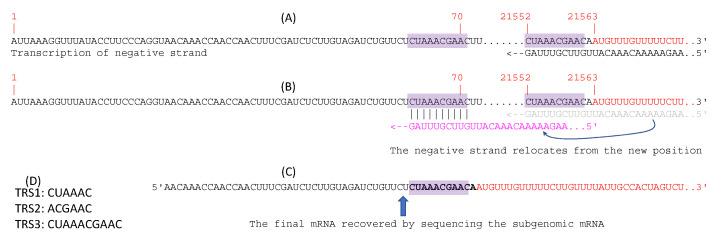
“There are three frequently used TRS in coronaviruses (Figure 4D).”
§ Detailed Dissection and Critical Evaluation of the Pfizer/BioNTech and Moderna mRNA Vaccines > 3. Results and Discussion > 3.3. Translation Initiation Signal
plain- Asserted: passes — The authors put it forward as true.
- Checkable: passes — It can be checked against evidence.
- Load-bearing: fails — The paper’s conclusions may not depend on it.
- Based: fails — The paper may give no reason why it holds.
Probably not a substantial claim. The paper’s conclusions may not depend on it. The paper may give no reason why it holds.
A conclusion the paper draws from its own results — it cites no other source for it, so there is none to check. The quote shows it is in the paper.
In the paper
“Therefore, the overuse of AAC by highly expressed E. coli genes could be driven either by selection for increased translation efficiency or increased translation accuracy or both.”
§ Detailed Dissection and Critical Evaluation of the Pfizer/BioNTech and Moderna mRNA Vaccines > 3. Results and Discussion > 3.2. Codon Optimization for Translation Accuracy
hedgedconditional- Asserted: passes — The authors put it forward as true.
- Checkable: passes — It can be checked against evidence.
- Load-bearing: passes — The paper’s conclusions depend on it.
- Based: passes — The paper gives a reason why it holds.
It may state two separate claims as one.
- Rests on an assumption: Highly expressed E. coli genes use AAC almost exclusively to encode Asn.
A conclusion the paper draws from its own results — it cites no other source for it, so there is none to check. The quote shows it is in the paper.
In the paper
“However, the liberal strategy might lead to more efficient translation elongation if there are too many codons demanding the most abundant tRNA, as I discussed before.”
§ Detailed Dissection and Critical Evaluation of the Pfizer/BioNTech and Moderna mRNA Vaccines > 3. Results and Discussion > 3.1. Codon Optimization for Translation Elongation Efficiency
hedgedconditional- Asserted: passes — The authors put it forward as true.
- Checkable: passes — It can be checked against evidence.
- Load-bearing: fails — The paper’s conclusions may not depend on it.
- Based: fails — The paper may give no reason why it holds.
Probably not a substantial claim. The paper’s conclusions may not depend on it. The paper may give no reason why it holds.
A conclusion the paper draws from its own results — it cites no other source for it, so there is none to check. The quote shows it is in the paper.
In the paper
“The observation, however, is also consistent with selection for translation efficiency.”
§ Detailed Dissection and Critical Evaluation of the Pfizer/BioNTech and Moderna mRNA Vaccines > 3. Results and Discussion > 3.2. Codon Optimization for Translation Accuracy
hedgedcorrelational- Asserted: passes — The authors put it forward as true.
- Checkable: passes — It can be checked against evidence.
- Load-bearing: fails — The paper’s conclusions may not depend on it.
- Based: passes — The paper gives a reason why it holds.
Probably not a substantial claim. The paper’s conclusions may not depend on it.
A conclusion the paper draws from its own results — it cites no other source for it, so there is none to check. The quote shows it is in the paper.
In the paper
“These factors might jointly impact negatively the translation efficiency of mRNA-1273 and contribute to the requirement of a high dosage of Moderna vaccine (100 μg/dose) relative to that of Pfizer/BioNTech vaccine (30 μg/dose).”
§ Detailed Dissection and Critical Evaluation of the Pfizer/BioNTech and Moderna mRNA Vaccines > 3. Results and Discussion > 3.3. Translation Initiation Signal
hedgedconditional- Asserted: passes — The authors put it forward as true.
- Checkable: passes — It can be checked against evidence.
- Load-bearing: passes — The paper’s conclusions depend on it.
- Based: passes — The paper gives a reason why it holds.
It may state two separate claims as one.
In the paper
“This is consistent with his inference that the difference between the conserved and variable sites has resulted from selection for accuracy.”
§ Detailed Dissection and Critical Evaluation of the Pfizer/BioNTech and Moderna mRNA Vaccines > 3. Results and Discussion > 3.2. Codon Optimization for Translation Accuracy
What the sources say
- Not checked — no full text of the sourcecites [37] Akashi, 1994, Synonymous codon usage in Drosophila melanogaster: Natural selection and translational accuracy, Genetics source
hedgeddirect- Asserted: passes — The authors put it forward as true.
- Checkable: passes — It can be checked against evidence.
- Load-bearing: passes — The paper’s conclusions depend on it.
- Based: passes — The paper gives a reason why it holds.
Probably not a substantial claim.
- The authors state this as an assumption: Conserved amino acid sites are functionally important and variable amino acid sites are of limited importance.
The paper states this without a source or data behind it here, so there is nothing to check it against. The quote shows it is in the paper.
In the paper
“Alanine is encoded by GCN and glycine by GGN, leading to a high frequency of G at the +4 site.”
§ Detailed Dissection and Critical Evaluation of the Pfizer/BioNTech and Moderna mRNA Vaccines > 3. Results and Discussion > 3.3. Translation Initiation Signal
plaindirect- Asserted: passes — The authors put it forward as true.
- Checkable: passes — It can be checked against evidence.
- Load-bearing: passes — The paper’s conclusions depend on it.
- Based: passes — The paper gives a reason why it holds.
It may state two separate claims as one.
A claim is checked only against the cited paper’s full text, never its abstract, and none is available for its sources.
In the paper
“This misreading error rate is six times greater for AAU than for AAC, with the error ratio consistently maintained in different experimental settings, e.g., under both Asn-starved and non-starved conditions [38], or with Streptomycin used to inhibit translation [39].”
§ Detailed Dissection and Critical Evaluation of the Pfizer/BioNTech and Moderna mRNA Vaccines > 3. Results and Discussion > 3.2. Codon Optimization for Translation Accuracy
What the sources say
plaincorrelational- Asserted: passes — The authors put it forward as true.
- Checkable: passes — It can be checked against evidence.
- Load-bearing: passes — The paper’s conclusions depend on it.
- Based: passes — The paper gives a reason why it holds.
It may state two separate claims as one.
A conclusion the paper draws from its own results — it cites no other source for it, so there is none to check. The quote shows it is in the paper.
In the paper
“When an mRNA is not translated efficiently, more of it is needed to produce the same amount of the encoded spike protein.”
§ Detailed Dissection and Critical Evaluation of the Pfizer/BioNTech and Moderna mRNA Vaccines > 3. Results and Discussion > 3.3. Translation Initiation Signal
plaindirect- Asserted: passes — The authors put it forward as true.
- Checkable: passes — It can be checked against evidence.
- Load-bearing: passes — The paper’s conclusions depend on it.
- Based: fails — The paper may give no reason why it holds.
Probably not a substantial claim. The paper may give no reason why it holds.
A conclusion the paper draws from its own results — it cites no other source for it, so there is none to check. The quote shows it is in the paper.
In the paper
“If one may extrapolate this observation from DNA to RNA, then one would predict that G626 would favor purine at the +4 site, i.e., a purine at +4 site is more likely to enhance the stop signal by interacting with G626 in eRF1 than a pyrimidine.”
§ Detailed Dissection and Critical Evaluation of the Pfizer/BioNTech and Moderna mRNA Vaccines > 3. Results and Discussion > 3.4. Translation Termination Signal
hedgedconditional- Asserted: passes — The authors put it forward as true.
- Checkable: passes — It can be checked against evidence.
- Load-bearing: unclear — It is unclear whether the paper’s conclusions depend on it.
- Based: passes — The paper gives a reason why it holds.
It may state two separate claims as one.
- The authors state this as an assumption: The observation that glycine interacts more favorably with purine than pyrimidine in protein-DNA interactions can be extrapolated to protein-RNA interactions.
A conclusion the paper draws from its own results — it cites no other source for it, so there is none to check. The quote shows it is in the paper.
In the paper
“UGA is a poor choice of a stop codon, and UGAU in Pfizer/BioNTech and Moderna mRNA vaccines could be even worse.”
§ Detailed Dissection and Critical Evaluation of the Pfizer/BioNTech and Moderna mRNA Vaccines > 3. Results and Discussion > 3.4. Translation Termination Signal
hedgedconditional- Asserted: passes — The authors put it forward as true.
- Checkable: passes — It can be checked against evidence.
- Load-bearing: passes — The paper’s conclusions depend on it.
- Based: passes — The paper gives a reason why it holds.
It may state two separate claims as one.
A conclusion the paper draws from its own results — it cites no other source for it, so there is none to check. The quote shows it is in the paper.
In the paper
“Therefore, the stop signals are ΨGAΨGA instead of UGAUGA in Pfizer/BioNTech’s vaccine, and ΨGAΨAAΨAG instead of UGAUAAUAG in Moderna’s vaccine.”
§ Detailed Dissection and Critical Evaluation of the Pfizer/BioNTech and Moderna mRNA Vaccines > 3. Results and Discussion > 3.4. Translation Termination Signal
plain- Asserted: passes — The authors put it forward as true.
- Checkable: passes — It can be checked against evidence.
- Load-bearing: passes — The paper’s conclusions depend on it.
- Based: passes — The paper gives a reason why it holds.
It may state two separate claims as one.
The paper relies on this without support.
Proper optimization of vaccine mRNA can reduce dosage required for each injection leading to more efficient immunization programs.
“Proper optimization of vaccine mRNA can reduce dosage required for each injection leading to more efficient immunization programs.”
The authors state this as an assumption.
The putative sequence of mRNA-1273 is the real mRNA-1273.
“In this context, it may be safe to assume that the putative sequence is the real mRNA-1273.”
The paper relies on this without support.
The two mRNA vaccines are administered through muscle injection.
“As the two mRNA vaccines are administered through muscle injection, it is relevant to characterize features of highly expressed muscle genes.”
The authors state this as an assumption.
tRNA abundance is well correlated with tRNA gene copy number.
“Assuming that tRNA abundance is well correlated with tRNA gene copy number, which is true for Saccharomyces cerevisiae [34] but not known for other eukaryotes”
The authors state this as an assumption.
An injection of Pfizer/BioNTech or Moderna vaccine produces the same number of the encoded spike proteins.
“one may assume that an injection of Pfizer/BioNTech or Moderna vaccine produces the same number of the encoded spike proteins.”
The paper relies on this without support.
All U nucleotides in the two mRNA vaccines were replaced by N1-methylpseudouridines (Ψ).
“All U nucleotides in the two mRNA vaccines were replaced by N1-methylpseudouridines (Ψ)”
The paper relies on this without support.
The Pfizer/BioNTech and Moderna vaccines are equivalent in efficacy despite the difference in dosage.
“Given the difference in dosage (100 μg with mRNA-1273 and 30 μg with BNT-162b2) and the equivalence in efficacy”
The paper relies on this without support.
There is no systematic evaluation of the two codon optimization strategies in translation efficiency.
“There is no systematic evaluation of these two codon optimization strategies in translation efficiency.”
The paper relies on this without support.
In E. coli, AAC is a major codon for Asn and AAU is a rarely used minor codon.
“AAC is a major codon (heavily used by highly expressed genes and decoded by the most abundant isoacceptor tRNA {XE “tRNA: isoacceptor”}{XE “isoacceptor tRNA”}) whereas AAU is a rarely used minor codon.”
The paper relies on this without support.
Highly expressed E. coli genes use AAC almost exclusively to encode Asn.
“Highly expressed E. coli genes use AAC almost exclusively to encode Asn”
The authors state this as an assumption.
Conserved amino acid sites are functionally important and variable amino acid sites are of limited importance.
“He classified amino acid sites into conserved sites (assumed to be functionally important) and variable sites (assumed to be of limited importance).”
The authors state this as an assumption.
The optimization done by natural selection can be extrapolated to translation in muscle cells.
“These first two strategies assume that the optimization done by natural selection can be extrapolated to translation in muscle cells.”
The paper relies on this without support.
The 5′-UTR serves two key functions: to stabilize mRNA and to facilitate scanning by the small ribosome subunit to localize the start codon.
“5′-UTR serves two key functions: to stabilize mRNA and to facilitate scanning by small ribosome subunit to localize the start codon.”
The paper relies on this without support.
G/U base pairs are usually too weak to close a stem.
“G/U base pairs are usually too weak to close a stem.”
The paper relies on this without support.
Functionally important and highly expressed genes such as ribosomal protein genes are expected to evolve strong termination signals.
“Functionally important and highly expressed genes such as RP genes are expected to evolve strong termination signals.”
The authors state this as an assumption.
The observation that glycine interacts more favorably with purine than pyrimidine in protein-DNA interactions can be extrapolated to protein-RNA interactions.
“If one may extrapolate this observation from DNA to RNA, then one would predict that G626 would favor purine at the +4 site, i.e., a purine at +4 site is more likely to enhance the stop signal by interacting with G626 in eRF1 than a pyrimidine.”
Claims other papers make about this one
Each is checked against this paper’s own text: does it say what the citing paper says it does?
The source backs part of the claim, not all of it — or backs it for a different population, condition or comparison.
In the citing paper
“These criteria are met by the 5′ UTRs of highly expressed natural genes such as HBA1 and HBB, encoding α-and β-globin, respectively, which provide high translational activity and mRNA stability [21,22].”
From Identification of novel 5’ UTR variants for enhanced mRNA translation and vaccine immunogenicity (2026) · cites this paper as [21]
Experimental — accuracy not yet measuredThe cited source says what the claim attributes to it.
In the citing paper
“the Pfizer-BioNTech mRNA vaccine contains the 5′ UTR of human α-globin, which was identified as one of the top 20% 5′ UTRs in massive screening studies,10,11,13 and the 3′ UTR AES-mtRNR1 combination of two genes, AES (Amino Enhancer of Split) and mtRNR1 (12S mitochondrial RNA).12”
From Evaluation of synthetic mRNA with selected UTR sequences and alternative poly(A) tail, in vitro and in vivo (2025) · cites this paper as [13]
In the citing paper
“For instance, BioNTech uses a segmented poly(A) tail whose two-tail structures are connected in tandem by a 10 bp UGC linker sequence (A30LA70).27,153”
From Advances in COVID-19 mRNA vaccine development (2022) · cites this paper as [153]
In the citing paper
“BNT162b2 (BioNTech/Pfizer) and mRNA-1273 (Moderna) are composed of 1-methylpseudouridine-modified full-length spike mRNA, with proline substitutions, that is GC rich, codon optimized, and composed of standard mRNA components: cap, 5′ UTR, coding sequence, 3′ UTR, and a poly(A) tail.”
From COVID-19 mRNA vaccines: Platforms and current developments (2022) · cites this paper as [93]
Citations
Cites
Tissue-based map of the human proteome
Uhlén, M., Fagerberg, L., Hallström, B. M., Lindskog, C., Oksvold, P., Mardinoglu, A., Sivertsson, Å., Kampf, C., Sjöstedt, E., Asplund, A., et al. (2015) · Science · doi:10.1126/science.1260419 · Cited by 15,286
Safety and Efficacy of the BNT162b2 mRNA Covid-19 Vaccine
Polack, F. P., Thomas, S. J., Kitchin, N., Absalon, J., Gurtman, A., Lockhart, S., Perez, J. L., Pérez Marc, G., Moreira, E. D., Zerbini, C., et al. (2020) · New England Journal of Medicine · doi:10.1056/nejmoa2034577 · Cited by 14,592 · cited 1×
“The two most frequently used SARS-CoV-2 vaccines, from Pfizer/BioNTech [1] and Moderna [2], respectively, are both mRNA vaccines.”
MethodEMBOSS: the European molecular biology open software suite.
Rice, P., Longden, I., & Bleasby, A. (2000) · Trends in Genetics · doi:10.1016/s0168-9525(00)02024-2 · Cited by 9,466
Sharp, P. M., & Li, W.-H. (1987) · Nucleic Acids Research · doi:10.1093/nar/15.3.1281 · Cited by 3,992
An mRNA Vaccine against SARS-CoV-2 — Preliminary Report
Jackson, L. A., Anderson, E. J., Rouphael, N. G., Roberts, P. C., Makhene, M., Coler, R. N., McCullough, M. P., Chappell, J. D., Denison, M. R., Stevens, L. J., et al. (2020) · New England Journal of Medicine · doi:10.1056/nejmoa2022483 · Cited by 3,237 · cited 1×
“Both mRNA encodes the same S-2P protein [5,6] which differ from the spike protein in the reference SARS-CoV-2 genome (NC_045512) by two amino acids, i.”
BackgroundVienna RNA secondary structure server
Hofacker, I. L. (2003) · Nucleic Acids Research · doi:10.1093/nar/gkg599 · Cited by 2,362
The Architecture of SARS-CoV-2 Transcriptome
Kim, D., Lee, J.-Y., Yang, J.-S., Kim, J. W., Kim, V. N., & Chang, H. (2020) · Cell · doi:10.1016/j.cell.2020.04.011 · Cited by 2,123
Karikó, K., Muramatsu, H., Welsh, F. A., Ludwig, J., Kato, H., Akira, S., & Weissman, D. (2008) · Molecular Therapy · doi:10.1038/mt.2008.200 · Cited by 1,930
SARS-CoV-2 mRNA Vaccine Design Enabled by Prototype Pathogen Preparedness
Corbett, K. S., Edwards, D. K., Leist, S. R., Abiona, O. M., Boyoglu-Barnum, S., Gillespie, R. A., Himansu, S., Schäfer, A., Ziwawo, C. T., DiPiazza, A. T., et al. (2020) · Nature · doi:10.1038/s41586-020-2622-0 · Cited by 1,615
Safety and Immunogenicity of SARS-CoV-2 mRNA-1273 Vaccine in Older Adults
Anderson, E. J., Rouphael, N. G., Widge, A. T., Jackson, L. A., Roberts, P. C., Makhene, M., Chappell, J. D., Denison, M. R., Stevens, L. J., Pruijssers, A. J., et al. (2020) · New England Journal of Medicine · doi:10.1056/nejmoa2028436 · Cited by 1,523
Research works printed but not linked: 3
- Xia, X. (2018). Bioinformatics and Translation Elongation. Bioinformatics and the Cell: Modern Computational Approaches in Genomics, Proteomics and Transcriptomics, Springer. · DOI · Paper page
- Xia, X. (2018). Bioinformatics and Translation Initiation. Bioinformatics and the Cell: Modern Computational Approaches in Genomics, Proteomics and Transcriptomics, Springer. · DOI · Paper page
- Xia, X. (2018). Bioinformatics and Translation Termination in Bacteria. Bioinformatics and the Cell: Modern Computational Approaches in Genomics, Proteomics and Transcriptomics, Springer. · DOI · Paper page
Cited by
Sorted by citations
Advances in COVID-19 mRNA vaccine development
Fang, E., Liu, X., Li, M., Zhang, Z., Song, L., Zhu, B., Wu, X., Liu, J., Zhao, D., & Li, Y. (2022) · Signal Transduction and Targeted Therapy · doi:10.1038/s41392-022-00950-y · Cited by 601
COVID-19 mRNA vaccines: Platforms and current developments
Szabó, G. T., Mahiny, A. J., & Vlatkovic, I. (2022) · Molecular Therapy · doi:10.1016/j.ymthe.2022.02.016 · Cited by 308
Effect of mRNA-LNP components of two globally-marketed COVID-19 vaccines on efficacy and stability
Zhang, L., More, K. R., Ojha, A., Jackson, C. B., Quinlan, B. D., Li, H., He, W., Farzan, M., Pardi, N., & Choe, H. (2023) · npj Vaccines · doi:10.1038/s41541-023-00751-6 · Cited by 244
Seneff, S., Nigh, G., Kyriakopoulos, A. M., & McCullough, P. A. (2022) · Food and Chemical Toxicology · doi:10.1016/j.fct.2022.113008 · Cited by 182
Kumari, M., Lu, R., Li, M., Huang, J., Hsu, F., Ko, S.-H., Ke, F.-Y., Su, S.-C., Liang, K.-H., Yuan, J. P., et al. (2022) · Journal of Biomedical Science · doi:10.1186/s12929-022-00852-9 · Cited by 166
Metadata
- Authors
- Xia, X.
- Affiliations
- University of Ottawa (CA)
- Corresponding author
- Xia, Xuhua
- ORCID
- Xia, Xuhua
- Venue
- Vaccines
- Publisher
- MDPI AG
- Published
- 2021-07-03
- Volume
- 9
- Issue
- 7
- Pages
- 734
- ISSN
- 2076-393X (ISSN-L)
- PMC
- PMC8310186
- OpenAlex
- W3177545102
- Cited by
- 201
- References
- 92
- Citations by year
- 2026: 28 · 2025: 40 · 2024: 42 · 2023: 49 · 2022: 34 · 2021: 8
- FWCI
- 10.44
- Type
- journal article
- Language
- en
- Open access
- gold
- doi.org
- Licence
- Locations
- Vaccines (publishedVersion, cc-by)
- PubMed Central (publishedVersion, cc-by)
- PubMed (publishedVersion)
- DOAJ (DOAJ: Directory of Open Access Journals) (submittedVersion, cc-by-sa)
- uO Research (University of Ottawa) (submittedVersion, cc-by-nd)
- University of Ottawa - Library
- Funders
- Natural Sciences and Engineering Research Council of Canada (RGPIN/2018-03878)
- Topics
- Life Sciences › Biochemistry, Genetics and Molecular Biology › Molecular Biology › RNA and protein synthesis mechanisms
- Health Sciences › Medicine › Infectious Diseases › SARS-CoV-2 and COVID-19 Research
- Life Sciences › Biochemistry, Genetics and Molecular Biology › Molecular Biology › RNA Interference and Gene Delivery
- Keywords
- mRNA vaccines, BNT162b2, Moderna vaccine, SARS-CoV-2, 5' untranslated region, codon usage, stop codon, 3' untranslated region, mRNA stability, N1-methylpseudouridine, wobble pairing, translation initiation, vaccine design
About these checks
Registry, retraction, Cites and statistics results are computed, not judged, with one exception: a printed reference that no index lists is read once by a model before it counts as a citation error. Claims are extracted by a model and kept only when their quote appears verbatim in the text; each cited source is then checked, with a model’s help, for whether it says what the claim relies on. Those verdicts can be wrong — read the claim’s quote and the cited source before relying on one.
A language model drew the claims from the paper on 2026-11-05, under version 3 of the claim definition (model deepseek-v4.1-flash, prompt extract-v3).
A second model labelled each claim on 2026-11-05 (model jev-1.13-20260917, definition revision gold-guideline-v0.2).
Cited sources are checked with a language model’s help (gpt-6-sol).
Statistics and arithmetic are recomputed, not judged.
Confidence bands are shown only for fields calibrated on our annotated test set. None is calibrated yet, so no band is shown.
What counts as a claim ›How we measure confidence ›How we check this ›
Are you an author, or do you see a problem with this page? Request a review
