

The DOI matches its Crossref record; 128 of the 128 references it cites were found in a registry or an index; 2 of the 118 sources its claims cite were checked for support.
Role of n-3 long-chain polyunsaturated fatty acids in human nutrition and health: review of recent studies and recommendations
Open accessAbstract
Long-chain (LC) n-3 polyunsaturated fatty acids (n-3 PUFAs), in particular docosahexaenoic acid (DHA) and eicosapentaenoic acid (EPA), are nutrients involved in many metabolic and physiological processes, and are referred to as n-3 LCPUFA. They have been extensively studied for their effects in human nutrition and health. This paper provides an overview on metabolism, sources, dietary intake, and status of n-3 LCPUFA. A summary of the dietary recommendations for n-3 LCPUFAs for different age groups as well as specific physiological conditions is provided. Evidence for n-3 LCPUFA in cardiovascular diseases, including new studies, is reviewed. Expert recommendations generally support a beneficial effect of n-3 LCPUFA on cardiovascular health and recommend a daily intake of 500 mg as DHA and EPA, or 1-2 servings of fish per week. The role of n-3 LCPUFA on brain health, in particular neurodegenerative disorders and depression, is reviewed. The evidence for beneficial effects of n-3 LCPUFA on neurodegenerative disorders is non-conclusive despite mechanistic support and observational data. Hence, no definite n-3 LCPUFA expert recommendations are made. Data for the beneficial effect of n-3 LCPUFA on depression are generally compelling. Expert recommendations have been established: 200-300 mg/day for depression; up to 1-2 g/day for major depressive disorder. Recent studies support a beneficial role of n-3 LCPUFAs in reducing the risk for premature birth, with a daily intake of 600-800 mg of DHA during pregnancy. Finally, international experts recently reviewed the scientific evidence on DHA and arachidonic acid (ARA) in infant nutrition and concluded that the totality of data support that infant and follow-on formulas should provide both DHA and ARA at levels similar to those in breast milk. In conclusion, the available scientific data support that dietary recommendations for n-3 LCPUFA should be established for the general population and for subjects with specific physiological conditions.
Overview
AI snapshot
Written from the paper’s full text.
TL;DR
This review summarizes n-3 LCPUFA metabolism, sources, intake/status, and expert recommendations, focusing on cardiovascular disease, brain health, pregnancy, and infant nutrition. It concludes that dietary recommendations are supported for the general population and specific physiological conditions, while evidence for neurodegenerative disorders remains non-conclusive.
Key findings
- Cardiovascular expert recommendations generally support benefit and recommend a daily intake of 500 mg DHA + EPA, or 1–2 servings of fish per week; EFSA set an adequate intake of 250 mg/day EPA + DHA for adults. In VITAL, the primary outcome was not statistically significant but showed an 8% reduction in major cardiovascular events, 28% lower total myocardial infarction, and 50% lower fatal myocardial infarction; REDUCE-IT reported that 4 g/day EPA reduced first major adverse cardiovascular events by 25% and cardiovascular death by 20%.
- For brain health, evidence for neurodegenerative disorders is non-conclusive and no definite expert n-3 LCPUFA recommendations are made; depression evidence is generally compelling, with ANSES recommending 200–300 mg/day and MDD guidelines recommending 1–2 g/day net EPA. A 2019 meta-analysis of 26 studies and 2,160 participants found an overall beneficial effect on depression symptoms, with EPA-pure and EPA-major formulations at ≤ 1 g/day showing clinical benefits.
- During pregnancy, recent studies support 600–800 mg/day DHA to reduce premature birth risk; one trial with 800 mg/day DHA reported early-preterm birth at 1.09% vs. 2.25% (P = 0.03), and another with 600 mg/day DHA reported longer gestation by 2.9 days and greater birth weight by 172 g. International experts concluded infant and follow-on formulas should provide both DHA and ARA at levels similar to breast milk.
- Globally, less than 20% of the world’s population consume ≥ 250 mg/day of seafood-origin n-3 LCPUFA; blood EPA + DHA levels were very low (≤ 4%) in North, Central, and South America, Europe, the Middle East, Southeast Asia, and Africa, and high (> 8%) in countries adjacent to the Sea of Japan, Scandinavia, and some indigenous or non-Westernized populations.
Methods
- Narrative review; no primary data collection. It provides an overview of n-3 LCPUFA metabolism, dietary sources, intake and status, and expert recommendations, then reviews recent evidence in CVD, brain health, pregnancy/prematurity, and infant nutrition.
- Evidence base includes expert reports (FAO/WHO, EFSA, IOM, NHMRC, ANSES, AHA), randomized trials (e.g., VITAL, REDUCE-IT, pregnancy DHA trials), observational studies, systematic reviews, and meta-analyses.
- Main analysis is qualitative synthesis and interpretation of cited literature; no systematic search strategy or quantitative pooling is described.
Limitations
- Stated in the paper: EPA and DHA intake estimates are limited by food composition databases and dietary reporting errors; neurodegenerative evidence is non-conclusive; clinical trials are less conclusive than observational studies; no tolerable upper intake level for n-3 LCPUFA could be established due to insufficient data; not all reviews support a beneficial role in cardiovascular health, with heterogeneity among populations, n-3 status, and intake discrepancies.
- Evident from the text: as a narrative review, it lacks a described systematic search, inclusion criteria, risk-of-bias assessment, or meta-analytic synthesis, so conclusions depend on the selected cited studies and expert interpretations.
Model-written summary. Check it against the paper before relying on it.
Integrity signals
Registry
Cites
Statistics
Figures
Verification
Claims the paper makes
104 Not checked yet · 21 Own interpretation · 2 No basis given · 1 Supported
Every source the paper cites for this claim was checked and supports it.
In the paper
“Dietary n-3 LCPUFA, eicosapentaenoic acid (EPA, 20:5n-3), and docosahexaenoic acid (DHA, 22:6n-3), have been associated with a decreased risk of chronic diseases, in particular CVD [3] and cognitive decline [4].”
§ Role of n-3 long-chain polyunsaturated fatty acids in human nutrition and health: review of recent studies and recommendations > INTRODUCTION
What the sources say
- Supportedcites [3] Mozaffarian, 2011, J Am Coll Cardiol source
Citation [3] is attached to the CVD portion of the sentence, not cognitive decline. The paper’s CHD mortality section reports that fish and n-3 PUFA consumption are associated with reduced CHD events, primarily CHD death; its Dietary Sources section identifies EPA and DHA as long-chain n-3 PUFA. No page numbers are provided in the supplied passages. (LLM, conf=0.92)
- Supportedcites [4] Sinn, 2012, Br J Nutr source
Citation [4] is attached to cognitive decline, not CVD. The paper’s Abstract says n-3 PUFA consumption may alleviate cognitive decline, and its Discussion reports that previous studies detected reduced cognitive decline in people with mild cognitive impairment. This supports the cited association, though the paper does not establish a reduction in risk for the general population. (LLM, conf=0.88)
plaincorrelational- Asserted: passes — The authors put it forward as true.
- Checkable: passes — It can be checked against evidence.
- Load-bearing: passes — The paper’s conclusions depend on it.
- Based: passes — The paper gives a reason why it holds.
- Supported
A conclusion the paper draws from its own results — it cites no other source for it, so there is none to check. The quote shows it is in the paper.
In the paper
“The evidence for beneficial effects of n-3 LCPUFA on neurodegenerative disorders is non-conclusive despite mechanistic support and observational data.”
§ Role of n-3 long-chain polyunsaturated fatty acids in human nutrition and health: review of recent studies and recommendations > Abstract
plain- Asserted: passes — The authors put it forward as true.
- Checkable: passes — It can be checked against evidence.
- Load-bearing: passes — The paper’s conclusions depend on it.
- Based: passes — The paper gives a reason why it holds.
In the paper
“Data revealed that geographical regions with high EPA + DHA blood levels (> 8%) included countries adjacent to the Sea of Japan, Scandinavia, and areas with indigenous populations or populations not fully adapted to Westernized food habits.”
§ Role of n-3 long-chain polyunsaturated fatty acids in human nutrition and health: review of recent studies and recommendations > METABOLISM AND NUTRITIONAL ROLE OF n-3 LCPUFA > Dietary source, intake and status
What the sources say
- Not checked yetcites [25] Stark, 2016, Prog Lipid Res source
plaincorrelational- Asserted: passes — The authors put it forward as true.
- Checkable: passes — It can be checked against evidence.
- Load-bearing: unclear — It is unclear whether the paper’s conclusions depend on it.
- Based: passes — The paper gives a reason why it holds.
A conclusion the paper draws from its own results — it cites no other source for it, so there is none to check. The quote shows it is in the paper.
In the paper
“Data for the beneficial effect of n-3 LCPUFA on depression are generally compelling.”
§ Role of n-3 long-chain polyunsaturated fatty acids in human nutrition and health: review of recent studies and recommendations > Abstract
boosteddirect- Asserted: passes — The authors put it forward as true.
- Checkable: passes — It can be checked against evidence.
- Load-bearing: passes — The paper’s conclusions depend on it.
- Based: unclear — It is unclear why the paper says it holds.
A conclusion the paper draws from its own results — it cites no other source for it, so there is none to check. The quote shows it is in the paper.
In the paper
“As most currently available data are overall supportive of n-3 LCPUFA reducing the risk of cardiac disease or death, expert guidelines have converged toward the development of consistent recommendations for the general population to consume at least 250 mg/day of n-3 LCPUFA or at least 2 servings/week of oily fish [262730313238].”
§ Role of n-3 long-chain polyunsaturated fatty acids in human nutrition and health: review of recent studies and recommendations > CVD AND n-3 LCPUFA
hedgeddirect- Asserted: passes — The authors put it forward as true.
- Checkable: passes — It can be checked against evidence.
- Load-bearing: passes — The paper’s conclusions depend on it.
- Based: passes — The paper gives a reason why it holds.
None of the sources cited for this claim have been checked yet.
In the paper
“Despite these recommendations, not all reviews support the presence of a beneficial role of n-3 LCPUFA in cardiovascular health [495051].”
§ Role of n-3 long-chain polyunsaturated fatty acids in human nutrition and health: review of recent studies and recommendations > CVD AND n-3 LCPUFA
What the sources say
plain- Asserted: passes — The authors put it forward as true.
- Checkable: passes — It can be checked against evidence.
- Load-bearing: unclear — It is unclear whether the paper’s conclusions depend on it.
- Based: passes — The paper gives a reason why it holds.
In the paper
“The NHMRC also included a recommendation for an upper safe intake level set at 3,000 mg/day for children, adolescents, and adults, similar to that established by the US FDA [37].”
§ Role of n-3 long-chain polyunsaturated fatty acids in human nutrition and health: review of recent studies and recommendations > METABOLISM AND NUTRITIONAL ROLE OF n-3 LCPUFA > Nutritional recommendations
What the sources say
- Not checked yetcites [37] Department of Health and Human Services, U.S. Food and Drug Administration. Substances affirmed as generally recognized as safe: menhaden oil [Internet]. College Park. Office of the Federal Register. 2005. cited 2020 April 5. https://www.federalregister.gov/documents/2005/03/23/05-5641/substances-affirmed-as-generally-recognized-as-safe-menhaden-oil
plain- Asserted: passes — The authors put it forward as true.
- Checkable: passes — It can be checked against evidence.
- Load-bearing: unclear — It is unclear whether the paper’s conclusions depend on it.
- Based: passes — The paper gives a reason why it holds.
In the paper
“The upper safe intake level for EPA + DHA was set at 2 g/day based on experimental evidence indicating that a high intake of n-3 LCPUFA may increase lipid peroxidation and reduce cytokine production.”
§ Role of n-3 long-chain polyunsaturated fatty acids in human nutrition and health: review of recent studies and recommendations > METABOLISM AND NUTRITIONAL ROLE OF n-3 LCPUFA > Nutritional recommendations
What the sources say
- Not checked yetcites [26] Food and Agriculture Organization of the United Nations, 2010
hedgedconditional- Asserted: passes — The authors put it forward as true.
- Checkable: passes — It can be checked against evidence.
- Load-bearing: passes — The paper’s conclusions depend on it.
- Based: passes — The paper gives a reason why it holds.
None of the sources cited for this claim have been checked yet.
In the paper
“As most currently available data are overall supportive of n-3 LCPUFA reducing the risk of cardiac disease or death, expert guidelines have converged toward the development of consistent recommendations for the general population to consume at least 250 mg/day of n-3 LCPUFA or at least 2 servings/week of oily fish [262730313238].”
§ Role of n-3 long-chain polyunsaturated fatty acids in human nutrition and health: review of recent studies and recommendations > CVD AND n-3 LCPUFA
What the sources say
- Not checked yetcites [26] Food and Agriculture Organization of the United Nations, 2010
- Not checked yetcites [27] EFSA Panel on Dietetic Products, Nutrition, and Allergies (NDA), 2010, EFSA J
- Not checked yetcites [30] U.S. Food and Drug Administration (FDA). Advice about Eating Fish [Internet]. Silver Spring. FDA. 2020. cited 2020 April 5. Available from: https://www.fda.gov/food/consumers/advice-about-eating-fish
plain- Asserted: passes — The authors put it forward as true.
- Checkable: passes — It can be checked against evidence.
- Load-bearing: passes — The paper’s conclusions depend on it.
- Based: passes — The paper gives a reason why it holds.
In the paper
“The EFSA also investigated the tolerable upper intake level (UL) and concluded that the available data were insufficient to establish an UL for n-3 LCPUFA (individually or combined) for any population group [28].”
§ Role of n-3 long-chain polyunsaturated fatty acids in human nutrition and health: review of recent studies and recommendations > METABOLISM AND NUTRITIONAL ROLE OF n-3 LCPUFA > Nutritional recommendations
What the sources say
- Not checked yetcites [28] EFSA Panel on Dietetic Products, Nutrition and Allergies (NDA), 2012, EFSA J
plain- Asserted: passes — The authors put it forward as true.
- Checkable: passes — It can be checked against evidence.
- Load-bearing: unclear — It is unclear whether the paper’s conclusions depend on it.
- Based: passes — The paper gives a reason why it holds.
- It may state two separate claims as one. 47
- Probably not a substantial claim. 35
None of the sources cited for this claim have been checked yet.
In the paper
“Blood levels of n-3 LCPUFA, particularly EPA and DHA, have been linked to a reduced risk of primary cardiac arrest [22], sudden cardiac death [23], and all cause dementia [24].”
§ Role of n-3 long-chain polyunsaturated fatty acids in human nutrition and health: review of recent studies and recommendations > METABOLISM AND NUTRITIONAL ROLE OF n-3 LCPUFA > Dietary source, intake and status
What the sources say
plaincorrelational- Asserted: passes — The authors put it forward as true.
- Checkable: passes — It can be checked against evidence.
- Load-bearing: unclear — It is unclear whether the paper’s conclusions depend on it.
- Based: passes — The paper gives a reason why it holds.
It may state two separate claims as one.
In the paper
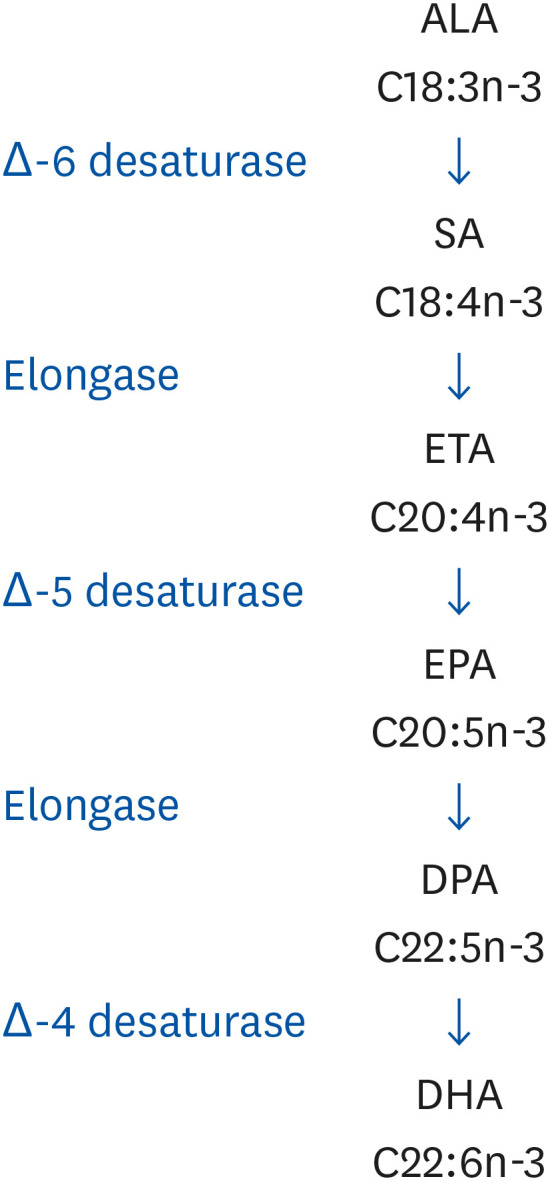
“Estimates for the conversion of ALA into EPA range from 8% to 12%, while its conversion into DHA may be less than 1% [8].”
§ Role of n-3 long-chain polyunsaturated fatty acids in human nutrition and health: review of recent studies and recommendations > METABOLISM AND NUTRITIONAL ROLE OF n-3 LCPUFA > Metabolism
What the sources say
- Not checked yetcites [8] Goyens, 2006, Am J Clin Nutr source
hedgeddirect- Asserted: passes — The authors put it forward as true.
- Checkable: passes — It can be checked against evidence.
- Load-bearing: passes — The paper’s conclusions depend on it.
- Based: passes — The paper gives a reason why it holds.
It may state two separate claims as one.
A conclusion the paper draws from its own results — it cites no other source for it, so there is none to check. The quote shows it is in the paper.
In the paper
“Polymorphisms in the FADS genes determine the efficiency of endogenous PUFA processing, and, therefore, nutritional and functional responses are likely to vary depending on the FADS genotype present.”
§ Role of n-3 long-chain polyunsaturated fatty acids in human nutrition and health: review of recent studies and recommendations > METABOLISM AND NUTRITIONAL ROLE OF n-3 LCPUFA > Metabolism
hedgeddirect- Asserted: passes — The authors put it forward as true.
- Checkable: passes — It can be checked against evidence.
- Load-bearing: unclear — It is unclear whether the paper’s conclusions depend on it.
- Based: passes — The paper gives a reason why it holds.
It may state two separate claims as one.
In the paper
“The dietary intake of n-3 LCPUFA is largely dependent on dietary habits and hence has been reported to show considerable geographical and population differences [13].”
§ Role of n-3 long-chain polyunsaturated fatty acids in human nutrition and health: review of recent studies and recommendations > METABOLISM AND NUTRITIONAL ROLE OF n-3 LCPUFA > Dietary source, intake and status
What the sources say
- Not checked yetcites [13] Micha, 2014, BMJ source
plaindirect- Asserted: passes — The authors put it forward as true.
- Checkable: passes — It can be checked against evidence.
- Load-bearing: unclear — It is unclear whether the paper’s conclusions depend on it.
- Based: passes — The paper gives a reason why it holds.
It may state two separate claims as one.
In the paper
“The ability to convert ALA into n-3 LCPUFA and the levels of n-3 LCPUFA in plasma phospholipids and red blood cells are, moreover, individually related to polymorphisms in the human Δ-5 and Δ-6 desaturase genes fatty acid desaturase 1 and 2 (FADS1 and FADS2, respectively) [12].”
§ Role of n-3 long-chain polyunsaturated fatty acids in human nutrition and health: review of recent studies and recommendations > METABOLISM AND NUTRITIONAL ROLE OF n-3 LCPUFA > Metabolism
What the sources say
- Not checked yetcites [12] Schaeffer, 2006, Hum Mol Genet source
plaincorrelational- Asserted: passes — The authors put it forward as true.
- Checkable: passes — It can be checked against evidence.
- Load-bearing: unclear — It is unclear whether the paper’s conclusions depend on it.
- Based: passes — The paper gives a reason why it holds.
It may state two separate claims as one.
The paper states this without a source or data behind it here, so there is nothing to check it against. The quote shows it is in the paper.
In the paper
“Expert recommendations have been established: 200–300 mg/day for depression; up to 1–2 g/day for major depressive disorder.”
§ Role of n-3 long-chain polyunsaturated fatty acids in human nutrition and health: review of recent studies and recommendations > Abstract
boosted- Asserted: passes — The authors put it forward as true.
- Checkable: passes — It can be checked against evidence.
- Load-bearing: passes — The paper’s conclusions depend on it.
- Based: fails — The paper may give no reason why it holds.
Probably not a substantial claim. The paper may give no reason why it holds. It may state two separate claims as one.
A conclusion the paper draws from its own results — it cites no other source for it, so there is none to check. The quote shows it is in the paper.
In the paper
“Despite overall positive data on a beneficial role of n-3 LCPUFA in human health, there is no consistent, global recommendation for dietary intake of n-3 LCPUFA to manage nutritional needs and reduce NCD risk.”
§ Role of n-3 long-chain polyunsaturated fatty acids in human nutrition and health: review of recent studies and recommendations > INTRODUCTION
plain- Asserted: passes — The authors put it forward as true.
- Checkable: passes — It can be checked against evidence.
- Load-bearing: passes — The paper’s conclusions depend on it.
- Based: passes — The paper gives a reason why it holds.
Probably not a substantial claim.
A conclusion the paper draws from its own results — it cites no other source for it, so there is none to check. The quote shows it is in the paper.
In the paper
“International experts recently reviewed the scientific evidence on DHA and arachidonic acid (ARA) in infant nutrition and concluded that the totality of data support that infant and follow-on formulas should provide both DHA and ARA at levels similar to those in breast milk.”
§ Role of n-3 long-chain polyunsaturated fatty acids in human nutrition and health: review of recent studies and recommendations > Abstract
plain- Asserted: passes — The authors put it forward as true.
- Checkable: passes — It can be checked against evidence.
- Load-bearing: passes — The paper’s conclusions depend on it.
- Based: passes — The paper gives a reason why it holds.
Probably not a substantial claim.
The paper states this without a source or data behind it here, so there is nothing to check it against. The quote shows it is in the paper.
In the paper
“Recent studies support a beneficial role of n-3 LCPUFAs in reducing the risk for premature birth, with a daily intake of 600–800 mg of DHA during pregnancy.”
§ Role of n-3 long-chain polyunsaturated fatty acids in human nutrition and health: review of recent studies and recommendations > Abstract
plaindirect- Asserted: passes — The authors put it forward as true.
- Checkable: passes — It can be checked against evidence.
- Load-bearing: passes — The paper’s conclusions depend on it.
- Based: unclear — It is unclear why the paper says it holds.
It may state two separate claims as one.
A conclusion the paper draws from its own results — it cites no other source for it, so there is none to check. The quote shows it is in the paper.
In the paper
“In conclusion, the available scientific data support that dietary recommendations for n-3 LCPUFA should be established for the general population and for subjects with specific physiological conditions.”
§ Role of n-3 long-chain polyunsaturated fatty acids in human nutrition and health: review of recent studies and recommendations > Abstract
plain- Asserted: passes — The authors put it forward as true.
- Checkable: passes — It can be checked against evidence.
- Load-bearing: passes — The paper’s conclusions depend on it.
- Based: passes — The paper gives a reason why it holds.
Probably not a substantial claim. It may state two separate claims as one.
A conclusion the paper draws from its own results — it cites no other source for it, so there is none to check. The quote shows it is in the paper.
In the paper
“Expert recommendations generally support a beneficial effect of n-3 LCPUFA on cardiovascular health and recommend a daily intake of 500 mg as DHA and EPA, or 1–2 servings of fish per week.”
§ Role of n-3 long-chain polyunsaturated fatty acids in human nutrition and health: review of recent studies and recommendations > Abstract
plainconditional- Asserted: passes — The authors put it forward as true.
- Checkable: passes — It can be checked against evidence.
- Load-bearing: passes — The paper’s conclusions depend on it.
- Based: passes — The paper gives a reason why it holds.
Probably not a substantial claim. It may state two separate claims as one.
In the paper
“During pregnancy and lactation, NHMRC recognized increased needs for n-3 LCPUFA intake and estimated that 115 mg and 145 mg per day, respectively, would cover those needs.”
§ Role of n-3 long-chain polyunsaturated fatty acids in human nutrition and health: review of recent studies and recommendations > METABOLISM AND NUTRITIONAL ROLE OF n-3 LCPUFA > Nutritional recommendations
What the sources say
- Not checked yetcites [34] National Health and Medical Research Council (AU), 2017
hedged- Asserted: passes — The authors put it forward as true.
- Checkable: passes — It can be checked against evidence.
- Load-bearing: fails — The paper’s conclusions may not depend on it.
- Based: passes — The paper gives a reason why it holds.
Probably not a substantial claim. The paper’s conclusions may not depend on it. It may state two separate claims as one.
In the paper
“The authors concluded that, globally, there is considerable variability in EPA + DHA blood levels, and that the very low to low range of blood EPA + DHA levels for most regions of the world may increase global risk for chronic disease.”
§ Role of n-3 long-chain polyunsaturated fatty acids in human nutrition and health: review of recent studies and recommendations > METABOLISM AND NUTRITIONAL ROLE OF n-3 LCPUFA > Dietary source, intake and status
What the sources say
- Not checked yetcites [25] Stark, 2016, Prog Lipid Res source
hedgedconditional- Asserted: passes — The authors put it forward as true.
- Checkable: passes — It can be checked against evidence.
- Load-bearing: passes — The paper’s conclusions depend on it.
- Based: passes — The paper gives a reason why it holds.
It may state two separate claims as one.
In the paper
“The combined EPA+DHA+DPA adequate intakes per day were set at 40 mg (1–3 years), 50 mg (4–8 years), 70 mg (9–13 years/boys), 85 mg (9–13 years/girls), 125 mg (14–18 years/boys), 85 mg (14–18 years/girls), 160 mg (men), and 90 mg (women).”
§ Role of n-3 long-chain polyunsaturated fatty acids in human nutrition and health: review of recent studies and recommendations > METABOLISM AND NUTRITIONAL ROLE OF n-3 LCPUFA > Nutritional recommendations
What the sources say
- Not checked yetcites [34] National Health and Medical Research Council (AU), 2017
plain- Asserted: passes — The authors put it forward as true.
- Checkable: passes — It can be checked against evidence.
- Load-bearing: fails — The paper’s conclusions may not depend on it.
- Based: passes — The paper gives a reason why it holds.
Probably not a substantial claim. The paper’s conclusions may not depend on it. It may state two separate claims as one.
In the paper
“For pregnant and lactating women, the ANSES recommendations were 250 mg of DHA or 500 mg of combined DHA and EPA.”
§ Role of n-3 long-chain polyunsaturated fatty acids in human nutrition and health: review of recent studies and recommendations > METABOLISM AND NUTRITIONAL ROLE OF n-3 LCPUFA > Nutritional recommendations
What the sources say
- Not checked yetcites [38] French Agency for Food, Environmental and Occupational Health Safety (ANSES). Update of the Recommended Nutritional Intake for Fatty Acids. Collective Expert Report [Internet]. Maisons-Alfort. ANSES. 2011. cited 2020 April 5. Available from: https://www.anses.fr/en/system/files/NUT2006sa0359Ra.pdf
plain- Asserted: passes — The authors put it forward as true.
- Checkable: passes — It can be checked against evidence.
- Load-bearing: fails — The paper’s conclusions may not depend on it.
- Based: passes — The paper gives a reason why it holds.
Probably not a substantial claim. The paper’s conclusions may not depend on it.
In the paper
“Rounding up to the nearest 10 mg, this established a level of 610 mg/day for men and 430 mg/day for women.”
§ Role of n-3 long-chain polyunsaturated fatty acids in human nutrition and health: review of recent studies and recommendations > METABOLISM AND NUTRITIONAL ROLE OF n-3 LCPUFA > Nutritional recommendations
What the sources say
- Not checked yetcites [34] National Health and Medical Research Council (AU), 2017
plain- Asserted: passes — The authors put it forward as true.
- Checkable: passes — It can be checked against evidence.
- Load-bearing: passes — The paper’s conclusions depend on it.
- Based: passes — The paper gives a reason why it holds.
Probably not a substantial claim.
In the paper
“For pregnancy and lactation, a daily intake of 100–200 mg of DHA, in addition to the adult adequate intake, was established to meet the increased demand for n-3 LCPUFA.”
§ Role of n-3 long-chain polyunsaturated fatty acids in human nutrition and health: review of recent studies and recommendations > METABOLISM AND NUTRITIONAL ROLE OF n-3 LCPUFA > Nutritional recommendations
What the sources say
- Not checked yetcites [27] EFSA Panel on Dietetic Products, Nutrition, and Allergies (NDA), 2010, EFSA J
plaindirect- Asserted: passes — The authors put it forward as true.
- Checkable: passes — It can be checked against evidence.
- Load-bearing: passes — The paper’s conclusions depend on it.
- Based: passes — The paper gives a reason why it holds.
Probably not a substantial claim.
None of the sources cited for this claim have been checked yet.
In the paper
“The 2015–2020 Dietary Guidelines for Americans and the Scientific Report of the 2015 US Dietary Guidelines Advisory Committee have recommended at least 2 servings of fish per week, providing an average of 250 mg EPA plus DHA per day, in place of other animal sources of protein [3233].”
§ Role of n-3 long-chain polyunsaturated fatty acids in human nutrition and health: review of recent studies and recommendations > METABOLISM AND NUTRITIONAL ROLE OF n-3 LCPUFA > Nutritional recommendations
What the sources say
- Not checked yetcites [32] U.S. Department of Health and Human Services, 2015
- Not checked yetcites [33] US Department of Agriculture, 2015
plain- Asserted: passes — The authors put it forward as true.
- Checkable: passes — It can be checked against evidence.
- Load-bearing: fails — The paper’s conclusions may not depend on it.
- Based: passes — The paper gives a reason why it holds.
Probably not a substantial claim. The paper’s conclusions may not depend on it.
In the paper
“Similarly, for CVD risk reduction in the general population, ANSES recommends a daily intake of 500 mg of combined EPA and DHA.”
§ Role of n-3 long-chain polyunsaturated fatty acids in human nutrition and health: review of recent studies and recommendations > METABOLISM AND NUTRITIONAL ROLE OF n-3 LCPUFA > Nutritional recommendations
What the sources say
- Not checked yetcites [38] French Agency for Food, Environmental and Occupational Health Safety (ANSES). Update of the Recommended Nutritional Intake for Fatty Acids. Collective Expert Report [Internet]. Maisons-Alfort. ANSES. 2011. cited 2020 April 5. Available from: https://www.anses.fr/en/system/files/NUT2006sa0359Ra.pdf
plaindirect- Asserted: passes — The authors put it forward as true.
- Checkable: passes — It can be checked against evidence.
- Load-bearing: passes — The paper’s conclusions depend on it.
- Based: passes — The paper gives a reason why it holds.
Probably not a substantial claim.
In the paper
“Based on the totality of evidence, the FDA recommends not exceeding 3 g/day EPA and DHA combined, with an intake of up to 2 g/day from dietary supplements [31].”
§ Role of n-3 long-chain polyunsaturated fatty acids in human nutrition and health: review of recent studies and recommendations > METABOLISM AND NUTRITIONAL ROLE OF n-3 LCPUFA > Nutritional recommendations
What the sources say
- Not checked yetcites [31] U.S. Food and Drug Administration (FDA). Qualified Health Claims: Letters of Enforcement Discretion [Internet]. Silver Spring. FDA. 2020. cited 2020 April 5. Available from: https://www.fda.gov/food/food-labeling-nutrition/qualified-health-claims-letters-enforcement-discretion
plain- Asserted: passes — The authors put it forward as true.
- Checkable: passes — It can be checked against evidence.
- Load-bearing: fails — The paper’s conclusions may not depend on it.
- Based: passes — The paper gives a reason why it holds.
Probably not a substantial claim. The paper’s conclusions may not depend on it. It may state two separate claims as one.
In the paper
“The IOM did not establish specific intake recommendations for EPA, DHA, or other n-3 LCPUFA, but it did recommend that approximately 10% of the Acceptable Macronutrient Distribution Range for ALA can be consumed as EPA and/or DHA.”
§ Role of n-3 long-chain polyunsaturated fatty acids in human nutrition and health: review of recent studies and recommendations > METABOLISM AND NUTRITIONAL ROLE OF n-3 LCPUFA > Nutritional recommendations
What the sources say
- Not checked yetcites [29] Institute of Medicine (US), 2005
plain- Asserted: passes — The authors put it forward as true.
- Checkable: passes — It can be checked against evidence.
- Load-bearing: passes — The paper’s conclusions depend on it.
- Based: passes — The paper gives a reason why it holds.
It may state two separate claims as one.
In the paper
“The NHMRC stated that, based on the concept of essentiality and given the lack of dose-response data, adequate intakes could be established for LA (n-6 in infants), ALA, and the combined n-3 LCPUFA, DHA + EPA + DPA, by using median population intakes in Australia.”
§ Role of n-3 long-chain polyunsaturated fatty acids in human nutrition and health: review of recent studies and recommendations > METABOLISM AND NUTRITIONAL ROLE OF n-3 LCPUFA > Nutritional recommendations
What the sources say
- Not checked yetcites [34] National Health and Medical Research Council (AU), 2017
hedged- Asserted: passes — The authors put it forward as true.
- Checkable: passes — It can be checked against evidence.
- Load-bearing: fails — The paper’s conclusions may not depend on it.
- Based: passes — The paper gives a reason why it holds.
Probably not a substantial claim. The paper’s conclusions may not depend on it.
None of the sources cited for this claim have been checked yet.
In the paper
“Based on the low conversion of ALA into DHA, the ANSES recommended a daily intake of 250 mg of DHA to meet adult nutritional requirements, which is twice the recommendation established in 2001 [39].”
§ Role of n-3 long-chain polyunsaturated fatty acids in human nutrition and health: review of recent studies and recommendations > METABOLISM AND NUTRITIONAL ROLE OF n-3 LCPUFA > Nutritional recommendations
What the sources say
- Not checked yetcites [38] French Agency for Food, Environmental and Occupational Health Safety (ANSES). Update of the Recommended Nutritional Intake for Fatty Acids. Collective Expert Report [Internet]. Maisons-Alfort. ANSES. 2011. cited 2020 April 5. Available from: https://www.anses.fr/en/system/files/NUT2006sa0359Ra.pdf
- Not checked yetcites [39] Beaufrère, 2001
plaindirect- Asserted: passes — The authors put it forward as true.
- Checkable: passes — It can be checked against evidence.
- Load-bearing: fails — The paper’s conclusions may not depend on it.
- Based: passes — The paper gives a reason why it holds.
Probably not a substantial claim. The paper’s conclusions may not depend on it. It may state two separate claims as one.
In the paper
“However, this recommendation is increased up to 750 mg/day for subjects with increased cardiovascular risk profiles.”
§ Role of n-3 long-chain polyunsaturated fatty acids in human nutrition and health: review of recent studies and recommendations > METABOLISM AND NUTRITIONAL ROLE OF n-3 LCPUFA > Nutritional recommendations
What the sources say
- Not checked yetcites [38] French Agency for Food, Environmental and Occupational Health Safety (ANSES). Update of the Recommended Nutritional Intake for Fatty Acids. Collective Expert Report [Internet]. Maisons-Alfort. ANSES. 2011. cited 2020 April 5. Available from: https://www.anses.fr/en/system/files/NUT2006sa0359Ra.pdf
plain- Asserted: passes — The authors put it forward as true.
- Checkable: passes — It can be checked against evidence.
- Load-bearing: passes — The paper’s conclusions depend on it.
- Based: passes — The paper gives a reason why it holds.
Probably not a substantial claim.
In the paper
“The EFSA set an adequate intake level for ALA at 0.5% of energy and did not identify a upper safe level.”
§ Role of n-3 long-chain polyunsaturated fatty acids in human nutrition and health: review of recent studies and recommendations > METABOLISM AND NUTRITIONAL ROLE OF n-3 LCPUFA > Nutritional recommendations
What the sources say
- Not checked yetcites [27] EFSA Panel on Dietetic Products, Nutrition, and Allergies (NDA), 2010, EFSA J
plain- Asserted: passes — The authors put it forward as true.
- Checkable: passes — It can be checked against evidence.
- Load-bearing: unclear — It is unclear whether the paper’s conclusions depend on it.
- Based: passes — The paper gives a reason why it holds.
It may state two separate claims as one.
In the paper
“For adult males and non-pregnant/non-lactating adult females, 0.25 g/day of EPA plus DHA is recommended, given there is insufficient evidence to establish a specific minimum intake for either EPA or DHA alone.”
§ Role of n-3 long-chain polyunsaturated fatty acids in human nutrition and health: review of recent studies and recommendations > METABOLISM AND NUTRITIONAL ROLE OF n-3 LCPUFA > Nutritional recommendations
What the sources say
- Not checked yetcites [26] Food and Agriculture Organization of the United Nations, 2010
plain- Asserted: passes — The authors put it forward as true.
- Checkable: passes — It can be checked against evidence.
- Load-bearing: passes — The paper’s conclusions depend on it.
- Based: passes — The paper gives a reason why it holds.
Probably not a substantial claim. It may state two separate claims as one.
In the paper
“Similarly, and after considering data regarding risk reduction related to n-3 LCPUFA consumption, a recommendation for adults was established at 500 mg of combined DHA and EPA.”
§ Role of n-3 long-chain polyunsaturated fatty acids in human nutrition and health: review of recent studies and recommendations > METABOLISM AND NUTRITIONAL ROLE OF n-3 LCPUFA > Nutritional recommendations
What the sources say
- Not checked yetcites [38] French Agency for Food, Environmental and Occupational Health Safety (ANSES). Update of the Recommended Nutritional Intake for Fatty Acids. Collective Expert Report [Internet]. Maisons-Alfort. ANSES. 2011. cited 2020 April 5. Available from: https://www.anses.fr/en/system/files/NUT2006sa0359Ra.pdf
plain- Asserted: passes — The authors put it forward as true.
- Checkable: passes — It can be checked against evidence.
- Load-bearing: fails — The paper’s conclusions may not depend on it.
- Based: passes — The paper gives a reason why it holds.
Probably not a substantial claim. The paper’s conclusions may not depend on it.
In the paper
“The expert consultation concluded that a daily ALA intake of 0.5–0.6% of energy is required to cover nutritional needs.”
§ Role of n-3 long-chain polyunsaturated fatty acids in human nutrition and health: review of recent studies and recommendations > METABOLISM AND NUTRITIONAL ROLE OF n-3 LCPUFA > Nutritional recommendations
What the sources say
- Not checked yetcites [26] Food and Agriculture Organization of the United Nations, 2010
plaindirect- Asserted: passes — The authors put it forward as true.
- Checkable: passes — It can be checked against evidence.
- Load-bearing: passes — The paper’s conclusions depend on it.
- Based: passes — The paper gives a reason why it holds.
Probably not a substantial claim.
In the paper
“With regard to the management of NCDs, ANSES reviewed the available evidence and concluded that it was sufficient to establish a minimum daily intake recommendation for the risk reduction of psychiatric diseases, in particular depression (200–300 mg of DHA + EPA).”
§ Role of n-3 long-chain polyunsaturated fatty acids in human nutrition and health: review of recent studies and recommendations > METABOLISM AND NUTRITIONAL ROLE OF n-3 LCPUFA > Nutritional recommendations
What the sources say
- Not checked yetcites [38] French Agency for Food, Environmental and Occupational Health Safety (ANSES). Update of the Recommended Nutritional Intake for Fatty Acids. Collective Expert Report [Internet]. Maisons-Alfort. ANSES. 2011. cited 2020 April 5. Available from: https://www.anses.fr/en/system/files/NUT2006sa0359Ra.pdf
plaindirect- Asserted: passes — The authors put it forward as true.
- Checkable: passes — It can be checked against evidence.
- Load-bearing: passes — The paper’s conclusions depend on it.
- Based: passes — The paper gives a reason why it holds.
Probably not a substantial claim.
In the paper
“An adequate intake for EPA + DHA was established for adults at 250 mg/day.”
§ Role of n-3 long-chain polyunsaturated fatty acids in human nutrition and health: review of recent studies and recommendations > METABOLISM AND NUTRITIONAL ROLE OF n-3 LCPUFA > Nutritional recommendations
What the sources say
- Not checked yetcites [27] EFSA Panel on Dietetic Products, Nutrition, and Allergies (NDA), 2010, EFSA J
plain- Asserted: passes — The authors put it forward as true.
- Checkable: passes — It can be checked against evidence.
- Load-bearing: fails — The paper’s conclusions may not depend on it.
- Based: passes — The paper gives a reason why it holds.
Probably not a substantial claim. The paper’s conclusions may not depend on it.
In the paper
“Long-term supplemental intakes of EPA and DHA combined of up to about 5 g/day do not appear to increase the risk of spontaneous bleeding or bleeding complications, nor do they affect glucose homeostasis, immune function, or lipid peroxidation, provided the oxidative stability of the n-3 LCPUFAs is guaranteed.”
§ Role of n-3 long-chain polyunsaturated fatty acids in human nutrition and health: review of recent studies and recommendations > METABOLISM AND NUTRITIONAL ROLE OF n-3 LCPUFA > Nutritional recommendations
What the sources say
- Not checked yetcites [28] EFSA Panel on Dietetic Products, Nutrition and Allergies (NDA), 2012, EFSA J
hedged- Asserted: passes — The authors put it forward as true.
- Checkable: passes — It can be checked against evidence.
- Load-bearing: passes — The paper’s conclusions depend on it.
- Based: passes — The paper gives a reason why it holds.
It may state two separate claims as one.
In the paper
“The Institute of Medicine (IOM) of the National Academies established adequate intake levels for ALA only as this was considered the only n-3 fatty acid that is nutritionally essential [29].”
§ Role of n-3 long-chain polyunsaturated fatty acids in human nutrition and health: review of recent studies and recommendations > METABOLISM AND NUTRITIONAL ROLE OF n-3 LCPUFA > Nutritional recommendations
What the sources say
- Not checked yetcites [29] Institute of Medicine (US), 2005
plaindirect- Asserted: passes — The authors put it forward as true.
- Checkable: passes — It can be checked against evidence.
- Load-bearing: passes — The paper’s conclusions depend on it.
- Based: passes — The paper gives a reason why it holds.
It may state two separate claims as one.
In the paper
“Given this evidence, and the modest intakes currently consumed in Australia and New Zealand, the NHMRC considered it prudent to encourage increased consumption of n-3 LCPUFA (DHA, EPA, and DPA).”
§ Role of n-3 long-chain polyunsaturated fatty acids in human nutrition and health: review of recent studies and recommendations > METABOLISM AND NUTRITIONAL ROLE OF n-3 LCPUFA > Nutritional recommendations
What the sources say
- Not checked yetcites [34] National Health and Medical Research Council (AU), 2017
plain- Asserted: passes — The authors put it forward as true.
- Checkable: passes — It can be checked against evidence.
- Load-bearing: passes — The paper’s conclusions depend on it.
- Based: passes — The paper gives a reason why it holds.
Probably not a substantial claim.
In the paper
“For adult pregnant and lactating females, the minimum intake for optimal adult health and fetal and infant development is 0.3 g/day EPA + DHA, of which at least 0.2 g/day should be DHA.”
§ Role of n-3 long-chain polyunsaturated fatty acids in human nutrition and health: review of recent studies and recommendations > METABOLISM AND NUTRITIONAL ROLE OF n-3 LCPUFA > Nutritional recommendations
What the sources say
- Not checked yetcites [26] Food and Agriculture Organization of the United Nations, 2010
plaindirect- Asserted: passes — The authors put it forward as true.
- Checkable: passes — It can be checked against evidence.
- Load-bearing: passes — The paper’s conclusions depend on it.
- Based: passes — The paper gives a reason why it holds.
Probably not a substantial claim. It may state two separate claims as one.
In the paper
“Specifically, a 100 mg/day incremental increase in DHA intake was associated with a 14% lower risk of dementia and a 37% lower risk of AD.”
§ Role of n-3 long-chain polyunsaturated fatty acids in human nutrition and health: review of recent studies and recommendations > BRAIN HEALTH AND COGNITIVE FUNCTIONALITY AND n-3 LCPUFA > Neurodegenerative disorders
What the sources say
- Not checked yetcites [82] Zhang, 2016, Am J Clin Nutr source
plaincorrelational- Asserted: passes — The authors put it forward as true.
- Checkable: passes — It can be checked against evidence.
- Load-bearing: passes — The paper’s conclusions depend on it.
- Based: passes — The paper gives a reason why it holds.
It may state two separate claims as one.
None of the sources cited for this claim have been checked yet.
In the paper
“A higher omega-3 index was associated with a greater hippocampal volume in the Women's Health Initiative Memory Study [80] and with a larger brain volume and improved cognitive test scores in the Framingham offspring cohort-based study [81].”
§ Role of n-3 long-chain polyunsaturated fatty acids in human nutrition and health: review of recent studies and recommendations > BRAIN HEALTH AND COGNITIVE FUNCTIONALITY AND n-3 LCPUFA > Neurodegenerative disorders
What the sources say
plaincorrelational- Asserted: passes — The authors put it forward as true.
- Checkable: passes — It can be checked against evidence.
- Load-bearing: unclear — It is unclear whether the paper’s conclusions depend on it.
- Based: passes — The paper gives a reason why it holds.
It may state two separate claims as one.
In the paper
“However, the secondary outcomes were highly relevant as omega-3 supplementation was associated with a reduction in total and fatal myocardial infarction risk by 28% and 50%, respectively.”
§ Role of n-3 long-chain polyunsaturated fatty acids in human nutrition and health: review of recent studies and recommendations > CVD AND n-3 LCPUFA > New clinical data
What the sources say
- Not checked yetcites [53] Manson, 2019, N Engl J Med source
plaincorrelational- Asserted: passes — The authors put it forward as true.
- Checkable: passes — It can be checked against evidence.
- Load-bearing: passes — The paper’s conclusions depend on it.
- Based: passes — The paper gives a reason why it holds.
It may state two separate claims as one.
In the paper
“Furthermore, a 26% reduction of cardiovascular death (myocardial infarction or stroke) was reported, while the risk of cardiovascular death or non-fatal myocardial infarction were reduced by 25%.”
§ Role of n-3 long-chain polyunsaturated fatty acids in human nutrition and health: review of recent studies and recommendations > CVD AND n-3 LCPUFA > New clinical data
What the sources say
- Not checked yetcites [54] Bhatt, 2019, N Engl J Med source
plaindirect- Asserted: passes — The authors put it forward as true.
- Checkable: passes — It can be checked against evidence.
- Load-bearing: passes — The paper’s conclusions depend on it.
- Based: passes — The paper gives a reason why it holds.
It may state two separate claims as one.
In the paper
“Similarly, relatively high fish consumption among 5,386 study participants was associated with a 60% lower risk of dementia and a 70% lower risk of AD over an average of 2.1 years in a population-based prospective study of people aged 55 or older who were free from dementia at baseline [78].”
§ Role of n-3 long-chain polyunsaturated fatty acids in human nutrition and health: review of recent studies and recommendations > BRAIN HEALTH AND COGNITIVE FUNCTIONALITY AND n-3 LCPUFA > Neurodegenerative disorders
What the sources say
- Not checked yetcites [78] Kalmijn, 1997, Ann Neurol source
plaincorrelational- Asserted: passes — The authors put it forward as true.
- Checkable: passes — It can be checked against evidence.
- Load-bearing: passes — The paper’s conclusions depend on it.
- Based: passes — The paper gives a reason why it holds.
It may state two separate claims as one.
In the paper
“Indeed, while the primary outcome of the study, a reduction in major cardiovascular events (a composite of myocardial infarction, stroke, and death from cardiovascular causes), was not achieved with statistical significance, the analysis did demonstrate an 8% reduction in such events.”
§ Role of n-3 long-chain polyunsaturated fatty acids in human nutrition and health: review of recent studies and recommendations > CVD AND n-3 LCPUFA > New clinical data
What the sources say
- Not checked yetcites [53] Manson, 2019, N Engl J Med source
boosteddirect- Asserted: passes — The authors put it forward as true.
- Checkable: passes — It can be checked against evidence.
- Load-bearing: unclear — It is unclear whether the paper’s conclusions depend on it.
- Based: passes — The paper gives a reason why it holds.
It may state two separate claims as one.
In the paper
“Lower serum DHA levels have also been associated with an increase in cerebral amyloidosis (build-up of protein deposits called amyloids) in healthy older adults, whereas a high DHA level has been associated with preservation of brain volume [76].”
§ Role of n-3 long-chain polyunsaturated fatty acids in human nutrition and health: review of recent studies and recommendations > BRAIN HEALTH AND COGNITIVE FUNCTIONALITY AND n-3 LCPUFA > Neurodegenerative disorders
What the sources say
- Not checked yetcites [76] Yassine, 2016, JAMA Neurol source
hedgedcorrelational- Asserted: passes — The authors put it forward as true.
- Checkable: passes — It can be checked against evidence.
- Load-bearing: passes — The paper’s conclusions depend on it.
- Based: passes — The paper gives a reason why it holds.
It may state two separate claims as one.
A conclusion the paper draws from its own results — it cites no other source for it, so there is none to check. The quote shows it is in the paper.
In the paper
“Clinical trial results have also suggested that n-3 LCPUFA supplementation does not appear to benefit patients with AD, although it might benefit patients with mild cognitive impairment.”
§ Role of n-3 long-chain polyunsaturated fatty acids in human nutrition and health: review of recent studies and recommendations > BRAIN HEALTH AND COGNITIVE FUNCTIONALITY AND n-3 LCPUFA > Neurodegenerative disorders
hedgedconditionaln = 295- Asserted: passes — The authors put it forward as true.
- Checkable: passes — It can be checked against evidence.
- Load-bearing: passes — The paper’s conclusions depend on it.
- Based: passes — The paper gives a reason why it holds.
It may state two separate claims as one.
In the paper
“In people who do not consume the recommended 1 or 2 servings of fish a week, the n-3 LCPUFA supplementation was linked to a 40% reduction in heart attacks; however, among the subjects who followed the fish consumption recommendation, there was no such association.”
§ Role of n-3 long-chain polyunsaturated fatty acids in human nutrition and health: review of recent studies and recommendations > CVD AND n-3 LCPUFA > New clinical data
What the sources say
- Not checked yetcites [53] Manson, 2019, N Engl J Med source
plaincorrelational- Asserted: passes — The authors put it forward as true.
- Checkable: passes — It can be checked against evidence.
- Load-bearing: passes — The paper’s conclusions depend on it.
- Based: passes — The paper gives a reason why it holds.
It may state two separate claims as one.
In the paper
“Additional risk reductions included: 1) 31% lower risk of fatal or non-fatal myocardial infarction; 2) 20% lower risk of cardiovascular death; 3) 32% lower risk of hospitalization or unstable angina; and 4) 28% lower risk of fatal or non-fatal stroke.”
§ Role of n-3 long-chain polyunsaturated fatty acids in human nutrition and health: review of recent studies and recommendations > CVD AND n-3 LCPUFA > New clinical data
What the sources say
- Not checked yetcites [54] Bhatt, 2019, N Engl J Med source
plaindirect- Asserted: passes — The authors put it forward as true.
- Checkable: passes — It can be checked against evidence.
- Load-bearing: passes — The paper’s conclusions depend on it.
- Based: passes — The paper gives a reason why it holds.
It may state two separate claims as one.
A conclusion the paper draws from its own results — it cites no other source for it, so there is none to check. The quote shows it is in the paper.
In the paper
“Furthermore, variations in dietary patterns might reflect the adoption of a healthier lifestyle, adopted in concert with the contribution provided by the single-nutrient supplementation.”
§ Role of n-3 long-chain polyunsaturated fatty acids in human nutrition and health: review of recent studies and recommendations > BRAIN HEALTH AND COGNITIVE FUNCTIONALITY AND n-3 LCPUFA > Neurodegenerative disorders
hedgedcorrelational- Asserted: passes — The authors put it forward as true.
- Checkable: fails — It may be too vague to check against evidence.
- Load-bearing: fails — The paper’s conclusions may not depend on it.
- Based: passes — The paper gives a reason why it holds.
Probably not a substantial claim. It may be too vague to check against evidence. The paper’s conclusions may not depend on it.
In the paper
“Moreover, ANSES concluded that, based on the totality of available data, there is plausible evidence supporting recommendations for a sufficient dietary intake of PUFA, and in particular n-3 LCPUFA for support maintenance in mental health.”
§ Role of n-3 long-chain polyunsaturated fatty acids in human nutrition and health: review of recent studies and recommendations > BRAIN HEALTH AND COGNITIVE FUNCTIONALITY AND n-3 LCPUFA > Expert recommendations
What the sources say
- Not checked yetcites [38] French Agency for Food, Environmental and Occupational Health Safety (ANSES). Update of the Recommended Nutritional Intake for Fatty Acids. Collective Expert Report [Internet]. Maisons-Alfort. ANSES. 2011. cited 2020 April 5. Available from: https://www.anses.fr/en/system/files/NUT2006sa0359Ra.pdf
hedgedconditional- Asserted: passes — The authors put it forward as true.
- Checkable: passes — It can be checked against evidence.
- Load-bearing: passes — The paper’s conclusions depend on it.
- Based: passes — The paper gives a reason why it holds.
Probably not a substantial claim.
In the paper
“A 2019 meta-analysis of double-blind randomized placebo-controlled trials (including 26 studies; 2,160 participants) showed an overall beneficial effect of n-3 LCPUFA on depression symptoms, and both EPA-pure (= 100% EPA) and EPA-major formulations (≥ 60% EPA) demonstrated clinical benefits at an EPA dosage of ≤ 1 g/day [127].”
§ Role of n-3 long-chain polyunsaturated fatty acids in human nutrition and health: review of recent studies and recommendations > BRAIN HEALTH AND COGNITIVE FUNCTIONALITY AND n-3 LCPUFA > Depression
What the sources say
- Not checked yetcites [127] Liao, 2019, Transl Psychiatry source
boosteddirectn = 2,160- Asserted: passes — The authors put it forward as true.
- Checkable: passes — It can be checked against evidence.
- Load-bearing: passes — The paper’s conclusions depend on it.
- Based: passes — The paper gives a reason why it holds.
It may state two separate claims as one.
In the paper
“DHA supplementation also resulted in longer gestation duration (2.9 day; P = 0.041), greater birth weight (172 g; P = 0.004), birth length (0.7 cm; P = 0.022), and head circumference (0.5 cm; P = 0.012).”
§ Role of n-3 long-chain polyunsaturated fatty acids in human nutrition and health: review of recent studies and recommendations > OTHER FUNCTIONAL BENEFITS RELATED TO n-3 LCPUFA
What the sources say
- Not checked yetcites [131] Carlson, 2013, Am J Clin Nutr source
plaindirectn = 530 ·- Asserted: passes — The authors put it forward as true.
- Checkable: passes — It can be checked against evidence.
- Load-bearing: passes — The paper’s conclusions depend on it.
- Based: passes — The paper gives a reason why it holds.
It may state two separate claims as one.
A conclusion the paper draws from its own results — it cites no other source for it, so there is none to check. The quote shows it is in the paper.
In the paper
“Moreover, distinct protective mechanisms are likely to be activated.”
§ Role of n-3 long-chain polyunsaturated fatty acids in human nutrition and health: review of recent studies and recommendations > BRAIN HEALTH AND COGNITIVE FUNCTIONALITY AND n-3 LCPUFA > Neurodegenerative disorders
hedgedconditional- Asserted: passes — The authors put it forward as true.
- Checkable: fails — It may be too vague to check against evidence.
- Load-bearing: fails — The paper’s conclusions may not depend on it.
- Based: fails — The paper may give no reason why it holds.
Probably not a substantial claim. It may be too vague to check against evidence. The paper’s conclusions may not depend on it. The paper may give no reason why it holds.
In the paper
“However, those authors did report a small-to-modest beneficial effect on depressive symptoms, although that effect was not clinically significant.”
§ Role of n-3 long-chain polyunsaturated fatty acids in human nutrition and health: review of recent studies and recommendations > BRAIN HEALTH AND COGNITIVE FUNCTIONALITY AND n-3 LCPUFA > Depression
What the sources say
- Not checked yetcites [120] Appleton, 2015, Cochrane Database Syst Rev
plainconditional- Asserted: passes — The authors put it forward as true.
- Checkable: passes — It can be checked against evidence.
- Load-bearing: unclear — It is unclear whether the paper’s conclusions depend on it.
- Based: passes — The paper gives a reason why it holds.
It may state two separate claims as one.
In the paper
“Major depressive disorder (MDD) affects one tenth of the world's population and has been reported to be the world's leading cause of disability [9192].”
§ Role of n-3 long-chain polyunsaturated fatty acids in human nutrition and health: review of recent studies and recommendations > BRAIN HEALTH AND COGNITIVE FUNCTIONALITY AND n-3 LCPUFA > Depression
What the sources say
- Not checked yetcites [9192]
plain- Asserted: passes — The authors put it forward as true.
- Checkable: passes — It can be checked against evidence.
- Load-bearing: fails — The paper’s conclusions may not depend on it.
- Based: passes — The paper gives a reason why it holds.
Probably not a substantial claim. The paper’s conclusions may not depend on it. It may state two separate claims as one.
A conclusion the paper draws from its own results — it cites no other source for it, so there is none to check. The quote shows it is in the paper.
In the paper
“Observational studies may disclose preventive effects associated with disease initiation, whereas in randomized trials involving patients already carrying a disease, the outcome more likely presents as a slowing of disease progression or a reduction in disease-related complications.”
§ Role of n-3 long-chain polyunsaturated fatty acids in human nutrition and health: review of recent studies and recommendations > BRAIN HEALTH AND COGNITIVE FUNCTIONALITY AND n-3 LCPUFA > Neurodegenerative disorders
hedgedconditional- Asserted: passes — The authors put it forward as true.
- Checkable: passes — It can be checked against evidence.
- Load-bearing: passes — The paper’s conclusions depend on it.
- Based: passes — The paper gives a reason why it holds.
Probably not a substantial claim. It may state two separate claims as one.
In the paper
“Therefore, Avallone and colleagues [90] concluded n-3 LCPUFA supplementation may indeed be a valuable and biologically plausible tool in the management of neurodegenerative diseases.”
§ Role of n-3 long-chain polyunsaturated fatty acids in human nutrition and health: review of recent studies and recommendations > BRAIN HEALTH AND COGNITIVE FUNCTIONALITY AND n-3 LCPUFA > Neurodegenerative disorders
What the sources say
- Not checked yetcites [90] Avallone, 2019, Int J Mol Sci source
hedgedconditional- Asserted: passes — The authors put it forward as true.
- Checkable: passes — It can be checked against evidence.
- Load-bearing: passes — The paper’s conclusions depend on it.
- Based: passes — The paper gives a reason why it holds.
Probably not a substantial claim.
- Rests on an assumption: Treatment with omega-3 fatty acids is generally safe and well-tolerated.
A conclusion the paper draws from its own results — it cites no other source for it, so there is none to check. The quote shows it is in the paper.
In the paper
“Evidence regarding the effectiveness of n-3 LCPUFA in depression is compelling, but not all results are conclusive.”
§ Role of n-3 long-chain polyunsaturated fatty acids in human nutrition and health: review of recent studies and recommendations > BRAIN HEALTH AND COGNITIVE FUNCTIONALITY AND n-3 LCPUFA > Depression
plainconditional- Asserted: passes — The authors put it forward as true.
- Checkable: passes — It can be checked against evidence.
- Load-bearing: passes — The paper’s conclusions depend on it.
- Based: passes — The paper gives a reason why it holds.
It may state two separate claims as one.
In the paper
“More recently interest in the role of n-3 LCPUFA during early life has increased as there is growing evidence that they can improve pregnancy outcomes, such as gestation duration, and because they are also believed to increase infant growth and enhance short- and long-term development of the offspring [129].”
§ Role of n-3 long-chain polyunsaturated fatty acids in human nutrition and health: review of recent studies and recommendations > OTHER FUNCTIONAL BENEFITS RELATED TO n-3 LCPUFA
What the sources say
- Not checked yetcites [129] Larqué, 2012, Br J Nutr source
plainconditional- Asserted: passes — The authors put it forward as true.
- Checkable: passes — It can be checked against evidence.
- Load-bearing: passes — The paper’s conclusions depend on it.
- Based: passes — The paper gives a reason why it holds.
It may state two separate claims as one.
In the paper
“Duration of gestation was higher in the DHA group than in the control group (17.59% vs. 13.72%; P = 0.01) and there was a higher mean birth weight (+ 68 g) and fewer low birth weight infants (3.41% vs. 5.27%; P = 0.03) in the DHA group.”
§ Role of n-3 long-chain polyunsaturated fatty acids in human nutrition and health: review of recent studies and recommendations > OTHER FUNCTIONAL BENEFITS RELATED TO n-3 LCPUFA
What the sources say
- Not checked yetcites [130] Makrides, 2010, JAMA source
plaindirect- Asserted: passes — The authors put it forward as true.
- Checkable: passes — It can be checked against evidence.
- Load-bearing: passes — The paper’s conclusions depend on it.
- Based: passes — The paper gives a reason why it holds.
It may state two separate claims as one.
In the paper
“Avallone and colleagues [90] stated that the protective effects exerted by n-3 LCPUFAs are likely to be modulated by patient-related factors, some of which may have a significant genetic component and may, therefore, be unmodifiable, and furthermore, may be unpredictable via routine clinical and biochemical evaluation.”
§ Role of n-3 long-chain polyunsaturated fatty acids in human nutrition and health: review of recent studies and recommendations > BRAIN HEALTH AND COGNITIVE FUNCTIONALITY AND n-3 LCPUFA > Neurodegenerative disorders
What the sources say
- Not checked yetcites [90] Avallone, 2019, Int J Mol Sci source
hedgedconditional- Asserted: passes — The authors put it forward as true.
- Checkable: passes — It can be checked against evidence.
- Load-bearing: passes — The paper’s conclusions depend on it.
- Based: passes — The paper gives a reason why it holds.
Probably not a substantial claim. It may state two separate claims as one.
In the paper
“However, mean birth weight z scores (corrected for gestational age and sex) did not differ between groups, indicating that group differences in birth size were largely a function of gestational age at birth.”
§ Role of n-3 long-chain polyunsaturated fatty acids in human nutrition and health: review of recent studies and recommendations > OTHER FUNCTIONAL BENEFITS RELATED TO n-3 LCPUFA
What the sources say
- Not checked yetcites [130] Makrides, 2010, JAMA source
hedged- Asserted: passes — The authors put it forward as true.
- Checkable: passes — It can be checked against evidence.
- Load-bearing: passes — The paper’s conclusions depend on it.
- Based: passes — The paper gives a reason why it holds.
It may state two separate claims as one.
In the paper
“The ANSES considered, in their 2011 report, that the totality of studies regarding n-3 LCPUFA demonstrate that it is associated with psychopathological processes, and its dietary intakes are capable of influencing those processes [38].”
§ Role of n-3 long-chain polyunsaturated fatty acids in human nutrition and health: review of recent studies and recommendations > BRAIN HEALTH AND COGNITIVE FUNCTIONALITY AND n-3 LCPUFA > Expert recommendations
What the sources say
- Not checked yetcites [38] French Agency for Food, Environmental and Occupational Health Safety (ANSES). Update of the Recommended Nutritional Intake for Fatty Acids. Collective Expert Report [Internet]. Maisons-Alfort. ANSES. 2011. cited 2020 April 5. Available from: https://www.anses.fr/en/system/files/NUT2006sa0359Ra.pdf
boostedcorrelational- Asserted: passes — The authors put it forward as true.
- Checkable: passes — It can be checked against evidence.
- Load-bearing: passes — The paper’s conclusions depend on it.
- Based: passes — The paper gives a reason why it holds.
Probably not a substantial claim. It may state two separate claims as one.
In the paper
“Pharmacological treatments with the currently available antidepressants, although proven to be effective in treating moderate to severe symptoms in MDD, have modest beneficial effects and various adverse effects [93].”
§ Role of n-3 long-chain polyunsaturated fatty acids in human nutrition and health: review of recent studies and recommendations > BRAIN HEALTH AND COGNITIVE FUNCTIONALITY AND n-3 LCPUFA > Depression
What the sources say
- Not checked yetcites [93] Cipriani, 2018, Lancet source
plaindirect- Asserted: passes — The authors put it forward as true.
- Checkable: passes — It can be checked against evidence.
- Load-bearing: passes — The paper’s conclusions depend on it.
- Based: passes — The paper gives a reason why it holds.
It may state two separate claims as one.
In the paper
“There were no reported adverse effects and no safety concerns were identified in the DHA group.”
§ Role of n-3 long-chain polyunsaturated fatty acids in human nutrition and health: review of recent studies and recommendations > OTHER FUNCTIONAL BENEFITS RELATED TO n-3 LCPUFA
What the sources say
- Not checked yetcites [131] Carlson, 2013, Am J Clin Nutr source
plain- Asserted: passes — The authors put it forward as true.
- Checkable: passes — It can be checked against evidence.
- Load-bearing: unclear — It is unclear whether the paper’s conclusions depend on it.
- Based: passes — The paper gives a reason why it holds.
It may state two separate claims as one.
A conclusion the paper draws from its own results — it cites no other source for it, so there is none to check. The quote shows it is in the paper.
In the paper
“Some of the reasons that may account for the inconsistencies are that, in controlled trials, dietary supplementation is usually carried out over a relatively limited time span compared with the life-long exposure of real-life observational studies; thus, a difference in the time courses of the 2 approaches could play a relevant role.”
§ Role of n-3 long-chain polyunsaturated fatty acids in human nutrition and health: review of recent studies and recommendations > BRAIN HEALTH AND COGNITIVE FUNCTIONALITY AND n-3 LCPUFA > Neurodegenerative disorders
hedgedconditional- Asserted: passes — The authors put it forward as true.
- Checkable: passes — It can be checked against evidence.
- Load-bearing: passes — The paper’s conclusions depend on it.
- Based: passes — The paper gives a reason why it holds.
Probably not a substantial claim. It may state two separate claims as one.
In the paper
“The mean DHA intake for the DHA-supplemented group was 469 mg/day, resulting in higher maternal and cord RBC-phospholipid-DHA levels (2.6%; P < 0.001) than those in the placebo group.”
§ Role of n-3 long-chain polyunsaturated fatty acids in human nutrition and health: review of recent studies and recommendations > OTHER FUNCTIONAL BENEFITS RELATED TO n-3 LCPUFA
What the sources say
- Not checked yetcites [131] Carlson, 2013, Am J Clin Nutr source
plaindirect- Asserted: passes — The authors put it forward as true.
- Checkable: passes — It can be checked against evidence.
- Load-bearing: unclear — It is unclear whether the paper’s conclusions depend on it.
- Based: passes — The paper gives a reason why it holds.
It may state two separate claims as one.
In the paper
“Lapillonne [6] highlighted that current nutritional management guidelines may not be suitable for recommending sufficient amounts of preformed DHA.”
§ Role of n-3 long-chain polyunsaturated fatty acids in human nutrition and health: review of recent studies and recommendations > OTHER FUNCTIONAL BENEFITS RELATED TO n-3 LCPUFA
What the sources say
- Not checked yetcites [6] Lapillonne, 2014, World Rev Nutr Diet source
hedged- Asserted: passes — The authors put it forward as true.
- Checkable: passes — It can be checked against evidence.
- Load-bearing: fails — The paper’s conclusions may not depend on it.
- Based: passes — The paper gives a reason why it holds.
Probably not a substantial claim. The paper’s conclusions may not depend on it.
In the paper
“The authors concluded that n-3 LCPUFA supplementation during pregnancy is an effective strategy for reducing the incidence of preterm births; however, it probably increases the incidence of post-term pregnancies.”
§ Role of n-3 long-chain polyunsaturated fatty acids in human nutrition and health: review of recent studies and recommendations > OTHER FUNCTIONAL BENEFITS RELATED TO n-3 LCPUFA
What the sources say
- Not checked yetcites [5] Middleton, 2018, Cochrane Database Syst Rev
hedgeddirectn = 19,927- Asserted: passes — The authors put it forward as true.
- Checkable: passes — It can be checked against evidence.
- Load-bearing: passes — The paper’s conclusions depend on it.
- Based: passes — The paper gives a reason why it holds.
It may state two separate claims as one.
In the paper
“Additionally, the authors detected a possible reduced risk of perinatal death, neonatal care admission, and low birth weight infants as well as a small increased risk of low gestational age infants with n-3 LCPUFA supplementation.”
§ Role of n-3 long-chain polyunsaturated fatty acids in human nutrition and health: review of recent studies and recommendations > OTHER FUNCTIONAL BENEFITS RELATED TO n-3 LCPUFA
What the sources say
- Not checked yetcites [5] Middleton, 2018, Cochrane Database Syst Rev
hedgedconditional- Asserted: passes — The authors put it forward as true.
- Checkable: passes — It can be checked against evidence.
- Load-bearing: unclear — It is unclear whether the paper’s conclusions depend on it.
- Based: passes — The paper gives a reason why it holds.
It may state two separate claims as one.
A conclusion the paper draws from its own results — it cites no other source for it, so there is none to check. The quote shows it is in the paper.
In the paper
“This novel approach to infant formula composition has given rise to concern and controversy because there is no accountable evidence source for the standards' suitability and safety in healthy infants.”
§ Role of n-3 long-chain polyunsaturated fatty acids in human nutrition and health: review of recent studies and recommendations > OTHER FUNCTIONAL BENEFITS RELATED TO n-3 LCPUFA
plaindirect- Asserted: passes — The authors put it forward as true.
- Checkable: passes — It can be checked against evidence.
- Load-bearing: passes — The paper’s conclusions depend on it.
- Based: passes — The paper gives a reason why it holds.
Probably not a substantial claim.
In the paper
“A recent overview of the lipid requirements of preterm infants emphasizes the importance of an adequate dietary intake of n-3 LCPUFA to support normal development of preterm infants [6].”
§ Role of n-3 long-chain polyunsaturated fatty acids in human nutrition and health: review of recent studies and recommendations > OTHER FUNCTIONAL BENEFITS RELATED TO n-3 LCPUFA
What the sources say
- Not checked yetcites [6] Lapillonne, 2014, World Rev Nutr Diet source
plaindirect- Asserted: passes — The authors put it forward as true.
- Checkable: passes — It can be checked against evidence.
- Load-bearing: fails — The paper’s conclusions may not depend on it.
- Based: passes — The paper gives a reason why it holds.
Probably not a substantial claim. The paper’s conclusions may not depend on it.
The paper relies on this without support.
Less than 20% of the world's human population consume ≥ 250 mg/day of seafood-origin n-3 LCPUFA.
“Global dietary intakes of n-3 LCPUFA has been examined, and it has been estimated that less than 20% of the world's human population consume ≥ 250 mg/day of seafood-origin n-3 LCPUFA.”
The paper relies on this without support.
The current mean intakes of EPA and DHA in the United States are approximately 100 mg/day.
“This recommendation is similar to the current mean intakes of EPA and DHA in the United States (US) (approximately 100 mg/day), an intake that is much lower than that being recommended by many groups worldwide.”
The paper relies on this without support.
n-3 LCPUFA are involved in many physiological and metabolic processes and play a key role in human metabolism.
“The n-3 LCPUFA are involved in many physiological and metabolic processes and hence play a key role in human metabolism.”
The paper relies on this without support.
ALA is essential in human nutrition as a precursor for n-3 LCPUFA.
“ALA is essential in human nutrition as a precursor for n-3 LCPUFA.”
The paper relies on this without support.
Fish, in particular fatty fish, is a rich source of n-3 LCPUFA (EPA and DHA).
“Fish, in particular fatty fish, is a rich source of n-3 LCPUFA (EPA and DHA).”
The paper relies on this without support.
The developing brain accumulates large amounts of DHA both pre- and postnatally, particularly during the first 2 years of life, with DHA predominantly acquired from the mother via placental transfer and breast milk.
“The developing brain accumulates large amounts of DHA both pre- and postnatally, particularly during the first 2 years of life, with DHA predominantly acquired from the mother via placental transfer and breast milk.”
The paper relies on this without support.
The conversion of ALA into EPA and DHA is decreased when the amount of LA in the diet increases (and vice versa).
“The conversion of ALA into EPA and DHA is decreased when the amount of LA in the diet increases (and vice versa).”
The paper relies on this without support.
DHA is a key/essential component of membrane structural lipids/phospholipids in the brain, nervous tissue, and retina.
“The key role of n-3 LCPUFA has been associated specifically with DHA as it is a key component of membrane structural lipids, especially in nervous tissue and the retina.”
“Because DHA is an essential component of cellular membrane phospholipids in the brain, researchers have hypothesized that n-3 LCPUFAs might protect cognitive function by helping to maintain neuronal function and cell membrane integrity within the brain [73].”
The paper relies on this without support.
The developing brain accumulates large amounts of DHA both pre- and postnatally, particularly during the first 2 years of life.
“The developing brain accumulates large amounts of DHA both pre- and postnatally, particularly during the first 2 years of life.”
The paper relies on this without support.
Treatment with omega-3 fatty acids is generally safe and well-tolerated.
“Regardless, treatment with omega-3 fatty acids is generally reported to be safe and well-tolerated.”
The paper relies on this without support.
Major depressive disorder is of heterogeneous etiology with multiple contributory biological mechanisms.
“MDD is of heterogeneous etiology with multiple contributory biological mechanisms.”
Claims other papers make about this one
Each is checked against this paper’s own text: does it say what the citing paper says it does?
The source backs part of the claim, not all of it — or backs it for a different population, condition or comparison.
In the citing paper
“Arachidonic acid, AA (20:4 D 5,8,11,14 ), eicosapentaenoic acid, EPA (20:5 D 5,8,11,14,17 ), and docosahexaenoic acid, DHA (22:6 D 5,8,11,14,17,19 ), are essential fatty acids required for neurological development, especially in neonates, and play a crucial role in maintaining a healthy immune system [58].”
From Key Targets for Improving Algal Biofuel Production (2021) · cites this paper as [58]
Experimental — accuracy not yet measured
Self-check
Percentages, sums and reported differences re-computed from the paper’s own numbers.
Each contradiction between two passages listed here was confirmed by an independent check.
Rated minor: it would not touch a result — a value no result rests on, a p-value that stays on the same side of the significance level, or a conflict that is clerical, resolved elsewhere in the paper, or outside its own findings.
In the paper
§ Role of n-3 long-chain polyunsaturated fatty acids in human nutrition and health: review of recent studies and recommendations > CVD AND n-3 LCPUFA > New clinical data
“Furthermore, a 26% reduction of cardiovascular death (myocardial infarction or stroke) was reported”
§ Role of n-3 long-chain polyunsaturated fatty acids in human nutrition and health: review of recent studies and recommendations > CVD AND n-3 LCPUFA > New clinical data
“2) 20% lower risk of cardiovascular death”
Citations
Cites
Molecular Mechanisms of Depression: Perspectives on New Treatment Strategies
Lang, U. E., & Borgwardt, S. (2013) · Cellular Physiology and Biochemistry · doi:10.1159/000350094 · Cited by 8,526
Global status report on noncommunicable diseases 2010.
Alwan, A. (2011) · Cited by 8,494
Trumbo, P., Schlicker, S., Yates, A. A., & Poos, M. (2002) · Journal of the American Dietetic Association · doi:10.1016/s0002-8223(02)90346-9 · Cited by 5,993
Global mortality, disability, and the contribution of risk factors: Global Burden of Disease Study
Murray, C. J., & Lopez, A. D. (1997) · The Lancet · doi:10.1016/s0140-6736(96)07495-8 · Cited by 4,492 · cited 1×
“Depression Major depressive disorder (MDD) affects one tenth of the world's population and has been reported to be the world's leading cause of disability [91,92].”
BackgroundFish Consumption, Fish Oil, Omega-3 Fatty Acids, and Cardiovascular Disease
Kris-Etherton, P. M., Harris, W. S., & Appel, L. J. (2002) · Circulation · doi:10.1161/01.cir.0000038493.65177.94 · Cited by 3,707
Cipriani, A., Furukawa, T. A., Salanti, G., Chaimani, A., Atkinson, L. Z., Ogawa, Y., Leucht, S., Ruhe, H. G., Turner, E. H., Higgins, J. P. T., et al. (2018) · The Lancet · doi:10.1016/s0140-6736(17)32802-7 · Cited by 3,541
Cardiovascular Risk Reduction with Icosapent Ethyl for Hypertriglyceridemia
Bhatt, D. L., Steg, P. G., Miller, M., Brinton, E. A., Jacobson, T. A., Ketchum, S. B., Doyle, R. T., Juliano, R. A., Jiao, L., Granowitz, C., et al. (2019) · New England Journal of Medicine · doi:10.1056/nejmoa1812792 · Cited by 3,317
Belmaker, R. H., & Agam, G. (2008) · New England Journal of Medicine · doi:10.1056/nejmra073096 · Cited by 2,166
Omega-3 Fatty Acids and Cardiovascular Disease
Mozaffarian, D., & Wu, J. H. Y. (2011) · Journal of the American College of Cardiology · doi:10.1016/j.jacc.2011.06.063 · Cited by 1,771
Macronutrients, P. O., Fiber, P. O. T. D. O. D., Nutrients, S. O. U. R. L. O., Intakes, S. O. I. A. U. O. D. R., Standing Committee on the Scientific Evaluation of Dietary Reference Intakes, Food and Nutrition Board, & Institute of Medicine (2005) · doi:10.17226/10490 · Cited by 1,482
Research works printed but not linked: 12
- Middleton, 2018, Cochrane Database Syst Rev, 11, CD003402
- Kinsella, 1990, Nutrition, 6, 24
- Food and Agriculture Organization of the United Nations, 2010, FAO Fats and Fatty Acids in Human Nutrition. Report of an Expert Consultation
- EFSA Panel on Dietetic Products, Nutrition, and Allergies (NDA), 2010, EFSA J, 8, 1461
- EFSA Panel on Dietetic Products, Nutrition and Allergies (NDA), 2012, EFSA J, 10, 2815
- US Department of Agriculture, 2015, Scientific Report of the 2015 Dietary Guidelines Advisory Committee
- National Health and Medical Research Council (AU), 2017, Nutrient Reference Values for Australia and New Zealand including Recommended Dietary Intakes (version 1.2)
- Beaufrère, 2001, Recommended Nutritional Intakes for the French Population
- Abdelhamid, 2018, Cochrane Database Syst Rev, 7, CD003177
- Burckhardt, 2016, Cochrane Database Syst Rev, 4, CD009002
- Sydenham, 2012, Cochrane Database Syst Rev, 6, CD005379
- Appleton, 2015, Cochrane Database Syst Rev, 2015, CD004692
Cited by
Sorted by citations
Drapkina, O. M., Васильевна, К. А., Калинина, А. М., Avdeev, S. M., Викторович, А. М., Alexandrova, L. M., Анциферова, А. А., Dm, A., Ахмеджанов, Н. М., Balanova, Y. А., et al. (2022) · CARDIOVASCULAR THERAPY AND PREVENTION · doi:10.15829/1728-8800-2022-3235 · Cited by 197
Mancinelli, A. C., Mattioli, S., Twining, C. W., Bosco, A. D., Donoghue, A. M., Arsi, K., Angelucci, E., Chiattelli, D., & Castellini, C. (2022) · Nutrients · doi:10.3390/nu14091969 · Cited by 97
Caponio, G. R., Lippolis, T., Tutino, V., Gigante, I., Nunzio, V. D., Milella, R. A., Gasparro, M., & Notarnicola, M. (2022) · Antioxidants · doi:10.3390/antiox11071274 · Cited by 80
Molecular Mechanisms Linking Omega-3 Fatty Acids and the Gut–Brain Axis
Zinkow, A., Grodzicki, W., Czerwińska, M., & Dziendzikowska, K. (2024) · Molecules · doi:10.3390/molecules30010071 · Cited by 66
Key Targets for Improving Algal Biofuel Production
Griffiths, G., Hossain, A. K., Sharma, V., & Duraisamy, G. (2021) · Clean Technologies · doi:10.3390/cleantechnol3040043 · Cited by 49
Drapkina, O. M., Karamnova, N. S., Васильевна, К. А., Gornyi, B., Дадаева, В. А., Drozdova, L. Y., Yeganyan, R. A., Олеговна, Е. С., Izmailova, O. V., Lavrenova, Е. A., et al. (2021) · CARDIOVASCULAR THERAPY AND PREVENTION · doi:10.15829/1728-8800-2021-2952 · Cited by 62
The Effects of Omega 3 and Omega 6 Fatty Acids on Glucose Metabolism: An Updated Review
Egalini, F., Guardamagna, O., Gaggero, G., Varaldo, E., Giannone, B., Beccuti, G., Benso, A. S., & Broglio, F. (2023) · Nutrients · doi:10.3390/nu15122672 · Cited by 51
Fekete, M., Csípő, T., Fazekas‐Pongor, V., Fehér, Á., Szarvas, Z., Kaposvári, C., Horváth, K., Lehoczki, A., Tarantini, S., & Varga, J. T. (2023) · Nutrients · doi:10.3390/nu15122741 · Cited by 39
Salman, H. B., Salman, M. A., & Yildiz, E. A. (2022) · Nutrición Hospitalaria · doi:10.20960/nh.03992 · Cited by 46
Functional Foods in Clinical Trials and Future Research Directions
Hajzer, Z. E., Alibrahem, W., Helu, N. K., Oláh, C., & Prokisch, J. (2025) · Foods · doi:10.3390/foods14152675 · Cited by 51
Dysregulation of cellular membrane homeostasis as a crucial modulator of cancer risk
Erazo‐Oliveras, A., Muñoz‐Vega, M., Salinas, M. L., Wang, X., & Chapkin, R. S. (2022) · FEBS Journal · doi:10.1111/febs.16665 · Cited by 38
Functional Lipids and Cardiovascular Disease Reduction: A Concise Review
Omachi, D. O., Aryee, A. N. A., & Onuh, J. O. (2024) · Nutrients · doi:10.3390/nu16152453 · Cited by 36
Smolińska, K., Szopa, A., Sobczyński, J., Serefko, A., & Dobrowolski, P. (2024) · Nutrients · doi:10.3390/nu16071093 · Cited by 33
Onuelu, J. E., Ben‐Azu, B., Adebayo, O. G., Fokoua, A. R., Nekabari, M. K., Ozah, E. O., Iwhiwhu, P., Ajayi, A. M., Oyovwi, O. M., Omogbiy, I. A., et al. (2024) · Behavioural Brain Research · doi:10.1016/j.bbr.2024.115397 · Cited by 29
Gouvêa, F. D. J., de Oliveira, V. S., Mariano, B. J., Takenaka, N. A. R., Gamallo, O. D., Ferreira, M. D. S., & Saldanha, T. (2023) · Food Research International · doi:10.1016/j.foodres.2023.113314 · Cited by 27
Lipids and the hallmarks of ageing: From pathology to interventions
Sharma, R., & Diwan, B. (2023) · Mechanisms of Ageing and Development · doi:10.1016/j.mad.2023.111858 · Cited by 31
Ponnusamy, A., Niluswan, K., Prodpran, T., Kim, J. T., Rhim, J., & Benjakul, S. (2024) · International Journal of Biological Macromolecules · doi:10.1016/j.ijbiomac.2024.130760 · Cited by 25
Fatty acids in normal and pathological pregnancies
Mauro, A. K., Rengarajan, A., Albright, C., & Boeldt, D. S. (2021) · Molecular and Cellular Endocrinology · doi:10.1016/j.mce.2021.111466 · Cited by 25
Advances in free fatty acid profiles in gestational diabetes mellitus
Du, H., Li, D., Molive, L. M., & Wu, N. (2024) · Journal of Translational Medicine · doi:10.1186/s12967-024-04922-4 · Cited by 28
Merdzhanova, A., Panayotova, V., Dobreva, D. A., & Peycheva, K. (2021) · Biomolecules · doi:10.3390/biom11111661 · Cited by 24
Domenici, R., & Vierucci, F. (2022) · International Journal of Environmental Research and Public Health · doi:10.3390/ijerph19052973 · Cited by 26
Pham, T.-P.-T., Hoang, T.-V., Cao, P.-T.-N., Le, T.-T.-D., Ho, V.-T.-N., Vu, T.-M.-H., Le, T.-H.-T., Pham, H.-T.-X., Tran, T.-T., Mafruhah, O. R., et al. (2024) · Food Chemistry X · doi:10.1016/j.fochx.2024.101880 · Cited by 20
Rahim, M. A., Imran, M., Khan, M. K., Ahmad, M. H., & Ahmad, R. S. (2021) · Journal of Food Processing and Preservation · doi:10.1111/jfpp.16248 · Cited by 20
Cholidis, P., Kranas, D., Chira, A., Galouni, E. A., Adamantidi, T., Anastasiadou, C., & Τσούπρας, Α. (2024) · Marine Drugs · doi:10.3390/md22120554 · Cited by 22
Total Mercury and Fatty Acids in Selected Fish Species on the Polish Market: A Risk to Human Health
Łuczyńska, J., Łuczyński, M. J., Nowosad, J., Kowalska‐Góralska, M., & Senze, M. (2022) · International Journal of Environmental Research and Public Health · doi:10.3390/ijerph191610092 · Cited by 18
Reveglia, P., Paolillo, C., Angiolillo, A., Ferretti, G., Angelico, R., Sirabella, R., Corso, G., Matrone, C., & Costanzo, A. D. (2023) · International Journal of Molecular Sciences · doi:10.3390/ijms24119736 · Cited by 17
Peng, M., Tavaniello, S., Banaszak, M., Wlaźlak, S., Palazzo, M., Grassi, G., & Maiorano, G. (2024) · Animals · doi:10.3390/ani14071099 · Cited by 16
Τσούπρας, Α., Cholidis, P., Kranas, D., Galouni, E. A., Ofrydopoulou, A., Efthymiopoulos, P., Shiels, K., Saha, S. K., Kyzas, G. Z., & Anastasiadou, C. (2024) · Pharmaceuticals · doi:10.3390/ph18010025 · Cited by 18
Décsi, T., Marosvölgyi, T., & Szabó, É. (2023) · Life · doi:10.3390/life13061326 · Cited by 15
Wu, S., Yang, K.-J., Liu, W., Malau, I. A., Zailani, H., Chang, C., Huang, S., Chang, J. P., Chiu, W., & Su, K. (2024) · Nutrients · doi:10.3390/nu16213688 · Cited by 19
Borasio, F., Cosmi, V. D., D’Oria, V., Scaglioni, S., Syrén, M., Turolo, S., Agostoni, C. V., Coniglio, M., Molteni, M., Antonietti, A., et al. (2023) · Biomolecules · doi:10.3390/biom13020368 · Cited by 14
Physico-Chemical Properties and Nutrition of Marine Lipids
Falch, E. (2023) · Foods · doi:10.3390/foods12224078 · Cited by 14
Attia, Y. A., Al‐Harthi, M. A., Al-Sagan, A. A., Hussein, E. O., Alhotan, R. A., Suliman, G. M., Abdulsalam, N. M., & Olal, M. J. (2022) · Italian Journal of Animal Science · doi:10.1080/1828051x.2022.2101390 · Cited by 13
Cardino, V. N., Goeden, T., Yakah, W., Ezeamama, A. E., & Fenton, J. I. (2023) · Nutrients · doi:10.3390/nu15081933 · Cited by 13
Liu, Y., Robinson, A. M., Su, X. Q., & Nurgali, K. (2024) · Biomolecules · doi:10.3390/biom14040447 · Cited by 12
Duttaroy, A. K. (2024) · Nutrients · doi:10.3390/nu16213717 · Cited by 14
Blood–Brain Barrier Disruption Mediated by FFA1 Receptor—Evidence Using Miniscope
Lindenau, K. L., Barr, J. L., Higgins, C. R., Sporici, K. T., Brailoiu, E., & Brailoiu, G. C. (2022) · International Journal of Molecular Sciences · doi:10.3390/ijms23042258 · Cited by 12
Bajerska, J., Skoczek-Rubińska, A., Małczak, L., Vučić, V., Arsić, A., Kojadinović, M., & Ristić-Medić, D. (2023) · Nutrition Research · doi:10.1016/j.nutres.2023.05.008 · Cited by 11
Guo, Y., Zhao, X., Liu, M., Zhang, C., Zhang, Y., Ma, Q., Wang, B., & Luo, H. (2021) · Journal of Agricultural and Food Chemistry · doi:10.1021/acs.jafc.1c03788 · Cited by 10
Li, M., Shi, Q., Jiang, X., Liu, X., Han, W., Fan, X., Li, P., & Qi, K. (2022) · Frontiers in Nutrition · doi:10.3389/fnut.2022.969848 · Cited by 11
Alibrandi, A., Zirilli, A., Donne, M. L., Giannetto, C., Lanfranchi, M., Pascale, A. D., Politi, C., Incognito, G. G., Ercoli, A., & Granese, R. (2024) · Journal of Clinical Medicine · doi:10.3390/jcm13072131 · Cited by 10
Jamali, M., Zarezadeh, M., Jamilian, P., & Ghoreishi, Z. (2023) · PharmaNutrition · doi:10.1016/j.phanu.2023.100372 · Cited by 9
A comparative study between olive oil and corn oil on oxidative metabolism
Drehmer, E., Moreno, M. Á. N., Carrera‐Juliá, S., & Moreno, M. L. (2022) · Food & Function · doi:10.1039/d2fo00919f · Cited by 9
Khattab, I. M., El-Hais, A. M., El-Hendawy, N. M., El-Bltagy, E. A., Allam, A. A., Hassan, A. A., & Atia, S. E. S. (2025) · Animal Feed Science and Technology · doi:10.1016/j.anifeedsci.2025.116312 · Cited by 8
Zhao, L., Wang, J., Yang, P., Erasmus, S. W., Huang, F., Barbut, S., & Zhang, C. (2025) · Meat Science · doi:10.1016/j.meatsci.2025.109819 · Cited by 8
Boukrouh, S., Rharad, A. A., Alia, O. A. E., Hornick, J., & Faye, B. (2026) · Small Ruminant Research · doi:10.1016/j.smallrumres.2026.107773 · Cited by 8
Serum and diet long‐chain omega‐3 fatty acid nutritional status in Chinese elite athletes
Zhang, Q., Xu, Q., Tian, H., Chu, Y., Qiu, J., & Sun, M. (2022) · Lipids · doi:10.1002/lipd.12362 · Cited by 9
Shen, M., Lian, Q., You, S., Zhou, L., Xu, B., Zhang, H., Amjad, M. U., & Liu, L. (2024) · Separation Science Plus · doi:10.1002/sscp.202400095 · Cited by 7
Zhang, H., Li, P., Zhu, Y., Jiang, Y., Feng, J., Zhao, Z., & Xu, J. H. (2024) · Animals · doi:10.3390/ani14040544 · Cited by 7
Marçal, J. O., Oliveira, G. P., Geraldo, A., Lima, L. M. Z., Erasmus, S. W., & Faria, P. B. (2024) · Journal of Food Composition and Analysis · doi:10.1016/j.jfca.2024.106218 · Cited by 8
Mitchell, C. M., Oxtoby, L. E., Shaw, P. A., Budge, S. M., Wooller, M. J., de Baca, T. C., Krakoff, J. A., Votruba, S. B., & O’Brien, D. M. (2022) · Journal of Nutrition · doi:10.1093/jn/nxac213 · Cited by 7
Nađ, T., Kolobarić, N., Mihaljević, Z., Drenjančević, I., Šušnjara, P., Stupin, A., Kardum, D., Kralik, Z., Kralik, G., Košević, M., et al. (2025) · Antioxidants · doi:10.3390/antiox14020204 · Cited by 6
Characterisation of Dry-Salted Violino and Bresaola from Grass-Fed Bergamasca Sheep
Lopez, A., Mainardi, E., Beretta, E., Ratti, S., Bellagamba, F., Corino, C., Moretti, V. M., & Rossi, R. (2024) · Animals · doi:10.3390/ani14030488 · Cited by 6
Effects of Trace Elements on the Fatty Acid Composition in Danubian Fish Species
Jovičić, K., Djikanović, V., Santrač, I., Živković, S. M., Dimitrijević, M., & Vranković, J. S. (2024) · Animals · doi:10.3390/ani14060954 · Cited by 6
Wang, Z., Sun, Y., Zhang, D., Wang, Y., Zhou, D., Li, W., Yan, J. Y., Chen, Y., Luo, S., Qian, Z., et al. (2024) · Nutrition Research · doi:10.1016/j.nutres.2024.09.015 · Cited by 6
Chang, Y., Xuan, Y., Zhang, R., Ding, X., Zeng, Q., Wang, J., Bai, S., Li, S., Liu, Y., Chen, Y., et al. (2024) · Animals · doi:10.3390/ani15010021 · Cited by 6
Hergenrader, A. J., VanOrmer, M., Slotkowski, R., Thompson, M. K., Freeman, A., Paetz, O., Sweeney, S. A., Wegner, L., Ali, K. Y., Bender, N., et al. (2023) · Nutrients · doi:10.3390/nu15204432 · Cited by 6
Tan, K., Xu, P., Choong, K., Cheong, K., & Farhadi, A. (2025) · npj Science of Food · doi:10.1038/s41538-025-00592-8 · Cited by 5
Zhang, H., Li, Z., Choong, K., Hao, Y., Xie, B., Cheong, K., Farhadi, A., & Tan, K. (2025) · npj Science of Food · doi:10.1038/s41538-025-00620-7 · Cited by 6
Teng, T., Zheng, Z., Jiao, W., Liu, N., Wang, A., Liu, M., Xie, L., Yang, Z., Hu, J., & Bao, Z. (2024) · Genes · doi:10.3390/genes15030365 · Cited by 5
Mickiewicz, A., Marlęga-Linert, J., Czapiewska, M., Marcinkowska, M., Krzesińska, A., Kuchta, A., Fijałkowski, M., Gruchała, M., & Mika, A. (2023) · Journal of clinical lipidology · doi:10.1016/j.jacl.2023.11.011 · Cited by 5
Palm oil as part of a high-fat diet: advances and challenges, or possible risks of pathology?
Kurhaluk, N. (2024) · Nutrition Reviews · doi:10.1093/nutrit/nuae038 · Cited by 5
Mujić, E., Mateo, J., Dehnavi, M., Omanović, H., Džaferović, A., Begić, M., & Čorbo, S. (2025) · Czech Journal of Animal Science · doi:10.17221/5/2025-cjas · Cited by 4
Hossain, M. Z., Kaur, M., Cole, R. M., Fisher, K. J., & Barringer, S. A. (2026) · Animals · doi:10.3390/ani16081139 · Cited by 4
Yánez-Jácome, G. S., Romero‐Estévez, D., Vélez-Terreros, P. Y., & Navarrete, H. (2023) · Toxicology Reports · doi:10.1016/j.toxrep.2023.05.009 · Cited by 4
Omega-3 Fatty Acids and Chronic Lung Diseases: A Narrative Review of Impacts from Womb to Tomb
Yaeger, M. J., Leuenberger, L., Shaikh, S. R., & Gowdy, K. M. (2024) · Journal of Nutrition · doi:10.1016/j.tjnut.2024.10.028 · Cited by 5
Spagnolo, A. M., Maurella, C., Sartini, M., & Bozzetta, E. M. (2025) · Environments · doi:10.3390/environments12020066 · Cited by 4
Jiang, M., Li, P., Han, X., Jiang, L., Han, L., He, Q., Yang, C. G., Sun, Z., Wang, Y., Cao, Y., et al. (2025) · Marine Drugs · doi:10.3390/md23040158 · Cited by 5
Lu, S.-A., Lee, I., Tan, C. X., Wang, S., Praveen, K., & Lee, W. (2025) · Frontiers in Nutrition · doi:10.3389/fnut.2025.1661702 · Cited by 4
Seasonal changes in the fatty acid profile of Kyrgyz khainak milk
Elemanova, R., Dzhunushalieva, T., Yurova, E., & Musulmanova, M. (2024) · Foods and raw materials · doi:10.21603/2308-4057-2024-2-617 · Cited by 4
Peran Makanan Laut Sumber Protein dan Anak Stunting di Wilayah Pesisir
Nirmala, I. R., & Octavia, L. (2022) · Jurnal Stunting Pesisir dan Aplikasinya · doi:10.36990/jspa.v1i2.707 · Cited by 4
Sun, X., Guo, C., Wang, Q., Zhang, Y., Wang, Z., Cao, Z., Wang, W., & Li, S. (2025) · Animal nutrition · doi:10.1016/j.aninu.2025.01.015 · Cited by 3
Cui, S., Liu, H., Tian, L., Dong, X., Li, X., & Qu, L. Q. (2025) · Journal of Agricultural and Food Chemistry · doi:10.1021/acs.jafc.5c05281 · Cited by 3
Inchingolo, A. D., Marinelli, G., Limongelli, L., Inchingolo, F., Favia, G., Ferrante, L., Noia, A. D., Maspero, C. M. N., Palermo, A., Inchingolo, A. M., et al. (2026) · Frontiers in Pediatrics · doi:10.3389/fped.2025.1710200 · Cited by 6
Appukutty, M., Shyam, S., Choo, Z. Y., Tan, S. S., Chong, H. Z. M., & Choong, A. (2022) · British Food Journal · doi:10.1108/bfj-11-2021-1250 · Cited by 3
A Recent Review On: Effect of Nutrients On Brain Function and Development
Liaqat, S., Bibi, F., Anjum, Z., Azeem, J., Ambreen, S., & Bibi, A. (2025) · Indus journal of bioscience research. · doi:10.70749/ijbr.v3i1.444 · Cited by 3
Fatica, A., Palazzo, M., Tavaniello, S., Peng, M., Teshale, D. B., Maiorano, G., & Salimei, E. (2025) · Italian Journal of Animal Science · doi:10.1080/1828051x.2025.2455501 · Cited by 3
Miraeez, S. F., Abbasi, F., Ansari, M., & Samadi, F. (2024) · European Journal of Lipid Science and Technology · doi:10.1002/ejlt.202400028 · Cited by 4
Mieszkowski, J., Konert, M., Kochanowicz, A., Niespodziński, B., Brzezinska, P. B., Stankiewicz, B., Piskorska, E., Żołądkiewicz, K., Antosiewicz, J., Śledziński, T., et al. (2024) · Journal of Functional Foods · doi:10.1016/j.jff.2024.106427 · Cited by 3
Zeng, X., Zhao, Z., Wang, G.-M., Ayittey, D. M., Zhu, J.-L., Zhou, Z., Ho, K.-C., Lin, C. S. K., & Sun, Z. (2024) · Sustainable Energy & Fuels · doi:10.1039/d4se01072h · Cited by 4
Jovičić, K., Djikanović, V., Santrač, I., Živković, S. M., Dimitrijević, M., & Vranković, J. S. (2023) · Preprints.org · doi:10.20944/preprints202307.1947.v1 · Cited by 3
A Life-Stage Approach to Precision Nutrition: A Narrative Review
Yoon, Y. S., Lee, H. I., & Oh, S. W. (2024) · Cureus · doi:10.7759/cureus.66813 · Cited by 2
Palabıyık, A. A., & Palabıyık, E. (2025) · Nutrire · doi:10.1186/s41110-025-00381-z · Cited by 4
Ma, Y., Luo, H.-T., Chen, J., Chen, J., Chen, W., Cao, Q., Luo, X., Bernard, L. A., Wang, S., He, D., et al. (2025) · Poultry Science · doi:10.1016/j.psj.2025.106090 · Cited by 2
Robichon, C., Durand, E., Gamaethiralalage, J. G., Bohuon, P., Baréa, B., Barouh, N., Courtois, F., Fine, F., de Smet, L. C. P. M., & Villeneuve, P. (2026) · Current Research in Food Science · doi:10.1016/j.crfs.2026.101344 · Cited by 2
Moskalev, A., Veselova, O., Calabrese, V., Rashan, L. J., & Franceschi, C. (2026) · Ageing Research Reviews · doi:10.1016/j.arr.2026.103241 · Cited by 5
Epure, A., Anăstăsoaie, V., & Cheţa, D. (2022) · Romanian Medical Journal · doi:10.37897/rmj.2022.2.5 · Cited by 2
Johnson, A. M., Charre-Perales, J., Todd, A., Arguelles-Ramos, M., & Ali, A. (2024) · British Poultry Science · doi:10.1080/00071668.2024.2326886 · Cited by 2
Dewi, D. K., Adi, N. P., Prayogo, A., Sundjaya, T., Wasito, E., Kekalih, A., Basrowi, R. W., & Jo, J. (2024) · The Open Public Health Journal · doi:10.2174/0118749445290351240520104252 · Cited by 6
Sustainable oil-based ingredients with health benefits for food colloids and products
Lee, W. J., Qiu, C., Li, J., & Wang, Y. (2021) · Current Opinion in Food Science · doi:10.1016/j.cofs.2021.10.004 · Cited by 2
Nutritional supplementation of the pharmacotherapy of prostate diseases
Bratchikov, O. I., Tyuzikov, I. A., & Dubonos, P. A. (2021) · Research Results in Pharmacology · doi:10.3897/rrpharmacology.7.67465 · Cited by 2
Enhanced antioxidant activity and intestinal absorption of unsaturated fatty acids via micellization
Gu, W., Bai, Y., Xu, H. G., Huang, Y., Peng, X., & Liu, H. (2025) · Food Bioscience · doi:10.1016/j.fbio.2025.107454 · Cited by 1
Nutritional strategies against dementia in rural populations
Gonçalves, B. D. S., Gannavaram, N. L., Yates, C., Kandula, A., Nayyar, A., Pillai, S. S., Puri, R. K., & Nayyar, A. (2025) · Frontiers in Nutrition · doi:10.3389/fnut.2025.1677197 · Cited by 1
Jaworowska, A., Murtaza, A., & Boateng, J. (2026) · Sustainability · doi:10.3390/su18073332 · Cited by 1
McEvoy, C. T., Idrose, N. S., Dharmage, S. C., Bui, D., Simpson, S. J., Patchen, B., Marshall, N., Kelly, R. S., Lynch, S. V., McDonald, C. M., et al. (2026) · Journal of Allergy and Clinical Immunology · doi:10.1016/j.jaci.2026.03.029 · Cited by 1
Gomes‐Bispo, A., de Mello-Sampayo, C., Camacho, P., Rego, B., Carvalho, S., Lopes, P. A., Gomes, R., Oliveira, S., Lourenço, M., Pinto, R. M. A., et al. (2026) · Heliyon · doi:10.1016/j.heliyon.2026.e45219 · Cited by 1
Current dietary accents for the elderly: Narrative review
Karamnova, N. S., & Shvabskaya, O. B. (2024) · Cardiosomatics · doi:10.17816/cs625902 · Cited by 1
Schmidt, W., Chen, F., Broadhurst, C. L., Qin, J., Crawford, M. A., & Kim, M. S. (2022) · Journal of Molecular Liquids · doi:10.1016/j.molliq.2022.119222
Kakvoća mesa brojlera na domaćem tržištu
Kralik, Z., Košević, M., Radišić, Ž., Gvozdanović, K., Kušec, I. D., & Kralik, G. (2022) · Meso · doi:10.31727/m.24.5.4
Effect of Primary Versus Revisional One Anastomosis Gastric Bypass (OAGB) on Fatty Acid Profile
Szymański, M., Wilczyński, M., Pakiet, A., Kaska, Ł., Proczko-Stepaniak, M., Bigda, J., Śledziński, T., & Mika, A. (2023) · Obesity Surgery · doi:10.1007/s11695-023-06928-1
Metadata
- Authors
- Van Dael, P.
- Affiliations
- Nutrition Science & Advocacy, DSM Nutritional Products, 4303 Kaiseraugst, Switzerland.
- ORCID
- Van Dael, Peter
- Venue
- Nutrition Research and Practice
- Publisher
- XMLink
- Published
- 2021
- Volume
- 15
- Issue
- 2
- Pages
- 137
- ISSN
- 1976-1457 (ISSN-L)
- 2005-6168
- PMC
- PMC8007408
- OpenAlex
- W3118775982
- Semantic Scholar
- 8dbeea342270caea041bd8207e7a189a3f6a9d53
- Cited by
- 138
- References
- 128
- Citations by year
- 2026: 30 · 2025: 30 · 2024: 36 · 2023: 16 · 2022: 18 · 2021: 8
- FWCI
- 2.60
- Type
- journal article
- Language
- en
- Open access
- diamond
- doi.org
- Licence
- Locations
- Nutrition Research and Practice (publishedVersion, cc-by-nc)
- PubMed Central (publishedVersion, cc-by-nc)
- PubMed (publishedVersion)
- Topics
- Health Sciences › Nursing › Nutrition and Dietetics › Fatty Acid Research and Health
- Life Sciences › Agricultural and Biological Sciences › Aquatic Science › Aquaculture Nutrition and Growth
- Health Sciences › Medicine › Public Health, Environmental and Occupational Health › Nutritional Studies and Diet
- Keywords
- n-3 long-chain polyunsaturated fatty acids, docosahexaenoic acid, eicosapentaenoic acid, dietary recommendations, cardiovascular disease, neurodegenerative diseases, depression, preterm birth, infant formula, arachidonic acid, fatty acid metabolism, fish consumption
About these checks
Registry, retraction, Cites and statistics results are computed, not judged, with one exception: a printed reference that no index lists is read once by a model before it counts as a citation error. Claims are extracted by a model and kept only when their quote appears verbatim in the text; each cited source is then checked, with a model’s help, for whether it says what the claim relies on. Those verdicts can be wrong — read the claim’s quote and the cited source before relying on one.
A language model drew the claims from the paper on 2026-10-09, under version 3 of the claim definition (model deepseek-v4.1-flash, prompt extract-v3).
A second model labelled each claim on 2026-10-09 (model jev-1.13-20260917, definition revision gold-guideline-v0.2).
Cited sources are checked with a language model’s help (gpt-6-sol).
Statistics and arithmetic are recomputed, not judged.
Confidence bands are shown only for fields calibrated on our annotated test set. None is calibrated yet, so no band is shown.
What counts as a claim ›How we measure confidence ›How we check this ›
Are you an author, or do you see a problem with this page? Request a review
