

The DOI matches its Crossref record; 69 of the 69 references it cites were found in a registry or an index; none of the 47 sources its claims cite is checked for support yet.
Keeping track of time: evidence for episodic-like memory in great apes
Open accessAbstract
Episodic memory, as defined by Tulving, can be described in terms of behavioural elements (what, where and when information) but it is also accompanied by an awareness of one's past (chronesthesia) and a subjective conscious experience (autonoetic awareness). Recent experiments have shown that corvids and rodents recall the where, what and when of an event. This capability has been called episodic-like memory because it only fulfils the behavioural criteria for episodic memory. We tested seven chimpanzees, three orangutans and two bonobos of various ages by adapting two paradigms, originally developed by Clayton and colleagues to test scrub jays. In Experiment 1, subjects were fed preferred but perishable food (frozen juice) and less preferred but non-perishable food (grape). After the food items were hidden, subjects could choose one of them either after 5 min or 1 h. The frozen juice was still available after 5 min but melted after 1 h and became unobtainable. Apes chose the frozen juice significantly more after 5 min and the grape after 1 h. In Experiment 2, subjects faced two baiting events happening at different times, yet they formed an integrated memory for the location and time of the baiting event for particular food items. We also included a memory task that required no temporal encoding. Our results showed that apes remember in an integrated fashion what, where and when (i.e., how long ago) an event happened; that is, apes distinguished between different events in which the same food items were hidden in different places at different times. The temporal control of their choices was not dependent on the familiarity of the platforms where the food was hidden. Chimpanzees' and bonobos' performance in the temporal encoding task was age-dependent, following an inverted U-shaped distribution. The age had no effect on the performance of the subjects in the task that required no temporal encoding.
Overview
AI snapshot
Written from the paper’s full text.
TL;DR
Great apes remembered what, where, and when food was hidden in an integrated fashion, choosing perishable frozen juice more after 5 min and non-perishable grape after 1 h. Performance on this episodic-like memory task followed an inverted U-shaped age pattern, while a non-temporal memory task showed no age effect.
Key findings
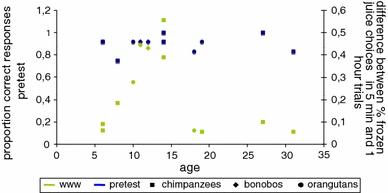
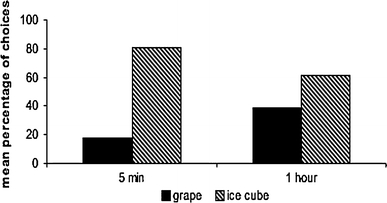
- In Experiment 1, apes chose frozen juice significantly more often after a 5-min retention interval than after 1 h (Wilcoxon: z = 2.55, p = 0.011, n = 12); 4 of 12 subjects showed this reversal individually.
- In the pre-test requiring no temporal encoding, apes remembered food location above chance across delays (Wilcoxon: z = 3.12, p = 0.002, n = 12), with no age effect (r_s = 0.08, p = 0.41).
- Experiment 1 www-memory performance showed an inverted U-shaped age trend (permutation test: c² = −0.142, p = 0.0682, n = 12); for chimpanzees and bonobos alone this was significant (c² = −0.026, p = 0.002, n = 9).
- In Experiment 2, subjects chose frozen juice significantly more often from the platform baited last than from the platform baited first (Wilcoxon: z = 1.79, p = 0.037, one-tailed, n = 5), supporting integrated what–where–when memory.
Methods
- Experiment 1 tested 7 chimpanzees, 3 orangutans, and 2 bonobos (12 total; ages 6–31 years) at the Wolfgang Köhler Primate Research Centre, using a platform with three possible baiting sites and two food types: preferred perishable frozen juice and less preferred non-perishable grape.
- Subjects chose after 5-min or 1-h retention intervals; analyses used Wilcoxon tests, Pearson chi-square, and permutation-based quadratic models of age effects.
- Experiment 2 tested 5 successful subjects (2 bonobos, 2 chimpanzees, 1 orangutan; ages 10–14 years) with two baiting events separated by 1 h and choice tests 5 min after the second event, analyzed with a one-tailed Wilcoxon test.
Limitations
- The paper states that the reduced sample size did not allow more fine-grained analyses to distinguish differences between great ape species or developmental patterns.
- The paper states that the data do not allow the conclusion that apes are actually recalling the baiting episode, and the mechanism used to keep track of time remains undetermined.
- The paper notes that orangutan performance could reflect species differences or simply that the tested orangutans were too young or too old; more broadly, the study assesses behavioral criteria for episodic-like memory, not autonoetic awareness.
Model-written summary. Check it against the paper before relying on it.
Integrity signals
Registry
Cites
Statistics
Figures
Verification
Claims the paper makes
26 Not checked yet · 20 Own interpretation · 15 Own result · 10 Own method · 8 No basis given
A result the paper reports from its own data — it cites no other source for it, so there is none to check. The quote shows it is in the paper.
In the paper
“Individual analyses showed that 4 out of 12 subjects chose the frozen juice significantly more often than the grape after the short RI and the grape after the long RI (Table 1).”
§ Keeping track of time: evidence for episodic-like memory in great apes > Experiment 1: content of memories > Results
plaincorrelationaln = 12 ·- Asserted: passes — The authors put it forward as true.
- Checkable: passes — It can be checked against evidence.
- Load-bearing: passes — The paper’s conclusions depend on it.
- Based: passes — The paper gives a reason why it holds.
A result the paper reports from its own data — it cites no other source for it, so there is none to check. The quote shows it is in the paper.
In the paper
“the performance on the www-memory test revealed an inverted U-shaped trend as a function of age (permutation test: c 2 = −0.142, p = 0.0682, n = 12, Fig. 1).”
§ Keeping track of time: evidence for episodic-like memory in great apes > Experiment 1: content of memories > Results
plaincorrelationaln = 12 ·- Asserted: passes — The authors put it forward as true.
- Checkable: passes — It can be checked against evidence.
- Load-bearing: unclear — It is unclear whether the paper’s conclusions depend on it.
- Based: passes — The paper gives a reason why it holds.
A result the paper reports from its own data — it cites no other source for it, so there is none to check. The quote shows it is in the paper.
In the paper
“Overall apes remembered the location of the food after each RI above the chance levels in the memory ability pre-test (Wilcoxon test: z = 3.12, p = 0.002, n = 12 in all intervals, Fig. 1)”
§ Keeping track of time: evidence for episodic-like memory in great apes > Experiment 1: content of memories > Results
plainn = 12 ·- Asserted: passes — The authors put it forward as true.
- Checkable: passes — It can be checked against evidence.
- Load-bearing: passes — The paper’s conclusions depend on it.
- Based: passes — The paper gives a reason why it holds.
A result the paper reports from its own data — it cites no other source for it, so there is none to check. The quote shows it is in the paper.
In the paper
“there was no change in performance across ages (r s=0.08, p = 0.41, n = 12).”
- Also stated in: § Abstract · plain
“The age had no effect on the performance of the subjects in the task that required no temporal encoding.”
§ Keeping track of time: evidence for episodic-like memory in great apes > Experiment 1: content of memories > Results
plainn = 12- Asserted: passes — The authors put it forward as true.
- Checkable: passes — It can be checked against evidence.
- Load-bearing: unclear — It is unclear whether the paper’s conclusions depend on it.
- Based: passes — The paper gives a reason why it holds.
- Also stated in: § Abstract · plain
The paper states this without a source or data behind it here, so there is nothing to check it against. The quote shows it is in the paper.
In the paper
“The temporal control of their choices was not dependent on the familiarity of the platforms where the food was hidden.”
§ Keeping track of time: evidence for episodic-like memory in great apes > Abstract
plain- Asserted: passes — The authors put it forward as true.
- Checkable: passes — It can be checked against evidence.
- Load-bearing: passes — The paper’s conclusions depend on it.
- Based: passes — The paper gives a reason why it holds.
A result the paper reports from its own data — it cites no other source for it, so there is none to check. The quote shows it is in the paper.
In the paper
“In Experiment 2, subjects faced two baiting events happening at different times, yet they formed an integrated memory for the location and time of the baiting event for particular food items.”
§ Keeping track of time: evidence for episodic-like memory in great apes > Abstract
plaindirect- Asserted: passes — The authors put it forward as true.
- Checkable: passes — It can be checked against evidence.
- Load-bearing: passes — The paper’s conclusions depend on it.
- Based: passes — The paper gives a reason why it holds.
- Rests on an assumption: Frozen juice remains available/edible after 5 min but melts and becomes unobtainable after 1 h.
A result the paper reports from its own data — it cites no other source for it, so there is none to check. The quote shows it is in the paper.
In the paper
“Apes chose the frozen juice significantly more after 5 min and the grape after 1 h.”
- Also stated in: § Results · plain
“Subjects chose the frozen juice significantly more often after the 5-min interval than after the 1-h interval (Wilcoxon test: z = 2.55, p = 0.011, n = 12; Fig. 2).”
§ Keeping track of time: evidence for episodic-like memory in great apes > Abstract
plaincorrelationaln = 12 ·- Asserted: passes — The authors put it forward as true.
- Checkable: passes — It can be checked against evidence.
- Load-bearing: passes — The paper’s conclusions depend on it.
- Based: passes — The paper gives a reason why it holds.
- Rests on an assumption: Frozen juice remains available/edible after 5 min but melts and becomes unobtainable after 1 h.
- Rests on an assumption: The grape is a non-perishable food.
- Also stated in: § Results · plain
A result the paper reports from its own data — it cites no other source for it, so there is none to check. The quote shows it is in the paper.
In the paper
“Focusing solely on members of the genus Pan (chimpanzees and bonobos) confirmed this result (permutation test: c 2 = −0.026, p = 0.002, n = 9).”
- Also stated in: § Abstract · plain
“Chimpanzees’ and bonobos’ performance in the temporal encoding task was age-dependent, following an inverted U-shaped distribution.”
§ Keeping track of time: evidence for episodic-like memory in great apes > Experiment 1: content of memories > Results
plaincorrelationaln = 9 ·- Asserted: passes — The authors put it forward as true.
- Checkable: passes — It can be checked against evidence.
- Load-bearing: unclear — It is unclear whether the paper’s conclusions depend on it.
- Based: passes — The paper gives a reason why it holds.
- Also stated in: § Abstract · plain
A result the paper reports from its own data — it cites no other source for it, so there is none to check. The quote shows it is in the paper.
In the paper
“Additionally, apes’ performance in the www-memory task showed an inverted U-shaped curve in which middle-age subjects performed better than the youngest and oldest subjects.”
- Also stated in: § General discussion · plain
“Additionally, subjects’ performance in the www-memory task showed an age-dependent inverted U-shaped curve.”
§ Keeping track of time: evidence for episodic-like memory in great apes > Experiment 1: content of memories > Discussion
plaincorrelational- Asserted: passes — The authors put it forward as true.
- Checkable: passes — It can be checked against evidence.
- Load-bearing: unclear — It is unclear whether the paper’s conclusions depend on it.
- Based: passes — The paper gives a reason why it holds.
- Also stated in: § General discussion · plain
A result the paper reports from its own data — it cites no other source for it, so there is none to check. The quote shows it is in the paper.
In the paper
“In fact, the performance in the 24-h delay condition was as good as that after a 2-min delay condition.”
§ Keeping track of time: evidence for episodic-like memory in great apes > Experiment 1: content of memories > Discussion
plain- Asserted: passes — The authors put it forward as true.
- Checkable: passes — It can be checked against evidence.
- Load-bearing: unclear — It is unclear whether the paper’s conclusions depend on it.
- Based: passes — The paper gives a reason why it holds.
- It may state two separate claims as one. 14
- The quote only partly states this claim. 1
- Probably not a substantial claim. 30
A result the paper reports from its own data — it cites no other source for it, so there is none to check. The quote shows it is in the paper.
In the paper
“Their choices remained unchanged during testing (Friedman tests: 5-min—χ 2 = 0.16, n = 12, p = 0.92; 1-h—χ 2 = 0.42, n = 12, p = 0.8).”
§ Keeping track of time: evidence for episodic-like memory in great apes > Experiment 1: content of memories > Results
plainn = 12- Asserted: passes — The authors put it forward as true.
- Checkable: passes — It can be checked against evidence.
- Load-bearing: unclear — It is unclear whether the paper’s conclusions depend on it.
- Based: passes — The paper gives a reason why it holds.
It may state two separate claims as one.
A result the paper reports from its own data — it cites no other source for it, so there is none to check. The quote shows it is in the paper.
In the paper
“Subjects younger than 7 and older than 18 years of age showed a much lower performance than adolescents and young adults.”
§ Keeping track of time: evidence for episodic-like memory in great apes > Experiment 1: content of memories > Results
plaincorrelationaln = 9- Asserted: passes — The authors put it forward as true.
- Checkable: passes — It can be checked against evidence.
- Load-bearing: unclear — It is unclear whether the paper’s conclusions depend on it.
- Based: passes — The paper gives a reason why it holds.
The quote only partly states this claim.
None of the sources cited for this claim have been checked yet.
In the paper
“Clayton and colleagues have shown that scrub jays flexibly integrated memories for the what, where and when of an event (Clayton and Dickinson 1998, 1999; Clayton et al. 2001, 2003b).”
§ Keeping track of time: evidence for episodic-like memory in great apes > Introduction
What the sources say
boosteddirect- Asserted: passes — The authors put it forward as true.
- Checkable: passes — It can be checked against evidence.
- Load-bearing: fails — The paper’s conclusions may not depend on it.
- Based: passes — The paper gives a reason why it holds.
Probably not a substantial claim. The paper’s conclusions may not depend on it.
A conclusion the paper draws from its own results — it cites no other source for it, so there is none to check. The quote shows it is in the paper.
In the paper
“Since subjects rarely selected the empty boxes in the pre-test and test (pre-test: less than 12% of the trials, test: less than 3% of the trials), this suggests that their choices of the less preferred food after 1-h delay were not simply due to memory lapses.”
§ Keeping track of time: evidence for episodic-like memory in great apes > Experiment 1: content of memories > Results
hedgedn = 12- Asserted: passes — The authors put it forward as true.
- Checkable: passes — It can be checked against evidence.
- Load-bearing: passes — The paper’s conclusions depend on it.
- Based: passes — The paper gives a reason why it holds.
It may state two separate claims as one.
In the paper
“Therefore, one weakness in Clayton’s experimental approach is that it does not measure memory for unique experiences because they require training.”
§ Keeping track of time: evidence for episodic-like memory in great apes > Introduction
What the sources say
- Not checked yetcites Zentall et al. 2001 source
plaindirect- Asserted: passes — The authors put it forward as true.
- Checkable: passes — It can be checked against evidence.
- Load-bearing: fails — The paper’s conclusions may not depend on it.
- Based: passes — The paper gives a reason why it holds.
Probably not a substantial claim. The paper’s conclusions may not depend on it.
What the paper did — it cites no source for this, so there is none to check. The quote shows it is in the paper.
In the paper
“It is important to mention that the apes did not have any previous experience with the frozen juice that we used in our experiment.”
§ Keeping track of time: evidence for episodic-like memory in great apes > Experiment 1: content of memories > Methods
plain- Asserted: passes — The authors put it forward as true.
- Checkable: passes — It can be checked against evidence.
- Load-bearing: fails — The paper’s conclusions may not depend on it.
- Based: passes — The paper gives a reason why it holds.
Probably not a substantial claim. The paper’s conclusions may not depend on it.
What the paper did — it cites no source for this, so there is none to check. The quote shows it is in the paper.
In the paper
“In the pre-test, we tested individuals’ general long-term memory.”
§ Keeping track of time: evidence for episodic-like memory in great apes > Experiment 1: content of memories > Methods
plain- Asserted: passes — The authors put it forward as true.
- Checkable: passes — It can be checked against evidence.
- Load-bearing: fails — The paper’s conclusions may not depend on it.
- Based: passes — The paper gives a reason why it holds.
Probably not a substantial claim. The paper’s conclusions may not depend on it.
What the paper did — it cites no source for this, so there is none to check. The quote shows it is in the paper.
In the paper
“In each round and for each trial different baiting places were used and the three possible sites were counterbalanced.”
§ Keeping track of time: evidence for episodic-like memory in great apes > Experiment 1: content of memories > Methods
plain- Asserted: passes — The authors put it forward as true.
- Checkable: passes — It can be checked against evidence.
- Load-bearing: fails — The paper’s conclusions may not depend on it.
- Based: passes — The paper gives a reason why it holds.
Probably not a substantial claim. The paper’s conclusions may not depend on it. It may state two separate claims as one.
In the paper
“However, their subjects were asked to remember these three elements in separate occasions, raising doubts about the integration of the components.”
§ Keeping track of time: evidence for episodic-like memory in great apes > Introduction
What the sources say
- Not checked yetcites Hoffman et al. 2009
plaindirect- Asserted: passes — The authors put it forward as true.
- Checkable: passes — It can be checked against evidence.
- Load-bearing: passes — The paper’s conclusions depend on it.
- Based: passes — The paper gives a reason why it holds.
It may state two separate claims as one.
What the paper did — it cites no source for this, so there is none to check. The quote shows it is in the paper.
In the paper
“The order in which subjects were presented in the two types of trials was counterbalanced.”
§ Keeping track of time: evidence for episodic-like memory in great apes > Experiment 1: content of memories > Methods
plain- Asserted: passes — The authors put it forward as true.
- Checkable: passes — It can be checked against evidence.
- Load-bearing: fails — The paper’s conclusions may not depend on it.
- Based: passes — The paper gives a reason why it holds.
Probably not a substantial claim. The paper’s conclusions may not depend on it.
None of the sources cited for this claim have been checked yet.
In the paper
“recent experimental studies have shown evidence for planning in chimpanzees, bonobos and orangutans”
§ Keeping track of time: evidence for episodic-like memory in great apes > Introduction
What the sources say
plaincorrelational- Asserted: passes — The authors put it forward as true.
- Checkable: passes — It can be checked against evidence.
- Load-bearing: passes — The paper’s conclusions depend on it.
- Based: passes — The paper gives a reason why it holds.
Probably not a substantial claim.
What the paper did — it cites no source for this, so there is none to check. The quote shows it is in the paper.
In the paper
“To provide a unique baiting location on every trial within each round for each ape, the three baiting sites were covered with three different containers each. Additionally, these containers were different for each trial.”
§ Keeping track of time: evidence for episodic-like memory in great apes > Experiment 1: content of memories > Methods
plaindirect- Asserted: passes — The authors put it forward as true.
- Checkable: passes — It can be checked against evidence.
- Load-bearing: passes — The paper’s conclusions depend on it.
- Based: passes — The paper gives a reason why it holds.
Probably not a substantial claim. It may state two separate claims as one.
None of the sources cited for this claim have been checked yet.
In the paper
“An alternative approach suggested by Eacott et al. (2005) challenged the main role of the “when” component in episodic-like memory.”
§ Keeping track of time: evidence for episodic-like memory in great apes > Introduction
What the sources say
hedgeddirect- Asserted: passes — The authors put it forward as true.
- Checkable: passes — It can be checked against evidence.
- Load-bearing: passes — The paper’s conclusions depend on it.
- Based: passes — The paper gives a reason why it holds.
Probably not a substantial claim. It may state two separate claims as one.
In the paper
“The results from these experiments showed that rats were sensitive not only to the location of the objects, but also to the temporal order in which they were presented. These results led the authors to conclude that rats integrated what, where and when an event happened.”
§ Keeping track of time: evidence for episodic-like memory in great apes > Introduction
What the sources say
- Not checked yetcites Kart-Teke et al. 2006 source
plaindirect- Asserted: passes — The authors put it forward as true.
- Checkable: passes — It can be checked against evidence.
- Load-bearing: fails — The paper’s conclusions may not depend on it.
- Based: passes — The paper gives a reason why it holds.
Probably not a substantial claim. The paper’s conclusions may not depend on it. It may state two separate claims as one.
What the paper did — it cites no source for this, so there is none to check. The quote shows it is in the paper.
In the paper
“Prior to the experiment, we established the apes’ preference for two food items.”
§ Keeping track of time: evidence for episodic-like memory in great apes > Experiment 1: content of memories > Methods
plain- Asserted: passes — The authors put it forward as true.
- Checkable: passes — It can be checked against evidence.
- Load-bearing: passes — The paper’s conclusions depend on it.
- Based: passes — The paper gives a reason why it holds.
Probably not a substantial claim.
None of the sources cited for this claim have been checked yet.
In the paper
“Other bird and mammal species have also been shown to possess such type of memory”
§ Keeping track of time: evidence for episodic-like memory in great apes > Introduction
What the sources say
plain- Asserted: passes — The authors put it forward as true.
- Checkable: passes — It can be checked against evidence.
- Load-bearing: fails — The paper’s conclusions may not depend on it.
- Based: passes — The paper gives a reason why it holds.
Probably not a substantial claim. The paper’s conclusions may not depend on it.
In the paper
“Interestingly, longitudinal and cross-sectional studies in human memory have reported an inverted U-shaped curve as a function of age for episodic memory and no age effect for long-term memory (Bialystok and Craik 2006 for a review).”
§ Keeping track of time: evidence for episodic-like memory in great apes > Experiment 1: content of memories > Discussion
What the sources say
- Not checked yetcites Bialystok and Craik 2006 source
plaincorrelational- Asserted: passes — The authors put it forward as true.
- Checkable: passes — It can be checked against evidence.
- Load-bearing: fails — The paper’s conclusions may not depend on it.
- Based: passes — The paper gives a reason why it holds.
Probably not a substantial claim. The paper’s conclusions may not depend on it. It may state two separate claims as one.
In the paper
“Recently, Hoffman et al. 2009 examined working memory (Baddeley 2000) for what, where and when information in rhesus monkeys using a new paradigm based on a computer task and found positive evidence for episodic-like memory.”
§ Keeping track of time: evidence for episodic-like memory in great apes > Introduction
What the sources say
- Not checked yetcites Hoffman et al. 2009
plain- Asserted: passes — The authors put it forward as true.
- Checkable: passes — It can be checked against evidence.
- Load-bearing: fails — The paper’s conclusions may not depend on it.
- Based: passes — The paper gives a reason why it holds.
Probably not a substantial claim. The paper’s conclusions may not depend on it.
None of the sources cited for this claim have been checked yet.
In the paper
“The trial-unique learning paradigm has been successfully implemented in rodents (rats: Kart-Teke et al. 2006; mice: Dere et al. 2005) and birds (Zentall et al. 2001).”
§ Keeping track of time: evidence for episodic-like memory in great apes > Introduction
What the sources say
plain- Asserted: passes — The authors put it forward as true.
- Checkable: passes — It can be checked against evidence.
- Load-bearing: fails — The paper’s conclusions may not depend on it.
- Based: passes — The paper gives a reason why it holds.
Probably not a substantial claim. The paper’s conclusions may not depend on it.
None of the sources cited for this claim have been checked yet.
In the paper
“However, as pointed out by Crystal (2009), episodic memory is defined as a long-term memory system and the unexpected question experiment carried out by Zentall et al. (2001) only deals with short-time delays between the encoding event and the experimental question.”
§ Keeping track of time: evidence for episodic-like memory in great apes > Introduction
What the sources say
plain- Asserted: passes — The authors put it forward as true.
- Checkable: passes — It can be checked against evidence.
- Load-bearing: unclear — It is unclear whether the paper’s conclusions depend on it.
- Based: passes — The paper gives a reason why it holds.
It may state two separate claims as one.
None of the sources cited for this claim have been checked yet.
In the paper
“It has also been argued that episodic memory and future planning depend on common processes”
§ Keeping track of time: evidence for episodic-like memory in great apes > Introduction
What the sources say
hedgedcorrelational- Asserted: fails — The authors may not put it forward as true.
- Checkable: passes — It can be checked against evidence.
- Load-bearing: fails — The paper’s conclusions may not depend on it.
- Based: passes — The paper gives a reason why it holds.
Probably not a substantial claim. The authors may not put it forward as true. The paper’s conclusions may not depend on it.
In the paper
“The results from this experiment showed that pigeons were able to report which action they performed in the past.”
§ Keeping track of time: evidence for episodic-like memory in great apes > Introduction
What the sources say
- Not checked yetcites Zentall et al. 2001 source
plain- Asserted: passes — The authors put it forward as true.
- Checkable: passes — It can be checked against evidence.
- Load-bearing: fails — The paper’s conclusions may not depend on it.
- Based: passes — The paper gives a reason why it holds.
Probably not a substantial claim. The paper’s conclusions may not depend on it.
The paper states this without a source or data behind it here, so there is nothing to check it against. The quote shows it is in the paper.
In the paper
“Compared to rodents and birds, non-human primates have received relatively little attention in episodic-like memory research.”
§ Keeping track of time: evidence for episodic-like memory in great apes > Introduction
plain- Asserted: passes — The authors put it forward as true.
- Checkable: passes — It can be checked against evidence.
- Load-bearing: fails — The paper’s conclusions may not depend on it.
- Based: fails — The paper may give no reason why it holds.
Probably not a substantial claim. The paper’s conclusions may not depend on it. The paper may give no reason why it holds.
In the paper
“Rats’ success in this task allowed the authors to conclude that rats recollected the what, where and which of a past episode.”
§ Keeping track of time: evidence for episodic-like memory in great apes > Introduction
What the sources say
- Not checked yetcites Eacott et al. 2005 source
plaindirect- Asserted: passes — The authors put it forward as true.
- Checkable: passes — It can be checked against evidence.
- Load-bearing: fails — The paper’s conclusions may not depend on it.
- Based: passes — The paper gives a reason why it holds.
Probably not a substantial claim. The paper’s conclusions may not depend on it.
What the paper did — it cites no source for this, so there is none to check. The quote shows it is in the paper.
In the paper
“It is precisely our reduced sample size that does not allow us to carry out more fine-grained analyses in order to tell apart differences between the great ape species included in this study and the developmental patterns in this memory system.”
§ Keeping track of time: evidence for episodic-like memory in great apes > General discussion
plaindirect- Asserted: passes — The authors put it forward as true.
- Checkable: passes — It can be checked against evidence.
- Load-bearing: fails — The paper’s conclusions may not depend on it.
- Based: passes — The paper gives a reason why it holds.
Probably not a substantial claim. The paper’s conclusions may not depend on it.
A conclusion the paper draws from its own results — it cites no other source for it, so there is none to check. The quote shows it is in the paper.
In the paper
“Likewise, they chose more often the frozen juice in the platform baited last because the frozen juice was hidden 5 min ago and was, therefore, still edible.”
§ Keeping track of time: evidence for episodic-like memory in great apes > Experiment 2: structure of memories > Discussion
plaindirect- Asserted: passes — The authors put it forward as true.
- Checkable: passes — It can be checked against evidence.
- Load-bearing: passes — The paper’s conclusions depend on it.
- Based: passes — The paper gives a reason why it holds.
It may state two separate claims as one.
- Rests on an assumption: Frozen juice hidden 1 h earlier had melted and was not edible, while frozen juice hidden 5 min earlier was still edible.
In the paper
“Familiarity is a recognition process that provides a temporal cue for knowing which food item will be available without actually recollecting the past event (Kort et al. 2005).”
§ Keeping track of time: evidence for episodic-like memory in great apes > General discussion
What the sources say
- Not checked yetcites Kort et al. 2005 source
plaindirect- Asserted: passes — The authors put it forward as true.
- Checkable: passes — It can be checked against evidence.
- Load-bearing: passes — The paper’s conclusions depend on it.
- Based: passes — The paper gives a reason why it holds.
Probably not a substantial claim.
What the paper did — it cites no source for this, so there is none to check. The quote shows it is in the paper.
In the paper
“The order of the 5 min and 1-h trials and the baited sites on the platform were counterbalanced across subjects.”
§ Keeping track of time: evidence for episodic-like memory in great apes > Experiment 2: structure of memories > Methods
plain- Asserted: passes — The authors put it forward as true.
- Checkable: passes — It can be checked against evidence.
- Load-bearing: fails — The paper’s conclusions may not depend on it.
- Based: passes — The paper gives a reason why it holds.
Probably not a substantial claim. The paper’s conclusions may not depend on it. It may state two separate claims as one.
The paper states this without a source or data behind it here, so there is nothing to check it against. The quote shows it is in the paper.
In the paper
“As a consequence, an animal using this representation would be unable to discriminate two episodes sharing the same “what” because the “where” and the “when” components are not directly connected.”
§ Keeping track of time: evidence for episodic-like memory in great apes > Experiment 2: structure of memories
hedgeddirect- Asserted: passes — The authors put it forward as true.
- Checkable: passes — It can be checked against evidence.
- Load-bearing: passes — The paper’s conclusions depend on it.
- Based: fails — The paper may give no reason why it holds.
Probably not a substantial claim. The paper may give no reason why it holds.
The paper states this without a source or data behind it here, so there is nothing to check it against. The quote shows it is in the paper.
In the paper
“Second, an inverted U-shape distribution is a feature of episodic memory in humans.”
§ Keeping track of time: evidence for episodic-like memory in great apes > General discussion
plaincorrelational- Asserted: passes — The authors put it forward as true.
- Checkable: passes — It can be checked against evidence.
- Load-bearing: passes — The paper’s conclusions depend on it.
- Based: fails — The paper may give no reason why it holds.
Probably not a substantial claim. The paper may give no reason why it holds.
In the paper
“Friedman (1993) described three types of information that humans (but also animals) could process: temporal locations, which refer to when an event took place within a time pattern; temporal distances, implying how long ago an event occurred and before–after relations or order of events.”
§ Keeping track of time: evidence for episodic-like memory in great apes > General discussion
What the sources say
- Not checked yetcites Friedman 1993 source
plain- Asserted: passes — The authors put it forward as true.
- Checkable: passes — It can be checked against evidence.
- Load-bearing: fails — The paper’s conclusions may not depend on it.
- Based: passes — The paper gives a reason why it holds.
Probably not a substantial claim. The paper’s conclusions may not depend on it.
What the paper did — it cites no source for this, so there is none to check. The quote shows it is in the paper.
In the paper
“The statistical test was one-tailed given that we had an a priori prediction.”
§ Keeping track of time: evidence for episodic-like memory in great apes > Experiment 2: structure of memories > Methods
plain- Asserted: passes — The authors put it forward as true.
- Checkable: passes — It can be checked against evidence.
- Load-bearing: fails — The paper’s conclusions may not depend on it.
- Based: passes — The paper gives a reason why it holds.
Probably not a substantial claim. The paper’s conclusions may not depend on it.
What the paper did — it cites no source for this, so there is none to check. The quote shows it is in the paper.
In the paper
“The nature of this experiment was confirmatory.”
§ Keeping track of time: evidence for episodic-like memory in great apes > Experiment 2: structure of memories
plain- Asserted: passes — The authors put it forward as true.
- Checkable: passes — It can be checked against evidence.
- Load-bearing: fails — The paper’s conclusions may not depend on it.
- Based: passes — The paper gives a reason why it holds.
Probably not a substantial claim. The paper’s conclusions may not depend on it.
A conclusion the paper draws from its own results — it cites no other source for it, so there is none to check. The quote shows it is in the paper.
In the paper
“The results of this experiment confirmed the findings from the first experiment, that is, subjects’ choices are mediated by the temporal information.”
§ Keeping track of time: evidence for episodic-like memory in great apes > Experiment 2: structure of memories > Discussion
plaindirect- Asserted: passes — The authors put it forward as true.
- Checkable: passes — It can be checked against evidence.
- Load-bearing: passes — The paper’s conclusions depend on it.
- Based: passes — The paper gives a reason why it holds.
It may state two separate claims as one.
A conclusion the paper draws from its own results — it cites no other source for it, so there is none to check. The quote shows it is in the paper.
In the paper
“However, the mechanism that apes used to keep track of time and the nature of the temporal representation of the past events remains undetermined.”
§ Keeping track of time: evidence for episodic-like memory in great apes > General discussion
plain- Asserted: passes — The authors put it forward as true.
- Checkable: passes — It can be checked against evidence.
- Load-bearing: fails — The paper’s conclusions may not depend on it.
- Based: passes — The paper gives a reason why it holds.
Probably not a substantial claim. The paper’s conclusions may not depend on it. It may state two separate claims as one.
The paper states this without a source or data behind it here, so there is nothing to check it against. The quote shows it is in the paper.
In the paper
“If the three components occurred in an integrated representation, interrogating any episodic memory for any feature of the event will retrieve the other two features.”
§ Keeping track of time: evidence for episodic-like memory in great apes > Experiment 2: structure of memories
plaindirect- Asserted: fails — The authors may not put it forward as true.
- Checkable: passes — It can be checked against evidence.
- Load-bearing: passes — The paper’s conclusions depend on it.
- Based: fails — The paper may give no reason why it holds.
Probably not a substantial claim. The authors may not put it forward as true. The paper may give no reason why it holds.
None of the sources cited for this claim have been checked yet.
In the paper
“Research on memory for the past events in humans has shown that there is no evidence that events are coded by the times of their occurrence or that memory is temporally organised (Friedman 1993, 2004).”
§ Keeping track of time: evidence for episodic-like memory in great apes > General discussion
What the sources say
plain- Asserted: passes — The authors put it forward as true.
- Checkable: passes — It can be checked against evidence.
- Load-bearing: fails — The paper’s conclusions may not depend on it.
- Based: passes — The paper gives a reason why it holds.
Probably not a substantial claim. The paper’s conclusions may not depend on it. It may state two separate claims as one.
The paper relies on this without support.
Frozen juice remains available/edible after 5 min but melts and becomes unobtainable after 1 h.
“The frozen juice was still available after 5 min but melted after 1 h and became unobtainable.”
“After 1 h, the frozen juice melted and became unobtainable, but it was still edible if chosen after 5 min.”
The paper relies on this without support.
The grape is a non-perishable food.
“less preferred but non-perishable food (grape)”
The paper relies on this without support.
Chimpanzees, bonobos and orangutans represent our closest and most distant great ape relatives, respectively.
“We tested chimpanzees, bonobos and orangutans because they represent our closest and most distant great ape relatives, respectively.”
The paper relies on this without support.
Frozen juice hidden 1 h earlier had melted and was not edible, while frozen juice hidden 5 min earlier was still edible.
“the frozen juice hidden in that platform was baited 1 h earlier and, therefore, had melted”
“the frozen juice was hidden 5 min ago and was, therefore, still edible”
The paper relies on this without support.
Apes prefer frozen juice over grapes when both are available.
“they should preferentially choose the frozen juice in the table baited last but the grape in the table baited first”
The paper relies on this without support.
The orangutan's significant reversal of choices in the last round of Experiment 1 indicates that her choices were based on how long ago the baiting event took place.
“We included one of the orangutans because in the last round of Experiment 1 she significantly reversed her choices (χ 2 = 6, p = 0.014; see table 1 for more details).”
Claims other papers make about this one
Each is checked against this paper’s own text: does it say what the citing paper says it does?
In the citing paper
“these predominantly focus on the content criterion, and as a result, there is little evidence for the structure (but see [68,75]) and flexibility (but see [74]) criteria in the literature.”
From Is episodic-like memory like episodic memory? (2024) · cites this paper as [75]
In the citing paper
“Furthermore, older dogs and apes who were otherwise healthy showed lower performances in an incidental encoding and what–where–when test, respectively, compared with younger conspecifics [75,146].”
From Is episodic-like memory like episodic memory? (2024) · cites this paper as [75]
In the citing paper
“The same binding of multiple event features, permitting the discrimination between two similar events, has also been demonstrated in rats and apes [68,75].”
From Is episodic-like memory like episodic memory? (2024) · cites this paper as [75]
In the citing paper
“Some studies, however, use non-natural methodological elements to test for episodic-like memory [75], such as pecking or approaching certain shapes or coloured panels that are presented in front of the subjects [56,78–81], or requiring subjects to recall their own or others’ previous actions out of an array of behaviours [95,96].”
From Is episodic-like memory like episodic memory? (2024) · cites this paper as [75]
Statistics recomputed
Every reported test result, recomputed from its test statistic and degrees of freedom. A result shows as not adding up only once an independent check has confirmed it.
- Consistentz = 3.12reported p = .002 · recomputed p = .002
“z = 3.12, p = .002”
- Consistentz = 2.55reported p = .011 · recomputed p = .011
“z = 2.55, p = .011”
- Consistentz = 1.79reported p = .037 · recomputed p = .073
“z = 1.79, p = .037”
The paper states a one-tailed test
Self-check
Percentages, sums and reported differences re-computed from the paper’s own numbers.
Each contradiction between two passages listed here was confirmed by an independent check.
Rated major: it would touch a result — a value a result rests on, reported and recomputed p-values on opposite sides of the significance level, two passages that conflict with no sign which is right, or a cited work retracted before this paper was published.
In the paper
§ Keeping track of time: evidence for episodic-like memory in great apes > General discussion
“they were as accurate at remembering where an item was hidden after 24 h as they were after 2 min.”
§ Keeping track of time: evidence for episodic-like memory in great apes > Experiment 1: content of memories > Methods
“| Fraukje | Pan troglodytes | 31 | 100 | 100 | 100 | 33.33 | 88.88 | 83.34 | 0.23 | NS | NT | NT | | Padanaa | Pongo pygmaeus | 10 | 100 | 100 | 100 | 66.66 | 100 | 77.23 | 0.58 | NS | 100 | 50 |”
Rated minor: it would not touch a result — a value no result rests on, a p-value that stays on the same side of the significance level, or a conflict that is clerical, resolved elsewhere in the paper, or outside its own findings.
In the paper
§ Keeping track of time: evidence for episodic-like memory in great apes > Experiment 2: structure of memories > Methods
“Subjects received a total of 6 trials, 3 per condition.”
§ Keeping track of time: evidence for episodic-like memory in great apes > Experiment 1: content of memories > Methods
“| Fifi | Pan troglodytes | 14 | 100 | 100 | 100 | 66.66 | 83.33 | 44.45 | 5.9 | 0.035 | 80 | 20 |”
Citations
Cites
The episodic buffer: a new component of working memory?
Baddeley, A. (2000) · Trends in Cognitive Sciences · doi:10.1016/s1364-6613(00)01538-2 · Cited by 7,359 · cited 2×
“Recently, Hoffman et al. 2009 examined working memory (Baddeley 2000) for what, where and when information in rhesus monkeys using a new paradigm based on a computer task and found positive evidence for episodic-like memory.”
BackgroundMethod(1983) · Medical Entomology and Zoology · Cited by 6,051
Episodic memory: from mind to brain
Tulving, E. (2002) · Annual Review of Psychology · doi:10.1146/annurev.psych.53.100901.135114 · Cited by 4,950
Randomization, Bootstrap and Monte Carlo Methods in Biology
Manly, B. F. J. (2018) · Chapman & Hall/CRC eBooks · doi:10.1201/9781315273075 · Cited by 4,209
(2007) · Cognitive Psychology · doi:10.4135/9781446212967.n15 · Cited by 3,749
The handbook of aging and cognition
Craik, F. I. M., & Salthouse, T. A. (1992) · doi:10.4324/9781410601988 · Cited by 2,064
The evolution of foresight: What is mental time travel, and is it unique to humans?
Suddendorf, T., & Corballis, M. C. (2007) · Behavioral and Brain Sciences · doi:10.1017/s0140525x07001975 · Cited by 2,031
Randomization, Bootstrap and Monte Carlo Methods in Biology.
Kemp, A. W., & Manly, B. F. J. (1997) · Biometrics · doi:10.2307/2533527 · Cited by 1,928
The handbook of aging and cognition
Mitchell, D. B. (2001) · Applied Cognitive Psychology · doi:10.1002/acp.747 · Cited by 1,898
The Handbook of aging and cognition
(1993) · Choice Reviews Online · doi:10.5860/choice.30-3520 · Cited by 1,603
Research works printed but not linked: 2
- Haccou P, Meelis E (1994) Statistical analyses of behavioural data. Oxford University Press, Oxford
- Schwartz BL (2005) Do humans primates have episodic memory? In: Terrace HS, Metcalfe J (eds) The missing link in cognition. Oxford University Press, Oxford, pp 225–241
Cited by
Sorted by citations
The evolution of episodic memory
Allen, T. A., & Fortin, N. J. (2013) · Proceedings of the National Academy of Sciences · doi:10.1073/pnas.1301199110 · Cited by 350
Why do we remember? The communicative function of episodic memory
Mahr, J. B., & Csibra, G. (2017) · Behavioral and Brain Sciences · doi:10.1017/s0140525x17000012 · Cited by 371
Thinking chickens: a review of cognition, emotion, and behavior in the domestic chicken
Marino, L. (2017) · Animal Cognition · doi:10.1007/s10071-016-1064-4 · Cited by 281
Differences in the Cognitive Skills of Bonobos and Chimpanzees
Herrmann, E., Hare, B. A., Call, J., & Tomasello, M. (2010) · PLoS ONE · doi:10.1371/journal.pone.0012438 · Cited by 236
Self-citationThe cognition of ‘nuisance’ species
Barrett, L. P., Stanton, L. A., & Benson-Amram, S. (2019) · Animal Behaviour · doi:10.1016/j.anbehav.2018.05.005 · Cited by 166
Avian Models for Human Cognitive Neuroscience: A Proposal
Clayton, N. S., & Emery, N. J. (2015) · Neuron · doi:10.1016/j.neuron.2015.04.024 · Cited by 157
Janmaat, K. R. L., Ban, S. D., & Boesch, C. (2013) · Animal Behaviour · doi:10.1016/j.anbehav.2013.09.021 · Cited by 161
Translating cognition from animals to humans
Keeler, J. F., & Robbins, T. W. (2011) · Biochemical Pharmacology · doi:10.1016/j.bcp.2010.12.028 · Cited by 137
Dissociating memory traces and scenario construction in mental time travel
Cheng, S., Werning, M., & Suddendorf, T. (2015) · Neuroscience & Biobehavioral Reviews · doi:10.1016/j.neubiorev.2015.11.011 · Cited by 144
Thinking Pigs: A Comparative Review of Cognition, Emotion, and Personality in Sus domesticus
Marino, L., & Colvin, C. M. (2015) · International Journal of Comparative Psychology · doi:10.46867/ijcp.2015.28.00.04 · Cited by 132
Science, sentience, and animal welfare
Jones, R. C. (2013) · Biology & Philosophy · doi:10.1007/s10539-012-9351-1 · Cited by 119
How intelligent is a cephalopod? Lessons from comparative cognition
Schnell, A. K., Amodio, P., Boeckle, M., & Clayton, N. S. (2021) · Biological Reviews · doi:10.1111/brv.12651 · Cited by 120
Boyer, D., & Walsh, P. D. (2010) · Philosophical Transactions of the Royal Society A Mathematical Physical and Engineering Sciences · doi:10.1098/rsta.2010.0275 · Cited by 113
The effect of time left alone at home on dog welfare
Rehn, T., & Keeling, L. J. (2010) · Applied Animal Behaviour Science · doi:10.1016/j.applanim.2010.11.015 · Cited by 132
Rosenbaum, R. S., Kim, A. S. N., & Baker, S. (2017) · Elsevier eBooks · doi:10.1016/b978-0-12-809324-5.21037-7 · Cited by 111
Birds of a feather? Parrot and corvid cognition compared
Lambert, M. L., Jacobs, I. F., Osvath, M., & von Bayern, A. M. P. (2018) · Behaviour · doi:10.1163/1568539x-00003527 · Cited by 111
How to be a frugivore (in a changing world)
Corlett, R. T. (2011) · Acta Oecologica · doi:10.1016/j.actao.2011.01.005 · Cited by 105
Memory for Distant Past Events in Chimpanzees and Orangutans
Martín-Ordás, G., Berntsen, D., & Call, J. (2013) · Current Biology · doi:10.1016/j.cub.2013.06.017 · Cited by 103
Self-citationGreat ape cognition and captive care: Can cognitive challenges enhance well-being?
Clark, F. E. (2011) · Applied Animal Behaviour Science · doi:10.1016/j.applanim.2011.10.010 · Cited by 109
Learning to remember: The early ontogeny of episodic memory
Mullally, S. L., & Maguire, E. A. (2014) · Developmental Cognitive Neuroscience · doi:10.1016/j.dcn.2013.12.006 · Cited by 108
What is episodic memory if it is a natural kind?
Cheng, S., & Werning, M. (2014) · Synthese · doi:10.1007/s11229-014-0628-6 · Cited by 105
Do different tests of episodic memory produce consistent results in human adults?
Cheke, L. G., & Clayton, N. S. (2013) · Learning & Memory · doi:10.1101/lm.030502.113 · Cited by 95
Episodic Memory in Nonhuman Animals
Templer, V. L., & Hampton, R. R. (2013) · Current Biology · doi:10.1016/j.cub.2013.07.016 · Cited by 94
Janmaat, K. R. L., Boesch, C., Byrne, R. W., Chapman, C. A., Bi, Z. B. G., Head, J. S., Robbins, M. M., Wrangham, R. W., & Polansky, L. (2016) · American Journal of Primatology · doi:10.1002/ajp.22527 · Cited by 85
Great Apes Make Anticipatory Looks Based on Long-Term Memory of Single Events
Kano, F., & Hirata, S. (2015) · Current Biology · doi:10.1016/j.cub.2015.08.004 · Cited by 84
Binding of Episodic Memories in the Rat
Crystal, J. D., & Smith, A. E. (2014) · Current Biology · doi:10.1016/j.cub.2014.10.074 · Cited by 77
Comparative Developmental Psychology: How is Human Cognitive Development Unique?
Rosati, A. G., Wobber, V., Hughes, K. D., & Santos, L. R. (2014) · Evolutionary Psychology · doi:10.1177/147470491401200211 · Cited by 80
Convergent Evolution of Cognition in Corvids, Apes and Other Animals
van Horik, J. O., Clayton, N. S., & Emery, N. J. (2012) · Oxford University Press eBooks · doi:10.1093/oxfordhb/9780199738182.013.0005 · Cited by 78
Chimpanzees and bonobos exhibit divergent spatial memory development
Rosati, A. G., & Hare, B. A. (2012) · Developmental Science · doi:10.1111/j.1467-7687.2012.01182.x · Cited by 66
Origins of spatial, temporal and numerical cognition: Insights from comparative psychology
Haun, D. B. M., Jordan, F. M., Vallortígara, G., & Clayton, N. S. (2010) · Trends in Cognitive Sciences · doi:10.1016/j.tics.2010.09.006 · Cited by 68
Self-citationTaï chimpanzees anticipate revisiting high-valued fruit trees from further distances
Ban, S. D., Boesch, C., & Janmaat, K. R. L. (2014) · Animal Cognition · doi:10.1007/s10071-014-0771-y · Cited by 63
Detecting effects of spatial memory and dynamic information on animal movement decisions
Schlägel, U. E., & Lewis, M. A. (2014) · Methods in Ecology and Evolution · doi:10.1111/2041-210x.12284 · Cited by 64
von Eugen, K., Tabrik, S., Güntürkün, O., & Ströckens, F. (2020) · The Journal of Comparative Neurology · doi:10.1002/cne.24878 · Cited by 66
Binder, S., Dere, E., & Zlomuzica, A. (2015) · Progress in Neurobiology · doi:10.1016/j.pneurobio.2015.04.002 · Cited by 56
On the working memory of humans and great apes: Strikingly similar or remarkably different?
Read, D., Manrique, H. M., & WALKER, M. J. (2021) · Neuroscience & Biobehavioral Reviews · doi:10.1016/j.neubiorev.2021.12.019 · Cited by 58
Territory surveillance and prey management: Wolves keep track of space and time
Schlägel, U. E., Merrill, E. H., & Lewis, M. A. (2017) · Ecology and Evolution · doi:10.1002/ece3.3176 · Cited by 55
Fenton, A. (2014) · Cambridge Quarterly of Healthcare Ethics · doi:10.1017/s0963180113000662 · Cited by 52
Language, Memory, and Mental Time Travel: An Evolutionary Perspective
Corballis, M. C. (2019) · Frontiers in Human Neuroscience · doi:10.3389/fnhum.2019.00217 · Cited by 54
Enduring voice recognition in bonobos
Keenan, S., Mathevon, N., Stevens, J. M. G., Guéry, J. P., Zuberbühler, K., & Levréro, F. (2016) · Scientific Reports · doi:10.1038/srep22046 · Cited by 50
People–primate interactions: implications for primate conservation
Humle, T., & Hill, C. M. (2016) · doi:10.1093/acprof:oso/9780198703389.003.0014 · Cited by 50
The evolutionary origins of syntax: Event cognition in nonhuman primates
Wilson, V. A. D., Zuberbühler, K., & Bickel, B. (2022) · Science Advances · doi:10.1126/sciadv.abn8464 · Cited by 47
Fujita, K., Morisaki, A., Takaoka, A., Maeda, T., & Hori, Y. (2012) · Animal Cognition · doi:10.1007/s10071-012-0529-3 · Cited by 46
Osvath, M., & Persson, T. (2013) · Frontiers in Psychology · doi:10.3389/fpsyg.2013.00698 · Cited by 43
Janmaat, K. R. L. (2019) · Evolutionary Anthropology Issues News and Reviews · doi:10.1002/evan.21794 · Cited by 45
Episodic memory development: Bridging animal and human research
Bevandić, J., Chareyron, L. J., Bachevalier, J., Cacucci, F., Genzel, L., Newcombe, N. S., Vargha‐Khadem, F., & Ólafsdóttir, H. F. (2024) · Neuron · doi:10.1016/j.neuron.2024.01.020 · Cited by 49
Giant Australian cuttlefish use mutual assessment to resolve male-male contests
Schnell, A. K., Smith, C. L., Hanlon, R. T., & Harcourt, R. G. (2015) · Animal Behaviour · doi:10.1016/j.anbehav.2015.05.026 · Cited by 40
Great ape foresight is looking great
Osvath, M. (2010) · Animal Cognition · doi:10.1007/s10071-010-0336-7 · Cited by 39
Mental time travel, language, and evolution
Corballis, M. C. (2019) · Neuropsychologia · doi:10.1016/j.neuropsychologia.2019.107202 · Cited by 38
Episodic-like memory is preserved with age in cuttlefish
Schnell, A. K., Clayton, N. S., Hanlon, R. T., & Jozet-Alves, C. (2021) · Proceedings of the Royal Society B: Biological Sciences · doi:10.1098/rspb.2021.1052 · Cited by 36
Animal morality: What is the debate about?
Fitzpatrick, S. (2017) · Biology & Philosophy · doi:10.1007/s10539-017-9599-6 · Cited by 37
Death of the (traveling) salesman: Primates do not show clear evidence of multi‐step route planning
Janson, C. H. (2013) · American Journal of Primatology · doi:10.1002/ajp.22186 · Cited by 34
EPS Mid-Career Award 2013: Ways of thinking: From crows to children and back again
Clayton, N. S. (2014) · Quarterly Journal of Experimental Psychology · doi:10.1080/17470218.2014.943673 · Cited by 34
Memory processing in great apes: the effect of time and sleep
Martín-Ordás, G., & Call, J. (2011) · Biology Letters · doi:10.1098/rsbl.2011.0437 · Cited by 34
Self-citationAssociations between subjective time perception and well‐being during stressful waiting periods
Rankin, K., Sweeny, K. M., & Xu, S. (2019) · Stress and Health · doi:10.1002/smi.2888 · Cited by 33
Davies, J. R., Garcia-Pelegrin, E., & Clayton, N. S. (2024) · PLOS ONE · doi:10.1371/journal.pone.0301298 · Cited by 31
Long-Term Memory of Past Events in Great Apes
Lewis, A., Berntsen, D., & Call, J. (2019) · Current Directions in Psychological Science · doi:10.1177/0963721418812781 · Cited by 32
Self-citationCephalopods: Ambassadors for rethinking cognition
Schnell, A. K., & Clayton, N. S. (2021) · Biochemical and Biophysical Research Communications · doi:10.1016/j.bbrc.2020.12.062 · Cited by 33
Are monkeys able to plan for future exchange?
Bourjade, M., Thierry, B., Call, J., & Dufour, V. (2012) · Animal Cognition · doi:10.1007/s10071-012-0502-1 · Cited by 30
Self-citationFellow travellers: Working memory and mental time travel in rodents
Dere, E., Dere, D., Silva, M. A. D. S., Huston, J. P., & Zlomuzica, A. (2017) · Behavioural Brain Research · doi:10.1016/j.bbr.2017.03.026 · Cited by 29
Episodic-like memory in common bottlenose dolphins
Davies, J. R., Garcia-Pelegrin, E., Baciadonna, L., Pilenga, C., Favaro, L., & Clayton, N. S. (2022) · Current Biology · doi:10.1016/j.cub.2022.06.032 · Cited by 29
Non-goal-directed recall of specific events in apes after long delays
Lewis, A., Call, J., & Berntsen, D. (2017) · Proceedings of the Royal Society B Biological Sciences · doi:10.1098/rspb.2017.0518 · Cited by 29
Self-citationDistinct Patterns of Hippocampal and Neocortical Evolution in Primates
Vanier, D. R., Sherwood, C. C., & Smaers, J. B. (2019) · Brain Behavior and Evolution · doi:10.1159/000500625 · Cited by 29
Chimpanzees form long‐term memories for food locations after limited exposure
Mendes, N., & Call, J. (2014) · American Journal of Primatology · doi:10.1002/ajp.22248 · Cited by 28
Self-citationIs episodic-like memory like episodic memory?
Davies, J. R., & Clayton, N. S. (2024) · Philosophical Transactions of the Royal Society B: Biological Sciences · doi:10.1098/rstb.2023.0397 · Cited by 27
Challenges and advanced concepts for the assessment of learning and memory function in mice
Lang, B., Kahnau, P., Hohlbaum, K., Mieske, P., Andresen, N., Boon, M. N., Thöne‐Reineke, C., Lewejohann, L., & Diederich, K. (2023) · Frontiers in Behavioral Neuroscience · doi:10.3389/fnbeh.2023.1230082 · Cited by 30
Russell, J. A., Cheke, L. G., Clayton, N. S., & Meltzoff, A. N. (2011) · Cognitive Development · doi:10.1016/j.cogdev.2011.09.002 · Cited by 27
Wild chacma baboons (Papio ursinus) remember single foraging episodes
Noser, R., & Byrne, R. W. (2015) · Animal Cognition · doi:10.1007/s10071-015-0862-4 · Cited by 26
Breeden, P., Dere, D., Zlomuzica, A., & Dere, E. (2016) · Reviews in the Neurosciences · doi:10.1515/revneuro-2015-0053 · Cited by 26
Martín-Ordás, G. (2020) · Wiley Interdisciplinary Reviews Cognitive Science · doi:10.1002/wcs.1530 · Cited by 26
The cognitive challenges of cooperation in human and nonhuman animals
Melis, A. P., & Raihani, N. (2023) · Nature Reviews Psychology · doi:10.1038/s44159-023-00207-7 · Cited by 28
Fellow travellers in cognitive evolution: Co-evolution of working memory and mental time travel?
Dere, D., Zlomuzica, A., & Dere, E. (2019) · Neuroscience & Biobehavioral Reviews · doi:10.1016/j.neubiorev.2019.07.016 · Cited by 25
Evidence of adaptation for mate choice within women's memory
Allan, K., Jones, B. C., DeBruine, L. M., & Smith, D. S. (2011) · Evolution and Human Behavior · doi:10.1016/j.evolhumbehav.2011.09.002 · Cited by 24
de Guinea, M., Estrada, A., Janmaat, K. R. L., Nekaris, K. A. I., & Belle, S. V. (2021) · Animal Behaviour · doi:10.1016/j.anbehav.2020.12.017 · Cited by 34
The inconvenient truth about thinking chickens
Marino, L. (2017) · Animal Sentience · doi:10.51291/2377-7478.1211 · Cited by 23
The ecological significance of time sense in animals
Ng, L., García, J. E., Dyer, A. G., & Stuart-Fox, D. M. (2020) · Biological reviews/Biological reviews of the Cambridge Philosophical Society · doi:10.1111/brv.12665 · Cited by 21
On the evolution of the human self: A data-driven review and reconsideration
Skowronski, J. J., & Sedikides, C. (2017) · Self and Identity · doi:10.1080/15298868.2017.1350601 · Cited by 23
Rowlands, M. (2019) · doi:10.1093/oso/9780190846039.001.0001 · Cited by 22
Chimpanzee leader election optimization
Wibowo, F. W., Sediyono, E., & Purnomo, H. D. (2022) · Mathematics and Computers in Simulation · doi:10.1016/j.matcom.2022.05.007 · Cited by 21
Did the popsicle melt? Preschoolers’ performance in an episodic-like memory task
Martin-Ordas, G., Atance, C. M., & Caza, J. (2017) · Memory · doi:10.1080/09658211.2017.1285940 · Cited by 20
Use of incidentally encoded memory from a single experience in cats
Takagi, S., Tsuzuki, M., Chijiiwa, H., Arahori, M., Watanabe, A., Saito, A., & Fujita, K. (2017) · Behavioural Processes · doi:10.1016/j.beproc.2016.12.014 · Cited by 19
Laera, G., Borghese, F., Hering, A., Kliegel, M., & Mioni, G. (2023) · Memory · doi:10.1080/09658211.2023.2191901 · Cited by 21
Bonobo Cognition and Behaviour
Cahn, C. (2015) · BRILL eBooks · doi:10.1163/9789004304178 · Cited by 20
Understanding autobiographical memory: an ecological theory
Berntsen, D., & Rubin, D. C. (2012) · Cambridge University Press eBooks · doi:10.1017/cbo9781139021937.024 · Cited by 19
Boyle, A. (2019) · Review of Philosophy and Psychology · doi:10.1007/s13164-019-00434-z · Cited by 19
Garcia‐Pelegrin, E., Wilkins, C., & Clayton, N. S. (2021) · Frontiers in Psychology · doi:10.3389/fpsyg.2021.755783 · Cited by 24
A test of the reward-value hypothesis
Smith, A. E., Dalecki, S. J., & Crystal, J. D. (2016) · Animal Cognition · doi:10.1007/s10071-016-1040-z · Cited by 18
Location and temporal memory of objects declines in aged marmosets (Callithrix jacchus)
De Castro, V., & Girard, P. (2021) · Scientific Reports · doi:10.1038/s41598-021-88357-7 · Cited by 17
Belblidia, H., Abdelouadoud, A., Jozet-Alves, C., Dumas, H., Freret, T., Leger, M., & Schumann-Bard, P. (2015) · Behavioural Brain Research · doi:10.1016/j.bbr.2015.02.043 · Cited by 17
Dekleva, M., Dufour, V., VRIES, H. D., Spruijt, B. M., & Sterck, E. H. M. (2011) · PLoS ONE · doi:10.1371/journal.pone.0016593 · Cited by 17
Behavioral evidence for memory replay of video episodes in the macaque
Zuo, S., Wang, L., Shin, J. H., Cai, Y., Zhang, B., Lee, S. W., Appiah, K., Zhou, Y., & Kwok, S. C. (2020) · eLife · doi:10.7554/elife.54519 · Cited by 20
Monkeys at the Movies: What Evolutionary Cinematics Tells Us about Film
Ghazanfar, A. A., & Shepherd, S. V. (2011) · Projections · doi:10.3167/proj.2011.050202 · Cited by 18
Robira, B., Benhamou, S., Masi, S., Llaurens, V., & Riotte‐Lambert, L. (2021) · Royal Society Open Science · doi:10.1098/rsos.210809 · Cited by 16
Deshmukh, S. S., & Knierim, J. J. (2012) · Wiley Interdisciplinary Reviews Cognitive Science · doi:10.1002/wcs.1164 · Cited by 23
Episodic Memory: A Comparative Approach
Martín-Ordás, G., & Call, J. (2013) · Frontiers in Behavioral Neuroscience · doi:10.3389/fnbeh.2013.00063 · Cited by 17
Self-citationRetractedThe Futures of the Past The Evolution of Imaginative Animals
Zacks, O., Ginsburg, S., & Jablonka, E. (2022) · Journal of Consciousness Studies · doi:10.53765/20512201.29.3.029 · Cited by 15
Great apes use landmark cues over spatial relations to find hidden food
Hribar, A., & Call, J. (2011) · Animal Cognition · doi:10.1007/s10071-011-0397-2 · Cited by 15
Self-citationDogs (Canis familiaris) use odor cues to show episodic-like memory for what, where, and when.
Lo, K. H., & Roberts, W. A. (2019) · Journal of comparative psychology · doi:10.1037/com0000174 · Cited by 15
Towards an animal model of consciousness based on the platform theory
Zlomuzica, A., & Dere, E. (2021) · Behavioural Brain Research · doi:10.1016/j.bbr.2021.113695 · Cited by 17
Distinctiveness enhances long‐term event memory in non‐human primates, irrespective of reinforcement
Lewis, A., Call, J., & Berntsen, D. (2017) · American Journal of Primatology · doi:10.1002/ajp.22665 · Cited by 14
Self-citationYi, X., Yi, S., Deng, Y., Wang, M., & Ju, M. (2021) · Animal Behaviour · doi:10.1016/j.anbehav.2021.02.009 · Cited by 13
Metadata
- Authors
- Martin-Ordas, G., Haun, D., Colmenares, F., & Call, J.
- Affiliations
- Max Planck Institute for Evolutionary Anthropology (DE)
- Universidad Complutense de Madrid (ES)
- Venue
- Animal Cognition
- Published
- 2009-09-27
- Volume
- 13
- Issue
- 2
- Pages
- 331-340
- ISSN
- 1435-9448 (ISSN-L)
- 1435-9456
- PMC
- PMC2822233
- OpenAlex
- W2165494708
- Semantic Scholar
- 448390e361ed5bf7a1a2721c8b62068b1f5cf1b0
- Cited by
- 244
- References
- 69
- Citations by year
- 2026: 14 · 2025: 9 · 2024: 11 · 2023: 14 · 2022: 12 · 2021: 22 · 2020: 14 · 2019: 35 · 2018: 8 · 2017: 23 · 2016: 6 · 2015: 14 · 2014: 17 · 2013: 10 · 2012: 12
- FWCI
- 15.04
- Type
- journal article
- Language
- en
- Open access
- hybrid
- doi.org
- Licence
- Locations
- Animal Cognition (publishedVersion, cc-by-nc)
- PubMed Central (publishedVersion, cc-by-nc)
- PubMed (publishedVersion)
- Max Planck Institute for Plasma Physics (submittedVersion)
- Max Planck Digital Library (submittedVersion, other-oa)
- MPG.PuRe (Max Planck Society) (submittedVersion, other-oa)
- MPG.PuRe (Max Planck Society) (submittedVersion)
- Topics
- Life Sciences › Agricultural and Biological Sciences › Ecology, Evolution, Behavior and Systematics › Primate Behavior and Ecology
- Life Sciences › Neuroscience › Cognitive Neuroscience › Memory Processes and Influences
- Social Sciences › Psychology › Developmental and Educational Psychology › Child and Animal Learning Development
- Keywords
- episodic-like memory, great apes, chimpanzees, bonobos, orangutans, temporal memory, temporal coding, age differences
- MeSH terms
- Animals, Pan troglodytes, Feeding Behavior, Female, Food Preferences, Male, Pongo pygmaeus, Mental Recall, Time Factors, Time Perception, Hominidae, Pan paniscus
About these checks
Registry, retraction, Cites and statistics results are computed, not judged, with one exception: a printed reference that no index lists is read once by a model before it counts as a citation error. Claims are extracted by a model and kept only when their quote appears verbatim in the text; each cited source is then checked, with a model’s help, for whether it says what the claim relies on. Those verdicts can be wrong — read the claim’s quote and the cited source before relying on one.
A language model drew the claims from the paper on 2026-10-09, under version 3 of the claim definition (model deepseek-v4.1-flash, prompt extract-v3).
A second model labelled each claim on 2026-10-09 (model jev-1.13-20260917, definition revision gold-guideline-v0.2).
Statistics and arithmetic are recomputed, not judged.
Confidence bands are shown only for fields calibrated on our annotated test set. None is calibrated yet, so no band is shown.
What counts as a claim ›How we measure confidence ›How we check this ›
Are you an author, or do you see a problem with this page? Request a review
