

The DOI matches its Crossref record; 233 of the 241 references it cites were found in a registry or an index; 5 of the 70 sources its claims cite were checked for support.
Integrating Archaeological Theory and Predictive Modeling: a Live Report from the Scene
Open accessAbstract
Archaeological predictive modeling has been used successfully for over 20 years as a decision-making tool in cultural resources management. Its appreciation in academic circles however has been mixed because of its perceived theoretical poverty. In this paper, we discuss the issue of integrating current archaeological theoretical approaches and predictive modeling. We suggest a methodology for doing so based on cognitive archaeology, middle range theory, and paleoeconomic modeling. We also discuss the problems associated with testing predictive models.
Overview
AI snapshot
Written from the paper’s full text.
TL;DR
The paper argues that archaeological predictive modeling has been theoretically impoverished and proposes integrating cognitive archaeology, middle range theory, and paleoeconomic modeling to build explanatory, testable models. It illustrates this with the Georgia Coast caloric-return model and discusses persistent problems of testing, observational bias, scale, and predicting unusual sites.
Key findings
- The authors propose a cognitive predictive modeling approach in which decisions bridge observed conditions and past events, using cost-benefit and caloric-return logic; the Georgia Coast model uses 37 forage categories, 12 months, 444 GIS surfaces at 30 m resolution over 4,669,484 acres, yielding 20,996,530 map units.
- In a 36 by 28 km Georgia/Florida sample with 308 sites, splitting composite caloric returns into low, moderate, and high categories produced a Kvamme’s gain statistic in excess of 0.80, whereas the best correlative or intuitive models did not produce gains better than 0.57; almost all sites in low-potential areas were along edges of high or moderate probability areas.
- For Late Bronze Age/Early Iron Age urnfields in the southern Netherlands, the authors assess Roymans and Kortlang’s theory against Binford’s middle-range criteria and find it only partly fulfills them; they suggest testing alternative models of fission/colonization versus intensification, with territory estimates such as ca. 300 ha per urnfield and communities of three to six families (20–40 people).
- They conclude that inductive/correlative methods remain useful for exploratory data analysis and gap-filling, while explanatory cognitive models can serve as heuristic and predictive tools; controlled field tests of predictive models are still very rare.
Methods
- Conceptual and theoretical synthesis: the paper reviews the history of archaeological predictive modeling, processual/post-processual debates, middle range theory, cognitive archaeology, and agent-based/complexity approaches, then proposes a methodology.
- Case illustration: the Georgia Coast Lower Coastal Plain paleoeconomic model consists of a Habitat Model, Available Caloric Model, and Returned Caloric Model, using environmental attractors, forage categories, monthly caloric returns, and cost-distance foot/canoe travel; a 36 by 28 km sample with 308 sites is used to test a composite caloric-return surface via Kvamme’s gain statistic.
- Secondary case: the southern Netherlands urnfield/celtic field settlement debate is used to examine how archaeological theory can be translated into middle range theory for predictive modeling; the authors state that a predictive model for this case is still lacking.
Limitations
- Stated: controlled field tests of predictive models are still very rare; the Georgia Coast model cannot be used directly for behaviors not related to daily subsistence activities, such as burials, because benefits are not easily quantified or spatialized; issues remain with group agency, temporality, predicting unusual occurrences, and scale/resolution.
- Stated: observational bias from non-probabilistic survey and CRM-driven survey threatens model development and testing; the uniformitarian condition is problematic for explaining social change; there is no universal method for integrating all archaeological theory into predictive modeling.
- Evident from the text: the Georgia Coast model is described as “still a work in progress” and has not yet been applied to the entire study area; the southern Netherlands example is illustrative only and lacks an operational predictive model; dynamical modeling tools remain technically difficult and not off-the-shelf.
Model-written summary. Check it against the paper before relying on it.
Integrity signals
Registry
Cites
Statistics
Figures
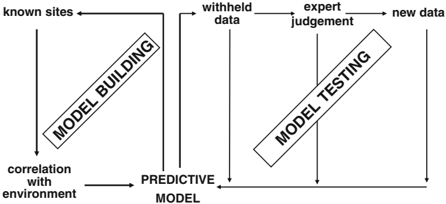

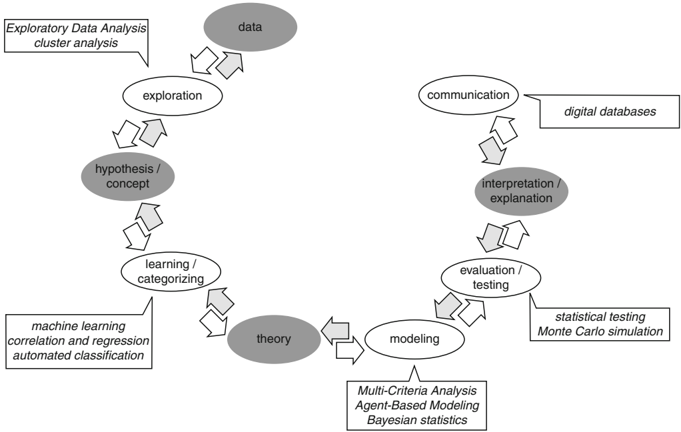
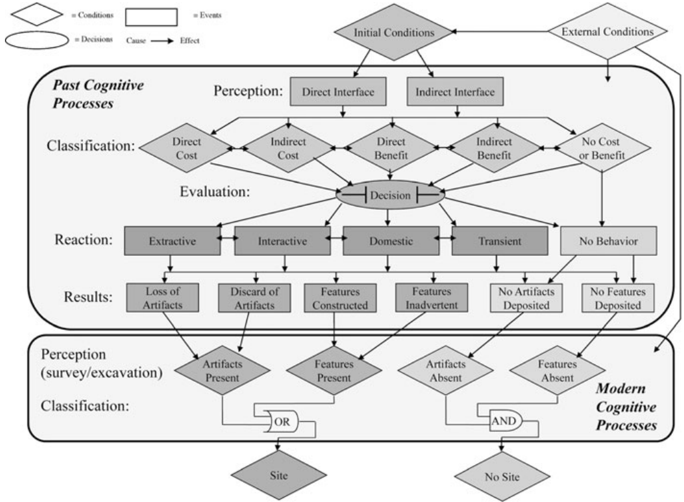
Verification
Claims the paper makes
152 Own interpretation · 41 No basis given · 18 Sources not found · 15 No full text of the sources · 7 Not checked yet · 3 Couldn’t confirm · 2 Partly supported · 1 Own method · 1 Own result · accuracy not yet measured
The cited sources that could be checked couldn’t confirm or dispute this claim.
In the paper
“The suite of applicable statistical techniques has, amongst others, been extended to Bayesian statistics (Millard 2005;Finke et al. 2008;van Leusen et al. 2009), Dempster-Shafer modeling (Ejstrud 2003(Ejstrud , 2005;;van Leusen et al. 2009), and resampling (Verhagen 2007b).”
§ Integrating Archaeological Theory and Predictive Modeling: a Live Report from the Scene > Predictive Modeling as a Scientific Endeavor
What the sources say
- Not matchedcites Millard 2005
Couldn’t be matched to a paper in Crossref, so it can’t be checked.
- Not matchedcites Ejstrud 2003
Couldn’t be matched to a paper in Crossref, so it can’t be checked.
- Could not verifycites Verhagen 2007b sourceExperimental — accuracy not yet measured
The citation to Verhagen (2007b) is attached specifically to resampling. The supplied passage about the thesis (section and page unavailable) mentions Bayesian statistics but not resampling; searches for resampling and related terms found no passage addressing its use in predictive modelling. (LLM, conf=0.72)
plain- Asserted: passes — The authors put it forward as true.
- Checkable: passes — It can be checked against evidence.
- Load-bearing: unclear — It is unclear whether the paper’s conclusions depend on it.
- Based: passes — The paper gives a reason why it holds.
- Not matched
The cited sources that could be checked couldn’t confirm or dispute this claim.
In the paper
“For a science, like archaeology, that has to deal with difficulties in obtaining decent-sized representative data sets in many cases, it offers the potential of obtaining statistically more reliable measures of predictive model quality with relatively small and non-optimal data sets (Verhagen 2007b).”
§ Integrating Archaeological Theory and Predictive Modeling: a Live Report from the Scene > Dealing with Observational Bias
What the sources say
- Could not verifycites Verhagen 2007b sourceExperimental — accuracy not yet measured
The available passage describing the thesis (section and page unavailable) mentions testing archaeological predictive models, but does not discuss resampling or whether it yields more reliable quality measures from small, non-optimal datasets. Searches for resampling, bootstrap validation, and statistically reliable measures returned no passage addressing that point. (LLM, conf=0.70)
hedgedconditional- Asserted: passes — The authors put it forward as true.
- Checkable: passes — It can be checked against evidence.
- Load-bearing: passes — The paper’s conclusions depend on it.
- Based: passes — The paper gives a reason why it holds.
- Could not verify
The cited sources support only part of this claim — read each source’s verdict below.
In the paper
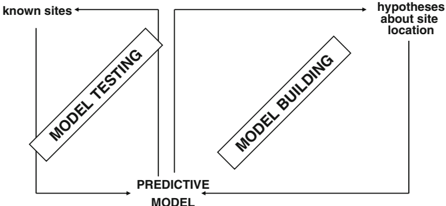
“Figure: 2 Fig. 2 Fig.2The procedure used for deductive predictive modeling.The model is created on the basis of hypotheses on site location preferences.In many cases, these are no more than”
§ Integrating Archaeological Theory and Predictive Modeling: a Live Report from the Scene > Conclusions
What the sources say
- Partly supportedcites Kamermans and Wansleeben 1999 sourceExperimental — accuracy not yet measured
The Introduction says deductive models are constructed from a priori anthropological and archaeological knowledge, supporting the claim that they begin with assumptions about site locations. It does not say those assumptions are often no more than educated guesses; the Additional information section instead calls for testing models against independent information. (LLM, conf=0.84)
plaindirect- Asserted: passes — The authors put it forward as true.
- Checkable: passes — It can be checked against evidence.
- Load-bearing: passes — The paper’s conclusions depend on it.
- Based: passes — The paper gives a reason why it holds.
- Partly supported
None of the sources cited for this claim have been checked yet.
In the paper
“While these may successfully be combined with statistical methods (Verhagen 2006;van Leusen et al. 2009), current practice still relies on either inductive or deductive modeling, not on approaches where both are combined.”
§ Integrating Archaeological Theory and Predictive Modeling: a Live Report from the Scene > Introduction
What the sources say
- Not matchedcites Verhagen 2006
Couldn’t be matched to a paper in Crossref, so it can’t be checked.
- Not checked — no full text of the sourcecites van Leusen et al. 2009 source
plain- Asserted: passes — The authors put it forward as true.
- Checkable: passes — It can be checked against evidence.
- Load-bearing: passes — The paper’s conclusions depend on it.
- Based: passes — The paper gives a reason why it holds.
- Not matched
The paper states this without a source or data behind it here, so there is nothing to check it against. The quote shows it is in the paper.
In the paper
“Archaeological theory on site location preference only plays a very limited role in these models.”
§ Integrating Archaeological Theory and Predictive Modeling: a Live Report from the Scene > Introduction
plain- Asserted: passes — The authors put it forward as true.
- Checkable: passes — It can be checked against evidence.
- Load-bearing: passes — The paper’s conclusions depend on it.
- Based: passes — The paper gives a reason why it holds.
The paper states this without a source or data behind it here, so there is nothing to check it against. The quote shows it is in the paper.
In the paper
“Understandably, given the traditional theoretical training of today's archaeologists and the powerful funding mechanisms of CRM, the focus of research in predictive modeling has been on its utility for cost savings and the improvement of existing techniques and data sets rather than pushing the envelope, so to speak, of theoretical research.”
§ Integrating Archaeological Theory and Predictive Modeling: a Live Report from the Scene > Predictive Modeling as a Scientific Endeavor
plaindirect- Asserted: passes — The authors put it forward as true.
- Checkable: passes — It can be checked against evidence.
- Load-bearing: passes — The paper’s conclusions depend on it.
- Based: passes — The paper gives a reason why it holds.
None of the sources cited for this claim could be matched to a paper in Crossref, so there is nothing to check it against.
In the paper
“However, relatively little attention has gone to the positioning of predictive modeling within a scientific research framework (but see Whitley 2004Whitley , 2005)).”
§ Integrating Archaeological Theory and Predictive Modeling: a Live Report from the Scene > Predictive Modeling as a Scientific Endeavor
What the sources say
- Not matchedcites Whitley 2004
Couldn’t be matched to a paper in Crossref, so it can’t be checked.
- Not matchedcites Whitley 2005
Couldn’t be matched to a paper in Crossref, so it can’t be checked.
plain- Asserted: passes — The authors put it forward as true.
- Checkable: passes — It can be checked against evidence.
- Load-bearing: passes — The paper’s conclusions depend on it.
- Based: passes — The paper gives a reason why it holds.
- Not matched
The paper states this without a source or data behind it here, so there is nothing to check it against. The quote shows it is in the paper.
In the paper
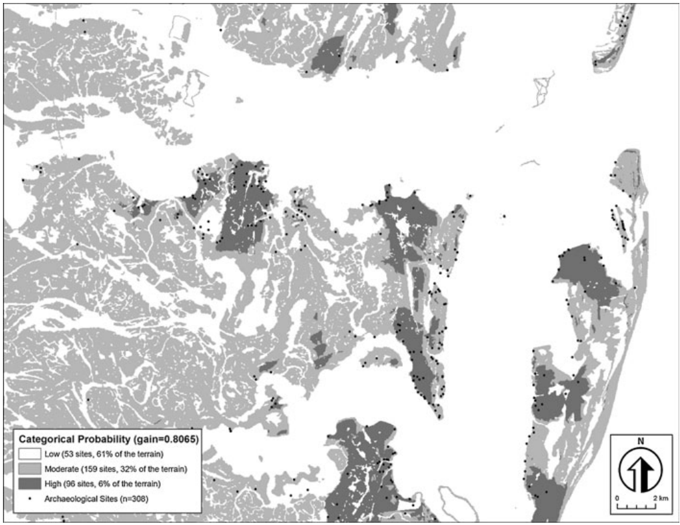
“Furthermore, almost all of the sites in low-potential areas were found along the edge of high or moderate probability areas.”
§ Integrating Archaeological Theory and Predictive Modeling: a Live Report from the Scene > Example: the Georgia Coast Model
plaincorrelational- Asserted: passes — The authors put it forward as true.
- Checkable: passes — It can be checked against evidence.
- Load-bearing: unclear — It is unclear whether the paper’s conclusions depend on it.
- Based: passes — The paper gives a reason why it holds.
The paper states this without a source or data behind it here, so there is nothing to check it against. The quote shows it is in the paper.
In the paper
“The general absence of steep slopes and the ubiquitous presence of freshwater make it impossible to use those variables as a means to limit the expected distribution of settlement choice.”
§ Integrating Archaeological Theory and Predictive Modeling: a Live Report from the Scene > Example: the Georgia Coast Model
plain- Asserted: passes — The authors put it forward as true.
- Checkable: passes — It can be checked against evidence.
- Load-bearing: passes — The paper’s conclusions depend on it.
- Based: passes — The paper gives a reason why it holds.
A result the paper reports from its own data — it cites no other source for it, so there is none to check. The quote shows it is in the paper.
In the paper
“Soil type also does not limit site selection because the archaeological sites from all periods are known from virtually all soils.”
§ Integrating Archaeological Theory and Predictive Modeling: a Live Report from the Scene > Example: the Georgia Coast Model
plain- Asserted: passes — The authors put it forward as true.
- Checkable: passes — It can be checked against evidence.
- Load-bearing: passes — The paper’s conclusions depend on it.
- Based: unclear — It is unclear why the paper says it holds.
- It may state two separate claims as one. 68
- Probably not a substantial claim. 148
- The quote only partly states this claim. 4
The cited sources that could be checked couldn’t confirm or dispute this claim.
In the paper
“However, standard methods for survey data”
§ Integrating Archaeological Theory and Predictive Modeling: a Live Report from the Scene > Dealing with Observational Bias
What the sources say
- Could not verifycites Verhagen 2007b sourceExperimental — accuracy not yet measured
The available passage (section and page not specified) says the thesis covers survey bias in data used for predictive modelling. It does not say whether standard survey-data filtering methods exist or whether their statistical basis is well developed and easily applied. Searches for those terms and for survey-bias correction found no passage addressing either point. (LLM, conf=0.72)
- Not checked — no full text of the sourcecites Finke et al. 2008 source
- Not checked — no full text of the sourcecites van Leusen et al. 2009 source
plain- Asserted: passes — The authors put it forward as true.
- Checkable: passes — It can be checked against evidence.
- Load-bearing: passes — The paper’s conclusions depend on it.
- Based: passes — The paper gives a reason why it holds.
It may state two separate claims as one.
- Could not verify
The cited sources support only part of this claim — read each source’s verdict below.
In the paper
“The model can easily be tested with statistical methods as the archaeological data set is not used for building the model.AfterKamermans and Wansleeben (1999)”
§ Integrating Archaeological Theory and Predictive Modeling: a Live Report from the Scene > Conclusions
What the sources say
- Partly supportedcites Kamermans and Wansleeben 1999 sourceExperimental — accuracy not yet measured
The Introduction says the deductive model is built from a priori knowledge and known sites are then used to evaluate it, supporting the separation between construction and testing. The Additional information section also calls for testing against independent information. Neither passage says that statistical testing is easy because the archaeological dataset was not used to build the model; the Results instead describes practical difficulties with a commonly used statistical test. (LLM, conf=0.84)
plaindirect- Asserted: passes — The authors put it forward as true.
- Checkable: passes — It can be checked against evidence.
- Load-bearing: passes — The paper’s conclusions depend on it.
- Based: passes — The paper gives a reason why it holds.
It may state two separate claims as one.
- Partly supported
In the paper
“Merely splitting the composite caloric returns surface equally into three categories (low, moderate, and high) produced a Kvamme's gain statistic 3 (Kvamme 1988) in excess of 0.80, whereas the best correlative or intuitive models did not produce better gains than 0.57 (Fig. 7).”
§ Integrating Archaeological Theory and Predictive Modeling: a Live Report from the Scene > Example: the Georgia Coast Model
What the sources say
- Not matchedcites Kvamme 1988
Couldn’t be matched to a paper in Crossref, so it can’t be checked.
plaindirectSingle case- Asserted: passes — The authors put it forward as true.
- Checkable: passes — It can be checked against evidence.
- Load-bearing: passes — The paper’s conclusions depend on it.
- Based: passes — The paper gives a reason why it holds.
It may state two separate claims as one.
- The authors state this as an assumption: Climatic conditions similar to today and a stable (modern) sea level since 4500 BP.
- The authors state this as an assumption: Maintenance and collection costs decrease over time (between 4500 and 300 BP), while hunting success and harvest rates, as well as storage potentials, increase with certain specific technological changes.
- The authors state this as an assumption: Energy conservation is a primary motivating factor for certain human spatial behaviors.
- Not matched
The paper states this without a source or data behind it here, so there is nothing to check it against. The quote shows it is in the paper.
In the paper
“In this case, 308 sites fall within the study area.”
§ Integrating Archaeological Theory and Predictive Modeling: a Live Report from the Scene > Example: the Georgia Coast Model
plain- Asserted: passes — The authors put it forward as true.
- Checkable: passes — It can be checked against evidence.
- Load-bearing: fails — The paper’s conclusions may not depend on it.
- Based: passes — The paper gives a reason why it holds.
Probably not a substantial claim. The paper’s conclusions may not depend on it.
A conclusion the paper draws from its own results — it cites no other source for it, so there is none to check. The quote shows it is in the paper.
In the paper
“In this context, the advancement of theory implies that all interpretations are not inherently equally valid and that, just as we evaluate some sites as more important (to us as archaeologists) than others, the same applies to archaeological explanations and interpretations.”
§ Integrating Archaeological Theory and Predictive Modeling: a Live Report from the Scene > The Role of Post-processual Theory
plaindirect- Asserted: passes — The authors put it forward as true.
- Checkable: fails — It may be too vague to check against evidence.
- Load-bearing: passes — The paper’s conclusions depend on it.
- Based: passes — The paper gives a reason why it holds.
Probably not a substantial claim. It may be too vague to check against evidence.
A conclusion the paper draws from its own results — it cites no other source for it, so there is none to check. The quote shows it is in the paper.
In the paper
“So, despite the wide variety of disciplines that apply predictive modeling for many kinds of analysis (of which we have not attempted to provide a comprehensive overview), it seems that the theoretical underpinning of predictive models is equally challenging whether we are dealing with mechanistic and/or biologic processes or with human decision-making.”
§ Integrating Archaeological Theory and Predictive Modeling: a Live Report from the Scene > Predictive Modeling Outside Archaeology
hedged- Asserted: passes — The authors put it forward as true.
- Checkable: fails — It may be too vague to check against evidence.
- Load-bearing: passes — The paper’s conclusions depend on it.
- Based: fails — The paper may give no reason why it holds.
Probably not a substantial claim. It may be too vague to check against evidence. The paper may give no reason why it holds.
A conclusion the paper draws from its own results — it cites no other source for it, so there is none to check. The quote shows it is in the paper.
In the paper
“Apart from that, assessing uncertainty and indeterminacy is an essential aspect of dealing with questions of prediction.”
§ Integrating Archaeological Theory and Predictive Modeling: a Live Report from the Scene > The Role of Post-processual Theory
plain- Asserted: passes — The authors put it forward as true.
- Checkable: fails — It may be too vague to check against evidence.
- Load-bearing: passes — The paper’s conclusions depend on it.
- Based: fails — The paper may give no reason why it holds.
Probably not a substantial claim. It may be too vague to check against evidence. The paper may give no reason why it holds.
In the paper
“We embrace the post-processual emphasis on pluralism, as the only way in which archaeology as a science can move forward is by looking at problems from different angles (see also Wylie 2002, pp. 171-178).”
§ Integrating Archaeological Theory and Predictive Modeling: a Live Report from the Scene > The Role of Post-processual Theory
What the sources say
- Not checked — no full text of the sourcecites Wylie 2002 source
plaindirect- Asserted: passes — The authors put it forward as true.
- Checkable: fails — It may be too vague to check against evidence.
- Load-bearing: passes — The paper’s conclusions depend on it.
- Based: passes — The paper gives a reason why it holds.
Probably not a substantial claim. It may be too vague to check against evidence. It may state two separate claims as one.
A claim is checked only against the cited paper’s full text, never its abstract, and none is available for its sources.
In the paper
“Even though the heated debate between the two schools now seems to have become somewhat outdated (see, e.g., Hegmon 2003;Johnson 2006) and not many archaeologists nowadays would profess to be adherents of the”
§ Integrating Archaeological Theory and Predictive Modeling: a Live Report from the Scene > The Role of Post-processual Theory
What the sources say
hedged- Asserted: passes — The authors put it forward as true.
- Checkable: passes — It can be checked against evidence.
- Load-bearing: unclear — It is unclear whether the paper’s conclusions depend on it.
- Based: passes — The paper gives a reason why it holds.
It may state two separate claims as one.
The paper states this without a source or data behind it here, so there is nothing to check it against. The quote shows it is in the paper.
In the paper
“The post-processual school, initially developed in the early 1980s in response to the seemingly anti-humanistic, ecosystemic, and deductive-nomological philosophy promoted by the New Archaeology, has dominated much of the archaeological theoretical discourse over the past 25 years, especially in the UK.”
§ Integrating Archaeological Theory and Predictive Modeling: a Live Report from the Scene > The Role of Post-processual Theory
plaindirect- Asserted: passes — The authors put it forward as true.
- Checkable: passes — It can be checked against evidence.
- Load-bearing: fails — The paper’s conclusions may not depend on it.
- Based: fails — The paper may give no reason why it holds.
Probably not a substantial claim. The paper’s conclusions may not depend on it. The paper may give no reason why it holds. It may state two separate claims as one.
A conclusion the paper draws from its own results — it cites no other source for it, so there is none to check. The quote shows it is in the paper.
In the paper
“As explained earlier, radical post-processualism takes the other extreme and to a large extent denies the possibility (and therefore the value) of generalization and prediction.”
§ Integrating Archaeological Theory and Predictive Modeling: a Live Report from the Scene > Middle Range Theory
plain- Asserted: passes — The authors put it forward as true.
- Checkable: passes — It can be checked against evidence.
- Load-bearing: fails — The paper’s conclusions may not depend on it.
- Based: fails — The paper may give no reason why it holds.
Probably not a substantial claim. The paper’s conclusions may not depend on it. The paper may give no reason why it holds.
A conclusion the paper draws from its own results — it cites no other source for it, so there is none to check. The quote shows it is in the paper.
In the paper
“The not-so-hidden agenda of early, radical post-processualism was therefore not to promote multiple interpretations in which”
§ Integrating Archaeological Theory and Predictive Modeling: a Live Report from the Scene > The Role of Post-processual Theory
plain- Asserted: passes — The authors put it forward as true.
- Checkable: passes — It can be checked against evidence.
- Load-bearing: unclear — It is unclear whether the paper’s conclusions depend on it.
- Based: passes — The paper gives a reason why it holds.
It may state two separate claims as one.
None of the sources cited for this claim have been checked yet.
In the paper
“Interestingly, the general methodology of predictive modeling was developed long before the first affordable GIS software became available in the mid 1980s.”
§ Integrating Archaeological Theory and Predictive Modeling: a Live Report from the Scene > Introduction
What the sources say
- Not matchedcites Plog and Hill 1971
Couldn’t be matched to a paper in Crossref, so it can’t be checked.
- Not checked — no full text of the sourcecites Green 1973 source
plain- Asserted: passes — The authors put it forward as true.
- Checkable: passes — It can be checked against evidence.
- Load-bearing: fails — The paper’s conclusions may not depend on it.
- Based: passes — The paper gives a reason why it holds.
Probably not a substantial claim. The paper’s conclusions may not depend on it.
- Not matched
The paper states this without a source or data behind it here, so there is nothing to check it against. The quote shows it is in the paper.
In the paper
“This aspect of post-processual thinking is taken aboard by many archaeologists nowadays, even though not all would see it as their principal research goal.”
§ Integrating Archaeological Theory and Predictive Modeling: a Live Report from the Scene > The Role of Post-processual Theory
hedged- Asserted: passes — The authors put it forward as true.
- Checkable: fails — It may be too vague to check against evidence.
- Load-bearing: fails — The paper’s conclusions may not depend on it.
- Based: fails — The paper may give no reason why it holds.
Probably not a substantial claim. It may be too vague to check against evidence. The paper’s conclusions may not depend on it. The paper may give no reason why it holds.
A conclusion the paper draws from its own results — it cites no other source for it, so there is none to check. The quote shows it is in the paper.
In the paper
“However, it was not embraced by many and seems to have faded into oblivion.”
§ Integrating Archaeological Theory and Predictive Modeling: a Live Report from the Scene > The Role of Post-processual Theory
hedged- Asserted: passes — The authors put it forward as true.
- Checkable: passes — It can be checked against evidence.
- Load-bearing: fails — The paper’s conclusions may not depend on it.
- Based: fails — The paper may give no reason why it holds.
Probably not a substantial claim. The paper’s conclusions may not depend on it. The paper may give no reason why it holds. It may state two separate claims as one.
In the paper
“It is however not usually seen in a post-processual light (but see Hegmon 2003) and has failed to make a breakthrough into mainstream archaeology up to now not only partly because of the technical difficulties involved but also because of the simplicity of the rules employed.”
§ Integrating Archaeological Theory and Predictive Modeling: a Live Report from the Scene > The Role of Post-processual Theory
What the sources say
- Not checked — no full text of the sourcecites Hegmon 2003 source
plaindirect- Asserted: passes — The authors put it forward as true.
- Checkable: passes — It can be checked against evidence.
- Load-bearing: unclear — It is unclear whether the paper’s conclusions depend on it.
- Based: passes — The paper gives a reason why it holds.
It may state two separate claims as one.
The paper states this without a source or data behind it here, so there is nothing to check it against. The quote shows it is in the paper.
In the paper
“Instead, the role of individuals (”
§ Integrating Archaeological Theory and Predictive Modeling: a Live Report from the Scene > The Role of Post-processual Theory
plaindirect- Asserted: passes — The authors put it forward as true.
- Checkable: passes — It can be checked against evidence.
- Load-bearing: fails — The paper’s conclusions may not depend on it.
- Based: passes — The paper gives a reason why it holds.
Probably not a substantial claim. The paper’s conclusions may not depend on it.
A conclusion the paper draws from its own results — it cites no other source for it, so there is none to check. The quote shows it is in the paper.
In the paper
“And while predictive models based on such theories may then seem to produce reasonable results from a CRM perspective (like predicting 70% of the archaeological site sample”
§ Integrating Archaeological Theory and Predictive Modeling: a Live Report from the Scene > Predictive Modeling as a Scientific Endeavor
hedged- Asserted: passes — The authors put it forward as true.
- Checkable: passes — It can be checked against evidence.
- Load-bearing: passes — The paper’s conclusions depend on it.
- Based: passes — The paper gives a reason why it holds.
It may state two separate claims as one. The quote only partly states this claim.
A conclusion the paper draws from its own results — it cites no other source for it, so there is none to check. The quote shows it is in the paper.
In the paper
“We want to stress however that the dichotomy between the”
§ Integrating Archaeological Theory and Predictive Modeling: a Live Report from the Scene > Introduction
plaindirect- Asserted: passes — The authors put it forward as true.
- Checkable: passes — It can be checked against evidence.
- Load-bearing: passes — The paper’s conclusions depend on it.
- Based: fails — The paper may give no reason why it holds.
Probably not a substantial claim. The paper may give no reason why it holds.
The paper states this without a source or data behind it here, so there is nothing to check it against. The quote shows it is in the paper.
In the paper
“Furthermore, postprocessualism emphasizes the importance of individual experience.”
§ Integrating Archaeological Theory and Predictive Modeling: a Live Report from the Scene > The Role of Post-processual Theory
plain- Asserted: passes — The authors put it forward as true.
- Checkable: passes — It can be checked against evidence.
- Load-bearing: fails — The paper’s conclusions may not depend on it.
- Based: passes — The paper gives a reason why it holds.
Probably not a substantial claim. The paper’s conclusions may not depend on it.
A conclusion the paper draws from its own results — it cites no other source for it, so there is none to check. The quote shows it is in the paper.
In the paper
“In fact, it incorporates two important characteristics of post-processual thought in a quantitative, dynamical modeling framework by explicitly including the role of agents in creating (spatial) patterns and by allowing for multiple model outcomes and thus multiple interpretations.”
§ Integrating Archaeological Theory and Predictive Modeling: a Live Report from the Scene > The Role of Post-processual Theory
plaindirect- Asserted: passes — The authors put it forward as true.
- Checkable: passes — It can be checked against evidence.
- Load-bearing: passes — The paper’s conclusions depend on it.
- Based: passes — The paper gives a reason why it holds.
It may state two separate claims as one.
A conclusion the paper draws from its own results — it cites no other source for it, so there is none to check. The quote shows it is in the paper.
In the paper
“What makes archaeological predictive modeling perhaps even more demanding is the fact that it is a discipline in which both lines of inquiry can play a role.”
§ Integrating Archaeological Theory and Predictive Modeling: a Live Report from the Scene > Predictive Modeling Outside Archaeology
hedgeddirect- Asserted: passes — The authors put it forward as true.
- Checkable: fails — It may be too vague to check against evidence.
- Load-bearing: passes — The paper’s conclusions depend on it.
- Based: fails — The paper may give no reason why it holds.
Probably not a substantial claim. It may be too vague to check against evidence. The paper may give no reason why it holds.
A conclusion the paper draws from its own results — it cites no other source for it, so there is none to check. The quote shows it is in the paper.
In the paper
“Scientific methods are essential to this.”
§ Integrating Archaeological Theory and Predictive Modeling: a Live Report from the Scene > The Role of Post-processual Theory
plaindirect- Asserted: passes — The authors put it forward as true.
- Checkable: fails — It may be too vague to check against evidence.
- Load-bearing: passes — The paper’s conclusions depend on it.
- Based: passes — The paper gives a reason why it holds.
Probably not a substantial claim. It may be too vague to check against evidence.
A conclusion the paper draws from its own results — it cites no other source for it, so there is none to check. The quote shows it is in the paper.
In the paper
“Theory, when it is considered at all, is either assumed to be existing and only needing extrapolation or it is reduced to specifying rather simplistic (ecological) cause-effect relationships that can be fit to the available environmental data sets.”
§ Integrating Archaeological Theory and Predictive Modeling: a Live Report from the Scene > Predictive Modeling as a Scientific Endeavor
plain- Asserted: passes — The authors put it forward as true.
- Checkable: passes — It can be checked against evidence.
- Load-bearing: passes — The paper’s conclusions depend on it.
- Based: fails — The paper may give no reason why it holds.
Probably not a substantial claim. The paper may give no reason why it holds. It may state two separate claims as one.
A conclusion the paper draws from its own results — it cites no other source for it, so there is none to check. The quote shows it is in the paper.
In the paper
“These approaches are much more controversial and do not seem directly relevant to predictive modeling, although they do suggest that archaeologists are beginning to understand the need to recreate past cognitive processes.”
§ Integrating Archaeological Theory and Predictive Modeling: a Live Report from the Scene > The Role of Post-processual Theory
hedged- Asserted: passes — The authors put it forward as true.
- Checkable: fails — It may be too vague to check against evidence.
- Load-bearing: fails — The paper’s conclusions may not depend on it.
- Based: fails — The paper may give no reason why it holds.
Probably not a substantial claim. It may be too vague to check against evidence. The paper’s conclusions may not depend on it. The paper may give no reason why it holds. It may state two separate claims as one.
A conclusion the paper draws from its own results — it cites no other source for it, so there is none to check. The quote shows it is in the paper.
In the paper
“So, while predictive modeling is from a scientific point of view a perfectly laudable and worthwhile enterprise that can be used to extend theories of spatial patterning into testable generalizations, in practice it stumbles when dealing with developing and testing site location theories in archaeology.”
§ Integrating Archaeological Theory and Predictive Modeling: a Live Report from the Scene > Predictive Modeling as a Scientific Endeavor
plain- Asserted: passes — The authors put it forward as true.
- Checkable: unclear — It is unclear whether it could be checked against evidence.
- Load-bearing: passes — The paper’s conclusions depend on it.
- Based: passes — The paper gives a reason why it holds.
It may state two separate claims as one.
A conclusion the paper draws from its own results — it cites no other source for it, so there is none to check. The quote shows it is in the paper.
In the paper
“In many instances, the data used for predictive modeling were never collected with the explicit aim of constructing a predictive model from it, creating all kinds of bias that are undesired from a statistical ( testing) point of view.”
§ Integrating Archaeological Theory and Predictive Modeling: a Live Report from the Scene > Predictive Modeling as a Scientific Endeavor
plaindirect- Asserted: passes — The authors put it forward as true.
- Checkable: passes — It can be checked against evidence.
- Load-bearing: passes — The paper’s conclusions depend on it.
- Based: fails — The paper may give no reason why it holds.
Probably not a substantial claim. The paper may give no reason why it holds. It may state two separate claims as one.
A conclusion the paper draws from its own results — it cites no other source for it, so there is none to check. The quote shows it is in the paper.
In the paper
“It will be clear that the exploratory (theory building) and testing phases in this scheme are the most problematic for predictive modeling.”
§ Integrating Archaeological Theory and Predictive Modeling: a Live Report from the Scene > Predictive Modeling as a Scientific Endeavor
boosted- Asserted: passes — The authors put it forward as true.
- Checkable: passes — It can be checked against evidence.
- Load-bearing: passes — The paper’s conclusions depend on it.
- Based: fails — The paper may give no reason why it holds.
Probably not a substantial claim. The paper may give no reason why it holds.
A conclusion the paper draws from its own results — it cites no other source for it, so there is none to check. The quote shows it is in the paper.
In the paper
“These criteria are however not unproblematic, and we will try to illustrate this in the next section.”
§ Integrating Archaeological Theory and Predictive Modeling: a Live Report from the Scene > Middle Range Theory
plain- Asserted: passes — The authors put it forward as true.
- Checkable: passes — It can be checked against evidence.
- Load-bearing: fails — The paper’s conclusions may not depend on it.
- Based: fails — The paper may give no reason why it holds.
Probably not a substantial claim. The paper’s conclusions may not depend on it. The paper may give no reason why it holds.
A conclusion the paper draws from its own results — it cites no other source for it, so there is none to check. The quote shows it is in the paper.
In the paper
“Most attempts to combine processual and post-processual thought in modeling however cannot be considered very successful.”
§ Integrating Archaeological Theory and Predictive Modeling: a Live Report from the Scene > The Role of Post-processual Theory
plain- Asserted: passes — The authors put it forward as true.
- Checkable: passes — It can be checked against evidence.
- Load-bearing: fails — The paper’s conclusions may not depend on it.
- Based: passes — The paper gives a reason why it holds.
Probably not a substantial claim. The paper’s conclusions may not depend on it.
A conclusion the paper draws from its own results — it cites no other source for it, so there is none to check. The quote shows it is in the paper.
In the paper
“Middle range theory is then the critical bridge between general theory and empirical data, in which both inductive and deductive perspectives can be effective.”
§ Integrating Archaeological Theory and Predictive Modeling: a Live Report from the Scene > Middle Range Theory
plaindirect- Asserted: passes — The authors put it forward as true.
- Checkable: fails — It may be too vague to check against evidence.
- Load-bearing: passes — The paper’s conclusions depend on it.
- Based: passes — The paper gives a reason why it holds.
Probably not a substantial claim. It may be too vague to check against evidence. It may state two separate claims as one.
A conclusion the paper draws from its own results — it cites no other source for it, so there is none to check. The quote shows it is in the paper.
In the paper
“A predictive model which recommends a less intensive survey strategy for some areas is then merely classifying some sites as being of lesser importance than others”
§ Integrating Archaeological Theory and Predictive Modeling: a Live Report from the Scene > Introduction
plaindirect- Asserted: passes — The authors put it forward as true.
- Checkable: fails — It may be too vague to check against evidence.
- Load-bearing: fails — The paper’s conclusions may not depend on it.
- Based: passes — The paper gives a reason why it holds.
Probably not a substantial claim. It may be too vague to check against evidence. The paper’s conclusions may not depend on it.
A conclusion the paper draws from its own results — it cites no other source for it, so there is none to check. The quote shows it is in the paper.
In the paper
“This assumption is made without regard to whether the prehistoric farmers had the ability to measure and track slight differences in soil fertility across the landscape and place settlements accordingly.”
§ Integrating Archaeological Theory and Predictive Modeling: a Live Report from the Scene > Predictive Modeling as a Scientific Endeavor
plain- Asserted: passes — The authors put it forward as true.
- Checkable: fails — It may be too vague to check against evidence.
- Load-bearing: fails — The paper’s conclusions may not depend on it.
- Based: fails — The paper may give no reason why it holds.
Probably not a substantial claim. It may be too vague to check against evidence. The paper’s conclusions may not depend on it. The paper may give no reason why it holds.
The paper states this without a source or data behind it here, so there is nothing to check it against. The quote shows it is in the paper.
In the paper
“Especially North American prehistoric archaeologists are still reluctant to see agency as a useful concept for their research.”
§ Integrating Archaeological Theory and Predictive Modeling: a Live Report from the Scene > The Role of Post-processual Theory
plain- Asserted: passes — The authors put it forward as true.
- Checkable: passes — It can be checked against evidence.
- Load-bearing: fails — The paper’s conclusions may not depend on it.
- Based: fails — The paper may give no reason why it holds.
Probably not a substantial claim. The paper’s conclusions may not depend on it. The paper may give no reason why it holds.
A conclusion the paper draws from its own results — it cites no other source for it, so there is none to check. The quote shows it is in the paper.
In the paper
“Archaeology in that sense takes an intermediate position as it combines elements of both.”
§ Integrating Archaeological Theory and Predictive Modeling: a Live Report from the Scene > Predictive Modeling Outside Archaeology
plaincorrelational- Asserted: passes — The authors put it forward as true.
- Checkable: passes — It can be checked against evidence.
- Load-bearing: fails — The paper’s conclusions may not depend on it.
- Based: passes — The paper gives a reason why it holds.
Probably not a substantial claim. The paper’s conclusions may not depend on it.
In the paper
“Tschauner (1996) states that most archaeological theory building can be characterized by generalizations in two forms:”
§ Integrating Archaeological Theory and Predictive Modeling: a Live Report from the Scene > Predictive Modeling as a Scientific Endeavor
What the sources say
- Not checked — no full text of the sourcecites Tschauner 1996 source
plain- Asserted: passes — The authors put it forward as true.
- Checkable: passes — It can be checked against evidence.
- Load-bearing: fails — The paper’s conclusions may not depend on it.
- Based: passes — The paper gives a reason why it holds.
Probably not a substantial claim. The paper’s conclusions may not depend on it.
A claim is checked only against the cited paper’s full text, never its abstract, and none is available for its sources.
In the paper
“The absence of causality in such statements would draw considerable criticism from philosophers of science (e.g., Salmon 1971Salmon , 1998)).”
§ Integrating Archaeological Theory and Predictive Modeling: a Live Report from the Scene > Predictive Modeling as a Scientific Endeavor
What the sources say
hedged- Asserted: passes — The authors put it forward as true.
- Checkable: fails — It may be too vague to check against evidence.
- Load-bearing: passes — The paper’s conclusions depend on it.
- Based: passes — The paper gives a reason why it holds.
Probably not a substantial claim. It may be too vague to check against evidence.
None of the sources cited for this claim have been checked yet.
In the paper
“By the 1980s, two primary lines of research were being called predictive models: first, a largely theoretical series of models based on the use of ecosystemic structures and relationships to identify spatial suitability (e.g., Jochim 1976Jochim , 1981;;Bettinger 1980) but which had no substantial quantitative evaluation of a spatial area (in the same sense as we would expect in a GIS) and, second,”
§ Integrating Archaeological Theory and Predictive Modeling: a Live Report from the Scene > Introduction
What the sources say
- Not matchedcites Jochim 1976
Couldn’t be matched to a paper in Crossref, so it can’t be checked.
- Not checked — no full text of the sourcecites Bettinger 1980 source
- Not matchedcites Kvamme 1983
Couldn’t be matched to a paper in Crossref, so it can’t be checked.
plain- Asserted: passes — The authors put it forward as true.
- Checkable: passes — It can be checked against evidence.
- Load-bearing: passes — The paper’s conclusions depend on it.
- Based: passes — The paper gives a reason why it holds.
It may state two separate claims as one.
- Not matched
A conclusion the paper draws from its own results — it cites no other source for it, so there is none to check. The quote shows it is in the paper.
In the paper
“The entire notion of a”
§ Integrating Archaeological Theory and Predictive Modeling: a Live Report from the Scene > Introduction
plaindirect- Asserted: passes — The authors put it forward as true.
- Checkable: fails — It may be too vague to check against evidence.
- Load-bearing: passes — The paper’s conclusions depend on it.
- Based: fails — The paper may give no reason why it holds.
Probably not a substantial claim. It may be too vague to check against evidence. The paper may give no reason why it holds.
A conclusion the paper draws from its own results — it cites no other source for it, so there is none to check. The quote shows it is in the paper.
In the paper
“GIS is routinely applied as a tool for”
§ Integrating Archaeological Theory and Predictive Modeling: a Live Report from the Scene > The Role of Post-processual Theory
plain- Asserted: passes — The authors put it forward as true.
- Checkable: passes — It can be checked against evidence.
- Load-bearing: passes — The paper’s conclusions depend on it.
- Based: passes — The paper gives a reason why it holds.
Probably not a substantial claim. It may state two separate claims as one.
A conclusion the paper draws from its own results — it cites no other source for it, so there is none to check. The quote shows it is in the paper.
In the paper
“Its appreciation in academic circles however has been mixed because of its perceived theoretical poverty.”
§ Integrating Archaeological Theory and Predictive Modeling: a Live Report from the Scene > Abstract
plaindirect- Asserted: passes — The authors put it forward as true.
- Checkable: passes — It can be checked against evidence.
- Load-bearing: passes — The paper’s conclusions depend on it.
- Based: fails — The paper may give no reason why it holds.
Probably not a substantial claim. The paper may give no reason why it holds.
A conclusion the paper draws from its own results — it cites no other source for it, so there is none to check. The quote shows it is in the paper.
In the paper
“Furthermore, the theory building that should go on between the phases of data exploration and extrapolation is currently often neglected.”
§ Integrating Archaeological Theory and Predictive Modeling: a Live Report from the Scene > Predictive Modeling as a Scientific Endeavor
plain- Asserted: passes — The authors put it forward as true.
- Checkable: fails — It may be too vague to check against evidence.
- Load-bearing: passes — The paper’s conclusions depend on it.
- Based: fails — The paper may give no reason why it holds.
Probably not a substantial claim. It may be too vague to check against evidence. The paper may give no reason why it holds.
A conclusion the paper draws from its own results — it cites no other source for it, so there is none to check. The quote shows it is in the paper.
In the paper
“From a modeling perspective, middle range theory is an obvious candidate.”
§ Integrating Archaeological Theory and Predictive Modeling: a Live Report from the Scene > Middle Range Theory
boosteddirect- Asserted: passes — The authors put it forward as true.
- Checkable: fails — It may be too vague to check against evidence.
- Load-bearing: passes — The paper’s conclusions depend on it.
- Based: fails — The paper may give no reason why it holds.
Probably not a substantial claim. It may be too vague to check against evidence. The paper may give no reason why it holds.
In the paper
“This has led some archaeologists to fully embrace phenomenology and try to engage the mindset of prehistoric people by simulating an immersion in their environment, by installing doorframes in the landscape, for example, in order to understand what it would be like to look at the landscape from inside a dwelling (see, e.g., Tilley et al. 2000).”
§ Integrating Archaeological Theory and Predictive Modeling: a Live Report from the Scene > The Role of Post-processual Theory
What the sources say
- Not checked — no full text of the sourcecites Tilley et al. 2000 source
plaindirect- Asserted: passes — The authors put it forward as true.
- Checkable: passes — It can be checked against evidence.
- Load-bearing: fails — The paper’s conclusions may not depend on it.
- Based: passes — The paper gives a reason why it holds.
Probably not a substantial claim. The paper’s conclusions may not depend on it.
A conclusion the paper draws from its own results — it cites no other source for it, so there is none to check. The quote shows it is in the paper.
In the paper
“For example, the assumption that prehistoric farmers would have preferred fertile land for agriculture is hardly contentious.However, when asked where this land might have been, how much of it would have been necessary to support the population, and where settlements might have been located with regard to the accessibility of this land or any other resources, theory readily gives way to the basic”
§ Integrating Archaeological Theory and Predictive Modeling: a Live Report from the Scene > Predictive Modeling as a Scientific Endeavor
hedgeddirect- Asserted: passes — The authors put it forward as true.
- Checkable: fails — It may be too vague to check against evidence.
- Load-bearing: fails — The paper’s conclusions may not depend on it.
- Based: fails — The paper may give no reason why it holds.
Probably not a substantial claim. It may be too vague to check against evidence. The paper’s conclusions may not depend on it. The paper may give no reason why it holds. It may state two separate claims as one. The quote only partly states this claim.
- The authors state this as an assumption: Prehistoric farmers would have preferred fertile land for agriculture.
- The authors state this as an assumption: Certain soil types are more productive than others and therefore supported more settlements.
The paper states this without a source or data behind it here, so there is nothing to check it against. The quote shows it is in the paper.
In the paper
“Furthermore, the classification schemes used for soil maps are intended for modern agricultural land suitability valuation purposes.”
§ Integrating Archaeological Theory and Predictive Modeling: a Live Report from the Scene > Predictive Modeling as a Scientific Endeavor
plain- Asserted: passes — The authors put it forward as true.
- Checkable: passes — It can be checked against evidence.
- Load-bearing: fails — The paper’s conclusions may not depend on it.
- Based: fails — The paper may give no reason why it holds.
Probably not a substantial claim. The paper’s conclusions may not depend on it. The paper may give no reason why it holds.
In the paper
“We consider pluralism in the refutationist tradition of setting up multiple models and theories that can be tested and compared in order to reveal weaknesses and thus contribute to the advancement of theory (Bell 1994).”
§ Integrating Archaeological Theory and Predictive Modeling: a Live Report from the Scene > The Role of Post-processual Theory
What the sources say
- Not matchedcites Bell 1994
Couldn’t be matched to a paper in Crossref, so it can’t be checked.
plain- Asserted: passes — The authors put it forward as true.
- Checkable: passes — It can be checked against evidence.
- Load-bearing: passes — The paper’s conclusions depend on it.
- Based: passes — The paper gives a reason why it holds.
Probably not a substantial claim.
- Not matched
In the paper
“While the modern view of land suitability may bear some relation to the (pre-)historic perception of land quality, this is by no means a straightforward relationship (see, e.g., Favory and van der Leeuw 1998, pp. 278-284).”
§ Integrating Archaeological Theory and Predictive Modeling: a Live Report from the Scene > Predictive Modeling as a Scientific Endeavor
What the sources say
- Not checked — no full text of the sourcecites Favory and van der Leeuw 1998 source
hedgedcorrelational- Asserted: passes — The authors put it forward as true.
- Checkable: passes — It can be checked against evidence.
- Load-bearing: passes — The paper’s conclusions depend on it.
- Based: passes — The paper gives a reason why it holds.
It may state two separate claims as one.
In the paper
“First of all, the accuracy and amount of detail of these can vary greatly; digital elevation models are especially notorious in this respect, and any errors in the original elevation maps will also have repercussions on the accuracy of derived data like slope maps, cost surfaces, and viewsheds (see, e.g., Nackaerts et al. 1999).”
§ Integrating Archaeological Theory and Predictive Modeling: a Live Report from the Scene > Predictive Modeling as a Scientific Endeavor
What the sources say
- Not checked — no full text of the sourcecites Nackaerts et al. 1999 source
plaindirect- Asserted: passes — The authors put it forward as true.
- Checkable: passes — It can be checked against evidence.
- Load-bearing: unclear — It is unclear whether the paper’s conclusions depend on it.
- Based: passes — The paper gives a reason why it holds.
It may state two separate claims as one.
A conclusion the paper draws from its own results — it cites no other source for it, so there is none to check. The quote shows it is in the paper.
In the paper
“From the foregoing, we conclude that the main problem with (hard-core) postprocessualism with regard to modeling is found in its rejection of scientific methods, in the mistaken assumption that using these will automatically lead to”
§ Integrating Archaeological Theory and Predictive Modeling: a Live Report from the Scene > The Role of Post-processual Theory
boosteddirect- Asserted: passes — The authors put it forward as true.
- Checkable: passes — It can be checked against evidence.
- Load-bearing: passes — The paper’s conclusions depend on it.
- Based: passes — The paper gives a reason why it holds.
It may state two separate claims as one.
A conclusion the paper draws from its own results — it cites no other source for it, so there is none to check. The quote shows it is in the paper.
In the paper
“It is therefore inaccurate to assume that GIS has been the main factor influencing the initial development of predictive modeling, although it certainly helped its further proliferation in the 1990s.”
§ Integrating Archaeological Theory and Predictive Modeling: a Live Report from the Scene > Introduction
plaindirect- Asserted: passes — The authors put it forward as true.
- Checkable: passes — It can be checked against evidence.
- Load-bearing: unclear — It is unclear whether the paper’s conclusions depend on it.
- Based: passes — The paper gives a reason why it holds.
It may state two separate claims as one.
A conclusion the paper draws from its own results — it cites no other source for it, so there is none to check. The quote shows it is in the paper.
In the paper
“If we focused on understanding how people inhabit and use their environment from a cognitive perspective and not by where they accumulate their detritus, then the”
§ Integrating Archaeological Theory and Predictive Modeling: a Live Report from the Scene > Introduction
plaindirect- Asserted: passes — The authors put it forward as true.
- Checkable: fails — It may be too vague to check against evidence.
- Load-bearing: passes — The paper’s conclusions depend on it.
- Based: passes — The paper gives a reason why it holds.
Probably not a substantial claim. It may be too vague to check against evidence.
A conclusion the paper draws from its own results — it cites no other source for it, so there is none to check. The quote shows it is in the paper.
In the paper
“Especially in areas that are predicted to be of”
§ Integrating Archaeological Theory and Predictive Modeling: a Live Report from the Scene > Introduction
plainconditional- Asserted: passes — The authors put it forward as true.
- Checkable: passes — It can be checked against evidence.
- Load-bearing: passes — The paper’s conclusions depend on it.
- Based: fails — The paper may give no reason why it holds.
Probably not a substantial claim. The paper may give no reason why it holds. It may state two separate claims as one.
A conclusion the paper draws from its own results — it cites no other source for it, so there is none to check. The quote shows it is in the paper.
In the paper
“In fact, other disciplines do not fare much better, although some of these might seem to be better equipped with tested and testable theories.”
§ Integrating Archaeological Theory and Predictive Modeling: a Live Report from the Scene > Predictive Modeling Outside Archaeology
hedged- Asserted: passes — The authors put it forward as true.
- Checkable: fails — It may be too vague to check against evidence.
- Load-bearing: fails — The paper’s conclusions may not depend on it.
- Based: fails — The paper may give no reason why it holds.
Probably not a substantial claim. It may be too vague to check against evidence. The paper’s conclusions may not depend on it. The paper may give no reason why it holds. It may state two separate claims as one. The quote only partly states this claim.
The paper states this without a source or data behind it here, so there is nothing to check it against. The quote shows it is in the paper.
In the paper
“Firstly, post-processual theory usually strongly downplays the determining influence on human behavior of both the natural environment and cultural”
§ Integrating Archaeological Theory and Predictive Modeling: a Live Report from the Scene > The Role of Post-processual Theory
boosteddirect- Asserted: passes — The authors put it forward as true.
- Checkable: passes — It can be checked against evidence.
- Load-bearing: passes — The paper’s conclusions depend on it.
- Based: fails — The paper may give no reason why it holds.
Probably not a substantial claim. The paper may give no reason why it holds.
A conclusion the paper draws from its own results — it cites no other source for it, so there is none to check. The quote shows it is in the paper.
In the paper
“The tension between these goals is evident, and when applied in this way it is virtually impossible to connect fundamental theory to actual data.”
§ Integrating Archaeological Theory and Predictive Modeling: a Live Report from the Scene > Middle Range Theory
plaindirect- Asserted: passes — The authors put it forward as true.
- Checkable: fails — It may be too vague to check against evidence.
- Load-bearing: passes — The paper’s conclusions depend on it.
- Based: fails — The paper may give no reason why it holds.
Probably not a substantial claim. It may be too vague to check against evidence. The paper may give no reason why it holds. It may state two separate claims as one.
A conclusion the paper draws from its own results — it cites no other source for it, so there is none to check. The quote shows it is in the paper.
In the paper
“In the final probability assessment, it is this very decision which is being modeled.”
§ Integrating Archaeological Theory and Predictive Modeling: a Live Report from the Scene > Cognitive Predictive Modeling
plain- Asserted: passes — The authors put it forward as true.
- Checkable: fails — It may be too vague to check against evidence.
- Load-bearing: fails — The paper’s conclusions may not depend on it.
- Based: fails — The paper may give no reason why it holds.
Probably not a substantial claim. It may be too vague to check against evidence. The paper’s conclusions may not depend on it. The paper may give no reason why it holds.
A conclusion the paper draws from its own results — it cites no other source for it, so there is none to check. The quote shows it is in the paper.
In the paper
“and, as we stated earlier, modeling is a way of opening up a theory to testing.”
§ Integrating Archaeological Theory and Predictive Modeling: a Live Report from the Scene > Model Testing
plaindirect- Asserted: passes — The authors put it forward as true.
- Checkable: fails — It may be too vague to check against evidence.
- Load-bearing: passes — The paper’s conclusions depend on it.
- Based: fails — The paper may give no reason why it holds.
Probably not a substantial claim. It may be too vague to check against evidence. The paper may give no reason why it holds.
In the paper
“Surprisingly enough, there is very little work done on these issues even though the importance of”
§ Integrating Archaeological Theory and Predictive Modeling: a Live Report from the Scene > Dealing with Observational Bias
What the sources say
- Not matchedcites Mischka 2008
Couldn’t be matched to a paper in Crossref, so it can’t be checked.
plain- Asserted: passes — The authors put it forward as true.
- Checkable: passes — It can be checked against evidence.
- Load-bearing: passes — The paper’s conclusions depend on it.
- Based: passes — The paper gives a reason why it holds.
It may state two separate claims as one.
- Not matched
The paper states this without a source or data behind it here, so there is nothing to check it against. The quote shows it is in the paper.
In the paper
“Even in the late 1990s, setting up and calculating a suite of scenarios in a GIS could take weeks or months, which would make it highly impractical to pursue a multitude of models.”
§ Integrating Archaeological Theory and Predictive Modeling: a Live Report from the Scene > Example: the Georgia Coast Model
hedgeddirect- Asserted: passes — The authors put it forward as true.
- Checkable: passes — It can be checked against evidence.
- Load-bearing: passes — The paper’s conclusions depend on it.
- Based: fails — The paper may give no reason why it holds.
Probably not a substantial claim. The paper may give no reason why it holds. It may state two separate claims as one.
A conclusion the paper draws from its own results — it cites no other source for it, so there is none to check. The quote shows it is in the paper.
In the paper
“Many manifestations of material culture are evidence of group rather than individual actions, but the methodology for dealing with the agency of social collectives seems to be underdeveloped.”
§ Integrating Archaeological Theory and Predictive Modeling: a Live Report from the Scene > Group Agency
hedged- Asserted: passes — The authors put it forward as true.
- Checkable: passes — It can be checked against evidence.
- Load-bearing: passes — The paper’s conclusions depend on it.
- Based: fails — The paper may give no reason why it holds.
Probably not a substantial claim. The paper may give no reason why it holds. It may state two separate claims as one.
A conclusion the paper draws from its own results — it cites no other source for it, so there is none to check. The quote shows it is in the paper.
In the paper
“The modeling itself is no longer the problembut developing and translating the necessary theory still is.”
§ Integrating Archaeological Theory and Predictive Modeling: a Live Report from the Scene > Example: the Georgia Coast Model
plain- Asserted: passes — The authors put it forward as true.
- Checkable: fails — It may be too vague to check against evidence.
- Load-bearing: passes — The paper’s conclusions depend on it.
- Based: passes — The paper gives a reason why it holds.
Probably not a substantial claim. It may be too vague to check against evidence. It may state two separate claims as one.
A conclusion the paper draws from its own results — it cites no other source for it, so there is none to check. The quote shows it is in the paper.
In the paper
“3. Binford's notion of uniformitarian assumptions is satisfied if we consider his meaning to have been that the explanations presented in this model do not require the adoption of general rules of human behavior that do not apply in other areas under other conditions.”
§ Integrating Archaeological Theory and Predictive Modeling: a Live Report from the Scene > Example: the Georgia Coast Model
hedged- Asserted: passes — The authors put it forward as true.
- Checkable: fails — It may be too vague to check against evidence.
- Load-bearing: fails — The paper’s conclusions may not depend on it.
- Based: fails — The paper may give no reason why it holds.
Probably not a substantial claim. It may be too vague to check against evidence. The paper’s conclusions may not depend on it. The paper may give no reason why it holds.
A conclusion the paper draws from its own results — it cites no other source for it, so there is none to check. The quote shows it is in the paper.
In the paper
“& The theory clearly provides plausible causes (population increase and associated social change) for demonstrable effects (the introduction of celtic field agriculture and a change in mortuary practice coupled to territorial division of the land).”
§ Integrating Archaeological Theory and Predictive Modeling: a Live Report from the Scene > Elucidating Middle Range Theory: Urnfields and Settlement in the Southern Netherlands
boosteddirect- Asserted: passes — The authors put it forward as true.
- Checkable: passes — It can be checked against evidence.
- Load-bearing: passes — The paper’s conclusions depend on it.
- Based: fails — The paper may give no reason why it holds.
Probably not a substantial claim. The paper may give no reason why it holds.
A conclusion the paper draws from its own results — it cites no other source for it, so there is none to check. The quote shows it is in the paper.
In the paper
“In all other cases, confirming observations do not prove the veracity of a model; they only support its probability.”
§ Integrating Archaeological Theory and Predictive Modeling: a Live Report from the Scene > Model Testing
plain- Asserted: passes — The authors put it forward as true.
- Checkable: passes — It can be checked against evidence.
- Load-bearing: fails — The paper’s conclusions may not depend on it.
- Based: fails — The paper may give no reason why it holds.
Probably not a substantial claim. The paper’s conclusions may not depend on it. The paper may give no reason why it holds.
A conclusion the paper draws from its own results — it cites no other source for it, so there is none to check. The quote shows it is in the paper.
In the paper
“2. The process of decision-making presented is distinctly cause and effect, not correlative.”
§ Integrating Archaeological Theory and Predictive Modeling: a Live Report from the Scene > Example: the Georgia Coast Model
plaindirect- Asserted: passes — The authors put it forward as true.
- Checkable: passes — It can be checked against evidence.
- Load-bearing: passes — The paper’s conclusions depend on it.
- Based: fails — The paper may give no reason why it holds.
Probably not a substantial claim. The paper may give no reason why it holds.
None of the sources cited for this claim could be matched to a paper in Crossref, so there is nothing to check it against.
In the paper
“Not surprisingly, it was concluded that probabilistic sampling is a necessary precondition for collecting data sets to be used for testing as this is the only way to obtain statistically reliable predictions and thus avoid the problem of observational bias.”
§ Integrating Archaeological Theory and Predictive Modeling: a Live Report from the Scene > Dealing with Observational Bias
What the sources say
- Not matchedcites Rose and Altschul 1988
Couldn’t be matched to a paper in Crossref, so it can’t be checked.
- Not matchedcites Kvamme 1988
Couldn’t be matched to a paper in Crossref, so it can’t be checked.
- Not matchedcites Kvamme 1990
Couldn’t be matched to a paper in Crossref, so it can’t be checked.
boosteddirect- Asserted: passes — The authors put it forward as true.
- Checkable: passes — It can be checked against evidence.
- Load-bearing: passes — The paper’s conclusions depend on it.
- Based: passes — The paper gives a reason why it holds.
Probably not a substantial claim.
- Not matched
The paper states this without a source or data behind it here, so there is nothing to check it against. The quote shows it is in the paper.
In the paper
“Once conditions are classified, a decision is made regarding whether to carry out some behavior.”
§ Integrating Archaeological Theory and Predictive Modeling: a Live Report from the Scene > Cognitive Predictive Modeling
plaindirect- Asserted: passes — The authors put it forward as true.
- Checkable: passes — It can be checked against evidence.
- Load-bearing: fails — The paper’s conclusions may not depend on it.
- Based: passes — The paper gives a reason why it holds.
Probably not a substantial claim. The paper’s conclusions may not depend on it.
The paper states this without a source or data behind it here, so there is nothing to check it against. The quote shows it is in the paper.
In the paper
“Similarly, the cost-distance radius at which it is more efficient to process the collected resource rather than bring it back whole (i.e., processing radius) would also be a function of its weight and its processing time or difficulty.”
§ Integrating Archaeological Theory and Predictive Modeling: a Live Report from the Scene > Example: the Georgia Coast Model
hedgeddirect- Asserted: passes — The authors put it forward as true.
- Checkable: passes — It can be checked against evidence.
- Load-bearing: fails — The paper’s conclusions may not depend on it.
- Based: passes — The paper gives a reason why it holds.
Probably not a substantial claim. The paper’s conclusions may not depend on it.
In the paper
“Decision-making is thought to be the result of conscious or unconscious weighing of the perceived costs and benefits of a particular action, given certain initial conditions.”
§ Integrating Archaeological Theory and Predictive Modeling: a Live Report from the Scene > Cognitive Predictive Modeling
What the sources say
- Not matchedcites Whitley 2005
Couldn’t be matched to a paper in Crossref, so it can’t be checked.
hedgeddirect- Asserted: passes — The authors put it forward as true.
- Checkable: fails — It may be too vague to check against evidence.
- Load-bearing: fails — The paper’s conclusions may not depend on it.
- Based: passes — The paper gives a reason why it holds.
Probably not a substantial claim. It may be too vague to check against evidence. The paper’s conclusions may not depend on it.
- Not matched
A conclusion the paper draws from its own results — it cites no other source for it, so there is none to check. The quote shows it is in the paper.
In the paper
“The actual interplay of causes and effects however remains somewhat vague.”
§ Integrating Archaeological Theory and Predictive Modeling: a Live Report from the Scene > Elucidating Middle Range Theory: Urnfields and Settlement in the Southern Netherlands
hedged- Asserted: passes — The authors put it forward as true.
- Checkable: fails — It may be too vague to check against evidence.
- Load-bearing: fails — The paper’s conclusions may not depend on it.
- Based: passes — The paper gives a reason why it holds.
Probably not a substantial claim. It may be too vague to check against evidence. The paper’s conclusions may not depend on it.
The paper states this without a source or data behind it here, so there is nothing to check it against. The quote shows it is in the paper.
In the paper
“For example, given that some species return only a modest number of calories, while others much more so, the cost-distance (i.e., foraging radius) at which it is no longer efficient to collect them would vary depending on their probable caloric return, ability to be gathered in quantity, dietary attractiveness, potential for other uses, and the current caloric or nutritional stress of the foragers”
§ Integrating Archaeological Theory and Predictive Modeling: a Live Report from the Scene > Example: the Georgia Coast Model
hedgeddirect- Asserted: passes — The authors put it forward as true.
- Checkable: passes — It can be checked against evidence.
- Load-bearing: fails — The paper’s conclusions may not depend on it.
- Based: fails — The paper may give no reason why it holds.
Probably not a substantial claim. The paper’s conclusions may not depend on it. The paper may give no reason why it holds.
A conclusion the paper draws from its own results — it cites no other source for it, so there is none to check. The quote shows it is in the paper.
In the paper
“Clearly, this becomes easier and more predictable for commonly recurring behaviors, and full evaluation of all the possible costs and benefits probably only occurs for uncommon or unfamiliar behaviors.”
§ Integrating Archaeological Theory and Predictive Modeling: a Live Report from the Scene > Cognitive Predictive Modeling
hedgedcorrelational- Asserted: passes — The authors put it forward as true.
- Checkable: passes — It can be checked against evidence.
- Load-bearing: fails — The paper’s conclusions may not depend on it.
- Based: fails — The paper may give no reason why it holds.
Probably not a substantial claim. The paper’s conclusions may not depend on it. The paper may give no reason why it holds. It may state two separate claims as one.
The paper states this without a source or data behind it here, so there is nothing to check it against. The quote shows it is in the paper.
In the paper
“After perception, each initial condition is classified (either consciously or subconsciously) with regard to its beneficial or adverse effects on site selection, i.e., a cost-benefits analysis.”
§ Integrating Archaeological Theory and Predictive Modeling: a Live Report from the Scene > Cognitive Predictive Modeling
plaindirect- Asserted: passes — The authors put it forward as true.
- Checkable: fails — It may be too vague to check against evidence.
- Load-bearing: fails — The paper’s conclusions may not depend on it.
- Based: fails — The paper may give no reason why it holds.
Probably not a substantial claim. It may be too vague to check against evidence. The paper’s conclusions may not depend on it. The paper may give no reason why it holds.
A conclusion the paper draws from its own results — it cites no other source for it, so there is none to check. The quote shows it is in the paper.
In the paper
“It is not hard to see that most sciences will have tremendous difficulties in producing these kinds of model results, and successful examples are restricted to things like the prediction of celestial mechanics, for example.”
§ Integrating Archaeological Theory and Predictive Modeling: a Live Report from the Scene > Model Testing
plain- Asserted: passes — The authors put it forward as true.
- Checkable: fails — It may be too vague to check against evidence.
- Load-bearing: passes — The paper’s conclusions depend on it.
- Based: passes — The paper gives a reason why it holds.
Probably not a substantial claim. It may be too vague to check against evidence. It may state two separate claims as one.
A conclusion the paper draws from its own results — it cites no other source for it, so there is none to check. The quote shows it is in the paper.
In the paper
“& First of all, the theory is unambiguous.”
§ Integrating Archaeological Theory and Predictive Modeling: a Live Report from the Scene > Elucidating Middle Range Theory: Urnfields and Settlement in the Southern Netherlands
plain- Asserted: passes — The authors put it forward as true.
- Checkable: fails — It may be too vague to check against evidence.
- Load-bearing: fails — The paper’s conclusions may not depend on it.
- Based: fails — The paper may give no reason why it holds.
Probably not a substantial claim. It may be too vague to check against evidence. The paper’s conclusions may not depend on it. The paper may give no reason why it holds.
A conclusion the paper draws from its own results — it cites no other source for it, so there is none to check. The quote shows it is in the paper.
In the paper
“The foraging radii (including both proximity-and perception-related falloff rates) can provide estimates of carrying capacity, relative monthly bounties by forage categories, intensity of resource competition, and surplus and exchange”
§ Integrating Archaeological Theory and Predictive Modeling: a Live Report from the Scene > Example: the Georgia Coast Model
plaindirect- Asserted: passes — The authors put it forward as true.
- Checkable: passes — It can be checked against evidence.
- Load-bearing: passes — The paper’s conclusions depend on it.
- Based: unclear — It is unclear why the paper says it holds.
It may state two separate claims as one.
- The authors state this as an assumption: Energy conservation is a primary motivating factor for certain human spatial behaviors.
In the paper
“Testability (or refutability) is the hallmark of any good scientific theory (Bell 1994), and, as we stated earlier, modeling is a way of opening up a theory to testing.”
§ Integrating Archaeological Theory and Predictive Modeling: a Live Report from the Scene > Model Testing
What the sources say
- Not matchedcites Bell 1994
Couldn’t be matched to a paper in Crossref, so it can’t be checked.
plain- Asserted: passes — The authors put it forward as true.
- Checkable: fails — It may be too vague to check against evidence.
- Load-bearing: passes — The paper’s conclusions depend on it.
- Based: passes — The paper gives a reason why it holds.
Probably not a substantial claim. It may be too vague to check against evidence.
- Not matched
A conclusion the paper draws from its own results — it cites no other source for it, so there is none to check. The quote shows it is in the paper.
In the paper
“Furthermore, extensification (taking more land into production while maintaining the same farming methods) might be an equally well-suited strategy to cope with an increasing demand for food.”
§ Integrating Archaeological Theory and Predictive Modeling: a Live Report from the Scene > Elucidating Middle Range Theory: Urnfields and Settlement in the Southern Netherlands
hedgedconditional- Asserted: passes — The authors put it forward as true.
- Checkable: passes — It can be checked against evidence.
- Load-bearing: fails — The paper’s conclusions may not depend on it.
- Based: passes — The paper gives a reason why it holds.
Probably not a substantial claim. The paper’s conclusions may not depend on it.
A conclusion the paper draws from its own results — it cites no other source for it, so there is none to check. The quote shows it is in the paper.
In the paper
“Because these models are ultimately representations of the spatial distribution of potential energy sources, it may be possible to develop a wide range of interpretive surfaces that consider more complex economic issues (a few examples are illustrated in Fig. 10).”
§ Integrating Archaeological Theory and Predictive Modeling: a Live Report from the Scene > Example: the Georgia Coast Model
hedgedconditional- Asserted: passes — The authors put it forward as true.
- Checkable: fails — It may be too vague to check against evidence.
- Load-bearing: fails — The paper’s conclusions may not depend on it.
- Based: passes — The paper gives a reason why it holds.
Probably not a substantial claim. It may be too vague to check against evidence. The paper’s conclusions may not depend on it.
- The authors state this as an assumption: Energy conservation is a primary motivating factor for certain human spatial behaviors.
The paper states this without a source or data behind it here, so there is nothing to check it against. The quote shows it is in the paper.
In the paper
“Decision-making is dependent on the acquisition of information.”
§ Integrating Archaeological Theory and Predictive Modeling: a Live Report from the Scene > Cognitive Predictive Modeling
plaindirect- Asserted: passes — The authors put it forward as true.
- Checkable: passes — It can be checked against evidence.
- Load-bearing: fails — The paper’s conclusions may not depend on it.
- Based: fails — The paper may give no reason why it holds.
Probably not a substantial claim. The paper’s conclusions may not depend on it. The paper may give no reason why it holds.
A conclusion the paper draws from its own results — it cites no other source for it, so there is none to check. The quote shows it is in the paper.
In the paper
“Obviously, correlative modelers are not assuming that there is no human agency or decision-making in site selection.”
§ Integrating Archaeological Theory and Predictive Modeling: a Live Report from the Scene > Cognitive Predictive Modeling
boosted- Asserted: passes — The authors put it forward as true.
- Checkable: passes — It can be checked against evidence.
- Load-bearing: fails — The paper’s conclusions may not depend on it.
- Based: fails — The paper may give no reason why it holds.
Probably not a substantial claim. The paper’s conclusions may not depend on it. The paper may give no reason why it holds.
In the paper
“Several important cultural changes are observed at the transition of Middle to Late Bronze Age in the area, and these are summarized as follows (Roymans and Kortlang 1999, p. 36):”
§ Integrating Archaeological Theory and Predictive Modeling: a Live Report from the Scene > Elucidating Middle Range Theory: Urnfields and Settlement in the Southern Netherlands
What the sources say
- Not matchedcites Roymans and Kortlang 1999
Couldn’t be matched to a paper in Crossref, so it can’t be checked.
plain- Asserted: passes — The authors put it forward as true.
- Checkable: passes — It can be checked against evidence.
- Load-bearing: fails — The paper’s conclusions may not depend on it.
- Based: passes — The paper gives a reason why it holds.
Probably not a substantial claim. The paper’s conclusions may not depend on it. It may state two separate claims as one.
- Not matched
A conclusion the paper draws from its own results — it cites no other source for it, so there is none to check. The quote shows it is in the paper.
In the paper
“We are however convinced that there are practical ways to better embed archaeological theory in predictive modeling.”
§ Integrating Archaeological Theory and Predictive Modeling: a Live Report from the Scene > Afterthought
plain- Asserted: passes — The authors put it forward as true.
- Checkable: fails — It may be too vague to check against evidence.
- Load-bearing: passes — The paper’s conclusions depend on it.
- Based: fails — The paper may give no reason why it holds.
Probably not a substantial claim. It may be too vague to check against evidence. The paper may give no reason why it holds.
A conclusion the paper draws from its own results — it cites no other source for it, so there is none to check. The quote shows it is in the paper.
In the paper
“Many behaviors were probably encoded into the neural pathways of past people in such a way that the cognitive processes of site selection were carried out as a matter of subconscious immediacy, based on having learned to heuristically assess a spatial environment for key indicators rather than to fully evaluate their surroundings every time.”
§ Integrating Archaeological Theory and Predictive Modeling: a Live Report from the Scene > Cognitive Predictive Modeling
hedgeddirect- Asserted: passes — The authors put it forward as true.
- Checkable: fails — It may be too vague to check against evidence.
- Load-bearing: passes — The paper’s conclusions depend on it.
- Based: fails — The paper may give no reason why it holds.
Probably not a substantial claim. It may be too vague to check against evidence. The paper may give no reason why it holds.
In the paper
“This is partly due to the fact that the predictive models themselves are predominantly used in CRM for designating zones where survey is enforced (see, e.g., van Leusen 2009), which means that supposedly high probability areas will be surveyed more often than low probability zones.”
§ Integrating Archaeological Theory and Predictive Modeling: a Live Report from the Scene > Dealing with Observational Bias
What the sources say
- Not checked — no full text of the sourcecites van Leusen 2009 source
plaindirect- Asserted: passes — The authors put it forward as true.
- Checkable: passes — It can be checked against evidence.
- Load-bearing: passes — The paper’s conclusions depend on it.
- Based: passes — The paper gives a reason why it holds.
It may state two separate claims as one.
A conclusion the paper draws from its own results — it cites no other source for it, so there is none to check. The quote shows it is in the paper.
In the paper
“& The uniformitarian condition will be problematic for any attempt to explain social change in prehistory as there are no present-day correlates available that could be used as benchmarks.”
§ Integrating Archaeological Theory and Predictive Modeling: a Live Report from the Scene > Elucidating Middle Range Theory: Urnfields and Settlement in the Southern Netherlands
plaindirect- Asserted: passes — The authors put it forward as true.
- Checkable: passes — It can be checked against evidence.
- Load-bearing: fails — The paper’s conclusions may not depend on it.
- Based: fails — The paper may give no reason why it holds.
Probably not a substantial claim. The paper’s conclusions may not depend on it. The paper may give no reason why it holds.
A conclusion the paper draws from its own results — it cites no other source for it, so there is none to check. The quote shows it is in the paper.
In the paper
“So, there is a real danger in unwittingly using archaeological survey data sets for predictive model testing, and the most important task is therefore to identify potential biases and try to correct for them.”
§ Integrating Archaeological Theory and Predictive Modeling: a Live Report from the Scene > Dealing with Observational Bias
plaindirect- Asserted: passes — The authors put it forward as true.
- Checkable: fails — It may be too vague to check against evidence.
- Load-bearing: passes — The paper’s conclusions depend on it.
- Based: passes — The paper gives a reason why it holds.
Probably not a substantial claim. It may be too vague to check against evidence. It may state two separate claims as one.
A conclusion the paper draws from its own results — it cites no other source for it, so there is none to check. The quote shows it is in the paper.
In the paper
“However, not everything can be so easily budgeted and evaluated for costs and benefits in terms of caloric returns.”
§ Integrating Archaeological Theory and Predictive Modeling: a Live Report from the Scene > Example: the Georgia Coast Model
plain- Asserted: passes — The authors put it forward as true.
- Checkable: fails — It may be too vague to check against evidence.
- Load-bearing: passes — The paper’s conclusions depend on it.
- Based: passes — The paper gives a reason why it holds.
Probably not a substantial claim. It may be too vague to check against evidence.
A conclusion the paper draws from its own results — it cites no other source for it, so there is none to check. The quote shows it is in the paper.
In the paper
“The specific surfaces illustrating the available caloric returns and the associated spatial decisions are guided by the environmental conditions, the species present, the acquisition (e.g., hunting, gathering, agriculture) and storage technologies available, and furthermore in the nature of trade, tribute, and the speculation on future returns that may have been part of social contracts.”
§ Integrating Archaeological Theory and Predictive Modeling: a Live Report from the Scene > Example: the Georgia Coast Model
hedgeddirect- Asserted: passes — The authors put it forward as true.
- Checkable: passes — It can be checked against evidence.
- Load-bearing: passes — The paper’s conclusions depend on it.
- Based: fails — The paper may give no reason why it holds.
Probably not a substantial claim. The paper may give no reason why it holds. It may state two separate claims as one.
- The authors state this as an assumption: Energy conservation is a primary motivating factor for certain human spatial behaviors.
A conclusion the paper draws from its own results — it cites no other source for it, so there is none to check. The quote shows it is in the paper.
In the paper
“On the other hand, the almost impenetrable jungle of archaeological theoretical writing has not helped us very much towards a better integration of quantitative modeling in archaeological research.”
§ Integrating Archaeological Theory and Predictive Modeling: a Live Report from the Scene > Afterthought
plain- Asserted: passes — The authors put it forward as true.
- Checkable: fails — It may be too vague to check against evidence.
- Load-bearing: fails — The paper’s conclusions may not depend on it.
- Based: passes — The paper gives a reason why it holds.
Probably not a substantial claim. It may be too vague to check against evidence. The paper’s conclusions may not depend on it.
A conclusion the paper draws from its own results — it cites no other source for it, so there is none to check. The quote shows it is in the paper.
In the paper
“Theoretical notions are often defined in such an abstract way that it may be quite hard to figure out whether we are dealing with, for example, middle range theory at all.”
§ Integrating Archaeological Theory and Predictive Modeling: a Live Report from the Scene > Afterthought
hedgedconditional- Asserted: passes — The authors put it forward as true.
- Checkable: fails — It may be too vague to check against evidence.
- Load-bearing: fails — The paper’s conclusions may not depend on it.
- Based: passes — The paper gives a reason why it holds.
Probably not a substantial claim. It may be too vague to check against evidence. The paper’s conclusions may not depend on it.
A conclusion the paper draws from its own results — it cites no other source for it, so there is none to check. The quote shows it is in the paper.
In the paper
“For economic reasons, most surveys will therefore tend to favor the detection of relatively large and conspicuous archaeological sites, and this practice is in many cases even codified in national or state survey guidelines.”
§ Integrating Archaeological Theory and Predictive Modeling: a Live Report from the Scene > Dealing with Observational Bias
hedgeddirect- Asserted: passes — The authors put it forward as true.
- Checkable: passes — It can be checked against evidence.
- Load-bearing: passes — The paper’s conclusions depend on it.
- Based: passes — The paper gives a reason why it holds.
It may state two separate claims as one.
A conclusion the paper draws from its own results — it cites no other source for it, so there is none to check. The quote shows it is in the paper.
In the paper
“These contexts are specific configurations of social and environmental variables that not so much determine the issues about which people reason but at least narrow these down to a range of what is likely.”
§ Integrating Archaeological Theory and Predictive Modeling: a Live Report from the Scene > Example: the Georgia Coast Model
hedgedconditional- Asserted: passes — The authors put it forward as true.
- Checkable: fails — It may be too vague to check against evidence.
- Load-bearing: passes — The paper’s conclusions depend on it.
- Based: fails — The paper may give no reason why it holds.
Probably not a substantial claim. It may be too vague to check against evidence. The paper may give no reason why it holds.
A conclusion the paper draws from its own results — it cites no other source for it, so there is none to check. The quote shows it is in the paper.
In the paper
“In between the assessment of the initial conditions and the selection of the location for a (typically unspecified) behavior is an assumption that some cognitive process took place which led to the behavior which caused the deposition of the site.”
§ Integrating Archaeological Theory and Predictive Modeling: a Live Report from the Scene > Cognitive Predictive Modeling
plaindirect- Asserted: passes — The authors put it forward as true.
- Checkable: passes — It can be checked against evidence.
- Load-bearing: passes — The paper’s conclusions depend on it.
- Based: fails — The paper may give no reason why it holds.
Probably not a substantial claim. The paper may give no reason why it holds.
A conclusion the paper draws from its own results — it cites no other source for it, so there is none to check. The quote shows it is in the paper.
In the paper
“Our modern cognitive process of perceiving these material byproducts (through survey and excavation) and classifying them into meaningful clusters (i.e., sites) completes the causal chain from the initial conditions to our typical units of study.”
§ Integrating Archaeological Theory and Predictive Modeling: a Live Report from the Scene > Cognitive Predictive Modeling
plaindirect- Asserted: passes — The authors put it forward as true.
- Checkable: fails — It may be too vague to check against evidence.
- Load-bearing: passes — The paper’s conclusions depend on it.
- Based: fails — The paper may give no reason why it holds.
Probably not a substantial claim. It may be too vague to check against evidence. The paper may give no reason why it holds.
A conclusion the paper draws from its own results — it cites no other source for it, so there is none to check. The quote shows it is in the paper.
In the paper
“In fact, some highly significant spatial behaviors result in the deposition of no artifacts or features whatsoever.”
§ Integrating Archaeological Theory and Predictive Modeling: a Live Report from the Scene > Cognitive Predictive Modeling
plain- Asserted: passes — The authors put it forward as true.
- Checkable: passes — It can be checked against evidence.
- Load-bearing: passes — The paper’s conclusions depend on it.
- Based: fails — The paper may give no reason why it holds.
Probably not a substantial claim. The paper may give no reason why it holds.
The paper states this without a source or data behind it here, so there is nothing to check it against. The quote shows it is in the paper.
In the paper
“All the direct and indirect acquisition and processing of information represent the cognitive process of perception (or acquiring knowledge).”
§ Integrating Archaeological Theory and Predictive Modeling: a Live Report from the Scene > Cognitive Predictive Modeling
plain- Asserted: passes — The authors put it forward as true.
- Checkable: fails — It may be too vague to check against evidence.
- Load-bearing: fails — The paper’s conclusions may not depend on it.
- Based: fails — The paper may give no reason why it holds.
Probably not a substantial claim. It may be too vague to check against evidence. The paper’s conclusions may not depend on it. The paper may give no reason why it holds.
A conclusion the paper draws from its own results — it cites no other source for it, so there is none to check. The quote shows it is in the paper.
In the paper
“Yet, the nature of the reductionist statistical analysis used in such models precludes any attempt to understand what cognitive steps are actually present in the process.”
§ Integrating Archaeological Theory and Predictive Modeling: a Live Report from the Scene > Cognitive Predictive Modeling
plaindirect- Asserted: passes — The authors put it forward as true.
- Checkable: fails — It may be too vague to check against evidence.
- Load-bearing: passes — The paper’s conclusions depend on it.
- Based: fails — The paper may give no reason why it holds.
Probably not a substantial claim. It may be too vague to check against evidence. The paper may give no reason why it holds.
In the paper
“4. The model can be considered independent from general theory (in the sense of Bogaard 2004) because it is independent from our assumptions about Native American subsistence practices on the Georgia Coast and their knowledge of the landscape.”
§ Integrating Archaeological Theory and Predictive Modeling: a Live Report from the Scene > Example: the Georgia Coast Model
What the sources say
- Not checked — no full text of the sourcecites Bogaard 2004 source
plain- Asserted: passes — The authors put it forward as true.
- Checkable: passes — It can be checked against evidence.
- Load-bearing: passes — The paper’s conclusions depend on it.
- Based: passes — The paper gives a reason why it holds.
It may state two separate claims as one.
The paper states this without a source or data behind it here, so there is nothing to check it against. The quote shows it is in the paper.
In the paper
“This is also demonstrated by the majority of agent-based modeling studies where simulated individual agents are provided with rules for social behavior, and patterns will emerge from the interactions of individuals over time.”
§ Integrating Archaeological Theory and Predictive Modeling: a Live Report from the Scene > Group Agency
boosteddirect- Asserted: passes — The authors put it forward as true.
- Checkable: passes — It can be checked against evidence.
- Load-bearing: passes — The paper’s conclusions depend on it.
- Based: fails — The paper may give no reason why it holds.
Probably not a substantial claim. The paper may give no reason why it holds. It may state two separate claims as one.
A conclusion the paper draws from its own results — it cites no other source for it, so there is none to check. The quote shows it is in the paper.
In the paper
“Whether the evaluation is conscious or subconscious though, the structure of the process is still the same.”
§ Integrating Archaeological Theory and Predictive Modeling: a Live Report from the Scene > Cognitive Predictive Modeling
plain- Asserted: passes — The authors put it forward as true.
- Checkable: fails — It may be too vague to check against evidence.
- Load-bearing: fails — The paper’s conclusions may not depend on it.
- Based: fails — The paper may give no reason why it holds.
Probably not a substantial claim. It may be too vague to check against evidence. The paper’s conclusions may not depend on it. The paper may give no reason why it holds.
The paper states this without a source or data behind it here, so there is nothing to check it against. The quote shows it is in the paper.
In the paper
“Correlative (inductive) models assume that the current distribution of archaeological sites is a direct reflection of once observable spatial characteristics that were consciously and/or subconsciously selected as locations for human behavior.”
§ Integrating Archaeological Theory and Predictive Modeling: a Live Report from the Scene > Cognitive Predictive Modeling
plaindirect- Asserted: passes — The authors put it forward as true.
- Checkable: passes — It can be checked against evidence.
- Load-bearing: fails — The paper’s conclusions may not depend on it.
- Based: fails — The paper may give no reason why it holds.
Probably not a substantial claim. The paper’s conclusions may not depend on it. The paper may give no reason why it holds.
A conclusion the paper draws from its own results — it cites no other source for it, so there is none to check. The quote shows it is in the paper.
In the paper
“This would seem to indicate that the celtic fields themselves are not evidence of further intensification, especially since no technological innovations are suggested that might have allowed for higher agricultural production.”
§ Integrating Archaeological Theory and Predictive Modeling: a Live Report from the Scene > Elucidating Middle Range Theory: Urnfields and Settlement in the Southern Netherlands
hedged- Asserted: passes — The authors put it forward as true.
- Checkable: passes — It can be checked against evidence.
- Load-bearing: unclear — It is unclear whether the paper’s conclusions depend on it.
- Based: passes — The paper gives a reason why it holds.
It may state two separate claims as one.
None of the sources cited for this claim have been checked yet.
In the paper
“However, various authors concluded that this condition could not be met under most circumstances (Brandt et al. 1992;Dalla Bona 1994;Deeben et al. 1997) because of biases in archaeological survey procedures and therefore a statistically”
§ Integrating Archaeological Theory and Predictive Modeling: a Live Report from the Scene > Dealing with Observational Bias
What the sources say
- Not checked — no full text of the sourcecites Brandt et al. 1992 source
- Not matchedcites Dalla Bona 1994
Couldn’t be matched to a paper in Crossref, so it can’t be checked.
- Not matchedcites Deeben et al. 1997
Couldn’t be matched to a paper in Crossref, so it can’t be checked.
hedgeddirect- Asserted: passes — The authors put it forward as true.
- Checkable: passes — It can be checked against evidence.
- Load-bearing: passes — The paper’s conclusions depend on it.
- Based: passes — The paper gives a reason why it holds.
It may state two separate claims as one.
A conclusion the paper draws from its own results — it cites no other source for it, so there is none to check. The quote shows it is in the paper.
In the paper
“In actuality, it is likely that many behavioral decisions were made on the basis of partial or incomplete information.”
§ Integrating Archaeological Theory and Predictive Modeling: a Live Report from the Scene > Cognitive Predictive Modeling
hedgedconditional- Asserted: passes — The authors put it forward as true.
- Checkable: fails — It may be too vague to check against evidence.
- Load-bearing: fails — The paper’s conclusions may not depend on it.
- Based: fails — The paper may give no reason why it holds.
Probably not a substantial claim. It may be too vague to check against evidence. The paper’s conclusions may not depend on it. The paper may give no reason why it holds.
A conclusion the paper draws from its own results — it cites no other source for it, so there is none to check. The quote shows it is in the paper.
In the paper
“The analysis of these variables allows a projection of the expected number of calories per 30 m map unit of prime habitat (i.e., HM value of 1), as well as their monthly resilience (a function of the estimated population density, their rate of survival assuming a stable population, the length of time it takes for an individual to reach reproductive maturity, and their mean number of offspring).”
§ Integrating Archaeological Theory and Predictive Modeling: a Live Report from the Scene > Example: the Georgia Coast Model
plaindirect- Asserted: passes — The authors put it forward as true.
- Checkable: passes — It can be checked against evidence.
- Load-bearing: passes — The paper’s conclusions depend on it.
- Based: passes — The paper gives a reason why it holds.
Probably not a substantial claim. It may state two separate claims as one.
A conclusion the paper draws from its own results — it cites no other source for it, so there is none to check. The quote shows it is in the paper.
In the paper
“In many cases, calories are expended in exchange for ephemeral or often unmeasureable benefits.”
§ Integrating Archaeological Theory and Predictive Modeling: a Live Report from the Scene > Example: the Georgia Coast Model
plaindirect- Asserted: passes — The authors put it forward as true.
- Checkable: fails — It may be too vague to check against evidence.
- Load-bearing: fails — The paper’s conclusions may not depend on it.
- Based: fails — The paper may give no reason why it holds.
Probably not a substantial claim. It may be too vague to check against evidence. The paper’s conclusions may not depend on it. The paper may give no reason why it holds.
The paper states this without a source or data behind it here, so there is nothing to check it against. The quote shows it is in the paper.
In the paper
“Agency theory in itself does not preclude dealing with groups as agents, but we will have to decide on the scale level first before trying to include agency into our models.”
§ Integrating Archaeological Theory and Predictive Modeling: a Live Report from the Scene > Group Agency
plain- Asserted: passes — The authors put it forward as true.
- Checkable: passes — It can be checked against evidence.
- Load-bearing: passes — The paper’s conclusions depend on it.
- Based: passes — The paper gives a reason why it holds.
Probably not a substantial claim.
A conclusion the paper draws from its own results — it cites no other source for it, so there is none to check. The quote shows it is in the paper.
In the paper
“Absence of a site in a correlative model implies the absence of behavior or the presence of behavior of no importance to archaeologists.”
§ Integrating Archaeological Theory and Predictive Modeling: a Live Report from the Scene > Cognitive Predictive Modeling
plaindirect- Asserted: passes — The authors put it forward as true.
- Checkable: passes — It can be checked against evidence.
- Load-bearing: passes — The paper’s conclusions depend on it.
- Based: fails — The paper may give no reason why it holds.
Probably not a substantial claim. The paper may give no reason why it holds. It may state two separate claims as one.
A conclusion the paper draws from its own results — it cites no other source for it, so there is none to check. The quote shows it is in the paper.
In the paper
“It will however, in many cases, be difficult to specify what the currency at the other end of the equation is, let alone the conversion rate.”
§ Integrating Archaeological Theory and Predictive Modeling: a Live Report from the Scene > Example: the Georgia Coast Model
plain- Asserted: passes — The authors put it forward as true.
- Checkable: fails — It may be too vague to check against evidence.
- Load-bearing: passes — The paper’s conclusions depend on it.
- Based: passes — The paper gives a reason why it holds.
Probably not a substantial claim. It may be too vague to check against evidence.
A conclusion the paper draws from its own results — it cites no other source for it, so there is none to check. The quote shows it is in the paper.
In the paper
“As discussed earlier, other sciences seem to be somewhat less concerned with the theoretical justification of quantitative model building and in that sense may be considered too naïve in their approaches to predictive modeling.”
§ Integrating Archaeological Theory and Predictive Modeling: a Live Report from the Scene > Afterthought
hedged- Asserted: passes — The authors put it forward as true.
- Checkable: fails — It may be too vague to check against evidence.
- Load-bearing: fails — The paper’s conclusions may not depend on it.
- Based: fails — The paper may give no reason why it holds.
Probably not a substantial claim. It may be too vague to check against evidence. The paper’s conclusions may not depend on it. The paper may give no reason why it holds. It may state two separate claims as one.
A conclusion the paper draws from its own results — it cites no other source for it, so there is none to check. The quote shows it is in the paper.
In the paper
“Obviously, a model may be rejected after realizing that the available data contradict its outcome, but the actual criteria on when to refute a model are unspecified and using statistical significance levels is only partly helpful in this.”
§ Integrating Archaeological Theory and Predictive Modeling: a Live Report from the Scene > Model Testing
plain- Asserted: passes — The authors put it forward as true.
- Checkable: passes — It can be checked against evidence.
- Load-bearing: fails — The paper’s conclusions may not depend on it.
- Based: passes — The paper gives a reason why it holds.
Probably not a substantial claim. The paper’s conclusions may not depend on it. It may state two separate claims as one.
A conclusion the paper draws from its own results — it cites no other source for it, so there is none to check. The quote shows it is in the paper.
In the paper
“This makes the assumption that we are concerned only with the physical products of the archaeological record itself.”
§ Integrating Archaeological Theory and Predictive Modeling: a Live Report from the Scene > Cognitive Predictive Modeling
plain- Asserted: passes — The authors put it forward as true.
- Checkable: passes — It can be checked against evidence.
- Load-bearing: passes — The paper’s conclusions depend on it.
- Based: passes — The paper gives a reason why it holds.
Probably not a substantial claim.
A conclusion the paper draws from its own results — it cites no other source for it, so there is none to check. The quote shows it is in the paper.
In the paper
“We contend that most, if not all, issues pertaining to the geographical distribution of archaeological remains can be approached by applying a combination of the principles of cognitive archaeology and the analysis of post-depositional processes.”
§ Integrating Archaeological Theory and Predictive Modeling: a Live Report from the Scene > Cognitive Predictive Modeling
plaindirect- Asserted: passes — The authors put it forward as true.
- Checkable: fails — It may be too vague to check against evidence.
- Load-bearing: passes — The paper’s conclusions depend on it.
- Based: fails — The paper may give no reason why it holds.
Probably not a substantial claim. It may be too vague to check against evidence. The paper may give no reason why it holds.
A conclusion the paper draws from its own results — it cites no other source for it, so there is none to check. The quote shows it is in the paper.
In the paper
“We would expect that sites resulting from the loss or discard of artifacts associated with daily activities would occur along these pathways, and a predictive model could be generated to capture them.”
§ Integrating Archaeological Theory and Predictive Modeling: a Live Report from the Scene > Example: the Georgia Coast Model
hedgedcorrelational- Asserted: passes — The authors put it forward as true.
- Checkable: passes — It can be checked against evidence.
- Load-bearing: passes — The paper’s conclusions depend on it.
- Based: passes — The paper gives a reason why it holds.
Probably not a substantial claim. It may state two separate claims as one.
- The authors state this as an assumption: Energy conservation is a primary motivating factor for certain human spatial behaviors.
None of the sources cited for this claim could be matched to a paper in Crossref, so there is nothing to check it against.
In the paper
“The cognitive modeling framework has already been successfully applied to a variety of case studies, including American slave societies (Whitley 2003), an Egyptian necropolis (Burns et al. 2008), and long term hunter-gatherer subsistence dynamics in the drowning Mesolithic landscape in the Dutch province of Flevoland (Peeters 2007), and as far as we can judge it delivers predictions more cost-eff”
§ Integrating Archaeological Theory and Predictive Modeling: a Live Report from the Scene > Example: the Georgia Coast Model
What the sources say
- Not matchedcites Whitley 2003
Couldn’t be matched to a paper in Crossref, so it can’t be checked.
- Not matchedcites Burns et al. 2008
Couldn’t be matched to a paper in Crossref, so it can’t be checked.
- Not matchedcites Peeters 2007
Couldn’t be matched to a paper in Crossref, so it can’t be checked.
boosted- Asserted: passes — The authors put it forward as true.
- Checkable: passes — It can be checked against evidence.
- Load-bearing: unclear — It is unclear whether the paper’s conclusions depend on it.
- Based: passes — The paper gives a reason why it holds.
It may state two separate claims as one.
- Not matched
A conclusion the paper draws from its own results — it cites no other source for it, so there is none to check. The quote shows it is in the paper.
In the paper
“In addition, no attempt is made to understand the relationship between behavior and the deposition of artifacts or features; it is assumed that there is a direct and consistent correlation.”
§ Integrating Archaeological Theory and Predictive Modeling: a Live Report from the Scene > Cognitive Predictive Modeling
plain- Asserted: passes — The authors put it forward as true.
- Checkable: passes — It can be checked against evidence.
- Load-bearing: passes — The paper’s conclusions depend on it.
- Based: passes — The paper gives a reason why it holds.
It may state two separate claims as one.
In the paper
“In general, he finds that for most species an effective one-way-daily foraging radius of 450 kcal consumed (or around 5 km in his estimation) is likely (Thomas 2008, Fig. 11.12).”
§ Integrating Archaeological Theory and Predictive Modeling: a Live Report from the Scene > Example: the Georgia Coast Model
What the sources say
- Not checked — no full text of the sourcecites Thomas 2008
hedged- Asserted: passes — The authors put it forward as true.
- Checkable: passes — It can be checked against evidence.
- Load-bearing: fails — The paper’s conclusions may not depend on it.
- Based: passes — The paper gives a reason why it holds.
Probably not a substantial claim. The paper’s conclusions may not depend on it.
The paper states this without a source or data behind it here, so there is nothing to check it against. The quote shows it is in the paper.
In the paper
“While we still do not have software that is particularly geared towards these kinds of exercises, increased computing power has now made it possible to run hundreds or thousands of models in a relatively short time.”
§ Integrating Archaeological Theory and Predictive Modeling: a Live Report from the Scene > Example: the Georgia Coast Model
hedgeddirect- Asserted: passes — The authors put it forward as true.
- Checkable: passes — It can be checked against evidence.
- Load-bearing: passes — The paper’s conclusions depend on it.
- Based: fails — The paper may give no reason why it holds.
Probably not a substantial claim. The paper may give no reason why it holds.
A conclusion the paper draws from its own results — it cites no other source for it, so there is none to check. The quote shows it is in the paper.
In the paper
“The decisions made reflecting their use or storage are tempered by the costs and benefits involved.”
§ Integrating Archaeological Theory and Predictive Modeling: a Live Report from the Scene > Example: the Georgia Coast Model
plainconditional- Asserted: passes — The authors put it forward as true.
- Checkable: passes — It can be checked against evidence.
- Load-bearing: fails — The paper’s conclusions may not depend on it.
- Based: fails — The paper may give no reason why it holds.
Probably not a substantial claim. The paper’s conclusions may not depend on it. The paper may give no reason why it holds.
A conclusion the paper draws from its own results — it cites no other source for it, so there is none to check. The quote shows it is in the paper.
In the paper
“While we can probably specify the energy input needed to go to a particular place and perform the burials and associated rituals, there is no quantifiable output involved.”
§ Integrating Archaeological Theory and Predictive Modeling: a Live Report from the Scene > Example: the Georgia Coast Model
hedged- Asserted: passes — The authors put it forward as true.
- Checkable: passes — It can be checked against evidence.
- Load-bearing: passes — The paper’s conclusions depend on it.
- Based: fails — The paper may give no reason why it holds.
Probably not a substantial claim. The paper may give no reason why it holds. It may state two separate claims as one.
The paper states this without a source or data behind it here, so there is nothing to check it against. The quote shows it is in the paper.
In the paper
“All predictive models have one thing in common: they are expressions of a probabilistic relationship between human behavior and prior existing spatial conditions.”
§ Integrating Archaeological Theory and Predictive Modeling: a Live Report from the Scene > Cognitive Predictive Modeling
plaincorrelational- Asserted: passes — The authors put it forward as true.
- Checkable: fails — It may be too vague to check against evidence.
- Load-bearing: passes — The paper’s conclusions depend on it.
- Based: fails — The paper may give no reason why it holds.
Probably not a substantial claim. It may be too vague to check against evidence. The paper may give no reason why it holds.
The paper states this without a source or data behind it here, so there is nothing to check it against. The quote shows it is in the paper.
In the paper
“Repeated consistency between model output and measured response is then taken as proof that the model is validated or even verified.”
§ Integrating Archaeological Theory and Predictive Modeling: a Live Report from the Scene > Model Testing
plaindirect- Asserted: passes — The authors put it forward as true.
- Checkable: passes — It can be checked against evidence.
- Load-bearing: passes — The paper’s conclusions depend on it.
- Based: passes — The paper gives a reason why it holds.
Probably not a substantial claim.
A conclusion the paper draws from its own results — it cites no other source for it, so there is none to check. The quote shows it is in the paper.
In the paper
“Archaeologists appear to actively employ popular terms such as”
§ Integrating Archaeological Theory and Predictive Modeling: a Live Report from the Scene > Afterthought
hedged- Asserted: passes — The authors put it forward as true.
- Checkable: passes — It can be checked against evidence.
- Load-bearing: fails — The paper’s conclusions may not depend on it.
- Based: fails — The paper may give no reason why it holds.
Probably not a substantial claim. The paper’s conclusions may not depend on it. The paper may give no reason why it holds.
A conclusion the paper draws from its own results — it cites no other source for it, so there is none to check. The quote shows it is in the paper.
In the paper
“Cognition is implied but is of no direct consequence for identifying correlations.”
§ Integrating Archaeological Theory and Predictive Modeling: a Live Report from the Scene > Cognitive Predictive Modeling
plain- Asserted: passes — The authors put it forward as true.
- Checkable: passes — It can be checked against evidence.
- Load-bearing: passes — The paper’s conclusions depend on it.
- Based: passes — The paper gives a reason why it holds.
Probably not a substantial claim.
A conclusion the paper draws from its own results — it cites no other source for it, so there is none to check. The quote shows it is in the paper.
In the paper
“Certain kinds of behavioral event are more likely to produce the intentional discard of artifacts, the unintentional loss of them, and/or the intentional or unintentional creation of features.”
§ Integrating Archaeological Theory and Predictive Modeling: a Live Report from the Scene > Cognitive Predictive Modeling
hedgedconditional- Asserted: passes — The authors put it forward as true.
- Checkable: passes — It can be checked against evidence.
- Load-bearing: passes — The paper’s conclusions depend on it.
- Based: fails — The paper may give no reason why it holds.
Probably not a substantial claim. The paper may give no reason why it holds.
A conclusion the paper draws from its own results — it cites no other source for it, so there is none to check. The quote shows it is in the paper.
In the paper
“However, we hope to have made clear that the approach sketched is not at all limited to ecological or economic systems and is a long way removed from the inductive and intuitive procedures prevalent in predictive modeling.”
§ Integrating Archaeological Theory and Predictive Modeling: a Live Report from the Scene > Example: the Georgia Coast Model
boosted- Asserted: passes — The authors put it forward as true.
- Checkable: fails — It may be too vague to check against evidence.
- Load-bearing: passes — The paper’s conclusions depend on it.
- Based: passes — The paper gives a reason why it holds.
Probably not a substantial claim. It may be too vague to check against evidence. It may state two separate claims as one.
A conclusion the paper draws from its own results — it cites no other source for it, so there is none to check. The quote shows it is in the paper.
In the paper
“Possible benefits could be of a practical (deposing of the deceased's body), social (strengthening community bonds), and ritual nature (providing a place of access to the world of the ancestors), and all of these have no clear quantifiable or even spatial characteristics, leaving us with considerable problems when trying to predict the most probable location for a burial site.”
§ Integrating Archaeological Theory and Predictive Modeling: a Live Report from the Scene > Example: the Georgia Coast Model
hedgeddirect- Asserted: passes — The authors put it forward as true.
- Checkable: fails — It may be too vague to check against evidence.
- Load-bearing: passes — The paper’s conclusions depend on it.
- Based: passes — The paper gives a reason why it holds.
Probably not a substantial claim. It may be too vague to check against evidence. It may state two separate claims as one.
A conclusion the paper draws from its own results — it cites no other source for it, so there is none to check. The quote shows it is in the paper.
In the paper
“By empirically showing the correlations between sites (or non-site localities) and the modern proxies for past initial conditions, there is presumed to be no need for understanding the in-between step of cognition at all.”
§ Integrating Archaeological Theory and Predictive Modeling: a Live Report from the Scene > Cognitive Predictive Modeling
plain- Asserted: passes — The authors put it forward as true.
- Checkable: fails — It may be too vague to check against evidence.
- Load-bearing: passes — The paper’s conclusions depend on it.
- Based: fails — The paper may give no reason why it holds.
Probably not a substantial claim. It may be too vague to check against evidence. The paper may give no reason why it holds.
What the paper did — it cites no source for this, so there is none to check. The quote shows it is in the paper.
In the paper
“It should be noted that the framework of this GIS model is not dependent upon the initial values chosen and inserting better or alternate data is always possible when it becomes available.”
§ Integrating Archaeological Theory and Predictive Modeling: a Live Report from the Scene > Example: the Georgia Coast Model
plain- Asserted: passes — The authors put it forward as true.
- Checkable: passes — It can be checked against evidence.
- Load-bearing: fails — The paper’s conclusions may not depend on it.
- Based: fails — The paper may give no reason why it holds.
Probably not a substantial claim. The paper’s conclusions may not depend on it. The paper may give no reason why it holds. It may state two separate claims as one.
A conclusion the paper draws from its own results — it cites no other source for it, so there is none to check. The quote shows it is in the paper.
In the paper
“We have to keep in mind that, in predictive modeling, we are trying to model a rather specific, testable implication of archaeological theory, i.e., the influence of human”
§ Integrating Archaeological Theory and Predictive Modeling: a Live Report from the Scene > Cognitive Predictive Modeling
plaindirect- Asserted: passes — The authors put it forward as true.
- Checkable: passes — It can be checked against evidence.
- Load-bearing: passes — The paper’s conclusions depend on it.
- Based: fails — The paper may give no reason why it holds.
Probably not a substantial claim. The paper may give no reason why it holds.
A conclusion the paper draws from its own results — it cites no other source for it, so there is none to check. The quote shows it is in the paper.
In the paper
“As mentioned earlier, examples of this way of thinking such as cognitive archaeology and complexity theory have not met with general acceptance among archaeologists.”
§ Integrating Archaeological Theory and Predictive Modeling: a Live Report from the Scene > Middle Range Theory
plain- Asserted: passes — The authors put it forward as true.
- Checkable: passes — It can be checked against evidence.
- Load-bearing: fails — The paper’s conclusions may not depend on it.
- Based: fails — The paper may give no reason why it holds.
Probably not a substantial claim. The paper’s conclusions may not depend on it. The paper may give no reason why it holds.
A conclusion the paper draws from its own results — it cites no other source for it, so there is none to check. The quote shows it is in the paper.
In the paper
“Cognitive predictive modeling is flexible enough to accommodate the prediction of all kinds of human activity leading to a variety of material imprints in the archaeological record.”
§ Integrating Archaeological Theory and Predictive Modeling: a Live Report from the Scene > Conclusions
plaindirect- Asserted: passes — The authors put it forward as true.
- Checkable: fails — It may be too vague to check against evidence.
- Load-bearing: passes — The paper’s conclusions depend on it.
- Based: fails — The paper may give no reason why it holds.
Probably not a substantial claim. It may be too vague to check against evidence. The paper may give no reason why it holds.
The paper states this without a source or data behind it here, so there is nothing to check it against. The quote shows it is in the paper.
In the paper
“Moving back and forth between scales is a fundamental aspect of archaeological research as all of our generalizations are made on the basis of individual observations that we try to connect into a coherent interpretative and theoretical framework.”
§ Integrating Archaeological Theory and Predictive Modeling: a Live Report from the Scene > The Issue of Scale
plain- Asserted: passes — The authors put it forward as true.
- Checkable: fails — It may be too vague to check against evidence.
- Load-bearing: fails — The paper’s conclusions may not depend on it.
- Based: passes — The paper gives a reason why it holds.
Probably not a substantial claim. It may be too vague to check against evidence. The paper’s conclusions may not depend on it.
A conclusion the paper draws from its own results — it cites no other source for it, so there is none to check. The quote shows it is in the paper.
In the paper
“Similarly, the spatial extent of predictive models is often limited to administrative boundaries, which has the added disadvantage of introducing edge effects when using variables based on distance calculations.”
§ Integrating Archaeological Theory and Predictive Modeling: a Live Report from the Scene > The Issue of Scale
plaindirect- Asserted: passes — The authors put it forward as true.
- Checkable: passes — It can be checked against evidence.
- Load-bearing: fails — The paper’s conclusions may not depend on it.
- Based: fails — The paper may give no reason why it holds.
Probably not a substantial claim. The paper’s conclusions may not depend on it. The paper may give no reason why it holds.
A conclusion the paper draws from its own results — it cites no other source for it, so there is none to check. The quote shows it is in the paper.
In the paper
“In most cases, dynamical models will be able to give a good idea of the kinds of pattern that will emerge from certain behaviors but not of the exact location or the chronological order in which they will appear.”
§ Integrating Archaeological Theory and Predictive Modeling: a Live Report from the Scene > Temporality
plain- Asserted: passes — The authors put it forward as true.
- Checkable: passes — It can be checked against evidence.
- Load-bearing: passes — The paper’s conclusions depend on it.
- Based: passes — The paper gives a reason why it holds.
It may state two separate claims as one.
A conclusion the paper draws from its own results — it cites no other source for it, so there is none to check. The quote shows it is in the paper.
In the paper
“Traditional correlative modeling is no good for this, and even deductive models do not seem to be very well suited for it because of the highly specific characteristics of these sites.”
§ Integrating Archaeological Theory and Predictive Modeling: a Live Report from the Scene > Temporality
hedgeddirect- Asserted: passes — The authors put it forward as true.
- Checkable: passes — It can be checked against evidence.
- Load-bearing: passes — The paper’s conclusions depend on it.
- Based: passes — The paper gives a reason why it holds.
It may state two separate claims as one.
The paper states this without a source or data behind it here, so there is nothing to check it against. The quote shows it is in the paper.
In the paper
“The modifiable area unit problem for example is a well-known phenomenon in geography: patterns can be made to emerge and disappear by changing the size and positions of the observational units.”
§ Integrating Archaeological Theory and Predictive Modeling: a Live Report from the Scene > The Issue of Scale
boosteddirect- Asserted: passes — The authors put it forward as true.
- Checkable: passes — It can be checked against evidence.
- Load-bearing: fails — The paper’s conclusions may not depend on it.
- Based: fails — The paper may give no reason why it holds.
Probably not a substantial claim. The paper’s conclusions may not depend on it. The paper may give no reason why it holds.
A conclusion the paper draws from its own results — it cites no other source for it, so there is none to check. The quote shows it is in the paper.
In the paper
“However, we want to amend to this that occurrences that are not very common can be predicted even on the basis of a single observation-although the error rate of the prediction will be impossible to establish in such a case.”
§ Integrating Archaeological Theory and Predictive Modeling: a Live Report from the Scene > Temporality
plaindirect- Asserted: passes — The authors put it forward as true.
- Checkable: passes — It can be checked against evidence.
- Load-bearing: passes — The paper’s conclusions depend on it.
- Based: unclear — It is unclear why the paper says it holds.
It may state two separate claims as one.
In the paper
“Archaeology has sometimes been accused of being obsessed with the unique (Pollard 2004).”
§ Integrating Archaeological Theory and Predictive Modeling: a Live Report from the Scene > Temporality
What the sources say
- Not matchedcites Pollard 2004
Couldn’t be matched to a paper in Crossref, so it can’t be checked.
hedged- Asserted: passes — The authors put it forward as true.
- Checkable: passes — It can be checked against evidence.
- Load-bearing: fails — The paper’s conclusions may not depend on it.
- Based: passes — The paper gives a reason why it holds.
Probably not a substantial claim. The paper’s conclusions may not depend on it.
- Not matched
A conclusion the paper draws from its own results — it cites no other source for it, so there is none to check. The quote shows it is in the paper.
In the paper
“Predictive modeling in this way evolves into a heuristic tool for developing and testing archaeological theory, not just an equation that will give us an estimate of site densities for a particular region.”
§ Integrating Archaeological Theory and Predictive Modeling: a Live Report from the Scene > Conclusions
plaindirect- Asserted: passes — The authors put it forward as true.
- Checkable: fails — It may be too vague to check against evidence.
- Load-bearing: passes — The paper’s conclusions depend on it.
- Based: passes — The paper gives a reason why it holds.
Probably not a substantial claim. It may be too vague to check against evidence.
The paper states this without a source or data behind it here, so there is nothing to check it against. The quote shows it is in the paper.
In the paper
“It is one of the most recurrent criticisms of predictive modeling that the models produced will fail to predict unique occurrences-the implication being that these are more interesting and valuable than general occurrences.”
§ Integrating Archaeological Theory and Predictive Modeling: a Live Report from the Scene > Temporality
boosted- Asserted: passes — The authors put it forward as true.
- Checkable: passes — It can be checked against evidence.
- Load-bearing: fails — The paper’s conclusions may not depend on it.
- Based: passes — The paper gives a reason why it holds.
Probably not a substantial claim. The paper’s conclusions may not depend on it.
In the paper
“Furthermore, geographers have long recognized the problem of what is known as ecological fallacy, i.e., the danger of erroneous extrapolation from one scale level to another (see, e.g., Harris 2006).”
§ Integrating Archaeological Theory and Predictive Modeling: a Live Report from the Scene > The Issue of Scale
What the sources say
- Not checked — no full text of the sourcecites Harris 2006 source
plain- Asserted: passes — The authors put it forward as true.
- Checkable: passes — It can be checked against evidence.
- Load-bearing: fails — The paper’s conclusions may not depend on it.
- Based: passes — The paper gives a reason why it holds.
Probably not a substantial claim. The paper’s conclusions may not depend on it.
A conclusion the paper draws from its own results — it cites no other source for it, so there is none to check. The quote shows it is in the paper.
In the paper
“We also think that the methodology suggested in this paper can be helpful in breaking through the self-reinforcing mechanism of site-based archaeological research in CRM that leads to doing more of the same all of the time.”
§ Integrating Archaeological Theory and Predictive Modeling: a Live Report from the Scene > Conclusions
plainconditional- Asserted: passes — The authors put it forward as true.
- Checkable: fails — It may be too vague to check against evidence.
- Load-bearing: passes — The paper’s conclusions depend on it.
- Based: fails — The paper may give no reason why it holds.
Probably not a substantial claim. It may be too vague to check against evidence. The paper may give no reason why it holds.
A conclusion the paper draws from its own results — it cites no other source for it, so there is none to check. The quote shows it is in the paper.
In the paper
“However, it is not always appreciated that the observational scale used may not be the scale at which processes operate and patterns emerge.”
§ Integrating Archaeological Theory and Predictive Modeling: a Live Report from the Scene > The Issue of Scale
hedged- Asserted: passes — The authors put it forward as true.
- Checkable: passes — It can be checked against evidence.
- Load-bearing: passes — The paper’s conclusions depend on it.
- Based: passes — The paper gives a reason why it holds.
Probably not a substantial claim.
A conclusion the paper draws from its own results — it cites no other source for it, so there is none to check. The quote shows it is in the paper.
In the paper
“Of course, the chain of cause and effect can be carried further to include our evaluating of archaeological sites for their significance to heritage management, our reactions with different kinds of preservation or management behavior, and the results of our efforts on understanding specific cultural landscapes and the archaeological record in general.”
§ Integrating Archaeological Theory and Predictive Modeling: a Live Report from the Scene > Conclusions
plaindirect- Asserted: passes — The authors put it forward as true.
- Checkable: fails — It may be too vague to check against evidence.
- Load-bearing: fails — The paper’s conclusions may not depend on it.
- Based: fails — The paper may give no reason why it holds.
Probably not a substantial claim. It may be too vague to check against evidence. The paper’s conclusions may not depend on it. The paper may give no reason why it holds. It may state two separate claims as one.
A conclusion the paper draws from its own results — it cites no other source for it, so there is none to check. The quote shows it is in the paper.
In the paper
“Our predictive model may then be accurate in identifying areas (river beds and adjacent flood plains) that are similar to those where depositions have been found in the past, but it is not very precise in delineating potential deposition locations as we do not have very clear ideas about what made people select specific places within flood plains for weapon deposition nor do we have sufficient”
§ Integrating Archaeological Theory and Predictive Modeling: a Live Report from the Scene > Temporality
hedgedconditional- Asserted: passes — The authors put it forward as true.
- Checkable: passes — It can be checked against evidence.
- Load-bearing: passes — The paper’s conclusions depend on it.
- Based: passes — The paper gives a reason why it holds.
It may state two separate claims as one.
A conclusion the paper draws from its own results — it cites no other source for it, so there is none to check. The quote shows it is in the paper.
In the paper
“The emphasis on the individual is also evident in current interest in phenomenology and agency even though these approaches deal less directly with the material record.”
§ Integrating Archaeological Theory and Predictive Modeling: a Live Report from the Scene > Temporality
plaincorrelational- Asserted: passes — The authors put it forward as true.
- Checkable: passes — It can be checked against evidence.
- Load-bearing: fails — The paper’s conclusions may not depend on it.
- Based: passes — The paper gives a reason why it holds.
Probably not a substantial claim. The paper’s conclusions may not depend on it.
A conclusion the paper draws from its own results — it cites no other source for it, so there is none to check. The quote shows it is in the paper.
In the paper
“Inductive methods can also be useful for filling in the gaps when theory is un(der)developed.”
§ Integrating Archaeological Theory and Predictive Modeling: a Live Report from the Scene > Conclusions
plainconditional- Asserted: passes — The authors put it forward as true.
- Checkable: fails — It may be too vague to check against evidence.
- Load-bearing: passes — The paper’s conclusions depend on it.
- Based: passes — The paper gives a reason why it holds.
Probably not a substantial claim. It may be too vague to check against evidence.
A conclusion the paper draws from its own results — it cites no other source for it, so there is none to check. The quote shows it is in the paper.
In the paper
“Explanatory models like the Georgia Coast Model not only increase the power of the predictions made but can also be used to explore all kinds of questions on the spatial behavior of people in the past.”
§ Integrating Archaeological Theory and Predictive Modeling: a Live Report from the Scene > Conclusions
plaindirect- Asserted: passes — The authors put it forward as true.
- Checkable: fails — It may be too vague to check against evidence.
- Load-bearing: passes — The paper’s conclusions depend on it.
- Based: fails — The paper may give no reason why it holds.
Probably not a substantial claim. It may be too vague to check against evidence. The paper may give no reason why it holds. It may state two separate claims as one.
The paper states this without a source or data behind it here, so there is nothing to check it against. The quote shows it is in the paper.
In the paper
“Even more, some of these activities, like hunting big game, can only be performed in groups.”
§ Integrating Archaeological Theory and Predictive Modeling: a Live Report from the Scene > Group Agency
plain- Asserted: passes — The authors put it forward as true.
- Checkable: passes — It can be checked against evidence.
- Load-bearing: fails — The paper’s conclusions may not depend on it.
- Based: fails — The paper may give no reason why it holds.
Probably not a substantial claim. The paper’s conclusions may not depend on it. The paper may give no reason why it holds.
A conclusion the paper draws from its own results — it cites no other source for it, so there is none to check. The quote shows it is in the paper.
In the paper
“Any dynamical model that would aim for (reliable) prediction would therefore have to be based on”
§ Integrating Archaeological Theory and Predictive Modeling: a Live Report from the Scene > Temporality
hedgedconditional- Asserted: passes — The authors put it forward as true.
- Checkable: passes — It can be checked against evidence.
- Load-bearing: passes — The paper’s conclusions depend on it.
- Based: passes — The paper gives a reason why it holds.
It may state two separate claims as one.
A conclusion the paper draws from its own results — it cites no other source for it, so there is none to check. The quote shows it is in the paper.
In the paper
“In most cases, we will have very little to choose from because of the limitations of the available data sets.”
§ Integrating Archaeological Theory and Predictive Modeling: a Live Report from the Scene > The Issue of Scale
plaindirect- Asserted: passes — The authors put it forward as true.
- Checkable: fails — It may be too vague to check against evidence.
- Load-bearing: passes — The paper’s conclusions depend on it.
- Based: fails — The paper may give no reason why it holds.
Probably not a substantial claim. It may be too vague to check against evidence. The paper may give no reason why it holds.
The paper states this without a source or data behind it here, so there is nothing to check it against. The quote shows it is in the paper.
In the paper
“One of the reasons why working with digital elevation models and derived variables like slope and aspect became so popular in North American predictive modeling was the availability of cheap or even free elevation models from the US government.”
§ Integrating Archaeological Theory and Predictive Modeling: a Live Report from the Scene > The Issue of Scale
plaindirect- Asserted: passes — The authors put it forward as true.
- Checkable: passes — It can be checked against evidence.
- Load-bearing: fails — The paper’s conclusions may not depend on it.
- Based: fails — The paper may give no reason why it holds.
Probably not a substantial claim. The paper’s conclusions may not depend on it. The paper may give no reason why it holds.
None of the sources cited for this claim could be matched to a paper in Crossref, so there is nothing to check it against.
In the paper
“For example, Late Bronze Age weapon depositions in fluvial contexts in the Netherlands are typical examples of highly specific sites that are considered extremely valuable for better understanding ritual practices (Roymans and Kortlang 1999;Fontijn 2003).”
§ Integrating Archaeological Theory and Predictive Modeling: a Live Report from the Scene > Temporality
What the sources say
- Not matchedcites Roymans and Kortlang 1999
Couldn’t be matched to a paper in Crossref, so it can’t be checked.
- Not matchedcites Fontijn 2003
Couldn’t be matched to a paper in Crossref, so it can’t be checked.
plain- Asserted: passes — The authors put it forward as true.
- Checkable: passes — It can be checked against evidence.
- Load-bearing: fails — The paper’s conclusions may not depend on it.
- Based: passes — The paper gives a reason why it holds.
Probably not a substantial claim. The paper’s conclusions may not depend on it.
- Not matched
A conclusion the paper draws from its own results — it cites no other source for it, so there is none to check. The quote shows it is in the paper.
In the paper
“However, we also hope to have made clear that the translation of archaeological theory into a predictive model is not always easy and will in most cases need a thorough analysis and reinterpretation of the available theoretical perspectives on the spatial patterning of archaeological remains into practical, middle range theoretical models.”
§ Integrating Archaeological Theory and Predictive Modeling: a Live Report from the Scene > Conclusions
plainconditional- Asserted: passes — The authors put it forward as true.
- Checkable: fails — It may be too vague to check against evidence.
- Load-bearing: passes — The paper’s conclusions depend on it.
- Based: passes — The paper gives a reason why it holds.
Probably not a substantial claim. It may be too vague to check against evidence.
The paper states this without a source or data behind it here, so there is nothing to check it against. The quote shows it is in the paper.
In the paper
“For example, it is only after Roman colonization that we see widespread quarrying in many mountainous regions of Europe, made possible by technological innovations in mining and road building and triggered by a new, socio-economic demand for building in stone.”
§ Integrating Archaeological Theory and Predictive Modeling: a Live Report from the Scene > Group Agency
plaindirect- Asserted: passes — The authors put it forward as true.
- Checkable: passes — It can be checked against evidence.
- Load-bearing: fails — The paper’s conclusions may not depend on it.
- Based: fails — The paper may give no reason why it holds.
Probably not a substantial claim. The paper’s conclusions may not depend on it. The paper may give no reason why it holds. It may state two separate claims as one.
The paper states this without a source or data behind it here, so there is nothing to check it against. The quote shows it is in the paper.
In the paper
“For some reasons, these weapons were not deposited in graves until later in the Iron Age.”
§ Integrating Archaeological Theory and Predictive Modeling: a Live Report from the Scene > Temporality
plain- Asserted: passes — The authors put it forward as true.
- Checkable: passes — It can be checked against evidence.
- Load-bearing: fails — The paper’s conclusions may not depend on it.
- Based: fails — The paper may give no reason why it holds.
Probably not a substantial claim. The paper’s conclusions may not depend on it. The paper may give no reason why it holds.
A conclusion the paper draws from its own results — it cites no other source for it, so there is none to check. The quote shows it is in the paper.
In the paper
“Consequently, we will then end up with predictive models with a large amount of”
§ Integrating Archaeological Theory and Predictive Modeling: a Live Report from the Scene > Temporality
plaindirect- Asserted: passes — The authors put it forward as true.
- Checkable: passes — It can be checked against evidence.
- Load-bearing: passes — The paper’s conclusions depend on it.
- Based: passes — The paper gives a reason why it holds.
The quote only partly states this claim.
In the paper
“The clarification of the subject is not helped by definitions like 'Agency is always situated in the resources of space/time, a being-in-the-world whose actions carry the past into the future and which make reference to absent places in the locations of its own operations'(Barrett 2000).It is just one example of a tendency to mystify aspects of archaeological theory in terms that are almost as”
§ Integrating Archaeological Theory and Predictive Modeling: a Live Report from the Scene > Conclusions
What the sources say
- Not matchedcites Barrett 2000
Couldn’t be matched to a paper in Crossref, so it can’t be checked.
plainSingle case- Asserted: passes — The authors put it forward as true.
- Checkable: fails — It may be too vague to check against evidence.
- Load-bearing: fails — The paper’s conclusions may not depend on it.
- Based: passes — The paper gives a reason why it holds.
Probably not a substantial claim. It may be too vague to check against evidence. The paper’s conclusions may not depend on it.
- Not matched
A conclusion the paper draws from its own results — it cites no other source for it, so there is none to check. The quote shows it is in the paper.
In the paper
“The finds of weaponry (especially swords) in rivers suggest the existence of a warrior elite that may have controlled access to exchange networks with other groups.”
§ Integrating Archaeological Theory and Predictive Modeling: a Live Report from the Scene > Temporality
hedgedconditional- Asserted: passes — The authors put it forward as true.
- Checkable: passes — It can be checked against evidence.
- Load-bearing: fails — The paper’s conclusions may not depend on it.
- Based: passes — The paper gives a reason why it holds.
Probably not a substantial claim. The paper’s conclusions may not depend on it.
The paper states this without a source or data behind it here, so there is nothing to check it against. The quote shows it is in the paper.
In the paper
“Although the study will cover the nearly 43,000,000 acres of the district, the goal is not to simplify the results into a highlow dichotomous model but to provide a quantitative measure for the probability of encountering the classes of sites and behaviors that the regulatory agencies (i.e., the USACE and the Mississippi, Louisiana, and Arkansas State Historic Preservation Offices) have helped to”
§ Integrating Archaeological Theory and Predictive Modeling: a Live Report from the Scene > Conclusions
plain- Asserted: passes — The authors put it forward as true.
- Checkable: passes — It can be checked against evidence.
- Load-bearing: passes — The paper’s conclusions depend on it.
- Based: passes — The paper gives a reason why it holds.
Probably not a substantial claim. It may state two separate claims as one.
A conclusion the paper draws from its own results — it cites no other source for it, so there is none to check. The quote shows it is in the paper.
In the paper
“The power of predictive models to predict the unusual ultimately depends on the data sets used, the spatial extent and resolution chosen, and the theoretical framework applied.”
§ Integrating Archaeological Theory and Predictive Modeling: a Live Report from the Scene > Temporality
plaindirect- Asserted: passes — The authors put it forward as true.
- Checkable: passes — It can be checked against evidence.
- Load-bearing: passes — The paper’s conclusions depend on it.
- Based: fails — The paper may give no reason why it holds.
Probably not a substantial claim. The paper may give no reason why it holds.
A conclusion the paper draws from its own results — it cites no other source for it, so there is none to check. The quote shows it is in the paper.
In the paper
“Figure: 1. Cognitive modeling in this example is unambiguous.The theory presented is straightforward and based on solid principles of energy capture and conserva-”
§ Integrating Archaeological Theory and Predictive Modeling: a Live Report from the Scene > Conclusions
boosted- Asserted: passes — The authors put it forward as true.
- Checkable: fails — It may be too vague to check against evidence.
- Load-bearing: fails — The paper’s conclusions may not depend on it.
- Based: fails — The paper may give no reason why it holds.
Probably not a substantial claim. It may be too vague to check against evidence. The paper’s conclusions may not depend on it. The paper may give no reason why it holds. It may state two separate claims as one.
A conclusion the paper draws from its own results — it cites no other source for it, so there is none to check. The quote shows it is in the paper.
In the paper
“Much of what we rubricate under problems of scale constitute an artifact of the way in which we collect and classify our data.”
§ Integrating Archaeological Theory and Predictive Modeling: a Live Report from the Scene > The Issue of Scale
plaindirect- Asserted: passes — The authors put it forward as true.
- Checkable: fails — It may be too vague to check against evidence.
- Load-bearing: fails — The paper’s conclusions may not depend on it.
- Based: fails — The paper may give no reason why it holds.
Probably not a substantial claim. It may be too vague to check against evidence. The paper’s conclusions may not depend on it. The paper may give no reason why it holds.
The paper states this without a source or data behind it here, so there is nothing to check it against. The quote shows it is in the paper.
In the paper
“The SWARM initiative (www.swarm.org),while better maintained, is not coupled to GIS and needs serious programming skills to be used to effect.”
§ Integrating Archaeological Theory and Predictive Modeling: a Live Report from the Scene > Temporality
plain- Asserted: passes — The authors put it forward as true.
- Checkable: passes — It can be checked against evidence.
- Load-bearing: unclear — It is unclear whether the paper’s conclusions depend on it.
- Based: passes — The paper gives a reason why it holds.
It may state two separate claims as one.
A conclusion the paper draws from its own results — it cites no other source for it, so there is none to check. The quote shows it is in the paper.
In the paper
“We still see an important role however for inductive, correlative methods as tools for exploratory data analysis in the phase leading up to theory building-after all, theories do not fall out of thin air; they are always based on particular observations.”
§ Integrating Archaeological Theory and Predictive Modeling: a Live Report from the Scene > Conclusions
plain- Asserted: passes — The authors put it forward as true.
- Checkable: fails — It may be too vague to check against evidence.
- Load-bearing: passes — The paper’s conclusions depend on it.
- Based: passes — The paper gives a reason why it holds.
Probably not a substantial claim. It may be too vague to check against evidence.
In the paper
“Note however that Shanks and Tilley (1987, p. 38) questioned the reverse assumption, promoted by New Archaeologists, that the formulation of universal or covering laws is a superior kind of scientific activity.”
§ Integrating Archaeological Theory and Predictive Modeling: a Live Report from the Scene > Temporality
What the sources say
- Not matchedcites Shanks and Tilley 1987
Couldn’t be matched to a paper in Crossref, so it can’t be checked.
plain- Asserted: passes — The authors put it forward as true.
- Checkable: passes — It can be checked against evidence.
- Load-bearing: fails — The paper’s conclusions may not depend on it.
- Based: passes — The paper gives a reason why it holds.
Probably not a substantial claim. The paper’s conclusions may not depend on it.
- Not matched
A conclusion the paper draws from its own results — it cites no other source for it, so there is none to check. The quote shows it is in the paper.
In the paper
“The (deductive) cognitive modeling framework is extremely flexible, easier to operate and understand, better suited for testing purposes, and as far as we can tell produces better predictions than the currently prevailing alternatives-although we have to be a bit wary about the last statement as controlled field tests of predictive models are still very rare.”
§ Integrating Archaeological Theory and Predictive Modeling: a Live Report from the Scene > Conclusions
hedged- Asserted: passes — The authors put it forward as true.
- Checkable: passes — It can be checked against evidence.
- Load-bearing: passes — The paper’s conclusions depend on it.
- Based: fails — The paper may give no reason why it holds.
Probably not a substantial claim. The paper may give no reason why it holds. It may state two separate claims as one.
The paper states this without a source or data behind it here, so there is nothing to check it against. The quote shows it is in the paper.
In the paper
“They are never found outside fluvial contexts, and given the scarcity of these remains it is assumed that these locations may have had regional or even supra-regional significance as places where competition between local groups could be”
§ Integrating Archaeological Theory and Predictive Modeling: a Live Report from the Scene > Temporality
plain- Asserted: passes — The authors put it forward as true.
- Checkable: passes — It can be checked against evidence.
- Load-bearing: passes — The paper’s conclusions depend on it.
- Based: fails — The paper may give no reason why it holds.
Probably not a substantial claim. The paper may give no reason why it holds.
A conclusion the paper draws from its own results — it cites no other source for it, so there is none to check. The quote shows it is in the paper.
In the paper
“After all, many of the users of predictive maps working in urban and rural planning are not really interested in ever more complex and subtle mapping but need clear guidelines on what to do with the archaeological”
§ Integrating Archaeological Theory and Predictive Modeling: a Live Report from the Scene > Conclusions
plain- Asserted: passes — The authors put it forward as true.
- Checkable: fails — It may be too vague to check against evidence.
- Load-bearing: passes — The paper’s conclusions depend on it.
- Based: fails — The paper may give no reason why it holds.
Probably not a substantial claim. It may be too vague to check against evidence. The paper may give no reason why it holds.
A conclusion the paper draws from its own results — it cites no other source for it, so there is none to check. The quote shows it is in the paper.
In the paper
“It also entails working in a partnership with agencies and individuals that may have different goals in mind and finding ways in which to bridge the gap between interpretation and useful application.”
§ Integrating Archaeological Theory and Predictive Modeling: a Live Report from the Scene > Conclusions
plain- Asserted: passes — The authors put it forward as true.
- Checkable: fails — It may be too vague to check against evidence.
- Load-bearing: passes — The paper’s conclusions depend on it.
- Based: passes — The paper gives a reason why it holds.
Probably not a substantial claim. It may be too vague to check against evidence. It may state two separate claims as one.
A conclusion the paper draws from its own results — it cites no other source for it, so there is none to check. The quote shows it is in the paper.
In the paper
“For the moment however the technical difficulties involved are still substantial since no off-the-shelf GIS offers dynamical modeling capabilities, and the available open source products have not yet reached a sufficient state of sophistication for easy application.”
§ Integrating Archaeological Theory and Predictive Modeling: a Live Report from the Scene > Temporality
plaindirect- Asserted: passes — The authors put it forward as true.
- Checkable: passes — It can be checked against evidence.
- Load-bearing: passes — The paper’s conclusions depend on it.
- Based: passes — The paper gives a reason why it holds.
It may state two separate claims as one.
The paper states this without a source or data behind it here, so there is nothing to check it against. The quote shows it is in the paper.
In the paper
“This is not typical only of archaeology: all cartographic data suffer from this as they are the end product of generalization and classification schemes.”
§ Integrating Archaeological Theory and Predictive Modeling: a Live Report from the Scene > The Issue of Scale
plaindirect- Asserted: passes — The authors put it forward as true.
- Checkable: passes — It can be checked against evidence.
- Load-bearing: fails — The paper’s conclusions may not depend on it.
- Based: passes — The paper gives a reason why it holds.
Probably not a substantial claim. The paper’s conclusions may not depend on it.
A conclusion the paper draws from its own results — it cites no other source for it, so there is none to check. The quote shows it is in the paper.
In the paper
“In cases where we insufficiently understand the reasons for a particular behavior to define cause-and-effect relationships, statistical methods can at least give us an idea of the bandwidths involved.”
§ Integrating Archaeological Theory and Predictive Modeling: a Live Report from the Scene > Conclusions
plaincorrelational- Asserted: passes — The authors put it forward as true.
- Checkable: fails — It may be too vague to check against evidence.
- Load-bearing: passes — The paper’s conclusions depend on it.
- Based: fails — The paper may give no reason why it holds.
Probably not a substantial claim. It may be too vague to check against evidence. The paper may give no reason why it holds.
The paper states this without a source or data behind it here, so there is nothing to check it against. The quote shows it is in the paper.
In the paper
“The MAGICAL software developed by Lake for example was developed for use with GRASS version 4 and has not been upgraded since.”
§ Integrating Archaeological Theory and Predictive Modeling: a Live Report from the Scene > Temporality
plain- Asserted: passes — The authors put it forward as true.
- Checkable: passes — It can be checked against evidence.
- Load-bearing: fails — The paper’s conclusions may not depend on it.
- Based: fails — The paper may give no reason why it holds.
Probably not a substantial claim. The paper’s conclusions may not depend on it. The paper may give no reason why it holds. It may state two separate claims as one.
A conclusion the paper draws from its own results — it cites no other source for it, so there is none to check. The quote shows it is in the paper.
In the paper
“Other fundamental questions concerning the specificity of predictions are coupled to geographical and temporal scale or resolution.”
§ Integrating Archaeological Theory and Predictive Modeling: a Live Report from the Scene > The Issue of Scale
plaincorrelational- Asserted: passes — The authors put it forward as true.
- Checkable: fails — It may be too vague to check against evidence.
- Load-bearing: fails — The paper’s conclusions may not depend on it.
- Based: fails — The paper may give no reason why it holds.
Probably not a substantial claim. It may be too vague to check against evidence. The paper’s conclusions may not depend on it. The paper may give no reason why it holds.
The paper states this without a source or data behind it here, so there is nothing to check it against. The quote shows it is in the paper.
In the paper
“This includes developing a series of interpretive surfaces based on paleoeconomic modeling and aimed at specific temporal periods, site types, and behaviors.”
§ Integrating Archaeological Theory and Predictive Modeling: a Live Report from the Scene > Conclusions
plain- Asserted: passes — The authors put it forward as true.
- Checkable: passes — It can be checked against evidence.
- Load-bearing: passes — The paper’s conclusions depend on it.
- Based: passes — The paper gives a reason why it holds.
Probably not a substantial claim.
The paper relies on this without support.
The location of human settlement is closely related to characteristics of the natural environment.
“But the realization that the location of human settlement is closely related to characteristics of the natural environment, coupled with the processual emphasis on quantitative methods, was what enabled the formulation of statistical models for the prediction of site density in areas where no archaeological sites had yet been found.”
The authors state this as an assumption.
Prehistoric farmers would have preferred fertile land for agriculture.
“For example, the assumption that prehistoric farmers would have preferred fertile land for agriculture is hardly contentious.”
The authors state this as an assumption.
Certain soil types are more productive than others and therefore supported more settlements.
“theory readily gives way to the basic practical notion that certain soil types are more productive than others and therefore the corresponding units depicted on the soil map will have supported more settlements.”
The paper relies on this without support.
A predictive model based on the various theoretical approaches suggested is still lacking.
“For the moment, however, a predictive model based on the various theoretical approaches suggested is still lacking, and the example is only used here to illustrate the complexities of translating various theoretical approaches into middle range theory that could be used for predictive modeling purposes.”
The authors state this as an assumption.
A steadily rising population occurred during the whole Late Bronze Age/Early Iron Age period in the southern Netherlands.
“On the basis of the number of known burial sites, a steadily rising population is assumed during the whole period (see also Gerritsen 2003; this assumption is however challenged by Fokkens 2002, pp. 143-144).”
The authors state this as an assumption.
A threefold increase in population occurred at the beginning of the Early Iron Age compared to the Middle Bronze Age.
“Compared to the Middle Bronze Age, a threefold increase in population is postulated at the beginning of the Early Iron Age.”
The authors state this as an assumption.
The filling up of the landscape occurred by fission of small groups of people from existing settlements.
“A process of”
The authors state this as an assumption.
There is a causal link between population pressure and changes in agricultural production regime.
“In general, a causal link is assumed between population pressure and changes in agricultural production regime.”
The authors state this as an assumption.
The first settlements were installed before the urnfields.
“It seems logical to assume that the first settlements were installed before the urnfields, so if we can get a grip on settlement location factors then we will have a good idea of potential urnfield locations as well.”
The paper relies on this without support.
The processes involved in archaeological site formation are inherently inaccessible.
“An important reason for early postprocessualists to reject Binford's concept of middle range theory (Hodder 1991) is the fact that the processes involved in archaeological site formation are inherently inaccessible.”
The authors state this as an assumption.
Climatic conditions similar to today and a stable (modern) sea level since 4500 BP.
“assuming climatic conditions similar to today and a stable (modern) sea level since 4500 BP.”
The authors state this as an assumption.
Maintenance and collection costs decrease over time (between 4500 and 300 BP), while hunting success and harvest rates, as well as storage potentials, increase with certain specific technological changes.
“The model assumes that maintenance (e.g., tool manufacture, making nets and weirs, habitat improvements, etc.) and collection costs (e.g., search times, setting and checking traps, etc.) decrease over time (between 4500 and 300 BP-the applicable time frame), while hunting success and harvest rates, as well as storage potentials, increase with certain specific technological changes (e.g.,”
The authors state this as an assumption.
Energy conservation is a primary motivating factor for certain human spatial behaviors.
“The only general rule or assumption required by the Georgia Coast Model is that of energy conservation as a primary motivating factor for certain human spatial behaviors.”
The authors state this as an assumption.
The weapon deposition locations may have had regional or even supra-regional significance as places where competition between local groups could be played out.
“They are never found outside fluvial contexts, and given the scarcity of these remains it is assumed that these locations may have had regional or even supra-regional significance as places where competition between local groups could be”
The paper relies on this without support.
A certain amount of universality of individual actions is a necessary precondition for predictive modeling.
“For predictive modeling, however, a certain amount of universality of individual actions is a necessary precondition, and it begs the question whether the appropriate unit of analysis is the individual or rather a larger social group.”
Claims other papers make about this one
Each is checked against this paper’s own text: does it say what the citing paper says it does?
The source backs part of the claim, not all of it — or backs it for a different population, condition or comparison.
In the citing paper
“There currently seem to be no standard methods for judging the reliability of the predictions of pathways, even when methods for assessing predictive model performance are well established (Kvamme 1988;Verhagen 2008;Verhagen and Whitley 2012).”
From Modelling of pathways and movement networks in archaeology: an overview of current approaches (2019) · cites this paper as Verhagen and Whitley 2012
Experimental — accuracy not yet measuredThe source backs part of the claim, not all of it — or backs it for a different population, condition or comparison.
In the citing paper
“The middle-range theoretical approach advocated by Verhagen and Whitley (2012) can be applied to reduce the complexity of modelling by exploring causeand-effect relationships in clearly circumscribed spaces, especially since much archaeological data is providing anecdotal rather than quantitative information (see also Lovis 2016).”
From Modelling of pathways and movement networks in archaeology: an overview of current approaches (2019) · cites this paper as Verhagen and Whitley (2012)
Experimental — accuracy not yet measuredThe cited source says what the claim attributes to it.
In the citing paper
“In academic contexts, therefore, predictive models can be considered as heuristic tools (Verhagen and Whitley 2012) that can play an important role in formalizing and quantifying theoretical notions on the development of settlement patterns and land use.”
From Predictive modeling (2018) · cites this paper as Verhagen and Whitley 2012
In the citing paper
“For this reason a variety of different and complementary models is needed to reconstruct historical reality (Verhagen and Whitley, 2012; Citter, 2012; Herzog, 2013; Fovet and Zakšek, 2014).”
From Finding vanished routes: applying a multi-modelling approach on lost route and path networks in the veluwe region, the Netherlands (2018) · cites this paper as Verhagen and Whitley, 2012
In the citing paper
“This approach has the advantage that it can include more sophisticated theoretical frameworks that are based on causal explanation, it can include human agency as a factor, and it is not directly dependent on archaeological datasets (Verhagen and Whitley 2012).”
From Predictive modeling (2018) · cites this paper as Verhagen and Whitley 2012
Citations
Cites
Prospect Theory: An Analysis of Decision under Risk
Kahneman, D., & Tversky, A. (1979) · Econometrica · doi:10.2307/1914185 · Cited by 48,524
An Introduction to the Bootstrap
Efron, B., & Tibshirani, R. J. (1994) · doi:10.1201/9780429246593 · Cited by 40,500
Prospect theory: An analysis of decision under risk
Kahneman, D. J., & Tversky, A. (1988) · Cambridge University Press eBooks · doi:10.1017/cbo9780511609220.014 · Cited by 32,720
An Introduction to the Bootstrap
Efron, B., & Tibshirani, R. J. (1993) · doi:10.1007/978-1-4899-4541-9 · Cited by 21,230
Advances in prospect theory: Cumulative representation of uncertainty
Tversky, A., & Kahneman, D. (1992) · Journal of Risk and Uncertainty · doi:10.1007/bf00122574 · Cited by 15,467
Causality: Models, Reasoning, and Inference
Pearl, J. (2009) · doi:10.1017/cbo9780511803161 · Cited by 11,653
Social Theory and Social Structure
Ross, E. J., & Merton, R. Κ. (1958) · The American Catholic Sociological Review · doi:10.2307/3709394 · Cited by 10,318
Hume, D. A. (1739) · Cambridge University Press eBooks · doi:10.1017/cbo9780511620409.040 · Cited by 9,910
The Logic of Scientific Discovery
Bhaskar, R. (2013) · Routledge eBooks · doi:10.4324/9780203090732-9 · Cited by 7,765
The Logic of Scientific Discovery.
Hutchison, T. W., & Popper, K. R. (1959) · Economica · doi:10.2307/2550489 · Cited by 7,629
Social Theory and Social Structure.
Bock, K. E., & Merton, R. Κ. (1969) · American Sociological Review · doi:10.2307/2091967 · Cited by 6,687
Random forests for classification in ecology
Cutler, D. R., Edwards, T. C., Beard, K. H., Cutler, A., Hess, K. T., Gibson, J., & Lawler, J. J. (2007) · Ecology · doi:10.1890/07-0539.1 · Cited by 4,950
CAUSALITY: MODELS, REASONING AND INFERENCE
Hitchcock, C., & Pearl, J. (2001) · The Philosophical Review · doi:10.2307/3182612 · Cited by 4,827
On Optimal Use of a Patchy Environment
MacArthur, R. H., & Pianka, E. R. (1966) · The American Naturalist · doi:10.1086/282454 · Cited by 4,593
Cartwright, N. D. (1983) · Durham Research Online (Durham University) · doi:10.1093/0198247044.001.0001 · Cited by 4,005
The Perception of the Environment
Ingold, T. (2002) · doi:10.4324/9780203466025 · Cited by 3,356
Aspects of Scientific Explanation.
Resnik, M. D., & Hempel, C. G. (1966) · Philosophy and Phenomenological Research · doi:10.2307/2106169 · Cited by 3,331
The Perception of the Environment: Essays on Livelihood, Dwelling and Skill
Ingold, T. (2021) · Cited by 3,241
Verification, Validation, and Confirmation of Numerical Models in the Earth Sciences
Орескес, Н., Shrader‐Frechette, K., & Belitz, K. (1994) · Science · doi:10.1126/science.263.5147.641 · Cited by 3,026
Causality: models, reasoning, and inference
(2000) · Choice Reviews Online · doi:10.5860/choice.38-1494a · Cited by 2,968
The Psychology of Learning and Motivation
Ross, B. H. (2012) · Cited by 2,631
The Conditions of Agricultural Growth
Boserup, E. (2017) · Routledge eBooks · doi:10.4324/9781315131450 · Cited by 2,576
The temporality of the landscape
Ingold, T. (1993) · World Archaeology · doi:10.1080/00438243.1993.9980235 · Cited by 1,823
The foraging spectrum: diversity in hunter-gatherer lifeways
(1996) · Choice Reviews Online · doi:10.5860/choice.33-4591 · Cited by 1,594
Verhoef, P. C. (2003) · Journal of Marketing · doi:10.1509/jmkg.67.4.30.18685 · Cited by 1,530
Geographic information systems for geoscientists: modelling with GIS
(1995) · Choice Reviews Online · doi:10.5860/choice.32-6239 · Cited by 1,518
Complex Adaptive Systems: An Introduction to Computational Models of Social Life
Miller, J. H., & Page, S. E. (2009) · Princeton University Press eBooks · doi:10.1515/9781400835522 · Cited by 1,502
The Role of Time and Energy in Food Preference
Emlen, J. M. (1966) · The American Naturalist · doi:10.1086/282455 · Cited by 1,494
Uncertainty in Artificial Intelligence
Kanal, L. N., & Lemmer, J. F. (1992) · Elsevier eBooks · doi:10.1016/c2013-0-12606-2 · Cited by 1,446
Theory of the Location of Industries
White, L., Weber, A., & Friedrich, C. J. (1931) · Economic Geography · doi:10.2307/140943 · Cited by 1,415
Stephens, D. W., & Krebs, J. R. (1987) · Princeton University Press eBooks · doi:10.1515/9780691206790 · Cited by 1,400
The Structure of Science: Problems in the Logic of Scientific Explanation.
Duncan, O. D., & Nagel, E. (1961) · American Sociological Review · doi:10.2307/2090286 · Cited by 1,324
Advances in Archaeological Method and Theory
(1986) · Elsevier eBooks · doi:10.1016/c2013-0-07006-5 · Cited by 1,169
Causality models, reasoning and inference
Pearl, J. 1. (2000) · Cited by 1,044
Hodder, I., & Hutson, S. R. (2003) · Cambridge University Press eBooks · doi:10.1017/cbo9780511814211 · Cited by 929
Predicting species occurrences : issues of accuracy and scale
Scott, J. M. (2002) · Cited by 806
The conditions of agricultural growth
Boserup, E., & Chambers, R. (2014) · Routledge eBooks · doi:10.4324/9781315070360 · Cited by 710
Die zentralen Orte in Süddeutschland
Christaller, W. (1980) · Wissenschaftliche Buchgesellschaft eBooks · Cited by 703
Reading the Past: Current Approaches to Interpretation in Archaeology.
Crowell, A. L., & Hodder, I. (1992) · Man · doi:10.2307/2804182 · Cited by 667
Binford, L. R. (2024) · Lexington Books · doi:10.5040/9798881890735.ch8 · Cited by 659
Salmon, W. C. (1998) · Choice Reviews Online · doi:10.5860/choice.35-6187 · Cited by 656
Complex Adaptive Systems: An Introduction to Computational Models of Social Life
Shlesinger, M. F. (2007) · Journal of Statistical Physics · doi:10.1007/s10955-007-9384-z · Cited by 633
Geographic information systems for geoscientists: Modelling with GIS
Keller, C. P. (1995) · Computers & Geosciences · doi:10.1016/0098-3004(95)90019-5 · Cited by 614
Analysis of Ecological Systems.
Milner, C., Horn, D. J., Mitchell, R. D., & Stairs, G. R. (1980) · Journal of Applied Ecology · doi:10.2307/2402978 · Cited by 551
Statistical Explanation and Statistical Relevance
Salmon, W. C. (1971) · doi:10.2307/j.ctt6wrd9p · Cited by 543
Data mining techniques for customer relationship management
Rygielski, C., Wang, J., & Yen, D. C. (2002) · Technology in Society · doi:10.1016/s0160-791x(02)00038-6 · Cited by 508
Dynamics in Human and Primate Societies
Kohler, T. A., & Gummerman, G. J. (2000) · Oxford University Press eBooks · doi:10.1093/oso/9780195131673.001.0001 · Cited by 508
Salmon, W. C. (1998) · doi:10.1093/0195108647.001.0001 · Cited by 499
Tuan, Y., & Ittelson, W. H. (1974) · Geographical Review · doi:10.2307/213804 · Cited by 487
The Materiality of Stone : Explorations in Landscape Phenomenology: 1
(2004) · Bloomsbury Academic eBooks · doi:10.5040/9781474215732 · Cited by 456
Uncertainty in artificial intelligence
Parsons, S. (1994) · The Knowledge Engineering Review · doi:10.1017/s0269888900006597 · Cited by 416
Extending GIS-based visual analysis: the concept of visualscapes
Llobera, M. (2003) · International Journal of Geographical Information Science · doi:10.1080/713811741 · Cited by 404
Random forests as a tool for ecohydrological distribution modelling
Peters, J., Bernard De Baets, C., Verhoest, N. E. C., Samson, R., Degroeve, S., Becker, P. D., & Huybrechts, W. (2007) · Ecological Modelling · doi:10.1016/j.ecolmodel.2007.05.011 · Cited by 398
Population growth and collapse in a multiagent model of the Kayenta Anasazi in Long House Valley
Axtell, R. L., Epstein, J. M., Dean, J., Gumerman, G. J., Swedlund, A. C., Harburger, J., Chakravarty, S., Hammond, R. A., Parker, J. I., & Parker, M. T. (2002) · Proceedings of the National Academy of Sciences · doi:10.1073/pnas.092080799 · Cited by 390
Hume, D. (1739) · The Clarendon Edition of the Works of David Hume: A Treatise of Human Nature, Vol. 1: TextsTexts · doi:10.1093/oseo/instance.00032872 · Cited by 365
Maps in Minds: Reflections on Cognitive Mapping
Monmonier, M. S., Downs, R. M., & Stea, D. (1978) · Geographical Review · doi:10.2307/215060 · Cited by 359
Epstein, J. M. (2006) · Cited by 357
Spatial Technology and Archaeology: The archaeological applications of GIS
Wheatley, D., & Gillings, M. (2002) · doi:10.4324/9780203302392 · Cited by 354
Thinking from Things: Essays in the Philosophy of Archaeology
Wylie, A. (2002) · doi:10.1525/9780520935402 · Cited by 353
Maps in Minds: Reflections on Cognitive Mapping
Downs, R. M., & Stea, D. (1977) · Cited by 334
The Cognition of Geographic Space
Kitchin, R., & Blades, M. (2002) · I.B.Tauris eBooks · doi:10.5040/9780755620951 · Cited by 325
Dobres, M., & Robb, J. (2014) · Routledge eBooks · doi:10.4324/9781315866000 · Cited by 311
Language and Cognition: The Cognitive Consequences of Spatial Description in Guugu Yimithirr
Levinson, S. C. (1997) · Journal of Linguistic Anthropology · doi:10.1525/jlin.1997.7.1.98 · Cited by 308
The Ancient Mind: Elements of Cognitive Archaeology
Thomas, J., Renfrew, C., & Zubrow, E. B. W. (1995) · Journal of the Royal Anthropological Institute · doi:10.2307/3034584 · Cited by 295
Thinking from Things: Essays in the Philosophy of Archaeology
Evasdottir, E., & Wylie, A. (2004) · Anthropologica · doi:10.2307/25606173 · Cited by 294
Shanks, M., & Tilley, C. (2016) · Routledge eBooks · doi:10.4324/9780203973462 · Cited by 281
Causality: Some Statistical Aspects
Cox, D. R. (1992) · Journal of the Royal Statistical Society. Series A (Statistics in Society) · doi:10.2307/2982962 · Cited by 277
A Model for Exploring the Optimal Trade‐off between Field Processing and Transport
Metcalfe, D., & Barlow, K. R. (1992) · American Anthropologist · doi:10.1525/aa.1992.94.2.02a00040 · Cited by 270
(2004) · Princeton University Press eBooks · doi:10.1515/9780691228846 · Cited by 252
Influence Diagrams, Belief Nets and Decision Analysis.
Goodwin, P., Oliver, R. M., & Smith, J. Q. (1991) · Journal of the Royal Statistical Society Series C (Applied Statistics) · doi:10.2307/2347534 · Cited by 250
The model-based archaeology of socionatural systems
Kohler, T. A., & van der Leeuw, S. E. (2007) · Cited by 246
Environment, cognition, and action : an integrated approach
Gärling, T., & Evans, G. W. (1991) · Cited by 230
Resampling: The new statistics
Simon, J. L. (1992) · Cited by 230
The Structure of Science: Problems in the Logic of Scientific Explanation
Nagel, E. (1962) · Cited by 228
Inujjuamiut Foraging Strategies: Evolutionary Ecology of an Arctic Hunting Economy
Smith, E. A. (1991) · Medical Entomology and Zoology · Cited by 226
Predicting Species Occurrences: Issues of Accuracy and Scale
Gotelli, N. J. (2003) · The Auk · doi:10.1093/auk/120.4.1199 · Cited by 219
Building Past Landscape Perception With GIS: Understanding Topographic Prominence
Llobera, M. (2001) · Journal of Archaeological Science · doi:10.1006/jasc.2001.0720 · Cited by 216
Understanding Anasazi Culture Change Through Agent-Based Modeling
Dean, J. S., & Gumerman, G. J. (2000) · Dynamics in Human and Primate Societies · doi:10.1093/oso/9780195131673.003.0013 · Cited by 215
Butzer, K. W., & Barker, G. (1987) · The Journal of Interdisciplinary History · doi:10.2307/204733 · Cited by 213
Rivers of Change: Essays on Early Agriculture in Eastern North America
Green, W., Smith, B. D., Cowan, C. W., & Hoffman, M. P. (1997) · The American Indian Quarterly · doi:10.2307/1185723 · Cited by 212
Neolithic Farming in Central Europe
Bogaard, A. (2004) · doi:10.4324/9780203358009 · Cited by 209
Hunter-Gatherer subsistence and settlement. A predictive model
(1978) · Journal of Human Evolution · doi:10.1016/s0047-2484(78)80123-7 · Cited by 207
Data Analysis by Resampling: Concepts and Applications
Lunneborg, C. E. (1999) · Medical Entomology and Zoology · Cited by 205
Exploring the topography of mind: GIS, social space and archaeology
Llobera, M. (1996) · Antiquity · doi:10.1017/s0003598x00083745 · Cited by 203
Evaluation (not validation) of quantitative models.
Орескес, Н. (1998) · Environmental Health Perspectives · doi:10.1289/ehp.98106s61453 · Cited by 202
Environment, Subsistence and System: The Ecology of Small-Scale Social Formations
Alland, A. J., & Ellen, R. F. (1984) · Man · doi:10.2307/2802298 · Cited by 200
Agency and Archaeology: Past, Present, and Future Directions
Dornan, J. L. (2002) · Journal of Archaeological Method and Theory · doi:10.1023/a:1021318432161 · Cited by 198
Computer Applications and Quantitative Methods in Archaeology 1993
Wilcock, J., & Lockyear, K. (1995) · University of Michigan Press eBooks · doi:10.30861/9780860547747 · Cited by 194
Changing Diet Breadth in the Early Upper Palaeolithic of Southwestern France
Grayson, D. K., & Delpech, F. (1998) · Journal of Archaeological Science · doi:10.1006/jasc.1998.0339 · Cited by 191
Hunter-gatherer Subsistence And Settlement: A Predictive Model.
Jochim, M. A. (1975) · Deep Blue (University of Michigan) · doi:10.7302/19326 · Cited by 190
The Development of Spatial Cognition
(2013) · Psychology Press eBooks · doi:10.4324/9780203781654 · Cited by 189
Neolithic Farming in Central Europe: An Archaeobotanical Study of Crop Husbandry Practices
Bogaard, A. (2004) · Cited by 187
Middle-Range Theory in Archaeology: A Critical Review of Origins and Applications
Raab, L. M., & Goodyear, A. C. (1984) · American Antiquity · doi:10.2307/280018 · Cited by 185
Post-processual Landscape Archaeology: a Critique
Fleming, A. (2006) · Cambridge Archaeological Journal · doi:10.1017/s0959774306000163 · Cited by 180
(2018) · Routledge eBooks · doi:10.4324/9781315812281 · Cited by 169
Knowing about Environmental Knowing
Moore, G. T. (1979) · Environment and Behavior · doi:10.1177/0013916579111002 · Cited by 169
Strategies for Survival: Cultural Behavior in an Ecological Context
Jochim, M. A. (1981) · Cited by 166
Optimal diet breadth theory as a model to explain variability in Amazonian hunting
HAMES, R. B., & Vickers, W. T. (1982) · American Ethnologist · doi:10.1525/ae.1982.9.2.02a00090 · Cited by 162
Environment, Subsistence and System: The Ecology of Small-Scale Social Formations
Ellen, R. (1982) · doi:10.1017/cbo9780511607738 · Cited by 162
Data Analysis by Resampling: Concepts and Applications
Anderson-Cook, C. M. (2001) · Journal of the American Statistical Association · doi:10.1198/016214501753168406 · Cited by 161
Binford, L. R. (1977) · Academic Press eBooks · Cited by 161
Tomislav Hengl, A., Sierdsema, H., Radović, A., & Dilo, A. (2009) · Ecological Modelling · doi:10.1016/j.ecolmodel.2009.06.038 · Cited by 153
Behavioral Ecology and the Transition to Agriculture
Olszewski, D. I. (2007) · American Anthropologist · doi:10.1525/aa.2007.109.2.390 · Cited by 153
Interpreting Space: GIS and Archaeology. By K. M. S. Allen, S. W. Green, and E. B. W. Zubrow.
Davis, J. (1993) · American Journal of Archaeology · doi:10.2307/505664 · Cited by 151
Predictive Models for Archaeological Resource Location
Kohler, T. A., & Parker, S. C. (1986) · Elsevier eBooks · doi:10.1016/b978-0-12-003109-2.50011-8 · Cited by 148
GIS and Archaeological Site Location Modeling
(2005) · CRC Press eBooks · doi:10.1201/9780203563359 · Cited by 144
1. Behavioral Ecology and the Transition from Hunting and Gathering to Agriculture
Winterhalder, B. P., & Kennett, D. J. (2019) · University of California Press eBooks · doi:10.1525/9780520932456-004 · Cited by 139
Confronting scale in archaeology : issues of theory and practice
Lock, G., & Molyneaux, B. L. (2006) · doi:10.1007/0-387-32772-3 · Cited by 136
Setting Theoretical Egos Aside: Issues and Theory in North American Archaeology
Hegmon, M. (2003) · American Antiquity · doi:10.2307/3557078 · Cited by 133
Fontijn, D., Fokkens, H., & Bakels, C. C. (2002) · Leiden Repository (Leiden University) · Cited by 127
Central place models of acorn and mussel processing
Bettinger, R. L., Malhi, R., & McCarthy, H. (1997) · Journal of Archaeological Science · doi:10.1006/jasc.1996.0168 · Cited by 125
Behavioral Ecology and Hunter-Gatherer Foraging: An example from the Great Basin
Simms, S. R. (1987) · University of Michigan Press eBooks · doi:10.30861/9780860544937 · Cited by 124
Local Identities : Landscape and Community in the Late Prehistoric Meuse-Demer-Scheldt Region
Gerritsen, F. A. (2003) · Amsterdam University Press eBooks · doi:10.5117/9789053565889 · Cited by 123
Case Studies in Archaeological Predictive Modelling
Verhagen, P. (2007) · Leiden University Press eBooks · doi:10.24415/9789048502097 · Cited by 122
Self-citationFood Choice and Foraging Sites among the Alyawara
O’Connell, J. F., & Hawkes, K. (1984) · Journal of Anthropological Research · doi:10.1086/jar.40.4.3629795 · Cited by 120
(2004) · Choice Reviews Online · doi:10.5860/choice.42-1649 · Cited by 119
Time Resources, Society and Ecology
Carlstein, T. (2019) · Routledge eBooks · doi:10.4324/9780429329036 · Cited by 117
Carr, C. (1985) · Medical Entomology and Zoology · Cited by 115
Practical Applications of GIS for Archaeologists
(1999) · CRC Press eBooks · doi:10.1201/b16822 · Cited by 111
Raines, G. L. (1999) · Natural Resources Research · doi:10.1023/a:1021602316101 · Cited by 105
Richards, J. D. (1997) · American Journal of Archaeology · doi:10.2307/506256 · Cited by 102
The Awful Truth about Statistics in Archaeology
Thomas, D. H. (1978) · American Antiquity · doi:10.2307/279247 · Cited by 97
Anthropology, Space and Geographic Information Systems
Limp, W. F., Aldenderfer, M. S., & Maschner, H. D. G. (2000) · Journal of Field Archaeology · doi:10.2307/530598 · Cited by 95
Foragers and Farmers: Population Interaction and Agricultural Expansion in Prehistoric Europe
Harris, D. R., & Gregg, S. A. (1991) · Man · doi:10.2307/2803841 · Cited by 92
Foragers and Farmers: Population Interaction and Agricultural Expansion in Prehistoric Europe
Sherratt, A., & Gregg, S. A. (1989) · Journal of Field Archaeology · doi:10.2307/529840 · Cited by 92
Influence Diagrams, Belief Nets and Decision Analysis.
French, S., Oliver, R. M., & Smith, J. Q. (1991) · Journal of the Operational Research Society · doi:10.1057/jors.1991.88 · Cited by 92
Ingold, T. (2005) · Norwegian Archaeological Review · doi:10.1080/00293650500359078 · Cited by 91
Landscape Biography as Research Strategy: The Case of the South Netherlands Project
Roymans, N. G. A. M., Gerritsen, F. A., van der Heijden, C., Bosma, K. L. B., & Kolen, J. C. A. (2009) · Landscape Research · doi:10.1080/01426390802381185 · Cited by 91
Making space for an archaeology of place
University of Southampton, & Wheatley, D. (2004) · Internet Archaeology · doi:10.11141/ia.15.10 · Cited by 88
“Doing” Agency: Introductory Remarks on Methodology
Dobres, M., & Robb, J. (2005) · Journal of Archaeological Method and Theory · doi:10.1007/s10816-005-6926-z · Cited by 88
Behavioral Ecology and the Transition to Agriculture
(2019) · doi:10.1525/9780520932456 · Cited by 85
Tilley, C., & Bennett, W. (2020) · Routledge eBooks · doi:10.4324/9781003087083 · Cited by 83
2 The Role of Quantitative Models in Science
Орескес, Н. (2004) · Princeton University Press eBooks · doi:10.1515/9780691228846-004 · Cited by 83
Calculating the Cost of Resource Transportation: A Great Basin Example
Jones, K. T., & Madsen, D. B. (1989) · Current Anthropology · doi:10.1086/203780 · Cited by 76
Method in Archaeology: Middle-Range Theory as Hermeneutics
Kosso, P. (1991) · American Antiquity · doi:10.2307/281540 · Cited by 74
Case Studies in Archaeological Predictive Modelling
Verhagen, P. (2007) · doi:10.5117/9789087280079 · Cited by 74
Self-citationBintliff, J. L., Earle, T., & Peebles, C. S. (2006) · Wiley eBooks · doi:10.1002/9780470998618 · Cited by 71
An experiment in archaeological site location: Modeling in the Netherlands using GIS techniques
Brandt, R., Groenewoudt, B. J., & Kvamme, K. L. (1992) · World Archaeology · doi:10.1080/00438243.1992.9980207 · Cited by 68
The distribution of prehistoric population aggregates
Gumerman, G. J. (1971) · Cited by 65
Bonham-Carter, G. (1994) · Elsevier eBooks · doi:10.1016/b978-0-08-041867-4.50006-0 · Cited by 64
MAGICAL Computer Simulation of Mesolithic Foraging
Lake, M. (2000) · Oxford University Press eBooks · doi:10.1093/oso/9780195131673.003.0011 · Cited by 63
Coolbaugh, M. F., Raines, G. L., & Zehner, R. E. C. (2007) · Natural Resources Research · doi:10.1007/s11053-007-9037-6 · Cited by 62
Harris, M., & Ross, E. B. (1987) · Cited by 60
Zimmermann, F., & Breitenmoser, U. (2007) · Wildlife Biology · doi:10.2981/0909-6396(2007)13[406:pdapso]2.0.co;2 · Cited by 59
Time, Process and Structured Transformation in Archaeology
Kohler, T. A. (1998) · American Anthropologist · doi:10.1525/aa.1998.100.3.797 · Cited by 58
Case Studies in Archaeological Predictive Modeling
Verhagen, J. W. H. P. (2007) · Cited by 57
Posluschny, A., & Lambers, K. (2008) · Cited by 57
Nonlinear Models for Archaeology and Anthropology
Baden, W. W. (2016) · Routledge eBooks · doi:10.4324/9781315247908 · Cited by 56
Time, Process and Structured Transformation in Archaeology
(2013) · Routledge eBooks · doi:10.4324/9781315887708 · Cited by 56
The Evolution of Social Behavior in the Prehistoric American Southwest
Gumerman, G. J., Swedlund, A. C., Dean, J., & Epstein, J. M. (2003) · Artificial Life · doi:10.1162/106454603322694861 · Cited by 55
Predictive Modelling for Archaeological Heritage Management: A research agenda
van Leusen, M., & Kamermans, H. (2012) · Data Archiving and Networked Services (DANS) · doi:10.17026/dans-zqq-b335 · Cited by 55
On the nature of theoretical archaeology and archaeological theory
Johnson, M. H. (2006) · Archaeological Dialogues · doi:10.1017/s138020380621208x · Cited by 54
Geographical Information Systems and Landscape Archaeology
Attema, P. A. J. (2000) · Cited by 52
Explanatory/Predictive Models of Hunter–Gatherer Adaptation
BETTINGER, R. L. (1980) · Advances in Archaeological Method and Theory · doi:10.1016/b978-0-12-003103-0.50010-1 · Cited by 51
Spek, T., Waateringe, W. G.-V., Kooistra, M. J., & Bakker, L. (2003) · European Journal of Archaeology · doi:10.1177/146195710362003 · Cited by 50
Frieze, J. (1999) · Latin American Theatre Review (The University of Kansas) · Cited by 48
Causal Decision Theory and Decision-theoretic Causation
Hitchcock, C. (1996) · Noûs · doi:10.2307/2216116 · Cited by 48
Confronting Scale in Archaeology
Bürger, O., & Todd, L. C. (2006) · Springer eBooks · doi:10.1007/0-387-32773-8 · Cited by 47
Going over Old Ground: GIS, Archaeological Theory and the Act of Perception
Andresen, J. (1993) · Universitätsbibliothek Tübingen · doi:10.15496/publikation-2556 · Cited by 47
Styles, B. W. (1981) · Cited by 42
Peeters, H. (2015) · UvA-DARE (University of Amsterdam) · doi:10.17026/dans-xx6-2rdc · Cited by 42
Geographical Information Systems and Landscape Archaeology
Lazzari, M. (2016) · Routledge eBooks · doi:10.4324/9781315427737-70 · Cited by 40
Middle-range theory, behavioral archaeology, and postempiricist philosophy of science in archaeology
Tschauner, H. (1996) · Journal of Archaeological Method and Theory · doi:10.1007/bf02228929 · Cited by 39
Mapping the possible occurrence of archaeological sites by Bayesian inference
Finke, P. A., Meylemans, E., & Van de Wauw, J. (2008) · Journal of Archaeological Science · doi:10.1016/j.jas.2008.05.004 · Cited by 38
Advances in Archaeological Method and Theory
(1980) · Elsevier eBooks · doi:10.1016/c2013-0-07002-8 · Cited by 37
Canada Lynx Lynx canadensis Habitat and Forest Succession in Northern Maine, USA
Hoving, C. L., Harrison, D. J., Krohn, W. B., Jakubas, W. J., & McCollough, M. (2004) · Wildlife Biology · doi:10.2981/wlb.2004.034 · Cited by 35
Favory, F., & Van Der Leeuw, S. (1998) · Revue archéologique de Narbonnaise · doi:10.3406/ran.1998.1509 · Cited by 34
Archaeological Heritage Management in the Netherlands
Willems, W. J. H., Kars, H., & Hallewas, D. P. (1997) · Data Archiving and Networked Services (DANS) · Cited by 34
GIS and landscapes of perception.
Witcher, R. (1999) · Durham Research Online (Durham University) · Cited by 31
Bintliff, J. L. (2002) · Routledge eBooks · doi:10.4324/9780203017593-22 · Cited by 31
Identifying habitat suitability for hazel grouse Bonasa bonasia at the landscape scale
Mathys, L., Zimmermann, N. E., Zbinden, N., & Suter, W. (2006) · Wildlife Biology · doi:10.2981/0909-6396(2006)12[357:ihsfhg]2.0.co;2 · Cited by 30
Rivers of Change: Essays on Early Agriculture in Eastern North America
Smith, B. D., Cowan, C. W., & Hoffman, M. P. (2012) · Project Muse (Johns Hopkins University) · Cited by 30
Location Analysis of Prehistoric Maya Sites in Northern British Honduras
Green, E. L. (1973) · American Antiquity · doi:10.2307/279715 · Cited by 29
Art and the Re‐Presentation of the Past
Tilley, C., Hamilton, S., & Bender, B. (2000) · Journal of the Royal Anthropological Institute · doi:10.1111/1467-9655.t01-1-00003 · Cited by 28
Modeling Settlement Systems in a Dynamic Environment: Case Studies from Mesopotamia
Wilkinson, T. J., Gibson, M., Christiansen, J., Widell, M., Schloen, D., Kouchoukos, N., Woods, C., Sanders, J., Simunich, K.-L., Altaweel, M. R., et al. (2020) · UCL Discovery (University College London) · doi:10.6084/m9.figshare.13503276 · Cited by 27
Influence Diagrams, Belief Nets, and Decision Analysis
Terrell, G. R., Oliver, R. M., & Smith, J. Q. (1992) · Technometrics · doi:10.2307/1269579 · Cited by 26
Theuws, F., & Roymans, N. G. A. M. (1999) · Amsterdam University Press eBooks · doi:10.5117/9789053562789 · Cited by 26
Roymans, N., & Gerritsen, F. (2002) · Proceedings of the Prehistoric Society · doi:10.1017/s0079497x00001535 · Cited by 26
Sallach, D. L. (2001) · Journal of Artificial Societies and Social Simulation · Cited by 26
Urnfield symbolism, ancestors and the land in the Lower Rhine Region
Kortlang, F. P., & Roymans, N. G. A. M. (1999) · VU Research Portal · Cited by 25
Geographic Information Systems for Geoscientists
Bonham-Carter, G. (1994) · Infoscience (Ecole Polytechnique Fédérale de Lausanne) · Cited by 24
Thurston, T. L., & Fisher, C. T. (2006) · Studies in human ecology and adaptation · doi:10.1007/978-0-387-32762-4_1 · Cited by 23
Environmental perception and behavior : an inventory and prospect
Saarinen, T. F., Sell, J. L., & Seamon, D. (1984) · Cited by 23
Computing the past : computer applications and quantitative methods in archaeology : CAA92
Andresen, J., Madsén, T., & Scollar, I. (1993) · Aarhus University Press eBooks · Cited by 23
Blanke, T., Bodard, G., Dunn, S., Hedges, M., Jackson, M., & Rajbhandari, S. (2010) · Cited by 23
Gardening, foraging and herding: Neolithic land use and social territories in Southern Italy
Robb, J., & Hove, D. V. (2003) · Antiquity · doi:10.1017/s0003598x00092243 · Cited by 22
1. Archaeological prediction and risk management
Kamermans, H., van Leusen, M., & Verhagen, P. (2009) · Leiden University Press eBooks · doi:10.24415/9789048510634-002 · Cited by 22
Self-citationReitz, E. J., Pavão-Zuckerman, B., Weinand, D. C., Duncan, G., & Thomas, D. H. (2010) · American Museum Novitates · Cited by 21
Fokkens, H. (1998) · Leiden Repository (Leiden University) · Cited by 21
Miller, R. P., & Carlstein, T. (1983) · Geographical Review · doi:10.2307/214355 · Cited by 20
Food production and food procurement in the Bronze Age and Early Iron Age (2000-500 BC)
de Hingh (2000) · Cited by 18
Reconstructing Prehistory: Scientific Method in Archaeology. By James A. Bell.
Kardulias, P. N. (1995) · American Journal of Archaeology · doi:10.2307/506194 · Cited by 17
Verhagen, P., & Borsboom, A. (2009) · Journal of Archaeological Science · doi:10.1016/j.jas.2009.04.010 · Cited by 16
Self-citationAccuracy assessment of probabilistic visibilities
Nackaerts, K., Govers, G., & Orshoven, J. V. (1999) · International Journal of Geographical Information Science · doi:10.1080/136588199241076 · Cited by 16
Beck, C. (1999) · Cited by 16
The analysis of hunter-gatherer diets: Stalking an optimal foraging model
Winterhalder, B. P. (2009) · eScholarship (California Digital Library) · Cited by 15
Zeanah, D. W. (1996) · University Microfilms International eBooks · Cited by 13
Anthropology, Space, and Geographic Information Systems
Aldenderfer, M. S., & Maschner, H. D. G. (1996) · Cited by 13
Research works printed but not linked: 39
- Altschul, J. H., Sebastian, L., & Heidelberg, K. (2004). Predictive modeling in the military. Similar goals, divergent paths. Rio Rancho: SRI Foundation.
- Binford, L. R. (1982). Objectivity—explanation—archaeology 1981. In C. Renfrew, M. J. Rowlands, & B. A. Segraves (Eds.), Theory and explanation in archaeology (pp. 125–138). New York: Academic.
- Bird, D. W. (1997). Behavioral ecology and the archaeological consequences of central place foraging among the Merriam. In C. M. Barton & G. A. Clark (Eds.), Rediscovering Darwin: Evolutionary theory and archaeological explanation (pp. 291–306). Arlington: American Anthropological Association.
- Cowgill, G. L. (2000). “Rationality” and contexts in agency theory. In M.-A. Dobres & J. E. Robb (Eds.), Agency in archaeology (pp. 51–60). London: Routledge.
- Dalla Bona, L. (1994). Ontario Ministry of Natural Resources Archaeological Predictive Modelling Project. Thunder Bay: Center for Archaeological Resource Prediction, Lakehead University.
- Deeben, J., Hallewas, D. P., & Maarleveld, T. J. (2002). Predictive modelling in archaeological heritage management of the Netherlands: The indicative map of archaeological values (2nd generation). Berichten van de Rijksdienst voor het Oudheidkundig Bodemonderzoek, 45, 9–56.
- Dobres, M.-A., & Robb, J. E. (2000). Agency in archaeology: Paradigm or platitude? In M.-A. Dobres & J. E. Robb (Eds.), Agency in archaeology (pp. 3–17). London: Routledge.
- Downs, R. M., & Stea, D. (Eds.). (1973). Image and environment. Chicago: Aldine.
- Ejstrud, B. (2005). Taphomic models: Using Dempster–Shafer theory to assess the quality of archaeological data and indicative models. In M. van Leusen & H. Kamermans (Eds.), Predictive modelling for archaeological heritage management: A research agenda (pp. 183–194). Amersfoort: Rijksdienst voor het Oudheidkundig Bodemonderzoek.
- Epstein, J. (Ed.). (2006). Generative social science. Princeton: Princeton University Press.
- Ericson, J. E., & Goldstein, R. (1980). Work space: A new approach to the analysis of energy expenditure within site catchments. In F. J. Findlow & J. E. Ericson (Eds.), Catchment analysis. Essays on prehistoric resource space (pp. 21–30). Los Angeles: Department of Anthropology, University of California.
- Flannery, K. V. (1976). The early Meso-American village. New York: Academic.
- Gimblett, H. R. (Ed.). (2002). Integrating geographic information systems and agent-based modeling techniques. Oxford: Oxford University Press.
- Hudak, G.J., E. Hobbs, A. Brooks, C.A. Sersland, C. Phillips (eds.). 2002. Mn/model final report 2002: A predictive model of precontact archaeological site location for the state of Minnesota. St. Paul: Minnesota Department of Transportation. http://www.mnmodel.dot.state.mn.us/pages/final_report.html . Accessed on 2 November 2010.
- Judge, J. W., & Sebastian, L. (Eds.). (1988). Quantifying the present and predicting the past: Theory, method and application of archaeological predictive modelling. Denver: U.S. Department of the Interior, Bureau of Land Management.
- King, T. F. (1984). An overview of the archaeological law at the federal level. American Archaeology, 4, 115–118.
- Kohler, T. A., & van der Leeuw, S. (Eds.). (2007). Model-based archaeology of socionatural systems. Santa Fe: School of Advanced Research.
- Kohler, T. A., Johnson, C. D., Varien, M., Ortman, S., Reynolds, R., Kobti, Z., et al. (2007). Settlement ecodynamics in the prehispanic Central Mesa Verde Region. In T. A. Kohler & S. E. van der Leeuw (Eds.), Model-based archaeology of socionatural systems (pp. 61–104). Santa Fe: School of Advanced Research.
- Kosso, P. (2006). Introduction. The epistemology of archaeology. In G. G. Fagan (Ed.), Archaeological fantasies (pp. 3–22). London: Routledge.
- Kvamme, K. L. (1983). A manual for predictive site location models: examples from the Grand Junction District, Colorado. Grand Junction District: Bureau of Land Management.
- Kvamme, K. L. (1984). Models of prehistoric site location near Pinyon Canyon, Colorado. In C. J. Condie (Ed.), Papers of the Philmont Conference on the archaeology of Northeastern New Mexico (pp. 349–370). Albuquerque: New Mexico Archaeological Council.
- Kvamme, K. L. (1990). The fundamental principles and practice of predictive archaeological modeling. In A. Voorrips (Ed.), Mathematics and information science in archaeology: A flexible framework (pp. 257–295). Bonn: Holos Verlag.
- Limp, W. F., & Carr, C. (1985). The analysis of decision making: Alternative applications in archaeology. In C. Carr (Ed.), For concordance in archaeological analysis: Bridging data structure, quantitative technique, and theory (pp. 128–172). Prospect Heights: Waveland.
- Lock, G., & Stančič, Z. (Eds.). (1995). Archaeology and geographic information systems: A European perspective. London: Taylor and Francis.
- Millard, A. R. (2005). What can Bayesian statistics do for predictive modelling? In M. van Leusen & H. Kamermans (Eds.), Predictive modelling for archaeological heritage management: A research agenda (pp. 169–182). Amersfoort: Rijksdienst voor het Oudheidkundig Bodemonderzoek.
- O’Sullivan, D., and M.N. Gahegan. 2007. Issues around verification, validation, calibration, and confirmation of agent-based models of complex spatial systems. Paper presented at the NSF-ESRC Workshop on agent-based models of complex spatial systems. Santa Barbara, CA, April 14–16. http://www.m8p.com . Accessed on 2 November 2010.
- Parker, S. C. (1985). Predictive modeling of site settlement systems using multivariate logistics. In C. Carr (Ed.), For concordance in archaeological analysis: Bridging data structure, quantitative technique, and theory (pp. 173–207). Prospect Heights: Waveland Press.
- Reitz, E. J., Pavao-Zuckerman, B., Weinand, D. C., & Duncan, G. A. (2010). Mission and Pueblo of Santa Catalina de Guale, St. Catherines Island, Georgia: A comparative zooarchaeological analysis. New York: American Museum of Natural History.
- Roymans, N., & Theuws, F. (1999). Long-term perspectives on land and people in the Meuse–Demer–Scheldt region (1100 BC–1500 AD). In F. Theuws & N. Roymans (Eds.), Land and ancestors. Cultural dynamics in the Urnfield period and the Middle Ages in the Southern Netherlands (pp. 1–32). Amsterdam: Amsterdam University Press.
- Schiffer, M. B. (1976). Behavorial archaeology. New York: Academic.
- Sebastian, L., & Judge, J. W. (1988). Predicting the past: Correlation, explanation and the use of archaeological models. In W. J. Judge & L. Sebastian (Eds.), Quantifying the present and predicting the past: Theory, method, and application of archaeological predictive modelling (pp. 1–18). Denver: US Department of the Interior, Bureau of Land Management.
- Tobler, W. (1993). Non-isotropic geographic modeling. In W. Tobler (Ed.), Three presentations on geographic analysis and modeling. Santa Barbara: National Center for Geographic Information and Analysis, University of California.
- Trifković, V. (2005). Construction of space in Early Holocene iron gates. Oxford: The Institute of Archaeology, University of Oxford.
- van Leusen, M., & Kamermans, H. (Eds.). (2005). Predictive modelling for archaeological heritage management: A research agenda. Amersfoort: Rijksdienst voor het Oudheidkundig Bodemonderzoek.
- Verhagen, P. (2005). Prospection strategies and archaeological predictive modelling. In M. van Leusen & H. Kamermans (Eds.), Predictive modelling for archaeological heritage management: A research agenda (pp. 109–121). Amersfoort: Rijksdienst voor het Oudheidkundig Bodemonderzoek.
- Warren, R. E. (1990). Predictive modelling in archaeology: A primer. In K. M. Allen, S. W. Green, & E. B. W. Zubrow (Eds.), Interpreting space: GIS and archaeology (pp. 90–111). London: Taylor and Francis.
- Whitley, T. G. (2005). A brief outline of causality-based cognitive archaeological probabilistic modeling. In M. van Leusen & H. Kamermans (Eds.), Predictive modelling for archaeological heritage management: A research agenda (pp. 123–138). Amersfoort: Rijksdienst voor het Oudheidkundig Bodemonderzoek.
- Willey, G. R. (1953). Prehistoric settlement in the Virú Valley, Peru. Washington, DC: United States Government Printing Office.
- Zeidler, J. A. (1995). Archaeological inventory survey standards and cost-estimation guidelines for the Department of Defense. Champaign: USACERL.
Cited by
Sorted by citations
Towards a New Paradigm? The Third Science Revolution and its Possible Consequences in Archaeology
Kristiansen, K. (2021) · Current Swedish Archaeology · doi:10.37718/csa.2014.01 · Cited by 347
Models of settlement hierarchy based on partial evidence
Bevan, A., & Wilson, A. (2013) · Journal of Archaeological Science · doi:10.1016/j.jas.2012.12.025 · Cited by 87
Llobera, M. (2012) · Journal of Archaeological Method and Theory · doi:10.1007/s10816-012-9139-2 · Cited by 81
Modelling of pathways and movement networks in archaeology: an overview of current approaches
Verhagen, P., Nuninger, L., & Groenhuijzen, M. R. (2019) · Computational Social Sciences · doi:10.1007/978-3-030-04576-0_11 · Cited by 117
Self-citationYaworsky, P. M., Vernon, K. B., Spangler, J. D., Brewer, S. C., & Codding, B. F. (2020) · PLOS One · doi:10.1371/journal.pone.0239424 · Cited by 104
Metadata
- Authors
- Verhagen, P., & Whitley, T. G.
- Affiliations
- Vrije Universiteit Amsterdam (NL)
- Corresponding author
- Verhagen, Philip
- ORCID
- Verhagen, Philip
- Venue
- Journal of Archaeological Method and Theory
- Published
- 2011-02-01
- Volume
- 19
- Issue
- 1
- Pages
- 49-100
- ISSN
- 1072-5369 (ISSN-L)
- 1573-7764
- OpenAlex
- W2068976599
- Cited by
- 190
- References
- 241
- Citations by year
- 2026: 20 · 2025: 11 · 2024: 7 · 2023: 21 · 2022: 16 · 2021: 13 · 2020: 14 · 2019: 18 · 2018: 12 · 2017: 13 · 2016: 13 · 2015: 11 · 2014: 9 · 2013: 5 · 2012: 7
- FWCI
- 17.52
- Type
- journal article
- Language
- en
- Open access
- hybrid
- doi.org
- Licence
- cc-by-nc
- Locations
- Journal of Archaeological Method and Theory (publishedVersion, cc-by-nc)
- VU Research Portal (publishedVersion, other-oa)
- UWA Profiles and Research Repository (UWA) (submittedVersion, other-oa)
- Digital Academic REpository of VU University Amsterdam (Vrije Universiteit Amsterdam) (submittedVersion)
- Data Archiving and Networked Services (DANS) (submittedVersion, other-oa)
- Funders
- National Science Foundation (0816400)
- Colorado State University
- Vrije Universiteit Amsterdam
- Nederlandse Organisatie voor Wetenschappelijk Onderzoek
- U.S. Geological Survey
- Topics
- Social Sciences › Archeology › Archaeological Research and Protection
- Social Sciences › Arts and Humanities › Archeology (arts and humanities) › Archaeology and Cultural Heritage
- Social Sciences › Arts and Humanities › Archeology (arts and humanities) › Archaeological and Geological Studies
- Keywords
- archaeological predictive modeling, archaeological theory, cognitive archaeology, middle-range theory, model testing, cultural resource management, decision-making
About these checks
Registry, retraction, Cites and statistics results are computed, not judged, with one exception: a printed reference that no index lists is read once by a model before it counts as a citation error. Claims are extracted by a model and kept only when their quote appears verbatim in the text; each cited source is then checked, with a model’s help, for whether it says what the claim relies on. Those verdicts can be wrong — read the claim’s quote and the cited source before relying on one.
A language model drew the claims from the paper on 2026-11-08, under version 3 of the claim definition (model deepseek-v4.1-flash, prompt extract-v3).
A second model labelled each claim on 2026-11-08 (model jev-1.13-20260917, definition revision gold-guideline-v0.2).
Cited sources are checked with a language model’s help (gpt-6-sol).
Statistics and arithmetic are recomputed, not judged.
Confidence bands are shown only for fields calibrated on our annotated test set. None is calibrated yet, so no band is shown.
What counts as a claim ›How we measure confidence ›How we check this ›
Are you an author, or do you see a problem with this page? Request a review
