

The DOI matches its Crossref record; 119 of the 122 references it cites were found in a registry or an index; 7 of the 139 sources its claims cite were checked for support.
A mixed-studies systematic review and meta-analysis of school-based interventions to promote physical activity and/or reduce sedentary time in children
Open accessAbstract
Purpose: The aim of this mixed-studies systematic review was to ascertain the effectiveness of school-based interventions in increasing physical activity (PA) and/or reducing sedentary time (ST) in children aged 5-11 years, as well as to explore their effectiveness in relation to categories of the theory of expanded, extended, and enhanced opportunity (TEO). Methods: = 419) resulted in 112 records that were full-text screened. Two independent reviewers subsequently used the mixed-methods appraisal tool to assess the methodological quality of 57 full-text studies that met the inclusion criteria after full-text screening. The interventions were summarised using the TIDierR checklist and TEO. The strength of evidence was determined using a 5-level rating system utilising a published decision tree. Results: Overall evidence ratings for interventions implemented within school settings were: no evidence of effects on moderate-to-vigorous physical activity (MVPA) and inconclusive evidence of effects on sedentary time. In relation to the TEO, expansion of PA appeared to be the most promising intervention type for MVPA, with moderate evidence of effect, whereas extension and enhancement of PA opportunity demonstrated no evidence of effect. A critical issue of possible compensatory behavior was identified by analysis of intervention effect in relation to PA measurement duration; when studies measured changes in PA during the actual intervention, there was moderate evidence of effect, whereas those that measured changes in PA during the school day presented inconclusive evidence of effect, and those that measured changes in PA over a whole day yielded no evidence of effect. Two meta-analyses of those studies using a whole-day accelerometer measure for MVPA or ST showed a significant but moderate effect for MVPA (effect size = 0.51; 95% confidence interval (CI): 0.02-0.99) and a large but nonsignificant effect for ST (effect size = 1.15; 95%CI: -1.03 to 3.33); both meta-analyses demonstrated low precision, considerable inconsistency, and high heterogeneity. Conclusion: The findings have important implications for future intervention research in terms of intervention design, implementation, and evaluation.
Overview
AI snapshot
Written from the paper’s full text.
TL;DR
This mixed-studies systematic review and meta-analysis of school-based interventions in children aged 5–11 found no overall evidence of effect on MVPA and inconclusive evidence on sedentary time, despite many individual studies reporting positive effects. Expanded PA opportunities (e.g., after-school clubs, class PA breaks, active learning, active travel) were the most promising, but whole-day effects were limited and meta-analytic estimates were imprecise and highly heterogeneous.
Key findings
- Across 57 original studies (29 RCTs, 17 non-randomised, 10 descriptive, 1 mixed-methods), 68% reported a positive PA effect; 62% of 37 MVPA studies were positive; 6 of 11 ST studies reported positive effects. Overall evidence ratings were no evidence for MVPA and inconclusive for ST.
- By TEO category, expanded opportunities had moderate evidence for MVPA (82% positive), extended opportunities had inconclusive evidence, and enhanced opportunities had no evidence. After-school clubs (moderate), class PA breaks, physically active learning, and active travel (limited) were the most promising intervention types.
- Measurement time influenced findings: during intervention delivery, 100% of 9 studies reported positive effects (moderate evidence); during the school day, 76% of 16 studies were positive (inconclusive evidence); over the whole day, 58% (19/33) were positive (no evidence). Whole-day accelerometer meta-analysis gave pooled ES 0.51 (95%CI 0.02–0.99) for MVPA and 1.15 (95%CI –1.03 to 3.33) for ST, with I² = 98.43% and 98.6%, respectively.
- Publication bias was suggested for MVPA (Egger z = 4.3749, p < 0.0001), and sensitivity analyses made the pooled MVPA effect non-significant after removing several individual studies.
Methods
- Mixed-studies systematic review and meta-analysis registered with PROSPERO (CRD42017082184) and reported per PRISMA; searched ERIC, MEDLINE, PsychINFO, SPORTDiscus, and Web of Science through 30 June 2017. Inclusion criteria were children aged 5–11, school-based PA/SB interventions lasting at least 4 weeks, and objectively assessed PA, ST, or both; 57 original studies plus 3 follow-up reports were included.
- Quality was appraised with the Mixed Methods Appraisal Tool (MMAT); strength of evidence used a 5-level rating system (strong, moderate, limited, inconclusive, no evidence); data extraction used the TIDieR checklist and categorised interventions by the Theory of Expanded, Extended, and Enhanced Opportunities (TEO).
- A post hoc random-effects meta-analysis was conducted on whole-day accelerometer studies reporting MVPA or ST, using Hedges’ g; mixed-effect meta-regression examined study type and quality; heterogeneity used Q and I²; publication bias used funnel plots and Egger regression (not for ST due to only 4 studies).
Limitations
- Stated: the initial literature search did not include specific intervention-type or sex terms, though secondary searches likely mitigated this; the TEO was applied retrospectively rather than underpinning included studies; methodological quality was variable, with common lack of randomisation and unclear dropout; many studies did not report tailoring/modifications or adherence; some used objective PA only in a subsample, risking selection bias; device, time frame, and cut-point variation weakened conclusions; ST meta-analysis had only 4 studies, precluding meta-regression and funnel plots.
- Evident: meta-analytic estimates had low precision and considerable heterogeneity; MVPA publication bias was detected and sensitivity analyses made the pooled MVPA effect non-significant after removing several studies; the abstract and Results report different pooled ES values (0.57/1.57 vs 0.51/1.15), an inconsistency in reporting.
Model-written summary. Check it against the paper before relying on it.
Integrity signals
Registry
Cites
Statistics
Figures
Verification
Claims the paper makes
68 Not checked yet · 66 Own result · 19 Own interpretation · 15 Own method · 15 No basis given · 2 Partly supported · 1 Supported · 1 Supported so far · accuracy not yet measured
Every source the paper cites for this claim was checked and supports it.
In the paper
“it is widely reported that the majority of children do not meet these guidelines.”
§ A mixed-studies systematic review and meta-analysis of school-based interventions to promote physical activity and/or reduce sedentary time in children > Introduction
What the sources say
- Supportedcites [3] Gomes, 2017, Correlates of compliance with recommended levels of physical activity in children, Sci Rep source
The Discussion concludes that most children in the large multinational sample did not achieve the daily MVPA guidelines. The Results report that only 4.8% met them on all seven days, supporting the citing sentence’s broad statement. (LLM, conf=0.94)
- Supportedcites [4] Tremblay, 2016, Global matrix 2.0: report card grades on the physical activity of children and youth comparing 38 countries, J Phys Act Health source
The Overall Physical Activity section reports low (D) grades in 20 countries and failing (F) grades in seven, describing widespread childhood physical inactivity. Table 2 defines this indicator by the percentage of children and youth meeting physical activity guidelines, so the reported grades support the claim. Page numbers were not available in our copy. (LLM, conf=0.93)
boosted- Asserted: passes — The authors put it forward as true.
- Checkable: passes — It can be checked against evidence.
- Load-bearing: passes — The paper’s conclusions depend on it.
- Based: passes — The paper gives a reason why it holds.
- Supported
The cited sources support only part of this claim — read each source’s verdict below.
In the paper
“This most commonly took the form of a combination of expanding and enhancing PA opportunities, but overall these approaches led to an inconclusive evidence rating of MVPA.63, 65, 74, 77, 81, 82, 85,88, 89, 90,93, 96, 97, 101, 108”
§ A mixed-studies systematic review and meta-analysis of school-based interventions to promote physical activity and/or reduce sedentary time in children > Discussion > Intervention approach and the TEO
What the sources say
- Partly supportedcites [63] Kipping, 2014, Effect of intervention aimed at increasing physical activity, reducing sedentary behaviour, and increasing fruit and vegetable consumption in children: active for life year 5 (AFLY5) school-based cluster randomised controlled trial, BMJ sourceExperimental — accuracy not yet measured
The Methods (Intervention; page not provided) describe a multicomponent school programme, and the Results and Discussion (pages not provided) report no evidence that it increased accelerometer-assessed MVPA. This trial supports a null finding for AFLY5, but it does not assign an overall inconclusive evidence rating to multicomponent approaches. (LLM, conf=0.84)
- Supportedcites [65] Magnusson, 2011, Assessment of a two-year school-based physical activity intervention among 7-9-year-old children, Int J Behav Nutr Phys Act source
The Methods (Intervention objectives and implementation) describe a multicomponent approach combining PE, recess, and activity integrated into lessons. The Results (Physical activity—accelerometers) report increased school-hours MVPA after one year but no significant difference at the end of two years. This study therefore supplies an example of mixed MVPA findings underlying the citing authors’ overall evidence rating; it does not itself assign that rating. (LLM, conf=0.86)
- Partly supportedcites [74] Eather, 2013, Improving the fitness and physical activity levels of primary school children: results of the fit-4-fun group randomized controlled trial, Prev Med sourceExperimental — accuracy not yet measured
The Discussion (page unavailable) identifies Fit-4-Fun as a multicomponent school-based intervention. The Changes in primary and secondary outcomes section reports increased activity in steps per day, while Study strengths and limitations explains that pedometers did not measure activity intensity. The paper therefore supports including this trial as a multicomponent example, but does not provide an MVPA-specific result or an overall evidence rating. (LLM, conf=0.83)
plaindirect- Asserted: passes — The authors put it forward as true.
- Checkable: passes — It can be checked against evidence.
- Load-bearing: passes — The paper’s conclusions depend on it.
- Based: passes — The paper gives a reason why it holds.
- Partly supported
The sources with a verdict support this claim; the rest weren’t checked yet, have no full text we could read, or their verdicts aren’t rated yet.
In the paper
“A number of studies combined aspects of the TEO in a multicomponent approach.64, 91, 99”
§ A mixed-studies systematic review and meta-analysis of school-based interventions to promote physical activity and/or reduce sedentary time in children > Discussion > Intervention approach and the TEO
What the sources say
- Supportedcites [64] Kriemler, 2010, Effect of school based physical activity programme (KISS) on fitness and adiposity in primary schoolchildren: cluster randomised controlled trial, BMJ source
The Methods > Intervention section says the KISS programme was based on a socio-ecological conceptual model, targeted both class and individual levels, and combined lessons, activity breaks, and homework. The Discussion > Conclusions section explicitly calls it a multi-component intervention. The paper therefore supports its use as one example among the studies cited. (LLM, conf=0.90)
- Not checked yetcites [91] Pangrazi, 2003, Impact of promoting lifestyle activity for youth (PLAY) on children's physical activity, J Sch Health source
- Not checked yetcites [99] Dauenhauer, 2016, Effects of a three-tiered intervention model on physical activity and fitness levels of elementary school children, J Prim Prev source
plain- Asserted: passes — The authors put it forward as true.
- Checkable: passes — It can be checked against evidence.
- Load-bearing: unclear — It is unclear whether the paper’s conclusions depend on it.
- Based: passes — The paper gives a reason why it holds.
- Supported
The paper states this without a source or data behind it here, so there is nothing to check it against. The quote shows it is in the paper.
In the paper
“The evidence regarding the use of differing intervention types to expand PA opportunity was inconsistent.”
§ A mixed-studies systematic review and meta-analysis of school-based interventions to promote physical activity and/or reduce sedentary time in children > Results > Strength of evidence for type of intervention and evidence of effect
plain- Asserted: passes — The authors put it forward as true.
- Checkable: passes — It can be checked against evidence.
- Load-bearing: passes — The paper’s conclusions depend on it.
- Based: passes — The paper gives a reason why it holds.
A result the paper reports from its own data — it cites no other source for it, so there is none to check. The quote shows it is in the paper.
In the paper
“A positive effect on PA was reported in 68% of the 57 studies.”
§ A mixed-studies systematic review and meta-analysis of school-based interventions to promote physical activity and/or reduce sedentary time in children > Results > Strength of evidence for effect of intervention on PA and ST
plain- Asserted: passes — The authors put it forward as true.
- Checkable: passes — It can be checked against evidence.
- Load-bearing: passes — The paper’s conclusions depend on it.
- Based: passes — The paper gives a reason why it holds.
A result the paper reports from its own data — it cites no other source for it, so there is none to check. The quote shows it is in the paper.
In the paper
“Focusing specifically on those studies that measured MVPA (37 studies), 62% indicated a positive effect.”
§ A mixed-studies systematic review and meta-analysis of school-based interventions to promote physical activity and/or reduce sedentary time in children > Results > Strength of evidence for effect of intervention on PA and ST
plain- Asserted: passes — The authors put it forward as true.
- Checkable: passes — It can be checked against evidence.
- Load-bearing: unclear — It is unclear whether the paper’s conclusions depend on it.
- Based: passes — The paper gives a reason why it holds.
A result the paper reports from its own data — it cites no other source for it, so there is none to check. The quote shows it is in the paper.
In the paper
“The sample size of children with objectively assessed PA and/or ST was < 250 in 30 studies,47, 49, 51, 52, 55, 56,58, 59, 60,65, 66,70, 71, 72, 73, 74,78, 79, 83, 84, 87, 89, 90, 94, 95,98, 99, 100,102, 103”
§ A mixed-studies systematic review and meta-analysis of school-based interventions to promote physical activity and/or reduce sedentary time in children > Results > Description of studies included in the analysis
plain- Asserted: passes — The authors put it forward as true.
- Checkable: passes — It can be checked against evidence.
- Load-bearing: unclear — It is unclear whether the paper’s conclusions depend on it.
- Based: passes — The paper gives a reason why it holds.
A result the paper reports from its own data — it cites no other source for it, so there is none to check. The quote shows it is in the paper.
In the paper
“Overall, the evidence rating for ST was inconclusive.”
- Also stated in: § Abstract · plain
“Overall evidence ratings for interventions implemented within school settings showed no evidence of effects of moderate-to-vigorous physical activity and inconclusive evidence of effects of sedentary time.”
§ A mixed-studies systematic review and meta-analysis of school-based interventions to promote physical activity and/or reduce sedentary time in children > Results > Strength of evidence for effect of intervention on PA and ST
plain- Asserted: passes — The authors put it forward as true.
- Checkable: passes — It can be checked against evidence.
- Load-bearing: passes — The paper’s conclusions depend on it.
- Based: passes — The paper gives a reason why it holds.
- Also stated in: § Abstract · plain
In the paper
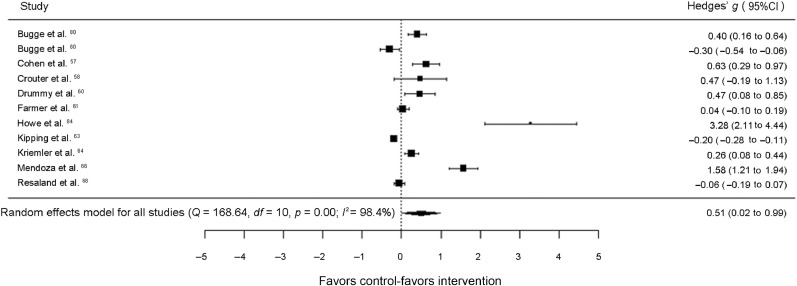
“Sensitivity analysis revealed a substantial reduction in magnitude and increase in the precision of the estimate upon removal of Howe et al.84 (–0.05; 95%CI: –0.12 to 0.02).”
§ A mixed-studies systematic review and meta-analysis of school-based interventions to promote physical activity and/or reduce sedentary time in children > Results > Meta-analysis of whole-day accelerometer-measured MVPA and ST
What the sources say
- Not checked yetcites Howe et al.84 Howe, 2012, A recess intervention to promote moderate-to-vigorous physical activity, Pediatr Obes source
plaindirect- Asserted: passes — The authors put it forward as true.
- Checkable: passes — It can be checked against evidence.
- Load-bearing: unclear — It is unclear whether the paper’s conclusions depend on it.
- Based: passes — The paper gives a reason why it holds.
A result the paper reports from its own data — it cites no other source for it, so there is none to check. The quote shows it is in the paper.
In the paper
“The funnel plot for studies reporting MVPA outcomes identified 2 studies as clear outliers.”
§ A mixed-studies systematic review and meta-analysis of school-based interventions to promote physical activity and/or reduce sedentary time in children > Results > Meta-analysis of whole-day accelerometer-measured MVPA and ST
boosted- Asserted: passes — The authors put it forward as true.
- Checkable: passes — It can be checked against evidence.
- Load-bearing: unclear — It is unclear whether the paper’s conclusions depend on it.
- Based: passes — The paper gives a reason why it holds.
- Probably not a substantial claim. 54
- It may state two separate claims as one. 68
The cited sources support only part of this claim — read each source’s verdict below.
In the paper
“an analysis of report cards of active healthy kids across 15 countries found that 20%–39% of kids in 10 of those countries earned a grade of D in meeting PA guidelines and <20% earned an F.4”
§ A mixed-studies systematic review and meta-analysis of school-based interventions to promote physical activity and/or reduce sedentary time in children > Introduction
What the sources say
- Partly supportedcites [4] Tremblay, 2016, Global matrix 2.0: report card grades on the physical activity of children and youth comparing 38 countries, J Phys Act Health sourceExperimental — accuracy not yet measured
The Abstract says the analysis covered 38 countries, not 15. The Overall Physical Activity section reports D grades for 20 countries and F grades for 7, not D grades for 10 countries. The D and F grading definitions do support the cited percentage thresholds, though the grades were assigned to country indicators, not individual children. (LLM, conf=0.90)
plain- Asserted: passes — The authors put it forward as true.
- Checkable: passes — It can be checked against evidence.
- Load-bearing: fails — The paper’s conclusions may not depend on it.
- Based: passes — The paper gives a reason why it holds.
Probably not a substantial claim. The paper’s conclusions may not depend on it. It may state two separate claims as one.
- Partly supported
The paper states this without a source or data behind it here, so there is nothing to check it against. The quote shows it is in the paper.
In the paper
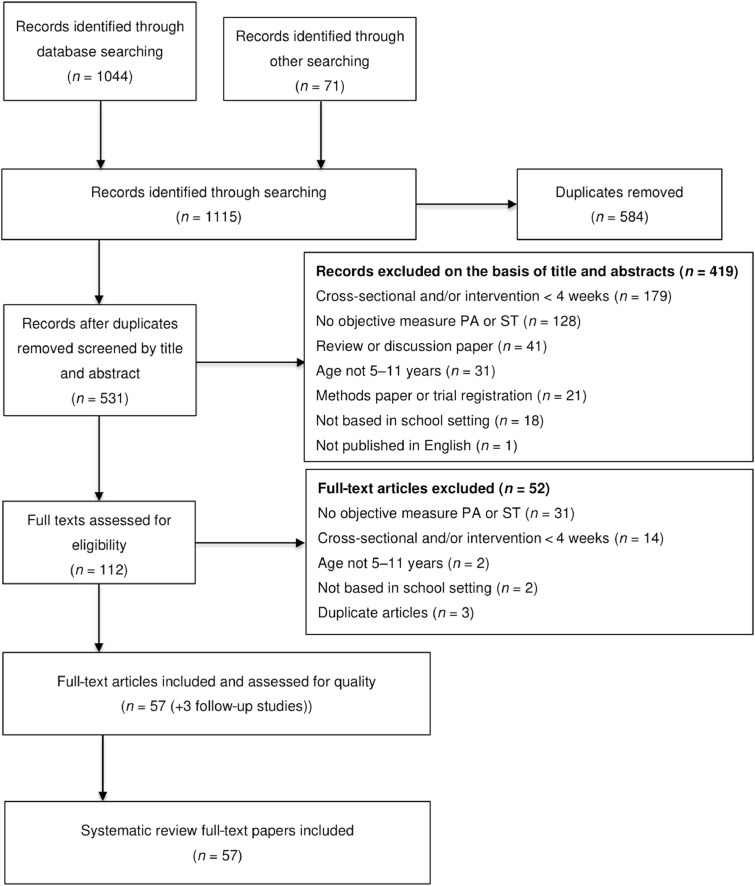
“The systematic review, therefore, included 57 original studies and 3 additional studies that reported follow-up data from 3 of the 57 original studies.”
§ A mixed-studies systematic review and meta-analysis of school-based interventions to promote physical activity and/or reduce sedentary time in children > Methods > Inclusion criteria and selection process
plain- Asserted: passes — The authors put it forward as true.
- Checkable: passes — It can be checked against evidence.
- Load-bearing: passes — The paper’s conclusions depend on it.
- Based: passes — The paper gives a reason why it holds.
It may state two separate claims as one.
A result the paper reports from its own data — it cites no other source for it, so there is none to check. The quote shows it is in the paper.
In the paper
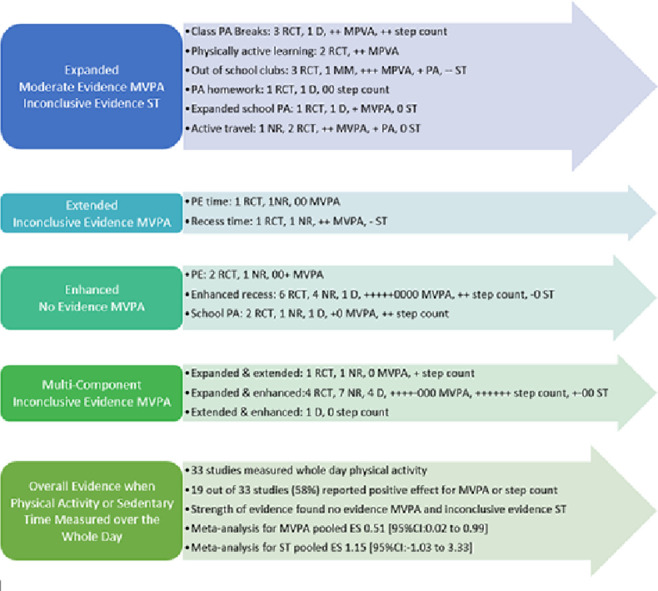
“Intervention studies that extended opportunity by increasing time for pre-existing PA comprised 2 studies that extended PE, with no evidence to support their effectiveness, and 2 studies that extended recess time, with inconclusive evidence of their effectiveness.”
§ A mixed-studies systematic review and meta-analysis of school-based interventions to promote physical activity and/or reduce sedentary time in children > Results > Strength of evidence for type of intervention and evidence of effect
plain- Asserted: passes — The authors put it forward as true.
- Checkable: passes — It can be checked against evidence.
- Load-bearing: unclear — It is unclear whether the paper’s conclusions depend on it.
- Based: passes — The paper gives a reason why it holds.
It may state two separate claims as one.
A result the paper reports from its own data — it cites no other source for it, so there is none to check. The quote shows it is in the paper.
In the paper
“There was no overall evidence of effect for MVPA due to the quality of evidence, with 2 of the 3 large, high-quality RCTs48, 63, 67 reporting no effect on MVPA.”
§ A mixed-studies systematic review and meta-analysis of school-based interventions to promote physical activity and/or reduce sedentary time in children > Results > Strength of evidence for effect of intervention on PA and ST
plain- Asserted: passes — The authors put it forward as true.
- Checkable: passes — It can be checked against evidence.
- Load-bearing: passes — The paper’s conclusions depend on it.
- Based: passes — The paper gives a reason why it holds.
It may state two separate claims as one.
A result the paper reports from its own data — it cites no other source for it, so there is none to check. The quote shows it is in the paper.
In the paper
“Enhancing opportunity for PA was identified in 18 studies, and approaches to modifying current PA opportunities in order to increase the amount of PA included PE, recess, and overall school PA.”
§ A mixed-studies systematic review and meta-analysis of school-based interventions to promote physical activity and/or reduce sedentary time in children > Results > Strength of evidence for type of intervention and evidence of effect
plainn = 18- Asserted: passes — The authors put it forward as true.
- Checkable: passes — It can be checked against evidence.
- Load-bearing: unclear — It is unclear whether the paper’s conclusions depend on it.
- Based: passes — The paper gives a reason why it holds.
It may state two separate claims as one.
The paper states this without a source or data behind it here, so there is nothing to check it against. The quote shows it is in the paper.
In the paper
“Typically, total step count was the dependent variable for pedometer measures.”
§ A mixed-studies systematic review and meta-analysis of school-based interventions to promote physical activity and/or reduce sedentary time in children > Results > Strength of evidence for PA outcome measure and evidence of effect
plain- Asserted: passes — The authors put it forward as true.
- Checkable: passes — It can be checked against evidence.
- Load-bearing: fails — The paper’s conclusions may not depend on it.
- Based: passes — The paper gives a reason why it holds.
Probably not a substantial claim. The paper’s conclusions may not depend on it.
A result the paper reports from its own data — it cites no other source for it, so there is none to check. The quote shows it is in the paper.
In the paper
“There was evidence of a moderate effect on physical activity measured during actual interventions, but this was not replicated across the whole day, suggesting compensatory behaviors.”
§ A mixed-studies systematic review and meta-analysis of school-based interventions to promote physical activity and/or reduce sedentary time in children > Abstract
hedged- Asserted: passes — The authors put it forward as true.
- Checkable: passes — It can be checked against evidence.
- Load-bearing: passes — The paper’s conclusions depend on it.
- Based: passes — The paper gives a reason why it holds.
It may state two separate claims as one.
A result the paper reports from its own data — it cites no other source for it, so there is none to check. The quote shows it is in the paper.
In the paper
“Overall, 82% of studies that expanded PA opportunities reported a positive effect on PA or MVPA, and there was moderate evidence of effect on MVPA.”
§ A mixed-studies systematic review and meta-analysis of school-based interventions to promote physical activity and/or reduce sedentary time in children > Results > Strength of evidence for type of intervention and evidence of effect
plaincorrelational- Asserted: passes — The authors put it forward as true.
- Checkable: passes — It can be checked against evidence.
- Load-bearing: passes — The paper’s conclusions depend on it.
- Based: passes — The paper gives a reason why it holds.
It may state two separate claims as one.
A result the paper reports from its own data — it cites no other source for it, so there is none to check. The quote shows it is in the paper.
In the paper
“The descriptions of the device-based measurements of PA typically included device-model details, time frame for device measures, cut-points, and data-inclusion criteria, although the descriptions were not consistent across all studies.”
§ A mixed-studies systematic review and meta-analysis of school-based interventions to promote physical activity and/or reduce sedentary time in children > Results > Strength of evidence for PA outcome measure and evidence of effect
plain- Asserted: passes — The authors put it forward as true.
- Checkable: passes — It can be checked against evidence.
- Load-bearing: fails — The paper’s conclusions may not depend on it.
- Based: passes — The paper gives a reason why it holds.
Probably not a substantial claim. The paper’s conclusions may not depend on it. It may state two separate claims as one.
A result the paper reports from its own data — it cites no other source for it, so there is none to check. The quote shows it is in the paper.
In the paper
“Taken together, the evidence rating for multicomponent programmes was inconclusive evidence on MVPA, with 66% reporting a positive impact on either PA or MVPA.”
§ A mixed-studies systematic review and meta-analysis of school-based interventions to promote physical activity and/or reduce sedentary time in children > Results > Strength of evidence for type of intervention and evidence of effect
plain- Asserted: passes — The authors put it forward as true.
- Checkable: passes — It can be checked against evidence.
- Load-bearing: passes — The paper’s conclusions depend on it.
- Based: passes — The paper gives a reason why it holds.
It may state two separate claims as one.
A result the paper reports from its own data — it cites no other source for it, so there is none to check. The quote shows it is in the paper.
In the paper
“One study93 used both accelerometer and pedometer measures.”
§ A mixed-studies systematic review and meta-analysis of school-based interventions to promote physical activity and/or reduce sedentary time in children > Results > Strength of evidence for PA outcome measure and evidence of effect
plainSingle case- Asserted: passes — The authors put it forward as true.
- Checkable: passes — It can be checked against evidence.
- Load-bearing: fails — The paper’s conclusions may not depend on it.
- Based: passes — The paper gives a reason why it holds.
Probably not a substantial claim. The paper’s conclusions may not depend on it.
A result the paper reports from its own data — it cites no other source for it, so there is none to check. The quote shows it is in the paper.
In the paper
“The majority of studies (n = 49, 86%) were published within the past decade.”
§ A mixed-studies systematic review and meta-analysis of school-based interventions to promote physical activity and/or reduce sedentary time in children > Results > Description of studies included in the analysis
plainn = 49- Asserted: passes — The authors put it forward as true.
- Checkable: passes — It can be checked against evidence.
- Load-bearing: fails — The paper’s conclusions may not depend on it.
- Based: passes — The paper gives a reason why it holds.
Probably not a substantial claim. The paper’s conclusions may not depend on it.
A result the paper reports from its own data — it cites no other source for it, so there is none to check. The quote shows it is in the paper.
In the paper
“and > 1000 in 8 studies.50, 63, 67, 68, 92, 93, 97, 101”
§ A mixed-studies systematic review and meta-analysis of school-based interventions to promote physical activity and/or reduce sedentary time in children > Results > Description of studies included in the analysis
plainn = 8- Asserted: passes — The authors put it forward as true.
- Checkable: passes — It can be checked against evidence.
- Load-bearing: fails — The paper’s conclusions may not depend on it.
- Based: passes — The paper gives a reason why it holds.
Probably not a substantial claim. The paper’s conclusions may not depend on it.
A result the paper reports from its own data — it cites no other source for it, so there is none to check. The quote shows it is in the paper.
In the paper
“the remaining 6 studies were conducted in Canada;75, 92 Hong Kong, China;103 Iceland;65 Norway;68 and Switzerland.64”
§ A mixed-studies systematic review and meta-analysis of school-based interventions to promote physical activity and/or reduce sedentary time in children > Results > Description of studies included in the analysis
plainn = 7- Asserted: passes — The authors put it forward as true.
- Checkable: passes — It can be checked against evidence.
- Load-bearing: fails — The paper’s conclusions may not depend on it.
- Based: passes — The paper gives a reason why it holds.
Probably not a substantial claim. The paper’s conclusions may not depend on it.
A result the paper reports from its own data — it cites no other source for it, so there is none to check. The quote shows it is in the paper.
In the paper
“In 6 studies, only a subsample had objectively assessed PA and/or ST.62, 70, 76, 78, 83, 95”
§ A mixed-studies systematic review and meta-analysis of school-based interventions to promote physical activity and/or reduce sedentary time in children > Results > Description of studies included in the analysis
plain- Asserted: passes — The authors put it forward as true.
- Checkable: passes — It can be checked against evidence.
- Load-bearing: fails — The paper’s conclusions may not depend on it.
- Based: passes — The paper gives a reason why it holds.
Probably not a substantial claim. The paper’s conclusions may not depend on it.
A result the paper reports from its own data — it cites no other source for it, so there is none to check. The quote shows it is in the paper.
In the paper
“and in 2 Australasian countries52, 56, 57, 73, 74, 86, 102 (n = 7, 12%)”
§ A mixed-studies systematic review and meta-analysis of school-based interventions to promote physical activity and/or reduce sedentary time in children > Results > Description of studies included in the analysis
plainn = 7- Asserted: passes — The authors put it forward as true.
- Checkable: passes — It can be checked against evidence.
- Load-bearing: fails — The paper’s conclusions may not depend on it.
- Based: passes — The paper gives a reason why it holds.
Probably not a substantial claim. The paper’s conclusions may not depend on it.
A result the paper reports from its own data — it cites no other source for it, so there is none to check. The quote shows it is in the paper.
In the paper
“between 250 and 999 in 19 studies,48, 53, 54, 57, 61, 62, 64, 69,75, 76, 77,80, 81, 82,85, 86, 88, 91, 96”
§ A mixed-studies systematic review and meta-analysis of school-based interventions to promote physical activity and/or reduce sedentary time in children > Results > Description of studies included in the analysis
plain- Asserted: passes — The authors put it forward as true.
- Checkable: passes — It can be checked against evidence.
- Load-bearing: fails — The paper’s conclusions may not depend on it.
- Based: passes — The paper gives a reason why it holds.
Probably not a substantial claim. The paper’s conclusions may not depend on it.
A result the paper reports from its own data — it cites no other source for it, so there is none to check. The quote shows it is in the paper.
In the paper
“7 European Union countries50, 51, 55, 67, 70, 79, 80, 85, 87, 89 (n = 18, 32%)”
§ A mixed-studies systematic review and meta-analysis of school-based interventions to promote physical activity and/or reduce sedentary time in children > Results > Description of studies included in the analysis
plainn = 18- Asserted: passes — The authors put it forward as true.
- Checkable: passes — It can be checked against evidence.
- Load-bearing: fails — The paper’s conclusions may not depend on it.
- Based: passes — The paper gives a reason why it holds.
Probably not a substantial claim. The paper’s conclusions may not depend on it.
A result the paper reports from its own data — it cites no other source for it, so there is none to check. The quote shows it is in the paper.
In the paper
“The analysis of the accelerometer data collected varied; 9 different cut-points were utilized for time spent in MVPA.”
§ A mixed-studies systematic review and meta-analysis of school-based interventions to promote physical activity and/or reduce sedentary time in children > Results > Strength of evidence for PA outcome measure and evidence of effect
plain- Asserted: passes — The authors put it forward as true.
- Checkable: passes — It can be checked against evidence.
- Load-bearing: fails — The paper’s conclusions may not depend on it.
- Based: passes — The paper gives a reason why it holds.
Probably not a substantial claim. The paper’s conclusions may not depend on it.
A result the paper reports from its own data — it cites no other source for it, so there is none to check. The quote shows it is in the paper.
In the paper
“A number of studies (n = 18) were multicomponent, combining TEO categories, most commonly expanding and enhancing PA opportunities.”
§ A mixed-studies systematic review and meta-analysis of school-based interventions to promote physical activity and/or reduce sedentary time in children > Results > Strength of evidence for type of intervention and evidence of effect
plainn = 18- Asserted: passes — The authors put it forward as true.
- Checkable: passes — It can be checked against evidence.
- Load-bearing: unclear — It is unclear whether the paper’s conclusions depend on it.
- Based: passes — The paper gives a reason why it holds.
It may state two separate claims as one.
A result the paper reports from its own data — it cites no other source for it, so there is none to check. The quote shows it is in the paper.
In the paper
“Only 11 studies47, 52, 58, 59, 63, 68, 77, 78, 81, 84, 85 included a measure of ST, 6 of which47, 58, 59, 77, 78, 84 reported a positive effect during the school day or whole day.”
§ A mixed-studies systematic review and meta-analysis of school-based interventions to promote physical activity and/or reduce sedentary time in children > Results > Strength of evidence for effect of intervention on PA and ST
plain- Asserted: passes — The authors put it forward as true.
- Checkable: passes — It can be checked against evidence.
- Load-bearing: passes — The paper’s conclusions depend on it.
- Based: passes — The paper gives a reason why it holds.
It may state two separate claims as one.
A result the paper reports from its own data — it cites no other source for it, so there is none to check. The quote shows it is in the paper.
In the paper
“Of the studies enhancing PA opportunities, 61% reported a positive effect on either PA or MVPA, but the evidence ratings showed no evidence on MVPA.”
§ A mixed-studies systematic review and meta-analysis of school-based interventions to promote physical activity and/or reduce sedentary time in children > Results > Strength of evidence for type of intervention and evidence of effect
plainn = 18- Asserted: passes — The authors put it forward as true.
- Checkable: passes — It can be checked against evidence.
- Load-bearing: unclear — It is unclear whether the paper’s conclusions depend on it.
- Based: passes — The paper gives a reason why it holds.
It may state two separate claims as one.
A result the paper reports from its own data — it cites no other source for it, so there is none to check. The quote shows it is in the paper.
In the paper
“Of the 57 studies, 67% utilised accelerometer measurement, and 35% used pedometers.”
§ A mixed-studies systematic review and meta-analysis of school-based interventions to promote physical activity and/or reduce sedentary time in children > Results > Strength of evidence for PA outcome measure and evidence of effect
plain- Asserted: passes — The authors put it forward as true.
- Checkable: passes — It can be checked against evidence.
- Load-bearing: unclear — It is unclear whether the paper’s conclusions depend on it.
- Based: passes — The paper gives a reason why it holds.
It may state two separate claims as one.
A result the paper reports from its own data — it cites no other source for it, so there is none to check. The quote shows it is in the paper.
In the paper
“within the UK (n = 8, 14%),60, 61, 63, 76, 78, 82, 90, 100”
§ A mixed-studies systematic review and meta-analysis of school-based interventions to promote physical activity and/or reduce sedentary time in children > Results > Description of studies included in the analysis
plainn = 8- Asserted: passes — The authors put it forward as true.
- Checkable: passes — It can be checked against evidence.
- Load-bearing: fails — The paper’s conclusions may not depend on it.
- Based: passes — The paper gives a reason why it holds.
Probably not a substantial claim. The paper’s conclusions may not depend on it.
A result the paper reports from its own data — it cites no other source for it, so there is none to check. The quote shows it is in the paper.
In the paper
“The 57 studies included 29 RCT studies47, 48, 49, 50, 51, 52, 53, 54, 55, 56, 57, 58, 59, 60, 61, 62, 63, 64, 65, 66, 67, 68, 69, 70, 71, 72, 73, 74, 75 (mean quality 45%), 17 NR studies76, 77, 78, 79, 80, 81, 82, 83, 84, 85, 86, 87, 88, 89, 90, 91, 92 (mean quality 50%), 10 descriptive studies93, 94, 95, 96, 97, 98, 99, 100, 101, 102 (mean quality 83%), and 1 mixed-methods study103 (quality 50%).”
§ A mixed-studies systematic review and meta-analysis of school-based interventions to promote physical activity and/or reduce sedentary time in children > Results > Description of studies included in the analysis
plain- Asserted: passes — The authors put it forward as true.
- Checkable: passes — It can be checked against evidence.
- Load-bearing: unclear — It is unclear whether the paper’s conclusions depend on it.
- Based: passes — The paper gives a reason why it holds.
It may state two separate claims as one.
A result the paper reports from its own data — it cites no other source for it, so there is none to check. The quote shows it is in the paper.
In the paper
“Meta-analysis of the studies with whole-day accelerometer measures suggested a pooled effect size of 0.57 and 1.57 for moderate-to-vigorous physical activity and sedentary time, respectively, but with low precision, significant heterogeneity, and considerable inconsistency.”
§ A mixed-studies systematic review and meta-analysis of school-based interventions to promote physical activity and/or reduce sedentary time in children > Abstract
hedged- Asserted: passes — The authors put it forward as true.
- Checkable: passes — It can be checked against evidence.
- Load-bearing: passes — The paper’s conclusions depend on it.
- Based: passes — The paper gives a reason why it holds.
It may state two separate claims as one.
A result the paper reports from its own data — it cites no other source for it, so there is none to check. The quote shows it is in the paper.
In the paper
“The studies were conducted in the USA,47, 48, 49,53, 54, 58, 59, 62, 66, 69, 71, 72, 77, 81, 83, 84, 88, 91,93, 94, 95, 96, 97, 98, 99,101 (n = 26, 46%)”
§ A mixed-studies systematic review and meta-analysis of school-based interventions to promote physical activity and/or reduce sedentary time in children > Results > Description of studies included in the analysis
plainn = 26- Asserted: passes — The authors put it forward as true.
- Checkable: passes — It can be checked against evidence.
- Load-bearing: fails — The paper’s conclusions may not depend on it.
- Based: passes — The paper gives a reason why it holds.
Probably not a substantial claim. The paper’s conclusions may not depend on it.
A result the paper reports from its own data — it cites no other source for it, so there is none to check. The quote shows it is in the paper.
In the paper
“Expanded opportunities, where time allocated for PA replaced time previously allocated for low-active or sedentary activities, were present in 17 studies (30%) and included class PA breaks, physically active learning, before- and after-school clubs, physically active homework, active travel, and a whole-school PA expansion.”
§ A mixed-studies systematic review and meta-analysis of school-based interventions to promote physical activity and/or reduce sedentary time in children > Results > Strength of evidence for type of intervention and evidence of effect
plain- Asserted: passes — The authors put it forward as true.
- Checkable: passes — It can be checked against evidence.
- Load-bearing: unclear — It is unclear whether the paper’s conclusions depend on it.
- Based: passes — The paper gives a reason why it holds.
It may state two separate claims as one.
A result the paper reports from its own data — it cites no other source for it, so there is none to check. The quote shows it is in the paper.
In the paper
“The pooled ES estimates for the effects of interventions on MVPA was 0.51 (95%CI: 0.02–0.99), indicating a statistically significant moderate effect, albeit with relatively low precision, as indicated by the CIs ranging from trivial to large.”
§ A mixed-studies systematic review and meta-analysis of school-based interventions to promote physical activity and/or reduce sedentary time in children > Results > Meta-analysis of whole-day accelerometer-measured MVPA and ST
hedgeddirect- Asserted: passes — The authors put it forward as true.
- Checkable: passes — It can be checked against evidence.
- Load-bearing: passes — The paper’s conclusions depend on it.
- Based: passes — The paper gives a reason why it holds.
It may state two separate claims as one.
A result the paper reports from its own data — it cites no other source for it, so there is none to check. The quote shows it is in the paper.
In the paper
“Sensitivity analysis revealed that effect estimates for MVPA were no longer significant after removal of several individual studies, though the magnitude of the estimates and their precision were similar”
§ A mixed-studies systematic review and meta-analysis of school-based interventions to promote physical activity and/or reduce sedentary time in children > Results > Meta-analysis of whole-day accelerometer-measured MVPA and ST
plain- Asserted: passes — The authors put it forward as true.
- Checkable: passes — It can be checked against evidence.
- Load-bearing: passes — The paper’s conclusions depend on it.
- Based: passes — The paper gives a reason why it holds.
It may state two separate claims as one.
A result the paper reports from its own data — it cites no other source for it, so there is none to check. The quote shows it is in the paper.
In the paper
“The pooled ES estimates for the effects of interventions on ST were 1.15 (95%CI: –1.03 to 3.33), indicating a nonsignificant large effect, with very low precision, as indicated by the CIs from a negative large effect to a positive large effect.”
§ A mixed-studies systematic review and meta-analysis of school-based interventions to promote physical activity and/or reduce sedentary time in children > Results > Meta-analysis of whole-day accelerometer-measured MVPA and ST
hedged- Asserted: passes — The authors put it forward as true.
- Checkable: passes — It can be checked against evidence.
- Load-bearing: passes — The paper’s conclusions depend on it.
- Based: passes — The paper gives a reason why it holds.
It may state two separate claims as one.
A result the paper reports from its own data — it cites no other source for it, so there is none to check. The quote shows it is in the paper.
In the paper
“As shown in Table 3, the time period for PA data collection varied, with measurements being taken during the actual intervention (16%, 9 studies), during the school day (28%, 16 studies), or during the whole day (58%, 33 studies).”
§ A mixed-studies systematic review and meta-analysis of school-based interventions to promote physical activity and/or reduce sedentary time in children > Results > Strength of evidence for PA outcome measure and evidence of effect
plain- Asserted: passes — The authors put it forward as true.
- Checkable: passes — It can be checked against evidence.
- Load-bearing: passes — The paper’s conclusions depend on it.
- Based: passes — The paper gives a reason why it holds.
It may state two separate claims as one.
In the paper
“Notably, 1 study47 analyzed multiple time frames (during the intervention and during the whole day).”
§ A mixed-studies systematic review and meta-analysis of school-based interventions to promote physical activity and/or reduce sedentary time in children > Results > Strength of evidence for PA outcome measure and evidence of effect
What the sources say
- Not checked yetcites [47] Adkins, 2013, Can dance exergaming contribute to improving physical activity levels in elementary school children?, Fr J Phys Health Educ Recreat Dance
plainSingle case- Asserted: passes — The authors put it forward as true.
- Checkable: passes — It can be checked against evidence.
- Load-bearing: fails — The paper’s conclusions may not depend on it.
- Based: passes — The paper gives a reason why it holds.
Probably not a substantial claim. The paper’s conclusions may not depend on it.
A result the paper reports from its own data — it cites no other source for it, so there is none to check. The quote shows it is in the paper.
In the paper
“In accord with previous studies,28, 29 68% of the studies in our review reported a positive impact on PA, and 62% reported a positive impact on MVPA.”
§ A mixed-studies systematic review and meta-analysis of school-based interventions to promote physical activity and/or reduce sedentary time in children > Discussion
plaindirect- Asserted: passes — The authors put it forward as true.
- Checkable: passes — It can be checked against evidence.
- Load-bearing: unclear — It is unclear whether the paper’s conclusions depend on it.
- Based: passes — The paper gives a reason why it holds.
It may state two separate claims as one.
None of the sources cited for this claim have been checked yet.
In the paper
“A total of 3 studies identified differential responses based on baseline characteristics, including 2 studies that reported a larger effect for the least active participants.71, 102”
§ A mixed-studies systematic review and meta-analysis of school-based interventions to promote physical activity and/or reduce sedentary time in children > Results > Participant characteristics and evidence of effect
What the sources say
- Not checked yetcites [71] Kang, 2009, Effects of group and individual-based step goals on children's physical activity levels in school, Pediatr Exerc Sci source
- Not checked yetcites [102] Oliver, 2006, An integrated curriculum approach to increasing habitual physical activity in children: a feasibility study, J Sch Health source
plaincorrelational- Asserted: passes — The authors put it forward as true.
- Checkable: passes — It can be checked against evidence.
- Load-bearing: unclear — It is unclear whether the paper’s conclusions depend on it.
- Based: passes — The paper gives a reason why it holds.
It may state two separate claims as one.
A result the paper reports from its own data — it cites no other source for it, so there is none to check. The quote shows it is in the paper.
In the paper
“The Cochrane Q showed a significant heterogeneity (Q = 168.7, df = 10, p < 0.0001) for MVPA and a considerable inconsistency measure, with I2 = 98.43%.”
§ A mixed-studies systematic review and meta-analysis of school-based interventions to promote physical activity and/or reduce sedentary time in children > Results > Meta-analysis of whole-day accelerometer-measured MVPA and ST
plain- Asserted: passes — The authors put it forward as true.
- Checkable: passes — It can be checked against evidence.
- Load-bearing: passes — The paper’s conclusions depend on it.
- Based: passes — The paper gives a reason why it holds.
It may state two separate claims as one.
The paper states this without a source or data behind it here, so there is nothing to check it against. The quote shows it is in the paper.
In the paper
“There was, therefore, no evidence of effect for either step count or MVPA when intervention effectiveness was measured across a whole day.”
§ A mixed-studies systematic review and meta-analysis of school-based interventions to promote physical activity and/or reduce sedentary time in children > Results > Strength of evidence for PA outcome measure and evidence of effect
plain- Asserted: passes — The authors put it forward as true.
- Checkable: passes — It can be checked against evidence.
- Load-bearing: passes — The paper’s conclusions depend on it.
- Based: passes — The paper gives a reason why it holds.
It may state two separate claims as one.
None of the sources cited for this claim have been checked yet.
In the paper
“There was no overall pattern, with some studies reporting a greater effect for girls than boys79, 91 and vice versa.75”
§ A mixed-studies systematic review and meta-analysis of school-based interventions to promote physical activity and/or reduce sedentary time in children > Results > Participant characteristics and evidence of effect
What the sources say
- Not checked yetcites [79] Weaver, 2018, Partnerships for active children in elementary schools: outcomes of a 2-year pilot study to increase physical activity during the school day, Am J Health Promot source
- Not checked yetcites [91] Pangrazi, 2003, Impact of promoting lifestyle activity for youth (PLAY) on children's physical activity, J Sch Health source
- Not checked yetcites [75] Naylor, 2008, An active school model to promote physical activity in elementary schools: action schools! BC, Br J Sports Med source
plain- Asserted: passes — The authors put it forward as true.
- Checkable: passes — It can be checked against evidence.
- Load-bearing: unclear — It is unclear whether the paper’s conclusions depend on it.
- Based: passes — The paper gives a reason why it holds.
It may state two separate claims as one.
A result the paper reports from its own data — it cites no other source for it, so there is none to check. The quote shows it is in the paper.
In the paper
“For ST, the Cochrane Q showed a significant heterogeneity (Q = 38.7, df = 3, p < 0.0001) and a considerable inconsistency measure, with I2 = 98.6%.”
§ A mixed-studies systematic review and meta-analysis of school-based interventions to promote physical activity and/or reduce sedentary time in children > Results > Meta-analysis of whole-day accelerometer-measured MVPA and ST
plain- Asserted: passes — The authors put it forward as true.
- Checkable: passes — It can be checked against evidence.
- Load-bearing: passes — The paper’s conclusions depend on it.
- Based: passes — The paper gives a reason why it holds.
It may state two separate claims as one.
In the paper
“Extending PE time did not lead to any reported increase in MVPA in 2 studies; in fact, 1 high-quality, large RCT increased PE time from 2 to 6 lessons (4.5 h/week) and found that, when measured over a whole day, there was no significant difference in MVPA between children in intervention and control schools.67”
§ A mixed-studies systematic review and meta-analysis of school-based interventions to promote physical activity and/or reduce sedentary time in children > Discussion > Intervention approach and the TEO
What the sources say
- Not checked yetcites [67] Moller, 2014, Do extra compulsory physical education lessons mean more physically active children: findings from the childhood health, activity, and motor performance school study Denmark (The CHAMPS-study DK), Int J Behav Nutr Phys Act source
plain- Asserted: passes — The authors put it forward as true.
- Checkable: passes — It can be checked against evidence.
- Load-bearing: passes — The paper’s conclusions depend on it.
- Based: passes — The paper gives a reason why it holds.
It may state two separate claims as one.
None of the sources cited for this claim have been checked yet.
In the paper
“Whilst the intervention duration of these studies was variable, with 4 studies lasting 4–10 weeks,55, 58, 66 others were implemented over a longer duration, for example, 10 months,73 1 year,81 or 2 years.70”
§ A mixed-studies systematic review and meta-analysis of school-based interventions to promote physical activity and/or reduce sedentary time in children > Discussion
What the sources say
- Not checked yetcites [55] Martin, 2017, Active classrooms: a cluster randomized controlled trial evaluating the effects of a movement integration intervention on the physical activity levels of primary school children, J Phys Act Health source
- Not checked yetcites [58] Crouter, 2015, Effect on physical activity of a randomized afterschool intervention for inner city children in 3rd to 5th grade, PLoS One source
- Not checked yetcites [66] Mendoza, 2011, The walking school bus and children's physical activity: a pilot cluster randomized controlled trial, Pediatrics source
plain- Asserted: passes — The authors put it forward as true.
- Checkable: passes — It can be checked against evidence.
- Load-bearing: passes — The paper’s conclusions depend on it.
- Based: passes — The paper gives a reason why it holds.
It may state two separate claims as one.
None of the sources cited for this claim have been checked yet.
In the paper
“Indeed, of the 3 studies reporting expansion of after-school PA, only one had >250 participants,48 and although 1 study reported more than 80% attendance,58 the other 2 studies did not report attendance rates.58, 103”
§ A mixed-studies systematic review and meta-analysis of school-based interventions to promote physical activity and/or reduce sedentary time in children > Discussion > Intervention approach and the TEO
What the sources say
- Not checked yetcites [48] Dzewaltowski, 2010, HOP'N after-school project: an obesity prevention randomized controlled trial, Int J Behav Nutr Phys Act source
- Not checked yetcites [58] Crouter, 2015, Effect on physical activity of a randomized afterschool intervention for inner city children in 3rd to 5th grade, PLoS One source
- Not checked yetcites [103] Cheung, 2015, Parental attitude on children's after-school physical activity participation: lesson from a pilot study, Asian J Phys Edu Recr
plain- Asserted: passes — The authors put it forward as true.
- Checkable: passes — It can be checked against evidence.
- Load-bearing: passes — The paper’s conclusions depend on it.
- Based: passes — The paper gives a reason why it holds.
It may state two separate claims as one.
The paper states this without a source or data behind it here, so there is nothing to check it against. The quote shows it is in the paper.
In the paper
“After-school clubs (moderate evidence rating), class PA breaks (limited evidence rating), physically active learning (limited evidence rating), and active travel (limited evidence rating) appear to be the most promising expanded opportunity interventions in school settings for children.”
§ A mixed-studies systematic review and meta-analysis of school-based interventions to promote physical activity and/or reduce sedentary time in children > Discussion > Intervention approach and the TEO
hedgedcorrelational- Asserted: passes — The authors put it forward as true.
- Checkable: passes — It can be checked against evidence.
- Load-bearing: passes — The paper’s conclusions depend on it.
- Based: passes — The paper gives a reason why it holds.
It may state two separate claims as one.
None of the sources cited for this claim have been checked yet.
In the paper
“In our review, all 4 studies reporting class PA breaks found positive outcomes for MVPA or PA, but the risk of bias (quality and/or sample size) led to a limited-evidence rating.59, 60, 72, 98”
§ A mixed-studies systematic review and meta-analysis of school-based interventions to promote physical activity and/or reduce sedentary time in children > Discussion > Intervention approach and the TEO
What the sources say
- Not checked yetcites [59] Donnelly, 2009, Physical activity across the curriculum (PAAC): a randomized controlled trial to promote physical activity and diminish overweight and obesity in elementary school children, Prev Med source
- Not checked yetcites [60] Drummy, 2016, The effect of a classroom activity break on physical activity levels and adiposity in primary school children, J Paediatr Child Health source
- Not checked yetcites [72] Mahar, 2006, Effects of a classroom-based program on physical activity and on-task behaviour, Med Sci Sports Exerc source
plaindirect- Asserted: passes — The authors put it forward as true.
- Checkable: passes — It can be checked against evidence.
- Load-bearing: passes — The paper’s conclusions depend on it.
- Based: passes — The paper gives a reason why it holds.
It may state two separate claims as one.
None of the sources cited for this claim have been checked yet.
In the paper
“Enhancing existing PA opportunities included enhancing PA in PE,62, 69, 79 recess,49, 50,52, 53, 54,61, 76, 84, 86, 87, 94 and overall school PA,70, 71, 92, 100 but these enhancements resulted in an overall rating of no evidence of effect on MVPA.”
§ A mixed-studies systematic review and meta-analysis of school-based interventions to promote physical activity and/or reduce sedentary time in children > Discussion > Intervention approach and the TEO
What the sources say
- Not checked yetcites [62] Going, 2003, The effects of the pathways obesity prevention program on physical activity in American Indian children, Prev Med source
- Not checked yetcites [69] Sallis, 1997, The effects of a 2-year physical education program (SPARK) on physical activity and fitness in elementary school students, Am J Public Health source
- Not checked yetcites [79] Weaver, 2018, Partnerships for active children in elementary schools: outcomes of a 2-year pilot study to increase physical activity during the school day, Am J Health Promot source
plain- Asserted: passes — The authors put it forward as true.
- Checkable: passes — It can be checked against evidence.
- Load-bearing: passes — The paper’s conclusions depend on it.
- Based: passes — The paper gives a reason why it holds.
It may state two separate claims as one.
A result the paper reports from its own data — it cites no other source for it, so there is none to check. The quote shows it is in the paper.
In the paper
“Whilst the meta-analysis of the studies with whole-day accelerometer measures suggested a pooled ES of 0.57 and 1.57 for MVPA and ST, respectively, both of these had low precision, significant heterogeneity, and considerable inconsistency.”
§ A mixed-studies systematic review and meta-analysis of school-based interventions to promote physical activity and/or reduce sedentary time in children > Discussion > PA increases in school intervention vs. compensatory PA decline
hedged- Asserted: passes — The authors put it forward as true.
- Checkable: passes — It can be checked against evidence.
- Load-bearing: passes — The paper’s conclusions depend on it.
- Based: passes — The paper gives a reason why it holds.
It may state two separate claims as one.
None of the sources cited for this claim have been checked yet.
In the paper
“Overall, the high risk of bias due to research quality led to an inconclusive evidence rating on MVPA, which differs from previous systematic reviews, which have suggested that interventions could lead to improvements in PA during school recess.21, 22, 23”
§ A mixed-studies systematic review and meta-analysis of school-based interventions to promote physical activity and/or reduce sedentary time in children > Discussion > Intervention approach and the TEO
What the sources say
- Not checked yetcites [21] Erwin, 2014, Impact of recess interventions on children's physical activity-a meta-analysis, Am J Health Promot source
- Not checked yetcites [22] Escalante, 2014, Playground designs to increase physical activity levels during school recess: a systematic review, Health Educ Behav source
- Not checked yetcites [23] Ridgers, 2012, Physical activity during school recess, Am J Prev Med source
plain- Asserted: passes — The authors put it forward as true.
- Checkable: passes — It can be checked against evidence.
- Load-bearing: passes — The paper’s conclusions depend on it.
- Based: passes — The paper gives a reason why it holds.
It may state two separate claims as one.
None of the sources cited for this claim have been checked yet.
In the paper
“Of these 17 studies, 11 were focused on older children, 3 were included in the current study, and the remaining 3 were screened out because the intervention focus of those 3 studies was weight loss/obesity prevention.”
§ A mixed-studies systematic review and meta-analysis of school-based interventions to promote physical activity and/or reduce sedentary time in children > Discussion > Limitations and recommendations for future research
plain- Asserted: passes — The authors put it forward as true.
- Checkable: passes — It can be checked against evidence.
- Load-bearing: unclear — It is unclear whether the paper’s conclusions depend on it.
- Based: passes — The paper gives a reason why it holds.
It may state two separate claims as one.
In the paper
“the intervention reporting was in line with the TIDieR checklist,45 which highlighted some common shortcomings”
§ A mixed-studies systematic review and meta-analysis of school-based interventions to promote physical activity and/or reduce sedentary time in children > Discussion > Limitations and recommendations for future research
What the sources say
- Not checked yetcites [45] Cohen, 1988
plain- Asserted: passes — The authors put it forward as true.
- Checkable: passes — It can be checked against evidence.
- Load-bearing: fails — The paper’s conclusions may not depend on it.
- Based: passes — The paper gives a reason why it holds.
Probably not a substantial claim. The paper’s conclusions may not depend on it. It may state two separate claims as one.
None of the sources cited for this claim have been checked yet.
In the paper
“More specifically, 2 studies included in our review explored PA over differing time periods, and both identified increased PA during the target intervention of recess52 or PE69 but not during the school day or the whole day.”
§ A mixed-studies systematic review and meta-analysis of school-based interventions to promote physical activity and/or reduce sedentary time in children > Discussion > PA increases in school intervention vs. compensatory PA decline
What the sources say
- Not checked yetcites [52] Engelen, 2013, Increasing physical activity in young primary school children: it's child's play: a cluster randomised controlled trial, Prev Med source
- Not checked yetcites [69] Sallis, 1997, The effects of a 2-year physical education program (SPARK) on physical activity and fitness in elementary school students, Am J Public Health source
plaindirect- Asserted: passes — The authors put it forward as true.
- Checkable: passes — It can be checked against evidence.
- Load-bearing: passes — The paper’s conclusions depend on it.
- Based: passes — The paper gives a reason why it holds.
It may state two separate claims as one.
A result the paper reports from its own data — it cites no other source for it, so there is none to check. The quote shows it is in the paper.
In the paper
“the most common limitations included the lack of randomization and lack of clarity regarding drop-out rates”
§ A mixed-studies systematic review and meta-analysis of school-based interventions to promote physical activity and/or reduce sedentary time in children > Discussion > Limitations and recommendations for future research
plain- Asserted: passes — The authors put it forward as true.
- Checkable: passes — It can be checked against evidence.
- Load-bearing: unclear — It is unclear whether the paper’s conclusions depend on it.
- Based: passes — The paper gives a reason why it holds.
It may state two separate claims as one.
A result the paper reports from its own data — it cites no other source for it, so there is none to check. The quote shows it is in the paper.
In the paper
“Furthermore, an additional 26 RCTs were identified in the current systematic review, including 12 that measured whole-day PA via accelerometer, thereby providing confidence that the current review included a comprehensive set of studies.”
§ A mixed-studies systematic review and meta-analysis of school-based interventions to promote physical activity and/or reduce sedentary time in children > Discussion > Limitations and recommendations for future research
plain- Asserted: passes — The authors put it forward as true.
- Checkable: passes — It can be checked against evidence.
- Load-bearing: passes — The paper’s conclusions depend on it.
- Based: passes — The paper gives a reason why it holds.
It may state two separate claims as one.
A result the paper reports from its own data — it cites no other source for it, so there is none to check. The quote shows it is in the paper.
In the paper
“it was typically possible to identify the rationale, materials, and procedures used in the studies, including who administered the intervention and how it was implemented”
§ A mixed-studies systematic review and meta-analysis of school-based interventions to promote physical activity and/or reduce sedentary time in children > Discussion > Limitations and recommendations for future research
hedged- Asserted: passes — The authors put it forward as true.
- Checkable: passes — It can be checked against evidence.
- Load-bearing: fails — The paper’s conclusions may not depend on it.
- Based: passes — The paper gives a reason why it holds.
Probably not a substantial claim. The paper’s conclusions may not depend on it.
In the paper
“global PA guidelines recommend that children aged 5–18 years engage in at least 60 min of moderate-to-vigorous physical activity (MVPA) every day.2”
§ A mixed-studies systematic review and meta-analysis of school-based interventions to promote physical activity and/or reduce sedentary time in children > Introduction
What the sources say
- Not checked yetcites [2] World Health Organization. Global recommendations on physical activity for health 5–17 years old. Available at: https://www.who.int/dietphysicalactivity/factsheet_young_people/en/; 2017. [accessed 06.10.2018].
plain- Asserted: passes — The authors put it forward as true.
- Checkable: passes — It can be checked against evidence.
- Load-bearing: fails — The paper’s conclusions may not depend on it.
- Based: passes — The paper gives a reason why it holds.
Probably not a substantial claim. The paper’s conclusions may not depend on it.
In the paper
“Recent 24-h movement guidelines have promoted whole-day movement patterns that target both enhanced MVPA and restriction of sedentary time (ST).6”
§ A mixed-studies systematic review and meta-analysis of school-based interventions to promote physical activity and/or reduce sedentary time in children > Introduction
What the sources say
- Not checked yetcites [6] Tremblay, 2016, Canadian 24-hour movement guidelines for children and youth: an integration of physical activity, sedentary behaviour, and sleep, Appl Physiol Nutr Metab source
plain- Asserted: passes — The authors put it forward as true.
- Checkable: passes — It can be checked against evidence.
- Load-bearing: fails — The paper’s conclusions may not depend on it.
- Based: passes — The paper gives a reason why it holds.
Probably not a substantial claim. The paper’s conclusions may not depend on it.
In the paper
“PA behaviors develop in early childhood and track through to adolescence and adulthood.7”
§ A mixed-studies systematic review and meta-analysis of school-based interventions to promote physical activity and/or reduce sedentary time in children > Introduction
What the sources say
- Not checked yetcites [7] Telama, 2014, Tracking of physical activity from early childhood through youth into adulthood, Med Sci Sports Exerc source
plaincorrelational- Asserted: passes — The authors put it forward as true.
- Checkable: passes — It can be checked against evidence.
- Load-bearing: passes — The paper’s conclusions depend on it.
- Based: passes — The paper gives a reason why it holds.
It may state two separate claims as one.
In the paper
“Physical activity (PA) has been associated with numerous physiological and psychosocial health benefits in school-aged children.1”
§ A mixed-studies systematic review and meta-analysis of school-based interventions to promote physical activity and/or reduce sedentary time in children > Introduction
What the sources say
- Not checked yetcites [1] Janssen, 2010, Systematic review of the health benefits of physical activity and fitness in school-aged children and youth, Int J Behav Nutr Phys Act source
plaincorrelational- Asserted: passes — The authors put it forward as true.
- Checkable: passes — It can be checked against evidence.
- Load-bearing: passes — The paper’s conclusions depend on it.
- Based: passes — The paper gives a reason why it holds.
Probably not a substantial claim.
None of the sources cited for this claim have been checked yet.
In the paper
“existing reviews of PA interventions in school settings have examined evidence across childhood and adolescence16, 28, 29, 32, 34 or focused exclusively on adolescents.17, 18, 19, 20,30, 31”
§ A mixed-studies systematic review and meta-analysis of school-based interventions to promote physical activity and/or reduce sedentary time in children > Introduction
What the sources say
- Not checked yetcites [16] Dobbins, 2013, School-based physical activity programs for promoting physical activity and fitness in children and adolescents aged 6 to 18, Cochrane Database Syst Rev
- Not checked yetcites [28] Salmon, 2007, Promoting physical activity participation among children and adolescents, Epidemiol Rev source
- Not checked yetcites [29] Timperio, 2004, Evidence-based strategies to promote physical activity among children, adolescents and young adults: review and update, J Sci Med Sport source
plain- Asserted: passes — The authors put it forward as true.
- Checkable: passes — It can be checked against evidence.
- Load-bearing: passes — The paper’s conclusions depend on it.
- Based: passes — The paper gives a reason why it holds.
It may state two separate claims as one.
In the paper
“a recent multilevel, worldwide review highlighted local school contexts as important correlates to PA in children.3”
§ A mixed-studies systematic review and meta-analysis of school-based interventions to promote physical activity and/or reduce sedentary time in children > Introduction
What the sources say
- Not checked yetcites [3] Gomes, 2017, Correlates of compliance with recommended levels of physical activity in children, Sci Rep source
plaincorrelational- Asserted: passes — The authors put it forward as true.
- Checkable: passes — It can be checked against evidence.
- Load-bearing: fails — The paper’s conclusions may not depend on it.
- Based: passes — The paper gives a reason why it holds.
Probably not a substantial claim. The paper’s conclusions may not depend on it.
What the paper did — it cites no source for this, so there is none to check. The quote shows it is in the paper.
In the paper
“The search strategies combined multiple keyword search terms agreed to a priori and were developed by breaking down the research question (Table 1).”
§ A mixed-studies systematic review and meta-analysis of school-based interventions to promote physical activity and/or reduce sedentary time in children > Methods > Information sources and search strategy
plain- Asserted: passes — The authors put it forward as true.
- Checkable: passes — It can be checked against evidence.
- Load-bearing: fails — The paper’s conclusions may not depend on it.
- Based: passes — The paper gives a reason why it holds.
Probably not a substantial claim. The paper’s conclusions may not depend on it.
In the paper
“The quality of the included studies was assessed by 2 independent reviewers (ED, AL) using the mixed-methods appraisal tool (MMAT).39”
§ A mixed-studies systematic review and meta-analysis of school-based interventions to promote physical activity and/or reduce sedentary time in children > Methods > Methodological quality
What the sources say
- Not checked yetcites [39] Pluye, 2009, A scoring system for appraising mixed methods research, and concomitantly appraising qualitative, quantitative and mixed methods primary studies in Mixed Studies Reviews, Int J Nurs Stud source
plain- Asserted: passes — The authors put it forward as true.
- Checkable: passes — It can be checked against evidence.
- Load-bearing: passes — The paper’s conclusions depend on it.
- Based: passes — The paper gives a reason why it holds.
Probably not a substantial claim.
What the paper did — it cites no source for this, so there is none to check. The quote shows it is in the paper.
In the paper
“A 2-step screening process was used to determine whether each study met the inclusion criteria.”
§ A mixed-studies systematic review and meta-analysis of school-based interventions to promote physical activity and/or reduce sedentary time in children > Methods > Inclusion criteria and selection process
plain- Asserted: passes — The authors put it forward as true.
- Checkable: passes — It can be checked against evidence.
- Load-bearing: fails — The paper’s conclusions may not depend on it.
- Based: passes — The paper gives a reason why it holds.
Probably not a substantial claim. The paper’s conclusions may not depend on it.
In the paper
“Booth and Okely15 highlighted the compulsory nature of attendance, teachers as credible change agents, and access to facilities as the primary strengths of a school as an intervention setting.”
§ A mixed-studies systematic review and meta-analysis of school-based interventions to promote physical activity and/or reduce sedentary time in children > Introduction
What the sources say
- Not checked yetcites [15] Booth, 2005, Promoting physical activity among children and adolescents: the strengths and limitations of school-based approaches, Health Promot J Austr source
plain- Asserted: passes — The authors put it forward as true.
- Checkable: passes — It can be checked against evidence.
- Load-bearing: fails — The paper’s conclusions may not depend on it.
- Based: passes — The paper gives a reason why it holds.
Probably not a substantial claim. The paper’s conclusions may not depend on it. It may state two separate claims as one.
In the paper
“a recent review finding that 10 countries had an annual decrease of 4.2% in PA and an increase in ST after the age of 5 years.11”
§ A mixed-studies systematic review and meta-analysis of school-based interventions to promote physical activity and/or reduce sedentary time in children > Introduction
What the sources say
- Not checked yetcites [11] Cooper, 2015, Objectively measured physical activity and sedentary time in youth: the International Children's Accelerometry Database (ICAD), Int J Behav Nutr Phys Act source
plaincorrelational- Asserted: passes — The authors put it forward as true.
- Checkable: passes — It can be checked against evidence.
- Load-bearing: passes — The paper’s conclusions depend on it.
- Based: passes — The paper gives a reason why it holds.
It may state two separate claims as one.
In the paper
“van Sluijs et al.34 have suggested that additional structural environmental and policy changes might be required to change children's PA behavior, thereby advocating for the need to examine children and adolescents as separate groups.”
§ A mixed-studies systematic review and meta-analysis of school-based interventions to promote physical activity and/or reduce sedentary time in children > Introduction
What the sources say
- Not checked yetcites [34] van Sluijs, 2007, Effectiveness of interventions to promote physical activity in children and adolescents: systematic review of controlled trials, BMJ source
hedgedconditional- Asserted: passes — The authors put it forward as true.
- Checkable: passes — It can be checked against evidence.
- Load-bearing: passes — The paper’s conclusions depend on it.
- Based: passes — The paper gives a reason why it holds.
Probably not a substantial claim. It may state two separate claims as one.
What the paper did — it cites no source for this, so there is none to check. The quote shows it is in the paper.
In the paper
“In cases where the 2 independent reviewers disagreed on either the study design or the scoring of criteria within a study design criteria, a third reviewer (MJ or KM) considered the study and mediated agreement.”
§ A mixed-studies systematic review and meta-analysis of school-based interventions to promote physical activity and/or reduce sedentary time in children > Methods > Methodological quality
plain- Asserted: passes — The authors put it forward as true.
- Checkable: passes — It can be checked against evidence.
- Load-bearing: fails — The paper’s conclusions may not depend on it.
- Based: passes — The paper gives a reason why it holds.
Probably not a substantial claim. The paper’s conclusions may not depend on it.
In the paper
“One exception is a review by Hynynen et al.,17 who suggested that future research should acknowledge that MVPA and ST require different intervention strategies.”
§ A mixed-studies systematic review and meta-analysis of school-based interventions to promote physical activity and/or reduce sedentary time in children > Introduction
What the sources say
- Not checked yetcites [17] Hynynen, 2016, A systematic review of school-based interventions targeting physical activity and sedentary behaviour among older adolescents, Int Rev Sport Exerc Psychol source
hedged- Asserted: fails — The authors may not put it forward as true.
- Checkable: passes — It can be checked against evidence.
- Load-bearing: fails — The paper’s conclusions may not depend on it.
- Based: passes — The paper gives a reason why it holds.
Probably not a substantial claim. The authors may not put it forward as true. The paper’s conclusions may not depend on it.
None of the sources cited for this claim have been checked yet.
In the paper
“the theory of expanded, extended, and enhanced opportunities (TEO), which proposes a common taxonomy to identify appropriate targets for interventions across different settings and contexts, could afford a more practical approach to school-based PA interventions.19, 37”
§ A mixed-studies systematic review and meta-analysis of school-based interventions to promote physical activity and/or reduce sedentary time in children > Introduction
What the sources say
- Not checked yetcites [19] Owen, 2017, The effectiveness of school-based physical activity interventions for adolescent girls: a systematic review and meta-analysis, Prev Med source
- Not checked yetcites [37] Beets, 2016, The theory of expanded, extended, and enhanced opportunities for youth physical activity promotion, Int J Behav Nutr Phys Act source
plain- Asserted: passes — The authors put it forward as true.
- Checkable: passes — It can be checked against evidence.
- Load-bearing: passes — The paper’s conclusions depend on it.
- Based: passes — The paper gives a reason why it holds.
Probably not a substantial claim.
None of the sources cited for this claim have been checked yet.
In the paper
“the theory of expanded, extended, and enhanced opportunities (TEO), which proposes a common taxonomy to identify appropriate targets for interventions across different settings and contexts, could afford a more practical approach to school-based PA interventions.19, 37”
§ A mixed-studies systematic review and meta-analysis of school-based interventions to promote physical activity and/or reduce sedentary time in children > Introduction
What the sources say
- Not checked yetcites [19] Owen, 2017, The effectiveness of school-based physical activity interventions for adolescent girls: a systematic review and meta-analysis, Prev Med source
- Not checked yetcites [37] Beets, 2016, The theory of expanded, extended, and enhanced opportunities for youth physical activity promotion, Int J Behav Nutr Phys Act source
hedgedconditional- Asserted: passes — The authors put it forward as true.
- Checkable: fails — It may be too vague to check against evidence.
- Load-bearing: fails — The paper’s conclusions may not depend on it.
- Based: passes — The paper gives a reason why it holds.
Probably not a substantial claim. It may be too vague to check against evidence. The paper’s conclusions may not depend on it.
In the paper
“a recent longitudinal study involving more than 1000 children reported a decline in MVPA (3 min for girls; 7 min for boys) and an increase in ST (83 min for girls; 74 min for boys) between UK School Year 1 (5–6 years) and 4 (8–9 years).10”
§ A mixed-studies systematic review and meta-analysis of school-based interventions to promote physical activity and/or reduce sedentary time in children > Introduction
What the sources say
- Not checked yetcites [10] Jago, 2017, Change in children's physical activity and sedentary time between year 1 and year 4 of primary school in the B-PROACT1V cohort, Int J Behav Nutr Phys Act source
plaincorrelationaln = 1,000- Asserted: passes — The authors put it forward as true.
- Checkable: passes — It can be checked against evidence.
- Load-bearing: passes — The paper’s conclusions depend on it.
- Based: passes — The paper gives a reason why it holds.
It may state two separate claims as one.
What the paper did — it cites no source for this, so there is none to check. The quote shows it is in the paper.
In the paper
“Two independent reviewers (ED, AL) assessed the full-text of the remaining 112 studies against the inclusion criteria, resulting in a further 52 studies’ being excluded.”
§ A mixed-studies systematic review and meta-analysis of school-based interventions to promote physical activity and/or reduce sedentary time in children > Methods > Inclusion criteria and selection process
plain- Asserted: passes — The authors put it forward as true.
- Checkable: passes — It can be checked against evidence.
- Load-bearing: fails — The paper’s conclusions may not depend on it.
- Based: passes — The paper gives a reason why it holds.
Probably not a substantial claim. The paper’s conclusions may not depend on it.
In the paper
“The present review was registered with the prospective register of systematic reviews (PROSPERO) (CRD42017082184) and is reported in accordance with the preferred items for systematic reviews and meta-analysis (PRISMA) criteria.38”
§ A mixed-studies systematic review and meta-analysis of school-based interventions to promote physical activity and/or reduce sedentary time in children > Methods
What the sources say
- Not checked yetcites [38] Moher, 2015, Preferred reporting items for systematic review and meta-analysis protocols (PRISMA-P) 2015 statement, Syst Rev source
plain- Asserted: passes — The authors put it forward as true.
- Checkable: passes — It can be checked against evidence.
- Load-bearing: fails — The paper’s conclusions may not depend on it.
- Based: passes — The paper gives a reason why it holds.
Probably not a substantial claim. The paper’s conclusions may not depend on it. It may state two separate claims as one.
In the paper
“A review of these reviews found strong evidence for the positive effect of school-based interventions on PA in youth and confirmed the public health potential of high-quality, school-based PA interventions.33”
§ A mixed-studies systematic review and meta-analysis of school-based interventions to promote physical activity and/or reduce sedentary time in children > Introduction
What the sources say
- Not checked yetcites [33] Kriemler, 2011, Effect of school-based interventions on physical activity and fitness in children and adolescents: a review of reviews and systematic update, Br J Sports Med source
boosteddirect- Asserted: passes — The authors put it forward as true.
- Checkable: passes — It can be checked against evidence.
- Load-bearing: passes — The paper’s conclusions depend on it.
- Based: passes — The paper gives a reason why it holds.
Probably not a substantial claim. It may state two separate claims as one.
None of the sources cited for this claim have been checked yet.
In the paper
“The MMAT has been content-validated for each domain, and items were developed from the literature as well as from consultations and workshops with experts.36, 39, 40”
§ A mixed-studies systematic review and meta-analysis of school-based interventions to promote physical activity and/or reduce sedentary time in children > Methods > Methodological quality
What the sources say
- Not checked yetcites [36] Pluye, 2014, Combining the power of stories and the power of numbers: mixed methods research and mixed studies reviews, Annu Rev Public Health source
- Not checked yetcites [39] Pluye, 2009, A scoring system for appraising mixed methods research, and concomitantly appraising qualitative, quantitative and mixed methods primary studies in Mixed Studies Reviews, Int J Nurs Stud source
- Not checked yetcites [40] Pace, 2012, Testing the reliability and efficiency of the pilot mixed methods appraisal tool (MMAT) for systematic mixed studies review, Int J Nurs Stud source
plain- Asserted: passes — The authors put it forward as true.
- Checkable: passes — It can be checked against evidence.
- Load-bearing: unclear — It is unclear whether the paper’s conclusions depend on it.
- Based: passes — The paper gives a reason why it holds.
It may state two separate claims as one.
In the paper
“Initially, strength of evidence was assessed utilizing a 5-level rating system (strong, moderate, limited, inconclusive, and no evidence) adopted from a previous high-quality systematic review34 based on study design, methodological quality, and sample size.”
§ A mixed-studies systematic review and meta-analysis of school-based interventions to promote physical activity and/or reduce sedentary time in children > Methods > Strength of the evidence
What the sources say
- Not checked yetcites [34] van Sluijs, 2007, Effectiveness of interventions to promote physical activity in children and adolescents: systematic review of controlled trials, BMJ source
plain- Asserted: passes — The authors put it forward as true.
- Checkable: passes — It can be checked against evidence.
- Load-bearing: passes — The paper’s conclusions depend on it.
- Based: passes — The paper gives a reason why it holds.
Probably not a substantial claim.
None of the sources cited for this claim have been checked yet.
In the paper
“There is evidence of both the reliability and efficiency of the MMAT as a tool for appraising the methodological quality of research.40, 41”
§ A mixed-studies systematic review and meta-analysis of school-based interventions to promote physical activity and/or reduce sedentary time in children > Methods > Methodological quality
What the sources say
- Not checked yetcites [40] Pace, 2012, Testing the reliability and efficiency of the pilot mixed methods appraisal tool (MMAT) for systematic mixed studies review, Int J Nurs Stud source
- Not checked yetcites [41] Souto, 2015, Systematic mixed studies reviews: updating results on the reliability and efficiency of the mixed methods appraisal tool, Int J Nurs Stud source
plain- Asserted: passes — The authors put it forward as true.
- Checkable: passes — It can be checked against evidence.
- Load-bearing: unclear — It is unclear whether the paper’s conclusions depend on it.
- Based: passes — The paper gives a reason why it holds.
It may state two separate claims as one.
What the paper did — it cites no source for this, so there is none to check. The quote shows it is in the paper.
In the paper
“Notably, neither meta regression nor funnels plots were conducted for ST as an outcome due to the low number of studies (n = 4).”
§ A mixed-studies systematic review and meta-analysis of school-based interventions to promote physical activity and/or reduce sedentary time in children > Methods > Meta-analysis
plainn = 4- Asserted: passes — The authors put it forward as true.
- Checkable: passes — It can be checked against evidence.
- Load-bearing: fails — The paper’s conclusions may not depend on it.
- Based: passes — The paper gives a reason why it holds.
Probably not a substantial claim. The paper’s conclusions may not depend on it.
What the paper did — it cites no source for this, so there is none to check. The quote shows it is in the paper.
In the paper
“Whilst the assessment of quality was undertaken independently, data extraction was accumulated by the 2 independent reviewers (ED, AL) into a shared file and then was checked and expanded by a 3rd reviewer (MJ or KM).”
§ A mixed-studies systematic review and meta-analysis of school-based interventions to promote physical activity and/or reduce sedentary time in children > Methods > Data extraction and data synthesis
plain- Asserted: passes — The authors put it forward as true.
- Checkable: passes — It can be checked against evidence.
- Load-bearing: fails — The paper’s conclusions may not depend on it.
- Based: passes — The paper gives a reason why it holds.
Probably not a substantial claim. The paper’s conclusions may not depend on it.
What the paper did — it cites no source for this, so there is none to check. The quote shows it is in the paper.
In the paper
“Random effects meta-analyses were chosen because heterogeneity was expected, given differences in interventions.”
§ A mixed-studies systematic review and meta-analysis of school-based interventions to promote physical activity and/or reduce sedentary time in children > Methods > Meta-analysis
plaindirect- Asserted: passes — The authors put it forward as true.
- Checkable: passes — It can be checked against evidence.
- Load-bearing: passes — The paper’s conclusions depend on it.
- Based: passes — The paper gives a reason why it holds.
Probably not a substantial claim.
What the paper did — it cites no source for this, so there is none to check. The quote shows it is in the paper.
In the paper
“Sensitivity analyses were performed for random effects meta-analyses by removing studies one by one to assess the robustness of the summary estimates.”
§ A mixed-studies systematic review and meta-analysis of school-based interventions to promote physical activity and/or reduce sedentary time in children > Methods > Meta-analysis
plain- Asserted: passes — The authors put it forward as true.
- Checkable: passes — It can be checked against evidence.
- Load-bearing: fails — The paper’s conclusions may not depend on it.
- Based: passes — The paper gives a reason why it holds.
Probably not a substantial claim. The paper’s conclusions may not depend on it.
What the paper did — it cites no source for this, so there is none to check. The quote shows it is in the paper.
In the paper
“Publication bias was analysed using funnel plots and the Egger regression asymmetry test.”
§ A mixed-studies systematic review and meta-analysis of school-based interventions to promote physical activity and/or reduce sedentary time in children > Methods > Meta-analysis
plain- Asserted: passes — The authors put it forward as true.
- Checkable: passes — It can be checked against evidence.
- Load-bearing: fails — The paper’s conclusions may not depend on it.
- Based: passes — The paper gives a reason why it holds.
Probably not a substantial claim. The paper’s conclusions may not depend on it.
The paper states this without a source or data behind it here, so there is nothing to check it against. The quote shows it is in the paper.
In the paper
“To the best of our knowledge, there has been no previous systematic review that considered interventions to reduce ST specifically in school children”
§ A mixed-studies systematic review and meta-analysis of school-based interventions to promote physical activity and/or reduce sedentary time in children > Discussion
hedged- Asserted: passes — The authors put it forward as true.
- Checkable: passes — It can be checked against evidence.
- Load-bearing: passes — The paper’s conclusions depend on it.
- Based: fails — The paper may give no reason why it holds.
Probably not a substantial claim. The paper may give no reason why it holds.
A conclusion the paper draws from its own results — it cites no other source for it, so there is none to check. The quote shows it is in the paper.
In the paper
“The finding of no evidence of effect for PA reinforces the point that systematic reviews, including meta-analyses, that combine children and adolescents as 1 homogeneous group need careful interpretation.”
§ A mixed-studies systematic review and meta-analysis of school-based interventions to promote physical activity and/or reduce sedentary time in children > Discussion
plain- Asserted: passes — The authors put it forward as true.
- Checkable: passes — It can be checked against evidence.
- Load-bearing: passes — The paper’s conclusions depend on it.
- Based: passes — The paper gives a reason why it holds.
Probably not a substantial claim.
None of the sources cited for this claim have been checked yet.
In the paper
“Two previous reviews also identified no overall evidence for PA during school-based interventions when focusing on children: van Sluijs et al.34 found less evidence for children than for adolescents, and Metcalf et al.104 identified a small effect on MVPA and a lower mean standardised difference among children younger than 10 years of age compared to older children.”
§ A mixed-studies systematic review and meta-analysis of school-based interventions to promote physical activity and/or reduce sedentary time in children > Discussion
What the sources say
- Not checked yetcites van Sluijs et al.34 van Sluijs, 2007, Effectiveness of interventions to promote physical activity in children and adolescents: systematic review of controlled trials, BMJ source
- Not checked yetcites Metcalf et al.104 Metcalf, 2012, Effectiveness of intervention on physical activity of children: systematic review and meta-analysis of controlled trials with objectively measured outcomes (EarlyBird 54), BMJ source
plain- Asserted: passes — The authors put it forward as true.
- Checkable: passes — It can be checked against evidence.
- Load-bearing: passes — The paper’s conclusions depend on it.
- Based: passes — The paper gives a reason why it holds.
It may state two separate claims as one.
A conclusion the paper draws from its own results — it cites no other source for it, so there is none to check. The quote shows it is in the paper.
In the paper
“Whilst after-school clubs and active travel appear to lead to promising outcomes for MVPA, scaling-up implementation is likely to be challenging due to the resources required and given that participation by children is typically optional, thereby potentially reducing intervention reach.”
§ A mixed-studies systematic review and meta-analysis of school-based interventions to promote physical activity and/or reduce sedentary time in children > Discussion > Intervention approach and the TEO
hedgeddirect- Asserted: passes — The authors put it forward as true.
- Checkable: passes — It can be checked against evidence.
- Load-bearing: passes — The paper’s conclusions depend on it.
- Based: passes — The paper gives a reason why it holds.
It may state two separate claims as one.
In the paper
“Beets et al.37 emphasized the importance of compulsory PA opportunities during the school day and in terms of expanded PA opportunities.”
§ A mixed-studies systematic review and meta-analysis of school-based interventions to promote physical activity and/or reduce sedentary time in children > Discussion > Intervention approach and the TEO
What the sources say
- Not checked yetcites Beets et al.37 Beets, 2016, The theory of expanded, extended, and enhanced opportunities for youth physical activity promotion, Int J Behav Nutr Phys Act source
plain- Asserted: passes — The authors put it forward as true.
- Checkable: passes — It can be checked against evidence.
- Load-bearing: fails — The paper’s conclusions may not depend on it.
- Based: passes — The paper gives a reason why it holds.
Probably not a substantial claim. The paper’s conclusions may not depend on it. It may state two separate claims as one.
A conclusion the paper draws from its own results — it cites no other source for it, so there is none to check. The quote shows it is in the paper.
In the paper
“It is plausible that such interventions could reduce the negative effects of seasonal change or, indeed, in the case of noncontrolled trials, changes in PA, irrespective of whether they are positive or negative, may be a consequence of time rather than the intervention itself.”
§ A mixed-studies systematic review and meta-analysis of school-based interventions to promote physical activity and/or reduce sedentary time in children > Discussion
hedgedconditional- Asserted: passes — The authors put it forward as true.
- Checkable: passes — It can be checked against evidence.
- Load-bearing: fails — The paper’s conclusions may not depend on it.
- Based: passes — The paper gives a reason why it holds.
Probably not a substantial claim. The paper’s conclusions may not depend on it. It may state two separate claims as one.
The paper states this without a source or data behind it here, so there is nothing to check it against. The quote shows it is in the paper.
In the paper
“No previous systematic reviews have considered different types of interventions in relation to the TEO, so this is a novel finding that may help inform future research and/or policy implementation.”
§ A mixed-studies systematic review and meta-analysis of school-based interventions to promote physical activity and/or reduce sedentary time in children > Discussion > Intervention approach and the TEO
plain- Asserted: passes — The authors put it forward as true.
- Checkable: passes — It can be checked against evidence.
- Load-bearing: passes — The paper’s conclusions depend on it.
- Based: fails — The paper may give no reason why it holds.
Probably not a substantial claim. The paper may give no reason why it holds. It may state two separate claims as one.
None of the sources cited for this claim have been checked yet.
In the paper
“This type of intervention appears to have potential for sustainability, with 2 of the 4 studies we reviewed reporting good teacher compliance59, 72 and with all 4 studies having been conducted over at least 8 weeks.59, 60, 72, 98”
§ A mixed-studies systematic review and meta-analysis of school-based interventions to promote physical activity and/or reduce sedentary time in children > Discussion > Intervention approach and the TEO
What the sources say
- Not checked yetcites [59] Donnelly, 2009, Physical activity across the curriculum (PAAC): a randomized controlled trial to promote physical activity and diminish overweight and obesity in elementary school children, Prev Med source
- Not checked yetcites [72] Mahar, 2006, Effects of a classroom-based program on physical activity and on-task behaviour, Med Sci Sports Exerc source
- Not checked yetcites [60] Drummy, 2016, The effect of a classroom activity break on physical activity levels and adiposity in primary school children, J Paediatr Child Health source
hedged- Asserted: passes — The authors put it forward as true.
- Checkable: passes — It can be checked against evidence.
- Load-bearing: unclear — It is unclear whether the paper’s conclusions depend on it.
- Based: passes — The paper gives a reason why it holds.
It may state two separate claims as one.
A conclusion the paper draws from its own results — it cites no other source for it, so there is none to check. The quote shows it is in the paper.
In the paper
“This finding highlights the importance of whole-day measurement of PA in order to fully elucidate the effect of an intervention in a particular setting and the likely health impacts.”
§ A mixed-studies systematic review and meta-analysis of school-based interventions to promote physical activity and/or reduce sedentary time in children > Discussion > PA increases in school intervention vs. compensatory PA decline
plain- Asserted: passes — The authors put it forward as true.
- Checkable: fails — It may be too vague to check against evidence.
- Load-bearing: passes — The paper’s conclusions depend on it.
- Based: passes — The paper gives a reason why it holds.
Probably not a substantial claim. It may be too vague to check against evidence.
In the paper
“A very recent meta-analysis of school-based PA interventions, which included only studies using whole-day accelerometer measurements, found a pooled ES of 0.02 and concluded that current school-based interventions do not increase young people's (children's and adolescents’) daily PA.109”
§ A mixed-studies systematic review and meta-analysis of school-based interventions to promote physical activity and/or reduce sedentary time in children > Discussion > PA increases in school intervention vs. compensatory PA decline
What the sources say
- Not checked yetcites [109] Love, 2019, Are school-based physical activity interventions effective and equitable? A meta-analysis of cluster randomized controlled trials with accelerometer-assessed activity, Obes Rev source
plain- Asserted: passes — The authors put it forward as true.
- Checkable: passes — It can be checked against evidence.
- Load-bearing: passes — The paper’s conclusions depend on it.
- Based: passes — The paper gives a reason why it holds.
Probably not a substantial claim. It may state two separate claims as one.
A conclusion the paper draws from its own results — it cites no other source for it, so there is none to check. The quote shows it is in the paper.
In the paper
“It should be noted that a number of intervention studies might not have aimed specifically to increase whole-day PA, but rather focused on behavior change over 1 small portion of the day.”
§ A mixed-studies systematic review and meta-analysis of school-based interventions to promote physical activity and/or reduce sedentary time in children > Discussion > PA increases in school intervention vs. compensatory PA decline
hedged- Asserted: passes — The authors put it forward as true.
- Checkable: passes — It can be checked against evidence.
- Load-bearing: fails — The paper’s conclusions may not depend on it.
- Based: fails — The paper may give no reason why it holds.
Probably not a substantial claim. The paper’s conclusions may not depend on it. The paper may give no reason why it holds.
What the paper did — it cites no source for this, so there is none to check. The quote shows it is in the paper.
In the paper
“Indeed, analysing studies based on measurement duration is a key strength of the present review.”
§ A mixed-studies systematic review and meta-analysis of school-based interventions to promote physical activity and/or reduce sedentary time in children > Discussion > PA increases in school intervention vs. compensatory PA decline
plain- Asserted: passes — The authors put it forward as true.
- Checkable: passes — It can be checked against evidence.
- Load-bearing: passes — The paper’s conclusions depend on it.
- Based: passes — The paper gives a reason why it holds.
Probably not a substantial claim.
In the paper
“Interestingly, Love et al.109 indicated a nonsignificant trend towards a decrease in standardised mean difference with increasing mean age of participants, which may explain the study's lower effect in comparison to our findings.”
§ A mixed-studies systematic review and meta-analysis of school-based interventions to promote physical activity and/or reduce sedentary time in children > Discussion > PA increases in school intervention vs. compensatory PA decline
What the sources say
- Not checked yetcites Love et al.109 Love, 2019, Are school-based physical activity interventions effective and equitable? A meta-analysis of cluster randomized controlled trials with accelerometer-assessed activity, Obes Rev source
hedgedconditional- Asserted: passes — The authors put it forward as true.
- Checkable: passes — It can be checked against evidence.
- Load-bearing: fails — The paper’s conclusions may not depend on it.
- Based: passes — The paper gives a reason why it holds.
Probably not a substantial claim. The paper’s conclusions may not depend on it. It may state two separate claims as one.
In the paper
“Possible reasons for this difference could be a reported effect that the difference in PA is moderated by age,21 or it could relate to the use of different time periods for the measurement of outcomes (e.g., measuring effects during recess vs. during the whole day).”
§ A mixed-studies systematic review and meta-analysis of school-based interventions to promote physical activity and/or reduce sedentary time in children > Discussion > Intervention approach and the TEO
What the sources say
- Not checked yetcites [21] Erwin, 2014, Impact of recess interventions on children's physical activity-a meta-analysis, Am J Health Promot source
hedgedconditional- Asserted: passes — The authors put it forward as true.
- Checkable: passes — It can be checked against evidence.
- Load-bearing: fails — The paper’s conclusions may not depend on it.
- Based: passes — The paper gives a reason why it holds.
Probably not a substantial claim. The paper’s conclusions may not depend on it. It may state two separate claims as one.
A conclusion the paper draws from its own results — it cites no other source for it, so there is none to check. The quote shows it is in the paper.
In the paper
“The inconclusive evidence for extending PA opportunities during the school day, alongside the significant time pressure reported by schools, suggest that there is little evidence to support extending PE or recess time as an evidence-based approach to increasing MVPA.”
§ A mixed-studies systematic review and meta-analysis of school-based interventions to promote physical activity and/or reduce sedentary time in children > Discussion > Intervention approach and the TEO
hedged- Asserted: passes — The authors put it forward as true.
- Checkable: passes — It can be checked against evidence.
- Load-bearing: passes — The paper’s conclusions depend on it.
- Based: passes — The paper gives a reason why it holds.
It may state two separate claims as one.
The paper states this without a source or data behind it here, so there is nothing to check it against. The quote shows it is in the paper.
In the paper
“Previous systematic reviews have analysed intervention effects collectively, regardless of the duration of objective PA measurement.”
§ A mixed-studies systematic review and meta-analysis of school-based interventions to promote physical activity and/or reduce sedentary time in children > Discussion > PA increases in school intervention vs. compensatory PA decline
plain- Asserted: passes — The authors put it forward as true.
- Checkable: passes — It can be checked against evidence.
- Load-bearing: passes — The paper’s conclusions depend on it.
- Based: passes — The paper gives a reason why it holds.
Probably not a substantial claim.
A conclusion the paper draws from its own results — it cites no other source for it, so there is none to check. The quote shows it is in the paper.
In the paper
“Thus, although whole-day increases in PA may be minimal due to compensatory behaviors, PA interventions may be successful in improving other outcomes.”
§ A mixed-studies systematic review and meta-analysis of school-based interventions to promote physical activity and/or reduce sedentary time in children > Discussion > PA increases in school intervention vs. compensatory PA decline
hedgedconditional- Asserted: passes — The authors put it forward as true.
- Checkable: passes — It can be checked against evidence.
- Load-bearing: passes — The paper’s conclusions depend on it.
- Based: passes — The paper gives a reason why it holds.
It may state two separate claims as one.
A conclusion the paper draws from its own results — it cites no other source for it, so there is none to check. The quote shows it is in the paper.
In the paper
“The TEO was, generally, easily applied in this context, and analysis by intervention category identified differential effectiveness, suggesting that the theory provided a useful taxonomy and framework for considering intervention effectiveness.”
§ A mixed-studies systematic review and meta-analysis of school-based interventions to promote physical activity and/or reduce sedentary time in children > Discussion > Limitations and recommendations for future research
hedgedcorrelational- Asserted: passes — The authors put it forward as true.
- Checkable: passes — It can be checked against evidence.
- Load-bearing: passes — The paper’s conclusions depend on it.
- Based: passes — The paper gives a reason why it holds.
Probably not a substantial claim. It may state two separate claims as one.
A conclusion the paper draws from its own results — it cites no other source for it, so there is none to check. The quote shows it is in the paper.
In the paper
“Despite the lack of evidence for the effect of PA interventions in increasing PA levels across the whole day, it should be noted that the increases in PA exhibited during intervention periods (which were moderately evidenced) might provide some benefit.”
§ A mixed-studies systematic review and meta-analysis of school-based interventions to promote physical activity and/or reduce sedentary time in children > Discussion > PA increases in school intervention vs. compensatory PA decline
hedgedconditional- Asserted: passes — The authors put it forward as true.
- Checkable: passes — It can be checked against evidence.
- Load-bearing: passes — The paper’s conclusions depend on it.
- Based: passes — The paper gives a reason why it holds.
It may state two separate claims as one.
A conclusion the paper draws from its own results — it cites no other source for it, so there is none to check. The quote shows it is in the paper.
In the paper
“The inconclusive evidence rating for ST over a whole day provides some promise in that even though attempts to increase MVPA do not seem to persist through a whole day, they may bring about some other behavior changes, for instance, reduced ST.”
§ A mixed-studies systematic review and meta-analysis of school-based interventions to promote physical activity and/or reduce sedentary time in children > Discussion > PA increases in school intervention vs. compensatory PA decline
hedgedconditional- Asserted: passes — The authors put it forward as true.
- Checkable: passes — It can be checked against evidence.
- Load-bearing: passes — The paper’s conclusions depend on it.
- Based: passes — The paper gives a reason why it holds.
It may state two separate claims as one.
What the paper did — it cites no source for this, so there is none to check. The quote shows it is in the paper.
In the paper
“The TEO was not used specifically to underpin any studies included in the current review but was retrospectively applied as a taxonomy to describe interventions.”
§ A mixed-studies systematic review and meta-analysis of school-based interventions to promote physical activity and/or reduce sedentary time in children > Discussion > Limitations and recommendations for future research
plain- Asserted: passes — The authors put it forward as true.
- Checkable: passes — It can be checked against evidence.
- Load-bearing: passes — The paper’s conclusions depend on it.
- Based: passes — The paper gives a reason why it holds.
Probably not a substantial claim. It may state two separate claims as one.
What the paper did — it cites no source for this, so there is none to check. The quote shows it is in the paper.
In the paper
“The current systematic review was prospectively registered with the Prospective Register of Systematic Reviews (PROSPERO) and, therefore, the risk of bias by adjustment of protocol was minimized.”
§ A mixed-studies systematic review and meta-analysis of school-based interventions to promote physical activity and/or reduce sedentary time in children > Discussion > Limitations and recommendations for future research
plaindirect- Asserted: passes — The authors put it forward as true.
- Checkable: passes — It can be checked against evidence.
- Load-bearing: unclear — It is unclear whether the paper’s conclusions depend on it.
- Based: passes — The paper gives a reason why it holds.
It may state two separate claims as one.
A conclusion the paper draws from its own results — it cites no other source for it, so there is none to check. The quote shows it is in the paper.
In the paper
“On the basis of these findings, it appears that practitioners and researchers are effectively identifying and implementing approaches to increasing PA during specific domains of the school day but are unable to ensure that the increases are sustained over the whole day.”
§ A mixed-studies systematic review and meta-analysis of school-based interventions to promote physical activity and/or reduce sedentary time in children > Discussion > PA increases in school intervention vs. compensatory PA decline
hedgeddirect- Asserted: passes — The authors put it forward as true.
- Checkable: passes — It can be checked against evidence.
- Load-bearing: passes — The paper’s conclusions depend on it.
- Based: passes — The paper gives a reason why it holds.
It may state two separate claims as one.
In the paper
“Ridgers et al.110 has advocated for strategies that negate compensatory responses and for the use of these strategies in intervention design and evaluation”
§ A mixed-studies systematic review and meta-analysis of school-based interventions to promote physical activity and/or reduce sedentary time in children > Discussion > Limitations and recommendations for future research
What the sources say
- Not checked yetcites [110] Ridgers, 2014, Compensation of physical activity and sedentary time in primary school children, Med Sci Sports Exerc source
plain- Asserted: passes — The authors put it forward as true.
- Checkable: passes — It can be checked against evidence.
- Load-bearing: fails — The paper’s conclusions may not depend on it.
- Based: passes — The paper gives a reason why it holds.
Probably not a substantial claim. The paper’s conclusions may not depend on it. It may state two separate claims as one.
In the paper
“Rowlands113 recently used raw accelerometer data to generate an activity gradient, which removed the issue of multiple cut-points”
§ A mixed-studies systematic review and meta-analysis of school-based interventions to promote physical activity and/or reduce sedentary time in children > Discussion > Limitations and recommendations for future research
What the sources say
- Not checked yetcites [113] Rowlands, 2018, Moving forward with accelerometer-assessed physical activity: two strategies to ensure meaningful, interpretable, and comparable measures, Pediatr Exerc Sci source
plaindirect- Asserted: passes — The authors put it forward as true.
- Checkable: passes — It can be checked against evidence.
- Load-bearing: unclear — It is unclear whether the paper’s conclusions depend on it.
- Based: passes — The paper gives a reason why it holds.
It may state two separate claims as one.
The authors state this as an assumption.
The correlation between baseline and postintervention values is r = 0.5.
“assuming a correlation of r = 0.5 between baseline and postintervention.44”
The paper relies on this without support.
Increasing MVPA and reducing ST among children produce health benefits.
“given the health benefits that can result”
The paper relies on this without support.
The school setting is an important location for health-promoting interventions.
“the importance of the school setting as a location for health-promoting interventions”
Claims other papers make about this one
Each is checked against this paper’s own text: does it say what the citing paper says it does?
The source backs part of the claim, not all of it — or backs it for a different population, condition or comparison.
In the citing paper
“There is some evidence that intervention strategies based at the school, home/family or community/neighbourhood level can increase physical activity in children and adolescents.115–120”
From Physical activity and health in Chinese children and adolescents: expert consensus statement (2020) (2020) · cites this paper as [120]
Experimental — accuracy not yet measured
Statistics recomputed
Every reported test result, recomputed from its test statistic and degrees of freedom. A result shows as not adding up only once an independent check has confirmed it.
- Consistentz = 4.3749reported p < .0001 · recomputed p < .001
“(z = 4.3749, p < .0001”
Self-check
Percentages, sums and reported differences re-computed from the paper’s own numbers.
Each contradiction between two passages listed here was confirmed by an independent check.
Rated major: it would touch a result — a value a result rests on, reported and recomputed p-values on opposite sides of the significance level, two passages that conflict with no sign which is right, or a cited work retracted before this paper was published.
In the paper
§ A mixed-studies systematic review and meta-analysis of school-based interventions to promote physical activity and/or reduce sedentary time in children > Abstract
“Meta-analysis of the studies with whole-day accelerometer measures suggested a pooled effect size of 0.57 and 1.57 for moderate-to-vigorous physical activity and sedentary time, respectively”
§ A mixed-studies systematic review and meta-analysis of school-based interventions to promote physical activity and/or reduce sedentary time in children > Results > Meta-analysis of whole-day accelerometer-measured MVPA and ST
“The pooled ES estimates for the effects of interventions on MVPA was 0.51 (95%CI: 0.02–0.99)”
Rated major: it would touch a result — a value a result rests on, reported and recomputed p-values on opposite sides of the significance level, two passages that conflict with no sign which is right, or a cited work retracted before this paper was published.
In the paper
§ A mixed-studies systematic review and meta-analysis of school-based interventions to promote physical activity and/or reduce sedentary time in children > Abstract
“Meta-analysis of the studies with whole-day accelerometer measures suggested a pooled effect size of 0.57 and 1.57 for moderate-to-vigorous physical activity and sedentary time, respectively”
§ A mixed-studies systematic review and meta-analysis of school-based interventions to promote physical activity and/or reduce sedentary time in children > Results > Meta-analysis of whole-day accelerometer-measured MVPA and ST
“The pooled ES estimates for the effects of interventions on ST were 1.15 (95%CI: –1.03 to 3.33)”
Rated minor: it would not touch a result — a value no result rests on, a p-value that stays on the same side of the significance level, or a conflict that is clerical, resolved elsewhere in the paper, or outside its own findings.
In the paper
§ A mixed-studies systematic review and meta-analysis of school-based interventions to promote physical activity and/or reduce sedentary time in children > Discussion > Intervention approach and the TEO
“although 1 study reported more than 80% attendance,58”
§ A mixed-studies systematic review and meta-analysis of school-based interventions to promote physical activity and/or reduce sedentary time in children > Discussion > Intervention approach and the TEO
“the other 2 studies did not report attendance rates.58, 103”
Rated minor: it would not touch a result — a value no result rests on, a p-value that stays on the same side of the significance level, or a conflict that is clerical, resolved elsewhere in the paper, or outside its own findings.
In the paper
§ A mixed-studies systematic review and meta-analysis of school-based interventions to promote physical activity and/or reduce sedentary time in children > Discussion > Intervention approach and the TEO
“Extending PA opportunities via increasing PE time62, 69, 79 or increasing recess time51, 78 led to an inconclusive evidence rating.”
§ A mixed-studies systematic review and meta-analysis of school-based interventions to promote physical activity and/or reduce sedentary time in children > Discussion > Intervention approach and the TEO
“Studies that reported on the enhancement of PA within PE have typically involved the provision of training and/or resources for teachers to increase activity during existing lessons.62, 69, 79”
Citations
Cites
PRISMA-P Group, Moher, D., Shamseer, L., Clarke, M., Ghersi, D., Liberati, A., Petticrew, M., Shekelle, P., & Stewart, L. A. (2015) · Systematic Reviews · doi:10.1186/2046-4053-4-1 · Cited by 26,223 · cited 1×
“The present review was registered with the prospective register of systematic reviews (PROSPERO) (CRD42017082184) and is reported in accordance with the preferred items for systematic reviews and meta-analysis (PRISMA) criteria.(38)”
MethodCochrane Handbook for Systematic Reviews of Interventions: Cochrane Book Series
(2008) · doi:10.1002/9780470712184 · Cited by 25,048
Hoffmann, T. C., Glasziou, P. P., Boutron, I., Milne, R., Perera, R., Moher, D., Altman, D. G., Barbour, V., Macdonald, H., Johnston, M., et al. (2014) · BMJ · doi:10.1136/bmj.g1687 · Cited by 10,548
Cochrane Handbook for Systematic Reviews of Interventions
Tarsilla, M. (2010) · Journal of MultiDisciplinary Evaluation · doi:10.56645/jmde.v6i14.284 · Cited by 5,232
Janssen, I., & LeBlanc, A. G. (2010) · International Journal of Behavioral Nutrition and Physical Activity · doi:10.1186/1479-5868-7-40 · Cited by 4,829
Calibration of two objective measures of physical activity for children
Evenson, K. R., Catellier, D. J., Gill, K., Ondrak, K. S., & McMurray, R. G. (2008) · Journal of Sports Sciences · doi:10.1080/02640410802334196 · Cited by 2,677 · cited 10×
“+MVPA ST RCT,(55) 75%, <250 Evenson et al.(118) +MVPA RCT,(56) 75%, <250 Evenson et al.”
BackgroundInfluentialEstimating effect sizes from pretest-posttest-control group designs
Morris, S. B. (2008) · Organizational Research Methods · doi:10.1177/1094428106291059 · Cited by 2,133 · cited 1×
“5 between baseline and postintervention.(44) Standardized between-group effect sizes (ES) using the Hedges’ g were calculated for each study and outcome measure to descriptively quantify the changes in the outcomes.”
MethodTremblay, M. S., Carson, V., Chaput, J.-P., Connor Gorber, S., Dinh, T., Duggan, M., Faulkner, G., Gray, C. E., Gruber, R., Janson, K., et al. (2016) · Applied Physiology, Nutrition, and Metabolism · doi:10.1139/apnm-2016-0151 · Cited by 2,024 · cited 1×
“Recent 24-h movement guidelines have promoted whole-day movement patterns that target both enhanced MVPA and restriction of sedentary time (ST).(6) PA behaviors develop in early childhood and track through to adolescence and adulthood.”
BackgroundCarson, V., Hunter, S., Kuzik, N., Gray, C. E., Poitras, V. J., Chaput, J.-P., Saunders, T. J., Katzmarzyk, P. T., Okely, A. D., Connor Gorber, S., et al. (2016) · Applied Physiology, Nutrition, and Metabolism · doi:10.1139/apnm-2015-0630 · Cited by 1,380 · cited 2×
“behaviors, (4) the theoretical underpinnings of interventions and (5) the reporting and methodological quality of interventions.”
BackgroundMethodPluye, P., & Hong, Q. N. (2014) · Annual Review of Public Health · doi:10.1146/annurev-publhealth-032013-182440 · Cited by 1,363 · cited 2×
“The MMAT has been content-validated for each domain, and items were developed from the literature as well as from consultations and workshops with experts.(36,39,40) There is evidence of both the reliability and efficiency of the MMAT as a tool for appraising the methodological quality of research.”
BackgroundMethod
Research works printed but not linked: 2
- Cooper, 2015, Objectively measured physical activity and sedentary time in youth: the International Children's Accelerometry Database (ICAD), Int J Behav Nutr Phys Act, 12, 113, 10.1186/s12966-015-0274-5 · DOI · Paper page
- Tuvey S, Steele J, Horton E, Mayo X, Liguori G, Mann S, et al. Do changes in cardiorespiratory fitness resulting from physical activity interventions impact academic performance and executive function in children and adolescents? A systematic review, meta-analysis, and meta-regression. preprint. Available at: https://osf.io/preprints/sportrxiv/4j2sa/. [accessed 04.03.2019].
Cited by
Sorted by citations
Daly-Smith, A., Quarmby, T., Archbold, V. S. J., Corrigan, N., Wilson, D., Resaland, G. K., Bartholomew, J. B., Singh, A. S., Tjomsland, H. E., Sherar, L. B., et al. (2020) · International Journal of Behavioral Nutrition and Physical Activity · doi:10.1186/s12966-020-0917-z · Cited by 238
Physical activity and health in Chinese children and adolescents: expert consensus statement (2020)
Chen, P., Wang, D., Shen, H., Yu, L., Gao, Q., Mao, L., Jiang, F., Luo, Y., Xie, M., Zhang, Y., et al. (2020) · British Journal of Sports Medicine · doi:10.1136/bjsports-2020-102261 · Cited by 225
Jones, A., Armstrong, B., Weaver, R. G., Parker, H., von Klinggraeff, L., & Beets, M. W. (2021) · International Journal of Behavioral Nutrition and Physical Activity · doi:10.1186/s12966-021-01189-6 · Cited by 170
Rethinking children’s physical activity interventions at school: A new context-specific approach
Jago, R., Salway, R., House, D., Beets, M. W., Lubans, D. R., Woods, C. B., & de Vocht, F. (2023) · Frontiers in Public Health · doi:10.3389/fpubh.2023.1149883 · Cited by 132
“, changing aspects of physical education) (2, 3).”
BackgroundWassenaar, T. M., Wheatley, C., Beale, N., Nichols, T. E., Salvan, P., Meaney, A., Atherton, K., Diaz‐Ordaz, K., Dawes, H., & Johansen‐Berg, H. (2021) · International Journal of Behavioral Nutrition and Physical Activity · doi:10.1186/s12966-021-01113-y · Cited by 124
“Findings from school-based PA interventions have been inconsistent, with recent reviews reporting no meaningful change in PA across the (school) day [24, 25], but enhanced (moderate-to-vigorous) PA during the actual intervention [25, 26].”
Background
Metadata
- Authors
- Jones, M., Defever, E., Letsinger, A., Steele, J., & Mackintosh, K. A.
- Affiliations
- Plymouth Marjon University (GB)
- Southampton Solent University (GB)
- Texas A&M University (US)
- Swansea University (GB)
- Corresponding author
- Jones, Michelle
- Venue
- Journal of Sport and Health Science
- Publisher
- Elsevier BV
- Published
- 2020-01
- Volume
- 9
- Issue
- 1
- Pages
- 3-17
- ISSN
- 2213-2961 (ISSN-L)
- 2095-2546
- PMC
- PMC6943767
- OpenAlex
- W2954737868
- Semantic Scholar
- 67ea0e7a2ab23e0f07258ac7c77f5074e681e033
- Cited by
- 189
- References
- 122
- Citations by year
- 2026: 21 · 2025: 30 · 2024: 33 · 2023: 27 · 2022: 22 · 2021: 43 · 2020: 11
- FWCI
- 2.30
- Type
- journal article
- Language
- en
- Open access
- diamond
- doi.org
- Licence
- Locations
- Journal of sport and health science/Journal of Sport and Health Science (publishedVersion, cc-by-nc-nd)
- PubMed Central (publishedVersion, cc-by-nc-nd)
- PubMed (publishedVersion)
- Plymouth Marjon University Repository (Plymouth Marjon University) (acceptedVersion)
- Topics
- Health Sciences › Medicine › Public Health, Environmental and Occupational Health › Physical Activity and Health
- Health Sciences › Medicine › Public Health, Environmental and Occupational Health › School Health and Nursing Education
- Health Sciences › Medicine › Public Health, Environmental and Occupational Health › Obesity, Physical Activity, Diet
- Keywords
- school-based intervention, children, physical activity, sedentary time, moderate-to-vigorous physical activity, compensatory behavior, accelerometer-measured activity, intervention effectiveness
- MeSH terms
- Child, Child, Preschool, Health Promotion, Humans, Schools, Exercise, Sedentary Behavior
About these checks
Registry, retraction, Cites and statistics results are computed, not judged, with one exception: a printed reference that no index lists is read once by a model before it counts as a citation error. Claims are extracted by a model and kept only when their quote appears verbatim in the text; each cited source is then checked, with a model’s help, for whether it says what the claim relies on. Those verdicts can be wrong — read the claim’s quote and the cited source before relying on one.
A language model drew the claims from the paper on 2026-10-08, under version 3 of the claim definition (model deepseek-v4.1-flash, prompt extract-v3).
A second model labelled each claim on 2026-10-08 (model jev-1.13-20260917, definition revision gold-guideline-v0.2).
Cited sources are checked with a language model’s help (gpt-6-sol).
Statistics and arithmetic are recomputed, not judged.
Confidence bands are shown only for fields calibrated on our annotated test set. None is calibrated yet, so no band is shown.
What counts as a claim ›How we measure confidence ›How we check this ›
Are you an author, or do you see a problem with this page? Request a review
