

Delineating and validating higher-order dimensions of psychopathology in the Adolescent Brain Cognitive Development (ABCD) study
Open accessPublished version of a preprint
The DOI matches its Crossref record; 80 of the 80 references it cites were found in a registry or an index.
Abstract
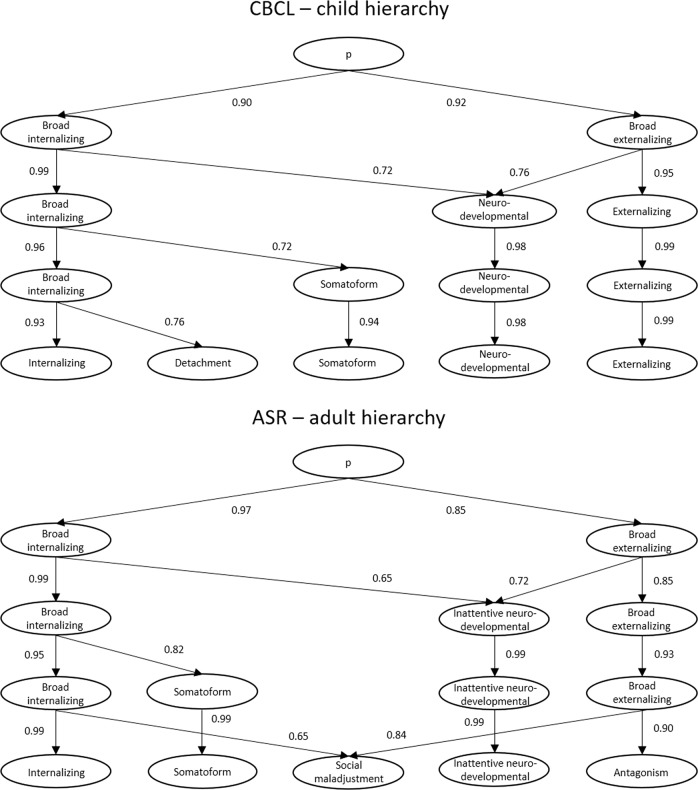
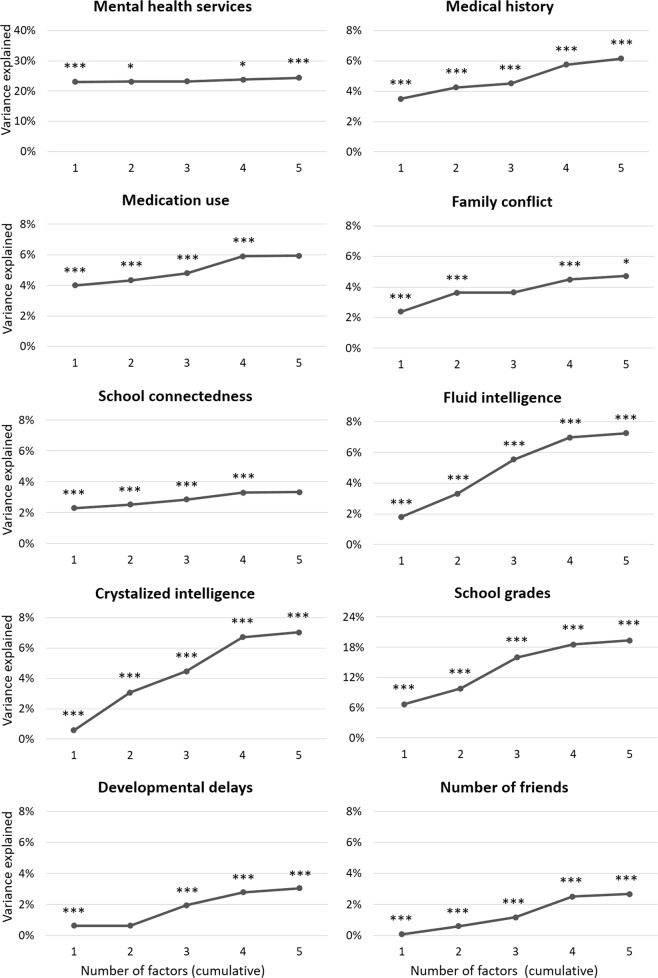
Hierarchical dimensional systems of psychopathology promise more informative descriptions for understanding risk and predicting outcome than traditional diagnostic systems, but it is unclear how many major dimensions they should include. We delineated the hierarchy of childhood and adult psychopathology and validated it against clinically relevant measures. Participants were 9987 9- and 10-year-old children and their parents from the Adolescent Brain Cognitive Development (ABCD) study. Factor analyses of items from the Child Behavior Checklist and Adult Self-Report were run to delineate hierarchies of dimensions. We examined the familial aggregation of the psychopathology dimensions, and the ability of different factor solutions to account for risk factors, real-world functioning, cognitive functioning, and physical and mental health service utilization. A hierarchical structure with a general psychopathology (‘p’) factor at the apex and five specific factors (internalizing, somatoform, detachment, neurodevelopmental, and externalizing) emerged in children. Five similar dimensions emerged also in the parents. Child and parent p-factors correlated highly ( r = 0.61, p < 0.001), and smaller but significant correlations emerged for convergent dimensions between parents and children after controlling for p-factors ( r = 0.09−0.21, p < 0.001). A model with child p-factor alone explained mental health service utilization ( R 2 = 0.23, p < 0.001), but up to five dimensions provided incremental validity to account for developmental risk and current functioning in children ( R 2 = 0.03−0.19, p < 0.001). In this first investigation comprehensively mapping the psychopathology hierarchy in children and adults, we delineated a hierarchy of higher-order dimensions associated with a range of clinically relevant validators. These findings hold important implications for psychiatric nosology and future research in this sample.
Overview
The claims and statistics of this paper haven’t been checked yet.
Free: it reads the open-access text and checks the first 5 claims that cite a source we can check. Create a free account to check every claim.
Integrity signals
Registry
Cites
Statistics
Figures
Verification
Claims the paper makes
The claims and statistics of this paper haven’t been checked yet.
Free: it reads the open-access text and checks the first 5 claims that cite a source we can check. Create a free account to check every claim.
Self-check
Percentages, sums and reported differences re-computed from the paper’s own numbers.
The self-check needs the paper’s full text.
Citations
Cites
Diagnostic and Statistical Manual of Mental Disorders
American Psychiatric Association (2013) · doi:10.1176/appi.books.9780890425596 · Cited by 116,369
Evaluating the use of exploratory factor analysis in psychological research.
Fabrigar, L. R., Wegener, D. T., MacCallum, R. C., & Strahan, E. J. (1999) · Psychological Methods · doi:10.1037/1082-989x.4.3.272 · Cited by 9,587
Insel, T., Cuthbert, B., Garvey, M., Heinssen, R., Pine, D. S., Quinn, K., Sanislow, C., & Wang, P. (2010) · American Journal of Psychiatry · doi:10.1176/appi.ajp.2010.09091379 · Cited by 7,067
Factor analysis in the development and refinement of clinical assessment instruments.
Floyd, F. J., & Widaman, K. F. (1995) · Psychological Assessment · doi:10.1037/1040-3590.7.3.286 · Cited by 3,970
Kotov, R., Krueger, R. F., Watson, D., Achenbach, T. M., Althoff, R. R., Bagby, R. M., Brown, T. A., Carpenter, W. T., Caspi, A., Clark, L. A., et al. (2017) · Journal of Abnormal Psychology · doi:10.1037/abn0000258 · Cited by 3,335
Self-citationThe p Factor: One General Psychopathology Factor in the Structure of Psychiatric Disorders?
Caspi, A., Houts, R. M., Belsky, D. W., Goldman-Mellor, S. J., Harrington, H., Israel, S., Meier, M. H., Ramrakha, S., Shalev, I., Poulton, R., et al. (2014) · Clinical Psychological Science · doi:10.1177/2167702613497473 · Cited by 2,449
The Structure of Common Mental Disorders
Krueger, R. F. (1999) · Archives of General Psychiatry · doi:10.1001/archpsyc.56.10.921 · Cited by 1,881
Recruiting the ABCD sample: Design considerations and procedures
Garavan, H., Bartsch, H., Conway, K., Decastro, A., Goldstein, R. Z., Heeringa, S., Jernigan, T., Potter, A., Thompson, W., & Zahs, D. (2018) · Developmental Cognitive Neuroscience · doi:10.1016/j.dcn.2018.04.004 · Cited by 1,393 · cited 1×
“Full details on recruitment can be found 106 elsewhere.(37) Briefly, the primary method for recruiting children aged 9 or 10 at the time of the baseline 107 assessments (between 2016 and 2018) and their parents was probability sampling of public and private 108 elementary schools within the catchment areas of the 21 r…”
MethodDelineating the Structure of Normal and Abnormal Personality: An Integrative Hierarchical Approach.
Markon, K. E., Krueger, R. F., & Watson, D. (2005) · Journal of Personality and Social Psychology · doi:10.1037/0022-3514.88.1.139 · Cited by 1,187
Self-citationNock, M. K., Hwang, I., Sampson, N. A., & Kessler, R. C. (2010) · Molecular Psychiatry · doi:10.1038/mp.2009.29 · Cited by 1,125
Affects of variable and subject sampling on factor pattern recovery.
Velicer, W. F., & Fava, J. L. (1998) · Psychological Methods · doi:10.1037/1082-989x.3.2.231 · Cited by 998
All for One and One for All: Mental Disorders in One Dimension
Caspi, A., & Moffitt, T. E. (2018) · American Journal of Psychiatry · doi:10.1176/appi.ajp.2018.17121383 · Cited by 918
The classification of children's psychiatric symptoms: A factor-analytic study.
Achenbach, T. M. (1966) · Psychological Monographs: General and Applied · doi:10.1037/h0093906 · Cited by 885
Barch, D. M., Albaugh, M. D., Avenevoli, S., Chang, L., Clark, D. B., Glantz, M. D., Hudziak, J. J., Jernigan, T. L., Tapert, S. F., Yurgelun-Todd, D., et al. (2018) · Developmental Cognitive Neuroscience · doi:10.1016/j.dcn.2017.10.010 · Cited by 814 · cited 1×
“129 For validation, we examined key risk factors, functioning measures, and service use variables: history of 130 developmental motor and speech delays,(38) conflict within the family, social peer functioning (number of 131 friends), academic functioning (school connectedness, average grades),(44) cognitive functionin…”
MethodSelf-citationCommon disorders are quantitative traits
Plomin, R., Haworth, C. M. A., & Davis, O. S. P. (2009) · Nature Reviews Genetics · doi:10.1038/nrg2670 · Cited by 670
Live fast, die young? A review on the developmental trajectories of ADHD across the lifespan
Franke, B., Michelini, G., Asherson, P., Banaschewski, T., Bilbow, A., Buitelaar, J. K., Cormand, B., Faraone, S. V., Ginsberg, Y., Haavik, J., et al. (2018) · European Neuropsychopharmacology · doi:10.1016/j.euroneuro.2018.08.001 · Cited by 643
Self-citationIs there a general factor of prevalent psychopathology during adulthood?
Lahey, B. B., Applegate, B., Hakes, J. K., Zald, D. H., Hariri, A. R., & Rathouz, P. J. (2012) · Journal of Abnormal Psychology · doi:10.1037/a0028355 · Cited by 641
Childhood externalizing and internalizing psychopathology in the prediction of early substance use
King, S. M., Iacono, W. G., & McGue, M. (2004) · Addiction · doi:10.1111/j.1360-0443.2004.00893.x · Cited by 552
Luciana, M., Bjork, J. M., Nagel, B. J., Barch, D. M., Gonzalez, R., Nixon, S. J., & Banich, M. T. (2018) · Developmental Cognitive Neuroscience · doi:10.1016/j.dcn.2018.02.006 · Cited by 530
Self-citationProgress in achieving quantitative classification of psychopathology
Krueger, R. F., Kotov, R., Watson, D., Forbes, M. K., Eaton, N. R., Ruggero, C. J., Simms, L. J., Widiger, T. A., Achenbach, T. M., Bach, B., et al. (2018) · World Psychiatry · doi:10.1002/wps.20566 · Cited by 490
Self-citationA hierarchical causal taxonomy of psychopathology across the life span.
Lahey, B. B., Krueger, R. F., Rathouz, P. J., Waldman, I. D., & Zald, D. H. (2017) · Psychological Bulletin · doi:10.1037/bul0000069 · Cited by 443
The hierarchical structure of DSM-5 pathological personality traits.
Wright, A. G. C., Thomas, K. M., Hopwood, C. J., Markon, K. E., Pincus, A. L., & Krueger, R. F. (2012) · Journal of Abnormal Psychology · doi:10.1037/a0027669 · Cited by 424
Doing it all Bass-Ackwards: The development of hierarchical factor structures from the top down
Goldberg, L. R. (2006) · Journal of Research in Personality · doi:10.1016/j.jrp.2006.01.001 · Cited by 409
New Dimensions in the Quantitative Classification of Mental Illness
Kotov, R. (2011) · Archives of General Psychiatry · doi:10.1001/archgenpsychiatry.2011.107 · Cited by 369
Self-citationTackett, J. L., Lahey, B. B., van Hulle, C., Waldman, I., Krueger, R. F., & Rathouz, P. J. (2013) · Journal of Abnormal Psychology · doi:10.1037/a0034151 · Cited by 360
MOOS, R. H. (1990) · Family Process · doi:10.1111/j.1545-5300.1990.00199.x · Cited by 352
Adult attention-deficit hyperactivity disorder: key conceptual issues
Asherson, P., Buitelaar, J., Faraone, S. V., & Rohde, L. A. (2016) · The Lancet Psychiatry · doi:10.1016/s2215-0366(16)30032-3 · Cited by 347
A paradigm shift in psychiatric classification: the Hierarchical Taxonomy Of Psychopathology (HiTOP)
Kotov, R., Krueger, R. F., & Watson, D. (2018) · World Psychiatry · doi:10.1002/wps.20478 · Cited by 318
Self-citationModeling psychopathology structure: a symptom-level analysis of Axis I and II disorders
Markon, K. E. (2010) · Psychological Medicine · doi:10.1017/s0033291709990183 · Cited by 311
A description of the ABCD organizational structure and communication framework.
Auchter, A. M., Hernandez Mejia, M., Heyser, C. J., Shilling, P. D., Jernigan, T. L., Brown, S. A., Tapert, S. F., & Dowling, G. J. (2018) · Developmental Cognitive Neuroscience · doi:10.1016/j.dcn.2018.04.003 · Cited by 278
Adolescent Irritability: Phenotypic Associations and Genetic Links With Depressed Mood
Stringaris, A., Zavos, H., Leibenluft, E., Maughan, B., & Eley, T. C. (2012) · American Journal of Psychiatry · doi:10.1176/appi.ajp.2011.10101549 · Cited by 271
Martel, M. M., Pan, P. M., Hoffmann, M. S., Gadelha, A., do Rosário, M. C., Mari, J. J., Manfro, G. G., Miguel, E. C., Paus, T., Bressan, R. A., et al. (2017) · Journal of Abnormal Psychology · doi:10.1037/abn0000205 · Cited by 268
Co‐occurrence of ADHD and low IQ has genetic origins
Kuntsi, J., Eley, T. C., Taylor, A., Hughes, C., Asherson, P., Caspi, A., & Moffitt, T. E. (2004) · American Journal of Medical Genetics Part B: Neuropsychiatric Genetics · doi:10.1002/ajmg.b.20076 · Cited by 267
Walsh, J. J., Barnes, J. D., Cameron, J. D., Goldfield, G. S., Chaput, J.-P., Gunnell, K. E., Ledoux, A.-A., Zemek, R. L., & Tremblay, M. S. (2018) · The Lancet Child & Adolescent Health · doi:10.1016/s2352-4642(18)30278-5 · Cited by 264
Andrews, G., Goldberg, D. P., Krueger, R. F., Carpenter, W. T., Hyman, S. E., Sachdev, P., & Pine, D. S. (2009) · Psychological Medicine · doi:10.1017/s0033291709990250 · Cited by 242
Thompson, W. K., Barch, D. M., Bjork, J. M., Gonzalez, R., Nagel, B. J., Nixon, S. J., & Luciana, M. (2019) · Developmental Cognitive Neuroscience · doi:10.1016/j.dcn.2018.12.004 · Cited by 227
Self-citationZucker, R. A., Gonzalez, R., Feldstein Ewing, S. W., Paulus, M. P., Arroyo, J., Fuligni, A., Morris, A. S., Sanchez, M., & Wills, T. (2018) · Developmental Cognitive Neuroscience · doi:10.1016/j.dcn.2018.03.004 · Cited by 221
The familial co-aggregation of ASD and ADHD: a register-based cohort study
Ghirardi, L., Brikell, I., Kuja-Halkola, R., Freitag, C. M., Franke, B., Asherson, P., Lichtenstein, P., & Larsson, H. (2018) · Molecular Psychiatry · doi:10.1038/mp.2017.17 · Cited by 220
Pettersson, E., Larsson, H., & Lichtenstein, P. (2016) · Molecular Psychiatry · doi:10.1038/mp.2015.116 · Cited by 215
Criterion validity of the general factor of psychopathology in a prospective study of girls
Lahey, B. B., Rathouz, P. J., Keenan, K., Stepp, S. D., Loeber, R., & Hipwell, A. E. (2015) · Journal of Child Psychology and Psychiatry · doi:10.1111/jcpp.12300 · Cited by 209
Mental disorders and risk of suicide attempt: a national prospective study
Hoertel, N., Franco, S., Wall, M. M., Oquendo, M. A., Kerridge, B. T., Limosin, F., & Blanco, C. (2015) · Molecular Psychiatry · doi:10.1038/mp.2015.19 · Cited by 206
A general psychopathology factor in early adolescence
Patalay, P., Fonagy, P., Deighton, J., Belsky, J., Vostanis, P., & Wolpert, M. (2015) · British Journal of Psychiatry · doi:10.1192/bjp.bp.114.149591 · Cited by 201
Snyder, H. R., Young, J. F., & Hankin, B. L. (2017) · Clinical Psychological Science · doi:10.1177/2167702616651076 · Cited by 189
A metastructural model of mental disorders and pathological personality traits
Wright, A. G. C., & Simms, L. J. (2015) · Psychological Medicine · doi:10.1017/s0033291715000252 · Cited by 177
Patrick, C. J., Kramer, M. D., Krueger, R. F., & Markon, K. E. (2013) · Psychological Assessment · doi:10.1037/a0034864 · Cited by 176
Waldman, I. D., Poore, H. E., van Hulle, C., Rathouz, P. J., & Lahey, B. B. (2016) · Journal of Abnormal Psychology · doi:10.1037/abn0000183 · Cited by 170
The joint structure of DSM-IV Axis I and Axis II disorders.
Røysamb, E., Kendler, K. S., Tambs, K., Ørstavik, R. E., Neale, M. C., Aggen, S. H., Torgersen, S., & Reichborn-Kjennerud, T. (2011) · Journal of Abnormal Psychology · doi:10.1037/a0021660 · Cited by 165
Waszczuk, M. A., Zavos, H. M. S., Gregory, A. M., & Eley, T. C. (2014) · JAMA Psychiatry · doi:10.1001/jamapsychiatry.2014.655 · Cited by 161
Longitudinal follow‐up of academic achievement in children with autism from age 2 to 18
Kim, S. H., Bal, V. H., & Lord, C. (2018) · Journal of Child Psychology and Psychiatry · doi:10.1111/jcpp.12808 · Cited by 144
Ensuring the Best Use of Data: The Adolescent Brain Cognitive Development Study
Compton, W. M., Dowling, G. J., & Garavan, H. (2019) · JAMA Pediatrics · doi:10.1001/jamapediatrics.2019.2081 · Cited by 136
The association between executive functioning and psychopathology: general or specific?
Bloemen, A. J. P., Oldehinkel, A. J., Laceulle, O. M., Ormel, J., Rommelse, N. N. J., & Hartman, C. A. (2018) · Psychological Medicine · doi:10.1017/s0033291717003269 · Cited by 131 · cited 1×
“298 These results confirm previous studies showing that both a general factor and specific dimensions are 299 necessary for characterizing youth psychopathology,(19) school grades, school and neighborhood 300 deprivation,(14) and executive functioning.(27) They are inconsistent with studies linking cognitive abilities…”
ResultKarcher, N. R., O’Brien, K. J., Kandala, S., & Barch, D. M. (2019) · Biological Psychiatry · doi:10.1016/j.biopsych.2019.01.013 · Cited by 131
Self-citationClark, D. B., Fisher, C. B., Bookheimer, S., Brown, S. A., Evans, J. H., Hopfer, C., Hudziak, J., Montoya, I., Murray, M., Pfefferbaum, A., et al. (2018) · Developmental Cognitive Neuroscience · doi:10.1016/j.dcn.2017.06.005 · Cited by 131 · cited 1×
“Parents or guardians 120 provided written informed consent after the procedures had been fully explained and children assented 121 before participation in the study.(43) 122”
MethodMcElroy, E., Belsky, J., Carragher, N., Fearon, P., & Patalay, P. (2018) · Journal of Child Psychology and Psychiatry · doi:10.1111/jcpp.12849 · Cited by 129
Kim, H., & Eaton, N. R. (2015) · Journal of Abnormal Psychology · doi:10.1037/abn0000113 · Cited by 123
Lithium specificity in bipolar illness: a classic agent for the classic disorder
Gershon, S., Chengappa, K. R., & Malhi, G. S. (2009) · Bipolar Disorders · doi:10.1111/j.1399-5618.2009.00709.x · Cited by 116 · cited 1×
“This supports the importance of examining multiple levels of the 293 psychopathology hierarchy, and is consistent with the views that fine-grained understanding of 294 psychopathology is necessary to fully explicate its etiology 58 and identify maximally effective 295 treatment.(59) Further, different dimensions were…”
ResultMina, an Il4 repressor, controls T helper type 2 bias
Okamoto, M., Van Stry, M., Chung, L., Koyanagi, M., Sun, X., Suzuki, Y., Ohara, O., Kitamura, H., Hijikata, A., Kubo, M., et al. (2009) · Nature Immunology · doi:10.1038/ni.1747 · Cited by 114
Tackett, J. L., Quilty, L. C., Sellbom, M., Rector, N. A., & Bagby, R. M. (2008) · Journal of Abnormal Psychology · doi:10.1037/a0013795 · Cited by 112
Olino, T. M., Dougherty, L. R., Bufferd, S. J., Carlson, G. A., & Klein, D. N. (2014) · Journal of Abnormal Child Psychology · doi:10.1007/s10802-014-9865-x · Cited by 106
Self-citationAndrews, G., Pine, D. S., Hobbs, M. J., Anderson, T. M., & Sunderland, M. (2009) · Psychological Medicine · doi:10.1017/s0033291709990274 · Cited by 94
Validating dimensions of psychosis symptomatology: Neural correlates and 20-year outcomes.
Kotov, R., Foti, D., Li, K., Bromet, E. J., Hajcak, G., & Ruggero, C. J. (2016) · Journal of Abnormal Psychology · doi:10.1037/abn0000188 · Cited by 93 · cited 1×
“We examined the 162 predictive power and the incremental validity of each level of the hierarchy over more parsimonious 163 structures with the significance of R(2) change between blocks.(48) We used this stringent test, rather than 164 comparing levels in pairs, to ensure that a significant result for models with mor…”
MethodSelf-citationForbes, M. K., Kotov, R., Ruggero, C. J., Watson, D., Zimmerman, M., & Krueger, R. F. (2017) · Comprehensive Psychiatry · doi:10.1016/j.comppsych.2017.04.006 · Cited by 93
Self-citationThe hierarchical structure of clinician ratings of proposed DSM–5 pathological personality traits.
Morey, L. C., Krueger, R. F., & Skodol, A. E. (2013) · Journal of Abnormal Psychology · doi:10.1037/a0034003 · Cited by 90
Blanco, C., Krueger, R. F., Hasin, D. S., Liu, S.-M., Wang, S., Kerridge, B. T., Saha, T., & Olfson, M. (2013) · JAMA Psychiatry · doi:10.1001/jamapsychiatry.2013.281 · Cited by 80
Carragher, N., Krueger, R. F., Eaton, N. R., Markon, K. E., Keyes, K. M., Blanco, C., Saha, T. D., & Hasin, D. S. (2014) · Social Psychiatry and Psychiatric Epidemiology · doi:10.1007/s00127-013-0770-3 · Cited by 77
Noordhof, A., Krueger, R. F., Ormel, J., Oldehinkel, A. J., & Hartman, C. A. (2015) · Journal of Abnormal Child Psychology · doi:10.1007/s10802-014-9923-4 · Cited by 75
Blanco, C., Wall, M. M., He, J.-P., Krueger, R. F., Olfson, M., Jin, C. J., Burstein, M., & Merikangas, K. R. (2015) · Journal of the American Academy of Child & Adolescent Psychiatry · doi:10.1016/j.jaac.2014.10.007 · Cited by 74
Haltigan, J. D., Aitken, M., Skilling, T., Henderson, J., Hawke, L., Battaglia, M., Strauss, J., Szatmari, P., & Andrade, B. F. (2018) · Journal of the American Academy of Child & Adolescent Psychiatry · doi:10.1016/j.jaac.2018.03.010 · Cited by 73
Pettersson, E., Lahey, B. B., Larsson, H., & Lichtenstein, P. (2018) · Journal of the American Academy of Child & Adolescent Psychiatry · doi:10.1016/j.jaac.2017.12.016 · Cited by 65
Measuring the hierarchical general factor model of psychopathology in young adults
Lahey, B. B., Zald, D. H., Perkins, S. F., Villalta‐Gil, V., Werts, K. B., Van Hulle, C. A., Rathouz, P. J., Applegate, B., Class, Q. A., Poore, H. E., et al. (2018) · International Journal of Methods in Psychiatric Research · doi:10.1002/mpr.1593 · Cited by 63
Michelini, G., Eley, T. C., Gregory, A. M., & McAdams, T. A. (2015) · Journal of Child Psychology and Psychiatry · doi:10.1111/jcpp.12318 · Cited by 50
Self-citationOrmel, J., Oerlemans, A. M., Raven, D., Laceulle, O. M., Hartman, C. A., Veenstra, R., Verhulst, F. C., Vollebergh, W., Rosmalen, J. G. M., Reijneveld, S. A., et al. (2017) · Psychological Medicine · doi:10.1017/s0033291716003445 · Cited by 47
Pinto, R., Rijsdijk, F., Ronald, A., Asherson, P., & Kuntsi, J. (2016) · Journal of Abnormal Child Psychology · doi:10.1007/s10802-015-0037-4 · Cited by 42
Shared Cognitive Impairments and Aetiology in ADHD Symptoms and Reading Difficulties
Cheung, C. H. M., Fazier-Wood, A. C., Asherson, P., Rijsdijk, F., & Kuntsi, J. (2014) · PLoS ONE · doi:10.1371/journal.pone.0098590 · Cited by 34
Michelini, G., Cheung, C. H. M., Kitsune, V., Brandeis, D., Banaschewski, T., McLoughlin, G., Asherson, P., Rijsdijk, F., & Kuntsi, J. (2021) · Journal of Attention Disorders · doi:10.1177/1087054718771191 · Cited by 27
Self-citationHierarchical organization of axis I psychiatric disorder comorbidity through age 30
Farmer, R. F., Seeley, J. R., Kosty, D. B., Olino, T. M., & Lewinsohn, P. M. (2013) · Comprehensive Psychiatry · doi:10.1016/j.comppsych.2012.12.007 · Cited by 20
Validation of Three Dimensions of Childhood Psychopathology in Young Clinic-Referred Boys
Loney, J., Carlson, G., Salisbury, H., & Volpe, R. (2005) · Journal of Attention Disorders · doi:10.1177/1087054705279298 · Cited by 11
Slobodskaya, H. R. (2016) · Journal of Abnormal Psychology · doi:10.1037/abn0000179 · Cited by 9
Jarnecke, A. M., South, S. C., Elkins, I. J., Krueger, R. F., Tully, E. C., & Iacono, W. G. (2016) · Development and Psychopathology · doi:10.1017/s095457941600122x · Cited by 7
(2001) · Medical Entomology and Zoology
Cited by
Sydnor, V. J., Larsen, B., Bassett, D. S., Alexander-Bloch, A., Fair, D. A., Liston, C., Mackey, A. P., Milham, M. P., Pines, A., Roalf, D. R., et al. (2021) · Neuron · doi:10.1016/j.neuron.2021.06.016 · Cited by 724
“Given the comorbid and transdiagnostic nature of psychiatric symptomatology, it has been proposed that there is a latent factor that predicts a generalized vulnerability to diverse psychopathology (the ‘‘p-factor’’) (Caspi et al., 2014, 2020; Michelini et al., 2019).”
Kotov, R., Krueger, R. F., Watson, D., Cicero, D. C., Conway, C. C., DeYoung, C. G., Eaton, N. R., Forbes, M. K., Hallquist, M. N., Latzman, R. D., et al. (2021) · Annual Review of Clinical Psychology · doi:10.1146/annurev-clinpsy-081219-093304 · Cited by 596
“…anticipating health care utilization), spectra such as detachment and antagonism are important in selection of treatment format (group versus individual), and symptom components such as anhedonia can provide specific targets for treatment development (Kotov et al. 2016, Michelini et al. 2019).”
BackgroundSelf-citationValidity and utility of Hierarchical Taxonomy of Psychopathology (HiTOP): I. Psychosis superspectrum
Kotov, R., Jonas, K. G., Carpenter, W. T., Dretsch, M. N., Eaton, N. R., Forbes, M. K., Forbush, K. T., Hobbs, K., Reininghaus, U., Slade, T., et al. (2020) · World Psychiatry · doi:10.1002/wps.20730 · Cited by 309
Self-citationWatson, D., Levin‐Aspenson, H. F., Waszczuk, M. A., Conway, C. C., Dalgleish, T., Dretsch, M. N., Eaton, N. R., Forbes, M. K., Forbush, K. T., Hobbs, K. A., et al. (2022) · World Psychiatry · doi:10.1002/wps.20943 · Cited by 265
Self-citationLinking RDoC and HiTOP: A new interface for advancing psychiatric nosology and neuroscience
Michelini, G., Palumbo, I. M., DeYoung, C. G., Latzman, R. D., & Kotov, R. (2021) · Clinical Psychology Review · doi:10.1016/j.cpr.2021.102025 · Cited by 273
Self-citation
Metadata
- Authors
- Michelini, G., Barch, D. M., Tian, Y., Watson, D., Klein, D. N., & Kotov, R.
- Affiliations
- Stony Brook University (US)
- Washington University in St. Louis (US)
- University of Notre Dame (US)
- Corresponding author
- Michelini, Giorgia
- Venue
- Translational Psychiatry
- Published
- 2019-10-17
- Volume
- 9
- Issue
- 1
- Pages
- 261-261
- ISSN
- 2158-3188 (ISSN-L)
- PMC
- PMC6797772
- OpenAlex
- W2980501619
- Cited by
- 171
- References
- 80
- Citations by year
- 2026: 19 · 2025: 19 · 2024: 30 · 2023: 26 · 2022: 18 · 2021: 38 · 2020: 20
- FWCI
- 22.20
- Type
- journal article
- Language
- en
- Open access
- gold
- doi.org
- Licence
- cc-by
- creativecommons.org/licenses/by/4.0 (tdm)
- creativecommons.org/licenses/by/4.0 (vor)
- Locations
- Translational Psychiatry (publishedVersion, cc-by)
- bioRxiv (Cold Spring Harbor Laboratory) (acceptedVersion, cc-by-nc-nd)
- PubMed Central (publishedVersion, cc-by)
- PubMed (publishedVersion)
- Digital Commons@Becker (Washington University School of Medicine) (submittedVersion, cc-by)
- DOAJ (DOAJ: Directory of Open Access Journals) (submittedVersion)
- Queen Mary Research Online (Queen Mary University of London) (submittedVersion, cc-by)
- Funders
- U.S. Department of Health & Human Services | NIH | National Institute of Mental Health
- U.S. Department of Health & Human Services | NIH | National Institute on Drug Abuse
- Topics
- Social Sciences › Psychology › Clinical Psychology › Child and Adolescent Psychosocial and Emotional Development
- Social Sciences › Psychology › Experimental and Cognitive Psychology › Mental Health Research Topics
- Social Sciences › Psychology › Clinical Psychology › Personality Disorders and Psychopathology
- Keywords
- general psychopathology factor, internalizing problems, externalizing problems, detachment, childhood psychopathology, adolescent psychopathology, familial aggregation, Child Behavior Checklist, Adult Self-Report, mental health service utilization, psychiatric classification, developmental risk
- MeSH terms
- Adolescent, Psychology, Adolescent, Mental Disorders, Child, Psychology, Child, Factor Analysis, Statistical, Female, Humans, Male, Psychopathology, United States
About these checks
Registry, retraction, Cites and statistics results are computed, not judged, with one exception: a printed reference that no index lists is read once by a model before it counts as a citation error. Claims are extracted by a model and kept only when their quote appears verbatim in the text; each cited source is then checked, with a model’s help, for whether it says what the claim relies on. Those verdicts can be wrong — read the claim’s quote and the cited source before relying on one.
Statistics and arithmetic are recomputed, not judged.
Confidence bands are shown only for fields calibrated on our annotated test set. None is calibrated yet, so no band is shown.
What counts as a claim ›How we measure confidence ›How we check this ›
Are you an author, or do you see a problem with this page? Request a review
Data sources
Bibliographic data: Semantic Scholar, OpenAlex, Crossref.
Contains information from the Semantic Scholar Academic Graph Datasets, made available under the ODC Attribution License (ODC-BY 1.0).
Semantic Scholar’s data is described in: Kinney, R., et al. (2023). The Semantic Scholar Open Data Platform. arXiv:2301.10140.
