

The DOI matches its Crossref record; 60 of the 60 references it cites were found in a registry or an index.
Whole-genome resequencing reveals world-wide ancestry and adaptive introgression events of domesticated cattle in East Asia
Open accessAbstract
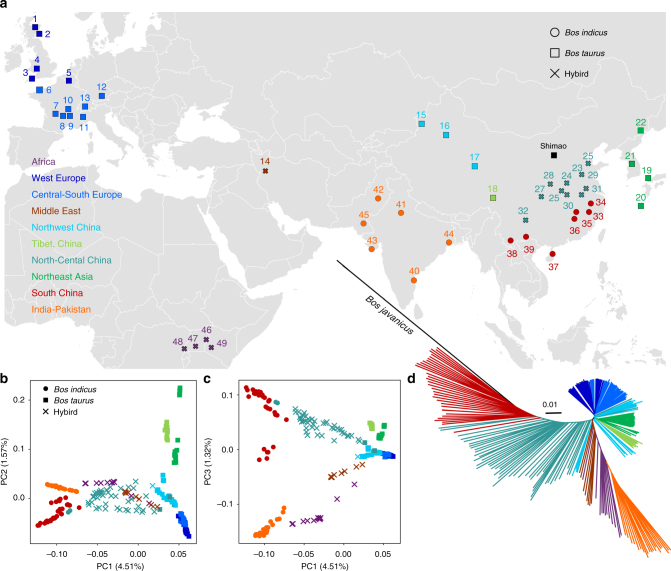
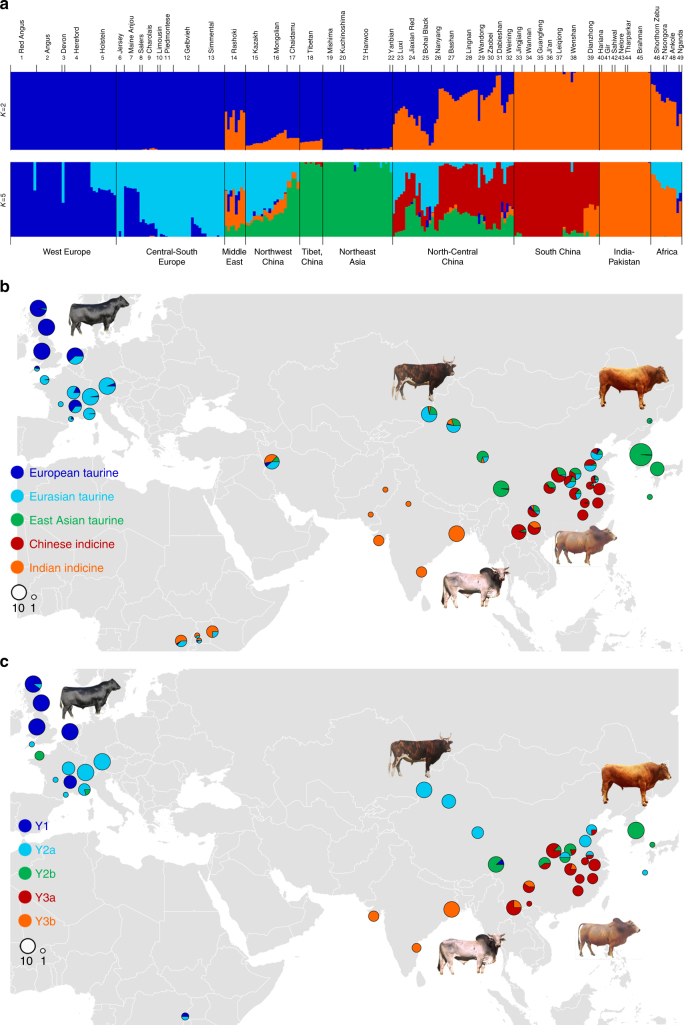
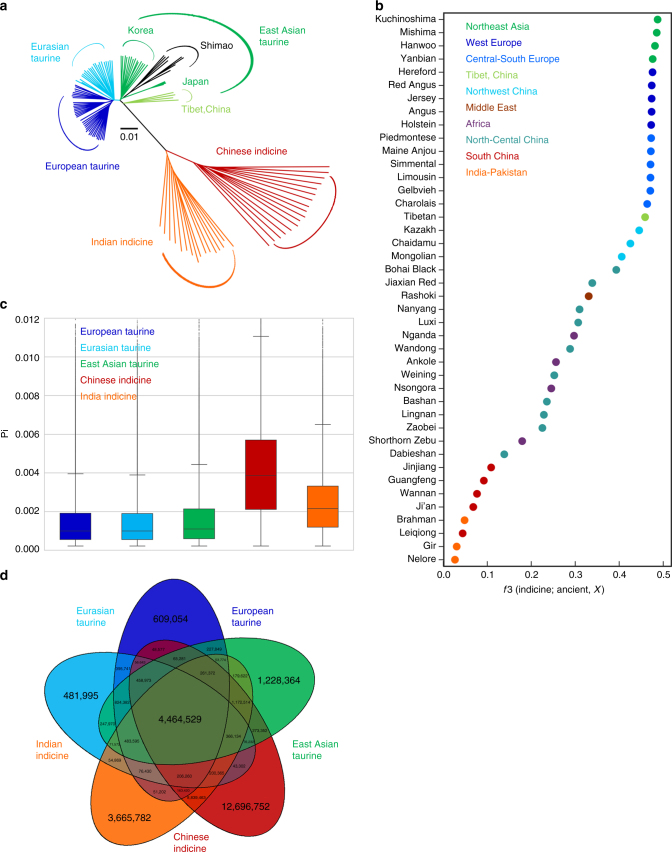
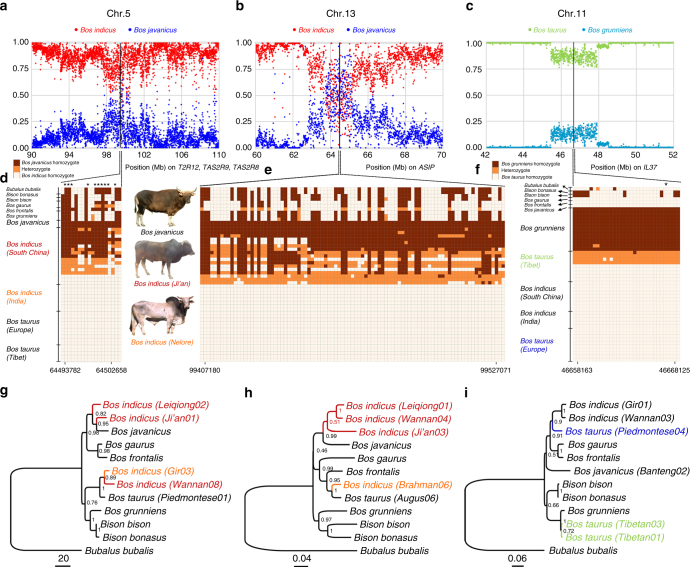
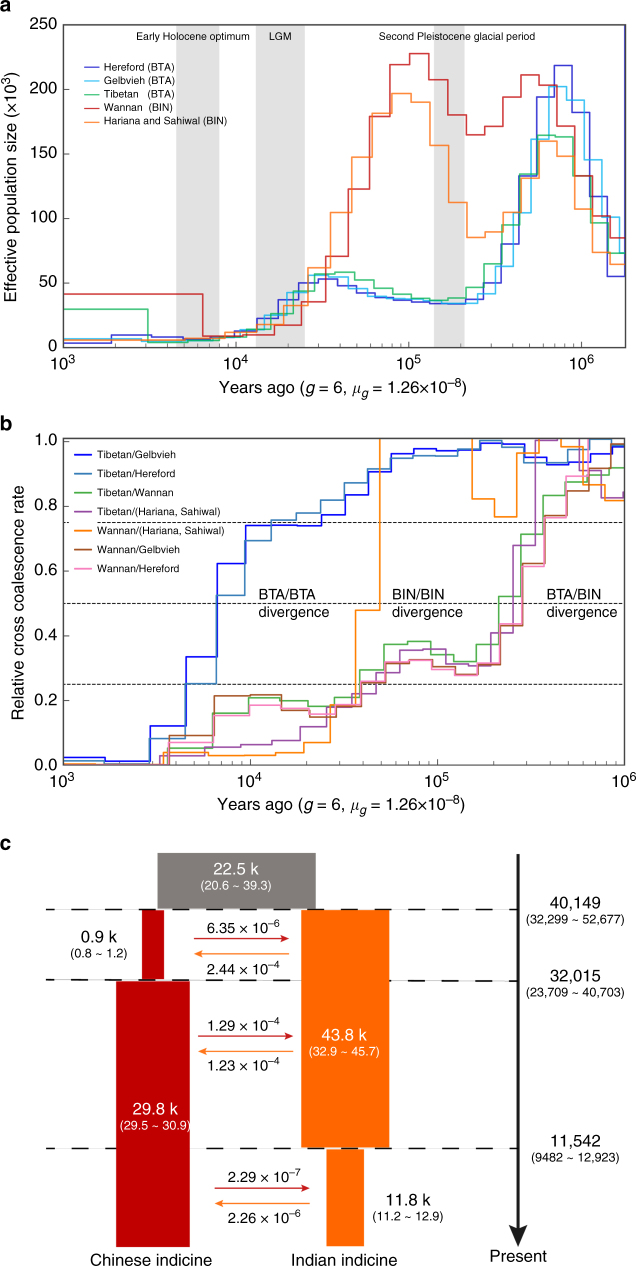
Cattle domestication and the complex histories of East Asian cattle breeds warrant further investigation. Through analysing the genomes of 49 modern breeds and eight East Asian ancient samples, worldwide cattle are consistently classified into five continental groups based on Y-chromosome haplotypes and autosomal variants. We find that East Asian cattle populations are mainly composed of three distinct ancestries, including an earlier East Asian taurine ancestry that reached China at least ~3.9 kya, a later introduced Eurasian taurine ancestry, and a novel Chinese indicine ancestry that diverged from Indian indicine approximately 36.6-49.6 kya. We also report historic introgression events that helped domestic cattle from southern China and the Tibetan Plateau achieve rapid adaptation by acquiring ~2.93% and ~1.22% of their genomes from banteng and yak, respectively. Our findings provide new insights into the evolutionary history of cattle and the importance of introgression in adaptation of cattle to new environmental challenges in East Asia.
Overview
The claims and statistics of this paper haven’t been checked yet.
Run the check — free, no account needed. It reads the open-access text and checks the sources it cites.
Integrity signals
Registry
Cites
Statistics
Figures
Verification
Claims the paper makes
The claims and statistics of this paper haven’t been checked yet.
Run the check — free, no account needed. It reads the open-access text and checks the sources it cites.
Claims other papers make about this one
Each is checked against this paper’s own text: does it say what the citing paper says it does?
The source backs part of the claim, not all of it — or backs it for a different population, condition or comparison.
In the citing paper
“strongly supporting the two independent domestication events involving distinct aurochs subspecies.”
From The Genomic Landscape of Cattle: Domestication, Dispersal, and Adaptive Evolution (2026) · cites this paper as [9]
Experimental — accuracy not yet measuredThe source backs part of the claim, not all of it — or backs it for a different population, condition or comparison.
In the citing paper
“Molecular divergence of taurine and indicine (also referred to as zebu) lineages is estimated to have occurred at approximately 201,000–301,200 years ago [5,7,8,9,10], strongly supporting the two independent domestication events involving distinct aurochs subspecies.”
From The Genomic Landscape of Cattle: Domestication, Dispersal, and Adaptive Evolution (2026) · cites this paper as [9]
Experimental — accuracy not yet measuredThe source backs part of the claim, not all of it — or backs it for a different population, condition or comparison.
In the citing paper
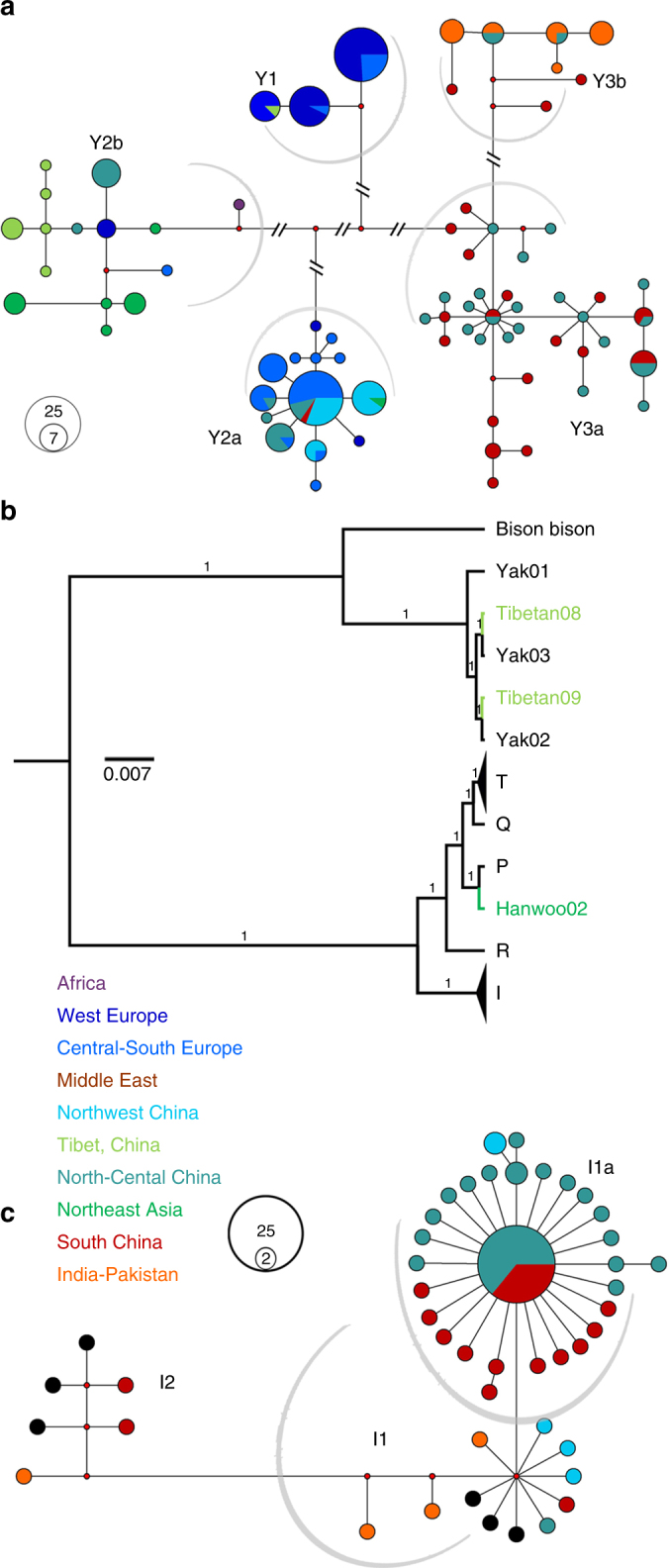
“The Y2 haplogroup is distributed across Eurasia and Africa, whiel Y2a sub-haplogroup is dominant in Eurasian cattle and Y2b sub-haplogroup is found having a higher proportion in Northeast Asian and Qinghai-Tibetan Plateau cattle [9,34].”
From The Genomic Landscape of Cattle: Domestication, Dispersal, and Adaptive Evolution (2026) · cites this paper as [9]
Experimental — accuracy not yet measuredThe source backs part of the claim, not all of it — or backs it for a different population, condition or comparison.
In the citing paper
“The divergence of Y3a from Y3b, as well as sub-haplogroups within indicine mitogenomes, occurred approximately 23,100–24,800 years ago, while South Asian indicine ancestry diverged from East Asian and African indicine ancestry approximately 10,300–40,100 and 11,800 years ago, respectively [9,10].”
From The Genomic Landscape of Cattle: Domestication, Dispersal, and Adaptive Evolution (2026) · cites this paper as [9]
Experimental — accuracy not yet measuredThe source backs part of the claim, not all of it — or backs it for a different population, condition or comparison.
In the citing paper
“The mtDNA I1 haplogroup and Y3b sub-haplogroup are widely distributed in India and other parts of the world, while Y3a sub-haplogroup predominates in southern China and Southeast Asia [6,9,36,37].”
From The Genomic Landscape of Cattle: Domestication, Dispersal, and Adaptive Evolution (2026) · cites this paper as [9]
Experimental — accuracy not yet measured
The source backs part of the claim, not all of it — or backs it for a different population, condition or comparison.
In the citing paper
“The autosomal genetic structure of modern cattle is primarily divided into six ancestries (Table 1): European taurine, East Asian taurine, African taurine, South Asian or Indian indicine, East Asian or Chinese indicine, and African indicine ancestry [9,10,31].”
From The Genomic Landscape of Cattle: Domestication, Dispersal, and Adaptive Evolution (2026) · cites this paper as [9]
Experimental — accuracy not yet measuredThe source backs part of the claim, not all of it — or backs it for a different population, condition or comparison.
In the citing paper
“The introgression proportions of banteng (Bos javanicus), gaur (Bos gaurus), and yak (Bos mutus) ancestries into East Asian indicine or Tibetan taurine cattle ranged from 1.13% to 10.21%, 2.06% to 9.98%, and 0.05% to 2.94%, respectively [9,10].”
From The Genomic Landscape of Cattle: Domestication, Dispersal, and Adaptive Evolution (2026) · cites this paper as [9]
Experimental — accuracy not yet measuredThe source backs part of the claim, not all of it — or backs it for a different population, condition or comparison.
In the citing paper
“During the late Neolithic (4000–5000 years ago), taurine cattle were introduced to East Asia from West Asia, carrying T3 and the East Asian-specific T4 haplogroups [9,33,55,56,57].”
From The Genomic Landscape of Cattle: Domestication, Dispersal, and Adaptive Evolution (2026) · cites this paper as [9]
Experimental — accuracy not yet measuredThe cited source says what the claim attributes to it.
In the citing paper
“Studies based on Y-chromosome microsatellites or SNP markers classify modern cattle paternal origins into taurine Y1, Y2 (Y2a and Y2b), and indicine Y3 (Y3a and Y3b) haplogroups [9,10].”
From The Genomic Landscape of Cattle: Domestication, Dispersal, and Adaptive Evolution (2026) · cites this paper as [9]
The cited source says what the claim attributes to it.
In the citing paper
“Tibetan and Northeast Asian cattle breeds share an East Asian taurine ancestry component, and the Y2b sub-haplogroup was likely maintained by geographical barriers [9].”
From The Genomic Landscape of Cattle: Domestication, Dispersal, and Adaptive Evolution (2026) · cites this paper as [9]
The cited source says what the claim attributes to it.
In the citing paper
“In contrast, Eurasian taurine ancestry and the Y2a sub-haplogroup predominated in cattle from Northwest China and south-central Europe [9].”
From The Genomic Landscape of Cattle: Domestication, Dispersal, and Adaptive Evolution (2026) · cites this paper as [9]
Self-check
Percentages, sums and reported differences re-computed from the paper’s own numbers.
The self-check needs the paper’s full text.
Citations
Cites
Guindon, S., Dufayard, J.-F., Lefort, V., Anisimova, M., Hordijk, W., & Gascuel, O. (2010) · Systematic Biology · doi:10.1093/sysbio/syq010 · Cited by 18,376
Bayesian Phylogenetics with BEAUti and the BEAST 1.7
Drummond, A. J., Suchard, M. A., Xie, D., & Rambaut, A. (2012) · Molecular Biology and Evolution · doi:10.1093/molbev/mss075 · Cited by 10,128
Fast model-based estimation of ancestry in unrelated individuals
Alexander, D. H., Novembre, J., & Lange, K. (2009) · Genome Research · doi:10.1101/gr.094052.109 · Cited by 9,898
Population Structure and Eigenanalysis
Patterson, N., Price, A. L., & Reich, D. (2006) · PLoS Genetics · doi:10.1371/journal.pgen.0020190 · Cited by 5,280
A draft sequence of the Neandertal genome
Green, R. E., Krause, J., Briggs, A. W., Maricic, T., Stenzel, U., Kircher, M., Patterson, N., Li, H., Zhai, W., Fritz, M. H.-Y., et al. (2010) · Science · doi:10.1126/science.1188021 · Cited by 4,318
Clark, P. U., Dyke, A. S., Shakun, J. D., Carlson, A. E., Clark, J., Wohlfarth, B., Mitrovica, J. X., Hostetler, S. W., & McCabe, A. M. (2009) · Science · doi:10.1126/science.1172873 · Cited by 3,277
Browning, S. R., & Browning, B. L. (2007) · The American Journal of Human Genetics · doi:10.1086/521987 · Cited by 3,217
Ancient Admixture in Human History
Patterson, N., Moorjani, P., Luo, Y., Mallick, S., Rohland, N., Zhan, Y., Genschoreck, T., Webster, T., & Reich, D. (2012) · Genetics · doi:10.1534/genetics.112.145037 · Cited by 2,848
Inference of population splits and mixtures from genome-wide allele frequency data
Pickrell, J. K., & Pritchard, J. K. (2012) · PLoS Genetics · doi:10.1371/journal.pgen.1002967 · Cited by 2,731
Gutenkunst, R. N., Hernandez, R. D., Williamson, S. H., & Bustamante, C. D. (2009) · PLoS Genetics · doi:10.1371/journal.pgen.1000695 · Cited by 1,906
Altitude adaptation in Tibetans caused by introgression of Denisovan-like DNA
Huerta-Sánchez, E., Jin, X., Asan, Bianba, Z., Peter, B. M., Vinckenbosch, N., Liang, Y., Yi, X., He, M., Somel, M., et al. (2014) · Nature · doi:10.1038/nature13408 · Cited by 1,208
Self-citationThe Molecular Receptive Ranges of Human TAS2R Bitter Taste Receptors
Meyerhof, W., Batram, C., Kühn, C., Brockhoff, A., Chudoba, E., Bufe, B., Appendino, G., & Behrens, M. (2009) · Chemical Senses · doi:10.1093/chemse/bjp092 · Cited by 1,146
Inferring human population size and separation history from multiple genome sequences
Schiffels, S., & Durbin, R. (2014) · Nature Genetics · doi:10.1038/ng.3015 · Cited by 1,073
Keane, T., Creevey, C. J., Pentony, M. M., Naughton, T. J., & Mclnerney, J. O. (2006) · BMC Evolutionary Biology · doi:10.1186/1471-2148-6-29 · Cited by 1,070
The yak genome and adaptation to life at high altitude
Qiu, Q., Zhang, G., Ma, T., Qian, W., Wang, J., Ye, Z., Cao, C., Hu, Q., Kim, J., Larkin, D. M., et al. (2012) · Nature Genetics · doi:10.1038/ng.2343 · Cited by 983
Self-citationRFMix: A Discriminative Modeling Approach for Rapid and Robust Local-Ancestry Inference
Maples, B. K., Gravel, S., Kenny, E. E., & Bustamante, C. D. (2013) · The American Journal of Human Genetics · doi:10.1016/j.ajhg.2013.06.020 · Cited by 900
Genome-wide survey of SNP variation uncovers the genetic structure of cattle breeds
The Bovine HapMap Consortium, Gibbs, R. A., Taylor, J. F., Van Tassell, C. P., Barendse, W., Eversole, K. A., Gill, C. A., Green, R. D., Hamernik, D. L., Kappes, S. M., et al. (2009) · Science · doi:10.1126/science.1167936 · Cited by 868
Self-citationIL-37 is a fundamental inhibitor of innate immunity
Nold, M. F., Nold‐Petry, C. A., Zepp, J. A., Palmer, B. E., Bufler, P., & Dinarello, C. A. (2010) · Nature Immunology · doi:10.1038/ni.1944 · Cited by 850
Beall, C. M., Cavalleri, G. L., Deng, L., Elston, R. C., Gao, Y., Knight, J., Li, C., Li, J. C., Liang, Y., McCormack, M., et al. (2010) · Proceedings of the National Academy of Sciences · doi:10.1073/pnas.1002443107 · Cited by 845
Self-citationEvidence for Two Independent Domestications of Cattle
Loftus, R. T., MacHugh, D. E., Bradley, D. G., Sharp, P. M., & Cunningham, P. (1994) · Proceedings of the National Academy of Sciences · doi:10.1073/pnas.91.7.2757 · Cited by 812
Self-citationThe BPP program for species tree estimation and species delimitation
Yang, Z. (2015) · Current Zoology · doi:10.1093/czoolo/61.5.854 · Cited by 779
Agriculture facilitated permanent human occupation of the Tibetan Plateau after 3600 B.P.
Chen, F., Dong, G., Zhang, D., Liu, X. Y., Jia, X., An, C. B., Ma, M. M., Xie, Y., Barton, L., Ren, X. Y., et al. (2014) · Science · doi:10.1126/science.1259172 · Cited by 733
Genetic diversity in farm animals – a review
Groeneveld, L. F., Lenstra, J. A., Eding, H., Toro, M. Á., Scherf, B., Pilling, D., Negrini, R., Finlay, E. K., Jianlin, H., Groeneveld, E., et al. (2010) · Animal Genetics · doi:10.1111/j.1365-2052.2010.02038.x · Cited by 680
Genetic Evidence for Near-Eastern Origins of European Cattle
Troy, C. S., MacHugh, D. E., Bailey, J. F., Magee, D. A., Loftus, R. T., Cunningham, P., Chamberlain, A. T., Sykes, B. C., & Bradley, D. G. (2001) · Nature · doi:10.1038/35074088 · Cited by 627
Self-citationBigham, A., Bauchet, M., Pinto, D., Mao, X., Akey, J. M., Mei, R., Scherer, S. W., Julian, C. G., Wilson, M. J., López Herráez, D., et al. (2010) · PLoS Genetics · doi:10.1371/journal.pgen.1001116 · Cited by 597
Mitochondrial diversity and the origins of African and European cattle
Bradley, D. G., MacHugh, D. E., Cunningham, P., & Loftus, R. T. (1996) · Proceedings of the National Academy of Sciences · doi:10.1073/pnas.93.10.5131 · Cited by 584
Self-citationEvidence for archaic adaptive introgression in humans
Racimo, F., Sankararaman, S., Nielsen, R., & Huerta-Sánchez, E. (2015) · Nature Reviews Genetics · doi:10.1038/nrg3936 · Cited by 521
Worldwide Patterns of Ancestry, Divergence, and Admixture in Domesticated Cattle
Decker, J. E., McKay, S. D., Rolf, M. M., Kim, J., Molina Alcalá, A., Sonstegard, T. S., Hanotte, O., Götherström, A., Seabury, C. M., Praharani, L., et al. (2014) · PLoS Genetics · doi:10.1371/journal.pgen.1004254 · Cited by 521
Self-citationAi, H., Fang, X., Yang, B. J., Huang, Z., Chen, H., Mao, L., Zhang, F., Zhang, L., Cui, L., He, W., et al. (2015) · Nature Genetics · doi:10.1038/ng.3199 · Cited by 379
Self-citationZhao, S., Zheng, P., Dong, S., Zhan, X., Wu, Q., Guo, X., Hu, Y., He, W., Zhang, S., Fan, W., et al. (2012) · Nature Genetics · doi:10.1038/ng.2494 · Cited by 353
Self-citationInterleukin 37 expression protects mice from colitis
McNamee, E. N., Masterson, J. C., Jedlicka, P., McManus, M. C., Grenz, A., Collins, C. B., Nold, M. F., Nold‐Petry, C. A., Bufler, P., Dinarello, C. A., et al. (2011) · Proceedings of the National Academy of Sciences · doi:10.1073/pnas.1111982108 · Cited by 320
Mitochondrial Genomes of Extinct Aurochs Survive in Domestic Cattle
Achilli, A., Olivieri, A., Pellecchia, M., Uboldi, C., Colli, L., Al-Zahery, N., Accetturo, M., Pala, M., Kashani, B. H., Perego, U. A., et al. (2008) · Current Biology · doi:10.1016/j.cub.2008.01.019 · Cited by 290
The Genome Landscape of Indigenous African Cattle
Kim, J., Hanotte, O., Mwai, O. A., Dessie, T., Bashir, S., Diallo, B., Agaba, M., Kim, K., Kwak, W., Sung, S., et al. (2017) · Genome biology · doi:10.1186/s13059-017-1153-y · Cited by 271
The bronze age of Southeast Asia
(1997) · Choice Reviews Online · doi:10.5860/choice.34-4553 · Cited by 269
Zebu Cattle Are an Exclusive Legacy of the South Asia Neolithic
Chen, S., Lin, B.-Z., Baig, M., Mitra, B., Lopes, R. J., Santos, A. M., Magee, D. A., Azevedo, M., Tarroso, P., Sasazaki, S., et al. (2010) · Molecular Biology and Evolution · doi:10.1093/molbev/msp213 · Cited by 248
Self-citationPark, S. D. E., Magee, D. A., McGettigan, P., Teasdale, M. D., Edwards, C. J., Lohan, A. J., Murphy, A., Braud, M., Donoghue, M. T. A., Liu, Y., et al. (2015) · Genome biology · doi:10.1186/s13059-015-0790-2 · Cited by 234
Self-citationGenomic Analyses Reveal Potential Independent Adaptation to High Altitude in Tibetan Chickens
Wang, M., Li, Y., Peng, M., Zhong, L., Wang, Z., Li, Q., Tu, X.-L., Dong, Y., Zhu, C., Wang, L., et al. (2015) · Molecular Biology and Evolution · doi:10.1093/molbev/msv071 · Cited by 225
New World Cattle Show Ancestry from Multiple Independent Domestication Events
McTavish, E. J., Decker, J. E., Schnabel, R. D., Taylor, J. F., & Hillis, D. M. (2013) · Proceedings of the National Academy of Sciences · doi:10.1073/pnas.1303367110 · Cited by 218
Cattle domestication in the Near East was followed by hybridization with aurochs bulls in Europe
Götherström, A., Anderung, C., Hellborg, L., Elburg, R., Smith, C. I., Bradley, D. G., & Ellegren, H. (2005) · Proceedings of the Royal Society B Biological Sciences · doi:10.1098/rspb.2005.3243 · Cited by 208
Self-citationTaming the Past: Ancient DNA and the Study of Animal Domestication
MacHugh, D. E., Larson, G., & Orlando, L. (2016) · Annual Review of Animal Biosciences · doi:10.1146/annurev-animal-022516-022747 · Cited by 180
Moving agriculture onto the Tibetan plateau: the archaeobotanical evidence
Guedes, J. D., Lü, H., Li, Y., Spengler, R. N., Wu, X., & Aldenderfer, M. S. (2013) · Archaeological and Anthropological Sciences · doi:10.1007/s12520-013-0153-4 · Cited by 176
The first steps of animal domestication : new archaeozoological approaches
Vigne, J., Peters, J., & Helmer, D. (2005) · Cited by 152
Genetic Diversity and Origin of Chinese Cattle Revealed by mtDNA D-Loop Sequence Variation
Lai, S.-J., Liu, Y.-P., Liu, Y.-X., Li, X.-W., & Yao, Y.-G. (2006) · Molecular Phylogenetics and Evolution · doi:10.1016/j.ympev.2005.06.013 · Cited by 143
Međugorac, I., Graf, A., Grohs, C., Rothammer, S., Zagdsuren, Y., Александровна, Г. Е., Zinovieva, N. A., Barbieri, J., Seichter, D., Ruß, I., et al. (2017) · Nature Genetics · doi:10.1038/ng.3775 · Cited by 135
Species Composition and Environmental Adaptation of Indigenous Chinese Cattle
Gao, Y., Gautier, M., Ding, X., Zhang, H., Wang, Y., Wang, X., Faruque, M. O., Li, J., Ye, S., Gou, X., et al. (2017) · Scientific Reports · doi:10.1038/s41598-017-16438-7 · Cited by 112
Self-citationMorphological and genetic evidence for early Holocene cattle management in northeastern China
Zhang, H., Paijmans, J. L. A., Chang, F., Wu, X., Chen, G., Lei, C., Yang, X., Wei, Z., Bradley, D. G., Orlando, L., et al. (2013) · Nature Communications · doi:10.1038/ncomms3755 · Cited by 109
Self-citationChang, T.-C., Yang, Y., Retzel, E. F., & Liu, W. (2013) · Proceedings of the National Academy of Sciences · doi:10.1073/pnas.1221104110 · Cited by 103
Origin and Phylogeographical Structure of Chinese Cattle
Lei, C. Z., Chen, H., Zhang, H. C., Cai, X., Liu, R. Y., Luo, L. Y., Wang, C. F., Zhang, W., Ge, Q. L., Zhang, R. F., et al. (2006) · Animal Genetics · doi:10.1111/j.1365-2052.2006.01524.x · Cited by 98
Self-citationThe Origins of Chinese Domestic Cattle as Revealed by Ancient DNA Analysis
Cai, D., Sun, Y., Tang, Z., Hu, S., Li, W., Zhao, X., Xiang, H., & Zhou, H. (2014) · Journal of Archaeological Science · doi:10.1016/j.jas.2013.09.003 · Cited by 85
Self-citationBrunson, K., Zhao, X., He, N., Dai, X., Rodrigues, A. T., & Yang, D. Y. (2016) · Journal of Archaeological Science · doi:10.1016/j.jas.2016.08.008 · Cited by 65
Deciphering the Wisent Demographic and Adaptive Histories from Individual Whole-Genome Sequences
Gautier, M., Moazami‐Goudarzi, K., Levéziel, H. H., Parrinello, H., Grohs, C., Rialle, S., Kowalczyk, R., & Flori, L. (2016) · Molecular Biology and Evolution · doi:10.1093/molbev/msw144 · Cited by 62
Liu, G. E., Matukumalli, L. K., Sonstegard, T. S., Shade, L. L., & Tassell, C. P. V. (2006) · BMC Genomics · doi:10.1186/1471-2164-7-140 · Cited by 41
Book Review: The First Steps of Animal Domestication
Hesse, B. C. (2006) · Journal of Ethnobiology · doi:10.2993/0278-0771(2006)26[171:tfsoad]2.0.co;2 · Cited by 41
History and population structure of a closed strain of Japanese Black Cattle
Mukai, F., Tsuji, S., Fukazawa, K., Ohtagaki, S., & Nambu, Y. (1989) · Journal of Animal Breeding and Genetics · doi:10.1111/j.1439-0388.1989.tb00239.x · Cited by 40
Paternal Origins of Chinese Cattle
Li, R., Zhang, X. M., Campana, M. G., Huang, J. P., Chang, Z. H., Qi, X. B., Shi, H., Su, B., Zhang, R. F., Lan, X. Y., et al. (2013) · Animal Genetics · doi:10.1111/age.12022 · Cited by 40
Self-citationMolecular biology of thermoregulation
Sieck, G. C. (2002) · Journal of Applied Physiology · doi:10.1152/japplphysiol.00003.2002 · Cited by 38
Zooarchaeological and Genetic Evidence for the Origins of Domestic Cattle in Ancient China
Lu, P., Brunson, K., Yuan, J., & Li, Z. (2017) · Asian perspectives · doi:10.1353/asi.2017.0003 · Cited by 28
Hassanin, A., & Ropiquet, A. (2007) · Journal of Zoology · doi:10.1111/j.1469-7998.2006.00272.x · Cited by 24
Shimao and Erlitou: new perspectives on the origins of the bronze industry in central China
Rawson, J. (2017) · Antiquity · doi:10.15184/aqy.2016.234 · Cited by 23
Lawler, A. J. (2009) · Science · doi:10.1126/science.325_940 · Cited by 16
Research works printed but not linked: 3
- National Bureau of Statistics. China Statistical Yearbook 2016 (China Statistics Press, Beijing, 2016).
- Vigne, J. D., Peters, J. & Helmer, D. The First Steps of Animal Domestication (Oxbow Books, Oxford, 2005).
- Flad, R., Yuan, J. & Li, S. C. On the source and features of the Neolithic domestic animals in the Gansu and Qinghai region, China. Archaeology 5, 80–86 (2009).
Cited by
Sorted by citations
863 genomes reveal the origin and domestication of chicken
Wang, M.-S., Thakur, M., Peng, M.-S., Jiang, Y., Frantz, L. A. F., Li, M., Zhang, J.-J., Wang, S., Peters, J., Otecko, N. O., et al. (2020) · Cell Research · doi:10.1038/s41422-020-0349-y · Cited by 286
Self-citationWidespread introgression across a phylogeny of 155 Drosophila genomes
Suvorov, A., Kim, B. Y., Wang, J., Armstrong, E. E., Peede, D., D’Agostino, E. R. R., Price, D. K., Waddell, P. J., Lang, M., Courtier‐Orgogozo, V., et al. (2021) · Current Biology · doi:10.1016/j.cub.2021.10.052 · Cited by 278
Ancient Cattle Genomics, Origins, and Rapid Turnover in the Fertile Crescent
Verdugo, M. P., Mullin, V. E., Scheu, A., Mattiangeli, V., Daly, K. G., Maisano Delser, P., Hare, A. J., Burger, J., Collins, M. J., Kehati, R., et al. (2019) · Science · doi:10.1126/science.aav1002 · Cited by 227
Self-citationHu, X., Yang, J. H., Xie, X.-L., Lv, F., Cao, Y.-H., Li, W., Liu, M., Wang, Y., Li, J., Liu, Y., et al. (2018) · Molecular Biology and Evolution · doi:10.1093/molbev/msy208 · Cited by 193
Self-citationThe origin of domestication genes in goats
Zheng, Z., Wang, X., Li, M., Li, Y., Yang, Z., Wang, X., Pan, X., Gong, M., Zhang, Y., Guo, Y., et al. (2020) · Science Advances · doi:10.1126/sciadv.aaz5216 · Cited by 184
Self-citation
Metadata
- Authors
- Chen, N., Cai, Y., Chen, Q., Li, R., Wang, K., Huang, Y., Hu, S., Huang, S., Zhang, H., Zheng, Z., Song, W., Ma, Z., Ma, Y., Dang, R., Zhang, Z., Xu, L., Jia, Y., Liu, S., Yue, X., Deng, W., Zhang, X., Sun, Z., Lan, X., Han, J., Chen, H., Bradley, D. G., Jiang, Y., & Lei, C.
- Affiliations
- Northwest A&F University (CN)
- Northwestern Polytechnical University (CN)
- Yunnan University (CN)
- Qinghai University (CN)
- Ningxia University (CN)
- Henan Academy of Agricultural Sciences (CN)
- Anhui Academy of Agricultural Sciences (CN)
- National Beef Cattle Industrial Technology System (CN)
- State Key Laboratory of Herbage Improvement and Grassland Agro-ecosystems (CN)
- Yunnan Agricultural University (CN)
- Kunming Institute of Zoology (CN)
- Chinese Academy of Agricultural Sciences (CN)
- Trinity College Dublin (IE)
- Corresponding author
- Jiang, Yu
- Lei, Chuzhao
- ORCID
- Chen, Ningbo
- Cai, Yudong
- Chen, Qiuming
- Li, Ran
- Wang, Kun
- Huang, Yongzhen
- Hu, Songmei
- Huang, Shisheng
- Zhang, Hucai
- Zheng, Zhuqing
- Song, Weining
- Ma, Zhijie
- Dang, Ruihua
- Zhang, Zijing
- Xu, Lei
- Jia, Yutang
- Yue, Xiangpeng
- Deng, Weidong
- Zhang, Xiaoming
- Lan, Xianyong
- Han, Jianlin
- Chen, Hong
- Bradley, Daniel G
- Jiang, Yu
- Lei, Chuzhao
- Venue
- Nature Communications
- Published
- 2018-06-14
- Volume
- 9
- Issue
- 1
- Pages
- 2337-2337
- ISSN
- 2041-1723 (ISSN-L)
- PMC
- PMC6002414
- OpenAlex
- W2805177757
- Cited by
- 403
- References
- 60
- Citations by year
- 2026: 26 · 2025: 49 · 2024: 66 · 2023: 56 · 2022: 52 · 2021: 74 · 2020: 38 · 2019: 29 · 2018: 12
- FWCI
- 23.77
- Type
- journal article
- Language
- en
- Open access
- gold
- doi.org
- Locations
- Nature Communications (publishedVersion, cc-by)
- Europe PMC (PubMed Central) (publishedVersion, cc-by)
- PubMed Central (publishedVersion, cc-by)
- PubMed (publishedVersion)
- Lanzhou University Institutional Repository (submittedVersion)
- RePEc: Research Papers in Economics (submittedVersion)
- CGSPace A Repository of Agricultural Research Outputs (Consultative Group for International Agricultural Research) (submittedVersion, cc-by)
- DOAJ (DOAJ: Directory of Open Access Journals) (submittedVersion)
- DOAJ (DOAJ: Directory of Open Access Journals) (submittedVersion, cc-by-sa)
- Trinity's Access to Research Output (TARA) (Trinity College Dublin) (submittedVersion)
- Funders
- Natural Science Foundation of Qinghai Province of China
- National Natural Science Foundation of China (31501918)
- Yunnan Modern Agriculture Beef Cattle Industry Technology System
- National Thousand Youth Talents Plan
- National Beef Cattle and Yak Industrial Technology System
- Topics
- Life Sciences › Biochemistry, Genetics and Molecular Biology › Genetics › Genetic and phenotypic traits in livestock
- Life Sciences › Biochemistry, Genetics and Molecular Biology › Genetics › Genetic diversity and population structure
- Life Sciences › Biochemistry, Genetics and Molecular Biology › Genetics › Forensic and Genetic Research
- Keywords
- cattle domestication, population ancestry, adaptive introgression, banteng, yak, Y-chromosome haplotypes
- MeSH terms
- Domestication, Animals, Breeding, Cattle, China, Chromosomes, Female, Genetics, Population, Geography, Haplotypes, Male, Mitochondria, Phylogeny, Species Specificity, Genetic Variation, Models, Statistical, Genome, Tibet, Polymorphism, Single Nucleotide
About these checks
Registry, retraction, Cites and statistics results are computed, not judged, with one exception: a printed reference that no index lists is read once by a model before it counts as a citation error. Claims are extracted by a model and kept only when their quote appears verbatim in the text; each cited source is then checked, with a model’s help, for whether it says what the claim relies on. Those verdicts can be wrong — read the claim’s quote and the cited source before relying on one.
Statistics and arithmetic are recomputed, not judged.
Confidence bands are shown only for fields calibrated on our annotated test set. None is calibrated yet, so no band is shown.
What counts as a claim ›How we measure confidence ›How we check this ›
Are you an author, or do you see a problem with this page? Request a review
