

Using social and behavioural science to support COVID-19 pandemic response
Open accessThe DOI matches its Crossref record; 257 of the 259 references it cites were found in a registry or an index; 24 of the 89 sources its claims cite were checked for support.
Abstract
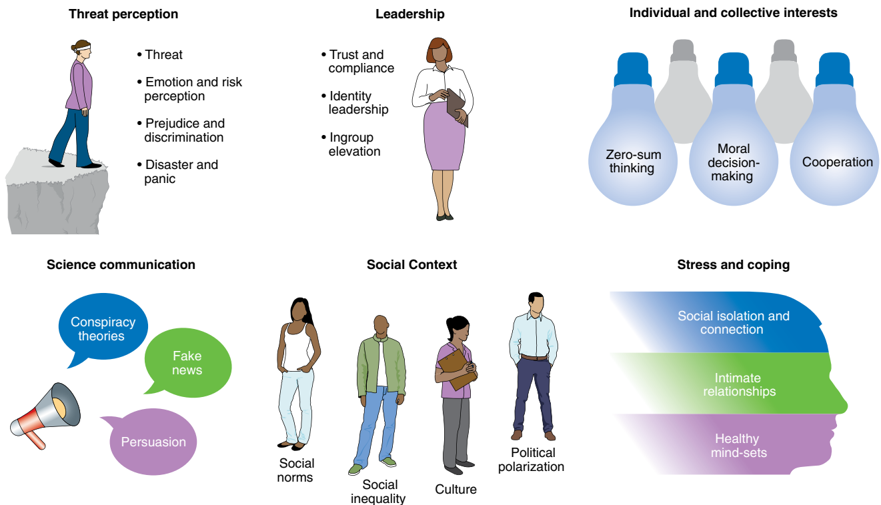
The COVID-19 pandemic represents a massive global health crisis. Because the crisis requires large-scale behaviour change and places significant psychological burdens on individuals, insights from the social and behavioural sciences can be used to help align human behaviour with the recommendations of epidemiologists and public health experts. Here we discuss evidence from a selection of research topics relevant to pandemics, including work on navigating threats, social and cultural influences on behaviour, science communication, moral decision-making, leadership, and stress and coping. In each section, we note the nature and quality of prior research, including uncertainty and unsettled issues. We identify several insights for effective response to the COVID-19 pandemic and highlight important gaps researchers should move quickly to fill in the coming weeks and months.
Overview
CoChat Summary
TL;DR
This perspective argues that social and behavioural science can help align public behaviour with COVID-19 public health recommendations across threat perception, social context, science communication, cooperation, leadership, and stress/coping. It synthesizes prior evidence and policy insights while cautioning that evidence is limited, often drawn from non-pandemic contexts, and in many areas unsettled.
Key findings
- The paper notes the scale of infectious disease threats: the bubonic plague killed approximately 25% of the European population, and by March 2020 COVID-19 had spread to more than 118,000 cases and caused 4,291 deaths in 114 countries. It also notes that 21 countries donated medical supplies to China in February, with China reciprocating widely.
- Fear appeals can change behaviour when people feel capable of dealing with the threat, but produce defensive reactions when people feel helpless; optimism bias can lead people to underestimate personal risk and ignore public health warnings.
- Social norms, inequality, culture, and political polarization shape pandemic behaviour: correcting misperceived norms can help when most people are already doing the desirable behaviour, but descriptive norms can backfire if the behaviour is undesirable unless paired with prescriptive norms.
- Effective communication and leadership may involve credible sources, messages that protect others or align with moral values, prebunking/inoculation against misinformation, accuracy nudges, shared social identity, and leaders modelling prosocial sacrifice; excessive national self-image concerns (“collective narcissism”) can backfire.
Methods
- Design: Perspective/narrative review; no primary data collection or sample. Topics were identified by the corresponding authors as potentially relevant to pandemic response and are explicitly not exhaustive.
- Evidence base: synthesizes prior social and behavioural research on threat perception, social context, science communication, moral decision-making, cooperation, leadership, and stress/coping, drawing on laboratory experiments, correlational studies, field experiments, meta-analyses, and preprints/forthcoming work.
- Analysis: narrative synthesis with policy implications and identified research gaps; no systematic search strategy or quantitative synthesis is reported.
Limitations
- Stated: due to space constraints, the paper provides only a brief summary of each topic; research on these topics is ongoing and in many cases far from settled; there is very little published social science research on the current pandemic, so discussion often draws from different circumstances and evidence quality varies substantially.
- Stated: insights and policy implications should be interpreted with caution.
- Evident: as a perspective rather than a systematic review or empirical study, it does not provide a comprehensive evidence appraisal, and its reliance on preprints and forthcoming sources limits certainty.
Model-written summary. Check it against the paper before relying on it.
Integrity signals
Registry
Cites
Statistics
Figures
Verification
Claims the paper makes
19 Valid · 5 Not valid · 37 Not checked · 13 Own results and interpretations
At least one cited source doesn’t support this claim or points to a different paper, and none confirmed it — see the verdicts below.
In the paper
“For instance, in hypothetical scenarios about deciding whether to go to work while sick, American and British participants reported they would be less willing to stay home when it was uncertain they would infect a co-worker.”
What the sources say
- Disputedcites [176] Kappes, A. et al. Uncertainty about the impact of social decisions increases prosocial behaviour. Nat. Hum. Behav. 2, 573–580 (2018). sourceExperimental — accuracy not yet measured
In the paper’s account of the infectious-disease scenario (Abstract; page not provided), participants facing uncertainty about how severely a co-worker might be affected were more likely to stay home than controls, not less. The paper distinguishes that impact uncertainty from uncertainty about whether a co-worker would be infected. Its Study 6 Methods (page not provided) describe recruitment through AMT, but do not establish the claimed American and British participant groups. (LLM, conf=0.88)
Checked by a reasoning model — may be wrong.
hedgedstates an association- Asserted: passes — The authors put it forward as true.
- Checkable: passes — It can be checked against evidence.
- Load-bearing: passes — The paper’s conclusions depend on it.
- Based: passes — The paper gives a reason why it holds.
- Disputed
The cited sources that could be checked couldn’t confirm or dispute this claim.
In the paper
“Moreover, there is mixed research regarding whether corrections may actually increase belief in the original misinformation 121,124-126 or in other misleading claims that fail to get corrected 127 .”
What the sources say
- Not checked — no full text of the sourcecites [121] Guess, A. & Coppock, A. Does counter-attitudinal information cause backlash? Results from three large survey experiments. Br. J. Polit. Sci. https://doi.org/10.1017/S0007123418000327 (2018). source
- Not matchedcites [124] Wittenberg, C. & Berinsky, A.J. Misinformation and its correction. in Social Media and Democracy: The State of the Field (eds Persily, N. & Tucker, J. A.) (Cambridge University Press, forthcoming).
Its entry has no title and year that we can search by.
- Not checked — no full text of the sourcecites [125] Swire, B. & Ecker, U.K.H. Misinformation and its correction: Cognitive mechanisms and recommendations for mass communication. in Misinformation and Mass Audiences (eds. Southwell, B. G., Thorson, E. A. & Sheble, L.) 195–2011 (University of Texas Press, 2018). source
- Not checked — no full text of the sourcecites [126] Wood, T. & Porter, E. The elusive backfire effect: mass attitudes’ steadfast factual adherence. Polit. Behav. 41, 135–163 (2018). source
- Could not verifycites [127] Pennycook, G., McPhetres, J., Zhang, Y. & Rand, D. Fighting COVID-19 misinformation on social media: Experimental evidence for a scalable accuracy nudge intervention. Preprint at PsyArXiv https://doi.org/10.31234/osf.io/uhbk9 (2020). sourceExperimental — accuracy not yet measured
Citation 127 is attached to the suggestion that corrections may increase belief in other misleading claims that go uncorrected. The Statement of Relevance and Discussion describe an accuracy nudge that improved sharing decisions, not corrections or their effects on belief in uncorrected claims. Searches for correction backfire and uncorrected misinformation found no passage addressing that point; page numbers were unavailable in our copy. (LLM, conf=0.76)
hedgedstates a possible cause- Asserted: passes — The authors put it forward as true.
- Checkable: passes — It can be checked against evidence.
- Load-bearing: passes — The paper’s conclusions depend on it.
- Based: passes — The paper gives a reason why it holds.
The sources with a verdict support this claim; the rest weren’t checked yet, have no full text we could read, or their verdicts aren’t rated yet.
In the paper
“Indeed, laboratory research has found that people prioritize local over global (or international) interests 185,186 .”
What the sources say
- Supportedcites [185] Milinski, M., Hilbe, C., Semmann, D., Sommerfeld, R. & Marotzke, J. Humans choose representatives who enforce cooperation in social dilemmas through extortion. Nat. Commun. 7, 10915 (2016). source
The Results section (‘Voters choose selfish representatives’; page unavailable) reports that participants preferentially re-elected representatives who contributed less to the shared climate account and elected candidates who pledged to contribute less than a fair share. In this simulated international dilemma, that supports the claim that participants favored their own group’s interests over the collective goal; it does not establish that everyone did so. (LLM, conf=0.85)
- Not checked — no full text of the sourcecites [186] Reinders Folmer, C. P. et al. One for all: what representing a group may do to us. J. Exp. Soc. Psychol. 48, 1047–1056 (2012). source
plain- Asserted: passes — The authors put it forward as true.
- Checkable: passes — It can be checked against evidence.
- Load-bearing: passes — The paper’s conclusions depend on it.
- Based: passes — The paper gives a reason why it holds.
- Supported
Every source the paper cites for this claim was checked and supports it.
In the paper
“However, when going to work risked infecting an elderly co-worker who would suffer a serious illness, participants reported they would be more willing to stay home 176 .”
What the sources say
- Supportedcites [176] Kappes, A. et al. Uncertainty about the impact of social decisions increases prosocial behaviour. Nat. Hum. Behav. 2, 573–580 (2018). source
The Study 6 Methods (page not provided) describe a scenario in which going to work could infect an older, vulnerable co-worker who would suffer severely, followed by a rating of willingness to go to work. The reported Study 6 findings (indexed under Abstract; page not provided) say participants given that risk information were significantly more likely to stay home than controls. (LLM, conf=0.92)
hedgedstates a cause- Asserted: passes — The authors put it forward as true.
- Checkable: passes — It can be checked against evidence.
- Load-bearing: passes — The paper’s conclusions depend on it.
- Based: passes — The paper gives a reason why it holds.
- Supported
The sources with a verdict support this claim; the rest weren’t checked yet, have no full text we could read, or their verdicts aren’t rated yet.
In the paper
“Several techniques, such as sanctioning defectors 187 or rewarding cooperators 188 , tend to increase cooperative behaviour in laboratory experiments using economic games.”
What the sources say
- Not checked — no full text of the sourcecites [187] Yamagishi, T. The provision of a sanctioning system as a public good. J. Pers. Soc. Psychol. 51, 110–116 (1986). source
- Supportedcites [188] Rand, D. G., Dreber, A., Ellingsen, T., Fudenberg, D. & Nowak, M. A. Positive interactions promote public cooperation. Science 325, 1272–1275 (2009). source
Citation 188 is attached to rewarding cooperators. The paper’s Abstract reports a laboratory comparison using repeated public goods games and finds that reward maintained public cooperation and, when both reward and punishment were available, increased contributions. (LLM, conf=0.93)
plainstates a cause- Asserted: passes — The authors put it forward as true.
- Checkable: passes — It can be checked against evidence.
- Load-bearing: unclear — It is unclear whether the paper’s conclusions depend on it.
- Based: passes — The paper gives a reason why it holds.
50 more claims · 13 with their cited sources checked
Create a free account to see all 74 claims and to verify the 2 references still open.
- It may state two separate claims as one. 13
- Probably not a substantial claim. 6
Claims other papers make about this one
Each is checked against this paper’s own text: does it say what the citing paper says it does?
The source backs part of the claim, not all of it — or backs it for a different population, condition or comparison.
In the citing paper
“COVID-19 is an international public health crisis, putting substantial burden on medical centers and increasing the psychological toll on health care workers (HCW).”
From Supporting the well-being of health care providers during the COVID-19 pandemic: The CopeColumbia response (2020) · cites this paper as [6]
Experimental — accuracy not yet measuredThe source backs part of the claim, not all of it — or backs it for a different population, condition or comparison.
In the citing paper
“these population-wide measures affected psychological well-being and mental health as well as increased social isolation [68] and loneliness.”
From Psychological correlates of perceived loneliness in college students before and during the COVID-19 stay-at-home period: a longitudinal study (2023) · cites this paper as [68]
Experimental — accuracy not yet measuredThe source backs part of the claim, not all of it — or backs it for a different population, condition or comparison.
In the citing paper
“they may eventually increase the social isolation of students and affect their psychological well-being and mental health [3].”
From Students under lockdown: Comparisons of students’ social networks and mental health before and during the COVID-19 crisis in Switzerland (2020) · cites this paper as [3]
Experimental — accuracy not yet measuredThe source backs part of the claim, not all of it — or backs it for a different population, condition or comparison.
In the citing paper
“effective interventions are hard to scale to a population level (12);”
From Psychological inoculation improves resilience against misinformation on social media (2022) · cites this paper as [12]
Experimental — accuracy not yet measuredThe source backs part of the claim, not all of it — or backs it for a different population, condition or comparison.
In the citing paper
“There is a shortage of studies that test anti-misinformation interventions in an ecologically valid manner, i.e., testing an intervention as consumers would interact with it in online environments (8, 12).”
From Psychological inoculation improves resilience against misinformation on social media (2022) · cites this paper as [12]
Experimental — accuracy not yet measured
6 more claims about this paper
Create a free account to see every claim other papers make about this one.
Citations
Cites
Granovetter, M. S. (1973) · American Journal of Sociology · doi:10.1086/225469 · Cited by 40,491
Zhou, F., Yu, T., Du, R., Fan, G., Liu, Y., Liu, Z., Xiang, J., Wang, Y., Song, B., Gu, X., et al. (2020) · The Lancet · doi:10.1016/s0140-6736(20)30566-3 · Cited by 27,263
The need to belong: Desire for interpersonal attachments as a fundamental human motivation.
Baumeister, R. F., & Leary, M. R. (1995) · Psychological Bulletin · doi:10.1037//0033-2909.117.3.497 · Cited by 23,245
Culture and the self: Implications for cognition, emotion, and motivation.
Markus, H. R., & Kitayama, S. (1991) · Psychological Review · doi:10.1037/0033-295x.98.2.224 · Cited by 21,995
Self-citationThe Psychological Impact of Quarantine and How to Reduce It: Rapid Review of the Evidence
Brooks, S. K., Webster, R. K., Smith, L. E., Woodland, L., Wessely, S., Greenberg, N., & Rubin, G. J. (2020) · doi:10.2139/ssrn.3532534 · Cited by 16,394
The psychological impact of quarantine and how to reduce it: Rapid review of the evidence
Brooks, S. K., Webster, R. K., Smith, L. E., Woodland, L., Wessely, S., Greenberg, N., & Rubin, G. J. (2020) · The Lancet · doi:10.1016/s0140-6736(20)30460-8 · Cited by 16,378
Nudge: improving decisions about health, wealth, and happiness
(2008) · Choice Reviews Online · doi:10.5860/choice.46-0977 · Cited by 11,572
Slovic, P. (1987) · Science · doi:10.1126/science.3563507 · Cited by 9,271
The Elaboration Likelihood Model of Persuasion
Petty, R. E., & Cacioppo, J. T. (1986) · Advances in Experimental Social Psychology · doi:10.1016/s0065-2601(08)60214-2 · Cited by 8,822
Self-citationThe emotional dog and its rational tail: A social intuitionist approach to moral judgment.
Haidt, J. (2001) · Psychological Review · doi:10.1037/0033-295x.108.4.814 · Cited by 8,048
Research works printed but not linked: 3
- Berkowitz, A.D. An overview of the social norms approach. in Changing the Culture of College Drinking: A Socially Situated Health Communication Campaign (eds. Stewart, L. & Lederman, L. C.) 193–214 (Hampton Press, 2005).
- Wittenberg, C. & Berinsky, A.J. Misinformation and its correction. in Social Media and Democracy: The State of the Field (eds Persily, N. & Tucker, J. A.) (Cambridge University Press, forthcoming).
- Ransohoff, K.J. Patients on the Trolley Track: The Moral Cognition of Medical Practitioners and Public Health Professionals. (Harvard Univ. Press, 2011).
Cited by
Items 3,801–3,900 of 5,015
Many Stories, One Science? Differentiating Public Health Framing in British Newspapers
Cheung, K. K. C., Chan, H., & Erduran, S. (2025) · Journalism Practice · doi:10.1080/17512786.2025.2518452 · Cited by 2
“…an important role in communicating science in public health policies and measures, as citizens relied on the reported scientific information (e.g., government’s mobility restrictions) for protective and preventive actions against the pandemic (Bavel et al. 2020; Gozzi et al. 2020; Tam et al. 2022).”
Jeong, S., Chung, J., Kim, M., et al. (2025) · Journal of Global Health · doi:10.7189/jogh.15.04189 · Cited by 1
“Similar to the political controversies surrounding nuclear energy, recent research has shown that political orientation significantly shapes COVID-19 risk perceptions and policy preferences [ 15 – 22 ].”
Conspiracy theories as engines of connection for enriched public debates on emerging technologies
Dorthe, G. (2025) · Communications Earth & Environment · doi:10.1038/s43247-025-02581-x · Cited by 1
“This article argues that concerned publics establish connections between issues that may be unexpected from science communication, debunking or prebunking 93,94 perspectives.”
Covid-19 Pandemic: A Social Welfare Perspective
Hartanto, D., Agussani, & Akrim, A. (2020) · Social Science and Humanities Journal · Cited by 1
Social behavior and disease: supporting science during the pandemic
Traniello, J. F. A., & Bakker, T. C. M. (2020) · Behavioral Ecology and Sociobiology · doi:10.1007/s00265-020-02882-5 · Cited by 1
Amin, M. A. S. (2020) · Jurnal Cakrawala Pendas · doi:10.31949/jcp.v6i2.2221 · Cited by 1
COVID-19 AND RACIAL ISSUES: HOW THIS DISEASE HAS GENERATED REPERCUSSIONS IN AFRICAN AMERICANS
Neto, M. L. R., Nobre, C. B., Silva, A. K. A., Cruz, C. M., Figueiredo, M. M. S., & Landim, T. M. (2020) · Amadeus International Multidisciplinary Journal · doi:10.14295/aimj.v5i9.119 · Cited by 1
Risk Assessment Model: Roadmap to Develop Kolkata into a Smart City
Saraff, S., Kumar, R., Mitra, A., Ghosh, S., Ghosh, S., & Das, S. (2018) · EAI Endorsed Transactions on Smart Cities · doi:10.4108/eai.5-10-2020.166545 · Cited by 1
“The virus itself spreads from person to person, and because people placed centrally in networks come into contact with more people, they are often among the first to become infected (134).”
BackgroundAuthorship analysis of English and Spanish tweets
Al-Rashdan, M. N., Abdullah, M., Al‐Ayyoub, M., & Jararweh, Y. (2020) · Proceedings of the Association for Information Science and Technology · doi:10.1002/pra2.261 · Cited by 1
“Studies have shown that it is not an easy task for the public to discriminate between scientific and non-scientific news which comes from non-trusted medical news sources (Van Bavel et al., 2020).”
BackgroundHow to Prepare and Protect Health-Care Teams During COVID-19: Know Thyself
Freeman, W. D., Karnatovskaia, L. V., & Dredla, B. K. (2020) · Neurocritical Care · doi:10.1007/s12028-020-01135-7 · Cited by 1
Toker, K., & Gözübol, Z. İ. (2020) · Bezmialem Science · doi:10.14235/bas.galenos.2020.4846 · Cited by 3
“…it was stated that deaths due to high age increased at the beginning of the pandemic, studies conducted later in the pandemic indicated that social norms, social inequalities, and social and cultural context elements such as culture were among the factors affecting the spread of the virus (21).”
BackgroundAspectos e intervenções psicossociais nas pandemias na contemporaneidade
Andrade, M. C. R., & Alvarenga, M. A. S. (2020) · Cadernos de Saúde Pública · doi:10.1590/0102-311x00253520 · Cited by 1
Naaz, N., & Ahmad, A. (2020) · Saudi Journal of Humanities and Social Sciences · doi:10.36348/sjhss.2020.v05i08.008 · Cited by 1
“has changed how we meet our daily needs, how we socially interact, and whether, how, and where we work [3, 5].”
BackgroundInfluentialBarros, M. V., Salvador, R., de Francisco, A. C., & Piekarski, C. M. (2020) · Anais ... Encontro Nacional de Engenharia de Produção/Anais do Encontro Nacional de Engenharia de Produção · doi:10.14488/enegep2020_tn_sd_353_1819_41487 · Cited by 1
Leadership in a crisis: doing things differently, doing different things
Paixão, G., Mills, C., McKimm, J., Hassanien, M. A., & Al-Hayani, A. A. (2021) · British Journal of Healthcare Management · doi:10.12968/bjhc.2020.0178 · Cited by 1
SARS-COV-2 pandemic: the food insecurity and social inequalities in Brazil
Caetano, C. C. D. S., Oliveira, L. A., Nogueira, A. T., Pena, L., & Lúcia, C. M. D. (2020) · The Journal of the Food and Culture of the Americas · doi:10.35953/raca.v2i2.79 · Cited by 1
Martínez, F. J. F., & Fernández, E. A. (2020) · Revista de Contabilidad y Tributación CEF · doi:10.51302/rcyt.2020.3755 · Cited by 5
Beldad, A. D. (2020) · International Journal of Web Based Communities · doi:10.1504/ijwbc.2021.112857 · Cited by 2
The Humanist Expressive Speech Acts of Journalists in the Covid-19 Outbreak
Supriyono, A. Y., Zulaeha, I., & Yuniawan, T. (2020) · Seloka Jurnal Pendidikan Bahasa dan Sastra Indonesia · doi:10.15294/seloka.v9i3.41945 · Cited by 1
Romansky, R. P. (2021) · Biomedical Journal of Scientific & Technical Research · doi:10.26717/bjstr.2021.33.005455 · Cited by 1
“The global health crisis caused by COVID-19 and the need for a significant change in the behavior and communication of individuals is discussed in [4], where the need for social and behavioral sciences to help adapt human behavior to anti-epidemic measures and requirements.”
BackgroundKoinig, I. (2021) · Advances in linguistics and communication studies · doi:10.4018/978-1-7998-6825-5.ch022 · Cited by 2
COVID-19: Rethinking Global Society
Lenzi, F. R. (2021) · Italian Sociological Review · doi:10.13136/isr.v11i1.417 · Cited by 3
Liu, J., Cheng, L., & Chi, H. (2020) · International Conference on Vision, Image and Signal Processing (ICVISP) · doi:10.1145/3448823.3448867 · Cited by 1
Knapp, S. J., Gottlieb, M. C., & Handelsman, M. M. (2021) · Practice Innovations · doi:10.1037/pri0000144 · Cited by 2
Anwar, Y., Maulana, M. F., Oktoberdinata, M. D., et al. (2021) · JPG (Jurnal Pendidikan Geografi) · doi:10.20527/jpg.v7i2.9833 · Cited by 1
Veréb, V. N., & Azevedo, A. (2021) · Advances in hospitality, tourism and the services industry (AHTSI) book series · doi:10.4018/978-1-7998-7352-5.ch010 · Cited by 3
COVID-19 Misinformation and Polarization on Twitter: #StayHome, #Plandemic, and Health Communication
Godard, R., & Holtzman, S. (2021) · International Journal of Social Media and Online Communities · doi:10.4018/ijsmoc.2021010102 · Cited by 4
Political elite behavior effectiveness in combating the COVID-19 pandemic: A case study of Vietnam
Tran, H. T. T. (2021) · Journal of Eastern European and Central Asian Research (JEECAR) · doi:10.15549/jeecar.v8i2.674 · Cited by 1
Impact of Social Capital on Health Safety During the SARS - CoV - 2 Flu Pandemic
Bylok, F. (2021) · System Safety Human - Technical Facility - Environment · doi:10.2478/czoto-2021-0032 · Cited by 1
Reyes, S. R., Cruz, C. A., Üstüner, M., Jjuuko, C., & Gulıyeva, S. (2021) · ISPRS annals of the photogrammetry, remote sensing and spatial information sciences · doi:10.5194/isprs-annals-v-5-2021-23-2021 · Cited by 1
Parenting through the COVID-19 pandemic
Morrison, N. M. V., & Morrison, B. W. (2021) · Elsevier eBooks · doi:10.1016/b978-0-12-824289-6.00008-8 · Cited by 2
Mayer, Á. (2021) · IME - Az egészségügyi vezetők szaklapja · doi:10.53020/ime-2021-108 · Cited by 2
Nine-month Trend of Time-Varying Reproduction Numbers of COVID-19 in West of Iran
Rahimi, E., Nazari, S. S. H., Mokhayeri, Y., Sharhani, A., & Mohammadi, R. (2021) · Journal of Research in Health Sciences · doi:10.34172/jrhs.2021.54 · Cited by 2
Validity and Reliability of the Solidarity in Pandemics Scale
Uluman, M., Eryiğit, D., Tunç, E. B., & Parlak, S. (2022) · International Journal of Psychology and Educational Studies · doi:10.52380/ijpes.2021.8.3.533 · Cited by 1
“International Journal of Psychology and Educational Studies, 8(3), 230-241. https://dx.doi.org/10.52380/ijpes.2021.8.3.533 individuals to focus solely on their own interests (Van Bavel et al., 2020).”
BackgroundInfluentialWidodo, A., Safruddin, S., Nasaruddin, N., et al. (2020) · Bravo’s Jurnal Program Studi Pendidikan Jasmani dan Kesehatan · doi:10.32682/bravos.v8i4.1728 · Cited by 1
Loneliness Among The Students Of Faculty Of Science And Arts During The COVID-19
Hamid, N. H. M. (2021) · Journal Of Organizational Behavior Research · doi:10.51847/qkugnnlaji · Cited by 2
Collaborative Research and Online Tools in the Era of COVID-19
Kondo, Y. (2020) · JOURNAL OF RURAL PLANNING ASSOCIATION · doi:10.2750/arp.39.104 · Cited by 1
The Impact of Covid-19 on Education System: Transformation of Virtual Learning
Hussin, H., Rashid, I. M. A., Jaini, A. B., Shariff, S., Ahmad, N. Z. A., & Hamzah, A. S. M. A. (2021) · International Journal of Academic Research in Business and Social Sciences · doi:10.6007/ijarbss/v11-i11/11258 · Cited by 1
“According to Bavel et al (2020), ‘physical distancing’ was best fitted for the current situation.”
BackgroundFreedman, G., Oates, I. G., & Kirk, S. E. (2023) · Scholarship of Teaching and Learning in Psychology · doi:10.1037/stl0000227 · Cited by 2
Watkins, E. L., Sibiya, Z., Bizos, D., & Lowman, W. (2021) · Wits Journal of Clinical Medicine · doi:10.18772/26180197.2021.v3n2a3 · Cited by 1
The consequences of neglecting to collect multisectoral data to monitor the COVID-19 pandemic
Verma, A. A., Slutsky, A. S., & Razak, F. A. (2021) · Canadian Medical Association Journal · doi:10.1503/cmaj.80136 · Cited by 1
Fadilah, M., Pariyana, P., Dewi, A. S., & Anggarini, R. (2021) · Indonesian Journal for Health Sciences · doi:10.24269/ijhs.v5i2.3090 · Cited by 6
Public Awareness on Prevention Behavior of Coronavirus Disease-19 at North Sulawesi Indonesia
Tucunan, A. A. T., Rumayar, A. A., Ratag, B. T., & Maitimo, B. I. (2021) · Open Access Macedonian Journal of Medical Sciences · doi:10.3889/oamjms.2021.6756 · Cited by 1
“The pandemic has led to a massive global public health campaign to slow the spread of the virus by increasing hand washing, reducing face touching, wearing masks in public and physical distancing [5].”
BackgroundNoorbhai, H., & Suliman, R. (2021) · Studies in systems, decision and control · doi:10.1007/978-3-030-72834-2_22 · Cited by 2
Lee, W. S., Choi, M., & Yoo, J. W. (2021) · Korean Journal of Journalism & Communication Studies · doi:10.20879/kjjcs.2021.65.5.011 · Cited by 1
“오늘날 주요대중매체로 등장한 소셜 미디어는 ‘친구’, ‘친구의 친구’, 그리고 ‘친구의 친구의 친구’에게 관 련정보를확산하는매개역할을함으로써사람들은위험에대한타인의여론을더광범위하게탐 지한다(Van Bavel et al., 2020).”
InfluentialMazein, A. V. (2021) · Административное и муниципальное право · doi:10.7256/2454-0595.2021.1.35047 · Cited by 1
Matthew, N. K., Shuib, A., Kunjuraman, V., D’Silva, J. L., & Abdullah, S. I. S. S. (2021) · International Journal of Academic Research in Business and Social Sciences · doi:10.6007/ijarbss/v11-i11/11270 · Cited by 1
Ballesteros, B. D. L. B., Cortez, E. A., de Oliveira, S. M., et al. (2021) · Research Society and Development · doi:10.33448/rsd-v10i15.23000 · Cited by 1
DETERMINANTS OF ATTITUDINAL COMPLIANCE DURING THE COVID-19 PANDEMIC
Pascaru, M. (2021) · Bulletin of the Transilvania University of Braşov Series VII Social Sciences • Law · doi:10.31926/but.ssl.2021.14.63.1.8 · Cited by 1
“Social science can contribute to that end, in order to align behavior to the recommendations of epidemiologists and of health specialists (Bavel et al., 2020, p. 460).”
BackgroundDavid, J.-C., Nadarajah, K., Niang, A., Delouvée, S., Goyette, M., Bordel, S., & Somat, A. (2021) · Infectious Disease Reports · doi:10.3390/idr13040089 · Cited by 3
“[10] have even called on the scientific community to pursue several research topics related to COVID-19 (e.”
BackgroundChristofoletti, A. E. M., Fukushima, R. L. M., Fernandes, M., Nunes, H. F. P., Metzner, A., & Drigo, A. J. (2021) · Revista Brasileira de Atividade Física & Saúde · doi:10.12820/rbafs.26e0229
CHANGES IN DANGER PERCEPTION AT DIFFERENT LEVELS OF LOCKDOWN DURING COVID-19 PANDEMIC IN WOMEN
Veshchikova, M., & Зверева, Н. В. (2021) · Moscow University Psychology Bulletin · doi:10.11621/vsp.2021.03.02 · Cited by 19
Torga, I. I. S. M., Guadalupe, S., Ribeiro, F. J., Machado, M. S., Silva, A., & Pena, M. (2021) · Emancipacao · doi:10.5212/emancipacao.v.21.2118173.025 · Cited by 1
Can probability neglect bias promote social distancing during the COVID-19 pandemic?
Shimizu, M., Yoshimura, T., & Hato, E. (2021) · Transportation Research Part F Traffic Psychology and Behaviour · doi:10.1016/j.trf.2021.11.007 · Cited by 2
Lestari, F., Kadir, A. R., Idham, M., Azwar, F., Ramadhany, G., Sembiring, F., Ghazmahadi, G., Hakim, A., Modjo, R., Widanarko, B., et al. (2021) · Sustainability · doi:10.3390/su14010169 · Cited by 3
Gale, N., & Roehrle, B. (2021) · European Psychologist · doi:10.1027/1016-9040/a000467 · Cited by 1
Dass, M. (2021) · International Journal of Social Science and Economic Research · doi:10.46609/ijsser.2021.v06i07.032 · Cited by 1
(2020) · International Journal of Biology and Genetics · doi:10.31829/2692-4242/biogen2020-3(1)-108 · Cited by 1
Yudaparmita, G. N. A., & Purandina, I. P. Y. (2022) · Lekantara Annual Conference on Public Administration, Literature, Social Sciences, Humanities, and Education (LePALISSHE) · doi:10.4108/eai.3-8-2021.2315081 · Cited by 1
“This COVID-19 pandemic is very dangerous, even more, widespread and there are no signs of an end to this pandemic [1].”
BackgroundUso de las ciencias del comportamiento en políticas públicas: perspectivas desde la pandemia
Abrevaya, S., Putrino, N., Tomio, A., Bibbo, D., Yoris, A., & Ramenzoni, V. C. (2022) · Revista Iberoamericana ConCiencia. · doi:10.32654/concienciaepg.7-1.7
Looi, J. C., Allison, S. C., Bastiampillai, T. J., & Maguire, P. A. (2022) · Australasian Psychiatry · doi:10.1177/10398562211060716 · Cited by 1
Jurado, M. D. M. M., Fuentes, M. D. C. P., Herrera‐Peco, I., Ruíz, N. F. O., Martín, A. B. B., Martínez, Á. M., Márquez, M. D. M. S., & Linares, J. J. G. (2022) · Journal of Clinical Medicine · doi:10.3390/jcm11061497 · Cited by 1
“Close COVID-19 positive cases cause a stressful situation [7,9], which could lead to uncertainty and feeling symptoms compatible with COVID-19, which could then cause alterations in behavior [21–23], anxiety [19], and depression because the perceived danger to oneself or one’s family cannot be managed [39].”
BackgroundKaryadi, L. W., Wijayanti, I., & Komalasari, M. A. (2022) · Journal of Asian Multicultural Research for Social Sciences Study · doi:10.47616/jamrsss.v3i2.276 · Cited by 1
“According to Bavel et al (2020), changing behavior by correcting misperceptions can be done with public messages that reinforce positive norms in society.”
BackgroundEngagement in Behavior to Prevent COVID-19 Infection for the Sake of Oneself or Others?
Shek, D. T. L. (2022) · Journal of Adolescent Health · doi:10.1016/j.jadohealth.2022.01.230 · Cited by 1
“[12] similarly highlighted the importance of moral decision-making, which has relevance to our understanding of behavior to prevent COVID infection.”
BackgroundBoyarskaya, L. A., Prokhorov, P. V., Yitsun, Y., et al. (2022) · Current Issues of Sports Psychology and Pedagogy · doi:10.15826/spp.2022.1.24 · Cited by 1
“Можно также объяснить ситуацию локдауна с позиции феномена жизни в ограниченном пространстве, который характеризуется нарастанием психологического пресыщение от постоянного общения людей [28].”
Comunicación en redes sociales en escenarios de pandemia o epidemia: un análisis bibliométrico
Andrade, C. F. O., Pastrana, C. A. A., & Jiménez‐Zarco, A. I. (2021) · Revista Perspectiva Empresarial · doi:10.16967/23898186.742 · Cited by 1
Innovative System Design for Remote Air Traffic Control Simulation Training
Liang, M. (2022) · IEEE Global Engineering Education Conference (EDUCON) · doi:10.1109/educon52537.2022.9766510 · Cited by 1
Demczuk, R., Manosso, F. C., da Silva, J. L., & Schiessl, D. (2022) · ReMark - Revista Brasileira de Marketing · doi:10.5585/remark.v21i3.19271 · Cited by 2
Bogor City Government’s Communication Crisis in Handling Covid-19
Putri, T. I., Lubis, D. P., & Budianto, H. (2022) · Jurnal Komunikasi Ikatan Sarjana Komunikasi Indonesia · doi:10.25008/jkiski.v7i1.620 · Cited by 1
Communication and Engagement in Disease Outbreaks and Pandemic Responses: Key Concepts and Issues
Obregón, R., Chitnis, K., & Manoncourt, E. (2022) · Springer eBooks · doi:10.1007/978-3-030-92296-2_1 · Cited by 1
Achieving Transformation in Our Highly Interconnected World I: Systems Thinking and Network Thinking
Fisher, L. (2022) · Creative economy · doi:10.1007/978-981-16-8566-8_8 · Cited by 2
Comunicação de risco em saúde da covid-19 na difusão institucional na rede social digital Facebook
González, J. G., & Flores, P. A. L. (2021) · doi:10.29327/561168.1-9 · Cited by 2
Emotions and Stressing Situations Adaptation of Nursing Students in the New Normality
Tapia-Pancardo, D. C., Martínez-Rangel, N. A., Romero-Salgado, R. M., et al. (2022) · Health · doi:10.4236/health.2022.147055 · Cited by 1
“To focus emotions toward goals keep motivation and establish attention to goals instead of obstacles; to reach that is essential a certain degree of optimism and proposal, such that evaluate to be proactive and positively endure the unforeseen [10] [11].”
BackgroundSarfraz, Z., Sarfraz, A., Sarfraz, M., Azeem, N., Hange, N., Félix, M., & Chérrez-Ojeda, I. (2022) · Annals of Medicine and Surgery · doi:10.1016/j.amsu.2022.104212
Models of Policy Implementation in Islamic School Learning Systems During Covid-19
Muslim, M., Hasan, N., & Sulistiani, I. R. (2021) · Jurnal Pendidikan Agama Islam · doi:10.14421/jpai.2021.182-08 · Cited by 1
Akhrani, L. A., Kusumaningrum, B. R., Lestari, I. P., & Sudarwati, E. (2022) · Jurnal Ilmu Perilaku · doi:10.25077/jip.6.1.90-112.2022 · Cited by 4
Wang, C., & Wang, J. (2022) · Health Promotion International · doi:10.1093/heapro/daac082 · Cited by 1
Social Structure, Security, Disaster, and Panic Buying
Sharma, P., & Pokharel, M. (2022) · Springer eBooks · doi:10.1007/978-3-031-10278-3_4 · Cited by 1
Use and perception of information sources on COVID-19 measures by citizens of Belgium
van Loenhout, J. A. F., Aujoulat, I., & den Broucke, S. V. (2022) · Frontiers in Communication · doi:10.3389/fcomm.2022.900555 · Cited by 2
“These challenges should be seriously addressed when engaging in risk communication, as they could have adverse consequences for public health (Bavel et al., 2020).”
BackgroundSyed, S., Mushtaq, T., Umar, N., Baig, W., Shakeel, C. S., & Zahid, H. (2022) · Proceedings of the Institution of mechanical engineers. Part H, journal of engineering in medicine · doi:10.1177/09544119221128073 · Cited by 3
Retos de la enseñanza remota de las ciencias básicas de la ingeniería en situación de contingencia
Iñiguez-Monroy, C. G., Salinas, W. E. A., Lara, M. D. L. F., & López, A. C. J. (2022) · Formación universitaria · doi:10.4067/s0718-50062022000500061 · Cited by 2
Delving into Data Science Methods in Response to the COVID ‐19 Infodemic
Chong, M., Shah, C., Shu, K., et al. (2022) · Proceedings of the Association for Information Science and Technology · doi:10.1002/pra2.625 · Cited by 1
“The circulation of misinformation has presented a precarious impact on the target audiences for them to grasp the pandemic in nations, such as Italy, Spain, and the United States (Bavel et al., 2020).”
BackgroundRaghoebar, S., Delnoij, J., Kamphorst, B. A., & Broekhuizen, H. (2022) · PLoS ONE · doi:10.1371/journal.pone.0276936 · Cited by 1
Ahmed, A., Fatima, S., Yasir, M., et al. (2022) · Pakistan Armed Forces Medical Journal · doi:10.51253/pafmj.v72i1.7060 · Cited by 1
Teaching Social Psychology Effectively: A Practical Guide
Plous, S., Myers, D. G., Kite, M. E., & Dunn, D. S. (2022) · Springer international handbooks of education · doi:10.1007/978-3-030-28745-0_16 · Cited by 1
Usage of Behavioural Innovation in the Context of the COVID-19 Crisis
Czerwonka, M., & Siembida, J. (2022) · Annales Universitatis Mariae Curie-Skłodowska sectio H Oeconomia · doi:10.17951/h.2022.56.3.7-17 · Cited by 1
“In this context, one should consider how to communicate so that it does not provoke extreme emotions and, at the same time, educate society on how to observe the requirements of public health (Bavel et al., 2020).”
BackgroundSpołeczny wymiar pandemii. Biopolityka i medykalizacja w czasach COVID-19
Kępski, P. (2022) · Przegląd Socjologiczny · doi:10.26485/ps/2022/71.3/4 · Cited by 1
1 Parents experiences in Slovenia during the COVID-19 pandemic
Klanjšek, P., Budler, L. C., Stričević, J., Sacco, T. L., & Kegl, B. (2023) · De Gruyter eBooks · doi:10.1515/9783110786088-001 · Cited by 1
Adamus, M., & Grežo, M. (2021) · MUNI ECON Working Papers · doi:10.5817/wp_muni_econ_2021-09 · Cited by 23
Impact of COVID-19 on Societal Behavior via Twitter Analytics
Bhaik, A., Gupta, P. K., Siddiqui, M. K., & Morales-Menéndez, R. (2022) · Revista Argentina de Ciencias del Comportamiento ( RACC ) · doi:10.32348/1852.4206.v14.n2.30816 · Cited by 2
Муращенкова, Н. В. (2022) · Monitoring obŝestvennogo mneniâ: èkonomičeskie i socialʹnye peremeny · doi:10.14515/monitoring.2022.6.2261
Wang, C., Chen, X., Zhao, X., Huang, X., & Pan, L. (2023) · PubMed Central · Cited by 1
Smith, M. J., Enns, E. A., White, L. A., Gilbertson, M. L. J., & Craft, M. E. (2023) · Royal Society Open Science · doi:10.1098/rsos.221122 · Cited by 1
Rural work and COVID-19: challenges and proposals for the prevention of damages
Santana, L. D. S., das Mercês, M. C., ROSSI, T. A., Gomes, A. M. T., de Oliveira, J. F., Barbosa, P. J. B., Santana, A. I. C., de Souza, M. C., & de Sousa, A. R. (2023) · Revista Brasileira de Medicina do Trabalho · doi:10.47626/1679-4435-2021-742 · Cited by 1
Working from home during COVID-19 lockdown: Changing competencies and work-home life boundaries
de Almeida, J. C., & Silva, M. G. (2022) · European Conference on Management, Leadership and Governance (ECMLG) · doi:10.34190/ecmlg.18.1.822 · Cited by 1
Hidayati, I., Herwangi, Y., Wibisono, B. H., et al. (2023) · Asian Transport Studies · doi:10.1016/j.eastsj.2023.100112 · Cited by 1
Kukafka, R., Millery, M. P., Pan, S. M., Silverman, T. B., Zhang, T., McGuinness, J. E., Crew, K. D., & Aguirre, A. N. (2023) · Humanities and Social Sciences Communications · doi:10.1057/s41599-023-01679-x · Cited by 1
“Research amassed from previous infectious disease outbreaks establishes key factors related to characterizing cognitive antecedents of behavior which are vital during the spread of pandemic disease and have been valuable in predicting how people respond to emerging infectious diseases (Bavel et al., 2020; Lee and You,…”
BackgroundThe Essence of Social Sciences in Global Public Health: An Introduction
Liamputtong, P. (2023) · Springer eBooks · doi:10.1007/978-3-030-96778-9_1-1 · Cited by 1
Investigating the predictors of perceived social support to control COVID-19: A qualitative study
Toghroli, R., Aghamolaei, T., Hassani, L., Ramezaninejad, V., Lebni, J. Y., NeJhaddadgar, N., Mehedi, N., & Ziapour, A. (2023) · Heliyon · doi:10.1016/j.heliyon.2023.e16878 · Cited by 2
Perceived Stress During Covid-19 Pandemic: Its Relationship To The Academic Performance Of Students
Demetillo, K. M. A. D., Melitante, K. J. A., & Nabua, E. B. (2023) · ACPES (ASEAN Council of Physical Education and Sport) International Conference (ACPES) · doi:10.4108/eai.28-10-2022.2327404 · Cited by 1
Metadata
- Authors
- Bavel, J. J. V., Baicker, K., Boggio, P. S., Capraro, V., Cichocka, A., Cikara, M., Crockett, M. J., Crum, A. J., Douglas, K. M., Druckman, J. N., Drury, J., Dube, O., Ellemers, N., Finkel, E. J., Fowler, J. H., Gelfand, M., Han, S., Haslam, S. A., Jetten, J., Kitayama, S., Mobbs, D., Napper, L. E., Packer, D. J., Pennycook, G., Peters, E., Petty, R. E., Rand, D. G., Reicher, S. D., Schnall, S., Shariff, A., Skitka, L. J., Smith, S. S., Sunstein, C. R., Tabri, N., Tucker, J. A., Linden, S. V. D., Lange, P. V., Weeden, K. A., Wohl, M. J. A., Zaki, J., Zion, S. R., & Willer, R.
- Affiliations
- New York University (US)
- Universidade Presbiteriana Mackenzie (BR)
- Middlesex University London (GB)
- University of Kent (GB)
- Harvard University (US)
- Yale University (US)
- Stanford University (US)
- Northwestern University (US)
- University of Sussex (GB)
- University of Chicago (US)
- Utrecht University (NL)
- University of California San Diego (US)
- University of Maryland, College Park (US)
- Peking University (CN)
- The University of Queensland (AU)
- University of Michigan (US)
- California Institute of Technology (US)
- Lehigh University (US)
- University of Regina (CA)
- University of Oregon (US)
- The Ohio State University (US)
- Massachusetts Institute of Technology (US)
- University of St Andrews (GB)
- University of Cambridge (GB)
- University of British Columbia (CA)
- University of Illinois Chicago (US)
- University of California, Berkeley (US)
- Carleton University (CA)
- Cornell University (US)
- Corresponding author
- Bavel, Jay J. Van
- Willer, Robb
- ORCID
- Bavel, Jay J. Van
- Baicker, Katherine
- Boggio, Paulo S.
- Capraro, Valerio
- Cichocka, Aleksandra
- Cikara, Mina
- Crockett, Molly J.
- Crum, Alia J.
- Douglas, Karen M.
- Druckman, James N.
- Drury, John
- Ellemers, Naomi
- Finkel, Eli J.
- Fowler, James H.
- Gelfand, Michele
- Han, Shihui
- Haslam, S. Alexander
- Jetten, Jolanda
- Kitayama, Shinobu
- Mobbs, Dean
- Napper, Lucy E.
- Packer, Dominic J.
- Pennycook, Gordon
- Peters, Ellen
- Petty, Richard E.
- Rand, David G.
- Reicher, Stephen D.
- Schnall, Simone
- Shariff, Azim
- Skitka, Linda J.
- Sunstein, Cass R.
- Tabri, Nassim
- Tucker, Joshua A.
- Linden, Sander van der
- Weeden, Kim A.
- Wohl, Michael J. A.
- Zaki, Jamil
- Zion, Sean R.
- Willer, Robb
- Venue
- Nature Human Behaviour
- Published
- 2020-04-30
- Volume
- 4
- Issue
- 5
- Pages
- 460-471
- ISSN
- 2397-3374 (ISSN-L)
- OpenAlex
- W3016902371
- Semantic Scholar
- d81abcd7f053b136423f1e7f57928524e8b0e1a0
- Cited by
- 4,964
- References
- 259
- Citations by year
- 2026: 177 · 2025: 288 · 2024: 483 · 2023: 741 · 2022: 1094 · 2021: 1474 · 2020: 702
- FWCI
- 175.81
- Type
- journal article
- Language
- en
- Open access
- bronze
- doi.org
- Licence
- www.springernature.com/gp/researchers/text-and-data-mining (tdm)
- www.springernature.com/gp/researchers/text-and-data-mining (vor)
- Locations
- Nature Human Behaviour (publishedVersion)
- PubMed (publishedVersion)
- Middlesex University Research Repository (Middlesex University Of London) (acceptedVersion)
- Kent Academic Repository (University of Kent) (acceptedVersion)
- DSpace@MIT (Massachusetts Institute of Technology) (submittedVersion, cc-by-nc-sa)
- Sussex Research Online (University of Sussex) (submittedVersion)
- CaltechAUTHORS (California Institute of Technology) (submittedVersion)
- RePEc: Research Papers in Economics (submittedVersion)
- BOA (University of Milano-Bicocca) (submittedVersion)
- Carleton University's Institutional Repository (MacOdrum Library, Carleton University) (submittedVersion, other-oa)
- Utrecht University Repository (Utrecht University) (submittedVersion)
- Figshare (submittedVersion)
- VU Research Portal (submittedVersion, other-oa)
- Utrecht University Repository (Utrecht University) (submittedVersion, other-oa)
- Data Archiving and Networked Services (DANS) (submittedVersion, other-oa)
- Funders
- U.S. Department of Health and Human Services (2P50 MH094258)
- National Institute of Mental Health (P50MH094258)
- Topics
- Social Sciences › Sociology and Political Science › COVID-19 Prevention and Impact
- Social Sciences › Communication › Communication and COVID-19 Impact
- Physical Sciences › Mathematics › Modeling and Simulation › COVID-19 epidemiological studies
- Keywords
- COVID-19 pandemic, pandemic response, behavior change, science communication, ethical decision-making, leadership, stress coping, psychological burden, public health recommendations
- MeSH terms
- Betacoronavirus, COVID-19, SARS-CoV-2, Adaptation, Psychological, Communicable Disease Control, Decision Making, Humans, Human Activities, Health Knowledge, Attitudes, Practice, Leadership, Pneumonia, Viral, Public Health, Quarantine, Stress, Psychological, Global Health, Coronavirus, Coronavirus Infections, Pandemics, Social Media, Epidemiological Monitoring
About these checks
Registry, retraction, Cites and statistics results are computed, not judged, with one exception: a printed reference that no index lists is read once by a model before it counts as a citation error. Claims are extracted by a model and kept only when their quote appears verbatim in the text; each cited source is then checked, with a model’s help, for whether it says what the claim relies on. Those verdicts can be wrong — read the claim’s quote and the cited source before relying on one.
The claim verdicts this report counts are experimental: their accuracy is not yet measured.
A language model drew the claims from the paper on 2026-10-10, under version 3 of the claim definition (model deepseek-v4.1-flash, prompt extract-v3).
A second model labelled each claim on 2026-10-10 (model jev-1.13-20260917, definition revision gold-guideline-v0.2).
Cited sources are checked with a language model’s help (gpt-6-sol).
Statistics and arithmetic are recomputed, not judged.
Confidence bands are shown only for fields calibrated on our annotated test set. None is calibrated yet, so no band is shown.
What counts as a claim ›How we measure confidence ›How we check this ›
Are you an author, or do you see a problem with this page? Request a review
Data sources
Bibliographic data: Semantic Scholar, OpenAlex, Crossref.
Contains information from the Semantic Scholar Academic Graph Datasets, made available under the ODC Attribution License (ODC-BY 1.0).
Semantic Scholar’s data is described in: Kinney, R., et al. (2023). The Semantic Scholar Open Data Platform. arXiv:2301.10140.
