

Using social and behavioural science to support COVID-19 pandemic response
Open accessThe DOI matches its Crossref record; 257 of the 259 references it cites were found in a registry or an index; 24 of the 89 sources its claims cite were checked for support.
Abstract
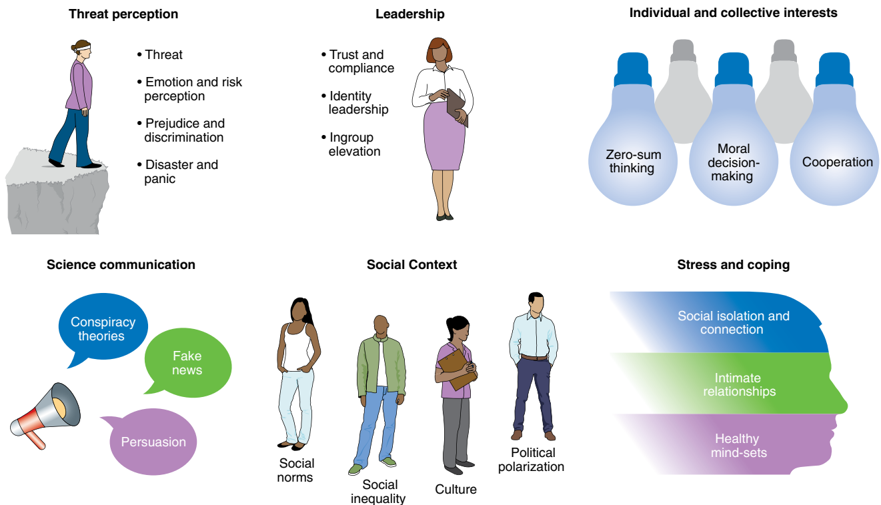
The COVID-19 pandemic represents a massive global health crisis. Because the crisis requires large-scale behaviour change and places significant psychological burdens on individuals, insights from the social and behavioural sciences can be used to help align human behaviour with the recommendations of epidemiologists and public health experts. Here we discuss evidence from a selection of research topics relevant to pandemics, including work on navigating threats, social and cultural influences on behaviour, science communication, moral decision-making, leadership, and stress and coping. In each section, we note the nature and quality of prior research, including uncertainty and unsettled issues. We identify several insights for effective response to the COVID-19 pandemic and highlight important gaps researchers should move quickly to fill in the coming weeks and months.
Overview
CoChat Summary
TL;DR
This perspective argues that social and behavioural science can help align public behaviour with COVID-19 public health recommendations across threat perception, social context, science communication, cooperation, leadership, and stress/coping. It synthesizes prior evidence and policy insights while cautioning that evidence is limited, often drawn from non-pandemic contexts, and in many areas unsettled.
Key findings
- The paper notes the scale of infectious disease threats: the bubonic plague killed approximately 25% of the European population, and by March 2020 COVID-19 had spread to more than 118,000 cases and caused 4,291 deaths in 114 countries. It also notes that 21 countries donated medical supplies to China in February, with China reciprocating widely.
- Fear appeals can change behaviour when people feel capable of dealing with the threat, but produce defensive reactions when people feel helpless; optimism bias can lead people to underestimate personal risk and ignore public health warnings.
- Social norms, inequality, culture, and political polarization shape pandemic behaviour: correcting misperceived norms can help when most people are already doing the desirable behaviour, but descriptive norms can backfire if the behaviour is undesirable unless paired with prescriptive norms.
- Effective communication and leadership may involve credible sources, messages that protect others or align with moral values, prebunking/inoculation against misinformation, accuracy nudges, shared social identity, and leaders modelling prosocial sacrifice; excessive national self-image concerns (“collective narcissism”) can backfire.
Methods
- Design: Perspective/narrative review; no primary data collection or sample. Topics were identified by the corresponding authors as potentially relevant to pandemic response and are explicitly not exhaustive.
- Evidence base: synthesizes prior social and behavioural research on threat perception, social context, science communication, moral decision-making, cooperation, leadership, and stress/coping, drawing on laboratory experiments, correlational studies, field experiments, meta-analyses, and preprints/forthcoming work.
- Analysis: narrative synthesis with policy implications and identified research gaps; no systematic search strategy or quantitative synthesis is reported.
Limitations
- Stated: due to space constraints, the paper provides only a brief summary of each topic; research on these topics is ongoing and in many cases far from settled; there is very little published social science research on the current pandemic, so discussion often draws from different circumstances and evidence quality varies substantially.
- Stated: insights and policy implications should be interpreted with caution.
- Evident: as a perspective rather than a systematic review or empirical study, it does not provide a comprehensive evidence appraisal, and its reliance on preprints and forthcoming sources limits certainty.
Model-written summary. Check it against the paper before relying on it.
Integrity signals
Registry
Cites
Statistics
Figures
Verification
Claims the paper makes
19 Valid · 5 Not valid · 37 Not checked · 13 Own results and interpretations
At least one cited source doesn’t support this claim or points to a different paper, and none confirmed it — see the verdicts below.
In the paper
“For instance, in hypothetical scenarios about deciding whether to go to work while sick, American and British participants reported they would be less willing to stay home when it was uncertain they would infect a co-worker.”
What the sources say
- Disputedcites [176] Kappes, A. et al. Uncertainty about the impact of social decisions increases prosocial behaviour. Nat. Hum. Behav. 2, 573–580 (2018). sourceExperimental — accuracy not yet measured
In the paper’s account of the infectious-disease scenario (Abstract; page not provided), participants facing uncertainty about how severely a co-worker might be affected were more likely to stay home than controls, not less. The paper distinguishes that impact uncertainty from uncertainty about whether a co-worker would be infected. Its Study 6 Methods (page not provided) describe recruitment through AMT, but do not establish the claimed American and British participant groups. (LLM, conf=0.88)
Checked by a reasoning model — may be wrong.
hedgedstates an association- Asserted: passes — The authors put it forward as true.
- Checkable: passes — It can be checked against evidence.
- Load-bearing: passes — The paper’s conclusions depend on it.
- Based: passes — The paper gives a reason why it holds.
- Disputed
The cited sources that could be checked couldn’t confirm or dispute this claim.
In the paper
“Moreover, there is mixed research regarding whether corrections may actually increase belief in the original misinformation 121,124-126 or in other misleading claims that fail to get corrected 127 .”
What the sources say
- Not checked — no full text of the sourcecites [121] Guess, A. & Coppock, A. Does counter-attitudinal information cause backlash? Results from three large survey experiments. Br. J. Polit. Sci. https://doi.org/10.1017/S0007123418000327 (2018). source
- Not matchedcites [124] Wittenberg, C. & Berinsky, A.J. Misinformation and its correction. in Social Media and Democracy: The State of the Field (eds Persily, N. & Tucker, J. A.) (Cambridge University Press, forthcoming).
Its entry has no title and year that we can search by.
- Not checked — no full text of the sourcecites [125] Swire, B. & Ecker, U.K.H. Misinformation and its correction: Cognitive mechanisms and recommendations for mass communication. in Misinformation and Mass Audiences (eds. Southwell, B. G., Thorson, E. A. & Sheble, L.) 195–2011 (University of Texas Press, 2018). source
- Not checked — no full text of the sourcecites [126] Wood, T. & Porter, E. The elusive backfire effect: mass attitudes’ steadfast factual adherence. Polit. Behav. 41, 135–163 (2018). source
- Could not verifycites [127] Pennycook, G., McPhetres, J., Zhang, Y. & Rand, D. Fighting COVID-19 misinformation on social media: Experimental evidence for a scalable accuracy nudge intervention. Preprint at PsyArXiv https://doi.org/10.31234/osf.io/uhbk9 (2020). sourceExperimental — accuracy not yet measured
Citation 127 is attached to the suggestion that corrections may increase belief in other misleading claims that go uncorrected. The Statement of Relevance and Discussion describe an accuracy nudge that improved sharing decisions, not corrections or their effects on belief in uncorrected claims. Searches for correction backfire and uncorrected misinformation found no passage addressing that point; page numbers were unavailable in our copy. (LLM, conf=0.76)
hedgedstates a possible cause- Asserted: passes — The authors put it forward as true.
- Checkable: passes — It can be checked against evidence.
- Load-bearing: passes — The paper’s conclusions depend on it.
- Based: passes — The paper gives a reason why it holds.
The sources with a verdict support this claim; the rest weren’t checked yet, have no full text we could read, or their verdicts aren’t rated yet.
In the paper
“Indeed, laboratory research has found that people prioritize local over global (or international) interests 185,186 .”
What the sources say
- Supportedcites [185] Milinski, M., Hilbe, C., Semmann, D., Sommerfeld, R. & Marotzke, J. Humans choose representatives who enforce cooperation in social dilemmas through extortion. Nat. Commun. 7, 10915 (2016). source
The Results section (‘Voters choose selfish representatives’; page unavailable) reports that participants preferentially re-elected representatives who contributed less to the shared climate account and elected candidates who pledged to contribute less than a fair share. In this simulated international dilemma, that supports the claim that participants favored their own group’s interests over the collective goal; it does not establish that everyone did so. (LLM, conf=0.85)
- Not checked — no full text of the sourcecites [186] Reinders Folmer, C. P. et al. One for all: what representing a group may do to us. J. Exp. Soc. Psychol. 48, 1047–1056 (2012). source
plain- Asserted: passes — The authors put it forward as true.
- Checkable: passes — It can be checked against evidence.
- Load-bearing: passes — The paper’s conclusions depend on it.
- Based: passes — The paper gives a reason why it holds.
- Supported
Every source the paper cites for this claim was checked and supports it.
In the paper
“However, when going to work risked infecting an elderly co-worker who would suffer a serious illness, participants reported they would be more willing to stay home 176 .”
What the sources say
- Supportedcites [176] Kappes, A. et al. Uncertainty about the impact of social decisions increases prosocial behaviour. Nat. Hum. Behav. 2, 573–580 (2018). source
The Study 6 Methods (page not provided) describe a scenario in which going to work could infect an older, vulnerable co-worker who would suffer severely, followed by a rating of willingness to go to work. The reported Study 6 findings (indexed under Abstract; page not provided) say participants given that risk information were significantly more likely to stay home than controls. (LLM, conf=0.92)
hedgedstates a cause- Asserted: passes — The authors put it forward as true.
- Checkable: passes — It can be checked against evidence.
- Load-bearing: passes — The paper’s conclusions depend on it.
- Based: passes — The paper gives a reason why it holds.
- Supported
The sources with a verdict support this claim; the rest weren’t checked yet, have no full text we could read, or their verdicts aren’t rated yet.
In the paper
“Several techniques, such as sanctioning defectors 187 or rewarding cooperators 188 , tend to increase cooperative behaviour in laboratory experiments using economic games.”
What the sources say
- Not checked — no full text of the sourcecites [187] Yamagishi, T. The provision of a sanctioning system as a public good. J. Pers. Soc. Psychol. 51, 110–116 (1986). source
- Supportedcites [188] Rand, D. G., Dreber, A., Ellingsen, T., Fudenberg, D. & Nowak, M. A. Positive interactions promote public cooperation. Science 325, 1272–1275 (2009). source
Citation 188 is attached to rewarding cooperators. The paper’s Abstract reports a laboratory comparison using repeated public goods games and finds that reward maintained public cooperation and, when both reward and punishment were available, increased contributions. (LLM, conf=0.93)
plainstates a cause- Asserted: passes — The authors put it forward as true.
- Checkable: passes — It can be checked against evidence.
- Load-bearing: unclear — It is unclear whether the paper’s conclusions depend on it.
- Based: passes — The paper gives a reason why it holds.
50 more claims · 13 with their cited sources checked
Create a free account to see all 74 claims and to verify the 2 references still open.
- It may state two separate claims as one. 13
- Probably not a substantial claim. 6
Claims other papers make about this one
Each is checked against this paper’s own text: does it say what the citing paper says it does?
The source backs part of the claim, not all of it — or backs it for a different population, condition or comparison.
In the citing paper
“COVID-19 is an international public health crisis, putting substantial burden on medical centers and increasing the psychological toll on health care workers (HCW).”
From Supporting the well-being of health care providers during the COVID-19 pandemic: The CopeColumbia response (2020) · cites this paper as [6]
Experimental — accuracy not yet measuredThe source backs part of the claim, not all of it — or backs it for a different population, condition or comparison.
In the citing paper
“these population-wide measures affected psychological well-being and mental health as well as increased social isolation [68] and loneliness.”
From Psychological correlates of perceived loneliness in college students before and during the COVID-19 stay-at-home period: a longitudinal study (2023) · cites this paper as [68]
Experimental — accuracy not yet measuredThe source backs part of the claim, not all of it — or backs it for a different population, condition or comparison.
In the citing paper
“they may eventually increase the social isolation of students and affect their psychological well-being and mental health [3].”
From Students under lockdown: Comparisons of students’ social networks and mental health before and during the COVID-19 crisis in Switzerland (2020) · cites this paper as [3]
Experimental — accuracy not yet measuredThe source backs part of the claim, not all of it — or backs it for a different population, condition or comparison.
In the citing paper
“effective interventions are hard to scale to a population level (12);”
From Psychological inoculation improves resilience against misinformation on social media (2022) · cites this paper as [12]
Experimental — accuracy not yet measuredThe source backs part of the claim, not all of it — or backs it for a different population, condition or comparison.
In the citing paper
“There is a shortage of studies that test anti-misinformation interventions in an ecologically valid manner, i.e., testing an intervention as consumers would interact with it in online environments (8, 12).”
From Psychological inoculation improves resilience against misinformation on social media (2022) · cites this paper as [12]
Experimental — accuracy not yet measured
6 more claims about this paper
Create a free account to see every claim other papers make about this one.
Citations
Cites
Granovetter, M. S. (1973) · American Journal of Sociology · doi:10.1086/225469 · Cited by 40,491
Zhou, F., Yu, T., Du, R., Fan, G., Liu, Y., Liu, Z., Xiang, J., Wang, Y., Song, B., Gu, X., et al. (2020) · The Lancet · doi:10.1016/s0140-6736(20)30566-3 · Cited by 27,263
The need to belong: Desire for interpersonal attachments as a fundamental human motivation.
Baumeister, R. F., & Leary, M. R. (1995) · Psychological Bulletin · doi:10.1037//0033-2909.117.3.497 · Cited by 23,245
Culture and the self: Implications for cognition, emotion, and motivation.
Markus, H. R., & Kitayama, S. (1991) · Psychological Review · doi:10.1037/0033-295x.98.2.224 · Cited by 21,995
Self-citationThe Psychological Impact of Quarantine and How to Reduce It: Rapid Review of the Evidence
Brooks, S. K., Webster, R. K., Smith, L. E., Woodland, L., Wessely, S., Greenberg, N., & Rubin, G. J. (2020) · doi:10.2139/ssrn.3532534 · Cited by 16,394
The psychological impact of quarantine and how to reduce it: Rapid review of the evidence
Brooks, S. K., Webster, R. K., Smith, L. E., Woodland, L., Wessely, S., Greenberg, N., & Rubin, G. J. (2020) · The Lancet · doi:10.1016/s0140-6736(20)30460-8 · Cited by 16,378
Nudge: improving decisions about health, wealth, and happiness
(2008) · Choice Reviews Online · doi:10.5860/choice.46-0977 · Cited by 11,572
Slovic, P. (1987) · Science · doi:10.1126/science.3563507 · Cited by 9,271
The Elaboration Likelihood Model of Persuasion
Petty, R. E., & Cacioppo, J. T. (1986) · Advances in Experimental Social Psychology · doi:10.1016/s0065-2601(08)60214-2 · Cited by 8,822
Self-citationThe emotional dog and its rational tail: A social intuitionist approach to moral judgment.
Haidt, J. (2001) · Psychological Review · doi:10.1037/0033-295x.108.4.814 · Cited by 8,048
Research works printed but not linked: 3
- Berkowitz, A.D. An overview of the social norms approach. in Changing the Culture of College Drinking: A Socially Situated Health Communication Campaign (eds. Stewart, L. & Lederman, L. C.) 193–214 (Hampton Press, 2005).
- Wittenberg, C. & Berinsky, A.J. Misinformation and its correction. in Social Media and Democracy: The State of the Field (eds Persily, N. & Tucker, J. A.) (Cambridge University Press, forthcoming).
- Ransohoff, K.J. Patients on the Trolley Track: The Moral Cognition of Medical Practitioners and Public Health Professionals. (Harvard Univ. Press, 2011).
Cited by
Items 3,901–4,000 of 5,015
Singh, G., Tongkachok, K., Kumar, K. K., & Chaurasia, A. (2023) · Algorithms for intelligent systems · doi:10.1007/978-981-99-1373-2_6 · Cited by 1
Côté, É., Dorfman, A., Lacourse, É., Lina, J., Pelletier‐Dumas, M., Stolle, D., & de la Sablonnière, R. (2023) · Social and Personality Psychology Compass · doi:10.1111/spc3.12826 · Cited by 1
Behavioral insights for containing the COVID-19 pandemic: Some practices in China
Zhang, N. (2020) · Behavioral Science & Policy · doi:10.1177/237946152000600219 · Cited by 6
Evaluation of the Online Geography Learning Program during the Covid-19 Pandemic Era
Susanthi, Y., & Nursa’ban, M. (2022) · Jurnal Pendidikan dan Pengajaran · doi:10.23887/jpp.v55i1.40598 · Cited by 2
“WHO had declared the Covid-19 pandemic an international disaster and urged each country to issue some policies for suppressing the transmission of the virus (Bavel et al., 2020; Scally et al., 2020).”
BackgroundNeuroethical Issues in Times of Health Crisis. What Roles for Neurosciences, IA, Neurotechnologies?Preprint
Tabouy, L. (2020) · Preprints.org · doi:10.20944/preprints202006.0192.v1
Braun, B., Taraktaş, B., Beckage, B., et al. (2020) · arXiv (Cornell University) · doi:10.48550/arxiv.2005.09751 · Cited by 1
“One question is whether these individual responses of behavioral modification will be enough to moderate the spread and whether there are additive or non-additive effects when implemented with top-down government policy on social distancing [8].”
BackgroundSofi‐Mahmudi, A., Shamsoddin, E., Ghasemi, P., Nasser, M., & Mesgarpour, B. (2020) · medRxiv · doi:10.1101/2020.08.01.20157065 · Cited by 2
“…be of many different types, namely financial crisis (Nicola et al. 2020), difficulties in conducting research (Sharpless 2020; Staniscuaski et al. 2020), behavioural alterations (Bavel et al. 2020), management policies (Weible et al. 2020), and healthcare provision problems (Tanne et al. 2020).”
BackgroundMendoza, D., Benney, T. M., Ganguli, R., Pothina, R., Krick, B., Pirozzi, C. S., Crosman, E. T., & Zhang, Y. (2020) · RePEc: Research Papers in Economics · doi:10.13140/rg.2.2.18592.20487 · Cited by 3
“The social distancing policies enacted in the Spring of 2020, in response to the growing SARSCoV-2 pandemic have saved many lives (Ferguson et al. 2020; McKibbin and Fernando 2020; Van Bavel et al. 2020).”
BackgroundAn Exploratory Study of COVID-19 Information on Twitter in the Greater RegionPreprint
Chen, N., Zhong, Z., & Pang, J. (2020) · arXiv (Cornell University) · doi:10.48550/arxiv.2008.05900 · Cited by 1
“The underestimation can be interpreted as optimism bias, which make people believe their exposure to disease is low [49].”
BackgroundLove Thy Neighbor? Perceived Community Abidance and Private Compliance to COVID-19 Norms in IndiaPreprint
Das, U., Sarkhel, P., & Ashraf, S. (2020) · RePEc: Research Papers in Economics · doi:10.48550/arxiv.2010.12350 · Cited by 1
Aggressive COVID-19 “second wave” in ItalyPreprint
Zheng, H., & Bonasera, A. (2020) · medRxiv · doi:10.1101/2020.11.11.20229872 · Cited by 1
Insights into the dynamics of SARS-CoV-2 pandemicvia Shannon-Fisher causality planePreprint
Fernandes, L. H. S., de Araujo, F. H. A., & da Silva, M. A. R. (2020) · doi:10.21203/rs.3.rs-36581/v1 · Cited by 1
Yadav, U. N., Yadav, O. P., Singh, D. R., Ghimire, S., Rayamajhee, B., Mistry, S. K., Rawal, L. B., Ali, A. M., Tamang, M. K., & Mehta, S. (2020) · Research Square · doi:10.21203/rs.3.rs-125117/v1 · Cited by 1
Samadipour, E., Ghardashi, F., Zardosht, R., Borzoee, F., & Navipour, E. (2021) · Research Square · doi:10.21203/rs.3.rs-146170/v1 · Cited by 1
“The high number of deaths as the consequence of the disease highlights the importance of the risk perception (27).”
BackgroundKoltai, J., Vásárhelyi, O., Röst, G., & Karsai, M. (2021) · arXiv (Cornell University) · doi:10.48550/arxiv.2102.09021 · Cited by 1
Lokonon, B. E., Alia, M. G., & Kakaï, R. G. (2021) · Preprints.org · doi:10.20944/preprints202103.0509.v1
“However, research works in social sciences (SS) have less been highlighted in the search for solutions against the pandemic (Leslie et al., 2020; Van Bavel et al., 2020).”
BackgroundApplying Behavioral Science in Combating COVID-19 at the Workplace: A Narrative ReviewPreprint
Ahadzi, D. F., Owusu, H.-M., Otoo, J. E., & Akumah, E. E. (2021) · Preprints.org · doi:10.20944/preprints202104.0136.v1 · Cited by 1
“Behavioral interventions are being adopted globally to suppress the transmission of the virus in communities and workplaces (Bavel et al., 2020; Lunn et al., 2020; West et al., 2020).”
BackgroundInfluentialFamily members’ psychological experiences of the COVID-19 lockdown: A qualitative studyPreprint
Salarvand, S., Mousavi, M., & Almasian, M. (2021) · Research Square · doi:10.21203/rs.3.rs-257826/v1 · Cited by 1
Günlü, A. (2021) · Research Square · doi:10.21203/rs.3.rs-427296/v1 · Cited by 1
“Retrieved from https://doi.org/10.1037/0022-3514.60.4.570 Sorensen, K., Van den Broucke, S., Fullam, J., Doyle, G., Pelikan, J., … & Brand, H. (2012).”
BackgroundInfluentialStress as a meaningful variable in models of covid-19 spreadingPreprint
Trenado, C., Santillana, M., & Ruge, D. (2020) · PsyArXiv (OSF Preprints) · doi:10.31234/osf.io/kcpqm · Cited by 2
Mediating Function of Awe from Collective Threat to Self-transcendental Values and EudaimoniaPreprint
Nakayama, M., & Uchida, Y. (2020) · PsyArXiv (OSF Preprints) · doi:10.31234/osf.io/yt3c4 · Cited by 1
Wise, T., Zbozinek, T. D., Charpentier, C. J., Michelini, G., Hagan, C. C., & Mobbs, D. (2021) · doi:10.31234/osf.io/zpg69 · Cited by 1
Self-citationConroy, D. (2021) · Research Square · doi:10.21203/rs.3.rs-350757/v1 · Cited by 1
The adverse impact of consecutive COVID-19 waves on mental healthPreprint
Novotný, J., Gonzalez-Rivas, J. P., Kunzová, Š., Skladaná, M., Pospíšilová, A., Polcrova, A. B., Vassilaki, M. E., Medina‐Inojosa, J. R., López-Jiménez, F. A., Geda, Y. E., et al. (2021) · medRxiv · doi:10.1101/2021.07.25.21261094 · Cited by 1
Using Evolutionary Game Dynamics to Reproduce Phase Portrait Diversity in a Pandemic ScenarioPreprint
Mendonça, J., Brum, A. A., Lyra, M. L., et al. (2021) · Research Square · doi:10.21203/rs.3.rs-709038/v1 · Cited by 1
Countering misinformation with targeted messages: Experimental evidence using mobile phones
Armand, A., Augsburg, B., Bancalari, A., & Kameshwara, K. K. (2026) · doi:10.1920/wp.ifs.2021.2721 · Cited by 1
“Being the most marginalized and less-educated share of the urban population in India, focusing on slum residents allows studying the roots of misconception among the citizens that are most-at-risk for the consequences of misinformation (Lazer et al., 2018; Bavel et al., 2020).”
BackgroundHu, J. (2021) · SSRN Electronic Journal · doi:10.2139/ssrn.3905381 · Cited by 2
van Baal, S. T., Verdejo‐García, A., & Hohwy, J. (2021) · medRxiv · doi:10.1101/2021.09.13.21263407 · Cited by 1
“A wealth of research has focused on best-practice for public health communication in order to achieve optimal guideline adherence of the public (1).”
BackgroundBehavioural Science-Informed Strategies for Increasing COVID-19 Vaccine Uptake in Children and Youth
Shapiro, G. K., Presseau, J., Weerasinghe, A., Allen, U., Arnason, T., Bodmer, N. S., Born, K. B., Buchan, J. L., Burns, R., Corace, K. M., et al. (2021) · doi:10.47326/ocsat.2021.02.50.1.0 · Cited by 4
“Social and Behavioural Science Factors That Impact Vaccination in Children and Youth Figure adapted from van Bavel et al. 2020.12 The World Health Organization’s behavioural and social drivers (BeSD) is a useful framework for ensuring that strategies for increasing vaccination reflect four domains…”
InfluentialOptimizing Non-Pharmaceutical Intervention Strategies Against COVID-19 Using Artificial IntelligencePreprint
Janko, V., Reščič, N., Vodopija, A., et al. (2021) · Research Square · doi:10.21203/rs.3.rs-1047502/v1 · Cited by 1
Efstratiou, A., & Caulfield, T. (2021) · arXiv (Cornell University) · doi:10.48550/arxiv.2111.10594 · Cited by 7
“These perceived group norms, especially in more homogeneous groups, can drive health and COVID-related behaviors in a consistent direction [8, 19].”
BackgroundDamnjanović, K., Lep, Ž., & Ilić, S. (2021) · PsyArXiv (OSF Preprints) · doi:10.31234/osf.io/f2b5w · Cited by 1
Covello, V. T. (2021) · Wiley eBooks · doi:10.1002/9781119081753.ch7 · Cited by 1
Proceedings of the 21st International RAIS Conference on Social Sciences and HumanitiesPreprint
Puaschunder, J. M. (2022) · SSRN Electronic Journal · doi:10.2139/ssrn.3967271 · Cited by 1
Conceptual replication study of fifteen JDM effects: Insights from the Polish samplePreprint
Sobków, A., Surowski, M., Olszewska, A., et al. (2021) · doi:10.31234/osf.io/5fc6z · Cited by 1
IMPLEMENTASI METODE K-MEANS CLUSTERING DALAM PENGELOMPOKAN PENYEBARAN COVID-19 DI SURABAYAPreprint
Asegaf, M. M., Arfianti, U. I., & Hamdani, A. R. (2022) · doi:10.31219/osf.io/2gwrb · Cited by 1
The global spread of (mis)information on spidersPreprint
Mammola, S., Malumbres‐Olarte, J., Arabesky, V., Barrales-Alcalá, D. A., Barrion-Dupo, A. L. A., Benamú, M. A., Bird, T. L., Bogomolova, M., Cardoso, P., Chatzaki, M., et al. (2022) · Research Square · doi:10.21203/rs.3.rs-1383492/v1 · Cited by 1
Validation and Psychometric Properties of the Sri Lankan Versions of the Fear of COVID-19 ScalePreprint
Kanchana, T. G., Jayamanne, B. D. W., & Griffiths, M. D. (2022) · Research Square · doi:10.21203/rs.3.rs-1387004/v1 · Cited by 2
Executive Political Ideology and Corporate Communications: Evidence from the COVID-19 PandemicPreprint
Che, Y., Chen, C., & Wang, V. X. (2022) · SSRN Electronic Journal · doi:10.2139/ssrn.4045165 · Cited by 2
Measuring Sensitivity to Social Distancing Behavior during the COVID-19 PandemicPreprint
Kontokosta, C. E., Hong, B., & Bonczak, B. J. (2022) · SSRN Electronic Journal · doi:10.2139/ssrn.4047033 · Cited by 1
Álvarez‐Gálvez, J., Anastasiou, A., Lamnisos, D., Constantinou, M., Nicolaou, C., Papacostas, S., Vasiliou, V. S., McHugh, L., Ļubenko, J., Ruiz, F. J., et al. (2022) · Research Square · doi:10.21203/rs.3.rs-1270359/v1 · Cited by 1
Bias in supervision: A social psychological perspective on regulatory decision-making
Coffeng, T. (2022) · Utrecht University Repository (Utrecht University) · doi:10.33540/1062 · Cited by 6
Kolner, C., van der Borg, W. E., Sanders, J. G., Joosten, M., Keijsers, J. F. E. M., de Bruin, M., & Corona Behavioural Unit, R. I. V. M. (2022) · doi:10.31234/osf.io/hwfgy · Cited by 1
Ük, B., & Bahçekapılı, H. G. (2022) · Research Square · doi:10.21203/rs.3.rs-1603792/v1 · Cited by 1
Drouin, O., Claude Montmarquette, A., Prud’homme, A., Fontaine, P., Arnaud, Y., & Silva, R. B. D. (2022) · doi:10.54932/nmaf4163 · Cited by 1
Altruism in the time of COVID-19: We are all in this together, but who is we?Preprint
Grimalda, G. F., Buchan, N. R., Ozturk, O. D., Pinate, A. C., Urso, G., & Brewer, M. B. (2021) · Research Square · doi:10.21203/rs.3.rs-139076/v2 · Cited by 4
The impact of pandemic-related worry on cognitive functioning and risk-takingPreprint
Castanheira, K. D. S., Sharp, M. E., & Otto, A. R. (2021) · PsyArXiv (OSF Preprints) · doi:10.31234/osf.io/wxmks · Cited by 2
The impact of face masks on interpersonal trust in times of COVID-19Preprint
Malik, S., Mihm, B., & Reichelt, M. (2021) · Research Square · doi:10.21203/rs.3.rs-515122/v1 · Cited by 1
Human Responses to Covid-19: The Role of Optimism Bias, Perceived Severity, and AnxietyPreprint
Fragkaki, I., Maciejewski, D. F., Weijman, E. L., et al. (2020) · doi:10.31234/osf.io/w4k9m · Cited by 1
McLoughlin, N., Jacob, C., Samrow, P., et al. (2021) · doi:10.31219/osf.io/8ez6u · Cited by 1
McLamore, Q., Syropoulos, S., Leidner, B., Hirschberger, G., Young, K., Zein, R. A., Baumert, A., Bilewicz, M., Bilgen, A., van Bezouw, M. J., et al. (2021) · Research Square · doi:10.21203/rs.3.rs-804300/v2 · Cited by 1
Self-citationKhan, S. S., & Khazaie, D. H. (2020) · PsyArXiv (OSF Preprints) · doi:10.31234/osf.io/yhw74 · Cited by 1
Puthillam, A., Kapoor, H., & Mahadeshwar, H. (2021) · PsyArXiv (OSF Preprints) · doi:10.31234/osf.io/frgzq · Cited by 2
Bored by bothering: A cost-value approach to pandemic boredomPreprint
Martarelli, C., Wolff, W., & Bieleke, M. (2021) · doi:10.31234/osf.io/z56ns · Cited by 1
Individually Optimal Choices can be Collectively Disastrous in COVID-19 Disease ControlPreprint
Stoddard, M., Egeren, D. V., Johnson, K. E., Rao, S., Furgeson, J., White, D., Nolan, R. P., Hochberg, N. S., & Chakravarty, A. (2021) · Research Square · doi:10.21203/rs.3.rs-143573/v1 · Cited by 2
Varieties of mobility measures: Comparing survey and mobile phone data during the COVID-19 pandemicPreprint
Kalleitner, F., Schiestl, D. W., & Heiler, G. (2021) · doi:10.31235/osf.io/r78fk · Cited by 1
Lange, P. A. M. V., & Gelfand, M. J. (2020) · Current Research in Ecological and Social Psychology · doi:10.1016/j.cresp.2020.100004 · Cited by 1
Self-citationReplicable quality across every channel: the Busara research agenda on methods in the Global SouthPreprint
Mughogho, W., Owsley, N. C., Wein, T., & Lab, B. L. B. (2021) · MetArXiv (OSF Preprints) · doi:10.31222/osf.io/2hn6v · Cited by 1
“The pandemic has also made much of that work exceptionally urgent (Van Bavel et al, 2020; Abaluck et al, 2021).”
BackgroundCommunication and COVID-19 Physical Distancing Behavior Among Dutch YouthPreprint
Rozendaal, E., van Woudenberg, T. J., Crone, E. A., et al. (2021) · doi:10.31234/osf.io/c6s5v · Cited by 1
Huang, Q., Cao, S., Zhou, S., et al. (2020) · doi:10.31234/osf.io/43fcg · Cited by 1
Aliabadi, S. F., Heydari, A., Fatemi, F., et al. (2022) · Research Square · doi:10.21203/rs.3.rs-1627738/v1 · Cited by 1
Psychometric Evaluation of the Fear of COVID-19 Scale Among Syrian PopulationPreprint
Khadour, F. A., Khadour, Y. A., Ebrahem, B. M., Nelson, J., & Xu, T. (2022) · Research Square · doi:10.21203/rs.3.rs-1683322/v1 · Cited by 1
“Fear is considered among the pandemic’s most prominent mental health impacts [23].”
BackgroundResultPredicting health behaviors across Belgium and France during the first wave of COVID-19 pandemicPreprint
Schmitz, M., Wollast, R., Bigot, A., et al. (2022) · doi:10.31234/osf.io/2vfbr · Cited by 1
Beniermann, A., Bergmann, A., & Büssing, A. G. (2022) · OSF Preprints (OSF Preprints) · doi:10.31219/osf.io/nxa32 · Cited by 1
Bersia, M., Koumantakis, E., Berchialla, P., Charrier, L., Ricotti, A., Dalmasso, P., & Comoretto, R. I. (2022) · SSRN Electronic Journal · doi:10.2139/ssrn.4143702 · Cited by 1
Lives Versus Livelihoods in the Middle Ages: The Impact of the Plague on Markets Over 400 YearsPreprint
Madsen, J. B., Robertson, P. E., & Ye, L. (2022) · SSRN Electronic Journal · doi:10.2139/ssrn.4149225 · Cited by 1
Nuhu, K., Humagain, K., Alorbi, G., et al. (2022) · Research Square · doi:10.21203/rs.3.rs-1666171/v1 · Cited by 1
Vaccination intentions during COVID-19 emergency: Correlational research in Italy and SerbiaPreprint
di Napoli, F. (2022) · PsyArXiv (OSF Preprints) · doi:10.31234/osf.io/y4zer · Cited by 1
Burnout Dimension Profiles Among Healthcare Workers in IndonesiaPreprint
Lamuri, A., Shatri, H., Umar, J., et al. (2022) · SSRN Electronic Journal · doi:10.2139/ssrn.4171584 · Cited by 1
(2022) · Emerald Group Publishing Limited eBooks · doi:10.1108/978-1-80382-271-620221019 · Cited by 1
Jifar, W. W., Oumer, O. M., & Muhammed, I. I. (2022) · Preprints.org · doi:10.20944/preprints202210.0281.v1
Ciríaco, T. G. M. (2022) · Digital Library of Theses and Dissertations (Universidade de São Paulo) · doi:10.11606/d.18.2022.tde-20122022-145449 · Cited by 1
The Fitness-Validation Model of Propagandist Persuasion and the 5Ds of Propaganda.Preprint
Adam‐Troian, J. (2022) · doi:10.31234/osf.io/52g63 · Cited by 1
Kuo, Y.-S. A., Chou, F.-C. B., & Chen, P.-H. A. (2023) · PsyArXiv (OSF Preprints) · doi:10.31234/osf.io/64bjc · Cited by 1
Hirschhorn, R., & Schönberg, T. (2023) · Elsevier eBooks · doi:10.1016/b978-0-12-820480-1.00014-0 · Cited by 1
A cost-benefit framework for prosocial motivation – advantages and challengesPreprint
Contreras-Huerta, L. S. (2023) · doi:10.31234/osf.io/kfbt6 · Cited by 1
Uricher, R., Nakayama, M., & Uchida, Y. (2023) · doi:10.31234/osf.io/rzfvc · Cited by 1
The Price of Quietness: How a Pandemic Affects City Dwellers’ Response to Road Traffic NoisePreprint
Yaopei, W., Tu, Y., & Fan, Y. (2023) · SSRN Electronic Journal · doi:10.2139/ssrn.4433939 · Cited by 1
Fan, L., Tybur, J. M., & Lange, P. A. M. V. (2023) · doi:10.31234/osf.io/wm4qy · Cited by 1
Self-citationDudás, L. (2023) · CUB Ph.D. Dissertations (Corvinus University of Budapest) · doi:10.14267/phd.2023010 · Cited by 3
Mermillod, M., & Morisseau, T. (2023) · doi:10.31234/osf.io/ncf3m · Cited by 1
Heino, M. T. J. (2023) · PsyArXiv (OSF Preprints) · doi:10.31234/osf.io/qxa4n · Cited by 1
The Robustness of Preferences During a Crisis: The Case of COVID-19Preprint
Bokern, P., Linde, J., Riedl, A. M., & Werner, P. (2023) · SSRN Electronic Journal · doi:10.2139/ssrn.4534634 · Cited by 1
Nguyen, K. T., Rima, X. Y., Nguyen, L. T. H., et al. (2023) · medRxiv · doi:10.1101/2023.08.31.23292825 · Cited by 1
Compreensão da percepção pública da Ação Climática: desafio para as lideranças brasileiras
Mascarenhas, K. L. (2023) · Digital Library of Theses and Dissertations (Universidade de São Paulo) · doi:10.11606/t.47.2023.tde-05092023-170946 · Cited by 1
Maher, P. J., MacCarron, P., O'Reilly, C., & Quayle, M. (2023) · SSRN Electronic Journal · doi:10.2139/ssrn.4573996 · Cited by 2
Armand, A., Augsburg, B., Bancalari, A., & Kameshwara, K. K. (2023) · doi:10.1920/wp/ifs.2023.3923 · Cited by 1
Zhai, Y., & Carney, J. V. (2024) · Cambridge Prisms Global Mental Health · doi:10.1017/gmh.2024.12.pr8 · Cited by 1
Sándor, A. V. (2023) · Eötvös Loránd Tudományegyetem · doi:10.15476/elte.2023.118 · Cited by 1
Ruggeri, K., Landini, G. A. R., Büsch, K., Cafarelli, V., Doubravová, B., Gürol, D. M., Miralem, M., Nilsson, F., Ashcroft-Jones, S., & Stock, F. (2024) · OSF Preprints (OSF Preprints) · doi:10.31219/osf.io/f8hyk · Cited by 2
Resource Allocation in Contagious NetworksPreprint
Zhang, Y., Dong, L., & Hu, M. X. (2024) · SSRN Electronic Journal · doi:10.2139/ssrn.4814803 · Cited by 1
Sękowski, M., Piotrowski, J. P., Nowak, B., & Żemojtel-Piotrowska, M. A. (2024) · SSRN Electronic Journal · doi:10.2139/ssrn.4865757 · Cited by 1
Chabalala, N., Weaich, M., Simbanegavi, P., Ndlovu, P., & Gethe, F. (2024) · SSRN Electronic Journal · doi:10.2139/ssrn.4897147 · Cited by 2
Agbasiere, C. L. (2024) · ISU Red - Research and eData (Illinois State University) · doi:10.30707/etd2024.20240827063556203603.999999 · Cited by 4
Ethical Dimensions and Decision-Making Dynamics: A Meta-Synthesis of Ai Nudging Across SectorsPreprint
Ofem, O. E. (2024) · SSRN Electronic Journal · doi:10.2139/ssrn.5029845 · Cited by 3
The cost of myopic pandemic responsePreprint
Nowak, S. A., de Lima, P. N., & Vardavas, R. (2024) · medRxiv · doi:10.1101/2024.02.19.24303020 · Cited by 1
Evolution of Perceived Vulnerability to Infection in Japan During the COVID-19 PandemicPreprint
Ikeda, A., Sasaki, K., & Yamada, Y. (2024) · Qeios · doi:10.32388/4co88y.4 · Cited by 1
“This return to normalcy may have contributed to the decrease in perceived infectability to pre-COVID-19 levels, alongside the lifting of governmental restrictions, likely contributed to the decline in perceived infectability [7] .”
Kusano, K., Napier, J. L., & Jost, J. T. (2024) · PsyArXiv (OSF Preprints) · doi:10.31234/osf.io/9qe2k_v1 · Cited by 2
Carter, W. (2025) · Preprints.org · doi:10.20944/preprints202506.0838.v1 · Cited by 1
MapAgora, civic opportunity datasets for the study of American local politics and public policy
Kim, J. Y., de Vries, M., & Han, H. C. (2025) · Scientific Data · doi:10.1038/s41597-025-05353-6 · Cited by 2
Metadata
- Authors
- Bavel, J. J. V., Baicker, K., Boggio, P. S., Capraro, V., Cichocka, A., Cikara, M., Crockett, M. J., Crum, A. J., Douglas, K. M., Druckman, J. N., Drury, J., Dube, O., Ellemers, N., Finkel, E. J., Fowler, J. H., Gelfand, M., Han, S., Haslam, S. A., Jetten, J., Kitayama, S., Mobbs, D., Napper, L. E., Packer, D. J., Pennycook, G., Peters, E., Petty, R. E., Rand, D. G., Reicher, S. D., Schnall, S., Shariff, A., Skitka, L. J., Smith, S. S., Sunstein, C. R., Tabri, N., Tucker, J. A., Linden, S. V. D., Lange, P. V., Weeden, K. A., Wohl, M. J. A., Zaki, J., Zion, S. R., & Willer, R.
- Affiliations
- New York University (US)
- Universidade Presbiteriana Mackenzie (BR)
- Middlesex University London (GB)
- University of Kent (GB)
- Harvard University (US)
- Yale University (US)
- Stanford University (US)
- Northwestern University (US)
- University of Sussex (GB)
- University of Chicago (US)
- Utrecht University (NL)
- University of California San Diego (US)
- University of Maryland, College Park (US)
- Peking University (CN)
- The University of Queensland (AU)
- University of Michigan (US)
- California Institute of Technology (US)
- Lehigh University (US)
- University of Regina (CA)
- University of Oregon (US)
- The Ohio State University (US)
- Massachusetts Institute of Technology (US)
- University of St Andrews (GB)
- University of Cambridge (GB)
- University of British Columbia (CA)
- University of Illinois Chicago (US)
- University of California, Berkeley (US)
- Carleton University (CA)
- Cornell University (US)
- Corresponding author
- Bavel, Jay J. Van
- Willer, Robb
- ORCID
- Bavel, Jay J. Van
- Baicker, Katherine
- Boggio, Paulo S.
- Capraro, Valerio
- Cichocka, Aleksandra
- Cikara, Mina
- Crockett, Molly J.
- Crum, Alia J.
- Douglas, Karen M.
- Druckman, James N.
- Drury, John
- Ellemers, Naomi
- Finkel, Eli J.
- Fowler, James H.
- Gelfand, Michele
- Han, Shihui
- Haslam, S. Alexander
- Jetten, Jolanda
- Kitayama, Shinobu
- Mobbs, Dean
- Napper, Lucy E.
- Packer, Dominic J.
- Pennycook, Gordon
- Peters, Ellen
- Petty, Richard E.
- Rand, David G.
- Reicher, Stephen D.
- Schnall, Simone
- Shariff, Azim
- Skitka, Linda J.
- Sunstein, Cass R.
- Tabri, Nassim
- Tucker, Joshua A.
- Linden, Sander van der
- Weeden, Kim A.
- Wohl, Michael J. A.
- Zaki, Jamil
- Zion, Sean R.
- Willer, Robb
- Venue
- Nature Human Behaviour
- Published
- 2020-04-30
- Volume
- 4
- Issue
- 5
- Pages
- 460-471
- ISSN
- 2397-3374 (ISSN-L)
- OpenAlex
- W3016902371
- Semantic Scholar
- d81abcd7f053b136423f1e7f57928524e8b0e1a0
- Cited by
- 4,964
- References
- 259
- Citations by year
- 2026: 177 · 2025: 288 · 2024: 483 · 2023: 741 · 2022: 1094 · 2021: 1474 · 2020: 702
- FWCI
- 175.81
- Type
- journal article
- Language
- en
- Open access
- bronze
- doi.org
- Licence
- www.springernature.com/gp/researchers/text-and-data-mining (tdm)
- www.springernature.com/gp/researchers/text-and-data-mining (vor)
- Locations
- Nature Human Behaviour (publishedVersion)
- PubMed (publishedVersion)
- Middlesex University Research Repository (Middlesex University Of London) (acceptedVersion)
- Kent Academic Repository (University of Kent) (acceptedVersion)
- DSpace@MIT (Massachusetts Institute of Technology) (submittedVersion, cc-by-nc-sa)
- Sussex Research Online (University of Sussex) (submittedVersion)
- CaltechAUTHORS (California Institute of Technology) (submittedVersion)
- RePEc: Research Papers in Economics (submittedVersion)
- BOA (University of Milano-Bicocca) (submittedVersion)
- Carleton University's Institutional Repository (MacOdrum Library, Carleton University) (submittedVersion, other-oa)
- Utrecht University Repository (Utrecht University) (submittedVersion)
- Figshare (submittedVersion)
- VU Research Portal (submittedVersion, other-oa)
- Utrecht University Repository (Utrecht University) (submittedVersion, other-oa)
- Data Archiving and Networked Services (DANS) (submittedVersion, other-oa)
- Funders
- U.S. Department of Health and Human Services (2P50 MH094258)
- National Institute of Mental Health (P50MH094258)
- Topics
- Social Sciences › Sociology and Political Science › COVID-19 Prevention and Impact
- Social Sciences › Communication › Communication and COVID-19 Impact
- Physical Sciences › Mathematics › Modeling and Simulation › COVID-19 epidemiological studies
- Keywords
- COVID-19 pandemic, pandemic response, behavior change, science communication, ethical decision-making, leadership, stress coping, psychological burden, public health recommendations
- MeSH terms
- Betacoronavirus, COVID-19, SARS-CoV-2, Adaptation, Psychological, Communicable Disease Control, Decision Making, Humans, Human Activities, Health Knowledge, Attitudes, Practice, Leadership, Pneumonia, Viral, Public Health, Quarantine, Stress, Psychological, Global Health, Coronavirus, Coronavirus Infections, Pandemics, Social Media, Epidemiological Monitoring
About these checks
Registry, retraction, Cites and statistics results are computed, not judged, with one exception: a printed reference that no index lists is read once by a model before it counts as a citation error. Claims are extracted by a model and kept only when their quote appears verbatim in the text; each cited source is then checked, with a model’s help, for whether it says what the claim relies on. Those verdicts can be wrong — read the claim’s quote and the cited source before relying on one.
The claim verdicts this report counts are experimental: their accuracy is not yet measured.
A language model drew the claims from the paper on 2026-10-10, under version 3 of the claim definition (model deepseek-v4.1-flash, prompt extract-v3).
A second model labelled each claim on 2026-10-10 (model jev-1.13-20260917, definition revision gold-guideline-v0.2).
Cited sources are checked with a language model’s help (gpt-6-sol).
Statistics and arithmetic are recomputed, not judged.
Confidence bands are shown only for fields calibrated on our annotated test set. None is calibrated yet, so no band is shown.
What counts as a claim ›How we measure confidence ›How we check this ›
Are you an author, or do you see a problem with this page? Request a review
Data sources
Bibliographic data: Semantic Scholar, OpenAlex, Crossref.
Contains information from the Semantic Scholar Academic Graph Datasets, made available under the ODC Attribution License (ODC-BY 1.0).
Semantic Scholar’s data is described in: Kinney, R., et al. (2023). The Semantic Scholar Open Data Platform. arXiv:2301.10140.
