

Using social and behavioural science to support COVID-19 pandemic response
Open accessThe DOI matches its Crossref record; 257 of the 259 references it cites were found in a registry or an index; 24 of the 89 sources its claims cite were checked for support.
Abstract
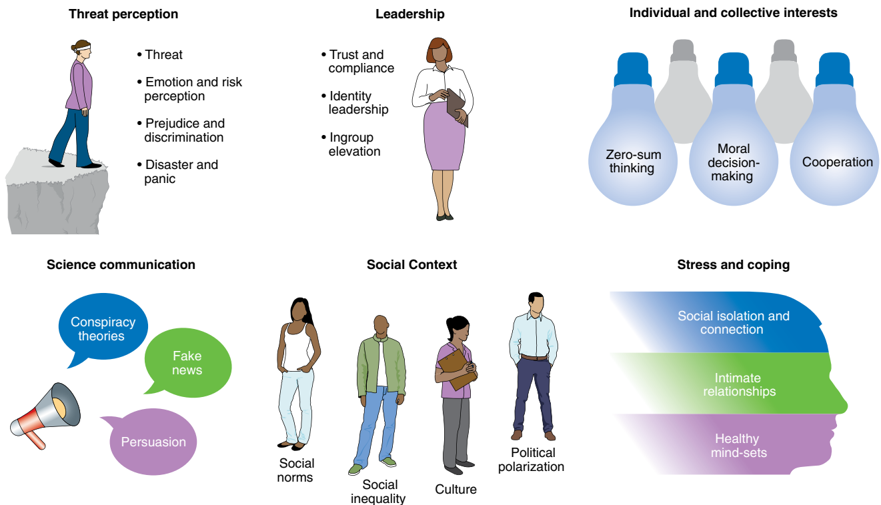
The COVID-19 pandemic represents a massive global health crisis. Because the crisis requires large-scale behaviour change and places significant psychological burdens on individuals, insights from the social and behavioural sciences can be used to help align human behaviour with the recommendations of epidemiologists and public health experts. Here we discuss evidence from a selection of research topics relevant to pandemics, including work on navigating threats, social and cultural influences on behaviour, science communication, moral decision-making, leadership, and stress and coping. In each section, we note the nature and quality of prior research, including uncertainty and unsettled issues. We identify several insights for effective response to the COVID-19 pandemic and highlight important gaps researchers should move quickly to fill in the coming weeks and months.
Overview
CoChat Summary
TL;DR
This perspective argues that social and behavioural science can help align public behaviour with COVID-19 public health recommendations across threat perception, social context, science communication, cooperation, leadership, and stress/coping. It synthesizes prior evidence and policy insights while cautioning that evidence is limited, often drawn from non-pandemic contexts, and in many areas unsettled.
Key findings
- The paper notes the scale of infectious disease threats: the bubonic plague killed approximately 25% of the European population, and by March 2020 COVID-19 had spread to more than 118,000 cases and caused 4,291 deaths in 114 countries. It also notes that 21 countries donated medical supplies to China in February, with China reciprocating widely.
- Fear appeals can change behaviour when people feel capable of dealing with the threat, but produce defensive reactions when people feel helpless; optimism bias can lead people to underestimate personal risk and ignore public health warnings.
- Social norms, inequality, culture, and political polarization shape pandemic behaviour: correcting misperceived norms can help when most people are already doing the desirable behaviour, but descriptive norms can backfire if the behaviour is undesirable unless paired with prescriptive norms.
- Effective communication and leadership may involve credible sources, messages that protect others or align with moral values, prebunking/inoculation against misinformation, accuracy nudges, shared social identity, and leaders modelling prosocial sacrifice; excessive national self-image concerns (“collective narcissism”) can backfire.
Methods
- Design: Perspective/narrative review; no primary data collection or sample. Topics were identified by the corresponding authors as potentially relevant to pandemic response and are explicitly not exhaustive.
- Evidence base: synthesizes prior social and behavioural research on threat perception, social context, science communication, moral decision-making, cooperation, leadership, and stress/coping, drawing on laboratory experiments, correlational studies, field experiments, meta-analyses, and preprints/forthcoming work.
- Analysis: narrative synthesis with policy implications and identified research gaps; no systematic search strategy or quantitative synthesis is reported.
Limitations
- Stated: due to space constraints, the paper provides only a brief summary of each topic; research on these topics is ongoing and in many cases far from settled; there is very little published social science research on the current pandemic, so discussion often draws from different circumstances and evidence quality varies substantially.
- Stated: insights and policy implications should be interpreted with caution.
- Evident: as a perspective rather than a systematic review or empirical study, it does not provide a comprehensive evidence appraisal, and its reliance on preprints and forthcoming sources limits certainty.
Model-written summary. Check it against the paper before relying on it.
Integrity signals
Registry
Cites
Statistics
Figures
Verification
Claims the paper makes
19 Valid · 5 Not valid · 37 Not checked · 13 Own results and interpretations
At least one cited source doesn’t support this claim or points to a different paper, and none confirmed it — see the verdicts below.
In the paper
“For instance, in hypothetical scenarios about deciding whether to go to work while sick, American and British participants reported they would be less willing to stay home when it was uncertain they would infect a co-worker.”
What the sources say
- Disputedcites [176] Kappes, A. et al. Uncertainty about the impact of social decisions increases prosocial behaviour. Nat. Hum. Behav. 2, 573–580 (2018). sourceExperimental — accuracy not yet measured
In the paper’s account of the infectious-disease scenario (Abstract; page not provided), participants facing uncertainty about how severely a co-worker might be affected were more likely to stay home than controls, not less. The paper distinguishes that impact uncertainty from uncertainty about whether a co-worker would be infected. Its Study 6 Methods (page not provided) describe recruitment through AMT, but do not establish the claimed American and British participant groups. (LLM, conf=0.88)
Checked by a reasoning model — may be wrong.
hedgedstates an association- Asserted: passes — The authors put it forward as true.
- Checkable: passes — It can be checked against evidence.
- Load-bearing: passes — The paper’s conclusions depend on it.
- Based: passes — The paper gives a reason why it holds.
- Disputed
The cited sources that could be checked couldn’t confirm or dispute this claim.
In the paper
“Moreover, there is mixed research regarding whether corrections may actually increase belief in the original misinformation 121,124-126 or in other misleading claims that fail to get corrected 127 .”
What the sources say
- Not checked — no full text of the sourcecites [121] Guess, A. & Coppock, A. Does counter-attitudinal information cause backlash? Results from three large survey experiments. Br. J. Polit. Sci. https://doi.org/10.1017/S0007123418000327 (2018). source
- Not matchedcites [124] Wittenberg, C. & Berinsky, A.J. Misinformation and its correction. in Social Media and Democracy: The State of the Field (eds Persily, N. & Tucker, J. A.) (Cambridge University Press, forthcoming).
Its entry has no title and year that we can search by.
- Not checked — no full text of the sourcecites [125] Swire, B. & Ecker, U.K.H. Misinformation and its correction: Cognitive mechanisms and recommendations for mass communication. in Misinformation and Mass Audiences (eds. Southwell, B. G., Thorson, E. A. & Sheble, L.) 195–2011 (University of Texas Press, 2018). source
- Not checked — no full text of the sourcecites [126] Wood, T. & Porter, E. The elusive backfire effect: mass attitudes’ steadfast factual adherence. Polit. Behav. 41, 135–163 (2018). source
- Could not verifycites [127] Pennycook, G., McPhetres, J., Zhang, Y. & Rand, D. Fighting COVID-19 misinformation on social media: Experimental evidence for a scalable accuracy nudge intervention. Preprint at PsyArXiv https://doi.org/10.31234/osf.io/uhbk9 (2020). sourceExperimental — accuracy not yet measured
Citation 127 is attached to the suggestion that corrections may increase belief in other misleading claims that go uncorrected. The Statement of Relevance and Discussion describe an accuracy nudge that improved sharing decisions, not corrections or their effects on belief in uncorrected claims. Searches for correction backfire and uncorrected misinformation found no passage addressing that point; page numbers were unavailable in our copy. (LLM, conf=0.76)
hedgedstates a possible cause- Asserted: passes — The authors put it forward as true.
- Checkable: passes — It can be checked against evidence.
- Load-bearing: passes — The paper’s conclusions depend on it.
- Based: passes — The paper gives a reason why it holds.
The sources with a verdict support this claim; the rest weren’t checked yet, have no full text we could read, or their verdicts aren’t rated yet.
In the paper
“Indeed, laboratory research has found that people prioritize local over global (or international) interests 185,186 .”
What the sources say
- Supportedcites [185] Milinski, M., Hilbe, C., Semmann, D., Sommerfeld, R. & Marotzke, J. Humans choose representatives who enforce cooperation in social dilemmas through extortion. Nat. Commun. 7, 10915 (2016). source
The Results section (‘Voters choose selfish representatives’; page unavailable) reports that participants preferentially re-elected representatives who contributed less to the shared climate account and elected candidates who pledged to contribute less than a fair share. In this simulated international dilemma, that supports the claim that participants favored their own group’s interests over the collective goal; it does not establish that everyone did so. (LLM, conf=0.85)
- Not checked — no full text of the sourcecites [186] Reinders Folmer, C. P. et al. One for all: what representing a group may do to us. J. Exp. Soc. Psychol. 48, 1047–1056 (2012). source
plain- Asserted: passes — The authors put it forward as true.
- Checkable: passes — It can be checked against evidence.
- Load-bearing: passes — The paper’s conclusions depend on it.
- Based: passes — The paper gives a reason why it holds.
- Supported
Every source the paper cites for this claim was checked and supports it.
In the paper
“However, when going to work risked infecting an elderly co-worker who would suffer a serious illness, participants reported they would be more willing to stay home 176 .”
What the sources say
- Supportedcites [176] Kappes, A. et al. Uncertainty about the impact of social decisions increases prosocial behaviour. Nat. Hum. Behav. 2, 573–580 (2018). source
The Study 6 Methods (page not provided) describe a scenario in which going to work could infect an older, vulnerable co-worker who would suffer severely, followed by a rating of willingness to go to work. The reported Study 6 findings (indexed under Abstract; page not provided) say participants given that risk information were significantly more likely to stay home than controls. (LLM, conf=0.92)
hedgedstates a cause- Asserted: passes — The authors put it forward as true.
- Checkable: passes — It can be checked against evidence.
- Load-bearing: passes — The paper’s conclusions depend on it.
- Based: passes — The paper gives a reason why it holds.
- Supported
The sources with a verdict support this claim; the rest weren’t checked yet, have no full text we could read, or their verdicts aren’t rated yet.
In the paper
“Several techniques, such as sanctioning defectors 187 or rewarding cooperators 188 , tend to increase cooperative behaviour in laboratory experiments using economic games.”
What the sources say
- Not checked — no full text of the sourcecites [187] Yamagishi, T. The provision of a sanctioning system as a public good. J. Pers. Soc. Psychol. 51, 110–116 (1986). source
- Supportedcites [188] Rand, D. G., Dreber, A., Ellingsen, T., Fudenberg, D. & Nowak, M. A. Positive interactions promote public cooperation. Science 325, 1272–1275 (2009). source
Citation 188 is attached to rewarding cooperators. The paper’s Abstract reports a laboratory comparison using repeated public goods games and finds that reward maintained public cooperation and, when both reward and punishment were available, increased contributions. (LLM, conf=0.93)
plainstates a cause- Asserted: passes — The authors put it forward as true.
- Checkable: passes — It can be checked against evidence.
- Load-bearing: unclear — It is unclear whether the paper’s conclusions depend on it.
- Based: passes — The paper gives a reason why it holds.
50 more claims · 13 with their cited sources checked
Create a free account to see all 74 claims and to verify the 2 references still open.
- It may state two separate claims as one. 13
- Probably not a substantial claim. 6
Claims other papers make about this one
Each is checked against this paper’s own text: does it say what the citing paper says it does?
The source backs part of the claim, not all of it — or backs it for a different population, condition or comparison.
In the citing paper
“COVID-19 is an international public health crisis, putting substantial burden on medical centers and increasing the psychological toll on health care workers (HCW).”
From Supporting the well-being of health care providers during the COVID-19 pandemic: The CopeColumbia response (2020) · cites this paper as [6]
Experimental — accuracy not yet measuredThe source backs part of the claim, not all of it — or backs it for a different population, condition or comparison.
In the citing paper
“these population-wide measures affected psychological well-being and mental health as well as increased social isolation [68] and loneliness.”
From Psychological correlates of perceived loneliness in college students before and during the COVID-19 stay-at-home period: a longitudinal study (2023) · cites this paper as [68]
Experimental — accuracy not yet measuredThe source backs part of the claim, not all of it — or backs it for a different population, condition or comparison.
In the citing paper
“they may eventually increase the social isolation of students and affect their psychological well-being and mental health [3].”
From Students under lockdown: Comparisons of students’ social networks and mental health before and during the COVID-19 crisis in Switzerland (2020) · cites this paper as [3]
Experimental — accuracy not yet measuredThe source backs part of the claim, not all of it — or backs it for a different population, condition or comparison.
In the citing paper
“effective interventions are hard to scale to a population level (12);”
From Psychological inoculation improves resilience against misinformation on social media (2022) · cites this paper as [12]
Experimental — accuracy not yet measuredThe source backs part of the claim, not all of it — or backs it for a different population, condition or comparison.
In the citing paper
“There is a shortage of studies that test anti-misinformation interventions in an ecologically valid manner, i.e., testing an intervention as consumers would interact with it in online environments (8, 12).”
From Psychological inoculation improves resilience against misinformation on social media (2022) · cites this paper as [12]
Experimental — accuracy not yet measured
6 more claims about this paper
Create a free account to see every claim other papers make about this one.
Citations
Cites
Granovetter, M. S. (1973) · American Journal of Sociology · doi:10.1086/225469 · Cited by 40,491
Zhou, F., Yu, T., Du, R., Fan, G., Liu, Y., Liu, Z., Xiang, J., Wang, Y., Song, B., Gu, X., et al. (2020) · The Lancet · doi:10.1016/s0140-6736(20)30566-3 · Cited by 27,263
The need to belong: Desire for interpersonal attachments as a fundamental human motivation.
Baumeister, R. F., & Leary, M. R. (1995) · Psychological Bulletin · doi:10.1037//0033-2909.117.3.497 · Cited by 23,245
Culture and the self: Implications for cognition, emotion, and motivation.
Markus, H. R., & Kitayama, S. (1991) · Psychological Review · doi:10.1037/0033-295x.98.2.224 · Cited by 21,995
Self-citationThe Psychological Impact of Quarantine and How to Reduce It: Rapid Review of the Evidence
Brooks, S. K., Webster, R. K., Smith, L. E., Woodland, L., Wessely, S., Greenberg, N., & Rubin, G. J. (2020) · doi:10.2139/ssrn.3532534 · Cited by 16,394
The psychological impact of quarantine and how to reduce it: Rapid review of the evidence
Brooks, S. K., Webster, R. K., Smith, L. E., Woodland, L., Wessely, S., Greenberg, N., & Rubin, G. J. (2020) · The Lancet · doi:10.1016/s0140-6736(20)30460-8 · Cited by 16,378
Nudge: improving decisions about health, wealth, and happiness
(2008) · Choice Reviews Online · doi:10.5860/choice.46-0977 · Cited by 11,572
Slovic, P. (1987) · Science · doi:10.1126/science.3563507 · Cited by 9,271
The Elaboration Likelihood Model of Persuasion
Petty, R. E., & Cacioppo, J. T. (1986) · Advances in Experimental Social Psychology · doi:10.1016/s0065-2601(08)60214-2 · Cited by 8,822
Self-citationThe emotional dog and its rational tail: A social intuitionist approach to moral judgment.
Haidt, J. (2001) · Psychological Review · doi:10.1037/0033-295x.108.4.814 · Cited by 8,048
Research works printed but not linked: 3
- Berkowitz, A.D. An overview of the social norms approach. in Changing the Culture of College Drinking: A Socially Situated Health Communication Campaign (eds. Stewart, L. & Lederman, L. C.) 193–214 (Hampton Press, 2005).
- Wittenberg, C. & Berinsky, A.J. Misinformation and its correction. in Social Media and Democracy: The State of the Field (eds Persily, N. & Tucker, J. A.) (Cambridge University Press, forthcoming).
- Ransohoff, K.J. Patients on the Trolley Track: The Moral Cognition of Medical Practitioners and Public Health Professionals. (Harvard Univ. Press, 2011).
Cited by
Items 4,001–4,100 of 5,015
IPSR Model: Misinformation Intervention through Prebunking in Social NetworksPreprint
Rai, R., Sharma, R. K., & Meena, C. (2025) · doi:10.36227/techrxiv.175424259.96125245/v1 · Cited by 3
An Identity-based Approach to Polarization and Public HealthPreprint
Pillai, R. M., Globig, L. K., Rathje, S., Sternisko, A., Thériault, R., & Bavel, J. J. V. (2025) · PsyArXiv (OSF Preprints) · doi:10.31234/osf.io/5z6r7_v1 · Cited by 1
Self-citationGreenhalgh, T., Ratnayake, S., Helm, R. K., Poliseli, L., Williamson, J., & Houghton, J. (2026) · Research Square · doi:10.21203/rs.3.rs-10307762/v1 · Cited by 3
The Role of Personality in Language Learning
Mrzyglod, E., Esposito, A., Fabbro, A., Fabbro, F., Crescentini, C., & Matiz, A. (2026) · Psychology of Language and Communication · doi:10.58734/plc-2026-0004
Lakatos, B., Gopcsa, L., Gondos, E., Riczu, A., Várnai, Z., Nagy, E. L., Molnár, E., Bekő, G., Bobek, I., Remenyi, P. P., et al. (2020) · PubMed · doi:10.1556/650.2020.31899 · Cited by 10
Comportement des ménages brésiliens face à la COVID-19
Phélinas, P., Ciriez, C., & Ciriez, C. (2022) · Revue d économie du développement · doi:10.3917/edd.351.0217 · Cited by 2
Majeed, S. M. I., & Gilani, R. A. (2020) · Life and Science · doi:10.37185/lns.1.1.120
Motivation: Theory/Human Model
Cabras, E., & von Humboldt, S. (2019) · Springer eBooks · doi:10.1007/978-3-319-69892-2_77-1
“Social distancing is an effective measure to restrain the spread of infections; however, older adults are highly susceptible to isolation, with a high mental health burden (Bavel et al. 2020; Newman et al. 2020).”
BackgroundPandemic Spread—an Empirical Analysis
Ziegler, Z. (2020) · Rambam Maimonides Medical Journal · doi:10.5041/rmmj.10410
Psychological implications as lockdown rules relax and shielding comes to an end
Bevin, A. (2020) · Journal of Kidney Care · doi:10.12968/jokc.2020.5.4.156
In a Pandemic, People Must Remember: Friends Are Contagious
Schlager, T., & Whillans, A. V. (2020)
Modeling the End Date of COVID-19 Pandemic
Koçak, M. (2020) · Turkiye Klinikleri Journal of Biostatistics · doi:10.5336/biostatic.2020-77234
“3 −( − 4)/ 4 41+ −( − 4)/ 42, 1, 2, 3, 4>0 (4)”
Hudiyana, J., & Takwin, B. (2020) · Jurnal Psikologi Sosial · doi:10.7454/jps.2020.19
Gupta, V., Singh, A., Panika, R., & Goel, P. (2020) · Indian Journal of Health Sciences and Biomedical Research (KLEU) · doi:10.4103/kleuhsj.kleuhsj_245_20
Anxiety Levels among Healthcare Professionals during Covid-19 Pandemic: A Multifactorial StudyPreprint
Hafeez, M., & Prof., A. M. (2020) · PsyArXiv (OSF Preprints) · doi:10.31234/osf.io/a4rw9
A Study On Developing Negative Attitude to Problems in the Coronavirus Pandemic
ALSANCAK, F., & Hüseyin Zahid, K. A. R. A. (2020) · Journal of Turkish Studies · doi:10.7827/turkishstudies.45408
Análise Custo-Volume-Lucro para ponderação de sistemas de produção leiteira
Huppes, C. M., Bigolin, T., Mühl, J. J., & de Souza, Â. R. L. (2021) · Editora Poisson eBooks · doi:10.36229/978-65-5866-139-9.cap.01
Shagidaeva, A. B. (2020) · Research Technologies of Pandemic Coronavirus Impact (RTCOV) · doi:10.2991/assehr.k.201105.049
“A gap is partially filled by studies on certain aspects of the psychological perception of a pandemic and its consequences, individual and group, including age aspects [6-19].”
BackgroundThe sooner the better? Anxiety and deliberate exposure to COVID-19 risk among young adults in FrancePreprint
Étilé, F., & Geoffard, P. (2020) · Research Square · doi:10.21203/rs.3.rs-105842/v1
Anxiety increases the willingness to be exposed to COVID-19 risk among young adults in FrancePreprint
Étilé, F., & Geoffard, P. (2020) · Research Square · doi:10.21203/rs.3.rs-105842/v3
Japonya’nın Stratejik Pandemi Yönetimi ve Covid-19 ile ilgili bir Araştırma
Yetgin, M. A. (2020) · Bartın Üniversitesi İktisadi ve İdari Bilimler Fakültesi Dergisi · doi:10.47129/bartiniibf.775791
When Music Changes, so Does the Dance
Morgül, G., & Fındıklı, M. A. (2020) · Advances in business strategy and competitive advantage book series · doi:10.4018/978-1-7998-4727-4.ch015
Fakhrou, A. A., & Ghareeb, S. A. (2020) · International Journal of Education · doi:10.5296/ije.v12i4.18047
“For instance, it affected people in social, behavioral and psychological areas (Bavel et al., 2020).”
BackgroundInfluentialDesconocimiento como factor de riesgo para contraer COVID-19: ¿A qué nos enfrentamos?
Camacho-Osornio, D., Franco-Escobar, L., Santos, A. G.-D. L., et al. (2020) · Educación y Salud Boletín Científico Instituto de Ciencias de la Salud Universidad Autónoma del Estado de Hidalgo · doi:10.29057/icsa.v9i17.6358
“a desarrollar síntomas o a sucumbir a la enfermedad, sino también a quién puede adoptar recomendaciones para retrasar la propagación de la enfermedad.(12) El coronavirus 2 del síndrome respiratorio agudo severo (SARS-CoV-2) se está extendiendo rápidamente por todo el mundo para causar miles de muertes cada día.”
BackgroundLópez, J. A. P., Alvarado, M. G. G., & Rojas-Russell, M. E. (2020) · Journal of Medical Internet Research · doi:10.2196/23439
Shumway, S., Hopper, J. D., Tolman, E., Ferguson, D. G., Hubble, G., Patterson, D., & Jensen, J. L. (2020) · doi:10.31235/osf.io/9nzr7
Negative COVID-19 Test: What Next?
Tripathy, S., Arafat, S. M. Y., Kar, S. K., et al. (2020) · Medical virology · doi:10.1007/978-981-15-6006-4_10
Peoples' response in times of Corona crisis: a survey of indian public
Raza, G., & Singh, S. (2020) · Journal of Science Communication · doi:10.22323/2.19070202
Significance of Business Philosophy towards The Covid-19 Post Pandemic
Thahir, L. S. (2020) · International Conference on Environmental and Technology of Law, Business and Education on Post Covid 19 (ICETLAWBE) · doi:10.4108/eai.26-9-2020.2302674
An Update On Novel Coronavirus: Conquering World
Juneja, K., & Deepshikha, D. (2020) · American Journal Of Pharmacy And Health Research · doi:10.46624/ajphr.2020.v8.i10.002
Mutiara, M. W., Mariati, Beng, J. T., et al. (2020) · Tarumanagara International Conference on the Applications of Social Sciences and Humanities (TICASH) · doi:10.2991/assehr.k.201209.112
Shabrina, Z. R. N., Adiwibowo, I. R., & Beryllia, N. A. (2020) · Buletin Psikologi · doi:10.22146/buletinpsikologi.60763 · Cited by 1
Altruism in the time of COVID-19: We are all in this together, but who is we?Preprint
Grimalda, G. F., Buchan, N. R., Ozturk, O. D., Pinate, A. C., Urso, G., & Brewer, M. B. (2021) · Research Square · doi:10.21203/rs.3.rs-139076/v1
Enciso, G. F., Palmeros, J. A. M., & López, G. A. T. (2020) · Revista del Centro de Investigación de la Universidad la Salle · doi:10.26457/recein.v14i54.2652 · Cited by 3
زيادة, خ. ا. م. (2020) · Mağallaẗ Al-Buḥūṯ Al-Bī'iyyaẗ wa Al-Ṭāqaẗ Bi Ǧāmiʿaẗ Al-Minūfiyyaẗ/Mağallaẗ Al-Buḥūṯ Al-Bī'iyyaẗ wa Al-Ṭāqaẗ Bi Ǧāmiʿaẗ Al-Minūfiyyaẗ · doi:10.21608/jbet.2020.134845
The Effects of Pre-Response Before COVID-19 Outbreak on Strategic Decision MakingPreprint
Jung, J. H., Kim, D.-W., & Jung, I. H. (2020) · Research Square · doi:10.21203/rs.3.rs-72232/v1
“However, cooperation and orderly behavior are common across the categories of emergencies and disasters, and people often show remarkable altruism [9].”
BackgroundBoas, A. A. V., Faria, D. A., Pires, A. A. D. S., & Morin, E. M. (2021) · Editora Poisson eBooks · doi:10.36229/978-65-5866-034-7.cap.06
Why does the COVID-19 outbreak in Mexico seem to be slower? Some hypotheses for testingPreprint
Elías-Gutiérrez, M., Mendoza-Carranza, M., Takahashi-Aguilar, U., Valdéz-Moreno, M., Prado-Bernal, J. A., & Mora-Loya, C. (2020) · Research Square · doi:10.21203/rs.3.rs-51450/v1
Addressing the challenges of TB diagnosis in the COVID era
Chikovore, J. (2020) · Public Health Action · doi:10.5588/pha.20.0074
Lestari, F., Kadir, A. R., Idham, M., et al. (2021) · Research Square · doi:10.21203/rs.3.rs-132920/v1
“I always take a shower using warm water when returning home from outside 110 (14) 219 (28) 150 (20) 179 (23) 113 (15)”
BackgroundPercepção do nível de inovação de empresas do setor de cerâmica vermelha no estado de Minas Gerais
da Silva, T. C. B. P., & Gomes, M. D. L. B. (2021) · Editora Poisson eBooks · doi:10.36229/978-65-5866-034-7.cap.12
Obioma, A., Ihua, N., & Christian, A. (2020) · International Journal of Coronaviruses · doi:10.14302/issn.2692-1537.ijcv-20-3620
Community Awareness and Participation in Handling Covid-19 in Surabaya, Indonesia
Wikanta, W. (2020) · Indian Journal of Forensic Medicine & Toxicology · doi:10.37506/ijfmt.v14i4.12280
Yang, Y. (2021) · E3S Web of Conferences · doi:10.1051/e3sconf/202123301163
“However, the International Monetary Fund (IMF) said the global economy will shrink by 3% this year[2].”
BackgroundReliability of the Hebrew Version of the Integrated Covid-19 Threat ScalePreprint
Taub, K., Abeles, D., & Yuval‐Greenberg, S. (2020) · doi:10.31234/osf.io/2wjbu
“The COVID-19 global pandemic of 2020 brought about a surge of psychological research focusing on its cognitive and emotional impact (2-4).”
BackgroundDachew, A. M., Zegene, G. M., Adraro, W., & Setegn, M. G. (2021) · Research Square · doi:10.21203/rs.3.rs-159253/v1
“Africa and Egypt taking the rst line in number of total cases [3].”
BackgroundEffects of Lockdown across Nation
Kawde, A. (2021) · Psychology and Education Journal · doi:10.17762/pae.v58i2.1874
“During this solitary, since there is physical separation, individuals desire to acquire connection, despite the fact that the situation is unique.[32] An investigation on various models of mass crisis conduct recommends a social mental reason for versatility.”
BackgroundToghroli, R., Aghamolaei, T., Hassani, L., Ramezaninejad, V., Lebni, J. Y., Nejhaddadgar, N., Mehedi, N., & Ziapour, A. (2021) · Research Square · doi:10.21203/rs.3.rs-234692/v1
COVID-19 REVIEW ON THE PHARMACOLOGY OF THE DRUGS USED FOR COVID-19 OUTBREAK
Ain, N. U. (2021) · Journal of University Medical & Dental College · doi:10.37723/jumdc.v12i1.488
Gan, Y., & Fu, Q. (2021) · Research Square · doi:10.21203/rs.3.rs-222428/v1 · Cited by 1
Kolandaisamy, I., & Kolandaisamy, R. (2020) · Journal of Computational and Theoretical Nanoscience · doi:10.1166/jctn.2020.9412
Helion, C., Ulichney, V., Smith, D. V., et al. (2021) · medRxiv · doi:10.1101/2021.02.26.21252547
Lessons from the Success Story: The Systematic Approach to Fight Against COVID-19 in Beijing
Han, Y., Li, J., Jia, K., et al. (2021) · Advances in geographical and environmental sciences · doi:10.1007/978-981-33-6440-0_2
“The media, businesses and social groups throughout society are responsible for publicizing, mobilizing, and implementing prevention and control measures in the course of pandemic prevention and control (Chan et al. 2020; Van Bavel et al. 2020).”
BackgroundCrooks, C. L., McNeil, T., Sawyer, B. D., Canham, M., & Muchlinski, D. (2020) · IEEE International Conference on Big Data (BigData) · doi:10.1109/bigdata50022.2020.9378279
“For example, reference [70] summarized socio-psychological concepts contributing to the promotion of healthy public behaviors during the COVID-19 pandemic.”
BackgroundInfluentialEvidence-Based Preparedness for Post COVID-19
Kitaw, Y., & Kaba, M. (2021) · IntechOpen eBooks · doi:10.5772/intechopen.96931
Greek Government’s Communication Approach During the Covid-19 First Wave
Tsekeris, C., & Efthymiou, G. (2020) · HAPSc Policy Briefs Series · doi:10.12681/hapscpbs.26452
“8 Furthermore, coordinated efforts across individuals, communities, stakeholders and governments to fight the spread of disease can send strong signals of cooperation and shared values, facilitating reorganisation of previously considered outgroups and in-groups into a single community with a common destiny (Bavel et…”
BackgroundInfluentialFactors Associated with COVID-19 Low Risk perception among urban dwellers in MalawiPreprint
Dzimbiri, M., Chilanga, E., Mwanjawala, P., & Keller, A. (2021) · Research Square · doi:10.21203/rs.3.rs-366905/v1
“The R&D Blueprint epidemic experts acknowledged the critical role of the field of Social and behavioral sciences in addressing the sociocultural challenges related to COVID-19 epidemic (Bavel et al. 2020).”
BackgroundRisk communications in the early phase of the COVID-19 pandemic: The Maldives’ experience
USMAN, T., & Moosa, S. (2020) · The Maldives National Journal of Research · doi:10.62338/4b4w9x85 · Cited by 1
Back to School: The Effects of School Reopening on Parents and Children
Dahlgaard, J. O., & Fazekas, Z. (2021) · Scandinavian Political Studies · doi:10.1111/1467-9477.12198
Prasad, J. B., Verma, P., & Tyagi, N. K. (2021) · Journal of Cancer Prevention & Current Research · doi:10.15406/jcpcr.2021.12.00451
Geographical Modules of COVID-19 Pandemic in Bangladesh: Social Response and Action Taken
Alam, M. T., Ashrafuzzaman, M., Showva, N. N., Ahmed, M., Jewel, F. A., & Rahman, M. (2021) · SciMedicine Journal · doi:10.28991/scimedj-2021-03-si-4
“So, this study thinks that in the event of this epidemic, the policy of the government should be scorned by the Honorable Prime Minister towards the country, so that people can understand more and participate in the battlefield against this virus along with the government [24, 25].”
BackgroundJurgiel, J., Dzieciątkowski, T., Szarpak, Ł., & Filipiak, K. J. (2021) · Folia Cardiologica · doi:10.5603/fc.a2021.0020
Τσιχουρίδης, Χ., Batsila, M., Πέτρου, Ν., & Ρουσσάκης, Ι. (2021) · 1ο Διεθνές Διαδικτυακό Εκπαιδευτικό Συνέδριο Από τον 20ο στον 21ο αιώνα μέσα σε 15 ημέρες · doi:10.12681/online-edu.3227
Canaan, R. G., & Pimenta, M. D. S. (2021) · doi:10.5151/v-enei-682
REMOVED DUE TO POLICY VIOLATIONSPreprint
Varol, T., ten Hoor, G., Mesters, I., et al. (2021) · doi:10.31234/osf.io/rs5yu
Flu Vaccination due to COVID 19 as a Risk-Aversion Health Measure among Low-Risk PopulationsPreprint
Ji, M., Huang, C., & Hall, B. J. (2021) · Research Square · doi:10.21203/rs.3.rs-497508/v1
Yanti, N. R., & Putri, I. A. (2021) · IOP Conference Series Earth and Environmental Science · doi:10.1088/1755-1315/757/1/012015
“The Covid-19 pandemic has caused a global health crisis, there has been massive behavioral changes and has placed a significant psychological burden[4].”
BackgroundULUSLARARASI ÜNİVERSİTE ÖĞRENCİLERİNİN PANDEMİ SÜRECİ
Bekçi, B. (2021) · Journal of Awareness · doi:10.26809/joa.6.2.04
Investigation of Individual Perception and Health Behavior towards Covid-19 Pandemic
Gül, İ., & Kundakcı, Y. E. (2021) · Journal of International Health Sciences and Management · doi:10.48121/jihsam.823422
Nugroho, N., Budianto, A., & Israhadi, E. (2024) · Proceeding of The International Conference of Inovation Science Technology Education Children and Health · doi:10.62951/icistech.v1i1.4
“In these conditions, doctors sometimes have to sacrifice their lives to protect the public from the spread of the Covid-19 pandemic [7].”
Arıkan, İ., & Demir, B. K. (2021) · Galician Medical Journal · doi:10.21802/gmj.2021.2.2
Ballesteros, B. D. L. B., & Cortez, E. A. (2021) · Research Society and Development · doi:10.33448/rsd-v10i6.15707
Aye, N. S., Pwint, K. H., Aung, H. M., Yadanar, P., Show, K. L., Thwin, T., & Wai, K. T. (2021) · Global Bioethics Enquiry Journal · doi:10.38020/gbe.9.1.2021.33-41
“The local Institutional Review Boards (IRB) might face some difficulties in reviewing those researches during public health emergency in response to pressure from the authorities concerned [5-8].”
BackgroundMohsen, F., Bakkar, B., Kikhia, J., et al. (2021) · Research Square · doi:10.21203/rs.3.rs-528706/v1
Sleeping beauties and temporal evolution of the coronavirus literaturePreprint
Haghani, M., & Varamini, P. (2021) · arXiv (Cornell University) · doi:10.48550/arxiv.2106.04810
Tracking the development of COVID-19 related PsyArXiv preprintsPreprint
Yesilada, M., Holford, D. L., Wulf, M., Hahn, U., Lewandowsky, S., Herzog, S. M., Radosevic, M., Stuchlý, E., Taylor, K. S., Ye, S., et al. (2021) · doi:10.31234/osf.io/evmgs
“Van Bavel et al. (2020) catalogued several psychological science research streams (e.g., communication and mental health, to name a few) that could have a positive impact on managing the outbreak and improving the lives of individuals during the pandemic.”
BackgroundDas, S., & Gupta, R. P. (2021) · EPRA International Journal of Socio-Economic and Environmental Outlook · doi:10.36713/epra7376
Cure and care in pandemic times: An existential perspective in mental health.
da Cruz, M. V., & Mendes, M. S. (2021) · The Humanistic Psychologist · doi:10.1037/hum0000231
Duțu, A., Diaconu, M., Pîrvu, D., OANCEA, O. E. M., & Brinzea, M. (2020) · Scientific Bulletin – Economic Sciences
Palleres, X. R., Baltierra-Reyes, F., & González-Muñoz, F. (2021) · Revista Peruana de Investigación en Salud · doi:10.35839/repis.5.3.919 · Cited by 6
Cognitive Contagion: How to model (and potentially counter) the spread of fake news.Preprint
Rabb, N., Cowen, L., de Ruiter, J. P., & Scheutz, M. J. (2021) · arXiv (Cornell University)
Individual-Level Heterogeneity in Mask-wearing During the COVID-19 Pandemic in MalaysiaPreprint
Zhang, S. X., Looi, K. H., Li, N., et al. (2021) · medRxiv · doi:10.1101/2021.07.02.21257837
“Scholars have noticed different receptiveness to facemask wearing across countries.(9) For example, in East Asia, face maskwearingcanbeubiquitousandwaseasilymademandatory quickly in the pandemic.”
BackgroundHEALTH AND WELNESS PROGRAM AND NEW NORMAL LIFESTYLE OF CvSU FACULTY AND THEIR PERFORMANCE
Jacob, L. A. B. (2021) · EPRA International Journal of Research & Development (IJRD) · doi:10.36713/epra7487 · Cited by 1
Nyahunda, L., & Tirivangasi, H. M. (2021) · World sustainability series · doi:10.1007/978-3-030-74693-3_28 · Cited by 2
Shifts in Help-seeking Patterns During COVID-19: Should Social Distancing be Rebranded?Preprint
Junus, A., Kwan, C., Wong, C. L. H., Chen, Z., & Yip, P. S. F. (2021) · Research Square · doi:10.21203/rs.3.rs-668704/v1
“Policies and population health messaging are powerful tools in mitigating mental health impacts of the COVID-19 pandemic [48], but as evidenced in this study, the current emphasis on “social distancing” needs to be reversed.”
BackgroundNiriwa, B. P., Azongo, M. A., & Asafo, M. K. (2021) · The International Journal of Humanities & Social Studies · doi:10.24940/theijhss/2021/v9/i3/hs2103-018
Renaldi, F. S., Sauriasari, R., & Riyadina, W. (2021) · Pharmacy Education · doi:10.46542/pe.2021.212.132142
“Many patient behaviours will change alongside the adaptation process in overcoming this pandemic (Acuña-Zegarra et al., 2020; Bavel et al., 2020).”
How Epidemic Psychology Works on Social Media: Evolution of responses to the COVID-19 pandemicPreprint
Aiello, L., Quercia, D., Zhou, K., Constantinides, M., Šćepanović, S., & Joglekar, S. (2020) · arXiv.org · doi:10.48550/arxiv.2007.13169 · Cited by 17
“Epidemics, in particular, present not only collective health hazards but also special challenges to mental health and public order that need to be addressed by social and behavioral sciences (Van Bavel et al., 2020).”
BackgroundKutlu, R., & Demirbaş, N. (2021) · The Annals of Clinical and Analytical Medicine · doi:10.4328/acam.20425
McLamore, Q., Syropoulos, S., Leidner, B., Hirschberger, G., Young, K., Zein, R. A., Baumert, A., Bilewicz, M., van Bezouw, M. J., Chatard, A., et al. (2021) · Research Square · doi:10.21203/rs.3.rs-804300/v1
Self-citationHIGHLIGHTS OF COVID VACCINE ERA'S IN LOW ASSETNATIONS.
Patel, B., Golani, P., Nagdev, S. A., Jaisinghani, H., & Mishra, R. (2021) · INTERNATIONAL JOURNAL OF SCIENTIFIC RESEARCH · doi:10.36106/ijsr/2726571
Worry and Perceived Risk of COVID-19 Among Government Employees in EthiopiaPreprint
Deressa, W., Worku, A., Getachew, S., Amogne, W., & Abebe, W. (2021) · Research Square · doi:10.21203/rs.3.rs-742611/v1
Kiling, I. Y., Savitri, S. I., & Ardi, R. (2021) · Jurnal Psikologi Sosial · doi:10.7454/jps.2021.11
COVID-19 Pandemic Is a Total Social Fact: Urgent Need for Social Studies on COVID-19 Pandemic
Ghahramani, S., Lankarani, K. B., Zahedroozegar, M. H., et al. (2021) · Shiraz E-Medical Journal · doi:10.5812/semj.118253
COVID-19 Discrepancies Rising from Population Density Political Polarization Exacerbates Policy Gap
Sidaoui, M., Abrams, N., & Adhikari, A. (2021) · Lecture notes in computer science · doi:10.1007/978-3-030-85447-8_14
“The pandemic revealed Americans are more willing to abide by stringent lockdown measures if they are convinced doing so would risk infecting a coworker of a serious illness (Bavel, 2020).”
BackgroundPourrazi, H., Modaberi, S., & Kabiri, R. (2021) · Archives of Hygiene Sciences · doi:10.52547/archhygsci.10.2.133 · Cited by 4
“The crisis of COVID-19 and measures such as social distancing may have significant social consequences beyond the lost lives [5-7].”
BackgroundUnderstanding Mobility Decision Making of People During Covid-19 with Decision Making Theory
Wu, G., Xia, S., Li, J., et al. (2021) · Advances in economics, business and management research/Advances in Economics, Business and Management Research · doi:10.2991/aebmr.k.210809.004
“Returning home and having family reunion in Mid-Autumn Festival is unchangeable in many people’s minds [23],”
Background
Metadata
- Authors
- Bavel, J. J. V., Baicker, K., Boggio, P. S., Capraro, V., Cichocka, A., Cikara, M., Crockett, M. J., Crum, A. J., Douglas, K. M., Druckman, J. N., Drury, J., Dube, O., Ellemers, N., Finkel, E. J., Fowler, J. H., Gelfand, M., Han, S., Haslam, S. A., Jetten, J., Kitayama, S., Mobbs, D., Napper, L. E., Packer, D. J., Pennycook, G., Peters, E., Petty, R. E., Rand, D. G., Reicher, S. D., Schnall, S., Shariff, A., Skitka, L. J., Smith, S. S., Sunstein, C. R., Tabri, N., Tucker, J. A., Linden, S. V. D., Lange, P. V., Weeden, K. A., Wohl, M. J. A., Zaki, J., Zion, S. R., & Willer, R.
- Affiliations
- New York University (US)
- Universidade Presbiteriana Mackenzie (BR)
- Middlesex University London (GB)
- University of Kent (GB)
- Harvard University (US)
- Yale University (US)
- Stanford University (US)
- Northwestern University (US)
- University of Sussex (GB)
- University of Chicago (US)
- Utrecht University (NL)
- University of California San Diego (US)
- University of Maryland, College Park (US)
- Peking University (CN)
- The University of Queensland (AU)
- University of Michigan (US)
- California Institute of Technology (US)
- Lehigh University (US)
- University of Regina (CA)
- University of Oregon (US)
- The Ohio State University (US)
- Massachusetts Institute of Technology (US)
- University of St Andrews (GB)
- University of Cambridge (GB)
- University of British Columbia (CA)
- University of Illinois Chicago (US)
- University of California, Berkeley (US)
- Carleton University (CA)
- Cornell University (US)
- Corresponding author
- Bavel, Jay J. Van
- Willer, Robb
- ORCID
- Bavel, Jay J. Van
- Baicker, Katherine
- Boggio, Paulo S.
- Capraro, Valerio
- Cichocka, Aleksandra
- Cikara, Mina
- Crockett, Molly J.
- Crum, Alia J.
- Douglas, Karen M.
- Druckman, James N.
- Drury, John
- Ellemers, Naomi
- Finkel, Eli J.
- Fowler, James H.
- Gelfand, Michele
- Han, Shihui
- Haslam, S. Alexander
- Jetten, Jolanda
- Kitayama, Shinobu
- Mobbs, Dean
- Napper, Lucy E.
- Packer, Dominic J.
- Pennycook, Gordon
- Peters, Ellen
- Petty, Richard E.
- Rand, David G.
- Reicher, Stephen D.
- Schnall, Simone
- Shariff, Azim
- Skitka, Linda J.
- Sunstein, Cass R.
- Tabri, Nassim
- Tucker, Joshua A.
- Linden, Sander van der
- Weeden, Kim A.
- Wohl, Michael J. A.
- Zaki, Jamil
- Zion, Sean R.
- Willer, Robb
- Venue
- Nature Human Behaviour
- Published
- 2020-04-30
- Volume
- 4
- Issue
- 5
- Pages
- 460-471
- ISSN
- 2397-3374 (ISSN-L)
- OpenAlex
- W3016902371
- Semantic Scholar
- d81abcd7f053b136423f1e7f57928524e8b0e1a0
- Cited by
- 4,964
- References
- 259
- Citations by year
- 2026: 177 · 2025: 288 · 2024: 483 · 2023: 741 · 2022: 1094 · 2021: 1474 · 2020: 702
- FWCI
- 175.81
- Type
- journal article
- Language
- en
- Open access
- bronze
- doi.org
- Licence
- www.springernature.com/gp/researchers/text-and-data-mining (tdm)
- www.springernature.com/gp/researchers/text-and-data-mining (vor)
- Locations
- Nature Human Behaviour (publishedVersion)
- PubMed (publishedVersion)
- Middlesex University Research Repository (Middlesex University Of London) (acceptedVersion)
- Kent Academic Repository (University of Kent) (acceptedVersion)
- DSpace@MIT (Massachusetts Institute of Technology) (submittedVersion, cc-by-nc-sa)
- Sussex Research Online (University of Sussex) (submittedVersion)
- CaltechAUTHORS (California Institute of Technology) (submittedVersion)
- RePEc: Research Papers in Economics (submittedVersion)
- BOA (University of Milano-Bicocca) (submittedVersion)
- Carleton University's Institutional Repository (MacOdrum Library, Carleton University) (submittedVersion, other-oa)
- Utrecht University Repository (Utrecht University) (submittedVersion)
- Figshare (submittedVersion)
- VU Research Portal (submittedVersion, other-oa)
- Utrecht University Repository (Utrecht University) (submittedVersion, other-oa)
- Data Archiving and Networked Services (DANS) (submittedVersion, other-oa)
- Funders
- U.S. Department of Health and Human Services (2P50 MH094258)
- National Institute of Mental Health (P50MH094258)
- Topics
- Social Sciences › Sociology and Political Science › COVID-19 Prevention and Impact
- Social Sciences › Communication › Communication and COVID-19 Impact
- Physical Sciences › Mathematics › Modeling and Simulation › COVID-19 epidemiological studies
- Keywords
- COVID-19 pandemic, pandemic response, behavior change, science communication, ethical decision-making, leadership, stress coping, psychological burden, public health recommendations
- MeSH terms
- Betacoronavirus, COVID-19, SARS-CoV-2, Adaptation, Psychological, Communicable Disease Control, Decision Making, Humans, Human Activities, Health Knowledge, Attitudes, Practice, Leadership, Pneumonia, Viral, Public Health, Quarantine, Stress, Psychological, Global Health, Coronavirus, Coronavirus Infections, Pandemics, Social Media, Epidemiological Monitoring
About these checks
Registry, retraction, Cites and statistics results are computed, not judged, with one exception: a printed reference that no index lists is read once by a model before it counts as a citation error. Claims are extracted by a model and kept only when their quote appears verbatim in the text; each cited source is then checked, with a model’s help, for whether it says what the claim relies on. Those verdicts can be wrong — read the claim’s quote and the cited source before relying on one.
The claim verdicts this report counts are experimental: their accuracy is not yet measured.
A language model drew the claims from the paper on 2026-10-10, under version 3 of the claim definition (model deepseek-v4.1-flash, prompt extract-v3).
A second model labelled each claim on 2026-10-10 (model jev-1.13-20260917, definition revision gold-guideline-v0.2).
Cited sources are checked with a language model’s help (gpt-6-sol).
Statistics and arithmetic are recomputed, not judged.
Confidence bands are shown only for fields calibrated on our annotated test set. None is calibrated yet, so no band is shown.
What counts as a claim ›How we measure confidence ›How we check this ›
Are you an author, or do you see a problem with this page? Request a review
Data sources
Bibliographic data: Semantic Scholar, OpenAlex, Crossref.
Contains information from the Semantic Scholar Academic Graph Datasets, made available under the ODC Attribution License (ODC-BY 1.0).
Semantic Scholar’s data is described in: Kinney, R., et al. (2023). The Semantic Scholar Open Data Platform. arXiv:2301.10140.
