

Swarm Learning for decentralized and confidential clinical machine learning
Open accessPublished version of a preprint
The DOI matches its Crossref record; 82 of the 86 references it cites were found in a registry or an index, and 1 are not checked yet; 9 of the 25 sources its claims cite were checked for support.
Abstract
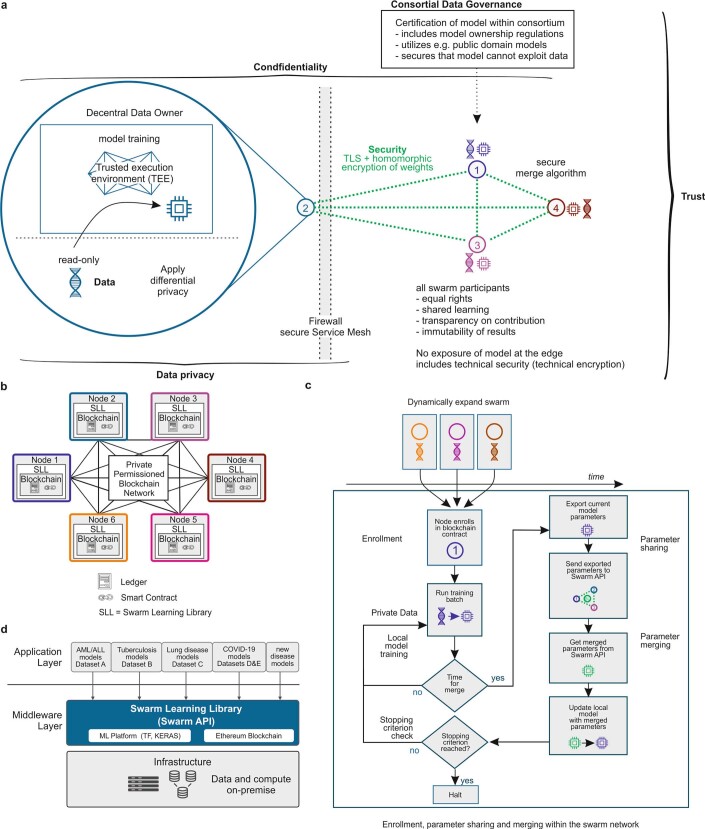
Fast and reliable detection of patients with severe and heterogeneous illnesses is a major goal of precision medicine 1,2 . Patients with leukaemia can be identified using machine learning on the basis of their blood transcriptomes 3 . However, there is an increasing divide between what is technically possible and what is allowed, because of privacy legislation 4,5 . Here, to facilitate the integration of any medical data from any data owner worldwide without violating privacy laws, we introduce Swarm Learning—a decentralized machine-learning approach that unites edge computing, blockchain-based peer-to-peer networking and coordination while maintaining confidentiality without the need for a central coordinator, thereby going beyond federated learning. To illustrate the feasibility of using Swarm Learning to develop disease classifiers using distributed data, we chose four use cases of heterogeneous diseases (COVID-19, tuberculosis, leukaemia and lung pathologies). With more than 16,400 blood transcriptomes derived from 127 clinical studies with non-uniform distributions of cases and controls and substantial study biases, as well as more than 95,000 chest X-ray images, we show that Swarm Learning classifiers outperform those developed at individual sites. In addition, Swarm Learning completely fulfils local confidentiality regulations by design. We believe that this approach will notably accelerate the introduction of precision medicine.
Verified 2026-10-05 · 1 reference not checked yet
Overview
CoChat Summary
TL;DR
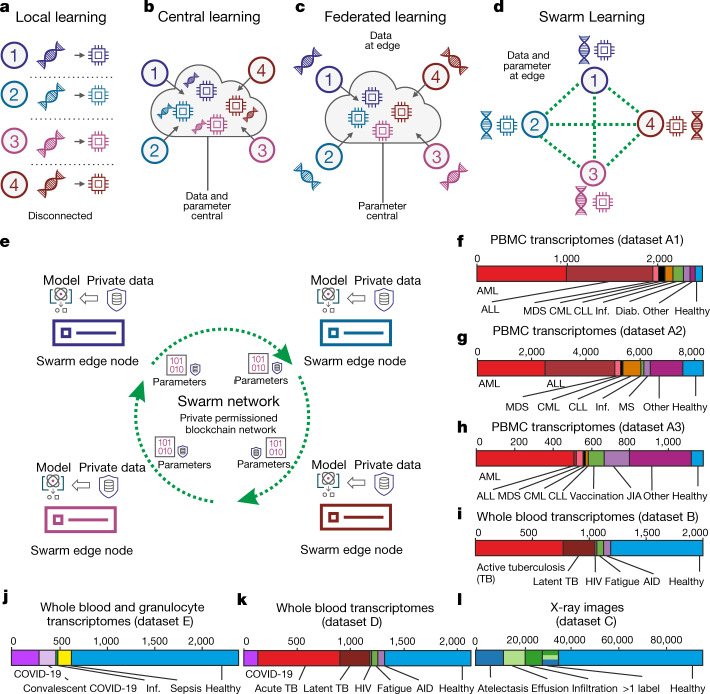
Swarm Learning (SL) is a decentralized machine-learning approach that combines edge computing, permissioned blockchain peer-to-peer networking, and coordination without a central parameter server, preserving confidentiality by design. Across four disease use cases—leukaemia, tuberculosis, COVID-19, and lung pathologies—SL classifiers trained on distributed data outperformed classifiers developed at individual sites and were close to or equivalent to centralized models.
Key findings
- Using more than 16,400 blood transcriptomes from 127 clinical studies and more than 95,000 chest X-ray images, SL outperformed individual nodes across leukaemia, tuberculosis, COVID-19, and lung pathology use cases; central models were only slightly better or equivalent in several scenarios.
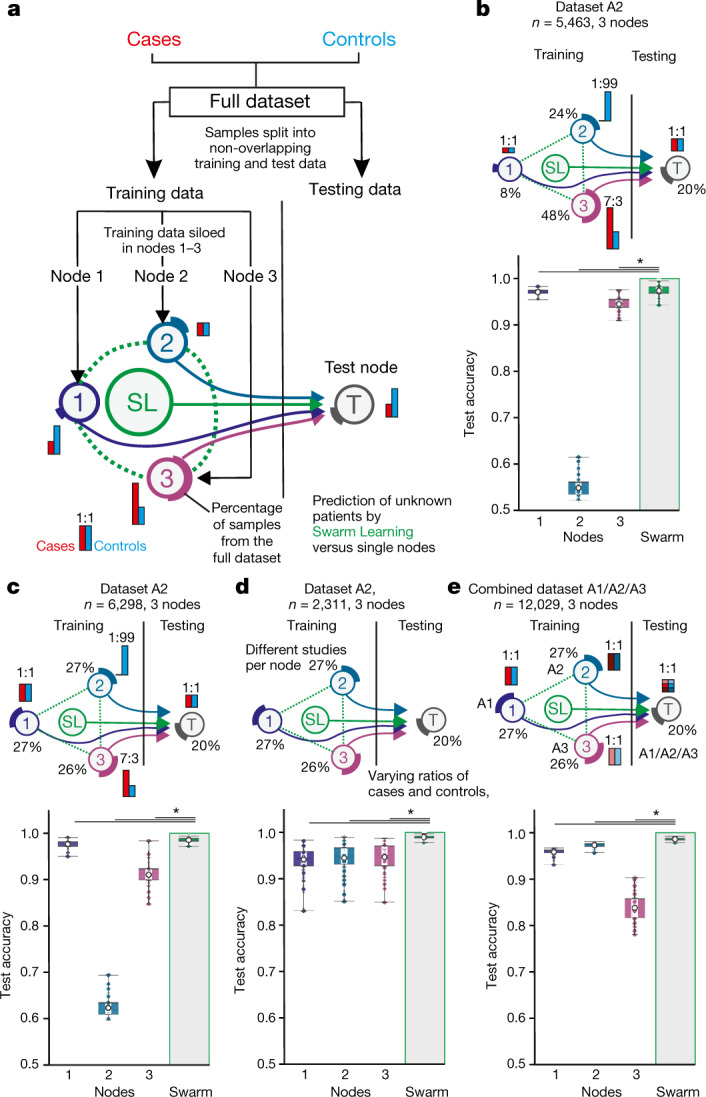
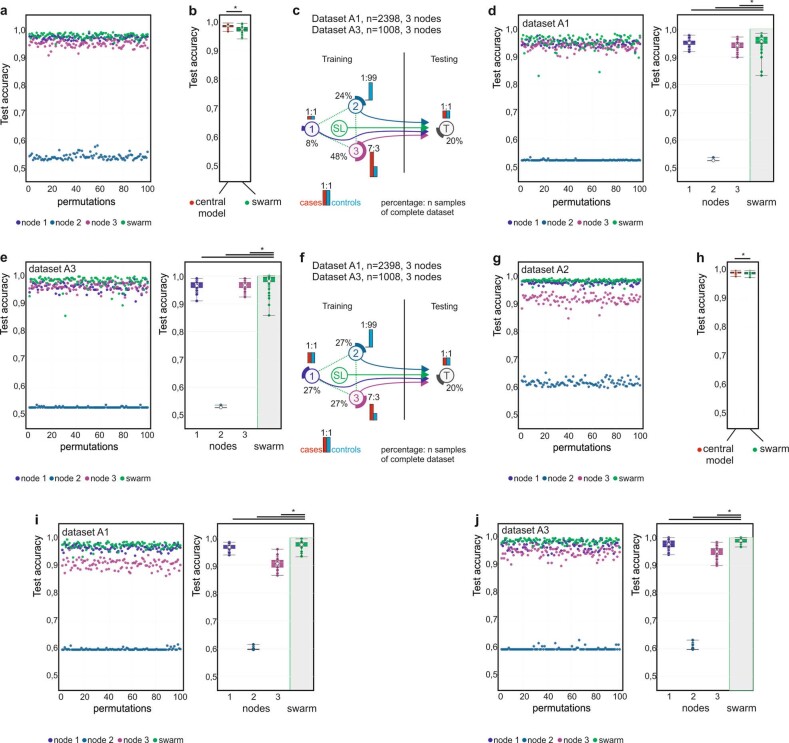
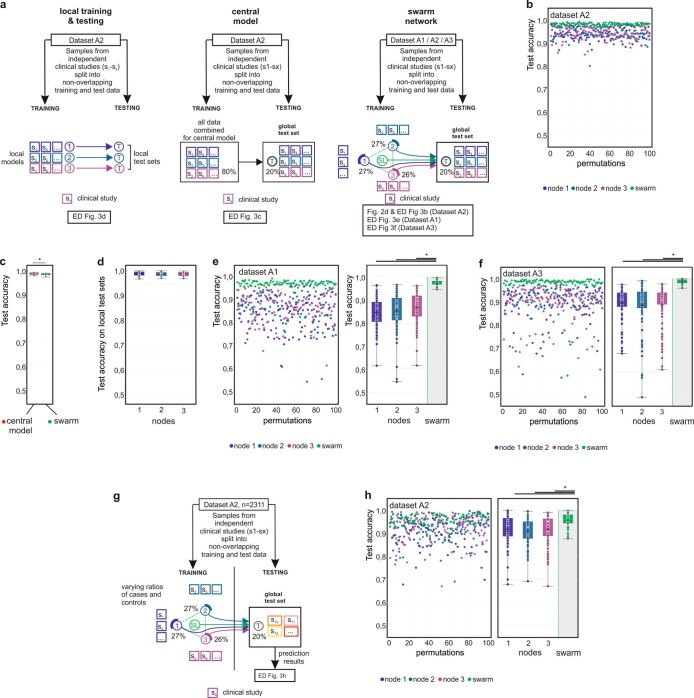
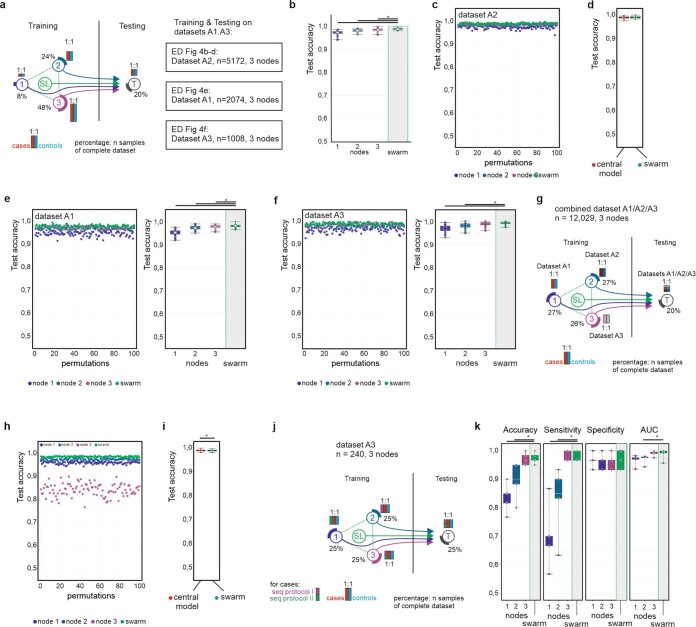
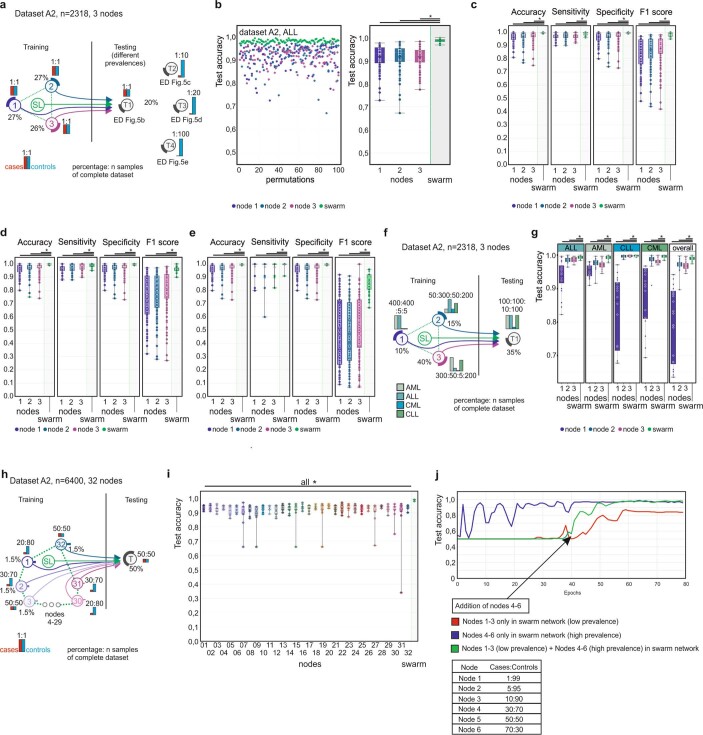
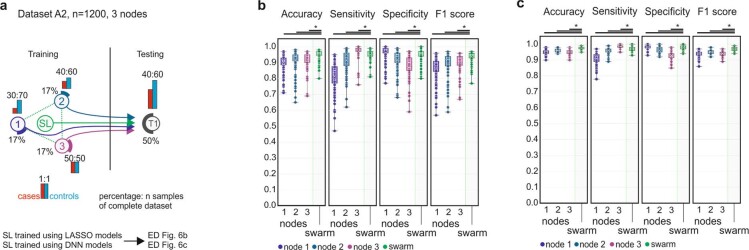
- In leukaemia PBMC datasets A1–A3, comprising more than 12,000 individuals, SL outperformed each node across multiple scenarios, including uneven case/control distributions, study-specific siloing, different transcriptomic technologies, up to 32 nodes, and LASSO instead of deep neural networks.
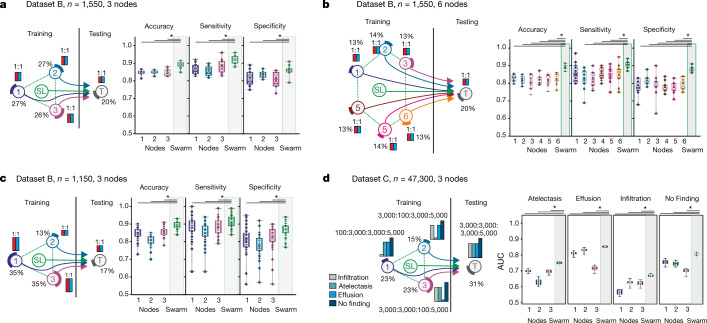
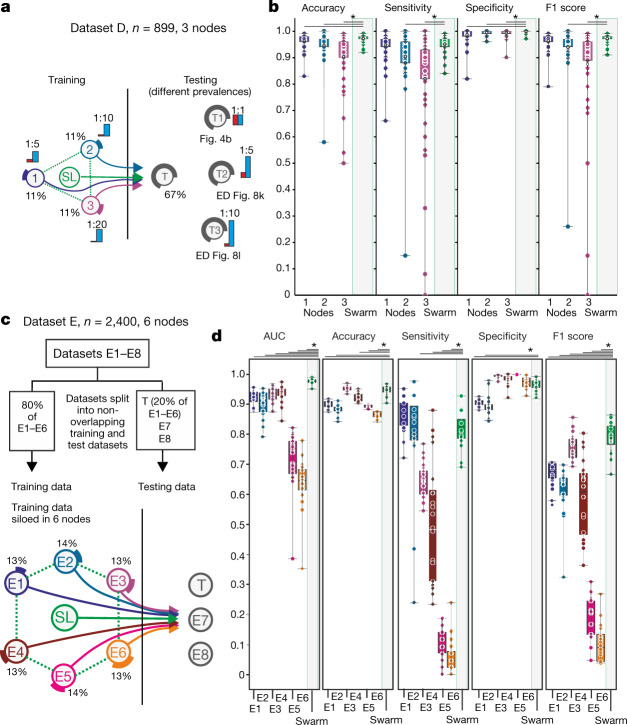
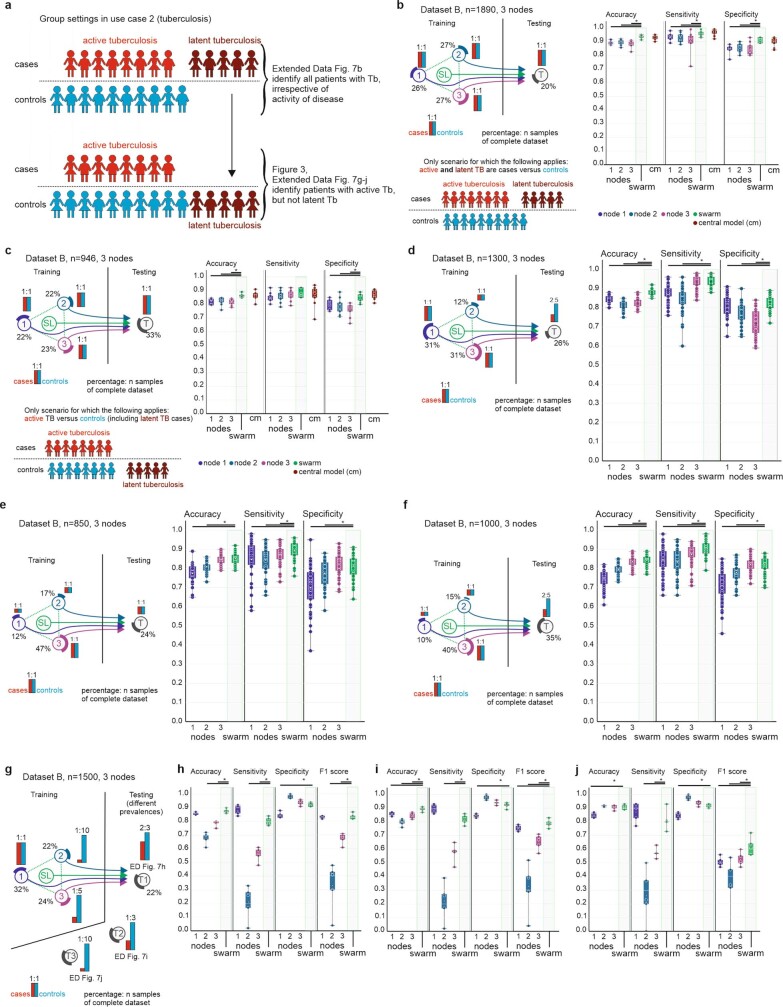
- For tuberculosis, SL outperformed individual nodes even when training samples were reduced by 50% or split into six smaller nodes; for COVID-19, SL outperformed all nodes in AUC on global test datasets and predicted samples from other centres when individual centre nodes could not.
- Overall, 16,694 analyses were performed across 26 AML, 4 ALL, 13 TB, 1 X-ray, and 18 COVID-19 scenarios, with 5–100 permutations per scenario and a total of 8,347 computer hours.
Methods
- Design: decentralized SL framework using edge nodes and a permissioned blockchain for secure onboarding, dynamic leader election, and parameter merging, with no central parameter server; raw data remain local and model parameters are exchanged and merged.
- Data: PBMC transcriptome datasets A1 (n = 2,500), A2 (n = 8,348), and A3 (n = 1,181); whole-blood datasets B (n = 1,999), D (n = 2,143), and E (n = 2,400); chest X-ray dataset C (95,831 images); simulations used 3–32 training nodes and independent test nodes.
- Analysis: deep neural network (Keras sequential) and LASSO; performance metrics included sensitivity, specificity, accuracy, F1 score, and AUC; differences were tested with one-sided Wilcoxon signed-rank test with continuity correction, using 5–100 permutations per scenario.
Limitations
- Stated: no statistical methods were used to predetermine sample size; experiments were not randomized, although permutations were performed; investigators were not blinded to allocation during experiments and outcome assessment.
- Stated/implied: SL performance was tested in simulated siloing and outbreak scenarios using existing datasets, not in a prospective real-world multi-centre clinical deployment; the paper notes potential limitations in TB outbreak scenarios but does not quantify them.
- Evident: although confidentiality is preserved by design and no raw data are exchanged, model parameters are shared; the paper suggests SL can inherit differential privacy, functional encryption, or encrypted transfer learning, but these were not implemented or tested here.
Model-written summary. Check it against the paper before relying on it.
Integrity signals
Registry
Cites
Statistics
Figures
Verification
Claims the paper makes
6 Valid · 0 Not valid · 7 Not checked · 58 Own results and interpretations
The cited sources support only part of this claim — read each source’s verdict below.
In the paper
“As medicine is inherently decentral, the volume of local data is often insufficient to train reliable classifiers20,21.”
§ Swarm Learning for decentralized and confidential clinical machine learning > Main
What the sources say
- Not checked yetcites [20] Rajkomar A Dean J Kohane I Machine learning in medicine N. Engl. J. Med. 2019 380 1347 1358 10.1056/NEJMra1814259 30943338 source
- Partly supportedcites [21] Savage N Calculating disease Nature 2017 550 S115 S117 10.1038/550S115a 29045372 sourceExperimental — accuracy not yet measured
In “BIOPSY BY NUMBERS” (page unavailable), the paper says a researcher wants a much larger dataset to validate and refine an ALS classification algorithm, and describes a shared MRI repository assembled to provide larger datasets. It does not say that medicine is inherently decentralized or that local datasets are often insufficient to train reliable classifiers; it also reports good predictions from a relatively small dataset. (LLM, conf=0.78)
plainstates a cause- Asserted: passes — The authors put it forward as true.
- Checkable: passes — It can be checked against evidence.
- Load-bearing: passes — The paper’s conclusions depend on it.
- Based: passes — The paper gives a reason why it holds.
The cited sources support only part of this claim — read each source’s verdict below.
In the paper
“With increasing efforts to enforce data privacy and security5,9,10 and to reduce data traffic and duplication, a decentralized data model will become the preferred choice for handling, storing, managing, and analysing any kind of large medical dataset19.”
§ Swarm Learning for decentralized and confidential clinical machine learning > Discussion
What the sources say
- Partly supportedcites [19] Kaissis GA Makowski MR Rückert D Braren RF Secure, privacy-preserving and federated machine learning in medical imaging Nat. Mach. Intell. 2020 2 305 311 10.1038/s42256-020-0186-1 sourceExperimental — accuracy not yet measured
The Outlook section of our copy supports the direction of the claim: it states that decentralized data storage and federated learning systems are 'replacing the current paradigm of data sharing and centralized storage' and are driven by privacy requirements, and the paper elsewhere notes such methods 'should require minimal or no data transfer'. However, the source hedges this as having 'the greatest potential to enable privacy-preserving cross-institutional research in a breadth of biomedical disciplines in the near future', whereas the citing sentence asserts it as a certainty ('will become the preferred choice') and extends it to 'handling, storing, managing, and analysing any kind of large medical dataset' — a scope and a confidence level the source does not claim. The 'reduce data traffic and duplication' motive is only partly reflected (the paper in fact lists communication overhead and burdensome data transfer as limitations of decentralized/federated and SMPC approaches). (LLM, conf=0.72)
plainstates a cause- Asserted: passes — The authors put it forward as true.
- Checkable: unclear — It is unclear whether it could be checked against evidence.
- Load-bearing: passes — The paper’s conclusions depend on it.
- Based: passes — The paper gives a reason why it holds.
- Partly supported
The cited sources support only part of this claim — read each source’s verdict below.
In the paper
“with current privacy regulations5,9,10 making it less appealing to develop centralized AI systems”
§ Swarm Learning for decentralized and confidential clinical machine learning > Discussion
What the sources say
- Partly supportedcites [5] Price WN II Cohen IG Privacy in the age of medical big data Nat. Med. 2019 25 37 43 10.1038/s41591-018-0272-7 30617331 PMC6376961 sourceExperimental — accuracy not yet measured
Price & Cohen (2019) do support the general thrust: in 'A path forward' they write that 'The basic harm of privacy overprotection is the brakes it puts on data-driven innovation,' that privacy protections limit data aggregation and innovative data use, and that 'Patchy, fragmented health data make data-driven innovation hard, imposing both technological and economic hurdles' (A path forward); they also note in 'Why do we need big data in health?' that AI uses 'require very large sets of data' and that without them 'algorithms cannot be trained or ... evaluated.' But our copy nowhere contrasts centralized with decentralized/federated architectures, and says nothing about privacy regulation making 'centralized' AI systems specifically less appealing — that comparative claim is the citing authors'. The paper's regulatory discussion is also confined to U.S. law (HIPAA de-identification, covered entities), narrower than the unqualified 'current privacy regulations' in the citing sentence. (LLM, conf=0.72)
- Not checked yetcites [9] Kels CG HIPAA in the era of data sharing J. Am. Med. Assoc. 2020 323 476 477 10.1001/jama.2019.19645 32016301 source
- Not checked yetcites [10] McCall B What does the GDPR mean for the medical community? Lancet 2018 391 1249 1250 10.1016/S0140-6736(18)30739-6 29619949 source
plainstates a cause- Asserted: passes — The authors put it forward as true.
- Checkable: passes — It can be checked against evidence.
- Load-bearing: passes — The paper’s conclusions depend on it.
- Based: passes — The paper gives a reason why it holds.
- Partly supported
Every source the paper cites for this claim was checked and supports it.
In the paper
“but progress is hindered by the limited size of datasets19”
§ Swarm Learning for decentralized and confidential clinical machine learning > Discussion
What the sources say
- Supportedcites [19] Kaissis GA Makowski MR Rückert D Braren RF Secure, privacy-preserving and federated machine learning in medical imaging Nat. Mach. Intell. 2020 2 305 311 10.1038/s42256-020-0186-1 source
The opening of our copy (Abstract/front-matter, p. 305) states that 'the broad application of artificial intelligence techniques in medicine is currently hindered by limited dataset availability for algorithm training and validation.' The Introduction (Abstract section, p. 305) ties progress specifically to oncology applications (tumour detection, genomic characterization, subtyping, grading, outcome/relapse risk) to 'the release of large, curated corpora of images', notes that 'even the largest current imaging studies in the field ... include considerably less data than, for example, ImageNet', and that 'the inability to access and leverage this data poses a significant barrier to AI applications in this field.' This supports the paraphrase that limited dataset size hinders progress in oncology machine learning, with the caveat that the source's scope is medical imaging AI generally rather than oncology alone. (LLM, conf=0.85)
plainstates a cause- Asserted: passes — The authors put it forward as true.
- Checkable: passes — It can be checked against evidence.
- Load-bearing: passes — The paper’s conclusions depend on it.
- Based: passes — The paper gives a reason why it holds.
- Supported
A result the paper reports from its own data — it cites no other source for it, so there is none to check. The quote shows it is in the paper.
In the paper
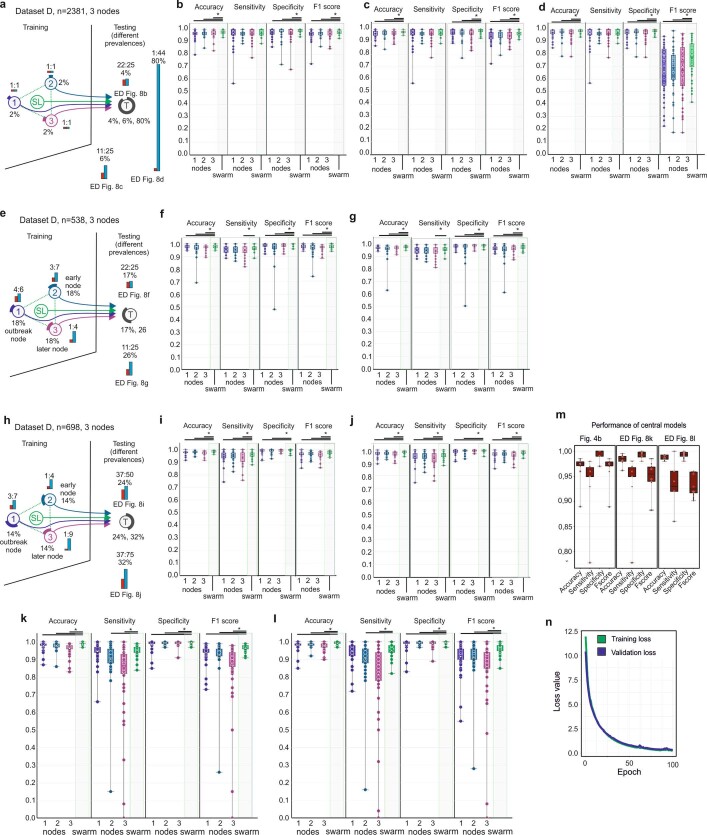
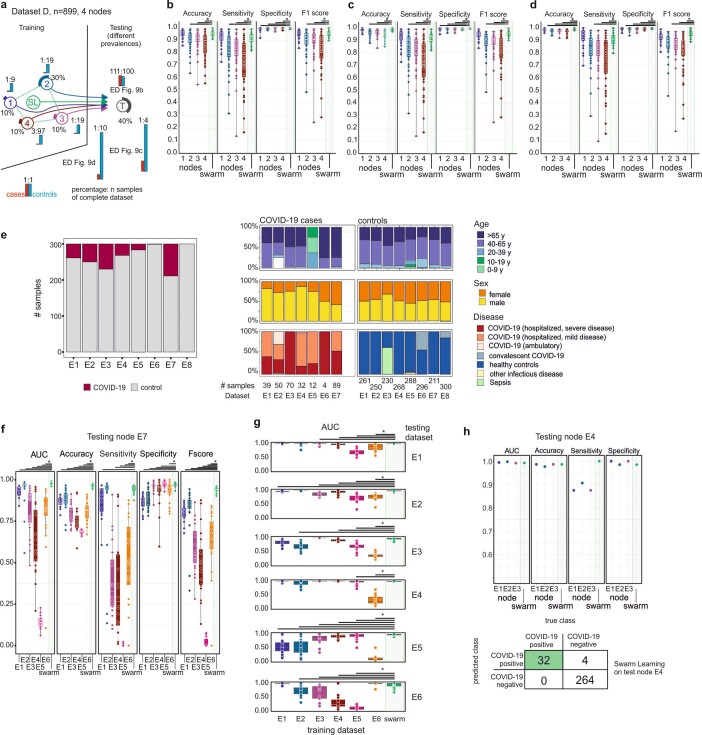
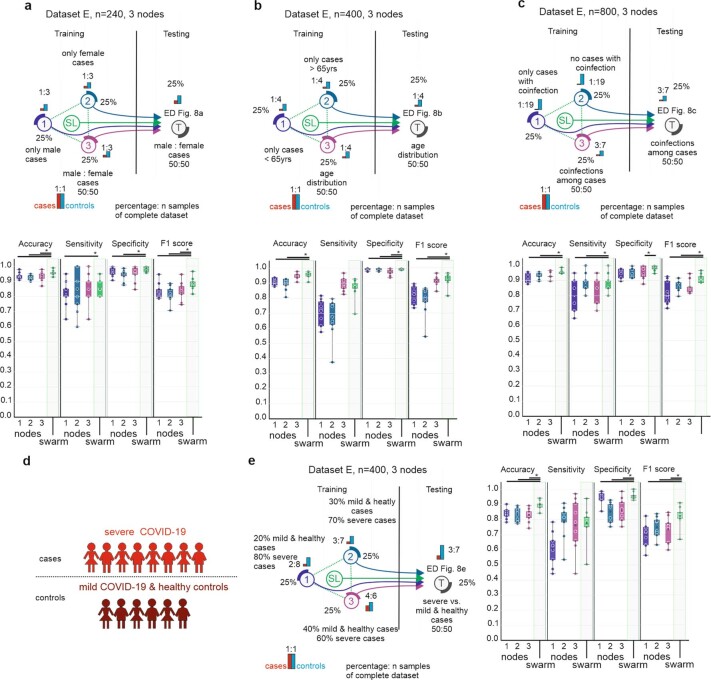
“When we reduced cases at training nodes, all performance measures remained very high at the test node for SL and individual nodes (Extended Data Fig. 8e–j).”
§ Swarm Learning for decentralized and confidential clinical machine learning > Identification of COVID-19
plain- Asserted: passes — The authors put it forward as true.
- Checkable: passes — It can be checked against evidence.
- Load-bearing: unclear — It is unclear whether the paper’s conclusions depend on it.
- Based: passes — The paper gives a reason why it holds.
32 more claims
Create a free account to see all 71 claims and to verify the 16 references still open.
- It may state two separate claims as one. 18
- Probably not a substantial claim. 20
Claims other papers make about this one
Each is checked against this paper’s own text: does it say what the citing paper says it does?
The source backs part of the claim, not all of it — or backs it for a different population, condition or comparison.
In the citing paper
“It can also overcome the straggler dilemma with heterogeneous hardware, as well as improve the robustness to data poisoning attacks and master node fails [35], [145].”
From Edge artificial intelligence for 6g: vision, enabling technologies, and applications (2022) · cites this paper as [35]
Experimental — accuracy not yet measuredThe source backs part of the claim, not all of it — or backs it for a different population, condition or comparison.
In the citing paper
“FL allows training of AI models through averaging of local updates from numerous healthcare facilities and smart devices, such as IoMT, despite the lack of local data.”
From Federated learning-based AI approaches in smart healthcare: Concepts, taxonomies, challenges and open issues (2023) · cites this paper as [11]
Experimental — accuracy not yet measuredThe source backs part of the claim, not all of it — or backs it for a different population, condition or comparison.
In the citing paper
“Federated Learning has presented itself as a viable method for implementing economic, innovative healthcare systems while ensuring privacy [11–15].”
From Federated learning-based AI approaches in smart healthcare: Concepts, taxonomies, challenges and open issues (2023) · cites this paper as [11]
Experimental — accuracy not yet measuredThe cited source says what the claim attributes to it.
In the citing paper
“In particular, swarm learning [35] provides a completely decentralized AI solution based on decentralized ML by keeping local datasets at each edge device.”
From Edge artificial intelligence for 6g: vision, enabling technologies, and applications (2022) · cites this paper as [35]
The cited source says what the claim attributes to it.
In the citing paper
“Besides, swarm learning has recently been developed in [35] to provide a decentralized and confidential clinical disease detection solution for diseases (e.g., COVID-19, tuberculosis, and leukaemia).”
From Edge artificial intelligence for 6g: vision, enabling technologies, and applications (2022) · cites this paper as [35]
6 more claims about this paper
Create a free account to see every claim other papers make about this one.
Citations
Cites
Moderated estimation of fold change and dispersion for RNA-seq data with DESeq2
Love, M. I., Huber, W., & Anders, S. (2014) · Genome Biology · doi:10.1186/s13059-014-0550-8 · Cited by 95,106
LeCun, Y., Bengio, Y., & Hinton, G. (2015) · Nature · doi:10.1038/nature14539 · Cited by 84,126
Scikit-learn: Machine Learning in Python
Pedregosa, F., Varoquaux, G., Gramfort, A., Michel, V., Thirion, B., Grisel, O., Blondel, M., Müller, A., Nothman, J., Louppe, G., et al. (2012) · arXiv · doi:10.48550/arxiv.1201.0490 · Cited by 71,016
STAR: ultrafast universal RNA-seq aligner
Dobin, A., Davis, C. A., Schlesinger, F., Drenkow, J., Zaleski, C., Jha, S., Batut, P., Chaisson, M., & Gingeras, T. R. (2013) · Bioinformatics · doi:10.1093/bioinformatics/bts635 · Cited by 51,709
Bootstrap methods: another look at the jackknife
Efron, B. (1979) · The Annals of Statistics · doi:10.1214/aos/1176344552 · Cited by 17,602
Dermatologist-level classification of skin cancer with deep neural networks
Esteva, A., Kuprel, B., Novoa, R. A., Ko, J., Swetter, S. M., Blau, H. M., & Thrun, S. (2017) · Nature · doi:10.1038/nature21056 · Cited by 14,362 · cited 1×
“Particularly in oncology, success has been reported in machine-learning-based tumour detection 3,37 , sub-typing 38 , and outcome prediction 39 , but progress is hindered by the limited size of datasets 19 , with current privacy regulations 5,9,10 making it less appealing to develop centralized AI…”
BackgroundCommunication-Efficient Learning of Deep Networks from Decentralized Data
McMahan, H. B., Moore, E., Ramage, D., Hampson, S., & Arcas, B. A. Y. (2016) · arXiv · doi:10.48550/arxiv.1602.05629 · Cited by 14,215
Gene Expression Omnibus: NCBI gene expression and hybridization array data repository
Edgar, R. (2002) · Nucleic Acids Research · doi:10.1093/nar/30.1.207 · Cited by 13,288
Exploration, normalization, and summaries of high density oligonucleotide array probe level data
Irizarry, R. A. (2003) · Biostatistics · doi:10.1093/biostatistics/4.2.249 · Cited by 10,603
Detection of 2019 novel coronavirus (2019-nCoV) by real-time RT-PCR
Corman, V. M., Landt, O., Kaiser, M., Molenkamp, R., Meijer, A., Chu, D. K., Bleicker, T., Brünink, S., Schneider, J., Schmidt, M. L., et al. (2020) · Eurosurveillance · doi:10.2807/1560-7917.es.2020.25.3.2000045 · Cited by 7,344 · cited 10×
“We obtained very similar results using datasets A1 and A3, which strongly supports the idea that the improvement in performance of SL is independent of data collection (clinical studies) or the technologies (microarray or RNA-seq) used for data generation (Extended Data Fig.”
MethodInfluential
Cited by
Items 401–500 of 944
Diniz, J. M., Vasconcelos, H., Rb-Silva, R., Ameijeiras-Rodriguez, C., Rodrigues, D., Ramos, P., Tomás, A., Gao, Y., Souza, J., & Freitas, A. (2026) · npj Digital Medicine · doi:10.1038/s41746-025-02329-z · Cited by 11
“Applications cover a variety of data formatsandconditions,includingsomeparticularlyprivacy-sensitive,using FL 14 – 20 and SL 21,22 .”
Federated Learning for Data and Model Heterogeneity in Medical Imaging
Madni, H. A., Umer, R. M., & Foresti, G. L. (2024) · Lecture notes in computer science · doi:10.1007/978-3-031-51026-7_15 · Cited by 13
Representing Noisy Image Without Denoising
Qi, S., Zhang, Y., Wang, C., Xiang, T., Cao, X., & Xiang, Y. (2024) · IEEE Transactions on Pattern Analysis and Machine Intelligence · doi:10.1109/tpami.2024.3386985 · Cited by 11
“(Radon Transform): The Radon transform of an image function f , denoted as R f , is defined as a line integral along a straight line L [56]: (1) where the line L ( r, θ ) = { ( x, y ) ∈ R 2 s . t . r − x cos θ − y sin θ = 0 } is with distance parameter r (w.r.t. the origin) and angle parameter θ…”
BackgroundHe, T., Han, P., Duan, S., Wang, Z., Wu, W., Liu, C., & Han, J. (2024) · Future Generation Computer Systems · doi:10.1016/j.future.2024.05.048 · Cited by 11
A Clinician's Guide to Sharing Data for AI in Ophthalmology
Gim, N., Wu, Y., Blazes, M. S., Lee, C. S., Wang, R. K., & Lee, A. (2024) · Investigative Ophthalmology & Visual Science · doi:10.1167/iovs.65.6.21 · Cited by 10
“Warnat-Herresthal et al. 63 demonstrated the feasibility of Swarm learning to develop disease classifiers, such as tuberculosis classification from blood transcriptomes.”
BackgroundReputation-Driven Asynchronous Federated Learning for Enhanced Trajectory Prediction With Blockchain
Chen, W., Jia, L., Zhou, Y., & Ren, Q. (2024) · IEEE Internet of Things Journal · doi:10.1109/jiot.2024.3495693 · Cited by 11
“The decentralized and traceable nature of blockchain makes it a vital complement to FL. Warnat-Herresthal et al. [25] integrated edge computing, blockchain, and FL to propose a decentralized training model, enabling all participants to merge parameters with equal rights while maintaining privacy.”
DegaFL: Decentralized Gradient Aggregation for Cross-Silo Federated Learning
Han, J., Han, Y., Jing, X., Huang, G., & Ma, Y. (2024) · IEEE Transactions on Parallel and Distributed Systems · doi:10.1109/tpds.2024.3501581 · Cited by 11
Heterogeneous Privacy-Preserving Blockchain-Enabled Federated Learning for Social Fintech
Xiong, H., Xia, Y., Zhao, Y., Wahaballa, A., & Yeh, K. (2025) · IEEE Transactions on Computational Social Systems · doi:10.1109/tcss.2025.3533634 · Cited by 11
“4, this article compares the proposed HPP-BEFL scheme with four previously discussed schemes [50], [51], [52], [53] regarding training accuracy, with 40 participants using the MNIST and CIFAR-10 datasets.”
Rectification of Syntactic and Semantic Privacy Mechanisms
Majeed, A., & Hwang, S. O. (2022) · IEEE Security & Privacy · doi:10.1109/msec.2022.3188365 · Cited by 12
Carraro, C., Bonaguro, L., Schulte-Schrepping, J., Horne, A., Oestreich, M., Warnat‐Herresthal, S., Helbing, T., Franco, M. D., Händler, K., Mukherjee, S., et al. (2022) · eLife · doi:10.7554/elife.78012 · Cited by 12
“…provided a list of susceptible cancer types, e.g., KIRC and PAAD, to support the further development of our drug candidate, and, once transferred on an ML platform, could offer a versatile predictive strategy translatable to the clinics ( Koromina et al., 2019 ; Warnat-Herresthal et al., 2021 ).”
Self-citationGenerative Data Augmentation for Non-IID Problem in Decentralized Clinical Machine Learning
Wang, Z., Duan, S., Wu, C., Lin, W., Zha, X., Han, P., & Liu, C. (2022) · International Conference on Data Intelligence and Security (ICDIS) · doi:10.1109/icdis55630.2022.00058 · Cited by 11
“To tackle the limitations of federated learning, swarm learning (SL) [7] combines edge computing and blockchain-based peer-to-peer network.”
BackgroundMethodInfluentialBlockchain-Based Continuous Knowledge Transfer in Decentralized Edge Computing Architecture
Jin, W., Xu, Y., Dai, Y., & Xu, Y. (2023) · Electronics · doi:10.3390/electronics12051154 · Cited by 13
Machine learning in drug supply chain management during disease outbreaks: a systematic review
Emmanuel, G., Ramadhan, A., Zarlis, M., Abdurachman, E., & Trisetyarso, A. (2023) · International Journal of Power Electronics and Drive Systems/International Journal of Electrical and Computer Engineering · doi:10.11591/ijece.v13i5.pp5517-5533 · Cited by 10
Model-Agnostic Federated Learning
Mittone, G., Riviera, W., Colonnelli, I., Birke, R., & Aldinucci, M. (2023) · Lecture notes in computer science · doi:10.1007/978-3-031-39698-4_26 · Cited by 14
FitzGerald, O., Behrens, F., Barton, A. C., Bertheussen, H., Boutouyrie‐Dumont, B., Coates, L. C., Davies, O. R., de Wit, M. P. T., Fagni, F., Goodyear, C. S., et al. (2023) · Therapeutic Advances in Musculoskeletal Disease · doi:10.1177/1759720x231192315 · Cited by 10
van Haastrecht, M., Brinkhuis, M., & Spruit, M. (2024) · Lecture Notes in Computer Science · doi:10.1007/978-3-031-64299-9_5 · Cited by 13
Building Trust in Medical Use of Artificial Intelligence – The Swarm Learning Principle
Schultze, J. L. (2023) · Journal of CME · doi:10.1080/28338073.2022.2162202 · Cited by 10
“…blood transcriptome dataset with more than 12,000 patient samples, we could clearly demonstrate that AI models trained in a Swarm Learning setting outperformed local models and where at par with central models, which would already strongly argue against further development of central models [14].”
BackgroundMethodInfluentialSelf-citationZhu, X., & Li, H. (2025) · Applied Sciences · doi:10.3390/app15105472 · Cited by 10
AI-Based Cancer Models in Oncology: From Diagnosis to ADC Drug Prediction
Sobhani, N., Kugeratski, F. G., Venturini, S., Roudi, R., Nguyen, T., D’Angelo, A., & Generali, D. (2025) · Cancers · doi:10.3390/cancers17213419 · Cited by 9
Securing Federated Learning in Robot Swarms Using Blockchain Technology
Pacheco, A., Vos, S. D., Reina, A., Dorigo, M., & Strobel, V. (2025) · Springer proceedings in advanced robotics · doi:10.1007/978-3-032-04584-3_32 · Cited by 11
CAreFL: Enhancing smart healthcare with Contribution‐Aware Federated Learning
Liu, Z., Chen, Y., Zhao, Y., Yu, H., Liu, Y., Bao, R., Jiang, J., Nie, Z., Xu, Q., & Yang, Q. (2023) · AI Magazine · doi:10.1002/aaai.12082 · Cited by 10
Systems analysis of human innate immunity in COVID-19
Müller, S. M., & Schultze, J. L. (2023) · Seminars in Immunology · doi:10.1016/j.smim.2023.101778 · Cited by 9
Self-citationPooling critical datasets with Federated Learning
Arfat, Y., Mittone, G., Colonnelli, I., D’Ascenzo, F., Esposito, R., & Aldinucci, M. (2023) · Euromicro International Conference on Parallel, Distributed and Network-Based Processing (PDP) · doi:10.1109/pdp59025.2023.00057 · Cited by 12
“These efforts, which range from open-source projects like TensorFlow Fed-erated [24] and PySyft [25] to commercial offerings like IBM ® Federated Learning [26] and HP Swarm Learning [27], have aimed to address the needs of researchers and practitioners in a variety of settings.”
BackgroundSwarm learning based credit scoring for P2P lending in block chain
John, A. P., Devaraj, J., Lathaselvi, G., & Liakath, J. A. (2023) · Peer-to-Peer Networking and Applications · doi:10.1007/s12083-023-01526-5 · Cited by 9
Swarm Learning Empowered Federated Deep Learning for Seamless Smartphone-Based Activity Recognition
Jamil, H., Jian, Y., Jamil, F., & Ahmad, S. (2024) · IEEE Transactions on Consumer Electronics · doi:10.1109/tce.2024.3479078 · Cited by 10
Medical imaging-based artificial intelligence in pneumonia: A narrative review
Yang, Y., Xing, W., Liu, Y., Li, Y., Ta, D., Song, Y., & Hou, D. (2025) · Neurocomputing · doi:10.1016/j.neucom.2025.129731 · Cited by 10
Self-citationUnraveling the Nexus of ML and 6G: Challenges, Opportunities, and Future Directions
Oukebdane, M. A., Shah, A. F. M. S., Azad, A. K., Ekoru, J. E. D., & Madahana, M. C. I. (2025) · IEEE Access · doi:10.1109/access.2025.3585051 · Cited by 24
“This allows for cooperative learning while preserving security and privacy [98].”
Meta-control of social learning strategiesPreprint
Yaman, A., Bredèche, N., Çaylak, O., Leibo, J. Z., & Lee, S. W. (2021) · arXiv (Cornell University) · doi:10.1371/journal.pcbi.1009882
“For instance, one recent example of distributed learning approach has been used in healthcare to detect illnesses [62].”
BackgroundAccelerating Blockchain-enabled Distributed Machine Learning by Proof of Useful Work
Du, Y., Leung, C., Wang, Z., & Leung, V. C. M. (2022) · International Workshop on Quality of Service · doi:10.1109/iwqos54832.2022.9812927 · Cited by 10
Non-interactive and privacy-preserving neural network learning using functional encryption
Deng, G., Duan, X., Tang, M., Zhang, Y., & Huang, Y. (2023) · Future Generation Computer Systems · doi:10.1016/j.future.2023.03.036 · Cited by 9
Relay learning: a physically secure framework for clinical multi-site deep learning
Bo, Z.-H., Guo, Y., Lyu, J., Liang, H., He, J., Deng, S., Xu, F., Lou, X., & Dai, Q. (2023) · npj Digital Medicine · doi:10.1038/s41746-023-00934-4 · Cited by 13
“To handle this problem, techniques like Federated Learning 9,10 , and Swarm Learning 11 are proposed.”
MethodInfluentialFederated Learning in Ophthalmology: Retinopathy of Prematurity
Teo, Z. L., & Ting, D. S. W. (2022) · Ophthalmology Retina · doi:10.1016/j.oret.2022.03.019 · Cited by 9
Leveraging federated learning for boosting data privacy and performance in IVF embryo selection
Lee, C., Tzeng, C., Li, M., Lai, H.-H., Chen, C., Huang, Y., Chang, T. A., Chen, C.-H., Huang, C.-C., Lee, M., et al. (2024) · Journal of Assisted Reproduction and Genetics · doi:10.1007/s10815-024-03148-z · Cited by 9
Wu, C., Li, Z., Wang, F., Chen, H., Bu, J., & Wang, H. (2025) · IEEE Transactions on Mobile Computing · doi:10.1109/tmc.2025.3564880 · Cited by 8
“PFL is expected to empower wide applications [14], [31], [32] and already attracts rising attention in the FL community given its strong advantage in robustness [25], [33], fairness [34], and incentive [35].”
Multi-omics to study chronic respiratory diseases and viral infections
Idrees, S., Chen, H., Sadaf, T., Rehman, S. F., Johansen, M. D., Paudel, K. R., Liu, G., Wang, Y., Luecken, M. D., Hortle, E., et al. (2026) · European Respiratory Review · doi:10.1183/16000617.0286-2024 · Cited by 10
“Swarm learning has emerged as a solution, integrating data while maintaining confidentiality through cutting-edge computing and blockchain-based peer-to-peer networking for onsite analysis [281].”
Accelerating and Securing Blockchain-Enabled Distributed Machine Learning
Du, Y., Wang, Z., Leung, C., & Leung, V. C. M. (2023) · IEEE Transactions on Mobile Computing · doi:10.1109/tmc.2023.3325334 · Cited by 9
Personalized federated learning via directed acyclic graph based blockchain
Huang, C., Liu, E., Wang, R., Liu, Y., Zhang, H., Geng, Y., Wang, J., & Han, S. (2023) · IET Blockchain · doi:10.1049/blc2.12054 · Cited by 8
Kawamura, Y., Sadr, A. V., Abedi, V., & Zand, R. (2024) · Journal of Clinical Medicine · doi:10.3390/jcm13051313 · Cited by 8
Sai, S., & Chamola, V. (2024) · IEEE Transactions on Consumer Electronics · doi:10.1109/tce.2024.3418963 · Cited by 14
“Hence, inspired by the swarm learning technique [17], we incorporate dynamic servers in the proposed model.”
Computational Approaches for Antimicrobial Peptide Delivery
Rios, T. B., de Rezende, S. B., Maximiano, M. R., Cardoso, M. H. E. S., Malmsten, M., de la Fuente‐Núñez, C., & Franco, O. L. (2024) · Bioconjugate Chemistry · doi:10.1021/acs.bioconjchem.4c00406 · Cited by 8
Wu, Y., Ji, Y., Lee, S., Akram, J., Braytee, A., & Anaissi, A. (2025) · Lecture notes in computer science · doi:10.1007/978-3-031-97635-3_27 · Cited by 8
Haudenschild, C., Vaickus, L. J., & Levy, J. (2022) · ACM Symposium on Applied Computing · doi:10.1145/3477314.3507007 · Cited by 9
“A data protection scheme, such as federated learning, where patient data is encrypted and processed behind the firewall of the originating institution before being used in a federated learning model is necessary for any model requiring broad access to protected patient data [24, 29].”
BackgroundDeceFL: A Principled Decentralized Federated Learning FrameworkPreprint
Yuan, Y., Liu, J., Jin, D., Yue, Z., Chen, R., Wang, M., Sun, C., Xu, L., Hua, F., He, X., et al. (2021) · arXiv (Cornell University) · doi:10.48550/arxiv.2107.07171 · Cited by 18
“Consider solving problem (16) using algorithms FedAvg, swarm learning (SL) in [8] and the proposed DeceFL respectively.”
BackgroundMethodXu, L., Chen, Y., Chen, Y., Nie, L., Wei, X., Xue, L., & Zhang, D. (2024) · Applied Energy · doi:10.1016/j.apenergy.2024.125053 · Cited by 7
An improved blockchain-based multi-region Federated Learning framework for crop disease diagnosis
Qin, Y., Xu, C., Zhou, Q., Zhang, L., & Zhang, Y. (2025) · Computers & Electrical Engineering · doi:10.1016/j.compeleceng.2025.110181 · Cited by 7
Lei, C., Zuo, Y., Kong, F., Chen, H., Cheng, H., Song, X., Zhang, L., & Zhou, H. (2025) · Journal of Global Health · doi:10.7189/jogh.15.03005 · Cited by 7
Yin, H., Huang, X., Liang, C., Cao, B., & Zhou, M. (2025) · IEEE Transactions on Vehicular Technology · doi:10.1109/tvt.2025.3573798 · Cited by 9
“Since then, the academic community has conducted many research explorations on blockchain-based FL. Swarm learning (SL) was introduced in [23], which combines FL and blockchain technology in the medical field, allowing edge nodes to process user data and model parameters without a central…”
The Potential of AI in Nursing Care: Multicenter Evaluation in Fall Risk Assessment
Nanevski, I., Jäger, S., Schulte‐Althoff, M., Behnke, E.-M., Fürstenau, D., & Bießmann, F. (2025) · Journal of Medical Internet Research · doi:10.2196/71034 · Cited by 7
Integrating AI into healthcare systems: A multivocal literature review
Mallardi, G., Calefato, F., Quaranta, L., & Lanubile, F. (2025) · Smart Health · doi:10.1016/j.smhl.2025.100631 · Cited by 9
Alharthi, R., Mehmood, R., & Albeshri, A. A. (2026) · Electronics · doi:10.3390/electronics15051078 · Cited by 7
Artificial Intelligence in Drug Discovery and Development: Raising Quality per Decision
Furukawa, S., Uchida, H., & Kishimoto, T. (2026) · Pharmacopsychiatry · doi:10.1055/a-2810-8972 · Cited by 8
Alves, R., Costa, B., Martins, H., & Faria, N. (2026) · Pharmacophore · doi:10.51847/f2rnaaswj2 · Cited by 7
Huang, Z., Li, Y., Cheng, H., Li, G., & Liang, Z. (2022) · Pharmacological Research - Modern Chinese Medicine · doi:10.1016/j.prmcm.2022.100124 · Cited by 7
Self-citationCommunication-Efficient Nonconvex Federated Learning With Error Feedback for Uplink and Downlink
Zhou, X., Chang, L., & Cao, J. (2023) · IEEE Transactions on Neural Networks and Learning Systems · doi:10.1109/tnnls.2023.3333804 · Cited by 8
“It is worth mentioning that the server in a centralized federated framework can be replaced by blockchain technology further, ensuring security, privacy, and fairness [19].”
Machine learning models for outcome prediction in thrombectomy for large anterior vessel occlusion
Samani, O. S., Warnat‐Herresthal, S., Savchuk, I., Bode, F. J., Nitsch, L., Stösser, S., Ebrahimi, T., von Danwitz, N. M., Asperger, H., Layer, J., et al. (2024) · Annals of Clinical and Translational Neurology · doi:10.1002/acn3.52185 · Cited by 17
Self-citationYang, Q. P., Xu, W. F., Wang, T., Wang, H., Wu, X., Cao, B., & Zhang, S. (2024) · IEEE Open Journal of the Communications Society · doi:10.1109/ojcoms.2024.3471621 · Cited by 10
“Blockchain, as the supporting technology of cryptocurrency and decentralized applications (DApps), provides a new angle to reform the FL architecture [8].”
BackgroundMethodPrivacy-Preserved Federated Learning for 3D Tooth Segmentation in Intra-Oral Mesh Scans
Liu, S., Yang, H. H., Tao, Y., Feng, Y., Hao, J., & Liu, Z. (2022) · Frontiers in Communications and Networks · doi:10.3389/frcmn.2022.907388 · Cited by 7
A Trustless Federated Framework for Decentralized and Confidential Deep Learning
Li, C., Shen, Q., Xiang, C., & Ramesh, B. (2022) · IEEE Global Emerging Technology Blockchain Forum: Blockchain & Beyond (iGETblockchain) · doi:10.1109/igetblockchain56591.2022.10087146 · Cited by 8
“Existing works [14], [15] have only partially explored this novel yet important research direction.”
BackgroundMethodA General-Purpose AI Assistant Embedded in an Open-Source Radiology Information System
Purkayastha, S., Isaac, R., Anthony, S., Shukla, S., Krupinski, E. A., Danish, J. A., & Gichoya, J. W. (2023) · Lecture notes in computer science · doi:10.1007/978-3-031-34344-5_46 · Cited by 9
Predicting anticancer drug sensitivity on distributed data sources using federated deep learning
Xu, X., Qi, Z., Han, X., Xu, A., Geng, Z., He, X., Ren, Y., & Duo, Z. (2023) · Heliyon · doi:10.1016/j.heliyon.2023.e18615 · Cited by 7
Blockchain-based fairness-enhanced federated learning scheme against label flipping attack
Jin, S., Li, Y., Chen, X., Li, R., & Shen, Z. (2023) · Journal of Information Security and Applications · doi:10.1016/j.jisa.2023.103580 · Cited by 7
Brickman, A., Baykara, Y., Carabaño, M., & Hacking, S. M. (2023) · Journal of Pathology Informatics · doi:10.1016/j.jpi.2023.100350 · Cited by 7
Cognitive Data Fusing for Internet of Things Based on Ensemble Learning and Federated Learning
Gao, Z., Liu, S., & Zhang, Y. (2024) · IEEE Internet of Things Journal · doi:10.1109/jiot.2024.3377221 · Cited by 8
“It should be noted that although FL can also be implemented in a peer-to-peer (P2P) form for secure purpose [22], [23], the network traffic burden would be heavier because the model needs to be transmitted multiple times in the network for each round of updates [23].”
BackgroundHiFi-Gas: Hierarchical Federated Learning Incentive Mechanism Enhanced Gas Usage Estimation
Sun, H., Tang, X., Yang, C., Yu, Z., Wang, X., Ding, Q., Li, Z., & Yu, H. (2024) · Proceedings of the AAAI Conference on Artificial Intelligence · doi:10.1609/aaai.v38i21.30317 · Cited by 16
“Collaborative model training techniques, such as federated learning (FL) (Yang et al. 2019, 2020; Goebel et al. 2023), have emerged to enhance ML solutions by leveraging distributedly owned data resources from multiple organizations (Warnat-Herresthal et al. 2021; Chen et al. 2023).”
MethodThe Convergence of HPC, AI and Big Data in Rapid-Response to the COVID-19 Pandemic
Sukumar, S. R., Balma, J. A., Rickett, C. D., Maschhoff, K., Landman, J., Yates, C. R., Chittiboyina, A. G., Peterson, Y. K., Vose, A., Byler, K., et al. (2022) · Communications in computer and information science · doi:10.1007/978-3-030-96498-6_9 · Cited by 7
Deutsche COVID-19 Omics Initiative (DeCOI)
Schultze, J. L. (2021) · BIOspektrum · doi:10.1007/s12268-021-1586-4 · Cited by 7
Self-citationEssential Concepts in Artificial Intelligence: A Guide for Pediatric Providers
Bolivar, L. E. M., & Satzer, M. B. (2025) · Children · doi:10.3390/children12101386 · Cited by 6
“Rather than relying on a centralized model, however, training is combined at one of the nodes—dynamically chosen by the group—that updates the parameters and redistributes the updated model (Figure 5) [1,39].”
Artificial intelligence for risk assessment and outcome prediction in malignant haematology
Eckardt, J., Walter, W., Middeke, J. M., & Haferlach, T. (2025) · British Journal of Haematology · doi:10.1111/bjh.70231 · Cited by 6
“These may be overcome using co-operative learning strategies such as federated 84 or swarm learning, 17 centralized data collection efforts such as the Harmony Alliance 85 or alternatively by sharing synthetic samples that mimic the behaviour of real patient cohorts without compromising privacy.”
Zhao, P., Su, N., Wang, Y., Sun, S., & Li, X. (2025) · IEEE Internet of Things Journal · doi:10.1109/jiot.2025.3633747 · Cited by 6
“Warnat-Herresthal et al. [35] innovatively proposed the SL paradigm in 2021, in response to these systemic defects.”
Amoah, A. S., Agnandji, S. T., Bengtson, M., Downs, J. A., Esen, M., Giddaluru, J., Jochems, S. P., Kaisar, M. M. M., Makinde, J., Manurung, M. D., et al. (2025) · The Lancet Microbe · doi:10.1016/j.lanmic.2025.101263 · Cited by 6
Vrettos, K., Giouroukou, K., Isaac, A., Raissaki, M., & Klontzas, M. E. (2025) · Pediatric Radiology · doi:10.1007/s00247-025-06497-8 · Cited by 7
“Unlike FL which still relies on central servers, Swarm Learning uses blockchain-based peer-to-peer coordination to allow medical institutions worldwide to collaboratively train diagnostic models on heterogeneous datasets without ever sharing raw patient data [79].”
CLEAR: an auditable foundation model for radiology grounded in clinical concepts
Han, T., Wu, R., Tian, Y., Khader, F., Adams, L. C., Bressem, K. K., Davatzikos, C. A., Kather, J. N., Shen, L., Mankoff, D. A., et al. (2026) · Nature Biomedical Engineering · doi:10.1038/s41551-026-01741-4 · Cited by 7
Federated learning in healthcare applications
Kanhegaonkar, P., & Prakash, S. (2024) · Elsevier eBooks · doi:10.1016/b978-0-44-313233-9.00013-8 · Cited by 7
Mibianto: ultra-efficient online microbiome analysis through k-mer based metagenomics
Hirsch, P., Molano, L.-A. G., Engel, A., Zentgraf, J., Rahmann, S., Hannig, M., Müller, R., Kern, F., Keller, A., & Schmartz, G. P. (2024) · Nucleic Acids Research · doi:10.1093/nar/gkae364 · Cited by 6
“…by kallisto ( 40 )), we arbitrarily chose 10 publicly available RNA-seq samples from the Gene Expression Omnibus project ID GSE79362 (SRR3235783-87, 89– 90, 92–94) ( 41 ) and calculated gene expression measures based on both our robustly averaged k -mer counts and the standard kallisto FPKM values.”
MethodSelf-citationDecentralized Online Bandit Federated Learning Over Unbalanced Directed Networks
Gao, W., Zhao, Z., Wei, M., Yang, J., Zhang, X., & Li, J. (2024) · IEEE Transactions on Network Science and Engineering · doi:10.1109/tnse.2024.3409755 · Cited by 9
“Baselines: We compare our algorithm to FedAvg [4], distributed (sub)gradient descent algorithm (DGD) and Swarm Learning [45].”
MethodExploring diabetes through the lens of AI and computer vision: Methods and future prospects
Chundi, R., Gomathy, S., Basivi, P. K., Tippana, A., Hulipalled, V. R., Prabakaran, N., Simha, J. B., Kim, C. W., Kakani, V., & Pasupuleti, V. R. (2024) · Computers in Biology and Medicine · doi:10.1016/j.compbiomed.2024.109537 · Cited by 9
Decentralized Federated Learning Algorithm Under Adversary Eavesdropping
Xu, L., Xu, D., Yi, X., Deng, C., Chai, T., & Yang, T. (2025) · IEEE/CAA Journal of Automatica Sinica · doi:10.1109/jas.2024.125079 · Cited by 9
Huang, H., Sun, S., Wang, D., & Xu, W. (2025) · IEEE/ASME Transactions on Mechatronics · doi:10.1109/tmech.2025.3528212 · Cited by 6
“Fromthe research mentioned above, we can identify the drawbacks of FL. Warnat-Herresthal et al. [24] introduced an innovative learning approach, swarm learning (SL), which sig-nificantly reduces the cost of communication between nodes and operates without a central server, ensuring equal rights…”
Overview of real-world applications of federated learning with NVIDIA FLARE
Roth, H. R., Xu, Z., Chen, C., Xu, D., Dogra, P., Flores, M. G., Cheng, Y., & Feng, A. (2025) · Journal of Biopharmaceutical Statistics · doi:10.1080/10543406.2025.2456174 · Cited by 6
Application of Machine Learning in the Diagnosis of Temporomandibular Disorders: An Overview
Wu, X., Zheng, Y., He, C., Liu, Y., Cheng, Q., Xiong, X., & Wang, J. (2025) · Oral Diseases · doi:10.1111/odi.15300 · Cited by 16
Data Valuation for Vertical Federated Learning: A Model-Free and Privacy-Preserving Method
Xiao, H., Wang, L., Wu, J., & Fang, X. (2025) · MIS Quarterly · doi:10.25300/misq/2025/19161 · Cited by 10
Federated Learning paradigm in E-health systems: An overview
Sellamna, A., Boukhamla, A. Z. E., & Benkaddour, M. K. (2022) · International Conference on Pattern Analysis and Intelligent Systems (PAIS) · doi:10.1109/pais56586.2022.9946905 · Cited by 6
“Therefore, federated learning (FL) has been considered as a potential solution for developing cost-efficient e-health systems with enhanced privacy [2] [3] .”
BackgroundHorry, M. J., Chakraborty, S., Pradhan, B., Paul, M., Zhu, J. F., Barua, P. D., Mir, H., Chen, F., Zhou, J. J., & Acharya, U. R. (2023) · IEEE Access · doi:10.1109/access.2023.3343451 · Cited by 7
“Secondly, we will implement the E-D algorithm as a swarm/federated learning [76], [77] model.”
MethodSong, R., Wu, J., Pan, Q., Imran, M. A., Naser, N., Jones, R. K., & Verikoukis, C. V. (2023) · Globecom · doi:10.1109/globecom54140.2023.10437789 · Cited by 6
“It means that manager has no need to set a central server to update global parameter, all of the learning processes can be completed by edge devices [4].”
BackgroundIntersection of machine learning and mobile crowdsourcing: a systematic topic-driven review
Chen, W., Hussain, W., Al-Qudah, I., Al‐Naymat, G., & Zhang, X. (2024) · Personal and Ubiquitous Computing · doi:10.1007/s00779-024-01820-w · Cited by 7
Du, Y., Wang, Z., Leung, C., & Leung, V. C. M. (2024) · Future Internet · doi:10.3390/fi16080267 · Cited by 8
“To further secure DML for smart health, a permissioned blockchain is used [32].”
MethodArtificial Intelligence in Anatomic Pathology
Levy, J., & Vaickus, L. J. (2021) · Advances in Molecular Pathology · doi:10.1016/j.yamp.2021.07.005 · Cited by 6
A Federated Database for Obesity Research: An IMI-SOPHIA Study
Delfin, C., Dragan, I., Kuznetsov, D., Tajes, J. F., Smit, F., Coral, D., Farzaneh, A., Haugg, A., Hungele, A., Niknejad, A., et al. (2024) · Life · doi:10.3390/life14020262 · Cited by 6
Federated Learning for Bronchus Cancer Detection Using Tiny Machine Learning Edge Devices
Genemo, M. D. (2024) · Indonesian Journal of Data and Science · doi:10.56705/ijodas.v5i1.116 · Cited by 6
“In this context, federated learning (FL) has emerged as a promising alternative for developing cost-effective smart healthcare applications that are also more private [3]–[8].”
BackgroundA Developmental Network Model of Conscious Learning in Biological BrainsPreprint
Weng, J. (2022) · Research Square · doi:10.21203/rs.3.rs-1700782/v2 · Cited by 7
Mauer, K., Iyappan, A., Parker, S., Sürün, B., Tremper, G., Menges, P., Kuchenbecker, L., Kırlı, K., Schultze, J. L., Nahnsen, S., et al. (2026) · Scientific Data · doi:10.1038/s41597-026-06575-y · Cited by 6
“…approaches, in combination with recent technical developments in the field of federated data processing and data visiting, such as trusted research environments or swarm learning 53 , necessitate a progression to increasingly flexible metadata models that can handle even more diverse use cases.”
Self-citationOne-Bit Byzantine-Tolerant Distributed Learning via Over-the-Air Computation
Yang, Y., Wu, Y., Jiang, Y., & Shi, Y. (2023) · IEEE Transactions on Wireless Communications · doi:10.1109/twc.2023.3326438 · Cited by 6
“Celebrated distributed learning paradigms such as federated learning [1], [2], [3], [4], swarm learning [5], and split learning [6], have realized a wide scope of applications including 6G networks [1], [2], [7], [8], Internet of Things (IoT) [9], autonomous driving [10], and healthcare industry…”
BackgroundJu, L., Hellander, A., & Spjuth, O. (2024) · Artificial Intelligence in the Life Sciences · doi:10.1016/j.ailsci.2024.100098 · Cited by 9
A Secure Dynamic Spectrum Access Scheme for Internet of Things With Swarm Learning
Li, F., Wang, Y., Lam, K., Shen, B., & Wang, L. (2025) · IEEE Internet of Things Journal · doi:10.1109/jiot.2025.3583710 · Cited by 5
“Inspired by blockchain networks, Warnat-Herresthal et al. [29] proposed SL based on FL. SL eliminates the central coordinator, utilizes edge computing, and relies on a blockchain-based peer-to-peer network where all participants are equal.”
InfluentialRecent advances and future prospects for blockchain in biomedicine
Ni, E., Tang, X., Zhou, X., Lee, D. H., Elhussein, A., Knight, E., Gürsoy, G., & Gerstein, M. (2025) · Cell Reports Methods · doi:10.1016/j.crmeth.2025.101114 · Cited by 8
“59 The integration of blockchain technology in the ML development pipeline opens the door for more decentralized, secure, and fair model creation.”
A bias-resilient client selection analysis for federated brain tumor segmentation
Zahoora, U., Shahid, A. R., & Gondal, F. F. (2025) · Scientific Reports · doi:10.1038/s41598-025-21548-8 · Cited by 5
Bracher‐Smith, M., & Escott‐Price, V. (2025) · Molecular Psychiatry · doi:10.1038/s41380-025-03330-4 · Cited by 7
Shan, F., Fan, L., Liu, Y., Mao, Y., Chen, Z., & Li, S. (2025) · Journal of Systems Architecture · doi:10.1016/j.sysarc.2025.103648 · Cited by 6
Sagar, K., Priti, K., & Chandra, H. (2026) · Journal of Microbiological Methods · doi:10.1016/j.mimet.2026.107390 · Cited by 5
Liu, C., Duan, Y., Wu, H., & Duan, J. (2026) · Frontiers in Public Health · doi:10.3389/fpubh.2025.1724001 · Cited by 7
Metadata
- Authors
- Warnat-Herresthal, S., Schultze, H., Shastry, K. L., Manamohan, S., Mukherjee, S., Garg, V., Sarveswara, R., Händler, K., Pickkers, P., Aziz, N. A., Ktena, S., Tran, F., Bitzer, M., Ossowski, S., Casadei, N., Herr, C., Petersheim, D., Behrends, U., Kern, F., Fehlmann, T., Schommers, P., Lehmann, C., Augustin, M., Rybniker, J., Altmüller, J., Mishra, N., Bernardes, J. P., Krämer, B., Bonaguro, L., Schulte-Schrepping, J., De Domenico, E., Siever, C., Kraut, M., Desai, M., Monnet, B., Saridaki, M., Siegel, C. M., Drews, A., Nuesch-Germano, M., Theis, H., Heyckendorf, J., Schreiber, S., Kim-Hellmuth, S., (COVAS), C.-1. A. S., Balfanz, P., Eggermann, T., Boor, P., Hausmann, R., Kuhn, H., Isfort, S., Stingl, J. C., Schmalzing, G., Kuhl, C. K., Röhrig, R., Marx, G., Uhlig, S., Dahl, E., Müller-Wieland, D., Dreher, M., Marx, N., Nattermann, J., Skowasch, D., Kurth, I., Keller, A., Bals, R., Nürnberg, P., Rieß, O., Rosenstiel, P., Netea, M. G., Theis, F., Mukherjee, S., Backes, M., Aschenbrenner, A. C., Ulas, T., (DeCOI), D. C.-1. O. I., Angelov, A., Bartholomäus, A., Becker, A., Bezdan, D., Blumert, C., Bonifacio, E., Bork, P., Boyke, B., Blum, H., Clavel, T., Colome-Tatche, M., Cornberg, M., De La Rosa Velázquez, I. A., Diefenbach, A., Dilthey, A., Fischer, N., Förstner, K., Franzenburg, S., Frick, J.-S., Gabernet, G., Gagneur, J., Ganzenmueller, T., Gauder, M., Geißert, J., Goesmann, A., Göpel, S., Grundhoff, A., Grundmann, H., Hain, T., Hanses, F., Hehr, U., Heimbach, A., Hoeper, M., Horn, F., Hübschmann, D., Hummel, M., Iftner, T., Iftner, A., Illig, T., Janssen, S., Kalinowski, J., Kallies, R., Kehr, B., Keppler, O. T., Klein, C., Knop, M., Kohlbacher, O., Köhrer, K., Korbel, J., Kremsner, P. G., Kühnert, D., Landthaler, M., Li, Y., Ludwig, K. U., Makarewicz, O., Marz, M., McHardy, A. C., Mertes, C., Münchhoff, M., Nahnsen, S., Nöthen, M., Ntoumi, F., Overmann, J., Peter, S., Pfeffer, K., Pink, I., Poetsch, A. R., Protzer, U., Pühler, A., Rajewsky, N., Ralser, M., Reiche, K., Ripke, S., da Rocha, U. N., Saliba, A.-E., Sander, L. E., Sawitzki, B., Scheithauer, S., Schiffer, P., Schmid-Burgk, J., Schneider, W., Schulte, E.-C., Sczyrba, A., Sharaf, M. L., Singh, Y., Sonnabend, M., Stegle, O., Stoye, J., Vehreschild, J., Velavan, T. P., Vogel, J., Volland, S., von Kleist, M., Walker, A., Walter, J., Wieczorek, D., Winkler, S., Ziebuhr, J., Breteler, M. M. B., Giamarellos-Bourboulis, E. J., Kox, M., Becker, M., Cheran, S., Woodacre, M. S., Goh, E. L., & Schultze, J. L.
- Affiliations
- Hewlett Packard Enterprise (United States) (US)
- German Center for Neurodegenerative Diseases (DE)
- University of Bonn (DE)
- Radboud University Nijmegen (NL)
- National and Kapodistrian University of Athens (GR)
- Christian-Albrechts-Universität zu Kiel (DE)
- Universitätsklinikum Tübingen (DE)
- University of Tübingen (DE)
- Universitätsklinikum des Saarlandes (DE)
- LMU Klinikum (DE)
- Technical University of Munich (DE)
- Saarland University (DE)
- University of Cologne (DE)
- German Center for Infection Research (DE)
- Universitätsklinikum Aachen (DE)
- RWTH Aachen University (DE)
- University Hospital Bonn (DE)
- GFZ Helmholtz Centre for Geosciences (DE)
- Philipps University of Marburg (DE)
- Center for Regenerative Therapies Dresden (DE)
- European Molecular Biology Laboratory (DE)
- Helmholtz Munich (DE)
- Medizinische Hochschule Hannover (DE)
- University Medical Center Hamburg-Eppendorf (DE)
- Düsseldorf University Hospital (DE)
- ZB MED - Information Centre for Life Sciences (DE)
- Quantitative Biology Center (DE)
- Justus-Liebig-Universität Gießen (DE)
- University Medical Center Freiburg (DE)
- Leibniz Institute of Virology (LIV) (DE)
- German Cancer Research Center (DE)
- Fraunhofer Institute for Cell Therapy and Immunology (DE)
- Charité – Universitätsmedizin Berlin (DE)
- Bielefeld University (DE)
- Helmholtz Centre for Environmental Research (DE)
- Heidelberg University (DE)
- Max Delbrück Center (DE)
- Helmholtz Centre for Infection Research (DE)
- Helmholtz Institute for RNA-based Infection Research (DE)
- Universitätsmedizin Göttingen (DE)
- Robert Koch Institute (DE)
- Max Planck Institute of Molecular Cell Biology and Genetics (DE)
- Corresponding author
- Schultze, Joachim L.
- ORCID
- Warnat-Herresthal, Stefanie
- Schultze, Hartmut
- Manamohan, Sathyanarayanan
- Mukherjee, Saikat
- Garg, Vishesh
- Händler, Kristian
- Pickkers, Peter
- Aziz, N. Ahmad
- Ktena, Sofia
- Tran, Florian
- Bitzer, Michael
- Ossowski, Stephan
- Casadei, Nicolas
- Herr, Christian
- Petersheim, Daniel
- Behrends, Uta
- Kern, Fabian
- Fehlmann, Tobias
- Schommers, Philipp
- Lehmann, Clara
- Augustin, Max
- Rybniker, Jan
- Altmüller, Janine
- Mishra, Neha
- Bernardes, Joana P.
- Krämer, Benjamin
- Bonaguro, Lorenzo
- Schulte-Schrepping, Jonas
- De Domenico, Elena
- Siever, Christian
- Desai, Milind
- Saridaki, Maria
- Siegel, Charles Martin
- Drews, Anna
- Nuesch-Germano, Melanie
- Theis, Heidi
- Heyckendorf, Jan
- Schreiber, Stefan
- Kim-Hellmuth, Sarah
- Balfanz, Paul
- Eggermann, Thomas
- Boor, Peter
- Hausmann, Ralf
- Kuhn, Hannah
- Isfort, Susanne
- Stingl, Julia Carolin
- Kuhl, Christiane K.
- Röhrig, Rainer
- Marx, Gernot
- Uhlig, Stefan
- Dahl, Edgar
- Dreher, Michael
- Marx, Nikolaus
- Nattermann, Jacob
- Skowasch, Dirk
- Kurth, Ingo
- Keller, Andreas
- Bals, Robert
- Nürnberg, Peter
- Rieß, Olaf
- Rosenstiel, Philip
- Netea, Mihai G.
- Theis, Fabian
- Aschenbrenner, Anna C.
- Ulas, Thomas
- Angelov, Angel
- Bartholomäus, Alexander
- Becker, Anke
- Bezdan, Daniela
- Blumert, Conny
- Bonifacio, Ezio
- Blum, Helmut
- Clavel, Thomas
- Cornberg, Markus
- Diefenbach, Andreas
- Dilthey, Alexander
- Fischer, Nicole
- Förstner, Konrad
- Franzenburg, Sören
- Frick, Julia-Stefanie
- Gabernet, Gisela
- Gagneur, Julien
- Ganzenmueller, Tina
- Gauder, Marie
- Geißert, Janina
- Goesmann, Alexander
- Göpel, Siri
- Grundhoff, Adam
- Grundmann, Hajo
- Hain, Torsten
- Hanses, Frank
- Hehr, Ute
- Hoeper, Marius
- Hübschmann, Daniel
- Hummel, Michael
- Iftner, Thomas
- Illig, Thomas
- Kalinowski, Jörn
- Kallies, René
- Kehr, Birte
- Keppler, Oliver T.
- Klein, Christoph
- Knop, Michael
- Kohlbacher, Oliver
- Köhrer, Karl
- Korbel, Jan
- Kremsner, Peter G.
- Kühnert, Denise
- Landthaler, Markus
- Li, Yang
- Ludwig, Kerstin U.
- Makarewicz, Oliwia
- Marz, Manja
- McHardy, Alice C.
- Mertes, Christian
- Nahnsen, Sven
- Nöthen, Markus
- Ntoumi, Francine
- Overmann, Jörg
- Peter, Silke
- Pfeffer, Klaus
- Pink, Isabell
- Poetsch, Anna R.
- Protzer, Ulrike
- Pühler, Alfred
- Rajewsky, Nikolaus
- Ralser, Markus
- Reiche, Kristin
- Ripke, Stephan
- da Rocha, Ulisses Nunes
- Saliba, Antoine-Emmanuel
- Sander, Leif Erik
- Sawitzki, Birgit
- Scheithauer, Simone
- Schiffer, Philipp
- Schmid-Burgk, Jonathan
- Schulte, Eva-Christina
- Sczyrba, Alexander
- Singh, Yogesh
- Sonnabend, Michael
- Stegle, Oliver
- Stoye, Jens
- Velavan, Thirumalaisamy P.
- Vogel, Jörg
- Volland, Sonja
- von Kleist, Max
- Walker, Andreas
- Walter, Jörn
- Wieczorek, Dagmar
- Winkler, Sylke
- Ziebuhr, John
- Breteler, Monique M. B.
- Giamarellos-Bourboulis, Evangelos J.
- Kox, Matthijs
- Becker, Matthias
- Cheran, Sorin
- Goh, Eng Lim
- Schultze, Joachim L.
- Venue
- Nature
- Published
- 2021-05-26
- Volume
- 594
- Issue
- 7862
- Pages
- 265-270
- ISSN
- 0028-0836 (ISSN-L)
- 1476-4687
- PMC
- PMC8189907
- OpenAlex
- W3164573547
- Cited by
- 884
- References
- 85
- Citations by year
- 2026: 131 · 2025: 174 · 2024: 177 · 2023: 207 · 2022: 157 · 2021: 36
- FWCI
- 50.98
- Type
- journal article
- Language
- en
- Open access
- hybrid
- doi.org
- Licence
- cc-by
- creativecommons.org/licenses/by/4.0 (tdm)
- creativecommons.org/licenses/by/4.0 (vor)
- Locations
- Nature (publishedVersion, cc-by)
- bioRxiv (Cold Spring Harbor Laboratory) (acceptedVersion, cc-by-nc-nd)
- PubMed Central (publishedVersion, cc-by)
- PubMed (publishedVersion)
- Kölner Universitäts PublikationsServer (Universität zu Köln) (publishedVersion)
- University of Groningen research database (University of Groningen / Centre for Information Technology) (publishedVersion, cc-by)
- MDC Repository (Max-Delbrueck-Center for Molecular Medicine) (acceptedVersion)
- Publication server of the Robert Koch Institute (Robert Kock Institute) (submittedVersion, cc-by)
- RePEc: Research Papers in Economics (submittedVersion)
- Figshare (submittedVersion, cc-by)
- Publikationsdatenbank der Fraunhofer-Gesellschaft (Fraunhofer-Gesellschaft) (submittedVersion, other-oa)
- Publication Database GFZ (GFZ German Research Centre for Geosciences) (submittedVersion, other-oa)
- Publication Database GFZ (GFZ German Research Centre for Geosciences) (submittedVersion, cc-by)
- mediaTUM (Technical University of Munich) (submittedVersion, other-oa)
- mediaTUM (Technical University of Munich) (submittedVersion)
- Site cant be reached (submittedVersion, cc-by)
- DZNE Pub (submittedVersion, cc-by)
- DZNE Pub (submittedVersion)
- Fraunhofer-Publica (Fraunhofer-Gesellschaft) (submittedVersion)
- GoeScholar The Publication Server of the Georg-August-Universität Göttingen (Georg-August-Universität Göttingen) (submittedVersion, cc-by)
- RWTH Publications (RWTH Aachen) (submittedVersion, cc-by)
- PuSH - Publication Server of Helmholtz Zentrum München (submittedVersion, cc-by)
- Radboud Repository (Radboud University) (submittedVersion)
- Radboud Repository (Radboud University) (submittedVersion, other-oa)
- University of Groningen research database (University of Groningen / Centre for Information Technology) (submittedVersion, cc-by)
- RWTH Publications (RWTH Aachen)
- Publications of the UdS (Saarland University) (cc-by)
- Funders
- Michael J. Fox Foundation for Parkinson's Research (14446)
- Care-for-Rare Foundation
- Francis Crick Institute (10134)
- European Commission (733100)
- Deutsche Forschungsgemeinschaft (SPP193 7, 733100, INST 216/981‐1, INST 217/577-1, EXC 2151, ZT-I-0007, INST 217/988-1, 01KX2021, INST 37/1049-1, INST 269/768-1, INST 257/605-1, INST 269/768, 390873048)
- Bundesministerium für Bildung und Forschung (FKZ 01KX2021, 01EA1809A, 01KX2021)
- National and Kapodistrian University of Athens
- Deutsches Zentrum für Neurodegenerative Erkrankungen
- Universität des Saarlandes
- Hector Fellow Academy
- Dr. Rolf M. Schwiete Stiftung
- Hector Stiftung
- Helmholtz Artificial Intelligence Cooperation Unit (ZT-I-0007)
- H2020 European Research Council (833247)
- Topics
- Physical Sciences › Computer Science › Artificial Intelligence › Privacy-Preserving Technologies in Data
- Physical Sciences › Computer Science › Information Systems › Blockchain Technology Applications and Security
- Health Sciences › Medicine › Health Informatics › Artificial Intelligence in Healthcare and Education
- Keywords
- swarm learning, decentralized machine learning, privacy-preserving data sharing, edge computing, federated learning, blood transcriptome, leukemia classification, COVID-19 pandemic, tuberculosis, lung pathology, chest X-ray classification, precision medicine, data ownership
- MeSH terms
- Clinical Decision-Making, Machine Learning, Blockchain, COVID-19, Confidentiality, Disease Outbreaks, Female, Humans, Leukemia, Leukocytes, Lung Diseases, Male, Software, Tuberculosis, Precision Medicine, Datasets as Topic
About these checks
Registry, retraction, Cites and statistics results are computed, not judged, with one exception: a printed reference that no index lists is read once by a model before it counts as a citation error. Claims are extracted by a model and kept only when their quote appears verbatim in the text; each cited source is then checked, with a model’s help, for whether it says what the claim relies on. Those verdicts can be wrong — read the claim’s quote and the cited source before relying on one.
The claim verdicts this report counts are experimental: their accuracy is not yet measured.
A language model drew the claims from the paper on 2026-10-05, under version 3 of the claim definition (model deepseek-v4.1-flash, prompt extract-v3).
A second model labelled each claim on 2026-10-05 (model jev-1.13-20260917, definition revision gold-guideline-v0.2).
Cited sources are checked with a language model’s help (gpt-6-sol and qwen3.8-omni-flash).
Statistics and arithmetic are recomputed, not judged.
Confidence bands are shown only for fields calibrated on our annotated test set. None is calibrated yet, so no band is shown.
What counts as a claim ›How we measure confidence ›How we check this ›
Are you an author, or do you see a problem with this page? Request a review
Data sources
Bibliographic data: Semantic Scholar, OpenAlex, Crossref.
Contains information from the Semantic Scholar Academic Graph Datasets, made available under the ODC Attribution License (ODC-BY 1.0).
Semantic Scholar’s data is described in: Kinney, R., et al. (2023). The Semantic Scholar Open Data Platform. arXiv:2301.10140.
