

Swarm Learning for decentralized and confidential clinical machine learning
Open accessPublished version of a preprint
The DOI matches its Crossref record; 82 of the 86 references it cites were found in a registry or an index, and 1 are not checked yet; 9 of the 25 sources its claims cite were checked for support.
Abstract
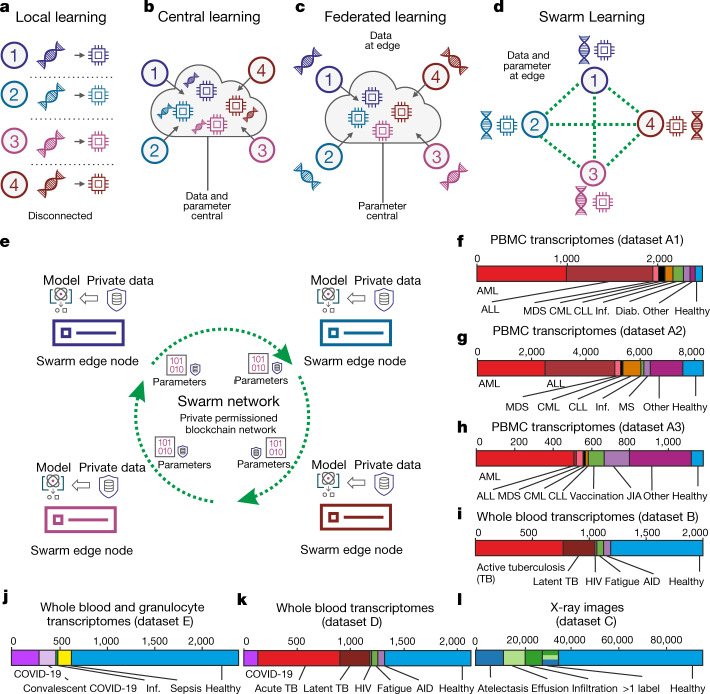
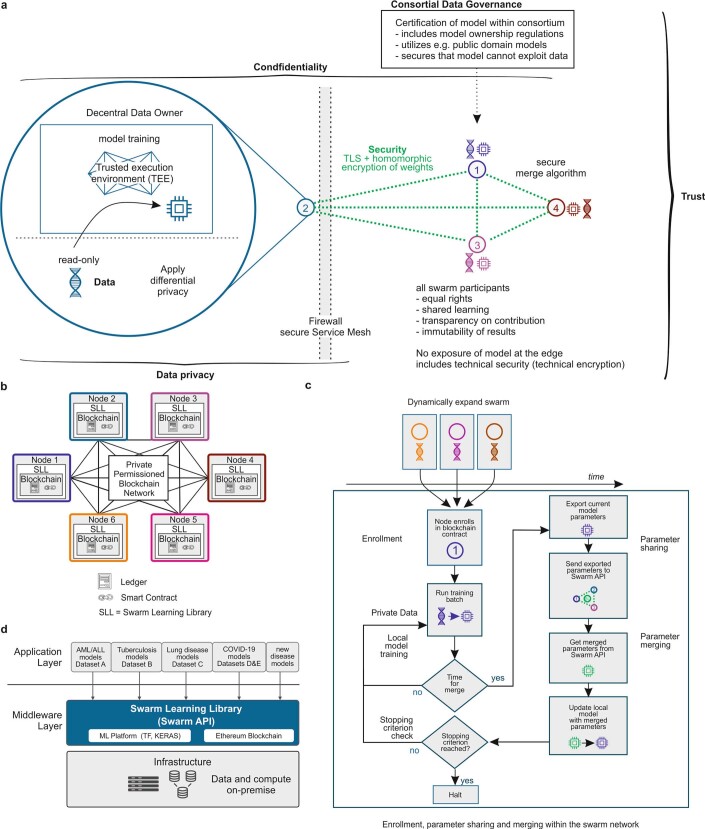
Fast and reliable detection of patients with severe and heterogeneous illnesses is a major goal of precision medicine 1,2 . Patients with leukaemia can be identified using machine learning on the basis of their blood transcriptomes 3 . However, there is an increasing divide between what is technically possible and what is allowed, because of privacy legislation 4,5 . Here, to facilitate the integration of any medical data from any data owner worldwide without violating privacy laws, we introduce Swarm Learning—a decentralized machine-learning approach that unites edge computing, blockchain-based peer-to-peer networking and coordination while maintaining confidentiality without the need for a central coordinator, thereby going beyond federated learning. To illustrate the feasibility of using Swarm Learning to develop disease classifiers using distributed data, we chose four use cases of heterogeneous diseases (COVID-19, tuberculosis, leukaemia and lung pathologies). With more than 16,400 blood transcriptomes derived from 127 clinical studies with non-uniform distributions of cases and controls and substantial study biases, as well as more than 95,000 chest X-ray images, we show that Swarm Learning classifiers outperform those developed at individual sites. In addition, Swarm Learning completely fulfils local confidentiality regulations by design. We believe that this approach will notably accelerate the introduction of precision medicine.
Verified 2026-10-05 · 1 reference not checked yet
Overview
CoChat Summary
TL;DR
Swarm Learning (SL) is a decentralized machine-learning approach that combines edge computing, permissioned blockchain peer-to-peer networking, and coordination without a central parameter server, preserving confidentiality by design. Across four disease use cases—leukaemia, tuberculosis, COVID-19, and lung pathologies—SL classifiers trained on distributed data outperformed classifiers developed at individual sites and were close to or equivalent to centralized models.
Key findings
- Using more than 16,400 blood transcriptomes from 127 clinical studies and more than 95,000 chest X-ray images, SL outperformed individual nodes across leukaemia, tuberculosis, COVID-19, and lung pathology use cases; central models were only slightly better or equivalent in several scenarios.
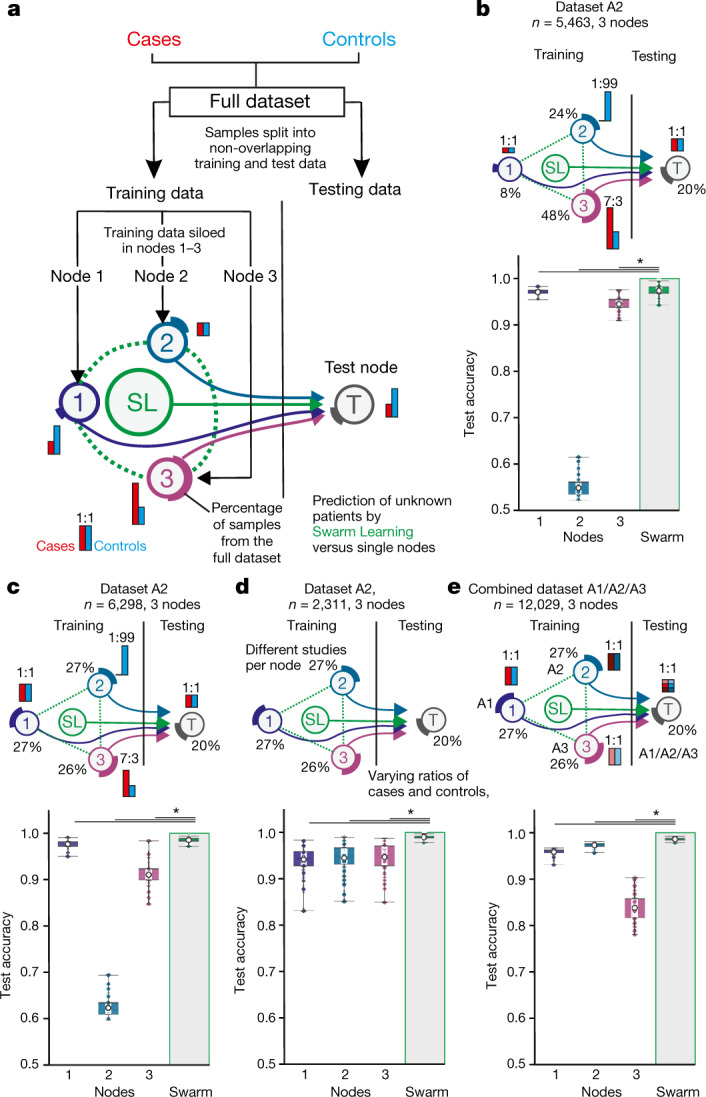
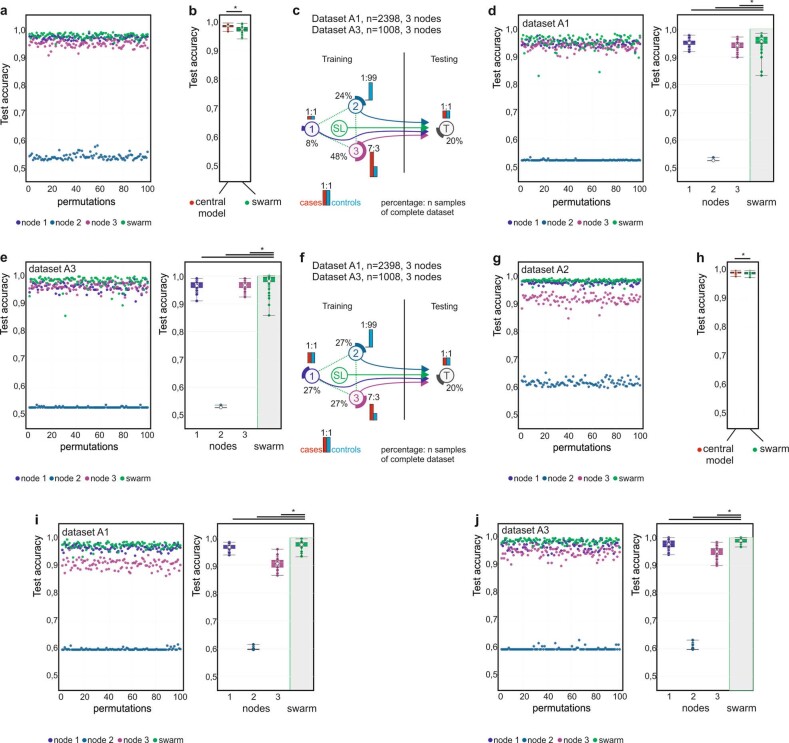
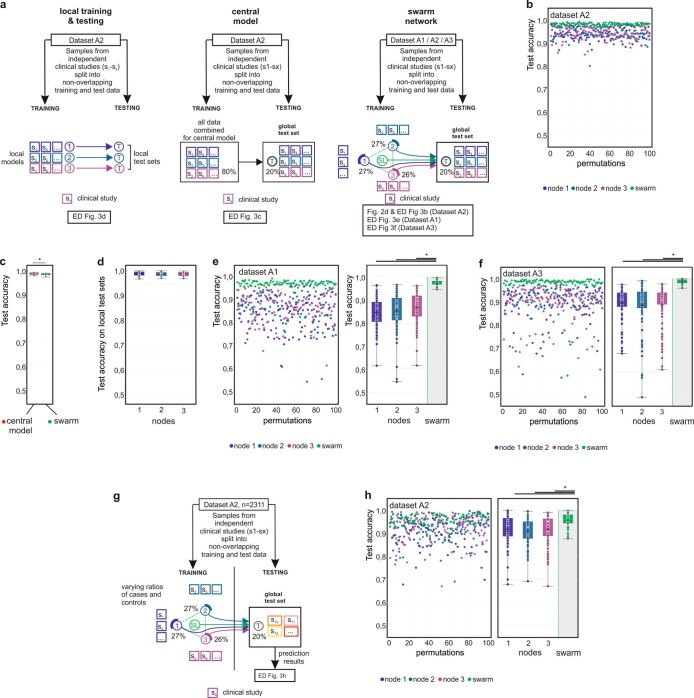
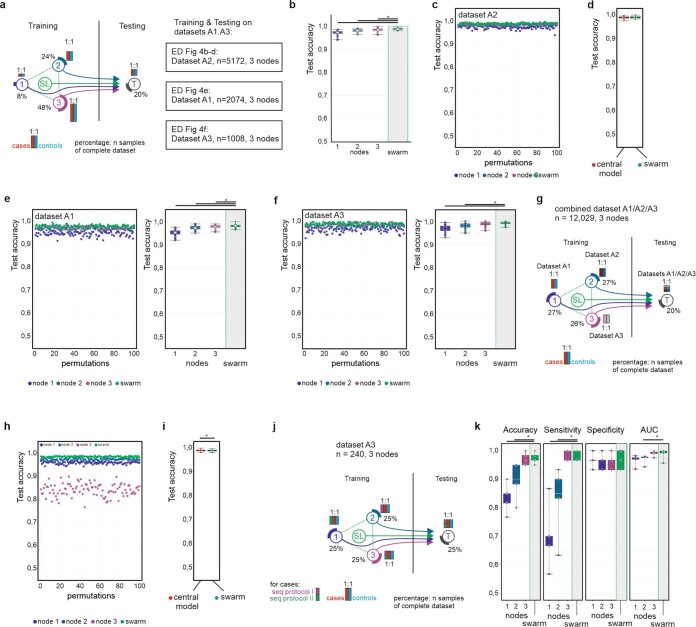
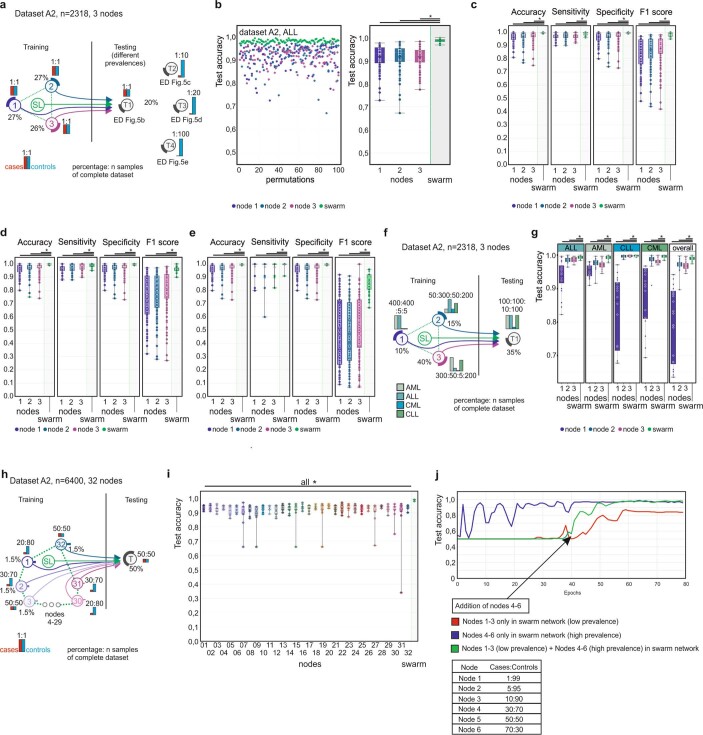
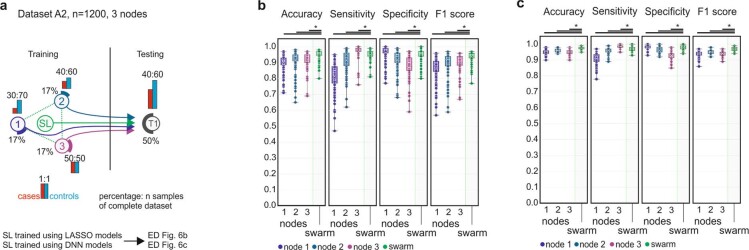
- In leukaemia PBMC datasets A1–A3, comprising more than 12,000 individuals, SL outperformed each node across multiple scenarios, including uneven case/control distributions, study-specific siloing, different transcriptomic technologies, up to 32 nodes, and LASSO instead of deep neural networks.
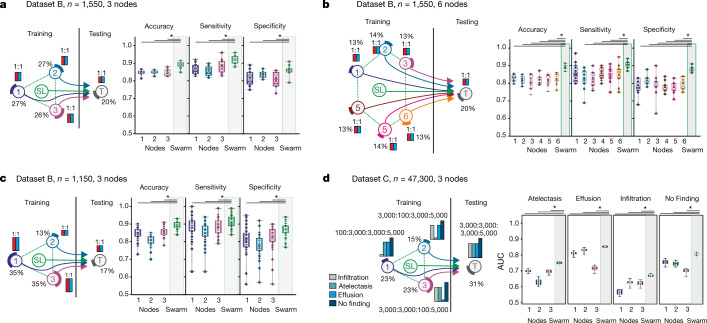
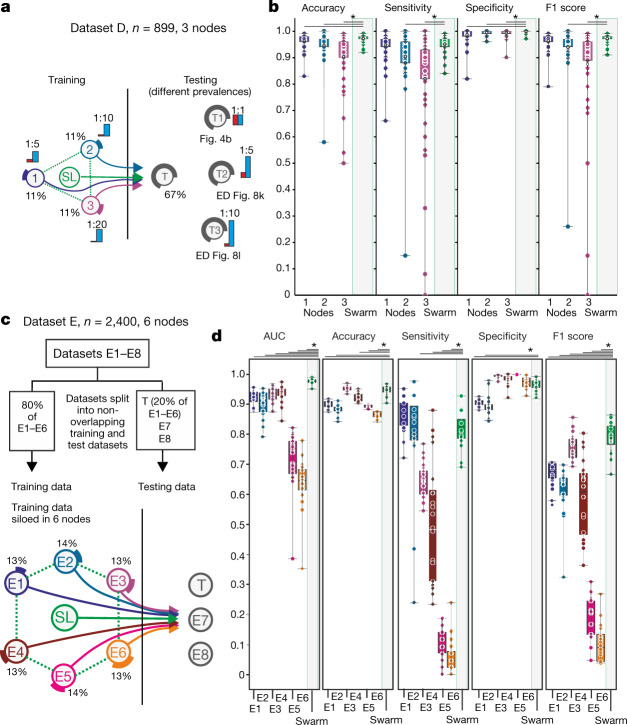
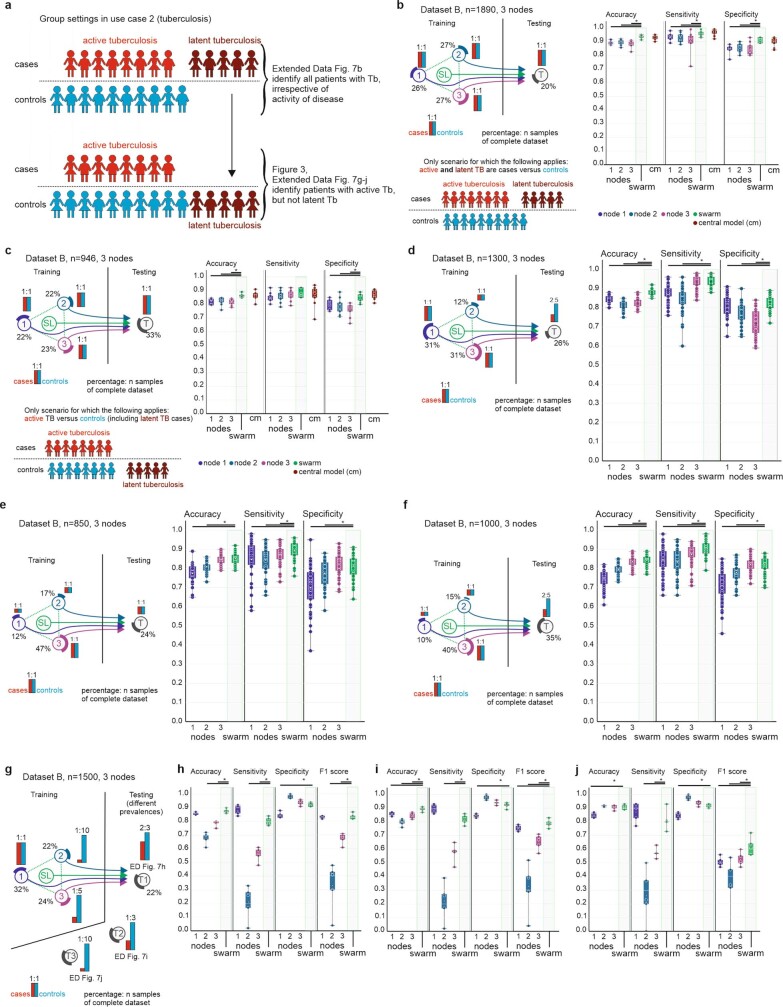
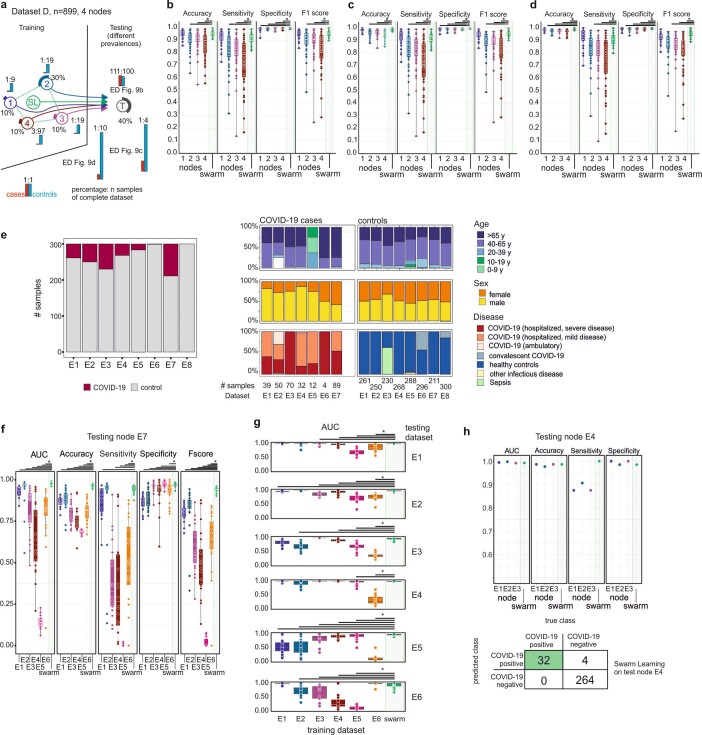
- For tuberculosis, SL outperformed individual nodes even when training samples were reduced by 50% or split into six smaller nodes; for COVID-19, SL outperformed all nodes in AUC on global test datasets and predicted samples from other centres when individual centre nodes could not.
- Overall, 16,694 analyses were performed across 26 AML, 4 ALL, 13 TB, 1 X-ray, and 18 COVID-19 scenarios, with 5–100 permutations per scenario and a total of 8,347 computer hours.
Methods
- Design: decentralized SL framework using edge nodes and a permissioned blockchain for secure onboarding, dynamic leader election, and parameter merging, with no central parameter server; raw data remain local and model parameters are exchanged and merged.
- Data: PBMC transcriptome datasets A1 (n = 2,500), A2 (n = 8,348), and A3 (n = 1,181); whole-blood datasets B (n = 1,999), D (n = 2,143), and E (n = 2,400); chest X-ray dataset C (95,831 images); simulations used 3–32 training nodes and independent test nodes.
- Analysis: deep neural network (Keras sequential) and LASSO; performance metrics included sensitivity, specificity, accuracy, F1 score, and AUC; differences were tested with one-sided Wilcoxon signed-rank test with continuity correction, using 5–100 permutations per scenario.
Limitations
- Stated: no statistical methods were used to predetermine sample size; experiments were not randomized, although permutations were performed; investigators were not blinded to allocation during experiments and outcome assessment.
- Stated/implied: SL performance was tested in simulated siloing and outbreak scenarios using existing datasets, not in a prospective real-world multi-centre clinical deployment; the paper notes potential limitations in TB outbreak scenarios but does not quantify them.
- Evident: although confidentiality is preserved by design and no raw data are exchanged, model parameters are shared; the paper suggests SL can inherit differential privacy, functional encryption, or encrypted transfer learning, but these were not implemented or tested here.
Model-written summary. Check it against the paper before relying on it.
Integrity signals
Registry
Cites
Statistics
Figures
Verification
Claims the paper makes
6 Valid · 0 Not valid · 7 Not checked · 58 Own results and interpretations
The cited sources support only part of this claim — read each source’s verdict below.
In the paper
“As medicine is inherently decentral, the volume of local data is often insufficient to train reliable classifiers20,21.”
§ Swarm Learning for decentralized and confidential clinical machine learning > Main
What the sources say
- Not checked yetcites [20] Rajkomar A Dean J Kohane I Machine learning in medicine N. Engl. J. Med. 2019 380 1347 1358 10.1056/NEJMra1814259 30943338 source
- Partly supportedcites [21] Savage N Calculating disease Nature 2017 550 S115 S117 10.1038/550S115a 29045372 sourceExperimental — accuracy not yet measured
In “BIOPSY BY NUMBERS” (page unavailable), the paper says a researcher wants a much larger dataset to validate and refine an ALS classification algorithm, and describes a shared MRI repository assembled to provide larger datasets. It does not say that medicine is inherently decentralized or that local datasets are often insufficient to train reliable classifiers; it also reports good predictions from a relatively small dataset. (LLM, conf=0.78)
plainstates a cause- Asserted: passes — The authors put it forward as true.
- Checkable: passes — It can be checked against evidence.
- Load-bearing: passes — The paper’s conclusions depend on it.
- Based: passes — The paper gives a reason why it holds.
The cited sources support only part of this claim — read each source’s verdict below.
In the paper
“With increasing efforts to enforce data privacy and security5,9,10 and to reduce data traffic and duplication, a decentralized data model will become the preferred choice for handling, storing, managing, and analysing any kind of large medical dataset19.”
§ Swarm Learning for decentralized and confidential clinical machine learning > Discussion
What the sources say
- Partly supportedcites [19] Kaissis GA Makowski MR Rückert D Braren RF Secure, privacy-preserving and federated machine learning in medical imaging Nat. Mach. Intell. 2020 2 305 311 10.1038/s42256-020-0186-1 sourceExperimental — accuracy not yet measured
The Outlook section of our copy supports the direction of the claim: it states that decentralized data storage and federated learning systems are 'replacing the current paradigm of data sharing and centralized storage' and are driven by privacy requirements, and the paper elsewhere notes such methods 'should require minimal or no data transfer'. However, the source hedges this as having 'the greatest potential to enable privacy-preserving cross-institutional research in a breadth of biomedical disciplines in the near future', whereas the citing sentence asserts it as a certainty ('will become the preferred choice') and extends it to 'handling, storing, managing, and analysing any kind of large medical dataset' — a scope and a confidence level the source does not claim. The 'reduce data traffic and duplication' motive is only partly reflected (the paper in fact lists communication overhead and burdensome data transfer as limitations of decentralized/federated and SMPC approaches). (LLM, conf=0.72)
plainstates a cause- Asserted: passes — The authors put it forward as true.
- Checkable: unclear — It is unclear whether it could be checked against evidence.
- Load-bearing: passes — The paper’s conclusions depend on it.
- Based: passes — The paper gives a reason why it holds.
- Partly supported
The cited sources support only part of this claim — read each source’s verdict below.
In the paper
“with current privacy regulations5,9,10 making it less appealing to develop centralized AI systems”
§ Swarm Learning for decentralized and confidential clinical machine learning > Discussion
What the sources say
- Partly supportedcites [5] Price WN II Cohen IG Privacy in the age of medical big data Nat. Med. 2019 25 37 43 10.1038/s41591-018-0272-7 30617331 PMC6376961 sourceExperimental — accuracy not yet measured
Price & Cohen (2019) do support the general thrust: in 'A path forward' they write that 'The basic harm of privacy overprotection is the brakes it puts on data-driven innovation,' that privacy protections limit data aggregation and innovative data use, and that 'Patchy, fragmented health data make data-driven innovation hard, imposing both technological and economic hurdles' (A path forward); they also note in 'Why do we need big data in health?' that AI uses 'require very large sets of data' and that without them 'algorithms cannot be trained or ... evaluated.' But our copy nowhere contrasts centralized with decentralized/federated architectures, and says nothing about privacy regulation making 'centralized' AI systems specifically less appealing — that comparative claim is the citing authors'. The paper's regulatory discussion is also confined to U.S. law (HIPAA de-identification, covered entities), narrower than the unqualified 'current privacy regulations' in the citing sentence. (LLM, conf=0.72)
- Not checked yetcites [9] Kels CG HIPAA in the era of data sharing J. Am. Med. Assoc. 2020 323 476 477 10.1001/jama.2019.19645 32016301 source
- Not checked yetcites [10] McCall B What does the GDPR mean for the medical community? Lancet 2018 391 1249 1250 10.1016/S0140-6736(18)30739-6 29619949 source
plainstates a cause- Asserted: passes — The authors put it forward as true.
- Checkable: passes — It can be checked against evidence.
- Load-bearing: passes — The paper’s conclusions depend on it.
- Based: passes — The paper gives a reason why it holds.
- Partly supported
Every source the paper cites for this claim was checked and supports it.
In the paper
“but progress is hindered by the limited size of datasets19”
§ Swarm Learning for decentralized and confidential clinical machine learning > Discussion
What the sources say
- Supportedcites [19] Kaissis GA Makowski MR Rückert D Braren RF Secure, privacy-preserving and federated machine learning in medical imaging Nat. Mach. Intell. 2020 2 305 311 10.1038/s42256-020-0186-1 source
The opening of our copy (Abstract/front-matter, p. 305) states that 'the broad application of artificial intelligence techniques in medicine is currently hindered by limited dataset availability for algorithm training and validation.' The Introduction (Abstract section, p. 305) ties progress specifically to oncology applications (tumour detection, genomic characterization, subtyping, grading, outcome/relapse risk) to 'the release of large, curated corpora of images', notes that 'even the largest current imaging studies in the field ... include considerably less data than, for example, ImageNet', and that 'the inability to access and leverage this data poses a significant barrier to AI applications in this field.' This supports the paraphrase that limited dataset size hinders progress in oncology machine learning, with the caveat that the source's scope is medical imaging AI generally rather than oncology alone. (LLM, conf=0.85)
plainstates a cause- Asserted: passes — The authors put it forward as true.
- Checkable: passes — It can be checked against evidence.
- Load-bearing: passes — The paper’s conclusions depend on it.
- Based: passes — The paper gives a reason why it holds.
- Supported
A result the paper reports from its own data — it cites no other source for it, so there is none to check. The quote shows it is in the paper.
In the paper
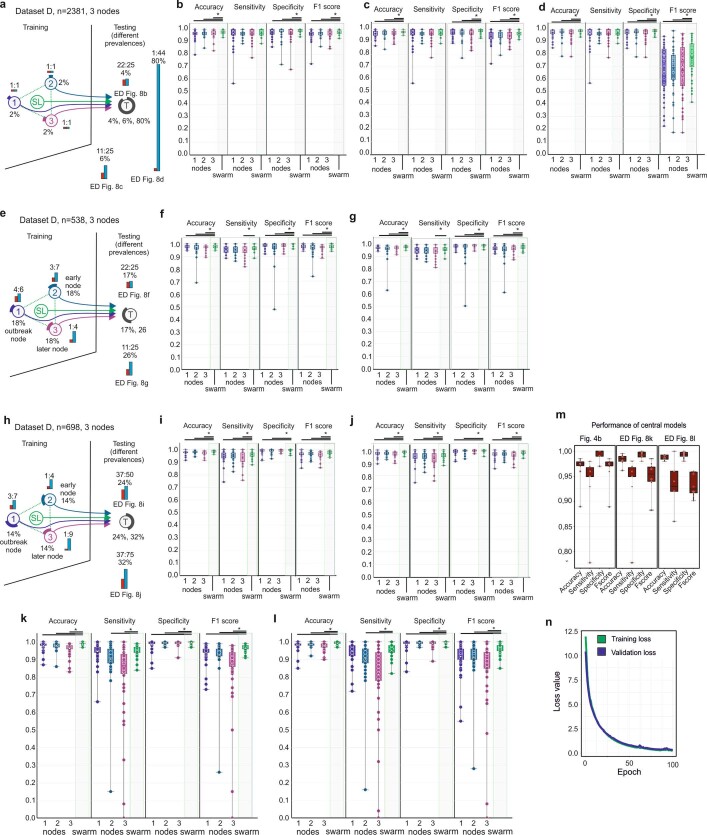
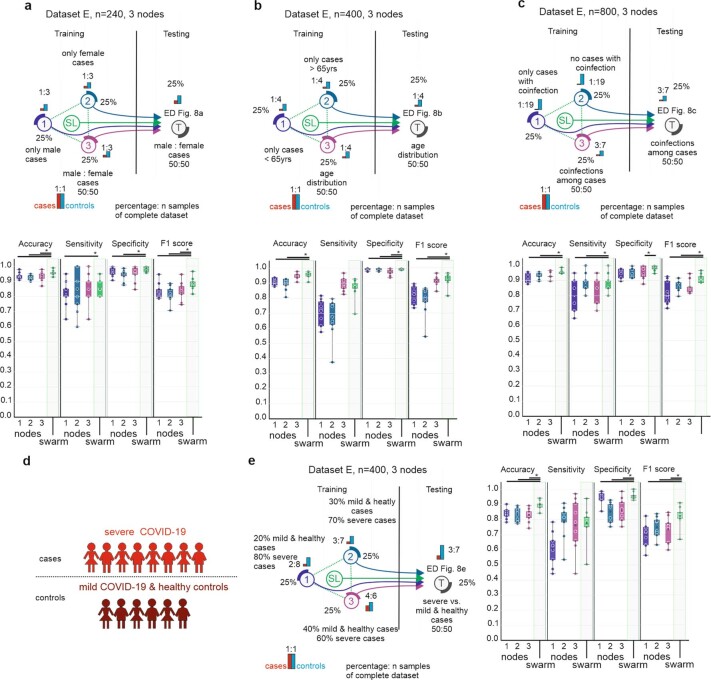
“When we reduced cases at training nodes, all performance measures remained very high at the test node for SL and individual nodes (Extended Data Fig. 8e–j).”
§ Swarm Learning for decentralized and confidential clinical machine learning > Identification of COVID-19
plain- Asserted: passes — The authors put it forward as true.
- Checkable: passes — It can be checked against evidence.
- Load-bearing: unclear — It is unclear whether the paper’s conclusions depend on it.
- Based: passes — The paper gives a reason why it holds.
32 more claims
Create a free account to see all 71 claims and to verify the 16 references still open.
- It may state two separate claims as one. 18
- Probably not a substantial claim. 20
Claims other papers make about this one
Each is checked against this paper’s own text: does it say what the citing paper says it does?
The source backs part of the claim, not all of it — or backs it for a different population, condition or comparison.
In the citing paper
“It can also overcome the straggler dilemma with heterogeneous hardware, as well as improve the robustness to data poisoning attacks and master node fails [35], [145].”
From Edge artificial intelligence for 6g: vision, enabling technologies, and applications (2022) · cites this paper as [35]
Experimental — accuracy not yet measuredThe source backs part of the claim, not all of it — or backs it for a different population, condition or comparison.
In the citing paper
“FL allows training of AI models through averaging of local updates from numerous healthcare facilities and smart devices, such as IoMT, despite the lack of local data.”
From Federated learning-based AI approaches in smart healthcare: Concepts, taxonomies, challenges and open issues (2023) · cites this paper as [11]
Experimental — accuracy not yet measuredThe source backs part of the claim, not all of it — or backs it for a different population, condition or comparison.
In the citing paper
“Federated Learning has presented itself as a viable method for implementing economic, innovative healthcare systems while ensuring privacy [11–15].”
From Federated learning-based AI approaches in smart healthcare: Concepts, taxonomies, challenges and open issues (2023) · cites this paper as [11]
Experimental — accuracy not yet measuredThe cited source says what the claim attributes to it.
In the citing paper
“In particular, swarm learning [35] provides a completely decentralized AI solution based on decentralized ML by keeping local datasets at each edge device.”
From Edge artificial intelligence for 6g: vision, enabling technologies, and applications (2022) · cites this paper as [35]
The cited source says what the claim attributes to it.
In the citing paper
“Besides, swarm learning has recently been developed in [35] to provide a decentralized and confidential clinical disease detection solution for diseases (e.g., COVID-19, tuberculosis, and leukaemia).”
From Edge artificial intelligence for 6g: vision, enabling technologies, and applications (2022) · cites this paper as [35]
6 more claims about this paper
Create a free account to see every claim other papers make about this one.
Citations
Cites
Moderated estimation of fold change and dispersion for RNA-seq data with DESeq2
Love, M. I., Huber, W., & Anders, S. (2014) · Genome Biology · doi:10.1186/s13059-014-0550-8 · Cited by 95,106
LeCun, Y., Bengio, Y., & Hinton, G. (2015) · Nature · doi:10.1038/nature14539 · Cited by 84,126
Scikit-learn: Machine Learning in Python
Pedregosa, F., Varoquaux, G., Gramfort, A., Michel, V., Thirion, B., Grisel, O., Blondel, M., Müller, A., Nothman, J., Louppe, G., et al. (2012) · arXiv · doi:10.48550/arxiv.1201.0490 · Cited by 71,016
STAR: ultrafast universal RNA-seq aligner
Dobin, A., Davis, C. A., Schlesinger, F., Drenkow, J., Zaleski, C., Jha, S., Batut, P., Chaisson, M., & Gingeras, T. R. (2013) · Bioinformatics · doi:10.1093/bioinformatics/bts635 · Cited by 51,709
Bootstrap methods: another look at the jackknife
Efron, B. (1979) · The Annals of Statistics · doi:10.1214/aos/1176344552 · Cited by 17,602
Dermatologist-level classification of skin cancer with deep neural networks
Esteva, A., Kuprel, B., Novoa, R. A., Ko, J., Swetter, S. M., Blau, H. M., & Thrun, S. (2017) · Nature · doi:10.1038/nature21056 · Cited by 14,362 · cited 1×
“Particularly in oncology, success has been reported in machine-learning-based tumour detection 3,37 , sub-typing 38 , and outcome prediction 39 , but progress is hindered by the limited size of datasets 19 , with current privacy regulations 5,9,10 making it less appealing to develop centralized AI…”
BackgroundCommunication-Efficient Learning of Deep Networks from Decentralized Data
McMahan, H. B., Moore, E., Ramage, D., Hampson, S., & Arcas, B. A. Y. (2016) · arXiv · doi:10.48550/arxiv.1602.05629 · Cited by 14,215
Gene Expression Omnibus: NCBI gene expression and hybridization array data repository
Edgar, R. (2002) · Nucleic Acids Research · doi:10.1093/nar/30.1.207 · Cited by 13,288
Exploration, normalization, and summaries of high density oligonucleotide array probe level data
Irizarry, R. A. (2003) · Biostatistics · doi:10.1093/biostatistics/4.2.249 · Cited by 10,603
Detection of 2019 novel coronavirus (2019-nCoV) by real-time RT-PCR
Corman, V. M., Landt, O., Kaiser, M., Molenkamp, R., Meijer, A., Chu, D. K., Bleicker, T., Brünink, S., Schneider, J., Schmidt, M. L., et al. (2020) · Eurosurveillance · doi:10.2807/1560-7917.es.2020.25.3.2000045 · Cited by 7,344 · cited 10×
“We obtained very similar results using datasets A1 and A3, which strongly supports the idea that the improvement in performance of SL is independent of data collection (clinical studies) or the technologies (microarray or RNA-seq) used for data generation (Extended Data Fig.”
MethodInfluential
Cited by
Scientific discovery in the age of artificial intelligence.
Wang, H., Fu, T., Du, Y., Gao, W., Huang, K., Liu, Z., Chandak, P., Liu, S., Van Katwyk, P., Deac, A., et al. (2023) · Nature · doi:10.1038/s41586-023-06221-2 · Cited by 1,823
Towards Personalized Federated Learning
Tan, A. Z., Yu, H., Cui, L., & Yang, Q. (2023) · IEEE Transactions on Neural Networks and Learning Systems · doi:10.1109/tnnls.2022.3160699 · Cited by 1,182
Acosta, J. N., Falcone, G. J., Rajpurkar, P., & Topol, E. J. (2022) · Nature Medicine · doi:10.1038/s41591-022-01981-2 · Cited by 1,365
“Finally, swarm learning is a relatively novel approach that, similarly to federated learning, is also based on several individuals or organizations training a model on local data, but does not require a trusted central server because it replaces it with the use of blockchain smart contracts 170 .”
BackgroundEdge artificial intelligence for 6g: vision, enabling technologies, and applications
Letaief, K. B., Shi, Y., Lu, J., & Lu, J. (2022) · IEEE Journal on Selected Areas in Communications · doi:10.1109/jsac.2021.3126076 · Cited by 829
“to-peer network was developed in [35] to support swarm learning without a central server.”
BackgroundInfluentialFederated learning for smart healthcare: A survey
Nguyen, D. C., Pham, Q.-V., Pathirana, P. N., Ding, M., Seneviratne, A., Lin, Z., Dobre, O., & Hwang, W.-J. (2023) · ACM Computing Surveys · doi:10.1145/3501296 · Cited by 827
Outlook on human-centric manufacturing towards Industry 5.0
Lu, Y., Zheng, H., Chand, S., Xia, W., Liu, Z., Xu, X., Wang, L., Qin, Z., & Bao, J. (2022) · Journal of Manufacturing Systems · doi:10.1016/j.jmsy.2022.02.001 · Cited by 671
Communication-efficient federated learning via knowledge distillation
Wu, C., Wu, F., Lyu, L., Huang, Y., & Xie, X. (2022) · Nature Communications · doi:10.1038/s41467-022-29763-x · Cited by 618
“Thus, it can be dif fi cult to collect and aggregate decentralized data into a uni fi ed dataset for centralized model training, which poses great challenges to the applications of many existing deep learning techniques without privacy awareness 8 .”
Decentralized federated learning: Fundamentals, state of the art, frameworks, trends, and challenges
Martínez Beltrán, E. T., Pérez, M. Q., Sánchez, P. M. S., Bernal, S. L., Bovet, G., Pérez, M. G., Pérez, G. M., & Celdrán, A. H. (2023) · IEEE Communications Surveys & Tutorials · doi:10.1109/comst.2023.3315746 · Cited by 625
“[158] 2021 Facilitate the integration of any medical data from any data owner worldwide without violating privacy laws Cross-silo Decentralized Real Custom model Custom aggregator Asynchronous Scheduling PBMC transcriptome [159] Chest X-ray [160]”
BackgroundPrivacy and Robustness in Federated Learning: Attacks and Defenses
Lyu, L., Yu, H., Ma, X., Chen, C., Sun, L., Zhao, J., Yang, Q., & Yu, P. S. (2024) · IEEE Transactions on Neural Networks and Learning Systems · doi:10.1109/tnnls.2022.3216981 · Cited by 548
“The recent emerging swarm learning [187] can be deemed as a decentralized FL framework, which unites edge computing, blockchain-based peer-to-peer networking and coordination while maintaining confidentiality without the need for a central coordinator.”
BackgroundNCBI GEO: archive for gene expression and epigenomics data sets: 23-year update
Clough, E., Barrett, T., Wilhite, S. E., Ledoux, P., Evangelista, C., Kim, I. F., Tomashevsky, M., Marshall, K. A., Phillippy, K. H., Sherman, P. M., et al. (2024) · Nucleic Acids Research · doi:10.1093/nar/gkad965 · Cited by 498
Applications of single-cell RNA sequencing in drug discovery and development
Van de Sande, B., Lee, J. S., Mutasa-Gottgens, E., Naughton, B., Bacon, W., Manning, J., Wang, Y., Pollard, J., Mendez, M., Hill, J., et al. (2023) · Nature Reviews Drug Discovery · doi:10.1038/s41573-023-00688-4 · Cited by 437
Artificial intelligence in histopathology: enhancing cancer research and clinical oncology
Shmatko, A., Ghaffari Laleh, N., Gerstung, M., & Kather, J. N. (2022) · Nature Cancer · doi:10.1038/s43018-022-00436-4 · Cited by 446
“Similarly, in swarm learning 124,125 , multiple parties co-train a model, but, in this case, they are coordinated by blockchain-based communication.”
BackgroundDistributed Artificial Intelligence Empowered by End-Edge-Cloud Computing: A Survey
Duan, S., Wang, D., Ren, J., Lyu, F., Zhang, Y., Wu, H., & Shen, X. (2023) · IEEE Communications Surveys & Tutorials · doi:10.1109/comst.2022.3218527 · Cited by 408
“The blockchain network can replace the centralized model exchange and aggregation due to the distributed ledger technology [147].”
BackgroundFeng, J., Phillips, R. V., Malenica, I., Bishara, A., Hubbard, A. E., Celi, L. A., & Pirracchio, R. (2022) · npj Digital Medicine · doi:10.1038/s41746-022-00611-y · Cited by 423
“The advantage of this option is that it minimizes the burden on the AI-QI team and the model vendor can leverage data from multiple institutions to improve model monitoring and maintenance 97,98 .”
BackgroundRahman, A., Hossain, M. S., Muhammad, G., Kundu, D., Debnath, T., Rahman, M., Khan, M. S. I., Tiwari, P., & Band, S. S. (2023) · Cluster Computing · doi:10.1007/s10586-022-03658-4 · Cited by 399
“Federated Learning has presented itself as a viable method for implementing economic, innovative healthcare systems while ensuring privacy [11–15].”
MethodDecentralized Federated Learning: A Survey and Perspective
Yuan, L., Wang, Z., Sun, L., Yu, P. S., & Brinton, C. G. (2024) · IEEE Internet of Things Journal · doi:10.1109/jiot.2024.3407584 · Cited by 290
“Another example of a star variant is the Swarm Learning framework proposed by Warnat-Herresthal et al. [53], which involves the dynamic election of a leader to aggregate model parameters.”
BackgroundOpenFL: the open federated learning library
Foley, P., Sheller, M. J., Edwards, B., Pati, S., Riviera, W., Sharma, M., Narayana Moorthy, P., Wang, S.-H., Martin, J., Mirhaji, P., et al. (2022) · Physics in Medicine & Biology · doi:10.1088/1361-6560/ac97d9 · Cited by 132
Deep generative molecular design reshapes drug discovery
Zeng, X., Wang, F., Luo, Y., Kang, S.-G., Tang, J., Lightstone, F. C., Fang, E. F., Cornell, W., Nussinov, R., & Cheng, F. (2022) · Cell Reports Medicine · doi:10.1016/j.xcrm.2022.100794 · Cited by 295
“In addition, advanced data-sharing and model-learning strategies, such as swarm learning 105,106 and federated learning, 74,107,108 will accelerate data sharing among industries, academics, governments, and health care systems for drug development.”
BackgroundArtificial intelligence in diabetes management: Advancements, opportunities, and challenges
Guan, Z., Li, H., Liu, R., Cai, C., Liu, Y., Li, J., Wang, X., Huang, S., Wu, L., Liu, D., et al. (2023) · Cell Reports Medicine · doi:10.1016/j.xcrm.2023.101213 · Cited by 412
“136 As an alternative, Warnat-Herresthal et al. introduced a decentralized ML approach named swarm learning, 136 which dispenses with a dedicated server, shares the parameters via the swarm network, and builds the models independently on private data at the individual sites.”
MethodWhen Federated Learning Meets Privacy-Preserving Computation
Chen, J., Yan, H., Liu, Z., Zhang, M., Xiong, H., & Yu, S. (2024) · ACM Computing Surveys · doi:10.1145/3679013 · Cited by 247
“To be consistent, the CNN model in Reference [56] is exploited as the (c) Loss evaluation of the four schemes with MNIST dataset.”
InfluentialThreats, attacks and defenses to federated learning: issues, taxonomy and perspectives
Liu, P., Xu, X., & Wang, W. (2022) · Cybersecurity · doi:10.1186/s42400-021-00105-6 · Cited by 244
“Warnat-Herresthal et al. (2021) proposed a decentralized collaborative computing method called Swarm Learning (SL), which combines privacy-preserving, edge computing and blockchain based peer-to-peer network.”
BackgroundTeo, Z. L., Jin, L., Liu, N., Li, S., Miao, D., Zhang, X., Ng, W. Y., Tan, T. F., Lee, D. M., Chua, K. J., et al. (2024) · Cell Reports Medicine · doi:10.1016/j.xcrm.2024.101419 · Cited by 255
“16 In addition, while FL provides greater privacy protection, the sharing of model updates still represents a potential source of privacy compromise.”
BackgroundArtificial intelligence, machine learning, and deep learning in liver transplantation
Bhat, M., Rabindranath, M., Chara, B. S., & Simonetto, D. A. (2023) · Journal of Hepatology · doi:10.1016/j.jhep.2023.01.006 · Cited by 226
A Comprehensive Review on Synergy of Multi-Modal Data and AI Technologies in Medical Diagnosis
Xu, X., Li, J., Zhu, Z., Zhao, L., Wang, H., Song, C., Chen, Y., Zhao, Q., Yang, J., & Pei, Y. (2024) · Bioengineering · doi:10.3390/bioengineering11030219 · Cited by 242
Radiomics and artificial intelligence for precision medicine in lung cancer treatment
Chen, M., Copley, S. J., Viola, P., Lu, H., & Aboagye, E. O. (2023) · Seminars in Cancer Biology · doi:10.1016/j.semcancer.2023.05.004 · Cited by 206
Swarm learning for decentralized artificial intelligence in cancer histopathology
Saldanha, O. L., Quirke, P., West, N. P., James, J. A., Loughrey, M. B., Grabsch, H. I., Salto-Tellez, M., Alwers, E., Cifci, D., Ghaffari Laleh, N., et al. (2022) · Nature Medicine · doi:10.1038/s41591-022-01768-5 · Cited by 227
“26 In SL, AI models are trained locally and models are combined centrally without requiring central coordination.”
BackgroundMethodFroelicher, D., Troncoso-Pastoriza, J. R., Raisaro, J. L., Cuendet, M. A., Sousa, J. S., Cho, H., Berger, B., Fellay, J., & Hubaux, J.-P. (2021) · Nature Communications · doi:10.1038/s41467-021-25972-y · Cited by 195
Responsible AI Pattern Catalogue: A Collection of Best Practices for AI Governance and Engineering
Lu, Q., Zhu, L., Xu, X., Whittle, J., Zowghi, D., & Jacquet, A. (2024) · ACM Computing Surveys · doi:10.1145/3626234 · Cited by 121
“Decentralized learning is a variant of federated learning, which could use blockchain to remove the single point of failure and coordinate the learning process in a fully decentralized way [114].”
BackgroundOgier du Terrail, J., Leopold, A., Joly, C., Béguier, C., Andreux, M., Maussion, C., Schmauch, B., Tramel, E. W., Bendjebbar, E., Zaslavskiy, M., et al. (2023) · Nature Medicine · doi:10.1038/s41591-022-02155-w · Cited by 217
Aminizadeh, S., Heidari, A., Toumaj, S., Darbandi, M., Navimipour, N. J., Rezaei, M., Talebi, S., Azad, P., & Unal, M. (2023) · Computer Methods and Programs in Biomedicine · doi:10.1016/j.cmpb.2023.107745 · Cited by 193
Decentralized Federated Learning: A Survey on Security and Privacy
Hallaji, E., Razavi-Far, R., Saif, M., Wang, B., & Yang, Q. (2024) · IEEE Transactions on Big Data · doi:10.1109/tbdata.2024.3362191 · Cited by 175
“Addressing these challenges requires ongoing research and adaptation of privacy-preserving techniques to suit the specific requirements of DFL. Developing optimized implementations of cryptographic methods, such as SMC, can help alleviate the computational overhead and address sensitivity concerns.”
BackgroundMethodReview on security of federated learning and its application in healthcare
Li, H., Li, C., Wang, J., Yang, A., Ma, Z., Zhang, Z., & Hua, D. (2023) · Future Generation Computer Systems · doi:10.1016/j.future.2023.02.021 · Cited by 181
Baker, S., & Xiang, W. (2023) · IEEE Communications Surveys & Tutorials · doi:10.1109/comst.2023.3256323 · Cited by 178
“Swarm learning has been tested for medical applications including tuberculosis detection and COVID-19 diagnosis, with promising results [179].”
BackgroundDecentralized federated learning through proxy model sharing
Kalra, S., Wen, J., Cresswell, J. C., Volkovs, M., & Tizhoosh, H. R. (2023) · Nature Communications · doi:10.1038/s41467-023-38569-4 · Cited by 160
Concepts and applications of digital twins in healthcare and medicine
Zhang, K., Zhou, H.-Y., Baptista‐Hon, D. T., Gao, Y., Liu, X., Oermann, E. K., Xu, S. H., Jin, S., Zhang, J., Sun, Z., et al. (2024) · Patterns · doi:10.1016/j.patter.2024.101028 · Cited by 223
“106,107 This can track and mediate access to health and genomic records.”
BackgroundDecentralized Federated Learning for Healthcare Networks: A Case Study on Tumor Segmentation
Camajori Tedeschini, B., Savazzi, S., Stoklasa, R., Barbieri, L., Stathopoulos, I., Nicoli, M., & Serio, L. (2022) · IEEE Access · doi:10.1109/access.2022.3141913 · Cited by 164
“First implementations of FL leveraged on a server-client architecture [6], [7] where the PS coordinates the learning process.”
BackgroundApplication of Deep Learning in Breast Cancer Imaging
Balkenende, L., Teuwen, J., & Mann, R. M. (2022) · Seminars in Nuclear Medicine · doi:10.1053/j.semnuclmed.2022.02.003 · Cited by 160
Privacy and Security in Federated Learning: A Survey
Gosselin, R., Vieu, L., Loukil, F., & Benoit, A. (2022) · Applied Sciences · doi:10.3390/app12199901 · Cited by 158
“In such a sensitive context, it has been shown that SL can push the BlockFL approach further by using smart contracts to protect the model from misleading participants and keep data and learning safe [63].”
BackgroundTao, S., Liu, H., Sun, C., Ji, H., Ji, G., Han, Z., Gao, R., Ma, J., Ma, R., Chen, Y., et al. (2023) · Nature Communications · doi:10.1038/s41467-023-43883-y · Cited by 192
Li, M., Xu, P., Hu, J., Tang, Z., & Yang, G. (2025) · Medical Image Analysis · doi:10.1016/j.media.2025.103497 · Cited by 228
Toward Explainable Artificial Intelligence for Precision Pathology
Klauschen, F., Dippel, J., Keyl, P., Jurmeister, P., Bockmayr, M., Mock, A., Buchstab, O., Alber, M., Ruff, L., Montavon, G., et al. (2024) · Annual Review of Pathology: Mechanisms of Disease · doi:10.1146/annurev-pathmechdis-051222-113147 · Cited by 139
A Survey on Federated Recommendation Systems
Sun, Z., Xu, Y., Liu, Y., He, W., Kong, L., Wu, F., Jiang, Y., & Cui, L. (2024) · IEEE Transactions on Neural Networks and Learning Systems · doi:10.1109/tnnls.2024.3354924 · Cited by 194
Blockchain applications in health care for COVID-19 and beyond: a systematic review
Ng, W. Y., Tan, T.-E., Movva, P. V. H., Fang, A. H. S., Yeo, K.-K., Ho, D., Foo, F. S. S., Xiao, Z., Sun, K., Wong, T. Y., et al. (2021) · The Lancet Digital Health · doi:10.1016/s2589-7500(21)00210-7 · Cited by 127
“To further enhance privacy-preservation and decentralisation of AI training, Warnat-Herresthal and colleagues 65 proposed a combination of blockchain and swamp learning as the next evolution beyond federated learning, in which way the central custodian is dispensed with and the data and parameters…”
BackgroundAntimicrobial resistance crisis: could artificial intelligence be the solution?
Liu, G., Yu, D., Fan, M.-M., Zhang, X., Jin, Z., Tang, C. M., & Liu, X. (2024) · Military Medical Research · doi:10.1186/s40779-024-00510-1 · Cited by 207
“Several promising avenues worth further exploration include federated learning, active learning, and swarm learning [210, 211].”
BackgroundArtificial intelligence, machine learning, and deep learning for clinical outcome prediction
Pettit, R. W., Fullem, R., Cheng, C., & Amos, C. I. (2021) · Emerging Topics in Life Sciences · doi:10.1042/etls20210246 · Cited by 120
Trustworthy Federated Learning via Blockchain
Yang, Z., Shi, Y., Zhou, Y., Wang, Z., & Yang, K. (2023) · IEEE Internet of Things Journal · doi:10.1109/jiot.2022.3201117 · Cited by 122
“…article, the proposed wireless B-FL combines the wireless FL with permissioned blockchain to execute global model aggregation based on the blockchain consensus protocol among multiple edge servers, which can resist failures or attacks of edge servers for trustworthy global model aggregation [19].”
MethodDeep learning in cancer genomics and histopathology
Unger, M., & Kather, J. N. (2024) · Genome Medicine · doi:10.1186/s13073-024-01315-6 · Cited by 152
“One way to address these challenges is through distributed learning such as federated or swarm learning, where peers that are prohibited from public data sharing can still jointly train models [112–114] (Fig.”
BackgroundTargeting the host response in sepsis: current approaches and future evidence
Bode, C., Weis, S., Sauer, A., Wendel‐Garcia, P. D., & David, S. (2023) · Critical Care · doi:10.1186/s13054-023-04762-6 · Cited by 140
Chen, Y., Wang, L., Qin, X., Wang, J., & Xie, X. (2023) · IEEE Transactions on Neural Networks and Learning Systems · doi:10.1109/tnnls.2023.3297103 · Cited by 155
“Swarm learning [34] applied this style into the real decentralized and confidential clinical machine learning; however, these methods often require large communication costs, and a few are designed for personalization federation FL.”
BackgroundLead federated neuromorphic learning for wireless edge artificial intelligence
Yang, H., Lam, K.-Y., Xiao, L., Xiong, Z., Hu, H., Niyato, D., & Vincent Poor, H. (2022) · Nature Communications · doi:10.1038/s41467-022-32020-w · Cited by 127
Architectural patterns for the design of federated learning systems
Lo, S. K., Lu, Q., Zhu, L., Paik, H.-Y., Xu, X., & Wang, C. (2022) · Journal of Systems and Software · doi:10.1016/j.jss.2022.111357 · Cited by 149
Iterative integration of deep learning in hybrid Earth surface system modelling
Chen, M., Qian, Z., Boers, N., Jakeman, A. J., Kettner, A. J., Brandt, M., Kwan, M., Batty, M., Li, W., Zhu, R., et al. (2023) · Nature Reviews Earth & Environment · doi:10.1038/s43017-023-00452-7 · Cited by 133
Retina Fundus Photograph-Based Artificial Intelligence Algorithms in Medicine: A Systematic Review
Grzybowski, A. E., Jin, K., Zhou, J., Pan, X., Wang, M., Ye, J., & Wong, T. Y. (2024) · Ophthalmology and Therapy · doi:10.1007/s40123-024-00981-4 · Cited by 137
“It adopts a decentralized architecture and sets nodes to share parameters [99] Currently, federal learning has made some achievements within ophthalmic medicine [100].”
BackgroundEncrypted federated learning for secure decentralized collaboration in cancer image analysis
Truhn, D., Arasteh, S. T., Saldanha, O. L., Müller‐Franzes, G. A., Khader, F., Quirke, P., West, N. P., Gray, R. G., Hutchins, G. G. A., James, J. A., et al. (2023) · Medical Image Analysis · doi:10.1016/j.media.2023.103059 · Cited by 129
Self-citationBlockchain, artificial intelligence, and healthcare: the tripod of future—a narrative review
Bathula, A., Gupta, S. K., Merugu, S., Saba, L., Khanna, N. N., Laird, J. R., Sanagala, S. S., Singh, R. K., Garg, D., Fouda, M. M., et al. (2024) · Artificial Intelligence Review · doi:10.1007/s10462-024-10873-5 · Cited by 124
Wang, X., Jiang, S., Hu, W., Ye, S., Wang, T., Wu, F., Li, Y., Li, X., Zhang, G., Chen, X., et al. (2022) · Journal of the American Chemical Society · doi:10.1021/jacs.2c06288 · Cited by 110
Self-citationDRL-Based Adaptive Sharding for Blockchain-Based Federated Learning
Lin, Y., Gao, Z., Du, H., Kang, J., Niyato, D. T., Wang, Q., Ruan, J., & Wan, S. (2023) · IEEE Transactions on Communications · doi:10.1109/tcomm.2023.3288591 · Cited by 113
“Warnat-Herresthal et al. [11] combined edge computing, blockchain, and federated learning to propose a decentralized training model, which allows all members to merge parameters with equal rights without violating privacy.”
BackgroundA survey on federated learning: a perspective from multi-party computation
Liu, F., Zheng, Z., Shi, Y., Tong, Y., & Zhang, Y. (2023) · Frontiers of Computer Science · doi:10.1007/s11704-023-3282-7 · Cited by 118
The Role of Genome Sequencing in Neonatal Intensive Care Units
Kingsmore, S. F., & Cole, F. S. (2022) · Annual Review of Genomics and Human Genetics · doi:10.1146/annurev-genom-120921-103442 · Cited by 104
Biomimetic mineralization based on self-assembling peptides
Li, Q., Wang, Y., Zhang, G., Su, R., & Qi, W. D. (2023) · Chemical Society Reviews · doi:10.1039/d2cs00725h · Cited by 101
No One Left Behind: Inclusive Federated Learning over Heterogeneous Devices
Liu, R., Wu, F., Wu, C., Wang, Y., Lyu, L., Chen, H., & Xie, X. (2022) · ACM SIGKDD Conference on Knowledge Discovery and Data Mining (KDD) · doi:10.1145/3534678.3539086 · Cited by 124
“Federated learning [25] is a machine learning technique that trains an algorithm across multiple decentralized edge devices (crossdevice) [14, 27, 48] or servers holding local data samples (crosssilo) [6, 41, 45], without exchanging them.”
BackgroundOpportunities and Challenges for Machine Learning in Rare Diseases
Decherchi, S., Pedrini, E., Mordenti, M., Cavalli, A., & Sangiorgi, L. (2021) · Frontiers in Medicine · doi:10.3389/fmed.2021.747612 · Cited by 109
“Interestingly, very recently, the Swarm distributed learning paradigm (55) has been pushed as a further development of federated learning, offering the explicit capability of nodes of avoiding relying on a central repository of learning parameters, thus creating an effective collective swarm of…”
BackgroundSPDL: A Blockchain-Enabled Secure and Privacy-Preserving Decentralized Learning System
Xu, M., Zou, Z., Cheng, Y., Hu, Q., Yu, D., & Cheng, X. (2022) · IEEE Transactions on Computers · doi:10.1109/tc.2022.3169436 · Cited by 106
“[18] proposed the concept of swarm learning which is analogous to decentralized learning, in which each node can join the learning process managed by Ethereum (again, PoWbased) and smart contracts.”
BackgroundDerraz, B., Breda, G., Kaempf, C., Baenke, F., Cotte, F., Reiche, K., Köhl, U., Kather, J. N., Eskenazy, D., & Gilbert, S. (2024) · npj Precision Oncology · doi:10.1038/s41698-024-00517-w · Cited by 94
“…the potential for much speeded development through the complementary advancements of generative models and multi-modal AI models which integrate multiple data modalities, including foundation and generalist approaches, alongside decentralised approaches enabling access to large data sets 30,31 .”
BackgroundApplication of artificial intelligence in cataract management: current and future directions
Gutiérrez, L., Lim, J. S., Foo, L. L., Ng, W. Y., Yip, M. Y. T., Lim, G. Y. S., Wong, M. M., Fong, A., Rosman, M., Mehta, J. S., et al. (2022) · Eye and Vision · doi:10.1186/s40662-021-00273-z · Cited by 103
“An extension known as swarm learning [67] can allow the AI model parameters to be further decentralized, thereby aiding in the development of a generalizable model.”
Tuberculosis Treatment Monitoring and Outcome Measures: New Interest and New Strategies
Heyckendorf, J., Georghiou, S. B., Frahm, N., Heinrich, N., Сергеевна, К. И., Reimann, M., Holtzman, D., Imperial, M. Z., Cirillo, D. M., Gillespie, S. H., et al. (2022) · Clinical Microbiology Reviews · doi:10.1128/cmr.00227-21 · Cited by 100
Self-citationContribution-Aware Federated Learning for Smart Healthcare
Liu, Z., Chen, Y., Zhao, Y., Yu, H., Liu, Y., Bao, R., Jiang, J., Nie, Z., Xu, Q., & Yang, Q. (2022) · Proceedings of the AAAI Conference on Artificial Intelligence · doi:10.1609/aaai.v36i11.21505 · Cited by 124
“Hence, collaborative model training is necessary for this field to benefit from AI technologies (Warnat-Herresthal et al. 2021).”
BackgroundHarnessing artificial intelligence to improve clinical trial design
Zhang, B., Zhang, L., Chen, Q., Jin, Z., Liu, S., & Zhang, S. (2023) · Communications Medicine · doi:10.1038/s43856-023-00425-3 · Cited by 92
Alsabah, M. Q., Naser, M. A., Albahri, A. S., Albahri, A. S., Alamoodi, A. H., Abdulhussain, S. H., & Alzubaidi, L. (2025) · Artificial Intelligence Review · doi:10.1007/s10462-025-11342-3 · Cited by 112
Nguyen, T. V., Dakka, M. A., Diakiw, S. M., VerMilyea, M. D., Perugini, M., Hall, J. M. M., & Perugini, D. (2022) · Scientific Reports · doi:10.1038/s41598-022-12833-x · Cited by 77
AI in Pathology: What could possibly go wrong?
Nakagawa, K., Moukheiber, L., Celi, L. A., Patel, M., Mahmood, F., Gondim, D., Hogarth, M., & Levenson, R. (2023) · Seminars in Diagnostic Pathology · doi:10.1053/j.semdp.2023.02.006 · Cited by 77
Li, G., Wu, J., Li, S., Yang, W., & Li, C. (2022) · IEEE Transactions on Industrial Informatics · doi:10.1109/tii.2022.3173996 · Cited by 88
Shao, J., Ma, J., Zhang, Q., Li, W., & Wang, C. (2023) · Seminars in Cancer Biology · doi:10.1016/j.semcancer.2023.02.006 · Cited by 90
A guide to systems-level immunomics
Bonaguro, L., Schulte-Schrepping, J., Ulas, T., Aschenbrenner, A. C., Beyer, M., & Schultze, J. L. (2022) · Nature Immunology · doi:10.1038/s41590-022-01309-9 · Cited by 86
Self-citationSaboury, B., Bradshaw, T., Boellaard, R., Buvat, I., Dutta, J., Hatt, M., Jha, A. K., Li, Q., Liu, C., McMeekin, H., et al. (2022) · Journal of Nuclear Medicine · doi:10.2967/jnumed.121.263703 · Cited by 91
Blockchains for COVID-19 Contact Tracing and Vaccine Support: A Systematic Review
Ricci, L., Maesa, D. D. F., Favenza, A., & Ferro, E. (2021) · IEEE Access · doi:10.1109/access.2021.3063152 · Cited by 86
From the origin of life to pandemics: emergent phenomena in complex systems
Artime, O., & Domenico, M. D. (2022) · Philosophical Transactions of the Royal Society A Mathematical Physical and Engineering Sciences · doi:10.1098/rsta.2020.0410 · Cited by 103
“Remarkably, it has been shown that it achieves better results than scenarios in which each node in the network learns separately [188].”
BackgroundFederated Analysis for Privacy-Preserving Data Sharing: A Technical and Legal Primer
Casaletto, J. A., Bernier, A., McDougall, R., & Cline, M. (2023) · Annual Review of Genomics and Human Genetics · doi:10.1146/annurev-genom-110122-084756 · Cited by 88
“— Warnat-Herresthal et al. (93) introduced swarm learning, which achieves decentralized trust by exchanging the role of the central federation authority among the federation members.”
BackgroundMethodA Survey on Scheduling Techniques in Computing and Network Convergence
Tang, S., Yu, Y., Wang, H., Wang, G., Chen, W., Xu, Z., Guo, S., & Gao, W. (2023) · IEEE Communications Surveys & Tutorials · doi:10.1109/comst.2023.3329027 · Cited by 97
“Implementing efficient AI training under the above conditions is also a challenge.”
Golubnitschaja, O., Polívka, J., Potužník, P., Pešta, M., Štětkářová, I., Mazuráková, A., Lacková, L., Kubatka, P., Kropp, M., Thumann, G., et al. (2024) · The EPMA Journal · doi:10.1007/s13167-024-00356-6 · Cited by 78
“…data in many areas of the world (such as the GDPR in the European Union), such an effort can only be successful, if data can be accessed and used in a decentralized manner, for example, with the help of federated data access and federated machine learning concepts, including swarm learning [188].”
BackgroundPrivacy-preserving Federated Learning and Uncertainty Quantification in Medical Imaging
Koutsoubis, N., Waqas, A., Yılmaz, Y., Ramachandran, R. P., Schabath, M. B., & Rasool, G. (2025) · Radiology Artificial Intelligence · doi:10.1148/ryai.240637 · Cited by 102
“Decentralized federated learning implementations do not rely a central server to coordinate learning, as shown in Figure 3B 23–25 .”
Sun, Y., Ochiai, H., & Esaki, H. (2021) · IEEE Transactions on Artificial Intelligence · doi:10.1109/tai.2021.3133819 · Cited by 91
“[12] is a decentralized approach that combines edge computing,”
BackgroundEckardt, J., Hahn, W., Röllig, C., Stasik, S., Platzbecker, U., Müller‐Tidow, C., Serve, H. L., Baldus, C. D., Schliemann, C., Schäfer‐Eckart, K., et al. (2024) · npj Digital Medicine · doi:10.1038/s41746-024-01076-x · Cited by 77
Akrami, N. E., Hanine, M., Flores, E. S., Aray, D. G., & Ashraf, I. (2023) · IEEE Access · doi:10.1109/access.2023.3298371 · Cited by 92
Advancing COVID-19 diagnosis with privacy-preserving collaboration in artificial intelligence
Bai, X., Wang, H., Ma, L., Xu, Y., Gan, J., Fan, Z., Yang, F., Ma, K., Yang, J., Bai, S., et al. (2021) · Nature Machine Intelligence · doi:10.1038/s42256-021-00421-z · Cited by 75
“Swarm Learning 34 was recently proposed towards model decentralization via edge computation; however, we conjecture that it is immature for the privacy-preserving machine learning 35 applications based on massive data collection and participants due to the exponential increase in computation.”
BackgroundMentis, A.-F. A., Lee, D., & Roussos, P. (2024) · Molecular Psychiatry · doi:10.1038/s41380-023-02047-6 · Cited by 75
Blockchain-Based Personalized Federated Learning for Internet of Medical Things
Lian, Z., Wang, W., Han, Z., & Su, C. (2023) · IEEE Transactions on Sustainable Computing · doi:10.1109/tsusc.2023.3279111 · Cited by 75
“Also in the medical field, it is attracting more and more attention for some healthcare applications [30], [31], [32].”
BackgroundSecondary data for global health digitalisation
Näher, A., Vorisek, C. N., Klopfenstein, S. A. I., Lehne, M., Thun, S., Alsalamah, S., Pujari, S., Heider, D., Ahrens, W., Pigeot, I., et al. (2023) · The Lancet Digital Health · doi:10.1016/s2589-7500(22)00195-9 · Cited by 80
“57 Figure 2 illustrates key differences in federated and swarm learning architectures.”
BackgroundAssessment and prediction of glioblastoma therapy response: challenges and opportunities
Qi, D., Li, J., Quarles, C. C., Fonkem, E., & Wu, E. (2022) · Brain · doi:10.1093/brain/awac450 · Cited by 78
Artificial Intelligence in Congenital Heart Disease
Jone, P., Gearhart, A. S., Lei, H., Xing, F., Nahar, J. K., López-Jiménez, F. A., Diller, G., Marelli, A. J., Wilson, L., Saidi, A. S., et al. (2022) · JACC Advances · doi:10.1016/j.jacadv.2022.100153 · Cited by 88
Sai, S., Chamola, V., Choo, K. R., Sikdar, B., & Rodrigues, J. J. P. C. (2022) · IEEE Internet of Things Journal · doi:10.1109/jiot.2022.3232793 · Cited by 87
Trading Off Privacy, Utility, and Efficiency in Federated Learning
Zhang, X., Kang, Y., Chen, K., Fan, L., & Yang, Q. (2023) · ACM Transactions on Intelligent Systems and Technology · doi:10.1145/3595185 · Cited by 103
“• GradInversion [47]: H ( d ) is the group consistency of estimated data, denoted as Group ( d ) ; I ( w | d ) corresponds to the negative (cid:2) 2 distance between the observed gradient д and the estimated gradient ∇ w L ( d , w ) .”
BackgroundFederated Learning for Decentralized Artificial Intelligence in Melanoma Diagnostics
Haggenmüller, S., Schmitt, M., Krieghoff‐Henning, E., Hekler, A., Maron, R. C., Wies, C., Utikal, J. S., Meier, F. E., Hobelsberger, S., Gellrich, F. F., et al. (2024) · JAMA Dermatology · doi:10.1001/jamadermatol.2023.5550 · Cited by 80
Blockchain technologies to mitigate COVID-19 challenges: A scoping review
Abd-Alrazaq, A. A., Alajlani, M., Alhuwail, D., Erbad, A., Giannicchi, A., Shah, Z., Hamdi, M., & Househ, M. S. (2020) · Computer Methods and Programs in Biomedicine Update · doi:10.1016/j.cmpbup.2020.100001 · Cited by 84
Liu, J., Chen, C., Li, Y., Sun, L., Song, Y., Zhou, J., Jing, B., & Dou, D. (2024) · Knowledge and Information Systems · doi:10.1007/s10115-024-02117-3 · Cited by 91
“By rewarding data contributors, model validators, and other participants with tokens, blockchain can incentivize active participation, data sharing, and model improvement [67].”
Self-citationBC4LLM: A perspective of trusted artificial intelligence when blockchain meets large language models
Luo, H., Luo, J., & Vasilakos, A. V. (2024) · Neurocomputing · doi:10.1016/j.neucom.2024.128089 · Cited by 88
Lung cancer risk prediction models based on pulmonary nodules: A systematic review
Wu, Z. L., Wang, F., Cao, W., Qin, C., Dong, X., Yang, Z., Zheng, Y., Luo, Z., Zhao, L., Yu, Y., et al. (2022) · Thoracic Cancer · doi:10.1111/1759-7714.14333 · Cited by 75
“Future studies should also focus on developing deep learning based models based on decentralized and deparametric data.(61) These methods process the raw data directly and therefore, reduce the heterogeneity while improving the models’ performance compared with traditional models.”
Generative Adversarial Networks: A Survey on Attack and Defense Perspective
Zhang, C., Yu, S., Tian, Z., & Yu, J. J. Q. (2023) · ACM Computing Surveys · doi:10.1145/3615336 · Cited by 85
“Recent research shifts their attention to fully-decentralized FL (conceptualized as swarm learning [126]) in which a central server does not exist and, instead, participants communicate in a mesh topology.”
BackgroundAdversarial interference and its mitigations in privacy-preserving collaborative machine learning
Usynin, D., Ziller, A., Makowski, M. R., Braren, R., Rueckert, D., Glocker, B., Kaissis, G. A., & Passerat‐Palmbach, J. (2021) · Nature Machine Intelligence · doi:10.1038/s42256-021-00390-3 · Cited by 73
Zuo, Y. (2024) · IEEE Internet of Things Journal · doi:10.1109/jiot.2024.3507746 · Cited by 93
“In another work, Warnat-Herresthal et al. [138] introduced Swarm Learning— a decentralized machine-learning approach that unites edge computing, blockchain-based P2P networking and coordination while maintaining confidentiality without the need for a central coordinator.”
Metadata
- Authors
- Warnat-Herresthal, S., Schultze, H., Shastry, K. L., Manamohan, S., Mukherjee, S., Garg, V., Sarveswara, R., Händler, K., Pickkers, P., Aziz, N. A., Ktena, S., Tran, F., Bitzer, M., Ossowski, S., Casadei, N., Herr, C., Petersheim, D., Behrends, U., Kern, F., Fehlmann, T., Schommers, P., Lehmann, C., Augustin, M., Rybniker, J., Altmüller, J., Mishra, N., Bernardes, J. P., Krämer, B., Bonaguro, L., Schulte-Schrepping, J., De Domenico, E., Siever, C., Kraut, M., Desai, M., Monnet, B., Saridaki, M., Siegel, C. M., Drews, A., Nuesch-Germano, M., Theis, H., Heyckendorf, J., Schreiber, S., Kim-Hellmuth, S., (COVAS), C.-1. A. S., Balfanz, P., Eggermann, T., Boor, P., Hausmann, R., Kuhn, H., Isfort, S., Stingl, J. C., Schmalzing, G., Kuhl, C. K., Röhrig, R., Marx, G., Uhlig, S., Dahl, E., Müller-Wieland, D., Dreher, M., Marx, N., Nattermann, J., Skowasch, D., Kurth, I., Keller, A., Bals, R., Nürnberg, P., Rieß, O., Rosenstiel, P., Netea, M. G., Theis, F., Mukherjee, S., Backes, M., Aschenbrenner, A. C., Ulas, T., (DeCOI), D. C.-1. O. I., Angelov, A., Bartholomäus, A., Becker, A., Bezdan, D., Blumert, C., Bonifacio, E., Bork, P., Boyke, B., Blum, H., Clavel, T., Colome-Tatche, M., Cornberg, M., De La Rosa Velázquez, I. A., Diefenbach, A., Dilthey, A., Fischer, N., Förstner, K., Franzenburg, S., Frick, J.-S., Gabernet, G., Gagneur, J., Ganzenmueller, T., Gauder, M., Geißert, J., Goesmann, A., Göpel, S., Grundhoff, A., Grundmann, H., Hain, T., Hanses, F., Hehr, U., Heimbach, A., Hoeper, M., Horn, F., Hübschmann, D., Hummel, M., Iftner, T., Iftner, A., Illig, T., Janssen, S., Kalinowski, J., Kallies, R., Kehr, B., Keppler, O. T., Klein, C., Knop, M., Kohlbacher, O., Köhrer, K., Korbel, J., Kremsner, P. G., Kühnert, D., Landthaler, M., Li, Y., Ludwig, K. U., Makarewicz, O., Marz, M., McHardy, A. C., Mertes, C., Münchhoff, M., Nahnsen, S., Nöthen, M., Ntoumi, F., Overmann, J., Peter, S., Pfeffer, K., Pink, I., Poetsch, A. R., Protzer, U., Pühler, A., Rajewsky, N., Ralser, M., Reiche, K., Ripke, S., da Rocha, U. N., Saliba, A.-E., Sander, L. E., Sawitzki, B., Scheithauer, S., Schiffer, P., Schmid-Burgk, J., Schneider, W., Schulte, E.-C., Sczyrba, A., Sharaf, M. L., Singh, Y., Sonnabend, M., Stegle, O., Stoye, J., Vehreschild, J., Velavan, T. P., Vogel, J., Volland, S., von Kleist, M., Walker, A., Walter, J., Wieczorek, D., Winkler, S., Ziebuhr, J., Breteler, M. M. B., Giamarellos-Bourboulis, E. J., Kox, M., Becker, M., Cheran, S., Woodacre, M. S., Goh, E. L., & Schultze, J. L.
- Affiliations
- Hewlett Packard Enterprise (United States) (US)
- German Center for Neurodegenerative Diseases (DE)
- University of Bonn (DE)
- Radboud University Nijmegen (NL)
- National and Kapodistrian University of Athens (GR)
- Christian-Albrechts-Universität zu Kiel (DE)
- Universitätsklinikum Tübingen (DE)
- University of Tübingen (DE)
- Universitätsklinikum des Saarlandes (DE)
- LMU Klinikum (DE)
- Technical University of Munich (DE)
- Saarland University (DE)
- University of Cologne (DE)
- German Center for Infection Research (DE)
- Universitätsklinikum Aachen (DE)
- RWTH Aachen University (DE)
- University Hospital Bonn (DE)
- GFZ Helmholtz Centre for Geosciences (DE)
- Philipps University of Marburg (DE)
- Center for Regenerative Therapies Dresden (DE)
- European Molecular Biology Laboratory (DE)
- Helmholtz Munich (DE)
- Medizinische Hochschule Hannover (DE)
- University Medical Center Hamburg-Eppendorf (DE)
- Düsseldorf University Hospital (DE)
- ZB MED - Information Centre for Life Sciences (DE)
- Quantitative Biology Center (DE)
- Justus-Liebig-Universität Gießen (DE)
- University Medical Center Freiburg (DE)
- Leibniz Institute of Virology (LIV) (DE)
- German Cancer Research Center (DE)
- Fraunhofer Institute for Cell Therapy and Immunology (DE)
- Charité – Universitätsmedizin Berlin (DE)
- Bielefeld University (DE)
- Helmholtz Centre for Environmental Research (DE)
- Heidelberg University (DE)
- Max Delbrück Center (DE)
- Helmholtz Centre for Infection Research (DE)
- Helmholtz Institute for RNA-based Infection Research (DE)
- Universitätsmedizin Göttingen (DE)
- Robert Koch Institute (DE)
- Max Planck Institute of Molecular Cell Biology and Genetics (DE)
- Corresponding author
- Schultze, Joachim L.
- ORCID
- Warnat-Herresthal, Stefanie
- Schultze, Hartmut
- Manamohan, Sathyanarayanan
- Mukherjee, Saikat
- Garg, Vishesh
- Händler, Kristian
- Pickkers, Peter
- Aziz, N. Ahmad
- Ktena, Sofia
- Tran, Florian
- Bitzer, Michael
- Ossowski, Stephan
- Casadei, Nicolas
- Herr, Christian
- Petersheim, Daniel
- Behrends, Uta
- Kern, Fabian
- Fehlmann, Tobias
- Schommers, Philipp
- Lehmann, Clara
- Augustin, Max
- Rybniker, Jan
- Altmüller, Janine
- Mishra, Neha
- Bernardes, Joana P.
- Krämer, Benjamin
- Bonaguro, Lorenzo
- Schulte-Schrepping, Jonas
- De Domenico, Elena
- Siever, Christian
- Desai, Milind
- Saridaki, Maria
- Siegel, Charles Martin
- Drews, Anna
- Nuesch-Germano, Melanie
- Theis, Heidi
- Heyckendorf, Jan
- Schreiber, Stefan
- Kim-Hellmuth, Sarah
- Balfanz, Paul
- Eggermann, Thomas
- Boor, Peter
- Hausmann, Ralf
- Kuhn, Hannah
- Isfort, Susanne
- Stingl, Julia Carolin
- Kuhl, Christiane K.
- Röhrig, Rainer
- Marx, Gernot
- Uhlig, Stefan
- Dahl, Edgar
- Dreher, Michael
- Marx, Nikolaus
- Nattermann, Jacob
- Skowasch, Dirk
- Kurth, Ingo
- Keller, Andreas
- Bals, Robert
- Nürnberg, Peter
- Rieß, Olaf
- Rosenstiel, Philip
- Netea, Mihai G.
- Theis, Fabian
- Aschenbrenner, Anna C.
- Ulas, Thomas
- Angelov, Angel
- Bartholomäus, Alexander
- Becker, Anke
- Bezdan, Daniela
- Blumert, Conny
- Bonifacio, Ezio
- Blum, Helmut
- Clavel, Thomas
- Cornberg, Markus
- Diefenbach, Andreas
- Dilthey, Alexander
- Fischer, Nicole
- Förstner, Konrad
- Franzenburg, Sören
- Frick, Julia-Stefanie
- Gabernet, Gisela
- Gagneur, Julien
- Ganzenmueller, Tina
- Gauder, Marie
- Geißert, Janina
- Goesmann, Alexander
- Göpel, Siri
- Grundhoff, Adam
- Grundmann, Hajo
- Hain, Torsten
- Hanses, Frank
- Hehr, Ute
- Hoeper, Marius
- Hübschmann, Daniel
- Hummel, Michael
- Iftner, Thomas
- Illig, Thomas
- Kalinowski, Jörn
- Kallies, René
- Kehr, Birte
- Keppler, Oliver T.
- Klein, Christoph
- Knop, Michael
- Kohlbacher, Oliver
- Köhrer, Karl
- Korbel, Jan
- Kremsner, Peter G.
- Kühnert, Denise
- Landthaler, Markus
- Li, Yang
- Ludwig, Kerstin U.
- Makarewicz, Oliwia
- Marz, Manja
- McHardy, Alice C.
- Mertes, Christian
- Nahnsen, Sven
- Nöthen, Markus
- Ntoumi, Francine
- Overmann, Jörg
- Peter, Silke
- Pfeffer, Klaus
- Pink, Isabell
- Poetsch, Anna R.
- Protzer, Ulrike
- Pühler, Alfred
- Rajewsky, Nikolaus
- Ralser, Markus
- Reiche, Kristin
- Ripke, Stephan
- da Rocha, Ulisses Nunes
- Saliba, Antoine-Emmanuel
- Sander, Leif Erik
- Sawitzki, Birgit
- Scheithauer, Simone
- Schiffer, Philipp
- Schmid-Burgk, Jonathan
- Schulte, Eva-Christina
- Sczyrba, Alexander
- Singh, Yogesh
- Sonnabend, Michael
- Stegle, Oliver
- Stoye, Jens
- Velavan, Thirumalaisamy P.
- Vogel, Jörg
- Volland, Sonja
- von Kleist, Max
- Walker, Andreas
- Walter, Jörn
- Wieczorek, Dagmar
- Winkler, Sylke
- Ziebuhr, John
- Breteler, Monique M. B.
- Giamarellos-Bourboulis, Evangelos J.
- Kox, Matthijs
- Becker, Matthias
- Cheran, Sorin
- Goh, Eng Lim
- Schultze, Joachim L.
- Venue
- Nature
- Published
- 2021-05-26
- Volume
- 594
- Issue
- 7862
- Pages
- 265-270
- ISSN
- 0028-0836 (ISSN-L)
- 1476-4687
- PMC
- PMC8189907
- OpenAlex
- W3164573547
- Cited by
- 884
- References
- 85
- Citations by year
- 2026: 131 · 2025: 174 · 2024: 177 · 2023: 207 · 2022: 157 · 2021: 36
- FWCI
- 50.98
- Type
- journal article
- Language
- en
- Open access
- hybrid
- doi.org
- Licence
- cc-by
- creativecommons.org/licenses/by/4.0 (tdm)
- creativecommons.org/licenses/by/4.0 (vor)
- Locations
- Nature (publishedVersion, cc-by)
- bioRxiv (Cold Spring Harbor Laboratory) (acceptedVersion, cc-by-nc-nd)
- PubMed Central (publishedVersion, cc-by)
- PubMed (publishedVersion)
- Kölner Universitäts PublikationsServer (Universität zu Köln) (publishedVersion)
- University of Groningen research database (University of Groningen / Centre for Information Technology) (publishedVersion, cc-by)
- MDC Repository (Max-Delbrueck-Center for Molecular Medicine) (acceptedVersion)
- Publication server of the Robert Koch Institute (Robert Kock Institute) (submittedVersion, cc-by)
- RePEc: Research Papers in Economics (submittedVersion)
- Figshare (submittedVersion, cc-by)
- Publikationsdatenbank der Fraunhofer-Gesellschaft (Fraunhofer-Gesellschaft) (submittedVersion, other-oa)
- Publication Database GFZ (GFZ German Research Centre for Geosciences) (submittedVersion, other-oa)
- Publication Database GFZ (GFZ German Research Centre for Geosciences) (submittedVersion, cc-by)
- mediaTUM (Technical University of Munich) (submittedVersion, other-oa)
- mediaTUM (Technical University of Munich) (submittedVersion)
- Site cant be reached (submittedVersion, cc-by)
- DZNE Pub (submittedVersion, cc-by)
- DZNE Pub (submittedVersion)
- Fraunhofer-Publica (Fraunhofer-Gesellschaft) (submittedVersion)
- GoeScholar The Publication Server of the Georg-August-Universität Göttingen (Georg-August-Universität Göttingen) (submittedVersion, cc-by)
- RWTH Publications (RWTH Aachen) (submittedVersion, cc-by)
- PuSH - Publication Server of Helmholtz Zentrum München (submittedVersion, cc-by)
- Radboud Repository (Radboud University) (submittedVersion)
- Radboud Repository (Radboud University) (submittedVersion, other-oa)
- University of Groningen research database (University of Groningen / Centre for Information Technology) (submittedVersion, cc-by)
- RWTH Publications (RWTH Aachen)
- Publications of the UdS (Saarland University) (cc-by)
- Funders
- Michael J. Fox Foundation for Parkinson's Research (14446)
- Care-for-Rare Foundation
- Francis Crick Institute (10134)
- European Commission (733100)
- Deutsche Forschungsgemeinschaft (SPP193 7, 733100, INST 216/981‐1, INST 217/577-1, EXC 2151, ZT-I-0007, INST 217/988-1, 01KX2021, INST 37/1049-1, INST 269/768-1, INST 257/605-1, INST 269/768, 390873048)
- Bundesministerium für Bildung und Forschung (FKZ 01KX2021, 01EA1809A, 01KX2021)
- National and Kapodistrian University of Athens
- Deutsches Zentrum für Neurodegenerative Erkrankungen
- Universität des Saarlandes
- Hector Fellow Academy
- Dr. Rolf M. Schwiete Stiftung
- Hector Stiftung
- Helmholtz Artificial Intelligence Cooperation Unit (ZT-I-0007)
- H2020 European Research Council (833247)
- Topics
- Physical Sciences › Computer Science › Artificial Intelligence › Privacy-Preserving Technologies in Data
- Physical Sciences › Computer Science › Information Systems › Blockchain Technology Applications and Security
- Health Sciences › Medicine › Health Informatics › Artificial Intelligence in Healthcare and Education
- Keywords
- swarm learning, decentralized machine learning, privacy-preserving data sharing, edge computing, federated learning, blood transcriptome, leukemia classification, COVID-19 pandemic, tuberculosis, lung pathology, chest X-ray classification, precision medicine, data ownership
- MeSH terms
- Clinical Decision-Making, Machine Learning, Blockchain, COVID-19, Confidentiality, Disease Outbreaks, Female, Humans, Leukemia, Leukocytes, Lung Diseases, Male, Software, Tuberculosis, Precision Medicine, Datasets as Topic
About these checks
Registry, retraction, Cites and statistics results are computed, not judged, with one exception: a printed reference that no index lists is read once by a model before it counts as a citation error. Claims are extracted by a model and kept only when their quote appears verbatim in the text; each cited source is then checked, with a model’s help, for whether it says what the claim relies on. Those verdicts can be wrong — read the claim’s quote and the cited source before relying on one.
The claim verdicts this report counts are experimental: their accuracy is not yet measured.
A language model drew the claims from the paper on 2026-10-05, under version 3 of the claim definition (model deepseek-v4.1-flash, prompt extract-v3).
A second model labelled each claim on 2026-10-05 (model jev-1.13-20260917, definition revision gold-guideline-v0.2).
Cited sources are checked with a language model’s help (gpt-6-sol and qwen3.8-omni-flash).
Statistics and arithmetic are recomputed, not judged.
Confidence bands are shown only for fields calibrated on our annotated test set. None is calibrated yet, so no band is shown.
What counts as a claim ›How we measure confidence ›How we check this ›
Are you an author, or do you see a problem with this page? Request a review
Data sources
Bibliographic data: Semantic Scholar, OpenAlex, Crossref.
Contains information from the Semantic Scholar Academic Graph Datasets, made available under the ODC Attribution License (ODC-BY 1.0).
Semantic Scholar’s data is described in: Kinney, R., et al. (2023). The Semantic Scholar Open Data Platform. arXiv:2301.10140.
