

Swarm Learning for decentralized and confidential clinical machine learning
Open accessPublished version of a preprint
The DOI matches its Crossref record; 82 of the 86 references it cites were found in a registry or an index, and 1 are not checked yet; 9 of the 25 sources its claims cite were checked for support.
Abstract
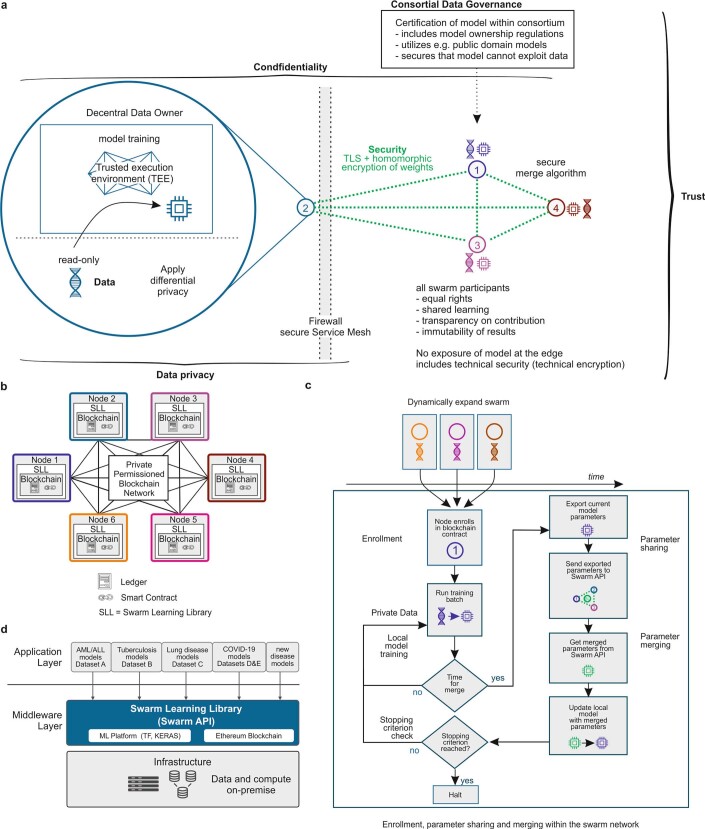
Fast and reliable detection of patients with severe and heterogeneous illnesses is a major goal of precision medicine 1,2 . Patients with leukaemia can be identified using machine learning on the basis of their blood transcriptomes 3 . However, there is an increasing divide between what is technically possible and what is allowed, because of privacy legislation 4,5 . Here, to facilitate the integration of any medical data from any data owner worldwide without violating privacy laws, we introduce Swarm Learning—a decentralized machine-learning approach that unites edge computing, blockchain-based peer-to-peer networking and coordination while maintaining confidentiality without the need for a central coordinator, thereby going beyond federated learning. To illustrate the feasibility of using Swarm Learning to develop disease classifiers using distributed data, we chose four use cases of heterogeneous diseases (COVID-19, tuberculosis, leukaemia and lung pathologies). With more than 16,400 blood transcriptomes derived from 127 clinical studies with non-uniform distributions of cases and controls and substantial study biases, as well as more than 95,000 chest X-ray images, we show that Swarm Learning classifiers outperform those developed at individual sites. In addition, Swarm Learning completely fulfils local confidentiality regulations by design. We believe that this approach will notably accelerate the introduction of precision medicine.
Verified 2026-10-05 · 1 reference not checked yet
Overview
CoChat Summary
TL;DR
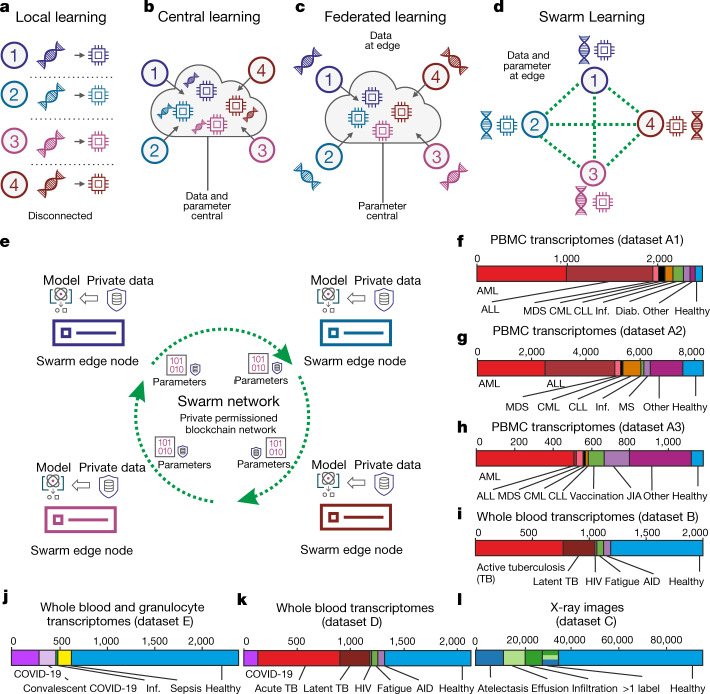
Swarm Learning (SL) is a decentralized machine-learning approach that combines edge computing, permissioned blockchain peer-to-peer networking, and coordination without a central parameter server, preserving confidentiality by design. Across four disease use cases—leukaemia, tuberculosis, COVID-19, and lung pathologies—SL classifiers trained on distributed data outperformed classifiers developed at individual sites and were close to or equivalent to centralized models.
Key findings
- Using more than 16,400 blood transcriptomes from 127 clinical studies and more than 95,000 chest X-ray images, SL outperformed individual nodes across leukaemia, tuberculosis, COVID-19, and lung pathology use cases; central models were only slightly better or equivalent in several scenarios.
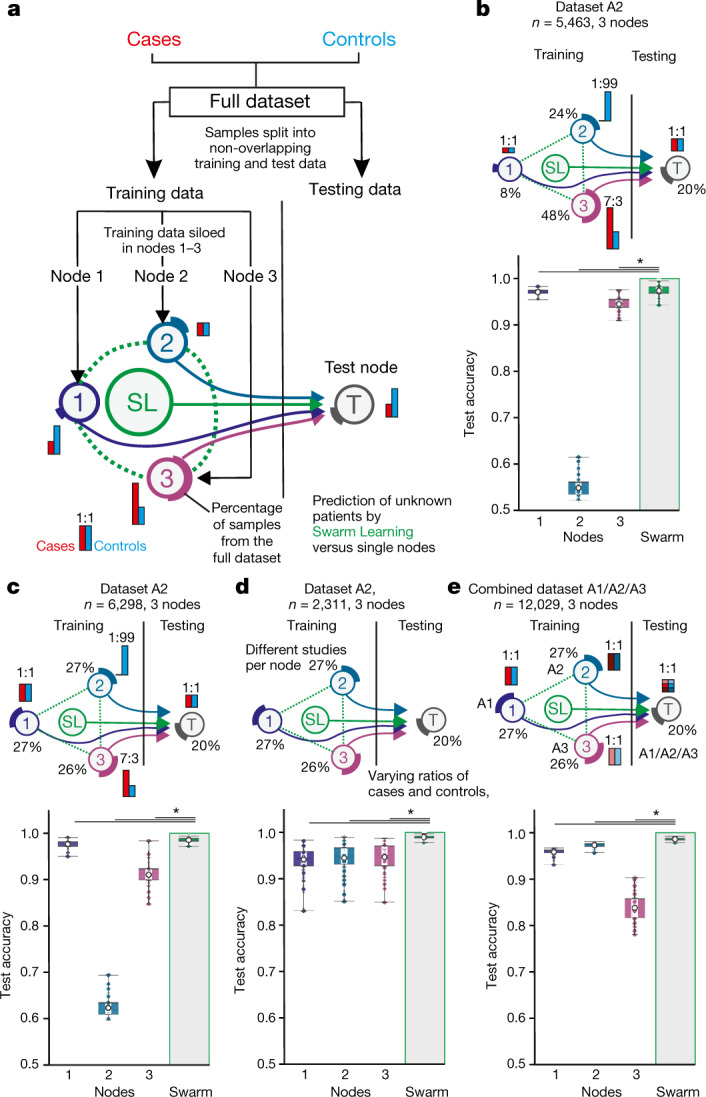
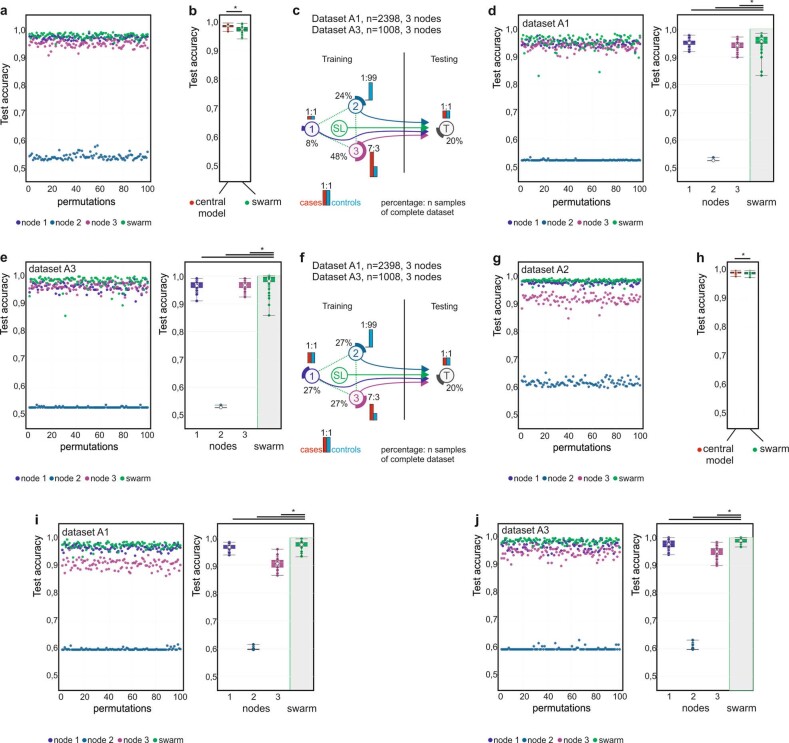
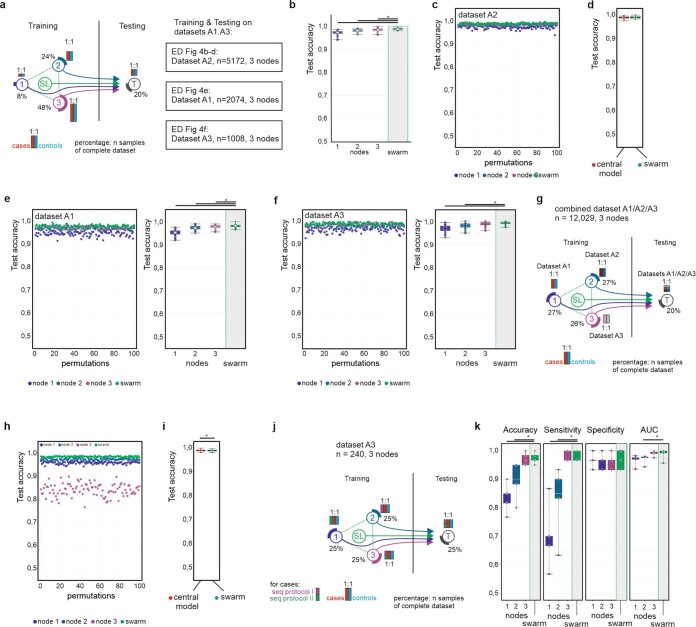
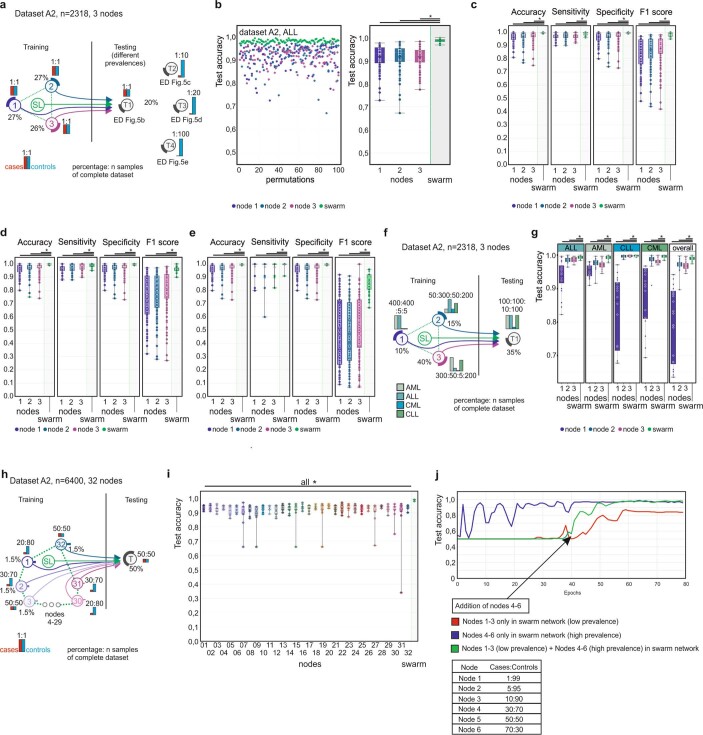
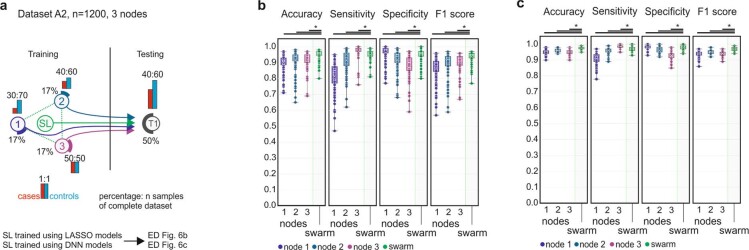
- In leukaemia PBMC datasets A1–A3, comprising more than 12,000 individuals, SL outperformed each node across multiple scenarios, including uneven case/control distributions, study-specific siloing, different transcriptomic technologies, up to 32 nodes, and LASSO instead of deep neural networks.
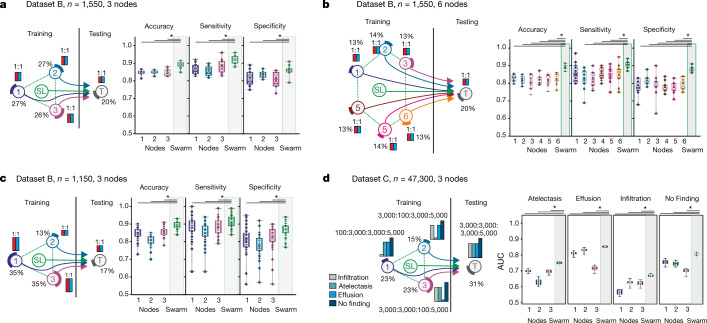
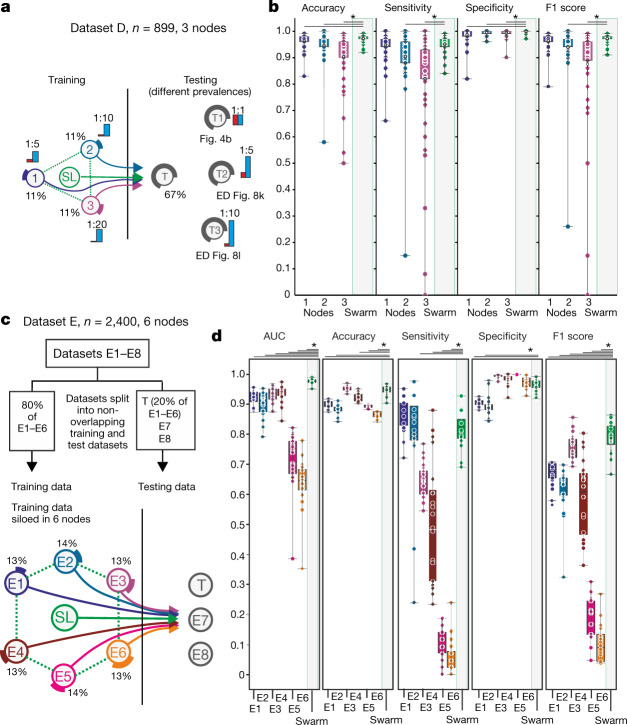
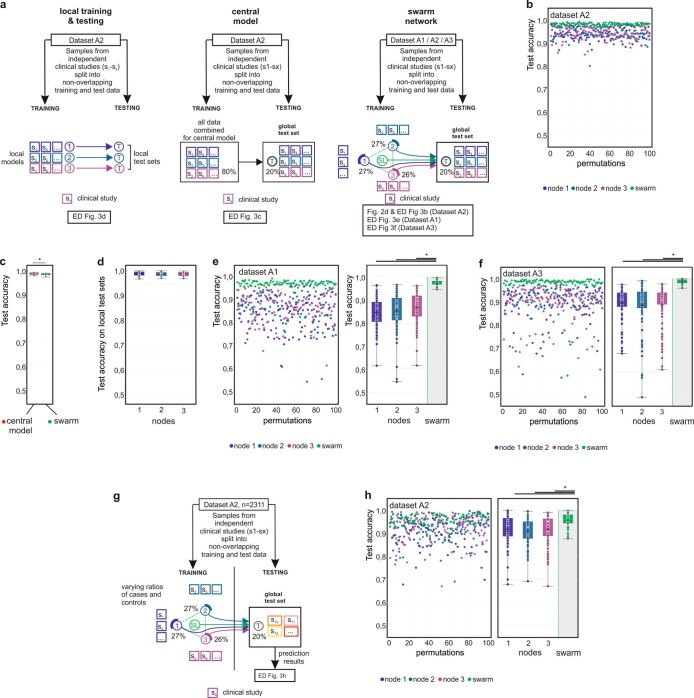
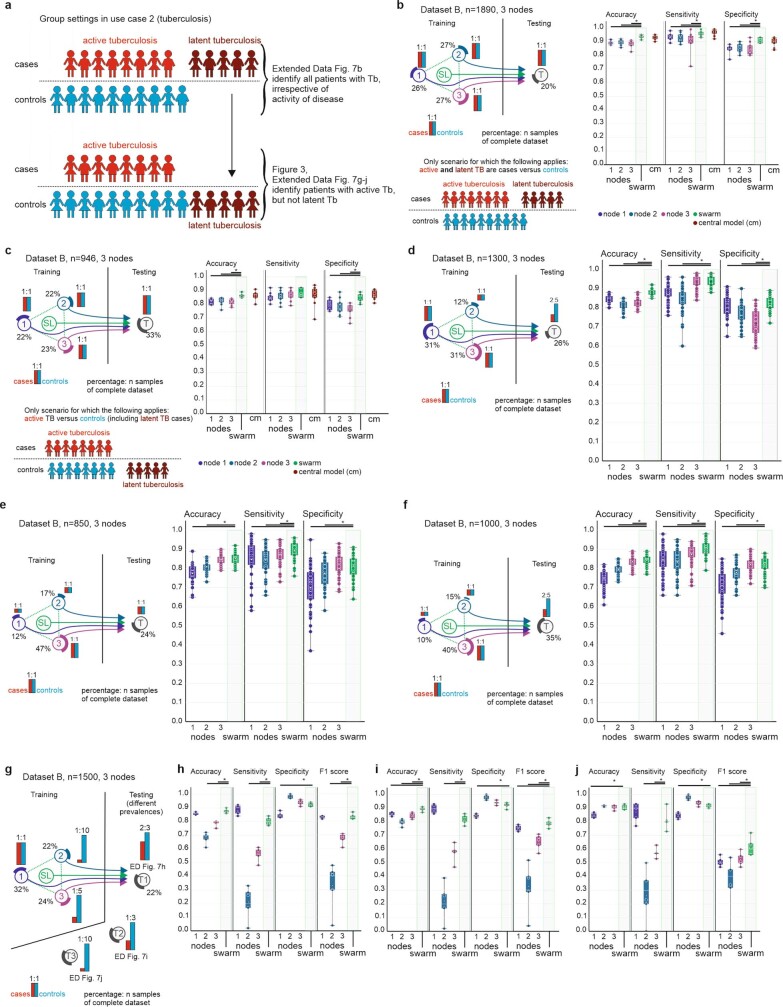
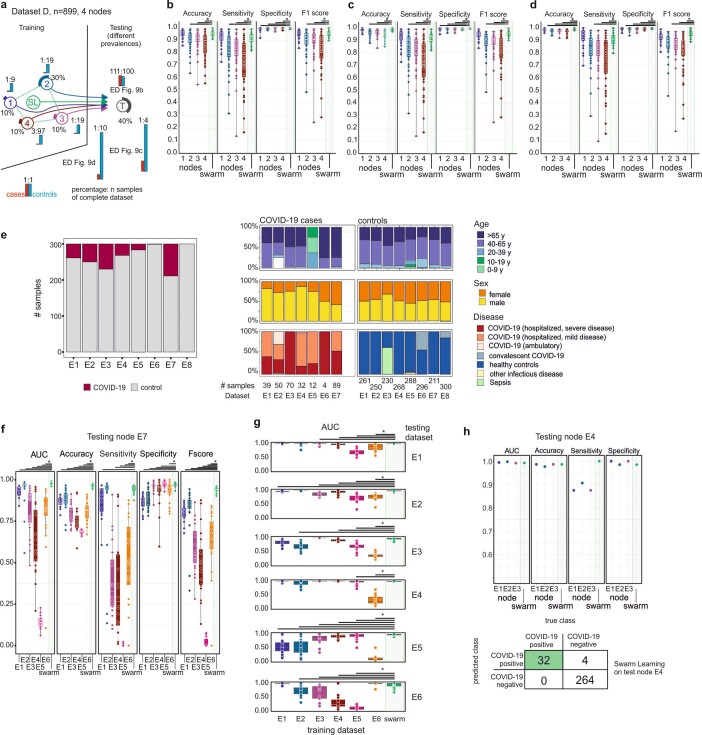
- For tuberculosis, SL outperformed individual nodes even when training samples were reduced by 50% or split into six smaller nodes; for COVID-19, SL outperformed all nodes in AUC on global test datasets and predicted samples from other centres when individual centre nodes could not.
- Overall, 16,694 analyses were performed across 26 AML, 4 ALL, 13 TB, 1 X-ray, and 18 COVID-19 scenarios, with 5–100 permutations per scenario and a total of 8,347 computer hours.
Methods
- Design: decentralized SL framework using edge nodes and a permissioned blockchain for secure onboarding, dynamic leader election, and parameter merging, with no central parameter server; raw data remain local and model parameters are exchanged and merged.
- Data: PBMC transcriptome datasets A1 (n = 2,500), A2 (n = 8,348), and A3 (n = 1,181); whole-blood datasets B (n = 1,999), D (n = 2,143), and E (n = 2,400); chest X-ray dataset C (95,831 images); simulations used 3–32 training nodes and independent test nodes.
- Analysis: deep neural network (Keras sequential) and LASSO; performance metrics included sensitivity, specificity, accuracy, F1 score, and AUC; differences were tested with one-sided Wilcoxon signed-rank test with continuity correction, using 5–100 permutations per scenario.
Limitations
- Stated: no statistical methods were used to predetermine sample size; experiments were not randomized, although permutations were performed; investigators were not blinded to allocation during experiments and outcome assessment.
- Stated/implied: SL performance was tested in simulated siloing and outbreak scenarios using existing datasets, not in a prospective real-world multi-centre clinical deployment; the paper notes potential limitations in TB outbreak scenarios but does not quantify them.
- Evident: although confidentiality is preserved by design and no raw data are exchanged, model parameters are shared; the paper suggests SL can inherit differential privacy, functional encryption, or encrypted transfer learning, but these were not implemented or tested here.
Model-written summary. Check it against the paper before relying on it.
Integrity signals
Registry
Cites
Statistics
Figures
Verification
Claims the paper makes
6 Valid · 0 Not valid · 7 Not checked · 58 Own results and interpretations
The cited sources support only part of this claim — read each source’s verdict below.
In the paper
“As medicine is inherently decentral, the volume of local data is often insufficient to train reliable classifiers20,21.”
§ Swarm Learning for decentralized and confidential clinical machine learning > Main
What the sources say
- Not checked yetcites [20] Rajkomar A Dean J Kohane I Machine learning in medicine N. Engl. J. Med. 2019 380 1347 1358 10.1056/NEJMra1814259 30943338 source
- Partly supportedcites [21] Savage N Calculating disease Nature 2017 550 S115 S117 10.1038/550S115a 29045372 sourceExperimental — accuracy not yet measured
In “BIOPSY BY NUMBERS” (page unavailable), the paper says a researcher wants a much larger dataset to validate and refine an ALS classification algorithm, and describes a shared MRI repository assembled to provide larger datasets. It does not say that medicine is inherently decentralized or that local datasets are often insufficient to train reliable classifiers; it also reports good predictions from a relatively small dataset. (LLM, conf=0.78)
plainstates a cause- Asserted: passes — The authors put it forward as true.
- Checkable: passes — It can be checked against evidence.
- Load-bearing: passes — The paper’s conclusions depend on it.
- Based: passes — The paper gives a reason why it holds.
The cited sources support only part of this claim — read each source’s verdict below.
In the paper
“With increasing efforts to enforce data privacy and security5,9,10 and to reduce data traffic and duplication, a decentralized data model will become the preferred choice for handling, storing, managing, and analysing any kind of large medical dataset19.”
§ Swarm Learning for decentralized and confidential clinical machine learning > Discussion
What the sources say
- Partly supportedcites [19] Kaissis GA Makowski MR Rückert D Braren RF Secure, privacy-preserving and federated machine learning in medical imaging Nat. Mach. Intell. 2020 2 305 311 10.1038/s42256-020-0186-1 sourceExperimental — accuracy not yet measured
The Outlook section of our copy supports the direction of the claim: it states that decentralized data storage and federated learning systems are 'replacing the current paradigm of data sharing and centralized storage' and are driven by privacy requirements, and the paper elsewhere notes such methods 'should require minimal or no data transfer'. However, the source hedges this as having 'the greatest potential to enable privacy-preserving cross-institutional research in a breadth of biomedical disciplines in the near future', whereas the citing sentence asserts it as a certainty ('will become the preferred choice') and extends it to 'handling, storing, managing, and analysing any kind of large medical dataset' — a scope and a confidence level the source does not claim. The 'reduce data traffic and duplication' motive is only partly reflected (the paper in fact lists communication overhead and burdensome data transfer as limitations of decentralized/federated and SMPC approaches). (LLM, conf=0.72)
plainstates a cause- Asserted: passes — The authors put it forward as true.
- Checkable: unclear — It is unclear whether it could be checked against evidence.
- Load-bearing: passes — The paper’s conclusions depend on it.
- Based: passes — The paper gives a reason why it holds.
- Partly supported
The cited sources support only part of this claim — read each source’s verdict below.
In the paper
“with current privacy regulations5,9,10 making it less appealing to develop centralized AI systems”
§ Swarm Learning for decentralized and confidential clinical machine learning > Discussion
What the sources say
- Partly supportedcites [5] Price WN II Cohen IG Privacy in the age of medical big data Nat. Med. 2019 25 37 43 10.1038/s41591-018-0272-7 30617331 PMC6376961 sourceExperimental — accuracy not yet measured
Price & Cohen (2019) do support the general thrust: in 'A path forward' they write that 'The basic harm of privacy overprotection is the brakes it puts on data-driven innovation,' that privacy protections limit data aggregation and innovative data use, and that 'Patchy, fragmented health data make data-driven innovation hard, imposing both technological and economic hurdles' (A path forward); they also note in 'Why do we need big data in health?' that AI uses 'require very large sets of data' and that without them 'algorithms cannot be trained or ... evaluated.' But our copy nowhere contrasts centralized with decentralized/federated architectures, and says nothing about privacy regulation making 'centralized' AI systems specifically less appealing — that comparative claim is the citing authors'. The paper's regulatory discussion is also confined to U.S. law (HIPAA de-identification, covered entities), narrower than the unqualified 'current privacy regulations' in the citing sentence. (LLM, conf=0.72)
- Not checked yetcites [9] Kels CG HIPAA in the era of data sharing J. Am. Med. Assoc. 2020 323 476 477 10.1001/jama.2019.19645 32016301 source
- Not checked yetcites [10] McCall B What does the GDPR mean for the medical community? Lancet 2018 391 1249 1250 10.1016/S0140-6736(18)30739-6 29619949 source
plainstates a cause- Asserted: passes — The authors put it forward as true.
- Checkable: passes — It can be checked against evidence.
- Load-bearing: passes — The paper’s conclusions depend on it.
- Based: passes — The paper gives a reason why it holds.
- Partly supported
Every source the paper cites for this claim was checked and supports it.
In the paper
“but progress is hindered by the limited size of datasets19”
§ Swarm Learning for decentralized and confidential clinical machine learning > Discussion
What the sources say
- Supportedcites [19] Kaissis GA Makowski MR Rückert D Braren RF Secure, privacy-preserving and federated machine learning in medical imaging Nat. Mach. Intell. 2020 2 305 311 10.1038/s42256-020-0186-1 source
The opening of our copy (Abstract/front-matter, p. 305) states that 'the broad application of artificial intelligence techniques in medicine is currently hindered by limited dataset availability for algorithm training and validation.' The Introduction (Abstract section, p. 305) ties progress specifically to oncology applications (tumour detection, genomic characterization, subtyping, grading, outcome/relapse risk) to 'the release of large, curated corpora of images', notes that 'even the largest current imaging studies in the field ... include considerably less data than, for example, ImageNet', and that 'the inability to access and leverage this data poses a significant barrier to AI applications in this field.' This supports the paraphrase that limited dataset size hinders progress in oncology machine learning, with the caveat that the source's scope is medical imaging AI generally rather than oncology alone. (LLM, conf=0.85)
plainstates a cause- Asserted: passes — The authors put it forward as true.
- Checkable: passes — It can be checked against evidence.
- Load-bearing: passes — The paper’s conclusions depend on it.
- Based: passes — The paper gives a reason why it holds.
- Supported
A result the paper reports from its own data — it cites no other source for it, so there is none to check. The quote shows it is in the paper.
In the paper
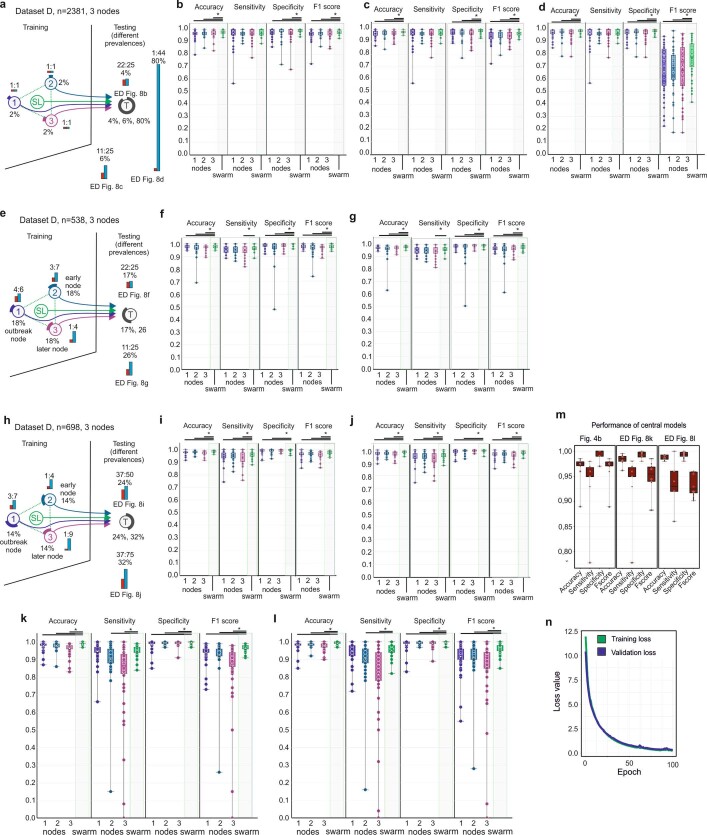
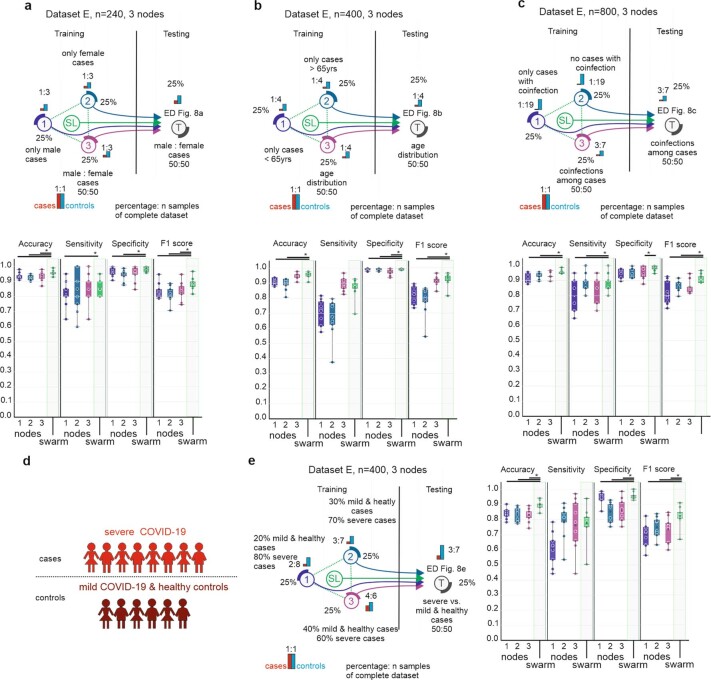
“When we reduced cases at training nodes, all performance measures remained very high at the test node for SL and individual nodes (Extended Data Fig. 8e–j).”
§ Swarm Learning for decentralized and confidential clinical machine learning > Identification of COVID-19
plain- Asserted: passes — The authors put it forward as true.
- Checkable: passes — It can be checked against evidence.
- Load-bearing: unclear — It is unclear whether the paper’s conclusions depend on it.
- Based: passes — The paper gives a reason why it holds.
32 more claims
Create a free account to see all 71 claims and to verify the 16 references still open.
- It may state two separate claims as one. 18
- Probably not a substantial claim. 20
Claims other papers make about this one
Each is checked against this paper’s own text: does it say what the citing paper says it does?
The source backs part of the claim, not all of it — or backs it for a different population, condition or comparison.
In the citing paper
“It can also overcome the straggler dilemma with heterogeneous hardware, as well as improve the robustness to data poisoning attacks and master node fails [35], [145].”
From Edge artificial intelligence for 6g: vision, enabling technologies, and applications (2022) · cites this paper as [35]
Experimental — accuracy not yet measuredThe source backs part of the claim, not all of it — or backs it for a different population, condition or comparison.
In the citing paper
“FL allows training of AI models through averaging of local updates from numerous healthcare facilities and smart devices, such as IoMT, despite the lack of local data.”
From Federated learning-based AI approaches in smart healthcare: Concepts, taxonomies, challenges and open issues (2023) · cites this paper as [11]
Experimental — accuracy not yet measuredThe source backs part of the claim, not all of it — or backs it for a different population, condition or comparison.
In the citing paper
“Federated Learning has presented itself as a viable method for implementing economic, innovative healthcare systems while ensuring privacy [11–15].”
From Federated learning-based AI approaches in smart healthcare: Concepts, taxonomies, challenges and open issues (2023) · cites this paper as [11]
Experimental — accuracy not yet measuredThe cited source says what the claim attributes to it.
In the citing paper
“In particular, swarm learning [35] provides a completely decentralized AI solution based on decentralized ML by keeping local datasets at each edge device.”
From Edge artificial intelligence for 6g: vision, enabling technologies, and applications (2022) · cites this paper as [35]
The cited source says what the claim attributes to it.
In the citing paper
“Besides, swarm learning has recently been developed in [35] to provide a decentralized and confidential clinical disease detection solution for diseases (e.g., COVID-19, tuberculosis, and leukaemia).”
From Edge artificial intelligence for 6g: vision, enabling technologies, and applications (2022) · cites this paper as [35]
6 more claims about this paper
Create a free account to see every claim other papers make about this one.
Citations
Cites
Moderated estimation of fold change and dispersion for RNA-seq data with DESeq2
Love, M. I., Huber, W., & Anders, S. (2014) · Genome Biology · doi:10.1186/s13059-014-0550-8 · Cited by 95,106
LeCun, Y., Bengio, Y., & Hinton, G. (2015) · Nature · doi:10.1038/nature14539 · Cited by 84,126
Scikit-learn: Machine Learning in Python
Pedregosa, F., Varoquaux, G., Gramfort, A., Michel, V., Thirion, B., Grisel, O., Blondel, M., Müller, A., Nothman, J., Louppe, G., et al. (2012) · arXiv · doi:10.48550/arxiv.1201.0490 · Cited by 71,016
STAR: ultrafast universal RNA-seq aligner
Dobin, A., Davis, C. A., Schlesinger, F., Drenkow, J., Zaleski, C., Jha, S., Batut, P., Chaisson, M., & Gingeras, T. R. (2013) · Bioinformatics · doi:10.1093/bioinformatics/bts635 · Cited by 51,709
Bootstrap methods: another look at the jackknife
Efron, B. (1979) · The Annals of Statistics · doi:10.1214/aos/1176344552 · Cited by 17,602
Dermatologist-level classification of skin cancer with deep neural networks
Esteva, A., Kuprel, B., Novoa, R. A., Ko, J., Swetter, S. M., Blau, H. M., & Thrun, S. (2017) · Nature · doi:10.1038/nature21056 · Cited by 14,362 · cited 1×
“Particularly in oncology, success has been reported in machine-learning-based tumour detection 3,37 , sub-typing 38 , and outcome prediction 39 , but progress is hindered by the limited size of datasets 19 , with current privacy regulations 5,9,10 making it less appealing to develop centralized AI…”
BackgroundCommunication-Efficient Learning of Deep Networks from Decentralized Data
McMahan, H. B., Moore, E., Ramage, D., Hampson, S., & Arcas, B. A. Y. (2016) · arXiv · doi:10.48550/arxiv.1602.05629 · Cited by 14,215
Gene Expression Omnibus: NCBI gene expression and hybridization array data repository
Edgar, R. (2002) · Nucleic Acids Research · doi:10.1093/nar/30.1.207 · Cited by 13,288
Exploration, normalization, and summaries of high density oligonucleotide array probe level data
Irizarry, R. A. (2003) · Biostatistics · doi:10.1093/biostatistics/4.2.249 · Cited by 10,603
Detection of 2019 novel coronavirus (2019-nCoV) by real-time RT-PCR
Corman, V. M., Landt, O., Kaiser, M., Molenkamp, R., Meijer, A., Chu, D. K., Bleicker, T., Brünink, S., Schneider, J., Schmidt, M. L., et al. (2020) · Eurosurveillance · doi:10.2807/1560-7917.es.2020.25.3.2000045 · Cited by 7,344 · cited 10×
“We obtained very similar results using datasets A1 and A3, which strongly supports the idea that the improvement in performance of SL is independent of data collection (clinical studies) or the technologies (microarray or RNA-seq) used for data generation (Extended Data Fig.”
MethodInfluential
Cited by
Items 101–200 of 944
Shi, Y., Zhou, M., Chang, C., Jiang, P., Wei, K., Zhao, J., Shan, Y., Zheng, Y., Zhao, F., Lv, X., et al. (2024) · Frontiers in Immunology · doi:10.3389/fimmu.2024.1409555 · Cited by 71
Differentially private knowledge transfer for federated learning
Qi, T., Wu, F., Wu, C., He, L., Huang, Y., & Xie, X. (2023) · Nature Communications · doi:10.1038/s41467-023-38794-x · Cited by 65
Butler‐Laporte, G., Povysil, G., Kosmicki, J. A., Cirulli, E. T., Drivas, T. G., Furini, S., Saad, C., Schmidt, A., Olszewski, P., Korotko, U., et al. (2022) · PLoS Genetics · doi:10.1371/journal.pgen.1010367 · Cited by 71
“In the future, more sophisticated approaches may be required to increase statistical power of exome-wide rare variant association studies [50].”
BackgroundSelf-citationLi, Z., Lu, J., Luo, S., Zhu, D., Shao, Y., Li, Y., Zhang, Z., Wang, Y., & Wu, C. (2022) · IEEE Transactions on Big Data · doi:10.1109/tbdata.2022.3222971 · Cited by 85
“Most recently, swarm learning [25] has been brought up as a P2P FL customized for medical research, utilizing edge computing and blockchain as infrastructures, and it has attracted wide attention.”
BackgroundSelf-citationBig data and deep learning for RNA biology
Hwang, H., Jeon, H., Yeo, N., & Baek, D. (2024) · Experimental & Molecular Medicine · doi:10.1038/s12276-024-01243-w · Cited by 74
Cheng, F., Wang, F., Tang, J., Zhou, Y., Fu, Z., Zhang, P., Haines, J. L., Leverenz, J. B., Gan, L., Hu, J., et al. (2024) · Cell Reports Medicine · doi:10.1016/j.xcrm.2023.101379 · Cited by 63
Zhou, J., Chen, S., Wu, Y., Li, H., Zhang, B., Zhou, L., Hu, Y., Xiang, Z., Li, Z., Chen, N., et al. (2024) · Science Advances · doi:10.1126/sciadv.adh8601 · Cited by 63
Westerlund, A. M., Hawe, J. S., Heinig, M., & Schunkert, H. (2021) · International Journal of Molecular Sciences · doi:10.3390/ijms221910291 · Cited by 77
Progress and challenges of artificial intelligence in lung cancer clinical translation
Zhu, E., Muneer, A., Zhang, J., Yang, X., Li, X., Zhou, C., Heymach, J. V., Wu, J., & Le, X. (2025) · npj Precision Oncology · doi:10.1038/s41698-025-00986-7 · Cited by 65
Shad, R., Cunningham, J. P., Ashley, E. A., Langlotz, C. P., & Hiesinger, W. (2021) · Nature Machine Intelligence · doi:10.1038/s42256-021-00399-8 · Cited by 55
da Silva, H. E. C., Santos, G. N. M., Leite, A. F., Mesquita, C. R. M., Figueiredo, P. T. D. S., Stefani, C. M., & de Melo, N. S. (2023) · PLoS ONE · doi:10.1371/journal.pone.0292063 · Cited by 81
Federated Learning for Diabetic Retinopathy Detection Using Vision Transformers
Chetoui, M., & Akhloufi, M. A. (2023) · BioMedInformatics · doi:10.3390/biomedinformatics3040058 · Cited by 67
Liu, Y., Huo, L., Wu, J., & Bashir, A. K. (2023) · IEEE Transactions on Intelligent Transportation Systems · doi:10.1109/tits.2023.3234444 · Cited by 69
“Recently, [7] put forward SL to solve the “integration before processing” problem in data analysis.”
BackgroundOpportunities and challenges for deep learning in cell dynamics research
Chai, B., Efstathiou, C., Yue, H., & Draviam, V. M. (2023) · Trends in Cell Biology · doi:10.1016/j.tcb.2023.10.010 · Cited by 63
“Swarm learning has been proposed for decentralised and con fi dential X-ray image analysis [111] and digital pathology [112], and could be extended to cell biological images and live-cell movies.”
Artificial Intelligence-Powered Blockchains for Cardiovascular Medicine
Krittanawong, C., Aydar, M., Virk, H. U. H., Kumar, A., Kaplin, S. L., Guimaraes, L., Wang, Z., & Halperin, J. L. (2021) · Canadian Journal of Cardiology · doi:10.1016/j.cjca.2021.11.011 · Cited by 63
Distributed and Secure Federated Learning for Wireless Computing Power Networks
Wang, P., Sun, W. Y., Zhang, H., Ma, W., & Zhang, Y. (2023) · IEEE Transactions on Vehicular Technology · doi:10.1109/tvt.2023.3247859 · Cited by 57
“Warnat-Herresthal et al. [21] introduced Swarm Learning, a decentralized machine, learning approach that unites edge computing, blockchain-based peer-to-peer networking and coordination while maintaining confiden-tiality without the need for a central coordinator, thereby going beyond federated…”
BackgroundMaize yield prediction using federated random forest
Zhang, Q., Zhao, X., Han, Y., Yang, F., Pan, S., Liu, Z., Wang, K., & Zhao, C. (2023) · Computers and Electronics in Agriculture · doi:10.1016/j.compag.2023.107930 · Cited by 60
Federated Learning in Ocular Imaging: Current Progress and Future Direction
Nguyen, T. X., Ran, A. R., Hu, X., Yang, D., Jiang, M., Dou, Q., & Cheung, C. Y.-L. (2022) · Diagnostics · doi:10.3390/diagnostics12112835 · Cited by 59
Gupta, S., Kumar, S., Chang, K., Lu, C., Singh, P., & Kalpathy–Cramer, J. (2023) · Radiographics · doi:10.1148/rg.220107 · Cited by 63
Personalized and privacy-preserving federated heterogeneous medical image analysis with PPPML-HMI
Zhou, J., Zhou, L., Wang, D., Xu, X., Li, H., Chu, Y., Han, W., & Gao, X. (2023) · Computers in Biology and Medicine · doi:10.1016/j.compbiomed.2023.107861 · Cited by 57
Tong, Z., Wang, J., Hou, X., Chen, J., Jiao, Z., & Liu, J. (2024) · IEEE Internet of Things Journal · doi:10.1109/jiot.2024.3370964 · Cited by 59
“Additionally, swarm learning was conceived in [31] for fast and reliable detection of patients with severe and diverse illnesses.”
BackgroundFunctional genomics data: privacy risk assessment and technological mitigation
Gürsoy, G., Li, T., Liu, S. X., Ni, E., Brannon, C. M., & Gerstein, M. (2021) · Nature Reviews Genetics · doi:10.1038/s41576-021-00428-7 · Cited by 57
Ma, Y., Zhang, C., Cabezas, M., Song, Y., Tang, Z., Liu, D., Cai, W., Barnett, M. H., & Wang, C. (2022) · IEEE Journal of Biomedical and Health Informatics · doi:10.1109/jbhi.2022.3151741 · Cited by 60
Quantitative protein biomarker panels: a path to improved clinical practice through proteomics
Hartl, J., Kurth, F., Kappert, K., Horst, D. A., Mülleder, M., Hartmann, G., & Ralser, M. (2023) · EMBO Molecular Medicine · doi:10.15252/emmm.202216061 · Cited by 58
“Newly developed ML strategies can simplify collaborative big-data studies, which comply with local data privacy regulations by sharing insights from data analysis performed at each site, but not the actual data (Warnat-Herresthal et al , 2021).”
BackgroundSelf-citationA survey on privacy for B5G/6G: New privacy challenges, and research directions
Sandeepa, C., Siniarski, B., Kourtellis, N., Wang, S., & Liyanage, M. (2022) · Journal of Industrial Information Integration · doi:10.1016/j.jii.2022.100405 · Cited by 63
“Privacy Preserving Decentralized AI Use of Federated Learning, and Swarm Learning [110, 111, 114] Possible use of other approaches such as Gossip Learning [116, 117], and decentralized Reinforcement Learningl [118, 119] Difficulty in selection of which learning technique to be used due to trade-offs, Cost in modificat…”
BackgroundMethodInfluentialMachine learning facilitating the rational design of nanozymes
Li, Y., Zhang, R., Yan, X., & Fan, K. (2023) · Journal of Materials Chemistry B · doi:10.1039/d3tb00842h · Cited by 54
Self-citationPrivacy-Preserving AI Framework for 6G-Enabled Consumer Electronics
Wang, X., Lyu, J., Peter, J. D., & Kim, B. (2024) · IEEE Transactions on Consumer Electronics · doi:10.1109/tce.2024.3371928 · Cited by 59
“Warnat-Herresthal et al. [34] introduced swarm learning, a decentralized machine learning approach.”
BackgroundMulti-omics based artificial intelligence for cancer research
Li, L., Sun, M., Wang, J., & Wan, S. (2024) · Advances in cancer research · doi:10.1016/bs.acr.2024.06.005 · Cited by 58
Differentially Private Federated Learning via Reconfigurable Intelligent Surface
Yang, Y., Zhou, Y., Wu, Y., & Shi, Y. (2022) · IEEE Internet of Things Journal · doi:10.1109/jiot.2022.3168066 · Cited by 53
“FL spans a wide scope of applications from 6G [1], [3], [4], IoT [5], [6], and keyboard prediction [7], to the recent applications in healthcare informatics [8]–[10], medical imaging [11], drug discovery [12], and diabetes mellitus [13].”
BackgroundLiu, N., Liu, M., Chen, X., Ning, Y., Lee, J. W., Siddiqui, F. J., Saffari, S. E., Ho, A. F. W., Shin, S. D., Huei‐Ming, M., et al. (2022) · EClinicalMedicine · doi:10.1016/j.eclinm.2022.101422 · Cited by 53
Efficient and Secure Federated Learning With Verifiable Weighted Average Aggregation
Yang, Z., Zhou, M. L., Yu, H., Sinnott, R., & Liu, H. (2022) · IEEE Transactions on Network Science and Engineering · doi:10.1109/tnse.2022.3206243 · Cited by 53
“Compared with the extensively adopted centralized learning paradigm [6], FL can build a well-trained model by collaboratively utilizing all participant’s data whilst protecting their data privacy [7], [8].”
Artificial Intelligence and liver: Opportunities and barriers
Balsano, C., Burra, P., Duvoux, C., Alisi, A., Piscaglia, F., Gerussi, A., Brunetto, M. R., Bonino, F., Montalti, R., Campanile, S., et al. (2023) · Digestive and Liver Disease · doi:10.1016/j.dld.2023.08.048 · Cited by 55
Amrollahi, F., Shashikumar, S. P., Holder, A. L., & Nemati, S. (2022) · Scientific Reports · doi:10.1038/s41598-022-12497-7 · Cited by 44
“Privacy-preserving methods have been proposed to leverage such data for learning while respecting institutional boundaries and autonomy over patient data 26,27 .”
Blockchain for Genomics: A Systematic Literature Review
Alghazwi, M., Türkmen, F., van der Velde, K. J., & Karastoyanova, D. (2022) · Distributed Ledger Technologies Research and Practice · doi:10.1145/3563044 · Cited by 53
“Additionally, federated learning using a blockchain solution called Swarm Learning (SL) was proposed in [116].”
Applying federated learning to combat food fraud in food supply chains
Gavai, A., Bouzembrak, Y., Mu, W., Martin, F. J., Kaliyaperumal, R., van Soest, J., Choudhury, A., Heringa, J., Dekker, A. L. A. J., & Marvin, H. J. P. (2023) · npj Science of Food · doi:10.1038/s41538-023-00220-3 · Cited by 54
Federated Edge Learning for 6G: Foundations, Methodologies, and Applications
Tao, M., Zhou, Y., Shi, Y., Lu, J., Cui, S. R., Lü, J., & Letaief, K. B. (2024) · Proceedings of the IEEE · doi:10.1109/jproc.2024.3509739 · Cited by 59
“In addition, blockchain can be integrated with swarm learning for further enhancing the privacy performance, as demonstrated in [332], while enhancing the classification accuracy of disease detection.”
Blockchain-Empowered Federated Learning: Benefits, Challenges, and Solutions
Cai, Z., Chen, J., Fan, Y., Zheng, Z., & Li, K. (2025) · IEEE Transactions on Big Data · doi:10.1109/tbdata.2025.3541560 · Cited by 61
“Examples include inter-hospital collab-orations [24], [156] and drone networks [56].”
Artificial intelligence for COVID-19: battling the pandemic with computational intelligence
Xu, Z., Su, C., Xiao, Y., & Wang, F. (2021) · Intelligent Medicine · doi:10.1016/j.imed.2021.09.001 · Cited by 54
Rajendran, S., Pan, W., Sabuncu, M. R., Chen, Y., Zhou, J., & Wang, F. (2024) · Patterns · doi:10.1016/j.patter.2023.100913 · Cited by 47
Liu, G. S., Yang, A., Kim, D., Hojel, A., Voevodsky, D., Wang, J., Tong, C. C. L., Ungerer, H., Palmer, J. N., Kohanski, M. A., et al. (2022) · International Forum of Allergy & Rhinology · doi:10.1002/alr.22958 · Cited by 47
“The development of new machine learning approaches to train neural networks using decentralized and confidential data sets, 21 and an emerging paradigm of leveraging foundation models trained at large scale to downstream tasks in health care, 22 offer unprecedented opportunities to overcome these…”
BackgroundArtificial intelligence in ophthalmology: Progress, challenges, and ethical implications
Savastano, M. C., Rizzo, C., Fossataro, C., Bacherini, D., Giansanti, F., Savastano, A., Arcuri, G., Rizzo, S., & Faraldi, F. (2025) · Progress in Retinal and Eye Research · doi:10.1016/j.preteyeres.2025.101374 · Cited by 52
Decision-Focused Learning for Power System Decision-Making Under Uncertainty
Zhang, H., Li, R., Du, Q., Tao, J., Pineda, S., Kariniotakis, G., Camal, S., Monroc, C. B., Sun, M., Wan, C., et al. (2025) · IEEE Transactions on Power Systems · doi:10.1109/tpwrs.2025.3597806 · Cited by 69
“While techniques such as federated learning [109] and swarm learning [110] have been proposed to address data privacy and collaborative training challenges, their application in DFL remains underexplored.”
Privacy-preserving federated neural network learning for disease-associated cell classification
Sav, S., Bossuat, J.-P., Troncoso-Pastoriza, J. R., Claassen, M., & Hubaux, J. (2022) · Patterns · doi:10.1016/j.patter.2022.100487 · Cited by 62
“The seminal work of SL 15 is based on edge computing and permissioned blockchains and removes the need for a central server in the FL approach.”
BackgroundMethodAdam, M., & Baroudi, U. (2024) · IEEE Open Journal of the Communications Society · doi:10.1109/ojcoms.2024.3506214 · Cited by 46
Direct prediction of genetic aberrations from pathology images in gastric cancer with swarm learning
Saldanha, O. L., Muti, H. S., Grabsch, H. I., Langer, R., Dislich, B., Kohlruss, M., Keller, G., van Treeck, M., Hewitt, K. J., Kolbinger, F. R., et al. (2022) · Gastric Cancer · doi:10.1007/s10120-022-01347-0 · Cited by 50
“SL has been successfully employed in experimental use cases in the analysis of transcriptomic data and X-Ray images [16] as well as computational pathology in colorectal cancer [17].”
MethodSelf-citationFrom Centralized to Federated Learning: Exploring Performance and End-to-End Resource Consumption
Drainakis, G., Pantazopoulos, P., Katsaros, K. V., Sourlas, V., Amditis, A., & Kaklamani, D. I. (2022) · Computer Networks · doi:10.1016/j.comnet.2023.109657 · Cited by 52
Privacy-Preserving Machine Learning for Healthcare: Open Challenges and Future Perspectives
Guerra-Manzanares, A., López, L. J. L., Maniatakos, M., & Shamout, F. E. (2023) · Lecture notes in computer science · doi:10.1007/978-3-031-39539-0_3 · Cited by 65
Decentralised, collaborative, and privacy-preserving machine learning for multi-hospital data
Fang, C., Dziedzic, A., Zhang, L., Oliva, L., Verma, A. A., Razak, F. A., Papernot, N., & Wang, B. (2024) · EBioMedicine · doi:10.1016/j.ebiom.2024.105006 · Cited by 55
“Addressing this limitation, Swarm Learning (SL), 22 on the other hand, is a decentralised FL approach.”
BackgroundDecentralized artificial intelligence in construction using blockchain
Zheng, C., Tao, X., Dong, L., Zukaib, U., Tang, J., Zhou, H., Cheng, J. C. P., Cui, X., & Shen, Z. (2024) · Automation in Construction · doi:10.1016/j.autcon.2024.105669 · Cited by 54
Backdoor Attack and Defense on Deep Learning: A Survey
Bai, Y., Xing, G., Wu, H., Rao, Z., Ma, C., Wang, S., Liu, X., Zhou, Y., Tang, J., Huang, K., et al. (2024) · IEEE Transactions on Computational Social Systems · doi:10.1109/tcss.2024.3482723 · Cited by 74
“Without the need for a central coordinator, swarm learning is a decentralized machine learning technique that combines blockchain-based peer-to-peer networks, edge computing, and coordination while protecting data confidentiality [53].”
Meissen, H. H., Gong, M. N., Wong, A.-K. I., Zimmerman, J. J., Nadkarni, N. M., Kane‐Gill, S. L., Amador-Castaneda, J., Bailey, H., Brown, S. M., DePriest, A., et al. (2022) · Critical Care Explorations · doi:10.1097/cce.0000000000000659 · Cited by 59
“Emerging strategies using blockchain technology have demonstrated that it is possible to federate data in ways that address security concerns (24).”
BackgroundAutomated Tumor Segmentation in Radiotherapy
Savjani, R. R., Lauria, M., Bose, S., Deng, J., Yuan, Y., & Andrearczyk, V. (2022) · Seminars in Radiation Oncology · doi:10.1016/j.semradonc.2022.06.002 · Cited by 50
Developing a classification of hematologic neoplasms in the era of precision medicine
Cazzola, M., & Sehn, L. H. (2022) · Blood · doi:10.1182/blood.2022015849 · Cited by 47
Current State and Prospects of Artificial Intelligence in Allergy
van Breugel, M., Fehrmann, R. S. N., Bügel, M., Rezwan, F. I., Holloway, J. W., Nawijn, M. C., Fontanella, S., Custovic, A., & Koppelman, G. H. (2023) · Allergy · doi:10.1111/all.15849 · Cited by 43
AI in Computational Pathology of Cancer: Improving Diagnostic Workflows and Clinical Outcomes?
Çifçi, D., Veldhuizen, G. P., Foersch, S., & Kather, J. N. (2023) · Annual Review of Cancer Biology · doi:10.1146/annurev-cancerbio-061521-092038 · Cited by 54
Cardiovascular Care Innovation through Data-Driven Discoveries in the Electronic Health Record
Dhingra, L. S., Shen, M., Mangla, A., & Khera, R. (2023) · The American Journal of Cardiology · doi:10.1016/j.amjcard.2023.06.104 · Cited by 47
Blockchain-Based Data Integrity Verification Scheme in AIoT Cloud–Edge Computing Environment
Li, Y., Shen, J., Ji, S., & Lai, Y.-H. (2023) · IEEE Transactions on Engineering Management · doi:10.1109/tem.2023.3262678 · Cited by 42
“Thedecentralization paradigmbecomesaprominentsolution,suchassoftware-definednetworks[5],edgecomputing[6],[7],federallearn-ing[8],andMetaverse[9].”
Self-citationEnergy storage management in electric vehicles
Zhang, J., Che, Y., Teodorescu, R., Song, Z., & Hu, X. (2025) · Nature Reviews Clean Technology · doi:10.1038/s44359-024-00020-2 · Cited by 46
“Remote model training has user-privacy issues, and decentralized machine-learning approaches, such as federated learning and swarm learning 166 , could offer a solu-tion.”
Carstens, M., Vasisht, S., Zhang, Z., Barbur, I., Reinke, A., Maier-Hein, L., Hashimoto, D. A., & Kolbinger, F. R. (2025) · npj Digital Medicine · doi:10.1038/s41746-025-02227-4 · Cited by 51
“…cation of metadata, the use of syntheticorfederateddata, and decentralized learning strategies thatenable cross-institutional model development without direct data exchange can furtherincrease acceptance via increased data con fi dentiality and maximize thebene fi tfromtheavailablepoolofdata 35,36 .”
A Novel Architecture Combining Oracle With Decentralized Learning for IIoT
Lin, Y., Gao, Z., Shi, W., Wang, Q., Li, H., Wang, M., Yang, Y., & Rui, L. (2022) · IEEE Internet of Things Journal · doi:10.1109/jiot.2022.3150789 · Cited by 48
“Moreover, swarm learning [23] proposed to train medical models based on blockchain, edge computing, and federated learning [24].”
BackgroundBlockchain-Based Distributed Federated Learning in Smart Grid
Antal, M., Mihailescu, V., Cioara, T., & Anghel, I. M. (2022) · Mathematics · doi:10.3390/math10234499 · Cited by 44
Xu, H., Seng, K. P., Ang, L.-M., & Smith, J. (2024) · IEEE Access · doi:10.1109/access.2024.3422211 · Cited by 50
“Group learning [108] is a decentralized learning framework based on blockchain technology with inherent features of global collaboration and knowledge sharing.”
Lu, S., Chen, Y., Chen, Y., Li, P., Sun, J., Zheng, C., Zou, Y., Liang, B., Li, M., Jin, Q., et al. (2025) · Nature Communications · doi:10.1038/s41467-025-57427-z · Cited by 50
Gao, Z., Wu, F., Gao, W., & Zhuang, X. (2022) · IEEE Transactions on Medical Imaging · doi:10.1109/tmi.2022.3220750 · Cited by 43
“Among them, swarm learning, a new decentralized paradigm, has been recently proposed [4].”
BackgroundMethodInfluentialAI-assisted facial analysis in healthcare: From disease detection to comprehensive management
Lei, C., Dang, K., Song, S., Wang, Z., Chew, S. P., Bian, R., Yang, X., Guan, Z., Lopes, C. I. M. D. A., Wang, M. H., et al. (2025) · Patterns · doi:10.1016/j.patter.2025.101175 · Cited by 49
“89 Third, leveraging privacy-enhancing technologies throughout the AI life cycle is recommended.”
D→K→I: Data-Knowledge-Driven Group Intelligence Framework for Smart Service in Education Metaverse
Zheng, W., Yan, L., Zhang, W., Ouyang, L., & Ding, W. (2022) · IEEE Transactions on Systems Man and Cybernetics Systems · doi:10.1109/tsmc.2022.3228849 · Cited by 43
“9, we leverage a next-generation AI federation learning architecture [50], [51] to ensure that educational data is stored locally by the data owner.”
BackgroundArtificial intelligence for precision medicine in autoimmune liver disease
Gerussi, A., Scaravaglio, M., Cristoferi, L., Verda, D., Milani, C., Bernardi, E. D., Ippolito, D., Asselta, R., Invernizzi, P., Kather, J. N., et al. (2022) · Frontiers in Immunology · doi:10.3389/fimmu.2022.966329 · Cited by 42
Sharing Data With Shared Benefits: Artificial Intelligence Perspective
Tajabadi, M., Grabenhenrich, L., Ribeiro, A. H., Leyer, M., & Heider, D. (2023) · Journal of Medical Internet Research · doi:10.2196/47540 · Cited by 39
“To address these challenges, new approaches like federated learning (FL) [12] and swarm learning (SL) [13] have emerged in recent years.”
Confederated Learning: Federated Learning With Decentralized Edge Servers
Wang, B., Fang, J., Li, H., Yuan, X., & Ling, Q. H. (2023) · IEEE Transactions on Signal Processing · doi:10.1109/tsp.2023.3241768 · Cited by 45
“A line of research to address the scalability issue is decentralized FL [15], [16], [17], [18], [19], [20], [21], [22], [23], [24], [25], [26], which has attracted much interest due to their enhanced scalability as well as its strengthened robustness to server failures.”
BackgroundPrototype-guided Knowledge Transfer for Federated Unsupervised Cross-modal Hashing
Li, J., Li, F., Zhu, L., Cui, H. J., & Li, J. (2023) · ACM International Conference on Multimedia (ACM MM) · doi:10.1145/3581783.3613837 · Cited by 50
“Deep cross-modal hashing methods generally require large amounts of multi-modal data to train models [16, 42, 45], but due to storage constraints and increasing attention to data privacy protection, collecting a large amount of multi-modal data may be too expensive or even prohibited [51].”
BackgroundPrivacy-preserving techniques for decentralized and secure machine learning in drug discovery
Smajíć, A., Grandits, M., & Ecker, G. F. (2023) · Drug Discovery Today · doi:10.1016/j.drudis.2023.103820 · Cited by 39
Yu, Y., Ren, W., Mao, L., Ouyang, W., Hu, Q., Yao, Q., Tan, Y., He, Z., Ban, X., Hu, H., et al. (2025) · Pharmacological Research · doi:10.1016/j.phrs.2025.107765 · Cited by 38
Blockchain-Based Swarm Learning for the Mitigation of Gradient Leakage in Federated Learning
Madni, H. A., Umer, R. M., & Foresti, G. L. (2023) · IEEE Access · doi:10.1109/access.2023.3246126 · Cited by 36
“The SL framework [20] was proposed for data confidentiality and decentralized clinical machine learning.”
MethodLiang, X., Zhao, J., Chen, Y., Bandara, E., & Shetty, S. S. (2023) · Journal of Medical Internet Research · doi:10.2196/46547 · Cited by 40
“Studies have shown that FL-trained models can achieve performance levels comparable with those trained using centrally hosted data sets and are superior to those trained with single-institution data alone [8,9].”
Leal-Neto, O. B., & von Wyl, V. (2024) · JMIR Public Health and Surveillance · doi:10.2196/49575 · Cited by 38
“Swarm learning, in contrast, uses a completely decentralized network of instances to collaboratively train machine learning models in a peer-to-peer manner [64].”
BackgroundEvery islet matters: improving the impact of human islet research
Gloyn, A. L., Ibberson, M. R., Marchetti, P., Powers, A. C., Rorsman, P., Sander, M., & Solimena, M. (2022) · Nature Metabolism · doi:10.1038/s42255-022-00607-8 · Cited by 37
Jahanbakht, M., Xiang, W., Waltham, N. J., & Azghadi, M. R. (2022) · IEEE Access · doi:10.1109/access.2022.3202975 · Cited by 35
“Centralized deep learning can be divided into data and model parallelization [23], while the decentralized deep learning involves federated learning [21] and fully decentralized swarm learning [24].”
BackgroundMa, S., Chen, J., & Ho, J. W. K. (2023) · Computer Methods and Programs in Biomedicine · doi:10.1016/j.cmpb.2023.107906 · Cited by 36
Optimization of diagnosis and treatment of hematological diseases via artificial intelligence
Wang, S., Huang, Z., Li, J., Wu, Y., Du, J., & Li, T. (2024) · Frontiers in Medicine · doi:10.3389/fmed.2024.1487234 · Cited by 43
Rise of precision medicine: can it deliver on its promise in IBD?
Schreiber, S., Aden, K., Tran, F., & Rosenstiel, P. C. (2025) · Gut · doi:10.1136/gutjnl-2023-330000 · Cited by 38
Self-citationA Comprehensive Analysis of Privacy Protection Techniques Developed for COVID-19 Pandemic
Majeed, A., & Hwang, S. O. (2021) · IEEE Access · doi:10.1109/access.2021.3130610 · Cited by 43
Federated Learning in Healthcare: From Research to Real-World Deployment
Bakas, S., Li, X., Shah, P., & Roth, H. R. (2026) · Annual Review of Biomedical Engineering · doi:10.1146/annurev-bioeng-080125-041414 · Cited by 40
A credibility-aware swarm-federated deep learning framework in internet of vehicles
Wang, Z., Li, X., Wu, T., Chen, X., & Zhang, L. (2023) · Digital Communications and Networks · doi:10.1016/j.dcan.2022.12.018 · Cited by 35
Ngo, T., Nguyen, D. C., Pathirana, P. N., Corben, L. A., Delatycki, M. B., Horne, M., Szmulewicz, D. J., & Roberts, M. (2022) · IEEE Transactions on Neural Systems and Rehabilitation Engineering · doi:10.1109/tnsre.2022.3161272 · Cited by 35
Medical report generation based on multimodal federated learning
Chen, J., & Pan, R. (2024) · Computerized Medical Imaging and Graphics · doi:10.1016/j.compmedimag.2024.102342 · Cited by 41
Santini, F., Wasserthal, J., Agosti, A., Deligianni, X., Keene, K. R., Kan, H. E., Sommer, S., Wang, F., Weidensteiner, C., Manco, G., et al. (2025) · Radiology Artificial Intelligence · doi:10.1148/ryai.240097 · Cited by 39
“…all the necessary training data in a single institution is the use of federated learning 11 , or, in its decentralized form, swarm learning 12,13 , where the same model is trained at different locations on local data, and the model parameters are then aggregated and redistributed multiple…”
AFM3D: An Asynchronous Federated Meta-Learning Framework for Driver Distraction Detection
Liu, S., You, L., Zhu, R., Liu, B., Liu, R., Yu, H., & Yuen, C. (2024) · IEEE Transactions on Intelligent Transportation Systems · doi:10.1109/tits.2024.3357138 · Cited by 38
“Although FL has been widely applied to various data-sensitive domains such as healthcare [8], 1558-0016 © 2024 IEEE.”
MethodLi, X., Gao, B., Qin, Q., Yao, P., Li, J., Zhao, H., Liu, C., Zhang, Q., Hao, Z., Li, Y., et al. (2025) · Nature Electronics · doi:10.1038/s41928-025-01390-6 · Cited by 33
“) # ( s e l c y c n i t y p y c n E ~ PK[1] ~ E n c r y p t i o n c y c l e s ( n o .”
Self-citationRajendran, A., Rajan, R. A., Balasubramaniyam, S., & Elumalai, K. (2025) · iRadiology · doi:10.1002/ird3.70027 · Cited by 43
Intelligent digital twin for federated learning in AIoT networks
Rizwan, A., Ahmad, R., Khan, A. N., Xu, R., & Kim, D. H. (2023) · Internet of Things · doi:10.1016/j.iot.2023.100698 · Cited by 36
Huang, C., Wang, L., & Han, X. G. (2023) · International World Wide Web Conference (WWW) · doi:10.1145/3543507.3583874 · Cited by 51
“3 Collaborative healthcare network [45] is composed of hospitals with multiple locations and diferent medical resources.”
BackgroundMethodDecentralized Machine Learning Training: A Survey on Synchronization, Consolidation, and Topologies
Khan, Q. W., Khan, A. N., Rizwan, A., Ahmad, R., Khan, S., & Kim, D. (2023) · IEEE Access · doi:10.1109/access.2023.3284976 · Cited by 40
Bernier, A., Molnár‐Gábor, F., Knoppers, B. M., Borry, P., César, P. M. D. G., Devriendt, T., Goisauf, M., Murtagh, M. J., Jiménez, P. N., Recuero, M., et al. (2023) · European Journal of Human Genetics · doi:10.1038/s41431-023-01403-y · Cited by 32
Artificial intelligence accelerates multi-modal biomedical process: A Survey
Li, J., Han, X., Qin, Y., Tan, F., Chen, Y., Wang, Z., Song, H., Zhou, X., Zhang, Y., Hu, L., et al. (2023) · Neurocomputing · doi:10.1016/j.neucom.2023.126720 · Cited by 36
Xu, R., Khan, S., Jin, W., Khan, A. N., Khan, Q. W., Lim, S., & Kim, D. H. (2024) · Applied Soft Computing · doi:10.1016/j.asoc.2024.111689 · Cited by 31
Beyond traditional orthopaedic data analysis: AI, multimodal models and continuous monitoring
Oettl, F. C., Zsidai, B., Oeding, J. F., Hirschmann, M. T., FELDT, R. H., Tischer, T., Samuelsson, K., & ESSKA Artificial Intelligence Working Group (2025) · Knee Surgery Sports Traumatology Arthroscopy · doi:10.1002/ksa.12657 · Cited by 34
“To mitigate these risks, researchers have developed sophisticated technical solutions including differential privacy, federated learning, homomorphic encryption, and swarm learning [7, 12, 31, 43, 44, 50].”
Privacy-preserving decentralized learning methods for biomedical applications
Tajabadi, M., Martin, R., & Heider, D. (2024) · Computational and Structural Biotechnology Journal · doi:10.1016/j.csbj.2024.08.024 · Cited by 36
Kuo, T.-T., Gabriel, R. A., Koola, J., Schooley, R. T., & Ohno-Machado, L. (2025) · Nature Communications · doi:10.1038/s41467-025-56510-9 · Cited by 37
Liu, G. S., Fereydooni, S., Lee, M. C., Polkampally, S., Huynh, J. D., Kuchibhotla, S., Shah, M. M., Ayoub, N., Capasso, R., Chang, M. T., et al. (2025) · npj Digital Medicine · doi:10.1038/s41746-025-01693-0 · Cited by 33
“Theuse of frameworks such as federated 39 and swarm learning 40 can help maintain the con fi dentiality of patient data and address data-sharing barriers for building large, representative datasets and accelerating model development and clinical validation.”
Privacy considerations for sharing genomics data
Oestreich, M., Chen, D., Schultze, J. L., Fritz, M., & Becker, M. (2021) · EXCLI journal · doi:10.17179/excli2021-4002 · Cited by 51
Self-citation
Metadata
- Authors
- Warnat-Herresthal, S., Schultze, H., Shastry, K. L., Manamohan, S., Mukherjee, S., Garg, V., Sarveswara, R., Händler, K., Pickkers, P., Aziz, N. A., Ktena, S., Tran, F., Bitzer, M., Ossowski, S., Casadei, N., Herr, C., Petersheim, D., Behrends, U., Kern, F., Fehlmann, T., Schommers, P., Lehmann, C., Augustin, M., Rybniker, J., Altmüller, J., Mishra, N., Bernardes, J. P., Krämer, B., Bonaguro, L., Schulte-Schrepping, J., De Domenico, E., Siever, C., Kraut, M., Desai, M., Monnet, B., Saridaki, M., Siegel, C. M., Drews, A., Nuesch-Germano, M., Theis, H., Heyckendorf, J., Schreiber, S., Kim-Hellmuth, S., (COVAS), C.-1. A. S., Balfanz, P., Eggermann, T., Boor, P., Hausmann, R., Kuhn, H., Isfort, S., Stingl, J. C., Schmalzing, G., Kuhl, C. K., Röhrig, R., Marx, G., Uhlig, S., Dahl, E., Müller-Wieland, D., Dreher, M., Marx, N., Nattermann, J., Skowasch, D., Kurth, I., Keller, A., Bals, R., Nürnberg, P., Rieß, O., Rosenstiel, P., Netea, M. G., Theis, F., Mukherjee, S., Backes, M., Aschenbrenner, A. C., Ulas, T., (DeCOI), D. C.-1. O. I., Angelov, A., Bartholomäus, A., Becker, A., Bezdan, D., Blumert, C., Bonifacio, E., Bork, P., Boyke, B., Blum, H., Clavel, T., Colome-Tatche, M., Cornberg, M., De La Rosa Velázquez, I. A., Diefenbach, A., Dilthey, A., Fischer, N., Förstner, K., Franzenburg, S., Frick, J.-S., Gabernet, G., Gagneur, J., Ganzenmueller, T., Gauder, M., Geißert, J., Goesmann, A., Göpel, S., Grundhoff, A., Grundmann, H., Hain, T., Hanses, F., Hehr, U., Heimbach, A., Hoeper, M., Horn, F., Hübschmann, D., Hummel, M., Iftner, T., Iftner, A., Illig, T., Janssen, S., Kalinowski, J., Kallies, R., Kehr, B., Keppler, O. T., Klein, C., Knop, M., Kohlbacher, O., Köhrer, K., Korbel, J., Kremsner, P. G., Kühnert, D., Landthaler, M., Li, Y., Ludwig, K. U., Makarewicz, O., Marz, M., McHardy, A. C., Mertes, C., Münchhoff, M., Nahnsen, S., Nöthen, M., Ntoumi, F., Overmann, J., Peter, S., Pfeffer, K., Pink, I., Poetsch, A. R., Protzer, U., Pühler, A., Rajewsky, N., Ralser, M., Reiche, K., Ripke, S., da Rocha, U. N., Saliba, A.-E., Sander, L. E., Sawitzki, B., Scheithauer, S., Schiffer, P., Schmid-Burgk, J., Schneider, W., Schulte, E.-C., Sczyrba, A., Sharaf, M. L., Singh, Y., Sonnabend, M., Stegle, O., Stoye, J., Vehreschild, J., Velavan, T. P., Vogel, J., Volland, S., von Kleist, M., Walker, A., Walter, J., Wieczorek, D., Winkler, S., Ziebuhr, J., Breteler, M. M. B., Giamarellos-Bourboulis, E. J., Kox, M., Becker, M., Cheran, S., Woodacre, M. S., Goh, E. L., & Schultze, J. L.
- Affiliations
- Hewlett Packard Enterprise (United States) (US)
- German Center for Neurodegenerative Diseases (DE)
- University of Bonn (DE)
- Radboud University Nijmegen (NL)
- National and Kapodistrian University of Athens (GR)
- Christian-Albrechts-Universität zu Kiel (DE)
- Universitätsklinikum Tübingen (DE)
- University of Tübingen (DE)
- Universitätsklinikum des Saarlandes (DE)
- LMU Klinikum (DE)
- Technical University of Munich (DE)
- Saarland University (DE)
- University of Cologne (DE)
- German Center for Infection Research (DE)
- Universitätsklinikum Aachen (DE)
- RWTH Aachen University (DE)
- University Hospital Bonn (DE)
- GFZ Helmholtz Centre for Geosciences (DE)
- Philipps University of Marburg (DE)
- Center for Regenerative Therapies Dresden (DE)
- European Molecular Biology Laboratory (DE)
- Helmholtz Munich (DE)
- Medizinische Hochschule Hannover (DE)
- University Medical Center Hamburg-Eppendorf (DE)
- Düsseldorf University Hospital (DE)
- ZB MED - Information Centre for Life Sciences (DE)
- Quantitative Biology Center (DE)
- Justus-Liebig-Universität Gießen (DE)
- University Medical Center Freiburg (DE)
- Leibniz Institute of Virology (LIV) (DE)
- German Cancer Research Center (DE)
- Fraunhofer Institute for Cell Therapy and Immunology (DE)
- Charité – Universitätsmedizin Berlin (DE)
- Bielefeld University (DE)
- Helmholtz Centre for Environmental Research (DE)
- Heidelberg University (DE)
- Max Delbrück Center (DE)
- Helmholtz Centre for Infection Research (DE)
- Helmholtz Institute for RNA-based Infection Research (DE)
- Universitätsmedizin Göttingen (DE)
- Robert Koch Institute (DE)
- Max Planck Institute of Molecular Cell Biology and Genetics (DE)
- Corresponding author
- Schultze, Joachim L.
- ORCID
- Warnat-Herresthal, Stefanie
- Schultze, Hartmut
- Manamohan, Sathyanarayanan
- Mukherjee, Saikat
- Garg, Vishesh
- Händler, Kristian
- Pickkers, Peter
- Aziz, N. Ahmad
- Ktena, Sofia
- Tran, Florian
- Bitzer, Michael
- Ossowski, Stephan
- Casadei, Nicolas
- Herr, Christian
- Petersheim, Daniel
- Behrends, Uta
- Kern, Fabian
- Fehlmann, Tobias
- Schommers, Philipp
- Lehmann, Clara
- Augustin, Max
- Rybniker, Jan
- Altmüller, Janine
- Mishra, Neha
- Bernardes, Joana P.
- Krämer, Benjamin
- Bonaguro, Lorenzo
- Schulte-Schrepping, Jonas
- De Domenico, Elena
- Siever, Christian
- Desai, Milind
- Saridaki, Maria
- Siegel, Charles Martin
- Drews, Anna
- Nuesch-Germano, Melanie
- Theis, Heidi
- Heyckendorf, Jan
- Schreiber, Stefan
- Kim-Hellmuth, Sarah
- Balfanz, Paul
- Eggermann, Thomas
- Boor, Peter
- Hausmann, Ralf
- Kuhn, Hannah
- Isfort, Susanne
- Stingl, Julia Carolin
- Kuhl, Christiane K.
- Röhrig, Rainer
- Marx, Gernot
- Uhlig, Stefan
- Dahl, Edgar
- Dreher, Michael
- Marx, Nikolaus
- Nattermann, Jacob
- Skowasch, Dirk
- Kurth, Ingo
- Keller, Andreas
- Bals, Robert
- Nürnberg, Peter
- Rieß, Olaf
- Rosenstiel, Philip
- Netea, Mihai G.
- Theis, Fabian
- Aschenbrenner, Anna C.
- Ulas, Thomas
- Angelov, Angel
- Bartholomäus, Alexander
- Becker, Anke
- Bezdan, Daniela
- Blumert, Conny
- Bonifacio, Ezio
- Blum, Helmut
- Clavel, Thomas
- Cornberg, Markus
- Diefenbach, Andreas
- Dilthey, Alexander
- Fischer, Nicole
- Förstner, Konrad
- Franzenburg, Sören
- Frick, Julia-Stefanie
- Gabernet, Gisela
- Gagneur, Julien
- Ganzenmueller, Tina
- Gauder, Marie
- Geißert, Janina
- Goesmann, Alexander
- Göpel, Siri
- Grundhoff, Adam
- Grundmann, Hajo
- Hain, Torsten
- Hanses, Frank
- Hehr, Ute
- Hoeper, Marius
- Hübschmann, Daniel
- Hummel, Michael
- Iftner, Thomas
- Illig, Thomas
- Kalinowski, Jörn
- Kallies, René
- Kehr, Birte
- Keppler, Oliver T.
- Klein, Christoph
- Knop, Michael
- Kohlbacher, Oliver
- Köhrer, Karl
- Korbel, Jan
- Kremsner, Peter G.
- Kühnert, Denise
- Landthaler, Markus
- Li, Yang
- Ludwig, Kerstin U.
- Makarewicz, Oliwia
- Marz, Manja
- McHardy, Alice C.
- Mertes, Christian
- Nahnsen, Sven
- Nöthen, Markus
- Ntoumi, Francine
- Overmann, Jörg
- Peter, Silke
- Pfeffer, Klaus
- Pink, Isabell
- Poetsch, Anna R.
- Protzer, Ulrike
- Pühler, Alfred
- Rajewsky, Nikolaus
- Ralser, Markus
- Reiche, Kristin
- Ripke, Stephan
- da Rocha, Ulisses Nunes
- Saliba, Antoine-Emmanuel
- Sander, Leif Erik
- Sawitzki, Birgit
- Scheithauer, Simone
- Schiffer, Philipp
- Schmid-Burgk, Jonathan
- Schulte, Eva-Christina
- Sczyrba, Alexander
- Singh, Yogesh
- Sonnabend, Michael
- Stegle, Oliver
- Stoye, Jens
- Velavan, Thirumalaisamy P.
- Vogel, Jörg
- Volland, Sonja
- von Kleist, Max
- Walker, Andreas
- Walter, Jörn
- Wieczorek, Dagmar
- Winkler, Sylke
- Ziebuhr, John
- Breteler, Monique M. B.
- Giamarellos-Bourboulis, Evangelos J.
- Kox, Matthijs
- Becker, Matthias
- Cheran, Sorin
- Goh, Eng Lim
- Schultze, Joachim L.
- Venue
- Nature
- Published
- 2021-05-26
- Volume
- 594
- Issue
- 7862
- Pages
- 265-270
- ISSN
- 0028-0836 (ISSN-L)
- 1476-4687
- PMC
- PMC8189907
- OpenAlex
- W3164573547
- Cited by
- 884
- References
- 85
- Citations by year
- 2026: 131 · 2025: 174 · 2024: 177 · 2023: 207 · 2022: 157 · 2021: 36
- FWCI
- 50.98
- Type
- journal article
- Language
- en
- Open access
- hybrid
- doi.org
- Licence
- cc-by
- creativecommons.org/licenses/by/4.0 (tdm)
- creativecommons.org/licenses/by/4.0 (vor)
- Locations
- Nature (publishedVersion, cc-by)
- bioRxiv (Cold Spring Harbor Laboratory) (acceptedVersion, cc-by-nc-nd)
- PubMed Central (publishedVersion, cc-by)
- PubMed (publishedVersion)
- Kölner Universitäts PublikationsServer (Universität zu Köln) (publishedVersion)
- University of Groningen research database (University of Groningen / Centre for Information Technology) (publishedVersion, cc-by)
- MDC Repository (Max-Delbrueck-Center for Molecular Medicine) (acceptedVersion)
- Publication server of the Robert Koch Institute (Robert Kock Institute) (submittedVersion, cc-by)
- RePEc: Research Papers in Economics (submittedVersion)
- Figshare (submittedVersion, cc-by)
- Publikationsdatenbank der Fraunhofer-Gesellschaft (Fraunhofer-Gesellschaft) (submittedVersion, other-oa)
- Publication Database GFZ (GFZ German Research Centre for Geosciences) (submittedVersion, other-oa)
- Publication Database GFZ (GFZ German Research Centre for Geosciences) (submittedVersion, cc-by)
- mediaTUM (Technical University of Munich) (submittedVersion, other-oa)
- mediaTUM (Technical University of Munich) (submittedVersion)
- Site cant be reached (submittedVersion, cc-by)
- DZNE Pub (submittedVersion, cc-by)
- DZNE Pub (submittedVersion)
- Fraunhofer-Publica (Fraunhofer-Gesellschaft) (submittedVersion)
- GoeScholar The Publication Server of the Georg-August-Universität Göttingen (Georg-August-Universität Göttingen) (submittedVersion, cc-by)
- RWTH Publications (RWTH Aachen) (submittedVersion, cc-by)
- PuSH - Publication Server of Helmholtz Zentrum München (submittedVersion, cc-by)
- Radboud Repository (Radboud University) (submittedVersion)
- Radboud Repository (Radboud University) (submittedVersion, other-oa)
- University of Groningen research database (University of Groningen / Centre for Information Technology) (submittedVersion, cc-by)
- RWTH Publications (RWTH Aachen)
- Publications of the UdS (Saarland University) (cc-by)
- Funders
- Michael J. Fox Foundation for Parkinson's Research (14446)
- Care-for-Rare Foundation
- Francis Crick Institute (10134)
- European Commission (733100)
- Deutsche Forschungsgemeinschaft (SPP193 7, 733100, INST 216/981‐1, INST 217/577-1, EXC 2151, ZT-I-0007, INST 217/988-1, 01KX2021, INST 37/1049-1, INST 269/768-1, INST 257/605-1, INST 269/768, 390873048)
- Bundesministerium für Bildung und Forschung (FKZ 01KX2021, 01EA1809A, 01KX2021)
- National and Kapodistrian University of Athens
- Deutsches Zentrum für Neurodegenerative Erkrankungen
- Universität des Saarlandes
- Hector Fellow Academy
- Dr. Rolf M. Schwiete Stiftung
- Hector Stiftung
- Helmholtz Artificial Intelligence Cooperation Unit (ZT-I-0007)
- H2020 European Research Council (833247)
- Topics
- Physical Sciences › Computer Science › Artificial Intelligence › Privacy-Preserving Technologies in Data
- Physical Sciences › Computer Science › Information Systems › Blockchain Technology Applications and Security
- Health Sciences › Medicine › Health Informatics › Artificial Intelligence in Healthcare and Education
- Keywords
- swarm learning, decentralized machine learning, privacy-preserving data sharing, edge computing, federated learning, blood transcriptome, leukemia classification, COVID-19 pandemic, tuberculosis, lung pathology, chest X-ray classification, precision medicine, data ownership
- MeSH terms
- Clinical Decision-Making, Machine Learning, Blockchain, COVID-19, Confidentiality, Disease Outbreaks, Female, Humans, Leukemia, Leukocytes, Lung Diseases, Male, Software, Tuberculosis, Precision Medicine, Datasets as Topic
About these checks
Registry, retraction, Cites and statistics results are computed, not judged, with one exception: a printed reference that no index lists is read once by a model before it counts as a citation error. Claims are extracted by a model and kept only when their quote appears verbatim in the text; each cited source is then checked, with a model’s help, for whether it says what the claim relies on. Those verdicts can be wrong — read the claim’s quote and the cited source before relying on one.
The claim verdicts this report counts are experimental: their accuracy is not yet measured.
A language model drew the claims from the paper on 2026-10-05, under version 3 of the claim definition (model deepseek-v4.1-flash, prompt extract-v3).
A second model labelled each claim on 2026-10-05 (model jev-1.13-20260917, definition revision gold-guideline-v0.2).
Cited sources are checked with a language model’s help (gpt-6-sol and qwen3.8-omni-flash).
Statistics and arithmetic are recomputed, not judged.
Confidence bands are shown only for fields calibrated on our annotated test set. None is calibrated yet, so no band is shown.
What counts as a claim ›How we measure confidence ›How we check this ›
Are you an author, or do you see a problem with this page? Request a review
Data sources
Bibliographic data: Semantic Scholar, OpenAlex, Crossref.
Contains information from the Semantic Scholar Academic Graph Datasets, made available under the ODC Attribution License (ODC-BY 1.0).
Semantic Scholar’s data is described in: Kinney, R., et al. (2023). The Semantic Scholar Open Data Platform. arXiv:2301.10140.
