

Swarm Learning for decentralized and confidential clinical machine learning
Open accessPublished version of a preprint
The DOI matches its Crossref record; 82 of the 86 references it cites were found in a registry or an index, and 1 are not checked yet; 9 of the 25 sources its claims cite were checked for support.
Abstract
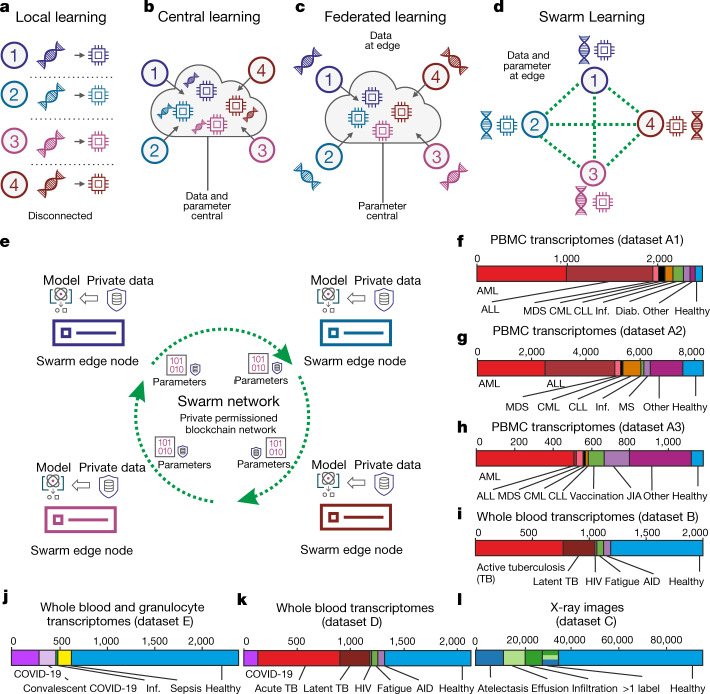
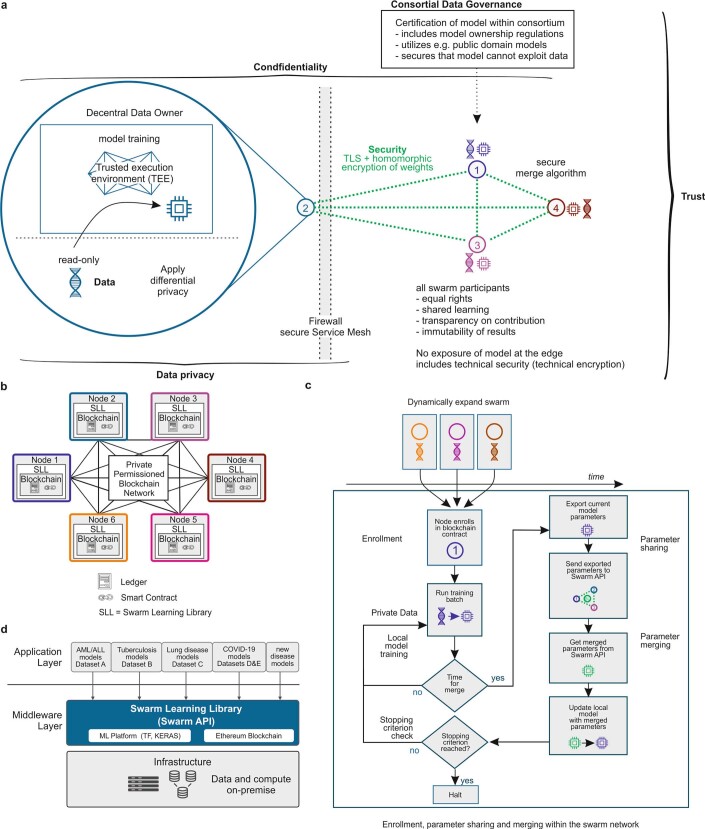
Fast and reliable detection of patients with severe and heterogeneous illnesses is a major goal of precision medicine 1,2 . Patients with leukaemia can be identified using machine learning on the basis of their blood transcriptomes 3 . However, there is an increasing divide between what is technically possible and what is allowed, because of privacy legislation 4,5 . Here, to facilitate the integration of any medical data from any data owner worldwide without violating privacy laws, we introduce Swarm Learning—a decentralized machine-learning approach that unites edge computing, blockchain-based peer-to-peer networking and coordination while maintaining confidentiality without the need for a central coordinator, thereby going beyond federated learning. To illustrate the feasibility of using Swarm Learning to develop disease classifiers using distributed data, we chose four use cases of heterogeneous diseases (COVID-19, tuberculosis, leukaemia and lung pathologies). With more than 16,400 blood transcriptomes derived from 127 clinical studies with non-uniform distributions of cases and controls and substantial study biases, as well as more than 95,000 chest X-ray images, we show that Swarm Learning classifiers outperform those developed at individual sites. In addition, Swarm Learning completely fulfils local confidentiality regulations by design. We believe that this approach will notably accelerate the introduction of precision medicine.
Verified 2026-10-05 · 1 reference not checked yet
Overview
CoChat Summary
TL;DR
Swarm Learning (SL) is a decentralized machine-learning approach that combines edge computing, permissioned blockchain peer-to-peer networking, and coordination without a central parameter server, preserving confidentiality by design. Across four disease use cases—leukaemia, tuberculosis, COVID-19, and lung pathologies—SL classifiers trained on distributed data outperformed classifiers developed at individual sites and were close to or equivalent to centralized models.
Key findings
- Using more than 16,400 blood transcriptomes from 127 clinical studies and more than 95,000 chest X-ray images, SL outperformed individual nodes across leukaemia, tuberculosis, COVID-19, and lung pathology use cases; central models were only slightly better or equivalent in several scenarios.
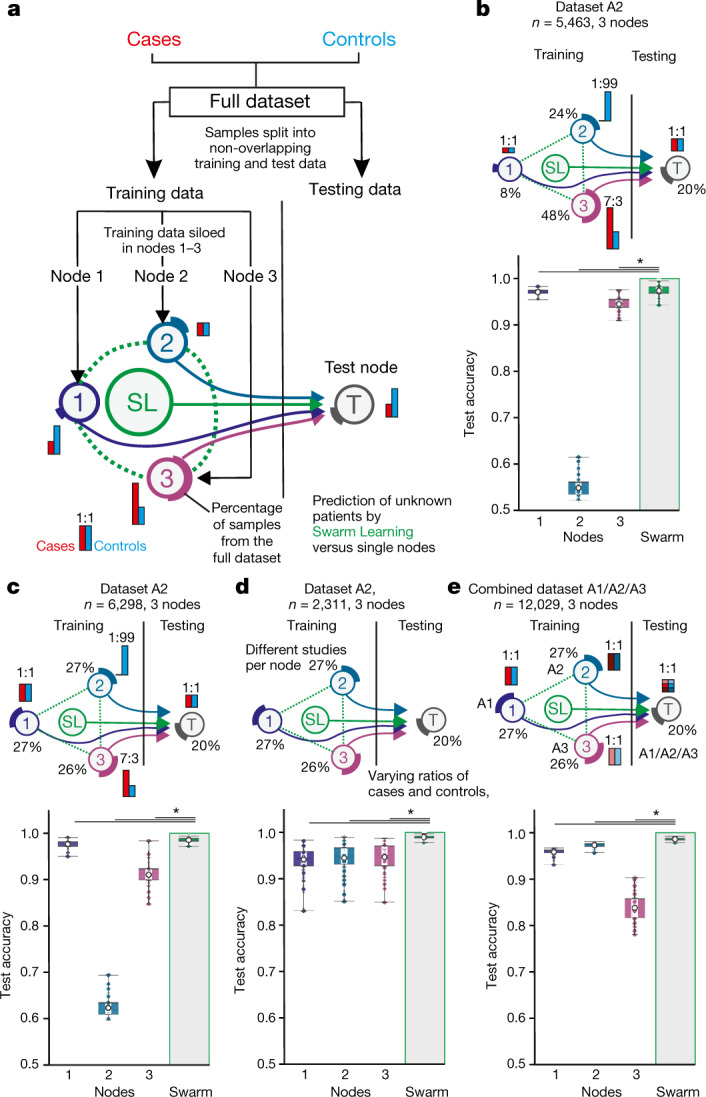
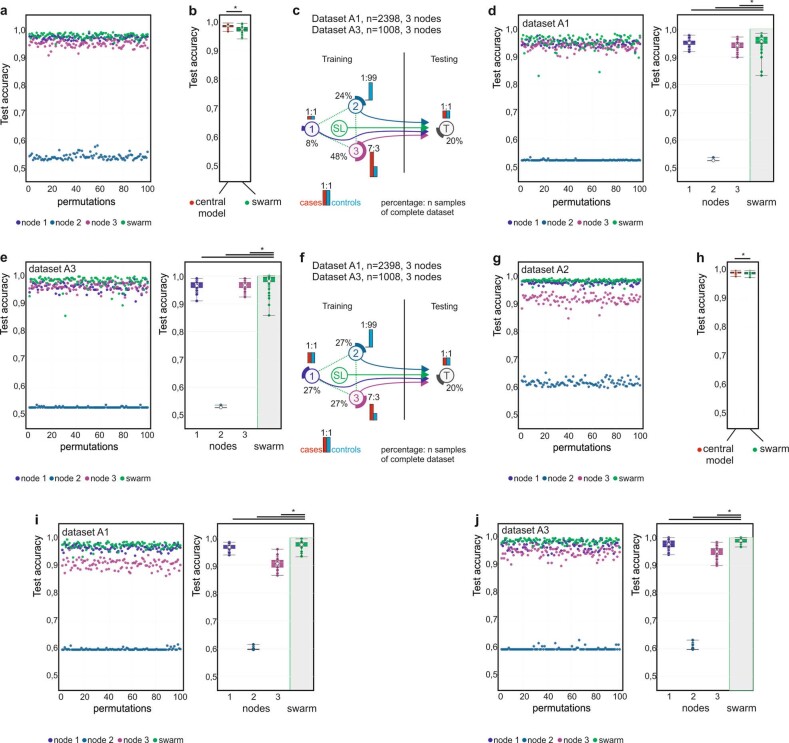
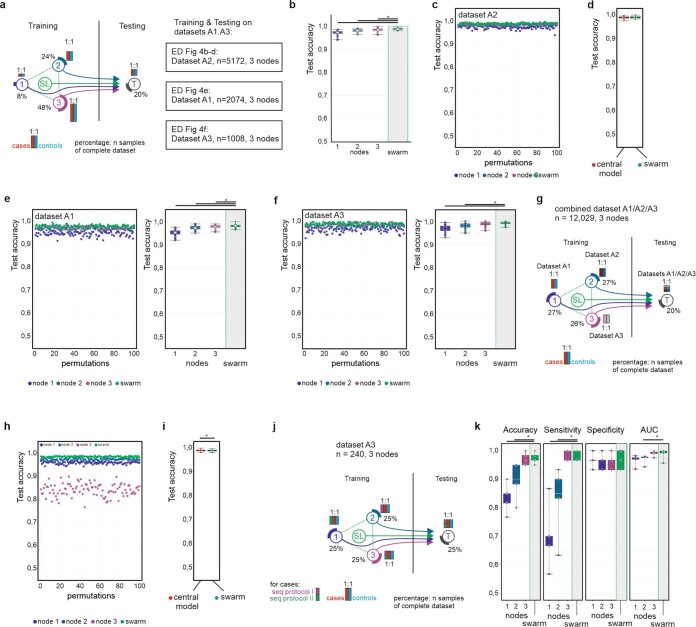
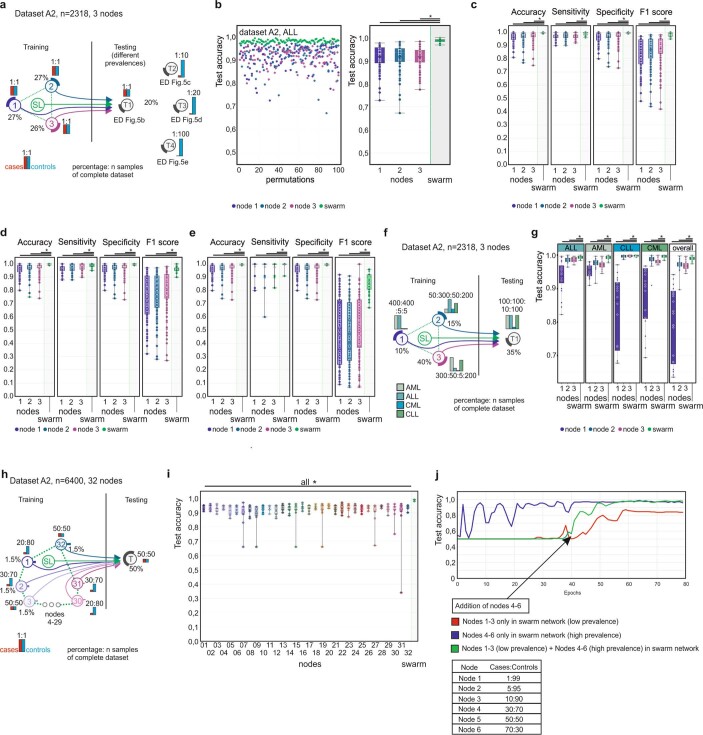
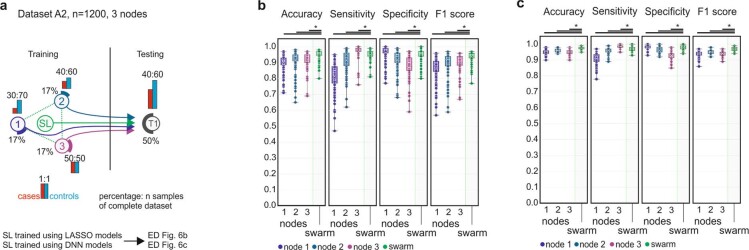
- In leukaemia PBMC datasets A1–A3, comprising more than 12,000 individuals, SL outperformed each node across multiple scenarios, including uneven case/control distributions, study-specific siloing, different transcriptomic technologies, up to 32 nodes, and LASSO instead of deep neural networks.
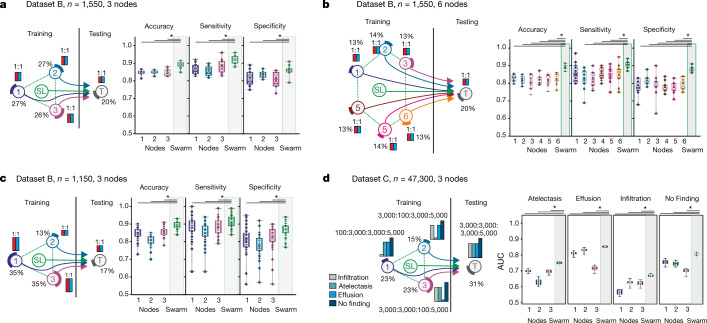
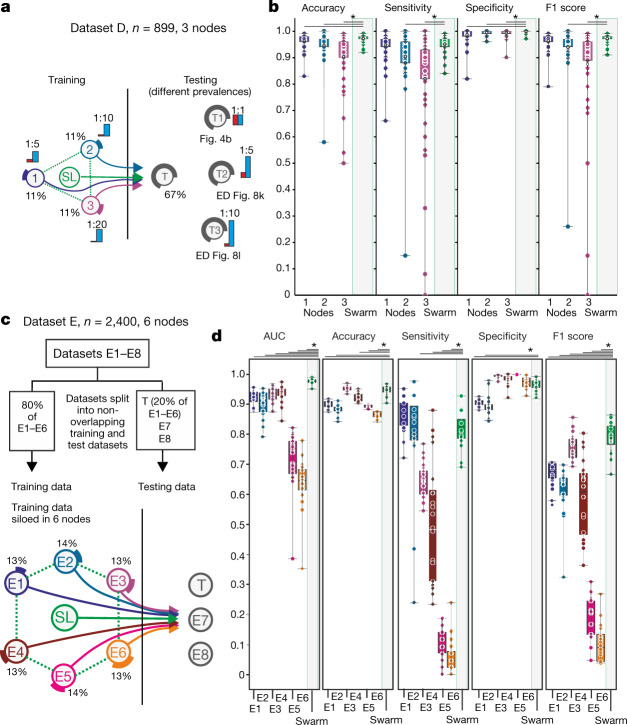
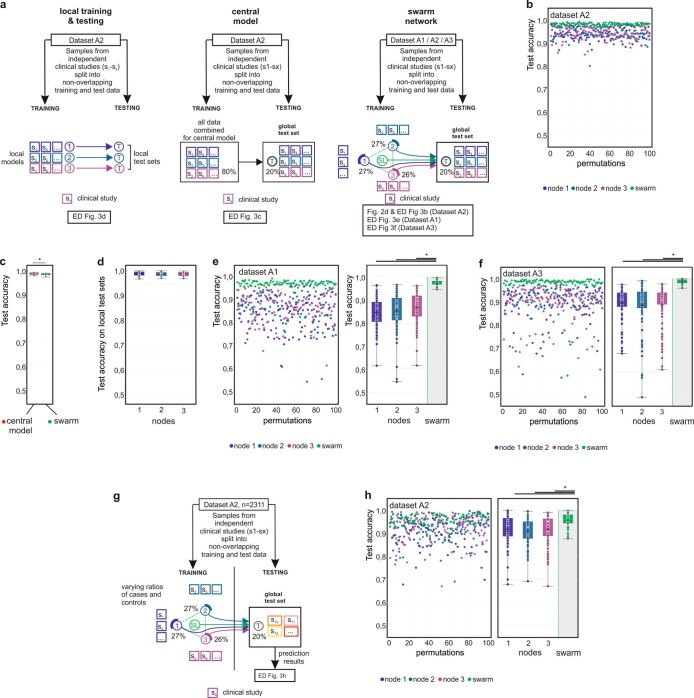
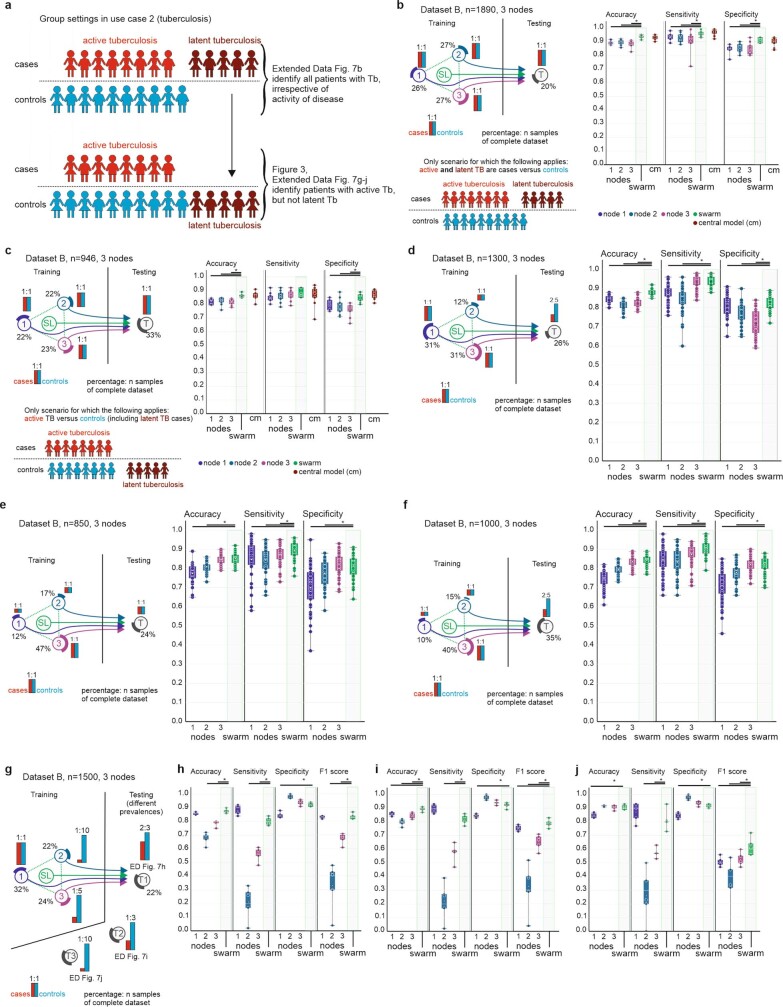
- For tuberculosis, SL outperformed individual nodes even when training samples were reduced by 50% or split into six smaller nodes; for COVID-19, SL outperformed all nodes in AUC on global test datasets and predicted samples from other centres when individual centre nodes could not.
- Overall, 16,694 analyses were performed across 26 AML, 4 ALL, 13 TB, 1 X-ray, and 18 COVID-19 scenarios, with 5–100 permutations per scenario and a total of 8,347 computer hours.
Methods
- Design: decentralized SL framework using edge nodes and a permissioned blockchain for secure onboarding, dynamic leader election, and parameter merging, with no central parameter server; raw data remain local and model parameters are exchanged and merged.
- Data: PBMC transcriptome datasets A1 (n = 2,500), A2 (n = 8,348), and A3 (n = 1,181); whole-blood datasets B (n = 1,999), D (n = 2,143), and E (n = 2,400); chest X-ray dataset C (95,831 images); simulations used 3–32 training nodes and independent test nodes.
- Analysis: deep neural network (Keras sequential) and LASSO; performance metrics included sensitivity, specificity, accuracy, F1 score, and AUC; differences were tested with one-sided Wilcoxon signed-rank test with continuity correction, using 5–100 permutations per scenario.
Limitations
- Stated: no statistical methods were used to predetermine sample size; experiments were not randomized, although permutations were performed; investigators were not blinded to allocation during experiments and outcome assessment.
- Stated/implied: SL performance was tested in simulated siloing and outbreak scenarios using existing datasets, not in a prospective real-world multi-centre clinical deployment; the paper notes potential limitations in TB outbreak scenarios but does not quantify them.
- Evident: although confidentiality is preserved by design and no raw data are exchanged, model parameters are shared; the paper suggests SL can inherit differential privacy, functional encryption, or encrypted transfer learning, but these were not implemented or tested here.
Model-written summary. Check it against the paper before relying on it.
Integrity signals
Registry
Cites
Statistics
Figures
Verification
Claims the paper makes
6 Valid · 0 Not valid · 7 Not checked · 58 Own results and interpretations
The cited sources support only part of this claim — read each source’s verdict below.
In the paper
“As medicine is inherently decentral, the volume of local data is often insufficient to train reliable classifiers20,21.”
§ Swarm Learning for decentralized and confidential clinical machine learning > Main
What the sources say
- Not checked yetcites [20] Rajkomar A Dean J Kohane I Machine learning in medicine N. Engl. J. Med. 2019 380 1347 1358 10.1056/NEJMra1814259 30943338 source
- Partly supportedcites [21] Savage N Calculating disease Nature 2017 550 S115 S117 10.1038/550S115a 29045372 sourceExperimental — accuracy not yet measured
In “BIOPSY BY NUMBERS” (page unavailable), the paper says a researcher wants a much larger dataset to validate and refine an ALS classification algorithm, and describes a shared MRI repository assembled to provide larger datasets. It does not say that medicine is inherently decentralized or that local datasets are often insufficient to train reliable classifiers; it also reports good predictions from a relatively small dataset. (LLM, conf=0.78)
plainstates a cause- Asserted: passes — The authors put it forward as true.
- Checkable: passes — It can be checked against evidence.
- Load-bearing: passes — The paper’s conclusions depend on it.
- Based: passes — The paper gives a reason why it holds.
The cited sources support only part of this claim — read each source’s verdict below.
In the paper
“With increasing efforts to enforce data privacy and security5,9,10 and to reduce data traffic and duplication, a decentralized data model will become the preferred choice for handling, storing, managing, and analysing any kind of large medical dataset19.”
§ Swarm Learning for decentralized and confidential clinical machine learning > Discussion
What the sources say
- Partly supportedcites [19] Kaissis GA Makowski MR Rückert D Braren RF Secure, privacy-preserving and federated machine learning in medical imaging Nat. Mach. Intell. 2020 2 305 311 10.1038/s42256-020-0186-1 sourceExperimental — accuracy not yet measured
The Outlook section of our copy supports the direction of the claim: it states that decentralized data storage and federated learning systems are 'replacing the current paradigm of data sharing and centralized storage' and are driven by privacy requirements, and the paper elsewhere notes such methods 'should require minimal or no data transfer'. However, the source hedges this as having 'the greatest potential to enable privacy-preserving cross-institutional research in a breadth of biomedical disciplines in the near future', whereas the citing sentence asserts it as a certainty ('will become the preferred choice') and extends it to 'handling, storing, managing, and analysing any kind of large medical dataset' — a scope and a confidence level the source does not claim. The 'reduce data traffic and duplication' motive is only partly reflected (the paper in fact lists communication overhead and burdensome data transfer as limitations of decentralized/federated and SMPC approaches). (LLM, conf=0.72)
plainstates a cause- Asserted: passes — The authors put it forward as true.
- Checkable: unclear — It is unclear whether it could be checked against evidence.
- Load-bearing: passes — The paper’s conclusions depend on it.
- Based: passes — The paper gives a reason why it holds.
- Partly supported
The cited sources support only part of this claim — read each source’s verdict below.
In the paper
“with current privacy regulations5,9,10 making it less appealing to develop centralized AI systems”
§ Swarm Learning for decentralized and confidential clinical machine learning > Discussion
What the sources say
- Partly supportedcites [5] Price WN II Cohen IG Privacy in the age of medical big data Nat. Med. 2019 25 37 43 10.1038/s41591-018-0272-7 30617331 PMC6376961 sourceExperimental — accuracy not yet measured
Price & Cohen (2019) do support the general thrust: in 'A path forward' they write that 'The basic harm of privacy overprotection is the brakes it puts on data-driven innovation,' that privacy protections limit data aggregation and innovative data use, and that 'Patchy, fragmented health data make data-driven innovation hard, imposing both technological and economic hurdles' (A path forward); they also note in 'Why do we need big data in health?' that AI uses 'require very large sets of data' and that without them 'algorithms cannot be trained or ... evaluated.' But our copy nowhere contrasts centralized with decentralized/federated architectures, and says nothing about privacy regulation making 'centralized' AI systems specifically less appealing — that comparative claim is the citing authors'. The paper's regulatory discussion is also confined to U.S. law (HIPAA de-identification, covered entities), narrower than the unqualified 'current privacy regulations' in the citing sentence. (LLM, conf=0.72)
- Not checked yetcites [9] Kels CG HIPAA in the era of data sharing J. Am. Med. Assoc. 2020 323 476 477 10.1001/jama.2019.19645 32016301 source
- Not checked yetcites [10] McCall B What does the GDPR mean for the medical community? Lancet 2018 391 1249 1250 10.1016/S0140-6736(18)30739-6 29619949 source
plainstates a cause- Asserted: passes — The authors put it forward as true.
- Checkable: passes — It can be checked against evidence.
- Load-bearing: passes — The paper’s conclusions depend on it.
- Based: passes — The paper gives a reason why it holds.
- Partly supported
Every source the paper cites for this claim was checked and supports it.
In the paper
“but progress is hindered by the limited size of datasets19”
§ Swarm Learning for decentralized and confidential clinical machine learning > Discussion
What the sources say
- Supportedcites [19] Kaissis GA Makowski MR Rückert D Braren RF Secure, privacy-preserving and federated machine learning in medical imaging Nat. Mach. Intell. 2020 2 305 311 10.1038/s42256-020-0186-1 source
The opening of our copy (Abstract/front-matter, p. 305) states that 'the broad application of artificial intelligence techniques in medicine is currently hindered by limited dataset availability for algorithm training and validation.' The Introduction (Abstract section, p. 305) ties progress specifically to oncology applications (tumour detection, genomic characterization, subtyping, grading, outcome/relapse risk) to 'the release of large, curated corpora of images', notes that 'even the largest current imaging studies in the field ... include considerably less data than, for example, ImageNet', and that 'the inability to access and leverage this data poses a significant barrier to AI applications in this field.' This supports the paraphrase that limited dataset size hinders progress in oncology machine learning, with the caveat that the source's scope is medical imaging AI generally rather than oncology alone. (LLM, conf=0.85)
plainstates a cause- Asserted: passes — The authors put it forward as true.
- Checkable: passes — It can be checked against evidence.
- Load-bearing: passes — The paper’s conclusions depend on it.
- Based: passes — The paper gives a reason why it holds.
- Supported
A result the paper reports from its own data — it cites no other source for it, so there is none to check. The quote shows it is in the paper.
In the paper
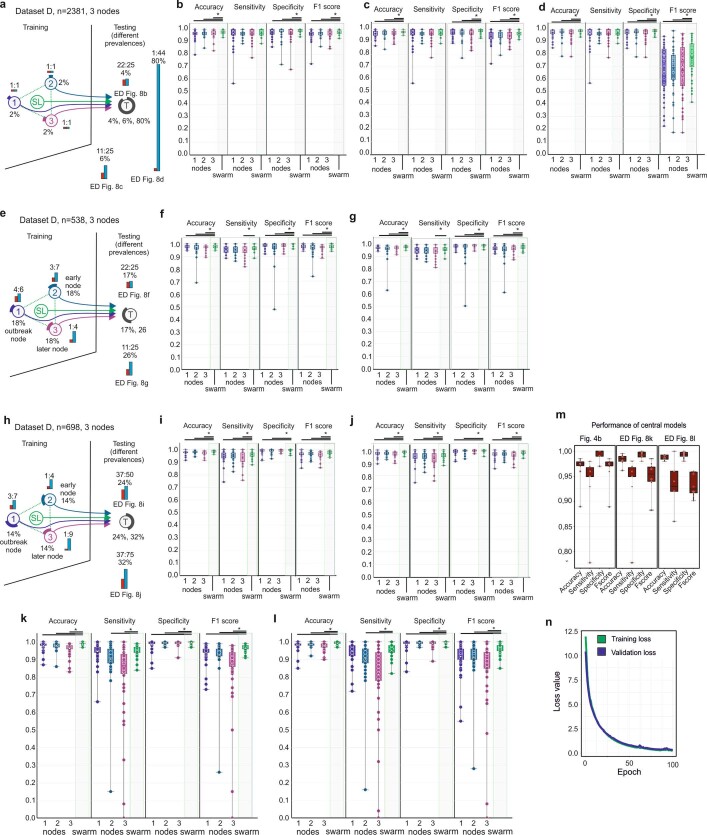
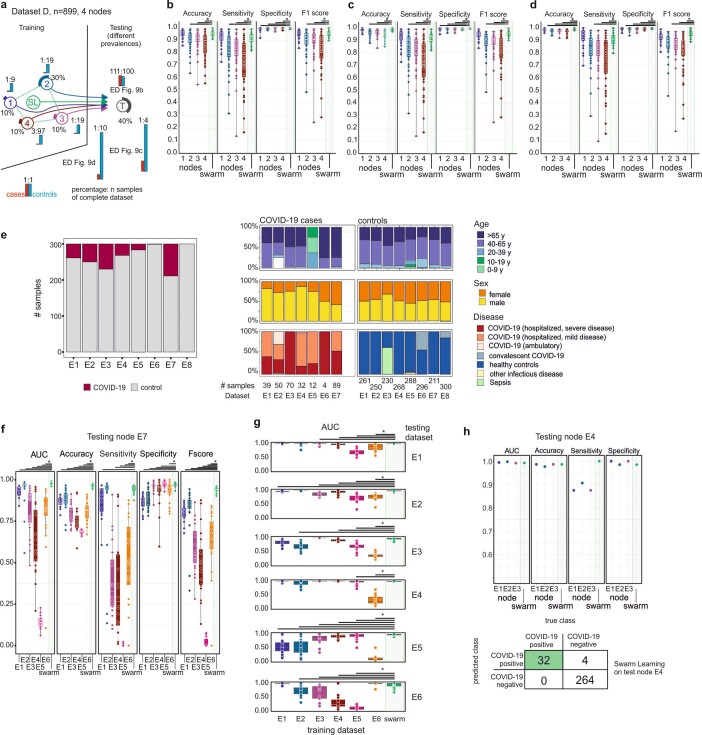
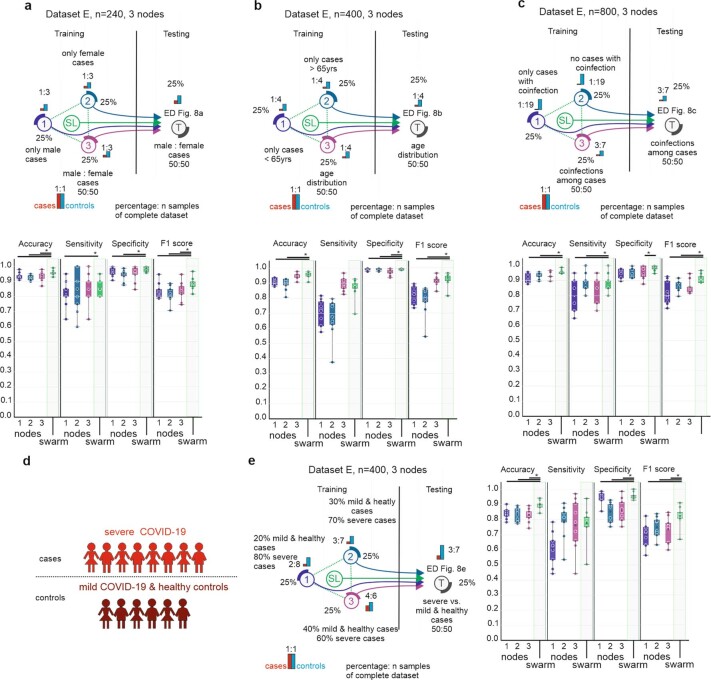
“When we reduced cases at training nodes, all performance measures remained very high at the test node for SL and individual nodes (Extended Data Fig. 8e–j).”
§ Swarm Learning for decentralized and confidential clinical machine learning > Identification of COVID-19
plain- Asserted: passes — The authors put it forward as true.
- Checkable: passes — It can be checked against evidence.
- Load-bearing: unclear — It is unclear whether the paper’s conclusions depend on it.
- Based: passes — The paper gives a reason why it holds.
32 more claims
Create a free account to see all 71 claims and to verify the 16 references still open.
- It may state two separate claims as one. 18
- Probably not a substantial claim. 20
Claims other papers make about this one
Each is checked against this paper’s own text: does it say what the citing paper says it does?
The source backs part of the claim, not all of it — or backs it for a different population, condition or comparison.
In the citing paper
“It can also overcome the straggler dilemma with heterogeneous hardware, as well as improve the robustness to data poisoning attacks and master node fails [35], [145].”
From Edge artificial intelligence for 6g: vision, enabling technologies, and applications (2022) · cites this paper as [35]
Experimental — accuracy not yet measuredThe source backs part of the claim, not all of it — or backs it for a different population, condition or comparison.
In the citing paper
“FL allows training of AI models through averaging of local updates from numerous healthcare facilities and smart devices, such as IoMT, despite the lack of local data.”
From Federated learning-based AI approaches in smart healthcare: Concepts, taxonomies, challenges and open issues (2023) · cites this paper as [11]
Experimental — accuracy not yet measuredThe source backs part of the claim, not all of it — or backs it for a different population, condition or comparison.
In the citing paper
“Federated Learning has presented itself as a viable method for implementing economic, innovative healthcare systems while ensuring privacy [11–15].”
From Federated learning-based AI approaches in smart healthcare: Concepts, taxonomies, challenges and open issues (2023) · cites this paper as [11]
Experimental — accuracy not yet measuredThe cited source says what the claim attributes to it.
In the citing paper
“In particular, swarm learning [35] provides a completely decentralized AI solution based on decentralized ML by keeping local datasets at each edge device.”
From Edge artificial intelligence for 6g: vision, enabling technologies, and applications (2022) · cites this paper as [35]
The cited source says what the claim attributes to it.
In the citing paper
“Besides, swarm learning has recently been developed in [35] to provide a decentralized and confidential clinical disease detection solution for diseases (e.g., COVID-19, tuberculosis, and leukaemia).”
From Edge artificial intelligence for 6g: vision, enabling technologies, and applications (2022) · cites this paper as [35]
6 more claims about this paper
Create a free account to see every claim other papers make about this one.
Citations
Cites
Moderated estimation of fold change and dispersion for RNA-seq data with DESeq2
Love, M. I., Huber, W., & Anders, S. (2014) · Genome Biology · doi:10.1186/s13059-014-0550-8 · Cited by 95,106
LeCun, Y., Bengio, Y., & Hinton, G. (2015) · Nature · doi:10.1038/nature14539 · Cited by 84,126
Scikit-learn: Machine Learning in Python
Pedregosa, F., Varoquaux, G., Gramfort, A., Michel, V., Thirion, B., Grisel, O., Blondel, M., Müller, A., Nothman, J., Louppe, G., et al. (2012) · arXiv · doi:10.48550/arxiv.1201.0490 · Cited by 71,016
STAR: ultrafast universal RNA-seq aligner
Dobin, A., Davis, C. A., Schlesinger, F., Drenkow, J., Zaleski, C., Jha, S., Batut, P., Chaisson, M., & Gingeras, T. R. (2013) · Bioinformatics · doi:10.1093/bioinformatics/bts635 · Cited by 51,709
Bootstrap methods: another look at the jackknife
Efron, B. (1979) · The Annals of Statistics · doi:10.1214/aos/1176344552 · Cited by 17,602
Dermatologist-level classification of skin cancer with deep neural networks
Esteva, A., Kuprel, B., Novoa, R. A., Ko, J., Swetter, S. M., Blau, H. M., & Thrun, S. (2017) · Nature · doi:10.1038/nature21056 · Cited by 14,362 · cited 1×
“Particularly in oncology, success has been reported in machine-learning-based tumour detection 3,37 , sub-typing 38 , and outcome prediction 39 , but progress is hindered by the limited size of datasets 19 , with current privacy regulations 5,9,10 making it less appealing to develop centralized AI…”
BackgroundCommunication-Efficient Learning of Deep Networks from Decentralized Data
McMahan, H. B., Moore, E., Ramage, D., Hampson, S., & Arcas, B. A. Y. (2016) · arXiv · doi:10.48550/arxiv.1602.05629 · Cited by 14,215
Gene Expression Omnibus: NCBI gene expression and hybridization array data repository
Edgar, R. (2002) · Nucleic Acids Research · doi:10.1093/nar/30.1.207 · Cited by 13,288
Exploration, normalization, and summaries of high density oligonucleotide array probe level data
Irizarry, R. A. (2003) · Biostatistics · doi:10.1093/biostatistics/4.2.249 · Cited by 10,603
Detection of 2019 novel coronavirus (2019-nCoV) by real-time RT-PCR
Corman, V. M., Landt, O., Kaiser, M., Molenkamp, R., Meijer, A., Chu, D. K., Bleicker, T., Brünink, S., Schneider, J., Schmidt, M. L., et al. (2020) · Eurosurveillance · doi:10.2807/1560-7917.es.2020.25.3.2000045 · Cited by 7,344 · cited 10×
“We obtained very similar results using datasets A1 and A3, which strongly supports the idea that the improvement in performance of SL is independent of data collection (clinical studies) or the technologies (microarray or RNA-seq) used for data generation (Extended Data Fig.”
MethodInfluential
Cited by
Items 801–900 of 944
AIoT-Driven Privacy-Preserving and Decentralized Ubiquitous Music Learning
Liu, Z., Zhao, Y., Xiong, H., Wahaballa, A., & Yeh, K. (2025) · IEEE Networking Letters · doi:10.1109/lnet.2025.3602131
“2, we evaluate the effectiveness of the proposed method on the MAESTRO and NSynth datasets, recording training and testing accuracy and loss over 50 communication rounds against a baseline [20].”
Trustworthy Federated Edge Learning via Blockchain
Zhou, Y., Fang, W., Shi, Y., & Letaief, K. B. (2025) · Wireless networks · doi:10.1007/978-3-031-96649-1_9
Differentially-Private Collaborative Online Personalized Mean Estimation
Yakimenka, Y., Weng, C.-W., Lin, H.-Y., Rosnes, E., & Kliewer, J. (2025) · IEEE Transactions on Information Forensics and Security · doi:10.1109/tifs.2025.3612276
Artificial intelligence in cancer imaging
Fang, M., Dong, D., Hui, H., Liu, Z., An, Y., Wang, S., He, B., Shao, L., & Tian, J. (2025) · Elsevier eBooks · doi:10.1016/b978-0-443-22253-5.00020-0
Radiomics-based intelligent diagnosis and treatment
Fang, M., Wang, Z., Fu, J., Wang, Y., Zhao, Y., Qin, Z., Zhang, C., Xie, X., Tang, L., & Dong, D. (2025) · Elsevier eBooks · doi:10.1016/b978-0-443-30142-1.00006-7
The Role of Blockchain in Genomics Sciences
Gautam, S. K., Menon, M., & Rana, R. (2025) · Wiley eBooks · doi:10.1002/9781394336043.ch20
SIMAIS: A swarm intelligence inspired biosensor for rapid protein detectionPreprint
Zheng, J., Bayinqiaoge, B., Schiff, H. F., Wang, X., Wu, T., Lu, X., Zhang, Y., Wang, Y., Tang, S., & Zhang, C. (2025) · bioRxiv (Cold Spring Harbor Laboratory) · doi:10.1101/2025.10.31.685929
“Swarm intelligence has inspired breakthroughs across diverse fields such as AI 10,11 , robotics 12-15 , optimisation algorithms 16-20 , and network systems 21-24 to tackle computationally intensive and dynamic challenges.”
An Architecture for Fully Decentralized Opportunistic Learning
Kong, D., Li, X., & Chen, W. (2025) · International Joint Conference on Neural Networks (IJCNN) · doi:10.1109/ijcnn64981.2025.11227244
Rewiring the Lymphatic Landscape: Disorders, Remodeling, and Cancer Progression
Kumar, S., Adhikari, U., & Singh, B. B. (2025) · Lymphatics · doi:10.3390/lymphatics3040037
Communication-Constrained Private Decentralized Online Personalized Mean Estimation
Yakimenka, Y., Lin, H.-Y., Rosnes, E., & Kliewer, J. (2025) · IEEE Information Theory Workshop (ITW) · doi:10.1109/itw62417.2025.11240277
“The interest in collaborative learning has grown considerably recently, fueled by prominent frameworks such as federated learning (FL) [1]–[3], which offers a partially de-centralized approach, and fully decentralized methods like swarm learning [4].”
Artificial intelligence in oncological imaging screening
Guo, Z., Xu, M., Zhong, C., Yin, X., Wang, B., & Jin, G. (2025) · International Journal of Surgery · doi:10.1097/js9.0000000000003858
Advancing Federated Learning - Towards Decentralization and Personalized Models
Casella, B. (2025) · Institutional Research Information System University of Turin (University of Turin) · doi:10.5281/zenodo.15781147
Digital public infrastructure for environmental sustainability
Chen, Y., Vergara, A. F., Hamilton, A., & Stockinger, K. (2024) · Zürcher Hochschule für Angewandte Wissenschaften digital collection (Zurich University of Applied Sciences) · doi:10.21256/zhaw-30874 · Cited by 5
Duda, L., Alibabaei, K., Kozlov, V. Y., Berberi, L., Vollmer, E., Klug, L., Benz, M., Volk, R., Muriedas, J. P. G. H., Götz, M., et al. (2025) · Repository KITopen (Karlsruhe Institute of Technology) · doi:10.5445/ir/1000182617
Li, W., Kim, M., Zhang, K., Chen, H., Jiang, X., & Harmanci, A. O. (2024) · Figshare · doi:10.6084/m9.figshare.26616745
Liu, Y., Huang, J., Chen, J.-C., Chen, W., Pan, Y., & Qiu, J. (2024) · Figshare · doi:10.6084/m9.figshare.25980485
Liu, Y., Huang, J., Chen, J.-C., Chen, W., Pan, Y., & Qiu, J. (2024) · Figshare · doi:10.6084/m9.figshare.26730148
Duda, L., Alibabaei, K., Vollmer, E., Klug, L., Benz, M., Kozlov, V. Y., Volk, R., Götz, M., Schultmann, F., & Streit, A. (2024) · Repository KITopen (Karlsruhe Institute of Technology) · doi:10.5445/ir/1000174831
Federated Learning for Urban Energy Efficiency: Detecting Thermal with UAV-based Imaging and AI
Duda, L., Alibabaei, K., Vollmer, E., Klug, L., Benz, M., Kozlov, V., Volk, R., Götz, M., Schultmann, F., & Streit, A. (2024) · Repository KITopen (Karlsruhe Institute of Technology) · doi:10.5445/ir/1000171680
Liu, Y., Huang, J., Chen, J.-C., Chen, W., Pan, Y., & Qiu, J. (2024) · Figshare · doi:10.6084/m9.figshare.25980636
Carstens, M. (2023) · Qucosa (Saxon State and University Library Dresden)
Privacy and profit: the dual benefits of federated learning in metaverse healthcare systems
Yogi, M. K., Nam, L., Adina, P., & Rajeswari, L. V. M. (2025) · Elsevier eBooks · doi:10.1016/b978-0-443-33789-5.00015-7
AdaptiveShield: Dynamic Defense Against Decentralized Federated Learning Poisoning Attacks
Feng, Y., Zheng, B., Li, T., Wu, C., Ma, Z., Shen, Y., & Ma, J. (2025) · IEEE Transactions on Dependable and Secure Computing · doi:10.1109/tdsc.2025.3641896
System Requirements for Decentralised Collaborative Machine Learning in Industry 4.0
Olbrych, S., Zhou, H. A., Abdelrazeq, A., & Schmitt, R. H. (2025) · IEEE/ACM International Conference on Big Data Computing, Applications and Technologies (BDCAT) · doi:10.1145/3773276.3774283
“…such as PySyft [53], BlockFL [29, 64], Substra [15], FedML [21], FLOWER [3], FATE [9, 37], Fed-BioMed [59], IBM Federated [38], HP Swarm Learning [63], FederatedScope [67], OpenFL [13], NVIDIA FLARE (NVFlare) [43, 52], NEBULA (Fedstel-lar) [39], have incorporated advanced privacy techniques…”
Robust and Efficient Cross-silo Blockchained Federated Learning with Proof of Generalization
Ren, P., & Yan, T. (2025) · International Conference on New Trends in Computational Intelligence (NTCI) · doi:10.1109/ntci67886.2025.11308176
Breaking Through Blockchain Scalability Barriers in IoT: A Decoupled Dual-Consensus Approach
Cao, M., Cao, B., & Peng, M. (2025) · IEEE International Conference on Smart Internet of Things (SmartIoT) · doi:10.1109/smartiot66867.2025.00057
“This dependency creates single points of failure and introduces security risks, as evidenced by cases in industrial IoT scenarios [4].”
Computing and AI in Genomics-Driven Precision Oncology: Methods, Trials, and Translation
Shukulli, A., & Ahmad, R. M. (2025) · Computing&AI Connect · doi:10.69709/caic.2025.144976
A Survey on Blockchain-Based Federated Learning (BCFL) Frameworks
Lin, C.-Y., Wang, L.-J., & Kuo, T. T. (2026) · Springer handbooks of computational statistics · doi:10.1007/978-3-031-95418-4_12
Multimodales Deep Learning zur Prognosevorhersage für das klarzellige Nierenzellkarzinom
Schulz, S. J. K. (2025) · Gutenberg Open Science · doi:10.25358/openscience-13911
Synapse: Federated Tool Routing via Typed Compendium ArtifactsPreprint
Chakraborty, A., Shah, Y., & Gupta, V. (2026) · arXiv (Cornell University) · doi:10.48550/arxiv.2602.00911
Über böse Uhren und eine euphorisierte Zukünftigkeit: Künstliche Intelligenz in der Medizin
Nößler, D., & Scherer, M. (2024) · EvidenzUpdate · doi:10.69156/pod.001/2024.01.00121
Advanced AI models for Early Cancer Detection Using Multi-Modality Images Techniques
Anusha, J., Mounika, A., Venkatesh, N., Srinivas, D., Reddy, R. A., & Rajesh, P. (2025) · IEEE Global Conference for Advancement in Technology (GCAT) · doi:10.1109/gcat66372.2025.11368374
“Surveys that defined open research areas and future directions in 6G in distributed data environments also build on these findings by pointing out that healthcare applications will require a high-bandwidth and secure transmission of imaging data between institutions [4].”
Kalimuthu, N. (2026) · International Journal of Artificial Intelligence Data Science and Machine Learning · doi:10.63282/3050-9262.ijaidsml-v7i1p107 · Cited by 1
Justine, C., Manamohan, S., Shine, L., & Jiji, C. V. (2026) · Informatica · doi:10.31449/inf.v50i9.9501
“Shifting away from centralized designs, Warnat-Herresthal et al. [ 20] introduced Swarm Learning— embedding consensus mechanisms into model training.”
Self-citationPrivacy in Collaborative Deep Learning Systems: A Taxonomy and Archetypes
Rank, S., Jin, D. S., Thiebes, S., & Sunyaev, A. (2026) · ACM Computing Surveys · doi:10.1145/3801094
“Moreover, such CDL systems have different scopes of NNs, including global scopes of NNs [138], individual scopes of NNs [58], and split scopes of NNs [36].”
Challenges and future perspectives of AI in gastrointestinal cancers
Kanagala, A., Mareddy, N. S. R., & Nagaraju, G. P. (2026) · Elsevier eBooks · doi:10.1016/b978-0-443-44121-9.00009-3
Federated learning, explainability, and the road ahead
Kaur, H., Chhabra, A., & Ghai, D. (2026) · Elsevier eBooks · doi:10.1016/b978-0-443-45252-9.00001-3
Sanjaya, P., & Pitkänen, E. (2026) · bioRxiv (Cold Spring Harbor Laboratory) · doi:10.64898/2026.04.01.715762
Optimization methods over networks for popular content delivery and distributed machine learning
Costantini, M. (2023) · theses.fr (ABES) · doi:10.70675/1f27d904z6f26z4a9ez8b79z78214cb50b08
Computational Intelligence for Drug Design and Development
Shukla, K., & Bansal, H. (2026) · Advances in computational intelligence and robotics book series · doi:10.4018/979-8-2600-0981-9.ch007
Kumar, S., Dutta, A., Singh, B. P., Vallur, S., Khushbu, & Singh, S. (2026) · Indian Journal of Otolaryngology and Head & Neck Surgery · doi:10.1007/s12070-026-06555-z · Cited by 1
Steffen, F. D., Lissat, A., Alten, J., Kriston, A., Scheidegger, N. K., Eckert, C., Bodmer, N., Schori, L. J., Schühle, S., Arpagaus, A., et al. (2026) · medRxiv · doi:10.64898/2026.04.08.26350164 · Cited by 1
P., R. S., Swetha, A. B., & B., V. S. P. (2026) · Journal of Ubiquitous Computing and Communication Technologies · doi:10.36548/jucct.2026.2.002
DFLF: A Scalable Decentralized Federated Learning Framework Based on Pytorch
Liu, F., Yuan, W., Zhou, Y., Ye, Q., & Lv, J. (2026) · IEEE International Conference on Acoustics Speech and Signal Processing · doi:10.1109/icassp55912.2026.11463164
Wikipedia-based AI model reveals the 100 technologies to watch
Crow, J. M. (2026) · Nature · doi:10.1038/d41586-026-00980-4
Roslan, A. H., Zulkifli, N. A., Noor, F. M., Ming, K. T. W., & Abdullah, S. H. (2024) · Journal of AI Analytics and Applications · doi:10.63646/jaiaa.2024.020302
Transparent Vision: A Theory of Hierarchical Invariant Representations
Qi, S., Zhang, Y., Wang, C., Xia, Z., Cao, X., & Fan, F. (2025) · IEEE/CVF International Conference on Computer Vision (ICCV) · doi:10.1109/iccv51701.2025.00328 · Cited by 1
“More recently, their applications are expanding into trust-related scenarios, e.g. , biometrics [39], medical diagnostics [47], self-driving cars [10], and mis-information detection [17].”
Exploring Continual Learning and NeuroEvolution for Decentralized Continual Learning
Lavorel, A., Kabachi, N., & Benkhelifa, E. (2026) · International Conference on Advances in Artificial Intelligence and Machine Learning (AAIML) · doi:10.1109/aaiml67890.2026.11498072
“Alternative strategies employ conventional Artificial Neural Networks trained via federated learning, with local training followed by weight aggregation across participants [13].”
Ethical, Privacy, and Regulatory Considerations
Shaikh, K., Thanki, R., & Shah, S. (2026) · Synthesis lectures on engineering, science, and technology · doi:10.1007/978-3-032-25486-3_6
Data-Centric Privacy Preservation Using Swarm-Optimized Machine Learning Models in Edge Networks
M.Anitha, & Sivaraman, K. (2026) · International Conference on Smart Futuristic Technology (SMARTTECH) · doi:10.1109/icsft66733.2026.11508111
“The above model outperforms rigorously two above baselines with 94.8% accuracy, increasing by 4.7% and 7.6% than the existing system [6] and [7].”
InfluentialKhadimzada, F. (2025) · International Journal of Electrical Electronics and Computer Systems · doi:10.65521/ijeecs.v14i1.2680
Privacy-Preserving Online Federated Learning for Massive Infinite Streams
Shi, L., Ren, X.-B., Yang, S.-S., Zhao, C., Hao, Y.-J., & Xu, Z.-L. (2026) · IEEE Transactions on Pattern Analysis and Machine Intelligence · doi:10.1109/tpami.2026.3697332
Knowledge-Augmented Multimodal Learning for Breast Cancer Diagnosis
Li, L., Wang, L., & Hou, L. (2026) · Communications in computer and information science · doi:10.1007/978-981-95-7299-1_19
Efficient Serverless Federated Learning With Edge Model Migration on Non-IID Data
Shi, Y., Hou, Q., Fan, P., & Letaief, K. B. (2026) · IEEE Transactions on Mobile Computing · doi:10.1109/tmc.2026.3698469
Application of Differential Privacy-Enhanced FedAvg Algorithm in Medical Sensor Data Processing
Kaczmarek, M. (2026) · Journal of Applied Automation Technologies · doi:10.64972/jaat.2026v4.126p179-192
“Therefore, robust privacy protection mechanisms remain a necessary condition for healthcare FL applications [8]. differential privacy (DP) is a mathematically rigorous method that prevents personal data leakage by adding controlled random noise to sensitive computations [11].”
Siva, M. A., & Chowdhary, C. L. (2026) · Scientific Reports · doi:10.1038/s41598-026-53829-1
“Many studies have researched the implementation of federated learning on the various medical imaging modalities like chest X-ray classification 30 , diabetic retinopathy 31 and COVID-19 diagnosis 32 .”
Overpass Ledger: Full Parallelization and Fast Re-Execution for High-Performance
Cao, M., Cao, B., Peng, W., & Peng, M. (2026) · IEEE Transactions on Parallel and Distributed Systems · doi:10.1109/tpds.2026.3700688
“Permis-sionedblockchainshavebeenwidelyadoptedacrossindustries suchasfinance,trade,supplychain,decentralizedidentification, andfederatedlearning[6],[7],[8],[9],[10],[11],offering transparentandaccountableworkflowsthatsavetimeandre-sources for collaboration among organizations.”
MoFedNet: Semantic Link is All Models Need
Chen, Y., Jiang, X.-L., Chen, Q., Yang, X., Li, J.-H., Zhang, T., Qin, X., & Huang, W.-L. (2026) · Journal of Computer Science and Technology · doi:10.1007/s11390-025-5684-5
Collective Intelligence: From the Perspective of Complex Systems
Wu, W., Tang, S., Xu, Y., & Wang, T. (2026) · Advanced topics in science and technology in China · doi:10.1007/978-981-95-8037-8_3
How AI platforms took over health and then the world
Monlezun, D. J. (2026) · Elsevier eBooks · doi:10.1016/b978-0-443-45505-6.00005-0
AI-Enabled Cloud-Edge-IoT Continuum for Hyper-Distributed and Trustworthy Applications
Aydeger, A., Zeydan, E., & Kurt, A. (2026) · Wireless and Optical Communications Conference · doi:10.1109/wocc69802.2026.11556173
“Swarm learning enables distributed optimization based on localized observations and group consensus [16].”
Jacobs, M. D., Goudarzi, S., Stücke, J., Röhm, R., Kanninen, T., Oinonen, T., Ritter, P., Schirner, M., Praßer, F., Bhagwagar, A., et al. (2026) · Frontiers in Digital Health · doi:10.3389/fdgth.2026.1814015
Self-citationRevisiting OCC in Permissioned Blockchain via Fast Re-Execution
Cao, M., Cao, B., Peng, W., & Peng, M. (2026) · IEEE Conference on Computer Communications (INFOCOM) · doi:10.1109/infocom59046.2026.11571449
Swarm Learning for Fault Detection in Heterogeneous Multi-Robot PCB Assembly
Bardas, G., Kefalakis, N., Soldatos, J., & Antonopoulos, G. (2026) · International Conference on Distributed Computing in Smart Systems and the Internet of Things (DCOSS-IoT) · doi:10.1109/dcoss-iot69657.2026.00156
“The framework is grounded in the FFT Produktionssysteme PCB assembly use case of the MODUL4R Horizon Europe project [6], where the HPE Swarm Learning Framework [3] was deployed at the edge gateway layer of the cyber-physical production system.”
InfluentialZeydan, E., Türk, Y., & Dev, K. (2026) · Joint European Conference on Networks and Communications & 6G Summit (EuCNC/6G Summit) · doi:10.1109/eucnc/6gsummit68295.2026.11577597
AI-Enabled Discovery and Sustainable Access to Biopharmaceuticals: A Legal and Policy Approach
Monisha, B., & Valarmathi, R. (2026) · Advances in computational intelligence and robotics book series · doi:10.4018/979-8-2600-2691-5.ch014
Saidi, Z., Akhrif, O., & Idrissi, Y. E. B. E. (2026) · Research Square · doi:10.21203/rs.3.rs-10219711/v1
Li, Y. X., Khandekar, N., Wang, S., Khanna, V. V., Sanker, J., & Gerstein, M. (2026) · Bioinformatics · doi:10.1093/bioinformatics/btag239
Self-citationSwarm Learning for the Detection of Middle Cerebral Artery Occlusion On CT Angiography
Harten, J. K., Hansel, S., Creuzberg, D., Brugnara, G., Kuetting, D. L. R., Uebachs, M., Weller, J. M., Petzold, G. C., Dorn, F., Vollmuth, P., et al. (2026) · Clinical Neuroradiology · doi:10.1007/s00062-026-01697-7
Self-citationA Swarm Intelligent Collaboration Approach for Ultra Task Scheduling in Mega-Constellation
Huo, L., Liu, Y., Zhu, X., Zuo, Y., Yao, W., & Chen, X. (2026) · IEEE Transactions on Mobile Computing · doi:10.1109/tmc.2026.3711968
“To address this, we propose using the model architecture based on Swarm Learning (SL) [14], which shares only parameters without sharing raw data, enabling wide-area modeling and analysis while ensuring information security.”
InfluentialPrivacy Preserving using Decentralized Federated Learning with Partial Dense-layer Weight Sharing
Nabha, R. A., Laouiti, A., & Samhat, A. E. (2026) · International Journal of Information Security · doi:10.1007/s10207-026-01288-0
Secure Decentralized Federated Learning via Gossip and Virtual VotingPreprint
Taherpour, A., & Wang, X. (2026) · arXiv (Cornell University) · doi:10.48550/arxiv.2607.08651
Asynchronous proximal federated aggregation for heterogeneous healthcare networks
Sreelakshmi, M., & Delhibabu, R. (2026) · Frontiers in Digital Health · doi:10.3389/fdgth.2026.1879670
“Second, to address the vulnerability of the central aggregator, we propose investigating the transition from a standard Hub-and-Spoke federated topology to a fully decentralized Swarm Learning architecture (26).”
Saravanan, M. (2023) · International Journal on Advanced Computer Theory and Engineering · doi:10.65521/ijacte.v12i1.3805
Privacy-Preserving Matching for Federated Causal Inference in Multicentre Patient CohortsPreprint
Gusinow, R., Morgan, A. S., Canziani, L. M., Zeitlin, J. A., Kim, M., Gentilotti, E., Ghosn, J., Florence, A.-M., Tami, A., Toschi, A., et al. (2026) · medRxiv · doi:10.64898/2026.07.16.26358171
SplitNN-FL: A Privacy-Preserving Hybrid Framework for Distributed Medical Diagnosis
Mansour, H., Khairi, A. M. K., Ali, T. S., Hadi, A. M., Hassan, A., Alhayaly, M. A., Selman, A. H., & Al-Sudani, S. F. K. (2026) · International Symposium on AI-Driven Engineering Systems (ISADES) · doi:10.1109/isades69945.2026.11608233
“…the highest F1-score in all eight categories, with the largest absolute improvement over FedAvg observed for malaria detection (0.958 versus 0.913, a 4.9 percentage point improvement) and the smallest for cardiac disease (0.914 versus 0.868, a 4.6 percentage point improvement) as mentioned in [18].”
InfluentialYin, Z., & Ho, J. W. K. (2026) · Computational and Structural Biotechnology Journal · doi:10.34133/csbj.0197
Global Research Trends and Insights on AI Usage in Tuberculosis: Bibliometric Analysis
He, J., Feng, S., Chen, Y., Zhijuan, L. A. I., Lyu, B., & Li, Y. (2026) · JMIR Medical Informatics · doi:10.2196/93885
“Complementary measures, including federated data infrastructure built on COVID-19–era governance templates [25] and clinician-driven postdeployment surveillance, would further support a transition from algorithm-development to deployment-oriented research.”
Self-citationArchitectural Foundations for Collaborative Machine Learning in Federated Data Spaces
Papadakis, N., Magoutis, K., & Bouloukakis, G. (2026) · IEEE International Conference on Software Architecture (ICSA) · doi:10.1109/icsa66085.2026.00024
Mapping the Intellectual Landscape of Personalized Federated Learning: A Bibliometric Analysis
Sabah, F., Chen, Y., Yang, Z. L., Azam, M., Ahmad, N., & Sarwar, R. (2026) · SN Computer Science · doi:10.1007/s42979-026-05201-3
Irani, S., Fallahi, A., Dehghan, A., Saleh, S. P., Khotanlou, H., & Ghadimi, H. (2026) · Research Square · doi:10.21203/rs.3.rs-10173984/v1
Zhao, P., 贾, 为., Sun, S., Wang, Y., & Li, X. F. (2026) · IEEE Internet of Things Journal · doi:10.1109/jiot.2026.3717315
“The seven baseline meth-ods include: 1) FedAvg [7]; 2) FedGS [10]; 3) FleFL [19]; 4) UCBFL [20]; 5) SL [21]; 6) SML [22]; and 7) TFL [27].”
Longo, U. G., Merone, M., Schena, E., Bandini, B., Nicodemi, G., Zsidai, B., Hilkert, A., Senorski, E. H., Grassi, A., Ley, C., et al. (2026) · Journal of Experimental Orthopaedics · doi:10.1002/jeo2.70863
Scalability and Saturation in Swarm Learning: A KPI-Driven Analysis on Real-World Clinical Data
Mantovani, M., Scaglia, S., & Combi, C. (2026) · ACM International Conference on Bioinformatics, Computational Biology, and Health Informatics (ACM-BCB) · doi:10.1145/3807503.3817123 · Cited by 1
“To overcome these limitations, Swarm Learning (SL) was proposed in 2021 by Warnat-Herresthal et al. [25].”
Continuous assurance for AI-driven clinical decision support systems
Al‐Horani, R. A., & Tadesse, A. F. (2026) · Frontiers in Artificial Intelligence · doi:10.3389/frai.2026.1870819 · Cited by 1
Swarm Learning: A Comprehensive Overview and Its Potential in Cybersecurity
Oliveira, D., & Kafle, A. (2026) · International Conference on Federated Learning and Intelligent Computing Systems (FLICS) · doi:10.1109/flics70075.2026.11621895
“Because of this, Swarm Learning works especially well in settings where nodes might not trust one another [4].”
InfluentialEspin, A. T., Wong, J. C., Hinson, H. E., Kuipers, T. B., Hoekstra, B. P. T., Jain, S., Sun, X., Yue, J. K., Pisică, D., Mikolić, A., et al. (2026) · medRxiv · doi:10.64898/2026.07.30.26359337
L-SDFL: A Lightweight Semi-Distributed Federated Learning for Communication Efficiency
Qu, D., Li, L., Li, R., Liu, X., Wang, H., & Min, G. (2026) · IEEE International Conference on Distributed Computing Systems (ICDCS) · doi:10.1109/2575-8411.2026.00057
“SL was a representative blockchain-based distributed FL approach [5].”
InfluentialAli, S. M., Ahmed, S. M., Shaikh, A., Jumani, T. A., & Masud, M. I. (2026) · Scientific Reports · doi:10.1038/s41598-026-63233-4
A systematic literature review on federated learning approaches in healthcare
Kaur, A., & Kukreja, V. (2026) · Multimedia Tools and Applications · doi:10.1007/s11042-026-21840-3
Sowan, B. I., & Massad, B. (2026) · Informatics in Medicine Unlocked · doi:10.1016/j.imu.2026.101794
Papadourakis, M., Amaxopoulou, E. E., & Matsoukas, M. (2026) · Expert Opinion on Drug Discovery · doi:10.1080/17460441.2026.2712551
“Swarm learning [96] and split learning offer alternative architectures with different trade-offs in decentralization and efficiency.”
SE4SS for Intelligent Customer Services
Li, X., & Wang, F.-Y. (2026) · SpringerBriefs in service science · doi:10.1007/978-3-032-24152-8_3
Knowledge distillation in split learning for heterogeneous clinical tabular data
Farheen, T. J. (2026) · BRAC University Institutional Repository (BRAC University)
The Pharmacy Data Commons Needed for Safe and Equitable Algorithm Development
Eriksen, K., Berg, S., & Dahl, M. (2025) · Archives of Pharmacy Practice · doi:10.51847/zuc4nbkgdt
Deep Learning-Based Prediction of Biomarkers from Colorectal Cancer Pathology Slides
Niehues, J. (2025) · Qucosa (Saxon State and University Library Dresden)
Nithiya, S., Murugaanandam, S., Sornalakshmi, K., Manickam, M., & Preethi, V. (2026) · International Journal of Online and Biomedical Engineering (iJOE) · doi:10.3991/ijoe.v22i08.62323
Alwzwazy, H. A., Gu, A., Dukhan, M., Zhao, Z., & Alzubaidi, L. (2026) · Artificial Intelligence in Medicine · doi:10.1016/j.artmed.2026.103513
Adaptive Perturbation and Gradient Correction in Differential Privacy for Deep Learning
Varshini, S., George, J., & Upreti, K. (2026) · International Conference on NextGen Data Science and Analytics (ICNDSA) · doi:10.1109/icndsa68777.2026.11652195
Metadata
- Authors
- Warnat-Herresthal, S., Schultze, H., Shastry, K. L., Manamohan, S., Mukherjee, S., Garg, V., Sarveswara, R., Händler, K., Pickkers, P., Aziz, N. A., Ktena, S., Tran, F., Bitzer, M., Ossowski, S., Casadei, N., Herr, C., Petersheim, D., Behrends, U., Kern, F., Fehlmann, T., Schommers, P., Lehmann, C., Augustin, M., Rybniker, J., Altmüller, J., Mishra, N., Bernardes, J. P., Krämer, B., Bonaguro, L., Schulte-Schrepping, J., De Domenico, E., Siever, C., Kraut, M., Desai, M., Monnet, B., Saridaki, M., Siegel, C. M., Drews, A., Nuesch-Germano, M., Theis, H., Heyckendorf, J., Schreiber, S., Kim-Hellmuth, S., (COVAS), C.-1. A. S., Balfanz, P., Eggermann, T., Boor, P., Hausmann, R., Kuhn, H., Isfort, S., Stingl, J. C., Schmalzing, G., Kuhl, C. K., Röhrig, R., Marx, G., Uhlig, S., Dahl, E., Müller-Wieland, D., Dreher, M., Marx, N., Nattermann, J., Skowasch, D., Kurth, I., Keller, A., Bals, R., Nürnberg, P., Rieß, O., Rosenstiel, P., Netea, M. G., Theis, F., Mukherjee, S., Backes, M., Aschenbrenner, A. C., Ulas, T., (DeCOI), D. C.-1. O. I., Angelov, A., Bartholomäus, A., Becker, A., Bezdan, D., Blumert, C., Bonifacio, E., Bork, P., Boyke, B., Blum, H., Clavel, T., Colome-Tatche, M., Cornberg, M., De La Rosa Velázquez, I. A., Diefenbach, A., Dilthey, A., Fischer, N., Förstner, K., Franzenburg, S., Frick, J.-S., Gabernet, G., Gagneur, J., Ganzenmueller, T., Gauder, M., Geißert, J., Goesmann, A., Göpel, S., Grundhoff, A., Grundmann, H., Hain, T., Hanses, F., Hehr, U., Heimbach, A., Hoeper, M., Horn, F., Hübschmann, D., Hummel, M., Iftner, T., Iftner, A., Illig, T., Janssen, S., Kalinowski, J., Kallies, R., Kehr, B., Keppler, O. T., Klein, C., Knop, M., Kohlbacher, O., Köhrer, K., Korbel, J., Kremsner, P. G., Kühnert, D., Landthaler, M., Li, Y., Ludwig, K. U., Makarewicz, O., Marz, M., McHardy, A. C., Mertes, C., Münchhoff, M., Nahnsen, S., Nöthen, M., Ntoumi, F., Overmann, J., Peter, S., Pfeffer, K., Pink, I., Poetsch, A. R., Protzer, U., Pühler, A., Rajewsky, N., Ralser, M., Reiche, K., Ripke, S., da Rocha, U. N., Saliba, A.-E., Sander, L. E., Sawitzki, B., Scheithauer, S., Schiffer, P., Schmid-Burgk, J., Schneider, W., Schulte, E.-C., Sczyrba, A., Sharaf, M. L., Singh, Y., Sonnabend, M., Stegle, O., Stoye, J., Vehreschild, J., Velavan, T. P., Vogel, J., Volland, S., von Kleist, M., Walker, A., Walter, J., Wieczorek, D., Winkler, S., Ziebuhr, J., Breteler, M. M. B., Giamarellos-Bourboulis, E. J., Kox, M., Becker, M., Cheran, S., Woodacre, M. S., Goh, E. L., & Schultze, J. L.
- Affiliations
- Hewlett Packard Enterprise (United States) (US)
- German Center for Neurodegenerative Diseases (DE)
- University of Bonn (DE)
- Radboud University Nijmegen (NL)
- National and Kapodistrian University of Athens (GR)
- Christian-Albrechts-Universität zu Kiel (DE)
- Universitätsklinikum Tübingen (DE)
- University of Tübingen (DE)
- Universitätsklinikum des Saarlandes (DE)
- LMU Klinikum (DE)
- Technical University of Munich (DE)
- Saarland University (DE)
- University of Cologne (DE)
- German Center for Infection Research (DE)
- Universitätsklinikum Aachen (DE)
- RWTH Aachen University (DE)
- University Hospital Bonn (DE)
- GFZ Helmholtz Centre for Geosciences (DE)
- Philipps University of Marburg (DE)
- Center for Regenerative Therapies Dresden (DE)
- European Molecular Biology Laboratory (DE)
- Helmholtz Munich (DE)
- Medizinische Hochschule Hannover (DE)
- University Medical Center Hamburg-Eppendorf (DE)
- Düsseldorf University Hospital (DE)
- ZB MED - Information Centre for Life Sciences (DE)
- Quantitative Biology Center (DE)
- Justus-Liebig-Universität Gießen (DE)
- University Medical Center Freiburg (DE)
- Leibniz Institute of Virology (LIV) (DE)
- German Cancer Research Center (DE)
- Fraunhofer Institute for Cell Therapy and Immunology (DE)
- Charité – Universitätsmedizin Berlin (DE)
- Bielefeld University (DE)
- Helmholtz Centre for Environmental Research (DE)
- Heidelberg University (DE)
- Max Delbrück Center (DE)
- Helmholtz Centre for Infection Research (DE)
- Helmholtz Institute for RNA-based Infection Research (DE)
- Universitätsmedizin Göttingen (DE)
- Robert Koch Institute (DE)
- Max Planck Institute of Molecular Cell Biology and Genetics (DE)
- Corresponding author
- Schultze, Joachim L.
- ORCID
- Warnat-Herresthal, Stefanie
- Schultze, Hartmut
- Manamohan, Sathyanarayanan
- Mukherjee, Saikat
- Garg, Vishesh
- Händler, Kristian
- Pickkers, Peter
- Aziz, N. Ahmad
- Ktena, Sofia
- Tran, Florian
- Bitzer, Michael
- Ossowski, Stephan
- Casadei, Nicolas
- Herr, Christian
- Petersheim, Daniel
- Behrends, Uta
- Kern, Fabian
- Fehlmann, Tobias
- Schommers, Philipp
- Lehmann, Clara
- Augustin, Max
- Rybniker, Jan
- Altmüller, Janine
- Mishra, Neha
- Bernardes, Joana P.
- Krämer, Benjamin
- Bonaguro, Lorenzo
- Schulte-Schrepping, Jonas
- De Domenico, Elena
- Siever, Christian
- Desai, Milind
- Saridaki, Maria
- Siegel, Charles Martin
- Drews, Anna
- Nuesch-Germano, Melanie
- Theis, Heidi
- Heyckendorf, Jan
- Schreiber, Stefan
- Kim-Hellmuth, Sarah
- Balfanz, Paul
- Eggermann, Thomas
- Boor, Peter
- Hausmann, Ralf
- Kuhn, Hannah
- Isfort, Susanne
- Stingl, Julia Carolin
- Kuhl, Christiane K.
- Röhrig, Rainer
- Marx, Gernot
- Uhlig, Stefan
- Dahl, Edgar
- Dreher, Michael
- Marx, Nikolaus
- Nattermann, Jacob
- Skowasch, Dirk
- Kurth, Ingo
- Keller, Andreas
- Bals, Robert
- Nürnberg, Peter
- Rieß, Olaf
- Rosenstiel, Philip
- Netea, Mihai G.
- Theis, Fabian
- Aschenbrenner, Anna C.
- Ulas, Thomas
- Angelov, Angel
- Bartholomäus, Alexander
- Becker, Anke
- Bezdan, Daniela
- Blumert, Conny
- Bonifacio, Ezio
- Blum, Helmut
- Clavel, Thomas
- Cornberg, Markus
- Diefenbach, Andreas
- Dilthey, Alexander
- Fischer, Nicole
- Förstner, Konrad
- Franzenburg, Sören
- Frick, Julia-Stefanie
- Gabernet, Gisela
- Gagneur, Julien
- Ganzenmueller, Tina
- Gauder, Marie
- Geißert, Janina
- Goesmann, Alexander
- Göpel, Siri
- Grundhoff, Adam
- Grundmann, Hajo
- Hain, Torsten
- Hanses, Frank
- Hehr, Ute
- Hoeper, Marius
- Hübschmann, Daniel
- Hummel, Michael
- Iftner, Thomas
- Illig, Thomas
- Kalinowski, Jörn
- Kallies, René
- Kehr, Birte
- Keppler, Oliver T.
- Klein, Christoph
- Knop, Michael
- Kohlbacher, Oliver
- Köhrer, Karl
- Korbel, Jan
- Kremsner, Peter G.
- Kühnert, Denise
- Landthaler, Markus
- Li, Yang
- Ludwig, Kerstin U.
- Makarewicz, Oliwia
- Marz, Manja
- McHardy, Alice C.
- Mertes, Christian
- Nahnsen, Sven
- Nöthen, Markus
- Ntoumi, Francine
- Overmann, Jörg
- Peter, Silke
- Pfeffer, Klaus
- Pink, Isabell
- Poetsch, Anna R.
- Protzer, Ulrike
- Pühler, Alfred
- Rajewsky, Nikolaus
- Ralser, Markus
- Reiche, Kristin
- Ripke, Stephan
- da Rocha, Ulisses Nunes
- Saliba, Antoine-Emmanuel
- Sander, Leif Erik
- Sawitzki, Birgit
- Scheithauer, Simone
- Schiffer, Philipp
- Schmid-Burgk, Jonathan
- Schulte, Eva-Christina
- Sczyrba, Alexander
- Singh, Yogesh
- Sonnabend, Michael
- Stegle, Oliver
- Stoye, Jens
- Velavan, Thirumalaisamy P.
- Vogel, Jörg
- Volland, Sonja
- von Kleist, Max
- Walker, Andreas
- Walter, Jörn
- Wieczorek, Dagmar
- Winkler, Sylke
- Ziebuhr, John
- Breteler, Monique M. B.
- Giamarellos-Bourboulis, Evangelos J.
- Kox, Matthijs
- Becker, Matthias
- Cheran, Sorin
- Goh, Eng Lim
- Schultze, Joachim L.
- Venue
- Nature
- Published
- 2021-05-26
- Volume
- 594
- Issue
- 7862
- Pages
- 265-270
- ISSN
- 0028-0836 (ISSN-L)
- 1476-4687
- PMC
- PMC8189907
- OpenAlex
- W3164573547
- Cited by
- 884
- References
- 85
- Citations by year
- 2026: 131 · 2025: 174 · 2024: 177 · 2023: 207 · 2022: 157 · 2021: 36
- FWCI
- 50.98
- Type
- journal article
- Language
- en
- Open access
- hybrid
- doi.org
- Licence
- cc-by
- creativecommons.org/licenses/by/4.0 (tdm)
- creativecommons.org/licenses/by/4.0 (vor)
- Locations
- Nature (publishedVersion, cc-by)
- bioRxiv (Cold Spring Harbor Laboratory) (acceptedVersion, cc-by-nc-nd)
- PubMed Central (publishedVersion, cc-by)
- PubMed (publishedVersion)
- Kölner Universitäts PublikationsServer (Universität zu Köln) (publishedVersion)
- University of Groningen research database (University of Groningen / Centre for Information Technology) (publishedVersion, cc-by)
- MDC Repository (Max-Delbrueck-Center for Molecular Medicine) (acceptedVersion)
- Publication server of the Robert Koch Institute (Robert Kock Institute) (submittedVersion, cc-by)
- RePEc: Research Papers in Economics (submittedVersion)
- Figshare (submittedVersion, cc-by)
- Publikationsdatenbank der Fraunhofer-Gesellschaft (Fraunhofer-Gesellschaft) (submittedVersion, other-oa)
- Publication Database GFZ (GFZ German Research Centre for Geosciences) (submittedVersion, other-oa)
- Publication Database GFZ (GFZ German Research Centre for Geosciences) (submittedVersion, cc-by)
- mediaTUM (Technical University of Munich) (submittedVersion, other-oa)
- mediaTUM (Technical University of Munich) (submittedVersion)
- Site cant be reached (submittedVersion, cc-by)
- DZNE Pub (submittedVersion, cc-by)
- DZNE Pub (submittedVersion)
- Fraunhofer-Publica (Fraunhofer-Gesellschaft) (submittedVersion)
- GoeScholar The Publication Server of the Georg-August-Universität Göttingen (Georg-August-Universität Göttingen) (submittedVersion, cc-by)
- RWTH Publications (RWTH Aachen) (submittedVersion, cc-by)
- PuSH - Publication Server of Helmholtz Zentrum München (submittedVersion, cc-by)
- Radboud Repository (Radboud University) (submittedVersion)
- Radboud Repository (Radboud University) (submittedVersion, other-oa)
- University of Groningen research database (University of Groningen / Centre for Information Technology) (submittedVersion, cc-by)
- RWTH Publications (RWTH Aachen)
- Publications of the UdS (Saarland University) (cc-by)
- Funders
- Michael J. Fox Foundation for Parkinson's Research (14446)
- Care-for-Rare Foundation
- Francis Crick Institute (10134)
- European Commission (733100)
- Deutsche Forschungsgemeinschaft (SPP193 7, 733100, INST 216/981‐1, INST 217/577-1, EXC 2151, ZT-I-0007, INST 217/988-1, 01KX2021, INST 37/1049-1, INST 269/768-1, INST 257/605-1, INST 269/768, 390873048)
- Bundesministerium für Bildung und Forschung (FKZ 01KX2021, 01EA1809A, 01KX2021)
- National and Kapodistrian University of Athens
- Deutsches Zentrum für Neurodegenerative Erkrankungen
- Universität des Saarlandes
- Hector Fellow Academy
- Dr. Rolf M. Schwiete Stiftung
- Hector Stiftung
- Helmholtz Artificial Intelligence Cooperation Unit (ZT-I-0007)
- H2020 European Research Council (833247)
- Topics
- Physical Sciences › Computer Science › Artificial Intelligence › Privacy-Preserving Technologies in Data
- Physical Sciences › Computer Science › Information Systems › Blockchain Technology Applications and Security
- Health Sciences › Medicine › Health Informatics › Artificial Intelligence in Healthcare and Education
- Keywords
- swarm learning, decentralized machine learning, privacy-preserving data sharing, edge computing, federated learning, blood transcriptome, leukemia classification, COVID-19 pandemic, tuberculosis, lung pathology, chest X-ray classification, precision medicine, data ownership
- MeSH terms
- Clinical Decision-Making, Machine Learning, Blockchain, COVID-19, Confidentiality, Disease Outbreaks, Female, Humans, Leukemia, Leukocytes, Lung Diseases, Male, Software, Tuberculosis, Precision Medicine, Datasets as Topic
About these checks
Registry, retraction, Cites and statistics results are computed, not judged, with one exception: a printed reference that no index lists is read once by a model before it counts as a citation error. Claims are extracted by a model and kept only when their quote appears verbatim in the text; each cited source is then checked, with a model’s help, for whether it says what the claim relies on. Those verdicts can be wrong — read the claim’s quote and the cited source before relying on one.
The claim verdicts this report counts are experimental: their accuracy is not yet measured.
A language model drew the claims from the paper on 2026-10-05, under version 3 of the claim definition (model deepseek-v4.1-flash, prompt extract-v3).
A second model labelled each claim on 2026-10-05 (model jev-1.13-20260917, definition revision gold-guideline-v0.2).
Cited sources are checked with a language model’s help (gpt-6-sol and qwen3.8-omni-flash).
Statistics and arithmetic are recomputed, not judged.
Confidence bands are shown only for fields calibrated on our annotated test set. None is calibrated yet, so no band is shown.
What counts as a claim ›How we measure confidence ›How we check this ›
Are you an author, or do you see a problem with this page? Request a review
Data sources
Bibliographic data: Semantic Scholar, OpenAlex, Crossref.
Contains information from the Semantic Scholar Academic Graph Datasets, made available under the ODC Attribution License (ODC-BY 1.0).
Semantic Scholar’s data is described in: Kinney, R., et al. (2023). The Semantic Scholar Open Data Platform. arXiv:2301.10140.
