

Swarm Learning for decentralized and confidential clinical machine learning
Open accessPublished version of a preprint
The DOI matches its Crossref record; 82 of the 86 references it cites were found in a registry or an index, and 1 are not checked yet; 9 of the 25 sources its claims cite were checked for support.
Abstract
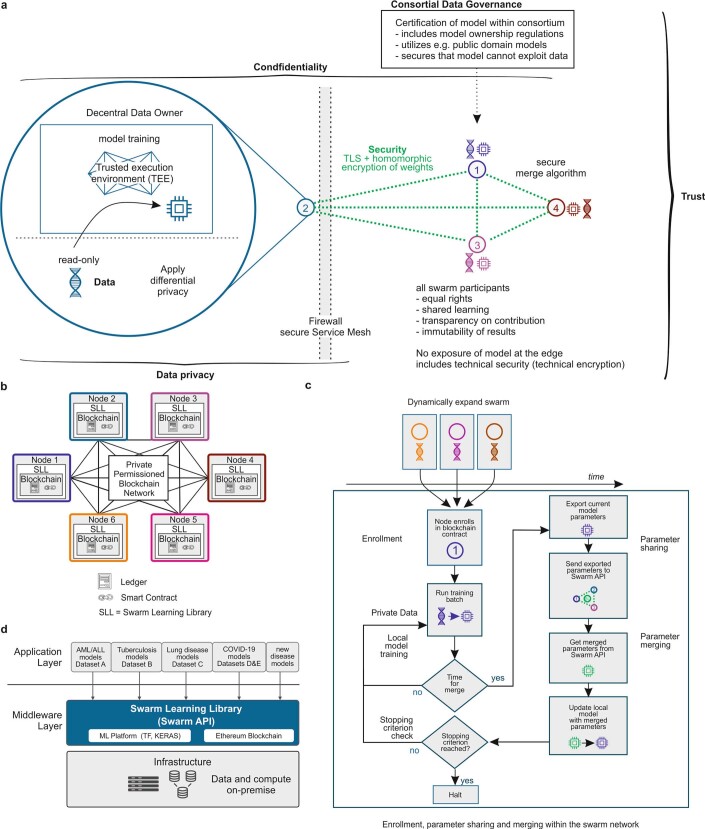
Fast and reliable detection of patients with severe and heterogeneous illnesses is a major goal of precision medicine 1,2 . Patients with leukaemia can be identified using machine learning on the basis of their blood transcriptomes 3 . However, there is an increasing divide between what is technically possible and what is allowed, because of privacy legislation 4,5 . Here, to facilitate the integration of any medical data from any data owner worldwide without violating privacy laws, we introduce Swarm Learning—a decentralized machine-learning approach that unites edge computing, blockchain-based peer-to-peer networking and coordination while maintaining confidentiality without the need for a central coordinator, thereby going beyond federated learning. To illustrate the feasibility of using Swarm Learning to develop disease classifiers using distributed data, we chose four use cases of heterogeneous diseases (COVID-19, tuberculosis, leukaemia and lung pathologies). With more than 16,400 blood transcriptomes derived from 127 clinical studies with non-uniform distributions of cases and controls and substantial study biases, as well as more than 95,000 chest X-ray images, we show that Swarm Learning classifiers outperform those developed at individual sites. In addition, Swarm Learning completely fulfils local confidentiality regulations by design. We believe that this approach will notably accelerate the introduction of precision medicine.
Verified 2026-10-05 · 1 reference not checked yet
Overview
CoChat Summary
TL;DR
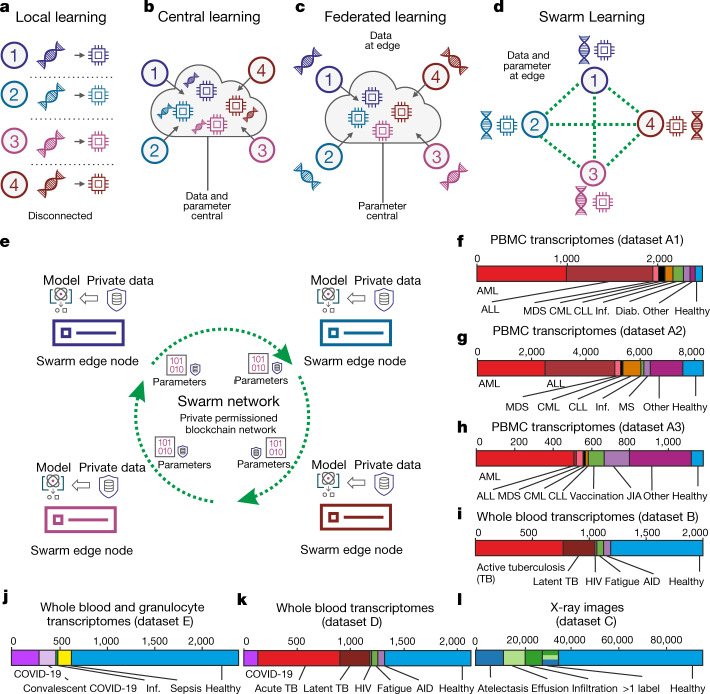
Swarm Learning (SL) is a decentralized machine-learning approach that combines edge computing, permissioned blockchain peer-to-peer networking, and coordination without a central parameter server, preserving confidentiality by design. Across four disease use cases—leukaemia, tuberculosis, COVID-19, and lung pathologies—SL classifiers trained on distributed data outperformed classifiers developed at individual sites and were close to or equivalent to centralized models.
Key findings
- Using more than 16,400 blood transcriptomes from 127 clinical studies and more than 95,000 chest X-ray images, SL outperformed individual nodes across leukaemia, tuberculosis, COVID-19, and lung pathology use cases; central models were only slightly better or equivalent in several scenarios.
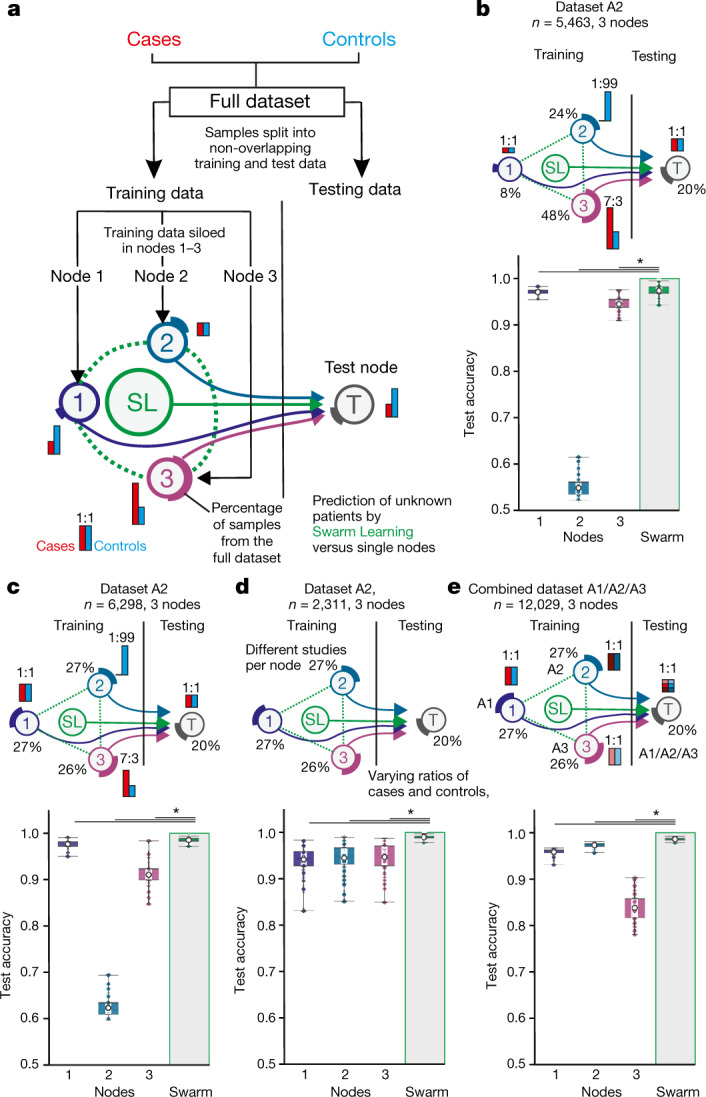
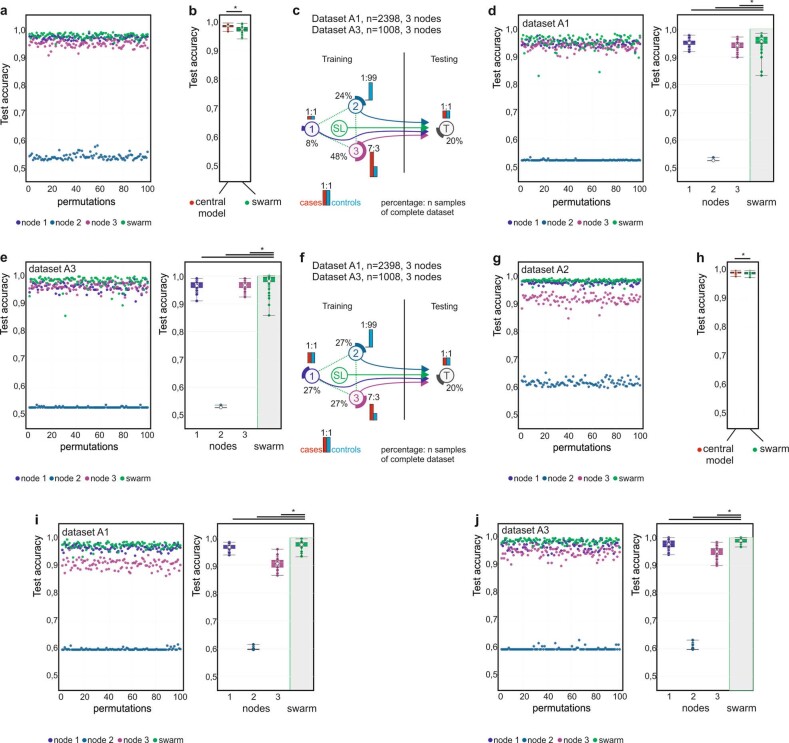
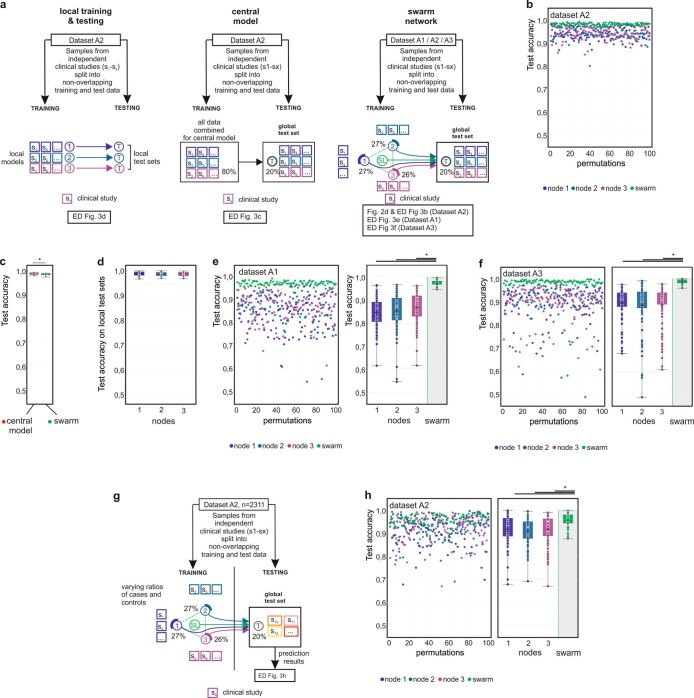
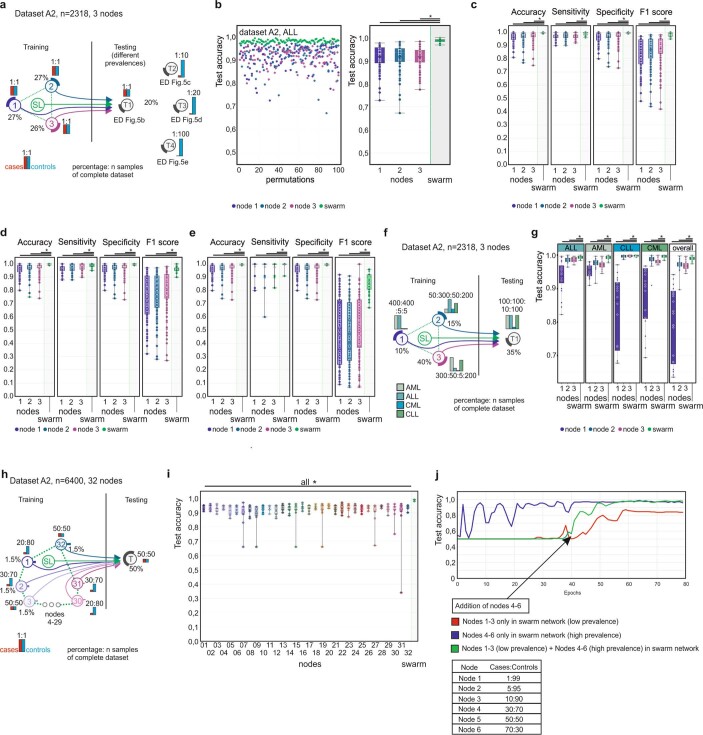
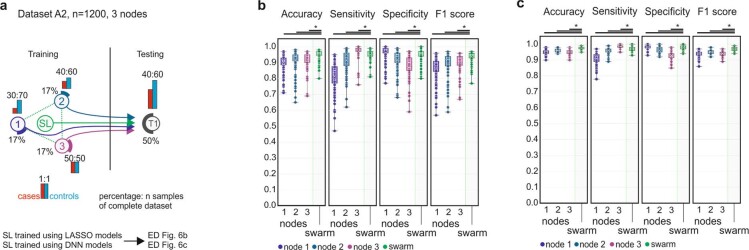
- In leukaemia PBMC datasets A1–A3, comprising more than 12,000 individuals, SL outperformed each node across multiple scenarios, including uneven case/control distributions, study-specific siloing, different transcriptomic technologies, up to 32 nodes, and LASSO instead of deep neural networks.
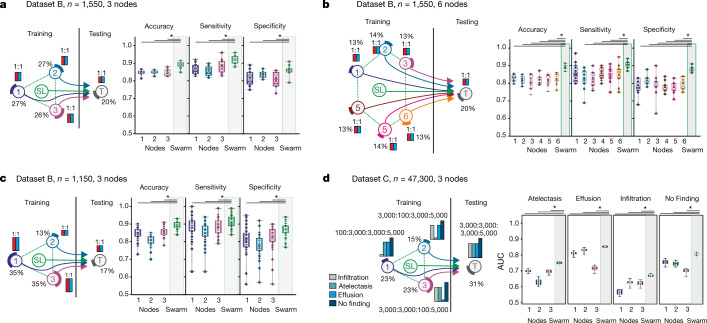
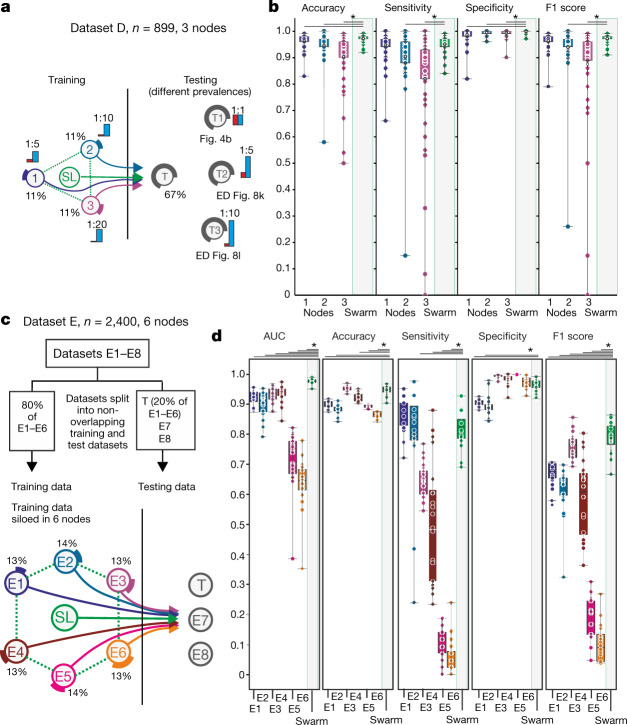
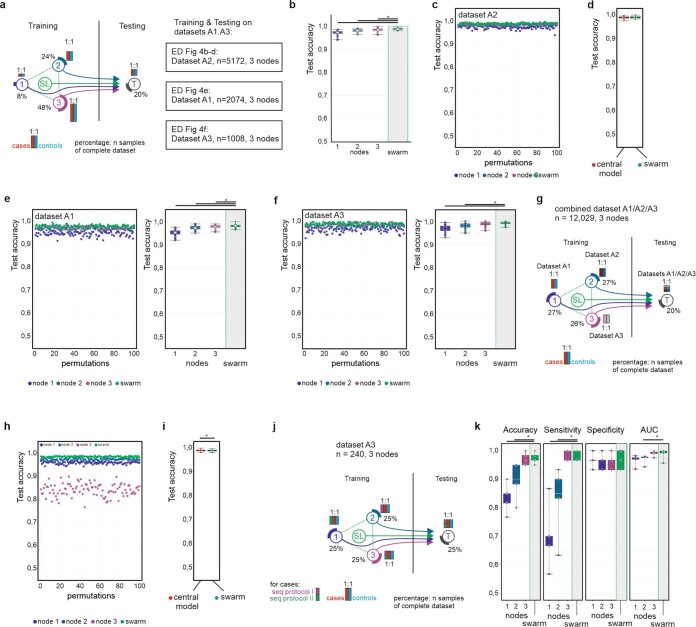
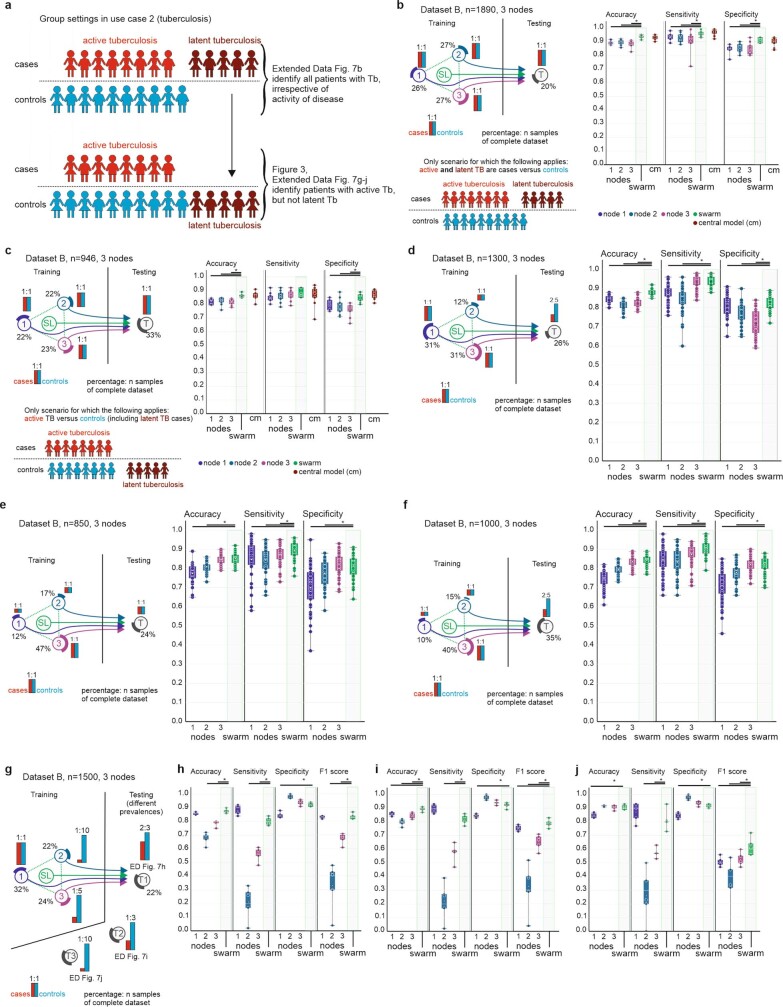
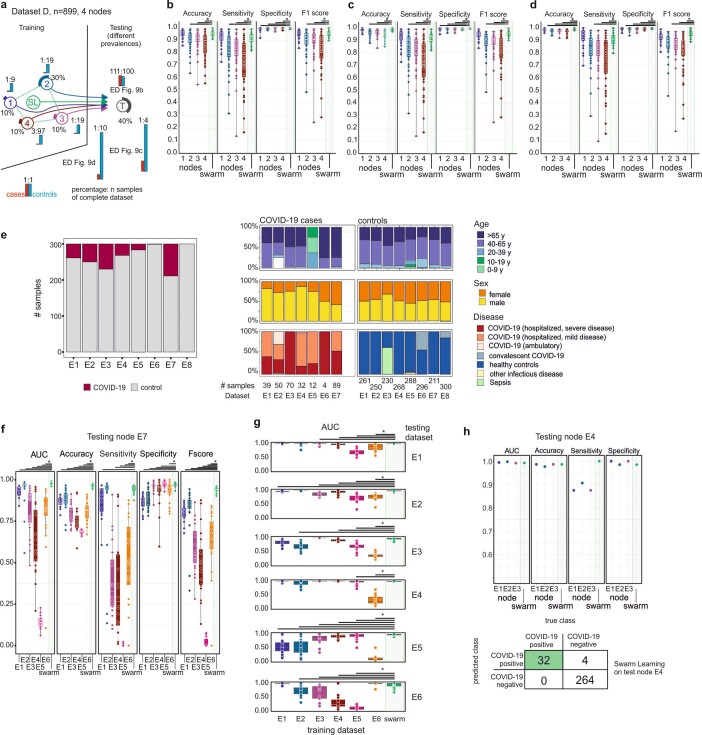
- For tuberculosis, SL outperformed individual nodes even when training samples were reduced by 50% or split into six smaller nodes; for COVID-19, SL outperformed all nodes in AUC on global test datasets and predicted samples from other centres when individual centre nodes could not.
- Overall, 16,694 analyses were performed across 26 AML, 4 ALL, 13 TB, 1 X-ray, and 18 COVID-19 scenarios, with 5–100 permutations per scenario and a total of 8,347 computer hours.
Methods
- Design: decentralized SL framework using edge nodes and a permissioned blockchain for secure onboarding, dynamic leader election, and parameter merging, with no central parameter server; raw data remain local and model parameters are exchanged and merged.
- Data: PBMC transcriptome datasets A1 (n = 2,500), A2 (n = 8,348), and A3 (n = 1,181); whole-blood datasets B (n = 1,999), D (n = 2,143), and E (n = 2,400); chest X-ray dataset C (95,831 images); simulations used 3–32 training nodes and independent test nodes.
- Analysis: deep neural network (Keras sequential) and LASSO; performance metrics included sensitivity, specificity, accuracy, F1 score, and AUC; differences were tested with one-sided Wilcoxon signed-rank test with continuity correction, using 5–100 permutations per scenario.
Limitations
- Stated: no statistical methods were used to predetermine sample size; experiments were not randomized, although permutations were performed; investigators were not blinded to allocation during experiments and outcome assessment.
- Stated/implied: SL performance was tested in simulated siloing and outbreak scenarios using existing datasets, not in a prospective real-world multi-centre clinical deployment; the paper notes potential limitations in TB outbreak scenarios but does not quantify them.
- Evident: although confidentiality is preserved by design and no raw data are exchanged, model parameters are shared; the paper suggests SL can inherit differential privacy, functional encryption, or encrypted transfer learning, but these were not implemented or tested here.
Model-written summary. Check it against the paper before relying on it.
Integrity signals
Registry
Cites
Statistics
Figures
Verification
Claims the paper makes
6 Valid · 0 Not valid · 7 Not checked · 58 Own results and interpretations
The cited sources support only part of this claim — read each source’s verdict below.
In the paper
“As medicine is inherently decentral, the volume of local data is often insufficient to train reliable classifiers20,21.”
§ Swarm Learning for decentralized and confidential clinical machine learning > Main
What the sources say
- Not checked yetcites [20] Rajkomar A Dean J Kohane I Machine learning in medicine N. Engl. J. Med. 2019 380 1347 1358 10.1056/NEJMra1814259 30943338 source
- Partly supportedcites [21] Savage N Calculating disease Nature 2017 550 S115 S117 10.1038/550S115a 29045372 sourceExperimental — accuracy not yet measured
In “BIOPSY BY NUMBERS” (page unavailable), the paper says a researcher wants a much larger dataset to validate and refine an ALS classification algorithm, and describes a shared MRI repository assembled to provide larger datasets. It does not say that medicine is inherently decentralized or that local datasets are often insufficient to train reliable classifiers; it also reports good predictions from a relatively small dataset. (LLM, conf=0.78)
plainstates a cause- Asserted: passes — The authors put it forward as true.
- Checkable: passes — It can be checked against evidence.
- Load-bearing: passes — The paper’s conclusions depend on it.
- Based: passes — The paper gives a reason why it holds.
The cited sources support only part of this claim — read each source’s verdict below.
In the paper
“With increasing efforts to enforce data privacy and security5,9,10 and to reduce data traffic and duplication, a decentralized data model will become the preferred choice for handling, storing, managing, and analysing any kind of large medical dataset19.”
§ Swarm Learning for decentralized and confidential clinical machine learning > Discussion
What the sources say
- Partly supportedcites [19] Kaissis GA Makowski MR Rückert D Braren RF Secure, privacy-preserving and federated machine learning in medical imaging Nat. Mach. Intell. 2020 2 305 311 10.1038/s42256-020-0186-1 sourceExperimental — accuracy not yet measured
The Outlook section of our copy supports the direction of the claim: it states that decentralized data storage and federated learning systems are 'replacing the current paradigm of data sharing and centralized storage' and are driven by privacy requirements, and the paper elsewhere notes such methods 'should require minimal or no data transfer'. However, the source hedges this as having 'the greatest potential to enable privacy-preserving cross-institutional research in a breadth of biomedical disciplines in the near future', whereas the citing sentence asserts it as a certainty ('will become the preferred choice') and extends it to 'handling, storing, managing, and analysing any kind of large medical dataset' — a scope and a confidence level the source does not claim. The 'reduce data traffic and duplication' motive is only partly reflected (the paper in fact lists communication overhead and burdensome data transfer as limitations of decentralized/federated and SMPC approaches). (LLM, conf=0.72)
plainstates a cause- Asserted: passes — The authors put it forward as true.
- Checkable: unclear — It is unclear whether it could be checked against evidence.
- Load-bearing: passes — The paper’s conclusions depend on it.
- Based: passes — The paper gives a reason why it holds.
- Partly supported
The cited sources support only part of this claim — read each source’s verdict below.
In the paper
“with current privacy regulations5,9,10 making it less appealing to develop centralized AI systems”
§ Swarm Learning for decentralized and confidential clinical machine learning > Discussion
What the sources say
- Partly supportedcites [5] Price WN II Cohen IG Privacy in the age of medical big data Nat. Med. 2019 25 37 43 10.1038/s41591-018-0272-7 30617331 PMC6376961 sourceExperimental — accuracy not yet measured
Price & Cohen (2019) do support the general thrust: in 'A path forward' they write that 'The basic harm of privacy overprotection is the brakes it puts on data-driven innovation,' that privacy protections limit data aggregation and innovative data use, and that 'Patchy, fragmented health data make data-driven innovation hard, imposing both technological and economic hurdles' (A path forward); they also note in 'Why do we need big data in health?' that AI uses 'require very large sets of data' and that without them 'algorithms cannot be trained or ... evaluated.' But our copy nowhere contrasts centralized with decentralized/federated architectures, and says nothing about privacy regulation making 'centralized' AI systems specifically less appealing — that comparative claim is the citing authors'. The paper's regulatory discussion is also confined to U.S. law (HIPAA de-identification, covered entities), narrower than the unqualified 'current privacy regulations' in the citing sentence. (LLM, conf=0.72)
- Not checked yetcites [9] Kels CG HIPAA in the era of data sharing J. Am. Med. Assoc. 2020 323 476 477 10.1001/jama.2019.19645 32016301 source
- Not checked yetcites [10] McCall B What does the GDPR mean for the medical community? Lancet 2018 391 1249 1250 10.1016/S0140-6736(18)30739-6 29619949 source
plainstates a cause- Asserted: passes — The authors put it forward as true.
- Checkable: passes — It can be checked against evidence.
- Load-bearing: passes — The paper’s conclusions depend on it.
- Based: passes — The paper gives a reason why it holds.
- Partly supported
Every source the paper cites for this claim was checked and supports it.
In the paper
“but progress is hindered by the limited size of datasets19”
§ Swarm Learning for decentralized and confidential clinical machine learning > Discussion
What the sources say
- Supportedcites [19] Kaissis GA Makowski MR Rückert D Braren RF Secure, privacy-preserving and federated machine learning in medical imaging Nat. Mach. Intell. 2020 2 305 311 10.1038/s42256-020-0186-1 source
The opening of our copy (Abstract/front-matter, p. 305) states that 'the broad application of artificial intelligence techniques in medicine is currently hindered by limited dataset availability for algorithm training and validation.' The Introduction (Abstract section, p. 305) ties progress specifically to oncology applications (tumour detection, genomic characterization, subtyping, grading, outcome/relapse risk) to 'the release of large, curated corpora of images', notes that 'even the largest current imaging studies in the field ... include considerably less data than, for example, ImageNet', and that 'the inability to access and leverage this data poses a significant barrier to AI applications in this field.' This supports the paraphrase that limited dataset size hinders progress in oncology machine learning, with the caveat that the source's scope is medical imaging AI generally rather than oncology alone. (LLM, conf=0.85)
plainstates a cause- Asserted: passes — The authors put it forward as true.
- Checkable: passes — It can be checked against evidence.
- Load-bearing: passes — The paper’s conclusions depend on it.
- Based: passes — The paper gives a reason why it holds.
- Supported
A result the paper reports from its own data — it cites no other source for it, so there is none to check. The quote shows it is in the paper.
In the paper
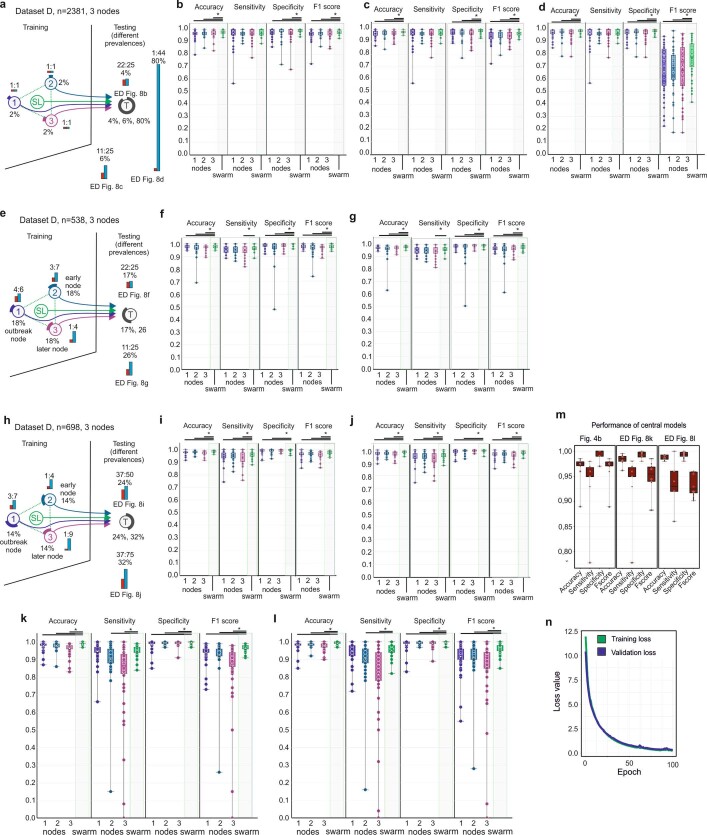
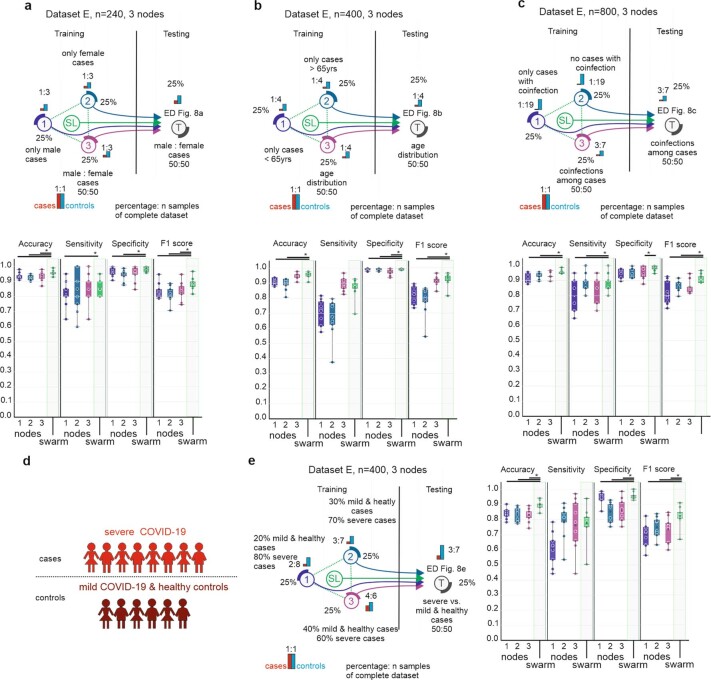
“When we reduced cases at training nodes, all performance measures remained very high at the test node for SL and individual nodes (Extended Data Fig. 8e–j).”
§ Swarm Learning for decentralized and confidential clinical machine learning > Identification of COVID-19
plain- Asserted: passes — The authors put it forward as true.
- Checkable: passes — It can be checked against evidence.
- Load-bearing: unclear — It is unclear whether the paper’s conclusions depend on it.
- Based: passes — The paper gives a reason why it holds.
32 more claims
Create a free account to see all 71 claims and to verify the 16 references still open.
- It may state two separate claims as one. 18
- Probably not a substantial claim. 20
Claims other papers make about this one
Each is checked against this paper’s own text: does it say what the citing paper says it does?
The source backs part of the claim, not all of it — or backs it for a different population, condition or comparison.
In the citing paper
“It can also overcome the straggler dilemma with heterogeneous hardware, as well as improve the robustness to data poisoning attacks and master node fails [35], [145].”
From Edge artificial intelligence for 6g: vision, enabling technologies, and applications (2022) · cites this paper as [35]
Experimental — accuracy not yet measuredThe source backs part of the claim, not all of it — or backs it for a different population, condition or comparison.
In the citing paper
“FL allows training of AI models through averaging of local updates from numerous healthcare facilities and smart devices, such as IoMT, despite the lack of local data.”
From Federated learning-based AI approaches in smart healthcare: Concepts, taxonomies, challenges and open issues (2023) · cites this paper as [11]
Experimental — accuracy not yet measuredThe source backs part of the claim, not all of it — or backs it for a different population, condition or comparison.
In the citing paper
“Federated Learning has presented itself as a viable method for implementing economic, innovative healthcare systems while ensuring privacy [11–15].”
From Federated learning-based AI approaches in smart healthcare: Concepts, taxonomies, challenges and open issues (2023) · cites this paper as [11]
Experimental — accuracy not yet measuredThe cited source says what the claim attributes to it.
In the citing paper
“In particular, swarm learning [35] provides a completely decentralized AI solution based on decentralized ML by keeping local datasets at each edge device.”
From Edge artificial intelligence for 6g: vision, enabling technologies, and applications (2022) · cites this paper as [35]
The cited source says what the claim attributes to it.
In the citing paper
“Besides, swarm learning has recently been developed in [35] to provide a decentralized and confidential clinical disease detection solution for diseases (e.g., COVID-19, tuberculosis, and leukaemia).”
From Edge artificial intelligence for 6g: vision, enabling technologies, and applications (2022) · cites this paper as [35]
6 more claims about this paper
Create a free account to see every claim other papers make about this one.
Citations
Cites
Moderated estimation of fold change and dispersion for RNA-seq data with DESeq2
Love, M. I., Huber, W., & Anders, S. (2014) · Genome Biology · doi:10.1186/s13059-014-0550-8 · Cited by 95,106
LeCun, Y., Bengio, Y., & Hinton, G. (2015) · Nature · doi:10.1038/nature14539 · Cited by 84,126
Scikit-learn: Machine Learning in Python
Pedregosa, F., Varoquaux, G., Gramfort, A., Michel, V., Thirion, B., Grisel, O., Blondel, M., Müller, A., Nothman, J., Louppe, G., et al. (2012) · arXiv · doi:10.48550/arxiv.1201.0490 · Cited by 71,016
STAR: ultrafast universal RNA-seq aligner
Dobin, A., Davis, C. A., Schlesinger, F., Drenkow, J., Zaleski, C., Jha, S., Batut, P., Chaisson, M., & Gingeras, T. R. (2013) · Bioinformatics · doi:10.1093/bioinformatics/bts635 · Cited by 51,709
Bootstrap methods: another look at the jackknife
Efron, B. (1979) · The Annals of Statistics · doi:10.1214/aos/1176344552 · Cited by 17,602
Dermatologist-level classification of skin cancer with deep neural networks
Esteva, A., Kuprel, B., Novoa, R. A., Ko, J., Swetter, S. M., Blau, H. M., & Thrun, S. (2017) · Nature · doi:10.1038/nature21056 · Cited by 14,362 · cited 1×
“Particularly in oncology, success has been reported in machine-learning-based tumour detection 3,37 , sub-typing 38 , and outcome prediction 39 , but progress is hindered by the limited size of datasets 19 , with current privacy regulations 5,9,10 making it less appealing to develop centralized AI…”
BackgroundCommunication-Efficient Learning of Deep Networks from Decentralized Data
McMahan, H. B., Moore, E., Ramage, D., Hampson, S., & Arcas, B. A. Y. (2016) · arXiv · doi:10.48550/arxiv.1602.05629 · Cited by 14,215
Gene Expression Omnibus: NCBI gene expression and hybridization array data repository
Edgar, R. (2002) · Nucleic Acids Research · doi:10.1093/nar/30.1.207 · Cited by 13,288
Exploration, normalization, and summaries of high density oligonucleotide array probe level data
Irizarry, R. A. (2003) · Biostatistics · doi:10.1093/biostatistics/4.2.249 · Cited by 10,603
Detection of 2019 novel coronavirus (2019-nCoV) by real-time RT-PCR
Corman, V. M., Landt, O., Kaiser, M., Molenkamp, R., Meijer, A., Chu, D. K., Bleicker, T., Brünink, S., Schneider, J., Schmidt, M. L., et al. (2020) · Eurosurveillance · doi:10.2807/1560-7917.es.2020.25.3.2000045 · Cited by 7,344 · cited 10×
“We obtained very similar results using datasets A1 and A3, which strongly supports the idea that the improvement in performance of SL is independent of data collection (clinical studies) or the technologies (microarray or RNA-seq) used for data generation (Extended Data Fig.”
MethodInfluential
Cited by
Items 501–600 of 944
Abbas, S. R., Abbas, Z., Rehman, M. U., & Lee, S. W. (2026) · Digital Health · doi:10.1177/20552076261420985 · Cited by 7
Esmaeilzadeh, P., & Maddah, M. (2026) · Health Systems · doi:10.1080/20476965.2026.2637433 · Cited by 5
Saldanha, O. L., Pfeiffer, K., Bodenstedt, S., Kirchner, M., Jenke, A. C., Barata, C., Barbosa, S., Barthel, J., Carstens, M., Castro, L. T., et al. (2026) · NEJM AI · doi:10.1056/aioa2501116 · Cited by 5
Personalized federated learning based on self-excluding aggregation with knowledge distillation
Bi, W.-Z., Yu, W.-J., & Gong, L.-H. (2026) · Cluster Computing · doi:10.1007/s10586-026-06362-9 · Cited by 5
Hierarchical Swarm Learning for Edge-Assisted Collaborative Vehicle Trajectory Prediction
Hou, X., Chen, L., Tang, J., Li, J., & Yang, W. (2023) · International Conference on Communications · doi:10.1109/icc45041.2023.10278931 · Cited by 5
Swarm Reinforcement Learning for Collaborative Content Caching in Information Centric Networks
Yang, J., Chen, L., Tang, J., Li, J., & Yang, W. (2023) · International Conference on Communications · doi:10.1109/icc45041.2023.10278917 · Cited by 5
“SL [10] is a new decentralized privacy-preserving distributed machine learning framework in which distributed nodes use local data for learning and blockchain network for data sharing, which can have higher privacy and security compared with FL.”
BackgroundYi, Y., You, R., Liu, H., Liu, C., Wang, Y., & Lv, J. (2024) · Proceedings of the AAAI Conference on Artificial Intelligence · doi:10.1609/aaai.v38i15.29584 · Cited by 10
“Distributed machine learning (ML) that involves several collaborative computing machines has been recognized as the backbone for training large-scale ML models in the modern society (Warnat-Herresthal et al. 2021; Kairouz et al. 2021).”
BackgroundXu, Y., Zhao, B., Zhou, H., & Su, J. (2024) · Computer Modeling in Engineering & Sciences · doi:10.32604/cmes.2024.053462 · Cited by 8
Tang, L., Zhao, Y., Xue, C., Jiang, Z., Zou, W., Liang, Y., & Chen, Q. (2024) · Digital Communications and Networks · doi:10.1016/j.dcan.2024.08.009 · Cited by 7
Kang, H., & Wang, J. (2024) · Complex & Intelligent Systems · doi:10.1007/s40747-024-01573-2 · Cited by 3
Swarm Robotics: Moving from Concept to Application
Septfons, B., Chehri, A., Chaibi, H., Saadane, R., & Tigani, S. (2022) · Smart innovation, systems and technologies · doi:10.1007/978-981-19-3455-1_14 · Cited by 5
Thoughts on Non-IID Data Impact in Healthcare with Federated Learning Medical Blockchain
Shae, Z., Chen, K.-Y., Chang, C.-Y., Tsai, Y., Chou, C., Baskett, W. I., Shyu, C., & Tsai, J. J. P. (2022) · IEEE International Conference on Cognitive Machine Intelligence (CogMI) · doi:10.1109/cogmi56440.2022.00013 · Cited by 7
“published an article at Nature journal [32] which called for the need and benefits of using blockchain for the distributed FL.”
BackgroundBlockchain-based Data Quality Assessment to Improve Distributed Machine Learning
Du, Y., Wang, Z., Leung, C., & Victor, L. (2023) · 2012 International Conference on Computing, Networking and Communications (ICNC) · doi:10.1109/icnc57223.2023.10074543 · Cited by 5
“To further secure DML for smart health, a permissioned blockchain is used [11].”
MethodRobust peer-to-peer learning via secure multi-party computation
Luo, Y., Luo, W., Zhang, R., Zhang, H., & Shi, Y. (2023) · Journal of Information and Intelligence · doi:10.1016/j.jiixd.2023.08.003 · Cited by 7
Song, F., Li, Y., Jiang, M., Li, K., Zhang, J., Zhang, Y., & Pang, Z. (2025) · IEEE Journal of Biomedical and Health Informatics · doi:10.1109/jbhi.2025.3531419 · Cited by 5
“In our work, the SL algorithm and the proposed HSGO framework were implemented using the Swarm Learning library [13].”
Self-citationNew solutions based on the generalized eigenvalue problem for the data collaboration analysis
Kawakami, Y., Takano, Y., & Imakura, A. (2025) · Information Sciences · doi:10.1016/j.ins.2025.122642 · Cited by 7
Training, testing and benchmarking medical AI models using Clinical AIBench
Huang, Y., Miao, X., Zhang, R., Ma, L., Liu, W., Zhang, F., Guan, X., Liang, X., Lu, X., Tang, S., et al. (2022) · BenchCouncil Transactions on Benchmarks Standards and Evaluations · doi:10.1016/j.tbench.2022.100037 · Cited by 5
Разработка архитектуры универсального фреймворка федеративного обучения
Efremov, M. A., Efremov, M. A., & Kholod, I. I. (2022) · Международный журнал Программные продукты и системы · doi:10.15827/0236-235x.138.263-272 · Cited by 6
Decentralized Federated Learning: A Defense Against Gradient Inversion Attack
Guang-xi, L., Xiong, Z., Li, R., & Li, W. (2023) · Lecture notes of the Institute for Computer Sciences, Social Informatics and Telecommunications Engineering · doi:10.1007/978-3-031-27041-3_4 · Cited by 6
Genomic surveillance of bacterial pathogens
Soni, V., Akhade, A. S., Bhattacharya, C., Chawla, Y., Bukhari, Z., Gupta, S. L., Basu, S., Jain, S., & Soni, Y. (2023) · Elsevier eBooks · doi:10.1016/b978-0-443-18769-8.00011-8 · Cited by 6
Improving Heterogeneous Model Reuse by Density Estimation
Tang, A., Luo, Y., Hu, H., He, F., Su, K., Du, B., Chen, Y., & Tao, D. (2023) · International Joint Conference on Artificial Intelligence · doi:10.24963/ijcai.2023/472 · Cited by 5
Blatter, T. U., Witte, H., Fasquelle-Lopez, J., Nakas, C. T., Raisaro, J. L., & Leichtle, A. B. (2023) · Journal of Medical Internet Research · doi:10.2196/47254 · Cited by 7
On the Impact of Label Noise in Federated Learning
Ke, S., Huang, C., & Liu, X. (2023) · International Symposium on Modeling and Optimization in Mobile, Ad Hoc, and Wireless Networks (WiOpt) · doi:10.23919/wiopt58741.2023.10349830 · Cited by 7
“• Since the first two statements of the corollary do not rely on the aggregation mechanism, they could also be extended from FL to a decentralized learning scenario, e.g. Swarm learning in decentralized clinical ML [45], decentralized optimization algorithms [46], [47], ML on blockchain [48].”
BackgroundGeneralizing Differentially Private Decentralized Deep Learning with Multi-agent Consensus
Bayrooti, J., Gao, Z., & Prorok, A. (2025) · Springer proceedings in advanced robotics · doi:10.1007/978-3-032-04584-3_21 · Cited by 5
Roth, H. R., Rieke, N., Albarqouni, S., & Li, Q. (2023) · IEEE Transactions on Medical Imaging · doi:10.1109/tmi.2023.3278528 · Cited by 5
DSFL: a blockchain-based data sharing and federated learning framework
Niu, H., Zhang, X., Chu, Z., & Shi, W. (2025) · Applied Intelligence · doi:10.1007/s10489-025-06400-w · Cited by 4
How does date-rounding affect phylodynamic inference for public health?
Featherstone, L. A., Ingle, D. J., Wirth, W., & Duchêne, S. (2025) · PLoS Computational Biology · doi:10.1371/journal.pcbi.1012900 · Cited by 5
Decoupling Intra- and Inter-Shard Consensus for High Scalability in Permissioned Blockchain
Cao, M., Cao, B., & Peng, M. (2025) · IEEE Transactions on Networking · doi:10.1109/ton.2025.3630569 · Cited by 4
“…applied in various industrial applications, such as decentralized identification in Internet of Things scenarios [1], authentication management in 6G networks [12], Environmental, Social, and Governance (ESG) reporting platforms [3], swarm learning in healthcare [2], and financial systems [13], [14].”
Artificial Intelligence in Transcriptomics: From Human-in-the-Loop to Agentic AI
Gentile, G., Morello, G., Cognata, V. L., Guarnaccia, M. C., & Cavallaro, S. (2026) · Journal of Personalized Medicine · doi:10.3390/jpm16040181 · Cited by 5
“…labeled data can be used for supervised learning tasks; for instance, a decentralized AI learning framework, called Swarm learning, has been used as a disease classifier for medical diagnoses of leukemia, tuberculosis, and coronavirus disease-19 (COVID-19) from patients’ blood transcriptomes [51].”
Du, M., Zhang, M., Liu, L., Xu, K., & Yin, Q. (2023) · Proceedings of the International Conference on Parallel Processing · doi:10.1145/3605573.3605592 · Cited by 5
“Benefiting from the confidence and robustness of blockchain, swarm learning[36] was introduced for data sharing under the increasingly stringent privacy protection regulations.”
BackgroundMethodMulti-Confederated Learning: Inclusive Non-IID Data handling with Decentralized Federated Learning
Duchesne, M., Zhang, K., & Talhi, C. (2024) · ACM Symposium on Applied Computing · doi:10.1145/3605098.3636000 · Cited by 4
Coutinho‐Almeida, J., Cruz-Correia, R. J., & Rodrigues, P. P. (2024) · Scientific Reports · doi:10.1038/s41598-024-61371-1 · Cited by 4
“There are two main branches of these approaches, distinguishable by the existence of a central orchestrator server: federated learning where such an entity exists, and peer-to-peer (or swarm) 6 learning where it does not.”
BackgroundBlockchain-Aided Wireless Federated Learning: Resource Allocation and Client Scheduling
Li, J., Zhang, W., Wei, K., Chen, G., Shu, F., Chen, W., & Jin, S. (2024) · IEEE Internet of Things Journal · doi:10.1109/jiot.2024.3417212 · Cited by 6
“The work in [15] combined edge computing with a blockchain-based P2P network to replace the central server in traditional FL, thereby enhancing the system privacy.”
MethodA Key Performance Indicator to Analyze Swarm Learning Performances with EHR
Mantovani, M., Scheda, R., Combi, C., & Diciotti, S. (2024) · IEEE International Conference on Healthcare Informatics (ICHI) · doi:10.1109/ichi61247.2024.00099 · Cited by 5
“Swarm Learning (SL) is a recently proposed technique that addresses this issue, and it allows to perform a distributed and synchronized training to solve a problem without the need for a permanent centralized control [4].”
BackgroundInfluentialTang, L., Kou, E., Zhang, W., Wu, Q., & Chen, Q. (2024) · IEEE Internet of Things Journal · doi:10.1109/jiot.2024.3448429 · Cited by 9
“This technique accomplishes an effective tradeoff between huge data and privacy [20].”
A federated graph learning method to realize multi-party collaboration for molecular discovery
Zhang, L., Zhang, J., Huang, R., Wang, Y., Liu, L., Zhang, Y., Chen, K., Jiang, J., & Wu, Y. (2026) · Nature Machine Intelligence · doi:10.1038/s42256-026-01184-1 · Cited by 5
Governance of Collaborative AI Development Strategies
Wiesmüller, S., & Bauer, M. (2023) · CSR, sustainability, ethics & governance · doi:10.1007/978-3-031-09245-9_4 · Cited by 5
A Medical Pre-diagnosis Scheme Based on Neural Network and Inner Product Function Encryption
Cui, X., Liu, H., Tang, M., & Ma, Y. (2023) · International Conference on Electronic Communication and Artificial Intelligence (ICECAI) · doi:10.1109/icecai58670.2023.10176838 · Cited by 5
“The development of big data and artificial intelligence has enabled the successful application of machine learning techniques in various scenarios, such as smart road networks[1], Internet of Things[2], and smart healthcare[3-5].”
BackgroundSundararajan, A., Bridges, R. A., Olama, M. M., & Ferrari, M. F. (2023) · IEEE PES Innovative Smart Grid Technologies Conference - Latin America (ISGT Latin America) · doi:10.1109/isgt-la56058.2023.10328226 · Cited by 4
“Using federated frameworks with Blockchain to leverage immutable and decentralized trust is also an option [21].”
MethodAdvanced Technologies for Precision Agriculture in Environmental and Meteorological Prediction
Padhiary, M., Kumar, R., & Sahu, B. (2025) · Advances in information security, privacy, and ethics book series · doi:10.4018/979-8-3693-6371-3.ch008 · Cited by 4
Privacy-Aware Spectrum Pricing and Power Control Optimization for LEO Satellite Internet-of-Things
Shen, B., Lam, K., Li, F., & Wang, L. (2025) · IEEE Transactions on Wireless Communications · doi:10.1109/twc.2025.3574172 · Cited by 5
“The Agent interacts with the coma munication environment to find the optimal scheme.”
Can privacy technologies replace cookies? Ad revenue in a field experiment
Gu, Z., Johnson, G. A., & Kobayashi, S. (2026) · Proceedings of the National Academy of Sciences · doi:10.1073/pnas.2603752123 · Cited by 6
Generalized pigeon-inspired optimization algorithm for balancing exploration and exploitation
Cheng, S., Zhang, M., Shi, Y., Lu, H. J., Lei, X., & Wang, R. (2022) · Scientia Sinica Technologica · doi:10.1360/sst-2021-0371 · Cited by 4
Goal Programming in Federated Learning: an Application to Time Series Forecasting
Repetto, M., Torre, D. L., & Tariq, M. U. (2022) · International Conference on Decision Aid Sciences and Applications (DASA) · doi:10.1109/dasa54658.2022.9765040 · Cited by 5
Chen, H., Chen, N., He, L., Zhang, H., Xu, J., Chen, H., & Li, Y. (2022) · Lecture notes in computer science · doi:10.1007/978-3-030-96772-7_50 · Cited by 4
Self-citationA MVCC Approach to Parallelizing Interoperability of Consortium Blockchain
Lin, W., Qu, Q., Ning, L., Fan, J., & Jiang, Q. (2022) · Lecture notes in computer science · doi:10.1007/978-3-030-96772-7_25 · Cited by 4
Decoupling Predictions in Distributed Learning for Multi-center Left Atrial MRI Segmentation
Gao, Z., Li, L., Wu, F., Wang, S., & Zhuang, X. (2022) · Lecture notes in computer science · doi:10.1007/978-3-031-16431-6_49 · Cited by 4
Aggarwal, G., Huang, C.-Y., Fan, D., Li, X., & Wang, Z. (2022) · Lecture notes in computer science · doi:10.1007/978-3-031-18523-6_10 · Cited by 5
Multi-dimensional Data Quick Query for Blockchain-Based Federated Learning
Yang, J., Cao, S., Xiangli, P., Li, X., & Zhang, X. (2022) · Lecture notes in computer science · doi:10.1007/978-3-031-19211-1_43 · Cited by 4
DISH: A Distributed Hybrid Primal-Dual Optimization Framework to Utilize System Heterogeneity
Niu, X., & Wei, E. (2022) · IEEE Conference on Decision and Control (CDC) · doi:10.1109/cdc51059.2022.9993156 · Cited by 4
Qi, Y., Lin, X., Wu, J., & Han, Y. (2023) · IEEE Systems Journal · doi:10.1109/jsyst.2023.3290939 · Cited by 4
“The SL proposedin[1] combines blockchain-basedswarm networkwith edge computing, realizing a decentralized cooperation computing paradigm without a centralized coordinator.”
BackgroundStrategic Analysis of Participants in BCFL-Enabled Decentralized IoT Data Sharing
Cheng, Z., Wang, B., Pan, Y., & Liu, Y. (2023) · Mathematics · doi:10.3390/math11214520 · Cited by 4
Li, Y., Ling, H., Ren, X., Yu, C. Y., & Liu, T. (2023) · IEEE Eurasia Conference on IOT, Communication and Engineering (ECICE) · doi:10.1109/ecice59523.2023.10383173 · Cited by 4
“Shastry introduced Swarm Learning, a novel framework to combine blockchain, peer-to-peer networking, edge computing, and machine learning to form a unified platform [1].”
BackgroundSelf-citationVenkataraman, A. V., Marshall, C. R., & Rittman, T. (2023) · OSF Preprints (OSF Preprints) · doi:10.31219/osf.io/myuq7 · Cited by 4
Blockchain Technology for Big-data Sharing in Material Genome Engineering
Wang, R., Ye, F., Tang, S. H., Zhang, H., He, J., Zhang, X., & Xu, C. (2025) · Scientific Data · doi:10.1038/s41597-025-06092-4 · Cited by 6
“Blockchain-based frameworks have achieved success in domains such as engineering 33 , healthcare 34–36 , and finance 37–39 , yet their application in Material Genome Engineering (MGE) remains limited 4 .”
Trustworthy Federated Fine-Tuning for Industrial Chains Demand Forecasting
Huang, G., Lin, G., Ning, L., Xu, Y., Lim, C. P., & Zhang, Y. (2025) · IEEE Transactions on Emerging Topics in Computational Intelligence · doi:10.1109/tetci.2025.3537941 · Cited by 3
“Applications range from FL and blockchain solutions for sharing medical data [18], collaborative security computing in the Internet of Vehicles [19], to hybrid blockchain and FL computing for multi-party energy sharing [20].”
Puca, P., Lopetuso, L. R., Laterza, L., Papa, A., Danese, S., Cesario, A., Damiani, A., Gasbarrini, A., Arcuri, G., & Scaldaferri, F. (2025) · Best Practice & Research Clinical Gastroenterology · doi:10.1016/j.bpg.2025.102050 · Cited by 3
Li, Z., Qiu, G., Wenlong, D., Lei, S., Shengxin, C., & Lyu, L. (2025) · The American Surgeon · doi:10.1177/00031348251394273 · Cited by 3
Frimpong, G., Anyebe, A. C. P., & Omachi, A. (2024) · International Journal of Scientific Research and Modern Technology. · doi:10.38124/ijsrmt.v3i12.962 · Cited by 3
From Cryptocurrencies to Collaborative Risk Management: A Review of Decentralized AI Approaches
Gürpinar, T., Gulum, M. A., & Martinelli, M. (2025) · FinTech · doi:10.3390/fintech4040074 · Cited by 3
“It is especially well-suited for scenarios where participants may be highly autonomous, such as in cross-border healthcare networks, federations of banks, or distributed industrial consortia [44,45].”
Veeranki, S. P. K., Hayn, D., Kramer, D., Gampawar, P. G., Baumgartner, M., Lorenzer, L. D., Schrempf, M., & Schreier, G. (2026) · BMC Medical Informatics and Decision Making · doi:10.1186/s12911-025-03322-y · Cited by 4
Temporale, C., Salvo, E. D., Gaeta, E., Rujas, M., Lopez-Perez, L., Haleem, M. S., Aidonis, V., Georga, E. I., Fotiadis, D. I., Pecchia, L., et al. (2026) · IEEE Access · doi:10.1109/access.2026.3657440 · Cited by 3
“Furthermore, exploring ways to integrate distributed federated architectures (e.g., Data Mesh [100] and Swarm Learning [101]) into the current centralized architecture would be a ground-breaking innovation that could revolutionize the health and life sciences sectors and beyond.”
Su, H., Wang, T., & Chen, C. (2026) · Frontiers in Cell and Developmental Biology · doi:10.3389/fcell.2026.1797221 · Cited by 3
“…including federated learning, swarm learning, and other distributed strategies, may support responsible data sharing and model development (Warnat-Herresthal et al., 2021; Cao et al., 2022), but such approaches must still be accompanied by transparent reporting, subgroup performance…”
Comparison of Ensemble and Federal Learning for Secure Data Collaboration in Satellite Networks
Gao, Z., Sun, W., & Zhang, Y. (2022) · IEEE/CIC International Conference on Communications in China (ICCC) · doi:10.1109/icccworkshops55477.2022.9896660 · Cited by 3
“When the server is not available due to secure or trust issues, a peer-to-peer (P2P) network can be built among all participants [19][20].”
BackgroundBlockchain, Information Security, Control, and Integrity: Who Is in Charge?
Barrera, J. A., Trotsyuk, A. A., Henn, D., Sivaraj, D., Chen, K., Mittal, S., Mermin-Bunnell, A. M., Larson, M. R., Padmanabhan, J., Kinney, B. M., et al. (2023) · Plastic & Reconstructive Surgery · doi:10.1097/prs.0000000000010409 · Cited by 3
Swarm Learning for Oncology Research
Shashank, H. S., Sathyanarayana, A., Acharya, A., Akhil, M., & Upadhyaya, S. R. (2023) · Lecture notes in computer science · doi:10.1007/978-3-031-36402-0_14 · Cited by 4
An alliance chain-based incentive mechanism for PSG data sharing
Zhang, W., Huo, X., & Bao, Z. (2023) · Peer-to-Peer Networking and Applications · doi:10.1007/s12083-023-01571-0 · Cited by 3
“In the literature [18], to address the data privacy issues and the unsound identity system on the blockchain, a fine-grained access control mechanism design is proposed and validated on the blockchain platform, which enhances data security while guaranteeing performance.”
Artificial Intelligence in Blood Transcriptomics
Warnat‐Herresthal, S., Oestreich, M., Schultze, J. L., & Becker, M. (2022) · Springer eBooks · doi:10.1007/978-3-030-64573-1_262 · Cited by 6
Self-citationTian, X., Jiang, Y., & Tianfield, H. (2022) · Adaptation, learning, and optimization · doi:10.1007/978-3-031-11748-0_8 · Cited by 3
A Review on Intelligent Health Care System Using Learning Methods
Raul, S., Das, S., Murty, C. S. V. V. S. N., & Devi, B. S. K. (2023) · Advances in transdisciplinary engineering · doi:10.3233/atde221251 · Cited by 3
Permissioned Blockchain-Based XGBoost for Multi Banks Fraud Detection
Asrori, S. S., Wang, L., & Ozawa, S. (2023) · Lecture notes in computer science · doi:10.1007/978-3-031-30111-7_57 · Cited by 4
Latency Minimization for Wireless Federated Learning with Heterogeneous Local Updates
Zhu, J., Shi, Y., Fu, M., Zhou, Y., Wu, Y., & Fu, L. (2023) · IEEE Wireless Communications and Networking Conference · doi:10.1109/wcnc55385.2023.10118880 · Cited by 3
“FL has received increasing attention in many critical applications, ranging from 6G communication [2], IoT [3], to biomedical healthcare [4].”
BackgroundCastelo-Branco, L., Lee, R. J., Brandão, M., Cortellini, A., Freitas, A., Garassino, M. C., Geukens, T., Grivas, P. D., Halabi, S., Oliveira, J., et al. (2023) · ESMO Open · doi:10.1016/j.esmoop.2023.101596 · Cited by 3
Improved Swarm Learning with Differential Privacy for Radio Frequency Fingerprinting
Zhang, L., Feng, L., Liu, Y., Zhou, F., Liu, B., Jia, Z., Wang, Y., Liu, H., & Ma, W. (2023) · IEEE International Symposium on Broadband Multimedia Systems and Broadcasting (BMSB) · doi:10.1109/bmsb58369.2023.10211163 · Cited by 3
“…there have been some machine learning frameworks designed specifically to protect data privacy, such as federation learning [5] and swarm learning [6], they are still exposed to security risks because attackers may access the models as ‘black boxes’ through inference attacks and model inversion…”
BackgroundDifferentially-Private Collaborative Online Personalized Mean Estimation
Yakimenka, Y., Weng, C.-W., Lin, H.-Y., Rosnes, E., & Kliewer, J. (2023) · IEEE International Symposium on Information Theory (ISIT) · doi:10.1109/isit54713.2023.10206796 · Cited by 3
“Collaborative learning has attracted significant attention lately through popular frameworks such as federated learning (FL) [1]–[3] (partially decentralized) and fully decentralized approaches like swarm learning [4].”
BackgroundOcaña, S. C., DeSanti, C., Daly, K., Shrees, C., László, N., Bellinghausen, C., Voss, C., & Cruz, J. (2023) · Breathe · doi:10.1183/20734735.0169-2023 · Cited by 3
“…overcomes the need for a central repository by uniting edge computing with blockchain-based peer-to-peer networking and coordination while maintaining confidentiality [27], allowing the integration of private medical data from any data owner worldwide without data sharing or violating privacy laws.”
BackgroundWill it run?—A proof of concept for smoke testing decentralized data analytics experiments
Welten, S., Weber, S., Holt, A., Beyan, O., & Decker, S. (2024) · Frontiers in Medicine · doi:10.3389/fmed.2023.1305415 · Cited by 3
“Besides FL and IIL, additional (hybrid) approaches for DA exist: Swarm Learning (SL) and Secure Multiparty Computation (SMPC), which use Peer-To-Peer (P2P) communication instead of relying on a central component (34, 35).”
BackgroundSlingshot: Globally Favorable Local Updates for Federated Learning
Liu, J., Huang, H., Wang, C., Zhou, S., Li, R., & Zheng, Z. (2024) · IEEE Open Journal of the Computer Society · doi:10.1109/ojcs.2024.3356599 · Cited by 3
“Therefore, FL can be applied to areas with strict privacy restrictions such as healthcare [2], [3].”
BackgroundPan, Q., Wu, J., Guan, X., & Deen, M. J. (2023) · Globecom · doi:10.1109/globecom54140.2023.10437300 · Cited by 3
“The conception of SL is first proposed in [7].”
BackgroundDuy, P. T., Tran, T.-D., Duy, H. N., Hoang, H. D., & Pham, V.-H. (2023) · RIVF International Conference on Computing and Communication Technologies (RIVF) · doi:10.1109/rivf60135.2023.10471775 · Cited by 3
“Meanwhile, Swarm Learning [10] opts for evaluation-based client selection, while FDC [12] prioritizes privacy but has a central server drawback.”
BackgroundFederated Learning on Transcriptomic Data: Model Quality and Performance Trade-Offs
Hannemann, A., Ewald, J., Seeger, L., & Buchmann, E. (2024) · Lecture notes in computer science · doi:10.1007/978-3-031-63772-8_26 · Cited by 5
Towards Opportunistic Federated Learning Using Independent Subnetwork Training
Romero, V., Matsui, T., Matsuda, Y., Suwa, H., & Yasumoto, K. (2024) · IEEE International Conference on Smart Computing · doi:10.1109/smartcomp61445.2024.00044 · Cited by 3
“In other cases, such as multi-vendor or multi-institutional collaborations, a third-party server may be undesirable due to trust issues [7], [11].”
Brain Storm Optimization based Swarm Learning for Diabetic Retinopathy Image Classification
Qu, L., Wang, C., & Shi, Y. (2024) · IEEE Congress on Evolutionary Computation (CEC) · doi:10.1109/cec60901.2024.10612118 · Cited by 3
“For example, Warnat-Herresthal et al. introduce a pioneering work in swarm learning [22], leveraging edge computing and blockchain technology to collaboratively train multiple local models sourced from different hospitals in a decentralized manner for four heterogeneous diseases, resulting in…”
BackgroundSPM-FL: A Federated Learning Privacy-Protection Mechanism Based on Local Differential Privacy
Chen, Z., & Zheng, H. (2024) · Electronics · doi:10.3390/electronics13204091 · Cited by 3
Wang, Y., Tripathi, S., Farshidi, S., & Zhao, Z. (2024) · Blockchain Research and Applications · doi:10.1016/j.bcra.2024.100244 · Cited by 3
“Integrating decentralized technologies, such as blockchains, smart contracts, decentralized storage and protocols, and Web3 wallet for research data management marks a significant shift towards decentralized data governance and autonomy over research lifecycle management [17, 16, 21].”
BackgroundDataFly: A Confidentiality-Preserving Data Migration Across Heterogeneous Blockchains
Li, T., Huang, H., Abla, P., Deng, Z., Yang, Q., Xie, A., He, D., & Zheng, Z. (2025) · IEEE Transactions on Computers · doi:10.1109/tc.2025.3535830 · Cited by 3
“Numerous permissioned blockchain platforms have been widely applied in multiple fields such as healthcare [1] and finance [2].”
Artificial Intelligence in Medicine: Revolutionizing Healthcare Practices and Patient OutcomesPreprint
Susilo, Y. K. B., Rahman, S. A., Yuliana, D., & Rasyid, F. A. (2025) · SSRN Electronic Journal · doi:10.2139/ssrn.5178173 · Cited by 5
ODFormer: a Virtual Organoid for Predicting Personalized Therapeutic Responses in Pancreatic CancerPreprint
Xu, J., Yang, X., Li, Y., Wang, H., Li, Y., Tang, S., Guo, S., Zou, J., Shi, X., Chen, Z., et al. (2025) · bioRxiv (Cold Spring Harbor Laboratory) · doi:10.1101/2025.07.08.663664 · Cited by 7
Self-citationModeling with Homophily Driven Heterogeneous Data in Gossip Learning
Ghosh, A., & Mascolo, C. (2023) · International Joint Conference on Artificial Intelligence · doi:10.24963/ijcai.2023/416 · Cited by 4
Donatello, D. (2025) · Journal of Ultrasound · doi:10.1007/s40477-025-00983-3 · Cited by 2
“2 and 3) [8, 15, 16].”
Practical Iterative Quantum Consensus Protocol With Sharding Construction
Ying, C., Du, Y., Zhang, W., Jiang, X., Wang, G., Jin, H., Li, J., Luo, Y., & Tao, D. (2025) · IEEE Journal on Selected Areas in Communications · doi:10.1109/jsac.2025.3568014 · Cited by 2
“Recently, it has been widely applied to various fields, such as mobile network [7], [8], supply chain management [9], financial services [10], Internet of vehicles [11], [12], electronic voting [13], transportation management [14] and health care [15].”
Hu, Y., Wang, Z., Xia, Y., Xiong, H., Fang, L., Peng, C., Wahaballa, A., Qin, Z., & Qin, Z. (2025) · IEEE Transactions on Intelligent Transportation Systems · doi:10.1109/tits.2025.3579613 · Cited by 6
“In order to investigate the temporal impact of introducing CLTSwNI&IA, comparative experiments were conducted between the original SL [60] and its variants using an MLP, with execution time measurements recorded.”
Fehse, L., Tajabadi, M., Martin, R., Holzmann, H., & Heider, D. (2025) · Computational and Structural Biotechnology Journal · doi:10.1016/j.csbj.2025.07.031 · Cited by 2
Decentralized Model Selection for Test-Time Adaptation in Heterogeneous Connected Systems
Du, Y., Leung, C., Wang, Z., Li, X., & Leung, V. C. M. (2026) · ACM Transactions on the Web · doi:10.1145/3764936 · Cited by 4
“Blockchain, a distributed ledger technology, is a kind of decentralization technique to establish collaboration among trustless entities verifiably [55].”
InfluentialNAAFL: A Non-Authoritative Anarchic Federated Learning for Defending Against Malicious Attacks
Xiu, R., Le, J., Zhang, D., Lü, Q., Xiang, T., & Liao, X. (2025) · IEEE Transactions on Sustainable Computing · doi:10.1109/tsusc.2025.3605384 · Cited by 2
“Compared to the traditional DML, FL significantly improves the privacy of clients [6], [7].”
Neurosurgery 4.0: A Scoping Review of Current Trends and Challenges in Specialized Smart Hospitals
Shabo, E., Sarikaya-Seiwert, S., Borger, V., Schneider, M. B., Vatter, H., & Hager, L. (2025) · Cureus · doi:10.7759/cureus.92673 · Cited by 2
Baker, S., Kilcullen, M., & Kandasamy, Y. (2025) · Acta Paediatrica · doi:10.1111/apa.70319 · Cited by 2
Kirchner, M., Hoffmann, H., Jenke, A. C., Saldanha, O. L., Pfeiffer, K., Kanjo, W., Alekseenko, J., de Boer, C., Kolamuri, S. R., Mazza, L., et al. (2026) · Medical Image Analysis · doi:10.1016/j.media.2026.104290 · Cited by 2
Zhou, W., Zhang, Y., Ping, Z., Cheng, C., & Sun, J. (2025) · Engineering Applications of Artificial Intelligence · doi:10.1016/j.engappai.2025.111940 · Cited by 2
Privacy Preserving Decentralized Online Federated Learning for Consumer Electronics
Wei, M., Liu, Z., Xia, L., & Zhao, Z. (2026) · IEEE Transactions on Consumer Electronics · doi:10.1109/tce.2026.3653552 · Cited by 4
“We benchmarked DP-DORO against several representative DFL algorithms, including DP-DSGD [11], Swarm Learning (SL) [6], and Gossip [20], on four challenging non-IID datasets: MNIST, FMNIST, CIFAR-10, and GTSRB.”
Metadata
- Authors
- Warnat-Herresthal, S., Schultze, H., Shastry, K. L., Manamohan, S., Mukherjee, S., Garg, V., Sarveswara, R., Händler, K., Pickkers, P., Aziz, N. A., Ktena, S., Tran, F., Bitzer, M., Ossowski, S., Casadei, N., Herr, C., Petersheim, D., Behrends, U., Kern, F., Fehlmann, T., Schommers, P., Lehmann, C., Augustin, M., Rybniker, J., Altmüller, J., Mishra, N., Bernardes, J. P., Krämer, B., Bonaguro, L., Schulte-Schrepping, J., De Domenico, E., Siever, C., Kraut, M., Desai, M., Monnet, B., Saridaki, M., Siegel, C. M., Drews, A., Nuesch-Germano, M., Theis, H., Heyckendorf, J., Schreiber, S., Kim-Hellmuth, S., (COVAS), C.-1. A. S., Balfanz, P., Eggermann, T., Boor, P., Hausmann, R., Kuhn, H., Isfort, S., Stingl, J. C., Schmalzing, G., Kuhl, C. K., Röhrig, R., Marx, G., Uhlig, S., Dahl, E., Müller-Wieland, D., Dreher, M., Marx, N., Nattermann, J., Skowasch, D., Kurth, I., Keller, A., Bals, R., Nürnberg, P., Rieß, O., Rosenstiel, P., Netea, M. G., Theis, F., Mukherjee, S., Backes, M., Aschenbrenner, A. C., Ulas, T., (DeCOI), D. C.-1. O. I., Angelov, A., Bartholomäus, A., Becker, A., Bezdan, D., Blumert, C., Bonifacio, E., Bork, P., Boyke, B., Blum, H., Clavel, T., Colome-Tatche, M., Cornberg, M., De La Rosa Velázquez, I. A., Diefenbach, A., Dilthey, A., Fischer, N., Förstner, K., Franzenburg, S., Frick, J.-S., Gabernet, G., Gagneur, J., Ganzenmueller, T., Gauder, M., Geißert, J., Goesmann, A., Göpel, S., Grundhoff, A., Grundmann, H., Hain, T., Hanses, F., Hehr, U., Heimbach, A., Hoeper, M., Horn, F., Hübschmann, D., Hummel, M., Iftner, T., Iftner, A., Illig, T., Janssen, S., Kalinowski, J., Kallies, R., Kehr, B., Keppler, O. T., Klein, C., Knop, M., Kohlbacher, O., Köhrer, K., Korbel, J., Kremsner, P. G., Kühnert, D., Landthaler, M., Li, Y., Ludwig, K. U., Makarewicz, O., Marz, M., McHardy, A. C., Mertes, C., Münchhoff, M., Nahnsen, S., Nöthen, M., Ntoumi, F., Overmann, J., Peter, S., Pfeffer, K., Pink, I., Poetsch, A. R., Protzer, U., Pühler, A., Rajewsky, N., Ralser, M., Reiche, K., Ripke, S., da Rocha, U. N., Saliba, A.-E., Sander, L. E., Sawitzki, B., Scheithauer, S., Schiffer, P., Schmid-Burgk, J., Schneider, W., Schulte, E.-C., Sczyrba, A., Sharaf, M. L., Singh, Y., Sonnabend, M., Stegle, O., Stoye, J., Vehreschild, J., Velavan, T. P., Vogel, J., Volland, S., von Kleist, M., Walker, A., Walter, J., Wieczorek, D., Winkler, S., Ziebuhr, J., Breteler, M. M. B., Giamarellos-Bourboulis, E. J., Kox, M., Becker, M., Cheran, S., Woodacre, M. S., Goh, E. L., & Schultze, J. L.
- Affiliations
- Hewlett Packard Enterprise (United States) (US)
- German Center for Neurodegenerative Diseases (DE)
- University of Bonn (DE)
- Radboud University Nijmegen (NL)
- National and Kapodistrian University of Athens (GR)
- Christian-Albrechts-Universität zu Kiel (DE)
- Universitätsklinikum Tübingen (DE)
- University of Tübingen (DE)
- Universitätsklinikum des Saarlandes (DE)
- LMU Klinikum (DE)
- Technical University of Munich (DE)
- Saarland University (DE)
- University of Cologne (DE)
- German Center for Infection Research (DE)
- Universitätsklinikum Aachen (DE)
- RWTH Aachen University (DE)
- University Hospital Bonn (DE)
- GFZ Helmholtz Centre for Geosciences (DE)
- Philipps University of Marburg (DE)
- Center for Regenerative Therapies Dresden (DE)
- European Molecular Biology Laboratory (DE)
- Helmholtz Munich (DE)
- Medizinische Hochschule Hannover (DE)
- University Medical Center Hamburg-Eppendorf (DE)
- Düsseldorf University Hospital (DE)
- ZB MED - Information Centre for Life Sciences (DE)
- Quantitative Biology Center (DE)
- Justus-Liebig-Universität Gießen (DE)
- University Medical Center Freiburg (DE)
- Leibniz Institute of Virology (LIV) (DE)
- German Cancer Research Center (DE)
- Fraunhofer Institute for Cell Therapy and Immunology (DE)
- Charité – Universitätsmedizin Berlin (DE)
- Bielefeld University (DE)
- Helmholtz Centre for Environmental Research (DE)
- Heidelberg University (DE)
- Max Delbrück Center (DE)
- Helmholtz Centre for Infection Research (DE)
- Helmholtz Institute for RNA-based Infection Research (DE)
- Universitätsmedizin Göttingen (DE)
- Robert Koch Institute (DE)
- Max Planck Institute of Molecular Cell Biology and Genetics (DE)
- Corresponding author
- Schultze, Joachim L.
- ORCID
- Warnat-Herresthal, Stefanie
- Schultze, Hartmut
- Manamohan, Sathyanarayanan
- Mukherjee, Saikat
- Garg, Vishesh
- Händler, Kristian
- Pickkers, Peter
- Aziz, N. Ahmad
- Ktena, Sofia
- Tran, Florian
- Bitzer, Michael
- Ossowski, Stephan
- Casadei, Nicolas
- Herr, Christian
- Petersheim, Daniel
- Behrends, Uta
- Kern, Fabian
- Fehlmann, Tobias
- Schommers, Philipp
- Lehmann, Clara
- Augustin, Max
- Rybniker, Jan
- Altmüller, Janine
- Mishra, Neha
- Bernardes, Joana P.
- Krämer, Benjamin
- Bonaguro, Lorenzo
- Schulte-Schrepping, Jonas
- De Domenico, Elena
- Siever, Christian
- Desai, Milind
- Saridaki, Maria
- Siegel, Charles Martin
- Drews, Anna
- Nuesch-Germano, Melanie
- Theis, Heidi
- Heyckendorf, Jan
- Schreiber, Stefan
- Kim-Hellmuth, Sarah
- Balfanz, Paul
- Eggermann, Thomas
- Boor, Peter
- Hausmann, Ralf
- Kuhn, Hannah
- Isfort, Susanne
- Stingl, Julia Carolin
- Kuhl, Christiane K.
- Röhrig, Rainer
- Marx, Gernot
- Uhlig, Stefan
- Dahl, Edgar
- Dreher, Michael
- Marx, Nikolaus
- Nattermann, Jacob
- Skowasch, Dirk
- Kurth, Ingo
- Keller, Andreas
- Bals, Robert
- Nürnberg, Peter
- Rieß, Olaf
- Rosenstiel, Philip
- Netea, Mihai G.
- Theis, Fabian
- Aschenbrenner, Anna C.
- Ulas, Thomas
- Angelov, Angel
- Bartholomäus, Alexander
- Becker, Anke
- Bezdan, Daniela
- Blumert, Conny
- Bonifacio, Ezio
- Blum, Helmut
- Clavel, Thomas
- Cornberg, Markus
- Diefenbach, Andreas
- Dilthey, Alexander
- Fischer, Nicole
- Förstner, Konrad
- Franzenburg, Sören
- Frick, Julia-Stefanie
- Gabernet, Gisela
- Gagneur, Julien
- Ganzenmueller, Tina
- Gauder, Marie
- Geißert, Janina
- Goesmann, Alexander
- Göpel, Siri
- Grundhoff, Adam
- Grundmann, Hajo
- Hain, Torsten
- Hanses, Frank
- Hehr, Ute
- Hoeper, Marius
- Hübschmann, Daniel
- Hummel, Michael
- Iftner, Thomas
- Illig, Thomas
- Kalinowski, Jörn
- Kallies, René
- Kehr, Birte
- Keppler, Oliver T.
- Klein, Christoph
- Knop, Michael
- Kohlbacher, Oliver
- Köhrer, Karl
- Korbel, Jan
- Kremsner, Peter G.
- Kühnert, Denise
- Landthaler, Markus
- Li, Yang
- Ludwig, Kerstin U.
- Makarewicz, Oliwia
- Marz, Manja
- McHardy, Alice C.
- Mertes, Christian
- Nahnsen, Sven
- Nöthen, Markus
- Ntoumi, Francine
- Overmann, Jörg
- Peter, Silke
- Pfeffer, Klaus
- Pink, Isabell
- Poetsch, Anna R.
- Protzer, Ulrike
- Pühler, Alfred
- Rajewsky, Nikolaus
- Ralser, Markus
- Reiche, Kristin
- Ripke, Stephan
- da Rocha, Ulisses Nunes
- Saliba, Antoine-Emmanuel
- Sander, Leif Erik
- Sawitzki, Birgit
- Scheithauer, Simone
- Schiffer, Philipp
- Schmid-Burgk, Jonathan
- Schulte, Eva-Christina
- Sczyrba, Alexander
- Singh, Yogesh
- Sonnabend, Michael
- Stegle, Oliver
- Stoye, Jens
- Velavan, Thirumalaisamy P.
- Vogel, Jörg
- Volland, Sonja
- von Kleist, Max
- Walker, Andreas
- Walter, Jörn
- Wieczorek, Dagmar
- Winkler, Sylke
- Ziebuhr, John
- Breteler, Monique M. B.
- Giamarellos-Bourboulis, Evangelos J.
- Kox, Matthijs
- Becker, Matthias
- Cheran, Sorin
- Goh, Eng Lim
- Schultze, Joachim L.
- Venue
- Nature
- Published
- 2021-05-26
- Volume
- 594
- Issue
- 7862
- Pages
- 265-270
- ISSN
- 0028-0836 (ISSN-L)
- 1476-4687
- PMC
- PMC8189907
- OpenAlex
- W3164573547
- Cited by
- 884
- References
- 85
- Citations by year
- 2026: 131 · 2025: 174 · 2024: 177 · 2023: 207 · 2022: 157 · 2021: 36
- FWCI
- 50.98
- Type
- journal article
- Language
- en
- Open access
- hybrid
- doi.org
- Licence
- cc-by
- creativecommons.org/licenses/by/4.0 (tdm)
- creativecommons.org/licenses/by/4.0 (vor)
- Locations
- Nature (publishedVersion, cc-by)
- bioRxiv (Cold Spring Harbor Laboratory) (acceptedVersion, cc-by-nc-nd)
- PubMed Central (publishedVersion, cc-by)
- PubMed (publishedVersion)
- Kölner Universitäts PublikationsServer (Universität zu Köln) (publishedVersion)
- University of Groningen research database (University of Groningen / Centre for Information Technology) (publishedVersion, cc-by)
- MDC Repository (Max-Delbrueck-Center for Molecular Medicine) (acceptedVersion)
- Publication server of the Robert Koch Institute (Robert Kock Institute) (submittedVersion, cc-by)
- RePEc: Research Papers in Economics (submittedVersion)
- Figshare (submittedVersion, cc-by)
- Publikationsdatenbank der Fraunhofer-Gesellschaft (Fraunhofer-Gesellschaft) (submittedVersion, other-oa)
- Publication Database GFZ (GFZ German Research Centre for Geosciences) (submittedVersion, other-oa)
- Publication Database GFZ (GFZ German Research Centre for Geosciences) (submittedVersion, cc-by)
- mediaTUM (Technical University of Munich) (submittedVersion, other-oa)
- mediaTUM (Technical University of Munich) (submittedVersion)
- Site cant be reached (submittedVersion, cc-by)
- DZNE Pub (submittedVersion, cc-by)
- DZNE Pub (submittedVersion)
- Fraunhofer-Publica (Fraunhofer-Gesellschaft) (submittedVersion)
- GoeScholar The Publication Server of the Georg-August-Universität Göttingen (Georg-August-Universität Göttingen) (submittedVersion, cc-by)
- RWTH Publications (RWTH Aachen) (submittedVersion, cc-by)
- PuSH - Publication Server of Helmholtz Zentrum München (submittedVersion, cc-by)
- Radboud Repository (Radboud University) (submittedVersion)
- Radboud Repository (Radboud University) (submittedVersion, other-oa)
- University of Groningen research database (University of Groningen / Centre for Information Technology) (submittedVersion, cc-by)
- RWTH Publications (RWTH Aachen)
- Publications of the UdS (Saarland University) (cc-by)
- Funders
- Michael J. Fox Foundation for Parkinson's Research (14446)
- Care-for-Rare Foundation
- Francis Crick Institute (10134)
- European Commission (733100)
- Deutsche Forschungsgemeinschaft (SPP193 7, 733100, INST 216/981‐1, INST 217/577-1, EXC 2151, ZT-I-0007, INST 217/988-1, 01KX2021, INST 37/1049-1, INST 269/768-1, INST 257/605-1, INST 269/768, 390873048)
- Bundesministerium für Bildung und Forschung (FKZ 01KX2021, 01EA1809A, 01KX2021)
- National and Kapodistrian University of Athens
- Deutsches Zentrum für Neurodegenerative Erkrankungen
- Universität des Saarlandes
- Hector Fellow Academy
- Dr. Rolf M. Schwiete Stiftung
- Hector Stiftung
- Helmholtz Artificial Intelligence Cooperation Unit (ZT-I-0007)
- H2020 European Research Council (833247)
- Topics
- Physical Sciences › Computer Science › Artificial Intelligence › Privacy-Preserving Technologies in Data
- Physical Sciences › Computer Science › Information Systems › Blockchain Technology Applications and Security
- Health Sciences › Medicine › Health Informatics › Artificial Intelligence in Healthcare and Education
- Keywords
- swarm learning, decentralized machine learning, privacy-preserving data sharing, edge computing, federated learning, blood transcriptome, leukemia classification, COVID-19 pandemic, tuberculosis, lung pathology, chest X-ray classification, precision medicine, data ownership
- MeSH terms
- Clinical Decision-Making, Machine Learning, Blockchain, COVID-19, Confidentiality, Disease Outbreaks, Female, Humans, Leukemia, Leukocytes, Lung Diseases, Male, Software, Tuberculosis, Precision Medicine, Datasets as Topic
About these checks
Registry, retraction, Cites and statistics results are computed, not judged, with one exception: a printed reference that no index lists is read once by a model before it counts as a citation error. Claims are extracted by a model and kept only when their quote appears verbatim in the text; each cited source is then checked, with a model’s help, for whether it says what the claim relies on. Those verdicts can be wrong — read the claim’s quote and the cited source before relying on one.
The claim verdicts this report counts are experimental: their accuracy is not yet measured.
A language model drew the claims from the paper on 2026-10-05, under version 3 of the claim definition (model deepseek-v4.1-flash, prompt extract-v3).
A second model labelled each claim on 2026-10-05 (model jev-1.13-20260917, definition revision gold-guideline-v0.2).
Cited sources are checked with a language model’s help (gpt-6-sol and qwen3.8-omni-flash).
Statistics and arithmetic are recomputed, not judged.
Confidence bands are shown only for fields calibrated on our annotated test set. None is calibrated yet, so no band is shown.
What counts as a claim ›How we measure confidence ›How we check this ›
Are you an author, or do you see a problem with this page? Request a review
Data sources
Bibliographic data: Semantic Scholar, OpenAlex, Crossref.
Contains information from the Semantic Scholar Academic Graph Datasets, made available under the ODC Attribution License (ODC-BY 1.0).
Semantic Scholar’s data is described in: Kinney, R., et al. (2023). The Semantic Scholar Open Data Platform. arXiv:2301.10140.
