

Swarm Learning for decentralized and confidential clinical machine learning
Open accessPublished version of a preprint
The DOI matches its Crossref record; 82 of the 86 references it cites were found in a registry or an index, and 1 are not checked yet; 9 of the 25 sources its claims cite were checked for support.
Abstract
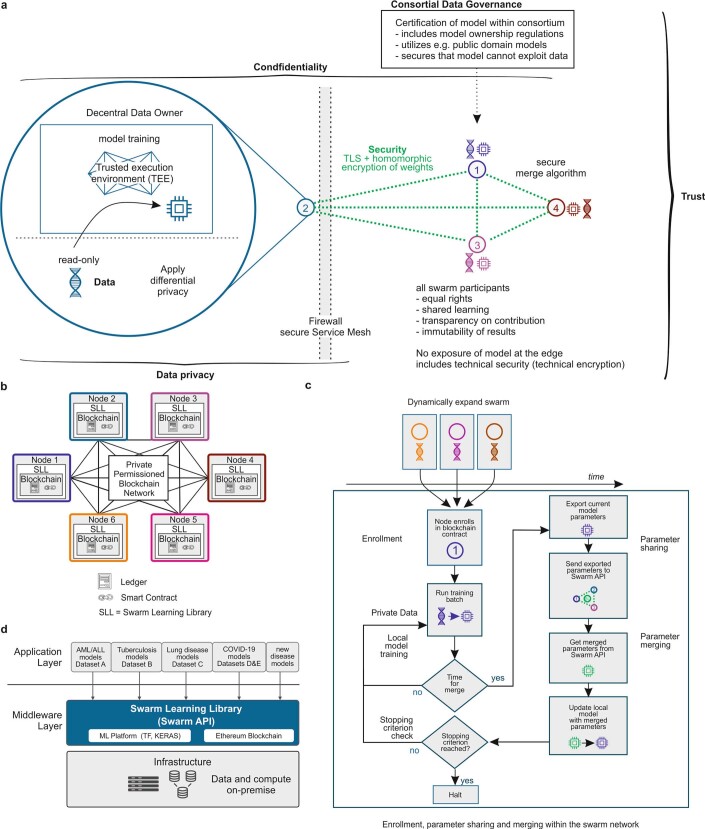
Fast and reliable detection of patients with severe and heterogeneous illnesses is a major goal of precision medicine 1,2 . Patients with leukaemia can be identified using machine learning on the basis of their blood transcriptomes 3 . However, there is an increasing divide between what is technically possible and what is allowed, because of privacy legislation 4,5 . Here, to facilitate the integration of any medical data from any data owner worldwide without violating privacy laws, we introduce Swarm Learning—a decentralized machine-learning approach that unites edge computing, blockchain-based peer-to-peer networking and coordination while maintaining confidentiality without the need for a central coordinator, thereby going beyond federated learning. To illustrate the feasibility of using Swarm Learning to develop disease classifiers using distributed data, we chose four use cases of heterogeneous diseases (COVID-19, tuberculosis, leukaemia and lung pathologies). With more than 16,400 blood transcriptomes derived from 127 clinical studies with non-uniform distributions of cases and controls and substantial study biases, as well as more than 95,000 chest X-ray images, we show that Swarm Learning classifiers outperform those developed at individual sites. In addition, Swarm Learning completely fulfils local confidentiality regulations by design. We believe that this approach will notably accelerate the introduction of precision medicine.
Verified 2026-10-05 · 1 reference not checked yet
Overview
CoChat Summary
TL;DR
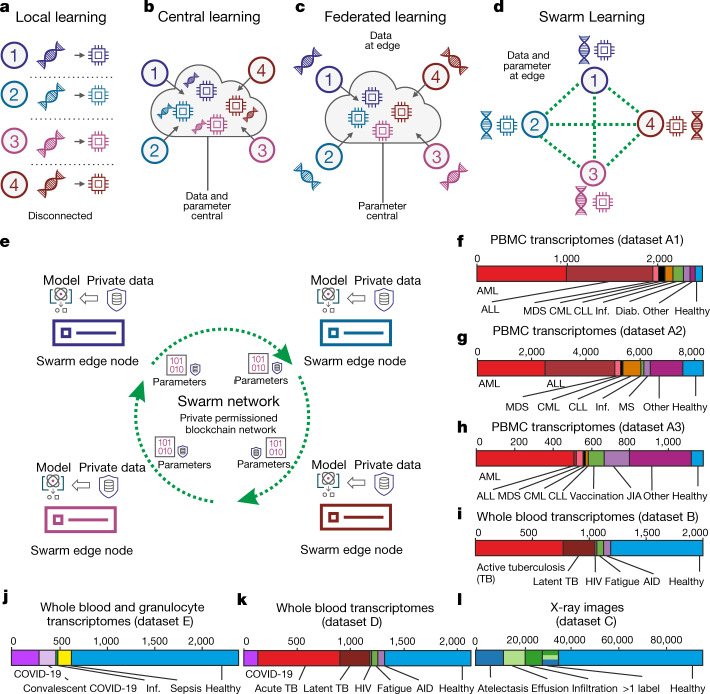
Swarm Learning (SL) is a decentralized machine-learning approach that combines edge computing, permissioned blockchain peer-to-peer networking, and coordination without a central parameter server, preserving confidentiality by design. Across four disease use cases—leukaemia, tuberculosis, COVID-19, and lung pathologies—SL classifiers trained on distributed data outperformed classifiers developed at individual sites and were close to or equivalent to centralized models.
Key findings
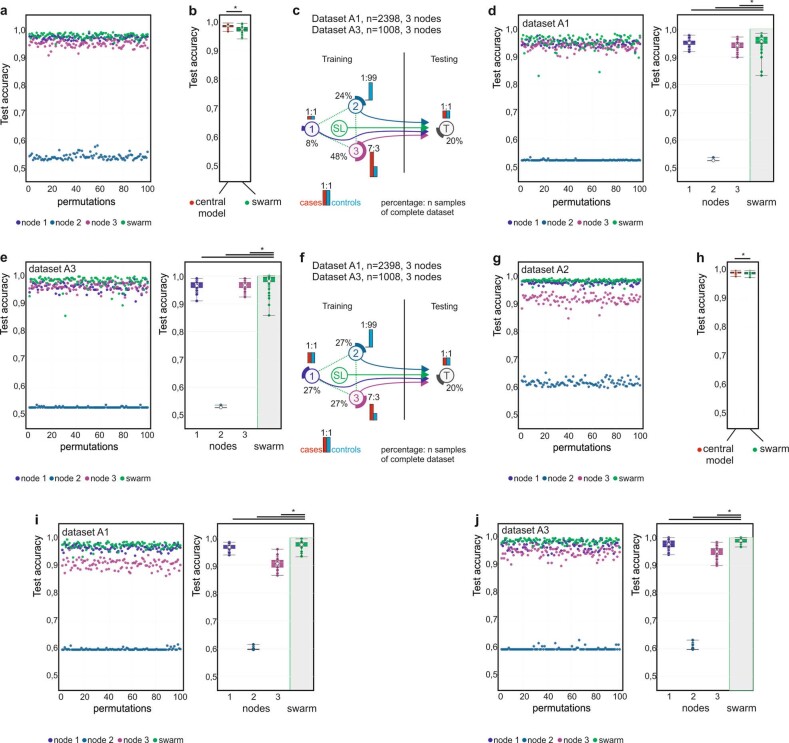
- Using more than 16,400 blood transcriptomes from 127 clinical studies and more than 95,000 chest X-ray images, SL outperformed individual nodes across leukaemia, tuberculosis, COVID-19, and lung pathology use cases; central models were only slightly better or equivalent in several scenarios.
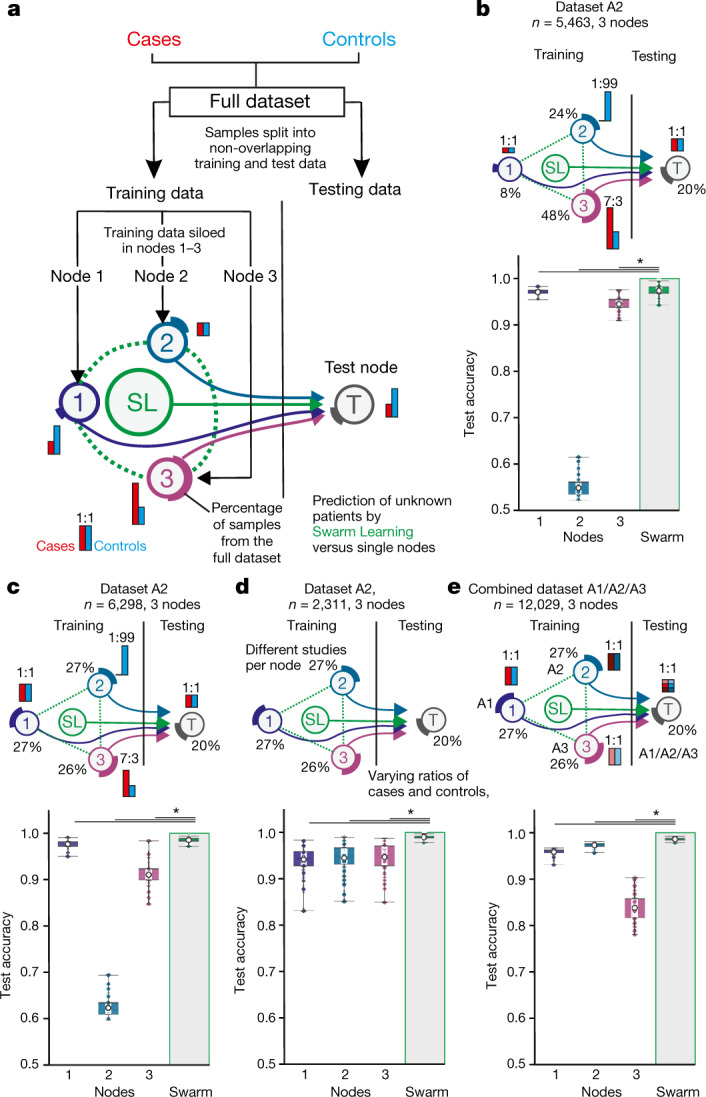
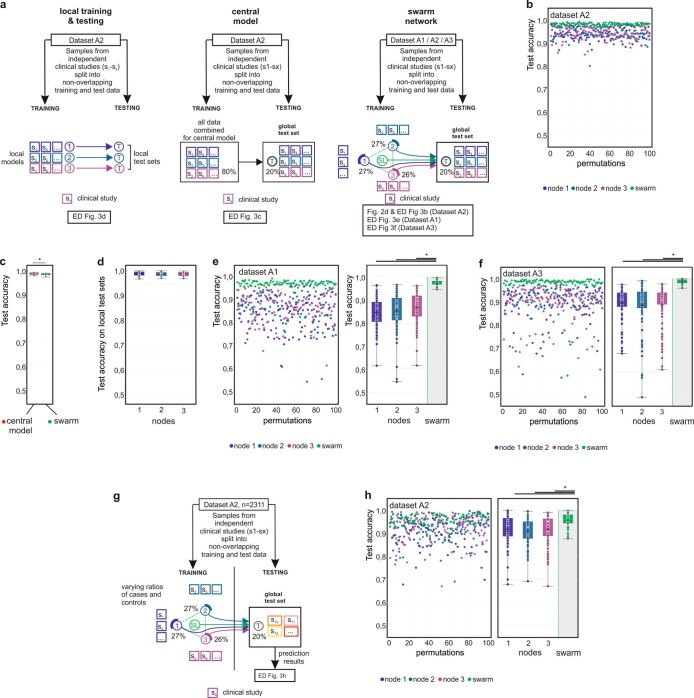
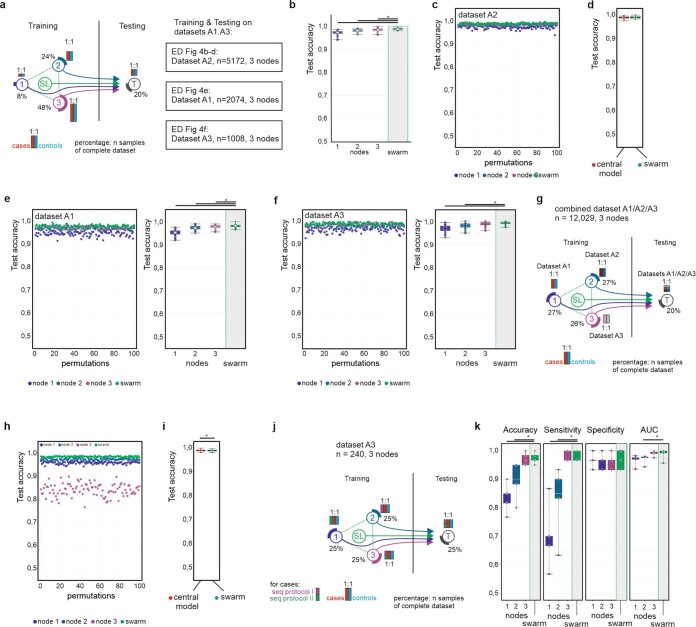
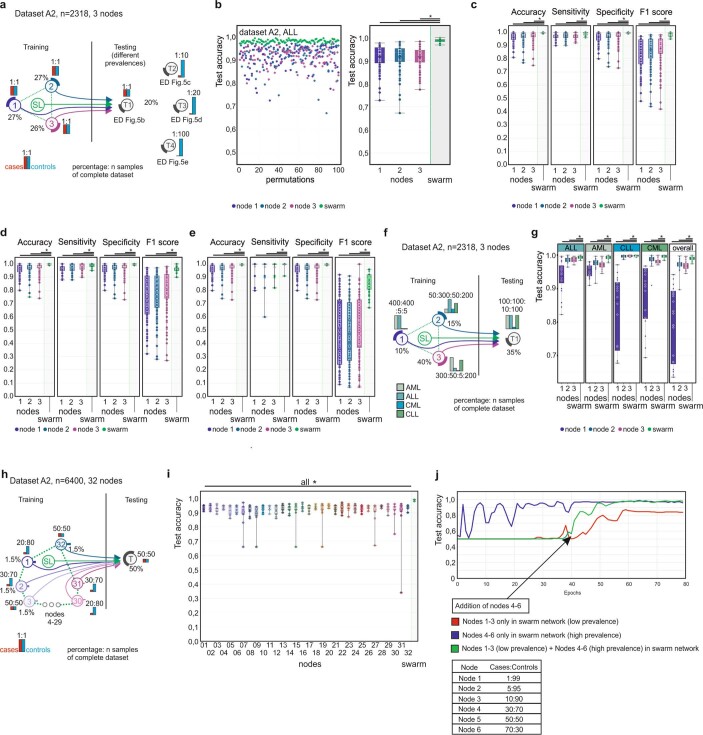
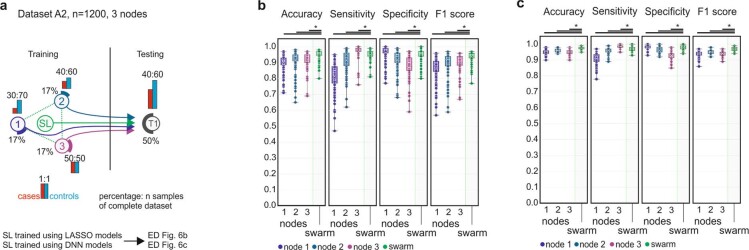
- In leukaemia PBMC datasets A1–A3, comprising more than 12,000 individuals, SL outperformed each node across multiple scenarios, including uneven case/control distributions, study-specific siloing, different transcriptomic technologies, up to 32 nodes, and LASSO instead of deep neural networks.
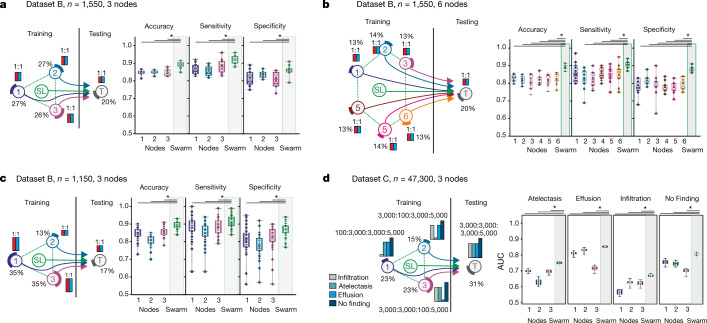
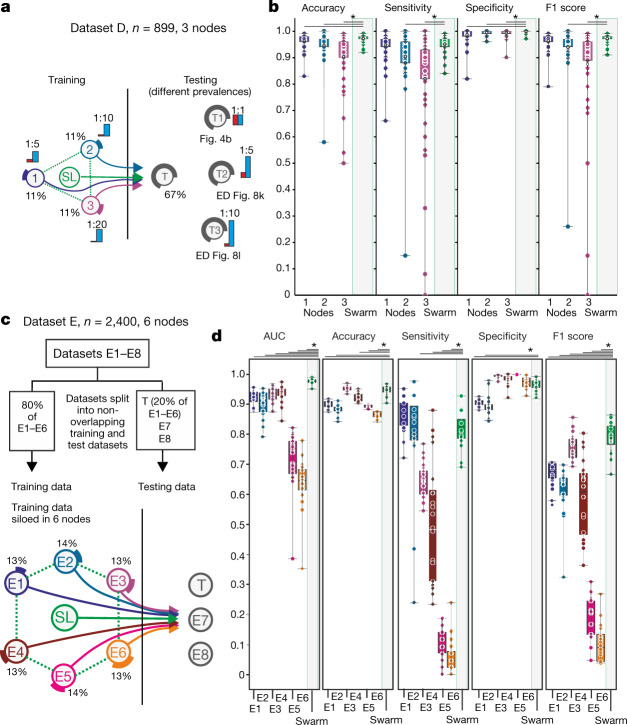
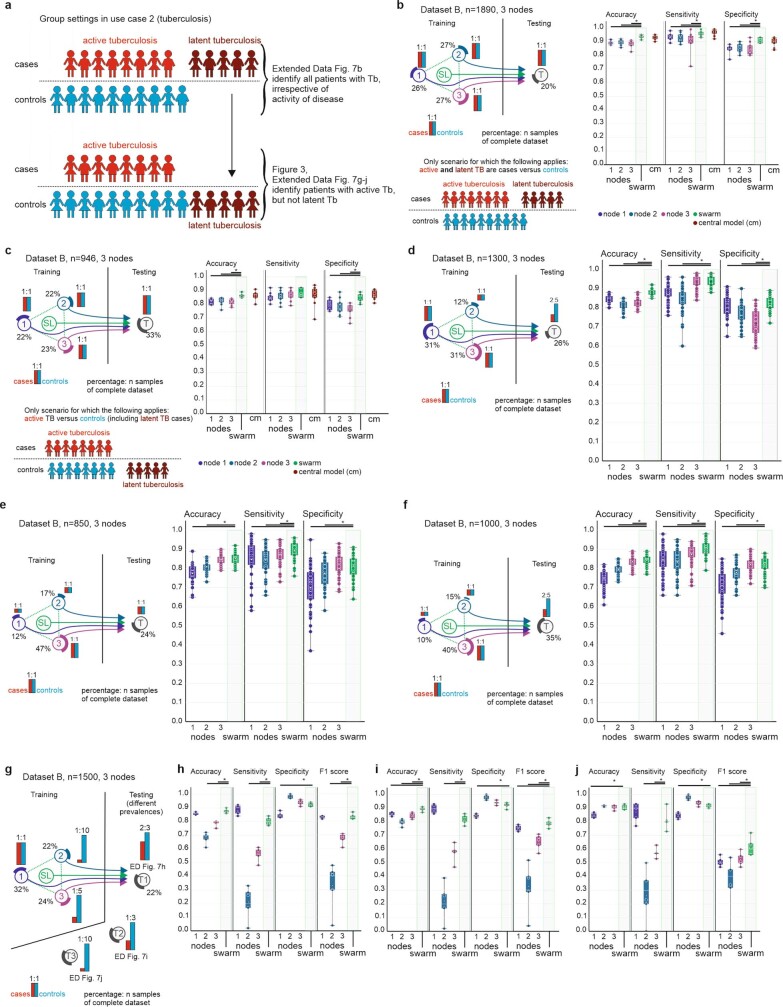
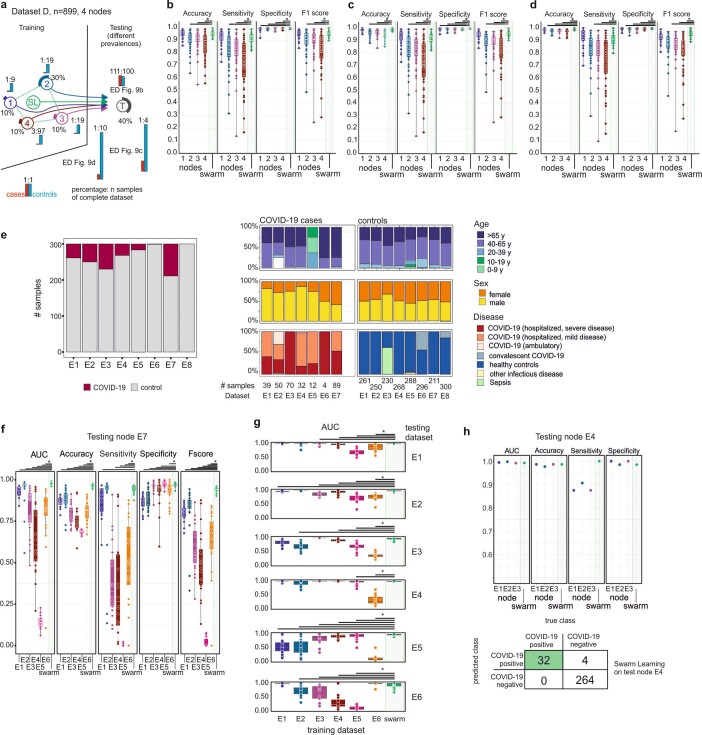
- For tuberculosis, SL outperformed individual nodes even when training samples were reduced by 50% or split into six smaller nodes; for COVID-19, SL outperformed all nodes in AUC on global test datasets and predicted samples from other centres when individual centre nodes could not.
- Overall, 16,694 analyses were performed across 26 AML, 4 ALL, 13 TB, 1 X-ray, and 18 COVID-19 scenarios, with 5–100 permutations per scenario and a total of 8,347 computer hours.
Methods
- Design: decentralized SL framework using edge nodes and a permissioned blockchain for secure onboarding, dynamic leader election, and parameter merging, with no central parameter server; raw data remain local and model parameters are exchanged and merged.
- Data: PBMC transcriptome datasets A1 (n = 2,500), A2 (n = 8,348), and A3 (n = 1,181); whole-blood datasets B (n = 1,999), D (n = 2,143), and E (n = 2,400); chest X-ray dataset C (95,831 images); simulations used 3–32 training nodes and independent test nodes.
- Analysis: deep neural network (Keras sequential) and LASSO; performance metrics included sensitivity, specificity, accuracy, F1 score, and AUC; differences were tested with one-sided Wilcoxon signed-rank test with continuity correction, using 5–100 permutations per scenario.
Limitations
- Stated: no statistical methods were used to predetermine sample size; experiments were not randomized, although permutations were performed; investigators were not blinded to allocation during experiments and outcome assessment.
- Stated/implied: SL performance was tested in simulated siloing and outbreak scenarios using existing datasets, not in a prospective real-world multi-centre clinical deployment; the paper notes potential limitations in TB outbreak scenarios but does not quantify them.
- Evident: although confidentiality is preserved by design and no raw data are exchanged, model parameters are shared; the paper suggests SL can inherit differential privacy, functional encryption, or encrypted transfer learning, but these were not implemented or tested here.
Model-written summary. Check it against the paper before relying on it.
Integrity signals
Registry
Cites
Statistics
Figures
Verification
Claims the paper makes
6 Valid · 0 Not valid · 7 Not checked · 58 Own results and interpretations
The cited sources support only part of this claim — read each source’s verdict below.
In the paper
“As medicine is inherently decentral, the volume of local data is often insufficient to train reliable classifiers20,21.”
§ Swarm Learning for decentralized and confidential clinical machine learning > Main
What the sources say
- Not checked yetcites [20] Rajkomar A Dean J Kohane I Machine learning in medicine N. Engl. J. Med. 2019 380 1347 1358 10.1056/NEJMra1814259 30943338 source
- Partly supportedcites [21] Savage N Calculating disease Nature 2017 550 S115 S117 10.1038/550S115a 29045372 sourceExperimental — accuracy not yet measured
In “BIOPSY BY NUMBERS” (page unavailable), the paper says a researcher wants a much larger dataset to validate and refine an ALS classification algorithm, and describes a shared MRI repository assembled to provide larger datasets. It does not say that medicine is inherently decentralized or that local datasets are often insufficient to train reliable classifiers; it also reports good predictions from a relatively small dataset. (LLM, conf=0.78)
plainstates a cause- Asserted: passes — The authors put it forward as true.
- Checkable: passes — It can be checked against evidence.
- Load-bearing: passes — The paper’s conclusions depend on it.
- Based: passes — The paper gives a reason why it holds.
The cited sources support only part of this claim — read each source’s verdict below.
In the paper
“With increasing efforts to enforce data privacy and security5,9,10 and to reduce data traffic and duplication, a decentralized data model will become the preferred choice for handling, storing, managing, and analysing any kind of large medical dataset19.”
§ Swarm Learning for decentralized and confidential clinical machine learning > Discussion
What the sources say
- Partly supportedcites [19] Kaissis GA Makowski MR Rückert D Braren RF Secure, privacy-preserving and federated machine learning in medical imaging Nat. Mach. Intell. 2020 2 305 311 10.1038/s42256-020-0186-1 sourceExperimental — accuracy not yet measured
The Outlook section of our copy supports the direction of the claim: it states that decentralized data storage and federated learning systems are 'replacing the current paradigm of data sharing and centralized storage' and are driven by privacy requirements, and the paper elsewhere notes such methods 'should require minimal or no data transfer'. However, the source hedges this as having 'the greatest potential to enable privacy-preserving cross-institutional research in a breadth of biomedical disciplines in the near future', whereas the citing sentence asserts it as a certainty ('will become the preferred choice') and extends it to 'handling, storing, managing, and analysing any kind of large medical dataset' — a scope and a confidence level the source does not claim. The 'reduce data traffic and duplication' motive is only partly reflected (the paper in fact lists communication overhead and burdensome data transfer as limitations of decentralized/federated and SMPC approaches). (LLM, conf=0.72)
plainstates a cause- Asserted: passes — The authors put it forward as true.
- Checkable: unclear — It is unclear whether it could be checked against evidence.
- Load-bearing: passes — The paper’s conclusions depend on it.
- Based: passes — The paper gives a reason why it holds.
- Partly supported
The cited sources support only part of this claim — read each source’s verdict below.
In the paper
“with current privacy regulations5,9,10 making it less appealing to develop centralized AI systems”
§ Swarm Learning for decentralized and confidential clinical machine learning > Discussion
What the sources say
- Partly supportedcites [5] Price WN II Cohen IG Privacy in the age of medical big data Nat. Med. 2019 25 37 43 10.1038/s41591-018-0272-7 30617331 PMC6376961 sourceExperimental — accuracy not yet measured
Price & Cohen (2019) do support the general thrust: in 'A path forward' they write that 'The basic harm of privacy overprotection is the brakes it puts on data-driven innovation,' that privacy protections limit data aggregation and innovative data use, and that 'Patchy, fragmented health data make data-driven innovation hard, imposing both technological and economic hurdles' (A path forward); they also note in 'Why do we need big data in health?' that AI uses 'require very large sets of data' and that without them 'algorithms cannot be trained or ... evaluated.' But our copy nowhere contrasts centralized with decentralized/federated architectures, and says nothing about privacy regulation making 'centralized' AI systems specifically less appealing — that comparative claim is the citing authors'. The paper's regulatory discussion is also confined to U.S. law (HIPAA de-identification, covered entities), narrower than the unqualified 'current privacy regulations' in the citing sentence. (LLM, conf=0.72)
- Not checked yetcites [9] Kels CG HIPAA in the era of data sharing J. Am. Med. Assoc. 2020 323 476 477 10.1001/jama.2019.19645 32016301 source
- Not checked yetcites [10] McCall B What does the GDPR mean for the medical community? Lancet 2018 391 1249 1250 10.1016/S0140-6736(18)30739-6 29619949 source
plainstates a cause- Asserted: passes — The authors put it forward as true.
- Checkable: passes — It can be checked against evidence.
- Load-bearing: passes — The paper’s conclusions depend on it.
- Based: passes — The paper gives a reason why it holds.
- Partly supported
Every source the paper cites for this claim was checked and supports it.
In the paper
“but progress is hindered by the limited size of datasets19”
§ Swarm Learning for decentralized and confidential clinical machine learning > Discussion
What the sources say
- Supportedcites [19] Kaissis GA Makowski MR Rückert D Braren RF Secure, privacy-preserving and federated machine learning in medical imaging Nat. Mach. Intell. 2020 2 305 311 10.1038/s42256-020-0186-1 source
The opening of our copy (Abstract/front-matter, p. 305) states that 'the broad application of artificial intelligence techniques in medicine is currently hindered by limited dataset availability for algorithm training and validation.' The Introduction (Abstract section, p. 305) ties progress specifically to oncology applications (tumour detection, genomic characterization, subtyping, grading, outcome/relapse risk) to 'the release of large, curated corpora of images', notes that 'even the largest current imaging studies in the field ... include considerably less data than, for example, ImageNet', and that 'the inability to access and leverage this data poses a significant barrier to AI applications in this field.' This supports the paraphrase that limited dataset size hinders progress in oncology machine learning, with the caveat that the source's scope is medical imaging AI generally rather than oncology alone. (LLM, conf=0.85)
plainstates a cause- Asserted: passes — The authors put it forward as true.
- Checkable: passes — It can be checked against evidence.
- Load-bearing: passes — The paper’s conclusions depend on it.
- Based: passes — The paper gives a reason why it holds.
- Supported
A result the paper reports from its own data — it cites no other source for it, so there is none to check. The quote shows it is in the paper.
In the paper
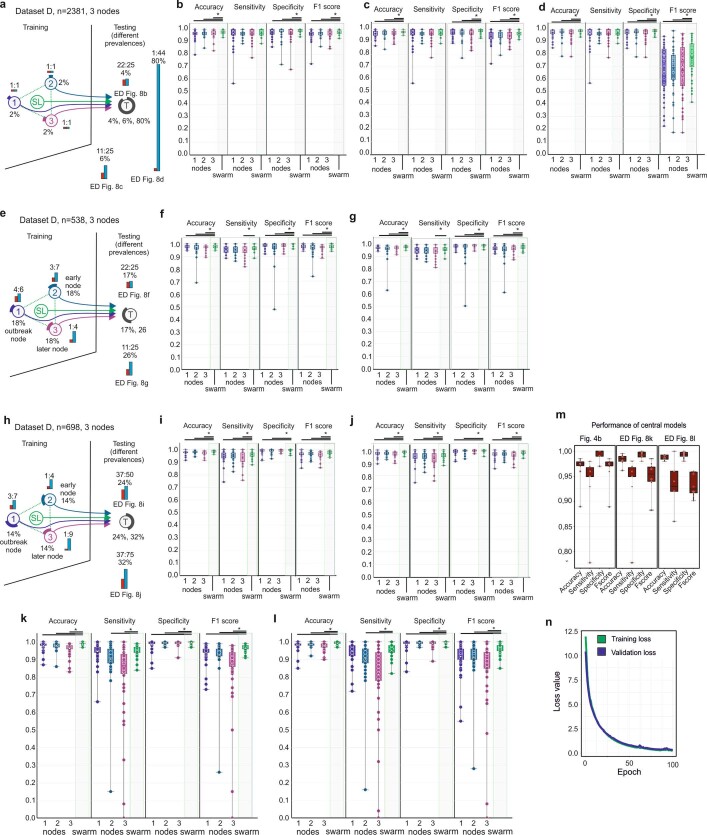
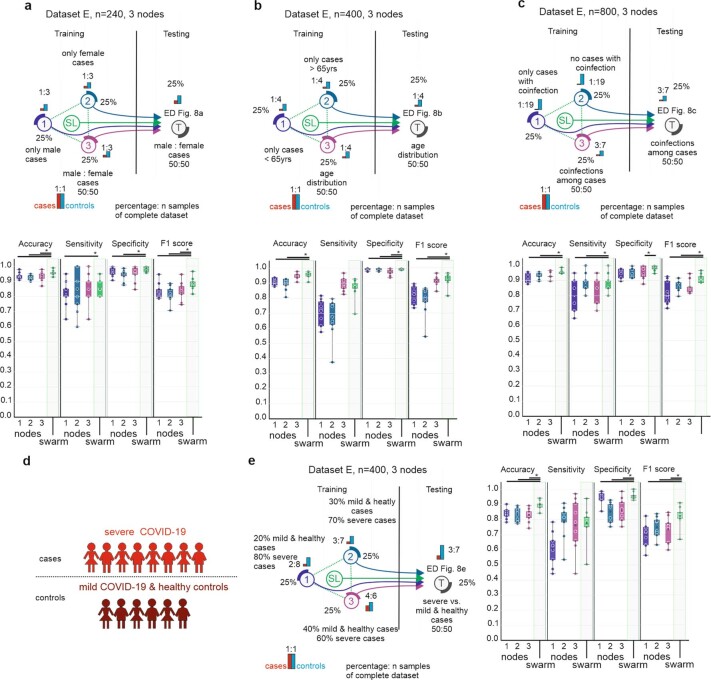
“When we reduced cases at training nodes, all performance measures remained very high at the test node for SL and individual nodes (Extended Data Fig. 8e–j).”
§ Swarm Learning for decentralized and confidential clinical machine learning > Identification of COVID-19
plain- Asserted: passes — The authors put it forward as true.
- Checkable: passes — It can be checked against evidence.
- Load-bearing: unclear — It is unclear whether the paper’s conclusions depend on it.
- Based: passes — The paper gives a reason why it holds.
32 more claims
Create a free account to see all 71 claims and to verify the 16 references still open.
- It may state two separate claims as one. 18
- Probably not a substantial claim. 20
Claims other papers make about this one
Each is checked against this paper’s own text: does it say what the citing paper says it does?
The source backs part of the claim, not all of it — or backs it for a different population, condition or comparison.
In the citing paper
“It can also overcome the straggler dilemma with heterogeneous hardware, as well as improve the robustness to data poisoning attacks and master node fails [35], [145].”
From Edge artificial intelligence for 6g: vision, enabling technologies, and applications (2022) · cites this paper as [35]
Experimental — accuracy not yet measuredThe source backs part of the claim, not all of it — or backs it for a different population, condition or comparison.
In the citing paper
“FL allows training of AI models through averaging of local updates from numerous healthcare facilities and smart devices, such as IoMT, despite the lack of local data.”
From Federated learning-based AI approaches in smart healthcare: Concepts, taxonomies, challenges and open issues (2023) · cites this paper as [11]
Experimental — accuracy not yet measuredThe source backs part of the claim, not all of it — or backs it for a different population, condition or comparison.
In the citing paper
“Federated Learning has presented itself as a viable method for implementing economic, innovative healthcare systems while ensuring privacy [11–15].”
From Federated learning-based AI approaches in smart healthcare: Concepts, taxonomies, challenges and open issues (2023) · cites this paper as [11]
Experimental — accuracy not yet measuredThe cited source says what the claim attributes to it.
In the citing paper
“In particular, swarm learning [35] provides a completely decentralized AI solution based on decentralized ML by keeping local datasets at each edge device.”
From Edge artificial intelligence for 6g: vision, enabling technologies, and applications (2022) · cites this paper as [35]
The cited source says what the claim attributes to it.
In the citing paper
“Besides, swarm learning has recently been developed in [35] to provide a decentralized and confidential clinical disease detection solution for diseases (e.g., COVID-19, tuberculosis, and leukaemia).”
From Edge artificial intelligence for 6g: vision, enabling technologies, and applications (2022) · cites this paper as [35]
6 more claims about this paper
Create a free account to see every claim other papers make about this one.
Citations
Cites
Moderated estimation of fold change and dispersion for RNA-seq data with DESeq2
Love, M. I., Huber, W., & Anders, S. (2014) · Genome Biology · doi:10.1186/s13059-014-0550-8 · Cited by 95,106
LeCun, Y., Bengio, Y., & Hinton, G. (2015) · Nature · doi:10.1038/nature14539 · Cited by 84,126
Scikit-learn: Machine Learning in Python
Pedregosa, F., Varoquaux, G., Gramfort, A., Michel, V., Thirion, B., Grisel, O., Blondel, M., Müller, A., Nothman, J., Louppe, G., et al. (2012) · arXiv · doi:10.48550/arxiv.1201.0490 · Cited by 71,016
STAR: ultrafast universal RNA-seq aligner
Dobin, A., Davis, C. A., Schlesinger, F., Drenkow, J., Zaleski, C., Jha, S., Batut, P., Chaisson, M., & Gingeras, T. R. (2013) · Bioinformatics · doi:10.1093/bioinformatics/bts635 · Cited by 51,709
Bootstrap methods: another look at the jackknife
Efron, B. (1979) · The Annals of Statistics · doi:10.1214/aos/1176344552 · Cited by 17,602
Dermatologist-level classification of skin cancer with deep neural networks
Esteva, A., Kuprel, B., Novoa, R. A., Ko, J., Swetter, S. M., Blau, H. M., & Thrun, S. (2017) · Nature · doi:10.1038/nature21056 · Cited by 14,362 · cited 1×
“Particularly in oncology, success has been reported in machine-learning-based tumour detection 3,37 , sub-typing 38 , and outcome prediction 39 , but progress is hindered by the limited size of datasets 19 , with current privacy regulations 5,9,10 making it less appealing to develop centralized AI…”
BackgroundCommunication-Efficient Learning of Deep Networks from Decentralized Data
McMahan, H. B., Moore, E., Ramage, D., Hampson, S., & Arcas, B. A. Y. (2016) · arXiv · doi:10.48550/arxiv.1602.05629 · Cited by 14,215
Gene Expression Omnibus: NCBI gene expression and hybridization array data repository
Edgar, R. (2002) · Nucleic Acids Research · doi:10.1093/nar/30.1.207 · Cited by 13,288
Exploration, normalization, and summaries of high density oligonucleotide array probe level data
Irizarry, R. A. (2003) · Biostatistics · doi:10.1093/biostatistics/4.2.249 · Cited by 10,603
Detection of 2019 novel coronavirus (2019-nCoV) by real-time RT-PCR
Corman, V. M., Landt, O., Kaiser, M., Molenkamp, R., Meijer, A., Chu, D. K., Bleicker, T., Brünink, S., Schneider, J., Schmidt, M. L., et al. (2020) · Eurosurveillance · doi:10.2807/1560-7917.es.2020.25.3.2000045 · Cited by 7,344 · cited 10×
“We obtained very similar results using datasets A1 and A3, which strongly supports the idea that the improvement in performance of SL is independent of data collection (clinical studies) or the technologies (microarray or RNA-seq) used for data generation (Extended Data Fig.”
MethodInfluential
Cited by
Items 701–800 of 944
Federated Grouping Panoptic Segmentation for LiDAR Point Cloud Based on Convolutional Network
Shi, C., Own, C., & Zhou, R. (2022) · IEEE International Conference on Tools with Artificial Intelligence (ICTAI) · doi:10.1109/ictai56018.2022.00010 · Cited by 2
“Accordingly, future research will improve the FL algorithm by using better aggregate calculations rather than averaging or the decentralized method as in [35].”
MethodAlam, M. U., Hollmén, J., & Rahmani, R. (2023) · Proceedings - IEEE Symposium on Computer-Based Medical Systems · doi:10.1109/cbms58004.2023.00294 · Cited by 2
“Furthermore, different devices and training models can be aggregated safely and securely using the federated learning [40] or swarm learning [41] approach.”
BackgroundTowards a Service-based Adaptable Data Layer for Cloud Workflows
Wang, Y., Janse, N., Bianchi, R., Koulouzis, S., & Zhao, Z. (2023) · IEEE Annual International Computer Software and Applications Conference (COMPSAC) · doi:10.1109/compsac57700.2023.00121 · Cited by 2
“In this context, decentralised data management is a typical paradigm for enabling trustworthiness among distributed parties, e.g., handling, storing, and managing medical datasets [11].”
Haritas, H. K., Haritas, C. K., & Kallimani, J. S. (2023) · Smart innovation, systems and technologies · doi:10.1007/978-981-99-3982-4_22 · Cited by 1
Yang, Y. S., Li, Z., Ren, L., & Wang, X. (2023) · International Journal of Imaging Systems and Technology · doi:10.1002/ima.22972 · Cited by 1
“33,34 Under the condition of not sharing the original medical data, the distributed training neural network can ensure the data security more.”
BackgroundA Framework of Large-Scale Peer-to-Peer Learning System
Luo, Y., Han, P., Luo, W., Xue, S., Chen, K., & Song, L. (2023) · Lecture notes in computer science · doi:10.1007/978-981-99-8082-6_3 · Cited by 1
Perspective Chapter: Deep Learning Misconduct and How Conscious Learning Avoids It
Weng, J. (2024) · Artificial intelligence · doi:10.5772/intechopen.113359 · Cited by 1
Wang, P., Tang, F., Xiao, Y., Zhu, H., & Jiang, Y. (2023) · IEEE International Conference on Medical Artificial Intelligence (MedAI) · doi:10.1109/medai59581.2023.00047 · Cited by 2
Swarm Learning based Decentralized and Confidential Transmission Scheme for Distribution PV Systems
Li, Z., Zhou, Y., Li, W., Deng, B., Tang, D., Yang, Y., Peng, J., & Hu, J. (2023) · International Conference on New Energy and Power Engineering (ICNEPE) · doi:10.1109/icnepe60694.2023.10429205 · Cited by 1
“SL was originally proposed for the integration of medical data in compliance with data protection requirements [13].”
BackgroundFramework part I: Artificial intelligence + data architecture
Monlezun, D. J. (2024) · Elsevier eBooks · doi:10.1016/b978-0-443-21597-1.00004-4 · Cited by 1
HARNESSING ARTIFICIAL INTELLIGENCE FOR REAL-TIME QUALITY ASSURANCE IN MEDICAL DEVICE MANUFACTURING
Barla, P. C., & Karthikeyan, L. (2024) · The American Journal of Engineering And Technology · doi:10.37547/tajet/volume06issue06-04 · Cited by 1
DISH: A Distributed Hybrid Optimization Method Leveraging System Heterogeneity
Niu, X., & Wei, E. (2024) · IEEE Transactions on Signal Processing · doi:10.1109/tsp.2024.3450351 · Cited by 1
“These include scenarios like distributed consensus problems [2] and network flow problems, driven by applications in power grids, sensor networks, communication networks, and machine learning [3,4].”
BackgroundDecentralized Federated Learning Links for Biometric Recognition
Guo, J., Mu, H., Ren, H., Han, C., & Sun, L. (2024) · International Joint Conference on Neural Networks (IJCNN) · doi:10.1109/ijcnn60899.2024.10650816 · Cited by 2
“This leads to the possibility that these federated biometric methods may be attacked by malicious servers [18], leading to interference in the global model [19]–[21].”
BackgroundSecuring the Future e‐Health: Context‐Aware Physical‐Layer Security
Letafati, M., Jorswieck, E. A., & Khalaj, B. H. (2024) · Wiley eBooks · doi:10.1002/9781394170944.ch12 · Cited by 1
UFL: Unlinkable Federated Learning Through Shuffle and Shamir’s Secret Sharing
Chen, J., Si, Z., Song, J., Mohanty, M., Wang, W., & Xiong, H. (2024) · Lecture notes in computer science · doi:10.1007/978-981-96-0814-0_16 · Cited by 3
Toward the development of learning methods with distributed processing using securely divided data
Miyajima, H., Shigei, N., Miyajima, H., & Shiratori, N. (2025) · Computers & Electrical Engineering · doi:10.1016/j.compeleceng.2025.110160 · Cited by 1
HE-Floc: Federated Learning Fingerprint Indoor Localization Method Based on Homomorphic Encryption
Li, C., & Zhang, X. (2024) · International Conference on Image Processing, Computer Vision and Machine Learning (ICICML) · doi:10.1109/icicml63543.2024.10958064 · Cited by 1
“However, in the sharing and aggregation of federated learning localization models, this method still faces differential attacks, model inversion attacks, gradient reverse inference attacks, and the risk of privacy leakage[7].”
Seaswarm: Mitigating Stragglers in Cross-Silo Swarm Learning via Semi-asynchronous Communication
Yang, X., Hu, C., & Cheng, D. (2025) · Communications in computer and information science · doi:10.1007/978-981-96-9961-2_34 · Cited by 1
Artificial intelligence/machine learning in the management of diabetes mellitus
Sonia, T. A., & Sharma, C. P. (2025) · Elsevier eBooks · doi:10.1016/b978-0-443-30272-5.00010-x · Cited by 1
Deep Learning with Multiple Data Set: A Weighted Goal Programming ApproachPreprint
Repetto, M., Torre, D. L., & Tariq, M. U. (2021) · arXiv (Cornell University) · Cited by 1
On the Fairness of Swarm Learning in Skin Lesion ClassificationPreprint
Fan, D., Wu, Y., & Li, X. (2021) · arXiv (Cornell University) · doi:10.48550/arxiv.2109.12176 · Cited by 4
“Recently, a new format of collaborative learning has been proposed, called Swarm Learning (SL) [21].”
BackgroundDistributed Multi-Agent Learning is More Effectively than Single-AgentPreprint
Ke, S., & Liu, W. (2021) · Research Square · doi:10.21203/rs.3.rs-1070129/v1 · Cited by 1
“Four different illness cases show that Swarm Learning classifiers outperform single-agent classifiers, showing that multi-agent distributed learning beats single-agent learning[26].”
BackgroundA Developmental Network Model of Conscious Learning in Biological BrainsPreprint
Weng, J. (2022) · Research Square · doi:10.21203/rs.3.rs-1700782/v1 · Cited by 2
Hallucinating Machines: Exploring the ethical implications of generative language models
Hill, M. (2023) · Open Access Victoria University of Wellington | Te Herenga Waka (Figshare) · doi:10.26686/wgtn.24180456 · Cited by 7
Fraioli, F., Albert, N. L., Boellaard, R., Galazzo, I. B., Brendel, M., Buvat, I., Castellaro, M., Cecchin, D., Fernandez, P. A., Guedj, É., et al. (2023) · European Journal of Nuclear Medicine and Molecular Imaging · doi:10.1007/s00259-023-06553-1 · Cited by 2
“An even more recent improvement is swarm learning, which combines federated learning with blockchain technologies to further ensure the robustness of the learning process [5].”
Distributed Multi-Agent Learning is More Effectively than Single-AgentPreprint
Ke, S., & Liu, W. (2023) · Research Square · doi:10.21203/rs.3.rs-1070129/v2 · Cited by 1
Yang, R., Li, Z., Yao, J., Zhang, B., Li, Z., Tang, W., Gong, J., Li, Y., Cao, X., Wang, Z., et al. (2024) · Research Square · doi:10.21203/rs.3.rs-3930064/v1 · Cited by 2
Self-citationInnocenti, L., Antonelli, M., Ourselin, S., & Lorenzi, M. (2025) · Elsevier eBooks · doi:10.1016/b978-0-44-323761-4.00034-1 · Cited by 2
Bandyopadhyay, A., Hennocq, Q., Lienhard, O., Hsieh, T., Zaiter, A., Breton, L., Warnat‐Herresthal, S., Schultze, H., Aschenbrenner, A. C., Cormier‐Daire, V., et al. (2026) · medRxiv · doi:10.64898/2026.01.02.26343337 · Cited by 1
Self-citationDoes Swarm Learning Solve Federation Opacity? The Need for Governance Beyond Decentralization
Bak, M., Warnat‐Herresthal, S., Willem, T., Zimmermann, B. M., Schulte-Schrepping, J., Ribeiro, L. S., Schultze, J. L., & McLennan, S. (2026) · The American Journal of Bioethics · doi:10.1080/15265161.2026.2690963 · Cited by 1
“Warnat-Herresthal et al. (2021) demonstrated the promise and feasibility of this approach by collaboratively training disease classifiers for COVID-19, tuberculosis, and leukemia at multiple clinical institutions.”
Self-citationBenchmarking LLMs' Swarm intelligence
Ruan, K., Huang, M., Wen, J.-R., & Sun, H. (2025) · arXiv · doi:10.48550/arxiv.2505.04364
“This focus on physical action differentiates our work from data processing approaches like Swarm Learning [31].”
Post-Selections in AI and How to Avoid ThemPreprint
Weng, J. (2021) · arXiv (Cornell University) · doi:10.48550/arxiv.2106.13233
Random Graph-Based Neuromorphic Learning with a Layer-Weaken StructurePreprint
Mao, R., & Cui, R. (2021) · arXiv (Cornell University) · doi:10.48550/arxiv.2111.08888
Privacy Preserving for Multiple Computer Vision Tasks
Wilson, A. (2021) · San José State University ScholarWorks (San Jose State University) · doi:10.31979/etd.5ruj-7wyr
Time for a voluntary crisis research service
Schultze, J. L., Gabriel, M., & Nicotera, P. (2022) · Cell Death and Differentiation · doi:10.1038/s41418-022-00968-3
“Technical solutions such as SL preserving data privacy are activated to collaborate even faster [13].”
BackgroundSelf-citationNotes on the Architecture, League Training and PFSP in AlphaStar
Zhao, J., Zhou, N., & Hong, L. (2021) · International Conference on Intelligent Systems and Knowledge Engineering (ISKE) · doi:10.1109/iske54062.2021.9755350
Privacy-preserving, Efficient, and Effective Machine LearningPreprint
Wu, C., Wu, F., Qi, T., Huang, Y., & Xie, X. (2022) · Research Square · doi:10.21203/rs.3.rs-1682972/v1
Huang, Z., Li, Y., Cheng, H., Li, G., & Liang, Z. (2022) · SSRN Electronic Journal · doi:10.2139/ssrn.4097411
Self-citationLinking research of biomedical datasets
Zhao, X.-J. G., & Cao, H. (2022) · Briefings in Bioinformatics · doi:10.1093/bib/bbac373
Health Data Management for Internet of Medical Things
Seneviratne, O. W. (2012) · Women in engineering and science · doi:10.1007/978-3-030-93592-4_1
Steinestel, K., & Tischler, V. (2022) · Die Pathologie · doi:10.1007/s00292-022-01141-w
Privacy-preserving personal data analysis
Sun, C. (2022) · Research Publications (Maastricht University) · doi:10.26481/dis.20221114cs
Emerging information technologies for the next generation of elderly care
Zhang, T., & Li, X. (2022) · Interdisciplinary Nursing Research · doi:10.1097/nr9.0000000000000003
(2022) · De Gruyter eBooks · doi:10.1515/9783110785982-007
Knowledge Discovery and AI Approaches for the Life Sciences
Apke, A., Weil, V., Dörpinghaus, J., & Schaaf, S. (2022) · Studies in big data · doi:10.1007/978-3-031-08411-9_7
Which Ethical Issues Need to Be Considered Related to Microwires or Utah Arrays?
Young, M. J. (2023) · Studies in neuroscience, psychology and behavioral economics · doi:10.1007/978-3-031-20910-9_7 · Cited by 1
Sitaru, S., Oueslati, T., Schielein, M. C., Weis, J., Kaczmarczyk, R., Rueckert, D., Biedermann, T., & Zink, A. (2023) · JDDG Journal der Deutschen Dermatologischen Gesellschaft · doi:10.1111/ddg.15113_g
(2023) · Elsevier eBooks · doi:10.1016/b978-0-323-90534-3.16001-9
Application of artificial intelligence in cardiovascular medicine and cardiac surgery
Druz, R. S., & Nahar, J. K. (2023) · Elsevier eBooks · doi:10.1016/b978-0-323-90534-3.00036-6
Artificial intelligence in respiratory medicine
Gonem, S. (2023) · Elsevier eBooks · doi:10.1016/b978-0-443-15688-5.00027-9
Wang, X., & Yu, Q. (2023) · International Journal on Recent and Innovation Trends in Computing and Communication · doi:10.17762/ijritcc.v11i6.7739
Privacy-Preserving Machine Learning in Healthcare: Encryption and Decryption Challenges
Agarwal, P., & Shrivastava, P. (2022) · Computology Journal of Applied Computer Science and Intelligent Technologies · doi:10.17492/computology.v2i1.2204
Yadav, J. S., & Bharathi, P. S. (2023) · AIP conference proceedings · doi:10.1063/5.0167129
MuSelect Chain: trusted decentralized mutual selection through blockchain
Shi, X., Chang, Y., Fu, Z., Zhang, Y., Ma, D. C., & Yang, Y. (2023) · Complex & Intelligent Systems · doi:10.1007/s40747-023-01270-6
“SwarmLearning [5] was proposed to facilitate the model’s training data from global nodes in secret.”
User‐Centric Decentralized Federated Learning for Autoencoder‐Based CSI Feedback
Jin, S., Guo, J., Lv, Y., & Cui, Y. (2023) · Wiley eBooks · doi:10.1002/9781119913924.ch12
Local Learning-based Collaborative Authentication In Edge-Fog Network
Amor, A. B., & Jebri, S. (2023) · International Conference on Cyberworlds (CW) · doi:10.1109/cw58918.2023.00080
“Federated Learning (FL) has emerged as a promising solution for realizing privacy protection and cost-effective services [4].”
BackgroundA Facial Blurring Recognition Framework Integrating Neural Networks and Transfer Learning
Ning, L. (2023) · IEEE International Conference on Civil Aviation Safety and Information Technology (ICCASIT) · doi:10.1109/iccasit58768.2023.10351666
Liao, B.-Y., & Chang, J.-W. (2024) · Lecture notes in electrical engineering · doi:10.1007/978-981-99-9342-0_5
A Blockchain Based Trustworthy Space in Cross-Domain Synergy
Sun, L., Jia, X., Liu, J., Song, Y., Xie, Y., & Xue, C. (2023) · IEEE International Conference on Blockchain (Blockchain) · doi:10.1109/blockchain60715.2023.00042
“Wu et al. [16] proposed a blockchain-based anonymous data sharing (BA-DS) scheme that utilizes unconditional linkable ring signatures and Signature of Knowledge (SoK) to support anonymous data sharing while recording valid revocation lists using blockchain during signature revocation stages to…”
MethodShi, J., Feng, B., Liu, Y., & Chen, X. (2023) · IEEE International Conference on Frontiers Technology of Information and Computer (ICFTIC) · doi:10.1109/icftic59930.2023.10455787
“However, training AI algorithms that are useful for clinical decision support often require a large amount of data as support, necessitating data sharing among multiple institutions [8] .”
BackgroundSL-Defender: Decentralized Defense for Adversarial Robustness in Federated Learning
Justine, C., Manamohan, S., & Jiji, C. V. (2023) · IEEE International Carnahan Conference on Security Technology (ICCST) · doi:10.1109/iccst59048.2023.10474244
“Swarm Learning [13], [14], [33], [34] is a decentralized Privacy-preserving Federated machine Learning Framework.”
BackgroundSelf-citationData-Driven Distributed Autonomous Architecture for 6G Networks
Li, P., Chen, X., Sun, Z., Xing, Y., Zhou, J., & Fan, W. (2024) · Communications in computer and information science · doi:10.1007/978-981-97-1280-9_12
Künstliche Intelligenz in der Pathologie: Status quo und Zukunftsperspektiven
Foersch, S., & Schulz, S. (2024) · best practice onkologie · doi:10.1007/s11654-024-00572-6
The Luckiest Network Gives the Average Error on Disjoint Tests: Experiments
Wu, X., & Weng, J. (2024) · International Conference on Artificial Intelligence in Electronics Engineering (AIEE) · doi:10.1145/3658835.3658839 · Cited by 2
“For example, the papers in Nature include [2, 6, 9, 14, 17, 25] [3–5, 15, 16, 26, 29, 38, 39].”
Collaborative Active Learning in Conditional Trust Environment
Chong, Z., Ohsaki, H., & Ng, B. (2024) · IEEE Symposium on Computer Applications & Industrial Electronics (ISCAIE) · doi:10.1109/iscaie61308.2024.10576555
“Another similar learning method is called swarm learning (SL) [10].”
Yu, Y., Ren, W., Mao, L., Ouyang, W., Hu, Q., Yao, Q., Tan, Y., He, Z., Ban, X., Hu, H., et al. (2024) · SSRN Electronic Journal · doi:10.2139/ssrn.4894775
Trustworthiness, Privacy, and Security in Federated Learning
Zhou, S., Xiao, L., Xiao, Y., & Qiu, M. (2024) · Springer optimization and its applications · doi:10.1007/978-3-031-58923-2_1
Adaptively Compressed Swarm Learning for Distributed Traffic Prediction over IoV-Web3.0
Song, X. Y., Chen, L., Tang, J., Li, J., Bai, Y., & Yang, W. (2024) · International Joint Conference on Neural Networks (IJCNN) · doi:10.1109/ijcnn60899.2024.10650359
“The proposal of Swarm Learning (SL) [6] provides a solution to the aforementioned concerns.”
BackgroundInfluentialMiao, Q., & Wang, F.-Y. (2024) · SpringerBriefs in service science · doi:10.1007/978-3-031-67419-8_5
Anatomical Embedding-Based Training Method for Medical Image Segmentation Foundation Models
Zhuang, M., Xu, R., Zhang, Q., Liu, A., Fan, X., & Wang, H. (2024) · Lecture notes in computer science · doi:10.1007/978-3-031-73471-7_15 · Cited by 1
Scale Wisely, Secure Wholly: P2P Swarm Learning Over Consortium Blockchain in Edge Networks
Gao, F., Chen, L., Zhang, Q., Li, G., Lin, X., Bai, Y., & Li, J. (2024) · International Conference on Communications · doi:10.1109/icc51166.2024.10622902
“A recent proposal known as Swarm Learning (SL) [4] offers a solution to the above limitations.”
BackgroundMethodInfluentialConfidential outsourced support vector machine learning based on well-separated structure
Deng, G., Tang, M., Huang, Z., Zhang, Y., & Xi, Y. (2024) · Future Generation Computer Systems · doi:10.1016/j.future.2024.107564
Multi-index federated aggregation algorithm based on trusted verification
Bao, Z., Wang, M., Bai, W., & Zhang, W. (2024) · CCF Transactions on High Performance Computing · doi:10.1007/s42514-024-00199-7
“AI-based solutions rely intrinsically on appropriate algorithms, but even more so on large training datasets (Warnat-Herresthal et al. 2021).”
Swarm Split Learning: A Fully Distributed Machine Learning System for Energy-Constrained IoT Systems
Ayad, A., Bauerle, T., Barhoush, M., & Schmeink, A. (2024) · International Conference on Federated Learning Technologies and Applications (FLTA) · doi:10.1109/flta63145.2024.10839834
Li, Y., Khandekar, N., Wang, S., Khanna, V. V., Sanker, J., & Gerstein, M. (2025) · bioRxiv (Cold Spring Harbor Laboratory) · doi:10.1101/2025.01.31.635830
Self-citationFinestra: Multi-aggregator Swarm Learning for Gradient Leakage Defense
Choi, H., Liao, J., Xiong, Y., Gong, Y., Hu, C., & Cheng, D. (2025) · Lecture notes in computer science · doi:10.1007/978-981-96-1545-2_11
Accelerated online averaging over networks
Liu, W., Liu, X., Mao, X., & Wu, Z. (2025) · Scientia Sinica Mathematica · doi:10.1360/ssm-2024-0223
Pham-Nguyen-Hai, A., Van-Thien, L., Nguyen-Khanh, T., & Le‐Trung, Q. (2024) · International Conference on Advanced Technologies for Communications · doi:10.1109/atc63255.2024.10908262
“In collaboration with Hewlett Packard Enterprise (HPE), Swarm learning [3] represents an advanced distributed machine learning solution.”
(2025) · Frontiers research topics · doi:10.3389/978-2-8325-6095-2
Wei, X., Zhao, P., Wang, Y., Lv, R., & Sun, S. (2025) · SSRN Electronic Journal · doi:10.2139/ssrn.5179539
Understanding The Genetics Of Lupus: Implications For Early Diagnosis And Personalized Treatment
Menghani, P. (2024) · African Journal of Biomedical Research · doi:10.53555/ajbr.v27i4s.7316
Ayyachamy, S., Manimaran, M., Yadalam, P. K., & Anegundi, R. V. (2025) · IGI Global eBooks · doi:10.4018/979-8-3693-8774-0.ch008
Ahamed, B. B., Manoharan, M., Sherubha, P., & Sasirekha, S. P. (2025) · Research Square · doi:10.21203/rs.3.rs-5966493/v1
CTr2L: A Novel Carbon Trading Transfer Learning Framework for the Price Volatility Forecasting
Hao, J., Bao, X., Guan, S., & Jiang, G. (2025) · Journal of Systems Science and Systems Engineering · doi:10.1007/s11518-025-5668-6 · Cited by 3
6G and AI: Viewpoints, Processes, and Technologies
Shoyusupov, S. A., Lanitha, B., Goyal, S., Goyal, V., Husain, S. O., & Sharma, P. (2024) · International Conference on Communication, Computing and Energy Efficient Technologies (I3CEET) · doi:10.1109/i3ceet61722.2024.10993761
Backpack Client Selection Keeping Swarm Learning in Industrial Digital Twins for Wireless Mapping
Wei, X., Su, N., Guo, Y., & Zhao, P. (2025) · Electronics · doi:10.3390/electronics14122323 · Cited by 13
Neural Gas method using autonomous and secure distributed processing with decomposed data
Miyajima, H., Shigei, N., Miyajima, H., & Shiratori, N. (2025) · Nonlinear Theory and Its Applications IEICE · doi:10.1587/nolta.16.377
Aircraft type identification using convolutional neural network applied with Swarm Learning
Mori, J., Kodomari, F., Tsuchiya, T., Morinaga, M., & Yamamoto, I. (2025) · Nippon Onkyo Gakkaishi/Acoustical science and technology/Nihon Onkyo Gakkaishi · doi:10.1250/ast.e24.127
A Utilization Method of Big Data in Blockchain Based on Swarm Learning
Cao, Y., Kang, H., Li, Y., & Zhang, Z. (2025) · Lecture notes of the Institute for Computer Sciences, Social Informatics and Telecommunications Engineering · doi:10.1007/978-3-031-93825-2_10
Self-citationAnzalone, A. J., Patrick, S., Abel, A., Price, B. S., Reisher, E., Ripplinger, K., Emmett, M. S., Horswell, R. L., Chu, S. T., Hillegass, W. B., et al. (2025) · Journal of Clinical and Translational Science · doi:10.1017/cts.2025.10098
“Moreover, the approach pioneered by the IDeA-CTR N3C Journal of Clinical and Translational Science consortium does not depend upon centralized databases; it can also be adapted to highly standardized, secure federated research networks, such as machine learning-powered swarm learning [61].”
Li, M., Jian, Z., Yang, K., Xie, X., Othman, W., & Li, T. (2025) · IEEE International Parallel and Distributed Processing Symposium (IPDPS) · doi:10.1109/ipdps64566.2025.00061
“However, traditional federated learning architecture is managed by central authorities, lacks proper oversight, making it vulnerable to malicious attacks, and faces single-point failure problems, reducing the overall robustness of the system [2].”
Quantum AI's health data security and governance: Safe and fair?
Monlezun, D. J. (2025) · Elsevier eBooks · doi:10.1016/b978-0-443-33353-8.00006-0
Monlezun, D. J. (2025) · Elsevier eBooks · doi:10.1016/b978-0-443-33353-8.00001-1
Enhanced Battery Capacity Estimation in Data-Limited Scenarios Through Swarm Learning
Zhang, J., Zhang, B., Xu, W., Zhang, Y., Jiang, W., Jiao, Q., Ren, Y., & Song, Z. (2025) · IEEE Transportation Electrification Conference and Expo · doi:10.1109/itec63604.2025.11098043
“Unlike centralized learning (CL) [7], which aggregates both data and computation on a single server, or federated learning, which still depends on a central coordinator, SL uses blockchain technology to ensure secure communication and distributed coordination among participants.”
InfluentialKI in der medizinischen Forschung
Kather, J. N. (2025) · Springer eBooks · doi:10.1007/978-3-662-71042-5_6
Chamberlain, J., Kuppermann, N., Nigrovic, L. E., Craig, S. S., Yock‐Corrales, A., Babl, F. E., Klassen, T. P., Oostenbrink, R., Schuh, S., Florin, T. A., et al. (2025) · Pediatric Emergency Care · doi:10.1097/pec.0000000000003429
Leveraging Data Science and Artificial Intelligence for Enhanced Monitoring Systems
Arena, F., Collotta, M., Pau, G., Ricciardello, A., Ruggieri, M., Salerno, V. M., & Scuro, C. (2025) · IEEE International Workshop on Metrology for Living Environment (MetroLivEnv) · doi:10.1109/metrolivenv64961.2025.11107156
“Notably, the model developed here achieved a 94% accuracy rate in anticipating maintenance needs prior to significant failures, surpassing the 80% accuracy typically reported by conventional methods [3].”
InfluentialTian, J., Xu, T., & Zhu, Q. (2025) · Lecture notes of the Institute for Computer Sciences, Social Informatics and Telecommunications Engineering · doi:10.1007/978-3-031-93257-1_14
Responsible Artificial Intelligence for Healthcare: Trends, Challenges, and Opportunities
Baker, S., & Ahn, E. (2025) · Springer eBooks · doi:10.1007/978-3-031-88024-7_1
Metadata
- Authors
- Warnat-Herresthal, S., Schultze, H., Shastry, K. L., Manamohan, S., Mukherjee, S., Garg, V., Sarveswara, R., Händler, K., Pickkers, P., Aziz, N. A., Ktena, S., Tran, F., Bitzer, M., Ossowski, S., Casadei, N., Herr, C., Petersheim, D., Behrends, U., Kern, F., Fehlmann, T., Schommers, P., Lehmann, C., Augustin, M., Rybniker, J., Altmüller, J., Mishra, N., Bernardes, J. P., Krämer, B., Bonaguro, L., Schulte-Schrepping, J., De Domenico, E., Siever, C., Kraut, M., Desai, M., Monnet, B., Saridaki, M., Siegel, C. M., Drews, A., Nuesch-Germano, M., Theis, H., Heyckendorf, J., Schreiber, S., Kim-Hellmuth, S., (COVAS), C.-1. A. S., Balfanz, P., Eggermann, T., Boor, P., Hausmann, R., Kuhn, H., Isfort, S., Stingl, J. C., Schmalzing, G., Kuhl, C. K., Röhrig, R., Marx, G., Uhlig, S., Dahl, E., Müller-Wieland, D., Dreher, M., Marx, N., Nattermann, J., Skowasch, D., Kurth, I., Keller, A., Bals, R., Nürnberg, P., Rieß, O., Rosenstiel, P., Netea, M. G., Theis, F., Mukherjee, S., Backes, M., Aschenbrenner, A. C., Ulas, T., (DeCOI), D. C.-1. O. I., Angelov, A., Bartholomäus, A., Becker, A., Bezdan, D., Blumert, C., Bonifacio, E., Bork, P., Boyke, B., Blum, H., Clavel, T., Colome-Tatche, M., Cornberg, M., De La Rosa Velázquez, I. A., Diefenbach, A., Dilthey, A., Fischer, N., Förstner, K., Franzenburg, S., Frick, J.-S., Gabernet, G., Gagneur, J., Ganzenmueller, T., Gauder, M., Geißert, J., Goesmann, A., Göpel, S., Grundhoff, A., Grundmann, H., Hain, T., Hanses, F., Hehr, U., Heimbach, A., Hoeper, M., Horn, F., Hübschmann, D., Hummel, M., Iftner, T., Iftner, A., Illig, T., Janssen, S., Kalinowski, J., Kallies, R., Kehr, B., Keppler, O. T., Klein, C., Knop, M., Kohlbacher, O., Köhrer, K., Korbel, J., Kremsner, P. G., Kühnert, D., Landthaler, M., Li, Y., Ludwig, K. U., Makarewicz, O., Marz, M., McHardy, A. C., Mertes, C., Münchhoff, M., Nahnsen, S., Nöthen, M., Ntoumi, F., Overmann, J., Peter, S., Pfeffer, K., Pink, I., Poetsch, A. R., Protzer, U., Pühler, A., Rajewsky, N., Ralser, M., Reiche, K., Ripke, S., da Rocha, U. N., Saliba, A.-E., Sander, L. E., Sawitzki, B., Scheithauer, S., Schiffer, P., Schmid-Burgk, J., Schneider, W., Schulte, E.-C., Sczyrba, A., Sharaf, M. L., Singh, Y., Sonnabend, M., Stegle, O., Stoye, J., Vehreschild, J., Velavan, T. P., Vogel, J., Volland, S., von Kleist, M., Walker, A., Walter, J., Wieczorek, D., Winkler, S., Ziebuhr, J., Breteler, M. M. B., Giamarellos-Bourboulis, E. J., Kox, M., Becker, M., Cheran, S., Woodacre, M. S., Goh, E. L., & Schultze, J. L.
- Affiliations
- Hewlett Packard Enterprise (United States) (US)
- German Center for Neurodegenerative Diseases (DE)
- University of Bonn (DE)
- Radboud University Nijmegen (NL)
- National and Kapodistrian University of Athens (GR)
- Christian-Albrechts-Universität zu Kiel (DE)
- Universitätsklinikum Tübingen (DE)
- University of Tübingen (DE)
- Universitätsklinikum des Saarlandes (DE)
- LMU Klinikum (DE)
- Technical University of Munich (DE)
- Saarland University (DE)
- University of Cologne (DE)
- German Center for Infection Research (DE)
- Universitätsklinikum Aachen (DE)
- RWTH Aachen University (DE)
- University Hospital Bonn (DE)
- GFZ Helmholtz Centre for Geosciences (DE)
- Philipps University of Marburg (DE)
- Center for Regenerative Therapies Dresden (DE)
- European Molecular Biology Laboratory (DE)
- Helmholtz Munich (DE)
- Medizinische Hochschule Hannover (DE)
- University Medical Center Hamburg-Eppendorf (DE)
- Düsseldorf University Hospital (DE)
- ZB MED - Information Centre for Life Sciences (DE)
- Quantitative Biology Center (DE)
- Justus-Liebig-Universität Gießen (DE)
- University Medical Center Freiburg (DE)
- Leibniz Institute of Virology (LIV) (DE)
- German Cancer Research Center (DE)
- Fraunhofer Institute for Cell Therapy and Immunology (DE)
- Charité – Universitätsmedizin Berlin (DE)
- Bielefeld University (DE)
- Helmholtz Centre for Environmental Research (DE)
- Heidelberg University (DE)
- Max Delbrück Center (DE)
- Helmholtz Centre for Infection Research (DE)
- Helmholtz Institute for RNA-based Infection Research (DE)
- Universitätsmedizin Göttingen (DE)
- Robert Koch Institute (DE)
- Max Planck Institute of Molecular Cell Biology and Genetics (DE)
- Corresponding author
- Schultze, Joachim L.
- ORCID
- Warnat-Herresthal, Stefanie
- Schultze, Hartmut
- Manamohan, Sathyanarayanan
- Mukherjee, Saikat
- Garg, Vishesh
- Händler, Kristian
- Pickkers, Peter
- Aziz, N. Ahmad
- Ktena, Sofia
- Tran, Florian
- Bitzer, Michael
- Ossowski, Stephan
- Casadei, Nicolas
- Herr, Christian
- Petersheim, Daniel
- Behrends, Uta
- Kern, Fabian
- Fehlmann, Tobias
- Schommers, Philipp
- Lehmann, Clara
- Augustin, Max
- Rybniker, Jan
- Altmüller, Janine
- Mishra, Neha
- Bernardes, Joana P.
- Krämer, Benjamin
- Bonaguro, Lorenzo
- Schulte-Schrepping, Jonas
- De Domenico, Elena
- Siever, Christian
- Desai, Milind
- Saridaki, Maria
- Siegel, Charles Martin
- Drews, Anna
- Nuesch-Germano, Melanie
- Theis, Heidi
- Heyckendorf, Jan
- Schreiber, Stefan
- Kim-Hellmuth, Sarah
- Balfanz, Paul
- Eggermann, Thomas
- Boor, Peter
- Hausmann, Ralf
- Kuhn, Hannah
- Isfort, Susanne
- Stingl, Julia Carolin
- Kuhl, Christiane K.
- Röhrig, Rainer
- Marx, Gernot
- Uhlig, Stefan
- Dahl, Edgar
- Dreher, Michael
- Marx, Nikolaus
- Nattermann, Jacob
- Skowasch, Dirk
- Kurth, Ingo
- Keller, Andreas
- Bals, Robert
- Nürnberg, Peter
- Rieß, Olaf
- Rosenstiel, Philip
- Netea, Mihai G.
- Theis, Fabian
- Aschenbrenner, Anna C.
- Ulas, Thomas
- Angelov, Angel
- Bartholomäus, Alexander
- Becker, Anke
- Bezdan, Daniela
- Blumert, Conny
- Bonifacio, Ezio
- Blum, Helmut
- Clavel, Thomas
- Cornberg, Markus
- Diefenbach, Andreas
- Dilthey, Alexander
- Fischer, Nicole
- Förstner, Konrad
- Franzenburg, Sören
- Frick, Julia-Stefanie
- Gabernet, Gisela
- Gagneur, Julien
- Ganzenmueller, Tina
- Gauder, Marie
- Geißert, Janina
- Goesmann, Alexander
- Göpel, Siri
- Grundhoff, Adam
- Grundmann, Hajo
- Hain, Torsten
- Hanses, Frank
- Hehr, Ute
- Hoeper, Marius
- Hübschmann, Daniel
- Hummel, Michael
- Iftner, Thomas
- Illig, Thomas
- Kalinowski, Jörn
- Kallies, René
- Kehr, Birte
- Keppler, Oliver T.
- Klein, Christoph
- Knop, Michael
- Kohlbacher, Oliver
- Köhrer, Karl
- Korbel, Jan
- Kremsner, Peter G.
- Kühnert, Denise
- Landthaler, Markus
- Li, Yang
- Ludwig, Kerstin U.
- Makarewicz, Oliwia
- Marz, Manja
- McHardy, Alice C.
- Mertes, Christian
- Nahnsen, Sven
- Nöthen, Markus
- Ntoumi, Francine
- Overmann, Jörg
- Peter, Silke
- Pfeffer, Klaus
- Pink, Isabell
- Poetsch, Anna R.
- Protzer, Ulrike
- Pühler, Alfred
- Rajewsky, Nikolaus
- Ralser, Markus
- Reiche, Kristin
- Ripke, Stephan
- da Rocha, Ulisses Nunes
- Saliba, Antoine-Emmanuel
- Sander, Leif Erik
- Sawitzki, Birgit
- Scheithauer, Simone
- Schiffer, Philipp
- Schmid-Burgk, Jonathan
- Schulte, Eva-Christina
- Sczyrba, Alexander
- Singh, Yogesh
- Sonnabend, Michael
- Stegle, Oliver
- Stoye, Jens
- Velavan, Thirumalaisamy P.
- Vogel, Jörg
- Volland, Sonja
- von Kleist, Max
- Walker, Andreas
- Walter, Jörn
- Wieczorek, Dagmar
- Winkler, Sylke
- Ziebuhr, John
- Breteler, Monique M. B.
- Giamarellos-Bourboulis, Evangelos J.
- Kox, Matthijs
- Becker, Matthias
- Cheran, Sorin
- Goh, Eng Lim
- Schultze, Joachim L.
- Venue
- Nature
- Published
- 2021-05-26
- Volume
- 594
- Issue
- 7862
- Pages
- 265-270
- ISSN
- 0028-0836 (ISSN-L)
- 1476-4687
- PMC
- PMC8189907
- OpenAlex
- W3164573547
- Cited by
- 884
- References
- 85
- Citations by year
- 2026: 131 · 2025: 174 · 2024: 177 · 2023: 207 · 2022: 157 · 2021: 36
- FWCI
- 50.98
- Type
- journal article
- Language
- en
- Open access
- hybrid
- doi.org
- Licence
- cc-by
- creativecommons.org/licenses/by/4.0 (tdm)
- creativecommons.org/licenses/by/4.0 (vor)
- Locations
- Nature (publishedVersion, cc-by)
- bioRxiv (Cold Spring Harbor Laboratory) (acceptedVersion, cc-by-nc-nd)
- PubMed Central (publishedVersion, cc-by)
- PubMed (publishedVersion)
- Kölner Universitäts PublikationsServer (Universität zu Köln) (publishedVersion)
- University of Groningen research database (University of Groningen / Centre for Information Technology) (publishedVersion, cc-by)
- MDC Repository (Max-Delbrueck-Center for Molecular Medicine) (acceptedVersion)
- Publication server of the Robert Koch Institute (Robert Kock Institute) (submittedVersion, cc-by)
- RePEc: Research Papers in Economics (submittedVersion)
- Figshare (submittedVersion, cc-by)
- Publikationsdatenbank der Fraunhofer-Gesellschaft (Fraunhofer-Gesellschaft) (submittedVersion, other-oa)
- Publication Database GFZ (GFZ German Research Centre for Geosciences) (submittedVersion, other-oa)
- Publication Database GFZ (GFZ German Research Centre for Geosciences) (submittedVersion, cc-by)
- mediaTUM (Technical University of Munich) (submittedVersion, other-oa)
- mediaTUM (Technical University of Munich) (submittedVersion)
- Site cant be reached (submittedVersion, cc-by)
- DZNE Pub (submittedVersion, cc-by)
- DZNE Pub (submittedVersion)
- Fraunhofer-Publica (Fraunhofer-Gesellschaft) (submittedVersion)
- GoeScholar The Publication Server of the Georg-August-Universität Göttingen (Georg-August-Universität Göttingen) (submittedVersion, cc-by)
- RWTH Publications (RWTH Aachen) (submittedVersion, cc-by)
- PuSH - Publication Server of Helmholtz Zentrum München (submittedVersion, cc-by)
- Radboud Repository (Radboud University) (submittedVersion)
- Radboud Repository (Radboud University) (submittedVersion, other-oa)
- University of Groningen research database (University of Groningen / Centre for Information Technology) (submittedVersion, cc-by)
- RWTH Publications (RWTH Aachen)
- Publications of the UdS (Saarland University) (cc-by)
- Funders
- Michael J. Fox Foundation for Parkinson's Research (14446)
- Care-for-Rare Foundation
- Francis Crick Institute (10134)
- European Commission (733100)
- Deutsche Forschungsgemeinschaft (SPP193 7, 733100, INST 216/981‐1, INST 217/577-1, EXC 2151, ZT-I-0007, INST 217/988-1, 01KX2021, INST 37/1049-1, INST 269/768-1, INST 257/605-1, INST 269/768, 390873048)
- Bundesministerium für Bildung und Forschung (FKZ 01KX2021, 01EA1809A, 01KX2021)
- National and Kapodistrian University of Athens
- Deutsches Zentrum für Neurodegenerative Erkrankungen
- Universität des Saarlandes
- Hector Fellow Academy
- Dr. Rolf M. Schwiete Stiftung
- Hector Stiftung
- Helmholtz Artificial Intelligence Cooperation Unit (ZT-I-0007)
- H2020 European Research Council (833247)
- Topics
- Physical Sciences › Computer Science › Artificial Intelligence › Privacy-Preserving Technologies in Data
- Physical Sciences › Computer Science › Information Systems › Blockchain Technology Applications and Security
- Health Sciences › Medicine › Health Informatics › Artificial Intelligence in Healthcare and Education
- Keywords
- swarm learning, decentralized machine learning, privacy-preserving data sharing, edge computing, federated learning, blood transcriptome, leukemia classification, COVID-19 pandemic, tuberculosis, lung pathology, chest X-ray classification, precision medicine, data ownership
- MeSH terms
- Clinical Decision-Making, Machine Learning, Blockchain, COVID-19, Confidentiality, Disease Outbreaks, Female, Humans, Leukemia, Leukocytes, Lung Diseases, Male, Software, Tuberculosis, Precision Medicine, Datasets as Topic
About these checks
Registry, retraction, Cites and statistics results are computed, not judged, with one exception: a printed reference that no index lists is read once by a model before it counts as a citation error. Claims are extracted by a model and kept only when their quote appears verbatim in the text; each cited source is then checked, with a model’s help, for whether it says what the claim relies on. Those verdicts can be wrong — read the claim’s quote and the cited source before relying on one.
The claim verdicts this report counts are experimental: their accuracy is not yet measured.
A language model drew the claims from the paper on 2026-10-05, under version 3 of the claim definition (model deepseek-v4.1-flash, prompt extract-v3).
A second model labelled each claim on 2026-10-05 (model jev-1.13-20260917, definition revision gold-guideline-v0.2).
Cited sources are checked with a language model’s help (gpt-6-sol and qwen3.8-omni-flash).
Statistics and arithmetic are recomputed, not judged.
Confidence bands are shown only for fields calibrated on our annotated test set. None is calibrated yet, so no band is shown.
What counts as a claim ›How we measure confidence ›How we check this ›
Are you an author, or do you see a problem with this page? Request a review
Data sources
Bibliographic data: Semantic Scholar, OpenAlex, Crossref.
Contains information from the Semantic Scholar Academic Graph Datasets, made available under the ODC Attribution License (ODC-BY 1.0).
Semantic Scholar’s data is described in: Kinney, R., et al. (2023). The Semantic Scholar Open Data Platform. arXiv:2301.10140.
