

Extending and improving metagenomic taxonomic profiling with uncharacterized species using MetaPhlAn 4
Open accessThe DOI matches its Crossref record; 101 of the 101 references it cites were found in a registry or an index.
Abstract
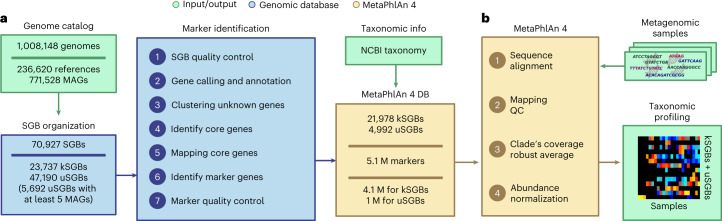
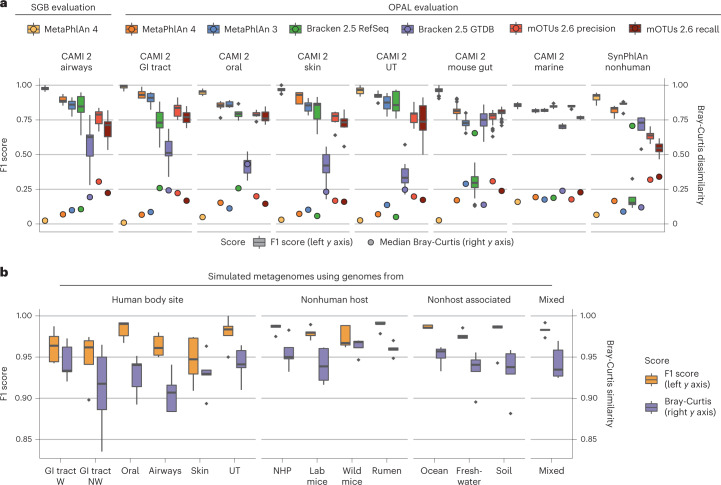
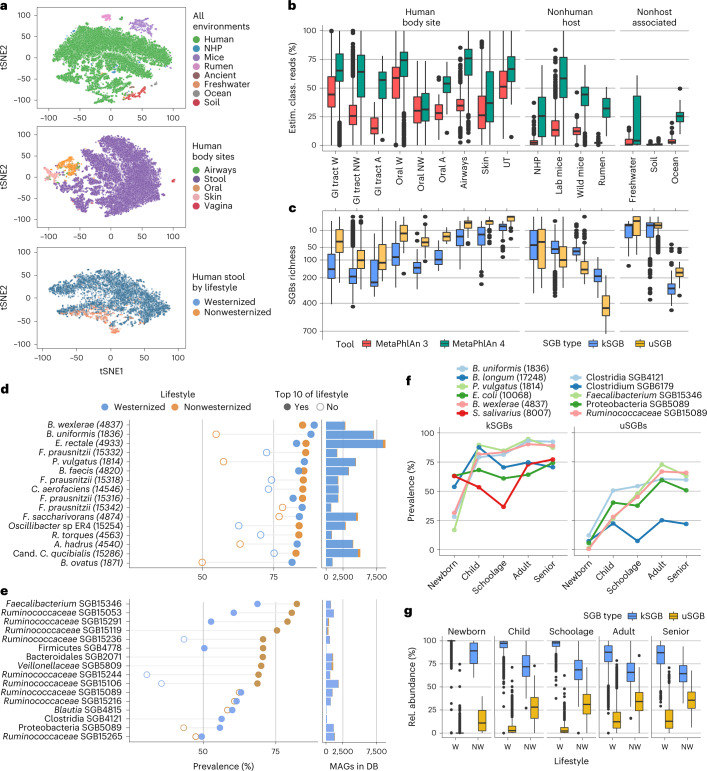
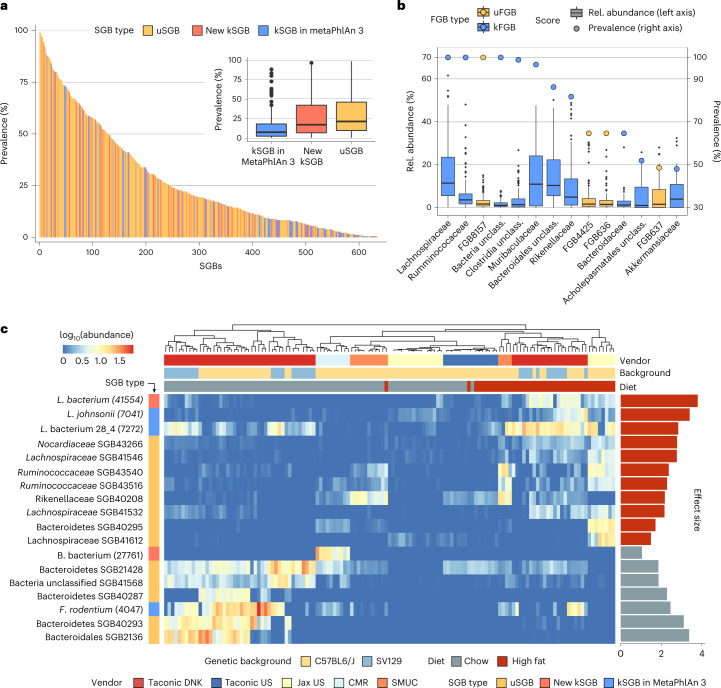
Metagenomic assembly enables new organism discovery from microbial communities, but it can only capture few abundant organisms from most metagenomes. Here we present MetaPhlAn 4, which integrates information from metagenome assemblies and microbial isolate genomes for more comprehensive metagenomic taxonomic profiling. From a curated collection of 1.01 M prokaryotic reference and metagenome-assembled genomes, we define unique marker genes for 26,970 species-level genome bins, 4,992 of them taxonomically unidentified at the species level. MetaPhlAn 4 explains ~20% more reads in most international human gut microbiomes and >40% in less-characterized environments such as the rumen microbiome and proves more accurate than available alternatives on synthetic evaluations while also reliably quantifying organisms with no cultured isolates. Application of the method to >24,500 metagenomes highlights previously undetected species to be strong biomarkers for host conditions and lifestyles in human and mouse microbiomes and shows that even previously uncharacterized species can be genetically profiled at the resolution of single microbial strains.
Overview
The claims and statistics of this paper haven’t been checked yet.
Free: it reads the open-access text and checks the first 5 claims that cite a source we can check. Create a free account to check every claim.
Integrity signals
Registry
Cites
Statistics
Figures
Verification
Claims the paper makes
The claims and statistics of this paper haven’t been checked yet.
Free: it reads the open-access text and checks the first 5 claims that cite a source we can check. Create a free account to check every claim.
Claims other papers make about this one
Each is checked against this paper’s own text: does it say what the citing paper says it does?
The cited source says what the claim attributes to it.
In the citing paper
“we performed a meta-analysis and mega-analysis of stools taxonomically profiled with MetaPhlAn 4 (ref. 37) and from patients enrolled in 12 cohorts from eight published studies26,38–44 across three cancer types, and classified as responders (n = 248) or non-responders (n = 513) based on RECIST1.1 criteria response rates”
From Gut OncoMicrobiome Signatures (GOMS) as next-generation biomarkers for cancer immunotherapy (2023) · cites this paper as [37]
The cited source says what the claim attributes to it.
In the citing paper
“We further performed strain-level and strain-matching analysis via StrainPhlAn 4 84 (STAR Methods) and identified potential transmission patterns for some food-human overlapping SGBs (Figures 6 and S6).”
From Unexplored microbial diversity from 2,500 food metagenomes and links with the human microbiome. (2024) · cites this paper as [84]
The check wasn’t confident either way, so it gives no verdict — never disputed.
In the citing paper
“A meta- and mega-analysis of stools obtained from patients with cancer treated with ICIs showed that GOMS associated with ICI resistance comprised microorganisms affiliated with chronic inflammation and immunosuppression and oral genera, and were shared across various pathological disorders.22,155”
From Melanoma and microbiota: Current understanding and future directions (2024) · cites this paper as [155]
Experimental — accuracy not yet measuredIn the citing paper
“We used MetaPhlAn 4 (ref. 37) for microbiome taxonomic profiling of stool samples from 1,879 adults across eight different cancer types (included in 30 cohorts from 23 published studies)25–29,38–55 and from a control group comprising 5,341 individuals without cancer (included in 17 cohorts from 14 published studies)”
From Gut OncoMicrobiome Signatures (GOMS) as next-generation biomarkers for cancer immunotherapy (2023) · cites this paper as [37]
In the citing paper
“Taxonomic profiling was performed at the level of species-level genome bins (SGBs) using MetaPhlAn4, which represent both existing and yet-to-be-characterized microbial species17.”
From Longitudinal gut microbiome changes in immune checkpoint blockade-treated advanced melanoma (2024) · cites this paper as [17]
1 more claim about this paper
Create a free account to see every claim other papers make about this one.
Self-check
Percentages, sums and reported differences re-computed from the paper’s own numbers.
The self-check needs the paper’s full text.
Citations
Cites
The Sequence Alignment/Map format and SAMtools
Li, H., Handsaker, B., Wysoker, A., Fennell, T., Ruan, J., Homer, N., Marth, G., Abecasis, G., Durbin, R., & 1000 Genome Project Data Processing Subgroup (2009) · Bioinformatics · doi:10.1093/bioinformatics/btp352 · Cited by 62,041 · cited 1×
“For item (1), StrainPhlAn 4 considers as input the reads-to-markers alignment results (in SAM format 96 ) from the MetaPhlAn 4 profiling together with the MetaPhlAn 4 database.”
MethodFast gapped-read alignment with Bowtie 2
Langmead, B., & Salzberg, S. L. (2012) · Nature Methods · doi:10.1038/nmeth.1923 · Cited by 56,400 · cited 1×
“To detect the SGB-specific marker genes, each set of core genes was then aligned against the genomes of the other SGBs using Bowtie 2 (version 2.3.5.1; -- sensitive parameter) 83 .”
MethodInfluentialMAFFT Multiple Sequence Alignment Software Version 7: Improvements in Performance and Usability
Katoh, K., & Standley, D. M. (2013) · Molecular Biology and Evolution · doi:10.1093/molbev/mst010 · Cited by 46,209 · cited 2×
“By default, multiple-sequence alignment is performed by MAFFT 92 , gappy positions (that is, positions with more than 67% of gaps) are trimmed by trimAl 91 and phylogenetic trees are inferred by RAxML 97 .”
MethodInfluentialRAxML version 8: a tool for phylogenetic analysis and post-analysis of large phylogenies
Stamatakis, A. (2014) · Bioinformatics · doi:10.1093/bioinformatics/btu033 · Cited by 32,291 · cited 3×
“By default, multiple-sequence alignment is performed by MAFFT 92 , gappy positions (that is, positions with more than 67% of gaps) are trimmed by trimAl 91 and phylogenetic trees are inferred by RAxML 97 .”
MethodInfluentialIQ-TREE: A Fast and Effective Stochastic Algorithm for Estimating Maximum-Likelihood Phylogenies
Nguyen, L.-T., Schmidt, H. A., von Haeseler, A., & Minh, B. Q. (2015) · Molecular Biology and Evolution · doi:10.1093/molbev/msu300 · Cited by 26,046
Prokka: rapid prokaryotic genome annotation
Seemann, T. (2014) · Bioinformatics · doi:10.1093/bioinformatics/btu153 · Cited by 18,818
Fast and sensitive protein alignment using DIAMOND
Buchfink, B., Xie, C., & Huson, D. H. (2015) · Nature Methods · doi:10.1038/nmeth.3176 · Cited by 14,201
trimAl: a tool for automated alignment trimming in large-scale phylogenetic analyses
Capella-Gutiérrez, S., Silla-Martínez, J. M., & Gabaldón, T. (2009) · Bioinformatics · doi:10.1093/bioinformatics/btp348 · Cited by 12,751 · cited 1×
“By default, multiple-sequence alignment is performed by MAFFT 92 , gappy positions (that is, positions with more than 67% of gaps) are trimmed by trimAl 91 and phylogenetic trees are inferred by RAxML 97 .”
MethodParks, D. H., Imelfort, M., Skennerton, C. T., Hugenholtz, P., & Tyson, G. W. (2015) · Genome Research · doi:10.1101/gr.186072.114 · Cited by 12,496
Diet rapidly and reproducibly alters the human gut microbiome
David, L. A., Maurice, C. F., Carmody, R. N., Gootenberg, D. B., Button, J. E., Wolfe, B. E., Ling, A. V., Devlin, A. S., Varma, Y., Fischbach, M. A., et al. (2014) · Nature · doi:10.1038/nature12820 · Cited by 10,100
Cited by
Items 901–1,000 of 1,000
Transketolase enzyme discovery and engineering
Tonoli, A., Dalby, P. A., Hailes, H. C., & Jeffries, J. W. E. (2025) · Methods in enzymology on CD-ROM/Methods in enzymology · doi:10.1016/bs.mie.2025.07.002 · Cited by 1
Analysis of the sheep (Ovis aries) vaginal microbiota preceding spontaneous abortion: a pilot study
Jonas, L. C., Schmitz‐Esser, S., & Youngs, C. R. (2025) · Access Microbiology · doi:10.1099/acmi.0.001005.v3 · Cited by 1
“MetaPhlAn4 was used to determine the microbial taxonomic composition of metagenome sequencing reads [10].”
Gao, Y., Wang, D., Lu, T., Liu, K., Li, S., Kang, J., Sha, S., Xing, G., Cheng, L., Fan, S., et al. (2025) · mSystems · doi:10.1128/msystems.00657-25 · Cited by 1
“To minimize the host’s impact on the microbial genome in subsequent analyzes, we mapped the quality-filtered reads to three databases: the MetaPhlAn4 database (23), the chm13 V2.”
Ghathian, K. S. A., Heintz, J. E., Mollerup, S., Paulsen, S. J., Krogfelt, K. A., Frimodt‐Møller, N., Hansen, K. H., Halkjær, S. I., Holm, A., Pinholt, M., et al. (2025) · MicrobiologyOpen · doi:10.1002/mbo3.70053 · Cited by 1
Uprety, T., Durazo, J., Paul, L., Metiner, K., Ruby, R. E., Loynachan, A. T., Janes, J. G., Kenndy, L., Cassone, L., Evely, M. M., et al. (2025) · Veterinary Microbiology · doi:10.1016/j.vetmic.2025.110705 · Cited by 1
Genomic Insights into Genetic Characteristics of Chromobacterium haemolyticum — China, 2023
Bei, W., Pei, Y., Yanan, W., & Xu, X. (2025) · China CDC Weekly · doi:10.46234/ccdcw2025.148 · Cited by 1
Eselevich, R. V., Balura, O. V., Melnikova, E. V., Zotov, K. Y., Монгуш, С. П., & Surov, D. A. (2025) · Bulletin of the Russian Military Medical Academy · doi:10.17816/brmma677240 · Cited by 1
Antibiotic-resistance and virulence-related genes in commercially bottled natural mineral waters
Radocchia, G., Brunetti, F., Marazzato, M., Scribano, D., Nencioni, L., Palamara, A. T., Schippa, S., & Pantanella, F. (2025) · BMC Microbiology · doi:10.1186/s12866-025-04336-2 · Cited by 1
“Taxonomy assignments were performed using Metaph-lan4 [25] and the obtained Species-level genome bins (SBGs) profiles were subsequently converted into GTDB-taxonomy-based profile by using the script sgb_to_gtdb_ profile.py provided with the Metaphlan package.”
Ma, P., Mu, W., Wang, Y., Liu, Y., Zou, Y., Lu, Z., Pang, S., Pan, H., Zhang, L., Chen, L., et al. (2025) · ISME Communications · doi:10.1093/ismeco/ycaf170 · Cited by 2
“Taxonomic annotations were performed using MetaPhlan4 [37] (v.4.0.3) using the standard reference database (mpa_vJan21_CHOCOPhlAnSGB_202103) with default parameters.”
InfluentialPérez-Pérez, L., Galisteo, C., Sanjuán, J. M. O., Cobo-Díaz, J. F., Puente, H., Rubio, P., Carvajal, A., & Argüello, H. (2025) · Animal Microbiome · doi:10.1186/s42523-025-00466-0 · Cited by 2
“Filtered reads were taxonomically assigned by Met-aPhlAn 4 [74] with vOct22_CHOCOPhlAnSGB_202212 database and functional annotated by SUPER-FOCUS v.0.35 [75] using 90 cluster size database.”
InfluentialGarg, V., Armstrong, E., Celeste, A., Wang, C., Shukla, A., Tesfu, A., Odujoko, O. O., Madariaga, A., Lee, Y. C., Li, W., et al. (2025) · Gynecologic Oncology · doi:10.1016/j.ygyno.2025.09.012 · Cited by 1
Mqambalala, A., Maleke, M., Deysel, L.-M., Osman, J. R., Gómez-Árias, A., Valverde, Á., & Castillo, J. (2025) · Microorganisms · doi:10.3390/microorganisms13102349 · Cited by 1
Zhao, S., Wang, H., Lu, W., Pei, Z., Zhang, H., Chen, W., Zhao, J., & Wu, W. (2025) · Food Bioscience · doi:10.1016/j.fbio.2025.107783 · Cited by 1
Powell, C. E., McCurry, M. D., Quevedo, S. F., Ventura, L., Krishnan, K., Dave, M., Mahmood, S. D., Specht, K., Bordia, R., Sargen, M. R., et al. (2025) · mSphere · doi:10.1128/msphere.00550-25 · Cited by 3
Leveraging metatranscriptomics for the characterisation of bovine blood viromes
Brito, B. P., DeMaere, M. Z., Lean, I. J., Hazelton, M. S., O’Rourke, B. A., Holmes, E. C., House, J. K., Rowe, S., Myers, G. S. A., & Chowdhury, P. R. (2025) · Scientific Reports · doi:10.1038/s41598-025-20367-1 · Cited by 1
Dziegiel, A. H., Duong, V. T., Bloomfield, S. J., Thomson, N. R., Maskell, D. J., Wain, J. R., Janecko, N., Baker, S., & Mather, A. E. (2025) · Microbial Genomics · doi:10.1099/mgen.0.001547 · Cited by 1
“0.3 (mpa_vJan21_CHOCOPhlAnSGB_202103) [36] was also used for classification, as an alternative marker gene-based method.”
InfluentialResponse of Bovine Uterine Microbiota to Staphylococcus aureus Infection
Li, Z., Zhang, X., Peng, L., Fang, Y., Liu, H., Zhou, Y., Wang, J., & Lu, W. (2025) · American Journal of Reproductive Immunology · doi:10.1111/aji.70178 · Cited by 1
“Metagenomic sequencing is not limited to the length of bacterial sequences, providing a better platform for improving microbial diversity, including DNA viruses, archaea, and yeasts [8, 9].”
Assessment of enzyme diversity in the fermented food microbiome
Li, P., Sun, J., Geng, Y., Jiang, Y., Li, Y., & Zhang, Z. (2025) · Cell Systems · doi:10.1016/j.cels.2025.101430 · Cited by 6
Miguel‐Etayo, P. D., Flores‐Rojas, K., Vázquez‐Cobela, R., Jurado‐Castro, J. M., Larruy‐García, A., Picáns‐Leis, R., Castro-Collado, C., Pastor‐Villaescusa, B., Llorente‐Cantarero, F. J., Aguilera, C. M., et al. (2025) · BMC Public Health · doi:10.1186/s12889-025-24351-2 · Cited by 3
“The raw data samples will be analyzed using MetaPhlAn version 3.0 [33].”
InfluentialYu, H., Liu, R., Wang, H.-T., Hou, Q.-Y., Qin, Y., Yang, X., Gao, Z.-Q., Yang, L., Zhao, Q., & Ma, H. (2025) · Frontiers in Cellular and Infection Microbiology · doi:10.3389/fcimb.2025.1708266 · Cited by 1
The Relationship Between Gut Microbiota During Pregnancy and the Level of Postpartum Adiposity
Houttu, N., Mokkala, K., Lindgren, H., Lotankar, M., Benchraka, C., Pärnänen, K. M. M., Saros, L., Muhli, E., Vahlberg, T. J., Lahti, L., et al. (2025) · MicrobiologyOpen · doi:10.1002/mbo3.70128 · Cited by 1
Patavoukas, E., Tong, B., Guðnadóttir, U., Charalampous, K., Brusselaers, N., Schuppe‐Koistinen, I., Engstrand, L., Fransson, E., Wiberg‐Itzel, E., & Hugerth, L. W. (2025) · BMC Microbiology · doi:10.1186/s12866-025-04473-8 · Cited by 2
“…were removed by annotating with kraken2 v.2.1.2 [ 19] on a reference containing only the human GRCh38 genome, and reads were annotated to the species level using the Metaphlan4 (mpa_ vOct22_CHOCOPhlAnSGB_202212) pipeline [20] (table S1), as well as functionally annotated with the Humann2 pipeline.”
InfluentialBersch-Ferreira, Â. C., Fonseca, D. C., Tramujas, L., Schiavon, C. A., Santos, R. H. N., Machado, R. H. V., Cavalcanti, A. B., & Marcadenti, A. (2025) · Obesity Surgery · doi:10.1007/s11695-025-08355-w · Cited by 1
MeTAline: enabling reproducible and scalable metagenomic analyses
Khannous‐Lleiffe, O., Fuentes, D., Májer, D., & Gabaldón, T. (2025) · NAR Genomics and Bioinformatics · doi:10.1093/nargab/lqaf158 · Cited by 1
“Among the most widely adopted tools for taxonomic profiling are Kraken2 [ 3 ] and MetaPhlAn4 [ 4 ], each representing two fundamentally distinct assembly-independent approaches: k -mer-based or marker-based, respectively, each of which may be best suited to different questions or datasets [ 5 , 6 ].”
Li, J., Popovich, P. G., Kigerl, K. A., McTigue, D. M., Schwab, J. M., Barnes, S., & Yarar‐Fisher, C. (2025) · Archives of Physical Medicine and Rehabilitation · doi:10.1016/j.apmr.2026.02.246 · Cited by 1
Lee, I., Kim, S. H., Lee, M.-J., Oh, A., Lee, Y. K., Lee, K. J., & Kim, B. S. (2025) · Journal of Microbiology and Biotechnology · doi:10.4014/jmb.2509.09032 · Cited by 1
“Species and strain identification were carried out using MetaPhlAn4 v.4.0 [25] and StrainPhlan4 v.4.0 [26], respectively.”
InfluentialThe glioblastoma virome across tumor and extracellular compartments
Ghorbani, M., Karimi, H., Solati, F., Anbarestani, N., & Khoshdoozmasouleh, N. (2025) · Frontiers in Oncology · doi:10.3389/fonc.2025.1705003 · Cited by 1
Liu, J., Qin, S., Lei, C.-C., Ma, H., Xie, L.-H., Liu, Y., Li, J., Ni, H., Yu, M.-Y., Liang, H.-R., et al. (2025) · Frontiers in Cellular and Infection Microbiology · doi:10.3389/fcimb.2025.1719025 · Cited by 1
Abuqwider, J., Pasolli, E., Scidà, G., Corrado, A., Vitale, M., Filippis, F. D., Ercolini, D., Annuzzi, G., Rivellese, A. A., & Bozzetto, L. (2025) · Nutrition Metabolism and Cardiovascular Diseases · doi:10.1016/j.numecd.2025.104487 · Cited by 1
Self-citationMollerup, S., Paulsen, S. J., Pedersen, M., & Westh, H. (2025) · FEMS Microbiology Letters · doi:10.1093/femsle/fnaf120 · Cited by 1
Kropp, D. R., Glover, M. E., Samanta, R., Unroe, K. A., Clinton, S. M., & Hodes, G. E. (2025) · Biology of Sex Differences · doi:10.1186/s13293-025-00794-5 · Cited by 1
Best Practice in Microbiome Research
Carding, S. R. (2025) · Springer protocols handbooks/Springer protocols · doi:10.1007/978-1-0716-5009-7 · Cited by 3
Protic, D. D., Bascarevic, D., Dimitrijevic, S., Pešović, J., Nikolić, V., Nikolic, S., Novicevic, V., Markovic, J., Arandjelović, I., Pavicevic, D. S., et al. (2025) · Scientific Reports · doi:10.1038/s41598-025-29896-1 · Cited by 2
“0 35 with default settings and vOct22 database.”
Yang, S., Deng, W., Yang, T., Liu, C., Li, C., Guo, L., Wei, R., Li, D., Huang, Y., Zhao, K., et al. (2025) · npj Biofilms and Microbiomes · doi:10.1038/s41522-025-00879-4 · Cited by 1
Xiao, Y., Liu, H., Wang, P., Zhang, Y., Wang, F., & Jing, H. (2025) · BMC Biology · doi:10.1186/s12915-025-02490-7 · Cited by 1
“…by mapping metagenomic reads against a catalog of clade-specific marker sequences currently spanning the bacterial and archaeal phylogenies with the default marker gene database mpa_v30_CHOC-OPhlAn_201901, marker-level analysis relied on the default presence threshold (–pres_th = 1.0) [54].”
InfluentialFu, J., Bu, G., Aimaier, S., Yang, Y., Bao, Z., & Wulasihan, M. (2025) · Frontiers in Microbiology · doi:10.3389/fmicb.2025.1683587 · Cited by 2
Beghini, F., Brito, I., Gerstein, M., & Christakis, N. A. (2025) · Cell Reports · doi:10.1016/j.celrep.2025.116724 · Cited by 2
Self-citationChatzis, A., Gaspari, M., Kontogiannopoulos, K. N., Sanguineti, D., Zampieri, G., Zouboulis, A. I., & Kougias, P. (2025) · Journal of environmental chemical engineering · doi:10.1016/j.jece.2025.119480 · Cited by 1
Khakvar, R., Pulinkala, G., Sar, M. B., & Komorowski, J. (2025) · Physiological and Molecular Plant Pathology · doi:10.1016/j.pmpp.2025.103092 · Cited by 1
Wang, H. (2025) · IntechOpen eBooks · doi:10.5772/intechopen.1012591 · Cited by 1
Altered Gut Microbiota in Pediatric Quiescent Crohn’s Disease Patients with Iron Deficiency Anemia
Gordon, E., Goc, J., Grier, A. R., Thomas, C., Bank, J. L. C., Artis, D., Longman, R., Sonnenberg, G. F., Scherl, E., Sockolow, R., et al. (2025) · Inflammatory Bowel Diseases · doi:10.1093/ibd/izaf295 · Cited by 1
Mercer, E. M., Piché‐Choquette, S., Gorospe, J., Rangipour, Z., Asbury, M. R., Alshaikh, B. N., Sycuro, L. K., Kembel, S. W., Giesbrecht, G. F., & Arrieta, M. (2025) · Gut Microbiology · doi:10.1016/j.gutmic.2025.100004 · Cited by 2
An ancient DNA perspective on the Russian conquest of Yakutia
Crubézy, É., Guarino‐Vignon, P., Seguin‐Orlando, A., Sarkissian, C. S. I. D., Hanghøj, K., Duchesne, S., Gérard, P., Thèves, C., Alcouffe, A., Romanova, L., et al. (2026) · Nature · doi:10.1038/s41586-025-09856-5 · Cited by 2
“29,94), considering the most abundant bacterial species of the red complex and eight pathogens.”
InfluentialYou, S., Zou, Y., Xiao, Y., He, L., Liu, L., Sun, Y., Jia, Y., Ge, G., & Du, S. (2026) · BMC Microbiology · doi:10.1186/s12866-025-04678-x · Cited by 1
“The fermented diet modulates the animal performance and gut microbiome through the taxonomic composition and functional potential of the microbiome in the fermented diet by the metagenomic sequencing technology [6, 18].”
Advancing Personalized Medicine With AI-Driven Microbiome and Nutrigenomics
Sah, A. K., Maurya, A. K., Mishra, P. S., Mishra, R., & Choudhary, R. K. (2026) · IGI Global eBooks · doi:10.4018/979-8-3373-4849-0.ch004 · Cited by 1
Montero, M. D. A., Kis, L., Vig, V., Kocsmár, R., Zink, A., Maixner, F., Mari, B., Mussauer, A., Sklánitz, A., Palkó, A., et al. (2026) · PLoS ONE · doi:10.1371/journal.pone.0340762 · Cited by 1
“1.1 [122], as well as mapping against the M. tuberculosis H37Rv reference genome (NC_000962.”
InfluentialCAMP: a modular metagenomics analysis system for integrated multistep data exploration
Mak, L. E., Tierney, B. T., Wei, W., Ronkowski, C., Toscan, R. B., Turhan, B., Toomey, M., Andrade-Martínez, J. S., Fu, C., Lucaci, A. G., et al. (2026) · NAR Genomics and Bioinformatics · doi:10.1093/nargab/lqaf172 · Cited by 2
Galgano, S., Faruk, M. U., Eising, I., Houdijk, J. G. M., & Khattak, F. (2026) · Animal Microbiome · doi:10.1186/s42523-025-00506-9 · Cited by 1
“1 pipeline [33] and the version Oct22-202212 of the CHOCOPhlAn (SGB) database, outputting total sum scaling (TSS) normalized taxonomy tables.”
A negative binomial latent factor model for paired microbiome sequencing data
Kim, H., Siddiqui, N. Y., Karstens, L., & Ma, L. (2026) · BMC Bioinformatics · doi:10.1186/s12859-025-06362-3 · Cited by 1
“These methods produce sequencing reads, which are subsequently mapped to taxa at various taxonomic levels using bioinformatic preprocessing pipelines, such as DADA2 [1] and MetaPhlAn [2].”
Guerrero‐Toledo, F. D. M., Espinosa‐Solares, T., Hernández-Eugenio, G., & Huber, D. H. (2026) · Frontiers in Microbiomes · doi:10.3389/frmbi.2025.1707779 · Cited by 1
“For this analysis, metagenomic taxonomic pro fi ling was performed with MetaPhlAn 4.0 (Blanco-M ı ́ guez et al., 2023) using species-level marker genes.”
InfluentialGut microbial signatures expose the westernized lifestyle of urban Ethiopian children
Kirsche, L., Leary, P., Blaser, M. J., Scharl, M. M., Negussie, A., & Mueller, A. (2026) · Communications Biology · doi:10.1038/s42003-026-09639-2 · Cited by 1
Dall, S. M., Møllekær, A. H., Kousgaard, S. J., Jakobsen, S. S., Larsen, L., Sørensen, B., Thorlacius-Ussing, O., & Albertsen, M. (2026) · Journal of Crohn s and Colitis · doi:10.1093/ecco-jcc/jjag150 · Cited by 1
Stensland, M., Bru, K. F., Austdal, M., Dahl, I. H., Jonsdottir, K., Lende, T. H., Heimvik, C., Elve, I., Omdal, R., van der Giezen, M., et al. (2026) · Clinical and Experimental Medicine · doi:10.1007/s10238-026-02073-y · Cited by 1
“1.1 and the database mpa_vJun23_ CHOCOPhlAnSGB_202403) with default parameters [43].”
InfluentialGuccione, C., Sfiligoi, I., Gonzalez, A., Shaffer, J. P., Kazachkova, M., Weng, Y., McDonald, D., Shah, S. C., Minot, S. S., Paulson, T. G., et al. (2026) · BMC Genomics · doi:10.1186/s12864-026-12545-w · Cited by 1
“…with the flags “-t rel_ab_w_ read_stats –unclassified_estimation” (run using the Next-flow workflow available at h t t p s : / / g i t h u b . c o m / F r e d H u t c h / m e t a p h l a n - n f commit 4a31444, and the reference d a t a b a s e version mpa_vJan21_CHOCOPhlAnSGB_202103) [49].”
Miller, K. J., Wolff, I. M., Valeriano, L. A. M. D. O., Soto-Girón, M. J., Jangi, S., Schott, E. M., Charbonneau, M. R., Ballok, A. E., & Toledo, G. V. (2026) · Beneficial Microbes · doi:10.1163/18762891-bja00109 · Cited by 3
Generation of a novel Slc7a9G105R mutant mouse identifies new biomarkers for cystinuria
Bhatt, N. P., Nguyen, T. T. H., Iacono, G., Rodriguez, G. R., Anderson, C. R. B., Perry, A., Barlow, C. K., Anderson, D., Burgio, G., Marsland, B. J., et al. (2026) · Kidney International · doi:10.1016/j.kint.2026.06.050 · Cited by 1
Assessment of human placental microbial signatures in pre-eclampsia using shotgun metagenomics
Olaniyi, K. S., Moodley, J., Moodley, R., & Mackraj, I. (2026) · Canadian Journal of Physiology and Pharmacology · doi:10.1139/cjpp-2025-0274 · Cited by 1
Ni, W., Huang, H., Wang, X., Yu, A., Ren, J., & Li, H. (2026) · Current Microbiology · doi:10.1007/s00284-026-04753-0 · Cited by 1
Chen, J., Dong, Y., Zhao, J., Lai, Y., Xiao, C., Fu, Y., Zhang, K., Ye, M., Gou, W., Hu, S., et al. (2026) · BMC Medicine · doi:10.1186/s12916-026-04710-5 · Cited by 2
“0.6) [20].”
InfluentialDing, L., Yang, S., Wu, F., Pilling, D., Zhang, J., Pool, K., Nishvanthi, M., Babington, S., Maloney, S. K., Chen, L., et al. (2026) · Microbiome · doi:10.1186/s40168-025-02332-2 · Cited by 1
“1.1) [30].”
InfluentialThe role of gut microbes in production of aromatic carboxaldehydes
Kumar, M., Son, R., Preston, S. M., Glowacki, R. W. P., Carr, K. M., Kim, J., Ma, J. Z., Ahern, P. P., Claesen, J., Sangwan, N., et al. (2026) · Gut Microbes · doi:10.1080/19490976.2026.2632979 · Cited by 1
“35 For the differential abundance analysis, we employed the random forest methodology integrated within the DAtest package.”
Pirolo, M., Sherwani, M. K., Espinosa‐Gongora, C., Eriksen, E. Ø., Tassinato, C., Alberdi, A., & Guardabassi, L. (2026) · Animal Microbiome · doi:10.1186/s42523-026-00522-3 · Cited by 1
“1.1 [19].”
InfluentialMazzoni, C., Ochana, B.-L., Orlanski‐Meyer, E., Yaʼacov, A. B., Focht, G., Harpenas, E., Shmorak, S., Ledder, O., Lev‐Tzion, R., Shemer, R., et al. (2026) · Microbiome · doi:10.1186/s40168-026-02344-6 · Cited by 5
“Non-human reads were taxonomically classified using MetaPhlAn4 [52] (database v. mpa_vJan21_CHOCOPhlAnSGB_202103).”
Movsesijan, T., Alcañiz, A. J., Roch, F., Chaughtai, M. S., Dzieciol, M., Stessl, B., Thalguter, S., Strachan, C. R., Raindl, M., Wagner, M., et al. (2026) · Food Research International · doi:10.1016/j.foodres.2026.118808 · Cited by 1
Detecting microbial footprints in cancer sequencing
Piccinno, G., Mjelle, R., & Segata, N. (2026) · Cancer Cell · doi:10.1016/j.ccell.2026.02.005 · Cited by 1
Self-citationHow “pro” are probiotics for wildlife species? Novel data, lack of evidence, and future directions
Bornbusch, S. L., Thacher, P., Francisque, M., DeCandia, A. L., Bortner, R., Garelle, D., Kendrick, E. L., Maslanka, M., & Muletz‐Wolz, C. R. (2026) · ISME Communications · doi:10.1093/ismeco/ycag036 · Cited by 3
“To assign taxonomic identity, we used MetaPhlAn4 (v. 4.1) [63] on concatenated forward and reverse reads, using marker genes identified across microbial whole genomes and metagenome-assembled genomes and grouping into species-level genome bins.”
InfluentialBoix-Amorós, A., Bu, K., Blank, R. B., Cantor, A., Gutiérrez, A., Rodríguez-Lago, I., Marín‐Jiménez, I., Sanz, J., Gratacós, J., Trujillo, E., et al. (2026) · Annals of the Rheumatic Diseases · doi:10.1016/j.ard.2026.01.018 · Cited by 1
KHITROV, A. A., Burakova, I. Y., Dmitrievna, S. Y., Pogorelova, S. V., Chirkin, E. A., Dmitrievna, M. P., Андреевич, Г. Д., Ожимкова, Е. В., Syromyatnikov, M. Y., & Korneeva, O. S. (2026) · Microorganisms · doi:10.3390/microorganisms14030592 · Cited by 1
Association between autoimmune diseases and the gut microbiome
Hirano, Y., Tomofuji, Y., Edahiro, R., Kishikawa, T., Miyawaki, S., & Okada, Y. (2026) · International Immunology · doi:10.1093/intimm/dxag013 · Cited by 1
Díaz, M., Wilson, N., Ponsero, A. J., Seecharran, T., Som, N., Al-Khanaq, H., Gutiérrez, A. V., & Gilmour, M. W. (2026) · Food Microbiology · doi:10.1016/j.fm.2026.105075 · Cited by 1
Cruz, M. C., Ruhal, R., Lavin, J., Bridwell, S., Balasjin, N. M., Raasch, B., Melton, R., Mayer, B. K., Marshall, C. W., & Hristova, K. R. (2026) · Applied and Environmental Microbiology · doi:10.1128/aem.01968-25 · Cited by 1
Gancz, A. S., Zhang, G., McMillan, A. S., Dougherty, M., McGill, S., Gulati, A., Baker, E. S., & Theriot, C. M. (2026) · Gut Microbes Reports · doi:10.1080/29933935.2026.2648346 · Cited by 1
Wei, G., Liu, M., Huang, L., & Chen, C. (2026) · Animal Microbiome · doi:10.1186/s42523-026-00551-y · Cited by 1
“0.6) with default parameters [24].”
InfluentialTestosterone administration partially modulates gut microbiota responses to severe energy deficit
Mohr, A. E., Berryman, C. E., Harris, M. N., Lawrence, A. B., Chakraborty, N., Campbell, R., Dimitrov, G. I., Gautam, A., Hammamieh, R., Lieberman, H. R., et al. (2026) · American Journal of Physiology-Endocrinology and Metabolism · doi:10.1152/ajpendo.00291.2025 · Cited by 3
Deng, J., Qiu, Q., Ye, S., Yu, J., Yao, D., Deng, H., Wang, C., Han, L., Deng, Y., Chen, Y., et al. (2026) · Journal of Translational Medicine · doi:10.1186/s12967-026-08013-4 · Cited by 1
“We utilized MetaPhlAn 4, whose expanded genomic database and refined algorithms permit a far deeper profiling of the microbial community, bringing previously unclassified ‘microbial dark matter’ into focus [16].”
InfluentialDynamic changes in the plasmidome and resistome in the gastrointestinal tract of chickens
Rysava, M., Palkovičová, J., stredanska, K., Schwarzerová, J., Jakubickova, M., Čejková, D., Aytan-Aktug, D., Otani, S., & Dolejská, M. (2026) · Microbiology Spectrum · doi:10.1128/spectrum.04074-25 · Cited by 1
Mining of food metagenomes reveals an unexplored diversity of dsDNA bacteriophages
Walsh, L. H., Soni, V., Ancla, J. B., Somerville, V., Segata, N., Joyce, S. A., van Sinderen, D., Mahony, J., Shkoporov, A. N., Kenny, J. G., et al. (2026) · npj Biofilms and Microbiomes · doi:10.1038/s41522-026-00941-9 · Cited by 1
Self-citationDasgupta, S. (2026) · OMICS A Journal of Integrative Biology · doi:10.1177/15578100261419483 · Cited by 1
“Tools such as QIIME2, MetaPhlAn, HUMAnN3, Kraken2, and MEGAN are widely used for taxonomic pro fi ling and functional annotation (Hall and Beiko, 2018; Blanco-Míguez et al., 2023; Gautam et al., 2023).”
Bartelli, T. F., Baydogan, S., Sahin, I., Hoffman, K. L., Petrosino, J. F., Blackburn, K. W., Zhao, J., Wood, A., Ayvaz, T., Surathu, A., et al. (2026) · Pancreas · doi:10.1097/mpa.0000000000002618 · Cited by 1
Associations of the gut microbiome and cardiometabolic risk in adolescence: the HOME study
Arzu, J. L., Fleury, E. S., Cecil, K. M., Chen, A., Lanphear, B. P., Yolton, K. A., Buckley, J. P., Braun, J. M., & Laue, H. E. (2026) · BMC Medical Genomics · doi:10.1186/s12920-026-02359-w · Cited by 1
“We used MetaPhlAn 4 with the CHOCOPHlAnSGB vOct22 data-base to generate taxonomic profiles of the metagenome including estimating the relative abundances of microbial taxa [38].”
Bilophila wadsworthia is linked to basal ganglia atrophy in the general population
Fässler, D., Wittfeld, K., Frenzel, S., der Auwera, S. V., Merhjerd, A., Gholizadeh, M., Simm, S., Kaderali, L., Franck, M., Rühlemann, M. C., et al. (2026) · Brain Behavior and Immunity · doi:10.1016/j.bbi.2026.106587 · Cited by 1
Wang, H., Wu, S., Zhang, K., Chen, K., Vilgalys, R. J., & Liao, H.-L. (2026) · Communications Biology · doi:10.1038/s42003-026-09820-7 · Cited by 1
van der Heijden, M., Clubb, J. H. A., Erawijantari, P. P., Ronkainen, A., Arias, V., Jirovec, E., Kudling, T. V., Pakola, S. A., Ojala, N., Haybout, L., et al. (2026) · OncoImmunology · doi:10.1080/2162402x.2026.2656514 · Cited by 1
Zhang, Z., Chen, C., Zhang, M., Zhu, J., Xu, X., Wang, Z., Zhou, L., Wu, C., Zong, M., Yin, T., et al. (2026) · Gut Microbes · doi:10.1080/19490976.2026.2657047 · Cited by 1
Tóth, A. G., Paholcsek, M., Solymosi, N., Stágel, A., Gömbös, P., Posta, K., Lakatos, I., Nagy, S. Á., Ferenczi, S., & Szőke, Z. (2026) · STAR Protocols · doi:10.1016/j.xpro.2026.104498 · Cited by 1
An ancient genome of Streptococcus pyogenes from a pre-Columbian Bolivian mummy
Valverde, G., Sarhan, M. S., Cook, R., Rota‐Stabelli, O., Adriaenssens, E. M., Zink, A., & Maixner, F. (2026) · Nature Communications · doi:10.1038/s41467-026-71603-9 · Cited by 2
Ranjan, A., Guo, C., Briese, T., Donovan, W. M., Kapoor, V., Chandrasekaran, A., MANSUKHANI, M. M., Berry, G. J., & Lipkin, W. I. (2026) · Frontiers in Microbiology · doi:10.3389/fmicb.2026.1802485 · Cited by 1
“Our design incorporated four major components: (1) Clade-specific marker genes: unique marker gene sequences from the MetaPhlAn4 database (vOct2022) (Blanco-Miguez et al., 2023), covering 894 known or potential pathogenic bacterial species (Supplementary Table S1); (2) 16S rRNA genes:…”
Integrated Multi-Omics Reveals Synergistic Hepatotoxicity of Ethanol and PFOS Co-Exposure
Stem, A. D., Alayyoub, M., Aalizadeh, R., Nikolopoulou, V., Lisgara, A., Shvartsman, A., Anitha, M., Patterson, A., Coble, R., Rushing, B., et al. (2026) · Chemico-Biological Interactions · doi:10.1016/j.cbi.2026.112101 · Cited by 1
Jin, H., Meng, L., Yuluğ, B., Altay, Ö., Li, X., Çankaya, Ş., Hanoğlu, L., Ji, B., Coşkun, E., İdil, E., et al. (2026) · Neurobiology of Disease · doi:10.1016/j.nbd.2026.107424 · Cited by 1
A Brief Review of Microbial Omics: Methods and Perspectives
Yan, C., Zhang, F., Long, C., Yin, Y., & Wang, L. (2026) · Methods in molecular biology · doi:10.1007/978-1-0716-5264-0_1 · Cited by 1
Chen, C., Xing, Y., Xing, G., Zeng, F., Zheng, N., Sha, S., Zhao, L., Zhang, Y., Ling, Y., Yao, X., et al. (2026) · Cell Reports Medicine · doi:10.1016/j.xcrm.2026.102777 · Cited by 2
Zeng, Y., Lau, E. Y. T., Ye, S., Lu, J., Zhang, R., Hu, R., & Liang, Q. (2026) · International Journal of Molecular Sciences · doi:10.3390/ijms27104457 · Cited by 1
Oumer, O. J., Simachew, A., Hartmann, E. M., Alexandersson, E., & Johansson, E. (2026) · mSystems · doi:10.1128/msystems.00485-26 · Cited by 1
Cohesive modules of engraftment in fecal microbiota transplantation
Rashidi, A., Minot, S. S., Lee, S. J., Hill, G. R., & Podlesny, D. (2026) · iScience · doi:10.1016/j.isci.2026.116025 · Cited by 1
Microbe Decoder uncovers functional traits of microbes in microbiome datasets
Hackmann, T. J., Parris, J. P., Seshadri, R., & Lingga, C. (2026) · Nucleic Acids Research · doi:10.1093/nar/gkag515 · Cited by 1
“Tools shown are DADA2 [ 9 ], QIIME2 [ 36 ], MetaPhlAn [ 11 ], IMG/M [ 21 ], GTDB-Tk [ 37 ], PICRUSt2 [ 38 ], HUMAnN [ 19 ], KAAS [ 18 ], and eggNOG-mapper [ 15 ]. with Microbe Decoder.”
InfluentialLiu, L., Narrowe, A. B., Firrman, J., Mahalak, K. K., Chetty, V. J., Lemons, J. M. S., Baudot, A., & den Abbeele, P. V. (2026) · Current Issues in Molecular Biology · doi:10.3390/cimb48060542 · Cited by 1
Dommann, J., Sprecher, V. P., Beisel, C., Ballmer, D., Hürlimann, E., Coulibaly, J. T., Keiser, J., & Schneeberger, P. H. H. (2026) · npj Biofilms and Microbiomes · doi:10.1038/s41522-026-01018-3 · Cited by 2
“To maintain taxonomic consistency between the resulting MAGs and the results from the participant-level work fl ow, the MAGs were taxonomically annotatedusingMetaPhlAn4 65 .”
Wang, W., Fortuna, R., Mayengbam, S., Seerattan, R. A., Mu, C., Rios, J. L., Abughazaleh, N., Vaghef‐Mehrabany, E., Tuplin, E. W. N., Hart, D. A., et al. (2026) · Gut Microbes · doi:10.1080/19490976.2026.2679516 · Cited by 2
“Two-dimensional NMDS and PERMANOVA analyses based on Bray–Curtis distance matricescalculated from MetaPhlAn4 taxonomy, HUMAnN3 pathway, and dbCAN3 PUL prediction, identified individual variation and prebiotic intervention as significant factors explaining community dissimilarity across these profiles ( p < 0.05, Figur…”
Influentialvan Dorst, J. M., Taylor, N., Pushpakumara, B. L. D. U., Tan, Z. T., Buchanan, D. D., Haber, P., Nash, E., Visser, S., Volovets, A., Sivam, S., et al. (2026) · Journal of Cystic Fibrosis · doi:10.1016/j.jcf.2026.05.016 · Cited by 1
Sanchis-Sanchis, C. E., Sancho-Cantus, D., Sanchis, E. S., Privado, J., Roig, F. J., Cuerda‐Ballester, M., Bargues‐Navarro, G., Cubero-Plazas, L., Bolós, P. M., Salazar, R. G. C., et al. (2026) · Frontiers in Microbiology · doi:10.3389/fmicb.2026.1815390 · Cited by 1
Metadata
- Authors
- Blanco-Míguez, A., Beghini, F., Cumbo, F., McIver, L. J., Thompson, K. N., Zolfo, M., Manghi, P., Dubois, L., Huang, K. D., Thomas, A. M., Nickols, W. A., Piccinno, G., Piperni, E., Punčochář, M., Valles-Colomer, M., Tett, A., Giordano, F., Davies, R., Wolf, J., Berry, S. E., Spector, T. D., Franzosa, E. A., Pasolli, E., Asnicar, F., Huttenhower, C., & Segata, N.
- Affiliations
- University of Trento (IT)
- Broad Institute (US)
- University of Vienna (AT)
- ZOE (United Kingdom) (GB)
- King's College London (GB)
- University of Naples Federico II (IT)
- Corresponding author
- Segata, Nicola
- ORCID
- Blanco-Míguez, Aitor
- Beghini, Francesco
- Cumbo, Fabio
- McIver, Lauren J.
- Thompson, Kelsey N.
- Zolfo, Moreno
- Manghi, Paolo
- Huang, Kun D.
- Thomas, Andrew Maltez
- Nickols, William A.
- Piccinno, Gianmarco
- Piperni, Elisa
- Punčochář, Michal
- Tett, Adrian
- Giordano, Francesca
- Davies, Richard
- Wolf, Jonathan
- Berry, Sarah E.
- Spector, Tim D.
- Franzosa, Eric A.
- Pasolli, Edoardo
- Asnicar, Francesco
- Huttenhower, Curtis
- Segata, Nicola
- Venue
- Nature Biotechnology
- Published
- 2023-02-23
- Volume
- 41
- Issue
- 11
- Pages
- 1633-1644
- ISSN
- 0733-222X (ISSN-L)
- 1087-0156
- 1546-1696
- PMC
- PMC10635831
- OpenAlex
- W4321611856
- Semantic Scholar
- e28eff291a1b5c8f0a98f826de240f846be03334
- Cited by
- 1,442
- References
- 101
- Citations by year
- 2026: 517 · 2025: 521 · 2024: 309 · 2023: 93
- FWCI
- 129.03
- Type
- journal article
- Language
- en
- Open access
- hybrid
- doi.org
- Licence
- cc-by
- creativecommons.org/licenses/by/4.0 (tdm)
- creativecommons.org/licenses/by/4.0 (vor)
- Locations
- Nature Biotechnology (publishedVersion, cc-by)
- PubMed Central (publishedVersion, cc-by)
- PubMed (publishedVersion)
- Iris (University of Trento) (submittedVersion, cc-by)
- Funders
- Harvard T.H. Chan School of Public Health
- Cancer Research UK (#C10674/A27140, A27140)
- National Institutes of Health (1u01ca230551-01a1, H2020, 1U01CA230551)
- Horizon 2020 Framework Programme (OncoBiome 825410, 818368, ONCOBIOME-825410 project, MASTER-818368 project, 825410)
- National Cancer Institute (1U01CA230551, U01 CA230551)
- National Institute of Allergy and Infectious Diseases (U19AI110820)
- National Institute of Diabetes and Digestive and Kidney Diseases (R24DK110499, P30DK043351)
- H2020 European Research Council (716575)
- HORIZON EUROPE European Research Council (101045015)
- Topics
- Life Sciences › Biochemistry, Genetics and Molecular Biology › Molecular Biology › Genomics and Phylogenetic Studies
- Life Sciences › Biochemistry, Genetics and Molecular Biology › Molecular Biology › Gut microbiota and health
- Physical Sciences › Environmental Science › Ecology › Microbial Community Ecology and Physiology
- Keywords
- metagenome-assembled genomes, marker genes, human gut microbiome, rumen microbiome, microbial biomarkers, metagenome assembly
- MeSH terms
- Gastrointestinal Microbiome, Animals, Humans, Phylogeny, Mice, Metagenome, Metagenomics, Microbiota
About these checks
Registry, retraction, Cites and statistics results are computed, not judged, with one exception: a printed reference that no index lists is read once by a model before it counts as a citation error. Claims are extracted by a model and kept only when their quote appears verbatim in the text; each cited source is then checked, with a model’s help, for whether it says what the claim relies on. Those verdicts can be wrong — read the claim’s quote and the cited source before relying on one.
Statistics and arithmetic are recomputed, not judged.
Confidence bands are shown only for fields calibrated on our annotated test set. None is calibrated yet, so no band is shown.
What counts as a claim ›How we measure confidence ›How we check this ›
Are you an author, or do you see a problem with this page? Request a review
Data sources
Bibliographic data: Semantic Scholar, OpenAlex, Crossref.
Contains information from the Semantic Scholar Academic Graph Datasets, made available under the ODC Attribution License (ODC-BY 1.0).
Semantic Scholar’s data is described in: Kinney, R., et al. (2023). The Semantic Scholar Open Data Platform. arXiv:2301.10140.
