

Extending and improving metagenomic taxonomic profiling with uncharacterized species using MetaPhlAn 4
Open accessThe DOI matches its Crossref record; 101 of the 101 references it cites were found in a registry or an index.
Abstract
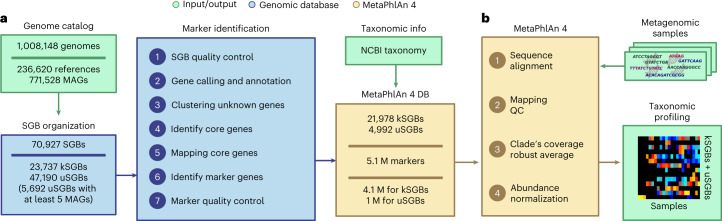
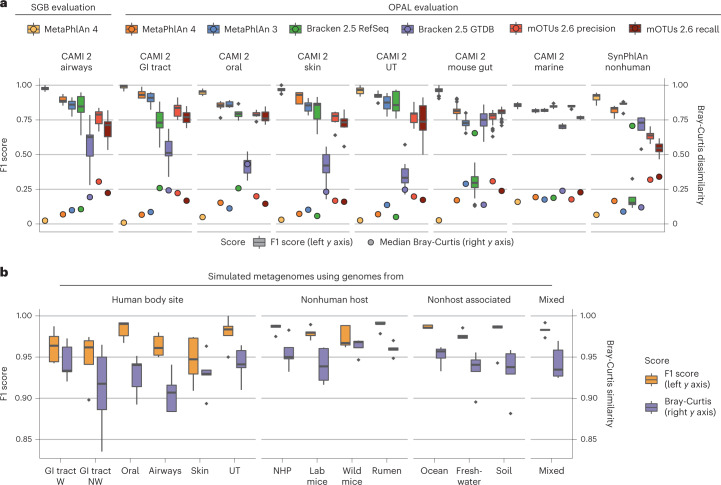
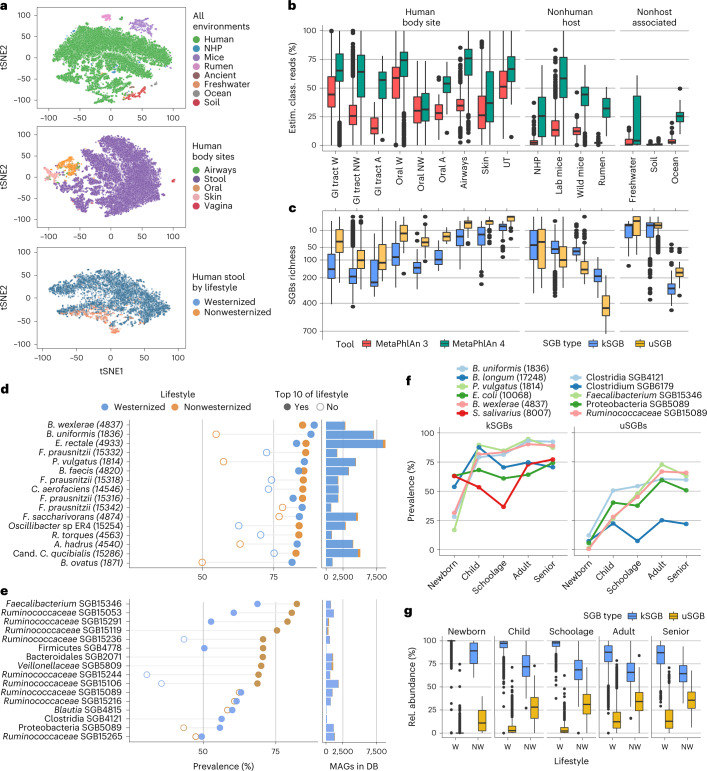
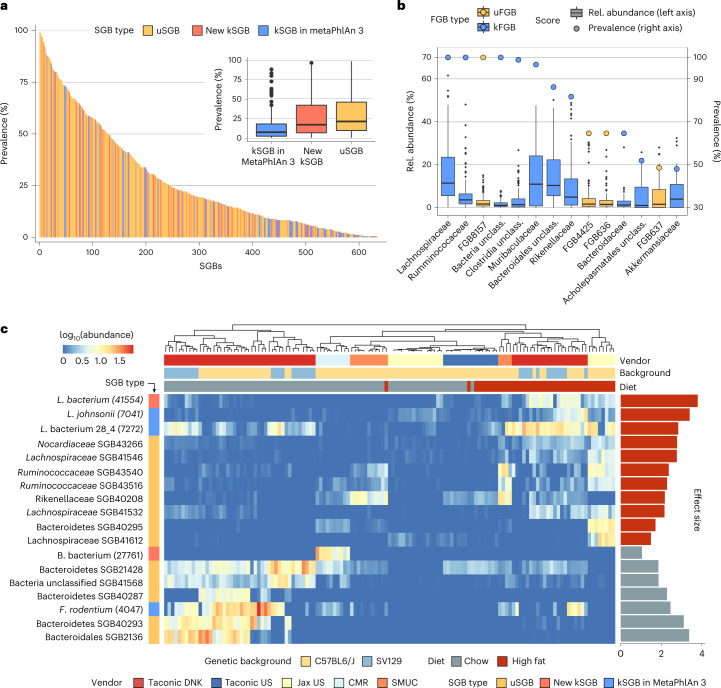
Metagenomic assembly enables new organism discovery from microbial communities, but it can only capture few abundant organisms from most metagenomes. Here we present MetaPhlAn 4, which integrates information from metagenome assemblies and microbial isolate genomes for more comprehensive metagenomic taxonomic profiling. From a curated collection of 1.01 M prokaryotic reference and metagenome-assembled genomes, we define unique marker genes for 26,970 species-level genome bins, 4,992 of them taxonomically unidentified at the species level. MetaPhlAn 4 explains ~20% more reads in most international human gut microbiomes and >40% in less-characterized environments such as the rumen microbiome and proves more accurate than available alternatives on synthetic evaluations while also reliably quantifying organisms with no cultured isolates. Application of the method to >24,500 metagenomes highlights previously undetected species to be strong biomarkers for host conditions and lifestyles in human and mouse microbiomes and shows that even previously uncharacterized species can be genetically profiled at the resolution of single microbial strains.
Overview
The claims and statistics of this paper haven’t been checked yet.
Free: it reads the open-access text and checks the first 5 claims that cite a source we can check. Create a free account to check every claim.
Integrity signals
Registry
Cites
Statistics
Figures
Verification
Claims the paper makes
The claims and statistics of this paper haven’t been checked yet.
Free: it reads the open-access text and checks the first 5 claims that cite a source we can check. Create a free account to check every claim.
Claims other papers make about this one
Each is checked against this paper’s own text: does it say what the citing paper says it does?
The cited source says what the claim attributes to it.
In the citing paper
“we performed a meta-analysis and mega-analysis of stools taxonomically profiled with MetaPhlAn 4 (ref. 37) and from patients enrolled in 12 cohorts from eight published studies26,38–44 across three cancer types, and classified as responders (n = 248) or non-responders (n = 513) based on RECIST1.1 criteria response rates”
From Gut OncoMicrobiome Signatures (GOMS) as next-generation biomarkers for cancer immunotherapy (2023) · cites this paper as [37]
The cited source says what the claim attributes to it.
In the citing paper
“We further performed strain-level and strain-matching analysis via StrainPhlAn 4 84 (STAR Methods) and identified potential transmission patterns for some food-human overlapping SGBs (Figures 6 and S6).”
From Unexplored microbial diversity from 2,500 food metagenomes and links with the human microbiome. (2024) · cites this paper as [84]
The check wasn’t confident either way, so it gives no verdict — never disputed.
In the citing paper
“A meta- and mega-analysis of stools obtained from patients with cancer treated with ICIs showed that GOMS associated with ICI resistance comprised microorganisms affiliated with chronic inflammation and immunosuppression and oral genera, and were shared across various pathological disorders.22,155”
From Melanoma and microbiota: Current understanding and future directions (2024) · cites this paper as [155]
Experimental — accuracy not yet measuredIn the citing paper
“We used MetaPhlAn 4 (ref. 37) for microbiome taxonomic profiling of stool samples from 1,879 adults across eight different cancer types (included in 30 cohorts from 23 published studies)25–29,38–55 and from a control group comprising 5,341 individuals without cancer (included in 17 cohorts from 14 published studies)”
From Gut OncoMicrobiome Signatures (GOMS) as next-generation biomarkers for cancer immunotherapy (2023) · cites this paper as [37]
In the citing paper
“Taxonomic profiling was performed at the level of species-level genome bins (SGBs) using MetaPhlAn4, which represent both existing and yet-to-be-characterized microbial species17.”
From Longitudinal gut microbiome changes in immune checkpoint blockade-treated advanced melanoma (2024) · cites this paper as [17]
1 more claim about this paper
Create a free account to see every claim other papers make about this one.
Self-check
Percentages, sums and reported differences re-computed from the paper’s own numbers.
The self-check needs the paper’s full text.
Citations
Cites
The Sequence Alignment/Map format and SAMtools
Li, H., Handsaker, B., Wysoker, A., Fennell, T., Ruan, J., Homer, N., Marth, G., Abecasis, G., Durbin, R., & 1000 Genome Project Data Processing Subgroup (2009) · Bioinformatics · doi:10.1093/bioinformatics/btp352 · Cited by 62,041 · cited 1×
“For item (1), StrainPhlAn 4 considers as input the reads-to-markers alignment results (in SAM format 96 ) from the MetaPhlAn 4 profiling together with the MetaPhlAn 4 database.”
MethodFast gapped-read alignment with Bowtie 2
Langmead, B., & Salzberg, S. L. (2012) · Nature Methods · doi:10.1038/nmeth.1923 · Cited by 56,400 · cited 1×
“To detect the SGB-specific marker genes, each set of core genes was then aligned against the genomes of the other SGBs using Bowtie 2 (version 2.3.5.1; -- sensitive parameter) 83 .”
MethodInfluentialMAFFT Multiple Sequence Alignment Software Version 7: Improvements in Performance and Usability
Katoh, K., & Standley, D. M. (2013) · Molecular Biology and Evolution · doi:10.1093/molbev/mst010 · Cited by 46,209 · cited 2×
“By default, multiple-sequence alignment is performed by MAFFT 92 , gappy positions (that is, positions with more than 67% of gaps) are trimmed by trimAl 91 and phylogenetic trees are inferred by RAxML 97 .”
MethodInfluentialRAxML version 8: a tool for phylogenetic analysis and post-analysis of large phylogenies
Stamatakis, A. (2014) · Bioinformatics · doi:10.1093/bioinformatics/btu033 · Cited by 32,291 · cited 3×
“By default, multiple-sequence alignment is performed by MAFFT 92 , gappy positions (that is, positions with more than 67% of gaps) are trimmed by trimAl 91 and phylogenetic trees are inferred by RAxML 97 .”
MethodInfluentialIQ-TREE: A Fast and Effective Stochastic Algorithm for Estimating Maximum-Likelihood Phylogenies
Nguyen, L.-T., Schmidt, H. A., von Haeseler, A., & Minh, B. Q. (2015) · Molecular Biology and Evolution · doi:10.1093/molbev/msu300 · Cited by 26,046
Prokka: rapid prokaryotic genome annotation
Seemann, T. (2014) · Bioinformatics · doi:10.1093/bioinformatics/btu153 · Cited by 18,818
Fast and sensitive protein alignment using DIAMOND
Buchfink, B., Xie, C., & Huson, D. H. (2015) · Nature Methods · doi:10.1038/nmeth.3176 · Cited by 14,201
trimAl: a tool for automated alignment trimming in large-scale phylogenetic analyses
Capella-Gutiérrez, S., Silla-Martínez, J. M., & Gabaldón, T. (2009) · Bioinformatics · doi:10.1093/bioinformatics/btp348 · Cited by 12,751 · cited 1×
“By default, multiple-sequence alignment is performed by MAFFT 92 , gappy positions (that is, positions with more than 67% of gaps) are trimmed by trimAl 91 and phylogenetic trees are inferred by RAxML 97 .”
MethodParks, D. H., Imelfort, M., Skennerton, C. T., Hugenholtz, P., & Tyson, G. W. (2015) · Genome Research · doi:10.1101/gr.186072.114 · Cited by 12,496
Diet rapidly and reproducibly alters the human gut microbiome
David, L. A., Maurice, C. F., Carmody, R. N., Gootenberg, D. B., Button, J. E., Wolfe, B. E., Ling, A. V., Devlin, A. S., Varma, Y., Fischbach, M. A., et al. (2014) · Nature · doi:10.1038/nature12820 · Cited by 10,100
Cited by
Items 101–200 of 1,000
Hadi, D. K., Baines, K. J., Jabbarizadeh, B., Miller, W. H., Jamal, R., Ernst, S., Logan, D., Bélanger, K., Esfahani, K., Elkrief, A., et al. (2025) · Journal for ImmunoTherapy of Cancer · doi:10.1136/jitc-2025-012659 · Cited by 49
Sun, Z., Liu, J., Zhang, M., Wang, T., Huang, S. W., Weiss, S. T., & Liu, Y. (2023) · Nature Communications · doi:10.1038/s41467-023-41099-8 · Cited by 47
“To minimize the in fl uence of different reference databases on measuring the recall, we further selected the shared microbial genomes between different metagenomic pro fi lers (e.g., mOTU3, MetaPhlAn4, and Kraken2) as source genomes for simulating the WMS data.”
InfluentialThe gut microbiome associates with phenotypic manifestations of post-acute COVID-19 syndrome
Su, Q., Lau, R. I., Liu, Q., Li, M. K. T., Mak, J. W. Y., Lu, W., Lau, I. S. F., Lau, L. H. S., Yeung, G. T. Y., Cheung, C. P., et al. (2024) · Cell Host & Microbe · doi:10.1016/j.chom.2024.04.005 · Cited by 44
Sun, W., Zhang, Y., Guo, R., Sha, S., Chen, C., Ullah, H., Zhang, Y., Ma, J., You, W., Meng, J., et al. (2024) · npj Biofilms and Microbiomes · doi:10.1038/s41522-024-00567-9 · Cited by 51
Quraishi, M. N., Cheesbrough, J., Rimmer, P. J., Mullish, B. H., Sharma, N. K., Efstathiou, E., Acharjee, A., Gkoutus, G., Patel, A. M., Marchesi, J. R., et al. (2024) · Journal of Crohn s and Colitis · doi:10.1093/ecco-jcc/jjae189 · Cited by 45
Macandog, A. D. G., Catozzi, C., Capone, M., Nabinejad, A., Nanaware, P. P., Liu, S., Vinjamuri, S., Stunnenberg, J. A., Galiè, S., Jodice, M. G., et al. (2024) · Cell Host & Microbe · doi:10.1016/j.chom.2024.10.006 · Cited by 40
Self-citationSong, L., & Langmead, B. (2024) · Genome biology · doi:10.1186/s13059-024-03244-4 · Cited by 50
“No.”
The Role and Applications of Artificial Intelligence in the Treatment of Chronic Pain
Meier, T. A., Refahi, M. S., Hearne, G., Restifo, D., Munoz‐Acuna, R., ROSEN, G. L., & Woloszynek, S. (2024) · Current Pain and Headache Reports · doi:10.1007/s11916-024-01264-0 · Cited by 46
Highly accurate and sensitive absolute quantification of bacterial strains in human fecal samples
Li, F., Liu, J., Maldonado-Gómez, M. X., Frese, S. A., Gänzle, M. G., & Walter, J. (2024) · Microbiome · doi:10.1186/s40168-024-01881-2 · Cited by 46
“The relative abundance of L. reuteri at the species level in the 16S rRNA gene sequencing and WMS datasets was determined using QIIME2 (based on the SILVA database, version 138) [51] and MetaPhlAn 4.0 [52], respectively.”
MethodInfluentialMcMillan, A. S., Zhang, G., Dougherty, M., McGill, S., Gulati, A., Baker, E. S., & Theriot, C. M. (2024) · mSphere · doi:10.1128/msphere.00706-24 · Cited by 44
Keshet, A., & Segal, E. (2024) · Nature Communications · doi:10.1038/s41467-024-53832-y · Cited by 52
Nooij, S., Vendrik, K. E. W., Zwittink, R. D., Ducarmon, Q. R., Keller, J. J., Kuijper, E. J., Terveer, E. M., & on behalf of the Netherlands Donor Feces Bank study group (2024) · Genome Medicine · doi:10.1186/s13073-024-01306-7 · Cited by 41
“Taxonomic microbiota profiles were determined using MetaPhlAn (version 4.0.3) [54], which maps reads to its custom marker database.”
MethodInfluentialBiological Upcycling of Plastics Waste
Klauer, R. R., Hansen, D. A., Wu, D., Monteiro, L. M. O., Solomon, K., & Blenner, M. (2024) · Annual Review of Chemical and Biomolecular Engineering · doi:10.1146/annurev-chembioeng-100522-115850 · Cited by 48
Li, P., Li, M., & Chen, W. (2025) · Gut Microbes · doi:10.1080/19490976.2025.2489074 · Cited by 48
Kim, H., Nelson, P., Nzabarushimana, É., Shen, J., Jensen, J., Bhosle, A., Li, C., Lee, N., Everett, C., Berdy, B. M., et al. (2025) · Nature Metabolism · doi:10.1038/s42255-025-01318-6 · Cited by 42
“Subsequently, taxonomic profiling was conducted using MetaPhlAn (v.4.0.3) 15 , which utilizes species-specific marker genes to call species presence and abundance per sample.”
InfluentialSelf-citationLiu, C., Mansoldo, F. R. P., Li, H., Vermelho, A. B., Zeng, R. J., Li, X., & Yao, M. (2025) · Nature Protocols · doi:10.1038/s41596-025-01239-4 · Cited by 66
Nong, Y., Xu, M., Liu, B., Li, J., He, D., Li, C., Lin, P., Luo, Y., Dang, C., & Fu, J. (2024) · Water Research · doi:10.1016/j.watres.2024.121566 · Cited by 40
Longitudinal dynamics of farmer and livestock nasal and faecal microbiomes and resistomes
Mahmud, B., Vargas, R. C., Sukhum, K. V., Patel, S., Liao, J., Hall, L. R., Kesaraju, A., Le, T., Kitchner, T., Kronholm, E., et al. (2024) · Nature Microbiology · doi:10.1038/s41564-024-01639-4 · Cited by 40
“We shotgun-sequenced all 712 faecal samples, generating 22.7 Gb of paired-end sequencing data, and profiled the species and metabolic pathway compositions using MetaPhlAn 4 38 and HUMAnN 3 39 , respectively.”
InfluentialGut Microbiota‐Butyrate‐PPARγ Axis Modulates Adipose Regulatory T Cell Population
Chen, B., Guan, L., Wu, C., Gong, Y., Wu, L., Zhang, M., Cao, Z., Chen, Y., Yang, C., Wang, B., et al. (2025) · Advanced Science · doi:10.1002/advs.202411086 · Cited by 52
Wei, X. L., Tsai, M.-S., Liang, L., Jiang, L., Hung, C.-J., Jelliffe‐Pawlowski, L. L., Rand, L., Snyder, M. P., & Jiang, C. (2024) · Cell Reports · doi:10.1016/j.celrep.2024.114078 · Cited by 42
Application of machine learning based genome sequence analysis in pathogen identification
Gao, Y., & Liu, M. (2024) · Frontiers in Microbiology · doi:10.3389/fmicb.2024.1474078 · Cited by 42
Dhaarani, R., & Reddy, M. K. (2025) · Intelligence-Based Medicine · doi:10.1016/j.ibmed.2025.100251 · Cited by 46
Interindividual variability in gut microbiome mediates the efficacy of resistant starch on MASLD
Long, X., Wang, H., Lu, Y., Gao, X., Xiao, Y., Zhang, M., Guo, J., Yang, H. J., Zhang, R., Li, Q., et al. (2025) · Cell Metabolism · doi:10.1016/j.cmet.2025.10.017 · Cited by 40
Connect the dots: sketching out microbiome interactions through networking approaches
Fabbrini, M., Scicchitano, D., Candela, M., Turroni, S., & Rampelli, S. (2023) · Microbiome Research Reports · doi:10.20517/mrr.2023.25 · Cited by 43
Overview of data preprocessing for machine learning applications in human microbiome research
Ibrahimi, E., Lopes, M. B., Dhamo, X., Mihajlović, A., Shigdel, R., Hron, K., Stres, B., D’Elia, D., Berland, M., & Marcos-Zambrano, L. J. (2023) · Frontiers in Microbiology · doi:10.3389/fmicb.2023.1250909 · Cited by 40
Lehmann, C. J., Dylla, N. P., Odenwald, M. A., Nayak, R., Khalid, M., Boissiere, J. C., Cantoral, J., Adler, E., Stutz, M. R., Cruz, M. D., et al. (2023) · Cell Host & Microbe · doi:10.1016/j.chom.2023.11.016 · Cited by 39
Exploring Cereal Metagenomics: Unravelling Microbial Communities for Improved Food Security
Masenya, K., Manganyi, M. C., & Dikobe, T. B. (2024) · Microorganisms · doi:10.3390/microorganisms12030510 · Cited by 39
Gut microbiota and tuberculosis
Liu, Y., Yang, L., Meskini, M., Goel, A., Opperman, M., Shyamal, S. S., Manaithiya, A., Xiao, M., Ni, R., An, Y., et al. (2025) · iMeta · doi:10.1002/imt2.70054 · Cited by 43
Microbial signals in primary and metastatic brain tumors
Morad, G., Damania, A. V., Melendez, B., Singh, B. B., Veguilla, F. J., Soto, R. A., Hoballah, Y. M., Sahasrabhojane, P. V., Wong, M. C., Ahmed, M. M., et al. (2025) · Nature Medicine · doi:10.1038/s41591-025-03957-4 · Cited by 46
“54 and the CHOCOPhlAn database (mpa_vJan21_CHOCOPhlAnSGB_202103).”
Bile acids regulate lipid metabolism through selective actions on fatty acid absorption
Chan, A. P., Jarrett, K. E., Lai, R. W., Brearley-Sholto, M. C., Cheng, A., Taveras, M. O., Iwata, A. M., Steel, M. E., Lau, A., Whang, E. C., et al. (2025) · Cell Metabolism · doi:10.1016/j.cmet.2025.11.010 · Cited by 42
Pereira‐Marques, J., Ferreira, R. M., & Figueiredo, C. (2024) · Gut Microbes · doi:10.1080/19490976.2024.2323235 · Cited by 37
“34,35 MetaPhlAn 4 expands existing capabilities of MetaPhlAn 3 by incorporating a new markers data-base that integrates information from both reference and metagenomic assembled genomes.”
BackgroundMethodInfluentialChen, M., Liu, Y., Zhou, Y., Pei, Y., Qu, M., Lv, P., Zhang, J., Xu, X., Hu, Y., & Wang, Y. (2024) · Journal of Hazardous Materials · doi:10.1016/j.jhazmat.2024.136641 · Cited by 41
Community‐scale models of microbiomes: Articulating metabolic modelling and metagenome sequencing
Cerk, K., Ugalde‐Salas, P., Nedjad, C. G., Lecomte, M., Muller, C., Sherman, D. J., Hildebrand, F., Labarthe, S., & Frioux, C. (2024) · Microbial Biotechnology · doi:10.1111/1751-7915.14396 · Cited by 44
Sun, C., Hu, G., Yi, L., Ge, W., Yang, Q., Yang, X., He, Y., Liu, Z., & Chen, W. (2024) · Microbiome · doi:10.1186/s40168-024-01891-0 · Cited by 38
“Additionally, metaPhlAn4 [34], a widely used taxonomic profiling tool, reported ~ 45% unaccounted abundances by existing reference genomes (Fig.”
BackgroundMethodProbing the functional significance of wild animal microbiomes using omics data
Worsley, S. F., Videvall, E., Harrison, X. A., Björk, J. R., Mazel, F., & Wanelik, K. M. (2024) · Functional Ecology · doi:10.1111/1365-2435.14650 · Cited by 37
Rahal, Z., Liu, Y., Peng, F., Yang, S., Jamal, M. A., Sharma, M., Moreno, H., Damania, A. V., Wong, M. C., Ross, M. C., et al. (2024) · Cancer Immunology Research · doi:10.1158/2326-6066.cir-24-0469 · Cited by 34
A ubiquitous mobile genetic element changes the antagonistic weaponry of a human gut symbiont
Sheahan, M. L., Flores, K., Coyne, M. J., García-Bayona, L., Chatzidaki‐Livanis, M., Holst, A. Q., Smith, R. C., Sundararajan, A., Barquera, B., & Comstock, L. E. (2024) · Science · doi:10.1126/science.adj9504 · Cited by 33
Gut microbiome and immune checkpoint inhibitor toxicity
Verheijden, R. J., van Eijs, M. J. M., Paganelli, F. L., Viveen, M. C., Rogers, M. R. C., Top, J., May, A. M., van de Wijgert, J. H. H. M., & Suijkerbuijk, K. P. M. (2025) · European Journal of Cancer · doi:10.1016/j.ejca.2025.115221 · Cited by 38
Alves Costa Silva, C., Piccinno, G., Suissa, D., Bourgin, M., Schreibelt, G., Durand, S., Birebent, R., Fidelle, M., Sow, C., Aprahamian, F., et al. (2024) · Nature Communications · doi:10.1038/s41467-024-45357-1 · Cited by 33
“For each meta-genome we pro fi led the taxonomic and functional potential compositions with MetaPhlAn 4(database vJan21) 33 and HUMAnN 3.6 74 , respectively.”
InfluentialSelf-citationOral reovirus reshapes the gut microbiome and enhances antitumor immunity in colon cancer
Lee, W. S., Lee, S. J., Lee, H. J., Yang, H., Go, E., Enkhtaivan, G., Song, K., Xiang, X., Park, D.-G., Alain, T., et al. (2024) · Nature Communications · doi:10.1038/s41467-024-53347-6 · Cited by 36
“0.0) for approximately one million micro-organisms composed of NCBI reference genomes and species-level genome bins (SGBs) 66 .”
InfluentialBacterial microcompartments and energy metabolism drive gut colonization by Bilophila wadsworthia
Sayavedra, L., Yasir, M., Goldson, A. J., Brion, A., Gall, G. L., Moreno‐Gonzalez, M., Altera, A., Paxhia, M. D., Warren, M. J., Savva, G. M., et al. (2025) · Nature Communications · doi:10.1038/s41467-025-60180-y · Cited by 38
Shi, Y., Li, Y., Li, H., Haerheng, A., Marcelino, V. R., Lu, M., Lemey, P., Tang, J., Bi, Y., Pettersson, J. H. ‐., et al. (2025) · Cell · doi:10.1016/j.cell.2025.08.016 · Cited by 39
Bacteriophages, gut bacteria, and microbial pathways interplay in cardiometabolic health
Kirk, D., Costeira, R., Visconti, A., Mirzaei, M. K., Deng, L., Valdes, A. M., & Menni, C. (2024) · Cell Reports · doi:10.1016/j.celrep.2024.113728 · Cited by 36
Breastfeeding and early Bifidobacterium-driven microbial colonization shape the infant gut resistome
Samarra, A., Alcañiz, A. J., Martínez-Costa, C., Marina, A., Comas, I., Segata, N., Quijada, N. M., & Collado, M. C. (2025) · Nature Communications · doi:10.1038/s41467-025-61154-w · Cited by 32
Self-citationSuarez, C., Rosenqvist, T., Dimitrova, I., Sedlacek, C. J., Modin, O., Paul, C. J., Hermansson, M., & Persson, F. (2024) · Microbiome · doi:10.1186/s40168-024-01762-8 · Cited by 32
“1.0 [52].”
InfluentialXing, Y., Liu, Y., Sha, S., Zhang, Y., Dou, Y., Liu, C., Xu, M., Zhao, L., Wang, J., Wang, Y., et al. (2024) · Journal of Medical Virology · doi:10.1002/jmv.29781 · Cited by 33
“38 The relative abundances of prokaryotic species were calculated by normalizing each sample, and the relative abundances at the phylum and genus levels were obtained by aggregating all species abundances from the same taxa.”
Wu, D., Xie, J., Liu, Y., Jin, L. N., Li, G., & An, T. (2023) · Environmental Science & Technology · doi:10.1021/acs.est.3c02593 · Cited by 32
Sequino, G., Cobo-Díaz, J. F., Valentino, V., Tassou, C. C., Volpe, S., Torrieri, E., Nychas, G. E., Álvarez‐Ordóñez, A., Ercolini, D., & Filippis, F. D. (2024) · Food Research International · doi:10.1016/j.foodres.2024.114318 · Cited by 34
Challenges in capturing the mycobiome from shotgun metagenome data: lack of software and databases
Avershina, E., Qureshi, A., Winther-Larsen, H. C., & Rounge, T. B. (2025) · Microbiome · doi:10.1186/s40168-025-02048-3 · Cited by 40
“Whole genome sequencing enables strain-level resolution, which is successfully exploited in bacterial studies [20].”
Baba, Y., Tsuge, D., & Aoki, R. (2025) · Bioscience Biotechnology and Biochemistry · doi:10.1093/bbb/zbaf071 · Cited by 33
Ibañez‐Lligoña, M., Colomer‐Castell, S., Gónzalez‐Sánchez, A., Gregori, J., de Campos, C. F., García‐Cehic, D., Andrés, C., Piñana, M., Pumarola, T., Rodríguez‐Frias, F., et al. (2023) · Viruses · doi:10.3390/v15020587 · Cited by 34
Branck, T. A., Hu, Z., Nickols, W. A., Walsh, A. M., Bhosle, A., Short, M. I., Nearing, J. T., Asnicar, F., McIver, L. J., Maharjan, S., et al. (2024) · The ISME Journal · doi:10.1093/ismejo/wrae201 · Cited by 33
“The tree was constructed as previously described [60],but instead called on the October 2022 database version with the following parameters: - d phylophlan –diversity high –fast –min_num_markers 50.”
BackgroundMethodInfluentialSelf-citationAya, V., Pardo-Rodriguez, D., Vega, L. C., Cala, M. P., & Ramírez, J. D. (2025) · Scientific Reports · doi:10.1038/s41598-025-98973-2 · Cited by 30
Uffelen, A. V., Posadas, A., Roosens, N. H. C., Marchal, K., Keersmaecker, S. C. J. D., & Vanneste, K. (2024) · Scientific Data · doi:10.1038/s41597-024-03672-8 · Cited by 32
“This newer version also includes new species-level genome bins into its underlying reference database, which could affect the recall obtained in our study 68 .”
BackgroundNori, S. R. C., Walsh, C. J., McAuliffe, F. M., Moore, R. L., Van Sinderen, D., Feehily, C., & Cotter, P. D. (2025) · npj Biofilms and Microbiomes · doi:10.1038/s41522-025-00682-1 · Cited by 29
Peterson, C. B., Saha, S., & Do, K.-A. (2023) · Annual Review of Statistics and Its Application · doi:10.1146/annurev-statistics-040522-120734 · Cited by 37
Reasoner, S. A., Bernard, R., Waalkes, A., Penewit, K. M., Lewis, J. D., Sokolow, A. G., Brown, R. F., Edwards, K. M., Salipante, S. J., Hadjifrangiskou, M., et al. (2024) · mBio · doi:10.1128/mbio.01935-23 · Cited by 29
“Species abundances were determined with MetaPhlAn4 following read alignment to the MetaPhlan4 database (37).”
MethodLadakis, D. C., Harrison, K. L., Smith, M. D., Solem, K., Gadani, S. P., Jank, L., Hwang, S. A., Farhadi, F., Dewey, B. E., Fitzgerald, K. C., et al. (2024) · Med · doi:10.1016/j.medj.2024.09.011 · Cited by 34
Sucrose-preferring gut microbes prevent host obesity by producing exopolysaccharides
Shimizu, H., Miyamoto, J., Hisa, K., Ohue‐Kitano, R., Takada, H., Yamano, M., Nishida, A., Sasahara, D., Masujima, Y., Watanabe, K., et al. (2025) · Nature Communications · doi:10.1038/s41467-025-56470-0 · Cited by 31
“0.4) 44 .”
InfluentialAI-driven multi-omics modeling of myalgic encephalomyelitis/chronic fatigue syndrome
Xiong, R., Aiken, E., Caldwell, R., Vernon, S. D., Kozhaya, L., Gunter, C., Bateman, L., Unutmaz, D., & Oh, J. (2025) · Nature Medicine · doi:10.1038/s41591-025-03788-3 · Cited by 35
“For immune profiling and plasma metabolomics, to remove the effects of identified confounders, each feature was adjusted by retaining the residuals 64 , that is, the part of the outcome not explained by the confounding factors, from a general linear model: Additionally, for network and patient…”
Pitfalls of genotyping microbial communities with rapidly growing genome collections
Zhao, C., Shi, Z. J., & Pollard, K. S. (2023) · Cell Systems · doi:10.1016/j.cels.2022.12.007 · Cited by 46
Microbiota-derived genotoxin tilimycin generates colonic stem cell mutations
Pöltl, L., Kitsera, M., Raffl, S., Schild, S., Ćosić, A., Kienesberger, S., Unterhauser, K., Raber, G., Lembacher‐Fadum, C., Breinbauer, R., et al. (2023) · Cell Reports · doi:10.1016/j.celrep.2023.112199 · Cited by 30
Cataloging the phylogenetic diversity of human bladder bacterial isolates
Du, J., Khemmani, M., Halverson, T. M., Ene, A., Limeira, R., Tinawi, L., Hochstedler, B. R., Noronha, M. F., Putonti, C., & Wolfe, A. J. (2024) · Genome biology · doi:10.1186/s13059-024-03216-8 · Cited by 29
“After quality control, all the clean paired-end reads were processed through MetaPhlAn (v 4.0.5) [115] with the Bowtie database (mpa_vJun23_CHOCOPhlAnSGB_202307) using default settings to identify taxonomy and estimate the relative abundances of discrete taxa.”
MethodInfluentialStamouli, S., Beber, M. E., Normark, T., Christensen, T. A., Li, L., Borry, M., Jamy, M., community, N.-C., & Yates, J. A. F. (2023) · bioRxiv (Cold Spring Harbor Laboratory) · doi:10.1101/2023.10.20.563221 · Cited by 36
Kan, C.-M., Tsang, H. F., Pei, X. M., Ng, S. S. M., Yim, A. K., Yu, A. C.-S., & Wong, S. C. C. (2024) · International Journal of Molecular Sciences · doi:10.3390/ijms25063333 · Cited by 32
“The incorrect assignment of ambiguously mapped/aligned reads or k-mers in poorly curated databases may lead to false positive results [196].”
BackgroundComputational Metagenomics: State of the Art
Pita-Galeana, M. A., Ruhle, M., López-Vázquez, L., de Anda‐Jáuregui, G., & Lemus, E. H. (2025) · International Journal of Molecular Sciences · doi:10.3390/ijms26189206 · Cited by 35
“MetaPhlAn 4 [53] expands its database to 19.5 metagenomes from diverse body sites, which has allowed it to obtain F1-scores of 0.80 to 0.85 when using the OPAL framework [54] and a nearly perfect 0.95 score when employing genomes from the SGB organization as reference when this method is applied in…”
InfluentialTreichel, N. S., Pauvert, C., Séneca, J., Pjevac, P., Berry, D., Penders, J., Hitch, T. C. A., & Clavel, T. (2026) · Nature Microbiology · doi:10.1038/s41564-026-02334-2 · Cited by 37
Vladimirovna, G. M., Burakova, I. Y., Dmitrievna, S. Y., Morozova, P., Chirkin, E. A., Gureev, A. P., Mikhaylov, E., Korneeva, O. S., & Syromyatnikov, M. (2024) · Microorganisms · doi:10.3390/microorganisms12071341 · Cited by 28
“The submucosa consisted of connective tissue with blood vessels. submucosa consisted of connective tissue with blood Crypts were visualized (Figure 1A). were visualized (Figure 1A) studied samples was performed using MetaPhlAn4 [28].”
MethodTian, Q., Zhang, P., Zhai, Y., Wang, Y., & Zou, Q. (2024) · Genome Biology and Evolution · doi:10.1093/gbe/evae102 · Cited by 28
“…gained recognition in the scientific community, the increasing volume and diversity of sequencing data necessitate further research and innovation to address challenges in identifying unknown or rare microbes and managing the surge in data storage and retrieval demands (Blanco-Míguez et al. 2023).”
BackgroundRole of next‐generation sequencing in revolutionizing healthcare for cancer management
Sahoo, O. S., Aidasani, H., Nayek, A., Tripathi, S., Talukdar, J., Gul, A., Kumar, D., Dhar, R., & Karmakar, S. (2024) · MedComm – Future Medicine · doi:10.1002/mef2.70001 · Cited by 32
Geng, P., Zhao, N., Zhou, Y., Harris, R. S., & Ge, Y. (2025) · Gut Microbes · doi:10.1080/19490976.2025.2455503 · Cited by 30
“High-quality microbial reads were mapped to ~1 million bacterial genomes using Metaphlan4 83 to predict the relative abundances of the taxa.”
Expansion of a bacterial operon during cancer treatment ameliorates fluoropyrimidine toxicity
Trepka, K. R., Kidder, W. A., Kyaw, T. S., Halsey, T. M., Olson, C. A., Ortega, E. F., Noecker, C. A., Upadhyay, V., Stanfield, D., Steiding, P., et al. (2025) · Science Translational Medicine · doi:10.1126/scitranslmed.adq8870 · Cited by 30
Bermingham, K. M., May, A., Asnicar, F., Pujol, J. C., Leeming, E. R., Franks, P. W., Valdes, A. M., Wolf, J., Hadjigeorgiou, G. M., Delahanty, L. M., et al. (2023) · European Journal of Nutrition · doi:10.1007/s00394-023-03241-6 · Cited by 31
Self-citationSucralose Consumption Ablates Cancer Immunotherapy Response through Microbiome Disruption
Morder, K. M., Nguyen, M., Wilfahrt, D. N., Dahmani, Z. L., Burr, A. B. P., Xie, B., Morikone, M., Nieves-Rosado, H. M., Gunn, W. G., Hurd, D. E., et al. (2025) · Cancer Discovery · doi:10.1158/2159-8290.cd-25-0247 · Cited by 30
A Bacteroides fragilis protease activates host PAR2 to induce intestinal pain and inflammation
Lakemeyer, M., Latorre, R., Blažková, K., Wood, H. M., Jensen, D. D., Shakil, N., Thomas, S. C., Saxena, D. B., Mulpuri, Y., Poolman, D., et al. (2025) · Cell Host & Microbe · doi:10.1016/j.chom.2025.09.010 · Cited by 29
Assembly of the infant gut microbiome and resistome are linked to bacterial strains in mother’s milk
Ferretti, P., Allert, M., Johnson, K. E., Rossi, M., Heisel, T. J., Gonia, S., Knights, D., Fields, D. A., Albert, F. W., Demerath, E. W., et al. (2025) · Nature Communications · doi:10.1038/s41467-025-66497-y · Cited by 31
“Species-level taxonomic profiling was performed with MetaPhlAn4 40 (Suppl.”
InfluentialButyrate enhances Clostridioides difficile sporulation in vitro
Baldassare, M. A., Bhattacharjee, D., Coles, J. D., Nelson, S., McCollum, C. A., & Seekatz, A. M. (2023) · Journal of Bacteriology · doi:10.1128/jb.00138-23 · Cited by 27
Colosimo, R., Harris, H. C., Ahn‐Jarvis, J. H., Troncoso‐Rey, P., Finnigan, T. J. A., Wilde, P. J., & Warren, F. J. (2024) · Communications Biology · doi:10.1038/s42003-024-05893-4 · Cited by 31
Chemoproteomic profiling of substrate specificity in gut microbiota-associated bile salt hydrolases
Han, L., Pendleton, A., Singh, A., Xu, R., Scott, S. A., Palma, J. A., Diebold, P. J., Malarney, K. P., Brito, I., & Chang, P. V. (2024) · Cell chemical biology · doi:10.1016/j.chembiol.2024.05.009 · Cited by 26
Özcan, E., Yu, K. B., Dinh, L., Lum, G. R., Lau, K., Hsu, J. J., Arino, M., Paramo, J., Lopez-Romero, A., & Hsiao, E. Y. (2025) · Nature Communications · doi:10.1038/s41467-025-56091-7 · Cited by 28
Schropp, N., Bauer, A., Stanislas, V., Huang, K. D., Lesker, T.-R., Bielecka, A. A., Strowig, T., & Michels, K. B. (2025) · Microbiome · doi:10.1186/s40168-024-02016-3 · Cited by 27
Self-citationBuilding microbial synthetic communities: get inspired by the design of synthetic plant communities
Durán, P., Vailleau, F., & Roux, F. (2025) · New Phytologist · doi:10.1111/nph.70011 · Cited by 25
Impact of DNA Extraction Methods on Gut Microbiome Profiles: A Comparative Metagenomic Study
Pu, Y., Zhou, X., Cai, H., Lou, T., Liu, C., Kong, M., Sun, Z., Wang, Y.-R., Zhang, R., Zhu, Y., et al. (2025) · Phenomics · doi:10.1007/s43657-025-00232-x · Cited by 26
Davis, B. C., Vikesland, P. J., & Pruden, A. J. (2025) · Environmental Science & Technology · doi:10.1021/acs.est.4c08284 · Cited by 27
Potential applications and future prospects of metagenomics in aquatic ecosystems
Rout, A. K., Rout, S. S., Panda, A., Tripathy, P. S., Kumar, N., Parida, S. N., Dey, S., Dash, S. S., Behera, B. K., & Pandey, P. K. (2025) · Gene · doi:10.1016/j.gene.2025.149720 · Cited by 27
Microbiome based precision medicine through integrated multiomics and machine learning
Kumar, A., Xu, C., & Dakal, T. C. (2025) · Microbiological Research · doi:10.1016/j.micres.2025.128384 · Cited by 28
Baby-to-baby strain transmission shapes the developing gut microbiome
Ricci, L., Heidrich, V., Punčochář, M., Armanini, F., Ciciani, M., Nabinejad, A., FAZAELI, F., Piperni, E., Servais, C., Pinto, F., et al. (2026) · Nature · doi:10.1038/s41586-025-09983-z · Cited by 31
“1) 16,68 using the vJun23_202307 markers database and using the –unclassified_estimation parameter (Supplementary Table 4).”
InfluentialSelf-citationSelect symbionts drive high IgA levels in the mouse intestine
Zhang, S., Han, Y., Schofield, W. B., Nicosia, M., Karell, P. E., Newhall, K. P., Zhou, J. Y., Musich, R. J., Pan, S., Valujskikh, A., et al. (2023) · Cell Host & Microbe · doi:10.1016/j.chom.2023.09.001 · Cited by 27
CoCas9 is a compact nuclease from the human microbiome for efficient and precise genome editing
Pedrazzoli, E., Demozzi, M., Visentin, E., Ciciani, M., Bonuzzi, I., Pezzè, L., Lucchetta, L., Maule, G., Amistadi, S., Esposito, F., et al. (2024) · Nature Communications · doi:10.1038/s41467-024-47800-9 · Cited by 32
Self-citationA history of repeated antibiotic usage leads to microbiota-dependent mucus defects
Krigul, K. L., Feeney, R. H., Wongkuna, S., Aasmets, O., Holmberg, S. M., Andreson, R., Puértolas-Balint, F., Pantiukh, K., Sootak, L., Org, T., et al. (2024) · Gut Microbes · doi:10.1080/19490976.2024.2377570 · Cited by 26
“The taxonomic composition of the decontaminated and quality-filtered metagen-omes was identified by using MetaPhlAn 4 33 with default parameters and database version mpa_vOct22_CHOCOPhlAnSGB_202212.”
MethodGut dysbiosis in oncology: a risk factor for immunoresistance
(2026) · doi:10.1038/s41422-025-01212-6 · Cited by 24
Zorea, A., Pellow, D., Levin, L., Pilosof, S., Friedman, J., Shamir, R., & Mizrahi, I. (2024) · Nature Communications · doi:10.1038/s41467-024-47272-x · Cited by 29
Filippis, F. D., Valentino, V., Yap, M., Cabrera‐Rubio, R., Barcenilla, C., Carlino, N., Cobo-Díaz, J. F., Quijada, N. M., Calvete‐Torre, I., Ruas‐Madiedo, P., et al. (2024) · npj Biofilms and Microbiomes · doi:10.1038/s41522-024-00541-5 · Cited by 26
Self-citationPita, S., Myers, P. N., Johansen, J., Russel, J., Nielsen, M. C., Eklund, A. C., & Nielsen, H. B. (2024) · Frontiers in Microbiology · doi:10.3389/fmicb.2024.1425489 · Cited by 28
Hai, C., Hao, Z., Bu, L., Lei, J., Liu, X., Zhao, Y., Bai, C., Su, G., Yang, L., & Li, G. (2024) · Communications Biology · doi:10.1038/s42003-024-07252-9 · Cited by 27
A widespread hydrogenase supports fermentative growth of gut bacteria in healthy people
Welsh, C., Cabotaje, P. R., Marcelino, V. R., Watts, T. D., Kountz, D. J., Jespersen, M., Gould, J. A., Doan, N. Q., Lingford, J. P., Koralegedara, T., et al. (2025) · Nature Microbiology · doi:10.1038/s41564-025-02154-w · Cited by 30
Human and bacterial genetic variation shape oral microbiomes and health
Kamitaki, N., Handsaker, R. E., Hujoel, M. L. A., Mukamel, R. E., Usher, C. L., McCarroll, S. A., & Loh, P. (2026) · Nature · doi:10.1038/s41586-025-10037-7 · Cited by 28
“Many of these unmapped reads instead mapped to clade-specific marker genes in microbial genomes 29 , enabling quantification of relative microbial abundances.”
Automated identification of sequence-tailored Cas9 proteins using massive metagenomic data
Ciciani, M., Demozzi, M., Pedrazzoli, E., Visentin, E., Pezzè, L., Signorini, L. F., Blanco‐Míguez, A., Zolfo, M., Asnicar, F., Casini, A., et al. (2022) · Nature Communications · doi:10.1038/s41467-022-34213-9 · Cited by 26
Self-citationBaseline gut microbiota and metabolome predict durable immunogenicity to SARS-CoV-2 vaccines
Peng, Y., Zhang, L., Mok, C. K. P., Ching, J. Y. L., Zhao, S., Wong, M. K. L., Zhu, J., Chen, C., Wang, S., Yan, S., et al. (2023) · Signal Transduction and Targeted Therapy · doi:10.1038/s41392-023-01629-8 · Cited by 26
Zhang, Y., Kitazumi, A., Liao, Y., Reyes, B. G. D. L., & Wu, V. C. H. (2023) · Microbiology Spectrum · doi:10.1128/spectrum.00226-23 · Cited by 25
Metadata
- Authors
- Blanco-Míguez, A., Beghini, F., Cumbo, F., McIver, L. J., Thompson, K. N., Zolfo, M., Manghi, P., Dubois, L., Huang, K. D., Thomas, A. M., Nickols, W. A., Piccinno, G., Piperni, E., Punčochář, M., Valles-Colomer, M., Tett, A., Giordano, F., Davies, R., Wolf, J., Berry, S. E., Spector, T. D., Franzosa, E. A., Pasolli, E., Asnicar, F., Huttenhower, C., & Segata, N.
- Affiliations
- University of Trento (IT)
- Broad Institute (US)
- University of Vienna (AT)
- ZOE (United Kingdom) (GB)
- King's College London (GB)
- University of Naples Federico II (IT)
- Corresponding author
- Segata, Nicola
- ORCID
- Blanco-Míguez, Aitor
- Beghini, Francesco
- Cumbo, Fabio
- McIver, Lauren J.
- Thompson, Kelsey N.
- Zolfo, Moreno
- Manghi, Paolo
- Huang, Kun D.
- Thomas, Andrew Maltez
- Nickols, William A.
- Piccinno, Gianmarco
- Piperni, Elisa
- Punčochář, Michal
- Tett, Adrian
- Giordano, Francesca
- Davies, Richard
- Wolf, Jonathan
- Berry, Sarah E.
- Spector, Tim D.
- Franzosa, Eric A.
- Pasolli, Edoardo
- Asnicar, Francesco
- Huttenhower, Curtis
- Segata, Nicola
- Venue
- Nature Biotechnology
- Published
- 2023-02-23
- Volume
- 41
- Issue
- 11
- Pages
- 1633-1644
- ISSN
- 0733-222X (ISSN-L)
- 1087-0156
- 1546-1696
- PMC
- PMC10635831
- OpenAlex
- W4321611856
- Semantic Scholar
- e28eff291a1b5c8f0a98f826de240f846be03334
- Cited by
- 1,442
- References
- 101
- Citations by year
- 2026: 517 · 2025: 521 · 2024: 309 · 2023: 93
- FWCI
- 129.03
- Type
- journal article
- Language
- en
- Open access
- hybrid
- doi.org
- Licence
- cc-by
- creativecommons.org/licenses/by/4.0 (tdm)
- creativecommons.org/licenses/by/4.0 (vor)
- Locations
- Nature Biotechnology (publishedVersion, cc-by)
- PubMed Central (publishedVersion, cc-by)
- PubMed (publishedVersion)
- Iris (University of Trento) (submittedVersion, cc-by)
- Funders
- Harvard T.H. Chan School of Public Health
- Cancer Research UK (#C10674/A27140, A27140)
- National Institutes of Health (1u01ca230551-01a1, H2020, 1U01CA230551)
- Horizon 2020 Framework Programme (OncoBiome 825410, 818368, ONCOBIOME-825410 project, MASTER-818368 project, 825410)
- National Cancer Institute (1U01CA230551, U01 CA230551)
- National Institute of Allergy and Infectious Diseases (U19AI110820)
- National Institute of Diabetes and Digestive and Kidney Diseases (R24DK110499, P30DK043351)
- H2020 European Research Council (716575)
- HORIZON EUROPE European Research Council (101045015)
- Topics
- Life Sciences › Biochemistry, Genetics and Molecular Biology › Molecular Biology › Genomics and Phylogenetic Studies
- Life Sciences › Biochemistry, Genetics and Molecular Biology › Molecular Biology › Gut microbiota and health
- Physical Sciences › Environmental Science › Ecology › Microbial Community Ecology and Physiology
- Keywords
- metagenome-assembled genomes, marker genes, human gut microbiome, rumen microbiome, microbial biomarkers, metagenome assembly
- MeSH terms
- Gastrointestinal Microbiome, Animals, Humans, Phylogeny, Mice, Metagenome, Metagenomics, Microbiota
About these checks
Registry, retraction, Cites and statistics results are computed, not judged, with one exception: a printed reference that no index lists is read once by a model before it counts as a citation error. Claims are extracted by a model and kept only when their quote appears verbatim in the text; each cited source is then checked, with a model’s help, for whether it says what the claim relies on. Those verdicts can be wrong — read the claim’s quote and the cited source before relying on one.
Statistics and arithmetic are recomputed, not judged.
Confidence bands are shown only for fields calibrated on our annotated test set. None is calibrated yet, so no band is shown.
What counts as a claim ›How we measure confidence ›How we check this ›
Are you an author, or do you see a problem with this page? Request a review
Data sources
Bibliographic data: Semantic Scholar, OpenAlex, Crossref.
Contains information from the Semantic Scholar Academic Graph Datasets, made available under the ODC Attribution License (ODC-BY 1.0).
Semantic Scholar’s data is described in: Kinney, R., et al. (2023). The Semantic Scholar Open Data Platform. arXiv:2301.10140.
