

Extending and improving metagenomic taxonomic profiling with uncharacterized species using MetaPhlAn 4
Open accessThe DOI matches its Crossref record; 101 of the 101 references it cites were found in a registry or an index.
Abstract
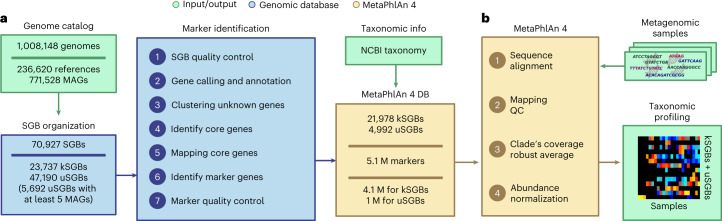
Metagenomic assembly enables new organism discovery from microbial communities, but it can only capture few abundant organisms from most metagenomes. Here we present MetaPhlAn 4, which integrates information from metagenome assemblies and microbial isolate genomes for more comprehensive metagenomic taxonomic profiling. From a curated collection of 1.01 M prokaryotic reference and metagenome-assembled genomes, we define unique marker genes for 26,970 species-level genome bins, 4,992 of them taxonomically unidentified at the species level. MetaPhlAn 4 explains ~20% more reads in most international human gut microbiomes and >40% in less-characterized environments such as the rumen microbiome and proves more accurate than available alternatives on synthetic evaluations while also reliably quantifying organisms with no cultured isolates. Application of the method to >24,500 metagenomes highlights previously undetected species to be strong biomarkers for host conditions and lifestyles in human and mouse microbiomes and shows that even previously uncharacterized species can be genetically profiled at the resolution of single microbial strains.
Overview
The claims and statistics of this paper haven’t been checked yet.
Free: it reads the open-access text and checks the first 5 claims that cite a source we can check. Create a free account to check every claim.
Integrity signals
Registry
Cites
Statistics
Figures
Verification
Claims the paper makes
The claims and statistics of this paper haven’t been checked yet.
Free: it reads the open-access text and checks the first 5 claims that cite a source we can check. Create a free account to check every claim.
Claims other papers make about this one
Each is checked against this paper’s own text: does it say what the citing paper says it does?
The cited source says what the claim attributes to it.
In the citing paper
“we performed a meta-analysis and mega-analysis of stools taxonomically profiled with MetaPhlAn 4 (ref. 37) and from patients enrolled in 12 cohorts from eight published studies26,38–44 across three cancer types, and classified as responders (n = 248) or non-responders (n = 513) based on RECIST1.1 criteria response rates”
From Gut OncoMicrobiome Signatures (GOMS) as next-generation biomarkers for cancer immunotherapy (2023) · cites this paper as [37]
The cited source says what the claim attributes to it.
In the citing paper
“We further performed strain-level and strain-matching analysis via StrainPhlAn 4 84 (STAR Methods) and identified potential transmission patterns for some food-human overlapping SGBs (Figures 6 and S6).”
From Unexplored microbial diversity from 2,500 food metagenomes and links with the human microbiome. (2024) · cites this paper as [84]
The check wasn’t confident either way, so it gives no verdict — never disputed.
In the citing paper
“A meta- and mega-analysis of stools obtained from patients with cancer treated with ICIs showed that GOMS associated with ICI resistance comprised microorganisms affiliated with chronic inflammation and immunosuppression and oral genera, and were shared across various pathological disorders.22,155”
From Melanoma and microbiota: Current understanding and future directions (2024) · cites this paper as [155]
Experimental — accuracy not yet measuredIn the citing paper
“We used MetaPhlAn 4 (ref. 37) for microbiome taxonomic profiling of stool samples from 1,879 adults across eight different cancer types (included in 30 cohorts from 23 published studies)25–29,38–55 and from a control group comprising 5,341 individuals without cancer (included in 17 cohorts from 14 published studies)”
From Gut OncoMicrobiome Signatures (GOMS) as next-generation biomarkers for cancer immunotherapy (2023) · cites this paper as [37]
In the citing paper
“Taxonomic profiling was performed at the level of species-level genome bins (SGBs) using MetaPhlAn4, which represent both existing and yet-to-be-characterized microbial species17.”
From Longitudinal gut microbiome changes in immune checkpoint blockade-treated advanced melanoma (2024) · cites this paper as [17]
1 more claim about this paper
Create a free account to see every claim other papers make about this one.
Self-check
Percentages, sums and reported differences re-computed from the paper’s own numbers.
The self-check needs the paper’s full text.
Citations
Cites
The Sequence Alignment/Map format and SAMtools
Li, H., Handsaker, B., Wysoker, A., Fennell, T., Ruan, J., Homer, N., Marth, G., Abecasis, G., Durbin, R., & 1000 Genome Project Data Processing Subgroup (2009) · Bioinformatics · doi:10.1093/bioinformatics/btp352 · Cited by 62,041 · cited 1×
“For item (1), StrainPhlAn 4 considers as input the reads-to-markers alignment results (in SAM format 96 ) from the MetaPhlAn 4 profiling together with the MetaPhlAn 4 database.”
MethodFast gapped-read alignment with Bowtie 2
Langmead, B., & Salzberg, S. L. (2012) · Nature Methods · doi:10.1038/nmeth.1923 · Cited by 56,400 · cited 1×
“To detect the SGB-specific marker genes, each set of core genes was then aligned against the genomes of the other SGBs using Bowtie 2 (version 2.3.5.1; -- sensitive parameter) 83 .”
MethodInfluentialMAFFT Multiple Sequence Alignment Software Version 7: Improvements in Performance and Usability
Katoh, K., & Standley, D. M. (2013) · Molecular Biology and Evolution · doi:10.1093/molbev/mst010 · Cited by 46,209 · cited 2×
“By default, multiple-sequence alignment is performed by MAFFT 92 , gappy positions (that is, positions with more than 67% of gaps) are trimmed by trimAl 91 and phylogenetic trees are inferred by RAxML 97 .”
MethodInfluentialRAxML version 8: a tool for phylogenetic analysis and post-analysis of large phylogenies
Stamatakis, A. (2014) · Bioinformatics · doi:10.1093/bioinformatics/btu033 · Cited by 32,291 · cited 3×
“By default, multiple-sequence alignment is performed by MAFFT 92 , gappy positions (that is, positions with more than 67% of gaps) are trimmed by trimAl 91 and phylogenetic trees are inferred by RAxML 97 .”
MethodInfluentialIQ-TREE: A Fast and Effective Stochastic Algorithm for Estimating Maximum-Likelihood Phylogenies
Nguyen, L.-T., Schmidt, H. A., von Haeseler, A., & Minh, B. Q. (2015) · Molecular Biology and Evolution · doi:10.1093/molbev/msu300 · Cited by 26,046
Prokka: rapid prokaryotic genome annotation
Seemann, T. (2014) · Bioinformatics · doi:10.1093/bioinformatics/btu153 · Cited by 18,818
Fast and sensitive protein alignment using DIAMOND
Buchfink, B., Xie, C., & Huson, D. H. (2015) · Nature Methods · doi:10.1038/nmeth.3176 · Cited by 14,201
trimAl: a tool for automated alignment trimming in large-scale phylogenetic analyses
Capella-Gutiérrez, S., Silla-Martínez, J. M., & Gabaldón, T. (2009) · Bioinformatics · doi:10.1093/bioinformatics/btp348 · Cited by 12,751 · cited 1×
“By default, multiple-sequence alignment is performed by MAFFT 92 , gappy positions (that is, positions with more than 67% of gaps) are trimmed by trimAl 91 and phylogenetic trees are inferred by RAxML 97 .”
MethodParks, D. H., Imelfort, M., Skennerton, C. T., Hugenholtz, P., & Tyson, G. W. (2015) · Genome Research · doi:10.1101/gr.186072.114 · Cited by 12,496
Diet rapidly and reproducibly alters the human gut microbiome
David, L. A., Maurice, C. F., Carmody, R. N., Gootenberg, D. B., Button, J. E., Wolfe, B. E., Ling, A. V., Devlin, A. S., Varma, Y., Fischbach, M. A., et al. (2014) · Nature · doi:10.1038/nature12820 · Cited by 10,100
Cited by
Items 601–700 of 1,000
Raich, S. S., Majzoub, M. E., Haifer, C., Paramsothy, S., Shamim, M. M. I., Borody, T. J., Leong, R. W. L., & Kaakoush, N. O. (2025) · mSystems · doi:10.1128/msystems.00991-25 · Cited by 5
Wang, Y., Mu, W., Guan, J., Ma, P., Li, Y., Zhang, Y., Zhu, W., Zhou, Y., Zou, Y., Zeng, T.-X., et al. (2025) · Cell Reports · doi:10.1016/j.celrep.2025.116374 · Cited by 6
Lee, J. Y., Mahurkar‐Joshi, S., Young, A., Labus, J. S., He, B., Aja, E., Jacobs, J. P., & Volkmann, E. R. (2025) · Frontiers in Immunology · doi:10.3389/fimmu.2025.1610360 · Cited by 6
Wu, Y., Ji, G. L., Han, D., Zhang, Y., Zhu, X., Li, H., Li, M., Gao, Y., Xie, R., Xu, M., et al. (2025) · npj Biofilms and Microbiomes · doi:10.1038/s41522-025-00826-3 · Cited by 5
“The correspondingGTDB 37 representativesandmatchedMetaPhlAnSGBs 38 are also indicated in Supplementary Data 2.”
InfluentialZheng, N., Wang, D., Xing, G., Gao, Y., Li, S., Liu, J., Kang, J., Sha, S., Cheng, L., Fan, S., et al. (2025) · BMC Microbiology · doi:10.1186/s12866-025-04348-y · Cited by 5
White, A. E., Koch, T. J., Jensen, T. Z. T., Niemann, J., Pedersen, M. W., Søtofte, M. B., Binder, D., Lepère, C., Harb, C., Huber, R., et al. (2025) · Proceedings of the Royal Society B Biological Sciences · doi:10.1098/rspb.2025.0092 · Cited by 5
Zhou, Z., Lin, J.-R., Li, J., Huang, X., Lu, Y., Huang, J., Xie, W., Lu, J., Huang, W., He, S., et al. (2025) · Journal for ImmunoTherapy of Cancer · doi:10.1136/jitc-2025-012444 · Cited by 6
“A variety of traditional machine learning algorithms, including decision trees, logistic regression, support vector machines, and K-nearest neighbors, were employed to construct the models.”
2024 Bangladesh Floodwaters Harbour Regional Hotspots of Pathogens and Antimicrobial Resistance
Rahman, T., Samia, N. S. N., Moon, S. B., Islam, M. S., Mahmud, Z. H., Kabir, M. S., Karim, M. M., Rahman, M., & Jubair, M. (2025) · Environmental Microbiology Reports · doi:10.1111/1758-2229.70240 · Cited by 5
Zhang, S., Shoaie, S., & Carpenter, G. H. (2025) · npj Science of Food · doi:10.1038/s41538-025-00643-0 · Cited by 5
“Taxonomic pro fi ling was performed using MetaPhlAn 4.1.1 77 , while functional pro fi ling was carried out with HUMAnN 3.9, using the ChocoPhlAn and full UniRef90 databases.”
InfluentialLiu, X. F., Li, J., & Ma, C. (2026) · Journal of Hazardous Materials · doi:10.1016/j.jhazmat.2026.141076 · Cited by 5
Gaonkar, P. P., Santana-Pereira, A. L. R., Golden, R., Lambert, A., Higgins, C., Adhikari, Y. P., Bailey, M., Macklin, K. S., & Huber, L. (2026) · BMC Microbiology · doi:10.1186/s12866-025-04664-3 · Cited by 6
“…approach used in this study for microbial profiling is very recalcitrant to false positives, offering a trade-off between recall and precision [21, 78–80], reported to lead to lower but precise detection of pathogens in metagenomes, such as low abundances of Salmonella in both synthetic and…”
InfluentialWen, W., Su, R., Liu, Y., Feng, Z., Li, Y., Li, J., Huang, Z., Zhang, F., Gao, S., Ma, Y., et al. (2026) · Cell Host & Microbe · doi:10.1016/j.chom.2026.01.016 · Cited by 6
A review of computational approaches for metagenomics by long-read sequencing
Le, B., Jia, L., 庞天翔, Han, S., Duan, Y., & Zhao, X.-M. (2026) · Science China Life Sciences · doi:10.1007/s11427-025-3133-3 · Cited by 7
“The traditional algorithms are designed based on short-read sequencing (SRS), such as Kraken2 (Wood et al., 2019) (often paired with Bracken (Lu et al., 2017) for abundance refinement), Centrifuge (Kim et al., 2016), and MetaPhlAn4 (Blanco-Míguez et al., 2023).”
Li, X., Xu, B., Lai, Z., Qin, J., Liang, C., Xu, H. M., Zhou, D., Zhou, H., Zhong, X., Liu, Z., et al. (2026) · Environment International · doi:10.1016/j.envint.2026.110146 · Cited by 6
Shen, W., Wang, H., Wang, J., Yuan, Y., Luo, Y., Chen, X. G., Li, J., Liu, Y., Yin, Y., Wang, M., et al. (2026) · Cell Host & Microbe · doi:10.1016/j.chom.2026.02.004 · Cited by 6
Clarke, B., Ordinola‐Zapata, R., Noblett, W., Gould, M., & Staley, C. M. (2026) · Journal of Endodontics · doi:10.1016/j.joen.2026.02.016 · Cited by 5
Shekarriz, S., Vigod, S. N., Bianco, T., Bala, A., Hao, C., Allard, J. P., Hota, S. S., Poutanen, S. M., Surette, M. G., & Taylor, V. H. (2026) · The Canadian Journal of Psychiatry · doi:10.1177/07067437261420877 · Cited by 5
Decoding the microbial landscape of endometrial cancer: a case-control study
Aquino, C. I., Vecchia, M. L., Pasolli, E., Sala, G., Ligori, A., Boldorini, R. L., Ferrante, D., Dianzani, I., Aspesi, A., Surico, D., et al. (2026) · BMC Microbiology · doi:10.1186/s12866-026-05017-4 · Cited by 7
“Taxonomic profiling with estimation of relative abundances at species-level was performed using MetaPhlAn version 4.1.0 with marker database version mpa_vJun23_CHOCOPh-lAnSGB_202307 [55].”
InfluentialSelf-citationMulti-kingdom profiling reveals altered gut phage-bacteria-metabolite interactions in MASLD
Zhou, X., Zhou, D. X., Pu, Y., Kim, H., Sun, Z., Qi, W., Jin, J., Zhang, W., Xia, M., Wang, C., et al. (2026) · Nature Communications · doi:10.1038/s41467-026-71981-0 · Cited by 6
“MAGs that could not be assigned to any known species were further determined whether represented previously undescribed speciesbymappingthemagainstthespecies-levelgenomebins(SGBs) database (SGB.Oct19) 59 using PhyloPhlAn 3 16 .”
Network topology of the gut microbiome associates with metabolic health in obesity
Lacruz-Pleguezuelos, B., Perez-Cuervo, A., Coleto-Checa, D., Bazán, G. X., Romero-Tapiador, S., Freixer, G., Fernández-Cabezas, J., Aguilar-Aguilar, E., Martín‐Segura, A., Cárdenas-Roig, N., et al. (2026) · Nature Communications · doi:10.1038/s41467-026-72588-1 · Cited by 5
Li, J., Barnes, S., Lefkowitz, E. J., & Yarar‐Fisher, C. (2024) · Physiological Genomics · doi:10.1152/physiolgenomics.00107.2023 · Cited by 5
Effects of a 217‐km mountain ultramarathon on the gut microbiota of an obese runner: A case report
Saragiotto, G. K., de Oliveira, L. F. V., Scharlack, N. K., de Oliveira, M. M., Freire, F. C., Simabuco, F. M., Sivieri, K., Sartoratto, A., Belli, T., & Antunes, A. E. C. (2024) · Physiological Reports · doi:10.14814/phy2.70017 · Cited by 5
Lu, R., Dumonceaux, T., Anzar, M., Zovoilis, A., Antonation, K. S., Barker, D. O. R., Corbett, C. R., Nadon, C. A., Robertson, J. A., Eagle, S. H. C., et al. (2024) · Bioinformatics · doi:10.1093/bioinformatics/btae601 · Cited by 5
Zhao, M., Yang, C., Zhu, L., Guo, X., Ma, H., Luo, Y., Wang, Q., & Chen, J. (2024) · Infection and Drug Resistance · doi:10.2147/idr.s475164 · Cited by 5
“Now MetaPhlAn 4 has been updated, 24 which relies on ~5.1M unique clade-specific marker genes identified from ~1M microbial genomes (~236,600 references and 771,500 metagenomic assembled genomes) spanning 26,970 species-level genome bins (SGBs,…”
BackgroundFavero, F., Re, A., Dason, M. S., Gravina, T., Gagliardi, M., Mellai, M., Corazzari, M., & Corà, D. (2024) · Biology Direct · doi:10.1186/s13062-024-00541-7 · Cited by 5
“…high-resolution and high-throughput genomic profiling of microbial biomass in 3xTgAD mice—an in vivo model that recapitulates the progression of AD—com-pared to age-matched WT littermates, using shotgun metagenomics followed by a clade-specific marker-based bioinformatic analysis [43, 44].”
MethodInfluentialDiet shapes and maintains the personalized native gut microbiomes in mice
Yang, Z., Zhang, Z., Jiang, S., Li, A., Song, H., & Zhang, J. (2024) · Journal of the Science of Food and Agriculture · doi:10.1002/jsfa.14073 · Cited by 5
Does preeclampsia impact the gut microbiota of preterm offspring during early infancy?
Chen, Y., Yi, Z.-T., Yu, H., Wu, X., Wang, J., Nie, C., Li, H., Li, S., Yan, Q., He, T., et al. (2025) · Journal of Translational Medicine · doi:10.1186/s12967-025-06120-2 · Cited by 5
Horvath, M., Yang, R., Castaneda, D. C., Callender, M., Aiken, E. S., Voigt, A. Y., Caldwell, R., Fachi, J. L., Luccia, B. D., Scholar, Z., et al. (2025) · BMC Biology · doi:10.1186/s12915-025-02129-7 · Cited by 6
“After demultiplexing, the fastq files were processed with MetaPhlAn 4 [68] using the flags –add_viruses and –unclassified_estimation.”
Armstrong, E., Kulikova, M., Yee, N., Rishu, A. H., Muscedere, J., Sibley, S. R., Maslove, D. M., Boyd, J. G., Evans, G. A., Detsky, M. E., et al. (2025) · Open Forum Infectious Diseases · doi:10.1093/ofid/ofaf137 · Cited by 5
“Taxonomic characterization of reads was performed with Metaphlan version 4.0.6 with default parameters [14].”
InfluentialBoutin, S., Käding, N., Belheouane, M., Merker, M., Rupp, J., & Nurjadi, D. (2025) · BMC Microbiology · doi:10.1186/s12866-025-03874-z · Cited by 6
“The clean metagenomic reads were also processed through Metaphlan 4.0 to profile the taxonomy of the metagenomes to the species levels, and the species of interest were further studied at the strain level using Strainphlan 4.1.0 [23, 24].”
InfluentialDahal, A., Chang, W. C., Johansson, E., Grashel, B., Morgan, D., Williams, L., Hammonds, M., Sachdeva, S., Spagna, D., Satish, L., et al. (2025) · Scientific Reports · doi:10.1038/s41598-025-99463-1 · Cited by 5
“Sequencing phenotypes were determined by presence or absence of reads in each sample mapping to SA-specific marker genes 16,17 .”
Liu, L., Firrman, J., Narrowe, A. B., Mahalak, K. K., Lemons, J. M. S., Marzorati, M., Duysburgh, C., Rotsaert, C., & de Wiele, T. V. (2025) · Scientific Reports · doi:10.1038/s41598-025-10144-5 · Cited by 6
“Trimmed, filtered reads were used as input to perform read-based taxonomic assignment and relative abundance estimation using MetaPhlAn v 4.0.6 using the mpa_vOct22_CHOCOPhlAnSGB_202212 reference database 39 .”
InfluentialCreedon, A. C., Bernard, H. M., Amati, F., Segata, N., Wallace, S. M., Arrè, A., Smith, H. A., Platts, A., Bulsiewicz, W. J., Bermingham, K. M., et al. (2026) · British Journal Of Nutrition · doi:10.1017/s0007114526107703 · Cited by 5
Self-citationElite controllers microbiome: unraveling the mystery of association and causation
Bai, X., Sönnerborg, A. B., & Nowak, P. (2024) · Current Opinion in HIV and AIDS · doi:10.1097/coh.0000000000000867 · Cited by 5
Zhang, Q., Hutchison, E. R., Pan, C., Warren, M. F., Keller, M. P., Attie, A., Lusis, A. J., & Rey, F. E. (2025) · Microbiome · doi:10.1186/s40168-025-02093-y · Cited by 6
“Gut microbial taxon was profiled by MetaPhlAn4 pipe-line (v.4.0.2) using the MetaPhlAn database (mpa_ vOct22) and the ChocoPhlAn pan-genome database (mpa_vOct22_CHOCOPhlAnSGB_202212) that contains a collection of around 1 million prokaryotic metagenome-assembled genomes [45].”
InfluentialOrdóñez, C. D., Mayoral-Campos, C., Egas, C., & Redrejo‐Rodríguez, M. (2023) · NAR Genomics and Bioinformatics · doi:10.1093/nargab/lqad073 · Cited by 5
“In the case of the piPolB MDA products, ther e ar e no RPs in the reaction and high-throughput sequencing ruled out contamination for the not assigned reads during Metaphlan profiling.”
MethodInfluentialBeyond personal space: Unveiling the transmission pattern of the human gut and oral microbiome
Andreu‐Sánchez, S., Wu, J., & Fu, J. (2023) · iMeta · doi:10.1002/imt2.98 · Cited by 7
“Valles ‐ Colomer and colleagues [7] addressed this technical issue by identifying marker genes in 646 gut and 252 oral bacterial species and constructing phylogenetic trees of the majority of strains using StrainPhlan4.”
BackgroundGarcía-Bayona, L., Said, N., Coyne, M. J., Flores, K., Elmekki, N. M., Sheahan, M. L., Gutiérrez-Camacho, A., Hutt, K., Yildiz, F. H., Kovács, Á. T., et al. (2024) · bioRxiv (Cold Spring Harbor Laboratory) · doi:10.1101/2024.04.29.590671 · Cited by 7
Precise and scalable metagenomic profiling with sample-tailored minimizer libraries
Nyström-Persson, J., Bapatdhar, N., & Ghosh, S. (2025) · NAR Genomics and Bioinformatics · doi:10.1093/nargab/lqaf076 · Cited by 4
Novel potential biomarkers for predicting childhood caries via metagenomic analysis
Zhang, H., Zheng, X., Huang, Y., Zou, Y., Zhang, T., Repo, M. A., Yin, M., You, Y., Jie, Z., & Xu, W.-A. (2025) · Frontiers in Cellular and Infection Microbiology · doi:10.3389/fcimb.2025.1522970 · Cited by 7
Morsy, Y., Walberg, Ã., Wawrzyniak, P., Hubeli, B., Truscello, L., Mamie, C., Niechcial, A., Gueguen, E., Manzini, R., Gottier, C., et al. (2025) · Gut Microbes · doi:10.1080/19490976.2025.2530157 · Cited by 5
Bargheet, A., Bø, G. H., Hetland, M. A. K., Justine, M., Moyo, S. J., Löhr, I. H., Blomberg, B., Langeland, N., Klingenberg, C., & Pettersen, V. K. (2026) · Cell Reports Medicine · doi:10.1016/j.xcrm.2026.102752 · Cited by 5
Sun, Z., Ning, Z., Wu, Q., Li, L., Doxey, A. C., & Figeys, D. (2025) · npj Biofilms and Microbiomes · doi:10.1038/s41522-025-00801-y · Cited by 4
“In contrast, most metagenomics studies with moderate sequencing depth (10 Gbases) have the ability to detect species with relative abundances down to approximately 0.01% in a given sample 43 .”
InfluentialGoldstein, C., Lavy, I., Sun, T., Ennis, D., Shreffler, W. G., Yuan, Q., Virkud, Y. V., Martin, V., & Yassour, M. (2026) · Genome Medicine · doi:10.1186/s13073-026-01646-6 · Cited by 5
“Microbial taxonomic profiling was performed with MetaPhlAn4 [41], which uses clade-specific marker Fig.”
Lu, Z., Petersen, C., Dai, R., Reyna, M. E., Ahmadiankalati, M., Sifuentes, E., Dai, D. L., Hoskinson, C., Bel, K. L. D., Miliku, K., et al. (2025) · Journal of Allergy and Clinical Immunology · doi:10.1016/j.jaci.2025.07.034 · Cited by 4
Blecksmith, S. E., Kalanetra, K. M., Weng, C.-Y., Suarez, C., Sitepu, I. R., Tang, Y., Cheang, S. E., Jiang, S., Cernioglo, K., Damian-Medina, K., et al. (2025) · Food & Function · doi:10.1039/d5fo00947b · Cited by 4
Dubli, K., Balasundaram, P., Rinku, C., Vettrivelan, S., Borwake, A., Aleman, F., Kapoor, R., Singh, R., Singh, R., Kapoor, A., et al. (2025) · Biomedicines · doi:10.3390/biomedicines13102371 · Cited by 4
“Microbial taxonomic profiling was performed using MetaPhlAn 4 [26,27], which depends on a curated set of clade-specific marker genes for accurate taxonomic classification from metagenomic reads.”
Ma, Y., Wang, D., Yu, X., Fan, Y., Yang, Z., Gao, X., Huang, X., Meng, J., Cheng, P., Liu, X., et al. (2025) · BMC Microbiology · doi:10.1186/s12866-025-04245-4 · Cited by 4
“0.6) with default parameters [29], and functional profiling was conducted with the HMP Unified Metabolic Analysis Network 3 (HUMAnN 3, v3.”
InfluentialDeng, W., Li, C., Huang, Y., Liu, C., Li, R., Li, T., Wu, D., He, Y., Li, D., Yang, S., et al. (2025) · Communications Biology · doi:10.1038/s42003-025-08943-7 · Cited by 5
“Inrecentyears,thegenerationofgenomicbinninghasmadeitpossible to reconstruct microbial genomes from shotgun metagenomic sequencing data, which provides insights into the microbial communities and their potential functions at the species level 22,23 .”
Severe Diarrhea Outbreaks in Newborn Piglets in China Associated With Porcine Rotavirus B
Sun, M., Li, T., Liu, W., Guo, Z., Wang, Z., Jiang, J., Li, Q., He, B., Guo, Y., & Gong, W. (2025) · Transboundary and Emerging Diseases · doi:10.1155/tbed/5588912 · Cited by 4
“To comprehensively assess the presence of bacteria, archaea, and parasites in the samples, the obtained HTS data were analyzed using Metaphlan 4.0.6 software [40].”
InfluentialAltered gut mycobiome and cross-kingdom microbial interactions in systemic lupus erythematosus
Wang, Z., Xing, Y., Xu, M., Chen, C., Zhu, Q., Chen, H., Zhang, Y., Chen, W., Feng, J., Zhang, A., et al. (2025) · Journal of Translational Medicine · doi:10.1186/s12967-025-07423-0 · Cited by 4
“For the prokaryotic gut microbiome, we used MetaPh-lAn4 [19] to profile species-level compositions.”
Sun, Y., Huang, Y., Li, R., Zhang, J., Fan, X., & Su, X. (2025) · Microbiome Research Reports · doi:10.20517/mrr.2025.75 · Cited by 6
“Following initial quality filtering and host genome removal [36] , taxonomic and functional profiles for WGS data were generated using MetaPhlan4 [50] and HUMAnN3 [51] under consistent settings (refer to METHODS, Figure 1B).”
Eremin, A. A., Sergeev, A. V., Zvereva, M. I., & Khrenova, M. G. (2025) · Mathematical Biology and Bioinformatics · doi:10.17537/2025.20.588 · Cited by 4
Cao, Q., Deng, Z., Li, M., Zhu, S.-Q., Huo, Y., Dong, H., Aernouts, B., Psifidi, A., & Xu, C. (2025) · Microbiome · doi:10.1186/s40168-025-02264-x · Cited by 6
“Taxonomic profiling was performed using MetaPhlAn4 [41], and functional annotation was conducted with HUMAnN3 [42].”
Ronchi, F., Hinterbrandner, M., Rubino, V., Römmele, M., Chiorazzo, T., Mooser, C., Ganal-Vonarburg, S. C., McCoy, K. D., Bhatia, R., Macpherson, A. J., et al. (2025) · Cell Reports · doi:10.1016/j.celrep.2025.116753 · Cited by 4
Wang, C., Narayanasamy, S., Shaabad, M., Dallol, A., Hala, S., & Hong, P. (2025) · Environmental Science & Technology · doi:10.1021/acs.est.5c11553 · Cited by 4
Arredondo, A., Àlvarez, G., Isabal, S., Teughels, W., Laleman, I., Contreras, M. J., Isbej, L., Huapaya, E., Mendoza, G., Mor, C., et al. (2026) · Journal of Oral Microbiology · doi:10.1080/20002297.2025.2610588 · Cited by 6
“The microbial composition of the samples was investigated to the species level using MetaPhlAn 4.0 [25].”
InfluentialFungal ecology in the age of 'omics
Shelton, B. R., Larrere, J., Belsham, D. Y., Omacini, M., Argüelles‐Moyao, A., Buscardo, E., da Silva, D. K. A., Zhao, X., Nakamura, N., Ángeles-Argáiz, R. E., et al. (2026) · New Phytologist · doi:10.1111/nph.70900 · Cited by 5
Karagiannis, T. T., Chen, Y., Bald, S., Tai, A., Reed, E. R., Milman, S., Andersen, S. L., Perls, T. T., Segrè, D., Sebastiani, P., et al. (2026) · PLoS Computational Biology · doi:10.1371/journal.pcbi.1013883 · Cited by 4
“Both metagenomics datasets were processed using KneadData, and taxonomic classification was performed using both MetaPhlAn4 [2] and Kraken2 [4] via an in-house metagenomic pipeline (available at https://github.com/Integrative-Longev-ity-Omics/MGS_pipeline).”
InfluentialGenome contamination may lead to an overestimation of horizontal gene transfer inferences
Godron, N., Ruppé, É., & Leclercq, S. O. (2026) · Nature Communications · doi:10.1038/s41467-026-69064-1 · Cited by 7
Xu, R., Mayer, M. J., Philo, M. R., Gall, G. L., Mulaw, G., Ponsero, A. J., & Narbad, A. (2026) · Journal of Applied Microbiology · doi:10.1093/jambio/lxag047 · Cited by 5
Han, Z., Sun, Z., Liu, X., Zhen, D., Guo, Q., Zheng, L., Jiang, S., Zhang, Z., Shen, S., & Zhang, J. (2026) · Nature Communications · doi:10.1038/s41467-026-69823-0 · Cited by 4
Impacts of host genetics on gut microbiome composition in Alzheimer’s disease
Liu, J., Cao, J., Jia, L., Gan, Z., Zhao, X., Yang, A., Lai, S., Chen, F., Yang, Y. T., & Zhao, X.-M. (2026) · Microbiome · doi:10.1186/s40168-026-02342-8 · Cited by 4
“In addition, we trained the LDA topic model using the genus-level relative abundance data based on other metagenomic profilers, including Met-aPhlAn4 [60] and Kraken2 [61, 62].”
Guðnadóttir, U., Prast‐Nielsen, S., Wagner, N., Hugerth, L. W., Alderheim, V. K., Antony, A. T., Du, J., Guerreiro, J. R., Boulund, F., Wiberg‐Itzel, E., et al. (2026) · npj Biofilms and Microbiomes · doi:10.1038/s41522-026-00956-2 · Cited by 4
Heng, Y. C., Chua, J. H., Silvaraju, S., Fan, H., Low, A., Lim, A. C. H., Chen, B., Mane, L., Dagar, S. S., Fliegerova, K. O., et al. (2026) · Microbiome · doi:10.1186/s40168-026-02392-y · Cited by 4
“1 (database mpavJun23; https:// hutte nhower. sph. harva rd. edu/ metap hlan/) [81] were downloaded from either Lifebit (https:// opend ata. lifeb it. ai/ table/ sgb) or NCBI (based on reference genomes recommended by GTDB-Tk).”
Water kefir as a paradigm for multi-omics and genome-scale metabolic modelling in fermented food
Khan, A., Breselge, S., O’Mahony, A. K., O’Sullivan, Ó., Cotter, P. D., McCarthy, S. N., Mahony, J., & Kenny, J. G. (2026) · npj Biofilms and Microbiomes · doi:10.1038/s41522-026-00985-x · Cited by 6
“For example, different approaches to taxonomic pro fi ling, such as MetaPhlAn 4 78 and Kraken 2 79 rely on different classi fi cation strategies and databases, and delivers variable taxonomic assignments and performance with respect to strain separation.”
Tekin, B., & Gurbanov, R. (2026) · World Journal of Microbiology and Biotechnology · doi:10.1007/s11274-026-05017-6 · Cited by 4
“Shotgun datasets, in contrast, rely on genome-based classifiers such as MetaPhlAn 4 (Blanco-Míguez et al. 2023) and Kraken 2 (Wood et al. 2019), which assign taxonomy based on unique marker genes or k-mer signatures.”
Hattori-Muroi, K., Maruta, H., Takahashi, D., Kinashi, Y., Hattori, K., Kabumoto, Y., Fujimura, Y., Tsukamoto, S., Suzuki, K., Oguchi, H., et al. (2026) · Immunity · doi:10.1016/j.immuni.2026.04.013 · Cited by 4
Dupraz, L., Orianne, G., Costa, G. D., Gauthier, R., Blondeau, A., Boinet, M., Farfar, A., Creusot, L., Magniez, A., Dubois, L., et al. (2026) · Gut Microbes · doi:10.1080/19490976.2026.2690688 · Cited by 4
Self-citationBushnell, B., Schulz, F., & Villada, J. C. (2026) · Cell Genomics · doi:10.1016/j.xgen.2026.101384 · Cited by 4
Vasco, K. A., Hansen, Z. A., Schilmiller, A. L., Bowcutt, B., Carbonell, S. L., Ruegg, P. L., Quinn, R. A., Zhang, L., & Manning, S. D. (2024) · Frontiers in Molecular Biosciences · doi:10.3389/fmolb.2024.1364637 · Cited by 5
Murovec, B., Deutsch, L., Osredkar, D., & Stres, B. (2024) · Frontiers in Microbiology · doi:10.3389/fmicb.2024.1426465 · Cited by 5
Gulyaeva, A. A., Liu, L., Garmaeva, S., Kruk, M., Weersma, R. K., Harmsen, H. J. M., & Zhernakova, A. (2024) · Microbiology Spectrum · doi:10.1128/spectrum.01066-24 · Cited by 6
DeVeaux, A. L., Hall-Moore, C. M., Shaikh, N., Wallace, M. A., Burnham, C. D., Schnadower, D., Kuppermann, N., Mahajan, P., Ramilo, O., Tarr, P. I., et al. (2025) · Microbiome · doi:10.1186/s40168-025-02079-w · Cited by 7
“MetaPhlAn4 [36] (v4.”
Ho, J. Y., Koh, X. Q., Kang, D. Y., Low, A., Hu, D., Haryono, M., Williams, R. B. H., Case, R. J., & Boucher, Y. (2025) · Frontiers in Microbiology · doi:10.3389/fmicb.2025.1437936 · Cited by 4
Embracing the unknown: Proteomic insights into the human microbiome
Zeng, S., Almeida, A., Mu, D., & Wang, S. (2025) · Cell Metabolism · doi:10.1016/j.cmet.2025.02.003 · Cited by 4
Alterations in Gut Microbiota of Infants Born to Mothers with Obesity
Meiirmanova, Z., Mukhanbetzhanov, N., Jarmukhanov, Z., Vinogradova, E. B., Kozhakhmetova, S., Morenko, M., Duisebayeva, A., Poddighe, D., Kushugulova, A. R., & Kozhakhmetov, S. (2025) · Biomedicines · doi:10.3390/biomedicines13040838 · Cited by 5
Yuan, J., Yang, J., Sun, Y., Meng, Y., He, Z., Zhang, W., Dang, L., Song, Y. X., Xu, K., Lv, N., et al. (2025) · Science China Life Sciences · doi:10.1007/s11427-024-2894-2 · Cited by 5
Li, W., Fan, Q., Yang, Y., Xiao, X., Li, J., & Zhang, Y. (2025) · ISME Communications · doi:10.1093/ismeco/ycaf090 · Cited by 6
Gut and oral microbial profile associations to oral cancer
Nayyar, J., Bedu-Ferrari, C., Patangia, D. V., Hurley, E., Feeley, L., Ross, R. P., Stanton, C., & Brady, P. (2025) · Journal of Dentistry · doi:10.1016/j.jdent.2025.105848 · Cited by 5
Jiménez-Arroyo, C., Molinero, N., del Campo, R., Delgado, S., & Moreno-Arribas, M. V. (2025) · Enfermedades Infecciosas y Microbiología Clínica · doi:10.1016/j.eimc.2025.06.017 · Cited by 5
A practical guide on environmental genomics for prokaryotic systematics
Ernster, N. M., & Rodriguez‐R, L. M. (2025) · Systematic and Applied Microbiology · doi:10.1016/j.syapm.2025.126643 · Cited by 5
A Graph Contrastive Learning Method for Enhancing Genome Recovery in Complex Microbial Communities
Guo, W., & Liu, Y. (2025) · Entropy · doi:10.3390/e27090921 · Cited by 5
“Metagenomics enables the comprehensive characterization of microbial communities by directly sequencing the collective genomic content of environmental samples, providing a cultivation-independent approach to studying microbial diversity and function [1–3].”
Raja, S. S., Costello, S. P., Rayner, C. K., Day, A. S., Portmann, L., Uylaki, W., Wheeler, R., Saxon, S., Tucker, E. C., Fon, J., et al. (2025) · Journal of Crohn s and Colitis · doi:10.1093/ecco-jcc/jjaf169 · Cited by 3
CarpeDeam: a de novo metagenome assembler for heavily damaged ancient datasets
Kraft, L., Söding, J., Steinegger, M., Jochheim, A., Sackett, P. W., Fernàndez-Guerra, A., & Renaud, G. (2025) · Genome biology · doi:10.1186/s13059-025-03839-5 · Cited by 4
“Assembly-based methods, which work with either assembled contigs or long reads, potentially increase classification accuracy.”
Gut bacterial dysbiosis in pediatric severe malaria associates with post-discharge mortality
Bednarski, O. J., Lehman, S. M., Mzinza, D. T., Kazinga, C., Namazzi, R., Opoka, R. O., Ren, J., Tran, T. M., Taylor, T. E., Seydel, K. B., et al. (2025) · Nature Communications · doi:10.1038/s41467-025-64632-3 · Cited by 5
“1.1) 123 using a 1.01 M prokaryotic reference and metagenome-assembled genomes.”
InfluentialBernardes, E. V. T., Glatthardt, T., Gutierrez, M. W., Nguyen, W. N. T., Mercer, E. M., Ramay, H. R., Thomson, C. A., Halim, T., Gopalakrishnan, N., MacConnell, K., et al. (2026) · Nature Communications · doi:10.1038/s41467-026-74417-x · Cited by 5
Agosti, P., Kouraki, A., Dionisi, T., Addolorato, G., D’Innocenzo, L., Sorrentino, S., Maio, F. D., Candia, E. D., Blanco‐Míguez, A., Bazzani, D., et al. (2024) · Arteriosclerosis Thrombosis and Vascular Biology · doi:10.1161/atvbaha.124.321490 · Cited by 4
Self-citationAssessing live microbial therapeutic transmission
Faith, J. J. (2025) · Gut Microbes · doi:10.1080/19490976.2024.2447836 · Cited by 4
Hunter, B. S., Cromwell, T., & Shim, H. (2025) · Computational and Structural Biotechnology Journal · doi:10.1016/j.csbj.2025.01.002 · Cited by 4
d’Humières, C., Haviari, S., Petitjean, M., Deconinck, L., Gueye, S., Peiffer‐Smadja, N., Chalal, L., Beldjoudi, N., Rossi, G., Nguyen, Y., et al. (2025) · International Journal of Medical Microbiology · doi:10.1016/j.ijmm.2025.151650 · Cited by 4
TIPP3 and TIPP3-fast: Improved abundance profiling in metagenomics
Shen, C., Wedell, E., Pop, M., & Warnow, T. J. (2025) · PLoS Computational Biology · doi:10.1371/journal.pcbi.1012593 · Cited by 4
“We compared TIPP3 to TIPP3-fast, Bracken [9], Kraken2 [8], mOTUsv3 [35], MetaPhlAn4 [14], and Metabuli [10] for abundance profiling accuracy on our testing data.”
Genotype-Environment-Driven Dysbiosis in the Skin Microbiome of Ichthyosis
Zhou, W. L., Ring, N. G., Caldwell, R., Milstone, L. M., & Oh, J. (2025) · Journal of Investigative Dermatology · doi:10.1016/j.jid.2025.06.1568 · Cited by 6
Akhtar, N., Jain, C., Chauhan, S. B., & Singh, I. P. (2025) · Medicine in Microecology · doi:10.1016/j.medmic.2025.100148 · Cited by 4
Imputing time-series microbiome abundance profiles with diffusion model
Seki, M., Zhang, Y., & Imoto, S. (2023) · IEEE International Conference on Bioinformatics and Biomedicine (BIBM) · doi:10.1109/bibm58861.2023.10385703 · Cited by 4
“2) WGS data: Relative abundance profiles were produced using MetaPhlAn 4 [16].”
MethodPantiukh, K., Krigul, K. L., Aasmets, O., & Org, E. (2026) · mSystems · doi:10.1128/msystems.00114-26 · Cited by 4
Rühlemann, M. C., Waschina, S., Wacker, E. M., Rausch, P., Schaan, A. P., Zafroon, Z., Franzpötter, K., Jacobs, G., Ellinghaus, D., Kruse, R., et al. (2023) · medRxiv · doi:10.1101/2023.12.10.23299783 · Cited by 5
Exposure and resistance to lantibiotics impact microbiota composition and functionPreprint
Zhang, Z. J., Cole, C. G., Lin, H., Wu, C., Haro, F., McSpadden, E., van der Donk, W. A., & Pamer, E. G. (2023) · bioRxiv (Cold Spring Harbor Laboratory) · doi:10.1101/2023.12.30.573728 · Cited by 4
“Fecal samples of both groups were collected over 14 days and samples were processed for metagenomic sequencing and analyzed with MetaPhlAn4 28 .”
PanTax: Strain-level taxonomic classification of metagenomic data using pangenome graphsPreprint
Zhang, W., Liu, Y., Xu, J., Chen, E., Schönhuth, A., & Luo, X. (2024) · bioRxiv (Cold Spring Harbor Laboratory) · doi:10.1101/2024.11.15.623887 · Cited by 6
Dravillas, C. E., Williams, N. F., Husain, M., Hoyd, R., Hussein, A., Meara, A. S., Lynn, M., Bibi, A., Conrad, B., Lepola, N., et al. (2025) · medRxiv · doi:10.1101/2025.01.30.25321413 · Cited by 5
Metadata
- Authors
- Blanco-Míguez, A., Beghini, F., Cumbo, F., McIver, L. J., Thompson, K. N., Zolfo, M., Manghi, P., Dubois, L., Huang, K. D., Thomas, A. M., Nickols, W. A., Piccinno, G., Piperni, E., Punčochář, M., Valles-Colomer, M., Tett, A., Giordano, F., Davies, R., Wolf, J., Berry, S. E., Spector, T. D., Franzosa, E. A., Pasolli, E., Asnicar, F., Huttenhower, C., & Segata, N.
- Affiliations
- University of Trento (IT)
- Broad Institute (US)
- University of Vienna (AT)
- ZOE (United Kingdom) (GB)
- King's College London (GB)
- University of Naples Federico II (IT)
- Corresponding author
- Segata, Nicola
- ORCID
- Blanco-Míguez, Aitor
- Beghini, Francesco
- Cumbo, Fabio
- McIver, Lauren J.
- Thompson, Kelsey N.
- Zolfo, Moreno
- Manghi, Paolo
- Huang, Kun D.
- Thomas, Andrew Maltez
- Nickols, William A.
- Piccinno, Gianmarco
- Piperni, Elisa
- Punčochář, Michal
- Tett, Adrian
- Giordano, Francesca
- Davies, Richard
- Wolf, Jonathan
- Berry, Sarah E.
- Spector, Tim D.
- Franzosa, Eric A.
- Pasolli, Edoardo
- Asnicar, Francesco
- Huttenhower, Curtis
- Segata, Nicola
- Venue
- Nature Biotechnology
- Published
- 2023-02-23
- Volume
- 41
- Issue
- 11
- Pages
- 1633-1644
- ISSN
- 0733-222X (ISSN-L)
- 1087-0156
- 1546-1696
- PMC
- PMC10635831
- OpenAlex
- W4321611856
- Semantic Scholar
- e28eff291a1b5c8f0a98f826de240f846be03334
- Cited by
- 1,442
- References
- 101
- Citations by year
- 2026: 517 · 2025: 521 · 2024: 309 · 2023: 93
- FWCI
- 129.03
- Type
- journal article
- Language
- en
- Open access
- hybrid
- doi.org
- Licence
- cc-by
- creativecommons.org/licenses/by/4.0 (tdm)
- creativecommons.org/licenses/by/4.0 (vor)
- Locations
- Nature Biotechnology (publishedVersion, cc-by)
- PubMed Central (publishedVersion, cc-by)
- PubMed (publishedVersion)
- Iris (University of Trento) (submittedVersion, cc-by)
- Funders
- Harvard T.H. Chan School of Public Health
- Cancer Research UK (#C10674/A27140, A27140)
- National Institutes of Health (1u01ca230551-01a1, H2020, 1U01CA230551)
- Horizon 2020 Framework Programme (OncoBiome 825410, 818368, ONCOBIOME-825410 project, MASTER-818368 project, 825410)
- National Cancer Institute (1U01CA230551, U01 CA230551)
- National Institute of Allergy and Infectious Diseases (U19AI110820)
- National Institute of Diabetes and Digestive and Kidney Diseases (R24DK110499, P30DK043351)
- H2020 European Research Council (716575)
- HORIZON EUROPE European Research Council (101045015)
- Topics
- Life Sciences › Biochemistry, Genetics and Molecular Biology › Molecular Biology › Genomics and Phylogenetic Studies
- Life Sciences › Biochemistry, Genetics and Molecular Biology › Molecular Biology › Gut microbiota and health
- Physical Sciences › Environmental Science › Ecology › Microbial Community Ecology and Physiology
- Keywords
- metagenome-assembled genomes, marker genes, human gut microbiome, rumen microbiome, microbial biomarkers, metagenome assembly
- MeSH terms
- Gastrointestinal Microbiome, Animals, Humans, Phylogeny, Mice, Metagenome, Metagenomics, Microbiota
About these checks
Registry, retraction, Cites and statistics results are computed, not judged, with one exception: a printed reference that no index lists is read once by a model before it counts as a citation error. Claims are extracted by a model and kept only when their quote appears verbatim in the text; each cited source is then checked, with a model’s help, for whether it says what the claim relies on. Those verdicts can be wrong — read the claim’s quote and the cited source before relying on one.
Statistics and arithmetic are recomputed, not judged.
Confidence bands are shown only for fields calibrated on our annotated test set. None is calibrated yet, so no band is shown.
What counts as a claim ›How we measure confidence ›How we check this ›
Are you an author, or do you see a problem with this page? Request a review
Data sources
Bibliographic data: Semantic Scholar, OpenAlex, Crossref.
Contains information from the Semantic Scholar Academic Graph Datasets, made available under the ODC Attribution License (ODC-BY 1.0).
Semantic Scholar’s data is described in: Kinney, R., et al. (2023). The Semantic Scholar Open Data Platform. arXiv:2301.10140.
