

Extending and improving metagenomic taxonomic profiling with uncharacterized species using MetaPhlAn 4
Open accessThe DOI matches its Crossref record; 101 of the 101 references it cites were found in a registry or an index.
Abstract
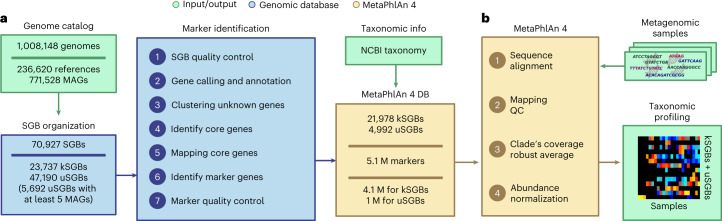
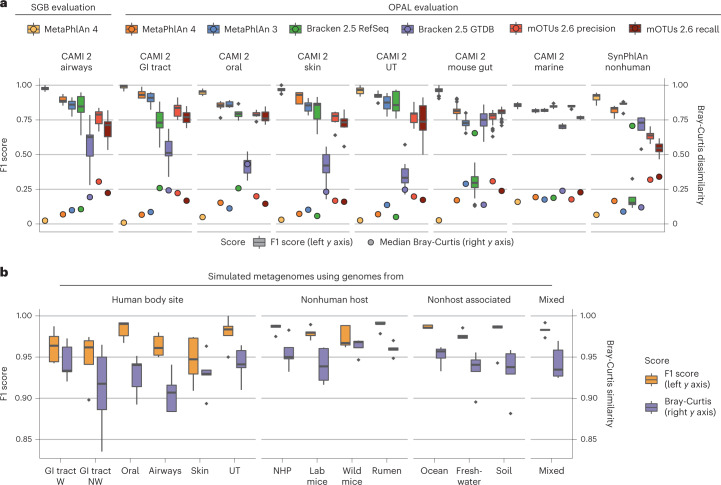
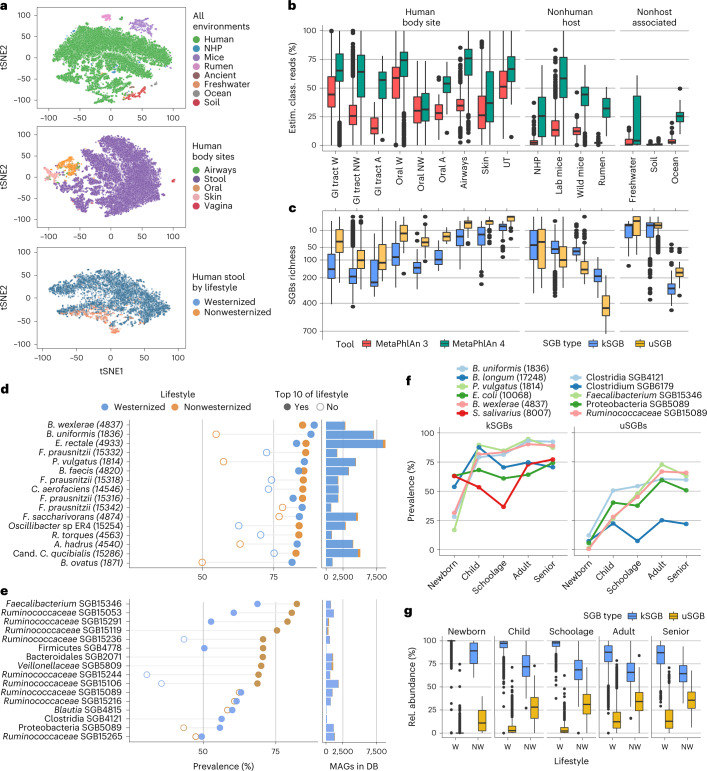
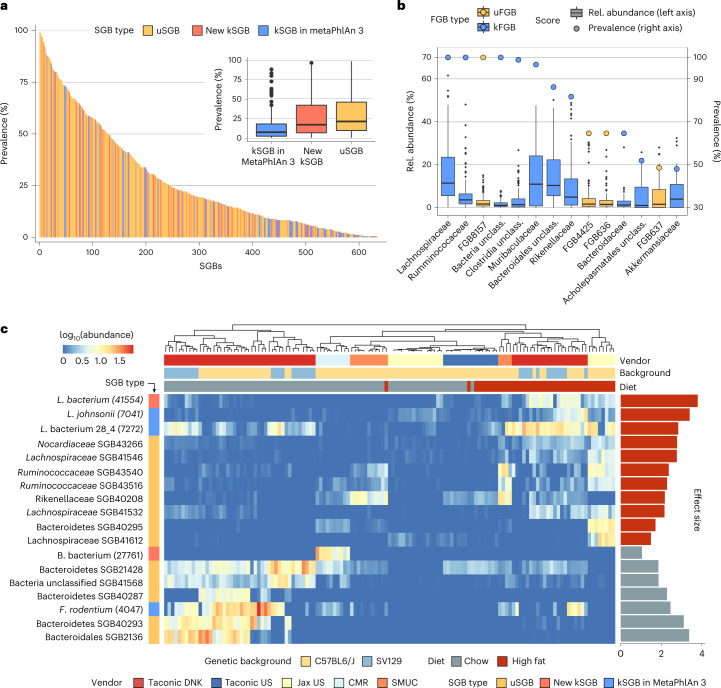
Metagenomic assembly enables new organism discovery from microbial communities, but it can only capture few abundant organisms from most metagenomes. Here we present MetaPhlAn 4, which integrates information from metagenome assemblies and microbial isolate genomes for more comprehensive metagenomic taxonomic profiling. From a curated collection of 1.01 M prokaryotic reference and metagenome-assembled genomes, we define unique marker genes for 26,970 species-level genome bins, 4,992 of them taxonomically unidentified at the species level. MetaPhlAn 4 explains ~20% more reads in most international human gut microbiomes and >40% in less-characterized environments such as the rumen microbiome and proves more accurate than available alternatives on synthetic evaluations while also reliably quantifying organisms with no cultured isolates. Application of the method to >24,500 metagenomes highlights previously undetected species to be strong biomarkers for host conditions and lifestyles in human and mouse microbiomes and shows that even previously uncharacterized species can be genetically profiled at the resolution of single microbial strains.
Overview
The claims and statistics of this paper haven’t been checked yet.
Free: it reads the open-access text and checks the first 5 claims that cite a source we can check. Create a free account to check every claim.
Integrity signals
Registry
Cites
Statistics
Figures
Verification
Claims the paper makes
The claims and statistics of this paper haven’t been checked yet.
Free: it reads the open-access text and checks the first 5 claims that cite a source we can check. Create a free account to check every claim.
Claims other papers make about this one
Each is checked against this paper’s own text: does it say what the citing paper says it does?
The cited source says what the claim attributes to it.
In the citing paper
“we performed a meta-analysis and mega-analysis of stools taxonomically profiled with MetaPhlAn 4 (ref. 37) and from patients enrolled in 12 cohorts from eight published studies26,38–44 across three cancer types, and classified as responders (n = 248) or non-responders (n = 513) based on RECIST1.1 criteria response rates”
From Gut OncoMicrobiome Signatures (GOMS) as next-generation biomarkers for cancer immunotherapy (2023) · cites this paper as [37]
The cited source says what the claim attributes to it.
In the citing paper
“We further performed strain-level and strain-matching analysis via StrainPhlAn 4 84 (STAR Methods) and identified potential transmission patterns for some food-human overlapping SGBs (Figures 6 and S6).”
From Unexplored microbial diversity from 2,500 food metagenomes and links with the human microbiome. (2024) · cites this paper as [84]
The check wasn’t confident either way, so it gives no verdict — never disputed.
In the citing paper
“A meta- and mega-analysis of stools obtained from patients with cancer treated with ICIs showed that GOMS associated with ICI resistance comprised microorganisms affiliated with chronic inflammation and immunosuppression and oral genera, and were shared across various pathological disorders.22,155”
From Melanoma and microbiota: Current understanding and future directions (2024) · cites this paper as [155]
Experimental — accuracy not yet measuredIn the citing paper
“We used MetaPhlAn 4 (ref. 37) for microbiome taxonomic profiling of stool samples from 1,879 adults across eight different cancer types (included in 30 cohorts from 23 published studies)25–29,38–55 and from a control group comprising 5,341 individuals without cancer (included in 17 cohorts from 14 published studies)”
From Gut OncoMicrobiome Signatures (GOMS) as next-generation biomarkers for cancer immunotherapy (2023) · cites this paper as [37]
In the citing paper
“Taxonomic profiling was performed at the level of species-level genome bins (SGBs) using MetaPhlAn4, which represent both existing and yet-to-be-characterized microbial species17.”
From Longitudinal gut microbiome changes in immune checkpoint blockade-treated advanced melanoma (2024) · cites this paper as [17]
1 more claim about this paper
Create a free account to see every claim other papers make about this one.
Self-check
Percentages, sums and reported differences re-computed from the paper’s own numbers.
The self-check needs the paper’s full text.
Citations
Cites
The Sequence Alignment/Map format and SAMtools
Li, H., Handsaker, B., Wysoker, A., Fennell, T., Ruan, J., Homer, N., Marth, G., Abecasis, G., Durbin, R., & 1000 Genome Project Data Processing Subgroup (2009) · Bioinformatics · doi:10.1093/bioinformatics/btp352 · Cited by 62,041 · cited 1×
“For item (1), StrainPhlAn 4 considers as input the reads-to-markers alignment results (in SAM format 96 ) from the MetaPhlAn 4 profiling together with the MetaPhlAn 4 database.”
MethodFast gapped-read alignment with Bowtie 2
Langmead, B., & Salzberg, S. L. (2012) · Nature Methods · doi:10.1038/nmeth.1923 · Cited by 56,400 · cited 1×
“To detect the SGB-specific marker genes, each set of core genes was then aligned against the genomes of the other SGBs using Bowtie 2 (version 2.3.5.1; -- sensitive parameter) 83 .”
MethodInfluentialMAFFT Multiple Sequence Alignment Software Version 7: Improvements in Performance and Usability
Katoh, K., & Standley, D. M. (2013) · Molecular Biology and Evolution · doi:10.1093/molbev/mst010 · Cited by 46,209 · cited 2×
“By default, multiple-sequence alignment is performed by MAFFT 92 , gappy positions (that is, positions with more than 67% of gaps) are trimmed by trimAl 91 and phylogenetic trees are inferred by RAxML 97 .”
MethodInfluentialRAxML version 8: a tool for phylogenetic analysis and post-analysis of large phylogenies
Stamatakis, A. (2014) · Bioinformatics · doi:10.1093/bioinformatics/btu033 · Cited by 32,291 · cited 3×
“By default, multiple-sequence alignment is performed by MAFFT 92 , gappy positions (that is, positions with more than 67% of gaps) are trimmed by trimAl 91 and phylogenetic trees are inferred by RAxML 97 .”
MethodInfluentialIQ-TREE: A Fast and Effective Stochastic Algorithm for Estimating Maximum-Likelihood Phylogenies
Nguyen, L.-T., Schmidt, H. A., von Haeseler, A., & Minh, B. Q. (2015) · Molecular Biology and Evolution · doi:10.1093/molbev/msu300 · Cited by 26,046
Prokka: rapid prokaryotic genome annotation
Seemann, T. (2014) · Bioinformatics · doi:10.1093/bioinformatics/btu153 · Cited by 18,818
Fast and sensitive protein alignment using DIAMOND
Buchfink, B., Xie, C., & Huson, D. H. (2015) · Nature Methods · doi:10.1038/nmeth.3176 · Cited by 14,201
trimAl: a tool for automated alignment trimming in large-scale phylogenetic analyses
Capella-Gutiérrez, S., Silla-Martínez, J. M., & Gabaldón, T. (2009) · Bioinformatics · doi:10.1093/bioinformatics/btp348 · Cited by 12,751 · cited 1×
“By default, multiple-sequence alignment is performed by MAFFT 92 , gappy positions (that is, positions with more than 67% of gaps) are trimmed by trimAl 91 and phylogenetic trees are inferred by RAxML 97 .”
MethodParks, D. H., Imelfort, M., Skennerton, C. T., Hugenholtz, P., & Tyson, G. W. (2015) · Genome Research · doi:10.1101/gr.186072.114 · Cited by 12,496
Diet rapidly and reproducibly alters the human gut microbiome
David, L. A., Maurice, C. F., Carmody, R. N., Gootenberg, D. B., Button, J. E., Wolfe, B. E., Ling, A. V., Devlin, A. S., Varma, Y., Fischbach, M. A., et al. (2014) · Nature · doi:10.1038/nature12820 · Cited by 10,100
Cited by
Items 701–800 of 1,000
Real, M. V. F., Colvin, M. S., Sheehan, M. J., & Moeller, A. H. (2024) · Microbiology Spectrum · doi:10.1128/spectrum.03566-23 · Cited by 4
Vasiliauskienė, D., Pranskevičius, M., Dauknys, R., Urbonavičius, J., Lukša, J., Burko, V., & Zagorskis, A. (2024) · Microorganisms · doi:10.3390/microorganisms12010109 · Cited by 3
“Microbial composition was profiled using MetaPhlAn4 [26].”
Liu, C., Tang, Z., Li, L., Kang, Y., Teng, Y., & Yu, Y. (2024) · Chinese Medical Journal · doi:10.1097/cm9.0000000000003182 · Cited by 3
“Researchers can initially use tools like MetaPhlAn (Blanco-Míguez et al [15] , https://huttenhower.sph.harvard.edu/metaphlan/) or Kraken (Derrick et al [27] , https://ccb.jhu.edu/software/kraken2/) to determine the microbial composition of the metagen-ome.”
BackgroundMethodRFW captures species-level metagenomic functions by integrating genome annotation information
Mi, K., Xu, R., & Liu, X. (2024) · Cell Reports Methods · doi:10.1016/j.crmeth.2024.100932 · Cited by 6
Kiguchi, Y., Hamamoto, N., Kashima, Y., Runtuwene, L. R., Ishizaka, A., Kuze, Y., Enokida, T., Tanaka, N., Tahara, M., Kageyama, S.-I., et al. (2025) · Nature Communications · doi:10.1038/s41467-025-62406-5 · Cited by 7
“GO enrichment was performed using ShinyGO 8.0 91 .”
InfluentialDeepCRC: Precision Colorectal Cancer Diagnosis Using Deep Learning and Metagenomic Biomarkers
Wang, H., Li, Y., Feng, Y. X., Shen, K., Lu, C. F., & Xie, Z. (2024) · IEEE International Conference on Bioinformatics and Biomedicine (BIBM) · doi:10.1109/bibm62325.2024.10822422 · Cited by 3
“Following this, we utilized MetaPhlAn to analyze the taxonomic structure of the microbiomes present in our samples [30].”
Benchmarking the impact of reference genome selection on taxonomic profiling accuracy
van Bemmelen, J., Nika, I., & Baaijens, J. A. (2026) · BMC Genomics · doi:10.1186/s12864-026-12874-w · Cited by 5
“Marker-based taxonomic profiling tools, like MetaPhlan [6] and mOTUs [7], use databases which only store marker gene sequences.”
Huang, C., Rosolowsky, E. T., Nour, M. A., Butalia, S., Ho, J., Mayengbam, S., Wang, W., Pyke, S., Virtanen, H., & Reimer, R. A. (2025) · BMJ Open · doi:10.1136/bmjopen-2025-102486 · Cited by 5
Multi-system dysregulation in placental malaria contributes to adverse perinatal outcomes in mice
Ekregbesi, P., Seibert, B., Parish, M. A., Flores-García, Y., Creisher, P. S., Hoffmann, J. P., Liu, J. A., Brayton, C. F., Zavala, F. P., & Klein, S. L. (2025) · Infection and Immunity · doi:10.1128/iai.00021-25 · Cited by 4
Phosphate-solubilizing function of Pediococcus pentosaceus PSM16 and its underlying mechanism
Hong, Y., Shasha, C., Mengyao, L., Li, W., Yan, G., Mengjiao, L., Qian, Z., Siyuan, Z., Diao, Z., Li, X., et al. (2025) · Microbiology Spectrum · doi:10.1128/spectrum.00491-25 · Cited by 4
“Subsequently, MetaPhlAn 4 was utilized for bacterial species detection (48), which identified 885 species within the SRP328020 data set (47).”
Pletsch, E. A., Smith, A. D., Ragonese, J., Narrowe, A. B., Cheung, L., Chen, C. T., Wang, T. T. Y., & Dawson, H. D. (2025) · Journal of Nutrition · doi:10.1016/j.tjnut.2025.05.041 · Cited by 3
Soler, Z., Serrano-Gómez, G., Pons-Tarín, M., Vega‐Abellaneda, S., Xie, Z., Manjón, I., Cognard, C., Varela, E., Yáñez, F., Noguera-Segura, A., et al. (2025) · npj Biofilms and Microbiomes · doi:10.1038/s41522-025-00769-9 · Cited by 3
Ashton, P., Mageiros, L., Meiring, J., Chirambo, A. C., Khanam, F., Dongol, S., Banda, H., Karkey, A., Preciado‐Llanes, L., Thomaides-Brears, H. B., et al. (2025) · Microbiome · doi:10.1186/s40168-025-02125-7 · Cited by 4
Seki, M., Zhang, Y., & Imoto, S. (2024) · Bioinformatics Advances · doi:10.1093/bioadv/vbaf181 · Cited by 3
Zhang, F., Li, A., Zhu, K., Zhang, K., Tian, Z., Wang, T., Zhang, X.-H., Zang, J., Sun, X., Shen, W., et al. (2025) · Journal of Hazardous Materials · doi:10.1016/j.jhazmat.2025.139476 · Cited by 4
The Effect of Sodium Benzoate on the Gut Microbiome Across Age Groups
Lemons, J. M. S., Firrman, J., Mahalak, K. K., Liu, L., Narrowe, A. B., Higgins, S., Moustafa, A. M., Baudot, A., Deyaert, S., & den Abbeele, P. V. (2025) · Foods · doi:10.3390/foods14172949 · Cited by 3
“Trimmed and filtered reads were input to MetaPhlAn v 4.1.1 (using the vJun23_CHOCOPhlAnSGB_202403 reference database) [20].”
InfluentialProfiling bile acids in the stools of humans and animal models of cystic fibrosis
Carmichael, M. M., Valls, R. A., Soucy, S. M., Sanville, J. L., Madan, J. C., Surve, S. V., Sundrud, M. S., & O’Toole, G. A. (2025) · Microbiology Spectrum · doi:10.1128/spectrum.01451-25 · Cited by 3
Li, Q., Liu, F., Zhong, J., Fang, X., Zhang, X., Xiong, H., Li, G., & Chen, H. (2025) · Frontiers in Microbiology · doi:10.3389/fmicb.2025.1656016 · Cited by 7
MetaflowX: a scalable and resource-efficient workflow for multi-strategy metagenomic analysis
Xia, Y., Liang, L., Wang, X., Chen, Z., Liu, J., Yang, Y., Xie, H., Ding, Z., Huang, X., Long, S., et al. (2025) · Nucleic Acids Research · doi:10.1093/nar/gkaf954 · Cited by 4
“Among these, MetaPhlAn4 [ 20 ], HUMAnN3 [ 15 ] (components of bioBakery), and nf-core / taxprofiler employ reference-based methodologies that rely on aligning sequencing reads to isolate genomes, gene catalogs, or established reference marker gene datasets.”
Hou, J., Liu, M., Li, Y., Li, L., Yao, Y., Xu, H., & An, Y. (2025) · Environment International · doi:10.1016/j.envint.2025.109840 · Cited by 3
Chandel, N., Patel, P., Somvanshi, P. R., Verma, A. K., & Thakur, V. (2025) · Journal of Nutrition · doi:10.1016/j.tjnut.2025.10.021 · Cited by 3
Faitová, T., Ilett, E. E., da Cunha‐Bang, C., Sengeløv, H., Brieghel, C., Gülay, A., Rafiq, S., Ravn, H. B., Zheng, C., Nielsen, R. V., et al. (2025) · Microbiology Spectrum · doi:10.1128/spectrum.00944-25 · Cited by 3
Lam, A. Y.-T., Lau, C.-H., Tam, W.-Y., Chan, C. T.-M., Lok, T.-M., Suen, L. K. P., Lee, L.-K., Yeung, E. Y.-Y., Lam, T.-K., Cheung, W.-K., et al. (2025) · Environmental Microbiome · doi:10.1186/s40793-025-00806-2 · Cited by 6
“1.1) [47].”
InfluentialĆosić, A., Halwachs, B., Schild-Prüfert, K., Zechner, E. L., & Kienesberger, S. (2025) · Gut Microbes · doi:10.1080/19490976.2025.2582900 · Cited by 3
“2.2), 56 applying a 1% relative abundance cutoff, and with SRST2 57 in combination with the KoSCAPE bla OXY gene variant database, using thresholds of 95% coverage and 3% divergence for species–level detection.”
InfluentialHu, P., Carr, A. N., Parlov, M., Swift, D. D., Tiesman, J. P., Ramji, B., Schoch, J. J., & Teufel, A. G. (2025) · Microorganisms · doi:10.3390/microorganisms13112632 · Cited by 4
“06 [24], a profiling algorithm using clade-specific marker genes and Kraken2 version 2.1.3 [25], a K-mer-based algorithm with an expanded database including ~3000 fungal genomes from NCBI.”
InfluentialCharacterization of the gut virome in patients with nonalcoholic fatty liver disease
Wang, L., Wang, L., Liu, M., Yuan, Q., Cheng, L., Chen, H., Mao, S., Li, S., Yan, Q., Xing, G., et al. (2025) · Journal of Translational Medicine · doi:10.1186/s12967-025-07443-w · Cited by 4
“The gut bacterial composition was profiled from fecal metagenomic data using MetaPhlAn4 [18], which performs taxonomic classification based on clade-specific marker genes.”
Shotgun metagenomics reveals distinct skin microbial species in allergen-sensitized individuals
Riskumäki, M., Ruuskanen, M. O., Mäenpää, K., Ruokolainen, L., Mäkelä, M. J., Jousilahti, P., Vartiainen, E. A., Ottman, N., Laatikainen, T. K., Haahtela, T., et al. (2025) · Microbial Genomics · doi:10.1099/mgen.0.001527 · Cited by 3
“0.2), we identified sample-specific strains within species with sufficient coverage by setting the StrainPhlAn option MARKER_IN_N_SAMPLES to 40 (marker is found in 40% of the samples) [23, 27].”
InfluentialMetagenomic profiling of airborne microbial communities from aircraft filters and face masks
Oumer, O. J., Sumner, J. T., Moghadam, A. A., Thompson, K. N., Huttenhower, C., Catlett, C., & Hartmann, E. M. (2025) · Microbiome · doi:10.1186/s40168-025-02276-7 · Cited by 3
“Metagenomic assembly and binning often recover only a subset of organisms within complex communities due to uneven coverage, low-abundance taxa, and challenges posed by high strain similarity that can hinder or fragment assemblies [25, 47].”
Self-citationA signature-protein-based approach for accurate and efficient profiling of the human gut virome
Yang, F., Xiong, L., Li, M., Feng, X., Ren, H., Shi, Z., Zhong, H., & Li, J. (2025) · Cell Reports Methods · doi:10.1016/j.crmeth.2025.101250 · Cited by 3
Sonets, I. V., Galeeva, I. S., Krivonos, D. V., Pavlenko, A. V., Vvedensky, A. V., Ahmetzyanova, A. A., Mikaelyan, K. A., Ilina, E. N., Олегович, Я. О., Revazova, Z. E., et al. (2025) · Dentistry Journal · doi:10.3390/dj13120590 · Cited by 3
Extensive cultivation of human gut phages revealing undescribed Bacteroidaceae phages
Liu, Z., Yang, Y., Mao, S., Wang, Z., Zhu, Q., Yuan, Y., & Xiang, Y. (2025) · Gut Microbes · doi:10.1080/19490976.2025.2597614 · Cited by 4
Yuan, F., Wang, L., Nguyen, S. M., Shu, X., Shrubsole, M. J., Wen, W., Cai, Q., Yu, D., & Zheng, W. (2025) · American Journal of Clinical Nutrition · doi:10.1016/j.ajcnut.2025.101135 · Cited by 4
González-Valdivia, C., Tong, B., Hjalmarsson, S., Guðnadóttir, U., Wagner, N. Y., Engstrand, L., Schuppe‐Koistinen, I., Fransson, E., Prast‐Nielsen, S., Brusselaers, N., et al. (2025) · Gut Microbes Reports · doi:10.1080/29933935.2025.2603861 · Cited by 4
Robert, M., Saha, S., Dizman, N., Rohlfs, M. L., Sirmans, E., Simon, J. M., Amaria, R., Oliva, I. C. G., Tawbi, H. A., Davies, M. A., et al. (2025) · Nutrients · doi:10.3390/nu18010040 · Cited by 3
Majzoub, M. E., Santiago, F. S., Raich, S. S., Sirigeri, P., Simovic, I., Tedla, N. T., & Kaakoush, N. O. (2026) · Gut Microbes · doi:10.1080/19490976.2025.2611543 · Cited by 3
“Quality filtered reads were analyzed using MetaPhlAn4 (database vOct22) 28 to generate tables with relative abundances of taxa classified to the species-genome bin (SGB) level using a marker-based analysis (t_ level in MetaPhlAn4 output).”
Liu, C., Xing, Y., Su, J., Liu, Y., Dou, Y., Wang, Z., Sha, S., Yan, Q., Xu, M., Zhao, L., et al. (2026) · Scientific Reports · doi:10.1038/s41598-025-33939-y · Cited by 3
Buffoni, M., Kerkvliet, J. J., Enting, H., Kers, J. G., Rogers, M. R. C., de Visser, J. A. G. M., Paganelli, F. L., Willems, R. J. L., & Schürch, A. C. (2026) · Animal Microbiome · doi:10.1186/s42523-025-00497-7 · Cited by 4
“To construct a taxonomic profile for each sample, Metaph-lan 4.0.3 [29] was employed, using its default parameters.”
InfluentialSchneeberger, P. H. H., Dommann, J., Rahman, N., Hürlimann, E., Sayasone, S., Ali, S., Coulibaly, J. T., & Keiser, J. (2026) · npj Biofilms and Microbiomes · doi:10.1038/s41522-026-00911-1 · Cited by 4
2Pipe starts with a question: matching you with the correct pipeline for MAG reconstruction
Yepes-García, J., & Falquet, L. (2026) · mSystems · doi:10.1128/msystems.00844-25 · Cited by 4
“Month XXXX Volume 0 Issue 0 10.1128/msystems.00844-25 5 C h e c k M 2 a n d G U N C”
InfluentialLiepina, E. E., Sīviņa, E., Jurkane, L., & Daneberga, Z. (2026) · Diagnostics · doi:10.3390/diagnostics16030433 · Cited by 3
Linking the microbiome to the complement system in geographic atrophy
Spörri, L. A., Studer, J. M., Kreuzer, M., Rotzetter, J., Schärer, D., Largiadèr, C. R., Jaggi, D., Zinkernagel, M. S., & Zysset‐Burri, D. C. (2026) · npj Genomic Medicine · doi:10.1038/s41525-026-00550-7 · Cited by 5
Levhar, N., Hadar, R., Braun, T., Shacham, H., Algavi, Y. M., Naamneh, R., Efroni, G., Agranovich, B., Abramovich, I., Asher, A. T., et al. (2026) · Scientific Reports · doi:10.1038/s41598-026-38558-9 · Cited by 3
“0.0 43 and functional profiles, including KEGG level 3 ontology 44 , using HUMAnN v3.”
InfluentialImpact of contact lenses on the ocular surface microbiome, tear proteome, and dry eye disease
Kopp, O. S., Morandi, S. C., Kreuzer, M., Uldry, A., Eldridge, N., Zinkernagel, M. S., & Zysset‐Burri, D. C. (2026) · Microbiology Spectrum · doi:10.1128/spectrum.02264-25 · Cited by 3
Associations Between Gut Microbiome Enterotypes and Body Weight Change During Whole Milk Consumption
Qin, P., Berzina, L., Geiker, N. R. W., Sandby, K., Krarup, T., Kristiansen, K., & Magkos, F. (2026) · Nutrients · doi:10.3390/nu18040563 · Cited by 3
Secker, B., Nayak, A. R., Husain, A. A., Arora, S., Nag, A., Shrivastava, S. K., Singer, A. C., Gomes, R. L., Acheampong, E. A., Chidambaram, S. B., et al. (2026) · Frontiers in Microbiology · doi:10.3389/fmicb.2025.1722229 · Cited by 4
Antibiotic resistance genes (ARGs) in rice: Source attribution and putative mobility patterns
Hou, J., Li, Y., Liu, M., Li, L., Chen, H., An, Y., Xu, H., & Yao, Y. (2026) · Food Microbiology · doi:10.1016/j.fm.2026.105055 · Cited by 3
HYMET: a hybrid metagenomic pipeline for accurate and efficient taxonomic classification
Silva, J. M., Martins, I. B., & Almeida, J. R. (2026) · GigaScience · doi:10.1093/gigascience/giag024 · Cited by 3
“…4, which excel at species-level assignments but sacrifice intermediate-rank accuracy and per-contig labeling capabilities, HYMET balances precision and recall consistently across multiple ranks, which is crucial for downstream metagenomic work-flows such as genome binning [ 15 , 23 , 71 ].”
Gut virome and metabolic associations in patients with acute pancreatitis
Liu, M., Wang, L., Liu, J., Yuan, Q., Zhang, Y., Wu, S., Zhang, Y., Guo, R., Zhang, Y., Lu, T., et al. (2026) · mSystems · doi:10.1128/msystems.01400-25 · Cited by 4
Integrating ANI and phylogenies for re-evaluation of Fusobacterium taxonomy and disease associations
Bi, D., Wu, Y., Ji, G., Zhu, X., Li, H., Xie, R., Gao, Y., Deng, Z., Han, D., Qin, H., et al. (2026) · Nature Communications · doi:10.1038/s41467-026-70540-x · Cited by 3
“To demonstrate the broader applicability ofthe revised Fusobacterium taxonomy, we integrated it with two representative bioinformatics toolkits, the genome taxonomy database (GTDB) 49 and MetaPhlAn 50 .”
Alvarado, D. A., Holthaus, T. A., Martell, S. G., Southey, N. L., Atallah, M., Sarma, R., Revilla, D., Brown, M., Mehta, T. D., Khan, N. A., et al. (2026) · Journal of Nutrition · doi:10.1016/j.tjnut.2026.101473 · Cited by 4
“0.6) [77], with Bowtie2 (v2.”
InfluentialKun-peng enables scalable and accurate pan-domain metagenomic classification
Chen, Q., Zhang, B., Peng, C., Huang, J., Liu, Z., Shen, X., & Jiang, C. (2026) · Briefings in Bioinformatics · doi:10.1093/bib/bbag119 · Cited by 4
“Marker-based methods, exemplified by MetaPhlAn4, achieve precise taxonomic assignments with small memory footprints but are limited to bacteria, archaea, and selected single-celled eukaryotes due to their clade-specific marker databases [8].”
Vázquez-Castellanos, J. F., Yoon, S. J., Won, S., Raes, J., Kwon, H. C., Si, J., & Suk, K. T. (2026) · Gut · doi:10.1136/gutjnl-2025-337436 · Cited by 3
Scale reliant mixed effects models enhance microbiome data analysis
McGovern, K. C., & Silverman, J. D. (2026) · Microbiome · doi:10.1186/s40168-026-02377-x · Cited by 4
Yersin, S., Gody, J., Mazel, F., Djimbele, E., Nigateloum, S. N., Gondje, B. P., Vondo, S. S., Kandou, K. J. E., Raub, A., Teo, Y., et al. (2026) · Gut Microbes · doi:10.1080/19490976.2026.2653550 · Cited by 5
Harshvardhan, Kaur, M., Grover, V., Pinnaka, A. K., & Korpole, S. (2026) · Frontiers in Microbiology · doi:10.3389/fmicb.2026.1799124 · Cited by 3
Day, R., Friedman, D. L., Cardoso, A., Naghibi, M., Pont-Beltran, A., Martínez-Blanch, J. F., Lamelas, A., Chenoll, E., Kakilla, C., Rea, K., et al. (2026) · Brain Sciences · doi:10.3390/brainsci16040419 · Cited by 3
“…[26], quality of life measured with the SF-36 [27], mood measured by the BDI and PHQ-9 [28], sleep measured by the PSQI [29], gastrointestinal complaints measured by the GSRS [30], perceived stress measured by the PSS [31] and physiological stress measured via salivary cortisol awakening response.”
Distinct signatures in the human gut and oral microbiomes of gastric cancer
Qin, Y., Zhang, Y.-X., Liu, L.-P., Xie, Y.-H., Ma, X.-Y., Hao, Y., Zhao, L.-C., Dong, J.-J., He, Y., Sun, K., et al. (2026) · Cell Reports Medicine · doi:10.1016/j.xcrm.2026.102761 · Cited by 4
Lee, E. M., McNulty, N. P., Hibberd, M. C., Cheng, J., Ahsan, K., Chang, H.-W., Cohen, B. A., & Gordon, J. I. (2026) · Nature Communications · doi:10.1038/s41467-026-71871-5 · Cited by 3
“…sequencing of microbial community DNA (metagenomics) has catalyzed an explosion of methods for testing the association of microbes with health and disease states 23 – 28 , predicting their encoded functions 29 – 33 , and assembling their individual genomes (metagenome-assembled genomes) 34 – 37 .”
Mouali, Y. E., Tawk, C., Huang, K. D., Sivapornnukul, P., Mengoni, C., Segata, N., & Strowig, T. (2026) · Cell Host & Microbe · doi:10.1016/j.chom.2026.04.006 · Cited by 4
Self-citationNogal, A., Wang, K., Thompson, K. N., Kim, H., Bhosle, A., Piccinno, G., Maharjan, S., Upreti, C. R., Nguyen, L. H., Segata, N., et al. (2026) · Cell Host & Microbe · doi:10.1016/j.chom.2026.05.001 · Cited by 3
Self-citationIntegration of donor microbiota following FMT correlates with anti-PD-1 response in melanoma
Fessler, J. L., Olm, M. R., Engleman, E. G., & Sonnenburg, J. L. (2026) · Nature Communications · doi:10.1038/s41467-026-73465-7 · Cited by 7
“Model inputs consist of MetaPhlAn4-derived species relative abundance pro fi les, which were used by the pretrained GALAXY/Micro-bLiver model to estimate total fecal microbial load (cells per gram of stool).”
InfluentialSingh, S., Al-Zharani, M., Barasarathi, J., Tan, C. S., Jaiswal, S. K., Srivastava, U., Sagar, A., & Sayyed, R. Z. (2026) · Current Genomics · doi:10.1016/j.curgen.2026.06.003 · Cited by 3
Hensen, A. D. O., Harmanus, C., Verbeek-Menken, P. H., Koopman, J. P. R., Lamers, O. A. C., Roozen, G. V. T., Janse, J. J., Balke-Buijs, M., van der Stoep, M. Y. E. C., Meij, P., et al. (2026) · Nature Communications · doi:10.1038/s41467-026-74327-y · Cited by 4
Zhao, Y., Chen, L., Li, C., Xu, Y., Huang, J., Chen, S., Yu, Z., & Liu, X. (2026) · mSystems · doi:10.1128/msystems.00194-26 · Cited by 4
Subclinical cholestasis is a hallmark of gut dysbiosis causing resistance to cancer immunotherapy
Varende, A.-L. M. D. L., Tian, A.-L., Thomas, S., Lahmar, I., Messaoudene, M., Li, S., Motiño, O., Guillaume-dit-Taunière, H., Iebba, V., Hurtado, Y., et al. (2026) · Cancer Cell · doi:10.1016/j.ccell.2026.06.022 · Cited by 5
Wei, M., Lian, T., Chen, L., Wang, L., Ye, J., Yao, X., Duan, S., Lu, Z., Jinji, T. U., Li, H., et al. (2026) · iMeta · doi:10.1002/imt2.70152 · Cited by 5
Qian, Z., Han, J., Lyu, B., Ainiwaer, A., Zhao, Q., Wang, S., Cheng, J., Li, Y., Sun, Y., Zhang, X., et al. (2026) · Gut · doi:10.1136/gutjnl-2026-339115 · Cited by 3
Bucher-Johannessen, C., Kværner, A. S., Birkeland, E. E., Botteri, E., Avershina, E., Bemanian, V., Hoff, G. S., Randel, K. R., Hovig, E. J., Berstad, P. M., et al. (2026) · Biology of Sex Differences · doi:10.1186/s13293-026-00985-8 · Cited by 3
Kumar, A., Sharma, R., Bokolia, M., Riyapi, D. A. S., Kumar, S., CHABBRA, R., & Singh, B. (2024) · Pedosphere · doi:10.1016/j.pedsph.2024.09.001 · Cited by 3
Chen, Y.-C., Su, Y.-Y., Chu, T.-Y., Wu, M.-F., Huang, C.-C., & Lin, C.-C. (2025) · npj Biofilms and Microbiomes · doi:10.1038/s41522-024-00598-2 · Cited by 3
“Taxonomic pro fi ling and quanti fi cation were then performed using MetaPhlAn 4.0.2 57 (with the database updated as of October 2022).”
InfluentialDistribution status and influencing factors of antibiotic resistance genes in the Chaohu Lake, China
Zhang, Y., Ding, G., Gao, Y., Li, Y., Zhou, P., Li, W., Zhou, M., Wang, J., & Tang, J. (2025) · PeerJ · doi:10.7717/peerj.19384 · Cited by 5
Goldschmidt, I., Kramer, M., Junge, N., Ouro-Djobo, N., Poets, A., Rathert, M., Geffers, R., Baumann, U., Hartleben, B., Schulze, K. D., et al. (2025) · Liver Transplantation · doi:10.1097/lvt.0000000000000659 · Cited by 4
Huang, X., Gao, X., Fan, Y., Wang, D., Chen, X., Qi, X., Yang, Z., Wang, Y.-E., Meng, J., Zou, G., et al. (2025) · Virulence · doi:10.1080/21505594.2025.2530660 · Cited by 3
“0.6) [56], which used clade-specific markers to provide pan-microbial (i.e. bacterial, archaeal and eukaryotic) quantification at species-level.”
InfluentialBabenkova, P. I., Gureev, A. P., Sadovnikova, I. S., Burakova, I. Y., Dmitrievna, S. Y., Pogorelova, S. V., Morozova, P., Gribovskaya, V., Adzhemian, D., & Syromyatnikov, M. (2025) · Microorganisms · doi:10.3390/microorganisms13081751 · Cited by 3
“Taxonomic profiling of samples was performed using MetaPhlAn 4 (Version 4.1.1) with standard bacterial, viral, and eukaryotic databases [12].”
InfluentialGenetic sex prediction from human gut shotgun metagenomic data: An ethical appraisal
Mollick, S. A. (2025) · Forensic Science International · doi:10.1016/j.forsciint.2025.112585 · Cited by 3
Kim, H. S., Kim, B., Nam, B., Oh, S. J., Park, S. K., Lee, S. W., Lee, J., Jo, S., Lee, Y.-A., Lee, J., et al. (2025) · BMJ Open · doi:10.1136/bmjopen-2024-092075 · Cited by 3
“53 The functional compositions of the microorganisms present in the samples will be determined using the HUMAnN3 programme.”
A model, mixed-species urinary catheter biofilm derived from spinal cord injury patients
Noorian, P., Hamann, K., Hoque, M. M., Espinoza-Vergara, G., To, J., Leo, D., Chari, P., Weber, G., Marial, O., Pryor, J., et al. (2025) · Biofilm · doi:10.1016/j.bioflm.2025.100332 · Cited by 4
“Metaphlan 4.1.1 [57] and Strainphlan 4.1 [58] were used to track individual strains across samples and determine whether there was strain specific divergence or the presence of a multi-strain species complex.”
InfluentialMADRe: Strain-level metagenomic classification through assembly-driven database reduction
Lipovac, J., Šikić, M., Vicedomini, R., & Križanović, K. (2026) · GigaScience · doi:10.1093/gigascience/giag030 · Cited by 4
“Despite these advances, a central challenge in metagenomic analysis is the accurate identification of organisms present in a sample, typically performed by comparing sequencing reads to reference genome databases [ 4 ].”
Instance-based transfer learning enables cross-cohort early detection of colorectal cancer
Sun, Y., Wu, S., Wu, Z., Zhu, W., Gao, H., Xing, J., Zhao, J., Fan, X., & Su, X. (2026) · npj Biofilms and Microbiomes · doi:10.1038/s41522-026-01001-y · Cited by 4
“Rawmetagenomicsequences were fi ltered by quality control and host removal, and then taxonomic and functional pro fi les were parsed by MetaPhlAn4 35 and HUMAnN3 36 , respectively, with consistent parameter settings across all datasets (refer to Methods for details).”
happi: a hierarchical approach to pangenomics inference
Trinh, P., Clausen, D. S., & Willis, A. D. (2023) · Genome biology · doi:10.1186/s13059-023-03040-6 · Cited by 3
Saragiotto, G. K., de Oliveira, L. F. V., de Oliveira, M. M., Simabuco, F. M., Belli, T., & Antunes, A. E. C. (2023) · Scandinavian Journal of Medicine and Science in Sports · doi:10.1111/sms.14512 · Cited by 3
Sim, K. H., Ho, J., Lim, J. Q., Chan, S. H., Li, A., & Chng, K. R. (2024) · Microbiology Spectrum · doi:10.1128/spectrum.03276-23 · Cited by 3
Talbot, B. M., Clennon, J. A., Rakotoarison, M. F. N., Rautman, L., Durry, S., Ragazzo, L. J., Wright, P. C., Gillespie, T. R., & Read, T. D. (2024) · PeerJ · doi:10.7717/peerj.17805 · Cited by 3
Role and Relation of Microbiome to Address Antimicrobial Resistance
Bhattacharya, C., Dinc, M. T., Basu, S., Chaudhuri, R., Fu, C., Cervantes, G., Adhikari, U. D., Panja, R., Qiu, J., Aditya, A., et al. (2024) · Springer eBooks · doi:10.1007/978-3-031-65986-7_6 · Cited by 3
Role of Computational Biology in Microbiome Research
Noor, F., Khurshid, M., Aslam, B., & Ashfaq, U. A. (2024) · Springer eBooks · doi:10.1007/978-981-97-3790-1_4 · Cited by 3
Burgio, V., & Raffaetà, R. (2024) · Biosemiotics · doi:10.1007/s12304-024-09586-7 · Cited by 5
“…in my interviews with the crew of Segata Lab is that of Law-sonibacter asaccharolyticus , a microbe that is associated with coffee consumption (Asnicar et al., 2021); its genomic identity corresponds to another taxonomic species (the Clostridium phoceensis ; see Blanco-Míguez et al., 2023).”
Ricci, L., Selma‐Royo, M., Golzato, D., Servais, C., Nabinejad, A., Marchi, P., Punčochář, M., Trenti, F., Garcia‐Aloy, M., Armanini, F., et al. (2025) · INTERNATIONAL JOURNAL OF SYSTEMATIC AND EVOLUTIONARY MICROBIOLOGY · doi:10.1099/ijsem.0.006798 · Cited by 3
“A further sequence mapping analysis against the MetaRef database (version June 2023) [4, 6] matched the 16S rRNA gene sequence of an unknown clade within the Catenibacterium genus.”
InfluentialSelf-citationStrainR2 accurately deconvolutes strain-level abundances in synthetic microbial communities
Heber, K., Tian, S., Betancurt-Anzola, D., Koo, H., & Bisanz, J. E. (2025) · Bioinformatics · doi:10.1093/bioinformatics/btaf440 · Cited by 3
Hillege, L. E., Trepka, K. R., Ziemons, J., Aarnoutse, R., Guthrie, B. G. H., de Vos‐Geelen, J., Iersel, L. V., van Hellemond, I. E. G., Baars, A., Vestjens, J. H. M. J., et al. (2024) · medRxiv · doi:10.1101/2024.10.11.24315249 · Cited by 3
Nickols, W. A., McIver, L. J., Walsh, A. M., Zhang, Y., Nearing, J. T., Asnicar, F., Punčochář, M., Segata, N., Nguyen, L. H., Hartmann, E. M., et al. (2024) · bioRxiv (Cold Spring Harbor Laboratory) · doi:10.1101/2024.11.08.622677 · Cited by 4
Self-citationMulti-omic Biomarkers Distinguish Rheumatoid Arthritis in Discordant Monozygotic TwinsPreprint
Blank, R. B., Bu, K., Chen, W., CUNNINGHAM, I. M., Sokolove, J. B., Lahey, L. J., Heguy, A., Medina, R., Úbeda, C., Nayak, R. R., et al. (2024) · medRxiv · doi:10.1101/2024.12.30.24319783 · Cited by 3
Banerjee, G., Papri, S. R., Huang, H., Satapathy, S. K., & Banerjee, P. (2025) · Scientific Data · doi:10.1038/s41597-024-04153-8 · Cited by 3
Hou, X., Wang, J., Wang, D.-X., Chen, Y., Li, X., Wu, W.-C., Le, S.-J., Mei, S.-Q., Liu, H.-L., Feng, Y., et al. (2025) · bioRxiv (Cold Spring Harbor Laboratory) · doi:10.1101/2025.01.09.632079 · Cited by 4
Towards a Generative Paradigm for Large-scale Microbiome Analysis by Generative Language ModelPreprint
Zhang, H., Kang, Z., Zhang, Y., Yang, R., & Ning, K. (2025) · bioRxiv (Cold Spring Harbor Laboratory) · doi:10.1101/2025.01.15.633278 · Cited by 4
Multi-omics Integration of Microbiota Transplant Therapy in Children with Autism Spectrum DisordersPreprint
Mallick, H., Nirmalkar, K., Adams, J. B., & Krajmalnik‐Brown, R. (2025) · bioRxiv (Cold Spring Harbor Laboratory) · doi:10.1101/2025.10.10.681677 · Cited by 3
Modasia, A. A., Reid, J. E. S. J., Alhasani, A. T., Dellschaft, N. S., Harris, H. C., Hoad, C. L., Gowland, P. A., Yakubov, G. E., Corsetti, M., Marciani, L., et al. (2026) · bioRxiv (Cold Spring Harbor Laboratory) · doi:10.64898/2026.04.07.717018 · Cited by 3
Genos-m: a foundation model for human-associated microbial genomesPreprint
Fang, C., Yang, F., Hou, H., Ren, H., Zhong, H., Xu, H., Zhang, J., Su, J., Cai, J., Yuan, J., et al. (2026) · bioRxiv (Cold Spring Harbor Laboratory) · doi:10.64898/2026.05.21.726868 · Cited by 3
“Genos-m generated genome-level embeddings for representative genomes of gut microbial species detected by MetaPhlAn4 [7].”
Yunusbaeva, M. M., Terentyeva, D. R., Borodinа, L. Y., Zakirova, A., Bulatov, S., Bilalov, F. S., & Yunusbayev, B. (2023) · Russian Journal of Infection and Immunity · doi:10.15789/2220-7619-iol-16867 · Cited by 2
Park, J. S., Kim, J., Kim, Y., Kim, K. H., Kwak, W., & Kim, I. (2024) · Current Genomics · doi:10.2174/0113892029314148240820082402 · Cited by 2
Esfand, S. M., Querdasi, F. R., Gancz, N. N., Savoca, P. W., Nussbaum, S. G., Somers, J. A., Ditzer, J., Figueroa, M. B., Chu, K. A., Towner, E., et al. (2024) · Brain Behavior & Immunity - Health · doi:10.1016/j.bbih.2024.100880 · Cited by 3
Metadata
- Authors
- Blanco-Míguez, A., Beghini, F., Cumbo, F., McIver, L. J., Thompson, K. N., Zolfo, M., Manghi, P., Dubois, L., Huang, K. D., Thomas, A. M., Nickols, W. A., Piccinno, G., Piperni, E., Punčochář, M., Valles-Colomer, M., Tett, A., Giordano, F., Davies, R., Wolf, J., Berry, S. E., Spector, T. D., Franzosa, E. A., Pasolli, E., Asnicar, F., Huttenhower, C., & Segata, N.
- Affiliations
- University of Trento (IT)
- Broad Institute (US)
- University of Vienna (AT)
- ZOE (United Kingdom) (GB)
- King's College London (GB)
- University of Naples Federico II (IT)
- Corresponding author
- Segata, Nicola
- ORCID
- Blanco-Míguez, Aitor
- Beghini, Francesco
- Cumbo, Fabio
- McIver, Lauren J.
- Thompson, Kelsey N.
- Zolfo, Moreno
- Manghi, Paolo
- Huang, Kun D.
- Thomas, Andrew Maltez
- Nickols, William A.
- Piccinno, Gianmarco
- Piperni, Elisa
- Punčochář, Michal
- Tett, Adrian
- Giordano, Francesca
- Davies, Richard
- Wolf, Jonathan
- Berry, Sarah E.
- Spector, Tim D.
- Franzosa, Eric A.
- Pasolli, Edoardo
- Asnicar, Francesco
- Huttenhower, Curtis
- Segata, Nicola
- Venue
- Nature Biotechnology
- Published
- 2023-02-23
- Volume
- 41
- Issue
- 11
- Pages
- 1633-1644
- ISSN
- 0733-222X (ISSN-L)
- 1087-0156
- 1546-1696
- PMC
- PMC10635831
- OpenAlex
- W4321611856
- Semantic Scholar
- e28eff291a1b5c8f0a98f826de240f846be03334
- Cited by
- 1,442
- References
- 101
- Citations by year
- 2026: 517 · 2025: 521 · 2024: 309 · 2023: 93
- FWCI
- 129.03
- Type
- journal article
- Language
- en
- Open access
- hybrid
- doi.org
- Licence
- cc-by
- creativecommons.org/licenses/by/4.0 (tdm)
- creativecommons.org/licenses/by/4.0 (vor)
- Locations
- Nature Biotechnology (publishedVersion, cc-by)
- PubMed Central (publishedVersion, cc-by)
- PubMed (publishedVersion)
- Iris (University of Trento) (submittedVersion, cc-by)
- Funders
- Harvard T.H. Chan School of Public Health
- Cancer Research UK (#C10674/A27140, A27140)
- National Institutes of Health (1u01ca230551-01a1, H2020, 1U01CA230551)
- Horizon 2020 Framework Programme (OncoBiome 825410, 818368, ONCOBIOME-825410 project, MASTER-818368 project, 825410)
- National Cancer Institute (1U01CA230551, U01 CA230551)
- National Institute of Allergy and Infectious Diseases (U19AI110820)
- National Institute of Diabetes and Digestive and Kidney Diseases (R24DK110499, P30DK043351)
- H2020 European Research Council (716575)
- HORIZON EUROPE European Research Council (101045015)
- Topics
- Life Sciences › Biochemistry, Genetics and Molecular Biology › Molecular Biology › Genomics and Phylogenetic Studies
- Life Sciences › Biochemistry, Genetics and Molecular Biology › Molecular Biology › Gut microbiota and health
- Physical Sciences › Environmental Science › Ecology › Microbial Community Ecology and Physiology
- Keywords
- metagenome-assembled genomes, marker genes, human gut microbiome, rumen microbiome, microbial biomarkers, metagenome assembly
- MeSH terms
- Gastrointestinal Microbiome, Animals, Humans, Phylogeny, Mice, Metagenome, Metagenomics, Microbiota
About these checks
Registry, retraction, Cites and statistics results are computed, not judged, with one exception: a printed reference that no index lists is read once by a model before it counts as a citation error. Claims are extracted by a model and kept only when their quote appears verbatim in the text; each cited source is then checked, with a model’s help, for whether it says what the claim relies on. Those verdicts can be wrong — read the claim’s quote and the cited source before relying on one.
Statistics and arithmetic are recomputed, not judged.
Confidence bands are shown only for fields calibrated on our annotated test set. None is calibrated yet, so no band is shown.
What counts as a claim ›How we measure confidence ›How we check this ›
Are you an author, or do you see a problem with this page? Request a review
Data sources
Bibliographic data: Semantic Scholar, OpenAlex, Crossref.
Contains information from the Semantic Scholar Academic Graph Datasets, made available under the ODC Attribution License (ODC-BY 1.0).
Semantic Scholar’s data is described in: Kinney, R., et al. (2023). The Semantic Scholar Open Data Platform. arXiv:2301.10140.
