

Extending and improving metagenomic taxonomic profiling with uncharacterized species using MetaPhlAn 4
Open accessThe DOI matches its Crossref record; 101 of the 101 references it cites were found in a registry or an index.
Abstract
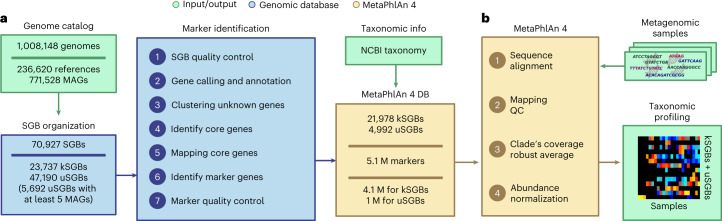
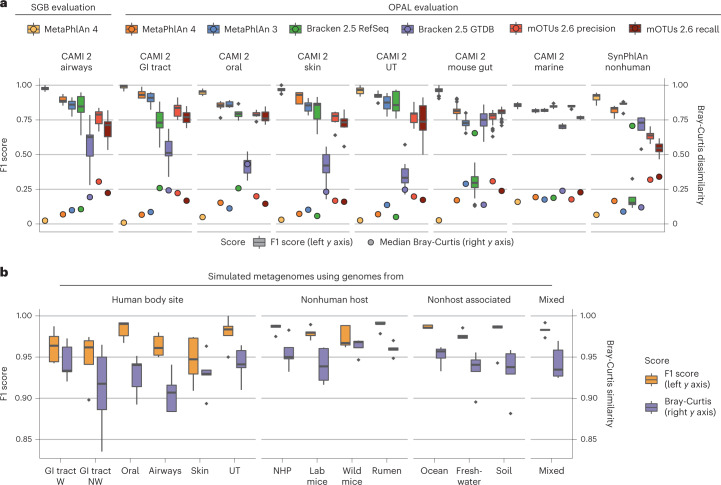
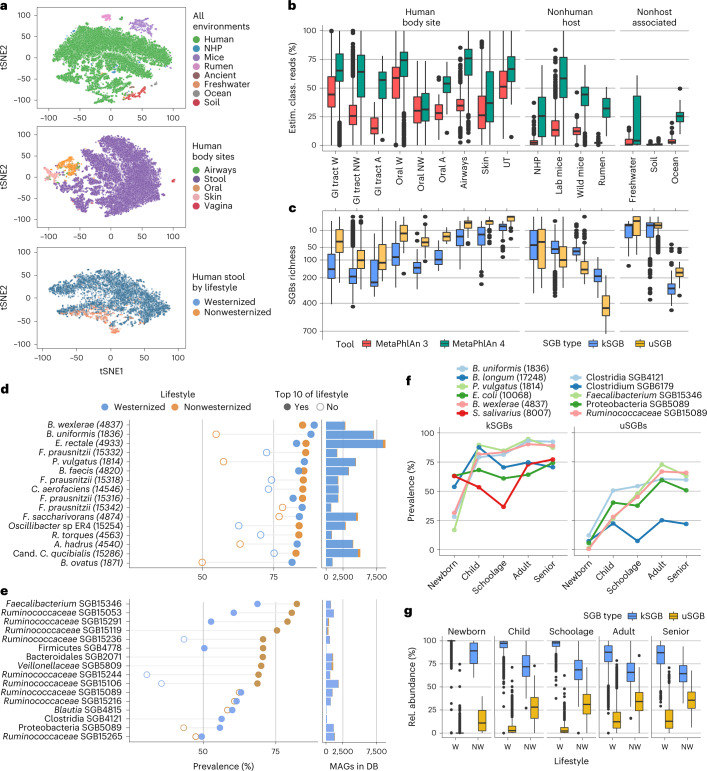
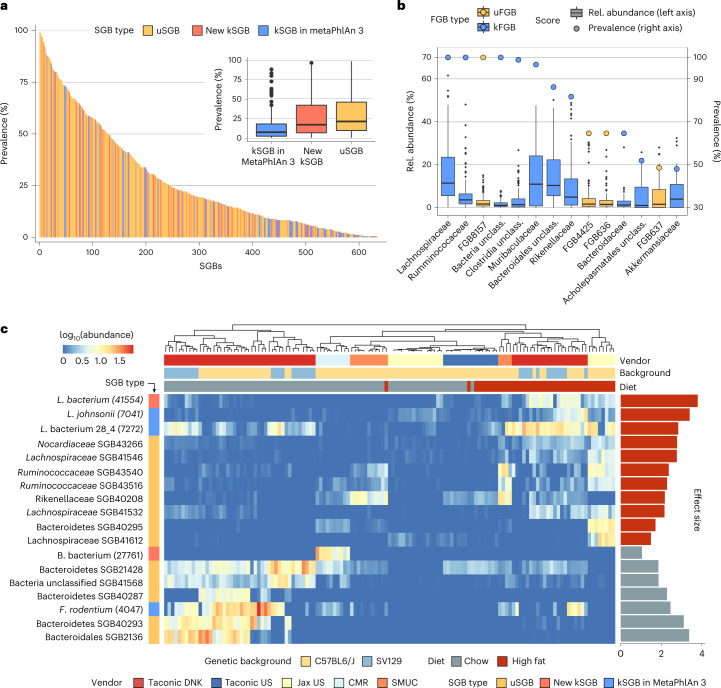
Metagenomic assembly enables new organism discovery from microbial communities, but it can only capture few abundant organisms from most metagenomes. Here we present MetaPhlAn 4, which integrates information from metagenome assemblies and microbial isolate genomes for more comprehensive metagenomic taxonomic profiling. From a curated collection of 1.01 M prokaryotic reference and metagenome-assembled genomes, we define unique marker genes for 26,970 species-level genome bins, 4,992 of them taxonomically unidentified at the species level. MetaPhlAn 4 explains ~20% more reads in most international human gut microbiomes and >40% in less-characterized environments such as the rumen microbiome and proves more accurate than available alternatives on synthetic evaluations while also reliably quantifying organisms with no cultured isolates. Application of the method to >24,500 metagenomes highlights previously undetected species to be strong biomarkers for host conditions and lifestyles in human and mouse microbiomes and shows that even previously uncharacterized species can be genetically profiled at the resolution of single microbial strains.
Overview
The claims and statistics of this paper haven’t been checked yet.
Free: it reads the open-access text and checks the first 5 claims that cite a source we can check. Create a free account to check every claim.
Integrity signals
Registry
Cites
Statistics
Figures
Verification
Claims the paper makes
The claims and statistics of this paper haven’t been checked yet.
Free: it reads the open-access text and checks the first 5 claims that cite a source we can check. Create a free account to check every claim.
Claims other papers make about this one
Each is checked against this paper’s own text: does it say what the citing paper says it does?
The cited source says what the claim attributes to it.
In the citing paper
“we performed a meta-analysis and mega-analysis of stools taxonomically profiled with MetaPhlAn 4 (ref. 37) and from patients enrolled in 12 cohorts from eight published studies26,38–44 across three cancer types, and classified as responders (n = 248) or non-responders (n = 513) based on RECIST1.1 criteria response rates”
From Gut OncoMicrobiome Signatures (GOMS) as next-generation biomarkers for cancer immunotherapy (2023) · cites this paper as [37]
The cited source says what the claim attributes to it.
In the citing paper
“We further performed strain-level and strain-matching analysis via StrainPhlAn 4 84 (STAR Methods) and identified potential transmission patterns for some food-human overlapping SGBs (Figures 6 and S6).”
From Unexplored microbial diversity from 2,500 food metagenomes and links with the human microbiome. (2024) · cites this paper as [84]
The check wasn’t confident either way, so it gives no verdict — never disputed.
In the citing paper
“A meta- and mega-analysis of stools obtained from patients with cancer treated with ICIs showed that GOMS associated with ICI resistance comprised microorganisms affiliated with chronic inflammation and immunosuppression and oral genera, and were shared across various pathological disorders.22,155”
From Melanoma and microbiota: Current understanding and future directions (2024) · cites this paper as [155]
Experimental — accuracy not yet measuredIn the citing paper
“We used MetaPhlAn 4 (ref. 37) for microbiome taxonomic profiling of stool samples from 1,879 adults across eight different cancer types (included in 30 cohorts from 23 published studies)25–29,38–55 and from a control group comprising 5,341 individuals without cancer (included in 17 cohorts from 14 published studies)”
From Gut OncoMicrobiome Signatures (GOMS) as next-generation biomarkers for cancer immunotherapy (2023) · cites this paper as [37]
In the citing paper
“Taxonomic profiling was performed at the level of species-level genome bins (SGBs) using MetaPhlAn4, which represent both existing and yet-to-be-characterized microbial species17.”
From Longitudinal gut microbiome changes in immune checkpoint blockade-treated advanced melanoma (2024) · cites this paper as [17]
1 more claim about this paper
Create a free account to see every claim other papers make about this one.
Self-check
Percentages, sums and reported differences re-computed from the paper’s own numbers.
The self-check needs the paper’s full text.
Citations
Cites
The Sequence Alignment/Map format and SAMtools
Li, H., Handsaker, B., Wysoker, A., Fennell, T., Ruan, J., Homer, N., Marth, G., Abecasis, G., Durbin, R., & 1000 Genome Project Data Processing Subgroup (2009) · Bioinformatics · doi:10.1093/bioinformatics/btp352 · Cited by 62,041 · cited 1×
“For item (1), StrainPhlAn 4 considers as input the reads-to-markers alignment results (in SAM format 96 ) from the MetaPhlAn 4 profiling together with the MetaPhlAn 4 database.”
MethodFast gapped-read alignment with Bowtie 2
Langmead, B., & Salzberg, S. L. (2012) · Nature Methods · doi:10.1038/nmeth.1923 · Cited by 56,400 · cited 1×
“To detect the SGB-specific marker genes, each set of core genes was then aligned against the genomes of the other SGBs using Bowtie 2 (version 2.3.5.1; -- sensitive parameter) 83 .”
MethodInfluentialMAFFT Multiple Sequence Alignment Software Version 7: Improvements in Performance and Usability
Katoh, K., & Standley, D. M. (2013) · Molecular Biology and Evolution · doi:10.1093/molbev/mst010 · Cited by 46,209 · cited 2×
“By default, multiple-sequence alignment is performed by MAFFT 92 , gappy positions (that is, positions with more than 67% of gaps) are trimmed by trimAl 91 and phylogenetic trees are inferred by RAxML 97 .”
MethodInfluentialRAxML version 8: a tool for phylogenetic analysis and post-analysis of large phylogenies
Stamatakis, A. (2014) · Bioinformatics · doi:10.1093/bioinformatics/btu033 · Cited by 32,291 · cited 3×
“By default, multiple-sequence alignment is performed by MAFFT 92 , gappy positions (that is, positions with more than 67% of gaps) are trimmed by trimAl 91 and phylogenetic trees are inferred by RAxML 97 .”
MethodInfluentialIQ-TREE: A Fast and Effective Stochastic Algorithm for Estimating Maximum-Likelihood Phylogenies
Nguyen, L.-T., Schmidt, H. A., von Haeseler, A., & Minh, B. Q. (2015) · Molecular Biology and Evolution · doi:10.1093/molbev/msu300 · Cited by 26,046
Prokka: rapid prokaryotic genome annotation
Seemann, T. (2014) · Bioinformatics · doi:10.1093/bioinformatics/btu153 · Cited by 18,818
Fast and sensitive protein alignment using DIAMOND
Buchfink, B., Xie, C., & Huson, D. H. (2015) · Nature Methods · doi:10.1038/nmeth.3176 · Cited by 14,201
trimAl: a tool for automated alignment trimming in large-scale phylogenetic analyses
Capella-Gutiérrez, S., Silla-Martínez, J. M., & Gabaldón, T. (2009) · Bioinformatics · doi:10.1093/bioinformatics/btp348 · Cited by 12,751 · cited 1×
“By default, multiple-sequence alignment is performed by MAFFT 92 , gappy positions (that is, positions with more than 67% of gaps) are trimmed by trimAl 91 and phylogenetic trees are inferred by RAxML 97 .”
MethodParks, D. H., Imelfort, M., Skennerton, C. T., Hugenholtz, P., & Tyson, G. W. (2015) · Genome Research · doi:10.1101/gr.186072.114 · Cited by 12,496
Diet rapidly and reproducibly alters the human gut microbiome
David, L. A., Maurice, C. F., Carmody, R. N., Gootenberg, D. B., Button, J. E., Wolfe, B. E., Ling, A. V., Devlin, A. S., Varma, Y., Fischbach, M. A., et al. (2014) · Nature · doi:10.1038/nature12820 · Cited by 10,100
Cited by
Items 301–400 of 1,000
ganon2: up-to-date and scalable metagenomics analysis
Piro, V. C., & Reinert, K. (2025) · NAR Genomics and Bioinformatics · doi:10.1093/nargab/lqaf094 · Cited by 21
Zaytsev, P., Rodin, V. A., Zaytseva, A., Zvereva, M. I., & Solovchenko, A. E. (2024) · Journal of Applied Phycology · doi:10.1007/s10811-024-03267-1 · Cited by 17
“…identification by BLAST or another sequence comparison tool such as implemented in MEGAN or TAXAssign algorithm (Huson et al. 2007; Inskeep et al. 2013), or classification based on the species-level genome bins e.g., with MetaPhlan 4 algorithm (Ljaz and Quince 2013; Blanco-Míguez et al. 2023).”
Ghensi, P., Heidrich, V., Bazzani, D., Asnicar, F., Armanini, F., Bertelle, A., Dell'Acqua, F., Dellasega, E., Waldner, R., Vicentini, D., et al. (2025) · Journal Of Clinical Periodontology · doi:10.1111/jcpe.14121 · Cited by 18
Self-citationMulti-dimensional metagenomics
Peng, H., Ruiz-Moreno, A. J., & Fu, J. (2025) · Nature Reviews Bioengineering · doi:10.1038/s44222-025-00346-x · Cited by 21
“MetaPhlAn is based on a large-scale collection of genomes and metagenome-assembled genomes (MAGs), and it identifies 100–200 marker genes per species on average.”
InfluentialMetabolomics and metagenomics in mice reveal the role of the gut microbiota in tryptophan metabolism
Levé, M., Manghi, P., Bredon, M., Lefèvre, A., Manara, S., Armanini, F., Emond, P., Planchais, J., Rolhion, N., Segata, N., et al. (2025) · iScience · doi:10.1016/j.isci.2025.113751 · Cited by 17
Self-citationFrom One-Size-Fits-All to Precision Medicine: The Promise of Personalized Probiotics
Montazeri‐Najafabady, N. (2025) · Probiotics and Antimicrobial Proteins · doi:10.1007/s12602-025-10815-9 · Cited by 22
Gut microbial ethanol metabolism contributes to auto-brewery syndrome in an observational cohort
Hsu, C. L., Shukla, S., Freund, L., Chou, A. C., Yang, Y., Bruellman, R., Tonetti, F. R., Cabré, N., Mayo, S. L., Lim, H. G., et al. (2026) · Nature Microbiology · doi:10.1038/s41564-025-02225-y · Cited by 19
“StrainPhlan was used to align metagenome reads to E. coli consensus marker gene sequences from the marker database ChocoPhlan version mpa vJune23CHOC-OPhlAnSGB_202403 (provided by MetaPhlan), and multiple sequence alignment (MSA) was generated.”
Song, Y., Chen, Q., Luo, S., Li, S., He, R., Yang, X., Shen, D., Long, C., Liu, S., Zhong, G., et al. (2026) · Microbiome · doi:10.1186/s40168-026-02360-6 · Cited by 23
“0 [50] using default parameters and the mpa_vJan21 database.”
Huang, K. D., Amend, L., Gálvez, E. J. C., Lesker, T.-R., de Oliveira, R., Bielecka, A., Blanco‐Míguez, A., Valles‐Colomer, M., Ruf, I., Pasolli, E., et al. (2024) · Cell Reports Medicine · doi:10.1016/j.xcrm.2024.101426 · Cited by 18
Self-citationWalsh, L., Lavelle, A., O’Connor, P., Hill, C., & Ross, R. P. (2024) · Gut Microbes · doi:10.1080/19490976.2024.2342583 · Cited by 17
“Cleaned metagenomic reads were then processed using the MetaPhlAn4 pipeline 28 against the chocophlan database (12/ 2022).”
MethodSahil, R., Pal, V., Kharat, A. S., & Jain, M. (2025) · Plant Cell & Environment · doi:10.1111/pce.15429 · Cited by 18
“We also aligned these reads to the curated database (CHOCOPhlAn) of MetaPhlAn4 (Blanco ‐ Míguez et al. 2023) for identifying the most abundant bacteria in the samples.”
Litichevskiy, L., Considine, M., Gill, J., Shandar, V., Cox, T. O., Descamps, H. C., Wright, K. M., Amses, K. R., Dohnalová, L., Liou, M. J., et al. (2025) · Nature Microbiology · doi:10.1038/s41564-025-01963-3 · Cited by 20
Fan, Y., Wang, D., Yang, J. X., Ning, D., He, Z., Zhang, P., Rocha, A. M., Xiao, N., Michael, J. P., Walker, K. F., et al. (2025) · Microbiome · doi:10.1186/s40168-025-02105-x · Cited by 17
“Species-level quantitative taxonomic profiling was performed using MetaPhlAn4 [5].”
Liu, B., Liu, Y., Xu, S., Wu, Q., Wu, D., Zhan, L., Liao, Y., Mai, Y., Zheng, M., Wang, S., et al. (2025) · Science China Life Sciences · doi:10.1007/s11427-025-3035-0 · Cited by 25
“…Observation Matrix (BIOM) from Mothur software, QIIME Zipped Visualization (qzv) files from QIIME2, or Metaphlan ’ s hierarchical annotation tables, while transcriptomic and metabolomic data are typically represented as annotated text files (Blanco-Míguez et al., 2023; Bolyen et al., 2019).”
Reliable detection of Host-Microbe Signatures in cancer using PRISM
Ghaddar, B., Blaser, M. J., & De, S. (2026) · Cancer Cell · doi:10.1016/j.ccell.2026.01.007 · Cited by 20
Improving metagenome binning by integrating intrinsic features and taxonomy
Kutuzova, S., Líndez, P. P., Danielsen, L. S., Nielsen, K. N., Olsen, N. S., Riber, L., Gobbi, A., Junco, L. M. F., Dougherty, P. E., Westergaard, J. C., et al. (2026) · Nature Biotechnology · doi:10.1038/s41587-026-03098-0 · Cited by 22
Lyte, J. M., Jia, X., Caputi, V., Zhang, D., Daniels, K. M., Phillips, G. J., & Lyte, M. (2025) · Poultry Science · doi:10.1016/j.psj.2025.104886 · Cited by 16
Shropshire, W. C., Hanson, B., & Shelburne, S. A. (2025) · Current Opinion in Infectious Diseases · doi:10.1097/qco.0000000000001118 · Cited by 18
“…genotyping systems that are interchangeable across local, state, and national laboratories Despite these gains, there remain challenges in agreed upon nomenclature as well as typing methodologies that can be utilized by health professionals other than skilled computational…”
Yao, Y., Pei, Z., Dai, Y., Chen, Y., Chang, Z., Wang, H., Zhao, J., Zhang, H., Zhai, Q., Lu, W., et al. (2025) · Advanced Science · doi:10.1002/advs.202506576 · Cited by 22
Lactobacillus iners dominates the vaginal microbiota of healthy Italian women of reproductive age
Vinerbi, E., Chillotti, F., Maschio, A., Lenarduzzi, S., Camarda, S., Crobu, F., Zhernakova, D. V., Faro, V. L., Vriz, G. B., Incollu, S., et al. (2025) · mSystems · doi:10.1128/msystems.00983-25 · Cited by 16
Streptococcus anginosus -derived methionine promotes gastric cancer progression
Zhou, C., Zhao, L., Qin, Y., Yu, J., Li, W., Feng, Q., Tong, X., Abuduaini, R., Lu, S., Tang, H., et al. (2026) · Gut · doi:10.1136/gutjnl-2025-336966 · Cited by 20
“The taxonomy composition of stool metagenomes was evaluated using MetaPhlAn4, 47 which could separate S. anginosus from S. constellatus using marker genes.”
Barrera-Suarez, M. A., Zhao, C., Karnatovskaia, L. V., & Sung, J. (2026) · Gut Microbes Reports · doi:10.1080/29933935.2026.2650247 · Cited by 22
Defining microbial community functions in chronic human infection with metatranscriptomics
Adekoya, A. E., Kargbo, H. A., & Ibberson, C. B. (2023) · mSystems · doi:10.1128/msystems.00593-23 · Cited by 18
Irankhah, L., Khorsand, B., Naghibzadeh, M., & Savadi, A. (2024) · Journal of Bioinformatics and Computational Biology · doi:10.1142/s0219720024500124 · Cited by 16
Dommann, J., Kerbl-Knapp, J., Torres, D. A., Egli, A., Keiser, J., & Schneeberger, P. H. H. (2024) · mSystems · doi:10.1128/msystems.00859-24 · Cited by 19
Zhao, Y., Fan, L., Gao, S.-H., Huang, F., Lei, Z., Wang, W., Gao, R., Dai, Z., Li, Q., Liang, B., et al. (2024) · Water Research · doi:10.1016/j.watres.2024.122538 · Cited by 16
Wu, W., Lo, Y.-L., Chiu, J.-Y., Hsu, C., Lo, I., Panyod, S., Liao, Y.-C., Chiu, T. H. T., Yang, Y.-T., Kuo, H., et al. (2024) · Gut Microbes · doi:10.1080/19490976.2024.2446374 · Cited by 19
“20”
Exploring DNA degradation in situ and in museum storage through genomics and metagenomics
Eriksen, A., Rodríguez, J. A., Seersholm, F. V., Hollund, H., Gotfredsen, A. B., Collins, M. J., Grønnow, B., Pedersen, M. W., Gilbert, M. T. P., & Matthiesen, H. (2025) · Communications Biology · doi:10.1038/s42003-025-07616-9 · Cited by 18
The amphipod genome reveals population dynamics and adaptations to hadal environment
Zhang, H., Sun, S., Liu, J., Guo, Q., Meng, L., Chen, J., Xiang, X., Zhou, Y., Zhang, N., Liu, H., et al. (2025) · Cell · doi:10.1016/j.cell.2025.01.030 · Cited by 17
Metagenomic analysis revealing links between age, gut microbiota and bone loss in Chinese adults
Li, Y., Shi, Z., Zhang, X., Ren, H., Ji, H., Yang, F., Fu, Z., Kong, X., Cheng, X., Li, J., et al. (2025) · npj Metabolic Health and Disease · doi:10.1038/s44324-025-00060-7 · Cited by 18
Barroso‐Sousa, R., Zañudo, J. G. T., Li, T., Reddy, S. M., Emens, L. A., Kuntz, T. M., Silva, C. A. C., AlDubayan, S. H., Chu, H., Overmoyer, B. A., et al. (2025) · Nature Communications · doi:10.1038/s41467-025-59695-1 · Cited by 18
Eisenhofer, R., Alberdi, A., & Woodcroft, B. J. (2026) · mSystems · doi:10.1128/msystems.01062-25 · Cited by 20
Blanco-Fuertes, M., Sibila, M., Franzo, G., Obregón-Gutierrez, P., Illas, F., Correa‐Fiz, F., & Aragón, V. (2023) · Animal Microbiome · doi:10.1186/s42523-023-00275-3 · Cited by 22
“Taxonomic profiling of each sample was assessed using Metaphlan4 [49, 53] software, on cleaned read level.”
MethodValles-Colomer, M., Manghi, P., Cumbo, F., Masetti, G., Armanini, F., Asnicar, F., Blanco-Miguez, A., Pinto, F., Punčochář, M., Garaventa, A., et al. (2024) · eBioMedicine · doi:10.1016/j.ebiom.2023.104917 · Cited by 14
“Strain pro fi ling was performed with StrainPhlAn 4 29 using the mpa_vJan21_CHOCOPhlAnSGB_202103 database as in. 40 Shortly, parameters “– sample_with_n_markers 20 – secondary_samples_with_n_markers 20 – sample_with_n_ markers_after_ fi lt 10 – marker_in_n_samples 50 – mutation_rates ” were used, and…”
MethodSelf-citationLinking the edible plant microbiome and human gut microbiome
Berg, G., Toledo, G. V., Schierstaedt, J., Hyöty, H., & Wicaksono, W. A. (2025) · Gut Microbes · doi:10.1080/19490976.2025.2551113 · Cited by 14
Pope, R., Visconti, A., Zhang, X., Louca, P., Baleanu, A.-F., Lin, Y., Asnicar, F., Bermingham, K. M., Wong, K. E., Michelotti, G. A., et al. (2025) · Nature Communications · doi:10.1038/s41467-025-66046-7 · Cited by 21
Self-citationNext-generation sequencing approaches for soil microbiome research
Reznikova, D. A., Barannikova, M. V., Shnakhova, L. M., Mitkin, N. A., & Vatlin, A. A. (2026) · Frontiers in Soil Science · doi:10.3389/fsoil.2025.1706999 · Cited by 17
Hempel, C. A., Buchner, D., Mack, L., Brasseur, M. V., Tulpan, D., Leese, F., & Steinke, D. (2023) · Frontiers in Microbiology · doi:10.3389/fmicb.2023.1217750 · Cited by 14
Tsakmaklis, A., Farowski, F., Zenner, R., Lesker, T. R., Strowig, T., Schlößer, H., Lehmann, J. M., von Bergwelt‐Baildon, M., Mauch, C., Schlaak, M. S., et al. (2023) · BMC Cancer · doi:10.1186/s12885-023-11551-5 · Cited by 14
Firrman, J., Narrowe, A. B., Liu, L., Mahalak, K. K., Lemons, J. M. S., den Abbeele, P. V., Baudot, A., Deyaert, S., Li, Y., Yao, Y., et al. (2024) · PLoS ONE · doi:10.1371/journal.pone.0301381 · Cited by 15
Melon: metagenomic long-read-based taxonomic identification and quantification using marker genes
Chen, X., Yin, X., Shi, X., Yan, W., Yang, Y., Liu, L., & Zhang, T. (2024) · Genome biology · doi:10.1186/s13059-024-03363-y · Cited by 15
“In contrast, marker-based profilers, such as MetaPhlAn4 [20] and mOTUs3 [21], only assign taxonomic labels to a small fraction of sequencing reads that map to databases comprised of specific gene families (i.e., phylogenetic marker genes).”
Vriend, E. M. C., Galenkamp, H., Herrema, H., Nieuwdorp, M., van den Born, B. H., & Verhaar, B. J. H. (2024) · npj Biofilms and Microbiomes · doi:10.1038/s41522-024-00628-z · Cited by 17
“We used MetaPhlAn (v.4.0.5) and the ChocoPhlAn database (vJun23_202307) to pro fi le the reads for microbial composition, and HUMAnN (v.3.8) with the UniRef90 (v.201901b, EC fi ltered) and ChocoPhlAn (vJun23_202307) databases to infer functional pathways 39,40 .”
InfluentialLing, M., Szarvas, J., Kurmauskaitė, V., Kiseliovas, V., Žilionis, R., Avot, B. J. P., Munk, P., & Aarestrup, F. M. (2025) · Frontiers in Microbiology · doi:10.3389/fmicb.2024.1516656 · Cited by 14
Debray, R., Dickson, C. C., Webb, S. E., Archie, E. A., & Tung, J. (2025) · Microbiome · doi:10.1186/s40168-025-02051-8 · Cited by 15
“To compare the major conclusions of the study with an alternative analysis pipeline, we additionally pro-filed metagenomes at the species level using MetaPhlAn [49].”
Parekh, Z., Xiao, J. F., Mani, A., Evans, Q., Phung, C., Barba, H., Xie, B., Sidebottom, A. M., Sundararajan, A., Lin, H., et al. (2025) · Investigative Ophthalmology & Visual Science · doi:10.1167/iovs.66.4.21 · Cited by 15
Shekarriz, S., Szamosi, J. C., Whelan, F., Lau, J. T., Libertucci, J., Rossi, L., Fontes, M. E., Wolfe, M., Lee, C., Moayyedi, P., et al. (2025) · Nature Communications · doi:10.1038/s41467-025-58673-x · Cited by 14
D'Aloisio, L. D., Ballal, M., Ghosh, S., Haskey, N., Abulizi, N., Karimianghadim, R., Liu, C., Sruthi, P., Lakshmipriya, N., Sudha, V., et al. (2025) · npj Biofilms and Microbiomes · doi:10.1038/s41522-025-00778-8 · Cited by 17
Long-read metagenomics for strain tracking after faecal microbiota transplant
Fan, Y., Ni, M., Aggarwala, V., Mead, E. A., Ksiezarek, M., Cao, L., Kamm, M. A., Borody, T. J., Paramsothy, S., Kaakoush, N. O., et al. (2025) · Nature Microbiology · doi:10.1038/s41564-025-02164-8 · Cited by 16
Dong, Q., Ma, B., Zhou, X., Huang, P., Gao, M., Yang, S., Jiao, Y., Zhou, Y., Shi, Z., Deng, Q., et al. (2025) · Genome Medicine · doi:10.1186/s13073-025-01566-x · Cited by 15
“For the 1762 newly assembled species, to enhance the detection of these microbes in population studies and provide a more comprehensive gut microbial composition profile, we integrated genomes from our GMR set into the MetaPhlAn4 taxonomic classification database [27], released in March 2024.”
InfluentialZhang, P., Roque, B. M., Romero, P., Shapiro, N., Eloe‐Fadrosh, E. A., Kebreab, E., Diamond, S., & Hess, M. (2025) · Microbiome · doi:10.1186/s40168-025-02251-2 · Cited by 17
“Furthermore, we compared the efficiency with which we could detect microbial species in our samples using a widely used microbiome profiler, MetaPhlAn4 43 , relative to our genome database.”
JAMS - A framework for the taxonomic and functional exploration of microbiological genomic dataPreprint
McCulloch, J. A., Badger, J. H., Cannon, N., Rodrigues, R. R., Valencia, M. E., Barb, J. J., Fernandes, M. R., Balaji, A. K., Crowson, L., Ó’hUigín, C., et al. (2023) · bioRxiv (Cold Spring Harbor Laboratory) · doi:10.1101/2023.03.03.531026 · Cited by 16
Høyer, K. L., Dahl Baunwall, S. M., Kornum, D. S., Klinge, M. W., Drewes, A. M., Yderstræde, K. B., Thingholm, L. B., Mortensen, M. S., Mikkelsen, S., Erikstrup, C., et al. (2025) · eClinicalMedicine · doi:10.1016/j.eclinm.2024.103000 · Cited by 13
The impact of an oral purified microbiome therapeutic on the gastrointestinal microbiome
Bryant, J. A., Vulić, M., Walsh, E., Allen, E. G., Beauchemin, N., Chafee, M. E., Diao, L., Fenn, K., Ford, K. A., Hasson, B. R., et al. (2026) · Nature Medicine · doi:10.1038/s41591-025-04076-w · Cited by 13
Soluble MAdCAM-1 as a biomarker in metastatic renal cell carcinoma
Silva, C. A. C., Machaalani, M., Saliby, R. M., Zhong, C., Xie, W., Pasolli, E., Piccinno, G., Dalban, C., Fidelle, M., Meurisse, A., et al. (2026) · Nature Medicine · doi:10.1038/s41591-025-04067-x · Cited by 17
Self-citationHost metabolism can produce many indoles and phenols independently of the microbiome
AbuSalim, J. E., Olszewski, K. L., Youssef, S., Mitchell, S. J., Hunter, C. J., Little, J. C., Sidebottom, A. M., Boyer, J. A., Knutson, S. D., Samarah, L. Z., et al. (2026) · Nature Metabolism · doi:10.1038/s42255-026-01550-8 · Cited by 19
Bazzani, D., Heidrich, V., Manghi, P., Blanco‐Míguez, A., Asnicar, F., Armanini, F., Cavaliere, S., Bertelle, A., Dell'Acqua, F., Dellasega, E., et al. (2024) · npj Biofilms and Microbiomes · doi:10.1038/s41522-024-00482-z · Cited by 17
Self-citationKim, N., Kim, C. Y., Ma, J., Yang, S., Park, D. J., Ha, S., Belenky, P. A., & Lee, I. (2024) · Gut Microbes · doi:10.1080/19490976.2024.2393791 · Cited by 15
“To test this hypothesis, we analyzed the relationship between the estimated relative abundance of mouse gut bacterial species using MRGM reference genomes via MetaPhlAn and Kraken2.”
MethodInfluentialSteinberg, R., Mœller, A., Gisler, A., Kryuchkova-Mostacci, N., Hilty, M., & Usemann, J. (2024) · Journal of Cystic Fibrosis · doi:10.1016/j.jcf.2024.10.001 · Cited by 13
Park, H. A., Sung, J., Chang, Y., Ryu, S., Yoon, K. J., Kim, H., & Kim, H. (2024) · Journal of Cachexia Sarcopenia and Muscle · doi:10.1002/jcsm.13636 · Cited by 13
Yang, J., Lei, O. K., Bhute, S. S., Kris‐Etherton, P. M., Lichtenstein, A. H., Matthan, N. R., Petersen, K. S., Sabaté, J., Reboussin, D. M., Lovato, L., et al. (2025) · Food & Function · doi:10.1039/d4fo03806a · Cited by 15
Wang, L., Liang, Z., Chai, Z., Cong, W., Zhu, L., Guo, Z., Song, M., Ma, J., Guo, T., Zhang, W., et al. (2024) · Environmental Pollution · doi:10.1016/j.envpol.2024.125610 · Cited by 15
Shao, L., Cai, G., Fu, J., Zhang, W., Ye, Y.-F., Ling, Z., & Ye, S. (2024) · Journal of Translational Medicine · doi:10.1186/s12967-024-05973-3 · Cited by 15
Jia, Y., Wang, J., Lin, X., Liang, T., Dai, H., Wu, B., Yang, M., Zhang, Y., & Li, R. (2025) · Frontiers in Plant Science · doi:10.3389/fpls.2025.1588888 · Cited by 13
Lin, S., Sun, Z., Zhu, X., Wang, M., Zhang, Q., Qian, J., Zhang, H., Mei, Z., Pu, Y., Kong, M., et al. (2025) · Nature Microbiology · doi:10.1038/s41564-025-02039-y · Cited by 17
“Taxonomic relative abundance for samples from the cleaned metagenomic reads was generated using MetaPhlan4 (v.4.0.6) 63 with the database of marker genes mpa_vOct22_CHOC-OPhlAnSGB_202212.”
InfluentialZhang, H.-H., Wang, F., Yu, S., Mao, D., Wang, X., & Luo, Y. (2025) · Environmental Science & Technology · doi:10.1021/acs.est.5c02241 · Cited by 14
Enhanced metagenomic strategies for elucidating the complexities of gut microbiota: a review
Li, X., & Lu, H. (2025) · Frontiers in Microbiology · doi:10.3389/fmicb.2025.1626002 · Cited by 21
Diagnostic Support in Dentistry Through Artificial Intelligence: A Systematic Review
Inchingolo, A. D., Marinelli, G., Fiore, A., Balestriere, L., Carone, C., Inchingolo, F., Corsalini, M., Venere, D. D., Palermo, A., Inchingolo, A. M., et al. (2025) · Bioengineering · doi:10.3390/bioengineering12111244 · Cited by 16
“…equitable oral healthcare delivery, while also suggesting avenues for integrating CNN-based screening into telemedicine and community care settings [77–79 2023) developed AI-based predictive models for diagnosing temporo-mandibular disorders (TMD) using clinical and psychological data [50,80,81].”
Metagenomics and its impact on environmental and therapeutic microbiology
Saggu, S. K., Kumar, M., & Kumar, S. (2025) · Archives of Microbiology · doi:10.1007/s00203-025-04588-6 · Cited by 9
“By directly sequencing DNA from environmental samples, metagenomics enables comprehensive insights to study taxonomic composition, functional potential and ecological interactions without the need for cultivation (Blanco-Míguez et al. 2023).”
Benchmarking Metagenomic Classifiers on Simulated Ancient and Modern Metagenomic Data
Pusadkar, V., & Azad, R. K. (2023) · Microorganisms · doi:10.3390/microorganisms11102478 · Cited by 14
“A recent study employing MetaPhlAn4 reclassified ancient metagenomic samples previously classified by MetaPhlAn3 and revealed an increase in observable microbial diversity by quantifying uncharacterized species [49].”
InfluentialThe core phageome and its interrelationship with preterm human milk lipids
Yew, W. C., Young, G. R., Nelson, A., Cheung, W., Stewart, C. J., Bridge, S. H., Granger, C. L., Berrington, J. E., Embleton, N. D., & Smith, D. (2023) · Cell Reports · doi:10.1016/j.celrep.2023.113373 · Cited by 15
Zhang, X., Ma, L., & Zhang, X.-X. (2024) · Journal of Hazardous Materials · doi:10.1016/j.jhazmat.2024.134886 · Cited by 14
Pessemier, B. D., López, C. D., Taelman, S., Verdonck, M., Chen, Y., Stockman, A., Lambert, J., de Wiele, T. V., & Callewaert, C. (2024) · Journal of Investigative Dermatology · doi:10.1016/j.jid.2024.07.020 · Cited by 15
Won, S., Cho, S., & Kim, H. (2024) · Microbiology Spectrum · doi:10.1128/spectrum.00931-24 · Cited by 17
“We downloaded the data from the SRA under project ID PRJEB15371 (28) and calculated the proportion of each species using MetaPhlAn 4.1 (29).”
InfluentialConstructing phylogenetic trees for microbiome data analysis: A mini-review
Liu, R., Qiao, X., Shi, Y., Peterson, C. B., Bush, W. S., Cominelli, F., Wang, M., & Zhang, L. (2024) · Computational and Structural Biotechnology Journal · doi:10.1016/j.csbj.2024.10.032 · Cited by 17
Biosynthetic potential of the gut microbiome in longevous populations
Liu, S., Zhang, Z., Wang, X., Ma, Y., Ruan, H., Wu, X., Li, B., Mou, X., Chen, T., Lu, Z., et al. (2024) · Gut Microbes · doi:10.1080/19490976.2024.2426623 · Cited by 13
The food additive butylated hydroxyanisole minimally affects the human gut microbiome ex vivo
Lemons, J. M. S., Narrowe, A. B., Firrman, J., Mahalak, K. K., Liu, L., Higgins, S., Moustafa, A. M., Baudot, A., Deyaert, S., & den Abbeele, P. V. (2025) · Food Chemistry · doi:10.1016/j.foodchem.2025.143037 · Cited by 12
Awasthi, S., Hiremath, V. M., Nain, S., Malik, S., Srinivasan, V., Rose, P., Choudhury, A., Grover, R., & Sharma, R. (2025) · Environmental Microbiome · doi:10.1186/s40793-025-00684-8 · Cited by 13
“Taxonomic profiling was performed using MetaPh-lAn4 (version 4.1.1) [30].”
InfluentialMartí, J. M., Kok, C. R., Thissen, J. B., Mulakken, N., Avila-Herrera, A., Jaing, C. J., Allen, J., & Be, N. A. (2025) · mSystems · doi:10.1128/msystems.01239-24 · Cited by 17
“These databases may include a range of indexed reference genomes, a subset of discriminative k-mers (e.g., CLARK [21] and KrakenUniq [31]), or a curated set of marker genes (e.g., MetaPhlAn4 [20]).”
Microplastics reduced the natural attenuation of antibiotic resistance genes in fertilized soils
Yang, J., Zhang, Y., Xiong, S.-Y., Wei, H.-J., Zhang, W., Lian, X.-L., Xu, X.-L., Jiang, H., & Sun, J. (2025) · Environmental Pollution · doi:10.1016/j.envpol.2025.126144 · Cited by 12
From air to insight: the evolution of airborne DNA sequencing technologies
Berelson, M. F. G., Heavens, D., Nicholson, P., Clark, M. D., & Leggett, R. M. (2025) · Microbiology · doi:10.1099/mic.0.001564 · Cited by 14
Using the microbiota to study connectivity at human–animal interfaces
Muloi, D. M., Caron, A., Berkley, J. A., Hassell, J. M., Brito, I., King, K. C., Moodley, A., & Fèvre, E. M. (2025) · Trends in Microbiology · doi:10.1016/j.tim.2025.05.006 · Cited by 14
Johansen, P. L., Chatzigiannidou, I., Berzina, L., Kristiansen, K., & Brix, S. (2025) · iMeta · doi:10.1002/imt2.70075 · Cited by 15
Caffrey, E. B., Olm, M. R., Kothe, C. I., Wastyk, H. C., Evans, J. D., & Sonnenburg, J. L. (2025) · mSystems · doi:10.1128/msystems.00141-25 · Cited by 15
“For MetaPhlAn4, all trimmed reads were profiled using MetaPhlAn v4.”
InfluentialThe metagenome and metabolome signatures of dental biofilms associated with severe dental fluorosis
Ajrithirong, P., Krasaesin, A., Sriarj, W., Gavila, P., Chetruengchai, W., Sriwattanapong, K., Manaspon, C., Samaranayake, L., & Porntaveetus, T. (2025) · Journal of Oral Microbiology · doi:10.1080/20002297.2025.2560591 · Cited by 12
“0) [15] with default parameters.”
Blank, R. B., Bu, K., Zhang, X., Chen, W., CUNNINGHAM, I. M., Sokolove, J. B., Lahey, L. J., Heguy, A., Medina, R., Úbeda, C., et al. (2025) · Annals of the Rheumatic Diseases · doi:10.1016/j.ard.2025.08.029 · Cited by 13
Human gut bacteria produce structurally related monoglycolipids with contrasting immune functions
Yoo, J., Jung, D.-J., Goh, B., Heo, K., Zheng, W., Lee, C. C., Seo, J. I., Geva‐Zatorsky, N., Wu, M., Park, S. B., et al. (2025) · Nature Microbiology · doi:10.1038/s41564-025-02141-1 · Cited by 14
“45).”
Metalog: curated and harmonised contextual data for global metagenomics samples
Kuhn, M., Schmidt, T., Ferretti, P., Glazek, A. M., Robbani, S. M., Akanni, W. A., Fullam, A., Schudoma, C., Cetin, E., Hassan, M., et al. (2025) · Nucleic Acids Research · doi:10.1093/nar/gkaf1118 · Cited by 17
“Taxonomic profiles were generated and are available for download based on mOTUs version 3.0 (44), SPIRE-mOTUs (10), and MetaPhlAn 4 (45).”
InfluentialJia, K., Chen, Y., Dai, D., Xie, Y., Peng, H., Cao, Y., Zou, H., Qiu, C., Tan, Y., zhang, X., et al. (2026) · BMC Medicine · doi:10.1186/s12916-025-04575-0 · Cited by 12
“Taxonomic profiling was accomplished using MetaPhlAn4 [19] with default parameters, while functional analyses were performed using HUMAnN3 with the Uniref90 database (https:// www. unipr ot. org/ help/ uniref).”
Strain-level genetic heterogeneity and colonization dynamics drive microbiome therapeutic efficacy
Chen, K., Liu, Y., Rong, J., Dai, N., Xu, C., Li, H., Zhong, L., Wang, B., Ji, Z., Xie, S., et al. (2026) · Cell Host & Microbe · doi:10.1016/j.chom.2026.02.002 · Cited by 13
Tlais, A. Z. A., Polo, A., Granehäll, L., Filannino, P., Vincentini, O., Battistis, F. D., Cagno, R. D., & Gobbetti, M. (2024) · Current Research in Food Science · doi:10.1016/j.crfs.2024.100833 · Cited by 13
Lamichhane, B., Brockway, C., Evasco, K. L., Nicholson, J., Neville, P. J., Levy, A., Smith, D. W., & Imrie, A. A. (2024) · Pathogens · doi:10.3390/pathogens13020107 · Cited by 11
Khattak, F., Galgano, S., Pedersen, N. R., Yan, H., Matthiesen, R., & Houdijk, J. G. M. (2024) · Journal of the Science of Food and Agriculture · doi:10.1002/jsfa.13378 · Cited by 11
Fonnes, S., Mollerup, S., Paulsen, S. J., Holzknecht, B. J., Westh, H., & Rosenberg, J. (2024) · Surgery · doi:10.1016/j.surg.2024.02.020 · Cited by 11
Jung, D., Park, S., Kurban, D., Dufour, S., & Ronholm, J. (2024) · mSystems · doi:10.1128/msystems.00362-24 · Cited by 13
4CAC: 4-class classifier of metagenome contigs using machine learning and assembly graphs
Pu, L., & Ron Shamir, A. (2024) · Nucleic Acids Research · doi:10.1093/nar/gkae799 · Cited by 11
Commensal-pathogen dynamics structure disease outcomes during Clostridioides difficile colonization
Fishbein, S. R. S., DeVeaux, A. L., Khanna, S., Ferreiro, A. L., Liao, J., Agee, W., Ning, J., Mahmud, B., Wallace, M. J., Hink, T., et al. (2024) · Cell Host & Microbe · doi:10.1016/j.chom.2024.12.002 · Cited by 13
Zhu, M., Wang, Q., Yang, Y., Liu, X., Zhang, J., Li, G., Liu, W., Xiang, X., & Chen, J. (2025) · Nutrition Journal · doi:10.1186/s12937-025-01116-6 · Cited by 11
“MetaPhlAn 4.0 (Metagenomic Phylogenetic Analysis 4.0) was employed for taxonomic profiling, following the methodology of a previously published study [23].”
InfluentialLee, J., Jo, S., Lee, J., Choi, M., Kim, K., Lee, S.-J., Kim, H. S., Bae, J., & Chung, S. J. (2025) · Microbiome · doi:10.1186/s40168-025-02095-w · Cited by 13
“0.1) [33] employing the mpa_vJan21_CHOCOPhlAnSGB database.”
InfluentialSelective butyrate production from CO2 and methanol in microbial electrosynthesis - influence of pH
Yao, H., Romans-Casas, M., Vassilev, I., Rinta‐Kanto, J. M., Puig, S., Rissanen, A. J., & Kokko, M. E. (2025) · Bioelectrochemistry · doi:10.1016/j.bioelechem.2025.109000 · Cited by 11
Edwin, N. R., Duff, A. M., Deveautour, C., Brennan, F., Abram, F., & O’Sullivan, Ó. (2025) · mSystems · doi:10.1128/msystems.01059-24 · Cited by 13
Metadata
- Authors
- Blanco-Míguez, A., Beghini, F., Cumbo, F., McIver, L. J., Thompson, K. N., Zolfo, M., Manghi, P., Dubois, L., Huang, K. D., Thomas, A. M., Nickols, W. A., Piccinno, G., Piperni, E., Punčochář, M., Valles-Colomer, M., Tett, A., Giordano, F., Davies, R., Wolf, J., Berry, S. E., Spector, T. D., Franzosa, E. A., Pasolli, E., Asnicar, F., Huttenhower, C., & Segata, N.
- Affiliations
- University of Trento (IT)
- Broad Institute (US)
- University of Vienna (AT)
- ZOE (United Kingdom) (GB)
- King's College London (GB)
- University of Naples Federico II (IT)
- Corresponding author
- Segata, Nicola
- ORCID
- Blanco-Míguez, Aitor
- Beghini, Francesco
- Cumbo, Fabio
- McIver, Lauren J.
- Thompson, Kelsey N.
- Zolfo, Moreno
- Manghi, Paolo
- Huang, Kun D.
- Thomas, Andrew Maltez
- Nickols, William A.
- Piccinno, Gianmarco
- Piperni, Elisa
- Punčochář, Michal
- Tett, Adrian
- Giordano, Francesca
- Davies, Richard
- Wolf, Jonathan
- Berry, Sarah E.
- Spector, Tim D.
- Franzosa, Eric A.
- Pasolli, Edoardo
- Asnicar, Francesco
- Huttenhower, Curtis
- Segata, Nicola
- Venue
- Nature Biotechnology
- Published
- 2023-02-23
- Volume
- 41
- Issue
- 11
- Pages
- 1633-1644
- ISSN
- 0733-222X (ISSN-L)
- 1087-0156
- 1546-1696
- PMC
- PMC10635831
- OpenAlex
- W4321611856
- Semantic Scholar
- e28eff291a1b5c8f0a98f826de240f846be03334
- Cited by
- 1,442
- References
- 101
- Citations by year
- 2026: 517 · 2025: 521 · 2024: 309 · 2023: 93
- FWCI
- 129.03
- Type
- journal article
- Language
- en
- Open access
- hybrid
- doi.org
- Licence
- cc-by
- creativecommons.org/licenses/by/4.0 (tdm)
- creativecommons.org/licenses/by/4.0 (vor)
- Locations
- Nature Biotechnology (publishedVersion, cc-by)
- PubMed Central (publishedVersion, cc-by)
- PubMed (publishedVersion)
- Iris (University of Trento) (submittedVersion, cc-by)
- Funders
- Harvard T.H. Chan School of Public Health
- Cancer Research UK (#C10674/A27140, A27140)
- National Institutes of Health (1u01ca230551-01a1, H2020, 1U01CA230551)
- Horizon 2020 Framework Programme (OncoBiome 825410, 818368, ONCOBIOME-825410 project, MASTER-818368 project, 825410)
- National Cancer Institute (1U01CA230551, U01 CA230551)
- National Institute of Allergy and Infectious Diseases (U19AI110820)
- National Institute of Diabetes and Digestive and Kidney Diseases (R24DK110499, P30DK043351)
- H2020 European Research Council (716575)
- HORIZON EUROPE European Research Council (101045015)
- Topics
- Life Sciences › Biochemistry, Genetics and Molecular Biology › Molecular Biology › Genomics and Phylogenetic Studies
- Life Sciences › Biochemistry, Genetics and Molecular Biology › Molecular Biology › Gut microbiota and health
- Physical Sciences › Environmental Science › Ecology › Microbial Community Ecology and Physiology
- Keywords
- metagenome-assembled genomes, marker genes, human gut microbiome, rumen microbiome, microbial biomarkers, metagenome assembly
- MeSH terms
- Gastrointestinal Microbiome, Animals, Humans, Phylogeny, Mice, Metagenome, Metagenomics, Microbiota
About these checks
Registry, retraction, Cites and statistics results are computed, not judged, with one exception: a printed reference that no index lists is read once by a model before it counts as a citation error. Claims are extracted by a model and kept only when their quote appears verbatim in the text; each cited source is then checked, with a model’s help, for whether it says what the claim relies on. Those verdicts can be wrong — read the claim’s quote and the cited source before relying on one.
Statistics and arithmetic are recomputed, not judged.
Confidence bands are shown only for fields calibrated on our annotated test set. None is calibrated yet, so no band is shown.
What counts as a claim ›How we measure confidence ›How we check this ›
Are you an author, or do you see a problem with this page? Request a review
Data sources
Bibliographic data: Semantic Scholar, OpenAlex, Crossref.
Contains information from the Semantic Scholar Academic Graph Datasets, made available under the ODC Attribution License (ODC-BY 1.0).
Semantic Scholar’s data is described in: Kinney, R., et al. (2023). The Semantic Scholar Open Data Platform. arXiv:2301.10140.
