

Extending and improving metagenomic taxonomic profiling with uncharacterized species using MetaPhlAn 4
Open accessThe DOI matches its Crossref record; 101 of the 101 references it cites were found in a registry or an index.
Abstract
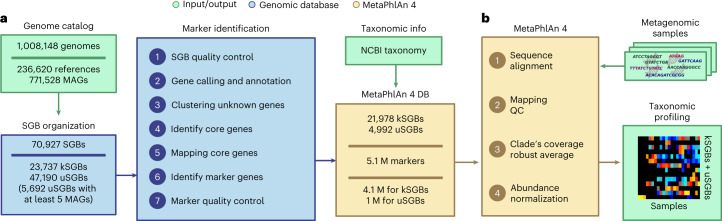
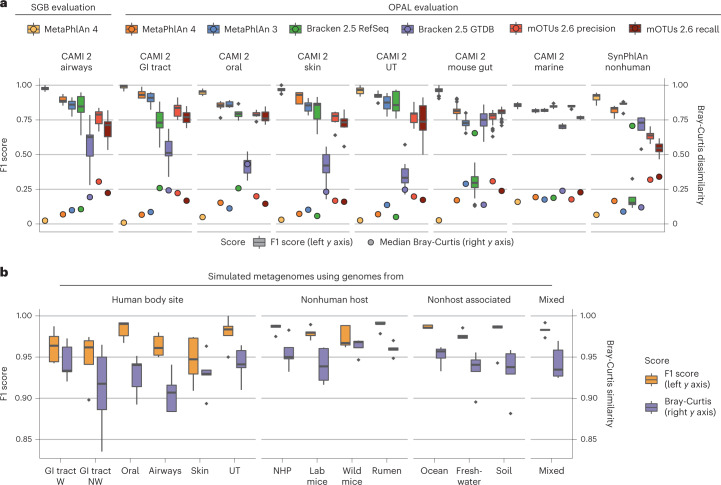
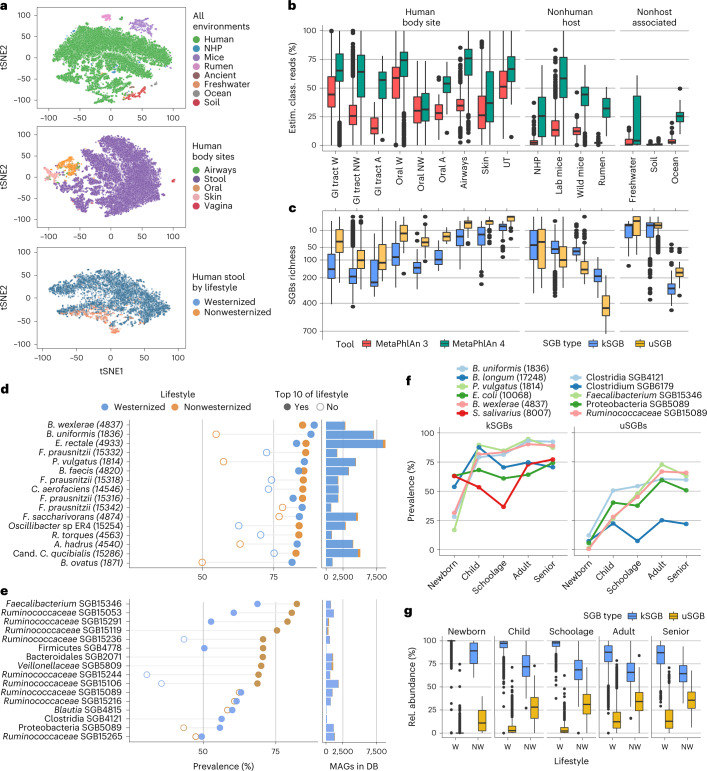
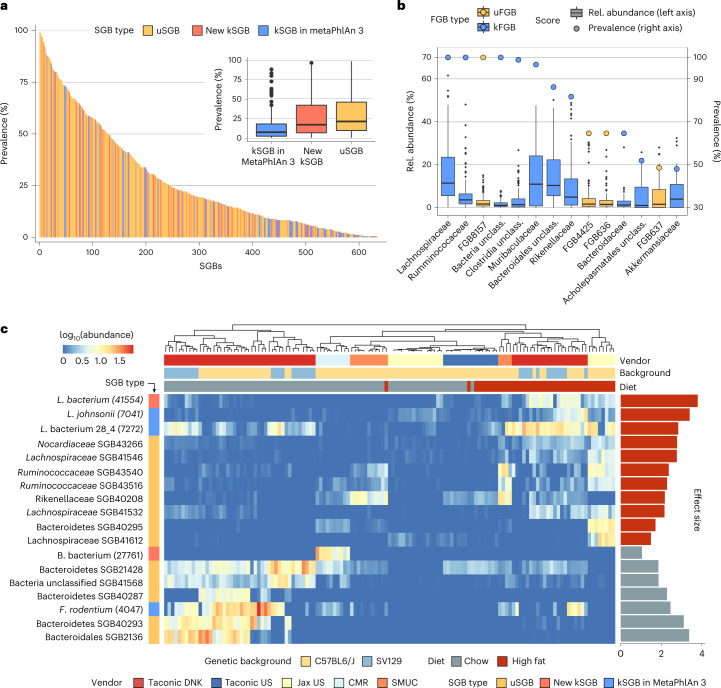
Metagenomic assembly enables new organism discovery from microbial communities, but it can only capture few abundant organisms from most metagenomes. Here we present MetaPhlAn 4, which integrates information from metagenome assemblies and microbial isolate genomes for more comprehensive metagenomic taxonomic profiling. From a curated collection of 1.01 M prokaryotic reference and metagenome-assembled genomes, we define unique marker genes for 26,970 species-level genome bins, 4,992 of them taxonomically unidentified at the species level. MetaPhlAn 4 explains ~20% more reads in most international human gut microbiomes and >40% in less-characterized environments such as the rumen microbiome and proves more accurate than available alternatives on synthetic evaluations while also reliably quantifying organisms with no cultured isolates. Application of the method to >24,500 metagenomes highlights previously undetected species to be strong biomarkers for host conditions and lifestyles in human and mouse microbiomes and shows that even previously uncharacterized species can be genetically profiled at the resolution of single microbial strains.
Overview
The claims and statistics of this paper haven’t been checked yet.
Free: it reads the open-access text and checks the first 5 claims that cite a source we can check. Create a free account to check every claim.
Integrity signals
Registry
Cites
Statistics
Figures
Verification
Claims the paper makes
The claims and statistics of this paper haven’t been checked yet.
Free: it reads the open-access text and checks the first 5 claims that cite a source we can check. Create a free account to check every claim.
Claims other papers make about this one
Each is checked against this paper’s own text: does it say what the citing paper says it does?
The cited source says what the claim attributes to it.
In the citing paper
“we performed a meta-analysis and mega-analysis of stools taxonomically profiled with MetaPhlAn 4 (ref. 37) and from patients enrolled in 12 cohorts from eight published studies26,38–44 across three cancer types, and classified as responders (n = 248) or non-responders (n = 513) based on RECIST1.1 criteria response rates”
From Gut OncoMicrobiome Signatures (GOMS) as next-generation biomarkers for cancer immunotherapy (2023) · cites this paper as [37]
The cited source says what the claim attributes to it.
In the citing paper
“We further performed strain-level and strain-matching analysis via StrainPhlAn 4 84 (STAR Methods) and identified potential transmission patterns for some food-human overlapping SGBs (Figures 6 and S6).”
From Unexplored microbial diversity from 2,500 food metagenomes and links with the human microbiome. (2024) · cites this paper as [84]
The check wasn’t confident either way, so it gives no verdict — never disputed.
In the citing paper
“A meta- and mega-analysis of stools obtained from patients with cancer treated with ICIs showed that GOMS associated with ICI resistance comprised microorganisms affiliated with chronic inflammation and immunosuppression and oral genera, and were shared across various pathological disorders.22,155”
From Melanoma and microbiota: Current understanding and future directions (2024) · cites this paper as [155]
Experimental — accuracy not yet measuredIn the citing paper
“We used MetaPhlAn 4 (ref. 37) for microbiome taxonomic profiling of stool samples from 1,879 adults across eight different cancer types (included in 30 cohorts from 23 published studies)25–29,38–55 and from a control group comprising 5,341 individuals without cancer (included in 17 cohorts from 14 published studies)”
From Gut OncoMicrobiome Signatures (GOMS) as next-generation biomarkers for cancer immunotherapy (2023) · cites this paper as [37]
In the citing paper
“Taxonomic profiling was performed at the level of species-level genome bins (SGBs) using MetaPhlAn4, which represent both existing and yet-to-be-characterized microbial species17.”
From Longitudinal gut microbiome changes in immune checkpoint blockade-treated advanced melanoma (2024) · cites this paper as [17]
1 more claim about this paper
Create a free account to see every claim other papers make about this one.
Self-check
Percentages, sums and reported differences re-computed from the paper’s own numbers.
The self-check needs the paper’s full text.
Citations
Cites
The Sequence Alignment/Map format and SAMtools
Li, H., Handsaker, B., Wysoker, A., Fennell, T., Ruan, J., Homer, N., Marth, G., Abecasis, G., Durbin, R., & 1000 Genome Project Data Processing Subgroup (2009) · Bioinformatics · doi:10.1093/bioinformatics/btp352 · Cited by 62,041 · cited 1×
“For item (1), StrainPhlAn 4 considers as input the reads-to-markers alignment results (in SAM format 96 ) from the MetaPhlAn 4 profiling together with the MetaPhlAn 4 database.”
MethodFast gapped-read alignment with Bowtie 2
Langmead, B., & Salzberg, S. L. (2012) · Nature Methods · doi:10.1038/nmeth.1923 · Cited by 56,400 · cited 1×
“To detect the SGB-specific marker genes, each set of core genes was then aligned against the genomes of the other SGBs using Bowtie 2 (version 2.3.5.1; -- sensitive parameter) 83 .”
MethodInfluentialMAFFT Multiple Sequence Alignment Software Version 7: Improvements in Performance and Usability
Katoh, K., & Standley, D. M. (2013) · Molecular Biology and Evolution · doi:10.1093/molbev/mst010 · Cited by 46,209 · cited 2×
“By default, multiple-sequence alignment is performed by MAFFT 92 , gappy positions (that is, positions with more than 67% of gaps) are trimmed by trimAl 91 and phylogenetic trees are inferred by RAxML 97 .”
MethodInfluentialRAxML version 8: a tool for phylogenetic analysis and post-analysis of large phylogenies
Stamatakis, A. (2014) · Bioinformatics · doi:10.1093/bioinformatics/btu033 · Cited by 32,291 · cited 3×
“By default, multiple-sequence alignment is performed by MAFFT 92 , gappy positions (that is, positions with more than 67% of gaps) are trimmed by trimAl 91 and phylogenetic trees are inferred by RAxML 97 .”
MethodInfluentialIQ-TREE: A Fast and Effective Stochastic Algorithm for Estimating Maximum-Likelihood Phylogenies
Nguyen, L.-T., Schmidt, H. A., von Haeseler, A., & Minh, B. Q. (2015) · Molecular Biology and Evolution · doi:10.1093/molbev/msu300 · Cited by 26,046
Prokka: rapid prokaryotic genome annotation
Seemann, T. (2014) · Bioinformatics · doi:10.1093/bioinformatics/btu153 · Cited by 18,818
Fast and sensitive protein alignment using DIAMOND
Buchfink, B., Xie, C., & Huson, D. H. (2015) · Nature Methods · doi:10.1038/nmeth.3176 · Cited by 14,201
trimAl: a tool for automated alignment trimming in large-scale phylogenetic analyses
Capella-Gutiérrez, S., Silla-Martínez, J. M., & Gabaldón, T. (2009) · Bioinformatics · doi:10.1093/bioinformatics/btp348 · Cited by 12,751 · cited 1×
“By default, multiple-sequence alignment is performed by MAFFT 92 , gappy positions (that is, positions with more than 67% of gaps) are trimmed by trimAl 91 and phylogenetic trees are inferred by RAxML 97 .”
MethodParks, D. H., Imelfort, M., Skennerton, C. T., Hugenholtz, P., & Tyson, G. W. (2015) · Genome Research · doi:10.1101/gr.186072.114 · Cited by 12,496
Diet rapidly and reproducibly alters the human gut microbiome
David, L. A., Maurice, C. F., Carmody, R. N., Gootenberg, D. B., Button, J. E., Wolfe, B. E., Ling, A. V., Devlin, A. S., Varma, Y., Fischbach, M. A., et al. (2014) · Nature · doi:10.1038/nature12820 · Cited by 10,100
Cited by
Items 401–500 of 1,000
Challenges and Opportunities in Analyzing Cancer-Associated Microbiomes
Chia, M., Pop, M., Salzberg, S. L., & Nagarajan, N. (2025) · Cancer Research · doi:10.1158/0008-5472.can-24-3629 · Cited by 12
Subspecies of the human gut microbiota carry implicit information for in-depth microbiome research
Tričković, M., Kieser, S., Zdobnov, E. M., & Trajkovski, M. (2025) · Cell Host & Microbe · doi:10.1016/j.chom.2025.07.015 · Cited by 13
Lantibiotic-producing bacteria impact microbiome resilience and colonization resistance
Cole, C. G., Zhang, Z. J., Dommaraju, S. R., Dong, Q., Pope, R. L., Son, S. S., McSpadden, E., Woodson, C., Lin, H., Dylla, N. P., et al. (2025) · Cell Host & Microbe · doi:10.1016/j.chom.2025.11.007 · Cited by 13
Liu, X., Geng, A., Xia, M., Lan, J., Wu, H., Zhou, Z., Huang, F., He, Y., Lei, T., Hur, J., et al. (2025) · Translational Psychiatry · doi:10.1038/s41398-025-03743-3 · Cited by 13
“The PCR product was extracted from a 2% agarose gel and puri fi ed.”
Tsouggou, N., Korozi, E., Pemaj, V., Drosinos, E. H., Kapolos, J., Papadelli, M., Skandamis, P. N., & Papadimitriou, K. (2026) · Foods · doi:10.3390/foods15020259 · Cited by 14
“Marker gene-based methods such as MetaPhlan3/MetaPhlan4 [38,39] allow species-level identification using clade-specific marker genes.”
Biodiversity and biogeography of the multi-kingdom cancer microbiome
Dohlman, A. B., Mjelle, R., Wood, H. M., Jiang, K., Shumate, A., Lee, I., Piccinno, G., Serna, G., Yakubu, A.-R., Nuciforo, P. G., et al. (2026) · Cell · doi:10.1016/j.cell.2026.04.015 · Cited by 16
Self-citationMetagenomic next generation sequencing for studying antibiotic resistance genes in the environment
Li, B., & Yan, T. (2023) · Advances in applied microbiology · doi:10.1016/bs.aambs.2023.05.001 · Cited by 13
O'Malley, K. N., McNamara, P. J., Marshall, C. W., LaMartina, E. L., Lam, T. “., Ali, N., & McDonald, W. (2024) · Journal of Hazardous Materials · doi:10.1016/j.jhazmat.2024.133923 · Cited by 18
Fangyukangsuan granules ameliorate hyperuricemia and modulate gut microbiota in rats
Zhang, Q.-Z., Zhang, J.-R., Li, X., Yin, J.-L., Jin, L.-M., Xun, Z., Xue, H., Yang, W., Zhang, H., Qu, J., et al. (2024) · Frontiers in Immunology · doi:10.3389/fimmu.2024.1362642 · Cited by 11
Smith, B. J., Zhao, C., Dubinkina, V. B., Jin, X., Zahavi, L., Shoer, S., Anderson, J. M., Segal, E., & Pollard, K. S. (2025) · Genome Research · doi:10.1101/gr.279543.124 · Cited by 13
Zhao, Y., Li, C., Wu, K., Chen, H., Wang, Q., Xiao, Y., Yao, S., Hong, A., Zhang, M., Lei, S., et al. (2024) · Biomedicines · doi:10.3390/biomedicines12071378 · Cited by 11
Zhang, L., Ning, D., Mantilla‐Calderon, D., Xu, Y., Liu, B., Chen, W., Gao, J., Hamilton, K. A., Liu, J., Zhou, J. Z., et al. (2024) · Nature Water · doi:10.1038/s44221-024-00345-z · Cited by 11
A Small-Molecule Inhibitor of Gut Bacterial Urease Protects the Host from Liver Injury
Richards-Corke, K. C., Jiang, Y., Yeliseyev, V., Zhang, Y., Franzosa, E. A., Wang, Z. A., Abeywardana, M. Y., Cole, P. A., Huttenhower, C., Bry, L., et al. (2025) · ACS Chemical Biology · doi:10.1021/acschembio.3c00556 · Cited by 11
Self-citationGrønbæk, I. M. B., Halkjær, S. I., Mollerup, S., Hansen, E. H., Paulsen, S. J., Engel, S., Theede, K., Wilkens, R., Boysen, T., & Petersen, A. M. (2025) · Gut Pathogens · doi:10.1186/s13099-025-00692-6 · Cited by 12
“Clade-based microbial profiling of the human-depleted reads was performed with MetaPhlAn v. 4.1.1 [ 18] (data-base version mpa_vJun23_CHOCOPhlAnSGB_202403) with the addition of the parameters –ignore_eukaryotes, –ignore_usgbs, and -t rel_ab_w_read_stats.”
InfluentialBessa, L. J., Egas, C., Pires, C., Proença, L., Mascarenhas, P., Pais, R. J., Barroso, H., Machado, V., Botelho, J., Alcoforado, G. A. P., et al. (2025) · Frontiers in Cellular and Infection Microbiology · doi:10.3389/fcimb.2025.1543100 · Cited by 15
The dynamics of microbiome and virome in migratory birds of southwest China
Luo, Q., Gao, H., Xiang, Y., Li, J., Lin, D., Wang, X., Liu, F., Guo, Y., Shen, C., Ding, Q. W., et al. (2025) · npj Biofilms and Microbiomes · doi:10.1038/s41522-025-00703-z · Cited by 14
Bioinformatic approaches to blood and tissue microbiome analyses: challenges and perspectives
Sirasani, J. P., Gardner, C., Jung, G., Lee, H., & Ahn, T.-H. (2025) · Briefings in Bioinformatics · doi:10.1093/bib/bbaf176 · Cited by 11
“Tools such as MEGAN [136] and Bracken [137] estimate abundance across taxonomic levels, while marker gene-based strategies (e.g. MetaPhlAn 4 [73]) focus on conserved regions for more reliable detection.”
Cumbo, F., Truglia, S., Weitschek, E., & Blankenberg, D. J. (2025) · Briefings in Bioinformatics · doi:10.1093/bib/bbaf177 · Cited by 10
Self-citationOdenwald, M. A., Ramaswamy, R., Lin, H., Lehmann, C. J., Moran, A., Mullowney, M. W., Sidebottom, A. M., Hernández, A. B., McMillin, M., Rose, A. R., et al. (2025) · Gastro Hep Advances · doi:10.1016/j.gastha.2025.100695 · Cited by 10
“This may be due to differences in sequencing techniques (eg 16S vs metagenomic sequencing), evolving analytic techniques, 32 – 36 or changing taxonomic nomenclature, 37 which makes generalizing meta-genomic fi ndings dif fi cult.”
Host origin of microbiota drives functional recovery and Clostridioides difficile clearance in mice
Millard, S., Vendrov, K. C., Young, V. B., & Seekatz, A. M. (2025) · mBio · doi:10.1128/mbio.01108-25 · Cited by 11
Xu, F., Guo, Y., Thomas, S. C., Saxena, A., Hwang, S., Vardhan, M., & Li, X. (2025) · International Journal of Oral Science · doi:10.1038/s41368-025-00376-6 · Cited by 10
Lee, S., Kim, J. H., Baek, J. W., Jung, K.-Y., Lee, Y., Koh, A., & Kim, H. (2025) · npj Parkinson's Disease · doi:10.1038/s41531-025-01040-w · Cited by 12
“0.6, mpa_vOct22) 53 .”
InfluentialYe, X., Sahana, G., Lund, M. S., & Cai, Z. (2025) · World Journal of Microbiology and Biotechnology · doi:10.1007/s11274-025-04504-6 · Cited by 14
Uncovering the gut microbiome and antibiotic resistome of mammals on the Tibetan Plateau
Chen, T., Tang, Z., Zhang, X., Yao, X., Li, Y., Zhuang, D., Luo, Y., Li, T., Bai, L., Zhao, F., et al. (2025) · Science China Life Sciences · doi:10.1007/s11427-025-3047-5 · Cited by 10
“1.0) (Blanco-Míguez et al., 2023) with the mpa_vJun23_CHOCOPhlAnSGB_202403 database.”
InfluentialMoksnes, M. R., Coward, E., Nethander, M., Dekkers, K. F., Grahnemo, L., Törnqvist, A. E., Li, L., Lundmark, P., Pertiwi, K., Baldanzi, G., et al. (2026) · Nature Genetics · doi:10.1038/s41588-026-02502-4 · Cited by 14
“43), and various species relevant for benchmarking.”
Maternal influences on infant gut microbiome and health
Sinha, T., Brushett, S., Fernández-Pato, A., Garmaeva, S., Andreu‐Sánchez, S., Spreckels, J. E., Mallon, C. A., Kuzub, N., Gois, M. F. B., Wu, J., et al. (2026) · Nature · doi:10.1038/s41586-026-10922-9 · Cited by 13
“Taxo-nomic composition of metagenomes was profiled using the MetaPhlAn4 tool with the MetaPhlAn database of marker genes mpa_vJan21 and the ChocoPhlAn Species level Genomic Bin (SGB) database (202103) 86 .”
Oral Anaerobutyricum soehngenii augments glycemic control in type 2 diabetes
Attaye, I., Witjes, J. J., Koopen, A. M., van der Vossen, E. W. J., Zwirs, D., Wortelboer, K., Collard, D., Kemper, E. M., Winkelmeijer, M., Holst, J. J., et al. (2024) · iScience · doi:10.1016/j.isci.2024.110455 · Cited by 11
Salmaso, N., Cerasino, L., Pindo, M., & Boscaini, A. (2024) · FEMS Microbiology Ecology · doi:10.1093/femsec/fiae117 · Cited by 10
Biospecimens in the HEALthy Brain and Child Development (HBCD) Study: Rationale and protocol
Sullivan, E. L., Bogdan, R., Bakhireva, L. N., Levitt, P. R., Jones, J., Sheldon, M., Croff, J. M., Thomason, M. E., Lo, J. O.-T., MacIntyre, L., et al. (2024) · Developmental Cognitive Neuroscience · doi:10.1016/j.dcn.2024.101451 · Cited by 12
A conserved pilin from uncultured gut bacterial clade TANB77 enhances cancer immunotherapy
Kim, C. Y., Park, D. J., Ahn, B., Baek, S., Hong, M. H., Nguyen, L. T., Hwang, S. H., Kim, N., Podlesny, D., Orakov, A. N., et al. (2024) · Nature Communications · doi:10.1038/s41467-024-55388-3 · Cited by 12
Cámara‐Martos, F., Bolívar, A., Rabasco-Vílchez, L., Lafont-Déniz, F., Luque-Ojeda, J. L., & Pérez-Rodríguez, F. (2025) · Food Research International · doi:10.1016/j.foodres.2025.115781 · Cited by 10
Hajjar, J., Voigt, A. Y., Conner, M. E., Swennes, A. G., Fowler, S., Calarge, C., Mendonca, D., Armstrong, D., Chang, C.-Y., Walter, J., et al. (2023) · Journal of Human Immunity · doi:10.70962/jhi.20250040 · Cited by 11
Statistical design of a synthetic microbiome that suppresses diverse gut pathogensPreprint
Oliveira, R. A., McSpadden, E., Pandey, B., Lee, K. K., Yousef, M., Chen, R. Y., Triebold, C., Haro, F., Aksianiuk, V., Patel, R., et al. (2024) · bioRxiv (Cold Spring Harbor Laboratory) · doi:10.1101/2024.02.28.582635 · Cited by 11
BiomeGPT: A foundation model for the human gut microbiomePreprint
Medearis, N. A., Zhu, S., & Zomorrodi, A. R. (2026) · bioRxiv (Cold Spring Harbor Laboratory) · doi:10.64898/2026.01.05.697599 · Cited by 11
Cruz, M. D., Lin, H., Han, J., Adler, E., Boissiere, J. C., Khalid, M., Sidebottom, A. M., Sundararajan, A., Lehmann, C. J., Moran, A., et al. (2023) · Frontiers in Transplantation · doi:10.3389/frtra.2023.1182534 · Cited by 10
Combining compositional data sets introduces error in covariance network reconstruction
Brunner, J. D., Robinson, A., & Chain, P. (2024) · ISME Communications · doi:10.1093/ismeco/ycae057 · Cited by 9
“This technology classifies taxa by comparing reads to a known database in order to assemble genomes for the taxa present in the community [42].”
MethodMAGinator enables accurate profiling of de novo MAGs with strain-level phylogenies
Zachariasen, T., Russel, J., Petersen, C., Vestergaard, G., Shah, S. A., Atienza, P., Passali, M., Turvey, S. E., Sørensen, S. J., Lund, O., et al. (2024) · Nature Communications · doi:10.1038/s41467-024-49958-8 · Cited by 9
Testosterone treatment impacts the intestinal microbiome of transgender individuals
Harris, R. M., de Pace, F., Kuntz, T. M., Morgan, X. C., Hyland, P., Summers, K., McDermott, E., Blumen, K., & Watnick, P. I. (2024) · mSphere · doi:10.1128/msphere.00557-24 · Cited by 10
Shi, X., Ju, F., Wei, W., Wu, L., Chen, X., & Ni, B. (2024) · Chemical Engineering Journal · doi:10.1016/j.cej.2024.155742 · Cited by 11
Castanet: a pipeline for rapid analysis of targeted multi-pathogen genomic data
Mayne, R., Secret, S., Geoghegan, C. G., Trebes, A., Kean, K., Reid, K., Lin, G.-L., Ansari, M. A., de Cesare, M., Bonsall, D., et al. (2024) · Bioinformatics · doi:10.1093/bioinformatics/btae591 · Cited by 9
“Second, since a background level of (un-targeted) metagenomic reads remains in the sequenceable library, the difference in read depth between the targeted and untargeted sequences can be used to calculate efficiency of capture, helping to distinguish true low-abundance positives from low-level…”
BackgroundCroCoDeEL: accurate control-free detection of cross-sample contamination in metagenomic data
Goulet, L., Plaza Oñate, F., Famechon, A., Quinquis, B., Belda, E., Prifti, E., Le Chatelier, E., & Gautreau, G. (2026) · Nature Communications · doi:10.1038/s41467-026-72637-9 · Cited by 4
“Performance of CroCoDeEL was evaluated using 25 semi-simulated sample pairs, assessing the in fl uence of varying contamination rates (0.5, 2, 5, 20%), sequencing depths (1, 5, 10M paired-end reads), and three taxonomic pro fi lers(MetaPhlAn4, Sylph, Meteor2).”
InfluentialIndustrialization drives the gut microbiome and resistome of the Chinese populations
Chen, T., Zhang, T., Zhuang, D., Luo, Y., Li, T., Zhao, F., Sang, J., Tang, Z., Jiang, P., Zhang, T., et al. (2025) · mSystems · doi:10.1128/msystems.01372-24 · Cited by 9
Tang, M., Zhang, Z., Lin, L., Niu, J., Meng, G., Wang, W., Wang, J., & Wang, Y. (2025) · Phenomics · doi:10.1007/s43657-025-00228-7 · Cited by 9
Improving gut virome comparisons using predicted phage host information
Shamash, M., Sinha, A., & Maurice, C. F. (2025) · mSystems · doi:10.1128/msystems.01364-24 · Cited by 12
Steriade, C., Thomas, S. C., Xu, F., Ahituv, A., Hanin, A., Pleshkevich, M., Hwang, S., Ramirez, A., Foreman, B. P., Yoo, J. Y., et al. (2025) · Epilepsia · doi:10.1111/epi.18450 · Cited by 9
“23 However, the gut eukaryotic microbiome, primarily fungal, is investigated increasingly in research on inflammatory bowel and other diseases.”
Fecal metabolite profiling identifies critically ill patients with increased 30-day mortality
de Porto, A. P. N. A., Dylla, N. P., Stutz, M. R., Lin, H., Khalid, M., Mullowney, M. W., Little, J., Rose, A. R., Moran, D., McMillin, M., et al. (2025) · Science Advances · doi:10.1126/sciadv.adt1466 · Cited by 12
Khattak, F., Galgano, S., Pearson, R., Houdijk, J. G. M., Short, F., & Leigh, A. (2025) · Poultry Science · doi:10.1016/j.psj.2025.105550 · Cited by 9
From Panels to Pathogen Networks: The Expanding Role of Targeted Sequencing in Veterinary Medicine
Luo, J., Lu, W., Liu, R., Zhang, S., Cao, J., & Ma, C. (2025) · Biology · doi:10.3390/biology14081075 · Cited by 10
Valentino, V., Magliulo, R., Balivo, A., Krysmann, A., Calvanese, C. M., Esposito, A., Sequino, G., Genovese, A., Porcellato, D., Ercolini, D., et al. (2025) · npj Biofilms and Microbiomes · doi:10.1038/s41522-025-00815-6 · Cited by 10
The Gut Resistome Atlas in Preterm Infants Enables Prediction of Necrotizing Enterocolitis Onset
Zeng, S., Wang, H., Zhang, L., Li, S., Yuan, Y., Tian, M., Qu, Y., Ying, J., Zhou, M., Hu, Y., et al. (2025) · Advanced Science · doi:10.1002/advs.202505154 · Cited by 10
Liu, S., Feng, B., Zhang, Z., Miao, J., Lai, X., Zhao, W., Xie, Q., Ye, X., Cao, C., Yu, P., et al. (2025) · npj Biofilms and Microbiomes · doi:10.1038/s41522-025-00828-1 · Cited by 10
Lyu, L., Fan, Y., Bryrup, T., Clos‐Garcia, M., Brix, S., Eiken, M., Stankevič, E., Lund, A., Knop, F. K., Jørgensen, N. R., et al. (2025) · Cell Reports Medicine · doi:10.1016/j.xcrm.2025.102426 · Cited by 14
Kumar, V., & Verma, P. (2025) · World Journal of Microbiology and Biotechnology · doi:10.1007/s11274-025-04674-3 · Cited by 9
“…bioinformatics pipelines, such as QIIME 2 (for microbiome amplicon sequencing) (Bokulich et al. 2018 ), MetaPhlAn 4 (for taxonomic profiling) (Blanco-Míguez et al. 2023), PICRUSt 2 (for functional analysis) (Douglas et al. 2020) and HUMAnN 2 (for functional pathway reconstruction) ( h t t p…”
Transitions in lung microbiota landscape associate with distinct patterns of pneumonia progression
Sumner, J. T., Huttelmaier, S., Pickens, C. I., Moghadam, A. A., Abdala‐Valencia, H., Shen, J., Peltekian, A., Misharin, A. V., Wolfe, A. R., Szabo, A. L., et al. (2025) · Cell Host & Microbe · doi:10.1016/j.chom.2025.11.011 · Cited by 11
Mobile genetic elements shape microbial diversity and functions in thawing permafrost soils
Guo, J., Aroney, S. T. N., Domínguez‐Huerta, G., Smith, D. A., Vik, D., Owusu-Ansah, C., Pratama, A. A., Solonenko, S. A., Tian, F., Howard‐Varona, C., et al. (2026) · Nature Microbiology · doi:10.1038/s41564-026-02391-7 · Cited by 11
“New tools are bringing metagenomic strain-level diversity into focus in intensively studied systems such as the human microbiome, but still struggle in complex or understudied systems such as soils 7–9 .”
Contreras, J. A., Valenzuela, E. I., Bovio-Winkler, P., Etchebehere, C., Gabaldón, C., & Quijano, G. (2023) · Chemical Engineering Journal · doi:10.1016/j.cej.2023.143137 · Cited by 10
Salas‐Espejo, E., Terron-Camero, L. C., Ruiz, J. L., Molina, N. M., & Andrés‐León, E. (2023) · Seminars in Reproductive Medicine · doi:10.1055/s-0044-1779025 · Cited by 9
“116 The Galaxy open-source platform also suggests a pipeline 117 based on MEGAHIT, metaSPAdes, HUMAnN, and MetaPhIAn, 88 which to our knowledge has not been applied to human reproduction yet.”
MethodGarrison, E. C., Brown, A. M. V., Salazar, M. M., Barr, B., Moustaïd‐Moussa, N., & Gollahon, L. (2024) · Nutrients · doi:10.3390/nu16111613 · Cited by 11
Kopera, K., Gromowski, T., Wydmański, W., Skonieczna‐Żydecka, K., Muszyńska, A., Zielińska, K., Wierzbicka-Woś, A., Kaczmarczyk, M., Kadaj-Lipka, R., Cembrowska-Lech, D., et al. (2024) · Frontiers in Microbiology · doi:10.3389/fmicb.2024.1342749 · Cited by 10
Sanguineti, D., Zampieri, G., Treu, L., & Campanaro, S. (2024) · mSystems · doi:10.1128/msystems.00213-24 · Cited by 10
“Among these methods, marker gene-based tools, such as MetaPhlAn, allow profiling microbial communities by mapping reads against sets of clade-specific marker genes, potentially achieving species or strain-level resolution (15).”
BackgroundMethodTian, Y., Rimal, B., Bisanz, J. E., Gui, W., Wolfe, T. M., Koo, I., Murray, I. A., Nettleford, S. K., Yokoyama, S., Dong, F., et al. (2024) · Environmental Health Perspectives · doi:10.1289/ehp13356 · Cited by 11
“To obtain the highest possible assignment rates of mice taxa, taxonomic characterization was performed with MetaPhlAn4 (version 4.0.6) 49 by incorporating species-level genome bins 50 with additional estimation of the unassigned fraction.”
MethodInfluentialdo Rosario, V. A., Lorzadeh, E., Brodaty, H., Anstey, K. J., Chan, K., Roodenrys, S. J., Kent, K., Bliokas, V. V., Phillipson, L., Weston–Green, K., et al. (2024) · BMJ Open · doi:10.1136/bmjopen-2024-086435 · Cited by 9
“…levels of pro-inflammatory cytokines related to dementia pathology (tumour necrosis factor-alpha, interleukin-1 and interleukin-6 (IL-1, IL-6)), (50); C-reactive protein; circulating levels of butyrate (produced by microbiota) and BDNF; vascular markers of endothelial function including,…”
Zepeda‐Rivera, M. A., Eisele, Y., Baryiames, A. A., Wu, H., Mengoni, C., Piccinno, G., McMahon, E. F., LaCourse, K. D., Jones, D. S., Hauner, H., et al. (2024) · Gut Microbes · doi:10.1080/19490976.2024.2442522 · Cited by 10
Self-citationShridhar, S. V., Beghini, F., Alexander, M., Singh, A., Juárez, R. M., Brito, I., & Christakis, N. A. (2024) · Cell Reports · doi:10.1016/j.celrep.2024.114442 · Cited by 12
Self-citationOrchestrating Microbiome Analysis with BioconductorPreprint
Borman, T., Benedetti, G., Muluh, G., Raulo, A., Valderrama, B., Sannikov, A., Peschel, S., Liu, Y., Hindström, R., Pärnänen, K. M. M., et al. (2025) · bioRxiv (Cold Spring Harbor Laboratory) · doi:10.1101/2025.10.29.685036 · Cited by 15
Rubio-Noguez, D., Bretón‐Deval, L., Salinas-Peralta, I., Juárez, K., & Galicia, L. (2024) · World Journal of Microbiology and Biotechnology · doi:10.1007/s11274-024-04025-8 · Cited by 8
“The tool to profile the microbial communities was executed using metagenomics phylogenetic analysis (MethaPhlAn4) (Blanco-Míguez et al. 2023 ).”
MethodAlhasani, A. T., Modasia, A. A., Anodiyil, M. S., Corsetti, M., Aliyu, A. I., Crooks, C. J., Marciani, L., Reid, J. E. S. J., Yakubov, G. E., Taylor, M., et al. (2024) · Journal of Nutrition · doi:10.1016/j.tjnut.2024.12.017 · Cited by 8
“Taxonomic pro fi ling using Meta-PhlAn4 [30] and MaAsLin2 [28] for species associations revealed 2 species that are more abundant in nonresponders as compared with responders: P . dorei and Clostridium spp. AM22_11AC and one species, which was more abundant in responders, Alistipes putridinis…”
Osagie, E., Akhigbe, P., Idemudia, N. L., Obuekwe, O. N., Adebiyi, R., Schlecht, N. F., Liu, J., Bromberg, Y., Eki-Udoko, F. E., Osazuwa-Peters, N., et al. (2025) · BMJ Open · doi:10.1136/bmjopen-2024-091017 · Cited by 9
Development of antibiotic resistome in premature infants
Keshet, A., Hochwald, O., Lavon, A., Borenstein‐Levin, L., Shoer, S., Godneva, A., Glantz-Gashai, Y., Cohen-Dolev, N., Timstut, F., Lotan‐Pompan, M., et al. (2025) · Cell Reports · doi:10.1016/j.celrep.2025.115515 · Cited by 8
CAMI Benchmarking Portal: online evaluation and ranking of metagenomic software
Meyer, F., Robertson, G., Deng, Z.-L., Koslicki, D., Gurevich, A. A., & McHardy, A. C. (2025) · Nucleic Acids Research · doi:10.1093/nar/gkaf369 · Cited by 12
“…currently includes 184 results for the marine dataset from 22 profiling methods and versions and the gold standard profile, from domain to strain level. mO-TUs 3.1.0 [ 29 ], MetaPhlAn 4.1.1 [ 30 ], and Sylph 0.8.0 [ 12 ] are among the more recent methods included in addition to the CAMI II results.”
InfluentialKiige, J. K., Kavoo, A. M., Mwajita, M. R., Mogire, D., Ogada, S., Wekesa, T. B., & Kiirika, L. M. (2025) · PLoS ONE · doi:10.1371/journal.pone.0323382 · Cited by 8
Raychaudhuri, S., Gem, H., Chung, K. K., McLean, J. S., Kerns, K. A., Hullar, M. A. J., Elmorr, E., Appelbaum, J. B., Percival, M. M., Walter, R. B., et al. (2025) · npj Biofilms and Microbiomes · doi:10.1038/s41522-025-00725-7 · Cited by 10
“Output fi les consisting of surviving paired and orphan reads were concatenated and used as input to MetaPhlAn4 44 .”
InfluentialLi, Y., Sun, C., Zhu, J., Geng, M., Li, M., Zhao, X., & Chen, W. (2025) · Microbiology Spectrum · doi:10.1128/spectrum.00013-25 · Cited by 14
“We calculated the taxonomic profiles of the gut bacteriome from the bulk data using MetaPhlAn4 (ver 4.0) (43).”
InfluentialIdentification of human pathogens in soil by virulence gene-based machine learning method
Qi, S., Wang, S., Xia, Y., Chen, S., & Lü, H. (2025) · Eco-Environment & Health · doi:10.1016/j.eehl.2025.100171 · Cited by 9
“Whole genome-based methods, e.g., DCiPatho, Kraken, and Meta-PhlAn, use either k-mer features or evolutionary branch-specific marker genes to identify pathogens in microbial communities [18 – 20].”
Cavalcante, A. L. G., Dari, D. N., Silva, M. F. D. M., Vieira, R. D. S., Aires, F. I. D. S., de Sousa, P. G., dos Santos, K. M., & dos Santos, J. C. S. (2025) · Molecular Catalysis · doi:10.1016/j.mcat.2025.115392 · Cited by 19
Gao, X., Ning, P., Luo, S., Wang, Y., Li, W., Fan, X., & Li, X. (2025) · International Journal of Food Microbiology · doi:10.1016/j.ijfoodmicro.2025.111441 · Cited by 8
Genomic characterization of normal and aberrant human milk production
Golan, Y., Nyquist, S. K., Liu, Z., Ennis, D., Zhao, J., Blair, E., Khan, A. R., Prahl, M. K., Gaw, S. L., Yassour, M., et al. (2025) · Science Advances · doi:10.1126/sciadv.adr7174 · Cited by 9
Distinct microbial and metabolic shifts characterize acute coronary syndrome and recovery
Xu, J., Dai, D., Yang, Y., Gao, S., Yang, J., Dong, C., Yang, W., Yuan, J., Wang, T., Tian, T., et al. (2025) · iMeta · doi:10.1002/imt2.70079 · Cited by 11
Lewis, Z. J., Scott, A., Madden, C. C., Vik, D. R., Zayed, A. A., Smith, G. J., Justice, S. S., Rudinsky, A. J., Hokamp, J. A., & Hale, V. L. (2025) · Microbiome · doi:10.1186/s40168-025-02191-x · Cited by 8
“0 [51] and SingleM [52] and SingleM condense.”
metaTraits: a large-scale integration of microbial phenotypic trait information
Podlesny, D., Kim, C. Y., Robbani, S. M., Schudoma, C., Fullam, A., Reimer, L. C., Koblitz, J., Schober, I., Iyappan, A., Rossum, T. V., et al. (2025) · Nucleic Acids Research · doi:10.1093/nar/gkaf1241 · Cited by 14
“Supported profilers currently include mOTUs [ 44 ], MetaPhlAn [ 45 ], Kraken [ 46 ], Krakenuniq [ 47 ], Bracken [ 48 ], Kaiju [ 49 ], as well as generic OTU tables with matching taxonomies.”
Ranson, A., Vázquez-Gómez, M., Alili, R., Durrafourd, J., Vitalis, O., Taillandier, P., Rebière, C., Merabtene, F., Belda, E., Crespo‐Piazuelo, D., et al. (2025) · Gut Microbes · doi:10.1080/19490976.2025.2587964 · Cited by 9
Omics-based decoding of molecular and metabolic crosstalk in the skin barrier ecosystem
Elettrico, L., Piacenti, G., Levron, C. L., Ansai, O., Croce, A., Duval, C., Proserpio, V., & Donati, G. (2026) · Cell Death and Differentiation · doi:10.1038/s41418-025-01648-8 · Cited by 8
“Table 1 provides a comparative overview of these tools, detailing their primary functions, applications, output and distinctive features to analyse shotgun metagenomics and 16S rRNA sequencing [89 – 98].”
Moiseyenko, A., Antonello, G., Schonhoff, A. M., Boktor, J. C., Long, K., Dirks, B., Oguienko, A. D., Winnett, A. V., Simpson, P., Daeizadeh, D., et al. (2026) · npj Parkinson s Disease · doi:10.1038/s41531-026-01287-x · Cited by 9
Self-citationRapid specific detection of oral bacteria using Cas13-based SHERLOCK
Liu, J., Carmichael, C., Hastürk, H., Shi, W., & Bor, B. (2023) · Journal of Oral Microbiology · doi:10.1080/20002297.2023.2207336 · Cited by 8
“0 marker genes attributed to that particular species [24].”
BackgroundYan, Y. L., Xu, J., Huang, W., Fan, Y., Li, Z., Tian, M., Ma, J., Lü, X., & Liang, J. (2024) · Microorganisms · doi:10.3390/microorganisms12050911 · Cited by 9
Mancin, L., Rollo, I., Golzato, D., Segata, N., Petri, C., Pengue, L., Vergani, L., Cassone, N., Corsini, A., Mota, J. F., et al. (2024) · International Journal of Sport Nutrition and Exercise Metabolism · doi:10.1123/ijsnem.2024-0012 · Cited by 9
Self-citationLuu, L. D. W., Rafique, R., Payne, M., Octavia, S., Robson, J. R., Sintchenko, V., & Lan, R. (2024) · Journal of Clinical Microbiology · doi:10.1128/jcm.01178-24 · Cited by 10
Pucci, N., Ujčič-Voortman, J. K., Verhoeff, A. P., & Mende, D. R. (2025) · PeerJ · doi:10.7717/peerj.18602 · Cited by 11
Houari, A. E., Carpenter, M., Chaplin, D., Golyshin, P. N., & McDonald, J. E. (2025) · Systematic and Applied Microbiology · doi:10.1016/j.syapm.2025.126590 · Cited by 10
Song, M. J., Freund, F. D., Tribble, C. M., Toffelmier, E. M., Miller, C., Shaffer, H. B., Li, F., & Rothfels, C. J. (2025) · American Journal of Botany · doi:10.1002/ajb2.70010 · Cited by 9
Refining microbiome diversity analysis by concatenating and integrating dual 16S rRNA amplicon reads
Kim, K. S., Noh, J., Kim, B. S., Koh, H., & Lee, D. (2025) · npj Biofilms and Microbiomes · doi:10.1038/s41522-025-00686-x · Cited by 10
Gut microbiome signatures predict 5-ASA efficacy in ulcerative colitis
Dang, Y., Xu, X., Ma, J., Zhou, M., Xu, C., Huang, X., Xu, F., Wang, Z., Shi, H., & Zhang, S. (2025) · iScience · doi:10.1016/j.isci.2025.112568 · Cited by 12
Sugar-rich foods exacerbate antibiotic-induced microbiome disruption
Dai, A., Ballweg, A., Jogia, W., Rangesa, M., Adintori, P. A., Baichoo, M., Funnell, T., Fei, T., Waters, N. R., Swartz, A., et al. (2026) · Nature · doi:10.1038/s41586-026-11077-3 · Cited by 8
“56).”
Ricci, L., Selma‐Royo, M., Golzato, D., Nabinejad, A., Servais, C., Armanini, F., Asnicar, F., Pinto, F., Tamburini, S., & Segata, N. (2023) · Microbiology Resource Announcements · doi:10.1128/mra.00329-23 · Cited by 9
Self-citationImpact of Baizhu, Daqingye, and Hehuanhua extracts on the human gut microbiome
Lemons, J. M. S., Narrowe, A. B., Liu, L., Firrman, J., Mahalak, K. K., den Abbeele, P. V., Baudot, A., Deyaert, S., Li, Y., & Yu, L. L. (2023) · Frontiers in Cellular and Infection Microbiology · doi:10.3389/fcimb.2023.1298392 · Cited by 8
Outbreak of piglet diarrhea associated with a new reassortant porcine rotavirus B
Li, Q., Wang, Z., Jiang, J., He, B., Sun, H., Tu, C., Guo, Y., & Gong, W. (2023) · Veterinary Microbiology · doi:10.1016/j.vetmic.2023.109947 · Cited by 8
Vancaester, E., & Blaxter, M. (2024) · Wellcome Open Research · doi:10.12688/wellcomeopenres.20730.1 · Cited by 8
“Bins generated by coverage and compositional patterns must be taxonomically classified post hoc , and another suite of methods have been developed to perform taxonomic profiling, such as GTDK-Tk 12 , MetaPhlAn4 13 , MEGAN-LR 14 and Centrifuge 15 .”
MethodExploring high-quality microbial genomes by assembling short-reads with long-range connectivity
Zhang, Z., Xiao, J., Wang, H., Yang, C., Huang, Y., Yue, Z., Chen, Y., Han, L., Yin, K., Lü, A., et al. (2024) · Nature Communications · doi:10.1038/s41467-024-49060-z · Cited by 15
Jank, L., Singh, S. S., Lee, J. J., Dhukhwa, A., Siavoshi, F., Joshi, D., Minney, V., Gupta, K., Ghimire, S., Deme, P., et al. (2024) · bioRxiv (Cold Spring Harbor Laboratory) · doi:10.1101/2024.10.27.620437 · Cited by 11
“To characterize the microbial composition at the species level, taxonomic profiling was conducted using MetaPhlAn 4 80 .”
MethodMajzoub, M. E., Luu, L. D. W., Haifer, C., Paramsothy, S., Borody, T. J., Leong, R. W. L., Thomas, T., & Kaakoush, N. O. (2024) · mSystems · doi:10.1128/msystems.00746-24 · Cited by 9
“Quality-filtered reads from above were analyzed using MetaPhlAn4 to profile the composition of the microbial communities and generate tables with relative abundan ces of microbial species (40).”
Method
Metadata
- Authors
- Blanco-Míguez, A., Beghini, F., Cumbo, F., McIver, L. J., Thompson, K. N., Zolfo, M., Manghi, P., Dubois, L., Huang, K. D., Thomas, A. M., Nickols, W. A., Piccinno, G., Piperni, E., Punčochář, M., Valles-Colomer, M., Tett, A., Giordano, F., Davies, R., Wolf, J., Berry, S. E., Spector, T. D., Franzosa, E. A., Pasolli, E., Asnicar, F., Huttenhower, C., & Segata, N.
- Affiliations
- University of Trento (IT)
- Broad Institute (US)
- University of Vienna (AT)
- ZOE (United Kingdom) (GB)
- King's College London (GB)
- University of Naples Federico II (IT)
- Corresponding author
- Segata, Nicola
- ORCID
- Blanco-Míguez, Aitor
- Beghini, Francesco
- Cumbo, Fabio
- McIver, Lauren J.
- Thompson, Kelsey N.
- Zolfo, Moreno
- Manghi, Paolo
- Huang, Kun D.
- Thomas, Andrew Maltez
- Nickols, William A.
- Piccinno, Gianmarco
- Piperni, Elisa
- Punčochář, Michal
- Tett, Adrian
- Giordano, Francesca
- Davies, Richard
- Wolf, Jonathan
- Berry, Sarah E.
- Spector, Tim D.
- Franzosa, Eric A.
- Pasolli, Edoardo
- Asnicar, Francesco
- Huttenhower, Curtis
- Segata, Nicola
- Venue
- Nature Biotechnology
- Published
- 2023-02-23
- Volume
- 41
- Issue
- 11
- Pages
- 1633-1644
- ISSN
- 0733-222X (ISSN-L)
- 1087-0156
- 1546-1696
- PMC
- PMC10635831
- OpenAlex
- W4321611856
- Semantic Scholar
- e28eff291a1b5c8f0a98f826de240f846be03334
- Cited by
- 1,442
- References
- 101
- Citations by year
- 2026: 517 · 2025: 521 · 2024: 309 · 2023: 93
- FWCI
- 129.03
- Type
- journal article
- Language
- en
- Open access
- hybrid
- doi.org
- Licence
- cc-by
- creativecommons.org/licenses/by/4.0 (tdm)
- creativecommons.org/licenses/by/4.0 (vor)
- Locations
- Nature Biotechnology (publishedVersion, cc-by)
- PubMed Central (publishedVersion, cc-by)
- PubMed (publishedVersion)
- Iris (University of Trento) (submittedVersion, cc-by)
- Funders
- Harvard T.H. Chan School of Public Health
- Cancer Research UK (#C10674/A27140, A27140)
- National Institutes of Health (1u01ca230551-01a1, H2020, 1U01CA230551)
- Horizon 2020 Framework Programme (OncoBiome 825410, 818368, ONCOBIOME-825410 project, MASTER-818368 project, 825410)
- National Cancer Institute (1U01CA230551, U01 CA230551)
- National Institute of Allergy and Infectious Diseases (U19AI110820)
- National Institute of Diabetes and Digestive and Kidney Diseases (R24DK110499, P30DK043351)
- H2020 European Research Council (716575)
- HORIZON EUROPE European Research Council (101045015)
- Topics
- Life Sciences › Biochemistry, Genetics and Molecular Biology › Molecular Biology › Genomics and Phylogenetic Studies
- Life Sciences › Biochemistry, Genetics and Molecular Biology › Molecular Biology › Gut microbiota and health
- Physical Sciences › Environmental Science › Ecology › Microbial Community Ecology and Physiology
- Keywords
- metagenome-assembled genomes, marker genes, human gut microbiome, rumen microbiome, microbial biomarkers, metagenome assembly
- MeSH terms
- Gastrointestinal Microbiome, Animals, Humans, Phylogeny, Mice, Metagenome, Metagenomics, Microbiota
About these checks
Registry, retraction, Cites and statistics results are computed, not judged, with one exception: a printed reference that no index lists is read once by a model before it counts as a citation error. Claims are extracted by a model and kept only when their quote appears verbatim in the text; each cited source is then checked, with a model’s help, for whether it says what the claim relies on. Those verdicts can be wrong — read the claim’s quote and the cited source before relying on one.
Statistics and arithmetic are recomputed, not judged.
Confidence bands are shown only for fields calibrated on our annotated test set. None is calibrated yet, so no band is shown.
What counts as a claim ›How we measure confidence ›How we check this ›
Are you an author, or do you see a problem with this page? Request a review
Data sources
Bibliographic data: Semantic Scholar, OpenAlex, Crossref.
Contains information from the Semantic Scholar Academic Graph Datasets, made available under the ODC Attribution License (ODC-BY 1.0).
Semantic Scholar’s data is described in: Kinney, R., et al. (2023). The Semantic Scholar Open Data Platform. arXiv:2301.10140.
