

Extending and improving metagenomic taxonomic profiling with uncharacterized species using MetaPhlAn 4
Open accessThe DOI matches its Crossref record; 101 of the 101 references it cites were found in a registry or an index.
Abstract
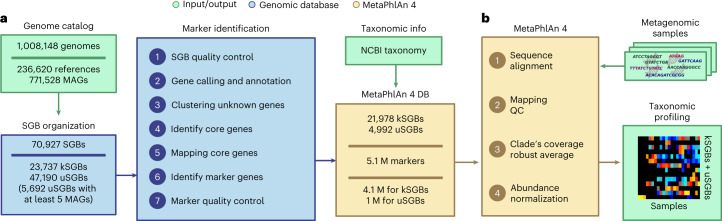
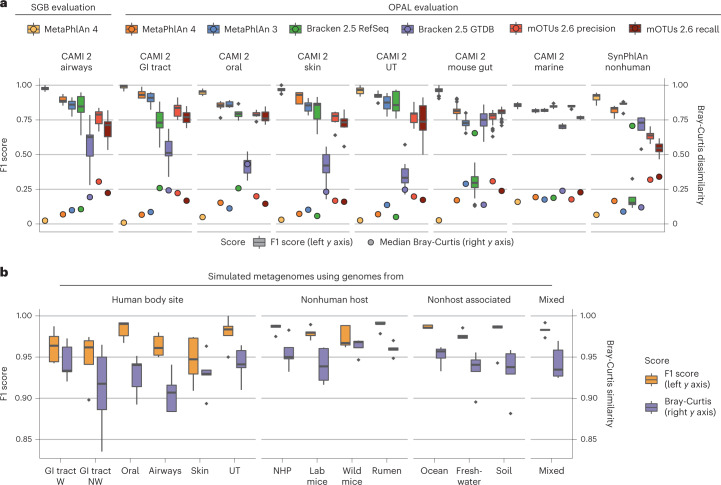
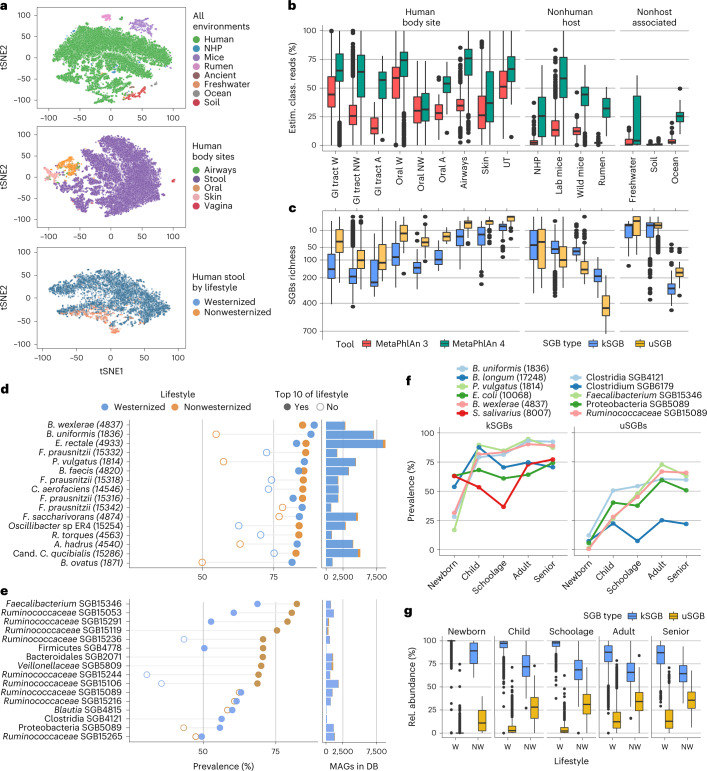
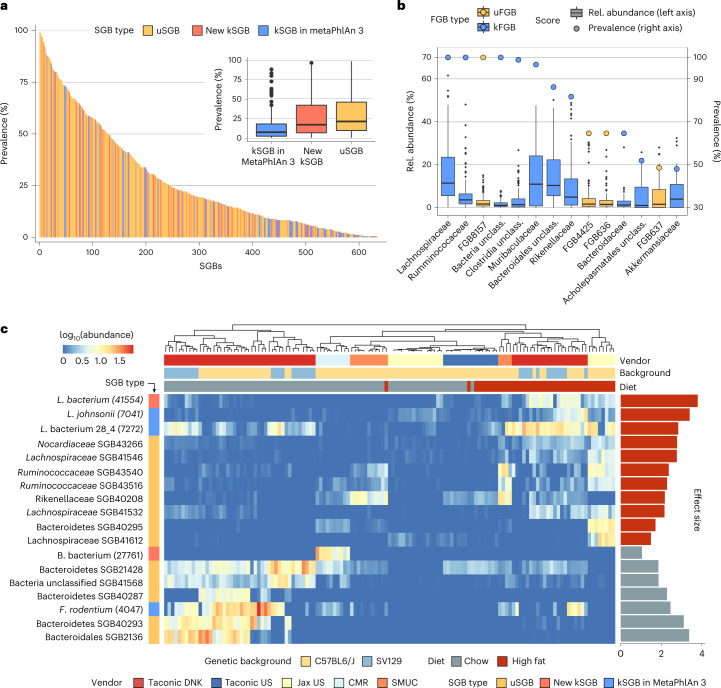
Metagenomic assembly enables new organism discovery from microbial communities, but it can only capture few abundant organisms from most metagenomes. Here we present MetaPhlAn 4, which integrates information from metagenome assemblies and microbial isolate genomes for more comprehensive metagenomic taxonomic profiling. From a curated collection of 1.01 M prokaryotic reference and metagenome-assembled genomes, we define unique marker genes for 26,970 species-level genome bins, 4,992 of them taxonomically unidentified at the species level. MetaPhlAn 4 explains ~20% more reads in most international human gut microbiomes and >40% in less-characterized environments such as the rumen microbiome and proves more accurate than available alternatives on synthetic evaluations while also reliably quantifying organisms with no cultured isolates. Application of the method to >24,500 metagenomes highlights previously undetected species to be strong biomarkers for host conditions and lifestyles in human and mouse microbiomes and shows that even previously uncharacterized species can be genetically profiled at the resolution of single microbial strains.
Overview
The claims and statistics of this paper haven’t been checked yet.
Free: it reads the open-access text and checks the first 5 claims that cite a source we can check. Create a free account to check every claim.
Integrity signals
Registry
Cites
Statistics
Figures
Verification
Claims the paper makes
The claims and statistics of this paper haven’t been checked yet.
Free: it reads the open-access text and checks the first 5 claims that cite a source we can check. Create a free account to check every claim.
Claims other papers make about this one
Each is checked against this paper’s own text: does it say what the citing paper says it does?
The cited source says what the claim attributes to it.
In the citing paper
“we performed a meta-analysis and mega-analysis of stools taxonomically profiled with MetaPhlAn 4 (ref. 37) and from patients enrolled in 12 cohorts from eight published studies26,38–44 across three cancer types, and classified as responders (n = 248) or non-responders (n = 513) based on RECIST1.1 criteria response rates”
From Gut OncoMicrobiome Signatures (GOMS) as next-generation biomarkers for cancer immunotherapy (2023) · cites this paper as [37]
The cited source says what the claim attributes to it.
In the citing paper
“We further performed strain-level and strain-matching analysis via StrainPhlAn 4 84 (STAR Methods) and identified potential transmission patterns for some food-human overlapping SGBs (Figures 6 and S6).”
From Unexplored microbial diversity from 2,500 food metagenomes and links with the human microbiome. (2024) · cites this paper as [84]
The check wasn’t confident either way, so it gives no verdict — never disputed.
In the citing paper
“A meta- and mega-analysis of stools obtained from patients with cancer treated with ICIs showed that GOMS associated with ICI resistance comprised microorganisms affiliated with chronic inflammation and immunosuppression and oral genera, and were shared across various pathological disorders.22,155”
From Melanoma and microbiota: Current understanding and future directions (2024) · cites this paper as [155]
Experimental — accuracy not yet measuredIn the citing paper
“We used MetaPhlAn 4 (ref. 37) for microbiome taxonomic profiling of stool samples from 1,879 adults across eight different cancer types (included in 30 cohorts from 23 published studies)25–29,38–55 and from a control group comprising 5,341 individuals without cancer (included in 17 cohorts from 14 published studies)”
From Gut OncoMicrobiome Signatures (GOMS) as next-generation biomarkers for cancer immunotherapy (2023) · cites this paper as [37]
In the citing paper
“Taxonomic profiling was performed at the level of species-level genome bins (SGBs) using MetaPhlAn4, which represent both existing and yet-to-be-characterized microbial species17.”
From Longitudinal gut microbiome changes in immune checkpoint blockade-treated advanced melanoma (2024) · cites this paper as [17]
1 more claim about this paper
Create a free account to see every claim other papers make about this one.
Self-check
Percentages, sums and reported differences re-computed from the paper’s own numbers.
The self-check needs the paper’s full text.
Citations
Cites
The Sequence Alignment/Map format and SAMtools
Li, H., Handsaker, B., Wysoker, A., Fennell, T., Ruan, J., Homer, N., Marth, G., Abecasis, G., Durbin, R., & 1000 Genome Project Data Processing Subgroup (2009) · Bioinformatics · doi:10.1093/bioinformatics/btp352 · Cited by 62,041 · cited 1×
“For item (1), StrainPhlAn 4 considers as input the reads-to-markers alignment results (in SAM format 96 ) from the MetaPhlAn 4 profiling together with the MetaPhlAn 4 database.”
MethodFast gapped-read alignment with Bowtie 2
Langmead, B., & Salzberg, S. L. (2012) · Nature Methods · doi:10.1038/nmeth.1923 · Cited by 56,400 · cited 1×
“To detect the SGB-specific marker genes, each set of core genes was then aligned against the genomes of the other SGBs using Bowtie 2 (version 2.3.5.1; -- sensitive parameter) 83 .”
MethodInfluentialMAFFT Multiple Sequence Alignment Software Version 7: Improvements in Performance and Usability
Katoh, K., & Standley, D. M. (2013) · Molecular Biology and Evolution · doi:10.1093/molbev/mst010 · Cited by 46,209 · cited 2×
“By default, multiple-sequence alignment is performed by MAFFT 92 , gappy positions (that is, positions with more than 67% of gaps) are trimmed by trimAl 91 and phylogenetic trees are inferred by RAxML 97 .”
MethodInfluentialRAxML version 8: a tool for phylogenetic analysis and post-analysis of large phylogenies
Stamatakis, A. (2014) · Bioinformatics · doi:10.1093/bioinformatics/btu033 · Cited by 32,291 · cited 3×
“By default, multiple-sequence alignment is performed by MAFFT 92 , gappy positions (that is, positions with more than 67% of gaps) are trimmed by trimAl 91 and phylogenetic trees are inferred by RAxML 97 .”
MethodInfluentialIQ-TREE: A Fast and Effective Stochastic Algorithm for Estimating Maximum-Likelihood Phylogenies
Nguyen, L.-T., Schmidt, H. A., von Haeseler, A., & Minh, B. Q. (2015) · Molecular Biology and Evolution · doi:10.1093/molbev/msu300 · Cited by 26,046
Prokka: rapid prokaryotic genome annotation
Seemann, T. (2014) · Bioinformatics · doi:10.1093/bioinformatics/btu153 · Cited by 18,818
Fast and sensitive protein alignment using DIAMOND
Buchfink, B., Xie, C., & Huson, D. H. (2015) · Nature Methods · doi:10.1038/nmeth.3176 · Cited by 14,201
trimAl: a tool for automated alignment trimming in large-scale phylogenetic analyses
Capella-Gutiérrez, S., Silla-Martínez, J. M., & Gabaldón, T. (2009) · Bioinformatics · doi:10.1093/bioinformatics/btp348 · Cited by 12,751 · cited 1×
“By default, multiple-sequence alignment is performed by MAFFT 92 , gappy positions (that is, positions with more than 67% of gaps) are trimmed by trimAl 91 and phylogenetic trees are inferred by RAxML 97 .”
MethodParks, D. H., Imelfort, M., Skennerton, C. T., Hugenholtz, P., & Tyson, G. W. (2015) · Genome Research · doi:10.1101/gr.186072.114 · Cited by 12,496
Diet rapidly and reproducibly alters the human gut microbiome
David, L. A., Maurice, C. F., Carmody, R. N., Gootenberg, D. B., Button, J. E., Wolfe, B. E., Ling, A. V., Devlin, A. S., Varma, Y., Fischbach, M. A., et al. (2014) · Nature · doi:10.1038/nature12820 · Cited by 10,100
Cited by
Items 801–900 of 1,000
Impact of simulation and reference catalogues on the evaluation of taxonomic profiling pipelines
Puller, V., Oñate, F. P., Prifti, E., & de Lahondès, R. (2025) · Microbial Genomics · doi:10.1099/mgen.0.001330 · Cited by 4
Leech, S. M., Barrett, H. L., Dorey, E. S., MULLINS, T. P., Laurie, J. G., & Nitert, M. D. (2025) · Microbial Genomics · doi:10.1099/mgen.0.001385 · Cited by 2
Ortiz-Báez, A. S., Rose, K. A., Lang, B. J., Hall, J., & Holmes, E. C. (2025) · One Health · doi:10.1016/j.onehlt.2025.101060 · Cited by 2
“0 [37].”
Association Between Dietary Polyphenol Intake and Polyphenol-Utilizing Bacteria in Healthy Adults
Wilson, S. M. G., Oliver, A., Alkan, Z., Patil, B. S., Stephensen, C. B., Kable, M. E., & Lemay, D. G. (2025) · Food & Function · doi:10.1039/d6fo00158k · Cited by 2
“0.6) 33 as described previously, 34 using the vOct22 CHOCOPhlAnSGB 202212 database.”
InfluentialFranzin, M., Lagatolla, C., Forgiarini, S. S., Haag, M., Neef, S. K., Comar, M., Schaeffeler, E., Bellich, B., Bramuzzo, M., Decorti, G., et al. (2025) · British Journal of Pharmacology · doi:10.1111/bph.70089 · Cited by 2
Chen, Y.-A., Kawashima, H., Park, J., Mohsen, A. S., Hosomi, K., Nakagata, T., Murakami, H., Nanri, H., Miyachi, M., Kunisawa, J., et al. (2025) · Scientific Reports · doi:10.1038/s41598-025-04339-z · Cited by 4
Hieta, J., Benchraka, C., Pärnänen, K. M. M., Houttu, N., Mokkala, K., Lotankar, M., Kataja, E., Lahti, L., & Laitinen, K. (2025) · Brain Behavior & Immunity - Health · doi:10.1016/j.bbih.2025.101042 · Cited by 4
Microbiota of Raw Milk and Raw Milk Cheeses
Yap, M., O’Sullivan, Ó., & Cotter, P. D. (2025) · Elsevier eBooks · doi:10.1016/b978-0-443-15956-5.00032-4 · Cited by 2
Hydrogen Sulfide Has a Minor Impact on Human Gut Microbiota Across Age Groups
Liu, L., Lemons, J. M. S., Firrman, J., Mahalak, K. K., Chetty, V. J., Narrowe, A. B., Higgins, S., Moustafa, A. M., Baudot, A., Deyaert, S., et al. (2025) · Sci · doi:10.3390/sci7030102 · Cited by 2
Bradley, E. S., Stansky, C., Zeamer, A. L., Huang, Z., Cincotta, L., Lopes, A., Potter, L., Fontes, T., Ward, D. V., Bucci, V., et al. (2025) · Virulence · doi:10.1080/21505594.2025.2546063 · Cited by 5
“Relative abundances of different microbial taxa were calculated using Metaphlan3 [26].”
mbSparse: an autoencoder-based imputation method to address sparsity in microbiome data
Qi, C., Cai, Y., He, G., Qian, K., Guo, M., & Cheng, L. (2025) · Gut Microbes · doi:10.1080/19490976.2025.2552347 · Cited by 4
Blecksmith, S. E., Oliver, A. S., Alkan, Z., & Lemay, D. G. (2025) · Journal of Nutrition · doi:10.1016/j.tjnut.2025.08.027 · Cited by 4
Gut microbiome signatures in iNPH: Insights from a shotgun metagenomics study
Park, R., Chevalier, C., Kieser, S., Marizzoni, M., Paquis, A., Armand, S., Scheffler, M., Allali, G., Assal, F., Momjian, S., et al. (2025) · PLoS ONE · doi:10.1371/journal.pone.0330251 · Cited by 3
“1) using the CHOCOPhlAnSGB database (vJun23_202307) [31].”
Longo, M., Rubio, T., Lamelas, A., Jericó, D., Rodenes-Gavidia, A., Cervero, J., Martínez-Blanch, J. F., Chenoll, E., Martorell, P., Paolini, E., et al. (2025) · Journal of Physiology and Biochemistry · doi:10.1007/s13105-025-01124-4 · Cited by 2
“Metaphlan v.4.0.6 was used to assign the taxonomy to the reads [ 4].”
InfluentialJiménez-Arroyo, C., Molinero, N., del Campo, R., Delgado, S., & Moreno-Arribas, M. V. (2025) · Enfermedades infecciosas y microbiologia clinica (English ed ) · doi:10.1016/j.eimce.2025.09.011 · Cited by 4
ICCTax: a hierarchical taxonomic classifier for metagenomic sequences on a large language model
Gao, Y., Bai, J., Zhou, F., He, Y., Wang, Y., & Huang, X. (2024) · Bioinformatics Advances · doi:10.1093/bioadv/vbaf257 · Cited by 4
Lv, Z., Liu, Z., Li, D., Cai, M., Liu, J., Zhang, X., & Shi, X. (2025) · Journal of Hazardous Materials · doi:10.1016/j.jhazmat.2025.140321 · Cited by 4
Development of the preterm infant gut and gastric residuals microbiome
Moriel, N., Jones, L., Harpenas, E., Rakow, N., Shmorak, S., Friedman, S. E., Shlomai, N. O., & Yassour, M. (2025) · Nature Communications · doi:10.1038/s41467-025-64819-8 · Cited by 5
Phylo-Spec: a phylogeny-fusion deep learning model advances microbiome status identification
Zhang, J., Meng, F. G., Sun, Y., Xu, W., Wu, S., & Su, X. (2025) · mSystems · doi:10.1128/msystems.01453-25 · Cited by 3
Genomic GC bias correction improves species abundance estimation from metagenomic data
Holcik, L., von Haeseler, A., & Pflug, F. (2025) · Nature Communications · doi:10.1038/s41467-025-65530-4 · Cited by 2
Merrill, L. C., Martínez, R. L., Palacios, N., Dawson-Hughes, B. F., Noel, S. E., Wang, Y., Tucker, K. L., & Mangano, K. M. (2025) · American Journal of Clinical Nutrition · doi:10.1016/j.ajcnut.2025.101129 · Cited by 2
Wright, R., Fisher, B. R., Comeau, A., & Langille, M. G. I. (2026) · Microbial Genomics · doi:10.1099/mgen.0.001739 · Cited by 3
Muratore, E., Conti, G., Fabbrini, M., Zama, D., Decembrino, N., Muggeo, P., Mura, R., Perruccio, K., Leardini, D., Barone, M., et al. (2025) · Scientific Reports · doi:10.1038/s41598-025-27280-7 · Cited by 2
Ouřadová, A., Ferrero, G., Brátová, M., Ďásková, N., Bohdanecka, A., Dohnalová, K., Heczková, M., Chalupský, K., Kŕaĺová, M., Kuzma, M., et al. (2025) · Gut Microbes · doi:10.1080/19490976.2025.2593050 · Cited by 2
Comparison of oral collection methods for 16S rRNA gene and shotgun metagenomic sequencing
Herrera, G., Zouiouich, S., Diaz-Mayoral, N. A., Purandare, V., Trabert, B. L., Wan, Y., Liu, J., Dagnall, C. L., Jones, K. M., Hicks, B. D., et al. (2025) · Microbiology Spectrum · doi:10.1128/spectrum.01806-25 · Cited by 4
Abuljadayel, D. A. (2025) · Journal of Applied Hematology · doi:10.4103/joah.joah_80_25 · Cited by 2
Cristofolini, M., Cattivelli, A., Barbieri, A., Zaccarini, G., Bertoldi, L., Solieri, L., & Tagliazucchi, D. (2025) · Probiotics and Antimicrobial Proteins · doi:10.1007/s12602-025-10879-7 · Cited by 3
“0.1 [ 44].”
InfluentialPotential of endophytic Beauveria bassiana against Coraebus (Coleoptera: Buprestidae) oak borers
Morda, W., Vinci, A., Lentini, A., Mannu, R., Olivieri, M., & Ruiu, L. (2025) · Pest Management Science · doi:10.1002/ps.70473 · Cited by 2
Gut microbial diversity impacts carbohydrate fermentation by children with severe acute malnutrition
Bisht, A., Ahn‐Jarvis, J. H., Corbin, K. R., Harris, S., Troncoso‐Rey, P., Olupot‐Olupot, P., Calder, N., Walsh, K., Maitland, K., Frost, G. S., et al. (2026) · iScience · doi:10.1016/j.isci.2026.114640 · Cited by 2
Choi, K. Y., Kang, S., Cook, S., Li, D., Choi, Y. Y., Seo, E. H., Han, X., Park, J. E., Lee, S., Lee, S., et al. (2026) · Alzheimer s & Dementia · doi:10.1002/alz.70981 · Cited by 5
Metagenomic analysis of the camel rumen archaeome and its functional potential
Abdelmegeid, M. K., Zeineldin, M. M., Séboussi, R., Mohamadin, M., Alharthi, A. S., Mansour, N., Okasha, L. A., Elolimy, A. A., & Saliu, E.-M. (2026) · Frontiers in Veterinary Science · doi:10.3389/fvets.2025.1738018 · Cited by 2
The enteric DNA virome differs in infants at risk for atopic disease
Perdue, T., Newkirk, C. E., Beblavy, R., Seppo, A., Davis, E. C., Sohn, M. B., Järvinen, K. M., & Monaco, C. L. (2026) · Gut Microbes · doi:10.1080/19490976.2026.2616066 · Cited by 2
“53 Similar to the virome, richness and Shannon diversity of the bacteriome increased over time (Figure 3A and B), and bacterial communities significantly differed between timepoints (Figure 3C).”
Pérez-Pérez, L., Argüello, H., Cobo-Díaz, J. F., Galisteo, C., Puente, H., Gómez-Martínez, S., & Carvajal, A. (2026) · Veterinary Research · doi:10.1186/s13567-025-01646-1 · Cited by 2
“Taxonomic assignment of filtered reads was performed using MetaPhlAn 4 [34] with vOct22_CHOCOPhlAnSGB_202212 database and functional annotation was conducted with SUPER-FOCUS v.0.35 [35] using the 90 cluster size database.”
InfluentialCai, J., Huang, A., You, L., Wang, Z., Huang, C., Huang, R., Li, Y., Liang, T., Zhang, F., Wu, Q., et al. (2026) · Food Research International · doi:10.1016/j.foodres.2026.118574 · Cited by 2
Lipidomic and Metagenomic Profiling of Chinese Female Emerging Adults With Oily Scalp
Yang, F., Xiang, B., Xia, D., Wu, Y., Chang, X., Sun, P., Zhang, M. H., & Zhang, Y. (2026) · Journal of Cosmetic Dermatology · doi:10.1111/jocd.70714 · Cited by 2
“MetaPhlAn4 (version 4.0.6) was used to generate taxonomic profiling data with database version mpa_vOct22_ CHOCOPhlAnSGB_202212 [23].”
InfluentialThriene, K., Stanislas, V., Huang, K. D., Strowig, T., & Michels, K. B. (2026) · Journal of Nutrition · doi:10.1016/j.tjnut.2026.101408 · Cited by 2
“Afterward, for each sample, the species-level microbial community was profiled and the abundance of each microbial member was quantified, using MetaPhlAn 4 [27] with -t rel_ab_w_read_stats – force – sgb .”
Self-citationLiu, T., Petersen, C., Zhao, N., Moraes, T. J., Subbarao, P., Simons, E., Azad, M. B., Miliku, K., Bode, L., Moore, B. F., et al. (2026) · JAMA Network Open · doi:10.1001/jamanetworkopen.2025.59385 · Cited by 2
Ju, Y., Lin, S., Hu, S., Jin, X., Xiao, L., Zhang, T., Zhang, Y., Zhang, L., Ma, X., Zhu, F., et al. (2026) · Gut Microbes · doi:10.1080/19490976.2026.2630563 · Cited by 2
Brayan, M.-T., Kaur, A., Barr, B., Garrison, E. C., Brashears, M. M., Brown, A. M. V., & Gollahon, L. (2026) · Dietetics · doi:10.3390/dietetics5010013 · Cited by 3
Gut microbiome composition and strain-sharing in multiplex autism spectrum disorder families
Lu, W., Wong, O. W., Zhu, J., Chen, S., Tun, H. M., Wan, Y., Xu, Z., Cheung, C. P., Ching, J. Y. L., Cheong, P. K., et al. (2026) · Nature Communications · doi:10.1038/s41467-026-70142-7 · Cited by 3
Host immunogenetic variation and gut microbiome functionality in a wild vertebrate population
Lee, C. Z., Worsley, S. F., Davies, C. S., Komdeur, J., Hildebrand, F., Dugdale, H. L., & Richardson, D. S. (2026) · Microbiome · doi:10.1186/s40168-026-02341-9 · Cited by 2
“Whereas smaller DNA fragments may still be sufficient for accurate taxonomic assignment of 16S ASVs and metagenomic species, as specific marker genes are typically used for taxonomic annotations [4, 74].”
Wen, J., Shi, J., An, X., Zhao, R., Guo, L., & Zhang, Q. (2026) · Journal of Water Process Engineering · doi:10.1016/j.jwpe.2026.109943 · Cited by 3
From hidden allies to precision symbionts: unleashing endophytes for sustainable agroecosystems
Kumar, V., & Nautiyal, C. S. (2026) · World Journal of Microbiology and Biotechnology · doi:10.1007/s11274-026-04896-z · Cited by 3
“For studying metagenom - ics and community analysis, the tools required are QIIME2, MetaPhIAn to carry out microbe profiling, and HUMAnN3 for studying functional metagenomics (Fung et al. 2021 ; Beghini et al. 2021 ; Blanco-Míguez et al. 2023).”
Epigenome-microbiome interplay in early life associates with infants’ neurodevelopmental outcomes
Ng, S. C., Peng, Y., Zhang, L., Zhao, S., Wong, O. W., Liu, X., Li, H., Zhu, J., Liu, Y., Su, Q., et al. (2026) · Cell Press Blue · doi:10.1016/j.cpblue.2026.100009 · Cited by 2
Guo, R., Gao, J., Zhang, C., Chang, Z., & Sun, Y. (2026) · Integrative Zoology · doi:10.1111/1749-4877.70110 · Cited by 2
Lundtorp-Olsen, C., Andersen, S., Massarenti, L., Gürsoy, M., van Splunter, A. P., Bikker, F. J., Gürsoy, U. K., Markvart, M., Damgaard, C., & Belstrøm, D. (2026) · Journal Of Clinical Periodontology · doi:10.1111/jcpe.70136 · Cited by 3
Zhou, Z., Lamanna, A., Halder, R., Pansart, E., Narayanasamy, S., Boussoufa, B., Kerkour, T., Wilmes, P., & Williams, E. G. (2026) · Microbiome · doi:10.1186/s40168-026-02369-x · Cited by 2
“We next examined the broad taxonomic profiles of the gut microbiota, using MG and MT reads processed with KneadData [36] and analyzed using MetaPhlAn4 [37] (Fig.”
Cardiolipin preserves Treg metabolic fitness and immune homeostasis in the gut
Regina, A., Solagna, F., Estrada, M. S., Jacobs, M. M. E., Martínez‐Martínez, D., Georgomanolis, T., Alibashikj, I., Gjurgji, S., Pearson, C., Chang, D., et al. (2026) · Nature Metabolism · doi:10.1038/s42255-026-01533-9 · Cited by 3
“After pre-processing the reads, taxonomy assignment was done with MetaPhlAn 4.06 using default parameters 87 to capture the species level with high quality.”
InfluentialZhang, Z. D., Lu, T., Dong, B., Liu, J. Q., Zhang, Y., Li, S., Liu, H., Xin, L., Guan, T., Guo, H., et al. (2026) · Journal of Translational Medicine · doi:10.1186/s12967-026-08403-8 · Cited by 2
“Specifically, quality-controlled reads were sequentially aligned against three reference databases: (1) the MetaPhlAn4 bacterial genome database [45], (2) the complete chm13 v2.”
González-Ramírez, I. S., Song, M. J., Mehlferber, E. C., & Mishler, B. D. (2026) · Applications in Plant Sciences · doi:10.1002/aps3.70064 · Cited by 2
Mannila, E., Gómez-Gallego, C., Muluh, G., Nuotio, P., Koistinen, V., Erawijantari, P. P., Salminen, S., Lahti, L., Kolehmainen, M., & Linderborg, K. M. (2026) · Journal of Nutrition · doi:10.1016/j.tjnut.2026.101690 · Cited by 2
DNA signatures preserved in the official 1978 sample collection of the Shroud of Turin
Barcaccia, G., Migliore, N. R., Gabelli, G., Agostini, V., Palumbo, F., Moroni, E., Nicolini, V., Gao, L., Mattutino, G., Perter, A., et al. (2026) · Scientific Reports · doi:10.1038/s41598-026-60684-7 · Cited by 2
“The Kraken results were further validated through an additional analysis with MetaPhlAn, a tool specifically designed to profile microbial communities from metagenomic shotgun sequencing 26 .”
Thompson, K. N., Ma, S., Bhosle, A., Nickols, W. A., Shen, J., Ghazi, A. R., Dang, N. H., Zhang, Y., Nzabarushimana, É., Kim, H., et al. (2026) · Gastroenterology · doi:10.1053/j.gastro.2026.06.023 · Cited by 4
Self-citationLi, Y., Hou, J., Liu, M., Chen, H., Wang, X., Sun, P., Zhao, L., Yao, Y., Du, Z., & An, Y. (2026) · Journal of Hazardous Materials · doi:10.1016/j.jhazmat.2026.143010 · Cited by 2
Gut Microbiome in Depression with and without REM Sleep Behavior Disorder
Yang, Y., Li, N., Zhou, L., Gong, S., He, Z., Tang, S., Ni, J., Liu, Y., Chan, J. W. Y., Or, B. P. N., et al. (2026) · Molecular Psychiatry · doi:10.1038/s41380-026-03773-3 · Cited by 2
Resistant starch types 2 and 4 induce distinct and reversible changes in the human gut microbiome
Piperni, E., Blanco‐Míguez, A., Mengoni, C., Piccinno, G., Punčochář, M., Ren, J., Segata, N., Asnicar, F., & Poole, A. C. (2026) · Microbiology Spectrum · doi:10.1128/spectrum.00763-26 · Cited by 3
Self-citationChang, M., Wang, Y., Ha, J., Neale, Z. R., Ajami, N. J., Diggs, L. P., Nalin, A. P., Ma, Y., Dong, S., Hoballah, Y. M., et al. (2026) · Nature Materials · doi:10.1038/s41563-026-02690-8 · Cited by 3
Rachid, R. A., Martínez‐Blanco, M., Kuziel, G. A., Victor, E. S., Groussin, M., Orakov, A. N., Russell, G., Nguyen, L. T. T., Poyet, M., Mukhatayev, Z., et al. (2026) · Science Translational Medicine · doi:10.1126/scitranslmed.aee3263 · Cited by 4
Self-citationDisrupted Gut Viral‐Bacterial Ecology of Patients With Liver Cirrhosis
Chang, H., Yang, Y., Zhang, P., Lei, Z., Zhang, Y., Li, S., Wang, L., Wang, Y., Jiang, J., Li, L., et al. (2026) · Liver International · doi:10.1111/liv.70836 · Cited by 2
Structure and function of the peatland prokaryotic microbiome
Cheung, S. M. K., Pancost, R. D., Vreeken, M., Gallego-Sala, A. V., & Bryce, C. C. (2026) · Environmental Microbiome · doi:10.1186/s40793-026-00955-y · Cited by 2
Antifungal therapy improves microbiome dynamics in inflammatory bowel disease
Pan, X., Conroy, A., Ngima, T. S., Mesko, M., Morzhanaeva, O., Li, A., Marino, J., Westblade, L. F., Grier, A., Bächer, P., et al. (2026) · Nature Medicine · doi:10.1038/s41591-026-04616-y · Cited by 2
Species and strain sharing in the vaginal microbiome of mothers and their adult daughters
Pinedo-Bardales, M., Erreygers, I., Allonsius, C. N., Hiel, M., Eilers, T., Rillaer, T. V., Gehrmann, T., Ahannach, S., Dillen, J., Boeck, I. D., et al. (2026) · Cell Reports · doi:10.1016/j.celrep.2026.117942 · Cited by 3
Self-citationXu, C., Huang, J., Gao, Y., Zhao, W., Shen, Y., Luo, F., Yu, G., Zhu, F., & Ni, Y. (2023) · Bioinformatics · doi:10.1093/bioinformatics/btad715 · Cited by 2
Sapoval, N., Tanevski, M., & Treangen, T. J. (2023) · Pacific Symposium on Biocomputing (PSB) · doi:10.1142/9789811286421_0039 · Cited by 3
Metagenomics: A approach for understanding microbe-microbe and plant-microbiome-interactions
Singh, A., Neha, Yadav, S., Bhardwaj, Y., Mehta, S., & Reddy, B. (2024) · Elsevier eBooks · doi:10.1016/b978-0-443-18446-8.00015-2 · Cited by 2
mi-Mic: a novel multi-layer statistical test for microbiota-disease associations
Shtossel, O., Finkelstein, S., & Louzoun, Y. (2024) · Genome biology · doi:10.1186/s13059-024-03256-0 · Cited by 2
“The raw sequencing reads are clustered into operational taxonomic units (OTUs), denoised into amplicon sequence variants (ASVs), or mapped to a microbial reference database (taxa) using existing bioinformatics pipelines, such as DADA2 [6] (for 16S), and MetaPhlAn [7, 8] (for WGS).”
MethodOral microbial diversity in 18th century African individuals from South Carolina
Fleskes, R. E., Johnson, S. J., Honap, T. P., Abin, C. A., Gilmore, J. K., Oubré, L., Bueschgen, W. D., Abel, S. M., Ofunniyin, A. A., Lewis, C. M., et al. (2024) · Communications Biology · doi:10.1038/s42003-024-06893-0 · Cited by 2
Rodríguez‐Pérez, H., Ciuffreda, L., Hernández-Beeftink, T., Guillén‐Guío, B., Domínguez, D., Corrales, A., Espinosa, E., Alcoba-Flórez, J., Lorenzo-Salazar, J. M., González‐Montelongo, R., et al. (2024) · American Journal of Respiratory Cell and Molecular Biology · doi:10.1165/rcmb.2024-0192le · Cited by 2
Pitfalls in gut single-cell eukaryote research
Tito, R. Y., & Stensvold, C. R. (2025) · Trends in Parasitology · doi:10.1016/j.pt.2024.12.011 · Cited by 3
Bakır-Güngör, B., Ersöz, N. Ş., & Yousef, M. (2025) · Applied Sciences · doi:10.3390/app15062940 · Cited by 4
Lotankar, M., Houttu, N., Benchraka, C., Lahti, L., & Laitinen, K. (2025) · Nutrition Metabolism and Cardiovascular Diseases · doi:10.1016/j.numecd.2025.104095 · Cited by 2
Purse, C., Parker, A., James, S. A., Baker, D. J., Moss, C. J., Evans, R., Durham, J., Funnell, S. G. P., & Carding, S. R. (2025) · Animal Microbiome · doi:10.1186/s42523-025-00409-9 · Cited by 2
“1) with the database mpa_vJun23_ CHOCOPhlAnSGB_202307 [42, 46].”
Quantitative Analysis of Alkylphenols In Environmental Samples With Metagenomic Impact Assessments
Kumar, A., Kumar, A., Malik, A. K., Kumar, A., Kumar, V., & Singh, B. (2025) · Water Air & Soil Pollution · doi:10.1007/s11270-025-08145-1 · Cited by 2
“0.6) (Blanco-Míguez et al., 2023), and functional profiles of microbial pathways were generated using HUMAnN3 (v3.”
InfluentialTurner, N., Shelton, B., Smith, B. A., Crane, L., Padgette, P. W., Roach, L., Wood, B. A., Alame, D., & Anderson, D. J. (2025) · Infection Control and Hospital Epidemiology · doi:10.1017/ice.2025.10222 · Cited by 2
Position statement of the Microbiota International Clinical Society
Palazzi, C. M., Ciampaglia, G., Binato, B., Ragazzini, M., Bertuccioli, A., Cavecchia, I., Matera, M., Cazzaniga, M., Zonzini, G. B., Zerbinati, N., et al. (2025) · Frontiers in Microbiomes · doi:10.3389/frmbi.2025.1657750 · Cited by 3
“Marker gene-based mapping or de novo assembly with reconstruction of metagenome-assembled genomes (MAGs) can be used in WGS work fl ows (Quince et al., 2017; Blanco-M ı ́ guez et al., 2023).”
Oskolkov, N. (2026) · Frontiers in Microbiology · doi:10.3389/fmicb.2026.1603339 · Cited by 3
“A variety of taxonomic classification tools, such as KrakenUniq (Breitwieser et al., 2018), Kraken2 (Wood et al., 2019), MetaPhlan (Blanco-Míguez et al., 2023), and Centrifuge (Kim et al., 2016), have been developed to analyze metagenomic datasets.”
InfluentialJie, Z., Liang, W., Ding, Q., Liu, X., Zhang, Y., Chen, N., Li, S., Tong, X., Gao, H., Lu, R., et al. (2026) · Nature Genetics · doi:10.1038/s41588-026-02639-2 · Cited by 3
“Consequently, most reference genomes in existing databases are derived from gut microbiomes (for example, MetaPhlAn) 29 , constraining functional and ecological insights into the vaginal ecosystem.”
Screening Host Genomic Data for Wolbachia Infections
Valerio, F., Twort, V., & Duplouy, A. (2023) · Methods in molecular biology · doi:10.1007/978-1-0716-3553-7_16 · Cited by 2
Wang, H., Wu, S., Zhang, K., Chen, K., Vilgalys, R. J., & Liao, H. (2024) · bioRxiv (Cold Spring Harbor Laboratory) · doi:10.1101/2024.01.20.576350 · Cited by 2
Vargas-Robles, D., Yap, Y. R., Singha, B., Tien, J., Purandare, M., Rojas-Correa, M., Madziar, C., Picker, M., Dumont, T., Leftwich, H. K., et al. (2024) · bioRxiv (Cold Spring Harbor Laboratory) · doi:10.1101/2024.04.23.590846 · Cited by 2
An efficient pipeline for creating metagenomic-assembled genomes from ancient oral microbiomesPreprint
Standeven, F. J., Dahlquist-Axe, G., Speller, C., Meehan, C. J., & Tedder, A. (2024) · bioRxiv (Cold Spring Harbor Laboratory) · doi:10.1101/2024.09.18.613623 · Cited by 2
Common fluorescent Pseudomonas in the phyllosphere can influence aphid behavior in diverse waysPreprint
Herr, K. L., Schieber, J., Rojer, Z., & Hendry, T. A. (2024) · Authorea · doi:10.22541/au.174194904.49807526/v1 · Cited by 3
Repurposing without Reinventing the Wheel - Ensemble Models for Differential AnalysisPreprint
Chatterjee, S., Paul, E., Liu, Z., Gao, J., Basak, P., Bhattacharyya, A., Banerjee, C., & Mallick, H. (2025) · bioRxiv (Cold Spring Harbor Laboratory) · doi:10.1101/2025.04.07.647549 · Cited by 2
Strainify: Strain-Level Microbiome Profiling for Low-Coverage Short-Read Metagenomic DatasetsPreprint
Luo, S., Kille, B., Vaughan, E. E., Clark, J. R., Maresso, A. W., Nute, M., & Treangen, T. J. (2025) · bioRxiv (Cold Spring Harbor Laboratory) · doi:10.1101/2025.10.10.681738 · Cited by 2
“For example, MetaPhlAn 4 13 uses a marker-based strategy, whereas TIPP3 combines phylogenetic placement with abundance b) The core genome is partitioned into windows, and a chi-squared test is applied to remove those with significantly higher variant density, indicative of recombination.”
Long-Term Intestinal Epithelial Remodeling Induced by Acute Protein-Energy MalnutritionPreprint
Schuran, F. A., Mishra, N., López-Agudelo, V. A., Sommer, N., Bernardes, J. P., Walker, A., Hinrichsen, F., Gong, T., Gilbert, F., Schröder, L., et al. (2025) · bioRxiv (Cold Spring Harbor Laboratory) · doi:10.1101/2025.10.20.683425 · Cited by 2
Duan, L. P., Zhang, C., Chen, Y., Duan, R., Zhang, Y., Zheng, H., Zhang, J., Zhang, T., Xu, J., Li, K., et al. (2024) · Research Square · doi:10.21203/rs.3.rs-4408084/v1 · Cited by 2
Larnder, A., Campbell, K. L., Edens, T. J., Lum, J. J., Goodlett, D. R., Han, J., Isaac, K. V., Warburton, R., Goecke, M. E., Hayashi, A., et al. (2026) · medRxiv · doi:10.64898/2026.02.06.26345778 · Cited by 3
Enhanced multi-omic viral profiling from microbial community sequencing with BAQLaVaPreprint
Jensen, J., Maharjan, S., Münch, P. C., Shen, J., Bowcutt, B., Sumner, J., Morgan, X., Thompson, K. N., Nguyen, L., Franzosa, E., et al. (2026) · bioRxiv · doi:10.64898/2026.02.11.705346 · Cited by 2
“BAQLaVa VGB and MetaPhlAn SGB profiles were prevalence-filtered following the same requirements as the validation set (i.e. retaining features present in at least 10 samples and 5 subjects).”
InfluentialSelf-citationAgolino, G., Cristofolini, M., Ronsivalle, M. A., Cattivelli, A., Tagliazucchi, D., Caggia, C., Solieri, L., & Randazzo, C. L. (2026) · Probiotics and Antimicrobial Proteins · doi:10.1007/s12602-025-10810-0 · Cited by 1
“0.1 [35].”
InfluentialRosenkrantz, W. S., Ritter, J. M., Keating, M. K., Bhatnagar, J., & Krumbeck, J. A. (2024) · Veterinary Dermatology · doi:10.1111/vde.13254 · Cited by 1
Esparteiro, D., Fouquet, G., Courtois, A., Naassïla, M., Nguyen-Khac, É., & Marcq, I. (2024) · Gastro Hep Advances · doi:10.1016/j.gastha.2024.07.020 · Cited by 1
Le microbiote dans la spondyloarthrite : où en est-on ?
Bréban, M., Beaufrère, M., Jacoutot, M., & Glatigny, S. (2024) · Revue du Rhumatisme · doi:10.1016/j.rhum.2024.09.009 · Cited by 1
Grønbæk, I. M. B., Mollerup, S., Halkjær, S. I., Paulsen, S. J., Pinholt, M., Westh, H., & Petersen, A. M. (2024) · BMC Research Notes · doi:10.1186/s13104-024-06999-y · Cited by 1
“Clade-based microbial profiling of the human-depleted reads was performed with MetaPhlAn v. 4.0.6 [14] (data-base version mpa_vOct22_CHOCOPhlAnSGB_202212) with addition of the parameters –ignore_eukaryotes, – ignore_usgbs, and -t rel_ab_w_read_stats.”
InfluentialGroup-wise normalization in differential abundance analysis of microbiome samples
Clark‐Boucher, D., Coull, B. A., Reeder, H. T., Wang, F., Sun, Q., Starr, J. R., & Lee, K. H. (2025) · BMC Bioinformatics · doi:10.1186/s12859-025-06235-9 · Cited by 1
“High-quality reads were taxonomically profiled using MetaPhlAn 4 [37], resulting in 2201 species-levels taxa in the HPFS cohort and 1860 in the NHSII cohort.”
Dietary exclusion of major food groups shapes the gut microbiome and may influence health
(2025) · Nature Microbiology · doi:10.1038/s41564-024-01875-8 · Cited by 1
Influence of feeding habit and duration on infant gut microbiome – a 6 month pilot study
Patangia, D. V., Grimaud, G. M., Lyons, K., Dempsey, E. M., Ryan, C. A., O'Shea, C., Ross, R. P., & Stanton, C. (2025) · Beneficial Microbes · doi:10.1163/18762891-bja00075 · Cited by 1
Coates, N., John, D. A., Jordan, S. E., Storey, M., Thornton, C. A., Garaiová, I., Wang, D., Allen, S. J., Michael, D. R., Plummer, S., et al. (2025) · Microorganisms · doi:10.3390/microorganisms13050984 · Cited by 1
Schroer, H. W., Beghini, F., Garay, J. A. R., Christakis, N. A., & Bosch, D. E. (2026) · mSystems · doi:10.1128/msystems.00305-26 · Cited by 1
“PolyProf profiling and taxonomic quantitation with MetaPhlAn4 (57) were applied to all infant and maternal samples.”
Self-citationHologenomics Reveals Specialized Dietary Adaptations in the Mengla Snail‐Eating Snake
Yan, C., Li, X., Peng, Z., Wu, W., Wang, Z., Zhu, Z., Liu, J., Wang, Y., Ren, J., Zhang, Z., et al. (2025) · Advanced Science · doi:10.1002/advs.202509999 · Cited by 2
Awad, N., Larson, P. J., Sissoko, C. A., Bond, L. L., & Dion, G. R. (2025) · Scientific Reports · doi:10.1038/s41598-025-11468-y · Cited by 1
Metadata
- Authors
- Blanco-Míguez, A., Beghini, F., Cumbo, F., McIver, L. J., Thompson, K. N., Zolfo, M., Manghi, P., Dubois, L., Huang, K. D., Thomas, A. M., Nickols, W. A., Piccinno, G., Piperni, E., Punčochář, M., Valles-Colomer, M., Tett, A., Giordano, F., Davies, R., Wolf, J., Berry, S. E., Spector, T. D., Franzosa, E. A., Pasolli, E., Asnicar, F., Huttenhower, C., & Segata, N.
- Affiliations
- University of Trento (IT)
- Broad Institute (US)
- University of Vienna (AT)
- ZOE (United Kingdom) (GB)
- King's College London (GB)
- University of Naples Federico II (IT)
- Corresponding author
- Segata, Nicola
- ORCID
- Blanco-Míguez, Aitor
- Beghini, Francesco
- Cumbo, Fabio
- McIver, Lauren J.
- Thompson, Kelsey N.
- Zolfo, Moreno
- Manghi, Paolo
- Huang, Kun D.
- Thomas, Andrew Maltez
- Nickols, William A.
- Piccinno, Gianmarco
- Piperni, Elisa
- Punčochář, Michal
- Tett, Adrian
- Giordano, Francesca
- Davies, Richard
- Wolf, Jonathan
- Berry, Sarah E.
- Spector, Tim D.
- Franzosa, Eric A.
- Pasolli, Edoardo
- Asnicar, Francesco
- Huttenhower, Curtis
- Segata, Nicola
- Venue
- Nature Biotechnology
- Published
- 2023-02-23
- Volume
- 41
- Issue
- 11
- Pages
- 1633-1644
- ISSN
- 0733-222X (ISSN-L)
- 1087-0156
- 1546-1696
- PMC
- PMC10635831
- OpenAlex
- W4321611856
- Semantic Scholar
- e28eff291a1b5c8f0a98f826de240f846be03334
- Cited by
- 1,442
- References
- 101
- Citations by year
- 2026: 517 · 2025: 521 · 2024: 309 · 2023: 93
- FWCI
- 129.03
- Type
- journal article
- Language
- en
- Open access
- hybrid
- doi.org
- Licence
- cc-by
- creativecommons.org/licenses/by/4.0 (tdm)
- creativecommons.org/licenses/by/4.0 (vor)
- Locations
- Nature Biotechnology (publishedVersion, cc-by)
- PubMed Central (publishedVersion, cc-by)
- PubMed (publishedVersion)
- Iris (University of Trento) (submittedVersion, cc-by)
- Funders
- Harvard T.H. Chan School of Public Health
- Cancer Research UK (#C10674/A27140, A27140)
- National Institutes of Health (1u01ca230551-01a1, H2020, 1U01CA230551)
- Horizon 2020 Framework Programme (OncoBiome 825410, 818368, ONCOBIOME-825410 project, MASTER-818368 project, 825410)
- National Cancer Institute (1U01CA230551, U01 CA230551)
- National Institute of Allergy and Infectious Diseases (U19AI110820)
- National Institute of Diabetes and Digestive and Kidney Diseases (R24DK110499, P30DK043351)
- H2020 European Research Council (716575)
- HORIZON EUROPE European Research Council (101045015)
- Topics
- Life Sciences › Biochemistry, Genetics and Molecular Biology › Molecular Biology › Genomics and Phylogenetic Studies
- Life Sciences › Biochemistry, Genetics and Molecular Biology › Molecular Biology › Gut microbiota and health
- Physical Sciences › Environmental Science › Ecology › Microbial Community Ecology and Physiology
- Keywords
- metagenome-assembled genomes, marker genes, human gut microbiome, rumen microbiome, microbial biomarkers, metagenome assembly
- MeSH terms
- Gastrointestinal Microbiome, Animals, Humans, Phylogeny, Mice, Metagenome, Metagenomics, Microbiota
About these checks
Registry, retraction, Cites and statistics results are computed, not judged, with one exception: a printed reference that no index lists is read once by a model before it counts as a citation error. Claims are extracted by a model and kept only when their quote appears verbatim in the text; each cited source is then checked, with a model’s help, for whether it says what the claim relies on. Those verdicts can be wrong — read the claim’s quote and the cited source before relying on one.
Statistics and arithmetic are recomputed, not judged.
Confidence bands are shown only for fields calibrated on our annotated test set. None is calibrated yet, so no band is shown.
What counts as a claim ›How we measure confidence ›How we check this ›
Are you an author, or do you see a problem with this page? Request a review
Data sources
Bibliographic data: Semantic Scholar, OpenAlex, Crossref.
Contains information from the Semantic Scholar Academic Graph Datasets, made available under the ODC Attribution License (ODC-BY 1.0).
Semantic Scholar’s data is described in: Kinney, R., et al. (2023). The Semantic Scholar Open Data Platform. arXiv:2301.10140.
