

Extending and improving metagenomic taxonomic profiling with uncharacterized species using MetaPhlAn 4
Open accessThe DOI matches its Crossref record; 101 of the 101 references it cites were found in a registry or an index.
Abstract
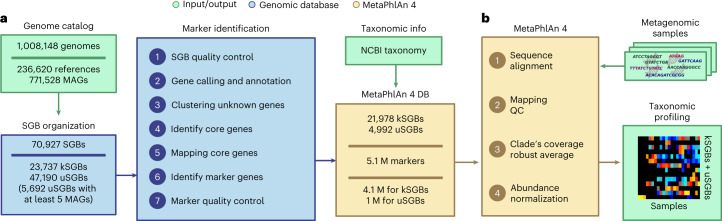
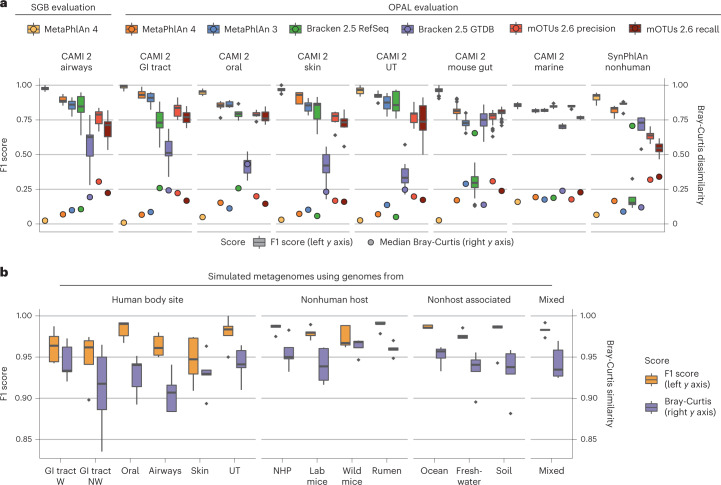
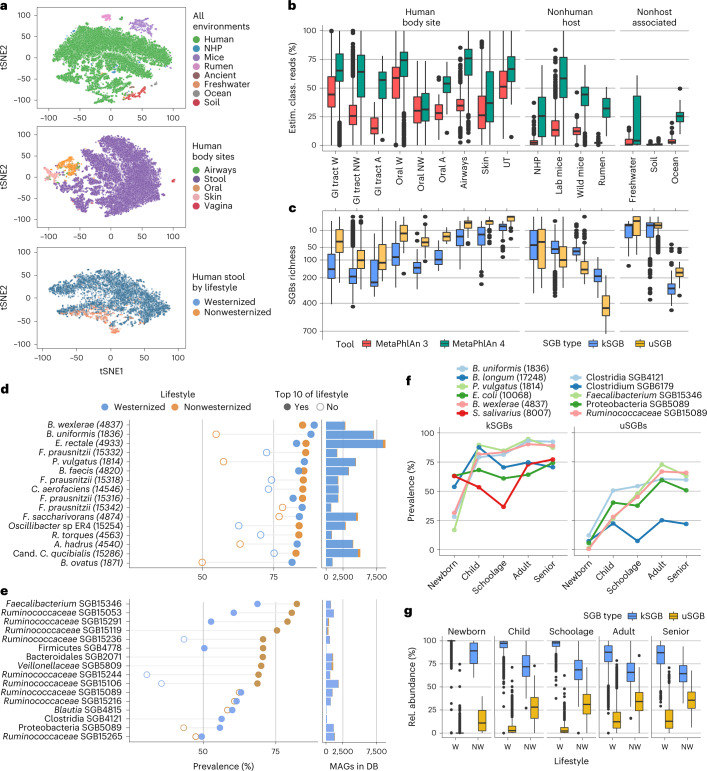
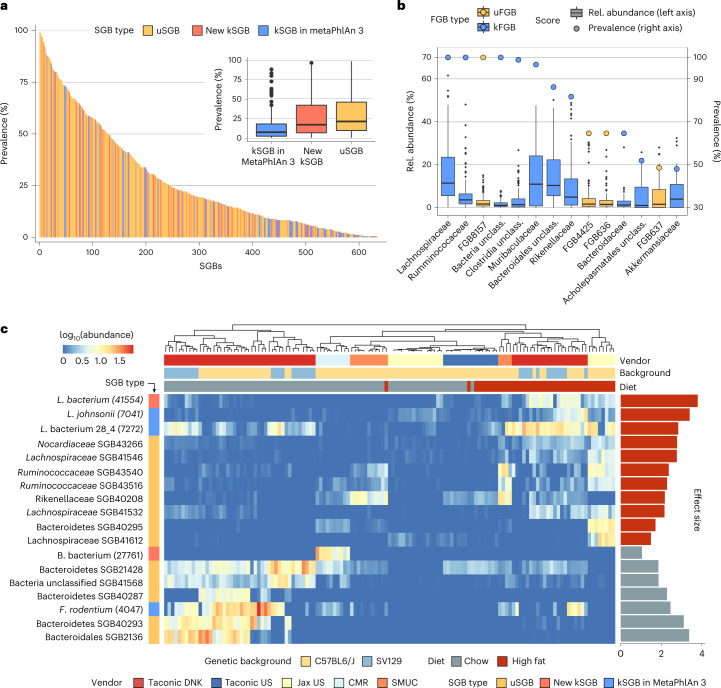
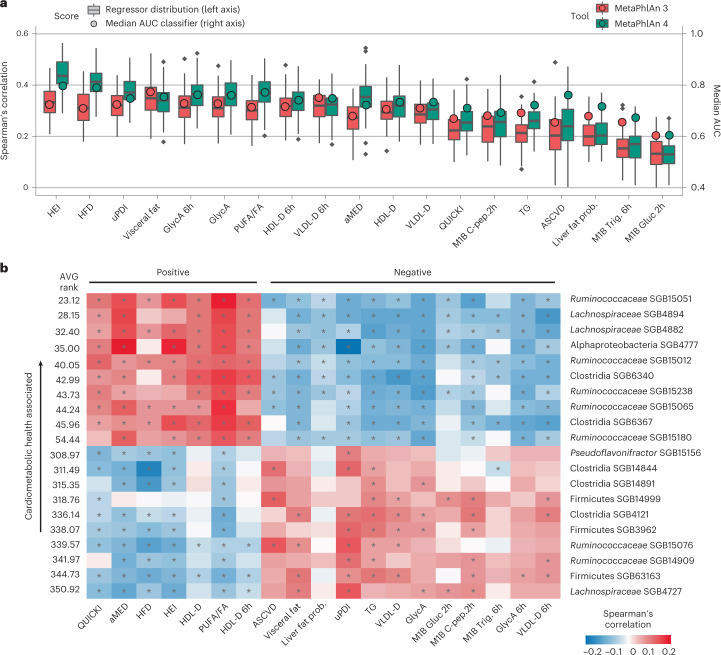
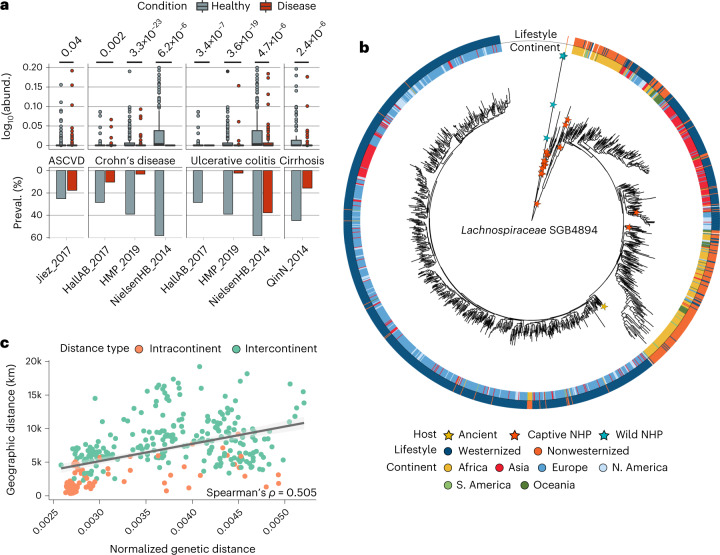
Metagenomic assembly enables new organism discovery from microbial communities, but it can only capture few abundant organisms from most metagenomes. Here we present MetaPhlAn 4, which integrates information from metagenome assemblies and microbial isolate genomes for more comprehensive metagenomic taxonomic profiling. From a curated collection of 1.01 M prokaryotic reference and metagenome-assembled genomes, we define unique marker genes for 26,970 species-level genome bins, 4,992 of them taxonomically unidentified at the species level. MetaPhlAn 4 explains ~20% more reads in most international human gut microbiomes and >40% in less-characterized environments such as the rumen microbiome and proves more accurate than available alternatives on synthetic evaluations while also reliably quantifying organisms with no cultured isolates. Application of the method to >24,500 metagenomes highlights previously undetected species to be strong biomarkers for host conditions and lifestyles in human and mouse microbiomes and shows that even previously uncharacterized species can be genetically profiled at the resolution of single microbial strains.
Overview
The claims and statistics of this paper haven’t been checked yet.
Free: it reads the open-access text and checks the first 5 claims that cite a source we can check. Create a free account to check every claim.
Integrity signals
Registry
Cites
Statistics
Figures
Verification
Claims the paper makes
The claims and statistics of this paper haven’t been checked yet.
Free: it reads the open-access text and checks the first 5 claims that cite a source we can check. Create a free account to check every claim.
Claims other papers make about this one
Each is checked against this paper’s own text: does it say what the citing paper says it does?
The cited source says what the claim attributes to it.
In the citing paper
“we performed a meta-analysis and mega-analysis of stools taxonomically profiled with MetaPhlAn 4 (ref. 37) and from patients enrolled in 12 cohorts from eight published studies26,38–44 across three cancer types, and classified as responders (n = 248) or non-responders (n = 513) based on RECIST1.1 criteria response rates”
From Gut OncoMicrobiome Signatures (GOMS) as next-generation biomarkers for cancer immunotherapy (2023) · cites this paper as [37]
The cited source says what the claim attributes to it.
In the citing paper
“We further performed strain-level and strain-matching analysis via StrainPhlAn 4 84 (STAR Methods) and identified potential transmission patterns for some food-human overlapping SGBs (Figures 6 and S6).”
From Unexplored microbial diversity from 2,500 food metagenomes and links with the human microbiome. (2024) · cites this paper as [84]
The check wasn’t confident either way, so it gives no verdict — never disputed.
In the citing paper
“A meta- and mega-analysis of stools obtained from patients with cancer treated with ICIs showed that GOMS associated with ICI resistance comprised microorganisms affiliated with chronic inflammation and immunosuppression and oral genera, and were shared across various pathological disorders.22,155”
From Melanoma and microbiota: Current understanding and future directions (2024) · cites this paper as [155]
Experimental — accuracy not yet measuredIn the citing paper
“We used MetaPhlAn 4 (ref. 37) for microbiome taxonomic profiling of stool samples from 1,879 adults across eight different cancer types (included in 30 cohorts from 23 published studies)25–29,38–55 and from a control group comprising 5,341 individuals without cancer (included in 17 cohorts from 14 published studies)”
From Gut OncoMicrobiome Signatures (GOMS) as next-generation biomarkers for cancer immunotherapy (2023) · cites this paper as [37]
In the citing paper
“Taxonomic profiling was performed at the level of species-level genome bins (SGBs) using MetaPhlAn4, which represent both existing and yet-to-be-characterized microbial species17.”
From Longitudinal gut microbiome changes in immune checkpoint blockade-treated advanced melanoma (2024) · cites this paper as [17]
1 more claim about this paper
Create a free account to see every claim other papers make about this one.
Self-check
Percentages, sums and reported differences re-computed from the paper’s own numbers.
The self-check needs the paper’s full text.
Citations
Cites
The Sequence Alignment/Map format and SAMtools
Li, H., Handsaker, B., Wysoker, A., Fennell, T., Ruan, J., Homer, N., Marth, G., Abecasis, G., Durbin, R., & 1000 Genome Project Data Processing Subgroup (2009) · Bioinformatics · doi:10.1093/bioinformatics/btp352 · Cited by 62,041 · cited 1×
“For item (1), StrainPhlAn 4 considers as input the reads-to-markers alignment results (in SAM format 96 ) from the MetaPhlAn 4 profiling together with the MetaPhlAn 4 database.”
MethodFast gapped-read alignment with Bowtie 2
Langmead, B., & Salzberg, S. L. (2012) · Nature Methods · doi:10.1038/nmeth.1923 · Cited by 56,400 · cited 1×
“To detect the SGB-specific marker genes, each set of core genes was then aligned against the genomes of the other SGBs using Bowtie 2 (version 2.3.5.1; -- sensitive parameter) 83 .”
MethodInfluentialMAFFT Multiple Sequence Alignment Software Version 7: Improvements in Performance and Usability
Katoh, K., & Standley, D. M. (2013) · Molecular Biology and Evolution · doi:10.1093/molbev/mst010 · Cited by 46,209 · cited 2×
“By default, multiple-sequence alignment is performed by MAFFT 92 , gappy positions (that is, positions with more than 67% of gaps) are trimmed by trimAl 91 and phylogenetic trees are inferred by RAxML 97 .”
MethodInfluentialRAxML version 8: a tool for phylogenetic analysis and post-analysis of large phylogenies
Stamatakis, A. (2014) · Bioinformatics · doi:10.1093/bioinformatics/btu033 · Cited by 32,291 · cited 3×
“By default, multiple-sequence alignment is performed by MAFFT 92 , gappy positions (that is, positions with more than 67% of gaps) are trimmed by trimAl 91 and phylogenetic trees are inferred by RAxML 97 .”
MethodInfluentialIQ-TREE: A Fast and Effective Stochastic Algorithm for Estimating Maximum-Likelihood Phylogenies
Nguyen, L.-T., Schmidt, H. A., von Haeseler, A., & Minh, B. Q. (2015) · Molecular Biology and Evolution · doi:10.1093/molbev/msu300 · Cited by 26,046
Prokka: rapid prokaryotic genome annotation
Seemann, T. (2014) · Bioinformatics · doi:10.1093/bioinformatics/btu153 · Cited by 18,818
Fast and sensitive protein alignment using DIAMOND
Buchfink, B., Xie, C., & Huson, D. H. (2015) · Nature Methods · doi:10.1038/nmeth.3176 · Cited by 14,201
trimAl: a tool for automated alignment trimming in large-scale phylogenetic analyses
Capella-Gutiérrez, S., Silla-Martínez, J. M., & Gabaldón, T. (2009) · Bioinformatics · doi:10.1093/bioinformatics/btp348 · Cited by 12,751 · cited 1×
“By default, multiple-sequence alignment is performed by MAFFT 92 , gappy positions (that is, positions with more than 67% of gaps) are trimmed by trimAl 91 and phylogenetic trees are inferred by RAxML 97 .”
MethodParks, D. H., Imelfort, M., Skennerton, C. T., Hugenholtz, P., & Tyson, G. W. (2015) · Genome Research · doi:10.1101/gr.186072.114 · Cited by 12,496
Diet rapidly and reproducibly alters the human gut microbiome
David, L. A., Maurice, C. F., Carmody, R. N., Gootenberg, D. B., Button, J. E., Wolfe, B. E., Ling, A. V., Devlin, A. S., Varma, Y., Fischbach, M. A., et al. (2014) · Nature · doi:10.1038/nature12820 · Cited by 10,100
Cited by
Items 501–600 of 1,000
Longitudinal profiling of low-abundance strains in microbiomes with ChronoStrain
Kim, Y., Worby, C. J., Acharya, S., van Dijk, L. R., Alfonsetti, D., Gromko, Z., Azimzadeh, P. N., Dodson, K., Gerber, G. K., Hultgren, S. J., et al. (2025) · Nature Microbiology · doi:10.1038/s41564-025-01983-z · Cited by 7
Early-life and concurrent predictors of the healthy adolescent microbiome in a cohort study
Laue, H. E., Willis, A. D., Wang, F., MacDougall, M. C., Xu, Y. Y., Karagas, M. R., Madan, J. C., Fleisch, A. F., Lanphear, B. P., Cecil, K. M., et al. (2025) · Genome Medicine · doi:10.1186/s13073-025-01481-1 · Cited by 7
“We aligned sequences to known microbial genomes and metagenome-assembled genomes (MAGs) using MetaPhlAn 4 with the CHOC-OPhlAnSGB vJun23 database [28].”
Florit, A., Rago, L., Rojas, A., Guzelkhanova, B., Pont-Beltran, A., Lamelas, A., Solaz-Fuster, M. C., Martínez-Blanch, J. F., López, M. E., García‐Laínez, G., et al. (2025) · Animals · doi:10.3390/ani15111615 · Cited by 8
“Metaphlan (v.4) was used to assign the taxonomy [37].”
Bruno, J. S., Heidrich, V., Restini, F. C. F., Alves, T. M. M. T., Miranda‐Silva, W., Knebel, F. H., Coser, E. M., Inoue, L. T., Asprino, P. F., Camargo, A. A., et al. (2025) · mSphere · doi:10.1128/msphere.00257-25 · Cited by 7
Siegwald, L., Cherta-Murillo, A., Christen, S., Boulangé, C. L., Chou, C. J., Foata, F., Lahiry, A., Frézal, A., Giner, M. P., Godin, J., et al. (2025) · Current Developments in Nutrition · doi:10.1016/j.cdnut.2025.107506 · Cited by 7
Keskey, R. C., Bluiminck, S., Sangwan, N., Meltzer, R. S., Lam, A., Thewissen, R., Zaborin, A., van Goor, H., Zaborina, O. Y., & Alverdy, J. C. (2025) · Microbiology Spectrum · doi:10.1128/spectrum.02766-24 · Cited by 8
“Non-mouse reads were processed for taxonomi cal and functional analysis using MetaPhlan3 (20) and HUMAnN3 (21), respectively.”
Wang, X., Dong, Q., Huang, P., Yang, S., Gao, M., Zhang, C., Zhang, C., Deng, Y., Huang, Z., Ma, B., et al. (2025) · Microbiome · doi:10.1186/s40168-025-02185-9 · Cited by 9
“Bacterial species abundances were generated using MetaPhlAn4 [50], which leverages approximately 5.1 million unique clade-specific marker genes identified from around 1 million microbial genomes.”
InfluentialClemente-Velasco, S., de Lucas, B., Tabone, M., Bressa, C., González-Soltero, R., Martínez‐López, S., Bailén, M., Domínguez-Balmaseda, D., Castellanos, N. P., Díez, G. G., et al. (2025) · Frontiers in Nutrition · doi:10.3389/fnut.2025.1653841 · Cited by 8
Wong, M. K., Armstrong, E., Heirali, A., Schneeberger, P. H. H., Chen, H., Cochrane, K., Sherriff, K., Allen‐Vercoe, E., Siu, L. L., Spreafico, A., et al. (2025) · mBio · doi:10.1128/mbio.01904-25 · Cited by 8
“Taxa were identified from cleaned reads using Metaphlan v.4.0.6 using default settings (32, 33).”
InfluentialBacteriophage diversity declines with COPD severity in the respiratory microbiome
Cook, R., Ponsero, A. J., Telatin, A., Yang, Y., Liang, Z., Wang, F., Chen, R., Wang, Z., Adriaenssens, E. M., Clokie, M. R. J., et al. (2025) · Cell Reports · doi:10.1016/j.celrep.2025.116413 · Cited by 8
Oñate, F. P., Quinquis, B., Thirion, F., Gilles, M., Morabito, C., Valeille, K., Martin, R. J., Guidet, B., Kern, C., & Pécastaings, S. (2025) · Microbiology Spectrum · doi:10.1128/spectrum.01732-25 · Cited by 7
Primary tumor microbiomes predict distant metastasis of colorectal cancer
Parajuli, B., Midya, V., Kiddle, R., Jager, N. D., Eggers, S. I., Spakowicz, D. J., Hoyd, R., Salhia, B., Chan, C. H. F., Churchman, M. L., et al. (2025) · npj Precision Oncology · doi:10.1038/s41698-025-01188-x · Cited by 9
Zoruk, P., Morozov, M. D., Veselovsky, V., Strokach, A., Babenko, V., & Klimina, K. (2025) · Frontiers in Microbiomes · doi:10.3389/frmbi.2025.1688681 · Cited by 8
Close, R., Kremer, S., Mitchem, M., Bellinghiere, A., Nirmalkar, K., Borges, C. R., Krajmalnik‐Brown, R., & Shah, D. D. (2025) · PNAS Nexus · doi:10.1093/pnasnexus/pgaf403 · Cited by 7
“1.0; https://github.com/ biobakery/MetaPhlAn) and the taxonomic profiles of bacteria were identified with the ChocoPhlAn pangenome database (33).”
InfluentialIntegrative multi-omics analysis reveals oral microbiome-metabolome signatures of obesity
Shibl, A. A., Denekew, T. W., Ahmad, A. R., Abdelrazig, S., Leonor, C., Utenova, L., Zhang, G., AbdelBaqi, M., Malla, Y., Arshad, M., et al. (2026) · Cell Reports · doi:10.1016/j.celrep.2025.116819 · Cited by 9
Recent Microbial Evolutionary Insights From Metagenomics
Moguel, B., Olivas, L. C., Guerrero‐Osornio, M. G., & Paredes, S. H. (2026) · Genome Biology and Evolution · doi:10.1093/gbe/evag029 · Cited by 7
Alkali-Activated Foams Coated with Colloidal Ag for Point-of-Use Water Disinfection
Hossain, M. A., Karkman, A., Prokkola, H., Chen, B., Perumal, P., & Luukkοnen, T. (2024) · ACS ES&T Water · doi:10.1021/acsestwater.3c00711 · Cited by 7
Targeted remodeling of the human gut microbiome using Juemingzi (Senna seed extracts)
Narrowe, A. B., Lemons, J. M. S., Mahalak, K. K., Firrman, J., den Abbeele, P. V., Baudot, A., Deyaert, S., Li, Y., Yu, L. L., & Liu, L. (2024) · Frontiers in Cellular and Infection Microbiology · doi:10.3389/fcimb.2024.1296619 · Cited by 7
Lee, C., Lin, C.-R., Chua, H., Wu, J., Chang, K., Ni, Y., Chang, M., & Chen, H. (2024) · JHEP Reports · doi:10.1016/j.jhepr.2024.101090 · Cited by 7
Gut microbiota genome features associated with brain injury in extremely premature infants
Seki, D., Kirkegaard, R. H., Osvatic, J., Hausmann, B., Séneca, J., Pjevac, P., Berger, A., Hall, L. J., Wisgrill, L., & Berry, D. (2024) · Gut Microbes · doi:10.1080/19490976.2024.2410479 · Cited by 9
“Short-read metagenomic data (Illumina) were processed using HUMAnN 3 19 with default setting.”
MethodTaeniasis impacts human gut microbiome composition and function
Mu, W., Ma, P., Wang, Y., Li, Y., Ding, Y., Zou, Y., Pu, L., Yan, Q., Kong, H., Guo, X., et al. (2024) · The ISME Journal · doi:10.1093/ismejo/wrae213 · Cited by 8
“0.3) [20] with the standard reference database (mpa_vJan21_ CHOCOPhlAnSGB_202103).”
BackgroundInfluentialGem, H., Ebadi, M., Sebastian, G., Abasaeed, R., Lloid, M. E., Minot, S. S., Dean, D. R., & Rashidi, A. (2024) · npj Biofilms and Microbiomes · doi:10.1038/s41522-024-00611-8 · Cited by 8
Newly identified species from the dog dental plaque microbiome highlight little overlap with humans
Heidrich, V., Fackelmann, G., Malešević, M., Armanini, F., Dey, H., Mengoni, C., Stanisavljević, N. S., Vukotić, G., & Segata, N. (2025) · npj Biofilms and Microbiomes · doi:10.1038/s41522-025-00665-2 · Cited by 8
Self-citationSaha, S., Kalathera, J., Sumi, T. S., Mane, V., Zimmermann, S., Waschina, S., & Pande, S. (2025) · Current Biology · doi:10.1016/j.cub.2025.01.068 · Cited by 7
Wong, M. K., Boukhaled, G. M., Armstrong, E., Liu, R., Heirali, A., Yee, N., Tsang, J., Spiliopoulou, P., Schneeberger, P. H. H., Wang, B. X., et al. (2025) · Journal for ImmunoTherapy of Cancer · doi:10.1136/jitc-2024-010681 · Cited by 8
Favale, N., Costa, S., Summa, D., Sabbioni, S., Mamolini, E., Tamburini, E., & Scapoli, C. (2025) · Current Research in Microbial Sciences · doi:10.1016/j.crmicr.2025.100383 · Cited by 7
Coskuner‐Weber, O., Alpsoy, S., Yolcu, O., Teber, E., de Marco, A., & Shumka, S. (2025) · Computational Biology and Chemistry · doi:10.1016/j.compbiolchem.2025.108444 · Cited by 7
Wong, S. H., Xu, X., Xu, X., Zhou, R., Ng, S. K., Ng, S. K., Fan, X., & Subramaniam, M. (2025) · Nutrients · doi:10.3390/nu17111748 · Cited by 8
Prandovszky, E., Liu, H., Severance, E. G., Splan, V. W., Dickerson, F., & Yolken, R. H. (2025) · Brain Behavior & Immunity - Health · doi:10.1016/j.bbih.2025.101081 · Cited by 10
TAXPASTA: TAXonomic Profile Aggregation and STAndardisation
Beber, M. E., Borry, M., Stamouli, S., & Yates, J. A. F. (2023) · The Journal of Open Source Software · doi:10.21105/joss.05627 · Cited by 7
Zuo, T., Liang, G., Huang, Z., Cao, Z., Bai, F., Zhou, Y., Wu, X., Wu, X., Chen, Y., Balati, M., et al. (2023) · Journal of Medical Virology · doi:10.1002/jmv.29083 · Cited by 7
kMetaShot: a fast and reliable taxonomy classifier for metagenome-assembled genomes
Defazio, G., Tangaro, M. A., Pesole, G., & Fosso, B. (2024) · Briefings in Bioinformatics · doi:10.1093/bib/bbae680 · Cited by 7
Sun, L., Liu, X., Zhou, L., Wang, H., Lian, C., Zhong, Z., Wang, M., Chen, H., & Li, C. (2025) · Communications Biology · doi:10.1038/s42003-024-07382-0 · Cited by 8
Zheng, Z., Ji, W., Wang, X., Wang, X., Dai, S., Zhang, Z., Zhang, Y., Wang, X., Cao, S., Chen, M., et al. (2025) · Waste Management · doi:10.1016/j.wasman.2025.01.030 · Cited by 7
Exploring Heterogeneity of Fecal Microbiome in Long COVID Patients at 3 to 6 Months After Infection
Blankestijn, J. M., Baalbaki, N., Beijers, R. J. H. C. G., Cornelissen, M. E. B., Wiersinga, W. J., Abdel‐Aziz, M. I., & der Zee, A. H. M. (2025) · International Journal of Molecular Sciences · doi:10.3390/ijms26041781 · Cited by 7
Yuan, S., Wu, Y., Balcázar, J. L., Wang, D., Zhu, D., Ye, M., Sun, M., & Hu, F. (2025) · Applied and Environmental Microbiology · doi:10.1128/aem.00296-25 · Cited by 7
Quantifying Metagenomic Strain Associations from Microbiomes with AnpanPreprint
Ghazi, A. R., Thompson, K. N., Bhosle, A., Mei, Z., Yan, Y., Wang, F., Wang, K., Franzosa, E. A., & Huttenhower, C. (2025) · bioRxiv (Cold Spring Harbor Laboratory) · doi:10.1101/2025.01.06.631550 · Cited by 11
Self-citationFreitas, A. C., Li, G., Shawon, J., Qamar, H., Pell, L. G., Kabir, M., Oduaran, O. H., Puebla-Barragan, S., Bassani, D. G., O'Callaghan, K. M., et al. (2025) · mSphere · doi:10.1128/msphere.00314-25 · Cited by 6
“Taxonomic profiling was done using MetaPhlAn 4 (64) with a custom database tailored for B. longum subspecies identification (standard database mpa_vJun23_CHOCOPhlAnSGB_202403 with B. longum subspeciesspecific markers), as previously described (26).”
Tang, Q., Zhao, Y., Li, X., Zhang, J., Li, J., Zhao, C., Pang, Y., Li, W., Huang, Q., Xiong, J., et al. (2025) · Journal of Environmental Management · doi:10.1016/j.jenvman.2025.124079 · Cited by 6
Jiang, Q., Zhuang, W., Zhang, Z., Wu, Z., Liu, J., Shi, J., & Deng, H. (2025) · Journal of Hazardous Materials · doi:10.1016/j.jhazmat.2025.138864 · Cited by 6
Modin, O., Zheng, D., Schnürer, A., Lundwall, T., Bolanos, S. E., & Olsson, J. (2025) · Microbial Biotechnology · doi:10.1111/1751-7915.70238 · Cited by 7
Lee, S., Raza, S., Lee, E., Chang, Y., Ryu, S., Kim, H., Kang, S., & Kim, H. (2025) · mSystems · doi:10.1128/msystems.00954-25 · Cited by 8
Li, Y., Hou, J., Liu, M., Du, Z., Chen, H., Liu, G., Wang, Y., Yao, Y., Sun, P., Zhao, L., et al. (2025) · Journal of Environmental Management · doi:10.1016/j.jenvman.2025.127960 · Cited by 6
Calculating fast differential genome coverages among metagenomic sources using micov
Weng, Y., Guccione, C., McDonald, D., Oles, R. E., Devkota, S., Kopylova, E., Sepich‐Poore, G. D., Salido, R. A., Din, M. O., Song, S. J., et al. (2025) · Communications Biology · doi:10.1038/s42003-025-09007-6 · Cited by 9
Waks, A. G., Fu, J., Chu, X., Kurt, B. B., Li, T., Kuntz, T. M., Shen, Y., Yang, D. D., Meli, K., Reardon, B. M., et al. (2025) · Nature Communications · doi:10.1038/s41467-025-66667-y · Cited by 7
High-resolution microbiome analysis of host-rich samples using 2bRAD-M without host depletion
Jiang, Y., Liu, J., Zhang, Y., Zhou, L., Kao, E., Hou, S., Niu, Q., Liu, Y., Xu, Z. Z., Ding, T., et al. (2025) · npj Biofilms and Microbiomes · doi:10.1038/s41522-025-00851-2 · Cited by 7
Harrison, L. C., Allnutt, T. R., Hanieh, S., Roth‐Schulze, A. J., Ngui, K., Stone, N. L., Bandala‐Sanchez, E., Backshell, L., Gurruwiwi, G. G., Gondarra, V., et al. (2025) · Nature Communications · doi:10.1038/s41467-025-65758-0 · Cited by 6
Sakanaka, A., Furuno, M., Ishikawa, A., Katakami, N., Inoue, M., Mayumi, S., Kurita, D., Nishizawa, H., Omori, K., Taya, N., et al. (2025) · Microbiome · doi:10.1186/s40168-025-02256-x · Cited by 7
“Using shotgun metagenomic sequencing, we further investigated the functional impact of saccharide migration on suprag-ingival biofilms through MetaPhlAn4 and HUMAnN3 pipelines [31, 32].”
Sun, J., Meng, Y., Chen, Z., Zhao, T., Yang, C., Chen, S., Wang, J., Lu, T., Song, F., Duan, Y., et al. (2026) · Microbiome · doi:10.1186/s40168-025-02300-w · Cited by 6
“Quality control was performed on the raw reads using Fastp (v.0.19.7) [38], and the clean reads obtained were subjected to taxonomic classification using MetaPhlAn (v.4.0.6) [46] to investigate the strain-level composition of the gut microbial community.”
InfluentialFernandez, J. C., Gilroy, R., Jones, R. B., Honaker, R. W., Whittle, M. J., Watson, P., & Amos, G. C. A. (2026) · Microbiome · doi:10.1186/s40168-025-02265-w · Cited by 8
“The resulting dendrogram was divided with cutoffs at 5%, 15%, and 30% genetic distance to define clusters of species-level genome bins (SGBs), genus-level genome bins (GGBs), and family-level genome bins (FGBs), respectively [7].”
Ren, X., Zheng, G., Liu, Y., Li, S., Liu, S., Wen, Y., Zhang, Y., Zhao, Y., Guan, H., Wang, X., et al. (2026) · Cell Host & Microbe · doi:10.1016/j.chom.2026.01.020 · Cited by 7
Zeamer, A. L., Lai, Y., Loew, E. B., Sanborn, V. E., Tracy, M., Jo, C., Ferdinand, D., Ward, D. V., Bhattarai, S. K., Drake, J., et al. (2026) · Gut Microbes · doi:10.1080/19490976.2026.2676162 · Cited by 6
Shukla, N., Bhatia, A., Kesheri, M., Kanchan, S., & Narayan, J. (2024) · Springer eBooks · doi:10.1007/978-981-97-1769-9_2 · Cited by 6
Metagenomic changes in response to antibiotic treatment in severe orthopedic trauma patients
Kouraki, A., Zheng, A. S., Miller, S., Kelly, A., Ashraf, W., Bazzani, D., Bonadiman, A., Tonidandel, G., Bolzan, M., Vijay, A., et al. (2024) · iScience · doi:10.1016/j.isci.2024.110783 · Cited by 6
Crombez, L., Descamps, A., Hirmz, H., Lambert, M., Calewaert, J., Siluk, D., Markuszewski, M. J., Biesemans, M., Petrella, G., Cicero, D. O., et al. (2024) · The Journal of Frailty & Aging · doi:10.14283/jfa.2024.75 · Cited by 6
“Tables of relative abundance estimates of bacterial taxa will be constructed using both marker-gene (38) and k-mer (39) based approaches; downstream analyses will be performed on both outputs and then compared for consistency of results.”
Ievina, L., Fomins, N., Gudrā, D., Ķēniņa, V., Vilmane, A., Grāvelsiņa, S., Rasa, S., Murovska, M., Frīdmanis, D., & Nora-Krūkle, Z. (2024) · Biomolecules · doi:10.3390/biom14101291 · Cited by 6
“Filtered reads were then taxonomically classified against the mpa_vOct22_CHOCOPhlAnSGB_202212 database using the Metaphlan4 v.4.1.0 tool [33] with the default parameters.”
MethodInfluentialYaqub, M. O., Joseph, C. E., Jain, A., & Edison, L. K. (2024) · Applied Microbiology · doi:10.3390/applmicrobiol4040102 · Cited by 7
Zhang, X., Mallick, H., & Rahnavard, A. (2026) · Communications Medicine · doi:10.1038/s43856-026-01612-8 · Cited by 10
“To move beyond taxonomy only analyses, we integrated multiple layers of microbial information, species ‑ level pro fi les (MetaPhlAn 4 17 ), predicted biosynthetic gene clusters (BGCs), and functional pathways to examine differences between responders (R) and non ‑ responders (NR).”
Arredondo, A., Gerard, À., Isabal, S., Teughels, W., Laleman, I., José, C. M., Isbej, L., Huapaya, E., Mendoza‐Azpur, G., Mor, C., et al. (2025) · Journal of Periodontal Research · doi:10.1111/jre.13406 · Cited by 6
HPV-KITE: sequence analysis software for rapid HPV genotype detection
Nowicki, M., Mroczek, M., Mukhedkar, D., Bała, P., Pimenoff, V. N., & Mühr, L. S. A. (2025) · Briefings in Bioinformatics · doi:10.1093/bib/bbaf155 · Cited by 6
“…including sequencing alignment(BWA[5,6],Bowtie[7,8],MOSAIK[9]),proteinalignment (Diamond [10], Kaiju [11]), marker gene detection (Metaphlan [12]), k-mer (Kraken2 [13], Clark [14]), and deep learning methods (Virtifier [15], VirFinder [16], DeepVirFinder [17], PPR-Meta [18], and ViraMiner…”
Flynn, A., Leech, J., McFadden, M., McAloon, C., Paul-Murphy, J., Crispie, F., Cotter, P. D., McAloon, C. G., & Kennedy, E. (2025) · Journal of Dairy Science · doi:10.3168/jds.2024-26165 · Cited by 7
Detection of parasites in food and water matrices by shotgun metagenomics: A narrative review
Vatta, P., & Cacciò, S. M. (2025) · Food and Waterborne Parasitology · doi:10.1016/j.fawpar.2025.e00265 · Cited by 6
Csécsei, P., Takács, B., Pasitka, L. P., Várnai, R., Péterfi, Z., Orban, B., Czabajszki, M., Oláh, C., & Schwarcz, A. (2025) · Journal of Clinical Medicine · doi:10.3390/jcm14103488 · Cited by 7
“Bacterial composition of the samples was identified by running MetaPhlAn4 [28], with the mpa_vJun23_CHOCOPhlAnSGB_202403 version of the CHOCOPhlAn database.”
Dasgupta, S. (2025) · OMICS A Journal of Integrative Biology · doi:10.1177/15578100251358958 · Cited by 7
“(cid:129) MetaPhlAn (Metagenomic Phylogenetic Analysis): Specialized in pro fi ling microbial clades from shotgun metagenomic data using unique marker genes (Blanco-Míguez et al., 2023).”
Timilsina, M., Chundru, D., Pradhan, A. K., Blaustein, R. A., & Ghanem, M. (2025) · Journal of Food Protection · doi:10.1016/j.jfp.2025.100583 · Cited by 7
Li, Y., Hou, J., Liu, M., Li, R., Du, Z., Yao, Y., Sun, P., Zhao, L., & An, Y. (2025) · Journal of Hazardous Materials · doi:10.1016/j.jhazmat.2025.139584 · Cited by 8
Environment and diet shape the geography-specific Drosophila melanogaster microbiota composition
Gale, J. T., Kreutz, R., Morgan, S. J. G., Davis, E. K., Hough, C., Cancino, W. A. C., Burnside, B., Barney, R. P., Hunsaker, R., Hoyt, A. T., et al. (2025) · Applied and Environmental Microbiology · doi:10.1128/aem.00883-25 · Cited by 12
“Sequences from the DEST data set were downloaded from the SRA using fasterq-dump v.2.10.8 from the SRA toolkit (https:// github.com/ncbi/sra-tools), and microbial profiling was performed using MetaPhlan3 and the ChocoPhlan v30 database (91).”
InfluentialHu, G., Savini, M., Cooke, M. B., Wei, X. L., Deng, D., Gao, S. M., Xia, R. A., Guan, Y., Wen, A. X., Yu, X., et al. (2025) · PLoS Biology · doi:10.1371/journal.pbio.3002749 · Cited by 6
“For taxonomic classification, we employed MetaPhlAn4 [56], which uses clade-specific marker genes to identify and quantify microbial species present in the samples.”
Markkanen, M. A., Pezzutto, D., Virta, M., & Karkman, A. (2025) · Microbiology Spectrum · doi:10.1128/spectrum.00857-25 · Cited by 6
Run-length compressed metagenomic read classification with SMEM-finding and tagging
Depuydt, L., Ahmed, O. Y., Fostier, J., Langmead, B., & Gagie, T. (2025) · iScience · doi:10.1016/j.isci.2025.114029 · Cited by 9
Bacterial metabolic signatures in MASLD predicted through gene-centric studies in stool metagenomes
Medina-Méndez, J. M., Iruzubieta, P., Fernández-López, R., Crespo, J., & de la Cruz, F. (2025) · BMC Microbiology · doi:10.1186/s12866-025-04549-5 · Cited by 6
“Alignments were filtered to retain only the best match for each read and gene family sequence by using the “ --max-hsps 1 ” option, with an E-value threshold 1e -10 .”
Human milk oligosaccharide mediates mutualism between Escherichia coli and Bifidobacterium bifidum
Seki, D., Pollak, S., Kujawska, M., Kiu, R., Acuna-Gonzalez, A., Crouch, L. I., Bakshani, C. R., Chivers, P. T., Mommers, M., van Best, N., et al. (2026) · Nature Communications · doi:10.1038/s41467-026-71764-7 · Cited by 7
Bethlehem, L., Bartu, L., Marke, G., Mar, P., Feldman, S., Eggers, J., Ruprecht, C., Britton, G. J., Aggarwala, V., Bongers, G., et al. (2026) · Nature Medicine · doi:10.1038/s41591-026-04442-2 · Cited by 7
Meta-Omics Analysis of a Formate Sidestream-Mediated Partial Nitritation-Coupled Anammox Process
Wang, J., Yan, X., Zhuang, J., Liu, Y., & Li, W. (2023) · ACS ES&T Water · doi:10.1021/acsestwater.2c00546 · Cited by 6
Сергеевич, Ш. Ф., Mazloum, A., Krotova, A. O., Byadovskaya, O. P., Prokhvatilova, L. B., Chvala, I. A., Zolotikov, U. E., Kozlova, A. D., Krylova, A. S., Grosfeld, E. V., et al. (2024) · Frontiers in Veterinary Science · doi:10.3389/fvets.2024.1321202 · Cited by 6
Leech, S. M., Borg, D. J., Rae, K. M., Kumar, S., Clifton, V. L., & Nitert, M. D. (2024) · Microbial Genomics · doi:10.1099/mgen.0.001269 · Cited by 10
“‘MetaPhlAn4’ (version 4.0.3) [33] and ‘HUMAnN 3.6’ [34] were used to generate taxonomic and functional profiles, respectively, with default settings.”
MethodInfluentialAging Modulates the Effect of Dietary Glycemic Index on Gut Microbiota Composition in Mice
Zhu, Y., Yeo, E. N., Smith, K., Greenberg, A. S., & Rowan, S. (2024) · Journal of Nutrition · doi:10.1016/j.tjnut.2024.07.014 · Cited by 6
SigAlign: an alignment algorithm guided by explicit similarity criteria
Bahk, K., & Sung, J. (2024) · Nucleic Acids Research · doi:10.1093/nar/gkae607 · Cited by 7
“Nevertheless, even in well-adapted metagenome analysis work-flows ( 23 ,24 ), alignment algorithms still operate under default settings or with minimal adjustments (e.g., ‘–very-sensitive’ for bowtie2), underscoring the need for better optimization strategies for specific research purposes.”
BackgroundFernández‐López, M. G., Sánchez‐Reyes, A., Rosas‐Ramírez, M. E., & Balcázar‐López, E. (2024) · Water Air & Soil Pollution · doi:10.1007/s11270-024-07349-1 · Cited by 7
Esparteiro, D., Fouquet, G., Courtois, A., Jedraszak, G., Marticho, L., Gourdel, M., Billon‐Crossouard, S., Croyal, M., Naassïla, M., Nguyen-Khac, É., et al. (2024) · Gut Microbes · doi:10.1080/19490976.2024.2382767 · Cited by 6
Zaytsev, P., Shurygin, B., Rodin, V. A., Panova, T. V., Zvereva, M. I., Skripnikova, E., & Solovchenko, A. E. (2024) · Nanobiotechnology Reports · doi:10.1134/s2635167624600470 · Cited by 6
He, B., Xu, S., Schooling, C. M., Leung, G. M., Ho, J. W. K., & Yeung, S. L. A. (2024) · Annals of Epidemiology · doi:10.1016/j.annepidem.2024.12.009 · Cited by 6
Neonatal microbiome dysbiosis decoded by mNGS: from mechanistic insights to precision interventions
Huang, F., Li, J., Liu, D., Li, Y., & Tang, J. (2025) · Frontiers in Cellular and Infection Microbiology · doi:10.3389/fcimb.2025.1642072 · Cited by 8
MetagenomicKG : a knowledge graph for metagenomic applications
Ma, C., Liu, S., Won, S. J., & Koslicki, D. (2026) · Bioinformatics · doi:10.1093/bioinformatics/btag421 · Cited by 6
Kim, H., Nzabarushimana, É., Huttenhower, C., Chan, A. T., & Nguyen, L. H. (2024) · Gastroenterology · doi:10.1053/j.gastro.2024.03.026 · Cited by 7
Self-citationvan der Vossen, E. W. J., Davids, M., Voermans, B., Wortelboer, K., Hartstra, A. V., Koopen, A. M., de Groot, P. F., Levin, E., & Nieuwdorp, M. (2024) · Gut Microbes · doi:10.1080/19490976.2024.2388295 · Cited by 7
Kim, H., Lee, K., Lee, J. Y., Kwon, B.-E., Kim, H. J., Park, H., Kim, T., Kwak, J.-G., Choi, J. E., Hong, K. H., et al. (2024) · Frontiers in Microbiomes · doi:10.3389/frmbi.2024.1362408 · Cited by 5
Prophage induction contributes to alterations in the gut phageome during intestinal inflammation
Sinha, A., Qian, A., Boutin, T., & Maurice, C. F. (2026) · Cell Reports · doi:10.1016/j.celrep.2026.117491 · Cited by 9
Abnormal Microbial Amino Acid Metabolism and Activated Pathogenesis in Scalp with Dandruff
Xu, Z., Yang, F., Xiang, B., Chang, X., Xia, D., Wu, Y., Zhang, Y., & Zhang, M. H. (2025) · Journal of Investigative Dermatology · doi:10.1016/j.jid.2025.01.006 · Cited by 5
Gao, Y., Cheng, Z., Huang, B., Mao, Y., Hu, J., Wang, S., Wang, Z., Wang, M., Huang, S., & Han, M. (2025) · Environmental Pollution · doi:10.1016/j.envpol.2025.126313 · Cited by 6
Goh, Y. Q., Cheam, G., Yeong, M. Y., Bhayana, N., Thomson, A. W., Zhang, J., Jia, X., Conway, P. L., Shrestha, S., & Wang, Y. (2025) · Microbiome Research Reports · doi:10.20517/mrr.2024.90 · Cited by 8
Salmaso, N., Cerasino, L., Brizio, M. D., Pindo, M., & Boscaini, A. (2025) · Environmental Microbiology Reports · doi:10.1111/1758-2229.70098 · Cited by 5
Characteristics of the gut virome in patients with premalignant colorectal adenoma
Zhang, P., Tuo, X., Jiang, J., Zhang, Y., Zhao, J., Deng, C., Zhao, G., Cheng, Y., Song, L., Yang, Y., et al. (2025) · Journal of Translational Medicine · doi:10.1186/s12967-025-06404-7 · Cited by 6
“[37], which relies on clade-specific marker genes to unambiguously classify metagenomic reads to taxonomies and yield relative abundances of taxa identified in the sample.”
Dong, Y., Jia, Y., Xu, X., Yu, M., Zhou, P., Qi, G., Yu, B. H., & Liu, J. (2025) · Chemical Engineering Journal · doi:10.1016/j.cej.2025.164559 · Cited by 6
The resistome of pasteurized and raw milk cheeses from the state of Vermont
de Sant’Anna, F. M., Chakrawarti, A., Haley, B. J., & Barlow, J. (2025) · International Journal of Food Microbiology · doi:10.1016/j.ijfoodmicro.2025.111333 · Cited by 6
Bidirectional subsethood of shared marker profiles enables accurate virus classification
Riccardi, C., Wang, Y., Yooseph, S., & Sun, F. (2025) · Microbiome · doi:10.1186/s40168-025-02159-x · Cited by 5
“The kVSCs dataset is an extract of the representative viral sequences included in the MetaPhlan 4.1 release [27].”
InfluentialLabisa-Morais, F., Valente, D., Blanco‐Míguez, A., Manghi, P., García-Valiente, A., Andriamaniraka, H., Armanini, F., Asnicar, F., Gregorio, C. D., Golzato, D., et al. (2025) · The ISME Journal · doi:10.1093/ismejo/wraf136 · Cited by 5
“We used the catalog of MAGs obtained to expand the ChocoPhlAn [46] reference database and accurately profile I.indri microbiomes through reference-based profiling with MetaPhlAn.”
InfluentialSelf-citationAdaptive pangenomic remodeling in the Azolla cyanobiont amid a transient microbiome
Armitage, D. W., Alonso-Sánchez, A. G., Coy, S. R., Cheng, Z., Hagenbeek, A., López-Martínez, K. P., Phua, Y. H., & Sears, A. R. (2025) · The ISME Journal · doi:10.1093/ismejo/wraf154 · Cited by 5
“The R package phyloseq [43] was used to characterize the leaf pocket communities based on taxonomic assignments from MetaPhlAn4.”
Metagenome-based characterization of the gut virome in patients with schizophrenia
Ren, Y., Zhang, P., Yu, H., Li, S., & Jiang, H. (2025) · Journal of Translational Medicine · doi:10.1186/s12967-025-06923-3 · Cited by 6
“Gut prokaryotic composition was taxonomically resolved using MetaPhlAn4 [27], with species-level relative abundances calculated through read normalization.”
Ebadi, M., Reddi, S., Senyshyn, L., Minot, S. S., Gooley, T. A., Kabage, A. J., Lee, S. J., Hill, G. R., Khoruts, A., & Rashidi, A. (2025) · Gut Microbes · doi:10.1080/19490976.2025.2551882 · Cited by 6
Metadata
- Authors
- Blanco-Míguez, A., Beghini, F., Cumbo, F., McIver, L. J., Thompson, K. N., Zolfo, M., Manghi, P., Dubois, L., Huang, K. D., Thomas, A. M., Nickols, W. A., Piccinno, G., Piperni, E., Punčochář, M., Valles-Colomer, M., Tett, A., Giordano, F., Davies, R., Wolf, J., Berry, S. E., Spector, T. D., Franzosa, E. A., Pasolli, E., Asnicar, F., Huttenhower, C., & Segata, N.
- Affiliations
- University of Trento (IT)
- Broad Institute (US)
- University of Vienna (AT)
- ZOE (United Kingdom) (GB)
- King's College London (GB)
- University of Naples Federico II (IT)
- Corresponding author
- Segata, Nicola
- ORCID
- Blanco-Míguez, Aitor
- Beghini, Francesco
- Cumbo, Fabio
- McIver, Lauren J.
- Thompson, Kelsey N.
- Zolfo, Moreno
- Manghi, Paolo
- Huang, Kun D.
- Thomas, Andrew Maltez
- Nickols, William A.
- Piccinno, Gianmarco
- Piperni, Elisa
- Punčochář, Michal
- Tett, Adrian
- Giordano, Francesca
- Davies, Richard
- Wolf, Jonathan
- Berry, Sarah E.
- Spector, Tim D.
- Franzosa, Eric A.
- Pasolli, Edoardo
- Asnicar, Francesco
- Huttenhower, Curtis
- Segata, Nicola
- Venue
- Nature Biotechnology
- Published
- 2023-02-23
- Volume
- 41
- Issue
- 11
- Pages
- 1633-1644
- ISSN
- 0733-222X (ISSN-L)
- 1087-0156
- 1546-1696
- PMC
- PMC10635831
- OpenAlex
- W4321611856
- Semantic Scholar
- e28eff291a1b5c8f0a98f826de240f846be03334
- Cited by
- 1,442
- References
- 101
- Citations by year
- 2026: 517 · 2025: 521 · 2024: 309 · 2023: 93
- FWCI
- 129.03
- Type
- journal article
- Language
- en
- Open access
- hybrid
- doi.org
- Licence
- cc-by
- creativecommons.org/licenses/by/4.0 (tdm)
- creativecommons.org/licenses/by/4.0 (vor)
- Locations
- Nature Biotechnology (publishedVersion, cc-by)
- PubMed Central (publishedVersion, cc-by)
- PubMed (publishedVersion)
- Iris (University of Trento) (submittedVersion, cc-by)
- Funders
- Harvard T.H. Chan School of Public Health
- Cancer Research UK (#C10674/A27140, A27140)
- National Institutes of Health (1u01ca230551-01a1, H2020, 1U01CA230551)
- Horizon 2020 Framework Programme (OncoBiome 825410, 818368, ONCOBIOME-825410 project, MASTER-818368 project, 825410)
- National Cancer Institute (1U01CA230551, U01 CA230551)
- National Institute of Allergy and Infectious Diseases (U19AI110820)
- National Institute of Diabetes and Digestive and Kidney Diseases (R24DK110499, P30DK043351)
- H2020 European Research Council (716575)
- HORIZON EUROPE European Research Council (101045015)
- Topics
- Life Sciences › Biochemistry, Genetics and Molecular Biology › Molecular Biology › Genomics and Phylogenetic Studies
- Life Sciences › Biochemistry, Genetics and Molecular Biology › Molecular Biology › Gut microbiota and health
- Physical Sciences › Environmental Science › Ecology › Microbial Community Ecology and Physiology
- Keywords
- metagenome-assembled genomes, marker genes, human gut microbiome, rumen microbiome, microbial biomarkers, metagenome assembly
- MeSH terms
- Gastrointestinal Microbiome, Animals, Humans, Phylogeny, Mice, Metagenome, Metagenomics, Microbiota
About these checks
Registry, retraction, Cites and statistics results are computed, not judged, with one exception: a printed reference that no index lists is read once by a model before it counts as a citation error. Claims are extracted by a model and kept only when their quote appears verbatim in the text; each cited source is then checked, with a model’s help, for whether it says what the claim relies on. Those verdicts can be wrong — read the claim’s quote and the cited source before relying on one.
Statistics and arithmetic are recomputed, not judged.
Confidence bands are shown only for fields calibrated on our annotated test set. None is calibrated yet, so no band is shown.
What counts as a claim ›How we measure confidence ›How we check this ›
Are you an author, or do you see a problem with this page? Request a review
Data sources
Bibliographic data: Semantic Scholar, OpenAlex, Crossref.
Contains information from the Semantic Scholar Academic Graph Datasets, made available under the ODC Attribution License (ODC-BY 1.0).
Semantic Scholar’s data is described in: Kinney, R., et al. (2023). The Semantic Scholar Open Data Platform. arXiv:2301.10140.
