

Extending and improving metagenomic taxonomic profiling with uncharacterized species using MetaPhlAn 4
Open accessThe DOI matches its Crossref record; 101 of the 101 references it cites were found in a registry or an index.
Abstract
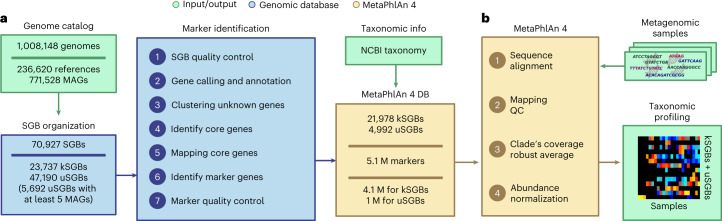
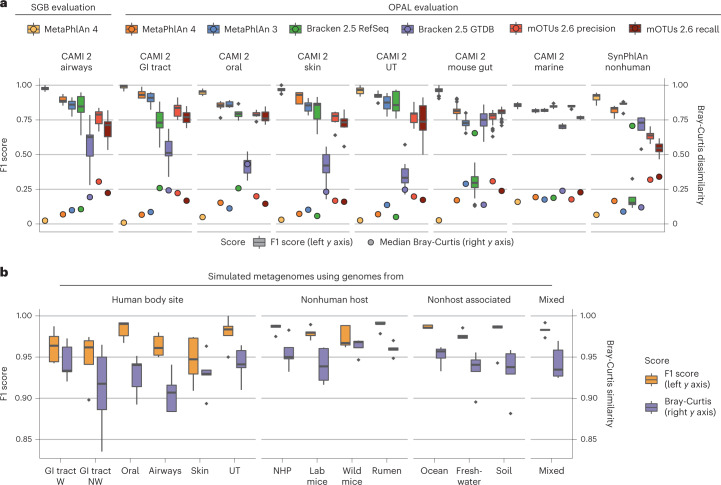
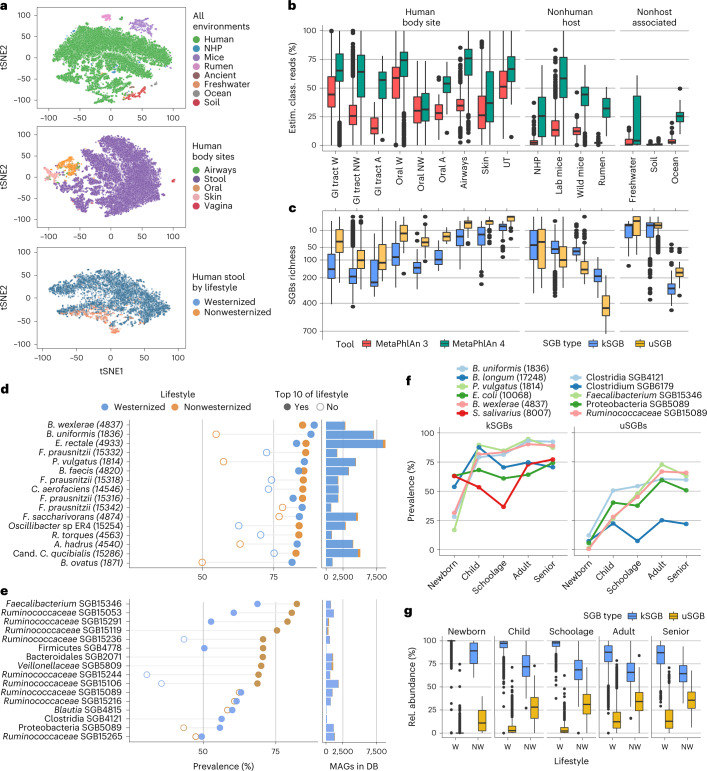
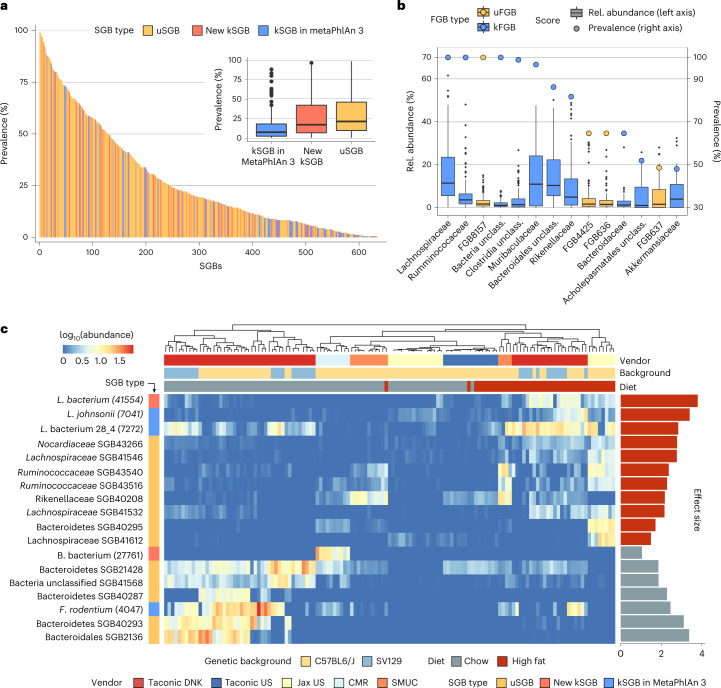
Metagenomic assembly enables new organism discovery from microbial communities, but it can only capture few abundant organisms from most metagenomes. Here we present MetaPhlAn 4, which integrates information from metagenome assemblies and microbial isolate genomes for more comprehensive metagenomic taxonomic profiling. From a curated collection of 1.01 M prokaryotic reference and metagenome-assembled genomes, we define unique marker genes for 26,970 species-level genome bins, 4,992 of them taxonomically unidentified at the species level. MetaPhlAn 4 explains ~20% more reads in most international human gut microbiomes and >40% in less-characterized environments such as the rumen microbiome and proves more accurate than available alternatives on synthetic evaluations while also reliably quantifying organisms with no cultured isolates. Application of the method to >24,500 metagenomes highlights previously undetected species to be strong biomarkers for host conditions and lifestyles in human and mouse microbiomes and shows that even previously uncharacterized species can be genetically profiled at the resolution of single microbial strains.
Overview
The claims and statistics of this paper haven’t been checked yet.
Free: it reads the open-access text and checks the first 5 claims that cite a source we can check. Create a free account to check every claim.
Integrity signals
Registry
Cites
Statistics
Figures
Verification
Claims the paper makes
The claims and statistics of this paper haven’t been checked yet.
Free: it reads the open-access text and checks the first 5 claims that cite a source we can check. Create a free account to check every claim.
Claims other papers make about this one
Each is checked against this paper’s own text: does it say what the citing paper says it does?
The cited source says what the claim attributes to it.
In the citing paper
“we performed a meta-analysis and mega-analysis of stools taxonomically profiled with MetaPhlAn 4 (ref. 37) and from patients enrolled in 12 cohorts from eight published studies26,38–44 across three cancer types, and classified as responders (n = 248) or non-responders (n = 513) based on RECIST1.1 criteria response rates”
From Gut OncoMicrobiome Signatures (GOMS) as next-generation biomarkers for cancer immunotherapy (2023) · cites this paper as [37]
The cited source says what the claim attributes to it.
In the citing paper
“We further performed strain-level and strain-matching analysis via StrainPhlAn 4 84 (STAR Methods) and identified potential transmission patterns for some food-human overlapping SGBs (Figures 6 and S6).”
From Unexplored microbial diversity from 2,500 food metagenomes and links with the human microbiome. (2024) · cites this paper as [84]
The check wasn’t confident either way, so it gives no verdict — never disputed.
In the citing paper
“A meta- and mega-analysis of stools obtained from patients with cancer treated with ICIs showed that GOMS associated with ICI resistance comprised microorganisms affiliated with chronic inflammation and immunosuppression and oral genera, and were shared across various pathological disorders.22,155”
From Melanoma and microbiota: Current understanding and future directions (2024) · cites this paper as [155]
Experimental — accuracy not yet measuredIn the citing paper
“We used MetaPhlAn 4 (ref. 37) for microbiome taxonomic profiling of stool samples from 1,879 adults across eight different cancer types (included in 30 cohorts from 23 published studies)25–29,38–55 and from a control group comprising 5,341 individuals without cancer (included in 17 cohorts from 14 published studies)”
From Gut OncoMicrobiome Signatures (GOMS) as next-generation biomarkers for cancer immunotherapy (2023) · cites this paper as [37]
In the citing paper
“Taxonomic profiling was performed at the level of species-level genome bins (SGBs) using MetaPhlAn4, which represent both existing and yet-to-be-characterized microbial species17.”
From Longitudinal gut microbiome changes in immune checkpoint blockade-treated advanced melanoma (2024) · cites this paper as [17]
1 more claim about this paper
Create a free account to see every claim other papers make about this one.
Self-check
Percentages, sums and reported differences re-computed from the paper’s own numbers.
The self-check needs the paper’s full text.
Citations
Cites
The Sequence Alignment/Map format and SAMtools
Li, H., Handsaker, B., Wysoker, A., Fennell, T., Ruan, J., Homer, N., Marth, G., Abecasis, G., Durbin, R., & 1000 Genome Project Data Processing Subgroup (2009) · Bioinformatics · doi:10.1093/bioinformatics/btp352 · Cited by 62,041 · cited 1×
“For item (1), StrainPhlAn 4 considers as input the reads-to-markers alignment results (in SAM format 96 ) from the MetaPhlAn 4 profiling together with the MetaPhlAn 4 database.”
MethodFast gapped-read alignment with Bowtie 2
Langmead, B., & Salzberg, S. L. (2012) · Nature Methods · doi:10.1038/nmeth.1923 · Cited by 56,400 · cited 1×
“To detect the SGB-specific marker genes, each set of core genes was then aligned against the genomes of the other SGBs using Bowtie 2 (version 2.3.5.1; -- sensitive parameter) 83 .”
MethodInfluentialMAFFT Multiple Sequence Alignment Software Version 7: Improvements in Performance and Usability
Katoh, K., & Standley, D. M. (2013) · Molecular Biology and Evolution · doi:10.1093/molbev/mst010 · Cited by 46,209 · cited 2×
“By default, multiple-sequence alignment is performed by MAFFT 92 , gappy positions (that is, positions with more than 67% of gaps) are trimmed by trimAl 91 and phylogenetic trees are inferred by RAxML 97 .”
MethodInfluentialRAxML version 8: a tool for phylogenetic analysis and post-analysis of large phylogenies
Stamatakis, A. (2014) · Bioinformatics · doi:10.1093/bioinformatics/btu033 · Cited by 32,291 · cited 3×
“By default, multiple-sequence alignment is performed by MAFFT 92 , gappy positions (that is, positions with more than 67% of gaps) are trimmed by trimAl 91 and phylogenetic trees are inferred by RAxML 97 .”
MethodInfluentialIQ-TREE: A Fast and Effective Stochastic Algorithm for Estimating Maximum-Likelihood Phylogenies
Nguyen, L.-T., Schmidt, H. A., von Haeseler, A., & Minh, B. Q. (2015) · Molecular Biology and Evolution · doi:10.1093/molbev/msu300 · Cited by 26,046
Prokka: rapid prokaryotic genome annotation
Seemann, T. (2014) · Bioinformatics · doi:10.1093/bioinformatics/btu153 · Cited by 18,818
Fast and sensitive protein alignment using DIAMOND
Buchfink, B., Xie, C., & Huson, D. H. (2015) · Nature Methods · doi:10.1038/nmeth.3176 · Cited by 14,201
trimAl: a tool for automated alignment trimming in large-scale phylogenetic analyses
Capella-Gutiérrez, S., Silla-Martínez, J. M., & Gabaldón, T. (2009) · Bioinformatics · doi:10.1093/bioinformatics/btp348 · Cited by 12,751 · cited 1×
“By default, multiple-sequence alignment is performed by MAFFT 92 , gappy positions (that is, positions with more than 67% of gaps) are trimmed by trimAl 91 and phylogenetic trees are inferred by RAxML 97 .”
MethodParks, D. H., Imelfort, M., Skennerton, C. T., Hugenholtz, P., & Tyson, G. W. (2015) · Genome Research · doi:10.1101/gr.186072.114 · Cited by 12,496
Diet rapidly and reproducibly alters the human gut microbiome
David, L. A., Maurice, C. F., Carmody, R. N., Gootenberg, D. B., Button, J. E., Wolfe, B. E., Ling, A. V., Devlin, A. S., Varma, Y., Fischbach, M. A., et al. (2014) · Nature · doi:10.1038/nature12820 · Cited by 10,100
Cited by
Items 201–300 of 1,000
Vasco, K. A., Carbonell, S. L., Sloup, R. E., Bowcutt, B., Colwell, R. R., Graubics, K., Erskine, R. J., Norby, B., Ruegg, P. L., Zhang, L., et al. (2023) · Animal Microbiome · doi:10.1186/s42523-023-00274-4 · Cited by 26
Diet-omics in the Study of Urban and Rural Crohn disease Evolution (SOURCE) cohort
Braun, T., Feng, R., Amir, A., Levhar, N., Shacham, H., Mao, R., Hadar, R., Toren, I., Algavi, Y. M., Abu-Saad, K., et al. (2024) · Nature Communications · doi:10.1038/s41467-024-48106-6 · Cited by 25
Exploring the Ocular Surface Microbiome and Tear Proteome in Glaucoma
Spörri, L. A., Uldry, A., Kreuzer, M., Herzog, E. L., Zinkernagel, M. S., Unterlauft, J. D., & Zysset‐Burri, D. C. (2024) · International Journal of Molecular Sciences · doi:10.3390/ijms25116257 · Cited by 29
Strain tracking in complex microbiomes using synteny analysis reveals per-species modes of evolution
Enav, H., Paz, I., & Ley, R. E. (2024) · Nature Biotechnology · doi:10.1038/s41587-024-02276-2 · Cited by 24
“Strain delineations used in strain tracking often use a minimal cutoff value of genomic similarity to bin strains into same or different categories 28,35,38 .”
Biomethanation on demand: Continuous and intermittent hydrogen supply on biological CO2 methanation
Xirostylidou, A., Gaspari, M., Kontogiannopoulos, K. N., Ghiotto, G., Treu, L., Campanaro, S., Zouboulis, A. I., & Kougias, P. (2024) · Chemical Engineering Journal · doi:10.1016/j.cej.2024.153677 · Cited by 24
Zolfo, M., Silverj, A., Blanco‐Míguez, A., Manghi, P., Rota‐Stabelli, O., Heidrich, V., Jensen, J., Maharjan, S., Franzosa, E. A., Menni, C., et al. (2024) · bioRxiv (Cold Spring Harbor Laboratory) · doi:10.1101/2024.02.19.580813 · Cited by 26
“CRISPR spacers were predicted from 377,346 metagenomic assembled genomes (MAGs) and 169,111 reference genomes from the Jan21 release of the ChohoPhlAn/MetaRef database 40 using MinCED with default settings, version 0.4.2, derived from CRT 96 .”
InfluentialSelf-citationImpact of the ONCOBIOME network in cancer microbiome research
Zitvogel, L., Derosa, L., Routy, B., Loibl, S., Heinzerling, L., de Vries, I. J. M., Engstrand, L., ONCOBIOME Network, Silva, C. A. C., Barbieri, D., et al. (2025) · Nature Medicine · doi:10.1038/s41591-025-03608-8 · Cited by 23
“https://doi.org/10.1038/s41591-025-03608-8 taxa, exploiting a database of currently more than 1.5 million isolate genomes and metagenome-assembled genomes 15 .”
InfluentialSelf-citationPangenomes of human gut microbiota uncover links between genetic diversity and stress response
Shoer, S., Reicher, L., Zhao, C., Pollard, K. S., Pilpel, Y., & Segal, E. (2024) · Cell Host & Microbe · doi:10.1016/j.chom.2024.08.017 · Cited by 23
Managing false positives during detection of pathogen sequences in shotgun metagenomics datasets
Bradford, L. M., Carrillo, C. D., & Wong, A. (2024) · BMC Bioinformatics · doi:10.1186/s12859-024-05952-x · Cited by 27
“To compare the detection sensitivity against other reference-based classification software, we also investigated these simulated libraries using the recently-released Metaphlan4 [21].”
InfluentialCha, J. H., Kim, N., Ma, J., Lee, S.-H., Koh, G., Yang, S., Beck, S., Byeon, I., Lee, B., & Lee, I. (2025) · Cell Host & Microbe · doi:10.1016/j.chom.2025.10.001 · Cited by 29
VIRE: a metagenome-derived, planetary-scale virome resource with environmental context
Nishijima, S., Fullam, A., Schmidt, T., Kuhn, M., & Bork, P. (2025) · Nucleic Acids Research · doi:10.1093/nar/gkaf1225 · Cited by 29
“Additionally, taxonomic profiles of the samples based on mOTUs [ 89 ] and MetaPhlAn [ 90 ] are also available.”
Balderramo, D. C., Romagnoli, P. A., Granlund, A. V. B., & Catalán‐Serra, I. (2023) · Gut and Liver · doi:10.5009/gnl220537 · Cited by 24
Humińska‐Lisowska, K., Zielińska, K., Mieszkowski, J., Michałowska‐Sawczyn, M., Cięszczyk, P., Łabaj, P. P., Wasąg, B., Frączek, B., Grzywacz, A., Kochanowicz, A., et al. (2024) · PLoS ONE · doi:10.1371/journal.pone.0297858 · Cited by 23
“Taxonomic profiles were calculated using Metaphlan4 [29], while functional and gene profiles were obtained using Humann 3.6 [30].”
MethodInfluentialHartikainen, A. K., Jalanka, J., Lahtinen, P., Ponsero, A. J., Mertsalmi, T. H., Finnegan, L., Crispie, F., Cotter, P. D., Arkkila, P. E. T., & Satokari, R. M. (2024) · npj Biofilms and Microbiomes · doi:10.1038/s41522-024-00549-x · Cited by 26
Oguri, N., Miyoshi, J., Nishinarita, Y., Wada, H., Nemoto, N., Hibi, N., Kawamura, N., Miyoshi, S., Lee, S. T. M., Matsuura, M., et al. (2024) · npj Biofilms and Microbiomes · doi:10.1038/s41522-024-00564-y · Cited by 25
Espinoza, J. L., Phillips, A., Prentice, M. B., Tan, G. S., Kamath, P. L., Lloyd, K. G., & Dupont, C. L. (2024) · Nucleic Acids Research · doi:10.1093/nar/gkae528 · Cited by 25
“The marker gene detection capabilities of VEBA 2.0 are designed to be used for building custom profiling databases such as Metaphlan4 ( 95 ) or MIDAS2 ( 96 ).”
MethodInfluentialPlanning and Analyzing a Low-Biomass Microbiome Study: A Data Analysis Perspective
Austin, G. I., & Korem, T. (2024) · The Journal of Infectious Diseases · doi:10.1093/infdis/jiae378 · Cited by 30
Pooled analysis of oral microbiome profiles defines robust signatures associated with periodontitis
Soueidan, A., Idiri, K., Bechina, C., Esparbès, P., Legrand, A., Bastard, Q. L., & Montassier, E. (2024) · mSystems · doi:10.1128/msystems.00930-24 · Cited by 25
Hou, J., Li, Y., Liu, M., Qu, Z., Du, Z., An, Y., Yang, F., & Yao, Y. (2024) · Journal of Hazardous Materials · doi:10.1016/j.jhazmat.2024.136587 · Cited by 23
He, D., Nong, Y., He, Y., Luo, Y., Li, C., Gao, J., Dang, C., & Fu, J. (2025) · Water Research · doi:10.1016/j.watres.2025.123564 · Cited by 24
Omary, L., Canfora, E. E., Puhlmann, M.-L., Gavriilidou, A., Rijnaarts, I., Holst, J. J., Bruls, Y. M. H., de Vos, W. M., & Blaak, E. E. (2025) · Cell Reports Medicine · doi:10.1016/j.xcrm.2025.102237 · Cited by 28
Velte, J. M., Mudiyanselage, S. D., Hofmann, O. F., Lee, S. T. M., Huguet‐Tapia, J. C., Miranda, M. A., & Martins, S. J. (2025) · mSystems · doi:10.1128/msystems.00921-25 · Cited by 27
Artificial intelligence for microbiology and microbiome research.
Wang, X.-W., Wang, T., & Liu, Y.-Y. (2026) · Cell Systems · doi:10.1016/j.cels.2026.101531 · Cited by 15
Contreras, M. J., Núñez-Montero, K., Bruna, P., Zárate, A. M., Pezo, F., García, M., Leal, K., & Barrientos, L. (2023) · Frontiers in Microbiology · doi:10.3389/fmicb.2023.1167763 · Cited by 22
Compositional and functional variability of the gut microbiome in children with infantile colic
Kozhakhmetov, S., Meiirmanova, Z., Mukhanbetzhanov, N., Jarmukhanov, Z., Vinogradova, E. B., Mureyev, S., Kozhakhmetova, S., Morenko, M., Shnayder, K., Duisebayeva, A., et al. (2023) · Scientific Reports · doi:10.1038/s41598-023-36641-z · Cited by 22
Rodenes-Gavidia, A., Lamelas, A., Bloor, S., Hobson, A. R., Treadway, S., Haworth, J. J., Vijayakumar, V., Naghibi, M., Day, R. O., & Chenoll, E. (2023) · Frontiers in Cellular and Infection Microbiology · doi:10.3389/fcimb.2023.1240267 · Cited by 24
“3 Fecal DNA bioinformatic analysis Metaphlan (version 4) (Blanco-Mıǵuez et al., 2023) was used to assign the taxonomy to the reads.”
MethodThe application of multi-omics in the respiratory microbiome: Progresses, challenges and promises
Gao, J., Yi, X., & Wang, Z. (2023) · Computational and Structural Biotechnology Journal · doi:10.1016/j.csbj.2023.10.016 · Cited by 22
“Shotgun metagenomic sequencing provides a more in depth characterization of microbial composition to the species and possibly strain levels [5], with unique insights into microbial functional capabilities.”
BackgroundHeston, S. M., Young, R. R., Jenkins, K. E. H., Martin, P. L., Stokhuyzen, A., Ward, D. V., Bhattarai, S. K., Bucci, V., Arshad, M., Chao, N. J. A., et al. (2024) · Gut Microbes · doi:10.1080/19490976.2024.2333748 · Cited by 25
Presence and Persistence of ESKAPEE Bacteria before and after Hospital Wastewater Treatment
Galarde-López, M., Velázquez-Meza, M. E., Godoy-Lozano, E. E., Carrillo-Quiroz, B. A., Cornejo‐Juárez, P., Sassoé-González, A., Ponce‐de‐León, A., Saturno-Hernández, P. J., & Alpuche-Aranda, C. M. (2024) · Microorganisms · doi:10.3390/microorganisms12061231 · Cited by 22
Yang, Y., Oláh, P., Rádai, Z., Maia, G. A., Salava, A., Salo, V., Barker, J., Lauerma, A., Andersson, B., Homey, B., et al. (2024) · EBioMedicine · doi:10.1016/j.ebiom.2024.105222 · Cited by 22
Surrogate markers of intestinal dysfunction associated with survival in advanced cancers
Birebent, R., Drubay, D., Alves Costa Silva, C., Marmorino, F., Vitali, G., Piccinno, G., Hurtado, Y., Bonato, A., Belluomini, L., Messaoudene, M., et al. (2025) · OncoImmunology · doi:10.1080/2162402x.2025.2484880 · Cited by 21
Self-citationShen, H., Li, Y., Pi, Q., Tian, J., Xu, X., Huang, Z., Huang, J., Pian, C., & Mao, S. (2025) · Journal of Advanced Research · doi:10.1016/j.jare.2025.01.005 · Cited by 25
Healthy microbiome—moving towards functional interpretation
Zielińska, K., Udekwu, K. I., Rudnicki, W. R., Frolova, A., & Łabaj, P. P. (2025) · GigaScience · doi:10.1093/gigascience/giaf015 · Cited by 22
Immunoglobulin A controls intestinal virus colonization to preserve immune homeostasis
Lisicka, W., Earley, Z. M., Sifakis, J. J., Erickson, S. A., Mattingly, J. R., Wu-Woods, N. J., Krishnamurthy, S. R., Belkaid, Y., Ismagilov, R. F., Cyster, J. G., et al. (2025) · Cell Host & Microbe · doi:10.1016/j.chom.2025.03.004 · Cited by 24
Gogokhia, L., Tran, N., Grier, A., Nagayama, M., Xiang, G., Funez-dePagnier, G., Lavergne, A., Ericsson, C., Maamar, S. B., Zhang, M., et al. (2025) · Med · doi:10.1016/j.medj.2025.100707 · Cited by 26
Mokhtari, P., Jambal, P., Metos, J., Shankar, K., & Babu, P. V. A. (2023) · EBioMedicine · doi:10.1016/j.ebiom.2023.104641 · Cited by 23
Hes, C., Desîlets, A., Tonneau, M., Ouarzadi, O. E., Sousa, M. D. F., Bahig, H., Filion, É., Nguyen‐Tan, P. F., Christopoulos, A., Benlaïfaoui, M., et al. (2023) · Oral Oncology · doi:10.1016/j.oraloncology.2023.106623 · Cited by 22
Ma, Y., Wu, N., Zhang, T., Li, Y., Cao, L., Zhang, P., Zhang, Z., Zhu, T., & Zhang, C. (2023) · Microbiology Spectrum · doi:10.1128/spectrum.03900-23 · Cited by 23
Corrivetti, G., Monaco, F., Vignapiano, A., Marenna, A., Palm, K., Fernández‐Arroyo, S., Capell, E. F., Leen, V., Ibarrola, O., Amil, B., et al. (2024) · Brain Sciences · doi:10.3390/brainsci14070658 · Cited by 23
Taxometer: Improving taxonomic classification of metagenomics contigs
Kutuzova, S., Nielsen, M. E., Líndez, P. P., Nissen, J. N., & Rasmussen, S. (2024) · Nature Communications · doi:10.1038/s41467-024-52771-y · Cited by 22
Standardization of gut microbiome analysis in sports
Mancin, L., Paoli, A., Berry, S., Gonzalez, J. T., Collins, A. J., Lizarraga, M. A., Mota, J. F., Nicola, S., & Rollo, I. (2024) · Cell Reports Medicine · doi:10.1016/j.xcrm.2024.101759 · Cited by 25
“Alternatively, to gain strain-level resolution and microbial functional analysis, whole metagenomic sequencing should be the first choice 46,47 (Table 2).”
BackgroundSelf-citationDíaz, M., Aird, H. C., Le-Viet, T., Gutiérrez, A. V., Larke-Mejía, N. L., Omelchenko, O., Moragues-Solanas, L., Fritscher, J., Som, N. F., McLauchlin, J., et al. (2024) · Food Microbiology · doi:10.1016/j.fm.2024.104649 · Cited by 22
Hu, P., Henry, J., Tiesman, J. P., Parlov, M., Bacon, R., Charbonneau, D. L., Venkataraman, A., Locker, K. C. S., Krigbaum, H., & Schwartz, J. R. (2024) · International Journal of Cosmetic Science · doi:10.1111/ics.12933 · Cited by 24
Sequino, G., Cobo-Díaz, J. F., Valentino, V., Tassou, C. C., Volpe, S., Torrieri, E., Nychas, G. E., Álvarez‐Ordóñez, A., Ercolini, D., & Filippis, F. D. (2025) · Food Microbiology · doi:10.1016/j.fm.2025.104734 · Cited by 20
Pais, R. J., Botelho, J., Machado, V., Alcoforado, G. A. P., Mendes, J. J., Alves, R. C., & Bessa, L. J. (2025) · Diagnostics · doi:10.3390/diagnostics15040425 · Cited by 21
Large-scale biosynthetic analysis of human microbiomes reveals diverse protective ribosomal peptides
Zhang, J., Zhang, D., Xu, Y., Zhang, J., Liu, R., Gao, Y., Shi, Y., Cai, P., Zhong, Z., He, B., et al. (2025) · Nature Communications · doi:10.1038/s41467-025-58280-w · Cited by 27
“Secondly, algorithmic biases may also contribute: tools like DeepRiPP and TrRiPP 15,16 are trained on known RiPP families, which historically prioritize shorter, more tractable sequences.”
Accurate profiling of microbial communities for shotgun metagenomic sequencing with Meteor2
Ghozlane, A., Thirion, F., Oñate, F. P., Gauthier, F., Chatelier, E. L., Annamalé, A., Almeida, M., Ehrlich, S. D., & Pons, N. (2025) · Microbiome · doi:10.1186/s40168-025-02249-w · Cited by 20
“Current methodologies typically use genome databases [4–7], species-specific marker genes [8] or universal single-copy marker genes databases [9, 10] for taxonomic profiling of metagenomes.”
InfluentialMa, J., Kim, N., Cha, J. H., Kim, W., Kim, C. Y., Lee, Y., Kim, H. S., Han, Y. D., Yong, D., Han, E., et al. (2025) · Nature Microbiology · doi:10.1038/s41564-025-02206-1 · Cited by 32
“Contrary to a previous report 8 , DNA-based species-level profiling using HRGM2 proved more accurate than marker-based methods, especially for samples with high species complexity.”
Segev, T., Barak, D., Zahavi, L., Godneva, A., Rein, M., Krongauz, D. L., Samocha‐Bonet, D., Rossman, H., Weinberger, A., & Segal, E. (2026) · Nature Medicine · doi:10.1038/s41591-026-04312-x · Cited by 25
“Models were trained using MetaPhlAn-derived 57 species to match the taxonomic format used in cFMD. cFMD studies and microbial species were filtered to include only those with significant predictive associations and food items reported in the cohort.”
Baltoumas, F. A., Karatzas, E., Páez-Espino, D., Venetsianou, N. K., Aplakidou, E., Oulas, A., Finn, R. D., Ovchinnikov, S., Pafilis, E., Kyrpides, N. C., et al. (2023) · Frontiers in Bioinformatics · doi:10.3389/fbinf.2023.1157956 · Cited by 25
Big Data for a Small World: A Review on Databases and Resources for Studying Microbiomes
Sengupta, P., Sivabalan, S. K. M., Mahesh, A., Palanikumar, I., Baskaran, D. K. K., & Raman, K. (2023) · Journal of the Indian Institute of Science · doi:10.1007/s41745-023-00370-z · Cited by 21
Sequino, G., Valentino, V., Esposito, A., Volpe, S., Torrieri, E., Filippis, F. D., & Ercolini, D. (2023) · Food Research International · doi:10.1016/j.foodres.2023.113788 · Cited by 21
Zulfiqar, M., Singh, V. P., Steinbeck, C., & Sorokina, M. (2024) · Critical Reviews in Microbiology · doi:10.1080/1040841x.2024.2306465 · Cited by 25
Yunusbaeva, M. M., Borodina, L., Terentyeva, D., Bogdanova, A. A., Zakirova, A., Bulatov, S., Altinbaev, R., Bilalov, F. S., & Yunusbayev, B. (2024) · Frontiers in Cellular and Infection Microbiology · doi:10.3389/fcimb.2024.1331521 · Cited by 24
Iqbal, S., Begum, F., Ullah, I., Jalal, N., & Shaw, P. M. (2024) · Critical Reviews in Microbiology · doi:10.1080/1040841x.2024.2319669 · Cited by 27
“Furthermore, complex classical tools, such as “HUMAnN2” (Franzosa et al. 2018) and “MetaPhlAn4”(Blanco-Míguez et al. 2023), are available to enable in-depth investigation of microbial communities.”
Blanco‐Míguez, A., Carloni, S., Cardenas, C., Dioguardi, C. C., Lambroia, L., Capretti, G. L., Nappo, G., Fugazza, A., Capogreco, A., Armanini, F., et al. (2024) · npj Biofilms and Microbiomes · doi:10.1038/s41522-024-00506-8 · Cited by 23
Self-citationLiu, C., Wang, J., Wang, Y., Li, L., Feng, Z., Xian, Y., Jiang, Y., Yu, J., Tong, T., Li, X., et al. (2024) · Plant and Soil · doi:10.1007/s11104-024-06847-9 · Cited by 21
Sinha, T., Prins, J. R., Fernández-Pato, A., Kruk, M., Dierikx, T. H., de Meij, T. G. J., de Boer, M. A., de Boer, J. F., Scherjon, S. A., Kurilshikov, A., et al. (2024) · Cell Host & Microbe · doi:10.1016/j.chom.2024.07.010 · Cited by 22
Zhang, C., Chen, Y., Duan, R., Zhang, Y., Zheng, H., Zhang, J., Zhang, T., Xu, J., Li, K., Pei, F., et al. (2025) · iMeta · doi:10.1002/imt2.70012 · Cited by 20
Early-life gut microbiome maturity regulates blood–brain barrier and cognitive development
Zemmel, Z. M., Fan, X., Yu, Y., Markiewicz, E. J., Tsai, H., Lu, L., Little, J., Ramaswamy, R., Andrews, B., Claud, E. C., et al. (2025) · Gut Microbes · doi:10.1080/19490976.2025.2551879 · Cited by 20
Bağcı, C., Negri, T., Buena‐Atienza, E., Groß, C., Ossowski, S., & Ziemert, N. (2025) · GigaScience · doi:10.1093/gigascience/giaf135 · Cited by 21
Fecal short‐chain fatty acids vary by sex and amyloid status
Kuehn, J. F., Zhang, Q., Heston, M. B., Kang, J. W., Harding, S. J., Davenport‐Sis, N. J., Peter, D. C., Kerby, R. L., Vemuganti, V., Schiffmann, E. C., et al. (2025) · Alzheimer s & Dementia · doi:10.1002/alz.70877 · Cited by 23
“Profiling microbiome composition, functional pathways, metagenome-assembled genomes, and SCFA gene annotation Reads were mapped to taxa and genetic pathways using the MetaPhlAn4 42 and humann3 databases.”
Improving the extraction of ancient Yersinia pestis genomes from the dental pulp
Clavel, P., Louis, L., Sarkissian, C. S. I. D., Thèves, C., Gillet, C., Chauvey, L., Tressières, G., Schiavinato, S., Tonasso‐Calvière, L., Telmon, N., et al. (2023) · iScience · doi:10.1016/j.isci.2023.106787 · Cited by 22
“com/lh3/seqtk MetaPhlAn 4 Blanco-Miguez et al.(52) https://github.”
InfluentialYi, S., Zhang, C., Yin, P., Yu, L., Tian, F., Chen, W., & Zhai, Q. (2023) · Food & Function · doi:10.1039/d3fo02182c · Cited by 20
Bugs as features (part 2): a perspective on enriching microbiome–gut–brain axis analyses
Bastiaanssen, T. F. S., Quinn, T. P., & Loughman, A. (2023) · Nature Mental Health · doi:10.1038/s44220-023-00149-2 · Cited by 19
“The most recent versions of MetaPhlAn 95 and StrainPhlAn 95 come with a specialized script to estimate microbial strain transmission and engraftment alike.”
Delbac, F., Sbaghdi, T., Garneau, J. R., Yersin, S., Chaucheyras‐Durand, F., Bocquet, M., Moné, A., Alaoui, H. E., Bulet, P., & Blot, N. (2024) · Microorganisms · doi:10.3390/microorganisms12010192 · Cited by 20
Chen, T., Mo, C., Yuan, Y., Li, S., Wu, Y., Liao, X., & Yang, Y. (2024) · Journal of Hazardous Materials · doi:10.1016/j.jhazmat.2024.133789 · Cited by 20
Microbiome multi-omics analysis reveals novel biomarkers and mechanisms linked with CD etiopathology
Serrano-Gómez, G., Yáñez, F., Soler, Z., Pons-Tarín, M., Mayorga, L., Guise, C. H.-D., Borruel, N., Rodríguez‐Sinovas, A., Consegal, M., Manjón, I., et al. (2025) · Biomarker Research · doi:10.1186/s40364-025-00802-1 · Cited by 22
Valencia, E. M., Maki, K. A., Dootz, J. N., & Barb, J. J. (2024) · Scientific Data · doi:10.1038/s41597-023-02877-7 · Cited by 20
Magliulo, R., Valentino, V., Balivo, A., Esposito, A., Genovese, A., Ercolini, D., & Filippis, F. D. (2024) · Food Research International · doi:10.1016/j.foodres.2024.114798 · Cited by 18
Goepp, M., Milburn, J. V., Zhang, B., Dong, Y., Tyrrell, V. J., Zheng, X., Marshall, J. M., Bolsega, S., Basic, M., Glendinning, L., et al. (2025) · Cell Host & Microbe · doi:10.1016/j.chom.2025.04.014 · Cited by 20
Fernández-Pato, A., Sinha, T., Garmaeva, S., Gulyaeva, A. A., Kuzub, N., Roux, S., Fu, J., Kurilshikov, A., & Zhernakova, A. (2025) · Cell Reports · doi:10.1016/j.celrep.2025.115731 · Cited by 19
Chandross-Cohen, T., Chung, T., Watson, S. C., Rolon, M. L., & Kovač, J. (2025) · Trends in Food Science & Technology · doi:10.1016/j.tifs.2025.105186 · Cited by 18
Liu, S., Chen, Y., Zhang, K., Tang, D., Zhang, J., Wang, Y., Zhao, J., Li, D., & Wang, T. (2025) · Frontiers in Microbiology · doi:10.3389/fmicb.2025.1578681 · Cited by 23
“…settings, interpretation thresholds vary: Kraken2 employs CS = 1.0 for pathogen detection with the objective of minimizing false alarms (Liu et al., 2024), while MetaPhlA4 ′ s marker-based approach facilitates strain-level profiling for the discovery of biomarkers (Blanco-Míguez et al., 2023).”
InfluentialMultimodal clocks of human aging
Li, J., Jiang, B., Zhang, W., Hao, J., Liu, Z., Ji, Q., Zheng, Y., Lu, X., Zheng, Z., Ma, S., et al. (2026) · Cell · doi:10.1016/j.cell.2026.04.025 · Cited by 35
Metal transporter SLC39A14/ZIP14 modulates regulation between the gut microbiome and host metabolism
Mitchell, S. B., Thorn, T. L., Lee, M.-T., Kim, Y., Comrie, J. M. C., Bai, Z. S., Johnson, E. L., & Aydemir, T. B. (2023) · American Journal of Physiology-Gastrointestinal and Liver Physiology · doi:10.1152/ajpgi.00091.2023 · Cited by 20
Martiny, H.-M., Pyrounakis, N., Petersen, T. N., Lukjančenko, O., Aarestrup, F. M., Clausen, P. T. L. C., & Munk, P. (2024) · Bioinformatics · doi:10.1093/bioinformatics/btae086 · Cited by 23
Pacwa-Płociniczak, M., Kumor, A., Bukowczan, M., Sinkkonen, A., Roslund, M. I., & Płociniczak, T. (2024) · Microbiological Research · doi:10.1016/j.micres.2024.127738 · Cited by 18
Gardnerella diversity and ecology in pregnancy and preterm birth
Berman, H. L., Goltsman, D. S. A., Anderson, M., Relman, D. A., & Callahan, B. J. (2024) · mSystems · doi:10.1128/msystems.01339-23 · Cited by 18
Magarelli, M., Novielli, P., Filippis, F. D., Magliulo, R., Bitonto, P. D., Diacono, D., Bellotti, R., & Tangaro, S. (2024) · Frontiers in Microbiology · doi:10.3389/fmicb.2024.1393243 · Cited by 21
Mouali, Y. E., Tawk, C., Huang, K. D., Amend, L., Lesker, T. R., Ponath, F., Vogel, J., & Strowig, T. (2024) · Cell Host & Microbe · doi:10.1016/j.chom.2024.09.008 · Cited by 20
Self-citationTong, M. H., Xu, J., Li, W., Jiang, K., Yang, Y., Chen, Z., Jiao, X., Meng, X., Wang, M., Hong, J., et al. (2024) · Nature Communications · doi:10.1038/s41467-024-53149-w · Cited by 20
Huang, K. D., Müller, M., Sivapornnukul, P., Bielecka, A. A., Amend, L., Tawk, C., Bruns, A., Lesker, T.-R., Hahn, A., & Strowig, T. (2024) · Cell Reports · doi:10.1016/j.celrep.2024.115067 · Cited by 21
Self-citationZhou, W., Zhou, Y., Zhang, S., Li, B., Li, Z., Bai, Z., Sun, D., Huangfu, C., Wang, N., Xia, T., et al. (2024) · Science China Life Sciences · doi:10.1007/s11427-024-2779-9 · Cited by 19
Dynamics of gut resistome and mobilome in early life: a meta-analysis
Bargheet, A., Noordzij, H. T., Ponsero, A. J., Jian, C., Korpela, K., Valles‐Colomer, M., Debelius, J. W., Kurilshikov, A., & Pettersen, V. K. (2025) · EBioMedicine · doi:10.1016/j.ebiom.2025.105630 · Cited by 21
Self-citationMasaadeh, A. H., ELETREBI, M. M., Parajuli, B., Jager, N. D., & Bosch, D. E. (2025) · Gut Microbes · doi:10.1080/19490976.2025.2479774 · Cited by 19
“54 After decontamination, there was a median of 14,361 high-quality reads per sample (interquartile range 7,048–23,975), which is comparable in sequencing depth to previous studies of colon FFPE samples.”
Systematically investigating and identifying bacteriocins in the human gut microbiome
Zhang, D., Zou, Y., Shi, Y., Zhang, J., Liu, J., Wu, G., Zhang, J., Gao, Y., Chen, M., & Li, Y. (2025) · Cell Genomics · doi:10.1016/j.xgen.2025.100983 · Cited by 20
Rakhalaru, P., Mampholo, B. M., Mamphogoro, T. P., & Thantsha, M. S. (2025) · Molecules · doi:10.3390/molecules30183816 · Cited by 21
“0 databases can reveal genes linked to secondary metabolite production, antibiotic biosynthesis, or stress resistance [146–148].”
InfluentialLiu, C., Wang, X., Zhang, Z., Wang, W., Wang, T., Zhao, Y., Wang, M., & Chen, W. (2025) · Nucleic Acids Research · doi:10.1093/nar/gkaf1190 · Cited by 19
“For whole-genome metagenomic shotgun sequencing data, we used MetaPhlAn4 [ 38 ] (version 4.1.0) with default settings to assign taxonomy to microbial reads.”
InfluentialNeugent, M. L., Hulyalkar, N. V., Ghosh, D., Saenz, C. N., Zimmern, P. E., Shulaev, V., & Nisco, N. J. D. (2025) · npj Biofilms and Microbiomes · doi:10.1038/s41522-025-00844-1 · Cited by 20
“GraphPad Prism 10 was used for plotting graphs,andMicrosoftExcelwasusedfordatainterrogationand fi ltering.”
Chen, M., Shu, Y., Li, Q., Kang, Z., Liu, T., Zhou, H., Huang, W., & Zhang, W. (2023) · npj Biofilms and Microbiomes · doi:10.1038/s41522-023-00419-y · Cited by 17
Chandel, N., Somvanshi, P. R., & Thakur, V. (2023) · British Journal Of Nutrition · doi:10.1017/s0007114523002179 · Cited by 19
“MetaPhlAn 4 · 0 (Metagenomic Phylogenetic Analysis) (23) was used for the compositional profiling of the samples using the processed sequence data, wherein the abundance of a species represents the number of individuals of that particular species.”
MethodRen, Y., Chen, L., Guo, R., Ma, S., Li, S., Zhang, Y., Jiang, H., Shi, H., & Zhang, P. (2024) · Journal of Translational Medicine · doi:10.1186/s12967-024-05004-1 · Cited by 20
“This database exhibited an approximately 25% increase in the number of species compared to the MetaPhlAn 4 database, which included 85 fungal species [26].”
ResultSteinbach, E., Belda, E., Alili, R., Adriouch, S., Dauriat, C. J. G., Donatelli, G., Dumont, J.-L., Pacini, F., Tuszynski, T., Pelloux, V., et al. (2024) · Gut Microbes · doi:10.1080/19490976.2024.2405547 · Cited by 19
Yu, Y., Kang, X., Liu, T., Wang, Y., Tang, J., Peng, W., Martin, F. M., & Tan, H. (2024) · Biology and Fertility of Soils · doi:10.1007/s00374-024-01874-1 · Cited by 18
“Metaphlan 4.0 was employed to analyse the relative abundances of bac - terial species in the metagenome according to the method described by Blanco-Míguez et al. (2023 ).”
InfluentialUnraveling the impact of host genetics and factors on the urinary microbiome in a young population
Zou, L., Zhang, Z., Chen, J., Guo, R., Tong, X., Ju, Y., Lu, H., Yang, H., Wang, J., Zong, Y., et al. (2024) · mBio · doi:10.1128/mbio.02773-24 · Cited by 19
Sitthideatphaiboon, P., Somlaw, N., Zungsontiporn, N., Ouwongprayoon, P., Sukswai, N., Korphaisarn, K., Poungvarin, N., Aporntewan, C., Hirankarn, N., Vinayanuwattikun, C., et al. (2024) · Scientific Reports · doi:10.1038/s41598-024-79339-6 · Cited by 20
Microbial vitamin biosynthesis links gut microbiota dynamics to chemotherapy toxicity
Hillege, L. E., Trepka, K. R., Guthrie, B. G. H., Fu, X., Aarnoutse, R., Paymar, M. R., Olson, C., Zhang, C., Ortega, E. F., Ramirez, L., et al. (2025) · mBio · doi:10.1128/mbio.00930-25 · Cited by 20
Association of distinct microbial and metabolic signatures with microscopic colitis
Chen, S.-Y., Kim, H., Nzabarushimana, É., Shen, J., Williams, K., Gurung, J., McGoldrick, J., Burke, K. E., Yarze, J. C., Nguyen, L. H., et al. (2025) · Nature Communications · doi:10.1038/s41467-025-59566-9 · Cited by 17
Variation and prognostic potential of the gut antibiotic resistome in the FINRISK 2002 cohort
Pärnänen, K. M. M., Ruuskanen, M. O., Sommeria‐Klein, G., Laitinen, V., Kantanen, P., Méric, G., Volpiano, C. G., Inouye, M., Knight, R. D., Salomaa, V. V., et al. (2025) · Nature Communications · doi:10.1038/s41467-025-61137-x · Cited by 20
“We performed taxonomic pro fi ling using MetaPhlAn3 v 3.1.0 and MetaPhlAn4 v 4.0.6 60,61 for R1 and R2 reads using the default settings.”
Influential
Metadata
- Authors
- Blanco-Míguez, A., Beghini, F., Cumbo, F., McIver, L. J., Thompson, K. N., Zolfo, M., Manghi, P., Dubois, L., Huang, K. D., Thomas, A. M., Nickols, W. A., Piccinno, G., Piperni, E., Punčochář, M., Valles-Colomer, M., Tett, A., Giordano, F., Davies, R., Wolf, J., Berry, S. E., Spector, T. D., Franzosa, E. A., Pasolli, E., Asnicar, F., Huttenhower, C., & Segata, N.
- Affiliations
- University of Trento (IT)
- Broad Institute (US)
- University of Vienna (AT)
- ZOE (United Kingdom) (GB)
- King's College London (GB)
- University of Naples Federico II (IT)
- Corresponding author
- Segata, Nicola
- ORCID
- Blanco-Míguez, Aitor
- Beghini, Francesco
- Cumbo, Fabio
- McIver, Lauren J.
- Thompson, Kelsey N.
- Zolfo, Moreno
- Manghi, Paolo
- Huang, Kun D.
- Thomas, Andrew Maltez
- Nickols, William A.
- Piccinno, Gianmarco
- Piperni, Elisa
- Punčochář, Michal
- Tett, Adrian
- Giordano, Francesca
- Davies, Richard
- Wolf, Jonathan
- Berry, Sarah E.
- Spector, Tim D.
- Franzosa, Eric A.
- Pasolli, Edoardo
- Asnicar, Francesco
- Huttenhower, Curtis
- Segata, Nicola
- Venue
- Nature Biotechnology
- Published
- 2023-02-23
- Volume
- 41
- Issue
- 11
- Pages
- 1633-1644
- ISSN
- 0733-222X (ISSN-L)
- 1087-0156
- 1546-1696
- PMC
- PMC10635831
- OpenAlex
- W4321611856
- Semantic Scholar
- e28eff291a1b5c8f0a98f826de240f846be03334
- Cited by
- 1,442
- References
- 101
- Citations by year
- 2026: 517 · 2025: 521 · 2024: 309 · 2023: 93
- FWCI
- 129.03
- Type
- journal article
- Language
- en
- Open access
- hybrid
- doi.org
- Licence
- cc-by
- creativecommons.org/licenses/by/4.0 (tdm)
- creativecommons.org/licenses/by/4.0 (vor)
- Locations
- Nature Biotechnology (publishedVersion, cc-by)
- PubMed Central (publishedVersion, cc-by)
- PubMed (publishedVersion)
- Iris (University of Trento) (submittedVersion, cc-by)
- Funders
- Harvard T.H. Chan School of Public Health
- Cancer Research UK (#C10674/A27140, A27140)
- National Institutes of Health (1u01ca230551-01a1, H2020, 1U01CA230551)
- Horizon 2020 Framework Programme (OncoBiome 825410, 818368, ONCOBIOME-825410 project, MASTER-818368 project, 825410)
- National Cancer Institute (1U01CA230551, U01 CA230551)
- National Institute of Allergy and Infectious Diseases (U19AI110820)
- National Institute of Diabetes and Digestive and Kidney Diseases (R24DK110499, P30DK043351)
- H2020 European Research Council (716575)
- HORIZON EUROPE European Research Council (101045015)
- Topics
- Life Sciences › Biochemistry, Genetics and Molecular Biology › Molecular Biology › Genomics and Phylogenetic Studies
- Life Sciences › Biochemistry, Genetics and Molecular Biology › Molecular Biology › Gut microbiota and health
- Physical Sciences › Environmental Science › Ecology › Microbial Community Ecology and Physiology
- Keywords
- metagenome-assembled genomes, marker genes, human gut microbiome, rumen microbiome, microbial biomarkers, metagenome assembly
- MeSH terms
- Gastrointestinal Microbiome, Animals, Humans, Phylogeny, Mice, Metagenome, Metagenomics, Microbiota
About these checks
Registry, retraction, Cites and statistics results are computed, not judged, with one exception: a printed reference that no index lists is read once by a model before it counts as a citation error. Claims are extracted by a model and kept only when their quote appears verbatim in the text; each cited source is then checked, with a model’s help, for whether it says what the claim relies on. Those verdicts can be wrong — read the claim’s quote and the cited source before relying on one.
Statistics and arithmetic are recomputed, not judged.
Confidence bands are shown only for fields calibrated on our annotated test set. None is calibrated yet, so no band is shown.
What counts as a claim ›How we measure confidence ›How we check this ›
Are you an author, or do you see a problem with this page? Request a review
Data sources
Bibliographic data: Semantic Scholar, OpenAlex, Crossref.
Contains information from the Semantic Scholar Academic Graph Datasets, made available under the ODC Attribution License (ODC-BY 1.0).
Semantic Scholar’s data is described in: Kinney, R., et al. (2023). The Semantic Scholar Open Data Platform. arXiv:2301.10140.
