

Invisible body illusion modulates interpersonal space
Open accessThe DOI matches its Crossref record; 53 of the 53 references it cites were found in a registry or an index.
Abstract
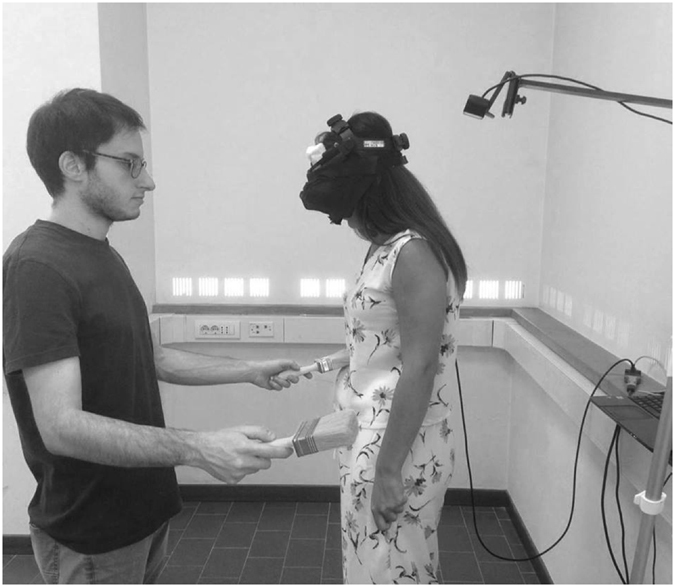
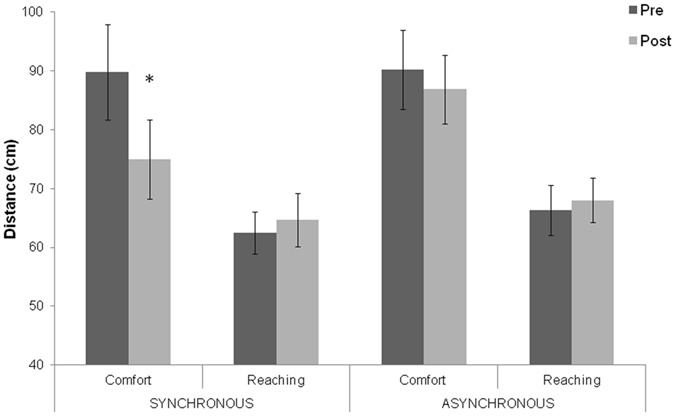
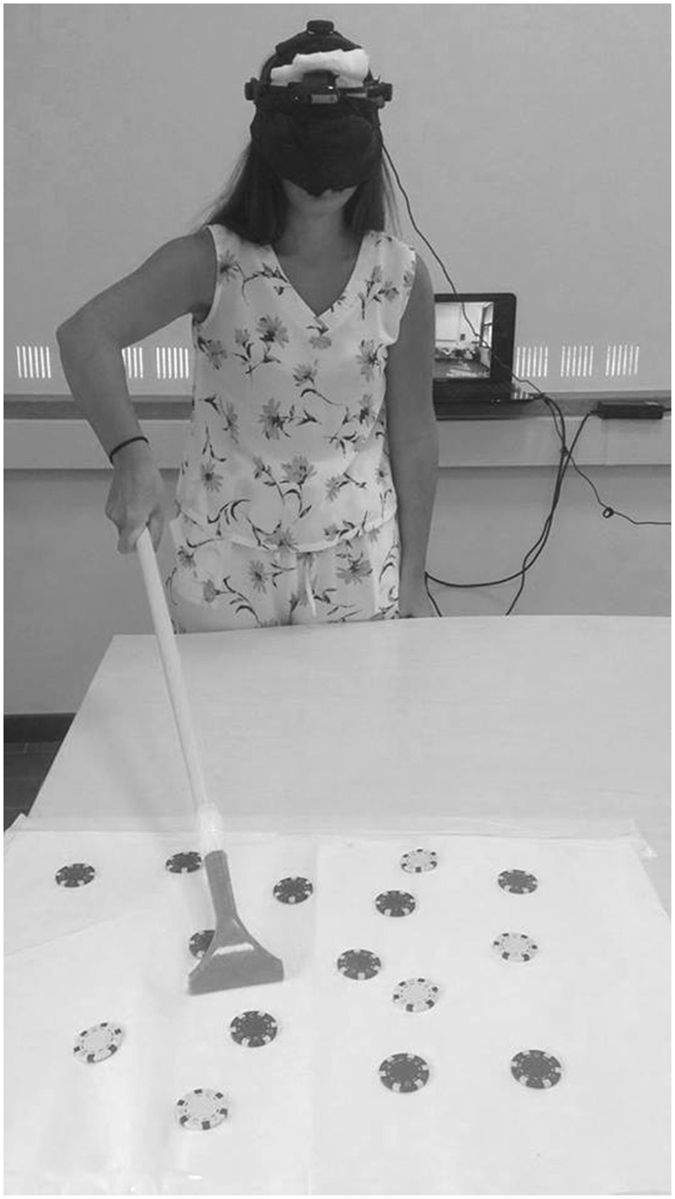
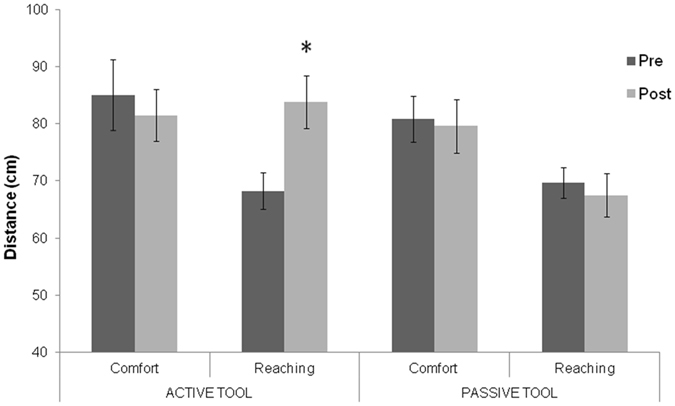
Interpersonal space (e.g., IPS) refers to the physical distance individuals maintain from others during social interactions, and into which intrusion by others can cause discomfort. Here, we asked whether the size of IPS is affected by manipulation of one’s own body representation. To address this issue, in Experiment 1, IPS was measured through a comfort-distance task, before and after eliciting the illusion of owning an invisible body. To rule out a general, nonspecific change in space perception consequent the illusion, we also assessed peripersonal space, e.g., PPS, the area around the body used to act on nearby objects, through a reaching-distance task. Results showed that the experience of invisibility induces a selective contraction of IPS, without affecting the perceived reaching space around the body. In Experiment 2, a tool-use manipulation produced the opposite dissociation, modifying the boundaries of PPS, but leaving IPS distance unaltered. Collectively, these findings support a close relationship between IPS and the conscious representation of the body external appearance, i.e. the body image, and suggest the existence of two functionally separate representations of the space immediately surrounding the body in humans, which may form the basis of distinct processes engaged for different behavioural contexts.
Overview
The claims and statistics of this paper haven’t been checked yet.
Free: it reads the open-access text and checks the first 5 claims that cite a source we can check. Create a free account to check every claim.
Integrity signals
Registry
Cites
Statistics
Figures
Verification
Claims the paper makes
The claims and statistics of this paper haven’t been checked yet.
Free: it reads the open-access text and checks the first 5 claims that cite a source we can check. Create a free account to check every claim.
Claims other papers make about this one
Each is checked against this paper’s own text: does it say what the citing paper says it does?
The source backs part of the claim, not all of it — or backs it for a different population, condition or comparison.
In the citing paper
“Some researchers (D' Angelo et al., 2017;Patan e et al., 2016) showed that this measure remained unchanged when facing an unfamiliar person, while it decreased after cooperative tool use in the same paradigm (Candini et al., 2019;Patan e et al., 2017).”
From The Peripersonal Space in a social world (2021) · cites this paper as D' Angelo et al., 2017
Experimental — accuracy not yet measuredThe cited source says what the claim attributes to it.
In the citing paper
“The use of a long tool consistently increased reachability distance estimated either alone (Bourgeois, Farn e, & Coello, 2014), or in the presence of a point-light walker (Quesque et al., 2017), a real confederate (D'Angelo, Pellegrino, & Frassinetti, 2017; Patan e, Iachini, Farn e, & Frassinetti, 2016), as well as following cooperative tool use (Patan e et al., 2017).”
From The Peripersonal Space in a social world (2021) · cites this paper as D'Angelo, Pellegrino, & Frassinetti, 2017
Self-check
Percentages, sums and reported differences re-computed from the paper’s own numbers.
The self-check needs the paper’s full text.
Citations
Cites
Faul, F., Erdfelder, E., Lang, A.-G., & Buchner, A. (2007) · Behavior Research Methods · doi:10.3758/bf03193146 · Cited by 65,971
The assessment and analysis of handedness: The Edinburgh inventory
Oldfield, R. C. (1971) · Neuropsychologia · doi:10.1016/0028-3932(71)90067-4 · Cited by 35,900
Barsalou, L. W. (2008) · Annual Review of Psychology · doi:10.1146/annurev.psych.59.103006.093639 · Cited by 5,936
Hall, E. T. (1973) · Leonardo · doi:10.2307/1572461 · Cited by 4,859
Gallagher, S. (2005) · doi:10.1093/0199271941.001.0001 · Cited by 3,311
The Proteus Effect: The Effect of Transformed Self-Representation on Behavior
Yee, N., & Bailenson, J. (2007) · Human Communication Research · doi:10.1111/j.1468-2958.2007.00299.x · Cited by 2,126
From presence to consciousness through virtual reality.
Sanchez-Vives, M. V., & Slater, M. (2005) · Nature reviews. Neuroscience · doi:10.1038/nrn1651 · Cited by 1,831
Maravita, A., & Iriki, A. (2004) · Trends in Cognitive Sciences · doi:10.1016/j.tics.2003.12.008 · Cited by 1,214
Putting yourself in the skin of a black avatar reduces implicit racial bias
Peck, T. C., Seinfeld, S., Aglioti, S. M., & Slater, M. (2013) · Consciousness and Cognition · doi:10.1016/j.concog.2013.04.016 · Cited by 967
When Far Becomes Near: Remapping of Space by Tool Use
Berti, A., & Frassinetti, F. (2000) · Journal of Cognitive Neuroscience · doi:10.1162/089892900562237 · Cited by 731
Self-citationBody schema and body image—Pros and cons
de Vignemont, F. (2010) · Neuropsychologia · doi:10.1016/j.neuropsychologia.2009.09.022 · Cited by 695
Somatosensory processes subserving perception and action
Dijkerman, H. C., & de Haan, E. H. F. (2007) · Behavioral and Brain Sciences · doi:10.1017/s0140525x07001392 · Cited by 614
Personal-space—where we now stand
Hayduk, L. A. (1983) · Psychological Bulletin · doi:10.1037/0033-2909.94.2.293 · Cited by 502
More than skin deep: Body representation beyond primary somatosensory cortex
Longo, M. R., Azañón, E., & Haggard, P. (2010) · Neuropsychologia · doi:10.1016/j.neuropsychologia.2009.08.022 · Cited by 479
Personal space regulation by the human amygdala
Kennedy, D. P., Gläscher, J., Tyszka, J. M., & Adolphs, R. (2009) · Nature Neuroscience · doi:10.1038/nn.2381 · Cited by 450
Tool-use induces morphological updating of the body schema
Cardinali, L., Frassinetti, F., Brozzoli, C., Urquizar, C., Roy, A. C., & Farnè, A. (2009) · Current Biology · doi:10.1016/j.cub.2009.05.009 · Cited by 416
Self-citationDynamic size-change of hand peripersonal space following tool use
Farnè, A., & Làdavas, E. (2000) · NeuroReport · doi:10.1097/00001756-200006050-00010 · Cited by 385
Changing bodies changes minds: Owning another body affects social cognition
Maister, L., Slater, M., Sanchez-Vives, M. V., & Tsakiris, M. (2015) · Trends in Cognitive Sciences · doi:10.1016/j.tics.2014.11.001 · Cited by 384
The rubber hand illusion in action
Kammers, M. P. M., de Vignemont, F., Verhagen, L., & Dijkerman, H. C. (2009) · Neuropsychologia · doi:10.1016/j.neuropsychologia.2008.07.028 · Cited by 374
Oxytocin Modulates Social Distance between Males and Females
Scheele, D., Striepens, N., Güntürkün, O., Deutschländer, S., Maier, W., Kendrick, K. M., & Hurlemann, R. (2012) · The Journal of Neuroscience · doi:10.1523/jneurosci.2755-12.2012 · Cited by 301
Synchronous multisensory stimulation blurs self-other boundaries.
Paladino, M.-P., Mazzurega, M., Pavani, F., & Schubert, T. W. (2010) · Psychological Science · doi:10.1177/0956797610379234 · Cited by 297
Peripersonal space in the brain
di Pellegrino, G., & Làdavas, E. (2015) · Neuropsychologia · doi:10.1016/j.neuropsychologia.2014.11.011 · Cited by 278
Peripersonal and interpersonal space in virtual and real environments: Effects of gender and age
Iachini, T., Coello, Y., Frassinetti, F., Senese, V. P., Galante, F., & Ruggiero, G. (2016) · Journal of Environmental Psychology · doi:10.1016/j.jenvp.2016.01.004 · Cited by 274
Self-citationTool-use reshapes the boundaries of body and peripersonal space representations
Canzoneri, E., Ubaldi, S., Rastelli, V., Finisguerra, A., Bassolino, M., & Serino, A. (2013) · Experimental Brain Research · doi:10.1007/s00221-013-3532-2 · Cited by 257
de Vignemont, F., & Iannetti, G. D. (2015) · Neuropsychologia · doi:10.1016/j.neuropsychologia.2014.11.018 · Cited by 238
Iachini, T., Coello, Y., Frassinetti, F., & Ruggiero, G. (2014) · PLoS ONE · doi:10.1371/journal.pone.0111511 · Cited by 236
Self-citationExperiencing ownership over a dark-skinned body reduces implicit racial bias
Maister, L., Sebanz, N., Knoblich, G., & Tsakiris, M. (2013) · Cognition · doi:10.1016/j.cognition.2013.04.002 · Cited by 221
Guterstam, A., Gentile, G., & Ehrsson, H. H. (2013) · Journal of Cognitive Neuroscience · doi:10.1162/jocn_a_00393 · Cited by 215
Self awareness and the body image
Longo, M. R., Schüür, F., Kammers, M. P. M., Tsakiris, M., & Haggard, P. (2009) · Acta Psychologica · doi:10.1016/j.actpsy.2009.02.003 · Cited by 179
Space perception and body morphology: extent of near space scales with arm length
Longo, M. R., & Lourenco, S. F. (2007) · Experimental Brain Research · doi:10.1007/s00221-007-0855-x · Cited by 177
Tool-use: An open window into body representation and its plasticity
Martel, M., Cardinali, L., Roy, A. C., & Farnè, A. (2016) · Cognitive Neuropsychology · doi:10.1080/02643294.2016.1167678 · Cited by 176
Don't Stand So Close to Me: The Effects of Self-Construal on Interpersonal Closeness
Holland, R. W., Roeder, U.-R., Rick B.van, B., Brandt, A. C., & Hannover, B. (2004) · Psychological Science · doi:10.1111/j.0956-7976.2004.00658.x · Cited by 173
The effect of facial expressions on peripersonal and interpersonal spaces
Ruggiero, G., Frassinetti, F., Coello, Y., Rapuano, M., di Cola, A. S., & Iachini, T. (2017) · Psychological Research · doi:10.1007/s00426-016-0806-x · Cited by 171
Self-citationExtension of perceived arm length following tool-use: Clues to plasticity of body metrics
Sposito, A. V., Bolognini, N., Vallar, G., & Maravita, A. (2012) · Neuropsychologia · doi:10.1016/j.neuropsychologia.2012.05.022 · Cited by 156
Illusory ownership of an invisible body reduces autonomic and subjective social anxiety responses
Guterstam, A., Abdulkarim, Z., & Ehrsson, H. H. (2015) · Scientific Reports · doi:10.1038/srep09831 · Cited by 132
Lloyd, D. M. (2009) · Neuroscience & Biobehavioral Reviews · doi:10.1016/j.neubiorev.2008.09.007 · Cited by 128
Personal Space Regulation in Childhood Autism Spectrum Disorders
Gessaroli, E., Santelli, E., di Pellegrino, G., & Frassinetti, F. (2013) · PLoS ONE · doi:10.1371/journal.pone.0074959 · Cited by 126
Self-citationWhen action is not enough: Tool-use reveals tactile-dependent access to Body Schema
Cardinali, L., Brozzoli, C., Urquizar, C., Salemme, R., Roy, A. C., & Farnè, A. (2011) · Neuropsychologia · doi:10.1016/j.neuropsychologia.2011.09.033 · Cited by 120
Don’t stand so close to me: a behavioral and ERP study of preferred interpersonal distance
Perry, A., Rubinsten, O., Peled, L., & Shamay-Tsoory, S. G. (2013) · NeuroImage · doi:10.1016/j.neuroimage.2013.07.042 · Cited by 118
Iachini, T., Pagliaro, S., & Ruggiero, G. (2015) · Acta Psychologica · doi:10.1016/j.actpsy.2015.09.003 · Cited by 106
The plasticity of near space: Evidence for contraction
Lourenco, S. F., & Longo, M. R. (2009) · Cognition · doi:10.1016/j.cognition.2009.05.011 · Cited by 106
Costs and benefits of tool-use on the perception of reachable space
Bourgeois, J., Farnè, A., & Coello, Y. (2014) · Acta Psychologica · doi:10.1016/j.actpsy.2014.01.008 · Cited by 96
Violations of Personal Space by Individuals with Autism Spectrum Disorder
Kennedy, D. P., & Adolphs, R. (2014) · PLoS ONE · doi:10.1371/journal.pone.0103369 · Cited by 89
Personal Space: An Analysis of E.T. Hall’s Proxemics Framework
Altman, I., & Vinsel, A. (1977) · Springer eBooks · doi:10.1007/978-1-4684-0808-9_5 · Cited by 87
Badets, A., Koch, I., & Philipp, A. M. (2014) · Psychological Research · doi:10.1007/s00426-014-0643-8 · Cited by 74
I-Space: The Effects of Emotional Valence and Source of Music on Interpersonal Distance
Tajadura-Jiménez, A., Pantelidou, G., Rebacz, P., Västfjäll, D., & Tsakiris, M. (2011) · PLoS ONE · doi:10.1371/journal.pone.0026083 · Cited by 70
Disturbed body image in patients with eating disorders
(1991) · American Journal of Psychiatry · doi:10.1176/ajp.148.2.211 · Cited by 66
Interpersonal distance and social anxiety in autistic spectrum disorders: A behavioral and ERP study
Perry, A., Levy-Gigi, E., Richter-Levin, G., & Shamay-Tsoory, S. G. (2015) · Social Neuroscience · doi:10.1080/17470919.2015.1010740 · Cited by 65
Candini, M., Giuberti, V., Manattini, A., Grittani, S., di Pellegrino, G., & Frassinetti, F. (2017) · Autism Research · doi:10.1002/aur.1637 · Cited by 64
Self-citationDisentangling Action from Social Space: Tool-Use Differently Shapes the Space around Us
Patané, I., Iachini, T., Farnè, A., & Frassinetti, F. (2016) · PLOS ONE · doi:10.1371/journal.pone.0154247 · Cited by 50
Self-citationThe perception of peripersonal space in right and left brain damage hemiplegic patients
Bartolo, A., Carlier, M., Hassaïni, S., Martin, Y., & Coello, Y. (2014) · Frontiers in Human Neuroscience · doi:10.3389/fnhum.2014.00003 · Cited by 42
Paillard, J. (2005) · Advances in consciousness research · doi:10.1075/aicr.62.07pai · Cited by 40
Don't Stand So Close to Me: The Effect of Auditory Input on Interpersonal Space
Lloyd, D. M., Coates, A. E., Knopp, J., Oram, S., & Rowbotham, S. J. (2009) · Perception · doi:10.1068/p6317 · Cited by 25
Research works printed but not linked: 2
- Aiello, J. R. Human spatial behaviour in Handbook of Environmental Psychology (Eds Stokols, D. and Altman, I.) 1, 389–504 (New York: Wiley, 1987).
- Sommer, R. From personal space to cyberspace in Handbook of Environmental Psychology (Eds Bechtel, R. B. and Churchman, A.) 2, 647–660 (New York: Wiley, 2002).
Cited by
Hecht, H., Welsch, R., Viehoff, J., & Longo, M. R. (2019) · Acta Psychologica · doi:10.1016/j.actpsy.2018.12.009 · Cited by 139
The Peripersonal Space in a social world
Bogdanova, O. V., Bogdanov, V. B., Dureux, A., Farnè, A., & Hadj-Bouziane, F. (2021) · Cortex · doi:10.1016/j.cortex.2021.05.005 · Cited by 86
“Some researchers (D’Angelo et al., 2017; Patané et al., 2016) showed that this measure remained unchanged when facing an unfamiliar person, while it decreased after cooperative tool use in the same paradigm (Candini et al.”
BackgroundMethodInfluentialNoel, J., Blanke, O., & Serino, A. (2018) · Annals of the New York Academy of Sciences · doi:10.1111/nyas.13867 · Cited by 79
The physiological correlates of interpersonal space
Candini, M., Battaglia, S., Benassi, M., di Pellegrino, G., & Frassinetti, F. (2021) · Scientific Reports · doi:10.1038/s41598-021-82223-2 · Cited by 73
Self-citationFrontier of Self and Impact Prediction
Cléry, J., & Hamed, S. B. (2018) · Frontiers in Psychology · doi:10.3389/fpsyg.2018.01073 · Cited by 54
“In the same lines, the introduction of invisible body illusions results in dissociable changes in InterPS and PPS sizes (D’Angelo et al., 2017).”
Background
Metadata
- Authors
- D’Angelo, M., di Pellegrino, G., & Frassinetti, F.
- Affiliations
- University of Bologna (IT)
- Istituti Clinici Scientifici Maugeri (IT)
- Corresponding author
- Frassinetti, Francesca
- Venue
- Scientific Reports
- Published
- 2017-05-02
- Volume
- 7
- Issue
- 1
- Pages
- 1302-1302
- ISSN
- 2045-2322 (ISSN-L)
- PMC
- PMC5430991
- OpenAlex
- W2609250021
- Cited by
- 32
- References
- 53
- Citations by year
- 2026: 2 · 2025: 2 · 2024: 1 · 2023: 1 · 2022: 6 · 2021: 11 · 2020: 2 · 2019: 3 · 2018: 4
- FWCI
- 3.04
- Type
- journal article
- Language
- en
- Open access
- gold
- doi.org
- Licence
- cc-by
- creativecommons.org/licenses/by/4.0 (tdm)
- creativecommons.org/licenses/by/4.0 (vor)
- Locations
- Scientific Reports (publishedVersion, cc-by)
- PubMed Central (publishedVersion, cc-by)
- PubMed (publishedVersion)
- Archivio istituzionale della ricerca (Alma Mater Studiorum Università di Bologna) (submittedVersion, cc-by)
- DOAJ (DOAJ: Directory of Open Access Journals) (submittedVersion, cc-by-sa)
- Funders
- Leverhulme Trust
- Università di Bologna
- Topics
- Physical Sciences › Computer Science › Human-Computer Interaction › Virtual Reality Applications and Impacts
- Life Sciences › Neuroscience › Cognitive Neuroscience › Embodied and Extended Cognition
- Life Sciences › Neuroscience › Cognitive Neuroscience › Tactile and Sensory Interactions
- Keywords
- personal space, body image, peripersonal space, representation of the body, tool use, spatial perception, reaching task, social distance
- MeSH terms
- Adult, Body Image, Female, Humans, Illusions, Interpersonal Relations, Personal Space, Physical Stimulation, Reaction Time, Space Perception, Touch, Young Adult
About these checks
Registry, retraction, Cites and statistics results are computed, not judged, with one exception: a printed reference that no index lists is read once by a model before it counts as a citation error. Claims are extracted by a model and kept only when their quote appears verbatim in the text; each cited source is then checked, with a model’s help, for whether it says what the claim relies on. Those verdicts can be wrong — read the claim’s quote and the cited source before relying on one.
Statistics and arithmetic are recomputed, not judged.
Confidence bands are shown only for fields calibrated on our annotated test set. None is calibrated yet, so no band is shown.
What counts as a claim ›How we measure confidence ›How we check this ›
Are you an author, or do you see a problem with this page? Request a review
Data sources
Bibliographic data: Semantic Scholar, OpenAlex, Crossref.
Contains information from the Semantic Scholar Academic Graph Datasets, made available under the ODC Attribution License (ODC-BY 1.0).
Semantic Scholar’s data is described in: Kinney, R., et al. (2023). The Semantic Scholar Open Data Platform. arXiv:2301.10140.
