

Inductively powered wireless pacing via a miniature pacemaker and remote stimulation control system
Open accessThe DOI matches its Crossref record; 31 of the 32 references it cites were found in a registry or an index; 11 of the 43 sources its claims cite were checked for support.
Abstract
Pacemakers have existed for decades as a means to restore cardiac electrical rhythms. However, lead-related complications have remained a clinical challenge. While market-released leadless devices have addressed some of the issues, their pacer-integrated batteries cause new health risks and functional limitations. Inductive power transfer enables wireless powering of bioelectronic devices; however, Specific Absorption Rate and size limitations reduce power efficiency for biomedical applications. We designed a remote-controlled system in which power requirements were significantly reduced via intermittent power transfer to control stimulation intervals. In parallel, the cardiac component was miniaturized to facilitate intravascular deployment into the anterior cardiac vein. Given size constraints, efficiency was optimal via a circular receiver coil wrapped into a half-cylinder with a meandering tail. The pacemaker was epicardially tested in a euthanized pig at 60 beats per minute, 2 V amplitude, and 1 ms pulse width, restoring mean arterial pressure from 0 to 37 mmHg. Power consumption was 1 mW at a range of > 3 cm with no misalignment and at 2 cm with 45° displacement misalignment, 45° x-axis angular misalignment, or 45° y-axis angular misalignment. Thus, we demonstrated a remote-controlled miniaturized pacing system with low power consumption, thereby providing a basis for the next generation of wireless implantable devices.
Overview
CoChat Summary
## TL;DR
The paper presents a remote-controlled, inductively powered pacing system designed to avoid lead-related complications by miniaturizing the cardiac module and moving control logic to the transmitter. In a euthanized pig, the system produced pacing at 60 beats per minute with 2 V amplitude and 1 ms pulse width, restoring mean arterial pressure from 0 to 37 mmHg.
## Key findings
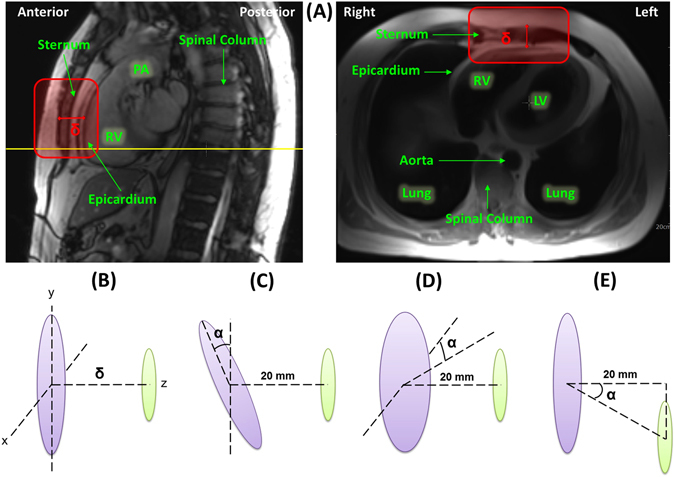
- MRI-based measurements estimated the transmitter-to-receiver distance at 2.0 ± 0.85 cm, which the authors used as the target range for testing.
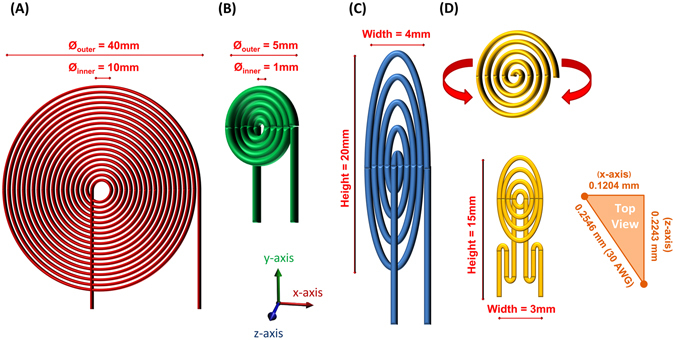
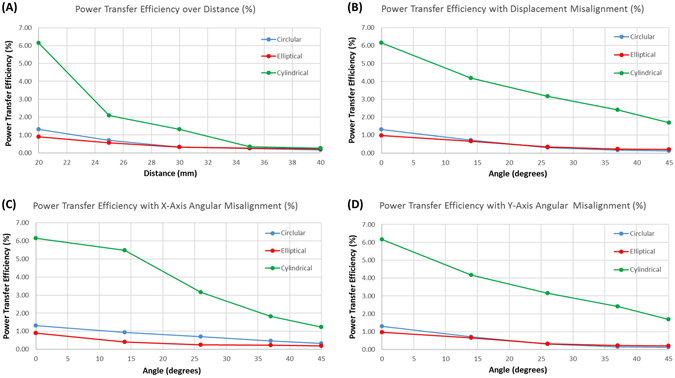
- Among three receiver antenna designs, the wrapped half-cylindrical antenna with a meandering tail gave the optimal power transfer efficiency across tested conditions.
- With a 5 V, 0.20 A transmitter supply, the system could reach 2 V across a 500 ohm load at >3 cm with no misalignment, or at 2 cm with 45° displacement, 45° x-axis angular, or 45° y-axis angular misalignment.
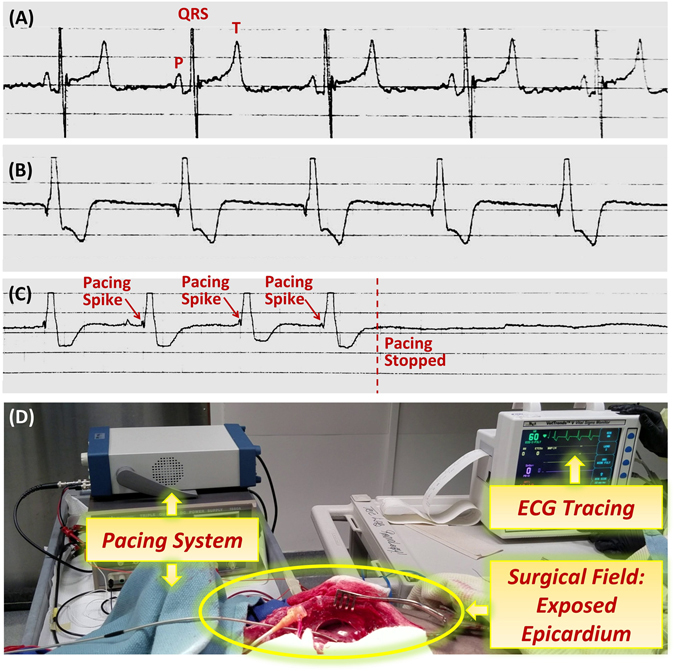
- Intermittent transmission reduced power demand from 1 W for continuous wireless transmission to 1 mW at 1 Hz and 1 ms pulse width; in the ex vivo pig test, pacing at 60 BPM, 2 V, and 1 ms restored mean arterial pressure from 0 to 37 mmHg.
## Methods
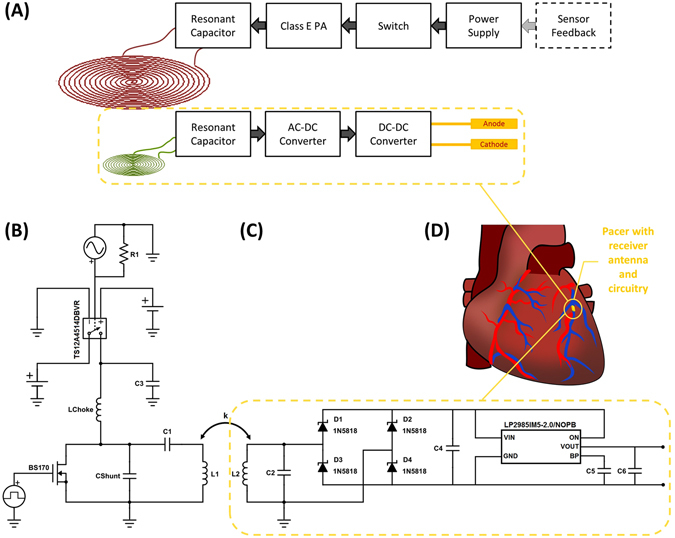
- The study developed a two-component wireless pacing architecture: a miniaturized cardiac receiver/stimulator with no internal control logic or battery, and a transmitting/control module containing the logic circuitry, class E power amplifier, and resonant tank circuit.
- Antenna prototypes were built and bench-tested in three receiver geometries under four conditions: distance from 20 to 40 mm, x-axis angular misalignment up to 45°, y-axis angular misalignment up to 45°, and displacement misalignment up to 45°; tests used a 500 ohm load.
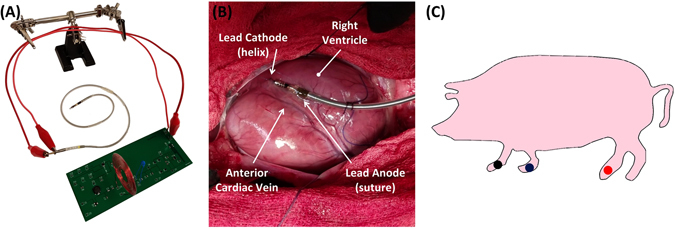
- Feasibility was then demonstrated in a postmortem male Yucatan miniature pig with thoracotomy and epicardial pacing via a bipolar lead connected to the receiver circuit, while ECG and mean arterial pressure were recorded.
## Limitations
- The paper states the work used a euthanized pig and postmortem/ex vivo pacing, so the demonstrated function is not an in vivo chronic implant result.
- The authors note that the presented work used a standard impedance lead, and say future work will require a single miniature leadless packaging with two electrodes for catheter delivery.
- Evident from the text: the pacing system was demonstrated with external pacing immediately post-euthanasia and not under physiological conditions of a living subject, so long-term safety, fixation, and clinical performance are not established in this paper.
Model-written summary. Check it against the paper before relying on it.
Integrity signals
Registry
Cites
Statistics
Figures
Verification
Claims the paper makes
11 Valid · 1 Not valid · 15 Not checked · 40 Own results and interpretations
The cited sources support only part of this claim — read each source’s verdict below.
In the paper
“Other complications include tissue puncture during the implant procedure, causing perforation and rupture of the heart or air entrapment in the lungs known as pneumothorax6.”
§ Inductively powered wireless pacing via a miniature pacemaker and remote stimulation control system > Introduction
What the sources say
- Partly supportedcites [6] Lin YS Risk factors influencing complications of cardiac implantable electronic device implantation: infection, pneumothorax and heart perforation: a nationwide population-based cohort study Med. 2014 93 e213 10.1097/MD.0000000000000213 PMC4602772 25501080 sourceExperimental — accuracy not yet measured
The Introduction identifies pneumothorax and heart perforation as complications after CIED implantation and reports a possible correlation between pneumothorax and subclavian vein puncture. The Discussion also refers to cardiac rupture, but the paper does not establish that tissue puncture during implantation causes both cardiac rupture and pneumothorax as the citing sentence states. Page numbers are unavailable in our copy. (LLM, conf=0.86)
plainstates a cause- Asserted: passes — The authors put it forward as true.
- Checkable: passes — It can be checked against evidence.
- Load-bearing: passes — The paper’s conclusions depend on it.
- Based: passes — The paper gives a reason why it holds.
- Partly supported
The cited sources support only part of this claim — read each source’s verdict below.
In the paper
“Although the recent FDA approval of the Micra marks a positive step towards leadless devices, it introduces a new set of complications, notably due to their integration of a battery into the main body of the pacer8–10.”
§ Inductively powered wireless pacing via a miniature pacemaker and remote stimulation control system > Introduction
What the sources say
- Partly supportedcites [8] Sperzel J State of the art of leadless pacing Europace 2015 17 1508 1513 10.1093/europace/euv096 26024918 PMC4617371 sourceExperimental — accuracy not yet measured
The table in “Leadless systems for right ventricle pacing” lists integrated batteries for both Micra and Nanostim. The same section raises unresolved questions about retrieval or implanting another device after battery depletion, but does not establish that battery integration has caused new complications. (LLM, conf=0.85)
- Not matchedcites [9] FDA Executive Summary Memorandum General Issues: Leadless Pacemaker Devices. (2016).
Its entry has no title and year that we can search by.
- Not matchedcites [10] Micra TM MC1VR01 Clinical Manual. (2016).
Its entry has no title and year that we can search by.
plainstates a cause- Asserted: passes — The authors put it forward as true.
- Checkable: passes — It can be checked against evidence.
- Load-bearing: passes — The paper’s conclusions depend on it.
- Based: passes — The paper gives a reason why it holds.
- Partly supported
The sources with a verdict support this claim; the rest weren’t checked yet, have no full text we could read, or their verdicts aren’t rated yet.
In the paper
“Power efficiency of an inductive link depends on two primary factors: (1) the quality factor of the transmitting and receiving antennas, and (2) the coupling coefficient.”
§ Inductively powered wireless pacing via a miniature pacemaker and remote stimulation control system > Introduction
What the sources say
- Not checked — no full text of the sourcecites [22] Chen, S. C. Q. & Thomas, V. Optimization of Inductive RFID Technology. Int. Symp. Electron. Environ. 82–87 (2001). source
- Not checked — no full text of the sourcecites [24] Finkenzeller, K. RFID Handbook: Fundamentals and Applications in Contactless Smart Cards, Radio Frequency Identification and near-Field Communication. (John Wiley & Sons, 2010), doi:10.1002/9780470665121. source
- Supportedcites [25] Kiani M Ghovanloo M A figure-of-merit for designing high-performance inductive power transmission links IEEE Trans. Ind. Electron. 2013 60 5292 5305 10.1109/TIE.2012.2227914 PMC4223690 25382898 source
Section II gives the power-transfer-efficiency equation in terms of the coupling coefficient and the transmitting and receiving coils’ quality factors. It supports the cited sentence’s description of the principal factors affecting inductive-link efficiency; the supplied passage has no page number. (LLM, conf=0.94)
plainstates a cause- Asserted: passes — The authors put it forward as true.
- Checkable: passes — It can be checked against evidence.
- Load-bearing: passes — The paper’s conclusions depend on it.
- Based: passes — The paper gives a reason why it holds.
The cited sources support only part of this claim — read each source’s verdict below.
In the paper
“Alternative solutions for leadless devices have been proposed, including utilization of energy harvesters11, 12 and ultrasound-based wireless pacers8, 13, 14. However, these are similarly hindered by a large device size that leads to mechanically stressed fixation mechanisms.”
§ Inductively powered wireless pacing via a miniature pacemaker and remote stimulation control system > Introduction
What the sources say
- Not checked yetcites [11] Hwang GT Self-powered cardiac pacemaker enabled by flexible single crystalline PMN-PT piezoelectric energy harvester Adv. Mater. 2014 26 4880 4887 10.1002/adma.201400562 24740465 source
Checked before — its earlier verdict is held back until a new check runs.
- Not checked — no full text of the sourcecites [12] Karami, M. A. & Inman, D. J. Powering pacemakers from heartbeat vibrations using linear and nonlinear energy harvesters. Appl. Phys. Lett. 100 (2012). source
- Partly supportedcites [8] Sperzel J State of the art of leadless pacing Europace 2015 17 1508 1513 10.1093/europace/euv096 26024918 PMC4617371 sourceExperimental — accuracy not yet measured
The technological-aspects section describes the ultrasound-based WiCS leadless pacer and its fixation tines, while the future-perspectives section mentions research on harvesting cardiac-motion energy. The paper does not say that either approach is hindered by large device size or that size mechanically stresses its fixation mechanism (no page numbers are available in our copy). (LLM, conf=0.86)
- Not checked — no full text of the sourcecites [13] Auricchio A First-in-man implantation of leadless ultrasound-based cardiac stimulation pacing system: Novel endocardial left ventricular resynchronization therapy in heart failure patients Europace 2013 15 1191 1197 10.1093/europace/eut124 23703364 source
- Not checked — no full text of the sourcecites [14] Lee KL In the wireless era: leadless pacing Expert Rev. Cardiovasc. Ther. 2010 8 171 174 10.1586/erc.09.168 20136603 source
plainstates a cause- Asserted: passes — The authors put it forward as true.
- Checkable: passes — It can be checked against evidence.
- Load-bearing: passes — The paper’s conclusions depend on it.
- Based: passes — The paper gives a reason why it holds.
- Not checked yet
The cited sources support only part of this claim — read each source’s verdict below.
In the paper
“Despite great advancements in implantable cardiac pacemaker technology, complications from pacemaker leads continue to compromise nearly 10% of all implants1, 2.”
§ Inductively powered wireless pacing via a miniature pacemaker and remote stimulation control system > Introduction
What the sources say
- Partly supportedcites [1] Kirkfeldt RE Johansen JB Nohr EA Jorgensen OD Nielsen JC Complications after cardiac implantable electronic device implantations: An analysis of a complete, nationwide cohort in Denmark Eur. Heart J. 2014 35 1186 1194 10.1093/eurheartj/eht511 24347317 PMC4012708 sourceExperimental — accuracy not yet measured
Table 2 in Results > Complication risk reports complications in 9.5% of all cardiac-device procedures, but that figure includes complications unrelated to leads and devices other than pacemakers. Lead-related re-intervention occurred in 2.4% of all procedures; the Results also report a 1.2% risk of right-ventricular lead complications requiring re-intervention after pacemaker and CRT-P procedures. The source therefore supports a near-10% overall complication rate, not the claimed near-10% rate for pacemaker-lead complications. (LLM, conf=0.89)
- Not checked — no full text of the sourcecites [2] Mela T Singh JP Leadless pacemakers: Leading us into the future? European Heart Journal 2015 36 2520 2522 10.1093/eurheartj/ehv261 26282468 source
plainstates a cause- Asserted: passes — The authors put it forward as true.
- Checkable: passes — It can be checked against evidence.
- Load-bearing: passes — The paper’s conclusions depend on it.
- Based: passes — The paper gives a reason why it holds.
- Partly supported
29 more claims · 3 with their cited sources checked
Create a free account to see all 67 claims and to verify the 3 references still open.
- It may state two separate claims as one. 27
- Borderline: one of the tests for a substantial claim is unclear. 1
- Probably not a substantial claim. 8
Claims other papers make about this one
Each is checked against this paper’s own text: does it say what the citing paper says it does?
The cited source says what the claim attributes to it.
In the citing paper
“While many remain battery-powered, wireless power transfer techniques can further reduce the form factor and invasiveness of these devices4–10.”
From Synchronized Biventricular Heart Pacing in a Closed-chest Porcine Model based on Wirelessly Powered Leadless Pacemakers (2020) · cites this paper as [5]
Experimental — accuracy not yet measuredThe cited source says what the claim attributes to it.
In the citing paper
“Prior studies have investigated wirelessly powered single-site cardiac pacing on rodent, rabbit and open-chest porcine models4,5,21.”
From Synchronized Biventricular Heart Pacing in a Closed-chest Porcine Model based on Wirelessly Powered Leadless Pacemakers (2020) · cites this paper as [5]
Citations
Cites
Simple accurate expressions for planar spiral inductances
Mohan, S. S., del Mar Hershenson, M., Boyd, S. P., & Lee, T. H. (1999) · IEEE Journal of Solid-State Circuits · doi:10.1109/4.792620 · Cited by 1,627
Finkenzeller, K. (2010) · doi:10.1002/9780470665121 · Cited by 1,428
Kirkfeldt, R. E., Johansen, J. B., Nohr, E. A., Jorgensen, O. D., & Nielsen, J. C. (2014) · European Heart Journal · doi:10.1093/eurheartj/eht511 · Cited by 871
Hwang, G., Park, H., Lee, J., Oh, S., Park, K., Byun, M., Park, H., Ahn, G., Jeong, C. K., No, K., et al. (2014) · Advanced Materials · doi:10.1002/adma.201400562 · Cited by 672
Udo, E. O., Zuithoff, N. P. A., van Hemel, N. M., de Cock, C. C., Hendriks, T., Doevendans, P. A., & Moons, K. G. M. (2012) · Heart Rhythm · doi:10.1016/j.hrthm.2011.12.014 · Cited by 597
Systemic Infection Related to Endocarditis on Pacemaker Leads: Clinical Presentation and Management
Klug, D., Lacroix, D., Savoye, C., Goullard, L., Grandmougin, D., Hennequin, J. L., Kacet, S., & Lekieffre, J. (1997) · Circulation · doi:10.1161/01.cir.95.8.2098 · Cited by 593
Wireless power transfer to deep-tissue microimplants
Ho, J. S., Yeh, A. J., Neofytou, E., Kim, S., Tanabe, Y., Patlolla, B., Beygui, R. E., & Poon, A. S. Y. (2014) · Proceedings of the National Academy of Sciences · doi:10.1073/pnas.1403002111 · Cited by 541
A very low-power CMOS mixed-signal IC for implantable pacemaker applications
Wong, L. S. Y., Hossain, S., Ta, A., Edvinsson, J., Rivas, D. H., & Naas, H. (2004) · IEEE Journal of Solid-State Circuits · doi:10.1109/jssc.2004.837027 · Cited by 395
Powering pacemakers from heartbeat vibrations using linear and nonlinear energy harvesters
Amin Karami, M., & Inman, D. J. (2012) · Applied Physics Letters · doi:10.1063/1.3679102 · Cited by 390
Hauser, R. G., Katsiyiannis, W. T., Gornick, C. C., Almquist, A. K., & Kallinen, L. M. (2010) · Europace · doi:10.1093/europace/eup375 · Cited by 264
Wireless power transfer to a cardiac implant
Kim, S., Ho, J. S., Chen, L. Y., & Poon, A. S. Y. (2012) · Applied Physics Letters · doi:10.1063/1.4745600 · Cited by 148
A Figure-of-Merit for Designing High-Performance Inductive Power Transmission Links
Kiani, M., & Ghovanloo, M. (2013) · IEEE Transactions on Industrial Electronics · doi:10.1109/tie.2012.2227914 · Cited by 146
Energy Encryption for Wireless Power Transfer
Zhang, Z., Chau, K. T., Qiu, C., & Liu, C. (2014) · IEEE Transactions on Power Electronics · doi:10.1109/tpel.2014.2363686 · Cited by 140
Lee, S.-Y., Su, M. Y., Liang, M.-C., Chen, Y.-Y., Hsieh, C.-H., Yang, C.-M., Lai, H.-Y., Lin, J.-W., & Fang, Q. (2011) · IEEE Transactions on Biomedical Circuits and Systems · doi:10.1109/tbcas.2011.2177661 · Cited by 102
Auricchio, A., Delnoy, P.-P., Regoli, F., Seifert, M., Markou, T., Butter, C., & for the collaborative study group (2013) · Europace · doi:10.1093/europace/eut124 · Cited by 94
Sani, A., Alomainy, A., & Hao, Y. (2009) · IEEE Transactions on Microwave Theory and Techniques · doi:10.1109/tmtt.2009.2029770 · Cited by 91
State of the art of leadless pacing
Sperzel, J., Burri, H., Gras, D., Tjong, F. V. Y., Knops, R. E., Hindricks, G., Steinwender, C., & Defaye, P. (2015) · Europace · doi:10.1093/europace/euv096 · Cited by 81
Optimization of inductive RFID technology
Chen, S. C. Q., & Thomas, V. (2002) · Proceedings of the 2001 IEEE International Symposium on Electronics and the Environment. 2001 IEEE ISEE (Cat. No.01CH37190) · doi:10.1109/isee.2001.924506 · Cited by 75
A wireless single-chip telemetry-powered neural stimulation system
Von Arx, J. A., & Najafi, K. (2003) · 1999 IEEE International Solid-State Circuits Conference. Digest of Technical Papers. ISSCC. First Edition (Cat. No.99CH36278) · doi:10.1109/isscc.1999.759199 · Cited by 74
Lin, Y.-S., Hung, S.-P., Chen, P.-R., Yang, C.-H., Wo, H.-T., Chang, P.-C., Wang, C.-C., Chou, C.-C., Wen, M.-S., Chung, C.-M., et al. (2014) · Medicine · doi:10.1097/md.0000000000000213 · Cited by 58
Zhang, Z., Chau, K. T., Liu, C., Qiu, C., & Lin, F. (2014) · Journal of Applied Physics · doi:10.1063/1.4866238 · Cited by 56
Inductive link design for medical implants
Ali, H., Ahmad, T. J., & Khan, S. A. (2009) · 2009 IEEE Symposium on Industrial Electronics & Applications · doi:10.1109/isiea.2009.5356376 · Cited by 41
Magnetic resonance imaging: Calculation of rates of energy absorption by a human‐torso model
Grandolfo, M., Vecchia, P., & Gandhi, O. P. (1990) · Bioelectromagnetics · doi:10.1002/bem.2250110203 · Cited by 36
Cruciani, S., Campi, T., Maradei, F., & Feliziani, M. (2014) · 2014 International Symposium on Electromagnetic Compatibility · doi:10.1109/emceurope.2014.6930874 · Cited by 34
The Influence of High Versus Normal Impedance Ventricular Leads on Pacemaker Generator Longevity
BERGER, T., ROITHINGER, F. X., ANTRETTER, H., HANGLER, H., PACHINGER, O., & HINTRINGER, F. (2003) · Pacing and Clinical Electrophysiology · doi:10.1046/j.1460-9592.2003.00329.x · Cited by 29
In the wireless era: leadless pacing
Lee, K. L. (2010) · Expert Review of Cardiovascular Therapy · doi:10.1586/erc.09.168 · Cited by 16
Leadless pacemakers: leading us into the future?: Figure 1
Mela, T., & Singh, J. P. (2015) · European Heart Journal · doi:10.1093/eurheartj/ehv261 · Cited by 13 · cited 8×
“The current pacer circuitry has two primary sources of power loss: (1) bridge rectifier diodes and (2) voltage regulator.”
BackgroundMethodInfluentialCompliance with FCC exposure guidelines for radiofrequency electromagnetic fields
Cleveland, R. F. (2004) · 2004 International Symposium on Electromagnetic Compatibility (IEEE Cat. No.04CH37559) · doi:10.1109/isemc.2004.1349969 · Cited by 10
Evaluation of Coronary Venous Anatomy by Multislice Computed Tomography
Sun, J. P., Yang, X. S., Lam, Y. Y., Garcia, M. J., & Yu, C. M. (2012) · World Journal of Cardiovascular Surgery · doi:10.4236/wjcs.2012.24018 · Cited by 8
Kristiansen, H. M., Hovstad, T., Vollan, G., & Faerestrand, S. (2012) · Indian Pacing and Electrophysiology Journal · doi:10.1016/s0972-6292(16)30458-2 · Cited by 5
Research works printed but not linked: 3
- Dobkin, D. M. The RF in RFID. (Elsevier Inc., 2008).
- Madjar, H. M. International, regional and national regulation of SRDs ISM Bands. In ITU Workshop on Short Range Devices and Ultra Wide Band 1–35 (International Telecommunication Union, 2014).
- Sokal NO Class-E RF Power Amplifiers QEX Commun. Quart 2001 204 9 20
Cited by
Magnetoelectric effect: principles and applications in biology and medicine– a review
Kopyl, S., Surmenev, R., Surmeneva, M., Fetisov, Y., & Kholkin, A. (2021) · Materials Today Bio · doi:10.1016/j.mtbio.2021.100149 · Cited by 202
Body-coupled power transmission and energy harvesting
Li, J., Dong, Y., Park, J. H., & Yoo, J. (2021) · Nature Electronics · doi:10.1038/s41928-021-00592-y · Cited by 135
Wireless Power Transfer for Implanted Medical Application: A Review
Zhou, Y., Liu, C., & Huang, Y. (2020) · Energies · doi:10.3390/en13112837 · Cited by 149
Miniature battery-free bioelectronics
Nair, V., Dalrymple, A. N., Yu, Z., Balakrishnan, G., Bettinger, C. J., Weber, D. J., Yang, K., & Robinson, J. T. (2023) · Science · doi:10.1126/science.abn4732 · Cited by 128
“For example, cardiac pacing typically draws 100 to 700 m W of power ( 11 , 12 ), whereas tonic spinal cord stimulation of 2 to 8 V in amplitude, 60 to 100 Hz in frequency, and 100 to 500 m s in pulse width requires an estimated power of 24 m W to 3.2 mW (assuming stimulation electrodes with an…”
BackgroundInfluentialNitric Oxide Release Device for Remote‐Controlled Cancer Therapy by Wireless Charging
Li, B., Ji, P., Peng, S., Pan, P., Zheng, D., Li, C., Sun, Y., & Zhang, X. (2020) · Advanced Materials · doi:10.1002/adma.202000376 · Cited by 78
Metadata
- Authors
- Abiri, P., Abiri, A., Packard, R. R. S., Ding, Y., Yousefi, A., Ma, J., Bersohn, M., Nguyen, K.-L., Markovic, D., Moloudi, S., & Hsiai, T. K.
- Affiliations
- University of California, Los Angeles (US)
- VA Greater Los Angeles Healthcare System (US)
- Corresponding author
- Hsiai, Tzung K.
- ORCID
- Venue
- Scientific Reports
- Published
- 2017-07-21
- Volume
- 7
- Issue
- 1
- Pages
- 6180-6180
- ISSN
- 2045-2322 (ISSN-L)
- PMC
- PMC5522478
- OpenAlex
- W2736222800
- Cited by
- 68
- References
- 32
- Citations by year
- 2026: 2 · 2025: 8 · 2024: 6 · 2023: 7 · 2022: 11 · 2021: 12 · 2020: 9 · 2019: 5 · 2018: 8
- FWCI
- 2.45
- Type
- journal article
- Language
- en
- Open access
- gold
- doi.org
- Licence
- cc-by
- creativecommons.org/licenses/by/4.0 (tdm)
- creativecommons.org/licenses/by/4.0 (vor)
- Locations
- Scientific Reports (publishedVersion, cc-by)
- PubMed Central (publishedVersion, cc-by)
- PubMed (publishedVersion)
- DOAJ (DOAJ: Directory of Open Access Journals) (submittedVersion, cc-by-sa)
- eScholarship (California Digital Library) (submittedVersion, cc-by)
- Funders
- American Heart Association (16SDG30910007)
- National Institutes of Health
- National Heart, Lung, and Blood Institute (R01HL118650, R01HL083015, R01HL129727, R01HL111437)
- Topics
- Physical Sciences › Engineering › Electrical and Electronic Engineering › Wireless Power Transfer Systems
- Health Sciences › Medicine › Cardiology and Cardiovascular Medicine › Cardiac pacing and defibrillation studies
- Physical Sciences › Engineering › Biomedical Engineering › Wireless Body Area Networks
- Keywords
- inductive power transfer, leadless pacemaker, receiver coil design, epicardial pacing, specific absorption rate, lead complications, porcine model
- MeSH terms
- Animals, Equipment Design, Humans, Miniaturization, Pacemaker, Artificial, Electric Power Supplies, Swine, Wireless Technology
About these checks
Registry, retraction, Cites and statistics results are computed, not judged, with one exception: a printed reference that no index lists is read once by a model before it counts as a citation error. Claims are extracted by a model and kept only when their quote appears verbatim in the text; each cited source is then checked, with a model’s help, for whether it says what the claim relies on. Those verdicts can be wrong — read the claim’s quote and the cited source before relying on one.
The claim verdicts this report counts are experimental: their accuracy is not yet measured.
A language model drew the claims from the paper on 2026-10-10, under version 3 of the claim definition (model deepseek-v4.1-flash, prompt extract-v3).
A second model labelled each claim on 2026-10-10 (model jev-1.13-20260917, definition revision gold-guideline-v0.2).
Cited sources are checked with a language model’s help (gpt-6-sol).
Statistics and arithmetic are recomputed, not judged.
Confidence bands are shown only for fields calibrated on our annotated test set. None is calibrated yet, so no band is shown.
What counts as a claim ›How we measure confidence ›How we check this ›
Are you an author, or do you see a problem with this page? Request a review
Data sources
Bibliographic data: Semantic Scholar, OpenAlex, Crossref.
Contains information from the Semantic Scholar Academic Graph Datasets, made available under the ODC Attribution License (ODC-BY 1.0).
Semantic Scholar’s data is described in: Kinney, R., et al. (2023). The Semantic Scholar Open Data Platform. arXiv:2301.10140.
