

Spending at least 120 minutes a week in nature is associated with good health and wellbeing
Open accessThe DOI matches its Crossref record; 51 of the 51 references it cites were found in a registry or an index; 12 of the 35 sources its claims cite were checked for support.
Abstract
Study of weekly nature exposure and self-reported health and wellbeing in a nationally representative sample.
Overview
CoChat Summary
## TL;DR
Using a nationally representative sample of adults in England (n = 19,806 weighted; n = 20,264 total sample), the paper finds that spending at least 120 minutes per week in natural environments is associated with higher odds of self-reported good health and high well-being. The association appears to level off around 200–300 minutes per week, and the authors caution that the study is cross-sectional and cannot establish causality.
## Key findings
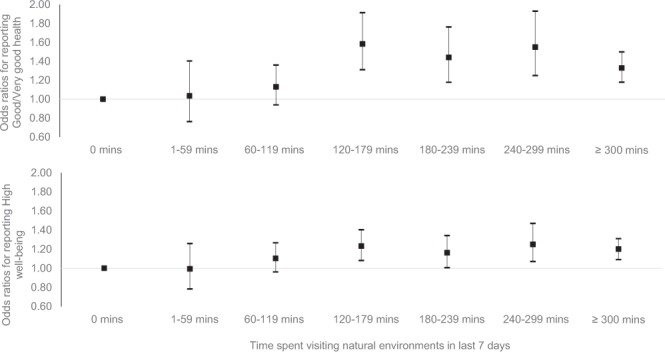
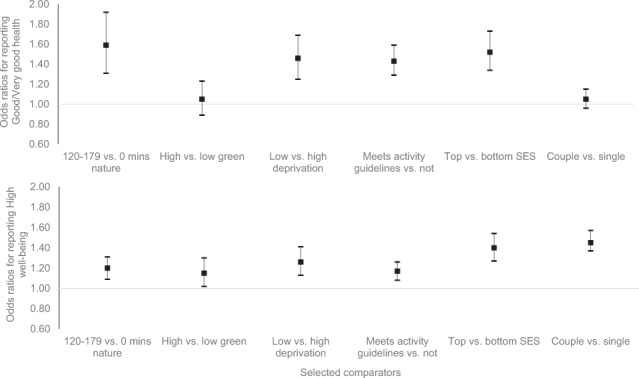
- In adjusted binomial logistic regression models, the association with good health and high well-being became significant only at ≥120 minutes per week in nature; for example, at 120–179 minutes, ORs were 1.59 [1.31–1.92] for health and 1.23 [1.08–1.40] for well-being, compared with 0 minutes.
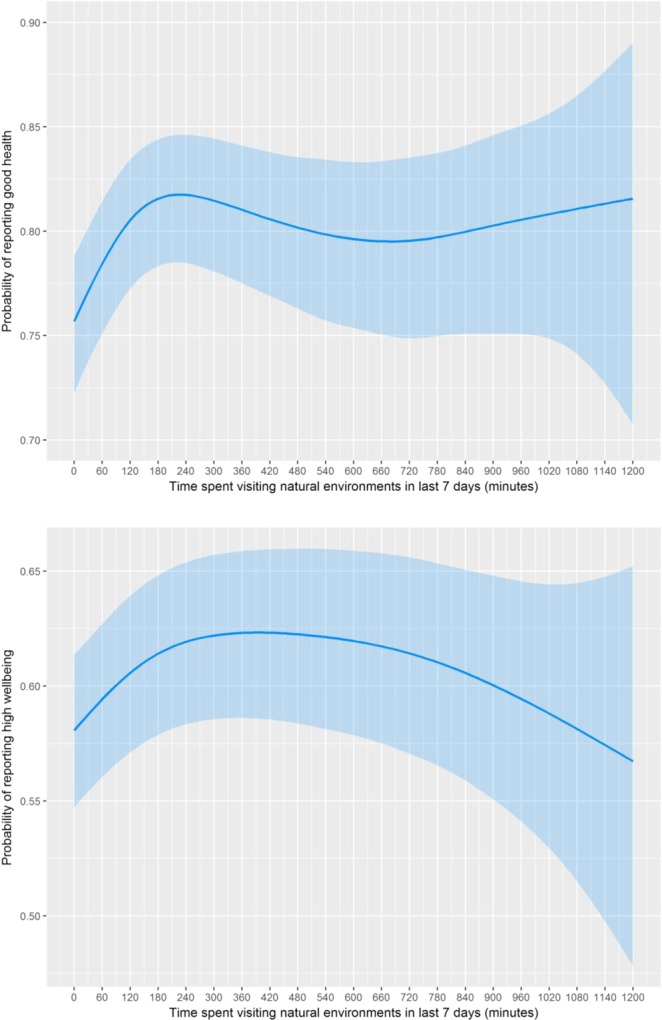
- The positive association was strongest up to about 200 minutes per week for health and 300 minutes per week for well-being, after which the relationship flattened or declined in spline analyses.
- The pattern was reported as consistent across key groups, including older adults and people with long-term health issues/disability; the paper also reports that the ≥120-minute “threshold” was seen across many stratified analyses.
- It did not matter how the 120 minutes were accumulated: additional analyses found no difference in health or well-being between one 120+ minute visit, two 60+ minute visits, or three or more ≤40 minute visits.
## Methods
- Design: Secondary analysis of a repeat cross-sectional survey; the study used survey weights to represent the adult population of England.
- Sample/data: Adults from Waves 6 and 7 of the Monitor of Engagement with the Natural Environment (MENE) survey (n = 20,264 total; n = 19,806 estimation sample for adjusted models; n = 19,808 for adjusted models with missing area-level data excluded).
- Main analysis: Survey-weighted binomial logistic regressions predicting binary health and well-being outcomes from weekly nature-contact duration categories; models adjusted for area- and individual-level covariates, with sensitivity analyses using splines and ordinal/continuous outcome specifications, plus a priori stratified analyses.
## Limitations
- The authors explicitly state the study is observational and cross-sectional, so they cannot rule out reverse causality or make causal claims.
- They note the weekly exposure estimate was based on one randomly selected visit in the last week, and that the data rely on self-reports, which may reduce accuracy.
- They caution that the apparent ≥120-minute threshold may partly reflect clustering of responses around hour marks and the way the data were categorized; this is an evident limitation from the text, alongside the very small variance explained by nature contact (about 1% in unadjusted models).
Model-written summary. Check it against the paper before relying on it.
Integrity signals
Registry
Cites
Statistics
Figures
Verification
Claims the paper makes
8 Valid · 1 Not valid · 15 Not checked · 60 Own results and interpretations
The cited sources support only part of this claim — read each source’s verdict below.
In the paper
“In other words, direct exposure, or more specifically in the current context, recreational time spent in natural environments per week, cannot accurately be inferred from neighbourhood greenspace near the home.”
§ Spending at least 120 minutes a week in nature is associated with good health and wellbeing > Introduction
What the sources say
- Partly supportedcites [23] Hillsdon, M., Coombes, E., Griew, P. & Jones, A. An assessment of the relevance of the home neighbourhood for understanding environmental influences on physical activity: how far from home do people roam? Int J Behav Nutr Phy 12, 100 (2015). sourceExperimental — accuracy not yet measured
The Conclusions and Discussion report that much outdoor physical activity occurs beyond the proximal home neighbourhood, so nearby neighbourhood characteristics may poorly represent the environments people use. The paper does not establish this specifically for weekly recreational time in natural environments or for neighbourhood greenspace; the Discussion says the researchers did not know which activities participants undertook. (LLM, conf=0.88)
- Could not verifycites [24] Sijtsma, F. J., de Vries, S., van Hinsberg, A. & Diederiks, J. Does ‘grey’ urban living lead to more ‘green’ holiday nights? A Netherlands Case Study. Landscape Urban Plan 105, 250–257 (2012). sourceExperimental — accuracy not yet measured
Our copy of Sijtsma et al. (2012) contains only repository/metadata records plus the Abstract; no body sections (Introduction, Methods, Discussion) are indexed. The Abstract (p. n/a) describes a GIS model of 'recreational shortages' — the shortage of locally available green space for recreational walking — linked to holiday nights away from home, but nowhere states that recreational time spent in natural environments per week cannot be inferred from neighbourhood greenspace near the home. Four searches (inference from neighbourhood greenspace, shortage of locally available green space for recreational walking, exposure vs. actual use, compensating behaviour/limitations) returned only the same abstract and citation blocks, so the claim's point is not addressed in the text we hold. (LLM, conf=0.65)
plain- Asserted: passes — The authors put it forward as true.
- Checkable: passes — It can be checked against evidence.
- Load-bearing: passes — The paper’s conclusions depend on it.
- Based: passes — The paper gives a reason why it holds.
- Partly supported
The cited sources support only part of this claim — read each source’s verdict below.
In the paper
“People travel beyond their local neighbourhoods to access recreational nature experiences, and indeed in our own data those who lived in the least green areas had higher odds of spending ≥120 mins in nature than those living in greener neighbourhoods (Appendix C).”
§ Spending at least 120 minutes a week in nature is associated with good health and wellbeing > Discussion
What the sources say
- Partly supportedcites [23] Hillsdon, M., Coombes, E., Griew, P. & Jones, A. An assessment of the relevance of the home neighbourhood for understanding environmental influences on physical activity: how far from home do people roam? Int J Behav Nutr Phy 12, 100 (2015). sourceExperimental — accuracy not yet measured
The Results report that 60.5% of recorded outdoor physical activity occurred beyond an 800 m home-neighbourhood boundary, and the Conclusions say adults undertook most outdoor physical activity outside their proximal home neighbourhood (page not provided). The paper does not establish that people travelled beyond their neighbourhoods specifically to access recreational nature experiences; it measured where activity occurred, not its purpose or whether it took place in nature. (LLM, conf=0.86)
plain- Asserted: passes — The authors put it forward as true.
- Checkable: passes — It can be checked against evidence.
- Load-bearing: passes — The paper’s conclusions depend on it.
- Based: passes — The paper gives a reason why it holds.
- Partly supported
Every source the paper cites for this claim was checked and supports it.
In the paper
“Research into shinrin-yoku (Japanese “forest bathing”)35, for instance, suggested that various psycho-physiological benefits can be gained from merely sitting passively in natural vs. urban settings.”
§ Spending at least 120 minutes a week in nature is associated with good health and wellbeing > Discussion
What the sources say
- Supportedcites [35] Park, B. J., Tsunetsugu, Y., Kasetani, T., Kagawa, T. & Miyazaki, Y. The physiological effects of Shinrin-yoku (taking in the forest atmosphere or forest bathing): evidence from field experiments in 24 forests across Japan. Environ Health Prev 15, 18–26 (2010). source
The Experimental design (p. 2) says subjects sat on chairs to view forest or city landscapes. The physiological results (p. 4) report more favorable stress-related measures after forest viewing, while the psychological results (p. 7) report better mood scores than after city viewing. (LLM, conf=0.93)
hedgedstates a possible cause- Asserted: passes — The authors put it forward as true.
- Checkable: passes — It can be checked against evidence.
- Load-bearing: passes — The paper’s conclusions depend on it.
- Based: passes — The paper gives a reason why it holds.
- Supported
Every source the paper cites for this claim was checked and supports it.
In the paper
“Experimental research, however, indicates that some benefits cannot be due solely to physical activity.”
§ Spending at least 120 minutes a week in nature is associated with good health and wellbeing > Discussion
What the sources say
- Supportedcites [35] Park, B. J., Tsunetsugu, Y., Kasetani, T., Kagawa, T. & Miyazaki, Y. The physiological effects of Shinrin-yoku (taking in the forest atmosphere or forest bathing): evidence from field experiments in 24 forests across Japan. Environ Health Prev 15, 18–26 (2010). source
The Experimental design (p. 2) reports no difference in exercise load between forest and city walks. The Results (p. 4) also report physiological benefits from viewing forest landscapes while seated, supporting the conclusion that physical activity alone cannot explain some benefits. (LLM, conf=0.93)
hedgedstates a cause- Asserted: passes — The authors put it forward as true.
- Checkable: passes — It can be checked against evidence.
- Load-bearing: passes — The paper’s conclusions depend on it.
- Based: passes — The paper gives a reason why it holds.
- Supported
The cited sources support only part of this claim — read each source’s verdict below.
In the paper
“Impoverished local opportunities need not be a barrier to nature exposure23,24.”
§ Spending at least 120 minutes a week in nature is associated with good health and wellbeing > Discussion
What the sources say
- Partly supportedcites [23] Hillsdon, M., Coombes, E., Griew, P. & Jones, A. An assessment of the relevance of the home neighbourhood for understanding environmental influences on physical activity: how far from home do people roam? Int J Behav Nutr Phy 12, 100 (2015). sourceExperimental — accuracy not yet measured
The Results and Conclusions (page numbers unavailable) show that adults undertook much of their outdoor physical activity beyond their proximal home neighbourhood, supporting the idea that nearby opportunities do not define where people go. The paper does not establish that those destinations provided nature exposure or that impoverished local nature opportunities were not a barrier to it. (LLM, conf=0.78)
- Partly supportedcites [24] Sijtsma, F. J., de Vries, S., van Hinsberg, A. & Diederiks, J. Does ‘grey’ urban living lead to more ‘green’ holiday nights? A Netherlands Case Study. Landscape Urban Plan 105, 250–257 (2012). sourceExperimental — accuracy not yet measured
Our copy of Sijtsma et al. (2012) holds only the repository record — the Abstract plus bibliographic metadata, with no body sections (searches on 'recreational shortage', 'nature exposure', 'compensating behaviour', 'discussion/conclusion' all returned the same abstract and citation blocks). The Abstract does support the compensatory mechanism behind the claim: 'the higher the greyness of the living environment – i.e. the higher the shortage of locally available green space for recreational walking – the more people spend nights away from home', with ~20% of holiday nights of the greyest residents related to that shortage. But the source measures holiday nights away from home and frames the shortage as a cost of agglomeration for well-being; it nowhere asserts 'nature exposure' or that a local shortage is not a barrier to nature contact, so the claim's generalisation to 'nature exposure' goes beyond what this source states. (LLM, conf=0.72)
plain- Asserted: passes — The authors put it forward as true.
- Checkable: passes — It can be checked against evidence.
- Load-bearing: unclear — It is unclear whether the paper’s conclusions depend on it.
- Based: passes — The paper gives a reason why it holds.
- Partly supported
21 more claims · 1 with their cited sources checked
Create a free account to see all 84 claims and to verify the 9 references still open.
- It may state two separate claims as one. 18
- Probably not a substantial claim. 46
Claims other papers make about this one
Each is checked against this paper’s own text: does it say what the citing paper says it does?
The cited source says what the claim attributes to it.
In the citing paper
“spending at least 120 min a week in nature was associated with good health [82].”
From EAACI Guidelines on the Importance of Green Space in Urban Environments for Allergy and Asthma Prevention (2026) · cites this paper as [82]
Citations
Cites
Hartig, T., Mitchell, R., de Vries, S., & Frumkin, H. (2014) · Annual Review of Public Health · doi:10.1146/annurev-publhealth-032013-182443 · Cited by 3,638
Self-citationEffect of exposure to natural environment on health inequalities: an observational population study
Mitchell, R., & Popham, F. (2008) · The Lancet · doi:10.1016/s0140-6736(08)61689-x · Cited by 2,099
Green space, urbanity, and health: how strong is the relation?
Maas, J., Verheij, R. A., Groenewegen, P. P., de Vries, S., & Spreeuwenberg, P. (2006) · Journal of Epidemiology and Community Health · doi:10.1136/jech.2005.043125 · Cited by 1,976
The Science of Mind Wandering: Empirically Navigating the Stream of Consciousness
Smallwood, J., & Schooler, J. W. (2015) · Annual Review of Psychology · doi:10.1146/annurev-psych-010814-015331 · Cited by 1,685
Barton, J., & Pretty, J. (2010) · Environmental Science & Technology · doi:10.1021/es903183r · Cited by 1,592
Miilunpalo, S., Vuori, I., Oja, P., Pasanen, M., & Urponen, H. (1997) · Journal of Clinical Epidemiology · doi:10.1016/s0895-4356(97)00045-0 · Cited by 1,473
Thompson Coon, J., Boddy, K., Stein, K., Whear, R., Barton, J., & Depledge, M. H. (2011) · Environmental Science & Technology · doi:10.1021/es102947t · Cited by 1,391
Self-citationNature Contact and Human Health: A Research Agenda
Frumkin, H., Bratman, G. N., Breslow, S. J., Cochran, B., Kahn Jr, P. H., Lawler, J. J., Levin, P. S., Tandon, P. S., Varanasi, U., Wolf, K. L., et al. (2017) · Environmental Health Perspectives · doi:10.1289/ehp1663 · Cited by 1,237
What are the benefits of interacting with nature?
Keniger, L., Gaston, K., Irvine, K., & Fuller, R. (2013) · International Journal of Environmental Research and Public Health · doi:10.3390/ijerph10030913 · Cited by 1,204
Research works printed but not linked: 1
- Stigsdotter, U. & Grahn, P. What makes a garden a healing garden. J Thera Hort 13, 60–69 (2002).
Cited by
Items 1,001–1,100 of 1,106
Pathogens, pollutants, and preservation: Biodiversity's role in mitigating health risks
Sharma, N., Diksha, Sharma, G., & Ohri, P. (2026) · Elsevier eBooks · doi:10.1016/b978-0-443-43986-5.00006-0
Fabio, R. A., & Manoti, L. (2026) · Frontiers in Psychology · doi:10.3389/fpsyg.2026.1730693 · Cited by 1
“…distinct, are sustainable consumption behaviors (SCBs), which focus on reducing the ecological impact of products and services across the stages of purchase, use, and disposal, balancing environmental, social, and economic consequences (White et al., 2019; Luchs et al., 2010; Wang and Udall, 2023).”
Nature-Based Therapy: Exploring the Processes That Foster Change
Rhodes, J. D., & Boylan, H. M. (2026) · Behavioral Sciences · doi:10.3390/bs16040574
“…improvements in positive mood typically involves more immersive or prolonged exposure to natural environments, with evidence suggesting that extended or more intensive nature experiences yield stronger restorative benefits than brief or low-dose exposures (Pham & Sanocki, 2024; White et al., 2019).”
bin Hatta, M. H., Samad, F. D. A., Chong, S. K., & Saini, S. M. (2026) · Healthcare · doi:10.3390/healthcare14081087 · Cited by 1
“Our findings suggest that medical schools can utilize standardized, global VR nature libraries to achieve maximum therapeutic return of investment (ROI) [12].”
The health condition of visitors influences their choice of physical activity in recreational parks
Naseem, N., Kashaf, M., Ansari, L., Ayesha, S. Q., Gill, S., Ahmed, W., Bano, S., Fang, H., & Rais, M. (2026) · Discover Public Health · doi:10.1186/s12982-026-01951-w
Loose, T., Côté, S. M., Malboeuf‐Hurtubise, C., Ayotte‐Beaudet, J., Lessard, G., Chadi, N., Gauvin, L. I., Ouellet‐Morin, I., & Geoffroy, M. (2023) · Figshare · doi:10.6084/m9.figshare.22607353
Vilhelmson, B., Thulin, E., & Elldér, E. (2022) · Figshare · doi:10.6084/m9.figshare.21532716
Hatala, A. R., Morton, D., Deschenes, C., & Bird‐Naytowhow, K. (2024) · Figshare · doi:10.6084/m9.figshare.27058997
Hatala, A. R., Morton, D., Deschenes, C., & Bird‐Naytowhow, K. (2024) · Figshare · doi:10.6084/m9.figshare.27059000
Mookerjee, S., Dallman-Porter, A., Tay, T. H. C., Simpson, T., Wu, S., Fusari, G., Harrison, M., Grailey, K., Gregory, J. J., Fertleman, M. B., et al. (2026) · doi:10.2196/preprints.99262
Sellars, P., Bennett, A., Crone, D., Mercer, J., & Clayton, D. (2026) · Mental Health Science · doi:10.1002/mhs2.70045
The Impact of Outdoor Physical Activities on the Health of Pregnant Women: A Scoping Review
Stojanović, N., Filipović, M., Miletić, V., Vitošević, B., Purenović-Ivanović, T., Rajković, Ž., Vitošević, J., Milanović, K., Durlević, S., & Ilić, I. (2026) · Healthcare · doi:10.3390/healthcare14091211
“Furthermore, natural environments have been linked to psychological benefits, including reduced perceived stress, improved mood, and enhanced emotional well-being [14,20].”
Hiemstra, S. R., Naaldenberg, J., & Vaandrager, L. (2026) · Wellbeing Space and Society · doi:10.1016/j.wss.2026.100412
Derose, K. P., Seelam, R., Perez, L. G., Arredondo, E. M., Han, B., Castro, G., & Cohen, D. A. (2026) · Journal of Behavioral Medicine · doi:10.1007/s10865-026-00672-4
“…for social interaction, and psychosocial restoration, each of which has been shown to reduce stress, improve mood, and lower cardiometabolic risk factors such as blood pressure and glucose regulation beyond total PA (White et al., 2019; Hartig et al., 2014; Twohig-Bennett & Jones 2018).”
Braçe, O., Correa-Fernández, J., García-Marín, R., Bernabéu, M. A. C., & Garrido‐Cumbrera, M. (2026) · Journal of Outdoor Recreation and Tourism · doi:10.1016/j.jort.2026.101046 · Cited by 1
Network structures of workplace sustainability and employee outcomes: a two-wave study
Sheeran, Z., Sutton, A., & Cooper-Thomas, H. D. (2026) · International journal of organizational analysis · doi:10.1108/ijoa-11-2025-6232 · Cited by 1
Yao, Z., & Liu, H. (2026) · Sustainability · doi:10.3390/su18104637
Re-evaluating suburban green spaces: their role in depression mitigation and social resilience
Ma, J., Cao, J., Wen, S., McBean, E. A., Guo, Z., Wang, Y., & Han, P. (2026) · Frontiers in Public Health · doi:10.3389/fpubh.2026.1754959 · Cited by 1
Bunting, J., Lau, A. R., Sosnowski, M. J., & Bales, K. L. (2026) · American Journal of Primatology · doi:10.1002/ajp.70163
“Specifically, one study determined that 5 h of contact with nature per week coincided with the peak of positive psychological impacts, with no increasing or decreasing impacts as time increased further (White et al. 2019).”
Nature, economy and mental health: Predictive insights from historical language patterns
Richardson, M. (2026) · Journal of Environmental Psychology · doi:10.1016/j.jenvp.2026.103078
Outdoor activities and social support on anxiety in Chinese older adults: a cross-sectional study
Li, Z., Dai, H., & Zhao, Y. (2026) · Frontiers in Public Health · doi:10.3389/fpubh.2026.1817922
“Indicates thatindividuals who spend at least about 120 min per week in natural environments such as parks and green spaces report significantly better mental health and life satisfaction than those with lower exposure (15).”
Bornioli, A., Leckie, G., Elliott, L., Wheeler, B. W., Nieuwenhuijsen, M. J., & van den Bosch, M. A. (2026) · Environmental Research · doi:10.1016/j.envres.2026.125555
Self-citationEun, Z. K. Y., Yang, H., Chen, N. R. Y., & Hartanto, A. (2026) · Journal of Environmental Psychology · doi:10.1016/j.jenvp.2026.103082
Senarathna, J. I. (2026) · Research Square · doi:10.21203/rs.3.rs-9731396/v1
Škorvagová, E., Píry, M., & Decký, M. (2026) · Civil and Environmental Engineering · doi:10.2478/cee-2026-0110
“…availability of green spaces and community-based natural spaces has been shown to correlate with reduced anxiety and depressive symptoms, lower perceptions of chronic stress, and higher subjectively perceived control over life (Hartig et al., 2014; Twohig-Bennett & Jones, 2018; White et al., 2019).”
Exploring Thermal Comfort and Pleasure in Outdoor Thermal Environments
Fang, Z., Zhang, S., Zhang, L., Feng, X., & Zhang, Y. (2026) · Environmental science and engineering · doi:10.1007/978-981-95-8899-2_7
The Four Circles: Me, My Days, My Ties, My World
Michelson, A. (2026) · Happiness studies book series · doi:10.1007/978-3-032-25390-3_7
Hu, F., Wu, C., & Liu, W. T. (2026) · Frontiers in Public Health · doi:10.3389/fpubh.2026.1760446
“And the existing research lacks of well-defined “dosing,” which means the parameters of adequate exposure, such as duration, frequency, and intensity, are undefined, hindering clinical prescription and reproducibility (116).”
Liang, Y., Wei, D.-Y., & Min, S. (2026) · Frontiers in Public Health · doi:10.3389/fpubh.2026.1831073 · Cited by 1
“Studies investigating the optimal “dose” of green exercise—in terms of frequency, duration, and intensity—are crucial for developing clear clinical guidelines (27, 28).”
Why green spaces are essential for older people living in nursing or residential care home settings
Dominy, D. (2026) · Nursing and Residential Care · doi:10.12968/nrec.2026.0015
Green, Indoor, or No Exercise? Health Outcomes of Physical Activity Settings Among Turkish Adults
Akpınar, A. (2026) · Journal of Physical Activity and Health · doi:10.1123/jpah.2025-0322
Sabırlı, T. N., Urlu, Y., Öngen, S., & Yüce, A. (2026) · Sustainability · doi:10.3390/su18115699
Zou, L., & Zhang, L. (2026) · Environmental Research · doi:10.1016/j.envres.2026.124909 · Cited by 1
Kakeh, S. F., & Izadi, B. (2026) · Research Square · doi:10.21203/rs.3.rs-9632924/v1
Chen, G., Zhang, B., Zhang, Y., & Song, K. (2026) · Healthcare · doi:10.3390/healthcare14121667
“Vertically, they mainly consist of two primary dosage characterization parameters, namely, frequency [26,27] and duration [28,29].”
What Counts as Nature? A Cross-Sectional Study of American Adults’ Perceptions of Nature Places
Maddock, J. E., Patterson, M. S., & Price, A. E. (2026) · Ecopsychology · doi:10.1177/19429347261459867
“…researchers to establish “ dose-response ” relations, such as the finding that spending 2 h a week in nature is associated with improved well-being (White et al., 2019), and a minimum dose of 10 min in nature per session improves mental health in college students (Meredith et al., 2019),…”
InfluentialLi, X., Zheng, J., Park, J. M., & Mitchell, J. (2026) · Societies · doi:10.3390/soc16060191
“Our findings extend the literature on green and blue environments [11,12] by linking perceived public land and water opportunities to a place-specific evaluative outcome.”
Blue Planetary Health and Multispecies Responsibility: A Relational Framework for Ocean Governance
Ferreira, J. M. A. (2026) · Challenges · doi:10.3390/challe17020020
Forest Bathing Associated with Increased Human Well-Being in a Rural Community of Chile
Buscaglione, B., Vargas‐Gaete, R., Gertner, N., Cantarutti, P., Zúñiga, C. A. I., & Salas, C. (2026) · Sustainability · doi:10.3390/su18126314
Landscape configuration and peripheral network decoupling during stress recoveryPreprint
Gao, T., Ma, K., Gao, M., Zhang, Y., Hu, L., Lv, C., & Qiu, L. (2026) · Research Square · doi:10.21203/rs.3.rs-9896572/v1
Education outside the classroom in Germany: An interdisciplinary multi-methods Study Protocol
Brandmeier, A., Börner, M., Mühlberg, T., Schulz, L., Kleinhenz, L., Endriß, T., Ellinger, S., & Schmid-Ellinger, J. (2026) · PLoS ONE · doi:10.1371/journal.pone.0337524
Wilderness makes me less sad, helpless, and healthier
Aeron, S., & Rahman, Z. (2026) · European Journal of Marketing · doi:10.1108/ejm-03-2025-0208
Clark, H., Leach, M., & Brymer, E. (2026) · Public Health · doi:10.1016/j.puhe.2026.106386 · Cited by 1
Meyer, M. R. U., Lewis, E. C., Janda, K. M., et al. (2026) · Journal of Agriculture Food Systems and Community Development · doi:10.5304/jafscd.2026.153.029
Mao, Y. (2026) · Landscape Architecture and Sustainability · doi:10.1016/j.las.2026.100057
Long, Y., Zhen, C., Cheng, L., Kang, F., Lin, Y., Li, J., Chen, Z., Chen, W., Liu, X. Y., & Song, Y. (2026) · iScience · doi:10.1016/j.isci.2026.116483
“40 Although UGS and group activities themselves help alleviate anxiety, two prominent issues currently exist: first, facilities fail to match the actual needs of adolescents in urban fringe areas, with only 15% of venues truly meeting their social requirements.”
Wendelboe‐Nelson, C., Lyon, K., Alex, E., Malden, S., Williams, A. J., & Thompson, C. W. (2026) · International Journal of Environmental Research and Public Health · doi:10.3390/ijerph23070844
“Research on pro-environmental behaviour supports the view that social context moderates the relationship between environmental contact and behaviour change [37,38].”
Nature connectedness and healthy eating: The possible role of self‐control
Chen, Y., He, N., He, J., Yang, R., Jiang, J., Yang, X., & Xu, J. (2026) · Applied Psychology Health and Well-Being · doi:10.1111/aphw.70181 · Cited by 1
Xu, J., Qian, Y., Zha, K., Jin, Y., Zhang, J., Takeda, S., Sun, F., Cui, J., & Nie, W. (2026) · Journal of Environmental Management · doi:10.1016/j.jenvman.2026.130389
Exploring Generation Z’s Intention to Adopt Natural-Based Tourism in Vietnam
Nguyễn, T. T. B., Phan, V. N. U., & Mã, K. V. (2026) · Advances in Hospitality and Tourism Research (AHTR) · doi:10.30519/ahtr.1838489
Connecting birds’ ecosystem services and human well-being: an integrative review
Muñoz‐Pacheco, C. B., Pereira, B., Estades, C. F., & Cerda, C. (2026) · Ecosystem Services · doi:10.1016/j.ecoser.2026.101880
Teaching outdoors in Quebec higher education: a current portrait of the situation
Bissonnette, F., Daigle, P., Lacoste, Y., Beaumont, J., Couture-Wilhelmy, L., McIntyre, H., & Gadais, T. (2026) · Journal of Adventure Education & Outdoor Learning · doi:10.1080/14729679.2026.2695063
Pre-task light exposure primes higher-order cognition and preserves moodPreprint
Mahfoud, D., & Najjar, R. P. (2026) · bioRxiv (Cold Spring Harbor Laboratory) · doi:10.64898/2026.06.28.735029
Chaudhary, S., Uniyal, S., Kumar, P., Raina, & Kumar, R. (2026) · Emerald Group Publishing Limited eBooks · doi:10.1108/978-1-83742-029-220261009
Nature-based physical activity in breast cancer survivors: a new frontier in supportive care
Carretti, G., Manetti, M., & Marini, M. (2026) · Oncology Reviews · doi:10.3389/or.2026.1837259
“In fact, time spent in natural environments such as forests, parks, gardens, or coastal areas has been associated with improvements in mental health, stress reduction, and overall wellbeing across diverse populations (28,65,66).”
Pre-service teachers’ perceptions of outdoor education in biology education
Kaasinen, A., & Särkelä, E. (2026) · Journal of Outdoor and Environmental Education · doi:10.1007/s42322-026-00260-9
Urban flower meadows as a climate change adaptation measure: a pilot study from Olomouc, Czechia
Novotný, D., Lehnert, M., Jurek, M., & Květoňová, V. (2026) · Urban Ecosystems · doi:10.1007/s11252-026-02065-6
“…2013 ), supporting human health (WHO 2016), enhancing quality of life (Swanwick et al. 2003), human psychology and well-being (Wagner et al. 2025 ; White et al. 2019; Carrus et al. 2015 ; Dallimer et al. 2012; Fuller et al. 2007), and conserving biodiversity (Lamp-inen et al. 2021; Ives et al.…”
Advancing the capability approach to well-being pathways from access and use of urban green space
Rahman, I., Saha, S., & Grunwald, A. (2026) · Scientific Reports · doi:10.1038/s41598-026-63359-5 · Cited by 2
“Yet, growing evidence suggested that health and well-being benefits were primarily generated by actual patterns of use and engagement rather than by mere spatial availability 17 .”
Miani, A., Capaccioli, F., Mariani, D., Guglielmino, D., & White, R. (2026) · International Journal of Environmental Medicine · doi:10.3390/ijem1030012
“White et al. reported that spending at least 120 min per week in nature was associated with higher probabilities of self-reported good health and high well-being [16].”
Guo, H., Zhou, Q., Liu, Y., Li, W., & Li, S. (2026) · Environment and Behavior · doi:10.1177/00139165261469312
“Similarly, White et al. (2019) found that as weekly visits to nature increased, participants’ reported well-being even declined after reaching a peak.”
Xiong, X., Yang, S., Jiang, X., & Zhang, Q. (2026) · Frontiers in Psychology · doi:10.3389/fpsyg.2026.1891123
Wahlroos, N., Stolt, M., & Suhonen, R. (2026) · Journal of Aging and Environment · doi:10.1080/26892618.2026.2707632
Maloney, S., Henning, T., Zhu, H., Martin, B., Hinze, V., Montero‐Marín, J., van der Velden, A. M., Moore, J., Wilhelm, K., Lomax, T., et al. (2026) · The Lancet Planetary Health · doi:10.1016/j.lanplh.2026.101450 · Cited by 2
Revisiting the Unani Concept of Hawā-e-Muheet through the Lens of Modern Ecotherapy
Ansari, A. S., Ansari, T. H., Ahmed, M. A. S., et al. (2026) · International Journal of Research and Review · doi:10.52403/ijrr.20260753
The woods as wisdom: A poetic autoethnography of a nature-based women’s circle
Castro, M. (2026) · Transpersonal Psychology Review · doi:10.53841/bpstrans.2026.27.1.9
Emi, M., Kawai, S., Sasakabe, T., Okada, R., Kubo, Y., Mitsuda, Y., Kato, Y., Matsunaga, T., Nagayoshi, M., Tamura, T., et al. (2026) · International Journal of Environmental Research and Public Health · doi:10.3390/ijerph23081020
“Although the definition of well-being differs from that used in this study, it has been reported that spending at least 120 min per week in natural environments leads to higher levels of well-being the following week [45].”
Chopin, M.-V. (2025) · Elsevier eBooks · doi:10.1016/b978-2-294-77999-2.00004-0
Jackson, S., Sharp, R. L., Heintzman, P., Craft, C. M., Brownlee, M. T. J., & Henry, C. (2026) · Leisure Sciences · doi:10.1080/01490400.2026.2713205
Tang, Q. (2026) · doi:10.1109/iehns68708.2026.11607356
“This finding validates the 120-minute threshold previously reported by White et al. (2019) [8] in the specific context of Chinese urban residential settlements.”
Liljegren, M., Bengtsson, A., Nordin, S., Lindahl, G., & Wijk, H. (2026) · BMC Geriatrics · doi:10.1186/s12877-026-08094-2
Eco-wellness Tourism: Integrating Sustainability with Holistic Well-being
Ganie, A. A., & Thakur, D. J. (2026) · Emerald Group Publishing Limited eBooks · doi:10.1108/978-1-80592-983-320261010
Shall we walk? A user study of an app tracking time in nature in everyday life
Litleskare, S., Schifanella, R., & Calogiuri, G. (2026) · Digital Health · doi:10.1177/20552076261470171
“45 In line with this assumption, current recommendations largely advise people to seek time in nature, independent of intensity, and instead focus on duration 8 and access.”
Rathnakumari, K. N., & Dissanayake, M. P. (2026) · Research Square · doi:10.21203/rs.3.rs-10332589/v1
Zhang, H., Meng, Y., Du, H., Feng, X., & Xu, Y. (2026) · Frontiers in Psychology · doi:10.3389/fpsyg.2026.1817776
“As a key restorative setting, the residential environment not only provides physical shelter but also facilitates emotional relief, psychological detachment, and physiological recovery following stressful daily activities (Van den Berg et al., 2010; White et al., 2019).”
InfluentialMolner, B., Spencer-Cavaliere, N., Storey, K., & Nykiforuk, C. I. J. (2026) · Journal of Adventure Education & Outdoor Learning · doi:10.1080/14729679.2026.2716032
Kaia, W.-M., Frederick, P., Fuoco, J., Loose, T., Chartrand, E., Alain, G., Bolanis, D., Pennestri, M., Khoury, B., Ouellet‐Morin, I., et al. (2026) · Journal of Environmental Psychology · doi:10.1016/j.jenvp.2026.103188
Impact of a device-free summer camp on adolescent mental health and wellbeing
Newson, J. J., Parameshwaran, D., Giese, C. A., Maxwell, B., Tapert, S. F., & Thiagarajan, T. C. (2026) · Mental Health & Prevention · doi:10.1016/j.mhp.2026.200554 · Cited by 1
McIntosh, J., & Marques, B. (2026) · Cities & Health · doi:10.1080/23748834.2026.2717012
Nature and Heart Health: Conversations With Your Patients
(2026) · Heart Lung and Circulation · doi:10.1016/j.hlc.2026.08.002
Exposure to forests and birdsong may reduce physiological stress among college students
Ford, T., DeMay, P., Hipp, J. A., Larson, L. R., Desrochers, H. M., Webb, J., Howell, I., Pratiwi, M. A., Meshram, K., Kluttz, J., et al. (2026) · Frontiers in Bird Science · doi:10.3389/fbirs.2026.1884835
Miura, S., Horikawa, S., Morizono, K., Miyazaki, M., Torii, H., Kuroda, H., & Matsuura, E. (2026) · PLoS ONE · doi:10.1371/journal.pone.0357733
Olsen, J., Nicholls, N., Burnett, H., Johnstone, A., & Mitchell, R. (2026) · BMJ Public Health · doi:10.1136/bmjph-2025-003311
Blue mind, healthy life and well-being: the therapeutic benefits of coastal living in Ghana
Damte, F. K. (2026) · Anthropocene Coasts · doi:10.1007/s44218-026-00148-7
“Notwithstanding these pressures, evidence suggests that even degraded or partially urbanized coastal environments retain meaningful restorative value (White et al. 2020b, a), underscoring the importance of understanding, protecting, and equitably managing coastal therapeutic landscapes.”
InfluentialMeena, P. (2026) · IGI Global eBooks · doi:10.4018/979-8-3373-6137-6.ch002
Chen, Y., Zhang, Y., Liu, J., & Gan, Y. (2026) · Applied Psychology Health and Well-Being · doi:10.1111/aphw.70218 · Cited by 1
Meneguzzo, F., & Zabini, F. (2026) · Behavioral Sciences · doi:10.3390/bs16091647
“This dimension was included because weekly nature contact of at least 120 min has been associated with better self-reported health and well-being across population groups (White et al., 2019).”
İlişkisel Dönüşümün Bir Alanı Olarak Yoga ve Pilates Kampı: Nitel Bir Araştırma
Sönmez, B. Y. (2026) · Sportive · doi:10.53025/sportive.1984754
Li, J., Gong, P., Schumann, G., Webster, C., & Jiang, B. (2026) · Journal of Environmental Psychology · doi:10.1016/j.jenvp.2026.103211
Nature-based therapy in the UAE: leveraging ecosystems to alleviate depression and anxiety
Al-Taani, A. A. K., Al-Gharaibeh, M. M., & Al-Taani, A. A. (2026) · Social Sciences & Humanities Open · doi:10.1016/j.ssaho.2026.103451
Hung, S.-H., Chou, W.-Y., & Suppakittpaisarn, P. (2026) · Environment and Behavior · doi:10.1177/00139165261485049
“…studies indicates that 20 to 30 min of nature exposure may be a time-efficient window for reducing physiological stress markers (Hunter et al., 2019), while at least 120 min of weekly nature contact has been associated with better general health and psychological well-being (White et al., 2019).”
InfluentialJin, L., Sun, P., & Song, Y. (2026) · Land · doi:10.3390/land15091762
Chen, C., Zhou, Z., & Zhao, B. (2026) · Forests · doi:10.3390/f17091129
Is compliance with the 3-30-300 rule associated with subjective citizens' well-being?
Sicard, P., Cordon, T., André, L., Marco, A. D., Paoletti, E., Pérez, S., Leca, Ș., Khaniabadi, Y. O., & Calatayud, V. (2026) · Journal of Environmental Management · doi:10.1016/j.jenvman.2026.131016
Tan, S., Zhu, G., Gu, Z., Liu, T., Dang, G., Tang, X., Ye, M., Tan, G., & Tang, Q. (2026) · Forests · doi:10.3390/f17101153
Uncover the forest therapy and nature-related intervention forms: a systematic review
Wei, Y., Shi, H., Zhang, Y., Shin, W. S., Lee, M., Devisscher, T., & Wang, G. (2026) · Journal of Forestry Research · doi:10.1007/s11676-026-02127-7
Correa-Fernández, J., Garrido‐Cumbrera, M., García-Marín, R., & Braçe, O. (2026) · Urban forestry & urban greening · doi:10.1016/j.ufug.2026.129718
Litleskare, S., Brambilla, E., & Calogiuri, G. (2026) · Journal of Environmental Psychology · doi:10.1016/j.jenvp.2026.103233
Associations Between Biodiversity-Related Exposures and Mental Health: A Scoping Review
Moreau, M., Boroujeni, K. B., Cohen, C. G., & Hudon, A. (2026) · Psychiatry International · doi:10.3390/psychiatryint7050217
“Evidence from a large, nationally representative cross-sectional survey in England (19,806 participants) showed that spending at least 120 min per week in nature was associated with better health and wellbeing, even after accounting for socioeconomic and behavioral factors [7].”
Malden, S., McDougall, C. W., Ross-Perez, A., Thompson, C. W., Villegas‐Diaz, R., Clemens, T. L., Wendelboe‐Nelson, C., & Williams, A. J. (2026) · Urban forestry & urban greening · doi:10.1016/j.ufug.2026.129732 · Cited by 1
Song, H., Chen, M., & Wang, M. (2026) · Applied Geography · doi:10.1016/j.apgeog.2026.104208
Metadata
- Authors
- White, M. P., Alcock, I., Grellier, J., Wheeler, B. W., Hartig, T., Warber, S. L., Bone, A., Depledge, M. H., & Fleming, L. E.
- Affiliations
- University of Exeter (GB)
- Uppsala University (SE)
- Corresponding author
- White, Mathew P.
- ORCID
- Venue
- Scientific Reports
- Published
- 2019-06-13
- Volume
- 9
- Issue
- 1
- Pages
- 7730-7730
- ISSN
- 2045-2322 (ISSN-L)
- PMC
- PMC6565732
- OpenAlex
- W2952548366
- Cited by
- 1,125
- References
- 51
- Citations by year
- 2026: 186 · 2025: 168 · 2024: 170 · 2023: 181 · 2022: 138 · 2021: 164 · 2020: 94 · 2019: 23
- FWCI
- 45.19
- Type
- journal article
- Language
- en
- Open access
- gold
- doi.org
- Licence
- cc-by
- creativecommons.org/licenses/by/4.0 (tdm)
- creativecommons.org/licenses/by/4.0 (vor)
- Locations
- Scientific Reports (publishedVersion, cc-by)
- PubMed Central (publishedVersion, cc-by)
- PubMed (publishedVersion)
- KTH Publication Database DiVA (KTH Royal Institute of Technology) (submittedVersion, other-oa)
- DOAJ (DOAJ: Directory of Open Access Journals) (submittedVersion)
- Figshare (submittedVersion, cc-by)
- Open Research Exeter (University of Exeter) (submittedVersion, cc-by)
- Funders
- DH | National Institute for Health Research (HPRU: Environmental Change & Health)
- Topics
- Social Sciences › Urban Studies › Urban Green Space and Health
- Social Sciences › Business, Management and Accounting › Tourism, Leisure and Hospitality Management › Recreation, Leisure, Wilderness Management
- Health Sciences › Medicine › Public Health, Environmental and Occupational Health › Physical Activity and Health
- Keywords
- nature contact, exposure-response relationship, self-reported health, well-being, green spaces, older adults, chronic disease
- MeSH terms
- Adolescent, Adult, Environment, Female, Health, Humans, Male, Middle Aged, Residence Characteristics, Exercise, Walking, Young Adult, Self Report
About these checks
Registry, retraction, Cites and statistics results are computed, not judged, with one exception: a printed reference that no index lists is read once by a model before it counts as a citation error. Claims are extracted by a model and kept only when their quote appears verbatim in the text; each cited source is then checked, with a model’s help, for whether it says what the claim relies on. Those verdicts can be wrong — read the claim’s quote and the cited source before relying on one.
The claim verdicts this report counts are experimental: their accuracy is not yet measured.
A language model drew the claims from the paper on 2026-10-10, under version 3 of the claim definition (model deepseek-v4.1-flash, prompt extract-v3).
A second model labelled each claim on 2026-10-10 (model jev-1.13-20260917, definition revision gold-guideline-v0.2).
Cited sources are checked with a language model’s help (gpt-6-sol and qwen3.8-omni-flash).
Statistics and arithmetic are recomputed, not judged.
Confidence bands are shown only for fields calibrated on our annotated test set. None is calibrated yet, so no band is shown.
What counts as a claim ›How we measure confidence ›How we check this ›
Are you an author, or do you see a problem with this page? Request a review
Data sources
Bibliographic data: Semantic Scholar, OpenAlex, Crossref.
Contains information from the Semantic Scholar Academic Graph Datasets, made available under the ODC Attribution License (ODC-BY 1.0).
Semantic Scholar’s data is described in: Kinney, R., et al. (2023). The Semantic Scholar Open Data Platform. arXiv:2301.10140.
