

Spending at least 120 minutes a week in nature is associated with good health and wellbeing
Open accessThe DOI matches its Crossref record; 51 of the 51 references it cites were found in a registry or an index; 12 of the 35 sources its claims cite were checked for support.
Abstract
Study of weekly nature exposure and self-reported health and wellbeing in a nationally representative sample.
Overview
CoChat Summary
## TL;DR
Using a nationally representative sample of adults in England (n = 19,806 weighted; n = 20,264 total sample), the paper finds that spending at least 120 minutes per week in natural environments is associated with higher odds of self-reported good health and high well-being. The association appears to level off around 200–300 minutes per week, and the authors caution that the study is cross-sectional and cannot establish causality.
## Key findings
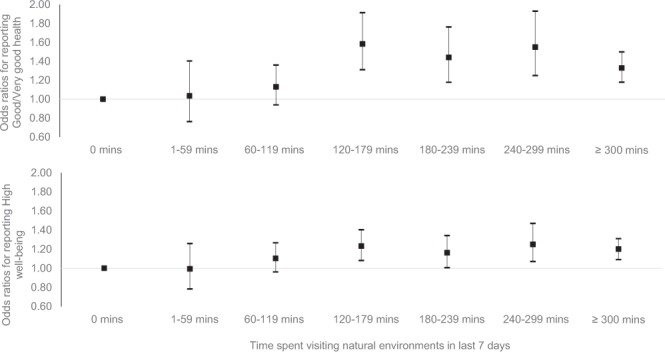
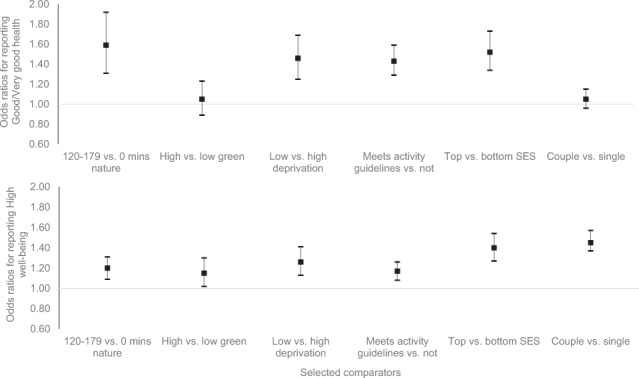
- In adjusted binomial logistic regression models, the association with good health and high well-being became significant only at ≥120 minutes per week in nature; for example, at 120–179 minutes, ORs were 1.59 [1.31–1.92] for health and 1.23 [1.08–1.40] for well-being, compared with 0 minutes.
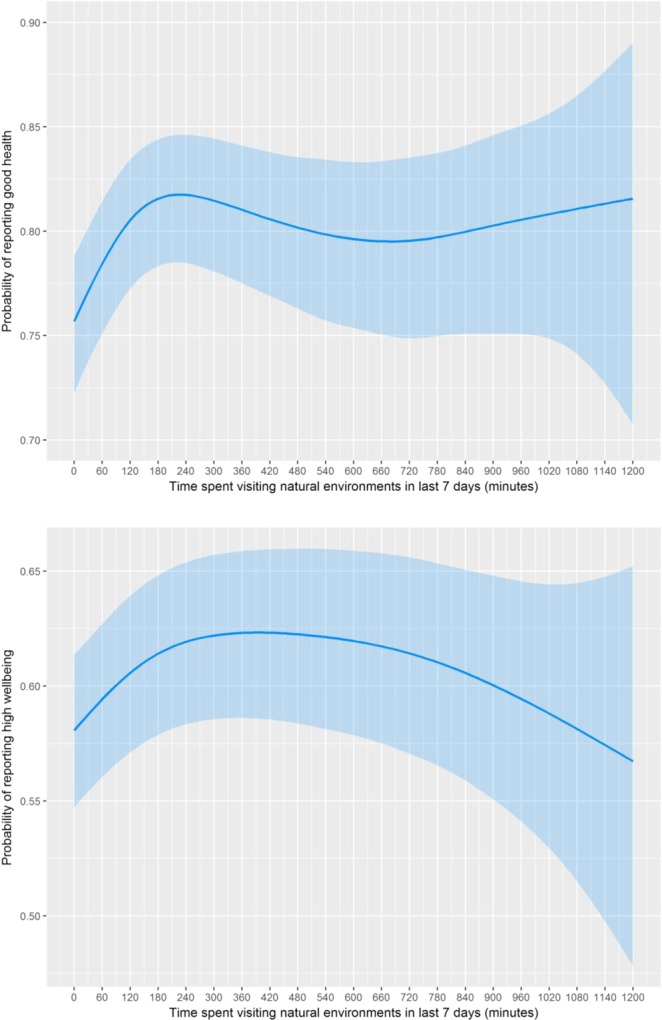
- The positive association was strongest up to about 200 minutes per week for health and 300 minutes per week for well-being, after which the relationship flattened or declined in spline analyses.
- The pattern was reported as consistent across key groups, including older adults and people with long-term health issues/disability; the paper also reports that the ≥120-minute “threshold” was seen across many stratified analyses.
- It did not matter how the 120 minutes were accumulated: additional analyses found no difference in health or well-being between one 120+ minute visit, two 60+ minute visits, or three or more ≤40 minute visits.
## Methods
- Design: Secondary analysis of a repeat cross-sectional survey; the study used survey weights to represent the adult population of England.
- Sample/data: Adults from Waves 6 and 7 of the Monitor of Engagement with the Natural Environment (MENE) survey (n = 20,264 total; n = 19,806 estimation sample for adjusted models; n = 19,808 for adjusted models with missing area-level data excluded).
- Main analysis: Survey-weighted binomial logistic regressions predicting binary health and well-being outcomes from weekly nature-contact duration categories; models adjusted for area- and individual-level covariates, with sensitivity analyses using splines and ordinal/continuous outcome specifications, plus a priori stratified analyses.
## Limitations
- The authors explicitly state the study is observational and cross-sectional, so they cannot rule out reverse causality or make causal claims.
- They note the weekly exposure estimate was based on one randomly selected visit in the last week, and that the data rely on self-reports, which may reduce accuracy.
- They caution that the apparent ≥120-minute threshold may partly reflect clustering of responses around hour marks and the way the data were categorized; this is an evident limitation from the text, alongside the very small variance explained by nature contact (about 1% in unadjusted models).
Model-written summary. Check it against the paper before relying on it.
Integrity signals
Registry
Cites
Statistics
Figures
Verification
Claims the paper makes
8 Valid · 1 Not valid · 15 Not checked · 60 Own results and interpretations
The cited sources support only part of this claim — read each source’s verdict below.
In the paper
“In other words, direct exposure, or more specifically in the current context, recreational time spent in natural environments per week, cannot accurately be inferred from neighbourhood greenspace near the home.”
§ Spending at least 120 minutes a week in nature is associated with good health and wellbeing > Introduction
What the sources say
- Partly supportedcites [23] Hillsdon, M., Coombes, E., Griew, P. & Jones, A. An assessment of the relevance of the home neighbourhood for understanding environmental influences on physical activity: how far from home do people roam? Int J Behav Nutr Phy 12, 100 (2015). sourceExperimental — accuracy not yet measured
The Conclusions and Discussion report that much outdoor physical activity occurs beyond the proximal home neighbourhood, so nearby neighbourhood characteristics may poorly represent the environments people use. The paper does not establish this specifically for weekly recreational time in natural environments or for neighbourhood greenspace; the Discussion says the researchers did not know which activities participants undertook. (LLM, conf=0.88)
- Could not verifycites [24] Sijtsma, F. J., de Vries, S., van Hinsberg, A. & Diederiks, J. Does ‘grey’ urban living lead to more ‘green’ holiday nights? A Netherlands Case Study. Landscape Urban Plan 105, 250–257 (2012). sourceExperimental — accuracy not yet measured
Our copy of Sijtsma et al. (2012) contains only repository/metadata records plus the Abstract; no body sections (Introduction, Methods, Discussion) are indexed. The Abstract (p. n/a) describes a GIS model of 'recreational shortages' — the shortage of locally available green space for recreational walking — linked to holiday nights away from home, but nowhere states that recreational time spent in natural environments per week cannot be inferred from neighbourhood greenspace near the home. Four searches (inference from neighbourhood greenspace, shortage of locally available green space for recreational walking, exposure vs. actual use, compensating behaviour/limitations) returned only the same abstract and citation blocks, so the claim's point is not addressed in the text we hold. (LLM, conf=0.65)
plain- Asserted: passes — The authors put it forward as true.
- Checkable: passes — It can be checked against evidence.
- Load-bearing: passes — The paper’s conclusions depend on it.
- Based: passes — The paper gives a reason why it holds.
- Partly supported
The cited sources support only part of this claim — read each source’s verdict below.
In the paper
“People travel beyond their local neighbourhoods to access recreational nature experiences, and indeed in our own data those who lived in the least green areas had higher odds of spending ≥120 mins in nature than those living in greener neighbourhoods (Appendix C).”
§ Spending at least 120 minutes a week in nature is associated with good health and wellbeing > Discussion
What the sources say
- Partly supportedcites [23] Hillsdon, M., Coombes, E., Griew, P. & Jones, A. An assessment of the relevance of the home neighbourhood for understanding environmental influences on physical activity: how far from home do people roam? Int J Behav Nutr Phy 12, 100 (2015). sourceExperimental — accuracy not yet measured
The Results report that 60.5% of recorded outdoor physical activity occurred beyond an 800 m home-neighbourhood boundary, and the Conclusions say adults undertook most outdoor physical activity outside their proximal home neighbourhood (page not provided). The paper does not establish that people travelled beyond their neighbourhoods specifically to access recreational nature experiences; it measured where activity occurred, not its purpose or whether it took place in nature. (LLM, conf=0.86)
plain- Asserted: passes — The authors put it forward as true.
- Checkable: passes — It can be checked against evidence.
- Load-bearing: passes — The paper’s conclusions depend on it.
- Based: passes — The paper gives a reason why it holds.
- Partly supported
Every source the paper cites for this claim was checked and supports it.
In the paper
“Research into shinrin-yoku (Japanese “forest bathing”)35, for instance, suggested that various psycho-physiological benefits can be gained from merely sitting passively in natural vs. urban settings.”
§ Spending at least 120 minutes a week in nature is associated with good health and wellbeing > Discussion
What the sources say
- Supportedcites [35] Park, B. J., Tsunetsugu, Y., Kasetani, T., Kagawa, T. & Miyazaki, Y. The physiological effects of Shinrin-yoku (taking in the forest atmosphere or forest bathing): evidence from field experiments in 24 forests across Japan. Environ Health Prev 15, 18–26 (2010). source
The Experimental design (p. 2) says subjects sat on chairs to view forest or city landscapes. The physiological results (p. 4) report more favorable stress-related measures after forest viewing, while the psychological results (p. 7) report better mood scores than after city viewing. (LLM, conf=0.93)
hedgedstates a possible cause- Asserted: passes — The authors put it forward as true.
- Checkable: passes — It can be checked against evidence.
- Load-bearing: passes — The paper’s conclusions depend on it.
- Based: passes — The paper gives a reason why it holds.
- Supported
Every source the paper cites for this claim was checked and supports it.
In the paper
“Experimental research, however, indicates that some benefits cannot be due solely to physical activity.”
§ Spending at least 120 minutes a week in nature is associated with good health and wellbeing > Discussion
What the sources say
- Supportedcites [35] Park, B. J., Tsunetsugu, Y., Kasetani, T., Kagawa, T. & Miyazaki, Y. The physiological effects of Shinrin-yoku (taking in the forest atmosphere or forest bathing): evidence from field experiments in 24 forests across Japan. Environ Health Prev 15, 18–26 (2010). source
The Experimental design (p. 2) reports no difference in exercise load between forest and city walks. The Results (p. 4) also report physiological benefits from viewing forest landscapes while seated, supporting the conclusion that physical activity alone cannot explain some benefits. (LLM, conf=0.93)
hedgedstates a cause- Asserted: passes — The authors put it forward as true.
- Checkable: passes — It can be checked against evidence.
- Load-bearing: passes — The paper’s conclusions depend on it.
- Based: passes — The paper gives a reason why it holds.
- Supported
The cited sources support only part of this claim — read each source’s verdict below.
In the paper
“Impoverished local opportunities need not be a barrier to nature exposure23,24.”
§ Spending at least 120 minutes a week in nature is associated with good health and wellbeing > Discussion
What the sources say
- Partly supportedcites [23] Hillsdon, M., Coombes, E., Griew, P. & Jones, A. An assessment of the relevance of the home neighbourhood for understanding environmental influences on physical activity: how far from home do people roam? Int J Behav Nutr Phy 12, 100 (2015). sourceExperimental — accuracy not yet measured
The Results and Conclusions (page numbers unavailable) show that adults undertook much of their outdoor physical activity beyond their proximal home neighbourhood, supporting the idea that nearby opportunities do not define where people go. The paper does not establish that those destinations provided nature exposure or that impoverished local nature opportunities were not a barrier to it. (LLM, conf=0.78)
- Partly supportedcites [24] Sijtsma, F. J., de Vries, S., van Hinsberg, A. & Diederiks, J. Does ‘grey’ urban living lead to more ‘green’ holiday nights? A Netherlands Case Study. Landscape Urban Plan 105, 250–257 (2012). sourceExperimental — accuracy not yet measured
Our copy of Sijtsma et al. (2012) holds only the repository record — the Abstract plus bibliographic metadata, with no body sections (searches on 'recreational shortage', 'nature exposure', 'compensating behaviour', 'discussion/conclusion' all returned the same abstract and citation blocks). The Abstract does support the compensatory mechanism behind the claim: 'the higher the greyness of the living environment – i.e. the higher the shortage of locally available green space for recreational walking – the more people spend nights away from home', with ~20% of holiday nights of the greyest residents related to that shortage. But the source measures holiday nights away from home and frames the shortage as a cost of agglomeration for well-being; it nowhere asserts 'nature exposure' or that a local shortage is not a barrier to nature contact, so the claim's generalisation to 'nature exposure' goes beyond what this source states. (LLM, conf=0.72)
plain- Asserted: passes — The authors put it forward as true.
- Checkable: passes — It can be checked against evidence.
- Load-bearing: unclear — It is unclear whether the paper’s conclusions depend on it.
- Based: passes — The paper gives a reason why it holds.
- Partly supported
21 more claims · 1 with their cited sources checked
Create a free account to see all 84 claims and to verify the 9 references still open.
- It may state two separate claims as one. 18
- Probably not a substantial claim. 46
Claims other papers make about this one
Each is checked against this paper’s own text: does it say what the citing paper says it does?
The cited source says what the claim attributes to it.
In the citing paper
“spending at least 120 min a week in nature was associated with good health [82].”
From EAACI Guidelines on the Importance of Green Space in Urban Environments for Allergy and Asthma Prevention (2026) · cites this paper as [82]
Citations
Cites
Hartig, T., Mitchell, R., de Vries, S., & Frumkin, H. (2014) · Annual Review of Public Health · doi:10.1146/annurev-publhealth-032013-182443 · Cited by 3,638
Self-citationEffect of exposure to natural environment on health inequalities: an observational population study
Mitchell, R., & Popham, F. (2008) · The Lancet · doi:10.1016/s0140-6736(08)61689-x · Cited by 2,099
Green space, urbanity, and health: how strong is the relation?
Maas, J., Verheij, R. A., Groenewegen, P. P., de Vries, S., & Spreeuwenberg, P. (2006) · Journal of Epidemiology and Community Health · doi:10.1136/jech.2005.043125 · Cited by 1,976
The Science of Mind Wandering: Empirically Navigating the Stream of Consciousness
Smallwood, J., & Schooler, J. W. (2015) · Annual Review of Psychology · doi:10.1146/annurev-psych-010814-015331 · Cited by 1,685
Barton, J., & Pretty, J. (2010) · Environmental Science & Technology · doi:10.1021/es903183r · Cited by 1,592
Miilunpalo, S., Vuori, I., Oja, P., Pasanen, M., & Urponen, H. (1997) · Journal of Clinical Epidemiology · doi:10.1016/s0895-4356(97)00045-0 · Cited by 1,473
Thompson Coon, J., Boddy, K., Stein, K., Whear, R., Barton, J., & Depledge, M. H. (2011) · Environmental Science & Technology · doi:10.1021/es102947t · Cited by 1,391
Self-citationNature Contact and Human Health: A Research Agenda
Frumkin, H., Bratman, G. N., Breslow, S. J., Cochran, B., Kahn Jr, P. H., Lawler, J. J., Levin, P. S., Tandon, P. S., Varanasi, U., Wolf, K. L., et al. (2017) · Environmental Health Perspectives · doi:10.1289/ehp1663 · Cited by 1,237
What are the benefits of interacting with nature?
Keniger, L., Gaston, K., Irvine, K., & Fuller, R. (2013) · International Journal of Environmental Research and Public Health · doi:10.3390/ijerph10030913 · Cited by 1,204
Research works printed but not linked: 1
- Stigsdotter, U. & Grahn, P. What makes a garden a healing garden. J Thera Hort 13, 60–69 (2002).
Cited by
Items 601–700 of 1,105
Schnekser, B., & Riley, M. (2026) · Journal of Experiential Education · doi:10.1177/10538259261423500 · Cited by 4
From Space to Well-Being: Understanding the Restorative Potential of Urban Riverfront Landscapes
Wu, S., Li, Q., Wu, Y., & Zhu, Z. (2026) · Buildings · doi:10.3390/buildings16061235 · Cited by 3
Marques, L. M. (2026) · Frontiers in Conservation Science · doi:10.3389/fcosc.2026.1881229 · Cited by 4
Playing with Minimalism: How Parents Are Sold on High-End Toys and Childhood Simplicity
Duvall, S.-S. (2021) · Springer eBooks · doi:10.1007/978-3-030-62881-9_4 · Cited by 3
History of degradation and rebirth of a coastal pine forest
Calandrelli, M. M., & Migliozzi, A. (2023) · Forest - Rivista di Selvicoltura ed Ecologia Forestale · doi:10.3832/efor4386-020 · Cited by 3
Explorando a Terra na educação básica
Carneiro, C. D. R., & Santos, G. C. (2023) · Universidade Estadual de Campinas, Sistema de Bibliotecas eBooks · doi:10.20396/isbn9786599482908 · Cited by 3
A Nature-Based Intervention to Support the Well-Being of Baccalaureate Nursing Students
Olson, E. T., Mathiason, M. A., Vermeesch, A. L., & Bliss, D. Z. (2024) · Journal of Nursing Education · doi:10.3928/01484834-20231205-07 · Cited by 4
Unlocking the Transformative Potential of Outdoor Office Work—A Constructivist Grounded Theory Study
Troije, C. P., Jensen, E. L., Redmalm, D., & Gustin, L. W. (2024) · Challenges · doi:10.3390/challe15020025 · Cited by 6
Moura, R., Camilo, C., Lima, M. L., Luís, S., Elliott, L. R., & White, M. P. (2024) · PsyEcology Bilingual Journal of Environmental Psychology · doi:10.1177/21711976241264147 · Cited by 4
“Yet, another recent study shows that people who spend more than 120 minutes (and up to 300 minutes) in nature in a week report higher levels of well-being in comparison to a lesser time, regardless of whether it was one long visit or multiple shorter visits (White et al., 2019).”
Self-citationPractising CBT amid the climate and ecological crises
Marks, E. M., & Cole, A. (2024) · The Cognitive Behaviour Therapist · doi:10.1017/s1754470x24000242 · Cited by 5
Sheeran, Z., Sutton, A., & Cooper-Thomas, H. D. (2025) · International Journal of Educational Management · doi:10.1108/ijem-11-2024-0704 · Cited by 10
Quan, L., Han, H., Ariza‐Montes, A., Ryu, H. B., & Yu, J. (2025) · Acta Psychologica · doi:10.1016/j.actpsy.2025.104845 · Cited by 17
Ajibade, I. M., Walter, M., Sauer, J. R., Raghunathasami, A., Done, J., Loikith, P. C., Lower, C., Chang, H., Pallathadka, A., Sowards, E. M., et al. (2025) · Climate Risk Management · doi:10.1016/j.crm.2025.100714 · Cited by 7
Nishiwaki, M., Takada, S., Otsuka, S., Makizako, H., Sakakima, H., Shiomi, N., Ooba, S., Matsumoto, N., & Kikuchi, K. (2025) · Frontiers in Public Health · doi:10.3389/fpubh.2025.1509528 · Cited by 4
“Indeed, previous studies have reported that exposure to green space is associated with mental health, self-reported health, and well-being (33, 34).”
From Research to Design: Enhancing Mental Well-Being Through Quality Public Green Spaces in Beirut
Raad, M., Kallas, G., As-sadi, F., Zeidan, N. S., Dawalibi, V., & Russo, A. (2025) · Land · doi:10.3390/land14081558 · Cited by 5
Does user-generated content increase the valuation of urban green space? Evidence from China
Alita, L., & Zhang, J. (2025) · Urban forestry & urban greening · doi:10.1016/j.ufug.2025.129086 · Cited by 4
Music and spirituality: Reflections on the role of music and the natural environment in healing
Bist, D., & Smith, P. (2021) · Journal for the Study of Spirituality · doi:10.1080/20440243.2021.1885941 · Cited by 3
“From a scientific perspective also, there is a growing body of epidemiological evidence which suggests that more exposure to, or contact with, natural environments (such as parks, woodlands and beaches) is associated with better health and wellbeing (White et al. 2019).”
BackgroundSolutions for development challenges: insights from protected and conserved areas
Fischborn, M., & Sandwith, T. (2021) · doi:10.2305/iucn.ch.2021.15.en · Cited by 7
Keep It Green for Generations to Come: Trail Running Events and the Impact on the Environment
Grafnetterova, N. (2022) · Case Studies in Sport Management · doi:10.1123/cssm.2021-0046 · Cited by 4
International Views on School-Based Outdoor Learning
Waite, S. (2022) · Springer eBooks · doi:10.1007/978-3-031-04108-2_17 · Cited by 4
Looking for metaphor in the natural world
Gibbs, R. W. (2022) · Figurative thought and language · doi:10.1075/ftl.17.02gib · Cited by 3
Area Neutrality: safeguarding urban biodiversity with a new land management framework in Trondheim
McCormack, A., Lunde, L. F., McDowell, J., Iqbal, A., Ojee, S., & Nowokreschenow, A. (2022) · IOP Conference Series Earth and Environmental Science · doi:10.1088/1755-1315/1122/1/012017 · Cited by 4
“This is due to decreased time spent in nature [14], fewer opportunities for exercise [7], increased stress [15], overstimulation [16], increased crime [3], decreased access to traditional foods and medicines [17], and negative public health impacts [18].”
BackgroundJohnson, E. A., Survase, S., & Gray, P. B. (2023) · Animals · doi:10.3390/ani13091522 · Cited by 5
“A growing body of literature indicates that greater exposure to natural environments is associated with better health and well-being outcomes [31], including affect and mood [32].”
BackgroundMaking Research Matter: Steps to Impact for Health and Care Researchers
Lamont, T. (2021) · Policy Press eBooks · doi:10.56687/9781447361176 · Cited by 7
Therapeutic Impact of Engagement in Green Spaces
Stepansky, K. E., Delbert, T., & Bucey, J. C. (2023) · IntechOpen eBooks · doi:10.5772/intechopen.1001148 · Cited by 8
Prognosis of breast cancer using machine learning classifiers
Dutta, A., Harshith, J., Ramamoorthy, A., Raj, A. S. A., Balamurugan, M., & Vinodhini, D. (2024) · Elsevier eBooks · doi:10.1016/b978-0-443-13999-4.00003-1 · Cited by 4
Jacob, L., & Reddy, K. J. (2024) · Indian Journal of Community Health · doi:10.47203/ijch.2024.v36i01.004 · Cited by 3
“( 32) An empirical study conducted on UK adolescents proves that factors like green space and fresh air have a significant positive impact on adolescents’ mental health, and this article also reports that they have negative expectations of the future environment.”
BackgroundInfluences of Outdoor Experiences During Childhood on Time Spent in Nature as an Adult
Kellstedt, D. K., Suess, C., & Maddock, J. E. (2024) · AJPM Focus · doi:10.1016/j.focus.2024.100235 · Cited by 6
“12 Similar to PA guidelines, most U.S. adults do not achieve these nature health goals.”
BackgroundSzramowiat-Sala, K., Goryl, W., Figaj, R. D., Filipowicz, M., Sornek, K., & Zyśk, J. (2024) · Clean Technologies and Environmental Policy · doi:10.1007/s10098-024-02875-2 · Cited by 6
“For a good well-being, a person should spend as much time as possible outdoors (White et al. 2019).”
The Role of Urban Green Spaces on Life Satisfaction and Migration Willingness in Tirana, Albania
Kruja, S., Braçe, O., Kokthi, E., & Garrido‐Cumbrera, M. (2024) · Human Ecology · doi:10.1007/s10745-024-00511-7 · Cited by 3
Urban green spaces and their role in enhancing quality of life
Akshay, K. J. (2024) · i-manager’s Journal on Structural Engineering · doi:10.26634/jste.12.4.20986 · Cited by 11
Hatala, A. R., Morton, D., Deschenes, C., & Bird‐Naytowhow, K. (2024) · BMC Public Health · doi:10.1186/s12889-024-20007-9 · Cited by 5
Ecosystems and Human Health: The Impact of Nature-Based Interventions
Vijayakumar, S., & Srivastava, P. (2024) · Springer eBooks · doi:10.1007/978-3-031-76128-7_3 · Cited by 3
Cyberbiosecurity, Ecopsychology, and Beyond: Our Formidable PIT Community [Last Word]
Perakslis, C. (2020) · IEEE Technology and Society Magazine · doi:10.1109/mts.2020.3039563 · Cited by 3
Coping on the inside: Design for therapeutic incarceration interventions - A case study
Wagenfeld, A., & Winterbottom, D. (2021) · Work · doi:10.3233/wor-203360 · Cited by 3
“For instance, in looking at what constitutes the optimal ‘dose’ of being in nature, findings show that 120 minutes a week, in any combination leads to self-reported good health and wellbeing as compared to having no contact with nature [6].”
Insights: 4th-Year Students’ Reflections on Design for Social Innovation
Del Gaudio, C. (2021) · Carleton University School of Industrial Design eBooks · doi:10.22215/srp/2021.delg · Cited by 10
Pasek, M., Kortas, J. A., Zong, X., & Lipowski, M. (2022) · Sustainability · doi:10.3390/su142013532 · Cited by 5
“These two hours, whether they involved a single contact with nature or were the result of several episodes of several minutes, seem to be the minimum necessary in this case for real health benefits, regardless of associated factors such as ethnicity, economic status or the experience of illness or disability [28].”
BackgroundWhat is Nature-Based Medicine and What Does It Do?
Puma, J. L. (2023) · American Journal of Lifestyle Medicine · doi:10.1177/15598276221148395 · Cited by 3
Nigro, H. O., & Císaro, S. E. G. (2020) · Transportation Research Interdisciplinary Perspectives · doi:10.1016/j.trip.2020.100207 · Cited by 3
Spiritual Tourism Transition: An Ethos of Hope during COVID-19 Crisis from Indian Perspectives
Kumar, S., Shekhar, S., Valeri, M., & Sageena, G. (2022) · Emerald Group Publishing Limited eBooks · doi:10.1108/978-1-80117-708-520221018 · Cited by 7
FUTURE OF DWELLING: INDOOR PLANTS AND PRODUCE
Cerro, C. (2022) · WIT transactions on ecology and the environment · doi:10.2495/sc220401 · Cited by 4
“Spending time outside in nature has proven to improve our wellbeing [14] by reducing mental fatigue, helping us relax and improve cognition [15].”
BackgroundAlejandre, J. C., CHASTIN, S. F. M., Irvine, K. N., Georgiou, M., Khanna, P., Tieges, Z., Smith, N., Chong, Y.-Y., Onagan, F. C., Price, L., et al. (2021) · medRxiv · doi:10.1101/2021.10.15.21264908 · Cited by 3
Fernandez, P., Bron, G. M., Kache, P. A., Tsao, J. I., Bartholomay, L. C., Hayden, M. H., Ernst, K. C., Berry, K. L., & Diuk‐Wasser, M. A. (2021) · Research Square · doi:10.21203/rs.3.rs-502309/v2 · Cited by 5
Hutchinson, K., Herkes, G., Bleasel, A., Nikpour, A., Wong, C., Ball, L., Braithwaite, J., & Rapport, F. (2020) · Australian Journal of Primary Health · doi:10.1071/pyv26n4abs · Cited by 4
Connecting with nature: The missing link between a satisfied life and a healthy life?
Sollis, K., Rajeevan, U., van Eeden, L. M., Lee, K., Keniger, L., Lin, B. B., Marsh, P., & Flies, E. J. (2026) · AMBIO · doi:10.1007/s13280-025-02325-3 · Cited by 4
“…nature—spending time in or near nature—have been shown to foster feelings of affinity and connectedness with nature (Schultz and Tabanico 2007), support pro-environmental attitudes and behaviours (Nisbet et al. 2009), and to benefit self-reported wellbeing (White et al. 2019; Martin et al. 2020).”
Ortega-García, J. A., Martínez-Gómez, C., Bach, A., Benitez-Rodríguez, L., & Ramis, R. (2024) · Anales de Pediatría (English Edition) · doi:10.1016/j.anpede.2024.03.004 · Cited by 2
Wallin, L., Lundqvist, U., Svedin, C. G., & Dennhag, I. (2024) · Children and Youth Services Review · doi:10.1016/j.childyouth.2024.107953 · Cited by 4
Echoes of Tranquillity: The Silent Appeal of New Zealand’s National Parks in Tourism Research
Wang, P. Q. (2024) · CABI eBooks · doi:10.1079/9781800623606.0018 · Cited by 3
Thompson, R. L., Wyka, K., Evenson, K. R., Thorpe, L. E., Johnson, G. D., Pavilonis, B., & Huang, T. T. ‐. (2025) · BMC Public Health · doi:10.1186/s12889-025-23639-7 · Cited by 4
“The cut-off of ≥ once per week as an indicator of frequent park use was selected based on previous studies that have demonstrated additional physical and mental health benefits for individuals who visit parks at least once per week [27, 29, 45, 46].”
Genovese, P. V., Xia, R., Wan, Y., Mehari, A., Aregawi, T., Li, Z., Yan, X., Weng, J., & Pan, L. (2025) · Geocarto International · doi:10.1080/10106049.2025.2564188 · Cited by 3
“BGI is proven to mitigate UHI through shading and evapotranspiration (Almaaitah et al. 2021; Wijeratne et al. 2025) and enhance human well-being by providing spaces for recreation and social interaction (Lamond and Everett 2019; White et al. 2019).”
Lau, S. S. S., Fong, J. W. L., Zsido, A. N., & Soga, M. (2025) · Urban forestry & urban greening · doi:10.1016/j.ufug.2025.129160 · Cited by 3
The effect of connectedness to nature on behavioral stages based on the transtheoretical model
Zheng, X., & Ueda, H. (2025) · Scientific Reports · doi:10.1038/s41598-025-25222-x · Cited by 4
Toward a roadmap for addressing today's health dilemma–The 101-statement consensus report
Wirnitzer, K., Motevalli, M. S., Tanous, D., Drenowatz, C. J., Moser, M., Cramer, H., Rosemann, T. J., Wagner, K., Michalsen, A., Knechtle, B., et al. (2025) · Frontiers in Nutrition · doi:10.3389/fnut.2025.1676080 · Cited by 4
Zhang, P., Lin, Y., Zhao, B., Ma, X., Luo, Q., & La, C. (2025) · Frontiers in Public Health · doi:10.3389/fpubh.2025.1670171 · Cited by 4
Jin, W., Gao, Y., Yang, H., Mao, X., Zhang, H., Chen, X., Khan, W. R., Bevilacqua, S., & Shi, Y. (2025) · Urban forestry & urban greening · doi:10.1016/j.ufug.2025.129230 · Cited by 4
Chen, Z., Lin, C., Zhou, S., & He, X. (2026) · Buildings · doi:10.3390/buildings16020248 · Cited by 2
Abate, R., Rogier, G., Łopuszańska, U., & Velotti, P. (2026) · Current Psychology · doi:10.1007/s12144-025-08541-0 · Cited by 3
“For example, there is evidence that contact with nature reduces anxiety, stress, and depression (Li et al., 2010; Bratman et al., 2019) and mental distress while simultaneously enhancing subjective well-being and cognitive development in children (White et al., 2019).”
Maffei, J., Thompson, R. L., Wyka, K., Tsui, E. K., Cohen, N., Sabounchi, N. S., & Huang, T. T. ‐. (2026) · Discover Public Health · doi:10.1186/s12982-026-01475-3 · Cited by 5
Dose thresholds of urban nature contact for human health: A critical scoping review
Qiu, M., Browning, M. H. E. M., Zhang, R., Hong, Y., Chen, S., Li, H., Xia, T., Mao, Y., Xian, Z., & Zhang, J. (2026) · Environmental Impact Assessment Review · doi:10.1016/j.eiar.2026.108495 · Cited by 3
Menhas, R., Alghzawi, H. M., Muhammad, S. M., & Poonja, H. A. (2026) · Australian Journal of Psychology · doi:10.1080/00049530.2026.2679707 · Cited by 2
“…barriers, weather conditions, and caregiver availability, simulated nature can also provide mental health benefits (Berman et al., 2008; Bratman et al., 2015; Browning et al., 2020; Prinz et al., 2024; Twohig-Bennett & Jones, 2018; Valtchanov et al., 2010; White et al., 2019; Yu et al., 2020).”
Both restored forest and birdsong promote psychological well-being
Peterson, M. N., Larson, L. R., Ford, T., DeMay, P., Swartz, F., Kluttz, J., Meshram, K., McDade, C., Desrochers, H. M., Hipp, J. A., et al. (2026) · Environmental Conservation · doi:10.1017/s0376892926100484 · Cited by 2
“Correlative studies have identified dosage guidelines of 2 h in nature per week (White et al. 2019), but logistical constraints have precluded experimental research that would identify dosage gradients for most forms of nature-based interventions (Shanahan et al. 2016).”
Forest Ecosystem Services for Human Health
Meneguzzo, F., & Zabini, F. (2021) · Sustainable development goals series · doi:10.1007/978-3-030-66284-4_4 · Cited by 3
Sewage Irrigation Fields—From Relict Landscape to Blue-Green Urban Infrastructure
Krzeminska, A. E., Zaręba, A. D., Adynkiewicz-Piragas, M., Modelska, M., Grijalva‐Noriega, F. J., Monreal, R., & van der Horst, D. (2022) · Water · doi:10.3390/w14162505 · Cited by 2
Does socioeconomic position and gender affect human-nature interactions?
Tiscareno-Osorno, X., Hossaini, J., Chabursky, S., Sayed, N., Temizarabacı, İ., Haehl, W., & Beckmann, J. (2022) · Journal of Public Health · doi:10.1007/s10389-022-01762-8 · Cited by 4
“Environmental degradation, often evident in low income areas, particularly within developing countries, might therefore pose a risk to women’s health (MacBride-Stewart et al. 2016; Majeed and Ozturk 2020; Wang and Dong 2019; White et al. 2019).”
BackgroundRubáš, D., Matějček, T., & Kroufek, R. (2022) · AUC GEOGRAPHICA · doi:10.14712/23361980.2022.9 · Cited by 2
Contemplation of Nature to Promote Mental Health and Prevent Depression in Youth
Medeiros, S., Langer, A. I., & Nielsen, S. S. (2022) · Depression and personality · doi:10.1007/978-3-031-13029-8_5 · Cited by 3
White, M. R., Langenheim, N., & Yang, T. (2022) · Environment and Planning B Urban Analytics and City Science · doi:10.1177/23998083221143120 · Cited by 2
“However, if not carefully planned, this densification can also result in loss of light amenity and reduced the quality of public open spaces, fundamental to the health and well-being of citizens (White et al., 2019).”
BackgroundSelf-citationChua, K. J., Knorr, D. A., Jimenez, J., Francia, A., Rojas, V., Garcia, J. I., & Fox, M. M. (2023) · Journal of Racial and Ethnic Health Disparities · doi:10.1007/s40615-023-01684-5 · Cited by 2
Contact with marine blue spaces for human health and well-being
Pouso, S., Britton, E., Vert, C., Marshall, J., & Uyarra, M. C. (2023) · Elsevier eBooks · doi:10.1016/b978-0-323-95227-9.00021-x · Cited by 4
Whitsed, R., & Horta, A. (2023) · Australian Geographer · doi:10.1080/00049182.2023.2253718 · Cited by 2
Sandu, M., Străteanu, A. G., & Udrea, L. (2023) · Annals of "Valahia" University of Târgovişte. Agriculture · doi:10.2478/agr-2023-0006 · Cited by 2
Leigh, F., Ayodele, A. M., & Adekoya-Olapade, O. (2024) · African Journal of Education and Practice · doi:10.47604/ajep.2249 · Cited by 6
“Outdoor activities equally offer flexible opportunities for creative play, communication and social skills (Chawla et al., 2014; White et al., 2019).”
BackgroundACOUSTIC BENEFITS OF GREEN INFRASTRUCTURE IN URBAN AREAS A RAPID EVIDENCE REVIEW
Waters, G. F., WOOD, C., MOHITH, D., NAUMANN, J., PIPER, B., MURDOCK, A., Notley, H., & MARAZZI, L. (2023) · doi:10.25144/16587 · Cited by 2
“• Green Infrastructure provides health and wellbeing benefits [7, 50, 80, 88] and encourages physical activity [1, 7, 34, 89].”
Barker, C., Chisholm, N., & Foran, A. (2024) · Journal of Adventure Education & Outdoor Learning · doi:10.1080/14729679.2024.2366927 · Cited by 9
“Research on Japanese ‘forest bathing’ suggests that there are various psycho-physiological benefits to be gained from merely sitting passively in natural settings (White et al., 2019).”
Lesser, I., & Thomson, C. J. (2024) · Journal of Aging and Physical Activity · doi:10.1123/japa.2023-0347 · Cited by 3
Branching Out: The Nonwork Nature and Employee Outcomes (NEO) Model
Brossoit, R. M., & Leslie, J. J. (2024) · Occupational Health Science · doi:10.1007/s41542-024-00203-0 · Cited by 3
“…to tree canopy coverage and land cover categories (e.g., grassland, deciduous forest, water) in the U.S., and the U.K. government collects data on how people in England interact with the outdoors (i.e., The Monitor of Engagement with the Natural Environment Survey , e.g., White et al., 2019).”
Largo-Wight, E., Kusomoto, H., Binder, M., Wludyka, P. S., & Hooper, S. L. (2024) · Ecopsychology · doi:10.1089/eco.2023.0073 · Cited by 4
“To best inform practice, and to better understand what forms, doses, and characteristics of indoor nature contact meaningfully affect well-being (White et al., 2019), this study was designed to measure the impact of flowers on perceived stress and stress-related outcomes.”
Jiang, Y., & Menz, S. (2025) · Land · doi:10.3390/land14040724 · Cited by 5
“Notwithstanding, as indicated by the World Health Organisation, exposure to the natural environment for a minimum of 120 min per week is correlated with significant benefits for both physical health and mental well being [18].”
Nature exposure and telomere length: A pathway to slower ageing and improved longevity
Mohol, P., Ghosh, A., Kulkarni, S., Madhavi, N., & Jagtap, S. (2025) · Multidisciplinary Reviews · doi:10.31893/multirev.2025286 · Cited by 2
Cultural ecosystem services and the natural capital of nature-based recreation and fisheries
Orchard, S. (2025) · Routledge eBooks · doi:10.4324/9781003414896-8 · Cited by 2
Gibbs, K., Fisher, Z., Denner, K., & Kemp, A. H. (2025) · Neuropsychological Rehabilitation · doi:10.1080/09602011.2025.2516560 · Cited by 4
“However, given that spending 120 min in nature per week is associated with positive self-reported health and wellbeing gains (White et al., 2019), the use of data generated prior to intervention completion was considered acceptable.”
Natural to artificial: a spectrum of sport spaces fit for the Anthropocene
Orr, M., Ross, W. J., & Pelcher, J. A. (2025) · Sport in Society · doi:10.1080/17430437.2024.2438008 · Cited by 2
“A 2019 study suggests that spending 120 min per week in nature is associated with good health and well-being as that exposure to nature alleviates stress, stabilizes blood pressure, and can treat both anxiety and depression (M. P. White et al. 2019).”
Bosma, J. M. (2026) · CHI Conference Extended Abstracts on Human Factors in Computing Systems (CHI EA) · doi:10.1145/3772363.3799181 · Cited by 1
Beyond Us: Building Collective Wellbeing
Lambert, L., Warren, M. A., Waldrop, R. J., Alsubaiei, S., Eubanks, A., & Fisher, J. L. (2022) · Springer eBooks · doi:10.1007/978-3-031-18329-4_3 · Cited by 3
notiz 121 in Beziehung mit Pflanzen leben
Weyland, B. (2020) · nAB - notizen zu Architektur und Bildung · doi:10.35468/nab2020-121 · Cited by 2
Preference-Based Planning of Urban Green Spaces: A Latent-Class Clustering Approach
Grilli, G., & Curtis, J. A. (2021) · Green energy and technology · doi:10.1007/978-3-030-57332-4_41 · Cited by 2
Preservice Teachers’ Views Regarding Out-of-Class Teaching Processes: A Case Study
Gökmen, A. (2021) · International Education Studies · doi:10.5539/ies.v14n5p74 · Cited by 2
“Following a prolonged and inactive period for students, it becomes necessary to carry out out-of-class learning activities that will improve their mental health in natural environments (Elliot, 2015; White et al., 2019).”
BackgroundInfluentialGhaleh, M. R., & Ghaleh, M. R. (2020) · IEEE International Symposium on Technology and Society (ISTAS) · doi:10.1109/istas50296.2020.9462208 · Cited by 2
Supriyanto, A., Kriswanto, E. S., Prasetyo, Y., et al. (2021) · Jurnal Keolahragaan · doi:10.21831/jk.v9i2.36586 · Cited by 2
“(White et al., 2019) explained that the lack of physical activity of individuals living in urban areas is due to lack of land and lack of time for physical activity.”
BackgroundMacDonald, C., Stone, K., & Spencer, R. (2022) · Healthy Populations Journal · doi:10.15273/hpj.v2i2.11416 · Cited by 2
Weinhardt, C. B., & Ruckert, J. H. (2023) · Ecopsychology · doi:10.1089/eco.2022.0016 · Cited by 3
“Acting to mitigate the spread of the COVID-19 virus (Betsch, Wieler, & Habersaat, 2020) or in service of promoting the health of the environment (Ramkissoon, Weiler, & Smith, 2012; White et al., 2019) supports our well-being.”
Benefits of Plants to Humans and Urban Ecosystems
Hartin, J. S., & Bennaton, R. (2023) · doi:10.3733/ucanr.8726 · Cited by 2
“(2019) determined that these benefits are maximized when individuals spend 120 minutes a week or more interacting with nature, but a shorter period of exposure is also beneficial (Shanahan et al. 2015; Shanahan et al. 2019; White et al. 2019).”
BackgroundLoy, M. (2023) · Integrative and Complementary Therapies · doi:10.1089/ict.2023.29076.mlo · Cited by 3
Urban Horticulture - Sustainable Gardening in Cities
Küden, A., & İmrak, B. (2023) · IntechOpen eBooks · doi:10.5772/intechopen.105243 · Cited by 4
Anderson, D. C., DeCaro, R. E., Chadalavada, M., Marín, A., Crosta, A. D., Ceccato, I., Malva, P. L., Mammarella, N., Domenico, A. D., Turk, K. W., et al. (2023) · Journal of Aging and Environment · doi:10.1080/26892618.2023.2269552 · Cited by 3
“…important in terms of cumulative time per week, more so than type of space (e.g., parks, wooded areas, alongside water, etc.) or activity (e.g., sitting passively versus physical activity) and how that time limit is reached (e.g., fewer longer periods or several shorter ones) (White et al., 2019).”
Outdoor therapy: Maverick or mainstream? A survey of clinical psychologists
Cooley, S. J., Taylor, E., Ceslikauskaite, K., et al. (2023) · Clinical Psychology Forum · doi:10.53841/bpscpf.2023.1.370.21 · Cited by 2
It's all relative: The role of cardiorespiratory fitness in hiking trail difficulty
Thomson, C. J., & Lesser, I. (2024) · Science & Sports · doi:10.1016/j.scispo.2024.03.006 · Cited by 2
Personality and Individual Differences
Ellis, D. A. (2020) · Cambridge University Press eBooks · doi:10.1017/9781108671408.006 · Cited by 5
Ellis, D. A. (2020) · Cambridge University Press eBooks · doi:10.1017/9781108671408.003 · Cited by 2
Sixty seconds on . . . friluftsliv
Kmietowicz, Z. (2023) · BMJ · doi:10.1136/bmj.p2249 · Cited by 2
Metadata
- Authors
- White, M. P., Alcock, I., Grellier, J., Wheeler, B. W., Hartig, T., Warber, S. L., Bone, A., Depledge, M. H., & Fleming, L. E.
- Affiliations
- University of Exeter (GB)
- Uppsala University (SE)
- Corresponding author
- White, Mathew P.
- ORCID
- Venue
- Scientific Reports
- Published
- 2019-06-13
- Volume
- 9
- Issue
- 1
- Pages
- 7730-7730
- ISSN
- 2045-2322 (ISSN-L)
- PMC
- PMC6565732
- OpenAlex
- W2952548366
- Cited by
- 1,125
- References
- 51
- Citations by year
- 2026: 186 · 2025: 168 · 2024: 170 · 2023: 181 · 2022: 138 · 2021: 164 · 2020: 94 · 2019: 23
- FWCI
- 45.19
- Type
- journal article
- Language
- en
- Open access
- gold
- doi.org
- Licence
- cc-by
- creativecommons.org/licenses/by/4.0 (tdm)
- creativecommons.org/licenses/by/4.0 (vor)
- Locations
- Scientific Reports (publishedVersion, cc-by)
- PubMed Central (publishedVersion, cc-by)
- PubMed (publishedVersion)
- KTH Publication Database DiVA (KTH Royal Institute of Technology) (submittedVersion, other-oa)
- DOAJ (DOAJ: Directory of Open Access Journals) (submittedVersion)
- Figshare (submittedVersion, cc-by)
- Open Research Exeter (University of Exeter) (submittedVersion, cc-by)
- Funders
- DH | National Institute for Health Research (HPRU: Environmental Change & Health)
- Topics
- Social Sciences › Urban Studies › Urban Green Space and Health
- Social Sciences › Business, Management and Accounting › Tourism, Leisure and Hospitality Management › Recreation, Leisure, Wilderness Management
- Health Sciences › Medicine › Public Health, Environmental and Occupational Health › Physical Activity and Health
- Keywords
- nature contact, exposure-response relationship, self-reported health, well-being, green spaces, older adults, chronic disease
- MeSH terms
- Adolescent, Adult, Environment, Female, Health, Humans, Male, Middle Aged, Residence Characteristics, Exercise, Walking, Young Adult, Self Report
About these checks
Registry, retraction, Cites and statistics results are computed, not judged, with one exception: a printed reference that no index lists is read once by a model before it counts as a citation error. Claims are extracted by a model and kept only when their quote appears verbatim in the text; each cited source is then checked, with a model’s help, for whether it says what the claim relies on. Those verdicts can be wrong — read the claim’s quote and the cited source before relying on one.
The claim verdicts this report counts are experimental: their accuracy is not yet measured.
A language model drew the claims from the paper on 2026-10-10, under version 3 of the claim definition (model deepseek-v4.1-flash, prompt extract-v3).
A second model labelled each claim on 2026-10-10 (model jev-1.13-20260917, definition revision gold-guideline-v0.2).
Cited sources are checked with a language model’s help (gpt-6-sol and qwen3.8-omni-flash).
Statistics and arithmetic are recomputed, not judged.
Confidence bands are shown only for fields calibrated on our annotated test set. None is calibrated yet, so no band is shown.
What counts as a claim ›How we measure confidence ›How we check this ›
Are you an author, or do you see a problem with this page? Request a review
Data sources
Bibliographic data: Semantic Scholar, OpenAlex, Crossref.
Contains information from the Semantic Scholar Academic Graph Datasets, made available under the ODC Attribution License (ODC-BY 1.0).
Semantic Scholar’s data is described in: Kinney, R., et al. (2023). The Semantic Scholar Open Data Platform. arXiv:2301.10140.
