

Spending at least 120 minutes a week in nature is associated with good health and wellbeing
Open accessThe DOI matches its Crossref record; 51 of the 51 references it cites were found in a registry or an index; 12 of the 35 sources its claims cite were checked for support.
Abstract
Study of weekly nature exposure and self-reported health and wellbeing in a nationally representative sample.
Overview
CoChat Summary
## TL;DR
Using a nationally representative sample of adults in England (n = 19,806 weighted; n = 20,264 total sample), the paper finds that spending at least 120 minutes per week in natural environments is associated with higher odds of self-reported good health and high well-being. The association appears to level off around 200–300 minutes per week, and the authors caution that the study is cross-sectional and cannot establish causality.
## Key findings
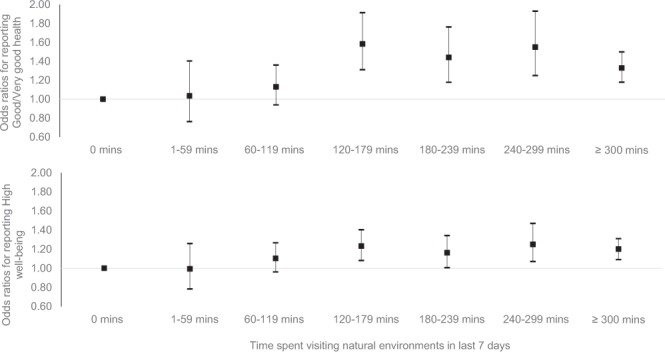
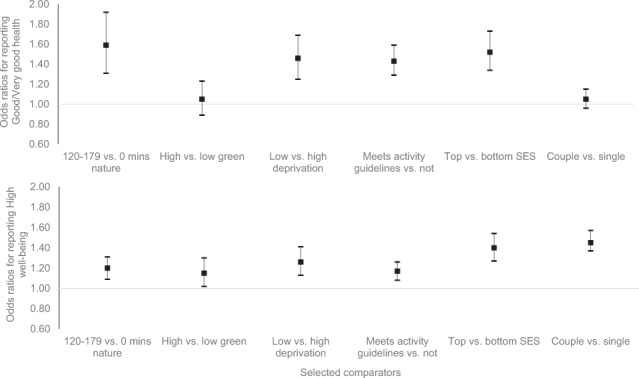
- In adjusted binomial logistic regression models, the association with good health and high well-being became significant only at ≥120 minutes per week in nature; for example, at 120–179 minutes, ORs were 1.59 [1.31–1.92] for health and 1.23 [1.08–1.40] for well-being, compared with 0 minutes.
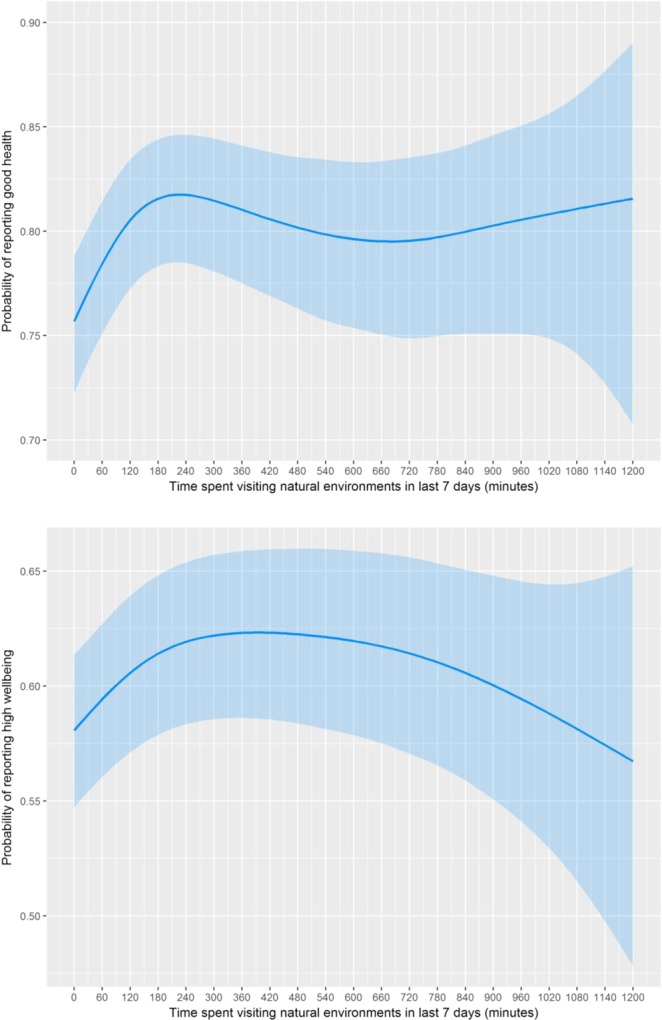
- The positive association was strongest up to about 200 minutes per week for health and 300 minutes per week for well-being, after which the relationship flattened or declined in spline analyses.
- The pattern was reported as consistent across key groups, including older adults and people with long-term health issues/disability; the paper also reports that the ≥120-minute “threshold” was seen across many stratified analyses.
- It did not matter how the 120 minutes were accumulated: additional analyses found no difference in health or well-being between one 120+ minute visit, two 60+ minute visits, or three or more ≤40 minute visits.
## Methods
- Design: Secondary analysis of a repeat cross-sectional survey; the study used survey weights to represent the adult population of England.
- Sample/data: Adults from Waves 6 and 7 of the Monitor of Engagement with the Natural Environment (MENE) survey (n = 20,264 total; n = 19,806 estimation sample for adjusted models; n = 19,808 for adjusted models with missing area-level data excluded).
- Main analysis: Survey-weighted binomial logistic regressions predicting binary health and well-being outcomes from weekly nature-contact duration categories; models adjusted for area- and individual-level covariates, with sensitivity analyses using splines and ordinal/continuous outcome specifications, plus a priori stratified analyses.
## Limitations
- The authors explicitly state the study is observational and cross-sectional, so they cannot rule out reverse causality or make causal claims.
- They note the weekly exposure estimate was based on one randomly selected visit in the last week, and that the data rely on self-reports, which may reduce accuracy.
- They caution that the apparent ≥120-minute threshold may partly reflect clustering of responses around hour marks and the way the data were categorized; this is an evident limitation from the text, alongside the very small variance explained by nature contact (about 1% in unadjusted models).
Model-written summary. Check it against the paper before relying on it.
Integrity signals
Registry
Cites
Statistics
Figures
Verification
Claims the paper makes
8 Valid · 1 Not valid · 15 Not checked · 60 Own results and interpretations
The cited sources support only part of this claim — read each source’s verdict below.
In the paper
“In other words, direct exposure, or more specifically in the current context, recreational time spent in natural environments per week, cannot accurately be inferred from neighbourhood greenspace near the home.”
§ Spending at least 120 minutes a week in nature is associated with good health and wellbeing > Introduction
What the sources say
- Partly supportedcites [23] Hillsdon, M., Coombes, E., Griew, P. & Jones, A. An assessment of the relevance of the home neighbourhood for understanding environmental influences on physical activity: how far from home do people roam? Int J Behav Nutr Phy 12, 100 (2015). sourceExperimental — accuracy not yet measured
The Conclusions and Discussion report that much outdoor physical activity occurs beyond the proximal home neighbourhood, so nearby neighbourhood characteristics may poorly represent the environments people use. The paper does not establish this specifically for weekly recreational time in natural environments or for neighbourhood greenspace; the Discussion says the researchers did not know which activities participants undertook. (LLM, conf=0.88)
- Could not verifycites [24] Sijtsma, F. J., de Vries, S., van Hinsberg, A. & Diederiks, J. Does ‘grey’ urban living lead to more ‘green’ holiday nights? A Netherlands Case Study. Landscape Urban Plan 105, 250–257 (2012). sourceExperimental — accuracy not yet measured
Our copy of Sijtsma et al. (2012) contains only repository/metadata records plus the Abstract; no body sections (Introduction, Methods, Discussion) are indexed. The Abstract (p. n/a) describes a GIS model of 'recreational shortages' — the shortage of locally available green space for recreational walking — linked to holiday nights away from home, but nowhere states that recreational time spent in natural environments per week cannot be inferred from neighbourhood greenspace near the home. Four searches (inference from neighbourhood greenspace, shortage of locally available green space for recreational walking, exposure vs. actual use, compensating behaviour/limitations) returned only the same abstract and citation blocks, so the claim's point is not addressed in the text we hold. (LLM, conf=0.65)
plain- Asserted: passes — The authors put it forward as true.
- Checkable: passes — It can be checked against evidence.
- Load-bearing: passes — The paper’s conclusions depend on it.
- Based: passes — The paper gives a reason why it holds.
- Partly supported
The cited sources support only part of this claim — read each source’s verdict below.
In the paper
“People travel beyond their local neighbourhoods to access recreational nature experiences, and indeed in our own data those who lived in the least green areas had higher odds of spending ≥120 mins in nature than those living in greener neighbourhoods (Appendix C).”
§ Spending at least 120 minutes a week in nature is associated with good health and wellbeing > Discussion
What the sources say
- Partly supportedcites [23] Hillsdon, M., Coombes, E., Griew, P. & Jones, A. An assessment of the relevance of the home neighbourhood for understanding environmental influences on physical activity: how far from home do people roam? Int J Behav Nutr Phy 12, 100 (2015). sourceExperimental — accuracy not yet measured
The Results report that 60.5% of recorded outdoor physical activity occurred beyond an 800 m home-neighbourhood boundary, and the Conclusions say adults undertook most outdoor physical activity outside their proximal home neighbourhood (page not provided). The paper does not establish that people travelled beyond their neighbourhoods specifically to access recreational nature experiences; it measured where activity occurred, not its purpose or whether it took place in nature. (LLM, conf=0.86)
plain- Asserted: passes — The authors put it forward as true.
- Checkable: passes — It can be checked against evidence.
- Load-bearing: passes — The paper’s conclusions depend on it.
- Based: passes — The paper gives a reason why it holds.
- Partly supported
Every source the paper cites for this claim was checked and supports it.
In the paper
“Research into shinrin-yoku (Japanese “forest bathing”)35, for instance, suggested that various psycho-physiological benefits can be gained from merely sitting passively in natural vs. urban settings.”
§ Spending at least 120 minutes a week in nature is associated with good health and wellbeing > Discussion
What the sources say
- Supportedcites [35] Park, B. J., Tsunetsugu, Y., Kasetani, T., Kagawa, T. & Miyazaki, Y. The physiological effects of Shinrin-yoku (taking in the forest atmosphere or forest bathing): evidence from field experiments in 24 forests across Japan. Environ Health Prev 15, 18–26 (2010). source
The Experimental design (p. 2) says subjects sat on chairs to view forest or city landscapes. The physiological results (p. 4) report more favorable stress-related measures after forest viewing, while the psychological results (p. 7) report better mood scores than after city viewing. (LLM, conf=0.93)
hedgedstates a possible cause- Asserted: passes — The authors put it forward as true.
- Checkable: passes — It can be checked against evidence.
- Load-bearing: passes — The paper’s conclusions depend on it.
- Based: passes — The paper gives a reason why it holds.
- Supported
Every source the paper cites for this claim was checked and supports it.
In the paper
“Experimental research, however, indicates that some benefits cannot be due solely to physical activity.”
§ Spending at least 120 minutes a week in nature is associated with good health and wellbeing > Discussion
What the sources say
- Supportedcites [35] Park, B. J., Tsunetsugu, Y., Kasetani, T., Kagawa, T. & Miyazaki, Y. The physiological effects of Shinrin-yoku (taking in the forest atmosphere or forest bathing): evidence from field experiments in 24 forests across Japan. Environ Health Prev 15, 18–26 (2010). source
The Experimental design (p. 2) reports no difference in exercise load between forest and city walks. The Results (p. 4) also report physiological benefits from viewing forest landscapes while seated, supporting the conclusion that physical activity alone cannot explain some benefits. (LLM, conf=0.93)
hedgedstates a cause- Asserted: passes — The authors put it forward as true.
- Checkable: passes — It can be checked against evidence.
- Load-bearing: passes — The paper’s conclusions depend on it.
- Based: passes — The paper gives a reason why it holds.
- Supported
The cited sources support only part of this claim — read each source’s verdict below.
In the paper
“Impoverished local opportunities need not be a barrier to nature exposure23,24.”
§ Spending at least 120 minutes a week in nature is associated with good health and wellbeing > Discussion
What the sources say
- Partly supportedcites [23] Hillsdon, M., Coombes, E., Griew, P. & Jones, A. An assessment of the relevance of the home neighbourhood for understanding environmental influences on physical activity: how far from home do people roam? Int J Behav Nutr Phy 12, 100 (2015). sourceExperimental — accuracy not yet measured
The Results and Conclusions (page numbers unavailable) show that adults undertook much of their outdoor physical activity beyond their proximal home neighbourhood, supporting the idea that nearby opportunities do not define where people go. The paper does not establish that those destinations provided nature exposure or that impoverished local nature opportunities were not a barrier to it. (LLM, conf=0.78)
- Partly supportedcites [24] Sijtsma, F. J., de Vries, S., van Hinsberg, A. & Diederiks, J. Does ‘grey’ urban living lead to more ‘green’ holiday nights? A Netherlands Case Study. Landscape Urban Plan 105, 250–257 (2012). sourceExperimental — accuracy not yet measured
Our copy of Sijtsma et al. (2012) holds only the repository record — the Abstract plus bibliographic metadata, with no body sections (searches on 'recreational shortage', 'nature exposure', 'compensating behaviour', 'discussion/conclusion' all returned the same abstract and citation blocks). The Abstract does support the compensatory mechanism behind the claim: 'the higher the greyness of the living environment – i.e. the higher the shortage of locally available green space for recreational walking – the more people spend nights away from home', with ~20% of holiday nights of the greyest residents related to that shortage. But the source measures holiday nights away from home and frames the shortage as a cost of agglomeration for well-being; it nowhere asserts 'nature exposure' or that a local shortage is not a barrier to nature contact, so the claim's generalisation to 'nature exposure' goes beyond what this source states. (LLM, conf=0.72)
plain- Asserted: passes — The authors put it forward as true.
- Checkable: passes — It can be checked against evidence.
- Load-bearing: unclear — It is unclear whether the paper’s conclusions depend on it.
- Based: passes — The paper gives a reason why it holds.
- Partly supported
21 more claims · 1 with their cited sources checked
Create a free account to see all 84 claims and to verify the 9 references still open.
- It may state two separate claims as one. 18
- Probably not a substantial claim. 46
Claims other papers make about this one
Each is checked against this paper’s own text: does it say what the citing paper says it does?
The cited source says what the claim attributes to it.
In the citing paper
“spending at least 120 min a week in nature was associated with good health [82].”
From EAACI Guidelines on the Importance of Green Space in Urban Environments for Allergy and Asthma Prevention (2026) · cites this paper as [82]
Citations
Cites
Hartig, T., Mitchell, R., de Vries, S., & Frumkin, H. (2014) · Annual Review of Public Health · doi:10.1146/annurev-publhealth-032013-182443 · Cited by 3,638
Self-citationEffect of exposure to natural environment on health inequalities: an observational population study
Mitchell, R., & Popham, F. (2008) · The Lancet · doi:10.1016/s0140-6736(08)61689-x · Cited by 2,099
Green space, urbanity, and health: how strong is the relation?
Maas, J., Verheij, R. A., Groenewegen, P. P., de Vries, S., & Spreeuwenberg, P. (2006) · Journal of Epidemiology and Community Health · doi:10.1136/jech.2005.043125 · Cited by 1,976
The Science of Mind Wandering: Empirically Navigating the Stream of Consciousness
Smallwood, J., & Schooler, J. W. (2015) · Annual Review of Psychology · doi:10.1146/annurev-psych-010814-015331 · Cited by 1,685
Barton, J., & Pretty, J. (2010) · Environmental Science & Technology · doi:10.1021/es903183r · Cited by 1,592
Miilunpalo, S., Vuori, I., Oja, P., Pasanen, M., & Urponen, H. (1997) · Journal of Clinical Epidemiology · doi:10.1016/s0895-4356(97)00045-0 · Cited by 1,473
Thompson Coon, J., Boddy, K., Stein, K., Whear, R., Barton, J., & Depledge, M. H. (2011) · Environmental Science & Technology · doi:10.1021/es102947t · Cited by 1,391
Self-citationNature Contact and Human Health: A Research Agenda
Frumkin, H., Bratman, G. N., Breslow, S. J., Cochran, B., Kahn Jr, P. H., Lawler, J. J., Levin, P. S., Tandon, P. S., Varanasi, U., Wolf, K. L., et al. (2017) · Environmental Health Perspectives · doi:10.1289/ehp1663 · Cited by 1,237
What are the benefits of interacting with nature?
Keniger, L., Gaston, K., Irvine, K., & Fuller, R. (2013) · International Journal of Environmental Research and Public Health · doi:10.3390/ijerph10030913 · Cited by 1,204
Research works printed but not linked: 1
- Stigsdotter, U. & Grahn, P. What makes a garden a healing garden. J Thera Hort 13, 60–69 (2002).
Cited by
Items 701–800 of 1,105
King, S., Lemieux, C. J., Reining, C. E., Cumbrera, M. G., Rawcliff, P., Leão, E. R., Hewlett, D., Hopkins, J., & Molsher, R. (2025) · doi:10.51644/iiyp2591 · Cited by 4
Zaino, A. A., Rasiya, A., Banaei, M., Abdullah, J., Abbas, M. Y., & Hassan, A. (2022) · Environment-Behaviour Proceedings Journal · doi:10.21834/ebpj.v7i20.2262 · Cited by 3
Being in nature: A heuristic inquiry
Bütschi, G. (2022) · Consciousness Spirituality & Transpersonal Psychology · doi:10.53074/cstp.2022.31 · Cited by 1
Estimating the impact of oceans on human health: The value of taking a burden of disease approach
Newton, J. N., Fleming, L. E., Depledge, M. H., Bennett, B. J., Morris, G., Keast, J., & Gribble, M. O. (2023) · Elsevier eBooks · doi:10.1016/b978-0-323-95227-9.00005-1 · Cited by 2
Self-citationConnecting Biodiversity and Human Wellbeing
Fisher, J. C., Nawrath, M., Dallimer, M., Irvine, K. N., & Davies, Z. G. (2023) · Routledge eBooks · doi:10.4324/9781003016120-13 · Cited by 2
On the Well-Being of Aesthetic Beings
Irvin, S. (2023) · Oxford University Press eBooks · doi:10.1093/oxfordhb/9780192866929.013.15 · Cited by 2
Effects of Short-Term Natural Environment Exposure on Preservice Teacher Well-Being
Allen, L. V. Z., Crim, C., Sosnaud, B., Barnett, E., & King, J. (2023) · Texas Educator Preparation · doi:10.59719/txep.v7i2.31 · Cited by 1
Towards Well-being: Self-Care in the Supervisory Space
Rawatlal, K. V. (2023) · SpringerBriefs in psychology · doi:10.1007/978-3-031-41929-4_9 · Cited by 1
Putri, V. S. I. S., Wijayanti, L. R. L. R., & Hidayati, N. I. (2024) · International Journal of Geoinformatics · doi:10.52939/ijg.v20i1.3031 · Cited by 4
Jirinec, V., Bresnan, A. M., Clément, M. A., Colón, M. R., Long, A. M., Rhyne, G. S., Rodrigues, P. F., Stein, E. D., Pérez‐Umphrey, A. A., Varian, C. P., et al. (2024) · Ornithological Applications · doi:10.1093/ornithapp/duae038 · Cited by 2
“…clean air and water (Chung et al. 2021), temperature regulation (Debbage and Shepherd 2015), aesthetic appeal (Tribot et al. 2018, Isik and Vessel 2021), human health and safety (White et al. 2019), recreational opportunities (Shrestha et al. 2007), and community cohesion (Weinstein et al. 2015).”
Gilbourne, C., Scarry, A., Tierney, A. C., & O’Connor, E. M. (2024) · Food Science & Nutrition · doi:10.1002/fsn3.4447 · Cited by 1
“…in mental wellbeing after exposure to these environments (Stigsdotter et al., 2010 ; Twohig-Bennett & Jones, 2018; van den Berg et al., 2016; White et al., 2019; Wood et al., 2017), improved weight status and obesity-related health outcomes (Ghimire et al., 2017; Lachowycz & Jones, 2011;…”
Anti-inflammatory diet or anti-inflammatory lifestyle?
Mariani, D., & Lucchetti, S. (2025) · Giornale di Clinica Nefrologica e Dialisi · doi:10.33393/gcnd.2025.3455 · Cited by 1
Gamify the City, XR, and Tomorrow’s Metaverse
Imperioso, M., & Morgado, P. (2025) · RaumFragen: Stadt - Region - Landschaft · doi:10.1007/978-3-031-75416-6_20 · Cited by 2
Phelan, A. S., Pisani, E., Tessari, C., & Secco, L. (2025) · Sustainability · doi:10.3390/su17135779 · Cited by 1
Fang, H., Guo, H., Chen, Y., Shi, H., Gan, Y., & Li, L. (2025) · International Journal of Mental Health Promotion · doi:10.32604/ijmhp.2025.066369 · Cited by 3
Motzkin, T., Svoray, T., & Erell, E. (2025) · Urban Climate · doi:10.1016/j.uclim.2025.102598 · Cited by 5
Makanjuola, A., Wallace, C. A., & Lynch, M. (2025) · Wellbeing Space and Society · doi:10.1016/j.wss.2025.100310 · Cited by 1
Bianchi, E., & Billington, S. L. (2025) · Sustainable Cities and Society · doi:10.1016/j.scs.2025.106874 · Cited by 4
McCormick, E. L., Rider, T. R., & Hu, J. (2025) · Indoor Environments · doi:10.1016/j.indenv.2025.100133 · Cited by 2
Fernandes, J., Bento, A. T., Gonçalves, G., & Campos, C. (2025) · Green Health · doi:10.3390/greenhealth1030017 · Cited by 1
“Associations were found between the duration, frequency, and intensity of exposure to nature and mood [100].”
Stanley, J. K., Stanley, J., & Vella‐Brodrick, D. (2025) · Sustainability · doi:10.3390/su17229988 · Cited by 1
Perceptions and Use of Urban Green Spaces, Leading Pathways to Urban Resilience
Paraskevopoulou, A. T., Mougiakou, Ε., & Malesios, C. (2025) · Sustainability · doi:10.3390/su172210093 · Cited by 1
The Right to the City in Urban Parks: The Role of Co-Governance in Fostering a Sense of Belonging
Liu, Y., Manfredini, M., Fang, Y., Guo, Z., & Weng, J. (2025) · Land · doi:10.3390/land14112250 · Cited by 2
Birdwatching vs. nature walks: a randomized trial to compare mental health outcomes in Iran
Ebrahimi, I., Kazemi, F., & Ebrahimi, M. A. A. (2025) · Human Dimensions of Wildlife · doi:10.1080/10871209.2025.2589874 · Cited by 1
“However, rapid urbanization and declining access to green spaces have increasingly limited opportunities for such restorative experiences, particularly in densely populated regions (Bratman et al., 2019; White et al., 2019).”
Song, T., & Xu, L. (2025) · Engineering Construction & Architectural Management · doi:10.1108/ecam-06-2025-1008 · Cited by 1
Cobeñas, P., Esenarro, D., Cairo, J. V., Gómez, A., Prado, M., Sosa, A. A. P., Raymundo, V., Garcia, F. L. P., Peña, J., Porras, E., et al. (2025) · Urban Science · doi:10.3390/urbansci10010002 · Cited by 1
“They also have the capacity to capture carbon and contribute to the stability of both marine and terrestrial ecosystems, reaffirming their strategic importance for global sustainability [2,3].”
Sulfa, D. M., Suwono, H., & Rahayu, S. E. (2025) · Environmental Development · doi:10.1016/j.envdev.2025.101417 · Cited by 2
Liljegren, M., Bengtsson, A., Lindahl, G., et al. (2026) · Wellbeing Space and Society · doi:10.1016/j.wss.2026.100350 · Cited by 1
Bureaucracy, happiness, and satisfaction at work
Tu, J., & Hill, S. J. (2026) · PLoS ONE · doi:10.1371/journal.pone.0338838 · Cited by 1
“Other research finds that exchanging wealth for free time as well as more time in nature increase happiness [5,6], suggesting that the time pressures of modern life could be one factor in declining satisfaction [7].”
Understanding the nature-wellbeing relationship in adults: a qualitative metasynthesis review
van Bekkum, J. E., McDougall, C., Wendelboe‐Nelson, C., Mason, S. S., Williams, A. J., Jepson, R. G., & Malden, S. (2026) · Wellbeing Space and Society · doi:10.1016/j.wss.2026.100359 · Cited by 4
Wang, Y., Vierikko, K., Langemeyer, J., Lehtimäki, J., & Kotze, D. J. (2026) · Ecosystem Services · doi:10.1016/j.ecoser.2026.101817 · Cited by 2
Probst, B. M., Burger, S., Arzberger, S., Annighöfer, P., Suda, M., & Egerer, M. (2026) · Urban forestry & urban greening · doi:10.1016/j.ufug.2026.129370 · Cited by 2
Moraga, F. R. G., Vergara, R. G., & Suazo, C. P. A. (2026) · Computers in Human Behavior Reports · doi:10.1016/j.chbr.2026.100987 · Cited by 1
Lu, C., Zhang, Y., & Wang, C. (2026) · Tourism Recreation Research · doi:10.1080/02508281.2026.2637464 · Cited by 2
Perceived and quantified nature exposure in relation to mental health
Bloomfield, L. S. P., Lombardo, S., Price, M., Ricketts, T. H., & Danforth, C. M. (2026) · Health & Place · doi:10.1016/j.healthplace.2026.103636 · Cited by 4
Yong, J. C., Lim, A. J. Y., Tan, E., & Chan, S. (2026) · Behavioral Sciences · doi:10.3390/bs16050650 · Cited by 3
Nature and the Experience of Meaning in Life: The Role of Experiential Appreciation
Needy, L. M., Peace, M. G., Gause, C., Orska, S. A., & Hicks, J. A. (2026) · Environment and Behavior · doi:10.1177/00139165261447114 · Cited by 1
“At the physiological level, time spent in nature has been shown to reduce stress, lower blood pressure, and is associated with lower prevalence of heart disease and overall mortality (Gascon et al., 2016; White et al., 2019).”
Zhao, Z., Zhang, M., Wang, J., Wang, X., & Guo, W. (2026) · Acta Psychologica · doi:10.1016/j.actpsy.2026.107091 · Cited by 1
Silva, M. B., Almendra, R., & Bressane, A. (2026) · Urban forestry & urban greening · doi:10.1016/j.ufug.2026.129525 · Cited by 1
Reconnecting Seniors with Blue Spaces: A Technology-Mediated Immersive Approach
Pellegrini, T., Pittarello, F., & Pranovi, F. (2026) · International Conference on Advanced Visual Interfaces (AVI) · doi:10.1145/3811427.3811465 · Cited by 1
Zheng, Y., Lin, T., Hamm, N., Chen, Y., Zhou, T., Guo, X., Geng, H., Ng, M. K. M., Han, H., Pettit, C. J., et al. (2026) · Landscape and Urban Planning · doi:10.1016/j.landurbplan.2026.105729 · Cited by 3
Liu, S., Tan, Y., & Zang, L. (2026) · Frontiers in Psychology · doi:10.3389/fpsyg.2026.1878240 · Cited by 1
“Population-based evidence shows that spending time in nature is associated with better health and wellbeing (White et al., 2019), and dose-oriented studies suggest that benefits may depend partly on patterns of nature contact (Shanahan et al., 2016).”
Bengtsson, A., Landin, H., Liljegren, M., Lindahl, G., Nordin, S., & Wijk, H. (2026) · Frontiers in Psychology · doi:10.3389/fpsyg.2026.1651502 · Cited by 1
“According to White et al. (2019), spending at least 2 h a week in a natural environment is associated with self-rated good health and wellbeing for people in general.”
InfluentialMarques, L. M. (2026) · International Journal of Environmental Research and Public Health · doi:10.3390/ijerph23080991 · Cited by 2
“…example, visual contact with vegetation, which is associated with measurable reductions in stress and improvements in psychological restoration) [26–29], and a moderating pathway, whereby landscape structure attenuates or amplifies the psychological impact of co-located stressors (for example,…”
Blikstein, P., & Guasti, L. (2020) · IUL Research · doi:10.57568/iulres.v1i2.75 · Cited by 1
Buru, T. H., Kállay, É., Cantor, M., & Papuc, I. (2021) · Springer tracts in civil engineering · doi:10.1007/978-3-030-57418-5_4 · Cited by 2
SUPPORTING CHILD AND FAMILY WELLBEING THROUGH NATURE DURING THE PANDEMIC
Barrable, A., Molesey, P., Touloumakos, A. Κ., & Booth, D. B. (2021) · Discovery Research Portal (University of Dundee) · doi:10.26262/hjp.v18i2.8047 · Cited by 3
“Two hours of contact with the natural environment per week has been found to create some of the positive impacts, irrespective of how that period was applied, e.g., many short visits or fewer, longer periods (White et al., 2019).”
BackgroundValverde, D. L. (2021) · REVISTARQUIS · doi:10.15517/ra.v10i2.45708 · Cited by 6
Cobreros, C., Maya, M., Biondi, S., Sanchez, X. A. S., & Ontiveros-Ortíz, E. N. (2021) · International Conference on Engineering and Product Design Education (EPDE) · doi:10.35199/epde.2021.83 · Cited by 4
“1 Domestic space and housing The subsequent measures have had implications on how we occupy our habitat and how we relate to the open environment and nature, observing the effects on our physical, mental, and emotional well-being [11].”
BackgroundRe-signifying Domestic Space in Times of Confinement Based on Biophilic Design
Cobreros, C., Flores-García, M., Biondi, S., Maya, M., & Ontiveros-Ortíz, E. N. (2021) · The urban book series · doi:10.1007/978-3-030-84134-8_8 · Cited by 1
The role of health saving technologies in maintaining pupils heath
Бекетова, Г. В., Savinova, K. B., Mozgova, G., et al. (2021) · Modern pediatrics Ukraine · doi:10.15574/sp.2021.120.16 · Cited by 1
“При цьому важливо уникати споживання промисло вих трансжирів, зменшувати вживання насиче них жирів і солі [3,30,31].”
Ortega-García, J. A., Martínez-Gómez, C., Bach, A., Benitez-Rodríguez, L., & Ramis, R. (2022) · Anales de Pediatría · doi:10.1016/j.anpedi.2022.09.018 · Cited by 1
ECONOMIC VALUE OF PUBLIC SPACE
Ozola, I., Sproge, L., & Libkovska, U. (2022) · International Multidisciplinary Scientific GeoConference SGEM ... · doi:10.5593/sgem2022/5.1/s20.017 · Cited by 1
THE RELATIONSHIP BETWEEN RESIDENTS' RECOGNITION OF NATURE AND SATISFACTION WITH LOCAL AREAS:
Junko, S. A. T. O., Inagaki, K., Sadohara, S., et al. (2023) · Journal of Environmental Engineering (Transactions of AIJ) · doi:10.3130/aije.88.204 · Cited by 1
Research in a Moving Field: Doing In-aqua Research in Blue Space Settings
Foley, R. (2023) · Springer eBooks · doi:10.1007/978-3-031-13615-3_2 · Cited by 3
Bansal, M., Aggarwal, R., & Singh, Y. (2023) · International Journal of Computer Applications · doi:10.5120/ijca2023920933 · Cited by 1
The Healing Power of Green Spaces: Combating Loneliness, Loss, and Isolation
McConatha, J. T., Ford, K., Cusmano, C., Lyman, N., & McConatha, M. (2023) · International Journal of Geriatrics and Gerontology · doi:10.29011/2577-0748.100076 · Cited by 4
“Although Eco psychology is an emerging field that addresses the positive relationship between time spent outside and well-being [26], the notion that fresh air and beautiful natural settings promote health is not new.”
BackgroundGola, M., Botta, M., D’Aniello, A. L., & Capolongo, S. (2024) · Urban sustainability · doi:10.1007/978-981-99-8672-9_4 · Cited by 1
Triangulation entre l’écopsychologie, l’écoformation et le cadre durandien de l’imaginaire
Bellehumeur, C. R. (2023) · Éducation relative à l environnement · doi:10.4000/ere.9864 · Cited by 1
Manchón, F. D. A. M., González, P. V., Martín, M., & Šimunić, A. (2023) · REVISTA DE EDUCACIÓN AMBIENTAL Y SOSTENIBILIDAD · doi:10.25267/rev_educ_ambient_sostenibilidad.2022.v5.i2.2102 · Cited by 3
Manchón, F. D. A. M., González, P. V., Martín, M., & Šimunić, A. (2023) · REVISTA DE EDUCACIÓN AMBIENTAL Y SOSTENIBILIDAD · doi:10.25267/rev_educ_ambient_sostenibilidad.2023.v5.i2.2102 · Cited by 1
Luz, H., & Nunes, V. C. (2024) · IntechOpen eBooks · doi:10.5772/intechopen.1004144 · Cited by 1
Public space as a place of rehabilitation for the elderly – a systematic literature review
Gębczyńska-Janowicz, A., & Janowicz, R. (2024) · Medycyna Pracy · doi:10.13075/mp.5893.01514 · Cited by 3
Markov, S., Pippirs, C., Steckenbauer, G. C., et al. (2024) · CABI eBooks · doi:10.1079/9781800621411.0003 · Cited by 1
Levine, J. F. (2024) · Journal of Legal Aspects of Sport · doi:10.18060/27251 · Cited by 2
“…a significant body of literature links these leisure activities to a variety of physical, mental, psychological, and cognitive social benefits (Andermo et al., 2020; Biddle & Asare, 2011; Murthy, 2023; Sahlberg & Doyle, 2019; Savina et al., 2016; White et al., 2019; Yogman & Hirsch-Pasek, 2018).”
BackgroundReeves, J. P., Freeman, W., Patel-Calverley, R., Newth, J. L., & Plimpton, B. (2026) · Wellbeing Space and Society · doi:10.1016/j.wss.2026.100401 · Cited by 2
Bishop, R., Underwood, F., Fraser, F., Burrows, L., & Shawe, J. (2024) · JBI Evidence Synthesis · doi:10.11124/jbies-23-00437 · Cited by 2
“10 Theories also exist to conceptualize the benefits of nature on human health, such as the biophilia hypothesis, 11 which considers our innate need to be in nature.”
“We Called It ‘Cancer Park’”: Soil Contamination and Outdoor Leisure in Southeast Los Angeles
Anderson, K. R., & Lopez, L. (2024) · Leisure Sciences · doi:10.1080/01490400.2024.2385443 · Cited by 1
“A growing body of research has also demonstrated that outdoor leisure is associated with many positive mental and physical health outcomes (White et al., 2019; Wicks et al., 2022).”
Factors impacting urban greenspace usage: new evidence from South Africa
Struwig, C., Davis, N. C., & Breetzke, G. D. (2024) · GeoJournal · doi:10.1007/s10708-024-11228-x · Cited by 2
“It is being increasingly acknowledged that the type and frequency of UGS interactions can impact usage rather than these spaces simply being available (see Fuller et al., 2007; Holt et al., 2019; Liu et al., 2018; White et al., 2019).”
Hawkes, C., Nelson, R., Zahl, M. L., & Schmalz, D. L. (2024) · Leisure/Loisir · doi:10.1080/14927713.2024.2420795 · Cited by 1
“According to White et al. (2019), participants reported higher health and well-being levels when they spent 120 minutes or more per week in nature compared to participants who did not meet this threshold.”
InfluentialUsing photovoice to investigate patient experiences of lupus nephritis in Canada
Cardwell, F. S., Elliott, S. J., Barber, M. R. W., Cheema, K., George, S., Boucher, A., & Clarke, A. E. (2024) · Lupus Science & Medicine · doi:10.1136/lupus-2024-001265 · Cited by 2
Zakaria, N., Ahmad, S., & Amir, A. F. (2024) · PLANNING MALAYSIA · doi:10.21837/pm.v22i34.1655 · Cited by 1
“Based on the study by White et.”
Ma, L., Liu, Y., Huang, Y., & Ye, R. (2024) · Annals of the American Association of Geographers · doi:10.1080/24694452.2024.2433014 · Cited by 7
“Research has shown that spending at least 120 minutes per week in natural settings is linked to improved health and well-being (White et al. 2019).”
Huish, J. L., Fisher, Z., Isham, A., & Kemp, A. H. (2025) · PLOS mental health. · doi:10.1371/journal.pmen.0000281 · Cited by 1
King Lear in the upper palaeolithic: searching for ethical principles in prehistory
Foster, C. E. (2025) · Bioethics News · doi:10.1007/s40592-025-00241-6 · Cited by 1
“…of curating that connection, are demonstrated by the growing evidence of a connection between human health and happiness and a relationship with the natural world (Hartig et al. 2014 ; Franco et al. 2017 ; Frumkin et al. 2017 ; Tillmann et al. 2018 ; White et al. 2019 ; Lackey et al. 2021).”
Nature-based awe among water professionals and its influence on workplace decision-making
Deboer-Smith, A., Smith, L. K. M., & Wolfe, S. E. (2025) · Discover Sustainability · doi:10.1007/s43621-025-01358-8 · Cited by 3
Perspectiva de ‘bem-estar único’ em sistemas agroflorestais - Uma análise bibliométrica
Bichel, A., & Zanin, E. (2021) · UNICIÊNCIAS · doi:10.17921/1415-5141.2021v25n1p26-32 · Cited by 1
Biodiversity and human health: the case for public health action
van Hove, M., & Gray, S. F. (2021) · Perspectives in Public Health · doi:10.1177/17579139211053366 · Cited by 1
Positive Ecological Psychology: Contributes to the Promotion of Healthy Lives and Well-Being
Silva, I., Jólluskin, G., & Cardoso, P. R. (2021) · World sustainability series · doi:10.1007/978-3-030-86304-3_16 · Cited by 3
Perception of health professionals regarding the use of horticultural therapy
Poje, M., Kasumović, V., Babojelić, M. S., Kušen, M., & Židovec, V. (2023) · Glasilo Future · doi:10.32779/gf.6.4.1 · Cited by 1
Bourdeau-Lepage, L. (2022) · Lucrările Seminarului Geografic · doi:10.47743/lsgdc.v50i2.00 · Cited by 1
Social Interaction and Interpersonal Relationships
Ellis, D. A. (2020) · Cambridge University Press eBooks · doi:10.1017/9781108671408.005 · Cited by 1
Roberts, W. C. (2019) · Baylor University Medical Center Proceedings · doi:10.1080/08998280.2019.1653685 · Cited by 1
“, strolling a treelined street or sitting by a lake) could enhance a person’s overall sense of well-being.(12) Those doing so were about 20% more likely to report high overall satisfaction with their lives than those who spent no time outdoors at all.”
BackgroundHow Urban Green Spaces Need to Change to Address the Public Post-Covid ExpectationsPreprint
Sikorska, D., Wojnowska-Heciak, M., Heciak, J., Bukowska, J., Łaszkiewicz, E., & Sikorski, P. (2022) · SSRN Electronic Journal · doi:10.2139/ssrn.4109031 · Cited by 1
Sumner, R. C., Cassarino, M., Setti, A., Dockray, S., & Crone, D. (2020) · PsyArXiv (OSF Preprints) · doi:10.31234/osf.io/knw3e · Cited by 1
Theories of wellbeing, practical applications and implications for coachingPreprint
Fisher, Z., Wilkie, L., Hamill, A., et al. (2023) · doi:10.31234/osf.io/q7kb5 · Cited by 1
The Transdisciplinary Case for Ecohealth Promotion in Outdoor LearningPreprint
Ritchie, S. D., D’Angelo, J., Feo, G. M. D., Takano, T., & Priest, S. (2023) · OSF Preprints (OSF Preprints) · doi:10.31219/osf.io/v2mr4 · Cited by 3
No human is an island: essays on the economic geography of happiness
Ziogas, T. (2024) · University of Groningen research database (University of Groningen / Centre for Information Technology) · doi:10.33612/diss.984225400 · Cited by 1
Data-Driven Shoreline Modeling: Historical Remote Sensing and Prediction MethodsPreprint
Lundine, M. A., & Trembanis, A. C. (2024) · SSRN Electronic Journal · doi:10.2139/ssrn.4838691 · Cited by 1
Meschini, M., Robinson, L. A., Culhane, F. E., & Goffredo, S. (2024) · SSRN Electronic Journal · doi:10.2139/ssrn.4875344 · Cited by 1
de Vries, S., Baliatsas, C., Verheij, R. A., et al. (2024) · SSRN Electronic Journal · doi:10.2139/ssrn.4878928 · Cited by 1
Bloomfield, L. S. P., Fudolig, M. I., Kim, J. H., Llorin, J., Lovato, J. L., McGinnis, E. W., McGinnis, R. S., Price, M., Ricketts, T. H., Dodds, P. S., et al. (2025) · PsyArXiv (OSF Preprints) · doi:10.31234/osf.io/sfhbd_v1 · Cited by 1
Bloomfield, L. S. P., Price, M., Lombardo, S., Ricketts, T. H., & Danforth, C. M. (2025) · doi:10.31234/osf.io/ekfxu_v1 · Cited by 1
Fagam, S. A., Sagada, M. L., Yakubu, K. I., Aule, T. T., & Tijjani, Z. A. (2025) · Faculty of Natural and Applied Sciences Journal of Applied and Physical Sciences · doi:10.63561/japs.v2i3.817 · Cited by 1
Amponsah, S. O., & Owusuaa-Foster, J. (2025) · Journal of Global Marketing · doi:10.1080/08911762.2025.2567962 · Cited by 1
“While governments and corporations play key roles, individual consumer actions, such as purchasing eco-friendly products, have become crucial levers for promoting environmental sustainability (White et al., 2019).”
Natur – eine Dosis-Findungsstudie
Spitzer, M. (2019) · Nervenheilkunde · doi:10.1055/a-0928-3204
“3 Erhöhung der Wahrscheinlichkeit guter oder sehr guter Gesundheit als Funktion von wöchentlich 2–3 Stunden versus 0 Stunden Zeit in der Natur (ganz links) im Vergleich zu anderen gemessenen Einflussfaktoren wie der Begrünung der Wohngegend, deren Qualität, des Treibens von Sport gemäß den Empfehlungen der WHO, dem so…”
BackgroundInfluentialDie Effekte des Waldaufenthaltes – aktuelle Studienlage
Schuh, A., & Immich, G. (2019) · Springer eBooks · doi:10.1007/978-3-662-59026-3_4
Engineering/Engendering Woodland Wellbeing
Goodenough, A., & Waite, S. (2019) · Springer eBooks · doi:10.1007/978-3-030-32629-6_10
Assessing the Affective in Active Spaces
Goodenough, A., & Waite, S. (2019) · Springer eBooks · doi:10.1007/978-3-030-32629-6_4
Fernandes, S. F. D. C., & Bonatto, D. D. A. M. (2019) · doi:10.5151/singeurb2019-43
Metadata
- Authors
- White, M. P., Alcock, I., Grellier, J., Wheeler, B. W., Hartig, T., Warber, S. L., Bone, A., Depledge, M. H., & Fleming, L. E.
- Affiliations
- University of Exeter (GB)
- Uppsala University (SE)
- Corresponding author
- White, Mathew P.
- ORCID
- Venue
- Scientific Reports
- Published
- 2019-06-13
- Volume
- 9
- Issue
- 1
- Pages
- 7730-7730
- ISSN
- 2045-2322 (ISSN-L)
- PMC
- PMC6565732
- OpenAlex
- W2952548366
- Cited by
- 1,125
- References
- 51
- Citations by year
- 2026: 186 · 2025: 168 · 2024: 170 · 2023: 181 · 2022: 138 · 2021: 164 · 2020: 94 · 2019: 23
- FWCI
- 45.19
- Type
- journal article
- Language
- en
- Open access
- gold
- doi.org
- Licence
- cc-by
- creativecommons.org/licenses/by/4.0 (tdm)
- creativecommons.org/licenses/by/4.0 (vor)
- Locations
- Scientific Reports (publishedVersion, cc-by)
- PubMed Central (publishedVersion, cc-by)
- PubMed (publishedVersion)
- KTH Publication Database DiVA (KTH Royal Institute of Technology) (submittedVersion, other-oa)
- DOAJ (DOAJ: Directory of Open Access Journals) (submittedVersion)
- Figshare (submittedVersion, cc-by)
- Open Research Exeter (University of Exeter) (submittedVersion, cc-by)
- Funders
- DH | National Institute for Health Research (HPRU: Environmental Change & Health)
- Topics
- Social Sciences › Urban Studies › Urban Green Space and Health
- Social Sciences › Business, Management and Accounting › Tourism, Leisure and Hospitality Management › Recreation, Leisure, Wilderness Management
- Health Sciences › Medicine › Public Health, Environmental and Occupational Health › Physical Activity and Health
- Keywords
- nature contact, exposure-response relationship, self-reported health, well-being, green spaces, older adults, chronic disease
- MeSH terms
- Adolescent, Adult, Environment, Female, Health, Humans, Male, Middle Aged, Residence Characteristics, Exercise, Walking, Young Adult, Self Report
About these checks
Registry, retraction, Cites and statistics results are computed, not judged, with one exception: a printed reference that no index lists is read once by a model before it counts as a citation error. Claims are extracted by a model and kept only when their quote appears verbatim in the text; each cited source is then checked, with a model’s help, for whether it says what the claim relies on. Those verdicts can be wrong — read the claim’s quote and the cited source before relying on one.
The claim verdicts this report counts are experimental: their accuracy is not yet measured.
A language model drew the claims from the paper on 2026-10-10, under version 3 of the claim definition (model deepseek-v4.1-flash, prompt extract-v3).
A second model labelled each claim on 2026-10-10 (model jev-1.13-20260917, definition revision gold-guideline-v0.2).
Cited sources are checked with a language model’s help (gpt-6-sol and qwen3.8-omni-flash).
Statistics and arithmetic are recomputed, not judged.
Confidence bands are shown only for fields calibrated on our annotated test set. None is calibrated yet, so no band is shown.
What counts as a claim ›How we measure confidence ›How we check this ›
Are you an author, or do you see a problem with this page? Request a review
Data sources
Bibliographic data: Semantic Scholar, OpenAlex, Crossref.
Contains information from the Semantic Scholar Academic Graph Datasets, made available under the ODC Attribution License (ODC-BY 1.0).
Semantic Scholar’s data is described in: Kinney, R., et al. (2023). The Semantic Scholar Open Data Platform. arXiv:2301.10140.
