

Spending at least 120 minutes a week in nature is associated with good health and wellbeing
Open accessThe DOI matches its Crossref record; 51 of the 51 references it cites were found in a registry or an index; 12 of the 35 sources its claims cite were checked for support.
Abstract
Study of weekly nature exposure and self-reported health and wellbeing in a nationally representative sample.
Overview
CoChat Summary
## TL;DR
Using a nationally representative sample of adults in England (n = 19,806 weighted; n = 20,264 total sample), the paper finds that spending at least 120 minutes per week in natural environments is associated with higher odds of self-reported good health and high well-being. The association appears to level off around 200–300 minutes per week, and the authors caution that the study is cross-sectional and cannot establish causality.
## Key findings
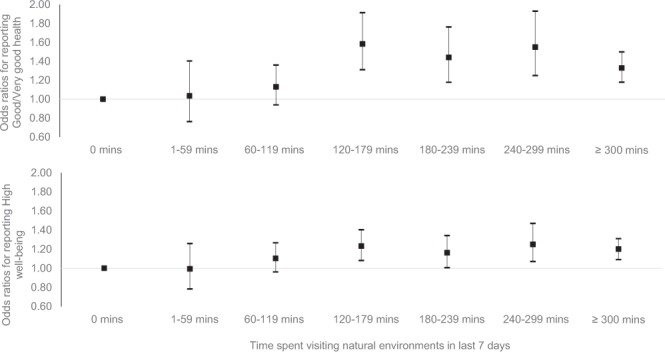
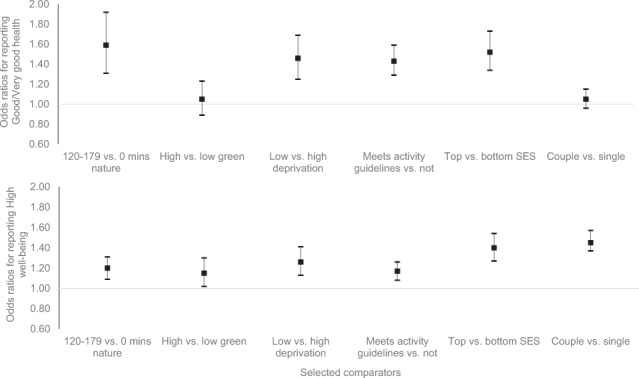
- In adjusted binomial logistic regression models, the association with good health and high well-being became significant only at ≥120 minutes per week in nature; for example, at 120–179 minutes, ORs were 1.59 [1.31–1.92] for health and 1.23 [1.08–1.40] for well-being, compared with 0 minutes.
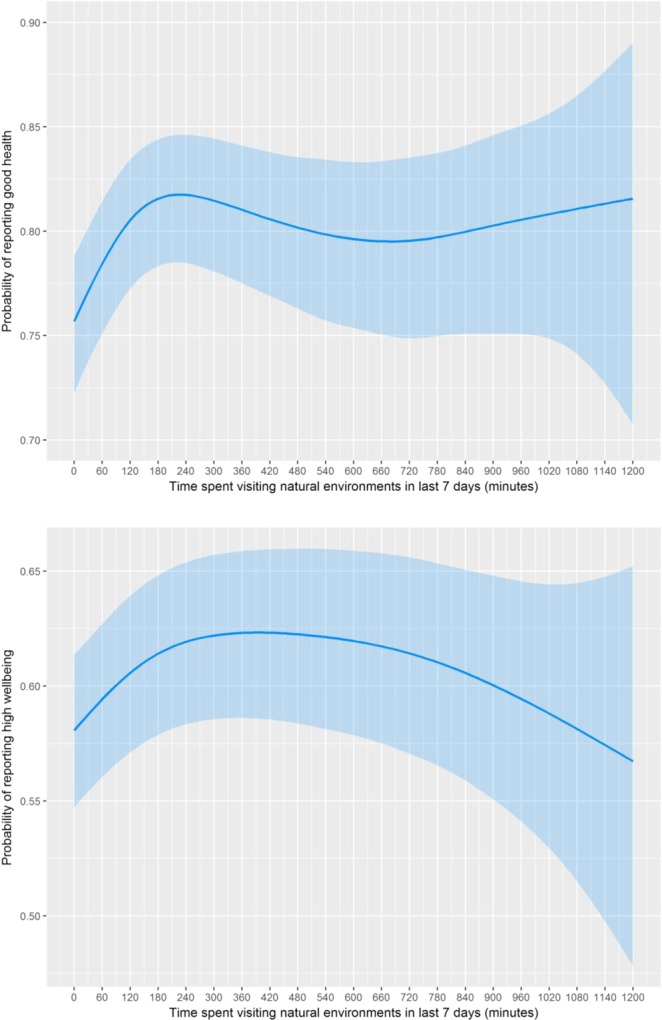
- The positive association was strongest up to about 200 minutes per week for health and 300 minutes per week for well-being, after which the relationship flattened or declined in spline analyses.
- The pattern was reported as consistent across key groups, including older adults and people with long-term health issues/disability; the paper also reports that the ≥120-minute “threshold” was seen across many stratified analyses.
- It did not matter how the 120 minutes were accumulated: additional analyses found no difference in health or well-being between one 120+ minute visit, two 60+ minute visits, or three or more ≤40 minute visits.
## Methods
- Design: Secondary analysis of a repeat cross-sectional survey; the study used survey weights to represent the adult population of England.
- Sample/data: Adults from Waves 6 and 7 of the Monitor of Engagement with the Natural Environment (MENE) survey (n = 20,264 total; n = 19,806 estimation sample for adjusted models; n = 19,808 for adjusted models with missing area-level data excluded).
- Main analysis: Survey-weighted binomial logistic regressions predicting binary health and well-being outcomes from weekly nature-contact duration categories; models adjusted for area- and individual-level covariates, with sensitivity analyses using splines and ordinal/continuous outcome specifications, plus a priori stratified analyses.
## Limitations
- The authors explicitly state the study is observational and cross-sectional, so they cannot rule out reverse causality or make causal claims.
- They note the weekly exposure estimate was based on one randomly selected visit in the last week, and that the data rely on self-reports, which may reduce accuracy.
- They caution that the apparent ≥120-minute threshold may partly reflect clustering of responses around hour marks and the way the data were categorized; this is an evident limitation from the text, alongside the very small variance explained by nature contact (about 1% in unadjusted models).
Model-written summary. Check it against the paper before relying on it.
Integrity signals
Registry
Cites
Statistics
Figures
Verification
Claims the paper makes
8 Valid · 1 Not valid · 15 Not checked · 60 Own results and interpretations
The cited sources support only part of this claim — read each source’s verdict below.
In the paper
“In other words, direct exposure, or more specifically in the current context, recreational time spent in natural environments per week, cannot accurately be inferred from neighbourhood greenspace near the home.”
§ Spending at least 120 minutes a week in nature is associated with good health and wellbeing > Introduction
What the sources say
- Partly supportedcites [23] Hillsdon, M., Coombes, E., Griew, P. & Jones, A. An assessment of the relevance of the home neighbourhood for understanding environmental influences on physical activity: how far from home do people roam? Int J Behav Nutr Phy 12, 100 (2015). sourceExperimental — accuracy not yet measured
The Conclusions and Discussion report that much outdoor physical activity occurs beyond the proximal home neighbourhood, so nearby neighbourhood characteristics may poorly represent the environments people use. The paper does not establish this specifically for weekly recreational time in natural environments or for neighbourhood greenspace; the Discussion says the researchers did not know which activities participants undertook. (LLM, conf=0.88)
- Could not verifycites [24] Sijtsma, F. J., de Vries, S., van Hinsberg, A. & Diederiks, J. Does ‘grey’ urban living lead to more ‘green’ holiday nights? A Netherlands Case Study. Landscape Urban Plan 105, 250–257 (2012). sourceExperimental — accuracy not yet measured
Our copy of Sijtsma et al. (2012) contains only repository/metadata records plus the Abstract; no body sections (Introduction, Methods, Discussion) are indexed. The Abstract (p. n/a) describes a GIS model of 'recreational shortages' — the shortage of locally available green space for recreational walking — linked to holiday nights away from home, but nowhere states that recreational time spent in natural environments per week cannot be inferred from neighbourhood greenspace near the home. Four searches (inference from neighbourhood greenspace, shortage of locally available green space for recreational walking, exposure vs. actual use, compensating behaviour/limitations) returned only the same abstract and citation blocks, so the claim's point is not addressed in the text we hold. (LLM, conf=0.65)
plain- Asserted: passes — The authors put it forward as true.
- Checkable: passes — It can be checked against evidence.
- Load-bearing: passes — The paper’s conclusions depend on it.
- Based: passes — The paper gives a reason why it holds.
- Partly supported
The cited sources support only part of this claim — read each source’s verdict below.
In the paper
“People travel beyond their local neighbourhoods to access recreational nature experiences, and indeed in our own data those who lived in the least green areas had higher odds of spending ≥120 mins in nature than those living in greener neighbourhoods (Appendix C).”
§ Spending at least 120 minutes a week in nature is associated with good health and wellbeing > Discussion
What the sources say
- Partly supportedcites [23] Hillsdon, M., Coombes, E., Griew, P. & Jones, A. An assessment of the relevance of the home neighbourhood for understanding environmental influences on physical activity: how far from home do people roam? Int J Behav Nutr Phy 12, 100 (2015). sourceExperimental — accuracy not yet measured
The Results report that 60.5% of recorded outdoor physical activity occurred beyond an 800 m home-neighbourhood boundary, and the Conclusions say adults undertook most outdoor physical activity outside their proximal home neighbourhood (page not provided). The paper does not establish that people travelled beyond their neighbourhoods specifically to access recreational nature experiences; it measured where activity occurred, not its purpose or whether it took place in nature. (LLM, conf=0.86)
plain- Asserted: passes — The authors put it forward as true.
- Checkable: passes — It can be checked against evidence.
- Load-bearing: passes — The paper’s conclusions depend on it.
- Based: passes — The paper gives a reason why it holds.
- Partly supported
Every source the paper cites for this claim was checked and supports it.
In the paper
“Research into shinrin-yoku (Japanese “forest bathing”)35, for instance, suggested that various psycho-physiological benefits can be gained from merely sitting passively in natural vs. urban settings.”
§ Spending at least 120 minutes a week in nature is associated with good health and wellbeing > Discussion
What the sources say
- Supportedcites [35] Park, B. J., Tsunetsugu, Y., Kasetani, T., Kagawa, T. & Miyazaki, Y. The physiological effects of Shinrin-yoku (taking in the forest atmosphere or forest bathing): evidence from field experiments in 24 forests across Japan. Environ Health Prev 15, 18–26 (2010). source
The Experimental design (p. 2) says subjects sat on chairs to view forest or city landscapes. The physiological results (p. 4) report more favorable stress-related measures after forest viewing, while the psychological results (p. 7) report better mood scores than after city viewing. (LLM, conf=0.93)
hedgedstates a possible cause- Asserted: passes — The authors put it forward as true.
- Checkable: passes — It can be checked against evidence.
- Load-bearing: passes — The paper’s conclusions depend on it.
- Based: passes — The paper gives a reason why it holds.
- Supported
Every source the paper cites for this claim was checked and supports it.
In the paper
“Experimental research, however, indicates that some benefits cannot be due solely to physical activity.”
§ Spending at least 120 minutes a week in nature is associated with good health and wellbeing > Discussion
What the sources say
- Supportedcites [35] Park, B. J., Tsunetsugu, Y., Kasetani, T., Kagawa, T. & Miyazaki, Y. The physiological effects of Shinrin-yoku (taking in the forest atmosphere or forest bathing): evidence from field experiments in 24 forests across Japan. Environ Health Prev 15, 18–26 (2010). source
The Experimental design (p. 2) reports no difference in exercise load between forest and city walks. The Results (p. 4) also report physiological benefits from viewing forest landscapes while seated, supporting the conclusion that physical activity alone cannot explain some benefits. (LLM, conf=0.93)
hedgedstates a cause- Asserted: passes — The authors put it forward as true.
- Checkable: passes — It can be checked against evidence.
- Load-bearing: passes — The paper’s conclusions depend on it.
- Based: passes — The paper gives a reason why it holds.
- Supported
The cited sources support only part of this claim — read each source’s verdict below.
In the paper
“Impoverished local opportunities need not be a barrier to nature exposure23,24.”
§ Spending at least 120 minutes a week in nature is associated with good health and wellbeing > Discussion
What the sources say
- Partly supportedcites [23] Hillsdon, M., Coombes, E., Griew, P. & Jones, A. An assessment of the relevance of the home neighbourhood for understanding environmental influences on physical activity: how far from home do people roam? Int J Behav Nutr Phy 12, 100 (2015). sourceExperimental — accuracy not yet measured
The Results and Conclusions (page numbers unavailable) show that adults undertook much of their outdoor physical activity beyond their proximal home neighbourhood, supporting the idea that nearby opportunities do not define where people go. The paper does not establish that those destinations provided nature exposure or that impoverished local nature opportunities were not a barrier to it. (LLM, conf=0.78)
- Partly supportedcites [24] Sijtsma, F. J., de Vries, S., van Hinsberg, A. & Diederiks, J. Does ‘grey’ urban living lead to more ‘green’ holiday nights? A Netherlands Case Study. Landscape Urban Plan 105, 250–257 (2012). sourceExperimental — accuracy not yet measured
Our copy of Sijtsma et al. (2012) holds only the repository record — the Abstract plus bibliographic metadata, with no body sections (searches on 'recreational shortage', 'nature exposure', 'compensating behaviour', 'discussion/conclusion' all returned the same abstract and citation blocks). The Abstract does support the compensatory mechanism behind the claim: 'the higher the greyness of the living environment – i.e. the higher the shortage of locally available green space for recreational walking – the more people spend nights away from home', with ~20% of holiday nights of the greyest residents related to that shortage. But the source measures holiday nights away from home and frames the shortage as a cost of agglomeration for well-being; it nowhere asserts 'nature exposure' or that a local shortage is not a barrier to nature contact, so the claim's generalisation to 'nature exposure' goes beyond what this source states. (LLM, conf=0.72)
plain- Asserted: passes — The authors put it forward as true.
- Checkable: passes — It can be checked against evidence.
- Load-bearing: unclear — It is unclear whether the paper’s conclusions depend on it.
- Based: passes — The paper gives a reason why it holds.
- Partly supported
21 more claims · 1 with their cited sources checked
Create a free account to see all 84 claims and to verify the 9 references still open.
- It may state two separate claims as one. 18
- Probably not a substantial claim. 46
Claims other papers make about this one
Each is checked against this paper’s own text: does it say what the citing paper says it does?
The cited source says what the claim attributes to it.
In the citing paper
“spending at least 120 min a week in nature was associated with good health [82].”
From EAACI Guidelines on the Importance of Green Space in Urban Environments for Allergy and Asthma Prevention (2026) · cites this paper as [82]
Citations
Cites
Hartig, T., Mitchell, R., de Vries, S., & Frumkin, H. (2014) · Annual Review of Public Health · doi:10.1146/annurev-publhealth-032013-182443 · Cited by 3,638
Self-citationEffect of exposure to natural environment on health inequalities: an observational population study
Mitchell, R., & Popham, F. (2008) · The Lancet · doi:10.1016/s0140-6736(08)61689-x · Cited by 2,099
Green space, urbanity, and health: how strong is the relation?
Maas, J., Verheij, R. A., Groenewegen, P. P., de Vries, S., & Spreeuwenberg, P. (2006) · Journal of Epidemiology and Community Health · doi:10.1136/jech.2005.043125 · Cited by 1,976
The Science of Mind Wandering: Empirically Navigating the Stream of Consciousness
Smallwood, J., & Schooler, J. W. (2015) · Annual Review of Psychology · doi:10.1146/annurev-psych-010814-015331 · Cited by 1,685
Barton, J., & Pretty, J. (2010) · Environmental Science & Technology · doi:10.1021/es903183r · Cited by 1,592
Miilunpalo, S., Vuori, I., Oja, P., Pasanen, M., & Urponen, H. (1997) · Journal of Clinical Epidemiology · doi:10.1016/s0895-4356(97)00045-0 · Cited by 1,473
Thompson Coon, J., Boddy, K., Stein, K., Whear, R., Barton, J., & Depledge, M. H. (2011) · Environmental Science & Technology · doi:10.1021/es102947t · Cited by 1,391
Self-citationNature Contact and Human Health: A Research Agenda
Frumkin, H., Bratman, G. N., Breslow, S. J., Cochran, B., Kahn Jr, P. H., Lawler, J. J., Levin, P. S., Tandon, P. S., Varanasi, U., Wolf, K. L., et al. (2017) · Environmental Health Perspectives · doi:10.1289/ehp1663 · Cited by 1,237
What are the benefits of interacting with nature?
Keniger, L., Gaston, K., Irvine, K., & Fuller, R. (2013) · International Journal of Environmental Research and Public Health · doi:10.3390/ijerph10030913 · Cited by 1,204
Research works printed but not linked: 1
- Stigsdotter, U. & Grahn, P. What makes a garden a healing garden. J Thera Hort 13, 60–69 (2002).
Cited by
Items 101–200 of 1,105
Poulsen, M. N., Nordberg, C. M., Fiedler, A., DeWalle, J., Mercer, D., & Schwartz, B. S. (2022) · Landscape and Urban Planning · doi:10.1016/j.landurbplan.2021.104282 · Cited by 55
Engemann, K., Svenning, J., Arge, L., Brandt, J. G., Erikstrup, C., Geels, C., Hertel, O., Mortensen, P. B., Plana‐Ripoll, O., Tsirogiannis, C., et al. (2020) · Environmental Research · doi:10.1016/j.envres.2020.109788 · Cited by 68
Allard‐Poesi, F., Matos, L. B. D. S., & Massu, J. (2022) · Health & Place · doi:10.1016/j.healthplace.2022.102759 · Cited by 64
Equity in green and blue spaces availability in Singapore
Nghiem, L. T. P., Zhang, Y., Oh, R. R. Y., Chang, C., Tan, C. L. Y., Shanahan, D. F., Lin, B. B., Gaston, K. J., Fuller, R. A., & Carrasco, L. R. (2021) · Landscape and Urban Planning · doi:10.1016/j.landurbplan.2021.104083 · Cited by 57
Friedman, S., Imrie, S., Fink, E., Gedikoglu, M., & Hughes, C. H. (2021) · People and Nature · doi:10.1002/pan3.10270 · Cited by 67
“As a concept, it builds upon access to nature, or simply having green space in reasonable proximity to the family's residence or the child's educational setting, and engagement with nature, or time spent physically in that green space (White et al., 2019).”
BackgroundAffective Benefits of Nature Contact: The Role of Rumination
Bratman, G. N., Young, G., Mehta, A., Lee Babineaux, I., Daily, G. C., & Gross, J. J. (2021) · Frontiers in Psychology · doi:10.3389/fpsyg.2021.643866 · Cited by 54
Crank, P. J., Hondula, D. M., & Sailor, D. J. (2022) · The Science of The Total Environment · doi:10.1016/j.scitotenv.2022.160599 · Cited by 65
Elliott, L. R., Pasanen, T., White, M. P., Wheeler, B. W., Grellier, J., Cirach, M., Bratman, G. N., van den Bosch, M. A., Roiko, A. H., Ojala, A., et al. (2023) · Environment International · doi:10.1016/j.envint.2023.108077 · Cited by 81
Self-citationFancello, G., Vallée, J., Sueur, C., van Lenthe, F. J., Kestens, Y., Montanari, A., & Chaix, B. (2023) · Environment International · doi:10.1016/j.envint.2023.108095 · Cited by 57
“The positive visual stimuli and mental restoration given by water elements is confirmed by several studies assessing the benefits of natural elements in cities (White et al., 2019).”
BackgroundCommentary: Inequality, precarity and sustainable ecosystems as elements of urban resilience
Adger, W. N., de Campos, R. S., Siddiqui, T. A., & Szaboova, L. (2020) · Urban Studies · doi:10.1177/0042098020904594 · Cited by 69
“White et al. (2019) demonstrated that time spent in outdoor green environments provides measurable health benefits, including reduced symptoms of anxiety and stress.”
Backgroundvan den Bogerd, N., Elliott, L. R., White, M. P., Mishra, H. S., Bell, S., Porter, M., Sydenham, Z., Garrett, J. K., & Fleming, L. E. (2021) · Landscape and Urban Planning · doi:10.1016/j.landurbplan.2021.104232 · Cited by 63
“Previous studies have shown that higher life satisfaction has been associated with window nature views (Chang et al., 2020), residential coastal proximity (Ambrey & Fleming, 2014), and more frequent nature visits (White et al., 2019), amongst other exposures.”
ResultSelf-citationRuslan, N. F. N., Goh, H. C., Hattam, C., Edwards‐Jones, A., & Moh, H. H. (2022) · Marine Policy · doi:10.1016/j.marpol.2022.105222 · Cited by 67
Liu, S., Nazarian, N., Niu, J., Hart, M., & de Dear, R. (2020) · Building and Environment · doi:10.1016/j.buildenv.2020.107112 · Cited by 54
Vitale, V., Martin, L., White, M. P., Elliott, L. R., Wyles, K. J., Browning, M. H. E. M., Pahl, S., Stehl, P., Bell, S., Bratman, G. N., et al. (2022) · Journal of Environmental Psychology · doi:10.1016/j.jenvp.2022.101876 · Cited by 63
Self-citationSee or Be? Contact with nature and well-being during COVID-19 lockdown
Mintz, K. K., Ayalon, O., Nathan, O., & Eshet, T. (2021) · Journal of Environmental Psychology · doi:10.1016/j.jenvp.2021.101714 · Cited by 62
The Potential for Outdoor Nature-Based Interventions in the Treatment and Prevention of Depression
Owens, M., & Bunce, H. L. I. (2022) · Frontiers in Psychology · doi:10.3389/fpsyg.2022.740210 · Cited by 60
Krols, J., Aerts, R., Vanlessen, N., Dewaelheyns, V., Dujardin, S., & Somers, B. (2022) · Landscape and Urban Planning · doi:10.1016/j.landurbplan.2022.104414 · Cited by 68
Zhang, Y., Zheng, Z., Zhang, S., Fang, Z., & Lin, Z. (2024) · Building and Environment · doi:10.1016/j.buildenv.2024.111933 · Cited by 59
Role of Restorativeness in Improving the Psychological Well-Being of University Students
Yusli, N. A. N. M., Roslan, S. B., Zaremohzzabieh, Z., Ghiami, Z., & Ahmad, N. (2021) · Frontiers in Psychology · doi:10.3389/fpsyg.2021.646329 · Cited by 58
Nature exposure and social health: Prosocial behavior, social cohesion, and effect pathways
Arbuthnott, K. D. (2023) · Journal of Environmental Psychology · doi:10.1016/j.jenvp.2023.102109 · Cited by 76
The role of nature in emotion regulation processes: An evidence-based rapid review
Vitale, V., & Bonaiuto, M. (2024) · Journal of Environmental Psychology · doi:10.1016/j.jenvp.2024.102325 · Cited by 72
How Urban Green Spaces Need to Change to Address the Public Post-Covid Expectations
Sikorska, D., Wojnowska-Heciak, M., Heciak, J., Bukowska, J., Łaszkiewicz, E., Hopkins, R. J., & Sikorski, P. (2022) · Urban forestry & urban greening · doi:10.1016/j.ufug.2023.127838 · Cited by 59
Wang, H., Gholami, S., Xu, W., Samavatekbatan, A., Sleipness, O. R., & Tassinary, L. G. (2024) · The Lancet Planetary Health · doi:10.1016/s2542-5196(24)00140-2 · Cited by 58
“37 The duration and frequency of visits to greenspaces were associated with improved mental health, 33 vitality, 89 general health, 90 and cardiovascular health.”
Cherkaoui, S. I., Boukherouk, M., Lakhal, T., Aghzar, A., & Youssfi, L. E. (2020) · E3S Web of Conferences · doi:10.1051/e3sconf/202018301003 · Cited by 55
Pro-Environmental Behaviors and Well-Being in Adolescence: The Mediating Role of Place Attachment
Bartolo, M. G., Servidio, R. C., Palermiti, A. L., Nappa, M. R., & Costabile, A. (2023) · International Journal of Environmental Research and Public Health · doi:10.3390/ijerph20105759 · Cited by 63
“Stimulating, motivating, and recommending action in favor of the environment among adolescents through ecofriendly and pro-environmental behavior can help them create meaning and shared values through collective actions, leading them to attain social and personal psychological wellbeing [17,18].”
BackgroundHuman well-being responses to species’ traits
Fisher, J. C., Dallimer, M., Irvine, K. N., Aizlewood, S. G., Austen, G. E., Fish, R. D., King, P. M., & Davies, Z. G. (2023) · Nature Sustainability · doi:10.1038/s41893-023-01151-3 · Cited by 65
Surfing the waves: Environmental and socio-economic aspects of surf tourism and recreation
Román, C., Borja, Á., Uyarra, M. C., & Pouso, S. (2022) · The Science of The Total Environment · doi:10.1016/j.scitotenv.2022.154122 · Cited by 72
Mapping urban greenspace use from mobile phone GPS data
Mears, M., Brindley, P., Barrows, P. D., Richardson, M., & Maheswaran, R. (2021) · PLoS ONE · doi:10.1371/journal.pone.0248622 · Cited by 58
“Another study, however, found that 120 minutes is necessary to provide consistent improvements to health and well-being of a magnitude similar to, for example, living in a low- compared to a high-deprivation area or achieving recommended levels of physical activity [76].”
BackgroundExploring how urban nature is associated with human wellbeing in a neotropical city
Fisher, J. C., Bicknell, J. E., Irvine, K. N., Fernandes, D., Mistry, J., & Davies, Z. G. (2021) · Landscape and Urban Planning · doi:10.1016/j.landurbplan.2021.104119 · Cited by 53
Russo, A., & Andreucci, M. B. (2023) · Sustainability · doi:10.3390/su15031982 · Cited by 67
Xu, J. H., Khanotia, A., Juni, S., Ku, J., Sami, H., Lin, V., Walterson, R., Payne, E., Jo, H., & Rahimpoor-Marnani, P. (2024) · JMIR Mental Health · doi:10.2196/52186 · Cited by 59
“In research led by White et al [25], it was revealed that dedicating 2 hours weekly to nature activities correlated with significantly better health and well-being outcomes compared to individuals with no nature exposure.”
BackgroundJiang, Y., Xie, Y., & Niu, J. (2024) · Building and Environment · doi:10.1016/j.buildenv.2024.111223 · Cited by 44
Waite, S., Husain, F., Scandone, B., Forsyth, E., & Piggott, H. (2021) · Journal of Adventure Education & Outdoor Learning · doi:10.1080/14729679.2021.1935286 · Cited by 41
“Given the evidence for beneficial effects from time spent in nature (Becker et al., 2017; Frumkin et al., 2017; White et al., 2019), there is a social justice imperative to understand obstructions to universal access and to develop more inclusive opportunities to improve engagement with the natural environment for the…”
BackgroundXie, J., Liu, B., & Elsadek, M. (2021) · International Journal of Environmental Research and Public Health · doi:10.3390/ijerph181910258 · Cited by 55
Contribution of Home Gardens to Sustainable Development: Perspectives from A Supported Opinion Essay
Santos, M., Moreira, H., Cabral, J. A., Gabriel, R., Teixeira, A. S., Bastos, R., & Aires, A. (2022) · International Journal of Environmental Research and Public Health · doi:10.3390/ijerph192013715 · Cited by 71
Green-Blue Spaces and Population Density versus COVID-19 Cases and Deaths in Poland
Ciupa, T., & Suligowski, R. (2021) · International Journal of Environmental Research and Public Health · doi:10.3390/ijerph18126636 · Cited by 43
“It is assumed that during this period, Poland experienced the first wave of the pandemic, but unlike in Western European countries (Italy, Spain, Great Britain, and France), it was relatively small [94–96].”
BackgroundClements, H., Valentin, S., Jenkins, N., Rankin, J., Gee, N. R., Snellgrove, D., & Sloman, K. A. (2021) · Animals · doi:10.3390/ani11082349 · Cited by 52
Horgan, S. A., Prorok, J. C., Ellis, K., Mullaly, L., Cassidy, K.-L., Seitz, D. P., & Checkland, C. (2024) · International Journal of Environmental Research and Public Health · doi:10.3390/ijerph21060664 · Cited by 55
“For example, situating natural open spaces so they are easily accessible and available to older adults contributes to population-level mental wellness outcomes [84].”
BackgroundExploring the health effects of neighborhood greenness on Lilong residents in Shanghai
Xiao, Y., Miao, S., Zhang, Y., Chen, H., & Wu, W. (2021) · Urban forestry & urban greening · doi:10.1016/j.ufug.2021.127383 · Cited by 43
Zhang, X., Zhang, Y., & Zhai, J. (2021) · Frontiers in Public Health · doi:10.3389/fpubh.2021.740187 · Cited by 55
“On the one hand, a home garden, along with other types of green space, provides opportunities for people to interact directly with nature which is beneficial to mental health (79, 80).”
BackgroundMao, Y., Peng, C., Liang, Y., Yuan, G., Ma, J., & Bonaiuto, M. (2022) · Social Indicators Research · doi:10.1007/s11205-022-02915-8 · Cited by 44
“The strong and direct prediction of green area to community identity from the present dataset, provides evidence on the significant role of green area in shaping residents’ community life, as greater exposure to natural environments equipped with parks, trees, plants and woodland is positively related to better physic…”
BackgroundBarriers to children’s outdoor time: teachers’ and principals’ experiences in elementary schools
Patchen, A. K., Rakow, D. A., Wells, N. M., Hillson, S., & Meredith, G. R. (2022) · Environmental Education Research · doi:10.1080/13504622.2022.2099530 · Cited by 63
“Even small amounts of nature can help, and benefits related to mental wellbeing have been documented in as little as ten minute doses (Meredith et al. 2020) and two hours over the course of a week (White et al. 2019).”
BackgroundHsieh, C.-H., & Li, D. (2022) · Frontiers in Psychiatry · doi:10.3389/fpsyt.2022.1007396 · Cited by 48
“Spending 120 min a week in nature was considered to have positive effect on health (29), and visiting nature more than once a week was positively associated with general wellbeing (30).”
BackgroundLinking restorative human health outcomes to protected area ecosystem diversity and integrity
Reining, C. E., Lemieux, C. J., & Doherty, S. T. (2021) · Journal of Environmental Planning and Management · doi:10.1080/09640568.2020.1857227 · Cited by 44
“That being said, the results are likely consistent with recent findings from White et al. (2019) who advise spending at least 120min a week in nature to receive health and well-being benefits.”
BackgroundResultInfluentialTime in Nature Associated with Decreased Fatigue in UK Truck Drivers
Longman, D. P., Shaw, C. N., Varela-Mato, V., Sherry, A. P., Ruettger, K. B., Sayyah, M., Guest, A. J., Chen, Y., Paine, N. J., King, J. A., et al. (2021) · International Journal of Environmental Research and Public Health · doi:10.3390/ijerph18063158 · Cited by 44
“Participants (nearly 20,000 respondents to the UK’s Monitor of Engagement with the Natural Environment survey, representing both sexes, a range of ages and socioeconomic backgrounds) spending at least 120-min/week experienced consistently higher levels of health and wellbeing than those who did not spend time in natur…”
BackgroundSuppakittpaisarn, P., Wu, C.-C., Tung, Y.-H., Yeh, Y.-C., Wanitchayapaisit, C., Browning, M. H. E. M., Chang, C., & SULLIVAN, W. C. (2022) · Landscape and Ecological Engineering · doi:10.1007/s11355-022-00523-9 · Cited by 51
Advancing Global Health through Environmental and Public Health Tracking
Lauriola, P., Crabbe, H., Behbod, B., Yip, F., Medina, S., Semenza, J. C., Vardoulakis, S., Kass, D., Zeka, A., Khonelidze, I., et al. (2020) · International Journal of Environmental Research and Public Health · doi:10.3390/ijerph17061976 · Cited by 38
“An example is the establishment of “Health Protection Research Units” in the UK, providing 5-year research programmes on topics such as Health Impact of Environmental Hazards [71] contributing methods for indoor air tracking, and Environmental Change and Health [72] addressing the role of ecological factors such as th…”
Wallace, R. L., Greenburg, J., & Clark, S. G. (2020) · Journal of Environmental Studies and Sciences · doi:10.1007/s13412-020-00609-6 · Cited by 50
Economic value of nature via healthcare savings and productivity increases
Buckley, R., & Chauvenet, A. L. M. (2022) · Biological Conservation · doi:10.1016/j.biocon.2022.109665 · Cited by 49
Scott, S., Gray, T. L., Charlton, J., & Millard, S. K. (2022) · International Journal of Environmental Research and Public Health · doi:10.3390/ijerph191912038 · Cited by 38
Forest features and mental health and wellbeing: A scoping review
Clark, H., Vanclay, J. K., & Brymer, E. (2023) · Journal of Environmental Psychology · doi:10.1016/j.jenvp.2023.102040 · Cited by 50
Developing policy and practice for marine net gain
Hooper, T. L., Austen, M. C., & Lannin, A. (2020) · Journal of Environmental Management · doi:10.1016/j.jenvman.2020.111387 · Cited by 37
“The link between environmental interaction and wellbeing is increasingly well documented (e.g. White et al., 2019), and risks to wellbeing occur where local people’s access to ecosystem services is restricted by either the development itself or the measures implemented to mitigate or offset its…”
Lu, S., Zhao, Y., Liu, J., Xu, F., & Wang, Z. (2021) · International Journal of Environmental Research and Public Health · doi:10.3390/ijerph18030964 · Cited by 56
Kortsch, T., Rehwaldt, R., Schwake, M. E., & Licari, C. (2022) · International Journal of Environmental Research and Public Health · doi:10.3390/ijerph19159117 · Cited by 75
Fisher, J. C., Bicknell, J. E., Irvine, K. N., Hayes, W. M., Fernandes, D., Mistry, J., & Davies, Z. G. (2021) · The Science of The Total Environment · doi:10.1016/j.scitotenv.2021.148653 · Cited by 43
“Indeed, while often subsumed within the definition of green spaces (van den Berg et al., 2017; Coldwell and Evans, 2018; White et al., 2019), some research suggests stronger positive associations are apparent when blue spaces are considered independently.”
BackgroundPeterson, M. N., Larson, L. R., Hipp, J. A., Beall, J. M., Lerose, C. S., Desrochers, H. R., Lauder, S., Torres, S., Tarr, N. M., Stukes, K., et al. (2024) · Journal of Environmental Psychology · doi:10.1016/j.jenvp.2024.102306 · Cited by 41
Martínez-Soto, J., Suárez, L. A. D. L. F., & Ruíz-Correa, S. (2021) · Frontiers in Psychology · doi:10.3389/fpsyg.2021.717116 · Cited by 49
“Wilson (1984) borrowed the term “biophilia” from Erich Fromm (1984) to suggest that human beings possess an innate tendency to seek connections with nature and other forms of life.”
BackgroundOh, R. R. Y., Fielding, K. S., Chang, C., Nghiem, L. T. P., Tan, C. L. Y., Quazi, S. A., Shanahan, D. F., Gaston, K. J., Carrasco, L. R., & Fuller, R. A. (2021) · International Journal of Environmental Research and Public Health · doi:10.3390/ijerph181910149 · Cited by 44
Analyze the usage of urban greenways through social media images and computer vision
Song, Y. H., Ning, H., Ye, X., Chandana, D., & Wang, S. (2022) · Environment and Planning B Urban Analytics and City Science · doi:10.1177/23998083211064624 · Cited by 42
“Researchers are also constrained in collecting large data samples for an extended period (White et al., 2019).”
BackgroundForest digital twin as a relaxation environment: A pilot study
Hejtmánek, L., Hůla, M., Herrová, A., & Surový, P. (2022) · Frontiers in Virtual Reality · doi:10.3389/frvir.2022.1033708 · Cited by 45
“, 2022), and total exposure of at least 120 min per week might lead to a permanent effect (Antonelli et al., 2022; White et al., 2019).”
BackgroundWilkie, L., Arroyo, P., Conibeer, H., Kemp, A. H., & Fisher, Z. (2021) · Frontiers in Psychology · doi:10.3389/fpsyg.2021.648286 · Cited by 35
Short-Term Effects of Forest Therapy on Mood States: A Pilot Study
(2021) · doi:10.3390/ijerph18189509 · Cited by 35
“Just 15–20 min of forest immersion are enough to convey, at least, significant psychological benefits, two hours (even not continuously) allow enhanced wellbeing for a week, irrespective of individual characteristics such as age and presence of chronic diseases [14].”
BackgroundZhao, H., Xu, G., Shi, Y., Li, J., & Zhang, Y. (2022) · Building and Environment · doi:10.1016/j.buildenv.2022.109361 · Cited by 43
Ch, N. A. N., Ansah, A. A., Katrahmani, A., Burmeister, J., Kun, A. L., Mills, C., Shaer, O., & Lee, J. D. (2022) · International Journal of Human-Computer Studies · doi:10.1016/j.ijhcs.2022.102982 · Cited by 43
“People who spend 120 min per week in nature reported a higher level of health and well-being (White et al., 2019).”
The benefits of nature exposure: The need for research that better informs implementation
Marvier, M., Kareiva, P., Felix, D., Ferrante, B. J., & Billington, M. B. (2023) · Proceedings of the National Academy of Sciences · doi:10.1073/pnas.2304126120 · Cited by 41
Bell, S., Mishra, H. S., Elliott, L. R., Shellock, R., Vassiljev, P., Porter, M., Sydenham, Z., & White, M. P. (2020) · Sustainability · doi:10.3390/su12104084 · Cited by 43
Self-citationQuarta, S., Levante, A., García‐Conesa, M., Lecciso, F., Scoditti, E., Carluccio, M. A., Calabriso, N., Damiano, F., Santarpino, G., Verri, T., et al. (2022) · International Journal of Environmental Research and Public Health · doi:10.3390/ijerph19084787 · Cited by 45
“, who also highlighted a positive relationship between PA and mental health [85,92] and confirm that PA benefits may be mediated by contact with the natural environment [35].”
BackgroundIwińska, K., Bieliński, J., Calheiros, C. S. C., Koutsouris, A., Kraszewska, M., & Mikusiński, G. (2023) · Journal of Cleaner Production · doi:10.1016/j.jclepro.2023.136330 · Cited by 43
Jin, Y., Yu, Z., Yang, G., Yao, X., Hu, M., Remme, R. P., van Bodegom, P. M., Morpurgo, J., Huang, Y., Wang, J., et al. (2024) · Environmental Pollution · doi:10.1016/j.envpol.2024.124726 · Cited by 41
Yang, Z., Kwan, M., Liu, D., & Huang, J. W. (2025) · Urban forestry & urban greening · doi:10.1016/j.ufug.2025.128683 · Cited by 41
Happy without money: Minimally monetized societies can exhibit high subjective well-being
Miñarro, S., Reyes‐García, V., Aswani, S., Selim, S. A., Barrington-Leigh, C. P., & Galbraith, E. D. (2021) · PLoS ONE · doi:10.1371/journal.pone.0244569 · Cited by 37
Wang, C., Geng, L., & Rodríguez-Casallas, J. D. (2021) · Current Psychology · doi:10.1007/s12144-021-01453-9 · Cited by 42
A Scoping Review of the Health Benefits of Nature-Based Physical Activity
Christiana, R. W., Besenyi, G. M., Gustat, J., Horton, T. H., Penbrooke, T. L., & Schultz, C. L. (2021) · Journal of Healthy Eating and Active Living · doi:10.51250/jheal.v1i3.25 · Cited by 50
Sprague, N. L., Berrigan, D. A., & Ekenga, C. C. (2020) · Health Equity · doi:10.1089/heq.2019.0118 · Cited by 45
“One study of adults in England found that spending at least 120 min a week in nature significantly increases the likelihood of reporting good HRQoL compared to those who had no nature contact.(69) However, additional research is required to better understand the dose–response relationship between NBE and nature contac…”
BackgroundJaung, W., & Carrasco, L. R. (2021) · Scientific Reports · doi:10.1038/s41598-021-85185-7 · Cited by 35
Yu, S., Guo, N., Zheng, C., Song, Y., & Hao, J. (2021) · International Journal of Environmental Research and Public Health · doi:10.3390/ijerph18147500 · Cited by 34
Galvez-Pol, A., Nadal, M., & Kilner, J. M. (2021) · Scientific Reports · doi:10.1038/s41598-021-95081-9 · Cited by 40
“We believe that natural environments were chosen because they could offer psychophysiological alleviation 38,41 and not because these spaces were more suitable during a pandemic.”
InfluentialGerdes, M. E., Aistis, L. A., Sachs, N. A., Williams, M., Roberts, J. D., & Goldstein, R. E. R. (2022) · International Journal of Environmental Research and Public Health · doi:10.3390/ijerph19095121 · Cited by 46
“Psychological benefits, such as increased feelings of relaxation and happiness, increased attention restoration, reduced anxiety, and reduced mental fatigue, were found with as little as 10 min spent in a natural setting or 120 min a week in nature [11,26,27].”
BackgroundRecreational fishing, health and well-being: findings from a cross-sectional survey
Pita, P., Gribble, M. O., Antelo, M., Ainsworth, G. B., Hyder, K., van den Bosch, M. A., & Villasante, S. (2022) · Ecosystems and People · doi:10.1080/26395916.2022.2112291 · Cited by 42
“Correspondingly, a large number of studies confirm a positive association between exposure and access to natural environments and various health benefits (Hartig et al. 2014; van den Bosch and Sang 2017; White et al. 2019).”
BackgroundInfluentialAre actual and perceived environmental conditions associated with variation in mental health?
Gomm, S., & Bernauer, T. (2023) · Environmental Research · doi:10.1016/j.envres.2023.115398 · Cited by 38
Redvers, N. (2021) · Frontiers in Public Health · doi:10.3389/fpubh.2021.678545 · Cited by 38
“benefits for physical and mental health (22) and increase”
BackgroundZhang, R., Liu, S., Li, M., He, X., & Zhou, C. (2021) · International Journal of Environmental Research and Public Health · doi:10.3390/ijerph181910250 · Cited by 38
“What will follow is that the development of the urban built environment will reduce contact between people and the natural environment [25] and increase the activities of daily life in the built environment [26,27].”
BackgroundGibbs, K., Wilkie, L., Jarman, J., Barker-Smith, A., Kemp, A. H., & Fisher, Z. (2022) · PLOS ONE · doi:10.1371/journal.pone.0266388 · Cited by 31
Feng, X., & Astell‐Burt, T. (2022) · Land · doi:10.3390/land11060904 · Cited by 37
Pathways linking biodiversity to human health: A conceptual framework.Preprint
Marselle, M., Hartig, T., Cox, D. T. C., de Bell, S., Knapp, S., Lindley, S., Triguero-Mas, M., Böhning-Gaese, K., Braubach, M., Cook, P., et al. (2020) · Environment International · doi:10.32942/osf.io/czyv4 · Cited by 500
Self-citationDown, M. J. A., Picknoll, D., Piggott, B., Hoyne, G. F., & Bulsara, C. (2023) · Journal of Adolescence · doi:10.1002/jad.12197 · Cited by 42
Greenspace as Workplace: Benefits, Challenges and Essentialities in the Physical Environment
Lygum, V. L., Dupret, K., Bentsen, P., Djernis, D., Grangaard, S., Ladegaard, Y., & Troije, C. P. (2023) · International Journal of Environmental Research and Public Health · doi:10.3390/ijerph20176689 · Cited by 37
“The positive associations peaked at 200–300 min per week, and this was true regardless of whether the time was spent in many short or few longer periods [9].”
BackgroundBiophilia Upscaling: A Systematic Literature Review Based on a Three-Metric Approach
Lefosse, D. C., van Timmeren, A., & Ratti, C. (2023) · Sustainability · doi:10.3390/su152215702 · Cited by 47
Wen, Y., Shen, X., & Shen, Y. (2024) · PLoS ONE · doi:10.1371/journal.pone.0297986 · Cited by 37
“…for patients is increasingly recognized, leading to the implementation of measures such as creating healing gardens [10], optimizing scenic views from windows [4], harnessing natural light [11], and employing virtual reality technology [12] to offer patients more immersive natural experiences.”
BackgroundArriazu-Ramos, A., Santamaría, J. M., Monge-Barrio, A., Bes‐Rastrollo, M., Gutiérrez, S., Frias, N. B., & Gutiérrez, A. S.-O. (2025) · Sustainability · doi:10.3390/su17104336 · Cited by 50
Harada, K., Hino, K., Iida, A., Yamazaki, T., Usui, H., Asami, Y., & Yokohari, M. (2021) · International Journal of Environmental Research and Public Health · doi:10.3390/ijerph18020542 · Cited by 42
Lin, Y., Wood, S. A., & Lawler, J. J. (2022) · Landscape and Urban Planning · doi:10.1016/j.landurbplan.2022.104539 · Cited by 32
“positive well-being significantly increases for people who spend at least two hours a week in nature (White et al., 2019).”
BackgroundBuckley, R., Cooper, M., Chauvenet, A. L. M., & Zhong, L. S. (2022) · Journal of Destination Marketing & Management · doi:10.1016/j.jdmm.2022.100744 · Cited by 41
How do Rural Second Homes Affect Human Health and Well-being? Review of Potential Impacts
Pitkänen, K., Lehtimäki, J., & Puhakka, R. (2020) · International Journal of Environmental Research and Public Health · doi:10.3390/ijerph17186748 · Cited by 40
“A recent study in England [52] showed that spending at least 120 min a week in nature—no matter how achieved—is associated with good self-reported health and well-being.”
BackgroundPeng, C., Yuan, G., Mao, Y., Wang, X., Ma, J., & Bonaiuto, M. (2020) · International Journal of Environmental Research and Public Health · doi:10.3390/ijerph18010004 · Cited by 36
Nature Exposure is Associated With Reduced Smartphone Use
Minor, K., Glavind, K. L., Schwartz, A. J., Danforth, C. M., Lehmann, S., & Bjerre-Nielsen, A. (2023) · Environment and Behavior · doi:10.1177/00139165231167165 · Cited by 35
“Consistent with prior literature investigating greenspace dose response relationships, we employed 1 hr binned exposure increments (White et al., 2019).”
BackgroundMethodResultCreative therapy in health and disease: Inner vision
Khalil, R., & Demarin, V. (2023) · CNS Neuroscience & Therapeutics · doi:10.1111/cns.14266 · Cited by 33
“According to White et al., 110 their study indicated that a minimum of 120 minutes per week spent in natural environments might serve as a crucial threshold for promoting health and well-being among a diverse group of adults residing in England.”
BackgroundBesenyi, G. M., Hayashi, E. B., & Christiana, R. W. (2020) · Journal of Physical Activity and Health · doi:10.1123/jpah.2019-0479 · Cited by 30
Pocket parks for promoting social interaction among residents of Baghdad City
Salih, S. A., Ismail, S. B., & Mseer, A. (2020) · International Journal of Architectural Research Archnet-IJAR · doi:10.1108/arch-11-2019-0261 · Cited by 29
Berry, M. S., Rung, J. M., Crawford, M. C., Yurasek, A. M., Ferreiro, A. V., & Almog, S. (2021) · Behavioural Processes · doi:10.1016/j.beproc.2021.104344 · Cited by 34
Metadata
- Authors
- White, M. P., Alcock, I., Grellier, J., Wheeler, B. W., Hartig, T., Warber, S. L., Bone, A., Depledge, M. H., & Fleming, L. E.
- Affiliations
- University of Exeter (GB)
- Uppsala University (SE)
- Corresponding author
- White, Mathew P.
- ORCID
- Venue
- Scientific Reports
- Published
- 2019-06-13
- Volume
- 9
- Issue
- 1
- Pages
- 7730-7730
- ISSN
- 2045-2322 (ISSN-L)
- PMC
- PMC6565732
- OpenAlex
- W2952548366
- Cited by
- 1,125
- References
- 51
- Citations by year
- 2026: 186 · 2025: 168 · 2024: 170 · 2023: 181 · 2022: 138 · 2021: 164 · 2020: 94 · 2019: 23
- FWCI
- 45.19
- Type
- journal article
- Language
- en
- Open access
- gold
- doi.org
- Licence
- cc-by
- creativecommons.org/licenses/by/4.0 (tdm)
- creativecommons.org/licenses/by/4.0 (vor)
- Locations
- Scientific Reports (publishedVersion, cc-by)
- PubMed Central (publishedVersion, cc-by)
- PubMed (publishedVersion)
- KTH Publication Database DiVA (KTH Royal Institute of Technology) (submittedVersion, other-oa)
- DOAJ (DOAJ: Directory of Open Access Journals) (submittedVersion)
- Figshare (submittedVersion, cc-by)
- Open Research Exeter (University of Exeter) (submittedVersion, cc-by)
- Funders
- DH | National Institute for Health Research (HPRU: Environmental Change & Health)
- Topics
- Social Sciences › Urban Studies › Urban Green Space and Health
- Social Sciences › Business, Management and Accounting › Tourism, Leisure and Hospitality Management › Recreation, Leisure, Wilderness Management
- Health Sciences › Medicine › Public Health, Environmental and Occupational Health › Physical Activity and Health
- Keywords
- nature contact, exposure-response relationship, self-reported health, well-being, green spaces, older adults, chronic disease
- MeSH terms
- Adolescent, Adult, Environment, Female, Health, Humans, Male, Middle Aged, Residence Characteristics, Exercise, Walking, Young Adult, Self Report
About these checks
Registry, retraction, Cites and statistics results are computed, not judged, with one exception: a printed reference that no index lists is read once by a model before it counts as a citation error. Claims are extracted by a model and kept only when their quote appears verbatim in the text; each cited source is then checked, with a model’s help, for whether it says what the claim relies on. Those verdicts can be wrong — read the claim’s quote and the cited source before relying on one.
The claim verdicts this report counts are experimental: their accuracy is not yet measured.
A language model drew the claims from the paper on 2026-10-10, under version 3 of the claim definition (model deepseek-v4.1-flash, prompt extract-v3).
A second model labelled each claim on 2026-10-10 (model jev-1.13-20260917, definition revision gold-guideline-v0.2).
Cited sources are checked with a language model’s help (gpt-6-sol and qwen3.8-omni-flash).
Statistics and arithmetic are recomputed, not judged.
Confidence bands are shown only for fields calibrated on our annotated test set. None is calibrated yet, so no band is shown.
What counts as a claim ›How we measure confidence ›How we check this ›
Are you an author, or do you see a problem with this page? Request a review
Data sources
Bibliographic data: Semantic Scholar, OpenAlex, Crossref.
Contains information from the Semantic Scholar Academic Graph Datasets, made available under the ODC Attribution License (ODC-BY 1.0).
Semantic Scholar’s data is described in: Kinney, R., et al. (2023). The Semantic Scholar Open Data Platform. arXiv:2301.10140.
